




Abstract
EncroChat was a European communications network that offered modified mobile telephones allowing encrypted communication among subscribers. The phones were typically used by organised crime groups (OCGs) because the messages they sent (which could only be sent to, and received by, another EncroChat-enabled phone), were highly encrypted. EncroChat was eventually shut down in June 2020 after it was infiltrated by French police following a joint operation also involving the National Crime Agency and Dutch police. As a result of the operation, thousands of EncroChat subscribers have been identified and prosecuted, including the appellants in the present case.
Jason Russo (R), Jamil Ahmed (A) and Mohammed Miah (M) were friends and work colleagues based in Luton. In late 2019, R became involved in an enterprise involving the supply of EncroChat-enabled phones to customers. R’s customers would pay £1500 – in cash – for a phone and a six month subscription to EncroChat. A and M were also involved in the enterprise, their roles being to deliver the phones and collect the cash payments. From then until June 2020, when the EncroChat server was infiltrated, some 50 EncroChat-enabled phones had been sold in this way, with a ‘significant number’ of them being used by drug dealers. (At least 10 of the customers to whom R, A and M supplied phones were later convicted of conspiracy to supply Class A drugs.)
R, A and M were charged with a single count of conspiracy under s 1 of the Criminal Law Act 1977 (CLA) to do an act (namely, provide EncroChat-enabled phones) capable of encouraging or assisting in the commission of one or more offences (namely, the supply of Class A or B drugs) believing that one or more would be committed. The substantive offence (encouraging or assisting in the commission of one or more offences believing that one or more would be committed) is found in s 46 of the Serious Crime Act 2007 (SCA).
R, A and M appeared before His Honour Judge Evans and a jury at Luton Crown Court in December 2023. They were convicted and appealed, submitting that the offence charged was equivalent to a conspiracy to aid and abet, which was not an offence known to law, following Kenning & Others [2008] EWCA Crim 1534, [2009] QB 221. Alternatively, it was argued that the Crown’s case – which alleged that when R, A and M joined the conspiracy they knew (as opposed to merely believed) that the phones would be used for the supply of drugs – required the jury to answer an ‘impossible’ question, because a person cannot ‘know’ what another person will do in the future.
Kenning & Others was distinguishable. That case decided that there was no offence known to English law of conspiracy to aid, abet, counsel or procure the commission of an offence by someone else. This was because s 1(1) of the CLA requires, inter alia, that the conspirators agree on a course of conduct which will ‘necessarily’ involve the commission of an offence(s). If ‘would-be aiders and abettors’ agreed to assist or encourage a ‘primary offender’ to commit an offence there was ‘no certainty’ that the offender would actually commit it and hence there was no conspiracy contrary to s 1 of the CLA (Kenning & Others at [18], per Lord Phillips CJ). However, the offence under s 46 SCA was ‘distinct’ from both aiding and abetting and also from attempting to commit an offence (Russo & Others at [18], per William Davis LJ, giving the unanimous judgment of the Court of Appeal). The s 46 offence was completed by doing an act capable of encouraging or assisting the relevant offence(s). What was subsequently done by the person who was encouraged or assisted was ‘irrelevant’ (at [18]). There was no reason ‘by reference to general principles of criminal liability or to [s 1 of the CLA] to conclude that it was not possible in law to conspire to do an act capable of encouraging or assisting an offence or offences’ (at [18]). Section 49(4) of the SCA precluded conspiracy as an offence which could be encouraged or assisted for the purposes of s 46 but that did not mean that the converse was also precluded, i.e., it was possible to conspire to encourage or assist an offence (at [19]). The mens rea of the s 46 SCA offence required that a defendant believed that the offence(s) which they encouraged or assisted would be committed and that their act would encourage or assist the commission of the offence or offences. The mens rea of conspiracy, set out in s 1(2) of the CLA, was intention or knowledge ‘as to the facts and circumstances which comprise the actus reus of the offence which the conspirators have agreed to commit’ (at [23]). Having charged R, A and M with conspiracy, the Crown set out to prove that they knew that their supply of phones would assist others to supply drugs. This was on the basis that ‘the only proper inference’ was that R, A and M ‘were fully aware from the outset of the use to which the EncroChat devices were being put. The jury must have concluded that this inference was a fair and proper one’ (at [30]). The jury had not been asked to answer an ‘impossible’ question.
However, requiring the jury to decide on the defendant’s knowledge (as opposed to their belief) ‘introduced an unnecessary complication’ (at [31]). The ruling of the House of Lords in Saik [2006] UKHL 18, [2007] 1 AC 18, was that if a substantive offence could be committed with a lesser mens rea, such as suspicion, that was insufficient for conspiracy to commit that offence. But that did not mean that belief was insufficient for conspiracy. In Saik, Lord Brown said that s 1(2) of the CLA ‘looks to the future so that the putative conspirator’s state of mind is in any event better described as belief than knowledge’ (Saik at [119]; emphasis added). The Court of Appeal in the present case could not see ‘why the same should not apply to a conspiracy to commit the offence’ in s 46 of the SCA (at [31]).
Moreover, it was not actually necessary for the present case to have been charged as a conspiracy. The prosecution case could properly have been put on the basis of ‘a single substantive count’ of the s 46 SCA offence (at [22] and [31]). An ‘act’ in s 46(1)(a) was to be read, in light of the definition in s 67 SCA, as including a ‘course of conduct’. There was no definition of a ‘course of conduct’ in the SCA but its ordinary English meaning was ‘a series of acts demonstrating a continuity of purpose’ (at [22]). In the present case, the ‘repeated supply of EncroChat devices had the purpose of assisting persons to supply drugs. This purpose continued throughout’ (at [22]).
Commentary
There are three inchoate offences in English law:
Attempt, contrary to s 1 of the Criminal Attempts Act 1981 (CAA). Encouraging or assisting an offence. There are actually three such offences under the SCA. As well as s 46, there is the offence of intentionally encouraging or assisting an offence (s 44 SCA) and the offence of encouraging or assisting an offence, believing that it will be committed (s 45 SCA). These three offences replaced the common law offence of incitement when the SCA entered into force in October 2008. Conspiracy (whether statutory or at common law).
The most significant aspect of Russo & Others is the decision that conspiracy to encourage or assist others to commit one or more offences is an offence known to English law. This is a ‘double inchoate’ offence. In the case, William Davis LJ quotes an observation in Smith, Hogan and Ormerod’s Criminal Law (17th Edition; 2024) that a conspiracy to commit an offence under s 46 of the SCA ‘is stretching liability so far that one begins to ask where it will all end’ (at [18]). The Court of Appeal’s response is a clear rejection of that observation and an endorsement of the concept of ‘double inchoate’ liability.
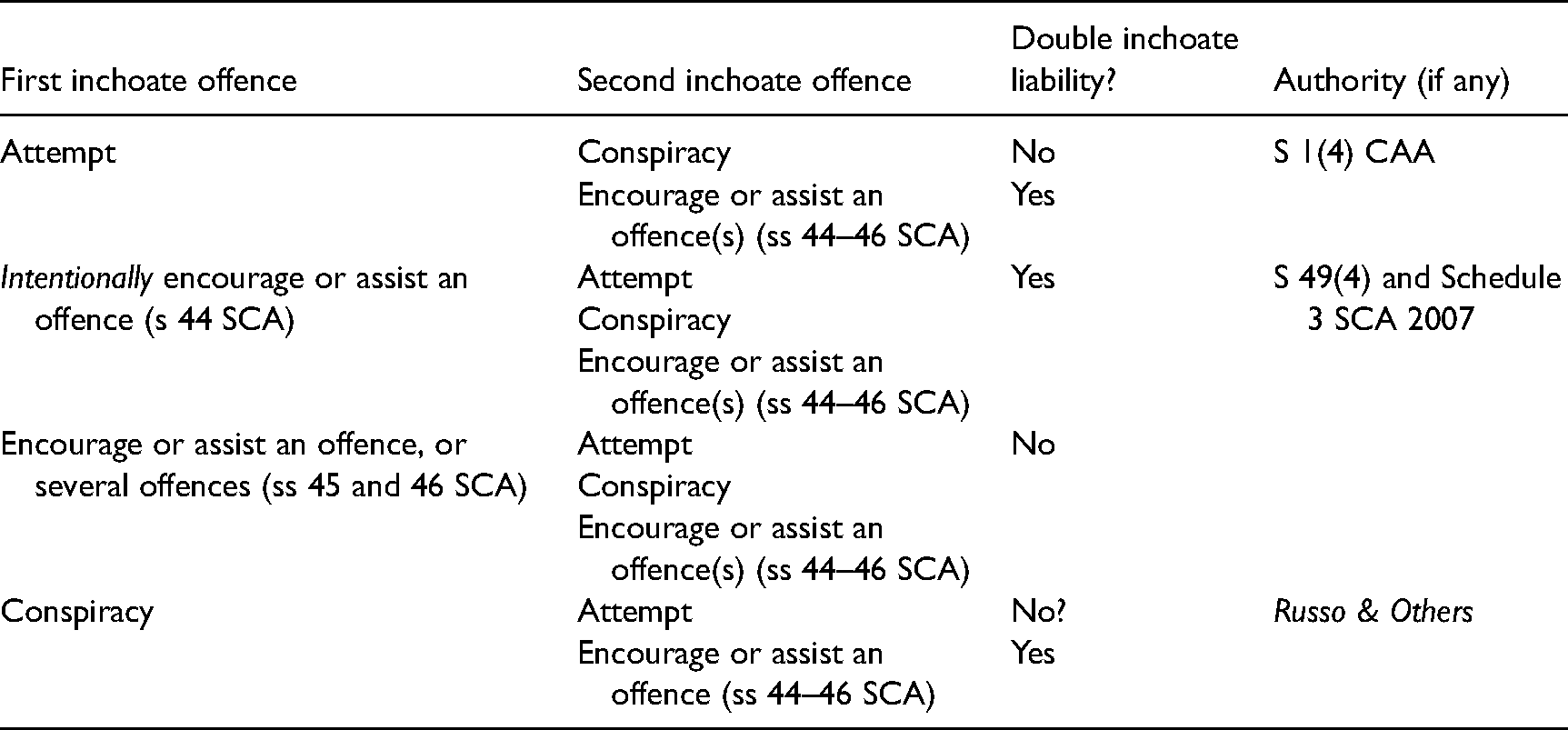
This table summarises the position of ‘double inchoate’ liability under English law. Note: it is necessary to deal with s 44 SCA separately from ss 45 and 46. In Conspiracy and Attempts (Law Com No 318; December 2009) the Law Commission explained that ‘in relation to another inchoate offence, D must intend the act of encouragement or assistance of the offence to take place. Accordingly, in “double inchoate” cases, D must be charged under s 44 of the 2007 Act’ (at [3.4] and [3.5]; emphasis added).
Attempted conspiracy
Section 1(4) CAA contains a list of offences that cannot be attempted. Conspiracy (whether under the CLA or at common law) is on the list (at s 1(4)(a)), so there is no offence of attempted conspiracy. In Conspiracy and Attempts (2009), the Law Commission discussed the pros and cons of recommending a repeal of s 1(4)(a) and concluded that creating a new offence of attempted conspiracy would be ‘undesirable and potentially confusing’ (at [3.21]).
Attempt to encourage or assist an offence
On the other hand, none of the offences in the SCA are mentioned in s 1(4) CAA, which means that it is possible to attempt to commit any of the offences under ss 44–46 SCA. This makes sense. Before the SCA came into force, in October 2008, the concept of ‘attempted incitement’ existed at common law (see e.g. Mann [1996] 2 Cr. App. R. (S.) 28, Goldman [2001] EWCA Crim 1684, Parnell [2004] EWCA Crim 2523 (where attempted incitement was, admittedly, described as ‘somewhat unusual’), Kingsley [2006] EWCA Crim 546).
The concept still exists today in other areas of criminal law, in particular cases under the Sexual Offences Act 2003 (the SOA) involving defendants (usually adult men) encouraging people whom they believe to be children (but are in reality undercover police officers or paedophile hunters) to perform sexual acts on themselves. Convictions for attempted incitement of a child under 13 to engage in sexual activity (under s 8 SOA) and/or attempted incitement of a child to engage in sexual activity (under s 10 SOA) have been obtained in numerous cases (see for example Price [2018] EWCA Crim 1528, Langham [2022] EWCA Crim 62, Forde [2022] EWCA Crim 1743, Palethorpe [2022] EWCA Crim 1858 and Kharutti [2024] EWCA Crim 377).
Meanwhile, the specific offences of encouraging or assisting suicide (under s 2 of the Suicide Act 1961) and encouraging or assisting serious self-harm (under s 184 of the Online Safety Act 2023) are on the excluded offences list (s 1(4)(ba) and (d) CAA, respectively), so there is no liability for attempting either of those offences.
Encouraging or assisting an attempt
It is possible to intentionally encourage or assist an attempt (under s 44 SCA). However, there is no equivalent offence under either ss 45 or 46 SCA. Such liability is explicitly precluded by s 49(4) and Schedule 3 of the SCA.
Encouraging or assisting a conspiracy
It is possible to intentionally encourage or assist a conspiracy (under s 44 SCA). However, there is no comparable offence under either ss 45 or 46 SCA. Again, liability here is explicitly precluded by s 49(4) and Schedule 3 of the SCA.
Encouraging or assisting an act of encouragement or assistance
It is possible to intentionally encourage or assist an act of encouragement or assistance (under s 44 SCA). However, there is no equivalent liability under either ss 45 or 46 SCA. Once more, liability is explicitly precluded by s 49(4) SCA.
Conspiracy to encourage or assist an offence
This is where the present case comes in. Russo & Others decides that there is an offence of conspiracy to encourage or assist one or more offences, under s 46 SCA. It logically follows that the same applies to the offences under ss 44 and 45 SCA.
Conspiracy to attempt
In Russo & Others, William Davis LJ says: ‘The terms of s 1(1) of the 1977 Act made it clear that there could not be a criminal conspiracy to attempt to commit an offence’ (at [13]). He cites Kenning & Others as authority for this proposition. However, this is a misunderstanding of, or at least a misreading of, Kenning & Others. That case says nothing about conspiracy to attempt. In the case, Lord Phillips CJ says that there ‘it is not an offence to attempt to aid, abet, counsel or procure the commission of an offence’ (at [16]) and uses that proposition to justify the holding that there is no offence of conspiracy to aid, abet, counsel or procure an offence either: ‘It would be odd if it was an offence to conspire to aid and abet, although no offence to attempt so to do’ (at [18]).
So, is it an offence to conspire to attempt? Kenning & Others does not decide the point at all, and the proposition in Russo & Others at [13] is obiter at best. As noted above, in Conspiracy and Attempts (2009), the Law Commission discusses attempted conspiracy but say nothing about conspiracy to attempt. It is submitted here that, technically, conspiracy to attempt does exist (despite William Davis LJ’s views to the contrary) but that it is highly unlikely to have any practical application. After all, a conspiracy to try to burgle a house or to try to rob a bank is simply a conspiracy to commit burglary or robbery, respectively.
