




Abstract
Between December 2019 and January 2020, Omar Scott (OS) made and received calls, and sent and received text messages, to and from a mobile phone that was in the possession of David Sika (DS), a prisoner in HMP Bristol. OS was charged with doing an act capable of encouraging or assisting the possession of an unauthorised phone in prison (an offence under s 40D of the Prison Act 1952, as amended), contrary to s 45 of the Serious Crime Act 2007 (the Act). The Crown case was that by making and receiving calls, and by sending and receiving texts, to and from DS's phone, OS was encouraging DS to possess the phone. OS appeared before District Judge Ross Johnson (the DJ) at Stratford Magistrates’ Court in April 2021. He was convicted and appealed, arguing that the DJ had misdirected himself by finding that there was an act ‘capable’ of encouraging the possession of a phone in prison, given that DS already had it before any of the calls or texts were made, sent or received.
Commentary
When the Act was passed, academic reaction to Part 2 (which contains the provisions on encouraging or assisting crime, ss 44–67) was less than enthusiastic. For example, David Ormerod and Rudy Fortson, ‘Serious Crime Act 2007: the Part 2 offences’ [2009] Crim LR 389, described the legislation as ‘complex’, ‘convoluted’, ‘tortuously difficult’ and containing ‘some of the worst criminal provisions to fall from Parliament in recent years …. These are offences of breathtaking scope and complexity. They constitute both an interpretative nightmare and a prosecutor's dream’. Similarly, John Spencer and Graham Virgo described the provisions as ‘complicated and unintelligible … over-detailed, convoluted and unreadable’ (‘Encouraging and assisting crime: legislate in haste, repent at leisure’ (2008) 9 Arch News 7).
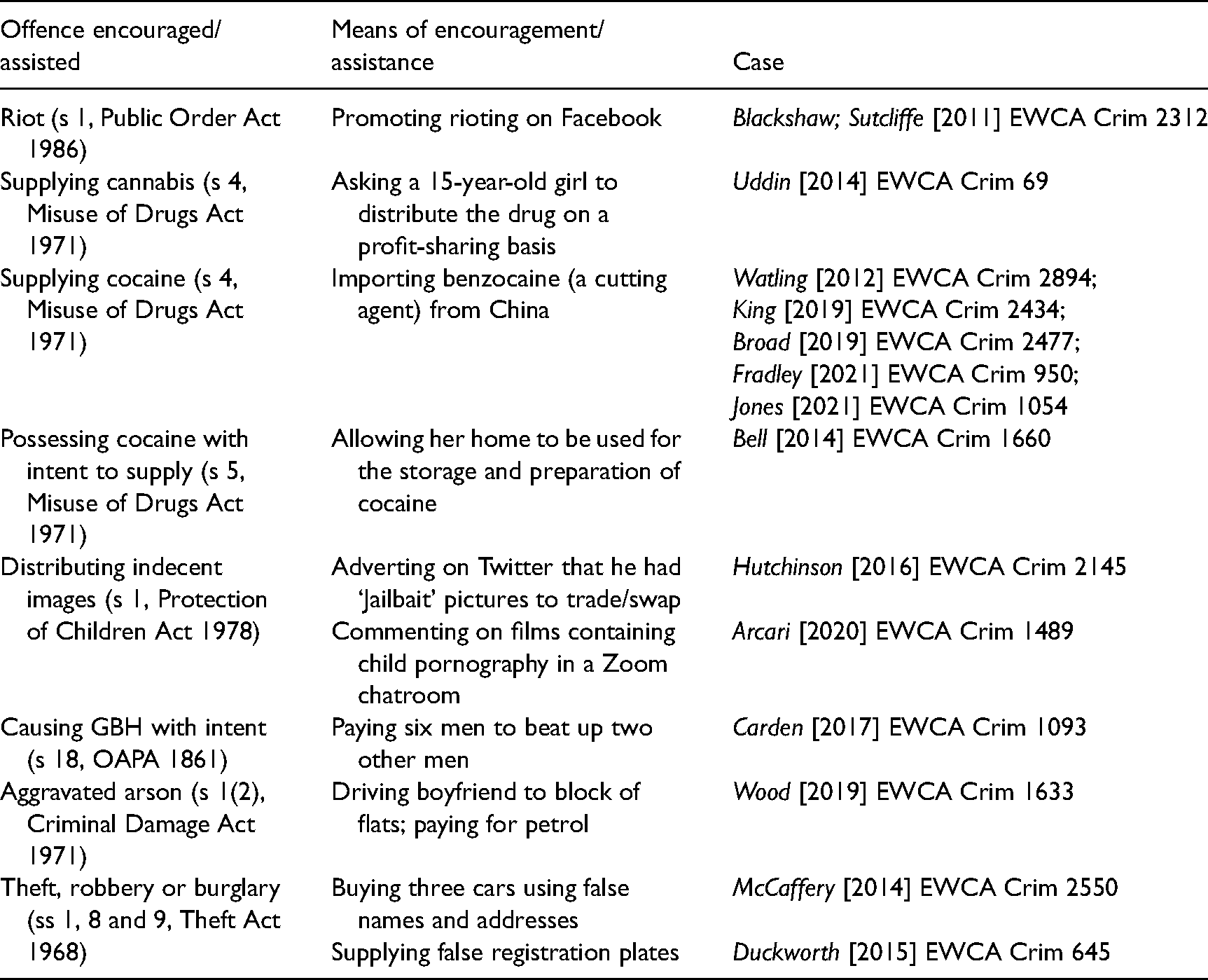
However, in the years that followed, there have been relatively few cases that have reached the appellate courts exploring the interpretation of Part 2 of the Act. Most of the Court of Appeal cases on Part 2 of the Act have been sentencing appeals. What these cases reveal is that the Part 2 offences (ss 44–46) have been used to successfully prosecute defendants for encouraging or assisting a wide range of crimes (this list does not purport to be exhaustive):
Intriguingly, the offence with which OS was convicted, encouraging or assisting the possession of an unauthorised phone in prison, had appeared in another Court of Appeal sentencing case, that of Loonat [2018] EWCA Crim 1835, although no issue was taken with the liability of the accused in that case. The guilty verdicts in both Loonat and the present case were undoubtedly correct, for the reasons given in the present case at [34] and [35].
Indeed, the notion that Part 2 of the Act applies to those who encourage others to continue pre-existing offending also arose in one of the cases listed above, Arcari [2020] EWCA Crim 1489. In that case, the National Crime Agency had identified Richard Arcari (RA) as a participant in a Zoom chatroom that was being used for viewing indecent images of children. RA posted comments saying ‘love YNG/ taboo/canine’ and ‘love vid perving with other pervs’. Almost immediately, others in the chatroom streamed category A videos. Two months later, RA joined another chatroom in which indecent images were again being shared. After another person in the chatroom streamed a video depicting the rape of what appeared to be a two-year-old boy, RA posted a comment saying ‘hot vid’. RA was charged with two counts under s 44 of the Act, that he had intentionally encouraged others to view indecent images of children (Arcari at [18]). It was subsequently acknowledged that no offence of viewing indecent images of children actually exists. The charges should have specified distributing/possessing/ publishing indecent images contrary to s 1 of the Protection of Children Act 1978, but this defect was not material (Arcari at [25] and [26]).
RA pleaded guilty but appealed, albeit only against the sentence. In the Court of Appeal, Simler LJ noted that it was ‘undoubtedly the case that on each of the [two] occasions, [RA] made comments that amounted to encouragement for others to continue sharing the indecent images of children that were being streamed or to share other images’ (Arcari at [28], emphasis added). Furthermore, the fact that the ‘hot vid’ comment ‘was made after an offence of distribution of indecent images had already been committed does not mean that the comment could not have amounted to encouragement to continue distribution or to distribute or share further images’ (Arcari at [29], emphasis added). Finally, the ‘hot vid’ comment ‘was capable of encouraging the sharing of further indecent images, because a positive reception from [RA] could well have encouraged that participant or other participants to stream further material of the same kind’ (Arcari at [29], emphasis added).
All of this goes to show that Part 2 of the Act applies to those who encourage (or assist) others to continue committing crimes, as well as to those who encourage (or assist) others to commence offending. As Farbey J said in the present case, ‘the “commission of an offence” in s 45(a) includes not only the doing of an act but also the continuation of an act by the principal’ (at [37]).