




Abstract
This article examines the new offence of Non-fatal Strangulation s. 75A Serious Crime Act 2015, inserted by s. 70 Domestic Abuse Act 2021 and concludes that further re-drafting should be considered. The creation of a specific crime of non-fatal strangulation is an issue previously considered and legislated for by a number of legal jurisdictions and their experiences are a source that England and Wales should have drawn upon to avoid further legislative reform in this area. This has not happened and s. 75A, prompted by the call to better protect victims of domestic violence and abuse, has been drafted in a manner that will limit its ability to achieve this aim. This is evident by the limited language to describe and define the prohibited conduct and the complexity arising from the inclusion of a defence of consent in some circumstances. Given the potential educative function this offence has, these aspects of the new offence are a significant blow to campaigners seeking improvements to the criminal justice response to domestic violence and abuse. This article outlines the relevance of non-fatal strangulation (NFS) to the social problem of domestic violence and abuse and makes the argument that a new specific offence is justified. It then explores from selected legal jurisdictions examples of non-fatal strangulation (NFS) offences to draw out elements that have either assisted or hindered the prosecution of these cases. This comparative approach provides the basis for analysis of the s. 75A offence to determine what challenges it will present to the prosecutorial authorities.
Keywords
Edwards argued in 2015 that the dangerousness of strangulation is not recognised by the courts in England and Wales and debates that consider legal reform in relation to this method of harm are long overdue. 1 Progress has now been forthcoming with the introduction of s. 75A Serious Crime Act 2015 following the enactment of s. 70 Domestic Abuse Act 2021. 2 The creation of a specific crime of non-fatal strangulation (NFS) is an issue previously considered and legislated for in a number of legal jurisdictions and it is a welcome move that England and Wales have sought to follow suit. Disappointingly, the experiences of these jurisdictions and their drafting of NFS offences appear to have been overlooked. S. 75A, prompted by the call to better protect victims of domestic violence and abuse, has been drafted in a manner that will limit its ability to achieve this aim. 3 This is evident by the limited language to describe and define the prohibited conduct and the complexity arising from the inclusion of a defence of consent in some circumstances. Given the potential educative function this offence has, these aspects of the new offence are a significant blow to campaigners seeking improvements to the criminal justice response to domestic violence and abuse. This article will outline the relevance of NFS to the social problem of domestic violence and abuse and make the argument that a new specific offence is justified. It will then explore from selected legal jurisdictions examples of NFS offences to draw out elements that have either assisted or hindered the prosecution of these cases. This comparative approach provides the basis for analysis of the s. 75A offence to determine what challenges it will present to the prosecutorial authorities.
The Problem of NFS in Cases of Domestic Violence and Abuse
Strangulation, asphyxiation, choking and suffocation are terms associated with NFS. Strangulation and asphyxiation are not synonymous as Busby clarifies. 4 Strangulation is the most dangerous activity and occurs when external pressure is applied to the trachea or carotid artery with either hands or ties. This impedes the blood and oxygen flow to the brain. 5 Asphyxiation involves the suffocation of the victim by blocking the mouth and nose with a hand or item such as a pillow or plastic bag. In this way oxygen intake to the brain is impeded, however, blood is allowed to flow to the brain. 6 Choking in the form of a chokehold occurs where a person uses part of their body such as a knee or arm to restrict the neck, resulting in the same effect as strangulation. Choking also refers to the placing of a physical obstruction in the throat. Oxygen intake is impeded, although blood continues to flow to the brain. 7 Each method of NFS can be lethal with strangulation leading to death in an alarmingly short time compared to asphyxiation. Distinguishing between these terms is important as they are different experientially. That NFS disproportionately harms women is illustrated by homicide figures and Yardley has calculated that women make up nearly three-quarters of all homicide victims killed by these methods. 8 Whilst NFS is a gendered crime, the Domestic Abuse Act 2021 itself is gender-neutral, an approach inconsistent with the Council of Europe Convention on preventing and combatting violence against women and domestic violence (Istanbul Convention). 9 NFS is used as a method of abuse by male perpetrators on their female partners and when it is used, NFS is a factor indicating a high risk of further domestic violence and abuse. 10 Glass et al found that a victim has an increased chance of experiencing another life threatening attack by the abuser after being strangled and of being killed by the abuser. 11
Understanding domestic violence and abuse through a coercive control lens helps to explain the use of NFS in abusive relationships. Controlling and coercive behaviour in an intimate relationship or by a family member is a criminal offence under s. 76 Serious Crime Act 2015. The offence sought to align criminal law with evolved policy understandings of domestic violence and abuse. 12 Stark is credited with reconceptualising domestic violence and abuse as coercive control, 13 where the abuser uses an ‘ongoing strategy of intimidation, isolation and control’ to secure the victim's compliance with their demands. 14 The strategy is successful because resistance is met with a credible threat or actual punishment. In many instances the threat will involve physical harm, although bespoke threats and punishments are adopted. 15 It is the credibility of the threats that allows the abuser to gain control resulting in the construction of a cage of domination. 16 As such, ‘coercive control can be useful to situate NFS, providing a broader account of the meaning and implication of the offence.’ 17 Thomas et al's study found that strangulation could occur on only one occasion to immobilise and terrorise a partner successfully setting the stage for other coercive and controlling behaviour by sending a credible threat that they could be killed if they fail to comply with the abuser's demands. 18 The researchers discovered that it was nearly impossible for their participants to discuss their experiences of NFS without talking about threats to kill or of further violence and their experience of coercive control. 19 Stansfield and Williams's study examined perpetrators of domestic violence through risk assessments undertaken by Family Relations Counsellors and case files held by the Court Support Services Division in Connecticut. They focused on heterosexual couples, which highlighted that males were significantly more likely to engage in NFS and threaten their partner's lives compared to their female counterparts. 20 Their study showed an empirical link between death threats and ‘subsequent escalation into NFS as a way of maintaining control through fear and intimidation’ in intimate relationships leading them to conclude that NFS is an extreme form of controlling behaviour. 21
The women's experiences in Thomas et al's study illustrate how NFS is used to facilitate coercive control. They found that there were several situations that triggered an NFS incident: sexual jealousy and accusations of infidelity; victims’ failure to comply with their partners’ demands; 22 a response to victims’ attempts to end the relationship; it came out of nowhere. As a consequence of the NFS incident women reported feelings of immediate and lasting fear, a sense of vulnerability and a change in their behaviour to avoid further violence. ‘Few abusive behaviours are so clearly linked to the possibility of dying’ and making NFS an effective tool to exert coercive control. 23
Despite the fact that NFS is an act of domination over the victim this aggravating feature is not properly acknowledged by the criminal justice system. In part this is because NFS causes harms that are not readily accommodated by the criminal law. In Edwards’ view the criminal law in England and Wales ‘contrives to treat male body force in strangulations as less heinous than other forms of body force and weapons and non-fatal assaults against women.’ 24 NFS is often minimised by undercharging where offences are pursued by the prosecution under the current legal framework. The Centre for Women's Justice found that common assault is frequently charged in cases of NFS and domestic violence and abuse despite CPS Guidance for prosecutors on offences against the person. 25 The Guidance states that decisions to charge a s. 47 Offences Against the Persons Act 1861 (OAPA 1861) offence of assault occasioning actual bodily harm 26 should not be judged solely by injuries sustained but also where ‘the circumstances in which the assault took place may be more serious (e.g. by strangulation or repeated or prolonged ducking in a bath, particularly where it results in momentary unconsciousness.)’ 27 Therefore, the visibility or invisibility of injuries incurred should not prevent a s. 47 charge being brought in an NFS case, although frontline support workers find that police officers do focus on physical injuries. 28 S. 21 OAPA 1861 incorporates the specificity of NFS. It provides that a person will be guilty of an offence where they strangle another in order to commit an indictable offence. If found guilty the defendant could face a maximum penalty of life imprisonment, demonstrating that this is a serious offence. However, Edwards has noted that it is rarely charged. 29 S. 21 is obviously limited in its application as the prohibited conduct must be executed with the intention to commit an indictable offence. In a coercive control informed legal system this would mean that the introduction of s. 76 Serious Crime Act 2015 (SCA 215) could have seen charges brought under s. 21 OAPA 1861. However, no prosecution of this kind has happened as far as the author can discern. Whilst there may be few visible injuries NFS is harmful and the next section considers the literature on this issue.
The Harm of NFS
As a method used to exert power and control over a victim, harm associated with coercive control applies where NFS occurs in a domestic setting. Such harm undermines a person's autonomy and liberty of the person with the psychological effects of trauma leaving them with feelings of helplessness and terror. 30 The psychological strains can have physical manifestations in the form of headaches and digestive disorders. 31 Given that NFS ensures that the victim is aware that she could be killed, feelings of helplessness and terror are amplified. 32 Research has also discovered several other injuries associated with NFS which are currently invisible in the criminal justice system. Examining the literature on NFS Douglas and Fitzgerald found that NFS caused a wide range of harms to the victim. 33 For example, miscarriage, 34 long-term vocal change, 35 memory loss, vision changes, post-traumatic stress disorder have all been caused by strangulation. 36 Some injuries occurred after days or weeks following the incident and included death from brain damage caused by a lack of oxygen during the strangulation, 37 and a life-threatening condition called ‘thyroid storm.’ 38 From this list it is evident that the harm associated with NFS involves both physical and psychological elements. 39 Whilst both physical and psychological injuries can happen, they may not necessarily leave visible marks making it difficult to prove the harm required for an existing offence against the person. Douglas and Fitzgerald found that women who had experienced NFS as part of intimate partner violence believed that their victimisation was not identified by police unless there were visible marks. 40 Women also did not connect the conduct with their less visible injuries such as memory loss, post-concussive syndrome or miscarrying a pregnancy. 41 Strack et al. found that there were no visible injuries in half the cases in their study of 300 strangulation victims and where there were injuries only 15 per cent appeared in a photograph. 42 Some women in Douglas and Fitzgerald's study believed the perpetrator had purposely avoided leaving marks on them as a deliberate tactic. 43
As a crime that disproportionately effects women and is carried out predominantly by men on women, it seems apparent that the use of NFS inherently gives rise to a sense of danger and threat to life on account of the different levels of physical strength between the victim and the defendant. 44 A person overpowered by another who is stopping their breathing and has no means of effectively defending themselves with their own strength will genuinely fear for their lives. 45 A person of equal or greater strength will not feel overpowered, will not sense the fragility of their life should a person seek to strangle them. This unwillingness to accept the vulnerability of women as a consequence of male violence and power by the criminal law communicates to women that their experiences do not matter. It makes the criminal laws and the system they operate within complicit in the abuse of women by men. A punch in the face does not automatically make the victim sense that they could die at the hands of the attacker and yet a punch has been readily criminalised, whilst little has been done to deter the practice of NFS, particularly in a domestic violence and abuse setting.
Justifying a Bespoke NFS Offence in England and Wales
It could be argued that a better understanding of the damage NFS can do to a person, particularly where it is used in an abusive relationship could in itself be sufficient to address the failure of the criminal law to protect victims of domestic violence and abuse. However, there are compelling reasons to reject this stance. Douglas has highlighted how the introduction of an NFS offence in Queensland, Australia has provided support to victims of domestic violence and abuse experiencing NFS. 46 It has enabled prosecutions to be brought, where previously serious offences were not in reality available because of issues of proof, much as in England and Wales. Existing offences lack the appropriate label to reflect the severity of the offending and the damage it causes particularly to a victim of domestic violence and abuse, where it is used as a tool to facilitate coercive control. In the cases of domestic violence and abuse the importance of recording NFS accurately is particularly acute, because an incident of NFS presents a high risk of future harm. 47 If a perpetrator's record of offending does not note this specific act, that risk of future harm is hidden to the domestic violence and abuse services providing support to the victims, or seeking to address perpetrator's behaviours via domestic abuse programmes. 48 It is also hidden from judges when making future sentencing decisions and probation boards who have to consider risk factors. Recognising the part NFS plays in a pattern of controlling behaviour, Lord Bishop of London was persuaded that a specific offence would ‘highlight how serial perpetrators of domestic abuse and coercive control should have an official history that reflects their potential risk to others.’ 49
Providing a stand-alone offence presents police, practitioners and victims with a tool to help them to identify the dangers of NFS and enables wider society to be educated about the connections between domestic violence and abuse and NFS. New knowledge of NFS can inform training and this can be incorporated into training manuals and risk-assessment tools. This is welcomed by policing authorities with the Police Superintendents’ Association supporting the introduction of a bespoke NFS offence that will provide the opportunity to have ‘better police training and information.’ 50 The specificity of an NFS offence could also encourage health professionals to look for indications of strangulation in domestic violence and abuse cases where there are no visible injuries. Douglas and Fitzgerald discovered that not all female victims of abuse reported their experiences of NFS under medical examination and without training health workers were unable to record instances of it ‘meaning there is no corroborating evidence of injury.’ 51 It is contended that the educative function that a bespoke NFS offence could have would enable first responders to identify the signs of injury and to respond to it appropriately. Finally, new legislation in this area would be following in the footsteps of other countries such as the United States, Australia and New Zealand where specific offences addressing NFS have enjoyed a degree of success. International endorsement for introducing a specific offence of non-fatal strangulation has been given by UN Women, who recognise that frequently victims of domestic violence and abuse experience it and it can lead to fatal consequences. 52 In developing an NFS offence in England and Wales, analysing the debates and approaches taken in other jurisdictions can assist in its formulation, determining what aspects adopted would operate most successfully. The next section will provide a comparative analysis of a selection of NFS offences in Australia and New Zealand, which will provide the backdrop to an evaluation of the proposed s.75A Serious Crime Act 2015.
A Comparative Assessment of Selected NFS Offences
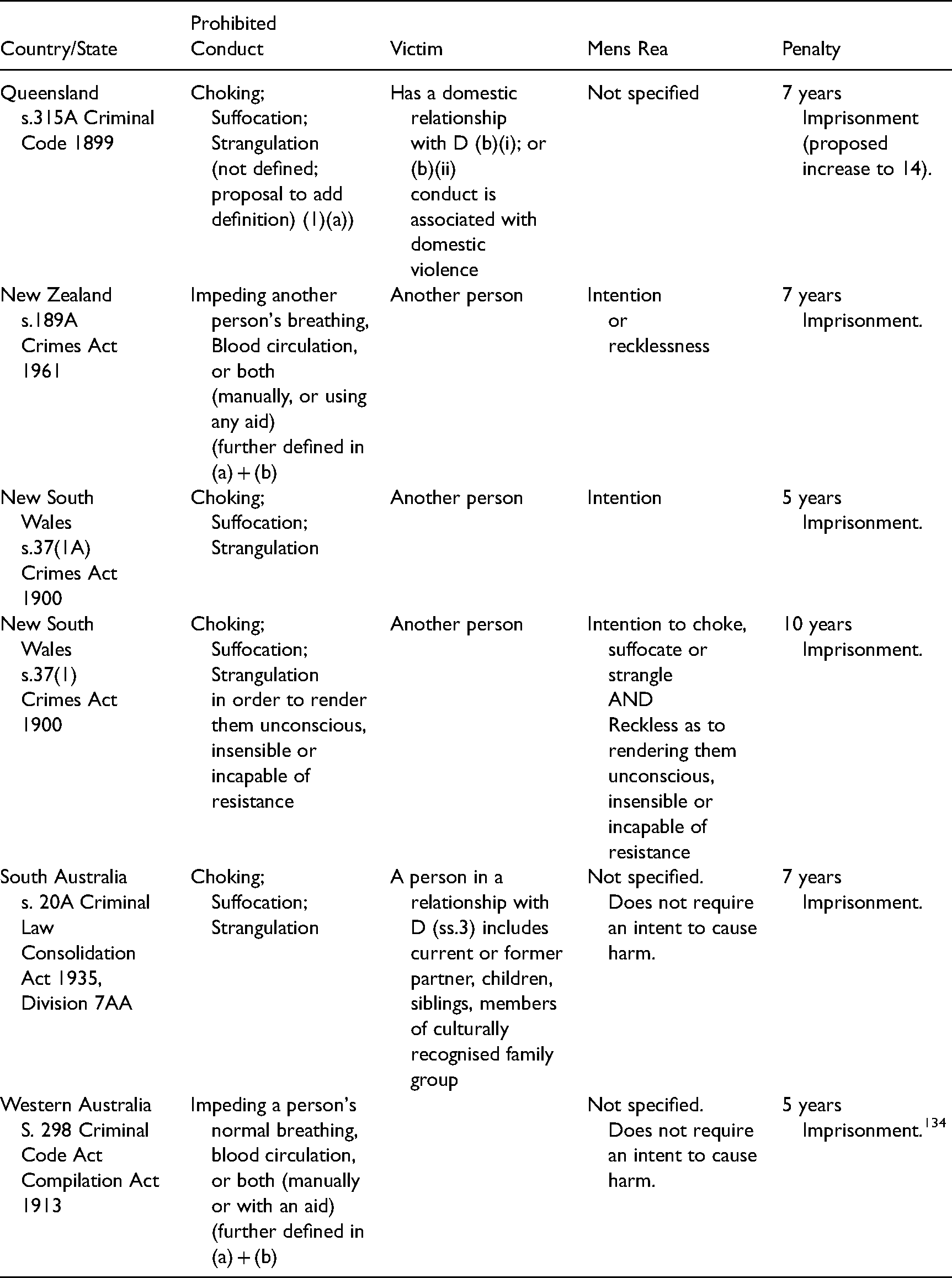
Several jurisdictions have developed a specific NFS criminal offence, for example in Australia 53 and New Zealand. This analysis seeks to identify a selection of these offences which provide variations in approaches and broadly reflect those in remaining jurisdictions. They touch upon concerns raised by the Westminster Government such as whether to apply to the limited setting of a domestic relationship and whether to include consent as a defence or consider exemptions where the conduct could be deemed lawful. 54 Table 1 offers an insight into appropriate penalties to apply upon conviction for an NFS offence. Comparing these offences provides the opportunity to explore what could work best in England and Wales and ensures that the criminal law contributes to the broader goal of protecting victims from domestic violence and abuse. 55 Table 1 breaks down the key components of a number of selected offences and their penalties.
Comparison of Non-Fatal Strangulation Offences (A limited selection)
Background
Recognition of the link between domestic violence/abuse and NFS, along with the inadequacies of the offences against the person framework prompted other jurisdictions to engage in a debate about how to criminalise this conduct more effectively. Several states had a provision similar to s. 21 OAPA 1861 prohibiting strangulation where it was used with the intention of committing a crime or allowing another to commit a crime. 56 As in England and Wales concerns arose that these offences were underused. 57 Queensland introduced an NFS offence on 5th May 2016 under s.315A Criminal Code 1899. 58 A Parliamentary report noted that the existing strangulation offence, which was based along the same lines as s. 21 OAPA 1861, had barely been used and opportunities to identify the conduct and calculate the risk of harm to victims of domestic violence and abuse were being missed. 59 The new legislation has achieved some degree of success with 592 offenders appearing before the Magistrates’ court for this offence in 2019–2020 and 258 penalties imposed. 60 New South Wales introduced a further NFS offence on 5th June 2014 61 following an earlier reform under s. 37(1) Crimes Act 1900 to create a specific NFS offence. The Domestic Violence Death Review Team had found s. 37(1) was failing as police officers continued to use common assault and actual bodily harm offences. This meant that strangulation remained unflagged and the seriousness of the conduct remained underestimated. 62 A review of the operation of s.37(1) found that its complexity made prosecution difficult with 53.5% of finalised charges before the court not resulting in conviction between June 2014 and March 2018. 63 Consequently, s.37(1A) 64 came into force on 22 November 2018 and did not require the prohibited conduct to be for any specified purpose. Within its first 12 months of operation 899 charges were brought, which is close to one and half times as many as had been prosecuted under section 37(1) and (2) for the previous four years. 65
More recently, both Western and South Australia have developed their own specific offences to address NFS. Persuaded by the same arguments raised in other jurisdictions, Western Australia added an NFS offence into its Criminal Code coming into force on 1st October 2020. 66 Within its first month and a half of operation 77 people were charged. 67 In South Australia January 2019, s. 20A Criminal Law Consolidation Act 1935 entered into force taking a narrower approach than Western Australia by limiting its use to domestic settings. 68
New Zealand was prompted to pursue the route of a specific offence following a finding that the connection between the use of strangulation in domestic abuse settings and its high risk of fatality were too significant to overlook. 69 In a review of family violence deaths, half of the cases had a history of strangulation, with multiple strangulations ranging from two to nine in number. 70 In addition, 7 of the 12 regional reviews reported that the perpetrator had a previous history of using strangulation against previous partners. 71 The Family Violence Death Review Committee considered that although it had ‘found multiple instances of non-fatal strangulation of both partners and children in the regional reviews’ these were often downplayed by police officers and if they did proceed to prosecution, as in other jurisdictions, the offences charged did not reflect the seriousness of the harm involved. 72 NFS in an abusive relationship in the Committee's view has more in common with sexual assaults than physical offences. As are sexual crimes, NFS is gendered in its disproportionate effect on women, it tends to take place in private, may leave no visible injuries, can be motivated by the desire to assert dominance and often has a profound psychological impact on her ‘because of the experience of terror, violation and extreme vulnerability that is imposed upon her.’ 73
In line with arguments supporting the introduction of a bespoke NFS offence in England and Wales, the debates in each jurisdiction determined that new criminal legislation was necessary. Reasons included the improvement of information-sharing about predictive domestic violence/abuse for risk-assessment decisions, 74 increased penalties to reflect the seriousness of the offending, 75 to reflect fair labelling and remove evidential barriers that inhibit prosecutions. 76
Defining the Prohibited Conduct
Having provided some background to the debates that led to legislative reform in the selected jurisdictions, this section will explore the offences in detail. The first element of an NFS offence is to articulate what activity is prohibited by the offence. Different definitions have been adopted in the selected offences for this comparison and analysis will highlight what could be the better option for England and Wales. As explained above, NFS is a term that covers a variety of conduct such as strangulation, asphyxiation and choking. These may be achieved manually, with an object or an alternative body part like a knee pressed down onto the neck. Determining how to ensure that these different methods are prohibited and whether this should be the case in all or certain circumstances requires some exploration. Table 2 clarifies the definitions adopted in the selected offences.
Comparison of legal terms for the prohibited conduct in selected non-fatal strangulation offences
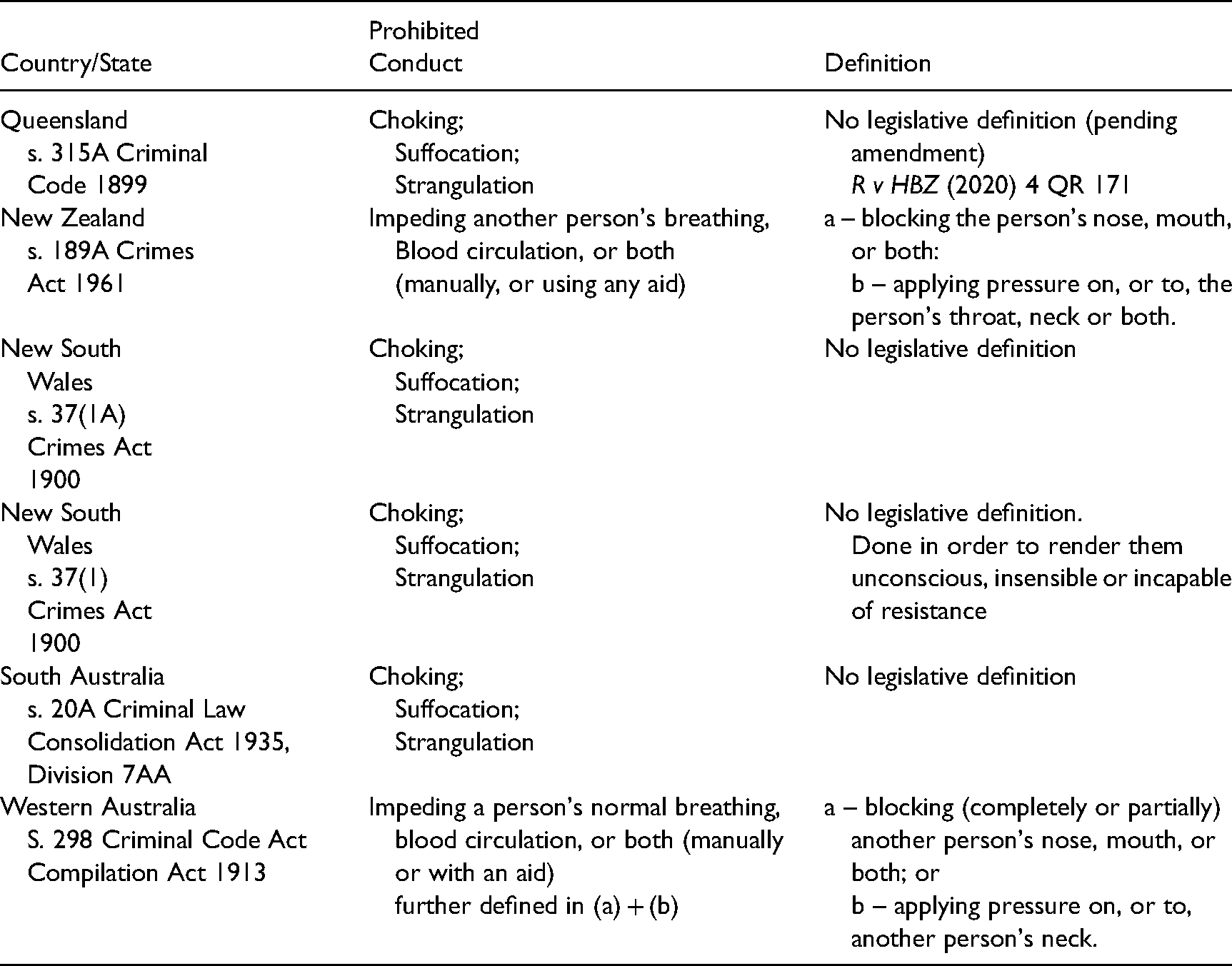
Table 2 shows that the most common language represented in this selection to describe the prohibited conduct for NFS offences is ‘choking, suffocation and strangulation.’ However, jurisdictions using these terms (Queensland, New South Wales and South Australia) do not provide a legislative definition. This gap has led to further legislative proposals in Queensland where there has been judicial consideration of the term choking. 77 In R v HBZ (2020) 4 QR 171 the appellant appealed against his conviction for choking his girlfriend on the basis that the judge had erred in their direction to the jury about the meaning of ‘choking’ for the purposes of s. 315A Criminal Code 1899. The judge had stated that choking bore its ordinary meaning ‘to stop or hinder the breathing of a person.’ 78 The appellant argued for a narrower interpretation implying that choking needed to stop a person's breathing completely by the application of internal pressure. It was also claimed that the words in the legislation should be distinguishable rather than interchangeable from each other. 79 The incident occurred when the appellant had wanted to prevent the complainant from speaking on the phone to the emergency services. According to the complainant's testimony,
He grabbed me, and he grabbed the phone, and then he put his hands around my neck—his right hand, and then he pushed on my shoulder at the same time to knock me onto the bed, and then he pinned me to the bed with his hand to stop me from speaking. So when I first started speaking, I could ask for help, but then the words wouldn't come out, and I struggled to breathe.
80
His hand was described as forming a “V” around her throat and ‘instead of squeezing, he just was on top of me and used his body weight as the force to stop me from speaking.’ He was successful in that she was not able to speak, however, she also experienced pains in her chest, had black spots to her vision, could not breathe for around 70 seconds and visible marks on her neck that were photographed. 81
The Court of Appeal approved the trial judge's direction to the jury having regard to the purpose of the offence and a Special Taskforce Report that used the terms choking and strangulation interchangeably. 82 The legislation was ‘not to be construed in a technical sense that may be familiar to medically qualified persons.’ 83 Choking for the purposes of s.315A included hindering or restricting the breathing of the victim. The act of choking may be for a ‘short duration, without any lasting injury and does not result in a complete stoppage of the breath of the victim.’ 84 There must however, be evidence that some pressure was employed to restrict the victim's breathing and not just merely placing hands on their neck. 85 Therefore, the decision means that whilst there is no requirement that the victim is harmed, evidence of injuries will support the prosecution's case that the prohibited conduct took place. A further legislative amendment is being sought to remove any ambiguity with the terms used in s. 315A and its effect would be to distinguish between each of the terms, contrary to the Court of Appeal's stance. 86 Statutory clarification of the prohibited conduct is a lesson that can be taken from the Queensland experience to avoid further legislative reform.
In New South Wales offences under s. 37(1) and s. 37(2) Crimes Act 1900 refer to choking, suffocation and strangulation ‘in order to render a person unconscious, insensible or incapable of resistance.’ 87 This narrow construction of the prohibited conduct requires evidence about its’ purpose and proved difficult to prosecute. 88 A Parliamentary review found that less than half the defendants charged and prosecuted under s 37 between 2014 and 2018 resulted in convictions. 89 The requirement that the conduct must be for the reckless purpose of rendering a person unconscious, insensible or incapable of resistance was considered to be a significant impediment to successful prosecutions. Consequently, a simpler offence, s. 37(1A), was introduced in December 2018 prohibiting choking, suffocation or strangulation, carrying a maximum sentence of 5 years imprisonment. Potentially the s. 37(1A) offence is too wide as the conduct is not defined in the statute and includes almost any act of a person putting their hands or arms around the neck, or the hand on the mouth of another person. To avoid such claims statutory clarity to describe the prohibited conduct would be appropriate. The experiences of New South Wales and Queensland indicate that continued legislative reform may be required if the prohibited harm is not carefully articulated when drafting an NFS offence. Legislative definitions create clarity and certainty in the law, in an area where for too long there has been insufficient knowledge and understanding about NFS and its dangerousness. New South Wales and Queensland therefore provide a useful lesson to drafters in England and Wales that vague terms will hinder the success of reform.
An offence that contains clear terms defining different forms of NFS has an educative function. Stating what happens when certain techniques are used explains to the criminal justice system and the wider public exactly what the dangers are. New Zealand and Western Australia's offences provide good examples of this. Rather than using terms like strangling and choking in the construction of the offence, s. 189A Crimes Act 1961 (NZ) and s.298 Crime Code Act Compilation Act 1913 (WA) define NFS as the practice of impeding a person's breathing or blood circulation by either blocking the person's nose, mouth, or both or applying pressure on, or to, the person's throat, neck or both. This indicates that the danger to the victim lies not only by preventing them from breathing but also in preventing the blood circulating properly around the body. Further detail is also provided in the legislation which specifies that the impediment to breathing or blood circulation can either be by hand or with an object, covering the many ways strangulation and asphyxiation are caused. The concern that overly detailed offences can be difficult to prove does not seem to have transpired judging by the New Zealand experience with the number of arrests made in the first few weeks averaging at 5 a day. 90 S. 298 of Western Australia's Criminal Code replicates New Zealand's drafting, although adds that the blocking of a person's nose or mouth can be complete or partial, which can assist courts further when dealing with these cases. The definition chosen by Western Australia was preferred to other versions used in other Australian states as it clarified that the offence does not require the complete stoppage of breathing. 91 Providing this level of detail can ensure that emphasis is placed on recognising the dangerous activity and the examples of successful NFS offences have not added a causal element requiring the conduct to cause a specified level of injury. Therefore, the issue of invisible injuries does not hamper prosecution as is the case with existing offences against the person. Given that courts tend to focus on physical injuries, a bespoke offence of NFS would benefit from the addition of the phrase ‘regardless of whether that conduct results in any visible injury’ to ensure that evidencing an injury does not remain a barrier to prosecution. 92
Should the Context of an NFS Offence be Limited to Domestic Relationships?
The connection between NFS and domestic violence and abuse is striking and consequently there is a strong argument that a bespoke offence should reflect this. Such an offence would have the benefit of enabling accurate recording of its use in abusive relationships, ensuring that it is flagged in case reports and assisting in risk assessments undertaken by relevant agencies when making decisions to protect the victim in the future. On the other hand, NFS is dangerous in any context and limiting a bespoke offence to a domestic violence and abuse setting could illogically exclude other scenarios such as dating relationships. 93 Baroness Newlove proposed two amendments, one that covered all strangulations and an alternative that would apply only where the victim and perpetrator were personally connected. 94 Consideration of the approaches taken in the selected states chosen for this comparison will cast light on whether England and Wales are correct to extend NFS as an offence regardless of context.
South Australia focuses its NFS offence within the domestic setting. 95 A domestic setting is defined extensively and includes people who are in some form of intimate personal relationship in which their lives are interrelated. 96 This is similar to s. 2(1)(e) Domestic Abuse Act 2021 (DAA 2021) which states that parties are personally connected where ‘they are, or have been, in an intimate personal relationship with each other.’ It seems unlikely that ‘an intimate personal relationship’ would be construed as including dating relationships, especially where they have very little duration and have no interrelated connection. On the other hand, s. 2(1)(e) DAA 2021 is more expansive than its South Australian counterpart as it does include relationships that have ended. Queensland opted to focus its NFS offence on family violence making the connection to this context in both the title of the offence ‘choking, suffocation or strangulation in a domestic setting’ and as an essential element of the actus reus of the offence. 97 The domestic setting is established by the victim and perpetrator being in a domestic relationship or that the conduct is ‘associated domestic violence.’ 98 Associated domestic violence refers to behaviour that amounts to domestic violence and abuse and is directed towards a child in the household or a relative or associate of the victim. The domestic setting does not create a geographical limitation therefore includes strangulations that occur in a public place. 99 Dating relationships are not expressly covered by this legislation and the Parliamentary Committee took the view that establishing the existence of a domestic relationship would not create evidential difficulties. The decision to retain the restriction to the domestic setting seems to be based on the belief that ‘this element of the offence cements the domestic context’ 100 and it avoids capturing ‘a range of conduct such as law enforcement, security and sport.’ 101 Proposed 2020 amendments to s. 315A do not make reference to changing this position. 102
Emphasising the connection between domestic violence and abuse and NFS is certainly an admirable goal, but adding it as a key actus reus component is problematic and not universal. New Zealand's s. 189A Crimes Act 1961 for example, does not seek to provide any restrictions on the circumstances the NFS occurs as does s. 298 Criminal Code Act Compilation Act 1913 in Western Australia. Every choke, strangle, suffocation, asphyxiation is dangerous and wrong in every context. The Attorney-General in Western Australia explained the decision to provide a broad offence, despite understanding the connection between domestic violence and abuse and NFS:
Although the act of strangulation or suffocation represents a particular risk in circumstances of family violence, the general application of the offence recognises that the act of strangulation of suffocation can cause serious adverse health outcomes for a victim, regardless of whether they are in a family relationship with the offender. 103
The existence of a specific NFS offence is in itself enough to add identification and recording in domestic violence and abuse cases. Where there are public policy reasons to exclude certain situations, new legislation could use the opportunity to list these as public policy exemptions, providing certainty in the law.
Possible Public Policy Exemptions
The Parliamentary Committee in Queensland preferred to restrict an NFS offence to a domestic setting on the basis that it would otherwise apply in circumstances where it may be in the public interest to allow it. Envisaged was the way breathing or blood circulation can be restricted for the purposes of sport and law enforcement. Another area where restraining a person arises is in the context of medical restraint. Should there be compelling reasons to permit NFS in certain circumstances, it is submitted that new legislation should provide the statutory clarity needed to confirm a public exemption. However, in the current climate the only context such an exemption should apply would be in relation to sports, as its use in law enforcement is internationally contentious following the murder of George Floyd by the police officer Derek Chauvin in Minneapolis, 25th May 2020 who kept his knee on Floyd's neck (a chokehold) for nine minutes and twenty-nine seconds. 104 Police officers use of chokeholds are a class C felony in New York as an aggravated strangulation offence. 105 Law enforcement personnel should be trained to use less dangerous practices to restrain individuals, protecting the restrained person's life and the officer from criminal sanctions. Medical practitioners may have to use physical restraints where a patient is a danger to themselves or others however, the use of NFS is not permitted. Restraining a patient in a medical setting is governed by the Mental Health Act Code of Practice for treating a patient with mental health issues and the Mental Capacity Act 2005 and its Code of Practice, chapter 5. 106 A National Institute for Health and Care Excellence guide clearly provides that conduct amounting to NFS discussed in this article is not permitted. It states: ‘Do not use manual restraint in a way that interferes with the service user's airway, breathing of circulation, for example by applying pressure to the rib cage, neck or abdomen, or obstructing the mouth or nose.’ 107
Combat sports, however, differ significantly from the domestic setting and that of an employee of a statutory agency restraining a dangerous person. Boxing competitors have been granted judicial exemption from liability for non-fatal offences on the basis that the defence of consent can operate where the victim is subjected to bodily harm, following obiter dicta comments in the leading House of Lords case of R v Brown. 108 Specific reference was made to boxing in Brown by Lord Mustill who noted that ‘sparring’ justified different legal treatment because it involved ‘the lesser risk of injury, the absence of the public disorder, the improvement of the health and skills of the participants, and the consequent benefit to the public at large.’ 109 From his perspective, it is impossible to provide an intellectually sound reason to permit consent as a defence to boxing and the sport's apparent immunity derives from society's choice to tolerate it. Weinberg has suggested that the laws governing consent and non-fatal offences in respect of sports like Mixed Martial Arts (MMA) and other activities like BDSM require a more nuanced approach than criminal law frameworks currently offer. 110 Certainly, the law relating to consent to non-fatal offences in sports has attracted much debate with the current position articulated in R v Barnes. 111 However, exemption from the NFS offence has no bearing on the broader issue of how consent operates in relation to general non-fatal offences and sport. An exemption to the offence of NFS would prevent liability for a combat sports player from the bespoke offence of NFS. Should a sportsperson become injured by a chokehold during a sports match, the prosecution could consider bringing charges under the general non-fatal offences’ framework taking into account the current judicial position in R v Barnes. Including an exemption to all combat sports, where forms of NFS are within the rules seems sensible. 112 Whilst the dangers of a chokehold remain for the sportsperson, the difference is the environment in which the conduct occurs. There is a referee that can intervene and a sport's governing body to provide guidance on the rules and address disciplinary matters. These appear to be sufficient protections for sports players and a wider review of the role of criminal law in combat sports would be needed to warrant treating the use of chokeholds differently to other forms of combat permitted within the rules of that sport.
Consent as a Defence
The issue of consent arises beyond a discussion of public exemption categories, as in some jurisdictions it has been made a statutory defence to NFS offences. Whether consent should be a factor in the development of an NFS in England and Wales was raised by the government during the House of Lords debates on the Domestic Abuse Bill. 113 Consequently, the NFS offence under s.75A Serious Crime Act 2015 114 does provide a defence where the complainant consented to the prohibited conduct. 115 S. 315A Criminal Code 1899 in Queensland expressly states that the choking, suffocation or strangulation must occur ‘without the other person's consent.’ The defence was added as the Parliamentary Committee was persuaded by the Bar Association of Queensland's view that as consent applies to sexual assault crimes and offences against the person an NFS offence should apply in the same way. 116 The defence ought to be limited in its application, it was contended, because where significant violence is used consent would be difficult to prove. However, valid concerns were expressed about its inclusion by the Women's Legal Service arguing that as with sexual assault and rape, including consent as a component of the offence ‘will give rise to extended legal arguments to the detriment of victims.’ 117 They make their argument in strong terms,
The inclusion of [consent]… will provide a very effective defence to this proposed offence as many women will be mute or frozen at the time that the assault occurs or the strangulation occurs… We actually believe that to include it will pretty well nullify the effectiveness of the offence.
118
Conversely, in Western Australia, the defence of consent was purposely excluded from the terms of the offence on the basis that its inclusion would require victims to give trial evidence on the matter even where the offence was witnessed. 119 New South Wales does include a consent defence as a component of s. 31(1A) Crimes Act 1900. The word ‘consent’ is hyperlinked to section 61HE which governs consent in relation to sexual offences, suggesting that it is intended to apply to s. 37(1A). Under s. 61HE(3)(b) consent is interpreted to include reckless indifference and is therefore more widely construed than it is in Queensland. Consent is not included under the more serious s.37(1) offence illustrating that jurisdictions are seeking to distinguish between different degrees of serious harm caused by the conduct, which is in keeping with applications of consent to general offences against the person. The problem however, is that a reason for creating NFS is the very fact that the lethality and severity of injuries caused to the victim are not readily identified and understood by the criminal justice system and the general non-fatal offences framework. For the offence to fulfil its educative purpose and provide greater protection to abused victims, it is submitted that consent should not be a defence to NFS particularly where it occurs in a domestically violent or abusive relationship. Instead statutory exemptions should be applied where the context of the NFS conduct is considered not to warrant criminal liability.
Mens Rea
The mens rea for the selected offences do offer a number of variations. The majority require a mens rea in respect of the NFS act alone such as s. 37(1A) Crimes Act 1900 (NSW) which expressly requires an intention to choke, suffocate or strangle the victim. The mens rea does not also extend to any harm that may have transpired from the NFS act. This is the preferred approach as it simplifies the prosecution's task allowing a new offence of NFS to be more readily applicable than the existing non-fatal offences and acknowledges the dangerousness of the act. The mens rea is not expressly stated in the Queensland, Western and South Australian offences and presumably they are also limited to an intention to carry out the prohibited conduct. S. 189A Crimes Act 1961 (New Zealand) provides the broadest mens rea requirement extending to either an intention or recklessness as to the act. In contrast s.37(1) Crimes Act 1900 has a two stage mens rea test firstly requiring the prosecution to establish that the defendant intended to choke, suffocate or strangle the victim and secondly to prove that the defendant was reckless as to rendering the victim unconscious, insensible or incapable of resistance. The effect of this two limb approach is to make the purpose of the prohibited conduct a key component of the offence. This makes the threshold to convict too high in many cases and explains the subsequent legal reform that led to a further NFS offence under s.37(1A) and its simpler construction. The majority and preferred approach to mens rea is therefore an intention to do the prohibited act.
The Proposed NFS Offence for England and Wales
The above analysis of a number of NFS offences provides a solid bases to compare the new NFS offence in England and Wales and consider whether it embodies lessons learnt from other legal jurisdictions. S. 70 Domestic Abuse Act 2021 inserting s. 75A into the Serious Crime Act 2015 states:
75A Strangulation or suffocation
A person (“A”) commits an offence if—
A intentionally strangles another person (“B”), or A does any other act to B that—
affects B's ability to breathe, and constitutes battery of B.
The prohibited conduct is not clearly defined and limits the ability to identify of all forms of NFS, which is a significant objective of the reform. The clearest conduct included in s. 75A is that of strangulation, however, it does not explain that this can be achieved either manually or with an object. Despite the lack of detail chokeholds that impede both the blood and oxygen flow to the brain appear to fall within s. 75A(1)(a). One would expect any attempt to interpret the term ‘strangles’ in the courts to capture these techniques within its ordinary meaning. Less clarity about the prohibited method of violence is conveyed in the alternative limb of ‘any other act’ albeit that this involves conduct that affects the victim's breathing where it constitutes a battery. Given the offence title includes ‘suffocation’ s. 75A(1)(b)(ii) appears to address this conduct, although it is odd that this is not expressly stated. As with the term strangulation, there is no indication about how breathing can be affected, for example by blocking the nose of the mouth with hands or an object, although complete stoppage of breath should not be required, merely that breathing be affected. Choking by placing an object in the victim's throat would fall within this limb. It is also strange that ‘any other act’ must amount to a battery as it is difficult to envisage a situation where NFS occurs without some form of physical contact. It does mean that any behaviour that causes the victim to have a panic attack would not fall within the parameters of this offence, although few would construe non-contact as a form of NFS. Instead, this issue could have been addressed by using the approach adopted in New Zealand and Western Australia. By not referring explicitly to the fact that NFS affects blood circulation and prevents oxygen flowing to the brain s. 75A SCA 2015 does not fulfil the potential educative function this offence could have, whereby the general public understand what the activity involves and its inherent dangerousness. Lessons from other jurisdictions would suggest that greater clarity regarding what the prohibited conduct consists of is preferable to avoid the need for further reform or judicial considerations.
The offence wisely extends beyond domestic settings, however, no public exemptions have been included. Public policy exceptions are likely to be covered by the choice to include consent as a key component of the offence in s. 75A(2). Adding consent as a defence within the statutory provision has consequences for the application of the mens rea to s.75A. Where consent is not raised, the prosecution must prove only that the defendant intended to strangle the victim. Whether an intent to carry out ‘any other act’ is required, is not stated and clarity is required. Whilst it would be illogical to have a broader mens rea requirement under s. 75A(1)(b) compared to s. 75A(1)(a), the anomaly seems to exist because of the inclusion under s. 75A(1)(b)(ii) that the act must constitute a battery. The mens rea for a battery requires either an intent or recklessness to the application of unlawful force to the victim. 120
Where consent is raised as a defence the prosecution must also establish that the defendant either intended or was reckless as to causing serious harm
Consent is problematic in cases of domestic violence and abuse when NFS is committed ‘in a context in which the perpetrator can exert coercion and exploit their knowledge of the particular vulnerabilities of the victim.’ 125 Excluding a defence of consent to s. 75A SCA 2015 would be consistent with s. 71 Domestic Abuse Act 2021 that abolishes the defence of consent where serious harm is caused for the purpose of sexual gratification. This provision was added in response to a rise in the use of the so-called ‘rough sex’ defence by defendants. 126 Section 71 provides that consent is no defence to a ‘relevant offence’ which includes only sections 47, 18 and 20 of the OAPA 1861, thereby placing the decision of R v Brown on a statutory footing. 127 S. 75A has been excluded from the list of relevant offences under s. 71(3) and this contradiction seems to hold little merit and ultimately creates inconsistency in the criminal law. 128 Where the prosecution pursues a charge for the act of strangulation under section 47 OAPA 1861 in a sexual gratification case consent would be no defence and a conviction could be established with evidence of an act of NFS, actual bodily harm 129 and proof of an intention or recklessness to apply unlawful force. As is well known there is no additional mens rea in respect of the actual bodily harm caused. 130 However, it appears that where the prosecution charges an act of NFS under s. 75A SCA 2015 consent would be a defence, unless serious harm was caused which the defendant either intended or was reckless about causing. 131 The mens rea requirement is therefore more burdensome for the prosecution in the latter scenario, than where the defence of consent is not raised. Preferable would be to exclude consent as a defence to NFS under s. 75A SCA 2015 regardless of the level of harm caused, unless it took place in the context of a specified exemption, such as a sports activity as outlined above. 132
Conclusion
The introduction of a new NFS offence to the offences against the person criminal law framework is a necessary reform to support agencies in their ability to provide adequate protection for victims of domestic violence and abuse. Other jurisdictions have acted sooner, recognising the connection between NFS, domestic violence and abuse and domestic homicides. Consequently, the experiences of other legal systems should inform the construction of a new offence in England and Wales. S. 75A Serious Crime Act 2015 does not capitalise on the opportunity to provide an educative role in terms of what NFS is and its fundamental dangerousness by adopting the vague phrase ‘any other act’ and not defining strangulation. For women's rights advocates, not requiring proof that the victim experienced a certain degree of harm is a positive move, however, this is outweighed by the operation of the defence of consent. To prove that the defendant did intend or was reckless as to causing serious harm, the actual suffering of victims could be called upon to build a stronger case. As consent is a key component of s. 75A SCA 2015, training of personnel throughout the criminal justice system on coercive control and the use of NFS within an abusive relationship will be essential if the offence is to fulfil its objective of providing better protection to victims and more accountability of perpetrators of domestic violence and abuse.
Following this analysis, a recommended re-drafting of a new offence of NFS in England and Wales would be: “(1) A person (“A”) commits an offence of strangulation or asphyxiation if that person intentionally impedes another person (“B”)'s breathing, blood circulation, or both, by doing any of the following (manually or using any aid)—
(a) blocking B’s nose, mouth, or both completely or partially; or
(b) applying pressure on, or to, B’s throat, neck, chest or more than one of these.
(2) A will be guilty of this offence regardless of whether the conduct results in visible injury. 133
(3) Consent is not a defence
(4) An exemption is made where the conduct takes place within the rules of a combat sport.”
Footnotes
Acknowledgments
Thanks to Professor Jo Samanta on her advice on the use of physical restraints in a medical setting.
Declaration of Conflicting Interests
The author(s) declared no potential conflicts of interest with respect to the research, authorship, and/or publication of this article.
Funding
The author(s) received no financial support for the research, authorship, and/or publication of this article.