




Abstract
On 23 March 2020, the United Kingdom (UK) government introduced new measures aimed at reducing the spread of coronavirus (Covid-19). These measures directed the closure of non-essential businesses and venues, prohibited all public gatherings of more than two people and required everyone to stay at home except for very limited purposes. The rationale behind the measures was clear: Stay Home, Stay Safe, Save Lives. Within days of the lockdown coming into force, reports emerged within the media that services supporting victims of gender-based violence (GBV) were facing an unprecedented increase in demand for assistance, indicating that cases of abuse were on the rise. Although GBV is not caused by lockdown measures, evidence indicates that they may increase the incidence rate and/or the severity of GBV in households where it is already being perpetrated. These findings are in line with existing research which demonstrates that natural disasters, disease and other forms of conflict leave citizens (particularly women and girls) vulnerable to GBV. Preventing and responding to GBV in times of humanitarian crises is a vital but challenging endeavour. Whilst support services struggle to secure adequate resources and capacity, restrictions on leaving the house mean that victims face barriers to reporting abuse and seeking help. Within this context, this article will analyse the impact of Covid-19 on the ability of victims of GBV to access justice. The first part of this article will explore the role of GBV organisations in the UK, the impact of humanitarian crises on reported rates of GBV, and how GBV can be mitigated during the Covid-19 outbreak. The second part of the article examines the effectiveness of the response to the crisis from government and public sector agencies including Her Majesty
Introduction
On 23 March 2020, the United Kingdom (UK) government introduced new measures aimed at reducing the spread of coronavirus (Covid-19). These measures directed the closure of non-essential businesses and venues, prohibited all public gatherings of more than two people and required everyone to stay at home except for very limited purposes such as for daily exercise, travelling to work where this cannot be done from home, or to purchase basic necessities. 1 Anyone leaving their home for one of the permitted reasons during the ‘lockdown’ period must practise ‘social distancing’ by ensuring they remain two metres apart from anyone outside their household. For the purpose of this article, these are more generally referred to as the ‘lockdown’ measures. In England, these measures were given statutory footing through the Health Protection (Coronavirus, Restrictions) (England) Regulations 2020 (‘the Regulations’) which came into force on 26 March 2020, however broadly similar provisions have been enacted across all devolved nations. 2 The measures are to be reviewed every 21 days. 3 At the time of writing this article, they remain in force with additional amendments to the original regulations. 4
Within days of the lockdown measures coming into force, reports emerged within the media that services supporting victims 5 of gender-based violence (GBV) were facing an unprecedented increase in demand for support. 6 The UK’s largest domestic abuse charity, Refuge, reported an increase in the numbers of calls and web-based contacts over various 24-hour periods of between 25% and 700% compared to pre-lockdown levels. 7 The Respect telephone line for male victims of abuse similarly reported a weekly increase of 16.6% in the number of calls received with traffic to their advice website rising by up to 125%. 8 In the same week, they recorded an increase of over 26% in requests for support from perpetrators of abuse. 9 Similar findings have been reported globally. 10
Against this background, this article will analyse the impact of Covid-19 on the ability of victims of GBV to access justice. Justice will look different for every victim of GBV and may change depending on at what point in time they are asked. This may include public exposure of the perpetrator, in the hope of preventing others from experiencing similar harm, 11 securing their or their children’s safety through an injunctive order or achieving financial independence from the perpetrator. For many, a safe place to call home will be a priority, particularly at a time when ‘home’ is more important than ever. ‘Justice’ may or may not therefore involve recourse to the formal court system.
The first section of this article will explore the role of GBV organisations in the UK, the impact of humanitarian crises on reported rates of GBV, and how GBV can be mitigated during the Covid-19 outbreak. The second section will examine the effectiveness of the response to the crisis from government and public sector agencies including Her Majesty’s Courts and Tribunal Service (HMCTS), the Crown Prosecution Service (CPS) and the police. The third part of the article will present the findings of a UK wide study into the impact of Covid-19 on GBV organisations and victims. Throughout the article, recommendations will be put forward as to the ways in which GBV organisations could be more effectively supported to ensure justice for victims. These recommendations were also submitted to the UK Government as part of the Home Office’s call for evidence on the preparedness for Covid-19. 12
Understanding GBV
GBV describes abuse which results in ‘physical, sexual, psychological or economic harm or suffering [disproportionately to women], including threats of such acts, coercion or arbitrary deprivation of liberty, whether occurring in public or in private life’.
13
The majority of GBV relates to interpersonal violence including domestic abuse, sexual violence, forced marriage, female genital mutilation, stalking, honour based violence and abuse and human trafficking.
14
The Equality and Human Rights Commission recognise that GBV is the result of unequal power relations, patriarchal social structures and socialisation practices which reflect wider gender inequalities.
15
GBV is often conceptualised as being synonymous with ‘Violence against Women and Girls’ (VAWG)
16
because women and girls are disproportionately victims of abuse whilst men are more likely to be perpetrators.
17
GBV is most commonly committed within family relationships
18
however it can also be perpetrated by the state failing to take active measures to protect its citizens from abuses.
19
The impact of ‘crisis’ on rates of GBV
Measures such as ‘social distancing’ and ‘lockdown’ do not cause GBV.
20
Neither does the stress, anxiety and economic hardship that may be felt by the existence of a pandemic. This would oversimplify the causes of a complex, deep-rooted and pervasive phenomenon and downplay the autonomy of the perpetrator by seeking to provide a justification for their behaviour. There is, however, evidence that these factors may increase the incidence rate and/or the severity of GBV in households where it is already being perpetrated. Risk factors for GBV include alcohol and drug use, frustration at being unable to support one’s family, female isolation, and crowding, all of which may be heightened during periods of lockdown.
21
The World Health Organisation has identified that disasters increase vulnerability to violence because of the scarcity of basic provisions, destruction of social networks, breakdown of law enforcement and social support programmes and disruptions to the economy.
22
There is a wealth of existing research which suggests that these risk factors both during and following natural disasters, disease and other forms of conflict leave citizens (and particularly women and girls) vulnerable to GBV. 23 Gearhart et al’s study in Florida, USA, found that exposure to natural disasters exceeding 199 days resulted in increases of reports in simple assaults by around 78 per year. 24 In the aftermath of Hurricane Katrina in 2005, there was over a 30% increase in emotional abuse and nearly a 50% increase in physical abuse amongst women experiencing domestic abuse. 25 Likewise, after Hurricane Harvey in 2017, domestic abuse organisations identified an increase in strangulation, kicking, beating, stabbing and other injuries with weapons. 26 Similar patterns already seem to be emerging in relation to Covid-19. It has been reported that perpetrators have threatened to throw victims out of the house to increase the prospect of them catching the virus 27 or have used a victim’s reliance on them to obtain food or medication as a means of control. 28
There is limited data available about the impact of Covid-19 on the reporting of GBV offences in the UK. The only police force to have released this data at the time of writing is Avon and Somerset Police who have recorded a 20.9% increase in domestic abuse incidents during the first two weeks of the lockdown—from 718 to 868 reports.
29
In addition, in the six weeks up to 19 April 2020, the Metropolitan Police Service (MPS) made 4,093 arrests for domestic abuse offences across London.
30
Since 9 March 2020, the MPS have issued 73 Domestic Violence Protection Orders and 90 Domestic Violence Protection Notices.
31
At least 16 domestic abuse related murders took place in the UK between 23 March 2020 and 12 April 2020.
32
Whilst this indicates that cases of abuse may be increasing, any data collected within the UK is likely to underestimate the gravity of the situation and therefore should be treated with caution. This is because there is no statutory definition of GBV within domestic law, which may lead to differences in police forces categorising offences. In addition, most forms of GBV are underreported even in times of stability.
33
In their April 2020 Survivor Survey, Women’s Aid found that 80% of victims reported that isolation had led to their informal support networks decreasing and 78% reported that Covid-19 had made it more difficult for them to leave their abuser.
34
The Role of GBV Support Services in the UK Mitigating the risks of GBV during the Covid-19 outbreak Survivors/victims of GBV need assistance to cope with the harmful consequences. They may need healthcare, psychological and social support, security, and legal redress. At the same time, prevention activities must be put in place to address causes and contributing factors to GBV in the setting. Providers must be knowledgeable, skilled, and compassionate in order to help the survivor/victim, and to establish effective preventive measures. Prevention and response to GBV therefore require coordinated action from actors from many sectors and agencies.
44
It is estimated that during 2016/2017 approximately 154,306 women in England used specialist GBV support services
35
and 27,767 women and children were placed in refuges for victims of abuse.
36
As at May 2018 there were 219 providers running 363 local services throughout England.
37
Kelly notes that the term support service, ‘encompasses organisations providing a range of options that enable women [and sometimes men] to create safety, seek justice and undo the harms of violence’.
38
Services are provided either by non-government organisations (NGOs) or government agencies.
39
They are founded on the principles of confidentiality and empowerment and are free at the time of need.
40
Research suggests that they positively impact the wellbeing of victims and their children; increase their sense of self-efficacy and their hope for the future and improve their access to community resources and opportunities.
41
Victims who have received support experience lower levels of re-abuse, an improved quality of life, higher self-esteem and decreased mental health difficulties.
42
Responding to victims’ needs and preventing further abuses is a vital but challenging endeavour. The Inter-Agency Standing Committee (IASC) have highlighted that in times of humanitarian crises a holistic and multi-agency approach must be co-ordinated from the earliest stages to ensure protection for victims.
43
The IASC GBV guidelines state:
This aligns with research by Kelly which suggests that GBV organisations should be key partners in the development of effective interventions by state agencies, especially law enforcement and the legal system. 45 The Global Protection Cluster and the IASC have published guidance on identifying and mitigating GBV risks within the Covid-19 response. 46 This recognises that GBV service provision is likely to be reduced and/or operate differently than under normal circumstances. They advocate that, where possible, provision and utilisation of GBV support services are improved. Staff and volunteers in all sectors should also be equipped to provide accurate, up-to-date information on available GBV services and be aware of current limitations. They recommend that GBV organisations document trends in safety risks for vulnerable populations and utilise this information to inform programming adaptations and advocacy with local/national governments. The IASC recommend that the UNICEF Availability, Accessibility, Acceptability and Quality Framework (AAAQ Framework) 47 is utilised as an essential part of GBV mitigation. This is a tool which assesses the barriers which may impede access to services through the use of pre-set questions.
The VAWG sector has also issued a joint statement to the Government which identified priorities for action. 48 This included providing ‘an immediate cash injection’ to ensure that organisations supporting victims of GBV remain resilient and are able to meet the heightened demand for their services; reimbursing lost refuge income as a result of refuges closing their doors to new entrants; investing in technology and remote working to ensure victims can access support via telephone or online; classifying VAWG professionals as key workers; delivering a clear public message about the scale, nature and impact of abuse and the support services available to victims; and ensuring that women are represented in the national and global responses to Covid-19 to challenge gender-stereotypes. 49
At the time of writing, the Government have announced a number of financial packages to support GBV organisations and their service users. On 8 April 2020, it was confirmed that frontline charities would benefit from an additional £750 million package of support to enable vital work to continue during the Covid-19 outbreak. 50 It was stated that frontline charities would include those supporting domestic abuse victims, to assist with the potential increased demand for such services in consequence of the pandemic. 51 HM Treasury has indicated that £360 million of the financial support will be directly allocated by government departments to charities providing key services and supporting vulnerable people during the crisis. 52 The majority of the total funding, approximately £200 million, will be received by hospices; the remaining funds are to be received by, ‘St Johns Ambulance and the Citizens Advice Bureau…as well as charities supporting vulnerable children, victims of domestic abuse, or disabled people’. 53
Within three days of funding being announced, the Home Secretary launched a national campaign to reach out to those at risk of abuse under the hashtag ‘#YouAreNotAlone’. The purpose of the campaign is to inform those at risk that they can still access support services and that the police remain on hand. 54 Furthermore, the Home Secretary announced £2 million to enhance online support services and helplines for domestic abuse, as well as securing support from Fujitsu to provide IT expertise to smaller domestic abuse charities. Although in the early stages, these proposals have not yet produced clear strategies and limited information is available about how funding is to be allocated. There still remains some degree of uncertainty as to how the £750 million will be, and is being, allocated. It is understood that applications to the National Lottery Fund opened on 22 May 2020, some two months after lockdown began. 55 The fact that they are only deciding applications on the order that they come in, is bound to disadvantage smaller organisations. The pots of funding are very limited, from £300 to £10,000, with some consideration of grants above £10,000 to cover costs for six months after the award. 56 The National Lottery Community Fund states that they will consider larger amounts for larger organisations, which provide services for multiple areas. 57
The ‘Justice’ Response to Covid-19
This section examines the effectiveness of the response to the crisis from government ‘justice’ agencies including HMCTS, the CPS and the police. The analysis reveals that within both the family and criminal justice system, there are barriers for victims of GBV in accessing the court system and navigating a remote court process. The analysis also illustrates that, as much of the guidance has been prepared hastily in a piecemeal approach, insufficient consideration has been given to the potential impact of many policies on victims of GBV. (a) The family justice response
The current threat of Covid-19 has brought unprecedented change to, and demand on, the justice system. This led to the Lord Chief Justice announcing on 17 March 2020 ‘it is not realistic to support that it will be business as usual, but it is of vital importance that the administration of justice does not grind to a halt…’
58
In seeking to manage its response to the pandemic, HMCTS initially detailed three main objectives: minimise the impact of the coronavirus outbreak on HMCTS staff, the judiciary and court and tribunal users; ensure sites remain open for business wherever possible and identify alternative arrangements to maintain essential services; and to minimise disruption for non-essential services that cannot proceed as normal.
59
To that end, at the time of writing, of 351 active courts, only 159 buildings remain open to the public for essential face-to-face hearings; a further 116 are categorised as, ‘staffed courts’ where only staff and judges attend to facilitate and conduct virtual or telephone hearings.
60
The remaining 76 courts are temporarily closed.
61
A promising indication from HMCTS, is that civil proceedings in the Magistrates’ Court involving vulnerable victims are deemed urgent and are, therefore, prioritised. 62 Among those civil and family proceedings considered urgent are: injunctions, emergency protection and breaches of injunctions. 63 Although it is positive that injunctive relief for GBV victims remains available, the government guidance for emergency injunctions presumes that victims are able to locate a safe space away from their abuser, complete an application, draft a witness statement and attend a telephone hearing. 64 The difficulties are further compounded where victims are unable to access legal aid and who, therefore, have to navigate a telephone hearing unrepresented, potentially even in the same home as their abuser. 65 It has been proposed that local authorities arrange a space where parents in care proceedings can access hearings remotely. 66 This is a simple and effective recommendation that could be used to facilitate hearings involving GBV.
Consideration has been afforded to litigants in person who may have difficulty conducting a hearing through electronic means, which would mitigate against the use of telephone hearings. The resounding call from senior judiciary is for professionals and judges to have a ‘willingness to be imaginative in the use of remote technology’. 67 Although sections 53–57 Coronavirus Act 2020 permit the use of video and audio technology in criminal courts and tribunals during the pandemic, there is no mention of the civil and family courts in England. For hearings in the High Court however, the Senior Courts Act 1981 makes clear that business may be conducted at any place in England and Wales. 68 This is also true of the Court of Appeal 69 and the Family Court. 70 There is also contemplation of the judge sitting at a remote location in FPR PD22A. 71 The court is obliged to manage cases in furtherance of the overriding objective with case management powers extending to making use of technology. 72 This is not an additional practice direction resulting from the pandemic; rather, it is an existing practice direction considered in the ordinary course of proceedings.
This is not to say that remote hearings are without difficulty. Hearings before Magistrates are not taking place due to the lack of IT equipment and feasibility of being assisted remotely by the Legal Adviser if points of law are raised. 73 It is also difficult to see how effective support can be given during a hearing to an unrepresented victim by a support service or a McKenzie Friend, while also maintaining social distancing. A resolution to such remote support may be considered as part of the bespoke IT remote court system which is in development. Alongside this, there needs to be heavy government investment in the IT infrastructure of GBV organisations.
At the time of writing, court users are required to engage with telephone conferencing and Skype for Business until the much-anticipated ‘Cloud Video Platform’ is fully introduced, after which, there will be a bespoke IT solution designed specifically for court hearings. This will be an improvement on the current approach of adapting to technology intended for conducting ordinary meetings outside of the legal profession. 74 It will be interesting to determine whether this acts as the catalyst for expediting technology-enhanced court reform, more generally. Mr Justice MacDonald acknowledged that there is currently no specific recommended IT platform for parties, advocates and the court to use; it is recommended that they choose from a, ‘suite’ or, ‘smörgåsbord’ of available platforms. 75 The judiciary have been provided useful guides for the various platforms by the Family Law Bar Association (FLBA) along with guidance from HMCTS. 76 Unfortunately, there appear to be no such guides on the court process for legal representatives and lay parties. A simple guide has been recommended by the judiciary however this is yet to be implemented. 77 The current guide for lay people in relation to domestic abuse injunction applications needs to be updated to cater for online hearings, as there is no mention of remote hearings in the current online guidance. 78 These issues could be readily addressed through video clips with instructions/guides for how to effectively use the platforms, as well as detailing the expectations of the court on the parties and their legal representatives. The clips could be made available on the government, judiciary and GBV organisations’ websites, as well as on social media and YouTube. This would promote transparency in the family justice system at a critical time.
The security of these online platforms is also uncertain given the recent craze for ‘Zoombombing’ where uninvited individuals access meetings hosted on the platform Zoom. 79 This has led to a number of companies preventing their employees from using the technology and Zoom being suspended in Singapore. 80 The lack of security cannot be conducive to confidentiality and legal professional privilege. Depending on the perpetrator of the Zoombombing, it could well place the victim at risk of further harassment or lead to reporting restrictions being breached. The security risk also extends to the parties taking pictures of those involved in the hearing, as well as recording elements or the whole of the hearing. Unfortunately, it is noted by the judiciary that this risk will have to be accepted in the short-term as the benefit of seeking justice outweighs the risk: ‘the perfect cannot be permitted to be the enemy of the good’. 81
Current guidance states that ‘steps should be taken to avoid matters that detract from the ordinary gravitas of a court hearing’, 82 but inevitably ‘that gravitas is lost’ as ‘in practice…a preoccupation with the technology distract[s] people’s attention from the substantive content of the case’. 83 In contrast, others have noted, ‘it felt comfortable and familiar relatively quickly’ and that witnesses might feel less intimidated. 84 The decision as to whether a hearing is to take place remotely, be adjourned or take place face-to-face remains a judicial one for the allocated judge, supported by their leadership judges. 85 It would, however, be useful for the judicial decision-making criteria to be published for practitioners and the public. This would perhaps alleviate the risk of appeals based on Article 6 of the Human Rights Act 1998 (Right to a Fair Trial).
It was announced on 19 March 2020 that the definition of a key worker included, ‘those essential to the running of the justice system’.
86
At that time, there was no clear guidance in relation to who was deemed ‘essential’. The Law Society subsequently clarified that only certain categories of legal practitioners were essential to the running of the justice system; including: Advocates required to appear before a court or tribunal including prosecutors; Other legal practitioners required to support the administration of justice including duty solicitors and barristers, legal executives, paralegals and others who work on imminent or ongoing court or tribunal hearings; Solicitors and barristers advising people living in institutions or deprived of their liberty; and Legal practitioners providing advice or attending a hearing for an urgent matter relating, for example, to the safeguarding of children or vulnerable adults, or a public safety matter.
87
It is agreed that these keyworkers are vital for facilitating access to justice, but there must be consideration of extending keyworker status to those advising victims of GBV more generally. There are occasions where victims do not feel able to immediately issue proceedings for injunctive protection; they may just require advice from a legal representative about their legal options. There is often work with the victim that is undertaken following proceedings, or advice provided to GBV organisations, which would not be regarded as an endeavour of a keyworker. The effect of this lack of keyworker status, and an inability to bill for work undertaken, has resulted in firms suspending practice and furloughing solicitors, legal executives and support staff. Furthermore, there is no mention of GBV organisation staff and volunteers being made keyworkers. This inevitably hinders access to justice for victims of GBV. (b) The criminal justice response
On 23 March 2020, the Lord Chief Justice announced a number of changes to criminal court operations in line with the lockdown measures announced by the government.
88
Guidance was provided that hearings in the Crown Court should take place remotely where this can be done lawfully and other hearings can progress if ‘suitable arrangements can be made to ensure distancing’.
89
It was suggested that telephone, video and other technology should be used to facilitate this, where possible. The Coronavirus Act 2020 was enacted two days later. Unlike the civil and family courts, the Coronavirus Act 2020 makes specific provision in sections 53–57 for the procedure to be followed where video and audio technology is to be used in criminal proceedings. Specifically, sections 53 and 54 (with reference to Schedules 23 and 24 of the Act) deal with the ‘expansion and availability of live links’. This extends the powers under the Criminal Justice Act 2003, allowing the court to direct that any party and/or a judge or justice is to take part in eligible criminal proceedings by live audio or video link.
Those provisions rely on courts having the appropriate technology in place. This is worrying given concerns that have been raised repeatedly by the judiciary over the last 5 years about the poor quality IT technology currently being used in court proceedings. 90 The Lord Chief Justice states that courts will need to ‘make best possible use of the equipment currently available’. 91 Research conducted by Gibbs into the use of video technology in the criminal courts suggested that it would cost ‘millions’ to make the system ‘fit for purpose’. 92 With the amount of government funding already being allocated to businesses and health services as a result of Covid-19, it is difficult to see where additional funding will come from.
This issue was alleviated somewhat by the temporary prohibition placed on jury trials and confirmation that the provisions in the Coronavirus Act 2020 do not extend to jury participation. 93 This makes the Crown Court largely redundant and limits the use of technology to directions hearings and bail applications. Trials underway at the time that lockdown measures were introduced were able to continue, albeit the Lord Chief Justice acknowledged that it may be necessary to adjourn these trials for a short time to ensure that social distancing measures can be put in place.
Whilst this may mean that issues with technology are less of a priority for the criminal courts, the delay in trials being heard has other more negative consequences. As the CPS have acknowledged this will ‘have a long-term impact on the criminal justice system, particularly in relation to the expanding pipeline of cases waiting to be heard’. 94 The Institute for Government recognises that a six month shutdown of courts would lead to a 60% increase in wait times in the Crown Court ‘from 18 weeks to 29 weeks’. 95 This has potentially significant cost consequences. It is estimated that it will cost £220 million and a period of two years to return wait times to a pre-lockdown level. 96 It is somewhat ironic that this is the exact same amount that it was hoped would have now been saved through the civil and criminal legal aid reforms, 97 although stage 1 of the Legal Aid Sentencing and Punishment of Offenders Act 2012 (LASPO) review has indicated that the real amount saved to date is much lower. 98
For many victims of GBV, these changes could lead to indefinite delays of criminal trials. Bishop et al suggest that one of the main reasons why a victim may disengage with a prosecution is due to ‘dissatisfaction, or fear of, the court process’.
99
The indefinite delay of these criminal trials could lead to dissatisfaction and therefore disengagement. In the year ending March 2019, 53% of prosecutions for domestic abuse related offences were not progressed due to evidential difficulties arising from the victim not supporting further action.
100
This already significant amount is only likely to rise with so many trials now being delayed. Evidential Issues
Even where trials can progress at a later date and the victim is still willing to engage with the process, the quality of their evidence could be detrimentally impacted by any delays. It is widely accepted that delays can lead to memory decay or distortion that in turn may lead to discrepancies between the evidence being provided in an initial interview and that provided during cross-examination months or sometimes years later.
101
Whilst criminal practice dictates that there will still be a need to ‘test’ evidence at trial, the effect of delay must be considered and it may be necessary to rely more heavily on witness statements taken at the time of police intervention.
This in itself raises another issue related to the lockdown measures: how should police proactively continue to take statements from victims and witnesses? The CPS have issued best practice guidance for police forces seeking to obtain statements over the telephone whilst the lockdown measures are in place. 102 It should be noted that there is no legal requirement on police officers to avoid taking statements face to face. The guidance simply acknowledges that this may be the preference of some officers in order to protect against the risk of infection, especially given the widespread lack of available Personal Protective Equipment (PPE). Witness statements taken over the phone should be subsequently verified by the witness signing the document, but a digital signature is permitted and this can be actioned using email. Alternatively, the statement can be posted to the witness for them to sign in ink and return. The guidance also indicates that it should be made clear on the statement itself that it was taken over the telephone.
Whilst this method for remote statements may be suitable for some witnesses, caution should be taken taking a statement over the telephone from a victim of GBV, especially at a time when it may be more difficult for them to seek support from a specialist service. Taking statements remotely, rather than face to face at the time of an incident potentially increases the risk of the victim being influenced by the perpetrator or associates. Crucially for victims of GBV, the CPS guidance indicates that the police officer taking the statement must consider if ‘there is a risk of harm to the witness if the statement was to be intercepted when sent by e-mail or post’. 103 This guidance should be updated to indicate that the police officer taking the statement should consider whether there is a risk of the witness being influenced as to the contents of the statement if it is not taken face to face.
An interview of the suspect will also be necessary in most cases in order to ‘pursue all reasonable lines of enquiry’, as required under section 23 Criminal Procedure and Investigations Act 1996. An interview protocol was therefore agreed for use during the Covid-19 outbreak. 104 This places a duty on the police ‘to ensure that all reasonably practicable steps are taken to protect visitors to the custody suite, including legal representatives, from infection with Covid-19’. 105 This includes providing PPE, if appropriate. Domestic abuse and other GBV offences do not fall within the categories of cases that allow for the interview to be dispensed with. The protocol therefore provides three options for how the police station interview can progress:
Completely virtual interview—all parties dial in to a Custody Laptop with the Officer in Charge in the interview room recording and suspect in the Virtual Custody room.
Partial virtual interview—Officer and Interviewee in interview room, legal representative appears via a video link.
All parties physically required due to the serious nature of the case—all persons will be issued with the appropriate PPE and given instructions on how to use this. 106
This should allow for interviews with suspects to take place in most cases involving a GBV related offence. Where none of those three options are available, the protocol sets out the procedure for a written statement to be taken under caution instead. 107
(ii) Is prosecution a proportionate response?
This is a question that prosecutors are always required to ask themselves under paragraph 14.4 of The Code for Crown Prosecutors, but is a question that the CPS have suggested needs particular consideration during the Covid-19 outbreak.
108
For live cases, the CPS have clarified that the outbreak will amount to ‘a change in circumstances’ under paragraph 3.6 of The Code for Crown Prosecutors and they should therefore be considering whether this has any impact on the public interest in continuing a case.
109
In their Coronavirus Interim Case Review Guidance, the CPS recommend: When considering whether prosecution or continuing proceedings is a proportionate response, this factor must be weighed with all other relevant public interest factors, such as the seriousness of the offence and the circumstances of and the harm caused to the victim, to form an overall assessment of the public interest.
110
In GBV cases ‘the circumstances of and the harm caused to the victim’ will be particularly important and it is hoped that, in applying this guidance, the CPS will take the view that continuing prosecutions in those cases will be in the public interest. No specific guidance is provided as to these types of cases, only that ‘each case must be decided on its own facts and merits’. 111
Guidance specifies that ‘high risk domestic abuse’ cases will require an immediate charging decision. 112 Other relevant offences that may involve GBV and require an immediate charging decision include: ‘serious violence’ and ‘serious sexual offences’. In those cases ‘the defendant will be placed before the next available court, for an application to remand them in custody’, using remote technology. 113 The Bail Act considerations noted as being particularly relevant in those cases are: ‘seriousness of offence and likely sentence; risk of further offending; and interference with witnesses’. 114
Other Rape and Serious Sexual Offence and domestic abuse offences are categorised as ‘high priority—non-custody bail cases’. 115 These will be cases where the CPS does not consider it necessary to remand the perpetrator in custody, but where bail conditions are required to protect the victim, prevent interference with witnesses and prevent further offending. The Covid-19 response guidance indicates that in those cases a long court bail date should be given of 28 days where there is an anticipated guilty plea and 56 days where there is an anticipated not guilty plea. 116 The hope is that by that time the current crisis has passed trials can be progressed.
Of particular concern for GBV cases, is the reference in the Coronavirus Interim Case Review Guidance to the need for prosecutors to actively seek to determine whether witnesses will still support the prosecution and attend court. 117 Similarly, the Interim Charging Protocol makes clear that the strength of the evidence (which could potentially be the victim’s statement alone) will be a relevant factor in the application to withhold bail. 118 As previously addressed, victim participation is frequently an issue in GBV cases, an issue only likely to be heightened by delays in trials being heard and a reduction in available support services. It would therefore be concerning if the CPS decide to discontinue prosecutions as a result of victims no longer wishing to engage with a system that is now entrenched in delay. The guidance does indicate that consideration needs to be given to whether witnesses require support to secure their attendance. The work of Independent Domestic Violence Advisors (IDVAs) and Independent Sexual Violence Advisors (ISVAs) is an important aspect of the criminal justice system and it is imperative that GBV organisations continue to receive the vital funding they require during and post Covid-19 outbreak. This is an issue that will be discussed in the key findings section.
(ⅲ) Early release of offenders
It is necessary to consider the position of those who are already serving prison sentences and the impact that Covid-19 has had and will continue to have on the prison service. This is both in terms of enabling social distancing within prisons where there are cases of Covid-19 and also dealing with the reduction in staff numbers as staff are required to self-isolate at home. This is an issue that has been considered across the world, with France, Germany, Canada, Australia and some states in the USA having already announced plans to release some prisoners early. 119
The Northern Ireland Justice Minister announced the ‘Covid-19—Temporary Release of Prisoners Scheme’ on 30 March 2020. 120 Through this scheme, the Northern Ireland Department of Justice will consider the early release of some prisoners to alleviate the pressure on the prison system caused by the Covid-19 outbreak. In her ministerial statement, the Justice Minister acknowledged that ‘such a move is contrary to the ethos of the justice system and will cause distress to victims and their families’ but argued that this is justified to protect staff and other inmates. Of relevance to this article are the exclusions which mean that prisoners who are serving a sentence for an offence involving ‘domestic violence or cruelty’ or an offence ‘perpetrated on the grounds of race, religion or sexual orientation’ are not eligible for early release under the scheme.
The government announced similar plans for England and Wales on 4 April 2020. 121 The press release makes clear that this will only apply to ‘low risk offenders who are within two months of their release date’. Anyone convicted of a violent or sexual offence will not be eligible. It is not clear from the limited information available whether individuals who have been convicted of non-physical domestic abuse and GBV offences will be eligible, such as those who have been convicted under section 76 Serious Crime Act 2015 or of harassment or stalking offences under the Protection from Harassment Act 1997. Further clarification needs to be provided as to what offences will and will not come within the exclusions.
The Scottish Parliament have confirmed that ‘those serving sentences for domestic abuse offences and those with non-harassment orders’ would be excluded from the early release scheme. 122 It was also confirmed that ‘Prison Governors will have the power to veto any individual from early release, where there is evidence that they would present an immediate risk to an identified individual’. 123 Most crucially for victims of GBV, the Scottish Parliament are consulting on changes to the Victim Notification Scheme, which will mean that that ‘victims and their families who have signed up to receive updates will be informed if their perpetrator will be released under these arrangements’. 124 These exclusions should limit the number of victims of GBV who will be impacted by the early release scheme in any event.
It is crucial that offenders of all types of GBV offences are excluded from the early release schemes or, if they are to be released early, appropriate provision is put in place to ensure that the victim is protected, informed and supported. This will include placing strict probation restrictions on the offender, including the monitoring of electronic communications as well as electronic tagging.
Methodology
As this article has already considered, there is a wealth of literature regarding the impact of humanitarian crises on the incidence rate and severity of GBV. There are, however, fewer empirical studies which document the impact of such crises on the ability of victims to access justice. This study aims to address this gap in the research. At the time of designing this study, the authors became aware that Women’s Aid were conducting a similar enquiry. 125 There are some fundamental differences between the two research projects however the most prominent of which is that whilst the Women’s Aid study focusses exclusively on female victims of abuse, 57% of the respondents to this study reported supporting male victims of abuse and 50% support people who identify as non-binary/gender queer. It is the authors’ position that this study is therefore more comprehensive in its scope. Nonetheless, given that both sets of data potentially comprise substantially the same respondents, a comparison of the findings would test the validity and reliability of this study. Unfortunately, at the time of writing, the findings of the Women’s Aid study are not yet in the public domain.
An online questionnaire was designed to elicit information about the impact of Covid-19 on the ability of GBV services to operate and support victims in the current climate. The study received ethical approval from Northumbria University. A request to participate in the study was sent by email to all GBV organisations listed in the Women’s Aid and Mankind directories that had a contact email address recorded. In total, 321 organisations were contacted using this method. Of those organisations contacted, the authors received an automated response email from 43 of the email addresses indicating that the email could not be delivered. This was either due to the email address not being recognised or the email being blocked as suspected spam. In total, the email was therefore received by 278 organisations. In addition, the authors sent out a general call to organisations on Twitter. It is impossible to say how many, if any, additional organisations this will have reached.
The authors received 52 responses. The respondents were asked to indicate the name of their organisation in order to prevent duplicate responses. At the analysis stage, all responses were collated and anonymised. It was noted that three separate organisations provided duplicate responses. In one case, the responses were cited as coming from exactly the same organisation and therefore one set of answers to the quantitative questions was deleted, at random and the duplication has not been counted in the overall response rate. The authors did, however, analyse all the qualitative data provided by the organisation in both responses, on the basis that this would provide us with a more in-depth insight into the work of that organisation. In the second case, it was identified that one set of responses was provided by the domestic abuse organisation, whilst the other was from the refuge attached to that organisation. In that case, a decision was made to retain both responses given that the impact on both services may have been different. In the final case, the responses appeared to be provided by two different branches operating under the same umbrella organisation. Again, the decision was made to include both of these responses. For the purposes of the statistical analysis, 51 responses were therefore analysed and are represented in the findings.
Based on the number of organisations that the authors are confident received the survey, the questionnaire had a response rate of 18%. In relation to representativeness, there is no central database of GBV organisations in the UK however research indicates there are approximately 363 services across England alone. 126 As the authors contacted 321 across the UK, it is indicative that the research could not be representative of all GBV organisations across the UK. The response rate of 18% meant that the data gathered from the questionnaire also cannot claim to be representative of the organisations within the Women’s Aid and Mankind directories. It is said that a non-response rate of 20% is a reasonable amount of missing data which does not jeopardise the representativeness of the sample. 127 In the present study, the non-response rate was 82%. Despite this, responses were received from a diverse range of organisations including those who specialise in supporting black and minority ethnic (BAME) victims, male victims and LGBT victims. The respondents also varied in size and geographical presence. Whilst some of the responding organisations were large commissioned organisations with a national offering, others were small services or were located in rural settings, funded solely through charitable grants. As Figure 1 below illustrates, responses have been obtained from all regions of the UK. It is the authors’ position that the response rate does not therefore undermine the important findings identified from this enquiry.
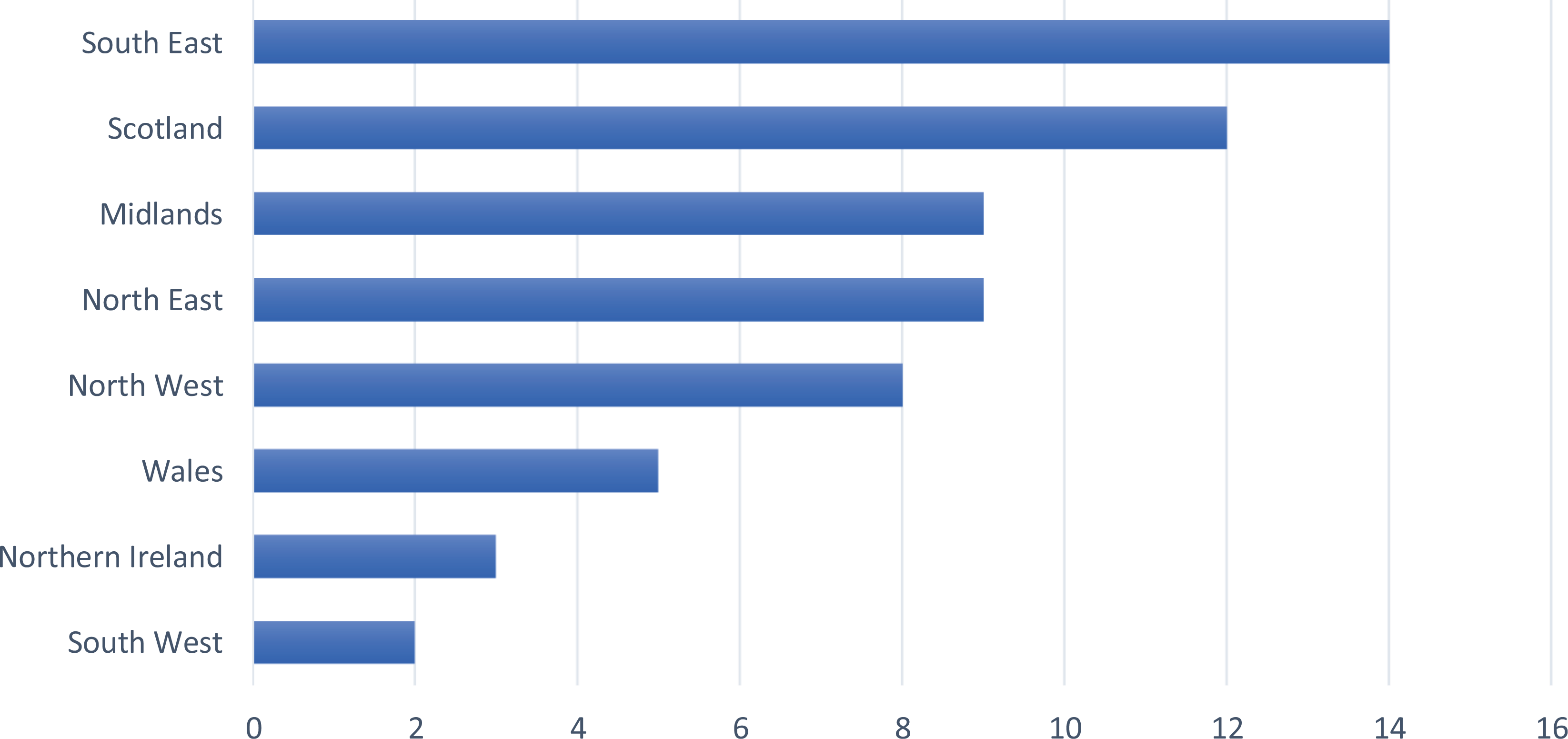
Geographical representation.
A number of the respondent organisations operate in multiple geographical regions and therefore fall into more than one of the above sections.
The respondents have experience supporting service users with a broad range of GBV offences. Over 98% of the organisations support victims of domestic abuse; 71% support victims of sexual abuse; 60% support victims of honour-based violence and abuse; 54% support service users who had experienced or been threatened with forced marriage; and 40% assist victims of threatened or actual female genital mutilation. In addition, the respondents support victims with GBV offences not previously considered by the authors including modern slavery; human trafficking; child sexual exploitation; exploitative prostitution and stalking. A few organisations stated that they also support young people who experience dating abuse. This reflects that in England and Wales, the statutory definition of domestic abuse contained in the Domestic Abuse Bill 2020 regards violence between people under the age of 16 as child abuse rather than domestic abuse. Despite this, many academics and practitioners still regard this as a form of GBV.
The questionnaire was hosted by onlinesurveys.ac.uk (previously Bristol Online). It opened on 31 March 2020 and remained open for completion until 23 April 2020. The responses therefore present a snapshot in the experiences of the respondent organisations during the first few weeks after lockdown measures were implemented. It is recognised that at this time, the organisational response to the Covid-19 outbreak may still have been evolving and therefore if the questionnaire was repeated at a later date, different data may be obtained. The benefit of using a questionnaire is it allowed for the quick collection of data from a large number of organisations across distant geographical regions (i.e. the entire UK). 128 In addition, questionnaires are widely regarded as an appropriate method to test peoples’ attitudes, beliefs, views and opinions in relation to a particular topic. 129 The questionnaire was free to design, albeit the University pays a subscription for the use of the hosting service. Online Surveys was specifically used because, in addition to providing design tools, the service offered features that assist with data collection and analysis. A combination of closed and open questions were used in order to obtain both quantitative and qualitative data. The benefit of eliciting quantitative data is that it enabled patterns to be identified from the research population and variables to be measured. As Rasinger notes, quantitative methods aim to investigate the answers to questions ‘starting with how many, how much, to what extent’. 130 However, quantitative data fails to ascertain deeper underlying meanings and explanations. 131 Accordingly, including open questions and free text boxes enabled the authors to record attitudes and feelings in order to provide depth to the quantitative data. As Rahman notes, qualitative questions create openness, encouraging participants to expand on their responses and open up on new areas which have not initially been considered. 132
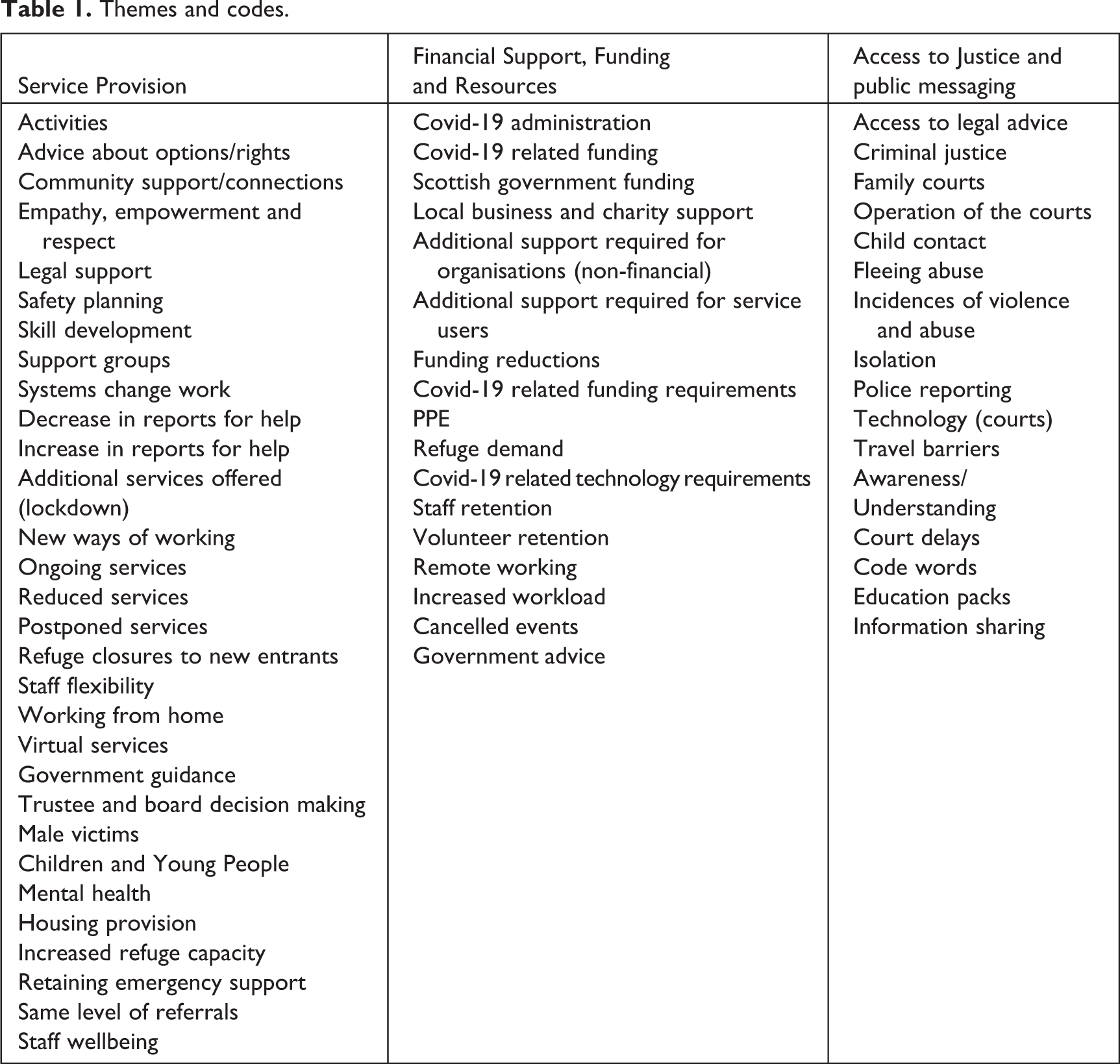
A statistical analysis was conducted utilising the analysis software on Online Surveys. The qualitative data was analysed using thematic analysis to identify any common themes or patterns in the free text comments made by the respondents. Thematic analysis enabled both similarities and differences to be identified in the data set, 133 something the authors felt important given the wide range of responding organisations. The three authors separately coded the qualitative data using NVivo to ensure reliability and consistency of the data analysis. 134 NVivo is recognised for providing a more rigorous yet efficient method of coding compared to manual or other digital processes. 135 After coding the data, the authors compared the codes they had identified and found them to be consistent, adding validity to the findings. They then categorised the codes into themes. Those themes and codes are set out in the diagram below and will be explored in the ‘findings and analysis’ section.
Themes and codes.
Findings and Analysis
This section outlines the findings of the questionnaire. The key themes that will be examined are; impact on service provision; financial support, funding and resources; access to justice and public messaging. These findings and the recommendations which follow were submitted for consideration to the UK Government as part of the Home Office’s call for evidence on the preparedness for Covid-19. 136
(a) Impact on service provision
The respondents were asked to provide a summary of the services provided prior to the Covid-19 outbreak. These broadly fell into the categories identified by Sullivan as; providing information about rights, options and experiences; carrying out safety planning; building skills; offering encouragement, empathy, and respect; providing supportive counselling; increasing access to community resources and opportunities; increasing social support and community connections; and carrying out community change and systems change work.
137
The list below provides a breakdown of the types of services which were provided in each category albeit some services may in practice fall within multiple categories: (a) (b) (c) (d) (e) (f) (g)
The findings demonstrate that access to justice for victims can be achieved through service provision in a number of key ways. Firstly, it was clear that the respondents played a role in providing ‘legal support’ to their service users, including through facilitating referrals to legal practitioners, attending appointments with them, helping service users to complete application forms and statements and/or providing practical and emotional assistance during court proceedings. For many victims, recourse through the criminal and family justice systems will be vital to their sense of justice.
138
As Kelly identifies ‘negotiating criminal and civil justice systems is complex in any eventuality, however in the aftermath of violence it can be all the more daunting’.
139
Support services are able to minimise some of the barriers to the courts, including lack of legal knowledge and understanding of victims’ rights; distrust in the justice system; fear of retaliation from the perpetrator and concerns about traumatising and insensitive processes.
140
This has been recognised by Kelly who notes that the role of support workers in ensuring that rights are realised is a ‘keystone in UK responses to domestic and sexual violence…here knowledge is a route to empowerment’.
141
As other studies have highlighted however, ‘justice’ is not always achieved through conventional legal proceedings. McGlynn’s study, for example, highlighted that ‘recognition’, ‘a voice’ and ‘meaningful consequences’ were core components of victims’ perceptions of justice.
142
Similarly, the United Nations Secretary-General’s guiding principles for GBV service provision recognise the role of ‘empowerment’ in supporting victims to achieve justice. The key principles are: Promoting the well-being, physical safety and economic security of victims and enabling them to overcome the multiple consequences of violence to rebuild their lives. Working from understandings of violence against women, which neither excuse or justify men’s violence or blames victims. Empowering and enabling victims to take control of their lives. Ensuring that victims have access to appropriate services and that a range of support options are available that take into account the particular access needs of women facing multiple discrimination. Ensuring that service providers are skilled, gender-sensitive, have ongoing training and conduct their work in accordance with clear guidelines, protocols and ethics codes and, where possible, provide female staff. Maintaining the confidentiality and privacy of the victim. Co-operating and co-ordinating with all other relevant services. Monitoring and evaluating service provision, seeking participation of service users.
143
The second way that GBV support services promote justice through service provision is by delivering projects aimed at upholding these principles. As this section will go on to consider, these principles were at the forefront of much of the work carried out by the respondents.
Helplines (and their web-based alternative, web chats) preserve privacy and confidentiality, provide information free of charge and often are a route into other services. 144 They are recognised as a lifeline for victims who are hesitant to seek help and particularly those who live in rural areas. 145 They are a critical part of the UK’s access to justice response under the Istanbul Convention alongside the provision of refuge accommodation. 146 Although the UK government has not yet ratified the Convention, prior to the Covid-19 outbreak, they committed £1.1 million per year (up until 2022) to support seven helpline services including a national helpline for victims of domestic abuse, LGBT victims of abuse, male victims of abuse, perpetrators of domestic abuse, stalking, ‘honour’-based violence and abuse; and revenge porn. 147 As this article has already discussed, since lockdown measures began, news headlines have reported that services supporting victims of GBV were facing an unprecedented increase in demand for support, indicating that cases of abuse were on the rise. 148 84% of the respondents to this study reported providing a telephone helpline or online facility for victims of GBV to report violence and seek help. Importantly, none of the respondents indicated that they had closed their helplines as a result of Covid-19. In contrast, a number of organisations stated that they had increased the capacity of their helplines by extending the hours/days of service. This indicates that victims of abuse continued to be able to secure initial information about their rights and options during this time.
In contrast to the position portrayed in the media, the findings of this study demonstrate that not all support services experienced an increase in hotline calls/online reports of violence. The vast majority (79%) of the respondents who operated a helpline noted a change since the introduction of the lockdown measures. There was a mixed response as to whether organisations cited an increase or decrease in calls/reports. Eleven organisations (21%) reported an increase in calls/reports. Quoted increases ranged from 25% to 120% which is broadly in line with the statistics which have been cited in the media. 149 As has already been discussed, whilst an increase in requests for help does not directly correlate to an increase in abuse, there is evidence that risk factors for GBV become more prevalent during times of humanitarian crises. 150 Research carried out by Women’s Aid indicates that 67% of victims currently experiencing abuse reported that it had worsened during lockdown and over a third of victims with children reported an increase in abuse directed towards their children. 151 As such, it may be tentatively inferred that some victims are experiencing higher rates of abuse during lockdown.
It was found that 21 of the responding organisations (41%) had experienced a decrease in calls/reports. These organisations did not state that this was because abuse had decreased during lockdown. Instead, they considered that victims faced increased barriers to seeking support even though helplines remained open. A number of the organisations noted that agencies which typically refer victims to their service were closed, resulting in fewer referrals. Respondents also expressed concern that victims isolating with their perpetrators and working from home had no practical opportunity to seek help. Previous epidemics have demonstrated that women typically take on additional physical and psychological burdens as caregivers which results in time barriers to accessing services. 152 The overly simplistic message that there is a dramatic increase in calls to services is potentially damaging as it may lead the public to disengage if they believe that all victims are able to seek help. Furthermore, victims may not feel able to contact a stretched service if the message is solely that the services are inundated with enquiries. A more balanced approach to the reporting of this issue is therefore required.
The above data demonstrates that alongside helpline and webchat facilities, victims need to be afforded opportunities to seek help in more accessible ways. In their written evidence to the UK government, the authors suggested that this could be achieved by GBV organisations setting up pop-up booths in supermarkets and/or pharmacies where GBV victims would sit 1:1 with a trained support worker, who is available remotely using a computer to promote social distancing. 153 This recommendation would be assisted by only one member of the family being able to enter the store during lockdown. It was noted that in Columbia, supermarkets and pharmacies have been designated as safe spaces for domestic abuse to be reported, 154 whilst in France, grocery stores are housing pop-up services. 155 This recommendation was therefore in line with the approach being adopted in other jurisdictions. On 1 May 2020, it was announced that victims of abuse would be able to contact support services in ‘safe spaces’ installed in Boots consultation rooms. 156 Whilst in the consultation room, people will have access to the National Domestic Abuse Helpline; Men’s Advice Line, the Domestic Abuse and Forced Marriage Helpline (Scotland); and the Domestic and Sexual Abuse Helpline (Northern Ireland). This was an initiative developed by Boots in collaboration with GBV organisations and is undoubtedly a step in the right direction. The UK Government should support other pharmacies and supermarkets to develop similar ‘safe spaces’.
The study demonstrated that in some instances, justice for victims may be compromised because of a reduction or withdrawal of some support services. It was reported that 78.8% of respondents had withdrawn or delayed services. This finding is in line with the Global Protection Cluster and the IASC guidance which recognises that many organisations will deliver a ‘reduced service provision’ during the lockdown period. 157 The main services which had been postponed or cancelled were fundraising events, community-based educational activities, face-to-face support groups and therapeutic work for adults, children and young people. Whilst many services were moved online, inevitably this was not possible for all services. Given the appreciation that children can experience ‘short and long term cognitive, behavioural and emotional effects as a result of witnessing domestic abuse’, 158 it is concerning that many of the services which were directed at children and young people had to be withdrawn completely.
It was noted that 30 of the respondents (57.7%) offered a refuge service. It was reassuring that in all cases, existing occupants were able to remain in the refuge accommodation, however, 26.7% of those respondents had closed their doors to new entrants. This was either as a result of the lockdown measures or because they were already at capacity. The data therefore indicates that there is reduced accommodation for victims of abuse during Covid-19. The decision to close was typically made by the occupants themselves or the organisation’s trustees because of the increased risk that communal accommodation posed to transmission of the virus and therefore the health of the residents. This decision, whilst understandable, seems to be at odds with the government’s current guidance that refuge accommodation can stay open. 159 Closing refuges reduces the availability of accommodation for victims fleeing abuse during the lockdown. This is particularly concerning because of the reported increase in domestic abuse at this time 160 and because there have been extensive cuts to refuge funding in recent years which may compromise their ability to operate in a post Covid-19 landscape. Research indicates that since 2010, local authorities have reduced refuge funding by £6.8 million. 161 Data collected by Women’s Aid indicates that in 2019, 64% of refuge referrals were declined due to capacity issues; less than 50% of refuges were able to accept women with more than two children and only 5% of refuge vacancies could accommodate women with no recourse to public funds. 162 The number of refuge bed spaces in England is currently 30% below the number recommended by the Council of Europe. 163 The severity of this is underpinned by the Judgment in the case of AT v Hungary which held that failure to provide access to immediate protection (the victim could not access a refuge and had no legal or other recourse to safety) will mean a state is in violation of CEDAW. 164
The second difficulty in closing refuges to new entrants is that it reduces the level of income received by support services as they are unable to claim housing benefit for empty refuge accommodation. This potentially impacts the viability of the refuge or support service in the future. Even in those refuges which remained open to new entrants, rental income had been lost, albeit to a lesser extent. This is because beds were vacant for longer as a result of government guidance that accommodation should not be cleaned for 72 hours after a resident has moved out. 165 In line with the recommendations of the VAWG sector statement, it would be appropriate for refuges to be reimbursed this lost income to ensure that there are not further refuge closures as a result of Covid-19.
There was evidence that the lockdown had resulted in the respondents offering additional and/or alternative services to support users that had not been provided prior to the lockdown measures. This finding accords with the Global Protection Cluster and the IASC guidance on identifying and mitigating GBV risks within the Covid-19 response, which recognised that GBV service provision was likely to ‘operate differently’ than under normal conditions.
166
Over 61% of the respondents reported providing additional services. Drawing on Sullivan’s categorisation, this included social support (providing practical assistance such as food parcels, collecting prescriptions, paying emergency housing costs for families and providing toy boxes to children); community resources and systems change work (developing blogs, preparing information packs for schools and delivering training to individuals and organisations who may come into contact with victims during the lockdown) and supportive counselling (by moving permitted services online, expanding channels of communication including through social media, text chat rooms and live chat services and by extending the availability of these services). The aim of these additional services was to improve the well-being of service users and enhance the visibility of the respondents to potential and existing users. Community-based services also play a key role in promoting healthy gender roles and highlighting the nature and scope of GBV. Such services are therefore especially important at a time when GBV may be experiencing a higher incident rate. (b) Financial support, funding and resources
As noted above, on 8 April 2020, it was confirmed that frontline charities would benefit from an additional £750 million package of support to enable vital work to continue during the Covid-19 outbreak.
167
There still remains a degree of uncertainty as to how those funds will be allocated and how they will support the organisations given the limited amounts available per charity, as above. The Home Affairs Committee also recognised that there was no published strategy of funding allocation, as at 24 April 2020.
168
The respondents were asked whether they have received any additional financial support over and above that already being provided prior to the outbreak to keep their services running. It was stated that 78.4% have received no additional funding. Of those services that had received additional funding in this UK wide study, there is generally no national or regional consistency evident from the responses, with the responses indicating somewhat of a postcode lottery for funding allocation. This is with the exception of the Scottish government, which has distributed funds to Women’s Aid, though not from the government package referred to above. Women’s Aid in Scotland has further allocated those funds to other services to help sustain their practices. There must be credit afforded to the Scottish government as a number of respondents acknowledged receipt of funding. 169
One organisation also reported receiving an ‘offer of practical help from Police and Crime Commissioner’ though it is mentioned that this assistance has not yet materialised. This is a reminder of the need to follow through on promises of assistance. It is unclear as to whether the offer from this Police and Crime Commissioner is linked with the £750 million government distribution. Dame Vera Baird QC has informed the Home Affairs Committee that half of the £750 million fund would be distributed through central government departments, while the other half would be distributed through local authorities and Police and Crime Commissioners. 170
It is integral to the organisations’ business continuity across the whole of the UK that the government funding must be provided across all devolved nations and constituencies to as many GBV services as possible. This is also recognised in the plea from one respondent: ‘we need the funding promised to be released as soon as possible’. Moreover, it is crucial that funding is allocated to all GBV organisations, rather than just larger, commissioned organisations. The impact of a lack of funding, or of expedited mechanisms to provide funding, is clear in the reported statistics. 171 There is also a request from one respondent for greater clarity to be announced by the government as to, ‘the impact this will have on annual reports and figures and how funders will show leniency towards this’. This comment feeds into the overwhelming drive by the authors for the government to release one, clear platform for advice to the public and to service providers.
It is vital that services which can be conducted remotely, continue to operate during lockdown in order that the, ‘administration of justice does not grind to a halt…’, 172 however a number of organisations reported barriers to moving services online such as resourcing electronic equipment for staff, volunteers and service users and ensuring victims could access online services due to the close proximity to their perpetrator. GBV organisations therefore need to be able to access additional funding to source the technology and specialist IT advice that they require to do this (regardless of whether or not they are experiencing an increased demand for their services). This could include technology for them to offer online web chat facilities and decoy websites or be as simple as them procuring additional telephones for their home workers. This recommendation would mitigate the effect of removing face-to-face programme and group support sessions discussed above and mirrors the VAWG sector statement on Covid-19, which highlighted that support services require considerable investment in technology. It is acknowledged that there is a proposed £2 million fund to assist with technology for domestic abuse charities, on top of the more general funding previously discussed. At the time of writing, this funding has not been allocated.
GBV organisations will also benefit from guidance about how to utilise their online presence to increase their donation income. This recommendation would also allow government funds to be preserved and could form part of the Home Secretary’s domestic abuse campaign. The funding for increased and improved IT infrastructure could extend to training in how to upload useful material online by the services, from help sheets to blogs and vlogs. Moreover, there should be material for children in need uploaded to their school websites and portals. The Home Secretary has announced that the government has sourced support from Fujitsu to provide IT expertise to smaller domestic abuse organisations. 173 The data indicates that this expertise will be invaluable to these organisations and needs to be rolled out urgently to sustain the provision of services by GBV organisations.
It is recognised that there are smaller funding pots available, with respondents reporting that small grants have been received for mobile phones, laptops and tablets, from councils, the STV Children Appeals Funds, Norfolk Community Foundation and Lloyds Bank Foundation. It is important that the services are made aware of the available offers of assistance, howsoever small. It is therefore unfortunate that only 15 organisations responded that they had been made aware of financial and non-financial support available to their organisations in light of the outbreak. The responses detailed that they had been contacted by businesses who offered non-financial support, as well as receiving emails regarding small grants. Furthermore, one respondent was awaiting news of whether they would benefit from resilience funding from the Scottish government, as well as The Martin Lewis Resilience Fund. There was hope from one respondent of the possibility of sourcing staff and volunteers from other services for service delivery. These offers, as well as the available funding and grant opportunities, are likely appreciated by the services, however the process of obtaining them can sometimes be a barrier. 174
The reality is that funding needs to be more accessible for smaller organisations. There must be a reduction in paperwork involved for funding applications. The authors suggest that there be an automatic entitlement to funding to cover temporary running costs, similar to the temporary reduced evidence requirements for legal aid. It must be recognised by government that GBV organisations have already faced a considerable period of financial cuts as a result of the austerity measures. It is important that these small grants are supplemented with longer-term sustainable funding, an issue raised by a number of the respondents. 175 The cessation or suspension of funding arises from various channels; for instance, one respondent noted that, ‘lottery have delayed the funding until September’, while another referenced their loss of income from fundraising; in their case, this was £150,000 from events such as the London Marathon. Another respondent referred to the loss of £10,000 - £15,000 annual profit from closure of their charity shop, which can have a drastic effect on a small organisation. In consequence of that lack of income, projects are unable to progress, and staff members are lost. Until the longer-term needs of the services are sated, organisations have noted their uncertain fiscal position will result in a reduction in both services and staff. Further non-financial assistance to GBV services could constitute a 6 to 12 month breathing space by way of a mortgage holiday on their working premises, as well as the current proposed 12-month business rates relief 100% exemption, rather than the usual maximum of 80% rates exemption. It is noted that services are expending time and resources on the drafting of policies for staff to work from home, as well as navigating GDPR issues. It is recommended that the government publish comprehensive and accessible guidance and templates to support services in their policy drafting.
The authors support the recommendation of the VAWG sector statement on Covid-19, which advocates repurposing the final £15 million Tampon Tax round as unrestricted grant funding to specialist GBV services to ensure that they can cope and adapt. The authors however do not propose that the funds be limited solely to women’s services as requested in the VAWG sector statement; rather the monies should be made available to all victims of GBV.
A number of the respondents identified receiving non-financial support from various channels to help run their services and refuges. There was no evidence that this support had emanated from the government. Instead, references were made to supermarkets providing food for the services’ clients, funders extending funding periods, newspapers offering free/discounted advertising space and donated items of food and equipment. Furthermore, a respondent provided the following heart-warming, but tragic reality: The staff of our local Superdrug all clubbed together and bought us a range of toiletries for our support packs. We are currently distributing support / self care packs to women and activity packs to children & young people in our service. [P]eople such as Superdrug staff have been donating…items to us…Staff at our local Lidl are asking for food donations for the women and families we support. Our local police force have been amazing in helping us facilitate safe exits for women trapped…[where] travel has to be officially authori[s]ed.
Refuge services are critical both during and immediately following lockdown. As at 19 April 2020, the Ministry of Housing, Communities and Local Government stated its priority was ‘making sure refuge services stay open and are accessible’. 176 The data from this study demonstrates that this approach is misguided because not all refuges are being provided with the appropriate funding and resources to stay open. For example, until May 2020, testing for Covid-19 was not available to those living in refuge accommodation. Refuge providers may feel more confident accepting new entrants if they have been screened prior to entry. The availability of testing could therefore increase the number of refuge spaces available. In addition, a number of respondents reported concerns around protecting the safety of the staff members who were required to visit refuge accommodation through the provision of PPE. The current government guidance for staff working in refuges is that staff and professionals are able to enter and leave unaffected areas as required. 177 The guidance also advises that continuity of staff should be maintained where possible and staff should follow ‘infection control procedures’, including washing their hands for 20 seconds more frequently than usual and covering their mouth when coughing or sneezing. 178 Disappointingly, the guidance does not make any reference to the provision of PPE for refuge workers. It is recommended that staff should be provided PPE in the same way as it is given to care workers. This must be provided free of charge, reflecting that support workers are putting their health, and the health of their families, at risk in providing these critical services. Support services should also be provided with guidance about effectively using and disposing of PPE as they are not medical professionals with experience of using PPE. This would help avoid the concerning situation outlined by one respondent: ‘volunteers have made us material masks when we were struggling for the correct PPE we require’.
In the event that there is insufficient refuge stock for victims fleeing violence during lockdown, the government must arrange for alternative accommodation. The authors initially considered that empty hotels, apartments or even empty nightingale hospitals may be a good temporary solution as this would support the UK’s hospitality industry whilst providing accommodation which would not place further people at risk through the use of shared refuged spaces. The cost of this would need to be underwritten by the government. This is in line with the approach being adopted in other European countries including France and Germany.
179
On 11 April 2020, the Government stated its commitment to look at alternative accommodation to support refuges.
180
Many of the respondents anticipated that demand for refuge accommodation would increase when lockdown measures were lifted. One respondent commented: At the moment it is early days. The key issue for us is what we do when this ends. Much like Christmas and New Year, women will hold it together in their homes while the lockdown is on. As soon as it ends, we will see a massive influx of women looking for accommodation.
In identifying suitable alternative accommodation for housing victims, the potential for a long-term escalation in housing need must be taken into account. Hotels and apartments are likely to re-open as lockdown measures are eased. In addition, nightingale hospitals will either be utilised for the ‘second wave’ of virus cases or returned to their former purpose. A better approach would therefore be for the government to provide additional funds to increase the capacity of existing refuge accommodation. For longer term accommodation, requiring housing authorities to give priority need to victims of GBV seeking rehousing is vital. This recommendation was included in the authors’ written evidence to the government on the preparedness for Covid-19. Subsequently, on 1 May 2020, the Communities Secretary Robert Jenrick announced that the government would be ‘ensuring that the victims of domestic violence get the priority need status that they need to access local housing services much more easily…’. 181 Whilst this policy is admirable in ending the postcode lottery of support for those fleeing violence, it is vital this provision extends to any victim of GBV, not just domestic abuse. In addition, the government must not impose unnecessarily strict evidential requirements on victims to demonstrate that they are a victim of abuse, as they have done in other areas, such as legal aid.
The IASC advocate that in order to prevent and respond to GBV during Covid-19, provision and utilisation of GBV support services should be improved. 182 The data from this study indicates that this is potentially undermined by a lack of resources and the increase in Covid-19 related administration that organisations face. This includes applying for pots of funding, redesigning policies and ensuring staff and volunteers have the resources to work from home. The IASC has also suggested that GBV support services document trends in safety risks for vulnerable populations and utilise this information to inform programming adaptations and advocacy with local/national governments. As this article has already stressed, funding is required for additional technology to support organisations with delivering services and developing their capacity in this climate. The proposed government funding needs to be allocated forthwith to all support services, and further clarification is required as to the application process and allocation criteria. The application process must not be arduous so as to detract from vital work carried out by the services.
Guidance also recommends that staff and volunteers in all sectors should be equipped to provide accurate, up-to-date information on available GBV services and be aware of current limitations on any services. 183 At present, there is no UK wide database of GBV organisations and therefore no way of achieving this ambition. The creation of a database, akin to Companies House or the Charity Commission, would achieve a number of purposes. Primarily, it could act as a public access site for victims to have an easily accessible and full directory of services area by area. In addition, it would facilitate the payment of government funding and ensure that organisations are not required to complete lengthy funding applications. The creation of a database should therefore be a priority. This is highlighted by the fact that the authors received 43 automated responses indicating that our email to the services in the Women’s Aid and Mankind directories could not be delivered. As above, this was either due to the email address not being recognised or the email being blocked as suspected spam. This could hinder access to justice for potential service users.
Finally, the respondents were asked whether Covid-19 was likely to impact whether they are able to retain staff and/or volunteers to provide support services. This has the potential to impact access to justice by jeopardising the ongoing viability of organisations. Over 41% of the respondents reported concerns about staff and volunteer retention. The reasons for this were varied. In a few organisations, short term staffing difficulties were anticipated because some staff had been furloughed under the Coronavirus Job Retention Scheme. In another organisation, funding which had been granted prior to the introduction of the lockdown measures had been postponed, meaning a new member of staff would not be able to join until the funding became available. Other organisations reported that reductions in funding more generally as a result of Covid-19 may impact their ability to retain staff in the longer term. Many respondents reported an expectation that they would lose volunteers as a result of the lockdown measures. Some of the respondents felt that volunteers would disengage while there was limited work for them, whilst others cited an increase in childcare and workload commitments as reasons why some volunteers would be unable to continue volunteering over this period. The authors argue that an increase in technology funding will allow links with volunteers to be maintained. A Covid-19 accreditation for volunteers through an online learning or webinar programme would also assist with retaining engagement and subsequently addressing a potential greater demand on the services. (c) Access to justice and public messaging
As already addressed above, the court system in the UK is a vital component in ensuring access to justice for victims of GBV, provided it is underpinned by the appropriate support services. 40 out of 51 (78.4%) of the organisations that responded to the survey usually provide support to victims of GBV whilst at court, but only 17 were continuing to provide this support during the outbreak. No further insight was provided by the remaining 23 services as to why they had chosen to withdraw this particular service. Pressures on resources and the inability to provide face to face services already addressed in this article may form part of their reasoning.
Not surprisingly, of the organisations that continued to provide this service, many raised concerns about the associated delay in criminal trials being heard. The main criticism voiced by organisations was around the lack of communication with victims about those delays and when their cases may be heard. In many ways this is not surprising, as it is difficult to predict when the courts will be fully up and running again. In order to prevent more victims disengaging with the process, it is imperative that HMCTS has a clear plan in place for how it is going to clear the backlog of cases that will exist without jeopardising a victim’s access to justice. As discussed earlier, this will not be without significant expense. 184
Three services also raised concerns about the ‘early release scheme’. As highlighted above, it is unlikely that this scheme will apply to offenders of domestic abuse or other GBV. Better information sharing to make this clear would put minds at rest. If, through a loophole in the current guidance, any GBV offender is to be released early, it will be important that victims are informed so that they can seek the appropriate support from services in advance.
Several organisations indicated that they have supported victims at remand hearings, which continue to take place. One organisation raised concerns that police bail would be used instead of a perpetrator being remanded in custody. As explained above, the ‘Interim CPS Charging Protocol’ will apply to decisions to remand or bail a perpetrator. Whilst this means that perpetrators will continue to be remanded in ‘high risk’ cases, in other cases, a perpetrator may be given a long bail date with bail conditions attached to protect the victim. It is necessary for support services to be kept informed about such decisions to be able to appropriately assist the victim in safety planning.
Another service raised concerns that more lenient sentences would be given to perpetrators of domestic abuse. There have in fact been no changes to the sentencing guidelines in domestic abuse cases. Again, this could be an indicator that better information sharing is needed with support services and the wider public. A lack of understanding about these issues could make victims more reluctant to disclose abuse or engage with the criminal justice process.
As discussed, the criminal justice system is just one avenue for protection for victims of GBV. The other arm of protection comes from the family justice system. Many academics have discussed the so called ‘choice’ that victims of GBV have in deciding with which justice system to engage. 185 Indeed, there is nothing preventing them engaging with both systems or neither. This ‘choice’ has always been somewhat limited in the fact that victims have very little power in the criminal justice system, with their role being a prosecution witness or complainant. 186 It is not a victim’s choice whether criminal proceedings are pursued, rather that decision belongs to the CPS. That ‘choice’ may appear to be even further reduced now that some trials are being indefinitely delayed.
This makes the role of the family courts even more important. The family courts continued to hear cases during lockdown, albeit in a new format, using remote technology. Unlike the civil courts, this technology was seldom used by the family courts prior to the Covid-19 lockdown. Many of the organisations reported assisting victims with the virtual court process, but there were large discrepancies in their reports of how hearings were now taking place, pointing to a possible inconsistency in approach across the UK. Some organisations reported supporting victims with video conferences, others reported courts dealing with matters ‘on paper’ and others reported hearings taking place ‘over the phone’. Each of these methods is not without problems.
The main criticisms of video conferencing are around the ability of a litigant in person to access this technology and the home environment in which these hearings are then taking place. One support service summed up their experience of assisting victims with video conferencing: …the women we support are experiencing higher levels of anxiety due to Family Courts trying to undertake hearings using video conferencing. Many women feel deeply uncomfortable about their children being present in their homes while this is undertaken. Some are also not very confident in the technology and don’t feel supported by the courts to use it.
Likewise, if the victim is applying for a protective order, it is possible that the perpetrator is living in the home with them and this can cause further difficulties. One organisation reported that some courts were now dealing with applications on paper. Whilst this addresses the issue of not having to attend a hearing in front of children or their abuser, it raises other access to justice issues. The same organisation explained that this approach places extra importance on the application and witness statement because there is no opportunity for a Judge to ask additional questions: This is ok for the clients that we assist as we make sure that their statements are constructed by solicitors, to give the best possible chance of success. We are concerned however about those who do not reach out for help and assistance, this could jeopardize their case.
The President of the Family Court, Sir Andrew McFarlane, has now addressed the approach to remote hearings in the case of Re B (Children) (Remote Hearing: Interim Care Order). 187 The president criticised the use of telephone hearings, noting that there is a ‘qualitative difference between a remote hearing conducted over the telephone and one undertaken via a video platform’. If he was this critical of telephone hearings, it can only be imagined what qualitative difference he would highlight between a live hearing and an application being dealt with on paper. Sir Andrew surmised that the ‘default option’ should always be video conferencing in urgent cases. This case involved emergency care proceedings, but could equally have application to other urgent family court proceedings.
That said, support services have also been complimentary of the approach of the family courts in being ‘flexible and reactive to each person’s circumstances’. Therefore, whilst video conferencing should be the ‘default’, the court should be flexible where the victim’s home circumstances are such that this would not be appropriate. Whilst leaving it to judicial discretion means there is a likely risk of inconsistency, enforcing a rigid approach to family court proceedings could deter victims from making an application. Perhaps a short additional court form for litigants in person to complete, asking them a series of short questions about their home environment and access to technology is the answer. This will allow the judge hearing the case to make an informed decision as to how the hearing can best take place. It is crucial that reflection and development is undertaken throughout this unprecedented period.
Worryingly, some responses indicate that victims and support services are not aware that the family courts even remain in operation. 188 Given the important role that the family courts play in ensuring immediate protection for victims and their children, it is vital that clear information is circulated widely about which courts are open and how applications can be made remotely. While this information has been made available to practitioners, the restrictions in legal aid mean that many family court users will be litigants in person. 189 Four of the support services specifically mentioned the links they had with local solicitors who were keeping them ‘up to date with legal procedures’ and providing legal advice to their service users. It was not clear from the responses whether this legal advice was being provided on a pro-bono basis or whether it was subject to legal aid funding eligibility.
It could be argued that access to legal advice and representation is always crucial to the smooth running of the family court system, but that is never truer than now. Not only do court users have the usual legal concepts and procedures to get to grips with but, as previously discussed, they also need to do this using remote technology, which they may never have experienced before or which they do not have the ability to access. Removal of the legal aid means test during the Covid-19 outbreak would ensure that all victims of domestic abuse are able to seek legal advice and support in accessing the new ‘virtual’ family court. If the provision of legal aid cannot be expanded, as very minimum a media campaign is required to make clear that the family courts are still in operation and can be accessed for emergency orders. This would be beneficial to victims, many of whom may not be engaging with a support service or have any access to legal advice.
For those victims who have been able to obtain the support, and in some cases legal advice, to be able to pursue proceedings during lockdown, the feedback from support services is largely positive. The majority of the survey responses on this subject related to emergency injunctions, most commonly non-molestation orders. They report that orders are still being granted ‘without delay’ and that the feedback from their service users was suggesting that remote hearings were working for those types of applications. 190
One organisation did suggest that service of emergency orders needs to be considered. They suggested that: ‘Service of these orders are critical, and we feel that the courts need to be more open minded about service and accept alternative service as personal service is not appropriate at this time’. While at first glance, there may appear a benefit to the applicant of relaxing service, this would raise potential human rights issues and could potentially jeopardise future criminal proceedings for a breach. Personal service is a crucial part of the non-molestation order process, in that the respondent must be aware of an order before a breach can be considered a criminal offence. 191 Without this, a respondent could face loss of liberty for breaching an order of which they were never even aware. To remove this element of the process, could also potentially jeopardise a future criminal conviction, if the respondent’s receipt of the order is in doubt. In any event, in a time of lockdown, it could surely be argued that it should be easier to locate a respondent and provide them with personal service. Provided court bailiffs are issued with appropriate PPE, there is no reason why service could not be effected personally in a safe way for all involved.
In contrast, the feedback in relation to child arrangements issues is less positive. Some services reported that their local court was ‘only taking urgent cases so family court cases regarding issues like child contact are currently not being heard’. The current version of the Remote Access Family Court guidance, details three categories of prioritisation: work that must be done, work that will be done and work that the court will do its best to accommodate. 192 As regards to work associated with children matters that must be done, the guidance specifically details Emergency Protection Orders, Interim Care Orders, Secure Accommodation Orders, urgent applications in private law children cases and Child Abduction Orders. 193 The work that will be done is the gatekeeping and allocation of public law and private law cases and the processing of orders, documentation and correspondence in public law cases. 194 The work that the court will do its best to accommodate is the processing of orders, documentation and correspondence in private law cases and adoption orders. 195
In completing work on these matters, it was noted by the President of the Family Division in Re B (Children) (Remote Hearing: Interim Care Order) that the fundamental principles of substantive law and procedural fairness are unchanged.
196
This requirement from the President is difficult to maintain under the great pressures faced in practice, which he has rightfully acknowledged. Without significant funding in technology and the justice system more generally, the judiciary has been left to navigate outdated systems with skeleton staff. This places great pressure on the parties, representatives, professionals and the court. In the Re B judgment, the President explained the pressures that the family courts are under during lockdown and surmised that the pressures of remote court processes had no doubt led to the wrong decision being made in this case: By the time the Recorder started to hear his first case, he had already been working for at least three hours. The hearings took place by telephone, as was then the practice in that court, with the Recorder at his home address and the other participants at various locations elsewhere… …During the course of the morning the Recorder received a continuous stream of bundles, documents and position statements in the other two cases… …At 17.57 the hearing concluded. By that time the Recorder had been working, almost continuously and mainly on the telephone, for 10½ hours. Our observation is that, although we have found the decision in this case to have been unquestionably wrong, the nature of the workload faced by the Recorder, experienced as he is, was surely a contributory factor.
197
It is inevitable that this increased demand will lead to further appeals akin to Re A (Children) (Remote Hearing: Care and Placement Orders)
198
and Re B (Children) (Remote Hearing: Interim Care Order).
199
It is clear from these cases that greater training is needed on the relevant guidance for the judiciary at this time of crisis, particularly in respect of urgent cases that cannot be adjourned until such time as lockdown measures are relaxed.
200
Some court users may be frustrated at having their case adjourned, though it is important that this hierarchy and prioritisation is utilised effectively to ensure the safe running of the court, as supported by the Court of Appeal in Re B: Alongside other courts and tribunals, the Family Court continues to discharge its duties, particularly in urgent child protection cases. The effective use of communication technology is indispensable to this ability to continue to deliver justice. A remote hearing, where it is appropriate, can replicate some but not all of the characteristics of a fully attended hearing. Provided good practice is followed, it will be a fair hearing, but we must be alert to ensure that the dynamics and demands of the remote process do not impinge upon the fundamental principles. In particular, experience shows that remote hearings place additional, and in some cases, considerable burdens on the participants. The court must therefore seek to ensure that it does not become overloaded and must make a hard-headed distinction between those decisions that must be prioritised and those that must unfortunately wait until proper time is available.
201
The family court was already at breaking point long before the lockdown was introduced 202 but it is clear from the Judgments discussed above that current circumstances have stretched the system even further. This means that difficult decisions need to be made as to which cases need to be heard urgently through this remote system and which cases can wait. A blanket delay for private law cases is not the answer and ignores the significant risk of harm to children in witnessing domestic abuse or other GBV. The fundamental principle of the Children Act 1989 is to ensure that the child’s welfare is the court’s paramount consideration. 203 This principle cannot be undermined at any point of the Covid-19 outbreak, despite the many challenges faced. The authors would therefore argue that any new applications for child arrangements orders involving such allegations should be treated as urgent and therefore prioritised, with clear guidance being issued to the judiciary to this effect.
In cases where there is an existing child arrangements order in place, there has been conflicting advice from the government on lockdown restrictions, which the President of the Family Division sought to clarify in, ‘Coronavirus Crisis: Guidance on Compliance with Family Court Child Arrangements Order’: …where Coronavirus restrictions cause the letter of a court order to be varied, the spirit of the order should nevertheless be delivered by making safe alternative arrangements for the child.
204
Where the withholding of time with the child arises and an application is made to the court, there will be consideration as to whether a person with parental responsibility acted reasonably to ensure the safety of the child. This is sound advice but has not been made particularly visible for parents in dispute. The guidance is clear and located on the judiciary website, though this is often not the most obvious place for litigants in person to look and must be addressed by the government. Knowledge of the guidance will serve a useful purpose in clarifying the parties’ positions and responsibilities.
In domestic abuse cases, pressure could be alleviated from the family courts, if the police were more willing to issue Domestic Violence Protection Notices (DVPNs) and apply for Domestic Violence Protection Orders (DVPOs) on a victim’s behalf through the Magistrates Court, which remain open for cases. In the survey, several organisations voiced criticisms of the perceived unwillingness by the police to do so. As the police will be the applicant in those cases, it removes the need for victims to use remote court technology in circumstances where their home environment may not allow for this. While those orders only last for a short period of 28 days, they would allow the victim space and time to seek support from a relevant service in relation to their longer-term safety planning. DVPOs and DVPNs are both evidence of domestic abuse that can be used in support of a legal aid application, therefore, subject to meeting the financial eligibility test, a victim should then be able to access legal advice about potential family court orders including those discussed above. Where a non-molestation order or occupation order has already been granted by the family courts, the authors would recommend that there be an automatic extension of those orders until the next listed hearing, or for a period of six months, whichever is sooner. Again, this would go some way to easing the pressure that the family courts are currently experiencing.
Aside from concerns about the lack of DVPNs and DVPOs, the feedback from organisations on their interaction with police forces during the lockdown period is overall very positive. Referrals continue to be made by the police to support services and vice versa. Only one organisation described ‘less reports to police’ but did not expand on this statement to provide us with any insight into why this is the case and whether they were referring to reporting by victims or support services. Support services report quicker response times and reports of police forces going above and beyond to assist victims with exit strategies where travel is an issue.
It is clear from the respondents that there is a need for all agencies to continue collaborative working in order to aid victims in their safety planning, whether or not that involves court proceedings. Victims can only make informed decisions about their safety planning if they (and the services/agencies supporting them) are fully aware of all the current available options. While there are now a large number of guidance notes available online (many of which have been discussed in this article), they tend to be directed towards professionals, not the victims themselves. New issues are being raised on an almost daily basis, meaning that many of those guidance notes have been reviewed and new versions produced, leading to further confusion among practitioners. 205 Victims need access to clear information about all of their options during lockdown, if they are expected to engage with any process or service. The proposals previously outlined regarding media campaigns and access to advice lines in ‘safe spaces’ will go some way towards this. They should also be supported by one comprehensive webpage, outlining in non-legalistic language, the current legal position and options available for all victims of GBV, not just those experiencing domestic abuse. The information on the gov.uk website must be consolidated, simplified and made specific to the Covid-19 lockdown.
Conclusion
At a time when victims of GBV are at increased risk of abuse, and there are more barriers to seeking help, preventing and responding to GBV must be a national priority. GBV support services are often at the forefront of the access to justice response, working in partnership with victims and their children to provide life-saving information and support. As this article has examined, the work of such services is prized for reducing rates of re-victimisation, providing victims with effective safety strategies, increasing the mental well-being of service users and developing their access to community resources and opportunities. 206
This study goes some way to documenting the experiences of GBV support services during this unprecedented time. Importantly, it hopes to dispel reports that all GBV support services are facing an unprecedented increase in demand for their services during this time, as this did not reflect the experiences of all participants in this study. The findings indicate that while services have been able to demonstrate resilience in the weeks following the lockdown measures, many of the respondent services are facing tough times ahead. This is for a variety of reasons including concerns about staff/volunteer retention; loss of funding; increased administration; resourcing difficulties in moving vital services online and delivering services in a safe and effective manner.
GBV organisations do not operate within a vacuum and policies adopted by wider government and state agencies inevitably impact their ability to effectively support victims. The government approach to supporting victims of abuse throughout the Covid-19 outbreak has developed in a piecemeal approach, reflecting the rapidly changing nature of the situation. The government response has largely revolved around its social media campaign to reassure those affected that support services remain available during this time, together with the proposed financial packages for domestic abuse support services and charitable organisations more generally. At the time of writing, the campaign has become little more than a token slogan which has arguably made no meaningful difference to the ability of victims to seek help. In addition, the proposed funding has not been made available to organisations quick enough and urgent clarification is required about how organisations can apply and the criteria by which funding will be allocated. If the government fail to take the action required now, many organisations will not be able to withstand the coming months and the government’s own message will be considerably undermined.
The authors made a number of recommendations to prevent and effectively respond to GBV at this time. These recommendations were underpinned by the key findings of this research study as discussed in the preceding sections. Broadly, the recommendations fall within the three overarching headings identified in the research. These were (a) impact on service provision (b) staffing, funding and resources and (c) access to justice and public messaging.
In relation to service provision, it was recommended that funding and technical support is provided to organisations to ensure that they are able to deliver core services online and to identify innovative ways of engaging with victims, which does not put them at increased risk. It is also recognised that both organisations and service users may require access to devices to enable them to deliver or receive these services. To ensure that victims are supported in making initial requests for help (i.e. where there is no existing relationship with a support service) it was recommended that pop-up booths be set up in supermarkets and/or pharmacies where domestic abuse victims could sit 1:1 with a trained charity worker who is located remotely. This would particularly assist victims who are unable to call a helpline because they are being closely monitored. The provision of refuge accommodation is a core service of many organisations. The authors recommended that adequate testing is made available to residents of refuges, particularly those with shared living spaces. PPE must be provided to support workers and professionals who ensure the safe running of the refuges on a day-to-day basis. Organisations must be reimbursed for lost income arising from any refuge closures. In the event that there is insufficient refuge accommodation for victims fleeing abuse, suitable alternative accommodation must be sourced. In the longer term, housing authorities must consider individuals fleeing abuse as priority need for local authority housing.
In relation to staffing and resourcing, it was recommended that funding must be fairly and promptly distributed across all types of support services, not just to larger commissioned services. As many of the respondents reported facing increased Covid-19 related administration, it is vital that the level of paperwork involved in applying for pots of funding is kept to a minimum or this will disproportionately impact smaller services. In addition, greater clarity and transparency is required in relation to which charities will benefit from government funding. In light of the reduced income that many organisations will face, the government should work with online training providers to inform the charities of how to utilise their online presence to increase their donation income, for example through online fundraising events. It is recommended that a 6–12 month breathing space should be offered to services following lockdown. In order to ease administration relating to the allocation of funding, a database/register of GBV support services should be devised. This could be akin to the Companies House and Charity Commission websites. It would also act as a public access site for victims to have an easily accessible and full directory of services area by area.
In relation to access to justice, the government must recognise that the justice system has experienced considerable funding cuts as a result of austerity measures and LASPO which has negatively affected its ability to operate effectively prior to the pandemic. This has resulted in an administrative backlog of cases as a result of the reduction in court staffing and the court estate. It is vital that HMCTS receives a funding injection to resource more judges and court administrators to preside over hearings and address the mounting court administration. If there is no financial injection, the justice system may reach its breaking point. To reduce the number of self-representing litigants and provide support for victims of abuse, it is imperative that the Legal Aid Agency remove the strict legal aid means threshold and evidence requirements to secure legal aid. Alternatively, if this is not feasible and there continues to be a high number of self-representing litigants in the family courts, there must be clearer guidance for the public on the current operation of the courts, including which applications are still being heard and how they are being heard. The authors consider it is problematic that current guidance is directed at professionals given the number of litigants in person in the family courts. As support services are finding it difficult to learn about the changes to the court, it is anticipated they would also find this guidance useful. The need for written guidance for members of the public is particularly evident in relation to child contact. To ease the pressure on the courts, it is recommended that there should be an automatic extension of family law injunctions. The police should also be more regularly exercising their ability to apply to the magistrates’ courts for DVPOs during lockdown.
Finally, in relation to public messaging, there is urgent need for clarification as part of the Home Secretary’s campaign that the police will attend the home of victims following a GBV incident, notwithstanding lockdown measures. The campaign could also clarify that victims are able to leave their home to access GBV support services (as this should fall within Regulation 6 on the basis that they are accessing a critical public service/escaping harm); and finally that victims and/or perpetrators can leave their home for a few days following an argument. A campaign of this nature would offer some reassurance to victims, while also indicating to perpetrators that abuse during the lockdown will not go unnoticed. It is suggested this public messaging could be achieved as part of the Daily National Briefing and repeated as part of a televised campaign.
As this article has examined, some recommendations have now been implemented. Their impact on supporting and upholding the rights of victims in the coming months will be kept under review. On 27 April 2020, the Home Affairs Committee published a series of recommendations aimed at securing the rights of victims. 207 Many of the published recommendations mirror those contained in this article. It is reassuring therefore, that across many different sectors, the call for action is the same. As the Home Affairs Committee have identified, ‘without strong action to tackle domestic abuse and support victims during the Covid-19 pandemic, society will be dealing with the devastating consequences for a generation’. 208 The evidence is now before the government and only time will tell whether they listen and provide an effective response.
Footnotes
Declaration of Conflicting Interests
The author(s) declared no potential conflicts of interest with respect to the research, authorship, and/or publication of this article.
Funding
The author(s) received no financial support for the research, authorship, and/or publication of this article.