



Abstract
This article examines religious and patriotic languages in digitized letters written by ordinary Finnish people in the Second World War. We combine qualitative and quantitative methods to analyse how religious and patriotic languages were used throughout the war years. Our findings show that the frequency of religious and patriotic vocabulary fluctuated widely during the war. Religious words were most notably connected to the intensity of the warfare, peaking during the periods of heated combat and dropping in the period of stationary warfare. Patriotic words were likewise common during the early periods of combat, but their use waned in the later war years. The analysis of words occurring in close proximity to the religious and patriotic words suggests that this was due to the different functions of the two languages. Religious parlance was essentially a vehicle of private emotional coping, while patriotic style gave a collective meaning to the sacrifices of the war. Religion and patriotism diverged during the war because the collective meaning of the war vanished but the need for emotional comfort persisted until its end.
One of the most salient questions the cultural history of war has to answer is the meanings people have attached to mass-scale violence and loss during and after the war and how these meanings have possibly changed or transformed as a result of war experiences. In its most classic form, the question has been widely debated in the study of the First World War and its aftermath. As the literary scholar Paul Fussell famously proposed in 1975, the war caused a seismic cultural rupture in British minds, breaking the ‘traditional’ patriotic-religious ways of seeing the war as a nationally and personally regenerating experience and replacing it with a new ‘modern’ mindset that was fundamentally ironic and devoid of any ‘big words’, such as glory or honour, which had guided the nation to the combat in 1914. 1 Since the 1970s, cultural historians have debated about the extent or even the very existence of this mental shift among war-ravaged populations. While several scholars have found evidence for a radical change during and after the First World War, there is also a persuasive argument that the traditional language relying on concepts like God and fatherland never went away, as it was crucial for people to cope with their devastating losses that craved a meaning. 2
On a more abstract level, the question of how a war affects those collective meanings used to mobilize people to join the war effort is not limited to 1914–18. In the context of nation states at war, the main ideological impetuses in motivating altruistic sacrifice and the exercise of violence have been patriotic and religious systems of meaning – and often a close combination of them. 3 In this article, we study the question of the endurance and change of patriotic-religious modes in giving meaning to war by analysing digitized private letters exchanged during the Second World War in Finland. The article will discuss the ways in which experiences of large-scale violence and loss, as well as extended periods of wartime circumstances, influence the coherence and strength of such cultural constructs. Additionally, it will contemplate the relation between patriotism and religious meanings in this respect, and show the differences in how they are respectively affected by the war.
Our article is part of the new digital history, an emerging field in which scholars experiment with computational methods to extract useful information from the vast datasets of historical sources. 4 This most recent quantitative turn in the humanities has been conceptualized with spatial metaphors such as ‘distant reading’ and ‘macroanalysis’, both of which underline the fact that through computational methods scholars can perceive different patterns in the sources than with the naked eye alone. 5 Text mining in digital history has so far concentrated on printed materials such as books and newspapers that have been digitized in vast amounts during the last decade. The most notable example is the Google Books digitizing project that already amounts to a massive 40 million books that scholars are able to study digitally through Google's Ngram function. 6 The distinguished cultural historian Jay Winter, for instance, has utilized this data recently in the context of war by analysing the change in the use of concepts such as ‘glory’, ‘duty’ and ‘honour’ in describing the First World War. 7
Handwritten wartime sources such as letters and diaries, on the other hand, have not been widely used in digital history as – until recently – their accurate automatic digitization has not been technically possible. This is unfortunate because these texts have the most immediate connection to the actual war events as experienced by ordinary people. In the case of soldiers’ letters, they are usually the only written source material available directly from the trenches and from the midst of combat. Interest in the handwritten data has, however, gained momentum in recent years. Thanks to the great advancements made by the European Union-funded project ‘The Recognition and Enrichment of Archival Documents’ (READ) in the technology of automatic text recognition of handwritten texts with their Transkribus program, it is now possible to ‘read’ historical handwritten sources with such accuracy that researchers are able to convert large collections of texts, such as letters, into digital form and to analyse them using computational methods. The rapidly advancing development in this regard is currently giving impetus to many new digital history projects. 8
The data that we analyse in this article consists of 7000 letters written by ordinary Finnish people during the Second World War. These letters are part of the War Letter Collection of the Tampere University Folklife Archives, which since the 1970s has gathered Finnish letters from 1939 to 1945 via public calls, amounting to date to over 60,000 wartime letters and postcards. This is an extraordinary if not a unique collection: it contains letter exchanges often lasting for several years from both soldiers and civilians and from people of all social strata and backgrounds, as the archive has welcomed letters from the Second World War years without any restrictions. Most of the letters, around 60 per cent, are from men serving in the army. This is due to the fact that their letters, usually addressed to people on the home front, were much more likely to survive the war than were civilians’ messages sent to the frontlines. The 7000 letters that we use are the first 7000 letters that the archive received as donations during the 1970s. The reason for their selection is that these letters were typed out in their original form with all errors and colloquial language in the 1980s. This enabled us to digitize these typewritten documents through an OCR software with an accuracy that even surpasses that which can be achieved with the original handwritten letters by the greatly improved Transkribus. 9
All in all, letter writing in wartime Finland was a major cultural phenomenon, with approximately 1.02 billion letters, postcards and packages delivered through the field post service between the autumn of 1939 and the autumn of 1944. As the frontlines were always relatively close to the Finnish home area, the field post provided a fast and efficient way of communication throughout the war years. For many letter writers, this was the first time they ever put pen to paper, and it is rare indeed to have such a vast and demographically extensive collection of everyday written material to be used for historical analysis. Unlike the memoirs and poems of the selected writers of the higher social classes that have dominated the research, letter collections like this truly reveal how the masses, the ordinary men and women plunged into war against their will, dealt with their war experiences in the midst of their conduct. 10
From this basis, our primary research question is the supposed change in patriotic-religious language during the Second World War in Finland. Is this phenomenon perceptible in ordinary people's everyday letter communication? Did the Finns abandon patriotism and religious motivations in giving meaning to their war experiences during the war years? How did these meanings possibly transform as the war went on? Second, we want to explore the roles of patriotic and religious vocabulary in ordinary Finns’ correspondence. When the Finns wrote in patriotic and religious fashion in letters, what was its purpose and to what experiences did it specifically relate? Did religion and patriotism form together a coherent combination of collective meanings, or is it possible to recognize contextual and time-bound differences in their usage?
How do we define religious and patriotic language in our analysis? Our method here is fairly straightforward. We have manually picked five keywords to present each of the two linguistic styles under scrutiny. For patriotic language, these words are ‘fatherland’ (isänmaa), ‘freedom’ (vapaus), ‘duty’ (velvollisuus), ‘hero’ (sankari) and ‘to sacrifice’ (uhrata); and for religious language, ‘God’ (Jumala), ‘Jesus’ (Jeesus), ‘prayer’ (rukous), ‘pray’ (rukoilla) and ‘blessing’ (siunaus). 11 We selected these words from a list that included the most frequently occurring words in our letter data, which indicates that these were the core concepts in which people expressed their patriotic and religious feelings in letters. The computational methods used in the article include counting relative frequencies of patriotic and religious words over time and counting collocations, that is those words that appear more frequently than would be statistically expected in close proximity to the selected patriotic and religious words. The collocation measure used in the analysis is mutual information (MI), which compares the frequency of the co-occurrence with the frequency of its individual parts. 12 Since it is impossible to memorize all the words and their relations in the war letter collection, we use quantitative analysis to reveal lexical patterns that need human interpretation. In the latter part of our analysis, we contextualize these findings by close reading letters in which the computationally identified patterns are present. When analysing changes in patriotic and religious vocabulary in letters over time, we will pay special attention to their connection to the violence of war. Cultural histories of war have traditionally argued that the break in collective meanings – both religious and nationalistic – was a response to the devastating human losses that people experienced during wartime. Therefore, we will combine the quantitative results of the letter analysis with the statistics of war-related fatalities in Finland during the Second World War, on which there is extremely accurate and comprehensive data available. 13 In our analysis, these numbers serve as the primary point of comparison for our findings from letters.
Although the question of war experiences vis-à-vis the ‘corrosion’ of collective meanings is a general one, the case of Finland in the Second World War provides a particular historical context for our study. In 1939–45, Finland participated in three different conflicts. First, in the Winter War from 30 November 1939 until 13 March 1940, the country fought alone to repel a Soviet invasion. In the Moscow Peace Treaty of March 1940, Finland had to cede large territories to the Soviet Union but retained its independence. After the so-called Interim Peace in 1940–41, Finland joined the German Operation Barbarossa against the Soviet Union in June 1941 and consequently reconquered the territory lost in 1940 and also occupied large parts of Soviet Karelia, which had never been a part of Finland. The offensive of 1941 was followed by a relative lull in combat that persisted until June 1944. The Soviet summer offensive against Finland in June–July 1944 almost crushed the Finnish defences but was eventually halted. Finland was ultimately able to discontinue hostilities with an armistice treaty in September 1944. In Finland, this second war against the Soviet Union is called the Continuation War. Finally, as stipulated in the armistice agreement, from the autumn of 1944 to the end of April 1945, the Finnish Army fought its former German ‘brothers-in-arms’ stationed in Northern Finland. This so-called Lapland War did not cause as heavy casualties as the two previous wars, although the northern parts of the country were largely devastated. All in all, Finland suffered about 96,000 war-related fatalities in 1939–45, which was a major human loss to a population of roughly 3.7 million. Exceptionally in war-torn Europe, almost all the losses were nevertheless military casualties: the Finnish civilian population was largely spared from direct war-related violence and also from experiencing foreign occupation. Thus, directly reflecting the intensity of frontline combat, the Finnish casualties peaked at three points in time: in the winter of 1939–40, in the summer and autumn of 1941 and finally in the summer of 1944. 14
The timeframe of our analysis is October 1939–December 1944. This covers the main phases of Finnish participation in the Second World War, when it fought against the Soviet Union, but it excludes the last months of the Lapland War in 1945, when only small-scale, low-intensity fighting took place in the far north of the country. The reason for this omission is that the vast majority of Finnish troops were already demobilized at this point and the number of surviving letters from this period in our dataset is too small to allow statistical conclusions. For the same reason, we have also excluded the period from June 1940 to June 1941 from our analysis. After the soldiers of the Winter War had been demobilized in the spring of 1940, only a reduced conscript army remained in service during the Interim Peace.
Finland of the 1930s was still a very homogenous country in terms of religion: officially, as many as 96 per cent of the population were members of the Evangelical Lutheran Church of Finland, while 1.8 per cent belonged to the Eastern Orthodox Church and 1.9 per cent had no religious affiliation. 15 Lutheranism was deeply embedded in Finnish culture and society, and upbringing in the home and education in schools were still strongly influenced by religious traditions and values. Although urbanization, industrialization and the labour movement did have a secularizing influence on Finnish society, the Lutheran clergy continued to have a prominent position in various spheres of social, cultural and political life. This was also true of the army: deployed as military chaplains, a large segment of the Finnish clergy was called up during the Second World War to discharge the important duty of taking care of soldiers’ religious observances as well as maintaining the fighting morale of the troops. In this role, religious and patriotic aims went hand in hand, which is characteristic of the close connection between Lutheranism and nationalism in Finland. 16
Against this background, it is to be expected that religious vocabulary would have been readily at hand for the Finns who wrote down their thoughts in the midst of violence and insecurity in 1939–44. We begin the empirical examination of the letter data by looking at the prevalence of religious talk during the war. Figure 1 shows the changing frequency of religious words in letters and the monthly count of Finnish casualties in the period October 1939–December 1944.
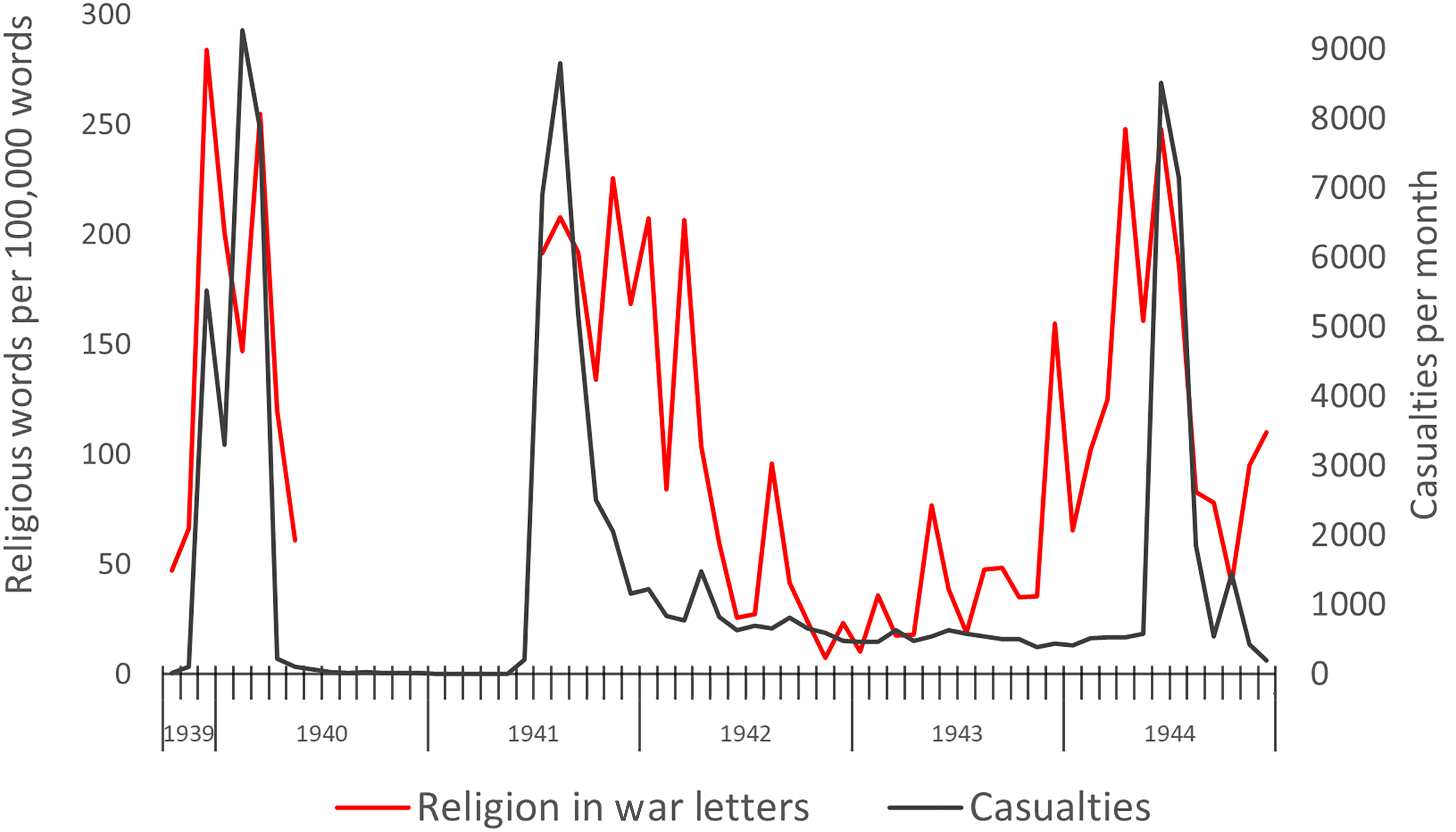
Relative frequency of five religious words (‘God’, ‘Jesus’, ‘prayer’, ‘to pray’ and ‘blessing’) in the War Letter Collection and monthly fatal casualties in the front, October 1939–December 1944.
Finnish historiography has typically claimed that religion played a particularly important role in people's thoughts during the Winter War of 1939–40. Repelling the Soviet invasion was predominantly considered a morally justified defensive war par excellence, and the ‘David versus Goliath’ struggle was widely described in spiritual terms. Especially as the Soviet Union was an atheistic dictatorship and openly antagonistic to religion, it was easy to resort to religious meanings in defining the Finnish self-image against the enemy and the importance of Finland's fight for survival. 17 Our findings provide quantitative support for this earlier interpretation. The highest peak of religious speech in letters took place immediately after the outbreak of the Winter War in December 1939 and religious vocabulary was altogether very common in our data during the winter of 1939–40.
Looking at the war years as a whole, the religiosity of the first months of the war is, however, not the main trend emerging from our data. It is instead that religious talk was closely connected to the intensity of warfare, so that religious words were employed most readily in the heat of combat. It is particularly easy to observe this trend in the Finnish case, as the periods of combat and military inactivity are easy to distinguish, as shown in Figure 1. After the first period of extensive religiosity in 1939–40, the two other high points were during the Finnish offensive in the latter half of 1941 and during the Soviet offensive in the summer of 1944. On the other hand, during the period of stationary warfare in 1942–44, when the casualties were only a fraction of those during the months of active fighting, religious talk was much rarer. 18
These findings correspond to the information that the Finnish Army gathered on soldiers’ religious attitudes during the war. According to the military chaplains’ observations and surveys conducted among the troops, Finnish soldiers were keen to attend religious services during the periods of active fighting but showed much less interest in spiritual matters when there was no immediate danger. Interestingly, though, the chaplains observed that the soldiers’ overall religiosity increased at the end of the war. A survey conducted at the end of the Continuation War showed that the share of men showing religious interest had risen between 1942 and 1944. A large portion of the respondents specifically linked their spiritual growth to their battlefield experiences. 19
Our descriptive statistics on the digitized war letters can be read to support the military chaplains’ observations. Although the intensity of religious talk was closely linked to the intensity of combat, the frequency of religious words rose at Christmas 1943 and then remained very high in the first half of 1944, when there was very little frontline activity and casualties were few. This trend suggests that there are also other factors in play than the mere extent of actual physical violence: the growing threat of battles to come and the insecurity about both national and personal survival could also serve to intensify religious sentiments. During 1941–2, the Finnish morale was generally high due to the successful Finnish offensive and the German advances on the eastern front. All the way until the latter part of 1942, it was largely seen that the Finns had already done their heaviest share in the war and that it was now up to the Germans to finish the conflict with the Soviet Union while the Finnish Army stood down. However, the German defeat at Stalingrad at the turn of 1942–3 was a bitter blow to Finnish public opinion. Followed by a series of other German setbacks, the earlier confidence in a German victory collapsed among the Finnish population. 20
The first half of 1944 was the most anxious period in this respect. After the Red Army broke the siege of Leningrad in January 1944 and launched a bombing campaign against Helsinki the following month, it was becoming apparent to everyone that Finland was again under a serious threat. Finnish peace overtures in March 1944 resulted in disappointment. At the front, Finnish soldiers were alarmed by growing Soviet activity that foreshadowed new battles. Studying the Finnish moods in 1944, historian Henrik Meinander illustrates the gloomy forecasts of this time by noting that there was a collective sense that ‘a hurricane or a thundercloud was menacingly approaching’ the nation. 21 It is plausible to suggest that the increased religiousness in the letters indicates the anxieties of the moment; the growing awareness that a defining, critical stage of the war was imminent and that the Finns had no cause for optimism regarding its outcome. For the frontline soldiers, this was not an abstract matter but a very concrete physical threat. Writing their words in their letters, people were already preparing for the coming violence and loss, which they then eventually faced during the Soviet offensive of June–July 1944. Although the religious talk peaked again when the battles started, it did not actually surpass the frequency of religious words in the spring.
In parallel with the observations on 1943–4, the data from the winter of 1941–2 likewise suggest that it was not the accumulation of violence alone that increased religiosity but that this was also a matter of other acute concerns and mentalities. As shown in Figure 1, the Finnish casualty rates decreased considerably in the autumn months of 1941, but religious language continued to be common in letters for several months until the spring of 1942. This trend may refer to the lasting effect of the victorious Finnish operations in 1941: the high moods of this period, which were commonly expressed in a spiritual fashion, continued to have significance for people months after the end of active military operations as at this point the Finnish people were optimistically awaiting their great, prosperous future. It may, furthermore, refer to the importance of religion in making sense of the personal losses just as religion remained important after the First World War. 22 At the turn of 1941–2, the Finns had suffered staggering losses, first in the Winter War and then in the offensive of 1941; although the casualties were now less heavy, there was a lot to mourn and to seek consolation for.
As a backdrop for the analysis of patriotic vocabulary in wartime letters, it is useful to point to some characteristic features of Finnish nationalism. In the nineteenth century, when Finland was an autonomous part of the Russian Empire, a Finnish national awakening started as a cultural project to define a Finnish nation that would be distinct from Sweden and Russia. From the early twentieth century onwards, Finnish nationalism began to take a more active and militant stand against the growing Russification attempts by the imperial authorities. After Finnish independence in December 1917, a short but bloody civil war raged between the socialists (‘Reds’) and the bourgeois and agrarian parties (‘Whites’). The latter were victorious, and for much of the interwar period, the socialists were largely pushed to the outskirts of the national community. While Russophobic and anti-Bolshevist ideas often combined with Lutheranism and militant nationalism in schools and various civic organizations, Finland still retained its democracy and there were also growing centrist and inclusive tendencies in understanding the Finnish nation in the latter half of the 1930s, thus incorporating also the social-democratic working class. Notwithstanding right-wing attempts to achieve a monopoly of the nation and patriotic rhetoric, Finland of the 1920s and 1930s developed into a nation state with a representative political system and with a wide-ranging network of ‘national’ institutions, policies and cultural influences affecting people's everyday lives in a multitude of ways from sports and music to education and military conscription. 23
Figure 2 shows the frequency of patriotic words in letters, which differs interestingly from that showing the frequency of religious words. Just like religious talk, patriotic language was widespread during the Winter War of 1939–40. This period was in many ways an extremely fertile ground for the emergence of patriotic sentiment. Falling under an unprovoked attack was experienced as a thoroughly unjust violation that threatened the whole existence of the Finnish nation and seemed to reveal the true nature of Soviet imperialism. The ensuing three and a half months of determined defensive warfare in which the outnumbered Finnish Army was successful in repulsing an invader far superior in quantitative terms only reinforced these sentiments. This short period of 105 days and its collective ethos, commonly referred to as ‘the spirit of the Winter War’, is still regularly recalled as the zenith of the Finnish national unity. One important aspect here was that the combined struggle against the Soviet Union was seen as erasing the traumatic memory of the Finnish Civil War in 1918, which had divided the nation for two decades. 24
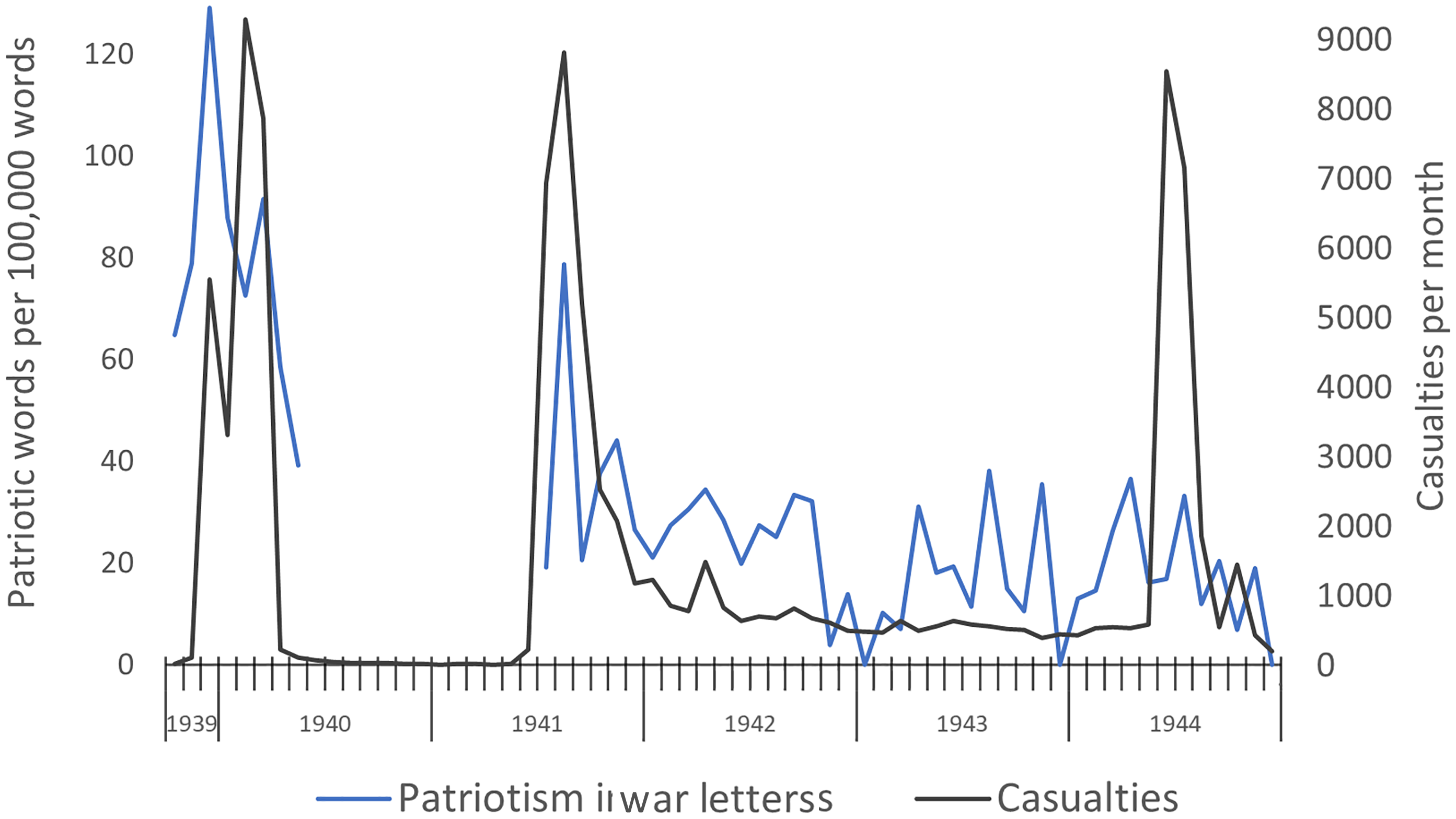
Relative frequency of five patriotic words (‘fatherland’, ‘freedom’, ‘duty’, ‘hero’ and ‘to sacrifice’) in the War Letter Collection and monthly fatal casualties in the front, October 1939–December 1944.
However, the use of patriotic and religious language did not follow the same trend in the later war years. At the outbreak of the Continuation War in 1941, there were strong nationalistic discourses in the Finnish media about a new victorious war and the consequent Greater Finland. It would thus be expected that patriotic vocabulary would also resurge in letters. As shown in Figure 2, this was to some extent the case, but the increase is only moderate if we consider that this was the high period of nationalistic fervour in public talk. 25 And after the very beginning of the Continuation War in the summer of 1941, patriotic words are mentioned only rarely.
In this same vein, historians Ville Kivimäki and Tuomas Tepora have argued that the national-patriotic meanings consigned to the collective war effort began to lose their charm as the war was prolonged. This is not to say that the new war did not enjoy the support of the majority of the Finnish population. When the war broke out in the summer of 1941, it was widely felt to be an inevitable consequence of the Soviet aggression back in 1939–40 and also an opportunity for retribution. Yet after the Finns had recaptured the areas lost in 1940, the just cause of the war was not agreed upon as unanimously as during the defensive struggle in 1939–40. This time, Finland had tied its destiny to German success and the Finns themselves had become invaders and occupiers of large Soviet territories in 1941–4. Spilling blood for offensive purposes did not carry the same mythical aura of moral righteousness as in 1939–40. For instance, as early as in the autumn of 1941 there were already large-scale cases of desertion and disobedience among the troops – phenomena that had been practically non-existent in the Winter War. 26
After the conclusion of the Finnish offensive in late 1941, the use of patriotic language declined much more rapidly, as was the case with religious parlance. Most notably, the Soviet offensive of 1944 did not cause any observable growth in the frequency of patriotic vocabulary at all. At this time, Finland was placed in a very similar position on the edge of the precipice as in the winter of 1939–40, fighting against overwhelming odds to retain its independence. One could expect the patriotic sentiment in letters to peak once more, but this was not the case.
Consequently, unlike in the case of religious talk, it seems that in the latter stages of war patriotic vocabulary had lost its usability and credibility in giving meaning to people's experiences and hardships. Why so? In the cultural histories of war, it has been argued that great human losses and the everyday reality of violence shattered the euphemistic language of high diction that was offered as a cultural framework to interpret one's war experiences. However, this theory does not suit the Finnish case one to one since the use of patriotic language already declined during the period 1942–3 when actual fighting was rare and the casualty numbers at their very lowest. It seems that it was not the continuous accumulation of violence that eroded patriotic meanings but rather the strange lull in the combat together with the prolongation of conflict with no clear end or collectively shared aim in sight. As the war dragged on, its banality and uneventfulness were difficult to address with high patriotism that underlined sacrifice, heroism and a fight for freedom. Furthermore, once lost this vocabulary seems to have been difficult to revive when hostilities resumed in earnest. To investigate this question more in detail, we now take a closer look at the uses and collocations of religious and patriotic vocabulary in letters and how they differ from each other.
Our findings thus far suggest that the fates of patriotic and religious parlance in Finland diverged during the Second World War. While patriotic language saw a clear decline, religious language retained its significance until the very end of the war. Next, we move on to explore the possible reasons for this divergence by analysing more closely the meanings of patriotic and religious language in letters. This is done, first, by examining which words occurred statistically frequently in conjunction with patriotic and religious vocabulary; and second, by looking at the concrete examples of employing religious and patriotic language in letters.
Two lexical patterns emerge from the statistical analysis of words appearing in close proximity to patriotic vocabulary in the war letters. First, death seems to be strongly present in these patriotic discourses. The nouns ‘sacrifice’, ‘life’ and ‘hero’ were often connected to the verbs ‘to demand’ and ‘to fall’ and to the adjective ‘precious’,
27
either to describe a fallen soldier or to prepare for a death in the field, as in the two examples below: Dear Miss K.! The fatherland demands sacrifices! With a heavy heart, I have to add to this second letter an insertion I’d rather not make. Yesterday we faced devastating news: Sergeant Leevi L. had to give his life in the battle against the archenemy.
28
I am fine here if I die then I have fallen in the service of my fatherland and then I have given everything for those ideals we are now protecting. 29
Both examples are taken from the Winter War which was the heyday of patriotic vocabulary in the war letters. The second pattern visible in Figure 3 is related to the collective meaning attributed to individual losses: terms such as ‘shared’, ‘Finland’, ‘the people / nation’ and ‘we’ were frequently used to rationalize patriotic deaths. The contrast in the meaning of death for individuals and wider national community was explicitly addressed in the letters: Although the death of every Finn is sad, one cannot take it seriously enough until someone close to you goes, that is why it is so hard to take. May You be comforted in Your great sorrow by the fact that Pauli was allowed to create a new, great future to our fatherland.
30
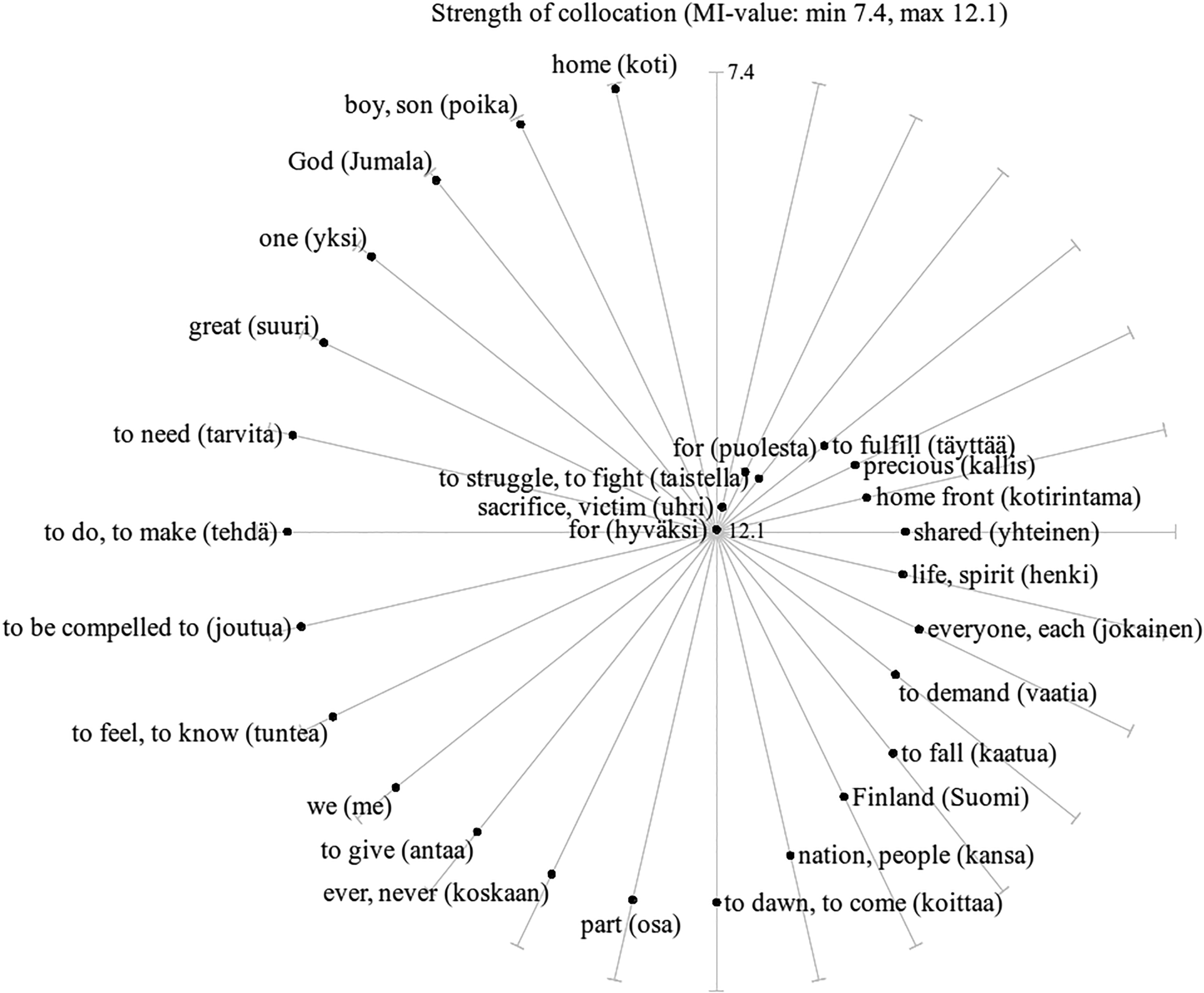
The collocates of fatherland, freedom, duty, hero and to sacrifice in the Finnish War Letter Collection, October 1939–December 1944. Window size: 5 words to the left and 5 words to the right of the search terms. Minimum frequency of collocation: 10 instances. We have not included the search terms in the visualization.
Yes, the war demands sacrifices from us now as before. That is the immutable truth. And what is more beautiful than to die a hero. Although each of us who have a home and a family there at home are fiercely rebelling against it in their hearts. 31
Thus, in regard to the diminishing frequency of patriotic language in wartime letters after 1941, two interrelated things seem to be happening simultaneously. First, soldiers’ deaths at the frontlines were less readily addressed in patriotic terms – and while the deaths were much less frequent from the autumn of 1941 until the summer of 1944, the patriotic language also lost its main theme of reference. Second, the collective ethos of the Winter War (and, to a lesser extent, of 1941) that was expressed through patriotic concepts began to lose its salience and people's interest and motivations withdrew back to the more private spheres of life. Ilona Kemppainen has made a similar observation in her study on Finnish war deaths: in newspaper death announcements, the grandiose words of sacrifice for the nation were commonly replaced by individual expressions of sorrow and loss as the war dragged on. 32 Interestingly, when the fighting started again in June 1944 and the casualties rose, patriotic language seems to have consumed its power to express people's feelings of loss and violence; there was no easy return to the collective ‘we’ of 1939–40 and 1941.
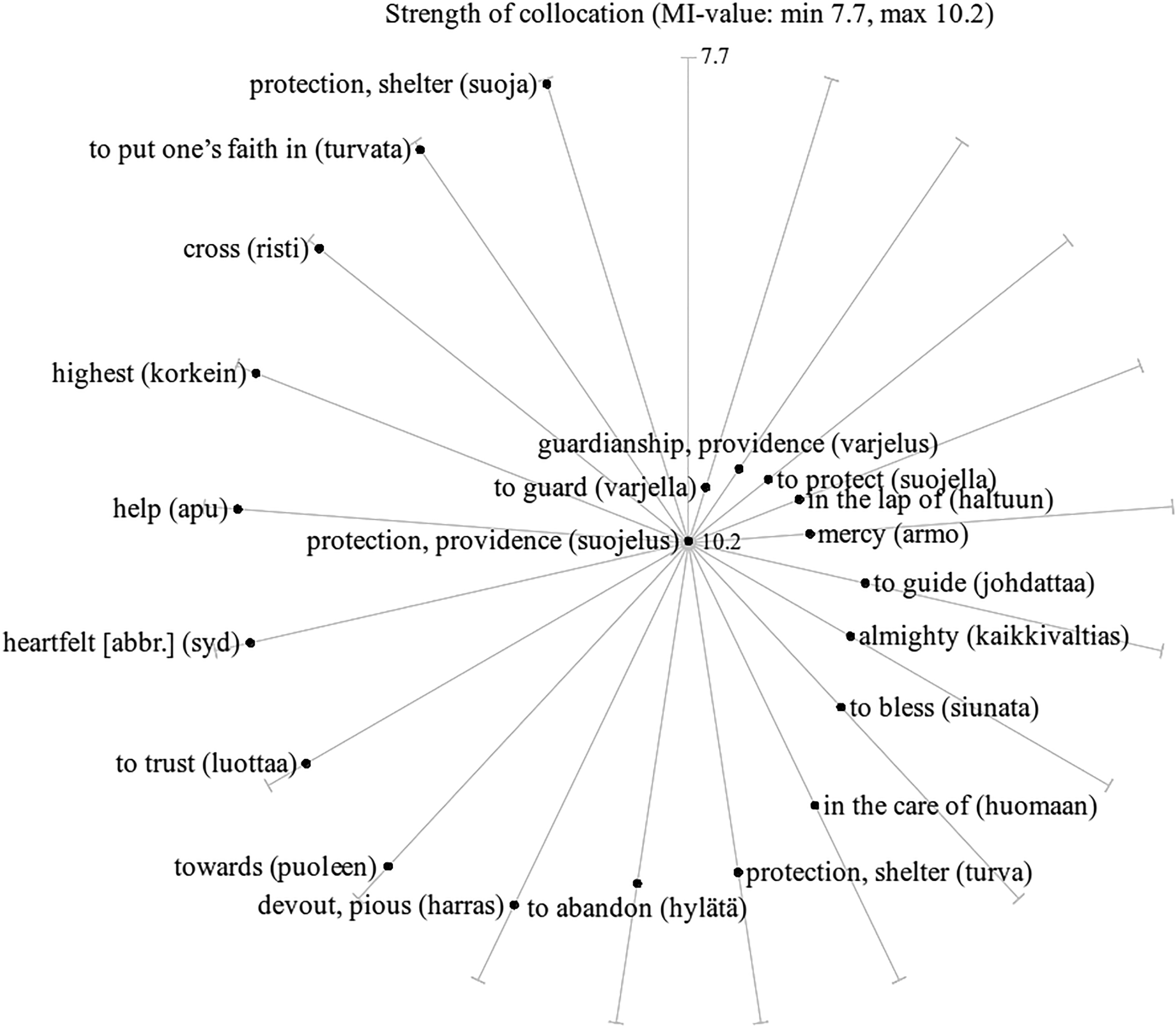
The collocates of God, Jesus, prayer, to pray and blessing in the Finnish War Letter Collection, October 1939–December 1944. Window size: 5 words to the left and 5 words to the right of the search terms. Minimum frequency of collocation: 10 instances. We have not included the search terms in the visualization.
Religion has most often been associated with coping with death in the cultural histories of war. It has been at the heart of mourning and making sense of one's losses.
33
The meaning of religious talk in the war letters is more complex. Naturally, religious language is tightly linked to war-related fatalities, also in letters, as can be seen by the significant increase in its occurrences during and after the heated periods of combat. Yet, and importantly, religious sentiments were not only a reaction to actual losses but they were also connected to the anticipation and fear of death and hardships. People turned to God during times when soldiers were at greatest risk or even before when danger felt imminent, wishing in their words that God would spare their own and their beloved one's lives. The words that are most frequently associated with our chosen religious vocabulary like ‘guardianship’, ‘to guard’, ‘protection’ and ‘to protect’ predominantly exemplify this purpose (Figure 4): I am happy to have You and to be able to love a woman like you. May God protect us and in His mercy give us health and strength to survive the troubles of the war until we shall be together once more.
34
My limbs are still in one piece. Here there is such a roaring now that one cannot do anything but trust in God's guardianship. […] These are the most bitter times I can't write more. 35
There are no other wishes here than the war to end and that God would protect us so long that one could come back home alive. To his beloved wife and children. 36
One important reason why letters display primarily the fear of death rather than its actualization arises from the nature of wartime letter relationships. During the war, people – and especially close family members – exchanged letters at a frantic pace, typically every few days, and the letter contents mirror this everyday function of communication. There are some cases in our data where people discuss their family members’ or relatives’ deaths, but these instances are overall in the minority. The meaning of religious talk in letters is thus primarily in coping with the emotionally devastating environment of the war and, in particular, the possibility of death. When facing a period when soldiers were most likely to be wounded in action, people turned to God for protection and emotional comfort for their anxiety. Writing about the protection of God in letters was in a sense a prayer. 37 This intention lost its meaning when the frontline situation became less hectic and perhaps also because people became inured to the uncertainty of war over time. However, as is seen in the last phase of heavy fighting in 1944, religion again rose to prominence when the men faced dangers at the end of the war. The letters thus display a widely perceived behaviour: people often turn to religion for help in times of great stress. 38
In this crucial respect, the contexts in which patriotism and religion were used in letters were different. But was there also a connection between these two languages? This is an important question because it has been common to view these two modes as integral parts of the same old, ‘traditional’ way of understanding war in the cultural history of war. As noted earlier, the link between religion and patriotism was firm also in Finland. During the war, it was especially reinforced by the military chaplains, who strove to legitimize the national war effort with religious underpinnings, stressing how the Finns were not only defending the freedom of their nation but also the Christian faith by associating the Finnish struggles with biblical ethics and even the history of holy wars and crusades. 39 This close bond between patriotism and religion in the Second World War Finland was put into words most famously by the Commander in Chief of the Finnish Army, Field Marshal Mannerheim, who declared in his widely distributed first daily order of the war that the Finns were fighting for ‘home, religion, and the fatherland.’
Although patriotic and religious modes of expression were typically used differently in letters, they also had connections. This is seen in the collocates of the patriotic vocabulary which include the word ‘God.’ This connection prevailed primarily during the early stages of war in 1939–40. The letters from this period testify that the connection between patriotism and religion, as scholars like Ilona Kemppainen and Tuomas Tepora have emphasized, was not mere empty words or hollow propaganda but a real experience for many ordinary Finns during the early parts of the war;
40
in fact, the famous mantra of ‘home, religion and the fatherland’ recurs literally in several letters: You behind the battle front, rest assured that here at the front are standing boys who fight with their trust in God. We fight for home, religion and fatherland. We are ready to die for them.
41
So far I have not got a scratch in this war. Although I have been in some hot spots. And many comrades are now cold. Their earthly struggle is over. When they have given their all for Fatherland, faith and home. I wonder how many of us will remain until the victory has been achieved. 42
These instances where people repeated phrases from media or propaganda do not necessarily tell about deep religious sensations. 43 They are more a reflection of the power of collective sentiments in Finland during this period and how they penetrated even the most private lives. Religion and patriotism go hand in hand here because, along with the concept of ‘home’, they were part and parcel of the same widely repeated and accepted cultural expression. 44
However, when we move to inspect the later war years, the connection between religion and patriotism, along with the overall decline in patriotism, fades. Religion persists in people's writing in 1941–4, but here its meaning is predominantly personal and devoid of explicit collective sentiment. Most notably, the militant patriotic themes that were common in military chaplains’ preaching during the offensive operations of the Finnish Army in 1941 are very rare if not totally absent from our data. There are no remarks about ‘holy wars’ in the letters and ‘crusades’ are mentioned only a few times and then too not in serious tones but rather in a playful or ironic manner. 45 There is, thus, a cultural rupture discernible in the letter contents: collective patriotic vocabulary becomes rare, apparently inadequate to address the banal hardships and incessant insecurities people had to face during the war. In the Finnish context, this can be seen as a phenomenon parallel to the canonic interpretation of the First World War as an experience that undermined the patriotic language of the pre-war era and the initial stages of the conflict. Yet the case of religious language is more complex. Unlike patriotic sentiments, religious vocabulary was able to perform two distinctive functions simultaneously: to address collective feelings (the ‘God–fatherland’ nexus) and to refer to very personal concerns and experiences. It is somewhat artificial to separate these two purposes, as religious talk certainly pertained to some level of collective sentiment even without direct associations with patriotic vocabulary. However, it seems clear that religious parlance focused increasingly on its private meanings as the war went on. In contrast to patriotic vocabulary, religious words regained their prominence in letters in the final stages of the Second World War.
The primary result of our article is that the trajectories of patriotic and religious language diverged from each other in the course of the Second World War: while in the Winter War, they both peaked simultaneously and frequently appeared together in the letters, by the end of the Continuation War, religious language still flourished but patriotic language had disappeared from private letter communication. Our findings thus provide further evidence to add to the existing Finnish scholarship, which has argued that patriotic language lost its meaning during the war; in this sense, a clear cultural rupture took place in Finland.
However, our data visualizations of digitized war letters enable us to examine this change more profoundly than would be possible if only observing with the naked eye, that is, relying only on manual close reading of primary sources. First, the large amount of quantitative data reveals a dramatic variation in the use of both patriotic and religious words over time. These two languages were part of the ideological lexicon of Finnish culture throughout the war, but they apparently gained prominence in people's letter exchanges in a striking fashion seemingly only during periods of intense combat and anxiety. This finding illustrates plainly the changing experiential landscape of the war that was attached to the changing political and military situations as well as people's emotional responses and adjustment to the war.
These changes as such tell a lot about the meanings that patriotic and religious speech had for people during the war. We continued our inspection by examining statistically the words that co-occurred within the two styles in question. This reveals clear differences in their functions: patriotic words were often needed to give a collective meaning to deaths that had already taken place in the front, whereas the main function of religious language was to prevent deaths from happening. ‘Fatherland’ did not provide protection but kept demanding sacrifices, whereas God was addressed for salvation and comfort. A crucial finding is also the asymmetric relation between the two types of language. While God appeared more frequently than statistically expected in the context of patriotic words, religious vocabulary had more important lexical companions than patriotic ones. This reveals most of all, the dual meaning of religion. It belonged to the public, collective discourse of the war, which appeared in the letters in the early phases of the war, but its more enduring meaning was the private one that was a vehicle of emotional coping. Our view is that understanding these divergent meanings of types of language is paramount in the cultural histories of war. It is tempting to draw lines between cultural modes such as ‘traditional’ and ‘modern’, but closer inspection reveals a complex, overlapping web of meanings that do not often fit into these simplified categories.
Our article also questions the connection between public language and private experiences. A prime advantage of studying digitized letters is that we can acquire statistical information on ordinary people's daily communication to a precision and extent that has not so far been possible. Our findings in this regard point to the diverging of private and public realms during the prolonged war. Early in the war, letters contain a plenty of patriotic, collective themes that flourished in the public sphere, but after 1941 these themes have merely a minor role, although they have previously been shown to have continued to manifest prominently in wartime media. This brings to the fore the question of agency: if individuals are able to choose the words they use in their war letters, why do they tend to make similar choices at the same time? The distinctive peaks in both patriotic and religious styles manifest that a seemingly free human agency, in what could be conceptualized as the private sphere of societal life, can produce surprisingly uniform patterns when individual acts are aggregated together. On the other hand, the different long-term trajectories of patriotic and religious language can be taken to indicate people's capacity to choose between the alternative meanings given to exceptional violence, and their resistance to blindly follow hegemonic cultural scripts offered by the media in their personal lives. Perhaps it is safest to say that the degree of agency depends on the historical situation: in extreme moments such as the deadliest war months, people's choices often converge, but universal laws are not found in the concrete histories of war experiences.
Finally, our article shows what the rapidly developing digital methods and datasets can offer for the study of war. Since its origins in the 1970s, the cultural history of war has relied heavily on the manual reading of individual testimonies like memoirs, poems and letters. While we in no way claim that the close reading of individual experiences would not be important also in the future – indeed, we consider the focus on lived experiences as pertinent for the study of war – we argue that the digital analysis of wartime texts can shed valuable new light on a field traditionally dominated by qualitative approaches. Computational methods offer no simple answers to complex research questions, but they can guide our attention towards dominant patterns and trends in the sources. This is particularly helpful in the context of such a grand-scale historical phenomenon as the presumed cultural rupture brought about by war experiences. When dealing with such vast questions, historians can read only a tiny slice of relevant subject matter by taking physical sources into their own hands. This easily leads to biases such as overemphasizing those writers who express themselves in a particularly skilful manner – and are able to publish their thoughts. In the coming years, when more autobiographical texts will be digitized and computational methods improve further, we as social and cultural historians of war will have a better understanding of what is commonplace and what is extraordinary in people's experiences of world wars.
Footnotes
Acknowledgements
The article was written in the project ‘DIGIKÄKI – Digital History and Handwritten Sources’ funded by the Jalmari Finne Foundation and operating at the Academy of Finland Centre of Excellence in the History of Experiences, Tampere University.
