




Abstract
This conceptual historical investigation of Adolf Hitler's use of the term ‘worldview’ (Weltanschauung) opens new perspectives on the debate over the relationship of religion and National Socialism. Most studies of Hitler's worldview have focused on the genealogy of his beliefs, an approach that has led to an anachronistic understanding of worldview. By contrast, this article reveals that Hitler's own usage of the term ‘worldview’ was decisively shaped by the German culture wars that preceded his entrance into politics in 1919. The article shows how the varying Nazi religious policies, from supporting ‘positive Christianity’ during the Weimar Republic to suppressing elements within the churches once taking power, continued to be framed by the dynamics of the culture wars.
Adolf Hitler devoted considerable attention in his writings and speeches to the role of worldview (Weltanschauung) in the functioning and ultimate success of National Socialism. ‘Every worldview’, he wrote in Mein Kampf, be it correct and of greatest benefit for humanity a thousand times over, will remain without importance for the practical development of a nation's life (Völkerleben) unless it is written on the banner of a fighting movement … This transformation of an ideal conception of a general worldview of utmost veracity into a clearly delimited, strictly organized, spiritually and volitionally unified political community of faith and struggle is the most important task, because the possibility of the victory of an idea depends entirely upon its successful completion.
1
Hitler insinuated that he possessed the unique gift of being able to fuse these roles. However, the initial wave of critical studies of Hitler in the 1950s and early 1960s found him to represent, in the first instance, the second of these ideal types, the Machiavellian politician who approached worldview in a pragmatic, if not cynical fashion. Allan Bullock stated that ‘the only principle of Nazism was power and domination for its own sake’, 3 while Martin Broszat concluded that ‘for Hitler worldview was largely mere phraseology'. The object of ‘belief’ was not a ‘mental concept, i.e. one that is held to be true, but the party, the organization, its activities and its and his success.’ 4
Although many authors persisted and today still persist in denigrating Hitler's thought as eclectic and derivative, 5 , in 1969 Eberhard Jäckel made the case for the coherence of Hitler's worldview and for its centrality to the Nazi system. Following this lead, Sebastian Haffner assigned Hitler to the class of politicians, who, like Lenin, were more prophetic than opportunistic. Later Ian Kershaw took up the idea of the ‘progammatist’ in his influential mediation of the intentionalist and functionalist interpretations of National Socialism. According to Kershaw, the distance between the prophetic vision set by the charismatic dictator and the mundane political operations of his subordinates was crucial to the dynamism of the regime, as it created space for the subordinates to ‘work towards the Führer’. 6
Jäckel's study further elaborated the dichotomous understanding of Hitler's worldview, when he proposed splitting it into two dimensions. The first consisted of Hitler's personal views, that is, ‘how [he] saw the world’, and the second comprised the system of thought that he offered for public consumption. 7 Utilizing this differentiation, subsequent scholars have sought to disentangle Hitler's ‘real’ or core beliefs from Nazi propaganda. Increasingly, a concern with ‘faith’ has entered the analysis of both sides of this dichotomy. There has been a growing interest in the religious content of Hitler's thought, on the one hand, and the politics of religion pursued by the National Socialist Party (NSDAP), on the other. This article enters into this area of lively scholarly debate. Yet, rather than locating Hitler's worldview somewhere on a continuum between inner faith and outer politics, it asks instead what may be gained by reconsidering Hitler's worldview in the context of the German culture wars of the early twentieth century. Before arguing for the benefits of this reorientation, it will be necessary to sketch out the existing historiographical approaches that have been taken to religion and Hitler's worldview.
The strongest case for placing religion at the centre of Hitler's motivations has been made by historians who adopted the theory – first advanced by interwar Catholic apologists – that at root Nazism was a ‘political religion’. According to one advocate of this theory, Klaus Vondung, the ‘apocalyptic worldview of Hitler and other Nazis [was] the most poignant manifestation of the National Socialist political religion and, above all, … the only plausible explanation for the Holocaust.’ 8 Although most scholars would reject such a totalizing explanation, many have nonetheless utilized aspects of the theory of political religion, arguing, for example, that utopian political ideologies were a compensatory response to the rapid modernization and secularization of German society. 9 Others have used theological terminology to describe the deep structures responsible for the regime's violence. Saul Friedländer called, for example, ‘redemptive antisemitism’ the ‘distinctive aspect of [Hitler's] worldview’. 10 Meanwhile, the political scientists driving the recent renewed interest in comparative fascism have put religious structures at the heart of their pithy definitions of generic fascism. For Roger Griffin the essence of fascism is ‘rebirth’ while for Michael Mann it is ‘transcendent and cleansing nation-statism'. 11
In what likely remains the most influential account of the relationship of National Socialism and religion, Klaus Scholder identified the contribution of Protestant thinkers to the ideology of the far right. Scholder concluded, however, that Hitler's worldview was largely grounded in the völkisch belief that each people required an arteigene faith, that is, one specific to its racial make-up. 12 If Scholder maintained that Nazism was, on balance, anti-Christian, in the 1990s a number of scholars began to tip the scales the other way with investigations of the penetration of the Protestant church by Nazi worldview, particularly in the German Christian movement. 13 The publication in 2003 of Richard Steigmann-Gall's The Holy Reich sparked controversy with its argument that the pro-Christian rhetoric of leading Nazis was not purely instrumental and that their core beliefs needed to be understood as an elaboration of key tenets of contemporary Christianity. This claim has been challenged, most recently by Samuel Koehne, who restated the case made by Scholder that Hitler's core faith was an esoteric race religion essentially hostile to Christianity. 14
The dichotomous approaches outlined above have been combined in Timothy Snyder's recent study Black Earth: The Holocaust as History and Warning. The book opens by locating Hitler's worldview in the tension between inner belief and exterior instrumental construction. His core belief, according to Snyder, was simple: endless racial struggle for territory and resources in which ‘the law of the jungle is the only law’. The outer shell was a calculated ideology that allowed the German race to organize itself: ‘What a race needed, thought Hitler, was a ‘worldview’ that permitted it to triumph, which meant, in the final analysis, ‘faith’ in its own mindless mission.’ Between the authentic and the instrumental pole lay ‘Hitler's worldview’, a discourse that ‘dismissed religious and secular traditions, yet relied upon both.’ 15 In the subsequent chapters Snyder transposes Kershaw's functionalist-intentionalist synthesis onto Nazi-occupied Eastern Europe. He argues that Hitler's racial worldview was the drive shaft onto which the various parties present in the occupied countries attached their own small motors and differentials, thereby contributing to the shape and speed of the Holocaust. Although Snyder's book remains principally concerned with these contingent factors in the East, Hitler's worldview still operates off-stage as the primum movens.
Snyder's approach is typical of most interpretations of Hitler's worldview mentioned thus far, which make a clear distinction between an internal core belief, on the one side, and public pronouncements and political engagement in the realm of religion and ideas, on the other. They privilege the former as the seat of action, which creates effects in the latter. This predominant model of approaching worldview appeals to a common sense understanding of human agency and seems particularly appropriate when analysing Hitler, who is widely taken to be the epitome of charismatic leadership, in which effects radiate from the person of the leader. Moreover, unlike other political ideologies, National Socialist worldview appears to have entered and exited the world stage with Hitler and to have been dependent upon his own articulation of it.
Without impugning the details of this scholarship, I want to underscore that the application of the term ‘worldview’ to both inner beliefs and public system of meaning is anachronistic. When Jäckel extended the term Weltanschauung in an anthropological direction to describe an individual's mental framework, he signalled his awareness that he was introducing an anachronism. After claiming that ‘even the uneducated, the very primitive, yes, even the mentally ill person has a picture of his environment, a view of the world’, he added the qualification that ‘[o]ne can consider it a world picture (Weltbild) instead of a worldview (Weltanschauung).’ 16 Blurring the difference between Weltbild and Weltanschauung became thinkable in West Germany only after the project of Weltanschauung had collapsed from the dual weight of the failure of National Socialism and the threat of Soviet communism. Once translated into English, the term became even more malleable and could stand in for any number of ideas relating to world and vision, from global strategy to political ideology and from racism to religious faith. 17
The anachronistic redeployment of historical terms can lead to analytical gain. This journal special issue, for example, argues that the term Kulturkampf can be taken from its narrow association with Germany in the 1870s and usefully applied to the interwar period as well. However, when scholars remain unaware of their anachronism and project their newer definition back on to the older usage, an occlusion of important dynamics connected to that term can occur. This, I submit, is the case for the historical investigation of Hitler's Weltanschauung. Hitler did not associate Weltanschauung with his private beliefs, nor was it a discarded semantic tool of a past era that he picked up in the streets and utilized as he saw fit. Quite the opposite. When Hitler was cooling his heels as a political nobody in a Bavarian barracks of the Reichswehr in late January 1919, 18 Max Weber described the contemporary political scene as ‘clash of worldviews’ to a crowd of Munich students in his famous speech ‘Politics as Vocation’. In other words, the term already structured a field of political and religious relations before Hitler emerged on the scene. According to conceptual historian Reinhart Koselleck, such categories created a space for experience and set a horizon for imagining future action (Erfahrungsraum and Erwartungshorizont). 19 As such, however adroitly Hitler may have used the concept of Weltanschauung later, it was already shaping his experiences and his future horizons before he claimed it in the name of the National Socialist Party (NSDAP).
The point here is that the application of worldview/Weltanschauung to everything from antisemitism, to völkisch spirituality, to social Darwinism, to plans for world conquest has led to a misapprehension of Hitler's use of the term. It has thereby obscured a useful vantage point for observing the religious politics of the NSDAP. In order to explain Hitler's statements on worldview, this article seeks first to recreate the restricted meanings of the term available to him. These had been generated within the competing social movements, churches and political parties that made up the nineteenth and twentieth-century culture wars. ‘Worldview’ had multiple definitions. However, when invoked in political discourse, it generally located the speaker directly or indirectly within fierce conflicts over religion, confessional division and secularism. The article then explores how Hitler used ‘worldview’ to think through the problems of confessional division in German history and come up with novel arguments about how a new nationalist, secular worldview might lead to their resolution. It examines the religious polemics used by Hitler to curry favour and shape his movement in the struggle for power. Finally, it shows the logical continuity in worldview politics between Hitler's early support of ‘positive Christianity’ and the increasing antireligious statements he made after taking power in 1933.
The connection between worldview and culture war goes back to the 1830s and 1840s, when religious conflicts became caught up in struggles between liberal and conservative political movements, and Weltanschauung left the realm of philosophy and became a key term in German public discourse. The renewed confessional struggle between Catholics and Protestants was one major fault line of the period, but more crucial for the development of worldview was the contestation between secularists and conservative Christians. 20 In the 1840s, Weltanschauung was embraced by intellectual and social movements on the left, including rationalist Christian dissenters who gathered in what later became known as the Free Religious Congregations. As they departed from the churches, these congregations began to develop clearly secularist spiritualties and, in the process, increasingly replaced terms such as ‘theology’ and ‘faith’ with ‘worldview’. 21
The Free Religious Congregations placed their struggle within a temporal scheme, accusing ‘old’ Christianity of using repressive means to block the ‘new’ worldview, which they increasingly conceived of as a total, monistic and immanent understanding of matter and spirit, underpinned by empirical science. One of their leaders, Eduard Baltzer, a former Protestant preacher, was the first to entitle a publication Old and New Worldviews in 1850. By the time the former Young Hegelian David Friedrich Strauss followed suit with his bestseller of 1873, The Old Faith and the New: A Confession, the secularist definition of Weltanschauung as a system of thought and ethics that had to be ‘unified and natural-scientific’ had become predominant, though by no means exclusive. 22 This predominance is proven ex negativo by the fact that in the 1880s and 1890s a number of Protestant apologists began to call for the formation of a ‘Christian worldview’, which they modelled explicitly on the naturalist worldview promulgated by anti-Christian popular scientists, such as the ‘German Darwin’ Ernst Haeckel. 23
By the early twentieth century, the secularist-religious struggle over worldview had carried over into partisan politics, giving the concept a further layer of meaning. In an address to a congress of sociologists in 1910, Max Weber identified two ‘worldview parties’ (Weltanschauungsparteien): Social Democracy and the Catholic Centre Party. For Weber, the power they claimed for their worldview stood in inverse proportion to their actual political power. As he sketched out in his Munich speech of 1919, the attachment to worldview was, in large measure, a defensive reaction to the marginalization that the socialist and the Catholic milieus had experienced as a result of Bismarck's Kulturkampf and anti-socialist laws in the 1870s and 1880s. Worldview supported the internal unity of these outsiders by offering them a vision of a better future, however it also led them into a ‘politics of conviction’ (Gesinnung) that did not allow them a realistic appraisal of political dilemmas nor the flexibility to reach compromises. 24 In other words, the claims implicit in the term Weltanschauung in 1919, i.e. a privileged access to a totalizing, noncontradictory system of truth with a clear ethical and political program, correlated to the powerless position of minority parties without real hope of being able to shape rational national policies. For this reason, Weber urged Munich students to avoid the temptation of the worldview parties, which he felt would ultimately undermine the dominance of educated elites. Yet, according to historian Frank Bösch, wartime defeat and revolution were traumatic experiences that consolidated the conservative milieu, just as the Kulturkampf and the Socialists Laws had consolidated the Catholic and working-class milieus in the 1870s and 1880s. 25 Having been robbed of the crown and the authoritarian state as points of identification above the parties, conservatives of all stripes, including the NSDAP, saw themselves as outsiders in the new republic and increasingly articulated their own revisionist programs in the language of worldview.
There were, however, counter currents working against the postwar drift to worldview. The viability of Weimar democracy hinged on the willingness of the Centre Party and the Social Democratic Party (SPD) to enter into coalition government. Precisely because these parties were deeply divided over religion, screwing back worldview politics was a crucial precondition for cooperation. The division of the socialist movement in 1917 left most of the radical secularists and doctrinaire Marxists in the camp of the left-wing Independent Socialist Party (USPD), which remained outside the government. This made it easier for the rump party to strike compromises with the Centre Party on religious matters. Religious socialists greeted the religious neutrality of the SPD's Görlitzer Program of 1921 as proof that ‘there was no uniform worldview with socialism’. 26
During the mid-1920s, friction between the SPD and the Centre Party over worldview differences increased. Many anticlerical freethinkers had re-entered the SPD following reunification with the USPD in 1922 and they formed a vocal and disgruntled minority that opposed concessions to the Centre Party and periodically launched church-leaving campaigns. This renewed identification of the SPD with godlessness was followed after 1928 by rising communist anticlericalism in response to the example set by Soviet antireligious policies. This led the Vatican to increase its pressure on the Centre Party to forgo any future coalitions with the SPD. Following the collapse of the Centre-led coalition under Chancellor Wilhelm Marx in 1928, conflicts erupted over the role of Christian labour unions and over the party's commitment to republican government. The election of a priest, Ludwig Kaas, to party chair in December 1928 helped resolve these crises, because it returned the party to its core worldview in Catholicism. 27 Party intellectuals proudly and with increasing frequency announced that among all Weimar parties, Centre represented ‘the party of worldview’. 28
Pope Pius's call for a ‘crusade of prayer’ against the persecution of religious believers and institutions in the Soviet Union in February 1930 was a signal event in the interwar Kulturkampf. The German churches mobilized against what they perceived to be the growing domestic threat of godlessness, represented by the communist and socialist Freethought organizations, which had grown to around 120,000 and 500,000 members respectively. The German right welcomed the Kulturkampf as a new arena of struggle in which it might appear as the champion of the churches. The leader of Stahlhelm, Germany's most vocal veterans’ organization, told a rally just before Easter of 1931 that if their efforts to end the SPD-Centre coalition in Prussia triggered a civil war, ‘this is also a war of Christian versus godless worldview’. 29 In the poisoned atmosphere of the late Weimar Republic, moderate parties appeared rudderless while those espousing worldview appeared to rule the day. 30
Before examining how Hitler positioned his party's religious politics within the interwar Kulturkampf, this article first turns to Hitler's novel perspective on worldview. Alone among the leaders of the German ‘worldview parties’, indeed probably alone among totalitarian dictators of the twentieth century, Hitler achieved a second-order perspective on worldview that contributed to his self-reflexive practice, the performative qualities of which have fascinated historians. Three factors may help explain why and how Hitler arrived at this unique perspective.
The first factor was that the nationalist right was a relative latecomer to the discourse on worldview, which meant Hitler had no clear model of what a right-wing ‘worldview party’ would consist. 31 Chauvinistic pressure groups and disparate völkisch associations in the late Wilhelmine period had bandied about the term, yet, it was only with the First World War that many on the right began to claim that German nationalism itself had, or should have, a worldview. Symptomatic of this trend was the declaration by Wilhelm II to his General Staff in June 1918 that the nation was engaged not in a military struggle, but in ‘a war of two worldviews’, in which ‘either the Prussian-German-Germanic worldview (preußisch-deutsch-germanische Weltanschauung), which honours justice, freedom, morality and honour, shall remain or else the Anglo-Saxon [worldview], which means: succumbing to the idolatry of money.’ This speech continued but also inverted the logic of one of the Kaiser's most successful public speeches, given at the outset of the war, in which he had declared: ‘I no longer recognize parties or confessions’. 32 Whereas the first speech appeared to end the anticatholic Kulturkampf, the second suggested the opening of a new, antisemitic Kulturkampf, at least that was the conclusion drawn by the Pan-German League. 33 Given the still inchoate nature of conservative worldview talk at the end of the war, it is not surprising that an activist seeking to make his mark in the consolidating reactionary milieu might develop an awareness of the openness of the term at that historical conjuncture.
A second factor conducive to Hitler's self-reflection was his position as an agitator. Hitler claimed to have ‘won a founded worldview’ prior to entering politics. In Mein Kampf he invoked a traditional Christian conversion narrative to describe the moment around 1909 when the ‘scales fell from [his] eyes’ and he accepted the antisemitic worldview and ‘was able to understand everything with it'. 34 Most historians, however, doubt the veracity of this account. 35 Ian Kershaw has argued that the consolidation of Hitler's worldview probably occurred in spring 1919 in response to the Bavarian council revolution and was projected backwards in order to give Hitler's claims to prophetic inspiration a clear narrative. According to Thomas Weber, the elements of völkisch thought that Hitler had been cobbling together during an army propaganda course fused under the shock caused by the terms of the Treaty of Versailles announced in July 1919. 36 If these dates are correct and Hitler's ideals gained coherence at roughly the same time that he began to agitate in public, then the relationship between belief and action needs to be understood dialectically. Whatever the origins of his ideas may have been, he developed them into a worldview in the performative context of agitation. The meeting hall served as a laboratory for experimentation in which Hitler tested his message in front of a live crowd. The resulting reflections on the relationship between the would-be prophet and his audience found their way into his theory of worldview. 37
A third factor that accounts for Hitler's unique perspective was the relationship he saw between worldview and truth. He told the National Socialist Party Congress in September 1933 that worldview ‘can be correct or false’, the important thing is that it corresponds to the interests of the individual who articulates it. 38 Rather than providing an accurate understanding of the laws of nature, worldview merely had to help the individual succeed in a world governed by these laws. Its suitability was determined ex post facto, that is, by the outcome of the Darwinian struggle for existence. This marked a significant departure from the epistemological grounding of worldview operative in the Catholic or socialist camps, which held their respective worldviews to be rooted in Biblical revelation or the scientific observation of social and biological reality. 39 In other words, whether revealed by God, nature or history, the shared assumption was that worldviews were founded upon an essential truth.
When Hitler claimed that worldview and truth were not identical, he was not expressing a relativist viewpoint, such as that put forward in 1920 by philosopher Heinrich Rickert, who argued that worldviews were essentially expressions of the shared values of a group. 40 For Hitler, worldview spoke not to the values or culture of a people but to their common biological disposition (Veranlagung). 41 This racial disposition, he claimed, admittedly vaguely, originated in divine providence. Worldview enabled a race to reach forward to the fulfilment of its purpose, or as Hitler often said, its ‘mission’ (Sendung) in history. 42
The origins of this theory likely lay in Hitler's readings of völkisch pamphlet literature, 43 however it does not follow that Hitler considered völkisch ideology the only expression of the racial Veranlagung of the German people. Such ideas were useless, he claimed, if they did not move the masses. The purpose of worldview was not to help individuals achieve objective self-consciousness or a true understanding of the world, but rather to unify a collective and give it the ability to act. It is significant that the above-mentioned speech to the 1933 Party Congress was on the subject of ‘German Art’. Worldview, like a work of art, had to resonate with the audience of racially homogenous individuals. Where worldview failed to mobilize, it had to be modified. Hitler applied this aesthetic test to völkisch teaching itself. Unlike some of his more zealous lieutenants, such as Heinrich Himmler and Alfred Rosenberg, Hitler side-lined völkisch culture wherever it threatened to limit the growth of the movement. He repeatedly made contemptuous remarks about the ‘Wotan worshippers’ in the party, and in 1927 removed the outspoken völkisch ideologue, Artur Dinter, from his position as Gauleiter. 44 When it came to worldview, Hitler wrote, ‘everything is to be measured and used or discarded according to its utility. In this way, theory cannot calcify into a deadly doctrine, given that everything is to serve life.’ At its core, Hitler claimed for his faith ‘only one doctrine: people (Volk) und fatherland (Vaterland)’. 45 This claim clearly indicates that racial theory was a cornerstone of Hitler's worldview. However, in light of our analysis, it also needs to be understood as a statement about the primacy of the audience that worldview was meant to unite.
Clear evidence that Hitler prioritized the effect of worldview over its content is found in his appreciation of the Christian churches, in particular the Catholic Church. In the chapter ‘Worldview and Organization’ in Mein Kampf, he praised the early Christian church for its merciless persecution of rivals. Not satisfied with building its own altar, ‘it necessarily proceeded to the destruction of heathen altars. Only out of this fanatical intolerance could apodictic faith develop; in fact, intolerance is the essential precondition for it.’ 46 Hitler believed that modern science was the death knell of Christianity, but this only made him more appreciative of the on-going Catholic defence of absolute faith against science and modernism. The Church had ‘recognized quite rightly that its resilience lay not in a greater or lesser accommodation to the current state of scientific discovery, which in reality always fluctuates, but rather in its rigid adherence to its once proclaimed dogmas.’ 47 This conclusion corresponded to Hitler's performative understanding of worldview, in which the avowal of truth, rather than truth itself was crucial. Unlike political parties that are open to compromise, ‘worldviews proclaim their infallibility'. 48 During a speech in 1927 he insisted that what allowed men to lay down their lives in battle was not knowledge but faith. 49
The history of Christianity also delivered Hitler examples of the failure of worldview. In a speech given to the Düsseldorf Industry Club in January 1932, Hitler argued that after the Reformation, Christianity became the greatest force holding Germany back in the imperialistic struggle, which he held to be the chief drama of world history: Germany once had – as the first precondition for the organization of our people as a whole – a worldview basis in our religion, Christianity. When this worldview basis was shattered, we see how the outwardly directed power of the nation turned to internal struggles, because nature compels people by inner necessity to search for a new common basis the moment that the common worldview basis is lost or weakened. These are the great eras of civil wars, religious wars, etc. – struggles and confusion, in which either a new worldview platform is found and upon it is built a nation that can again direct its power outwardly, or else the people splits and disintegrates. In Germany this process took place in nearly classical form. The religious struggles meant a retreat of the entire German energy to the inside, an absorption and expenditure of this energy in the interior and thus automatically a slowly creeping unresponsiveness to the great international global events.
50
Although the need for a separation of secular worldviews from the Christian confessions was one lesson of the Kulturkampf, Hitler was at pains to stress that this did not mean that his movement was anti-Christian. In speeches, he frequently referred to NSDAP support of ‘positive Christianity’ as laid out in point 24 of the 1920 party program: We demand freedom for all religious confessions within the state, insofar as they do not endanger its existence or conflict with the ethical or moral sentiments of the German race. The party as such represents the principle of positive Christianity, without binding itself to a particular confession. It combats the Jewish-materialistic spirit within and without us, and is convinced that a lasting recovery of our Volk can only proceed from within, based on the principle: common interest before personal interest.
52
Historian Derek Hastings has done most to uncover the confessional politics of the early NSDAP. According to Hastings, the nationalist tradition of ‘reform Catholicism’ in Munich provided a nurturing environment for the fledgling movement. Despite Koehne's justified criticism of Hastings for overestimating the contribution of a handful of reform Catholics to National Socialism, Hastings is correct when he draws attention to the strong affinity between the two regarding their stance on Catholic confessionalism. 55 Reform Catholics blamed political Catholicism, i.e. the Centre Party and its local offshoot the Bavarian People's Party, for keeping Catholics in a confessional ghetto that prevented them from joining the ‘national community’. Alone among the völkisch parties, the early NSDAP had several nominal Catholics in its top leadership, and Hitler initially avoided attacks on the Catholic church, even as he polemicized against political Catholicism. These factors opened the NSDAP to nationalist Catholics who wanted to overcome confessional division without betraying their own Catholic identity.
Hitler's relationship to the Catholic Church soured when he forged an alliance with anticatholic Protestant völkisch leaders, such as General Erich Ludendorff, in the run-up to the attempted coup in 1923. Nonetheless, Hitler largely avoided public statements against the Catholic Church and reportedly told Ludendorff: Your Excellency can afford to notify your enemy in advance that you wish to eliminate him. But to build a great political movement I need the Catholics of Bavaria just as much as the Protestants of Prussia. The other [business of reckoning with the Churches] comes later.
56
It will at any rate be my supreme task to ensure that in the newly awakened NSDAP the adherents of both confessions can live peacefully together side by side in order that they may take up the common struggle against the power that is the mortal foe of any true Christianity.
57
If Hitler sought to avoid the morass of confessional politics, why did he advocate ‘positive Christianity’ rather than merely insist on separation? The term only makes sense if one enlarges the confessional context to include secularism and Judaism. The party plank offered ‘positive Christianity’ as a means of expunging the ‘Jewish-materialistic spirit’. Judaism and materialism were multivalent words in the Nazi vocabulary, but their fusion was central to the Nazi understanding of secularism. They had also long been connected to the concept of ‘positive Christianity’, as it emerged at the outset of the nineteenth-century Kulturkampf in the heated polemics between rationalists and conservatives over the ‘positive tenets’ (positive Sätze) of the Protestant faith. 59 By the 1840s, many rationalists had come to reject Trinitarian beliefs and the virgin birth, and hence wanted to dispense with obligatory recitation of the Apostolic Creed in the liturgy. Conservative Lutherans staked their defence of the faith on the narrow adherence to the truth of the Church's ‘positive’ dogmas and became known as ‘positives’. 60 Because the Nazis wanted to avoid getting caught up in such dogmatic disputes, Koehne has argued that Nazi usage was ‘the exact opposite to “positive Christianity” as it was commonly understood.’ 61 This claim needs revision. While it is true that the Nazis had little time for theology, they clearly tread in the footsteps of the Lutheran ‘positives’ when it came to antisecularism and antisemitism.
Conservative Protestants viewed theological rationalism as a slippery slope that led seamlessly into natural scientific materialism and disbelief. Their rigid adherence to the positive dogmas and liturgical symbols was meant to serve as a dam against creeping secularism. This strategy was part of the global rise of religious orthodoxy, and it contributed to the collapse of the anticatholic Kulturkampf in the late 1870s. When Protestant conservatives sought to prevent the secularization of primary schools proposed by the Prussian state in 1876, they gave their organization the programmatic name Positive Union. Among its leaders was court chaplain Adolf Stoecker, who connected the struggle against secularism and socialism to the struggle against Jews. Along with historian Heinrich von Treitschke, Stoecker was the key protagonist in sparking the ‘Berlin Antisemitism Controversy’ of the late 1870s and early 1880s, which is widely considered a key event in the development of modern antisemitism. 62
Historians have long been misled by the claim made by Wilhelm Marr, the man credited with having invented the term ‘antisemitism’ in 1877, that he approached the ‘Jewish question’ from a ‘non-confessional point of view'. Hitler similarly stated that Jews were ‘a race and not a religious community’ in his earliest known political statement, a report to his superior in the Reichswehr Captain Karl Mayr in September 1919. 63 There was a complicated logic behind such denials of the religious quality of Judaism, which can be found among modern antisemites of every stripe. Stoecker insisted that Judaism had become an ‘irreligious power’ and a half-century later leading Lutheran theologian and NSDAP member Immanuel Hirsch called Bolshevism ‘perhaps an unbelieving aberration of the Jewish religion'. 64 By removing the quality of religion from Judaism while at the same time retaining it as a religious enemy, antisemites found a way to reframe the Kulturkampf and the struggle over secularism. Reversing Jewish emancipation became a strategy for sequestering secularism and overcoming confessional division. This logic was most clearly expressed by Treitschke, who claimed that if Germany overcame the threat of ‘arid disbelief’ spread by the Jewish press, Germany might achieve a ‘purer form of Christianity, … which would reunite the divided brothers'. 65 This was in nuce the Nazi program of ‘positive Christianity'.
Secularizing Judaism was a necessary step to make Jews into the agents of modern worldviews, whether scientific naturalism, Manchester liberalism, socialism, or communism. Antisemites could then paradoxically claim that their own secular worldviews, even if pagan, were ultimately Christian. Thus Hitler argued in October 1930 that because the parties that represented the cross had made that symbol impotent against the Marxist threat, Christians should embrace the swastika as a ‘political sign that will unite the people who stand on the foundation of a non-Marxist, non-materialist, … deeply idealistic worldview'. 66
When Hitler stood in front of a crowd and hashed out the relationship of worldview to Christianity, confession and secularism, he was at the same time staking out tactical positions in the Weimar-era political landscape. The chief targets of Nazi religious propaganda were not Marxism and Judaism, but the NSDAP's intimate enemies: the Catholic Centre Party and its regional affiliate the Bavarian People's Party. The willingness of the Centre Party to enter into coalition with the SPD made it the most powerful party in the Weimar Republic with representation in nearly every government coalition. Yet the diametrically opposed worldviews and religious policies of the socialist and Catholic parties remained a neuralgic spot that Hitler targeted with great regularity. In his proclamation on the re-founding of the NSDAP in 1925 Hitler claimed: No movement has waged the struggle against the Centre and its affiliates more energetically than our old party, yet not from religious but from purely political considerations. And thus even today the struggle is waged against Centre not because it professes to be ‘Christian’ or even ‘Catholic’, but solely because a party which allies itself with atheistic Marxism for the oppression of its own people is neither Christian nor Catholic.
67
Under the pretext of representing Catholic interests, this party already helped during peacetime to damage and wreck in all possible ways the principal stronghold of a truly Christian worldview – Germany. And this dishonest party never balked at going arm in arm in deepest friendship with avowed atheists and desecrators of religion when it believed the German nation state and thus the German people could thereby be harmed … So the Centre – the pious Christian Catholic Centre – always had the Jewish-atheist Marxists as beloved allies at its side during the establishment of the absurd German foreign policy.
68
One of Hitler's favourite responses to the charge that his party was anti-Catholic or anti-Christian was to argue that in confessional terms it was the most Christian party. He told a large public gathering in Munich in 1927: They have accused us of being against the church, [of being] bad Christians or not Christian at all. If under Christianity they understand only Konfession, then we are indeed bad Christians. If however the word of the Lord is authoritative, then we are the best. We National Socialists refuse to bring confessional strife into our ranks. … We serve Christ more than those who form electoral alliances with Marxists, atheists and Jews.
70
By sending up the Centre Party for its collusion with Jews and atheists, the NSDAP hoped to deflect the public condemnation of its antichristian rhetoric coming from the German bishops, which intensified following the 1930 publication of Alfred Rosenberg's Myth of the Twentieth Century. The party also used this tactic to curry favour with the Vatican. In February 1929, Hitler had greeted the reconciliation of the Italian state and the Vatican in the Lateran Accords as proof: that the fascist universe of thought (Gedankenwelt) is more closely related to Christianity than the Jewish-liberal or atheist-Marxist [universe of thought], with which the Catholic party of the Centre today feels so closely tied to the detriment of all Christianity and of our people.
As the rhetorical battles over secularism reached their apex in 1931, Hitler developed a new claim about worldview, namely that the culture war was eroding the moral fabric of Germany, thereby endangering the capacity of its people to achieve national unity. At a speech given in Erlangen in June 1931, Hitler argued that that: the most essential foundation, upon which one can build a national organization (Volks-Organisation), has been shaken. … Upon what do you want to build a common moral foundation, when one part says, we believe in God, and the other, we deny God.
73
Woe, if in addition to its confessional division, Germany also develops a lasting political one. Woe, if the worldviews of a political nature became petrified as we have experienced with our confessions. In Germany either communism or nationalism must rule.
74
A stock phrase in Hitler speeches of this time was that the Centre Party was going ‘arm in arm … with atheists and Freethinkers'.
76
This was given graphic representation in a send-up of Catholic politicians in the Nazi youth newspaper Der Junge Sturmtrupp in 1932. A further satirical metaphor was the unnatural sexual pairing of atheism and Catholicism, as found in the depiction of the sexually loose SPD woman and the priest in a second cartoon in the same paper (Figure 1). This motif of the ‘unholy union’ with similar gendered stereotypes was found also in the Communist press, where the chief target was not the Centre party but the SPD.
77
Left: ‘A mad toleration! The Godless “tolerate” the Centre. Centre “tolerates” the Godless’, Der junge Sturmtrupp: Kampfblatt der werktätigen Jugend Deutschlands, vol. 2, no. 4, 2 February 1932. Right: ‘The true people's community’ Priest: ‘My, my, these godless Nazis!!’ Caption below: ‘Decree of the BVP [Bavarian People's Party] for the Reichstag elections: “National Socialism is the worst enemy of a true national community”’. Der junge Sturmtrupp, vol. 2, no. 14, supplement, 15 July 1932. Source: Bavarian State Library.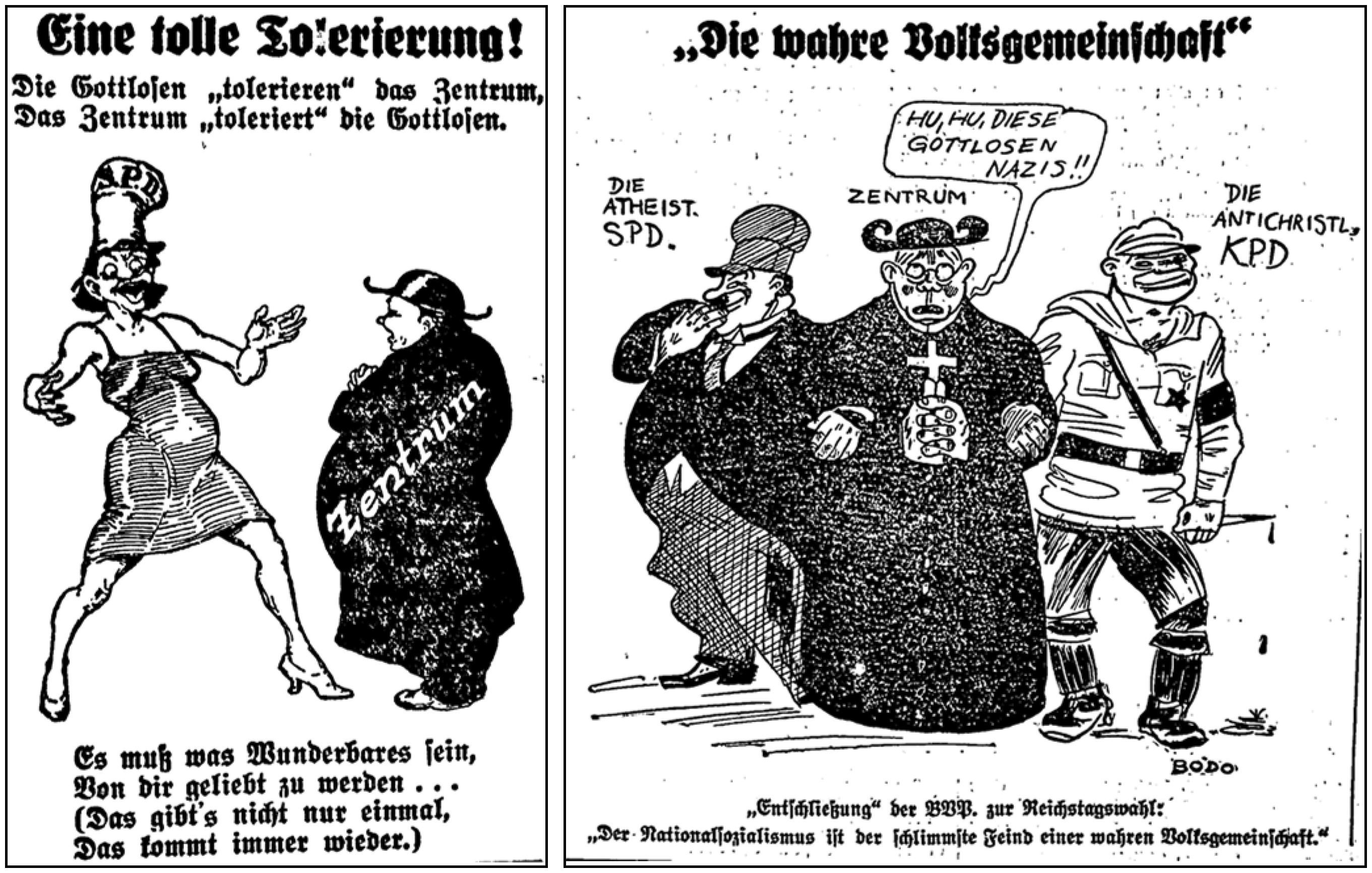
The antisecularist propaganda of the NSDAP was similar to that of other right-wing movements. Yet, the NSDAP differed in the strong measures it took upon entering local government in Thuringia in 1930 and Brunswick in 1931. Both of these states had been marked in the early Weimar period by having had socialist governments, which, without the moderating hand of the Centre Party as a coalition partner, had been able to establish two of the most secularized educational systems in Germany. Having obtained the crucial portfolios of Education and Interior, the new Nazi ministers closed some continuing education programs (Volkshochschulen) and secular (weltliche) primary schools, fired secularist teachers and reintroduced school prayers (which were subsequently struck down by the national court). 78
By 1932, the communist and socialist Freethought organizations had been thrown on the defensive. The government was effectively implementing an emergency decree issued by Brüning on the day before Easter 1931 that forbade offensive anticlerical agitation. This led to a growing asymmetry between secularist and antisecularist actions and propaganda in Germany. With numerous elections in the spring and summer of 1932, the Nazis milked what little evidence they could find of left-wing anticlerical activity. During his unsuccessful run-off against Hindenburg for Reich President in April, Hitler declared, ‘in the struggle against the abuse of religion, I’m not a Catholic and not a Protestant, but a German Christian, who does not want our people to receive a new religious conflict on top of its other struggles.’ 79 Less than two weeks later, with an eye to the upcoming elections for the Prussian parliament, Der Angriff published a broadsheet ‘To Protestant Christendom!’ calling on ‘Christian men and women’ to ‘erect a dam … against the filth of atheism’ and ‘the growing millions of the godless movement’. 80
The relentless criticism of the Brüning government for not stopping the Kulturkampf contributed decisively to the growing perception that the liberal state was weak and not able to protect the churches. Even the decree banning the communist freethought associations issued by the Minister of the Interior on 3 May 1932 was immediately attacked by the conservative parties as a half-measure because it had spared the socialist freethinkers. 81 On 30 May, Hindenburg forced Brüning to resign and appointed the archconservative Catholic aristocrat Franz von Papen to take his place. The war against secularism had formed a cornerstone of Papen's political career, and he announced that his government would be founded upon ‘the unchanging principles of Christian worldview’. 82 Yet, even Papen's coup against the SPD-Centre coalition government of Prussia did not remove the Kulturkampf from the political arena. Before and after the 31 July Reichstag election that brought the NSDAP 37 per cent of the popular vote, the DNVP and the NSDAP tried to outmatch each other in calling for an end to secularism. Each party submitted parliamentary legislation to extend the ban on communist freethought to its socialist counterpart. 83 In arguing for the Nazi bill, the NSDAP deputy and Protestant minister Johannes Peperkorn stated that ‘the Christian cross on the German churches and cathedrals will first be secure and regain a certain validity in German national life, when the swastika (Hakenkreuz) on the banners of Adolf Hitler flies from the city halls and roofs of the great cities of this people.’ 84
This article cannot engage substantively with the religious policies of the National Socialist government that took power on 30 January 1933. However, a brief glance reveals how Hitler's religious politics and his statements on worldview continued to be closely intertwined. Initially, the Nazis took energetic steps to fulfil campaign promises made in the name of ‘positive Christianity'. On 8 February, the Völkischer Beobachter declared an end to the ‘Kulturkampf’, by which it meant the confessional rivalry between Catholics and Protestants. At the same time, it used state power to intensify its struggle against Jews and secularists. In March the NSDAP shut down the socialist Freethought organizations and on 7 April it took a significant step towards the ghettoization of German Jews with the law banning them from state employment. 85 The party then used intimidation and a deal with the Vatican to eliminate political Catholicism. After the signing of the Concordat in July, Hitler boasted that he had succeeded in ‘driving the last nail in the coffin’ of the political parties and stopped priestly meddling in politics. 86
Yet, even as Hitler announced the end of the Kulturkampf, he began to make a new set of demands of the churches, which entailed their subordination under the new state's project of national unification. In a radio speech of 22 July he stated: ‘churches which fail to render to the state any positive support are for the state just as worthless as … [a] state which is incapable of fulfilling its duties to the church.’ In other words, now that the state had done its duty and eliminated Bolshevism, it was time for the churches to serve the state. Describing the recent Reich Concordat as ‘a final clarification of spheres regarding the functions of the State and of one church’, Hitler announced that he was seeking a similar settlement with the Protestants. Because the state had no interest in negotiating with 25 separate Protestant churches, Hitler declared his support for the German Christian movement in the upcoming church elections because it sought a sole Reich Church. 87
Efforts to subordinate the churches extended into the realm of theology. Overtures were made to Catholics, such as the NSDAP statement of 8 February 1933 that ‘the creator, who wants the division of humanity into peoples and races through the natural laws that he created, demand participation in the völkisch movement also from Catholics’. However, the theological penetration of Protestantism was much greater. The German Christian movement sought to Aryanize church membership and de-judaize Protestant theology. Hitler called on Protestants to endorse these reforms, arguing that the ‘freedom of the nation’ could ‘never be secured by petrified religious forces that have turned their backs upon the world … it can only be secured through the forces of a living movement.’ 88
While publicly supporting the German Christians, Hitler struck other tones with party loyalists. At a party meeting on 27 August 1933, he affirmed: ‘The unity of the Germans must be secured through a new Weltanschauung, since Christianity in its present form is no longer equal to the demands which are today made on those who would sustain the unity of the people.’ 89 This points to the tension in the religious policy of the young Nazi state. It oscillated between calls for the churches to fall in line with Nazi worldview and efforts to drive them further from the realm of worldview. Yet this apparent oscillation inhered in the very concept of worldview. The legacy of the culture wars meant that worldview had been and continued to be defined by the struggle between secular and religious forces. The importance of this struggle to National Socialism after 1933 extended into efforts by the regime to regulate the usage of the term itself. There is no better illustration of this than an exchange of letters between the ministries of the Interior and Church Affairs and the Research Office for the Study of Worldview (Forschungsheim für Weltanschauungskunde), a small apologetics outfit under the wing of the Protestant Church that had been established in Wittenberg in 1926 by Otto Kleinschmidt. This ornithologist and Protestant minister had developed some idiosyncratic antisemitic theories of race that had initially earned him some support within Nazi circles, but which were too Christian to avoid censure by the party in 1933. He had been receiving funding from the Ministry of the Interior for his anti-secularist agitation since the late 1920s, but this support dried up in the mid 1930s. In 1937, during the antireligious Kirchenkampf (‘church struggle’), the closure of his institute threatened. An ally in the Ministry of Church Affairs came to his aid and clarified the situation. What bothered the regime was not ultimately the nature of his research, but rather the fact that he attached the term ‘worldview’ to it. His ally suggested that if he removed the term from his institute's name, he might be allowed to continue to operate. In January 1939 Kleinschmidt informed the Ministry for Church Affairs that he had renamed his institute Church Research Office and, indeed, the matter was resolved. 90
What was Hitler's worldview? This question, which has animated much recent scholarship, is a question mal posée, if it is not preceded by the question: What did worldview mean in Hitler's time? Seemingly uninterested in the answer to that question, scholars have run with anachronistic definitions, such as the one introduced by Eberhard Jäckel, when he gave the subtitle A Blueprint for Power to his seminal study of 1969 Hitler's World View. Hitler did not, in fact, use worldview to describe his global military strategy. Nor did he use it for his personal philosophy. The problem with such anachronisms is that they have allowed the exploration of Hitler's worldview to turn into an exercise in peeling away of the outer and inner layers of an onion.
This article has taken a more superficial approach to Hitler's worldview. That is, it has attempted to show how contemporary meanings of the term tightly circumscribed his usage. One need not refer to political religion to explain why Hitler often invoked religion when discussing worldview. A more conventional answer is a better one. He did so, because, since its initial popularization in the 1840s, worldview had generally involved religion, or to be more precise, the past and ongoing conflicts over religion and secularism. Hitler's statements on worldview often revolved around the effects of the nineteenth-century culture war, which were still shaping politics in the Weimar Republic. Hitler believed that Bismarck's nationalism had ushered in a new form of worldview but had been prevented from fulfilling its mission by the confessional divisions between Catholics and Protestants. In the name of ‘positive Christianity’, Hitler thus demanded the elimination of confessional parties from the political realm to allow for a clean struggle between secular worldviews, i.e. National Socialism and Marxism.
When ruminating on the role of worldview in politics, Hitler drew insights from the socialist and communist parties, on the one hand, and the Catholic Church and the Centre Party, on the other. He appreciated the way each combined tight organization with zealous religious and political ideals. However, in accordance with his völkisch theory of truth, Hitler opened the door for an understanding of worldview as a political performance, the success of which was based on its ability to unite a national or racial community rather than on its truth content.
The culture wars also provide the key context for understanding the religious politics of the National Socialists. Many church activists recognized that the Nazi promotion of ‘positive Christianity’ contained no commitment to the theological teachings of the churches; however, they also recognized that this was no mere lip service to woo Christian voters. Positive Christianity was an anticonfessional formulation, which promised to re-unite Catholic and Protestant Germans by destroying their common enemies: liberal Judaism, Marxism and secularism. In the tradition of Protestant Church ‘Positives’, the Nazis saw these foes as representing different facets of the same worldview, which had together taken German national culture from the healthy realm of ‘idealism’ into the nihilistic realm of ‘materialism’. The intensification of the Kulturkampf between 1930 and 1933 provided Hitler with the opportunity to portray his as the most Christian party. Just as the violent deeds of the SA gave the NSDAP prominence in the low-grade civil war fought between paramilitaries, so its call for extreme measures against freethinkers allowed the party to appear as the standard-bearer of the Christian West in a religious war.
Hitler's understanding of worldview helps explain his attitude towards the Christian churches both before and after taking power. He viewed separation as a contract, by which the churches withdrew from the political realm, leaving the Nazis to fight against their common worldview enemies. Once these enemies were eliminated in 1933, the terms of the contract changed. The churches were expected to place their spiritual resources at the disposal of the regime and even to conform to Hitler's belief in the providential chosen-ness of races. His regime became increasingly jealous of the term worldview, which was reserved for the National Socialist project. Yet, even this protection of the term from church use illustrates that worldview continued to be defined by its location at the frontline of the German culture wars.
Footnotes
Acknowledgements
Research for this article was completed with the generous help of the Leverhulme Trust and the Arts and Humanities Research Council. For their useful comments the author wishes to thank Damien Valdez, Moritz Föllmer, Noah Strote, the anonymous reviewers of the JCH and the participants of the 2015 Belfast conference on ‘the interwar Kulturkampf’.
Funding
Funding sources: Arts and Humanities Research Council, (AH/J004146/1); Leverhulme Trust, (RF-2013-117).
1
A. Hitler, Mein Kampf: Eine Kritische Edition, edited by C. Hartmann, T. Vordermeyer and O. Plöckinger, 2 vols (Munich 2016), 975–7. (Translations are my own, unless otherwise noted.)
2
Hitler, Mein Kampf, 977.
3
Quoted in: E. Jäckel, Hitler's World View: A Blueprint for Power (Cambridge, MA 1981), 16.
4
M. Broszat, Der Nationalsozialismus: Weltanschauung, Programmatik, Wirklichkeit (Hannover 1960), 26.
5
Hans Mommsen called Hitler's worldview an ‘inhomogeneous and thoroughly petty construct’ marked by ‘eclectic superficiality’. H. Mommsen, ‘NS-Ideologie: Der Nationalsozialismus eine ideologische Simulation?', in H. Hoffmann and H. Klotz (eds), Die Kultur unseres Jahrhunderts, vol. 3 (Düsseldorf 1991), 43–54, 44, 51. Anson Rabinbach and Sander Gilman characterized National Socialist thought as a ‘shifting ideological morass’, an ‘unpalatable potpourri’ for which ‘no effort was made to offer a coherent doctrine, apart from the incoherent ramblings of Hitler's Mein Kampf '. ‘Preface’, A. Rabinbach and S. Gilman (eds), The Third Reich Sourcebook (Berkeley, CA 2013), xxv.
6
E. Jäckel, Hitlers Weltanschauung: Entwurf einer Herrschaft (Tübingen 1969); S. Haffner, Anmerkungen zu Hitler (Munich 1978), 97–8; I. Kershaw, Hitler (London 1991), 30.
7
Jäckel, Hitlers Weltanschauung, 24–5.
8
K. Vondung, ‘National Socialism as a Political Religion: Potentials and Limits of an Analytical Concept’, Totalitarian Movements and Political Religions, 6 (2005), 92. For a useful summary: W. Hardtwig, ‘Political Religion in Modern Germany: Reflections on Nationalism, Socialism and National Socialism’, GHI Bulletin, 28 (2001).
9
D. Peukert, Max Webers Diagnose der Moderne (Göttingen 1989), 102–19; U. Herbert, Geschichte Deutschlands im 20. Jahrhundert (Munich 2017).
10
Friedländer wrote: ‘Especially with regard to the Jews, Hitler was driven by ideological obsessions that were anything but the calculated devices of a demagogue … I call that distinctive aspect of his worldview “redemptive antisemitism”’, S. Friedländer, Nazi Germany and the Jews (New York, NY 1997), i, 3.
11
R. Griffin, The Nature of Fascism (New York, NY 1991); M. Mann, Fascists (Cambridge 2004), 13.
12
K. Scholder, Die Kirchen und das Dritte Reich (Frankfurt am Main 1977). On Protestant theology and völkisch thought, see also W. Tilgner, Volksnomostheologie und Schöpfungsglaube: Ein Beitrag zur Geschichte des Kirchenkampfes (Göttingen 1966).
13
D. Bergen, Twisted Cross: The German Christian Movement in the Third Reich (Chapel Hill, NC 1996); S. Heschel, The Aryan Jesus; Christian Theologians and the Bible in Nazi Germany (Princeton, NJ 2008); R. Ericksen, Complicity in the Holocaust: Churches and Universities in Nazi Germany (New York, NY 2012).
14
In January 2007 the Journal of Contemporary History dedicated a special issue to scholarly responses to R. Steigmann-Gall, The Holy Reich: Nazi Conceptions of Christianity 1919–1945 (Cambridge 2003). In 2013 a further response was published: S. Koehne, ‘Reassessing The Holy Reich: Leading Nazis’ Views on Confession, Community and “Jewish” Materialism’, Journal of Contemporary History, 48, 3 (July 2013), 423–45. See also, R. Töppel, ‘“Volk und Rasse”: Hitlers Quellen auf der Spur’, Vierteljahrshefte für Zeitgeschichte, lxiv (2016). Too late to be considered in this article: E. Kurlander, Hitler's Monsters: A Supernatural History of the Third Reich (New Haven, CT 2017).
15
T. Snyder, Black Earth: The Holocaust as History and Warning (New York, NY 2015), 1, 4, 3.
16
Jäckel, Hitlers Weltanschauung, 24.
17
For further examples, see B. Simms, ‘Against a “World of Enemies”: The Impact of the First World War on the Development of Hitler's Ideology’, International Affairs, 90 (2014). B. Simms and C. Laderman, Donald Trump: The Making of a World View (London 2017).
18
On 29 January 1919, the date of Weber's talk, Hitler was either still a sentry at a camp for internees in Traunstein or had been transferred to a Munich unit awaiting demobilization. I. Kershaw, Hitler: 1889–1936: Hubris (New York, NY and London 1998), 116–17; T. Weber, Metamorphose: Wie Adolf Hitler zum Nazi wurde: Vom unpolitischen Soldaten zum Autor von “Mein Kampf” (Berlin 2016), Chapter 2.
19
R. Koselleck, ‘Einleitung’, Geschichtliche Grundbegriffe: Historisches Lexikon Zur Politisch-Sozialen Sprache in Deutschland (Stuttgart 1972), XVI–XVIII.
20
C. Clark and W. Kaiser (eds), Culture Wars: Secular-Catholic Conflict in Nineteenth-Century Europe (Cambridge 2003); O. Blaschke, ‘Das 19. Jahrhundert: Ein Zweites Konfessionelles Zeitalter?’, Geschichte und Gesellschaft, 26 (2000).
21
T. Weir, Secularism and Religion in Nineteenth-Century Germany: The Rise of the Fourth Confession (New York, NY 2014), 84–104.
22
T. Weir, ‘The Riddles of Monism: An Introductory Essay’, in T. Weir (ed.), Monism: Science, Philosophy, Religion and the History of a Worldview (New York, NY 2012).
23
Two leading Reformed theologians who directly translated the term Weltanschauung into English and Dutch and made it the core of their apologetic strategies of the 1890s, were: James Orr, The Christian View of God and the World as Centering in the Incarnation (Edinburgh 1893); A. Kuyper, ‘Calvinism a Life-System’, in A. Kuyper, Lectures on Calvinism (Grand Rapids, MI 1931).
24
M. Weber, ‘Politics as Vocation’, in H.H. Gerth and C. Wright Mills (eds), From Max Weber: Essays in Sociology (New York, NY 1946), 122.
25
F. Bösch, Das konservative Milieu: Vereinskultur und lokale Sammlungspolitik in ost- und westdeutschen Regionen (1900–1960) (Göttingen 2002).
26
As quoted in: S. Heimann and F. Walter, Religiöse Sozialisten und Freidenker in der Weimarer Republik (Bonn 1993), 43. On Görlitz, see also H.A. Winkler, ‘Eduard Bernstein als Kritiker der Weimarer Sozialdemokratie’, in E. Collotti (ed.), L’ Internazionale Operaia e Socialista tra le due Guerre (Milan 1985), 1015.
27
U. von Hehl, ‘Staatsverständnis und Strategie des politischen Katholizismus in der Weimarer Republik’, in K.D. Bracher, M. Funke, and H.-A. Jacobson (eds), Die Weimarer Republik 1918–1933: Politik, Wirtschaft, Gesellschaft (Bonn 1987), 251; H. Hürten, Deutsche Katholiken 1918–1945 (Paderborn 1992), 96; N.D. Cary, The Path to Christian Democracy: German Catholics and the Party System from Windthorst to Adenauer (Cambridge, MA 1996), 121–8.
28
K.-A. Schulte, ‘Das Zentrum und die neue Zeit: Grundsätze und politischer Ideengehalt der Partei’, in K.-A. Schulte (ed.), Nationale Arbeit? das Zentrum und sein Wirken in der deutschen Republik (Berlin 1929), 31.
29
Braunschweigische Landeszeitung (29 March 1931); Deutsche Zeitung (28 March 1931).
30
S. Neumann, Die Parteien Der Weimarer Republik (Stuttgart 1965 [1932]), 105–7; T. Weir, ‘The Christian Front Against Godlessness: Anti-Secularism and the Demise of the Weimar Republic, 1928–1933’, Past & Present, 129 (2015).
31
In her seminal essay of 1978 Shulamit Volkov argued that by the end of the nineteenth century antisemitism represented the ‘Weltanschauung’ of German conservatism, however, this appears to be an anachronistic projection backwards. Most Wilhelmine era völkisch nationalists, such as Pan-German leader Heinrich Class, in fact, ascribed Weltanschauung to their liberal and socialist enemies rather than to themselves. S. Volkov, ‘Antisemitism as Cultural Code – Reflections on the History and Historiography of Antisemitism in Germany’, The Leo Baeck Institute Year Book, XXIII (1978); H. Claß, Wenn ich der Kaiser wär: politische Wahrheiten und Notwendigkeiten (Jena 1913), 125, 126, 131.
32
Balcony speech of 1 August 1914, reprinted in: W. Bihl (ed.) Deutsche Quellen zur Geschichte des Ersten Weltkrieges (Darmstadt 1991), 49.
33
Quotation of Kaiser's speech of 15 June 1918 in: ‘Der Kampf der Weltanschauungen’, Mitteilungen aus dem Verein zum Abwehr des Antisemitismus, 28, 12–13 (10 July 1918), 57–9. On the antisemitic spin given by Heinrich Claß, see J. Leicht, Heinrich Claß 1868–1953: Die politische Biographie eines Alldeutschen (Paderborn 2012), 244.
34
Hitler, Mein Kampf, 219–21.
35
Jäckel, Hitlers Weltanschauung, 71; Kershaw, Hitler: 1889–1936: Hubris, 101–5, 117–28.
36
Weber, Wie Adolf Hitler zum Nazi wurde, Chapter 7.
37
For a discussion of Hitler's reflections on audiences, see E. Fromm, ‘Psychology of Fascism’, in E. Fromm, Escape from Freedom (New York, NY 1994), 220–3.
38
A. Hitler, Die deutsche Kunst als stolzeste Verteidigung des deutschen Volkes: Rede, gehalten auf der Kulturtagung des Parteitages 1933 (Munich 1934), 3–4.
39
Marxist epistemology underwent a significant change under Stalin, when a new theory of truth emerged that bears resemblance to that of Hitler. When empirical facts of history were deemed contrary to the lessons of history, they could be suppressed. S. Dahlke, Individuum und Herrschaft im Stalinismus: Emel’jan Jaroslavskij (1878–1943) (Munich, 2010). On the ‘partisanship of truth’ in Stalin-era science, see I. Polianski, ‘Das Rätsel DDR und die “Welträtsel”: Wissenschaftlich-atheistische Aufklärung als propagandistisches Konzept der SED’, Deutschland Archiv (2007).
40
H. Rickert, ‘Psychologie der Weltanschauungen und Philosophie der Werte’, Logos, 9 (1920).
41
Hitler, Deutsche Kunst, 6.
42
Hitler connected the ‘mission’ of National Socialism to its ‘worldview goals’ in Völkischer Beobachter (20 January 1929).
43
B. Hamann, Hitlers Wien: Lehrjahre eines Diktators (Munich 1996), 285–336.
44
O. Plöckinger, Geschichte eines Buches: Adolf Hitlers ‘Mein Kampf’ 1922–1945 (Munich 2006), 254.
45
Hitler, Mein Kampf, 575.
46
Hitler, Mein Kampf, 1151.
47
Hitler, Mein Kampf, 1163.
48
Hitler, Mein Kampf, 1153.
49
Quoted in: R. Bucher, Hitlers Theologie (Würzburg 2008), 104.
50
A. Hitler, Hitler Reden und Proklamationen, 1932–1945: kommentiert von einem deutschen Zeitgenossen, ed. M. Domarus (Wiesbaden 1973), I/1, 82.
51
Hitler, Hitler Reden I/1, 82.
52
Quoted in: D. Hastings, Catholicism and the Roots of Nazism: Religious Identity and National Socialism (Oxford 2010), 46.
53
S. Koehne, ‘Nazi Germany as a Christian State: The “Protestant Experience” of 1933 in Württemberg’, Central European History, xlvi (2013). S. Koehne, ‘The Racial Yardstick: “Ethnotheism” and Official Nazi Views on Religion’, German Studies Review, xxxvii (2014). A similar position is taken by L. Siegele-Wenschkewitz, Nationalsozialismus und Kirche: Religionspolitik von Partei und Staat bis 1935 (Düsseldorf 1974), 47–50.
54
R.J. Evans, The Third Reich in Power 1933–1939 (London 2006), 220.
55
Hastings, Catholicism. S. Koehne, ‘Nazism and Religion: The Problem of “Positive Christianity”’, Australian Journal of Politics and History, 60 (2014).
56
Quoted in Scholder, Die Kirchen und das Dritte Reich, 115.
57
A. Hitler, Hitler. Reden, Schriften, Anordnungen: Februar 1925 bis Januar 1933, B. Dusik (ed.) (Munich 1992), vol. I, Doc. 1.
58
A. Hitler, Hitler. Reden, Schriften, Anordnungen, II/2, Doc. 237.
59
‘Rationalismus’, Conversations-Lexikon der Gegenwart, vol. 4, part 1 (Leipzig 1840), 492–506, 505.
60
See Weir, Fourth Confession, 197–9.
61
Koehne, ‘Nazism and Religion’.
62
Volkov, ‘Antisemitism as Cultural Code – Reflections on the History and Historiography of Antisemitism in Germany’; T. Weir, ‘The Specter of “Godless Jewry”: Secularism and the “Jewish Question” in Late Nineteenth Century Germany’, Central European History, 46 (2013).
63
Cited in: R. Gross, ‘“Positives Christentum” Religion und Moral in Hitlers Politik’, Anständig geblieben: Nationalsozialistische Moral (Frankfurt am Main 2010).
64
I. Hirsch, Die gegenwärtige geistige Lage im Spiegel philosophischer und theologischer Besinnung (Göttingen 1934), 24.
65
Quoted in: Weir, ‘Secularism and the “Jewish Question”’, 13.
66
Speech in Munich, 25 October 1930, Hitler: Reden, Schriften, Anordnungen, vol. IV/1, 33.
67
Völkischer Beobachter (26 February 1925), reprinted in: Hitler. Reden, Schriften, Anordnungen, vol. I, Doc. 1.
68
A. Hitler, Hitler's Second Book: The Unpublished Sequel to Mein Kampf, Gerhard Weinberg (ed.) (New York, NY 2006) 121, 60.
69
Weir, ‘The Christian Front Against Godlessness’.
70
Speech in Munich, 24 May 1927, Hitler: Reden, Schriften, Anordnungen, vol. II/1, Doc. 129.
71
‘Verordnungsblatt der Reichsleitung der NSDAP’, 10 June 1931, in Bundesarchiv Berlin, R 1501/126078, fol. 23.
72
Quotations in: Bucher, Hitlers Theologie, 207; G. Besier, Der Heilige Stuhl und Hitler-Deutschland: Die Faszination des Totalitären (Munich 2004), 153.
73
Quoted in Bucher, Hitlers Theologie, 105.
74
Speech given at the meeting of the ‘National Opposition’ in Bad Harzburg, 11 October 1931, in Hitler: Reden, Schriften, Anordnungen, vol. IV/3, Doc. 43.
75
Plöckinger, Geschichte eines Buches, 247. Die Welt am Montag, no. 20 (8 June 1931).
76
Speech to an NSDAP meeting in Rosenheim, 17 April 1932. Hitler gave this speech in three other locations on that same day. In his second book, Hitler named Centre the party that went ‘arm in arm in intimate friendship with declared deniers of God, atheists, and desecraters of religion’. Hitler: Reden, Schriften, Anordnungen, vol. V/1 , Doc. 40.
77
T. Weir, ‘A European Culture War in the Twentieth Century? Anti-Catholicism and Anti-Bolshevism between Moscow, Berlin, and the Vatican 1922 to 1933’, Journal of Religious History, 39 (2015).
78
W. Pyta, Gegen Hitler und für die Republik: die Auseinandersetzung der deutschen Sozialdemokratie mit der NSDAP in der Weimarer Republik (Düsseldorf 1989), 149–54; G. Neliba, Wilhelm Frick: der Legalist des Unrechtsstaates: eine politische Biographie (Paderborn and Munich 1992), 57–62; M. Lamberti, The Politics of Education: Teachers and School Reform in Weimar Germany (New York, NY 2004), 206.
79
Der Angriff (8 April 1932).
80
Der Angriff (19 April 1932).
81
J. Hürter, Wilhelm Groener: Reichswehrminister am Ende der Weimarer Republik, 1928–1932 (Munich 1993), 347; Reichsbote (7 May 1932); Völkischer Beobachter (12 May 1932); Tägliche Rundschau (14 May 1932); Berliner Börsen-Zeitung (22 May 1932).
82
Winkler, Weimar, 480–1. On Papen's antisecularism, see L.E. Jones, ‘Franz von Papen, Catholic Conservatives, and the Establishment of the Third Reich, 1933–1934’, Journal of Modern History, lxxxiii (2011); Weir, ‘The Christian Front Against Godlessness’.
83
Prussian Privy Archive (Geheimes Staatsarchiv), I HA, Rep. 169 D, no. 9, appendix 1, 205.
84
From the debate on 23 and 24 June 1932, Verhandlungen des Preußischen Landtags/Sitzungsberichte des Preußischen Landtags (Berlin 1932), 756–95, 834–57, 865–970, here 942.
85
‘Law for the Restoration of the Professional Civil Service’, Reichsgesetzblatt, no. 34 (7 April 1933).
86
Stated in a speech to SA on 21 July. A. Hitler, The Speeches of Adolf Hitler: April 1922–August 1939: An English Translation of Representative Passages Arranged under Subjects and Edited by Norman H. Baynes (London 1942), 373–4.
87
Hitler, The Speeches of Adolf Hitler, 376.
88
Völkischer Beobachter (8 February 1933); Hitler, The Speeches of Adolf Hitler, 377.
89
Hitler, The Speeches of Adolf Hitler, 377.
90
H.-P. Gensichen, ‘Naturwissenschaft und Theologie im Werk von Otto Kleinschmidt’, Dissertation Halle-Wittenberg (1977), 134.