



Abstract
A cross-national shift toward lower-yield nuclear weapons has generated renewed interest in the integrity of the firebreak: the conceptual barrier between conventional and nuclear warfare. We theorize that low-yield nuclear weapons alter nuclear nonuse mechanisms. They threaten to breach the firebreak by offering a more credible, but less costly, deterrent and undercut norms grounded in nuclear weapons’ effects. To test the integrity of the firebreak, we conduct simultaneous survey experiments investigating how Pakistani and Indian citizens consider low-yield nuclear weapons use in an escalating crisis. We find a low-yield nuclear weapons threat to be credible, but not necessarily stabilizing. Both publics in this rivalry exhibit substantial willingness not only to issue a nuclear response to a low-yield nuclear strike, but also to introduce nuclear weapons into conflict. However, neither universally seeks retribution. Vivid information about nuclear effects moderates retaliation preferences among citizens who strongly favor their co-nationals.
In the mid-1960s, US defense officials and deterrence theorists introduced the term “firebreak” to refer to the conceptual barrier to the use of nuclear weapons at the tactical level (Brodie 1966; Enthoven 1965). Just as firebreaks contain fires and prevent their spread, a firebreak in the battlefield sense would contain conflicts to conventional weapons and prevent escalation to nuclear use. In theory, this escalation firebreak is created by the bright-line distinction between nuclear and non-nuclear weapons. But might conventional conflict escalate to a point that risks breaching the firebreak? Preventing the breach depends on belief, Brodie (1966) and others argued: both sides must believe the firebreak will hold.
A cross-national shift toward lower-yield nuclear weapons has generated renewed interest in the meaning and integrity of the firebreak. Russia (Horovitz and Wachs 2024), Pakistan (Kidwai 2020), the United States (Department of Defense 2018), the United Kingdom (Beal and James 2025), and possibly China (Department of Defense 2024) are currently expanding their low-yield nuclear options. This shift arose from concern that states cannot credibly threaten to use city-destroying, high-yield nuclear weapons at the strategic level, rendering nuclear deterrence weak or ineffective. The more credible threat to use modern, smaller nuclear weapons in a battlefield setting may strengthen deterrence. Yet the notion that a nuclear conflict could be conducted with precision and on a limited scale may lessen fears of escalation to all-out nuclear war and of the harmful effects of a nuclear detonation. We argue that low-yield nuclear weapons alter nuclear nonuse mechanisms of credibility, costliness, and normative inhibitions. They offer a less costly and therefore more credible deterrent. But by reducing costliness, they also undercut norms grounded in the devastating effects of nuclear weapons. Further, if the more credible threat creates doubt as to the firebreak’s integrity, that loss of belief could destabilize a crisis, especially when vital interests are at stake.
To test the integrity of the firebreak in the presence of modern, low-yield nuclear weapons, we used experimental methods to examine perceptions of the weapons’ utility and appropriateness in South Asia, where a lower nuclear threshold has become a central feature of crisis dynamics. In the rivalry between India and Pakistan, Pakistan, as the weaker conventional power, has invested in low-yield nuclear weapons and short-range delivery systems to develop what they believe to be a more credible nuclear deterrent (Clary and Narang 2019; Hassan 2022; Kidwai 2020; Noor 2023; Tellis 2023). Recent armed confrontations between India and Pakistan, involving conventional military escalation and veiled nuclear threats, demonstrate that both states have been willing to engage in direct conflict under the nuclear shadow (Clary 2025; Narang and Williams 2022). Yet nuclear attitudes among Pakistani and Indian publics remain understudied. 1 Although nuclear-armed states’ histories vary with respect to nuclear weapons, nuclear development, and nuclear-armed rivals, attitudinal research has focused on publics in Western, consolidated democracies, leaving a gap in South Asia (Levin and Trager 2019).
Our original, cross-national survey experiment presented respondents in Pakistan and India with identical crisis scenarios concerning a vital interest to both states: the territorial dispute in Kashmir. Through this survey experiment, conducted door-to-door in Pakistan and by phone in India (winter 2023), we investigated the conditions under which citizens in one country are willing to use nuclear weapons against the other. To test whether low-yield nuclear weapons compromise core, theoretical nuclear non-use mechanisms—fear of costly retaliation, credibility of the retaliatory threat, and norms inhibiting nuclear weapons use—we offered low-yield nuclear weapons as one possible military strike option in different crisis scenarios and varied the vividness of information we provided about the unique effects of a nuclear explosion. We also examined how feelings toward citizens in the rival country affect willingness to use nuclear weapons. This study provides the first nationally representative assessment of attitudes within two non-Western, nuclear-armed democracies regarding a nuclearized conflict with each other.
We find evidence that both publics hold perceptions surrounding low-yield nuclear weapons that run counter to nuclear non-use mechanisms, with important distinctions that offer new insights into crisis dynamics. Both publics exhibited substantial willingness not only to support nuclear retaliation in response to the rival’s low-yield nuclear strike, but also to be the first to introduce nuclear weapons into the conflict. Citizens who hold a strong in-group bias relative to the rival population were particularly likely to select the most severe response. Findings from the India sample also imply that Pakistan’s emphasis on low-yield nuclear weapons as a credible deterrent may inflame rather than stabilize a crisis, with India’s public more likely to act as a goad than a constraint on Indian leaders. Both countries’ leaders pay close attention to public opinion regarding the Indo-Pakistani relationship, and certainly regarding Kashmir, especially during times of conflict (Clary et al. 2021; Fair 2017; Kapur 2015; Malhotra 2016; Narang and Staniland 2018).
However, neither public universally seeks revenge on their rival. Even among those with the strongest in-group bias, descriptive information about the unique effects of nuclear weapons, such as nuclear radiation and extreme heat, moderated retaliation preferences. This highlights the importance of future work to examine these mechanisms and the potential impact of debate that reaches attentive publics.
Our findings complicate theoretical understandings of the conventional-nuclear firebreak, and carry particular importance given the serious risks and uncertainties in the ongoing Indo-Pakistani rivalry. Moreover, because doctrines and perceptions regarding low-yield nuclear weapons are currently evolving across the international system, this study generates implications for both deterrence mechanisms and nuclear non-use norms that reach beyond South Asia. This evidence suggests that pursuing strategic stability through a pivot to modern, low-yield nuclear weapons as a credible deterrent may not succeed.
Nuclear Crisis Dynamics
Advances in certain types of nuclear weapons technology have long been theorized to pose challenges to the firebreak. Sixty years ago, Kahn (1965, 95–96) argued technological developments in “very small nuclear weapons” would one day blur the distinction “so sanctified by convention, so ratified by emotion . . . so easily defined and understood,” between conventional and nuclear weapons. Two “revolutions” have reinvigorated debate over the implications of such advances for escalation risks: the accuracy revolution in guidance systems, and the low-yield revolution that created a role for much smaller nuclear weapons in state arsenals, including on strategic delivery systems (Dill and Sagan 2025; Lieber and Press 2017; Sagan and Weiner 2021). Goddard and Larkin (2025, 14) refer to the technological revolutions as having “ushered in a changing strategic landscape,” generating competing predictions regarding the likelihood of nuclear weapons use. Multiple causal mechanisms are theorized to drive nuclear nonuse, and technological development can affect perceptions and understandings of each.
Whether modern, precision, low-yield nuclear weapons introduce stabilizing or destabilizing dynamics into the deterrence environment therefore depends in large part on whether and how the weapons affect core nuclear nonuse mechanisms. One pair of mechanisms is the threat of unacceptably costly punishment and the credibility of that threat (Goddard and Larkin 2025; Press et al. 2013). In a conflict between two nuclear-armed states, each should be deterred by the threat of nuclear retaliation by the other (Jervis 1989; Schelling 1960, 1966). But a logical paradox follows: precisely because of the costliness of a nuclear exchange, no state could credibly threaten to initiate a retaliatory response. If nuclear retaliation is thus an empty threat, nuclear weapons have no deterrent value. Schelling argued that the threat is not empty because it “leaves something to chance” (1960, 1966). There is always a risk that a conflict could escalate because the leader lacks perfect control over the situation, whether due to accident, miscommunication, an improperly conducted process, or something else. This uncertainty will deter an adversary. The threat is further made credible because no one knows exactly what action might cause the firebreak breach (Jervis 1989; Powell 2015; Schelling 1960, 1966). Even limited escalation could still end in the feared outcome.
If the prospect of using low-yield nuclear weapons in war does not strain credibility in the way high-yield nuclear weapons do, leaving something to chance becomes less important to deterrence. Instead, by virtue of their lower destructive power and greater targeting precision, low-yield nuclear weapons would manipulate the risk of escalation by lowering practical barriers to nuclear use. 2 Pakistan’s emphasis on low-yield nuclear weapons as part of its full spectrum deterrence (FSD) approach follows this logic of credibility (Noor 2023; Tellis 2023). As Pakistani Brigadier Imran Hassan (2022) of the SPD explained, FSD has succeeded in “reinforc [ing] the credibility of [Pakistan’s] deterrent” by “plug [ging] the gaps . . . at all tiers of strategic, operational, and tactical levels.” 3 Similarly, former Director-General of the SPD Lieutenant General Khalid Kidwai (2020, 5–6) argued FSD has forced India and the international community to make “the cold calculation that nuclear weapons could come into play sooner rather than later,” generating “nuclear deterrence . . . not nuclear bluff.”
A second set of mechanisms stems from the revulsion associated with the devastating effects of nuclear weapons, including the gruesome effects of thermal and nuclear radiation on the human body. The resulting norm that nuclear weapons should never be used in war, known as the nuclear taboo, may inhibit use of the weapons even in the absence of a risk of nuclear retaliation (Tannenwald 1999, 2007). But smaller, more precise nuclear weapons may moderate or even eliminate the revulsion supporting the nuclear taboo. Precision and size may also ease concerns regarding the noncombatant immunity norm inhibiting the targeting of civilians (Walsh 2015). The perception that low-yield nuclear weapons are more usable because they might be contained to the battlefield poses a threat to the norm inhibiting their use (Paul 2009).
These significant technological changes affect each of the theorized nuclear non-use mechanisms. In South Asia, the credibility Pakistan seeks through FSD depends partly on the perception that Pakistan’s leaders believe a limited nuclear strike could remain limited. How India would react is a matter of speculation, but India may be responding to FSD by shifting away from a massive retaliation doctrine and toward a counterforce doctrine—and even toward preemptive counterforce options, developing plans to attack Pakistan’s nuclear capabilities in a first strike (Clary and Narang 2019; but see Tellis 2023).
Also evident is norm contestation of the type associated with the development of precision weapons, which advocates may characterize as morally acceptable (Goddard and Larkin 2025). Pakistan and India’s civilian and military leaders use the language of the taboo, but competing norms, such as the right to self-defense, have increasingly been voiced (Tannenwald 2021). Further, while India remains formally committed to a No First Use (NFU) policy, some question its strength and reliability (Clary and Narang 2019; Sundaram and Ramana 2018). Tannenwald (2021, 20) identifies India’s recent shifts away from NFU, and toward escalatory policies, as clear evidence of taboo “weakening.”
The high salience and volatility of the Indo-Pakistani territorial conflict underscores the importance of this region for testing the strength of theorized non-use mechanisms. Two recent conflicts appeared to threaten the firebreak. First, in February 2019, the Pakistani militant group Jaish-e-Mohammed claimed credit for a vehicle bomb attack that killed Indian paramilitary forces near Pulwama, Kashmir. Viral social media posts, some with doctored or misrepresented images or videos, stoked public outrage, and leaders in both states issued veiled nuclear threats (Narang and Williams 2022). India and Pakistan entered into direct military conflict: India struck a purported Jaish-e-Mohammed site near Balakot, inside Pakistan’s sovereign territory, marking the first time in history one nuclear-armed state used airpower to attack another (Narang and Williams 2022; Scarr et al. 2019). Most recently, after an April 2025 terror attack killed twenty-six Indian civilians in Kashmir, India, blaming Pakistan, suspended the Indus Waters Treaty. As security forces on both sides exchanged cross-border fire, and an Indian border guard was captured, experts feared India would do “something spectacular” amid calls for vengeance (Mashal 2025). On May 7, India conducted air strikes against Pakistan—including several that reached farther into Pakistan than the 2019 strikes had—once again setting a new precedent. Pakistan counterattacked. Even as nuclear fears and rumors spread, each side continued to escalate, and the crisis lasted 4 days (Clary 2025).
In a future conflict, would the potential introduction of low-yield nuclear weapons promote caution? Or if the crisis escalates, as the last two have, would there instead be rising pressure to breach the firebreak and use a low-yield nuclear weapon on the battlefield? How do these publics think about escalation in a nuclearized environment?
Nuclear Attitudes in India and Pakistan
Survey experiments have generated new insights into nuclear crisis dynamics, yet results are sensitive to different treatments and scenarios (Bell 2023). This growing literature disproportionately focuses on Western and/or consolidated democracies, leaving us with gaps in understanding how nuclear use is understood by other citizenries (but see Egel and Hines, 2021; Ju and Byun, 2024; Schwartz, 2024; Smetana and Onderco, 2022b; Sukin et al., 2026; Valentino et al., 2016). In studies conducted across multiple democracies, a majority or near-majority of citizens were willing to respond to a national security threat by attacking a terrorist base with nuclear weapons (Dill et al. 2022; Press et al. 2013; Rathbun and Stein 2020). Similarly, a majority or near-majority of US respondents were willing to use nuclear weapons to attack a non-nuclear-armed, warring state (Sagan and Valentino 2017). 4 However, in studies in which the scenario involved a threat by a nuclear-armed state actor, substantially lower percentages of respondents reported willingness to use nuclear weapons against their enemy (Haworth et al., 2019; Koch, 2024; Koch and Wells, 2021; Smetana and Onderco, 2022b; Sukin, 2020).
Evidence from South Asia is limited. Valentino and Sagan's (2016) survey experiment from India showed just over 50 percent of citizens expressed willingness to use nuclear weapons against a terrorist group based in Pakistan. In a survey experiment regarding conventional escalation dynamics, Clary et al. (2021) found that respondents in Pakistani Punjab would support Pakistani leaders who order a conventional attack against Indian positions in Kashmir. Support for de-escalation was more tenuous. While respondents in the Clary and colleagues study were not asked about a nuclear attack, and while respondents in the Sagan and Valentino study were asked about a terrorist target, not a state target, the two studies raise concerns that both national publics might goad, rather than constrain, their leaders during a crisis.
Given these varied findings and the need for more evidence from South Asia, our research investigates public responses to a hypothetical scenario in which India and Pakistan engage in an escalating conflict over Kashmir. 5 Because respondents in studies outside South Asia have been less willing to use nuclear weapons against a nuclear-armed state actor, we expect Indian and Pakistani respondents will also prefer a conventional rather than a nuclear response. In this dyad, the mechanism of costliness also extends beyond nuclear retaliation. Since the two states border each other, and both claim Kashmir, nuclear weapons used to strike the rival’s territory could pose a threat to the attacker’s own citizens and land. Following these logics, we further expect respondents to be more willing to use low-yield than high-yield nuclear weapons.
However, if South Asian publics are willing to breach the firebreak and escalate to low-yield nuclear use, that finding would lend support to the argument that low-yield nuclear weapons, despite their bright-line status as nuclear weapons, pose a credible threat to the firebreak. If the credibility of nuclear use is less strained by smaller, more precise nuclear weapons, as theorized, then this would affirm the logic of Pakistan’s shift to full-spectrum deterrence.
Respondents will be more likely to retaliate with low-yield nuclear weapons than high-yield nuclear weapons.
Respondents will be more likely to retaliate with conventional bombs than low-yield nuclear weapons.
What if the enemy breaches the firebreak first? In Sukin’s (2020) study, a higher percentage of Americans and South Koreans opted to use nuclear weapons only after an enemy nuclear strike, compared to striking first. Similarly, in a poll (Gallup & Gilani, 2019) conducted soon after the Pulwama and Balakot crisis, a majority of Pakistanis opposed using nuclear weapons first in a conflict with India. Would a firebreak breach generate enough fear to de-escalate the conflict (Brodie 1966)? Or would the response also be nuclear? Jervis (1989, 196) argues the response would depend on how the breach is interpreted, going so far as to state: “The logic of strategic analysis simply cannot help us a great deal.” We expect that respondents will be more likely to interpret the enemy’s nuclear use as requiring a nuclear response and will be more willing to use nuclear weapons once the rival state has breached the firebreak.
Respondents will be more likely to retaliate with nuclear weapons when the enemy country uses low-yield nuclear weapons first.
Next, we examine a normative mechanism. Low-yield nuclear weapons, if conceived of as small, low-impact, and/or confined to the battlefield, may moderate or eliminate the revulsion supporting the nuclear taboo. In contrast, receiving vivid information about the distinctive harms caused by nuclear weapons in comparison to conventional weapons may galvanize support for the taboo (Blair and Horowitz 2024; Bowen et al. 2022; Koch and Wells 2021). We expect descriptive, norm-reinforcing information will dampen respondents’ willingness to use nuclear weapons.
Respondents will be less likely to retaliate with nuclear weapons if they understand the effects of nuclear weapons use are materially different from conventional bombing.
Finally, we examine a second normative mechanism theorized to affect beliefs and preferences regarding nuclear use. We expect an individual’s feelings toward citizens in the rival country, compared to feelings about fellow citizens in their home country, will affect willingness to use nuclear weapons against the rival. Dill et al. (2022) demonstrate that those who exhibit “compatriot partiality,” meaning those who value the lives of their co-nationals much more than those of foreign citizens, are more likely to support using nuclear weapons against a foreign state. These individuals are likely less concerned about harming foreign citizens, and may desire strong retaliation to protect their compatriots and/or exact retribution. Higher levels of in-group identification are associated with a desire to punish members of the outgroup, including through military force (Koch 2024; Liberman 2006, 2014; McDermott et al. 2017; Rathbun and Stein 2020). Findings in support of this hypothesis would offer insight into nuclear norm contestation dynamics. As Rathbun and Stein (2020, 795) explain, retribution can be “a morally motivated stance rooted in . . . [an] understanding of what constitutes ethical behavior.” For highly partial individuals, a norm that wrongdoing must be met with just punishment would compete with the nuclear-nonuse norm.
Respondents with high compatriot partiality will be more likely to choose nuclear retaliation than those with low compatriot partiality.
A survey experiment investigating the conditions under which Indian and Pakistani publics would support the use of low-yield nuclear weapons in a conflict over Kashmir is valuable not only for refining theories of escalation and the firebreak, but also for the policies and practices of nuclear deterrence. First, both publics could shape leaders’ beliefs about the political costs of different responses. The extent to which public attitudes affect elite decision-making on nuclear use is contested: while some argue public attitudes on nuclear use matter little (Rublee, 2021; Smetana and Onderco, 2022a), others point to evidence from historical cases (Tannenwald 2007), war games (Pauly 2018), and survey experiments (Smetana et al. 2025) indicating decision-makers are responsive to the public under certain conditions.
In India, the public has become much more attentive to nuclear and foreign policy issues due to the national “media boom” (Malhotra 2016). India’s leaders consider public opinion on salient foreign policy issues, especially regarding Pakistan, where foreign and domestic politics are closely linked (Kapur 2015). The Pulwama and Balakot crisis is a case in point, as social media and communication platforms facilitated the rapid spread of rumors and information—both false and true—throughout Indian society. Citizens demanded vengeance and retaliation. While it is unclear what impact social media ultimately had, India’s leaders were certainly paying attention to public opinion (Narang and Williams 2022), and a highly engaged public audience could shape leaders’ actions in a future crisis (Narang and Staniland 2018).
Second, while Western observers often discount the relevance of public opinion to governance in Pakistan, largely due to the governing power Pakistan’s military wields, country experts argue that both civilian and military leaders pay close attention to public pressures. Indo-Pakistani relations matter a great deal not only to India’s public, but also to Pakistan’s public (Clary et al. 2021; Narang and Staniland 2018). Pakistan’s leaders, operating in a political environment characterized by civil-military power struggles, consider how their actions will be perceived during times of widespread public scrutiny, like periods of heightened conflict with India (Fair 2017). Pakistani public opinion constrains—or frees—Pakistan’s top military leaders and the broader cohort of senior army officers, none of whom operate in a political vacuum, even during times of military rule (Koch 2023; Milam and Nelson 2013). It is not only in Western democracies that public opinion can shape foreign policy from below, but also in the South Asian democracies of India and Pakistan.
Third, survey experiments allow us to vary the conditions of a hypothetical crisis over Kashmir to directly test whether the use and availability of nuclear weapons has measurable and significant effects on public preferences. We can more easily consider counterfactuals: What if the rival state conducted an airstrike against a base inside national boundaries? What if the rival state used a low-yield nuclear weapon on the battlefield? National survey data provide a fuller picture of the range of public reactions leaders would likely observe in these types of real-world crisis scenarios. The possibility that a low-level conflict could escalate to wider war is not a distant hypothetical to South Asian citizens, but a reality.
Research Design
We fielded a survey experiment through firms in Pakistan (Gallup Pakistan) and India (Centre for Voting Opinion and Trends in Election Research, or CVoter) after consulting with survey research experts in both countries and scholars who had conducted survey experiments in Pakistan. 6 Recent research assessing door-to-door surveys fielded by different firms in India raises important concerns about ethics and sampling bias (Lee et al. 2023), which extend to surveys conducted in South Asia and the Global South more broadly. We took several steps to minimize both concerns, including piloting the survey instrument in Pakistan to assess respondent understanding of the consent script, the scenario, and the questions; using open-ended questions to understand respondents’ reasoning; and contracting with highly reputable firms.
The Pakistan study was fielded mid-February through early March 2023 and was conducted door-to-door in Urdu. After launching a 53-respondent pilot, Gallup Pakistan surveyed a national sample of 2,000 adult respondents. The India study was fielded in mid-March 2023 by phone. CVoter surveyed a national sample of 4,155 adult respondents in eleven Indian languages and dialects. Gallup Pakistan used stratified random sampling with probability proportionate to size based on the 2017 Census whereas CVoter (India) used random probability sampling, both producing diverse samples across key characteristics. The appendix includes tables outlining the distribution of gender, age, education, and urban/rural location. 7 Before providing the final data, each survey firm translated respondents’ answers to open-ended questions into English.
We created a single survey instrument, modifying the experimental treatment scenarios by switching the names of the home country and neighboring country when moving from Pakistan to India. Figure 1 describes the survey protocol; full survey instruments appear in the appendix. Both survey firms collected similar demographic data, occasionally using slightly different questions and categorizations to suit local needs. After age and citizenship screening questions, the survey asked respondents to indicate how warm or cold their feelings were toward each of six different countries (feeling thermometers). Survey instrument design.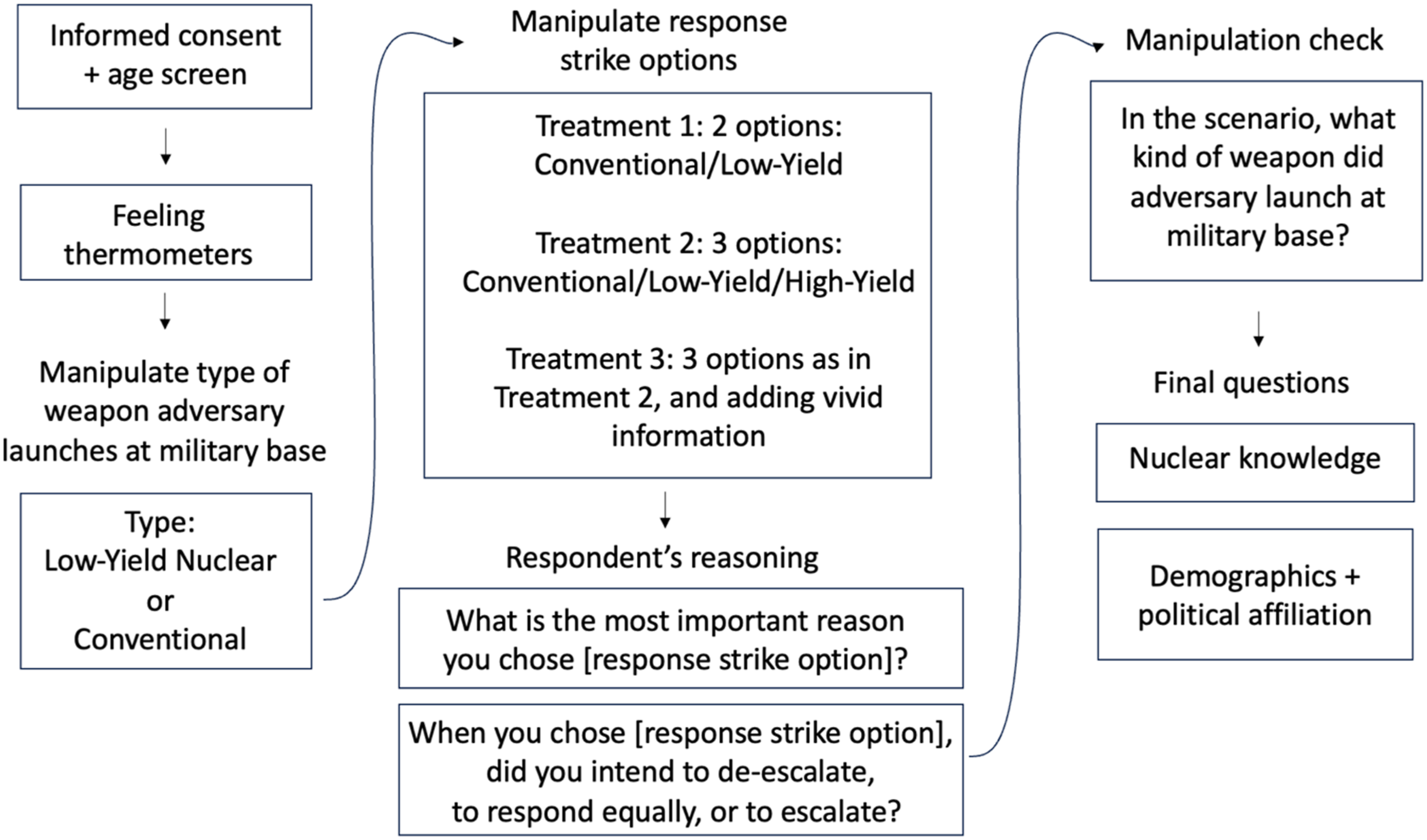
Next, respondents were read a hypothetical scenario involving either an Indian attack on a Pakistani military base in Kashmir (Pakistan survey), or a Pakistani attack on an Indian military base in Kashmir (Indian survey). Respondents were randomly assigned to one of two different conditions: after the defending country’s army responds by fighting back, the attacking country launches either a conventional (non-nuclear) strike or a low-yield nuclear strike at a military base in the defender’s homeland (rural Gujarat for India, and rural Punjab for Pakistan). Respondents were read soldier and civilian casualty figures resulting from the strike, and the number of deaths was held constant across the two conditions to isolate the effect of varying the type of initial strike.
After the scenario, respondents were randomly assigned to one of three types of response options. In response treatment one, respondents were given a binary choice: a conventional or low-yield nuclear response. The number of deaths and injuries was held constant for each response, a design that is externally valid and allows us to remove a possible confounder, severity/death toll. In response treatment two, respondents were asked to choose between a conventional response, a low-yield nuclear response, and a high-yield nuclear response. The information about the deaths and injuries that would result from the first two responses was again held constant, but the number of deaths and injuries that would result from the high-yield nuclear response was several times higher, in alignment with real-world effect estimates. 8 Response treatment three contained the same information as treatment two but added descriptive details about each response’s effects on human beings and the surrounding environment. 9 After selecting their retaliatory (i.e., response) strike preference (our key dependent measure), respondents were asked for their rationale for that choice, giving an open-ended response recorded by the surveyor. Respondents were also asked whether they intended to de-escalate the conflict, respond equally, or escalate the conflict.
We then asked each respondent to recall one key fact from the scenario: what kind of weapon the attacking country had launched at the respondent’s homeland. This factual manipulation check assesses respondent attentiveness to the key treatment manipulation. Factual manipulation checks in experimental social science studies have been found effective in identifying inattentive respondents (Kane and Barabas 2019) and recent studies investigate whether and when researchers should subset or drop subjects who fail manipulation checks (Aronow et al. 2019; Varaine 2023). While removing respondents may bias researchers’ assessments of treatment effects, our samples are known to pose specific attentiveness challenges (Lee et al. 2023). When inattentive respondents do not receive information from an experimental treatment, treatment effects will be biased toward zero, limiting what one can learn from the study (Druckman 2022; Kane et al. 2023). Therefore, we present our experimental results among the subset of respondents who correctly identified the key treatment manipulation. In the appendix, we provide all model estimations on the full sample of respondents for comparison. The term “full sample” indicates respondents are included regardless of whether they passed the manipulation check. Then, for each test using the full sample, we indicate in the text which experimental conditions are included. Substantively, our primary findings do not change, though we discuss one interesting and significant finding regarding attentive Pakistani respondents when we discuss our findings regarding Hypothesis 3. The survey ended with questions about nuclear knowledge, political affiliation, and demographic information.
In designing the survey instrument, we considered how to describe a low-yield nuclear weapon to a non-expert audience. Analysts and scholars converge around a general understanding that “low-yield” refers to nuclear weapons with an explosive yield of 10 kilotons or less (Kristensen and Korda 2019). Little Boy, the nuclear bomb used to attack Hiroshima in 1945, had an explosive yield of 15 kilotons. The difference between low-yield and high-yield nuclear weapons is thus largely a matter of perception.
10
Because there is no agreed-upon definition, and because the term tactical nuclear weapon is more often used by leaders and news media, and more likely to be encountered by the public, we chose to describe the low-yield nuclear weapon in the scenarios as a “low-yield, tactical nuclear bomb.” We also used the term “non-nuclear bomb” rather than “conventional weapons.” Survey experts at both Gallup Pakistan and CVoter assessed these descriptions to be more readily understood by survey respondents. CVoter translated “low-yield, tactical nuclear bomb” into Hindi as  , which reads in English as “low-blast [or low-explosion] tactical atomic bombs.” Gallup Pakistan’s translation into Urdu was
  , which reads in English as “light-weight or small atomic weapons.” During the pilot study conducted by Gallup Pakistan, interviewers reported that respondents had a general understanding of the meaning the terms conveyed: that a low-yield nuclear bomb is still a nuclear bomb, but is relatively small, should result in fewer deaths, and might be used on the battlefield.
We found further support for this presumption of general understanding when we examined respondents’ rationales for their preferred response strike. Many respondents who chose a low-yield rather than a high-yield nuclear strike offered reasons such as “The soldiers [in Pakistan] will be killed . . . but innocent people should not be harmed,” “[The low-yield option] is more useful/usable,” “Because India used a low-yield bomb, we should do the same,” “I don’t want the common people of Pakistan to be hurt much so I chose [the low-yield] option,” and “The lower the power, the lesser the damage.” Many respondents who chose a high-yield nuclear strike, on the other hand, identified reasons such as “This will do the most harm to Pakistanis,” “I want to answer with more force,” “So that there is more damage [to India],” and “It is more powerful, everything will be destroyed in a minute.” Of all respondents who used the particularly powerful term “destroy,” such as “Destroy [India] from the roots up,” approximately three-fourths had selected the high-yield nuclear strike, further supporting the presumption of general understanding.
Results and Discussion
Three main findings emerge from this research. First, in the context of a conflict over Kashmir, substantial numbers of Pakistani and Indian citizens express a willingness to use nuclear weapons. For each scenario, a clear majority of citizens chooses a nuclear response. Second, nearly half of Pakistani respondents, and more than half of Indian respondents, are willing to be the first to cross the firebreak by using nuclear weapons in response to a conventional strike by the rival. Third, citizens who score high on rival compatriot partiality, meaning there is a substantial difference between their degree of warm feelings toward their fellow citizens and cold feelings toward the rival citizens, are significantly more willing to use high-yield nuclear weapons during the hypothetical conflict. However, receiving descriptive, vivid information about the effects of nuclear weapons moderates high-partiality respondents’ preferences for retaliation.
Below, we review the results based on our preregistered hypotheses and discuss several exploratory findings. 11 The design of our survey experiment necessitates careful data analysis and presentation of results; to ensure consistency with our preregistered analysis plan, we conduct our hypothesis tests using both simple difference of means or proportions tests and multivariate ordered logistic regressions with an interaction term for the key treatment manipulation (Initial Strike Type X Response Option Type). Since the choice set of response options changes from two to three options, many of the figures arise from multivariate models that remove individuals receiving only two options. However, we also examine simpler group differences by each response type, including those who received only two options, and discuss these results in either the main text (as with H2), in footnotes, or in the appendix. For transparency and as evidence of consistency across different types of tests and model specifications, the appendix includes tables for the difference of means/proportions tests and full tabular model outputs of the multivariate results. 12
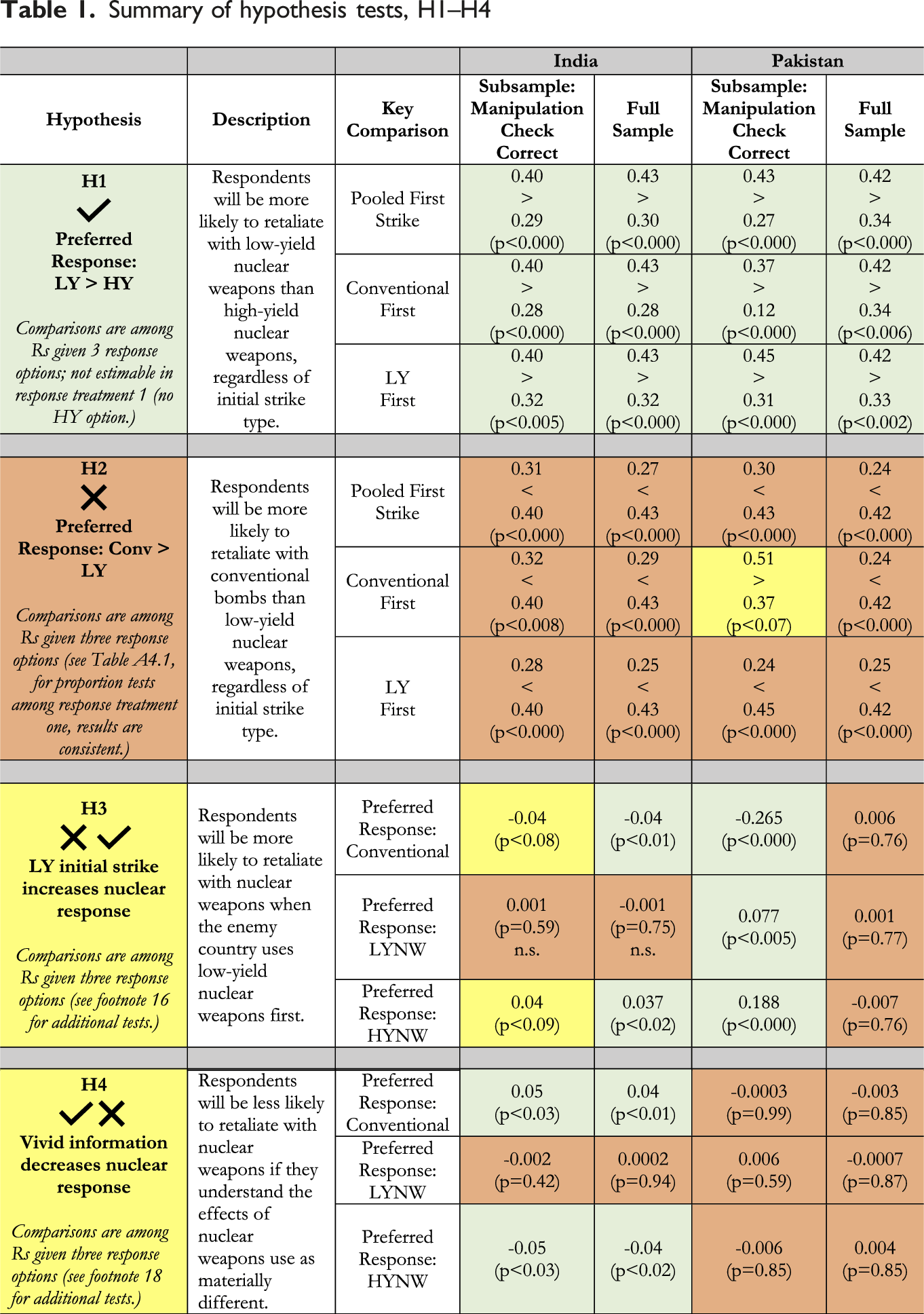
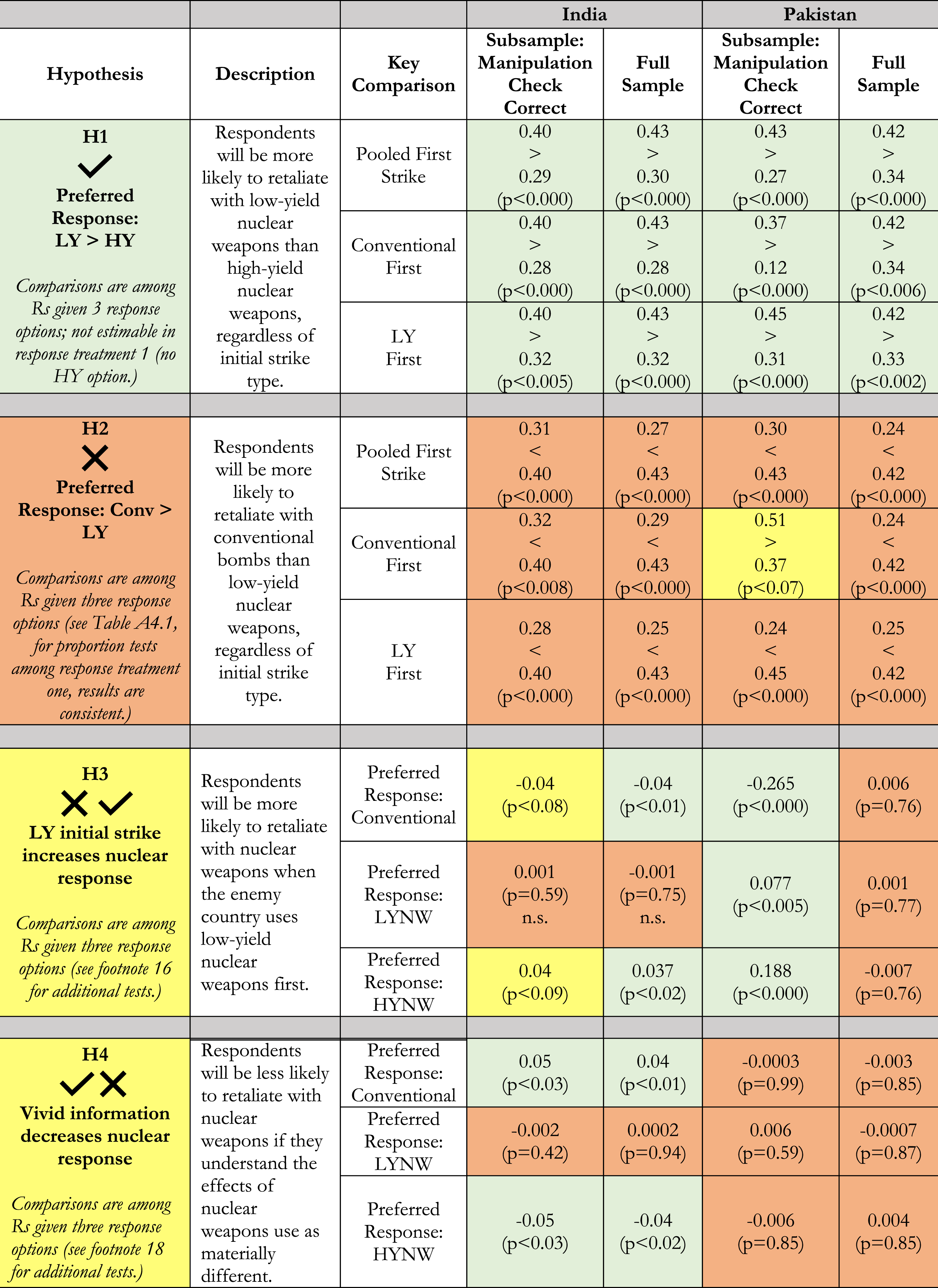
Hypothesis 1 expected respondents would be more willing to use low-yield nuclear weapons than high-yield nuclear weapons, regardless of the type of initial strike by the rival. H1 cannot be examined among respondents who were not shown a high-yield response option (response treatment one). Among respondents given three response options (with or without vivid text), simple tests of proportions are consistent with H1 in both India and Pakistan; whether pooled across initial strike type or examined separately, a significantly higher proportion of respondents prefer a low-yield to a high-yield nuclear response (appendix A1).
13
We also model respondents’ preferred response type as dependent on treatment condition using an ordered logistic regression with controls for age, gender, and education level. Figure 2 provides the marginal effects plots when the sample is limited to those who were shown a high-yield option (see appendix A2, A3). Regardless of whether Indian respondents received a conventional or low-yield nuclear Pakistani initial strike scenario, approximately 40 percent prefer to retaliate with a low-yield nuclear strike, and between 28 and 32 percent prefer the high-yield nuclear strike. Pakistanis, on the other hand, reveal less consistency: 37–45 percent prefer to respond to India with a low-yield nuclear strike, while 12–31 percent prefer the high-yield nuclear strike. Whether pooled across initial strike type or examined separately, preferences for a low-yield response are significantly higher than a high-yield one in both countries (consistent with H1) at the p < .005 level. Predicted probability of preferred response type by initial strike type.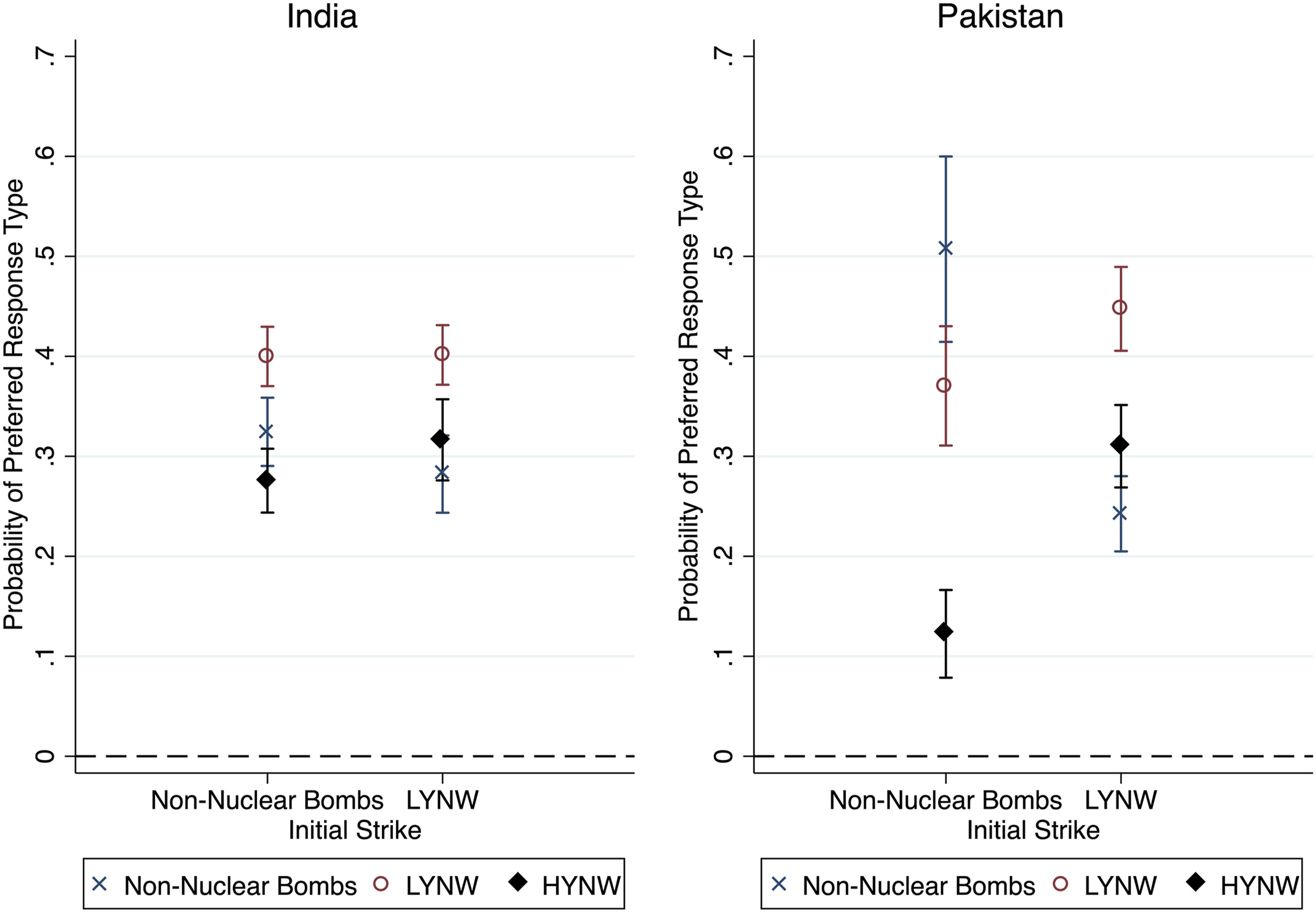
Hypothesis 2 expected respondents would be more willing to use non-nuclear (conventional) bombs than low-yield nuclear weapons, regardless of whether the rival crossed the firebreak by using nuclear weapons first. This hypothesis is not supported and results are largely significant in the opposite direction. 14 Further, when we limit the analysis to respondents randomly assigned to response treatment one (with only two strike choices: conventional or low-yield nuclear), we find that counter to H2, respondents are significantly more likely to prefer a low-yield nuclear response than a conventional response. 15 Recall that we located strike targets in sparsely populated areas to keep the casualty toll of the low-yield nuclear and conventional strikes constant, allowing us to isolate the difference between weapon type. Multivariate analyses among respondents given only two response options show that when pooled across type of initial strike, 40.8 percent of Indian respondents preferred a conventional response, compared to 59.2 percent who preferred a low-yield nuclear response (p < .00). In the Pakistan sample, 39.1 percent preferred a conventional response, compared to 60.9 percent who preferred a low-yield nuclear response (p < .00).
Hypothesis 3 expected respondents would be more likely to retaliate with nuclear weapons if the rival crossed the firebreak first, during the initial strike. To identify the change in each type of preferred response attributable to the initial strike type, we isolate the average marginal effect of the initial strike treatment manipulation (which shifts the initial strike from conventional to low-yield nuclear) from the multivariate model.
16
In Figure 3, any effect that intersects the reference line (at zero) is not statistically significant, while those falling above or below the reference line are statistically significant (p < .05). Average marginal effect of treatment change from non-nuclear to low-yield nuclear initial strike.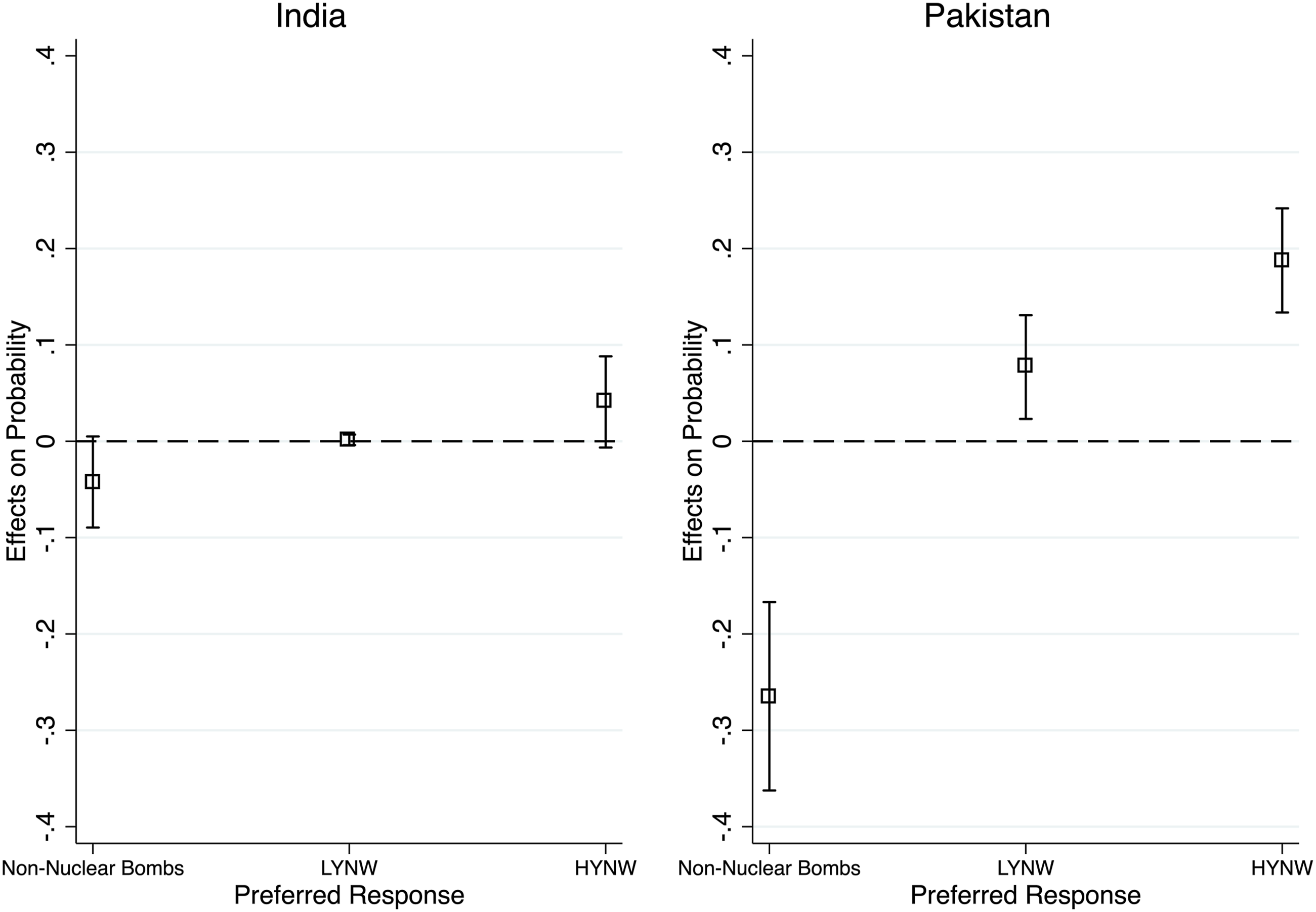
In India, there are small, marginally significant changes in the expected directions on respondents’ preferences for a non-nuclear response (decrease, p < .10) and a high-yield nuclear response (increase, p < .10) attributable to moving from a non-nuclear to a low-yield nuclear initial strike. However, there was no statistically significant change in preference for a low-yield nuclear response. In Pakistan, the shift across the firebreak from a non-nuclear to a low-yield nuclear initial strike significantly impacts preferences for all response strikes: Pakistani respondents decrease their preference for a non-nuclear response by about 26 percent (p < .000), increase their preference for a low-yield nuclear response by about 8 percent (p = .005), and increase their preference for a high-yield nuclear response by about 19 percent (p < .000).
Using the predicted probabilities reveals the scale of the change attributable to a low-yield nuclear initial strike among Pakistani respondents; when the initial strike was non-nuclear, about 51 percent of Pakistanis prefer a non-nuclear response, about 38 percent prefer a low-yield nuclear response, and about 12 percent prefer a high-yield nuclear response. But when the initial strike is a low-yield nuclear one, breaching the firebreak, the probability of preferring the non-nuclear response decreases to 24 percent, the low-yield nuclear response increases to 45 percent, and the high-yield nuclear response increases to 31 percent. These results support Hypothesis 3. However, among inattentive Pakistani respondents (those who failed to correctly identify the type of initial strike), there was no statistically significant change in preference for a low-yield nuclear response.
Supplementary analyses (see appendix A11) suggest a possible difference in the baseline assumptions each public holds about the nature of conflict with the rival state. As the scenario shifts from a non-nuclear to low-yield nuclear initial strike, Indian respondents’ predicted accuracy in recalling the strike type decreases significantly, by nearly 20 percent. Yet the same shift leads Pakistani respondents’ predicted accuracy to increase by more than 45 percent. Pakistanis seem to assume a nuclear initial strike from India and are then significantly more incorrect if the initial strike is non-nuclear, and vice versa for Indians. Perceptions and understandings of national military superiority or inferiority, and of victimization, may influence Indians toward thinking of Pakistan as only a conventional power, and may influence Pakistanis toward concluding that India would strike with the force of its nuclear arsenal (e.g., see Clary et al. 2022; Narang and Williams 2022; Fair 2014, Chap. 6). Expectations about the rival may affect the way in which citizens consider and interpret an attack.
In sum, across different types of tests of statistical significance and model estimations, H1 is consistently supported in both India and Pakistan as both publics prefer a low-yield to a high-yield nuclear response. H2 is not supported: both publics significantly prefer a low-yield nuclear response to a conventional response. The results for H3 are mixed: Indian respondents are less reactive than Pakistanis to initial strike type.
These findings have significant implications. First, publics were willing to breach the firebreak. Although respondents who received three options for retaliation preferred a low-yield to a high-yield nuclear response, in each country, the majority of respondents preferred a nuclear response, joining the rival across the nuclear threshold. Moreover, a near-majority of Pakistani respondents, and a clear majority of Indian respondents, were willing to breach the firebreak first in response to a conventional strike. This was the case even though the neighboring, rival state is nuclear-armed, and even though the effects of nuclear weapons may travel across national boundaries. The mechanism of costliness was not entirely absent: among the minority of respondents who preferred a conventional response, many explained they hoped to reduce tensions (typical responses include “cool matters down,” and “so that conditions remain normal”) or prevent costly retaliation (typical responses include “damage to us will be limited,” and “so that we give a response and also avoid provoking a nuclear war”). However, costliness did not inhibit large portions of these publics from choosing a nuclear response.
Second, the stronger preference for low-yield nuclear weapons affirms the logic of credibility underlying FSD—that lower-yield options “plug the gap.” Many Pakistani and Indian respondents who preferred a low-yield to a high-yield nuclear response indicated they wanted to limit the damage to the rival state. Some of the more specific, detailed responses invoked the noncombatant immunity norm. Those respondents reasoned the low-yield nuclear strike might avoid harming civilians (typical responses include “the [Pakistani] people should suffer less and the army should suffer more,” and “we need to take revenge from the [Indian] army, not the general public”). These perceptions of low-yield nuclear weapons as less destructive and more appropriate support the credibility of the low-yield end of Pakistan’s “full spectrum.”
Third, respondents in Pakistan are more sensitive to the initial strike type than respondents in India. Only after India hypothetically breached the firebreak did a majority of Pakistani respondents support a nuclear response. But a high rate of Indian respondents preferred to use nuclear weapons in the context of the hypothetical fight in Kashmir, regardless of whether Pakistan had first crossed the nuclear threshold. This willingness to engage in nuclear conflict implies that Pakistan’s FSD may not have the desired calming effect in an escalating conflict over Kashmir. At the least, the Indian population would likely not act as a constraint on Indian leaders, and might act instead as a goad.
The findings from both national samples suggest norms against nuclear non-use are weak. To further examine the mechanisms supporting respondents’ preferences, we test hypotheses 4 and 5.
17
In Hypothesis 4, we test the effect of descriptive, vivid information about nuclear weapons’ effects on strike preferences. While all respondents received information about the number of deaths and injuries associated with each retaliatory strike option, H4 expected that citizens would be less willing to use nuclear weapons if they also received information that some effects produced by nuclear weapons, such as a fireball and radiation, are materially different from effects produced by conventional bombs. As shown in Figure 4, vivid information has the strongest impact in India: providing details about the effects of non-nuclear, low-yield nuclear, and high-yield nuclear weapons significantly increases preferences for a non-nuclear response by approximately 5 percent (p = .03) and decreases preferences for a high-yield nuclear response by about 5 percent (p = .03).
18
However, the substantive effect of the descriptive information is small, and isolated to Indian respondents who received the conventional initial strike scenario. We do not obtain similar results in the Pakistan sample. For both samples, however, when asked why they chose their preferred strike, respondents who received vivid information were significantly more likely than other co-national respondents to name harmful effects specific to nuclear weapons—such as radiation, environmental damage, or congenital abnormalities.
19
Average marginal effect of treatment change from response options with number of casualties only to number of casualties and vivid description of effects of strike.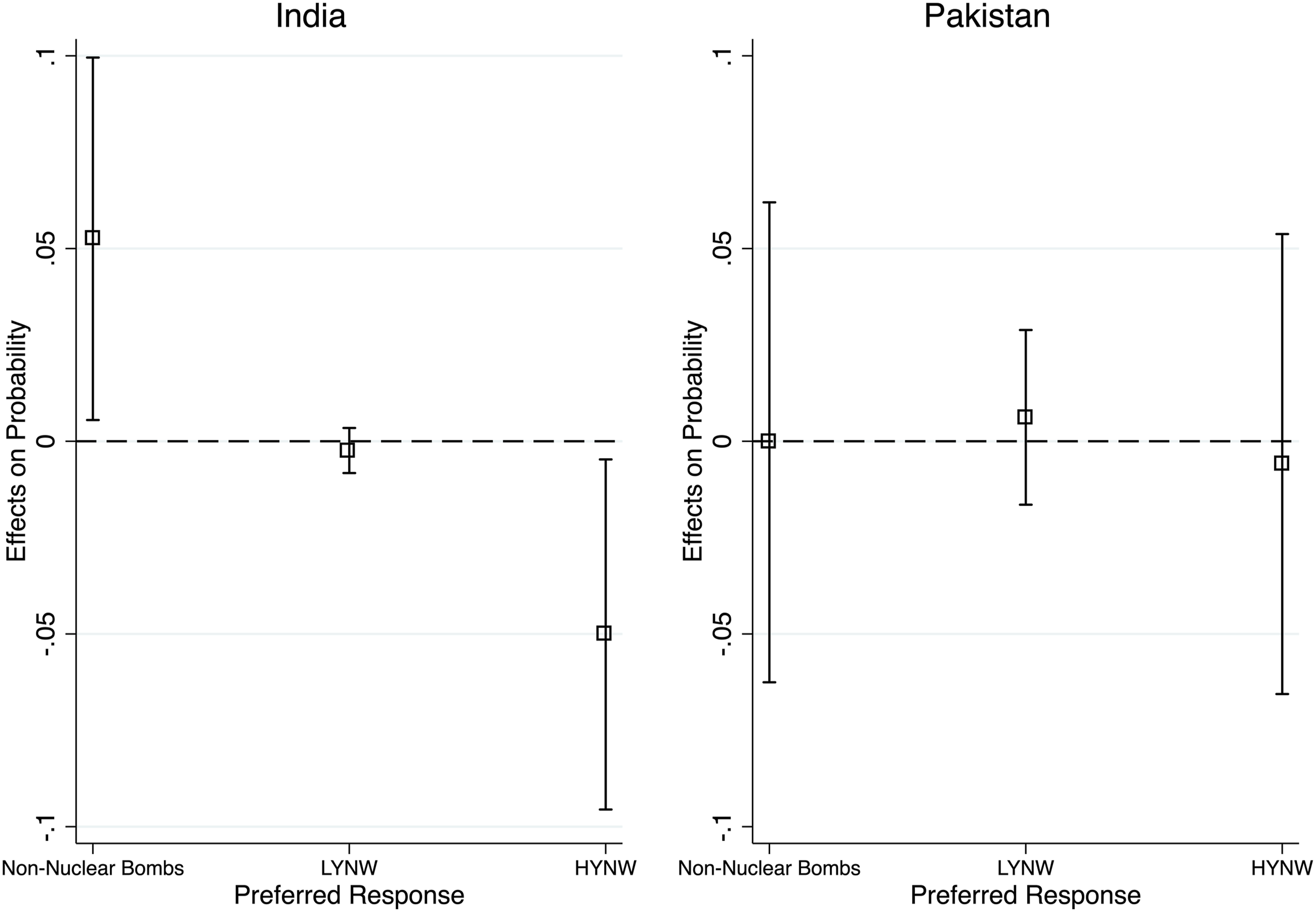
Summary of hypothesis tests, H1–H4
Survey modality provides additional insight into these findings. Because of survey firm practices and recommendations, the survey was conducted by phone in India but door-to-door in Pakistan. Public health studies in developing states have demonstrated that face-to-face and phone interviews produce reliable and concordant results (Mahfoud et al. 2015). But it remains probable that survey modality affected responses. Modality might help explain the results obtained from testing Hypothesis 4, that vivid information only had a significant impact in the expected direction in India. Perhaps respondents in Pakistan, who spoke to researchers face-to-face, were more attentive than respondents in India, who answered questions by phone. 21 Alternatively, Pakistani respondents may have experienced more social pressure to answer thoughtfully and carefully. Or perhaps Pakistani respondents felt social pressure to choose a severe response to demonstrate national loyalty, obscuring the effect vivid information might have had on their true preferences. Regardless, in seeking to understand how publics might pressure public officials during a crisis, measuring what people say they think remains highly relevant. 22
Hypothesis 5 tested a second possible mechanism: compatriot partiality. Citizens that feel much more warmly toward their co-nationals than toward foreign citizens may be more likely to choose nuclear retaliation. Following Dill et al. (2022), we operationalize compatriot partiality as a difference score in the feeling thermometer evaluations of the ingroup and the average of outgroup scores, excluding the rival (which we evaluate separately). We asked respondents to report how warmly they felt about citizens in Pakistan, India, China, Russia, the United Kingdom, and the United States. Responses were coded to range from −1 to +1. A negative score indicates warmer or more favorable feelings toward the outgroup than the ingroup; a positive score indicates warmer or more favorable feelings toward the ingroup relative to the outgroup. A score of zero indicates equally favorable feelings.
Figure 5 plots the distribution of these scores with separate lines for the outgroup average (China, Russia, United Kingdom, and United States) and for the rival (either Pakistan or India). In both countries, outgroup compatriot partiality appears normally distributed whereas rival compatriot partiality is heavily skewed toward the high end of the scale (i.e., there are stronger/higher expressions of dislike/coldness toward the rival). Distribution of compatriot partiality scores toward outgroups (average of four countries) and rival in India and Pakistan.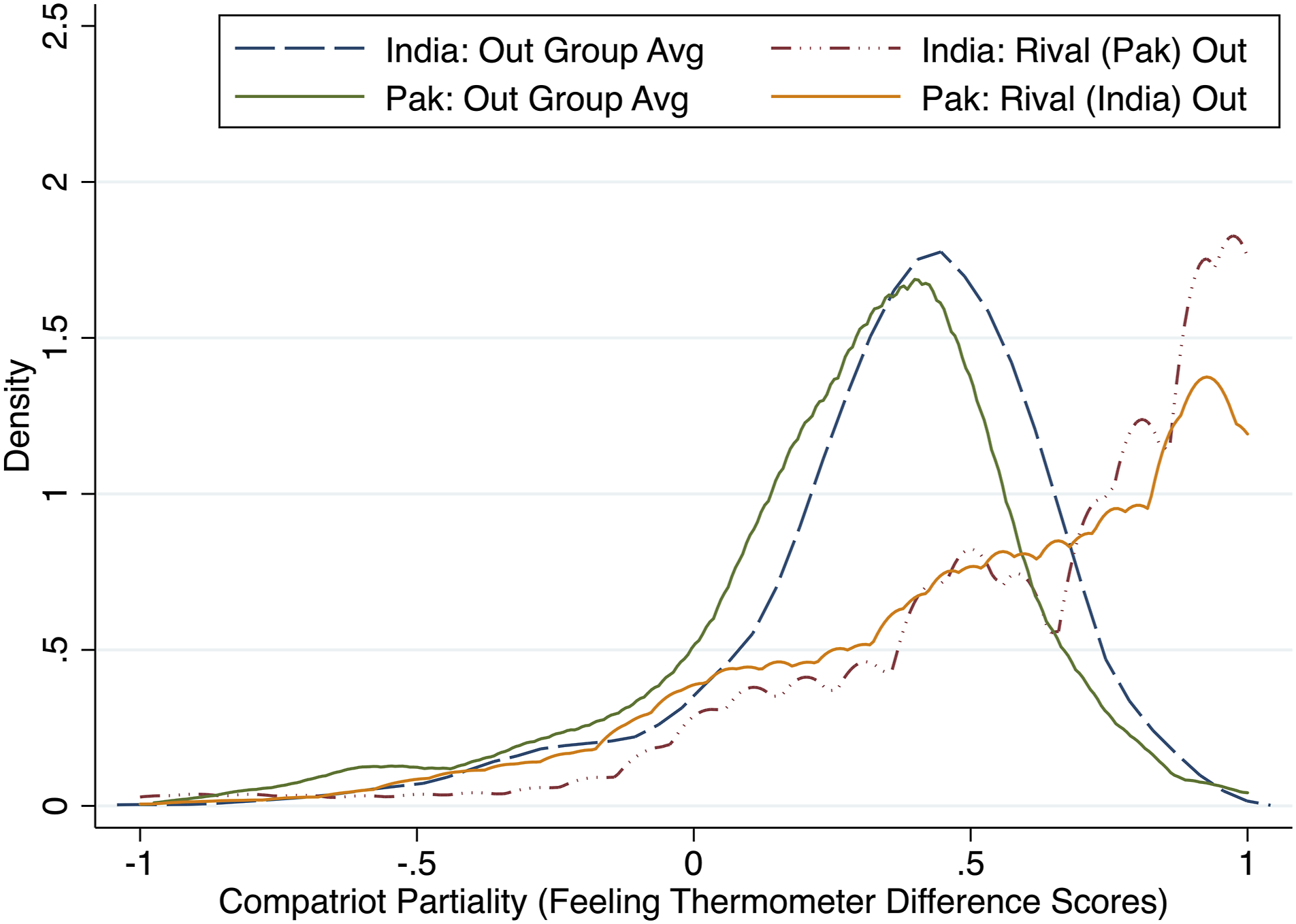
To dichotomize compatriot partiality, we identified where the distributions separate and suggest the point at which outgroup compatriot partiality declines but rival compatriot partiality increases (a cut point of 0.7) represents a meaningful indicator of scoring “high.” We find a stark difference: only 4.6 percent of Pakistani respondents and 6.1 percent of Indian respondents have high outgroup compatriot partiality (averaged across the four countries referenced), but rival compatriot partiality is high for 42 percent of Pakistanis and 53 percent of Indians.
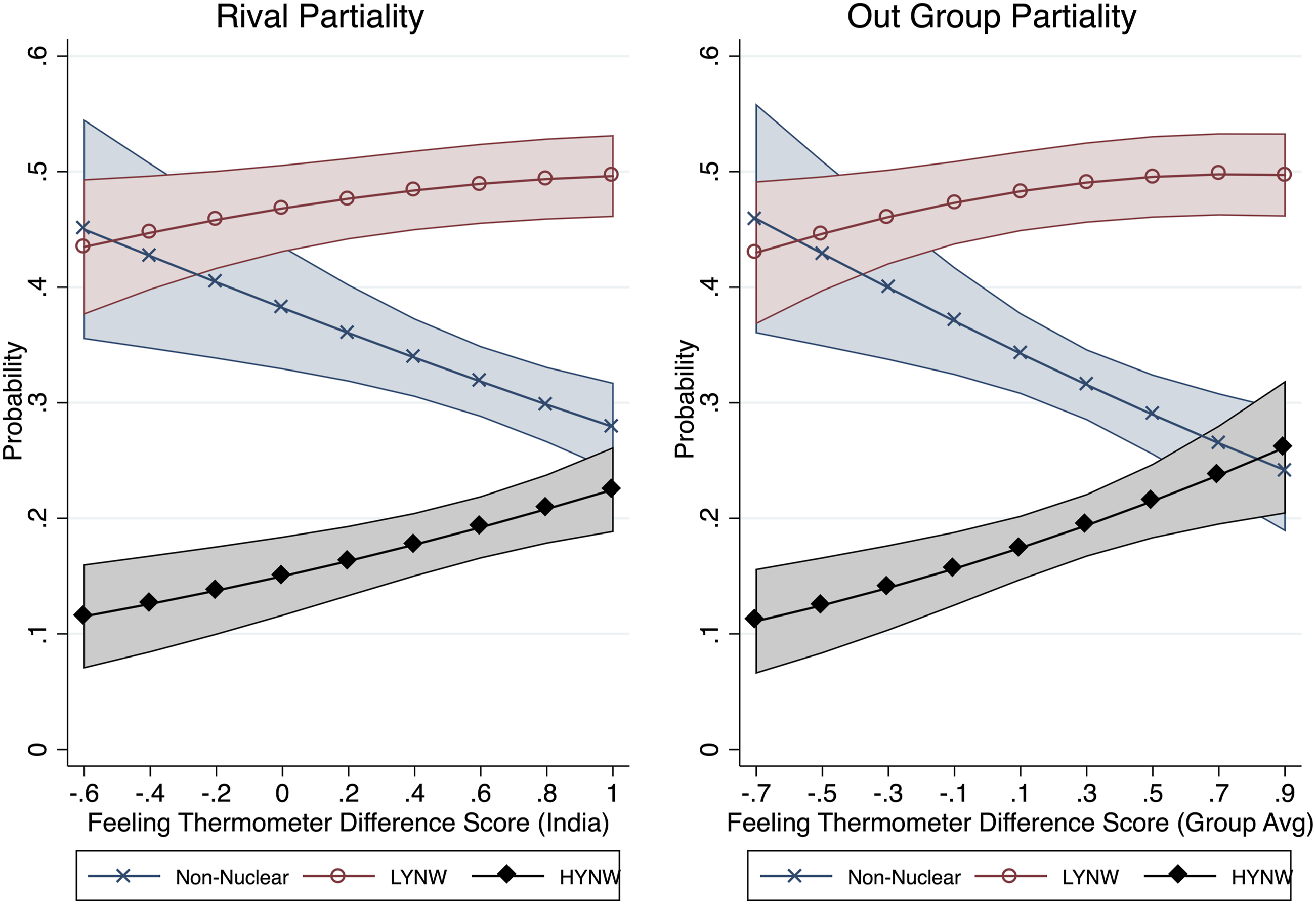
How do feelings toward outgroups and the rival impact respondents’ preferred strike type? We plotted the marginal effect of both types of compatriot partiality on preferred response type. Despite substantial differences in the two distributions, we see similar patterns across all four panels in Figure 6 (India) and Figure 7 (Pakistan).
23
In post-estimation tests, the slope of each preference line is significantly different from zero, excepting the line representing preference for the non-nuclear strike in the left panel of Figure 6. Therefore, compatriot partiality toward outgroups and the rival significantly and consistently impacts citizens’ response strike preferences in both India and Pakistan. Marginal effect of compatriot partiality on preferred response, India. Marginal effect of compatriot partiality on preferred response, Pakistan.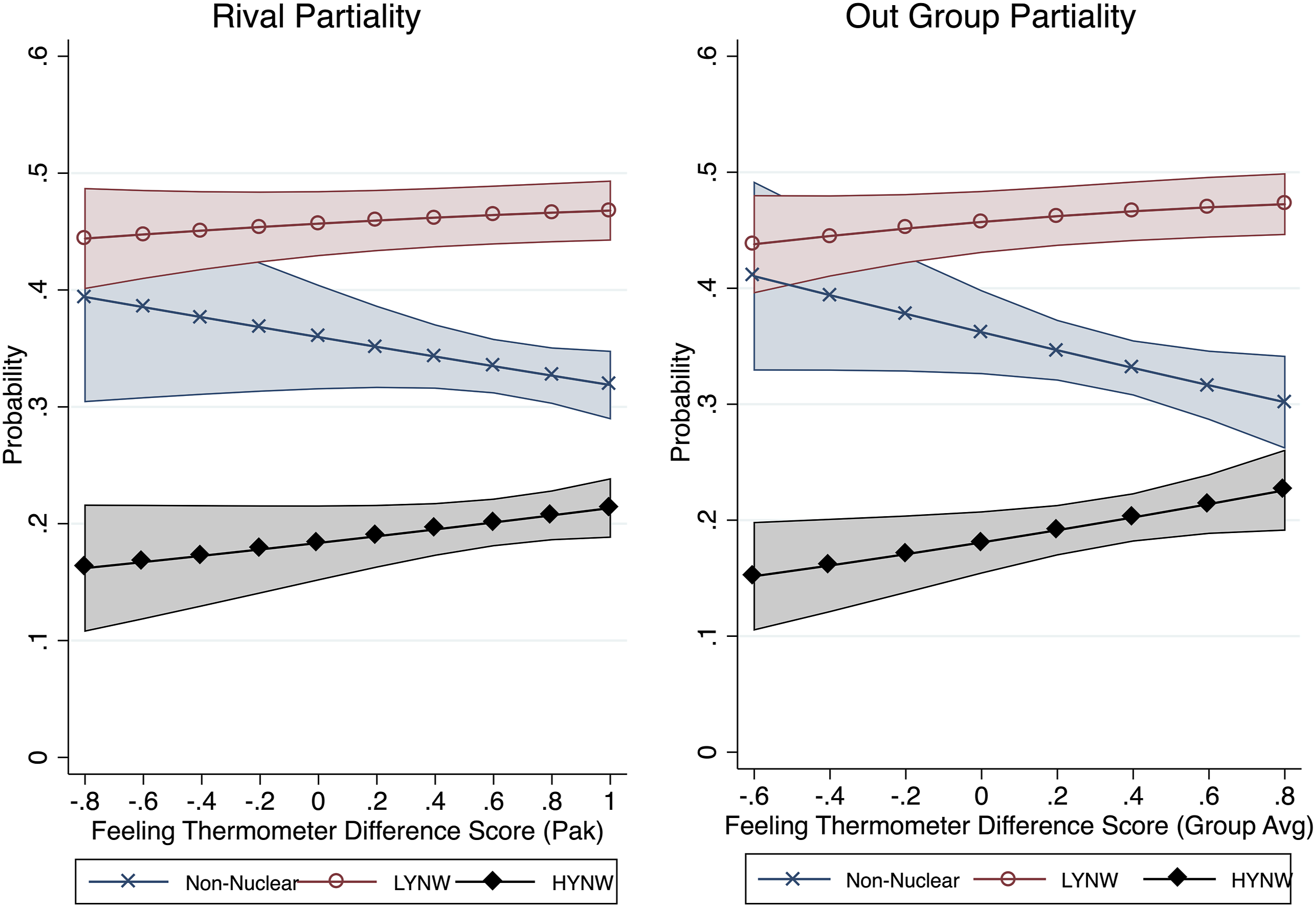
How does high rival compatriot partiality influence response preferences? We conducted exploratory analyses that interacted high rival compatriot partiality with the treatment conditions.
24
Among both Indians and Pakistanis, scoring high on rival compatriot partiality is associated with significantly higher preferences for a high-yield nuclear response, but the association relies on the absence of vivid information. When given three retaliatory strike options without vivid information, respondents with high rival compatriot partiality have a significantly higher preference for a high-yield nuclear response and significantly lower preference for a non-nuclear response (Figure 8). In India, the increase and decrease were 10 percent each (p = .00), whereas in Pakistan, they were 11 percent each (p = .01). Marginal effect of high rival compatriot partiality on strike preference.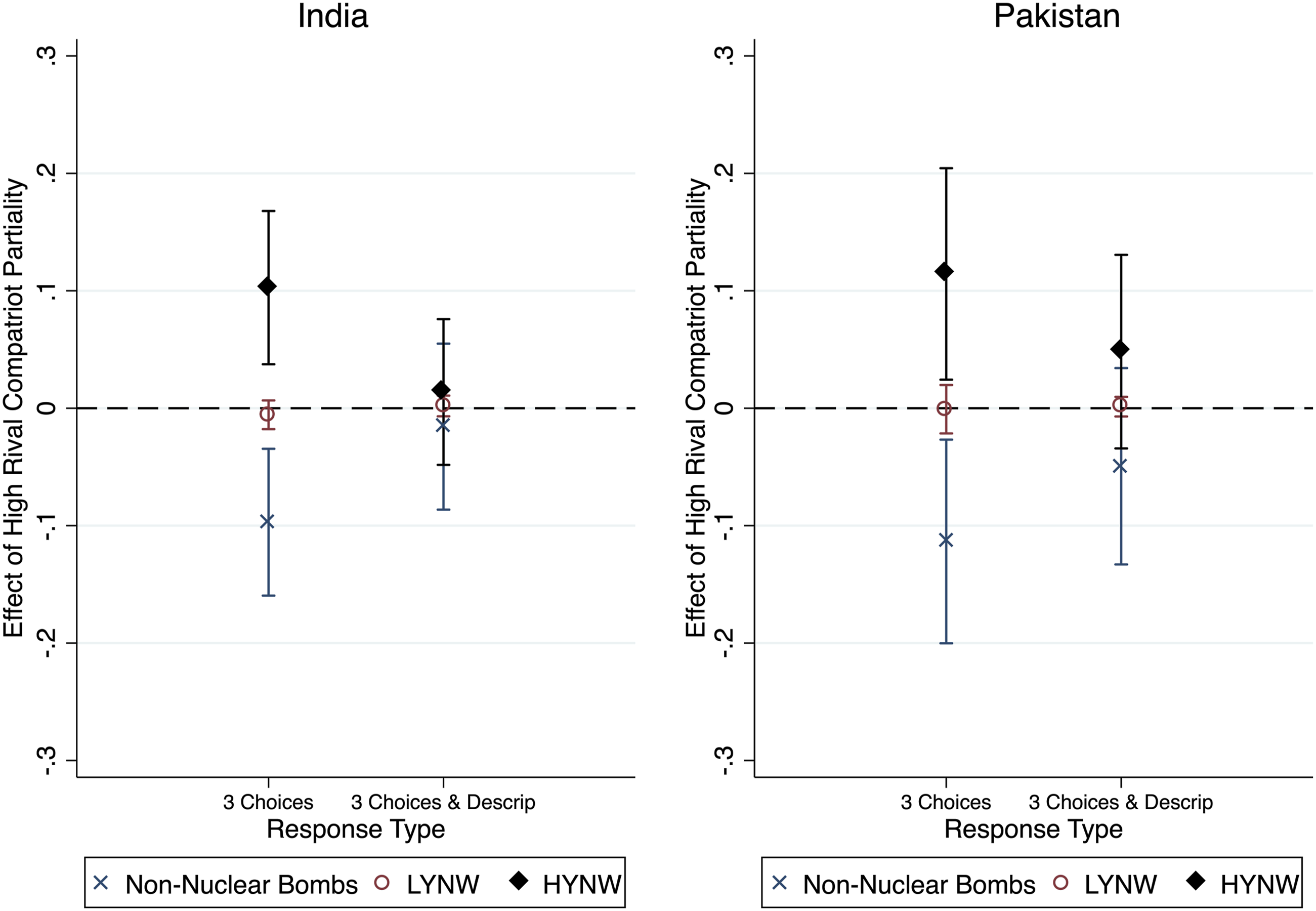
However, the significant impact of high rival compatriot partiality disappears among both Indian and Pakistani respondents when the three response options include vivid information about the weapons’ effects. This may indicate that even those who feel much colder toward their rival’s citizens than they do toward co-nationals do not simply reach for the most severe method of retaliation. Perhaps vivid information leads respondents to rethink the extent to which their enemy should be punished, or perhaps considering frightening nuclear effects, like fire, radiation, and burns, leads respondents to act more cautiously in hopes of de-escalation. Importantly, vivid information has a moderating effect on high-partiality respondents’ preferences for the highest degree of retaliation but does not impact respondents’ preferences for a low-yield nuclear response.
While more research is needed to investigate these mechanisms, we returned to respondents’ own words to refine our understanding. We asked respondents whether they intended to de-escalate the conflict, respond equally, or escalate the conflict. We also asked respondents to describe the most important reason they preferred their selected strike. Using a team of four human coders, we coded the open-ended responses for expressions of restraint (such as wanting to avoid starting a wider war or harming civilians or the environment) and/or retribution (such as seeking revenge). 25
We found that expressions of restraint were significantly more common among respondents intending to de-escalate the conflict, while expressions of retribution were significantly more common among respondents intending to escalate (both at p < .00, using difference of proportions tests). Sixty-seven percent of Indian respondents intending to de-escalate cited restraint in their reasoning, compared to 47.2 percent of Indian respondents not intending to de-escalate. Similarly, 68.7 percent of Pakistani respondents intending to de-escalate expressed restraint, compared to 32.1 percent of Pakistani respondents not intending to de-escalate. This association between restraint and de-escalation in respondents’ expressed rationales suggests that many viewed limiting the damage from their military’s response, and limiting the conflict itself, as related.
Of respondents who intended to escalate the conflict, 27.5 percent (India) and 30.2 percent (Pakistan) cited retribution, revenge, or the just nature of their selected action in their reasoning, compared to 11.3 percent (India) and 8.7 percent (Pakistan) of respondents not intending to escalate (p = .00 in both samples). Respondents who scored high on rival compatriot partiality were significantly more likely to use expressions of retribution or revenge (difference of proportions tests with p < .00 in both samples) and significantly less likely to use expressions of restraint (India: p < .10; Pakistan: p < .05).
These findings advance our theoretical understanding of normative mechanisms. While neither public universally desired retribution against their neighbor and rival, highly partial individuals were more likely to be motivated by retribution. Yet vivid information about the weapons’ effects moderated high-partiality respondents’ strike preferences. The belief that a wrongdoer, or attacker, deserves a harsh response appears to compete with the nuclear-nonuse norm.
Conclusion
Our study indicates that the cross-national shift toward precision, low-yield nuclear weapons poses some threat to the firebreak between conventional and nuclear weapons use. In our national samples, the substantial levels of support for using low-yield nuclear weapons in an escalating crisis indicate that Pakistan’s full-spectrum deterrent capability does “plug the gaps,” making the threat more credible by virtue of the weapons’ perceived usability. But that perception may not have the desired effect of shoring up the firebreak and deescalating a conflict. Findings from the India sample imply that Pakistan’s credibility strategy may inflame rather than stabilize a crisis, with India’s public more likely to act as a goad than a constraint on Indian leaders. If Kidwai is right that FSD has led decision-makers to make the “cold calculation” that nuclear conflict is possible in the near-term, then the credible threat carries great risk: it has created considerable doubt that the firebreak can hold. In the fog of war, the belief that one’s adversary is ready to escalate to nuclear use raises the risk of misinterpreting a missile launch and jumping to the conclusion that nuclear war has begun.
Several implications emerge from these findings. On the regional level, if Indian leaders question their belief in the firebreak, that perception could raise the risk of conflict escalation, including preventive action. A perception that low-yield nuclear weapons pose a more credible threat may also embolden Pakistan to act more aggressively in pursuit of national objectives in Kashmir. If Pakistan were to decide to boost nuclear credibility during a crisis through signaling, such as taking steps to ready low-yield nuclear weapons for use, this would heighten the risk of miscalculation or accident. The spring 2025 conflict left the Indian Air Force “in crisis” after its surprisingly poor performance (Ganguly 2025). Reduced confidence in air capabilities could spur India’s leaders to escalate more quickly in the next conflict with Pakistan in an attempt to gain an early advantage and prevent loss of aircraft.
This study also indicates that the mechanisms supporting nuclear non-use norms compete with normative logics such as loyalty, and the belief that wrongdoers deserve to be brought to justice. And at the individual citizen level, commitment to the NFU principle is weak or absent in both India and Pakistan. National debate about the effects of and possible responses to nuclear weapons use could moderate citizen preferences and reduce public pressure on leaders. Vivid descriptions of the unique effects of nuclear weapons may strengthen the mechanism of the nuclear taboo. As norms regarding the appropriateness of low-yield nuclear weapons are presently being debated and rethought across the international system, elites may be able to make use of this opening for a more public-reaching debate.
Each of these implications extends beyond South Asia to other conflicts involving nuclear-armed states. In the context of the ongoing Russian war in Ukraine, whether Vladimir Putin believes key Russian elites and the broader Russian public would support a decision to use low-yield nuclear weapons is likely to play a role in how close he is willing to get to the firebreak. The US deterrent response to Russia’s low-yield nuclear threats has stayed on the conventional side of the firebreak, meeting Russia’s attempt at a credible nuclear threat with a perhaps even more credible threat to keep the conflict conventional even if the firebreak is breached. Whether China seeks to increase threat credibility through low-yield nuclear weapons is currently unknown, but there would be some potential for such a maneuver in the event of a Taiwan contingency. As the doctrinal and strategic emphasis on low-yield nuclear weapons continues to evolve across nuclear-armed countries, the presence of these weapons may prove to be more disruptive than stabilizing.
Supplemental Material
Supplemental Material - Testing the Firebreak: Experimental Evidence on Low-Yield Nuclear Weapons and Deterrence in India and Pakistan
Supplemental Material for Testing the Firebreak: Experimental Evidence on Low-Yield Nuclear Weapons and Deterrence in India and Pakistan by Lisa Koch, Kristyn Karl, and Matthew Wells in Journal of Conflict Resolution
Supplemental Material
Supplemental Material - Testing the Firebreak: Experimental Evidence on Low-Yield Nuclear Weapons and Deterrence in India and Pakistan
Supplemental Material for Testing the Firebreak: Experimental Evidence on Low-Yield Nuclear Weapons and Deterrence in India and Pakistan by Lisa Koch, Kristyn Karl, and Matthew Wells in Journal of Conflict Resolution
Footnotes
Acknowledgments
We thank the Stanton Foundation for financial support, and we thank CVOTER and Gallup Pakistan for their expert work administering these surveys. We benefited from discussions of this work during presentations at the Center for International Security and Cooperation at Stanford University, the Blavatnik School of Government at Oxford University, the Keck Center for International and Strategic Studies at Claremont McKenna College, and the 2025 International Studies Association conference in Chicago. Our thanks to Jonathan Chu, Christopher Clary, Ayesha Ray, Scott Sagan, and Niloufer Siddiqui for their advice in the early stages of this project. For detailed comments, we thank Pedro Accorsa, Stephen Herzog, Aseema Sinha, Lauren Sukin, Jessica Zarkin, three anonymous reviewers, and the editor.

Funding
We received generous funding in support of this project from The Stanton Foundation.
Declaration of Conflicting Interests
The authors declared no potential conflicts of interest with respect to the research, authorship, and/or publication of this article.
Data Availability Statement
The data, replication files, and preregistered hypotheses and analysis plan can be found on Open Science Foundation at osf.io/uwnfm.
Supplemental Material
Supplemental material for this article is available online.