



Abstract
Sexual violence (SV) in secessionist conflicts reflects distinct political intentions behind rebels’ pursuit of statehood and incumbents’ commitment to territorial integrity. I argue that, compared with their counterparts in non-secessionist conflicts, (1) secessionist rebels are more motivated to eschew SV to garner domestic support and international recognition, while (2) central governments are more incentivized to employ SV to repress and discourage secessionist endeavors. I further theorize that, in secessionist conflicts relative to non-secessionist conflicts, (3) rebel-perpetrated SV is more likely to go unreported, whereas (4) state-perpetrated SV is less likely to go unreported, primarily because of secessionist rebels’ legitimacy-seeking and international actors’ disproportionate attention to heavy-handed state SV. Zero-inflated ordered probit analysis strongly supports these differential implications of secessionist strife for rebel and state SV and the reporting thereof. The theoretical and empirical contributions presented in this article enrich both our understanding of wartime SV and broader conflict studies.
Introduction
Wars of secession are among the deadliest and longest conflicts. Secessionist rebels regard control over contested land as indispensable to their cause and identity preservation, and central governments assert authority over territory to secure national sovereignty and thwart further secessionist movements. At their core, belligerents in secessionist conflicts are reluctant to countenance compromises and instead prolong intractable armed clashes due to commitment problems, issue indivisibilities, and security dilemmas (Butt 2017; Fearon 2004; Sorens 2012; Toft 2003)—both sides struggle to commit to peaceful solutions while their long-term objectives remain non-negotiable, rendering secessionist hostilities “the chief source of violence in the world” over the past several decades (Walter 2009, 3). Hence, secessionist conflicts characterized by entrenched enmity over competing territorial claims were once postulated to swarm with both rebel- and state-perpetrated sexual violence (SV 1 ) against civilians as part of ethnic cleansing, forced expulsion, and symbolic intimidation (Hayden 2000). This supposition, however, has lost credibility because documented instances of SV perpetrated by secessionist rebels have been rare, despite extensive SV committed by incumbent governments (e.g., Cohen 2016; Wood 2006, 2009).
Yet, secondary variables in cross-national quantitative studies indicate no clear relationship between secessionist conflict and rebel-perpetrated, state-perpetrated, or conflict-level SV. Specifically, Cohen (2016, 89) concludes that “secessionist aims are not strongly associated with wartime rape” since conflict aim “fails to reach statistical significance in any of [her] models” for rebel, state, and conflict-level rape. Narang and Liu (2022, 192) also find a null connection between secessionist aim and wartime SV aggregated across perpetrators. Similarly, Doctor (2021, Online Appendix) models secessionist conflict as a control and notes that “secessionist-type rebels are not reliably associated with differences in sexual violence.” Faulkner and Welsh (2022, Online Appendix) likewise show that secessionist conflict as a covariate weakly reduces rebel SV, with statistical significance in some models but not in most others. Further, Binningsbø and Nordås (2022, 1073–1077, Online Appendix) present inconclusive evidence while controlling for territorial incompatibility, implying that “separatist rebel groups in territorial conflicts seem to perpetrate less sexual violence than rebel groups fighting for control over the government.” 2 For her part, Davutoglu (2024, Online Appendix) finds null effects for state SV using the same control.
In summary, an outdated notion suggests a positive link between secessionism and wartime SV, while qualitative evidence highlights differential patterns of rebel and state SV in secessionist conflicts. First-cut explorations in quantitative research, however, find no conclusive association between secessionist strife and SV. The literature on wartime SV, despite extensive theoretical, typological, and empirical contributions (e.g., Butler et al. 2007; Cohen 2013, 2016; Cohen and Nordås 2014; Hoover Green 2016; Ju 2022, 2023; Wood 2006, 2009, 2018), has largely neglected these apparent discrepancies, complicating efforts to integrate qualitative findings into coherent theoretical and quantitative frameworks. To address this oversight, I advance research on secessionism and civilian targeting (e.g., Cunningham 2014; Fazal 2018b) by foregrounding SV in secessionist clashes as a unique lens to elucidate the asymmetric interests between breakaway campaigns and incumbent powers in their treatment of non-combatants. In so doing, I underscore how deliberate restraint from and deployment of SV in secessionist conflicts, as well as strategic efforts to obscure and highlight its reporting, reflect distinct political intentions underlying rebels’ pursuit of statehood and incumbents’ commitment to territorial integrity.
To that end, I develop a theory of secessionist conflict and SV informed by qualitative accounts and assess its observable implications. I argue that, compared with their counterparts in non-secessionist conflicts, (1) secessionist rebels are more motivated to eschew SV to garner domestic support and international recognition, while (2) central governments are more incentivized to employ SV to repress and discourage secessionist endeavors. I further theorize that, in secessionist conflicts relative to non-secessionist conflicts, (3) rebel SV is more likely to go unreported, whereas (4) state SV is less likely to go unreported, primarily because of secessionist rebels’ legitimacy-seeking and international actors’ disproportionate attention to heavy-handed state SV. My zero-inflated ordered probit (ZIOP) analysis finds considerable support for these differential implications of secessionist strife for rebel and state SV and the reporting thereof. Through post-estimation analysis, I demonstrate additional observable implications of my theory across secessionist conflict duration, highlighting rebel groups’ decreasing capacity to shield their legitimacy from reports of SV and state troops’ increasing propensity to employ extreme SV in long-lasting secessionist conflicts.
This article makes important contributions to the literature on wartime SV and beyond. First, I offer a theory explaining how secessionist conflict influences both rebel- and state-perpetrated SV and the reporting thereof. This theory resonates with decades of pertinent qualitative narratives and deepens our understanding of secessionist motives, incumbent strategies, and the role of international actors. Second, I present robust quantitative evidence for my theory, using a method well-suited to address excessive “zero” observations in SV data, which confound the true absence of SV (i.e., SV did not occur) with its unknown presence (i.e., SV was unreported despite occurring). Third, I contribute novel cross-national analysis that estimates the probability of unreported SV, exhibiting distinct reporting dynamics for rebel and state SV across secessionist and non-secessionist conflicts. Examining the dual sources of zero observations and the likelihood that cases go unreported bears notable implications for broader conflict studies. Overall, this article represents the first dedicated study on secessionism and wartime SV with generalizable theory, method, and evidence—an endeavor long overdue amid the rising rate of secessionist movements, which has “more than doubled over the last century” (Fazal 2018a, 113).
Scholarship on Wartime Sexual Violence
Research on wartime SV reveals significant variation in its frequency, form, and target across different armed actors (e.g., Cohen 2016; Ju 2023; Wood 2006, 2009, 2018). A pivotal takeaway from this scholarship is that SV is neither ubiquitous nor an unavoidable ramification of war. Some armed groups limit SV even in the context of atrocities (Hoover Green 2016; Wood 2006, 2009), while others order or authorize it at some command levels as a policy to further organizational goals (Schneider et al. 2015; Wood 2018). SV can also become institutionalized as sexual slavery and forced marriage for “internal” needs (Wood 2018, 521). In some cases, armed organizations deliberately employ SV as a strategy—whether as a weapon, tool, or tactic—targeting certain populations for ethnic cleansing, terrorization, humiliation, and feminization (Eriksson Baaz and Stern 2013; Sharlach 2000; Wood 2006). Even when officially prohibited, SV may occur as a tolerated practice without orders or authorization from leadership (Wood 2018).
Combatants driven by lust, stress, retribution, and/or reward perpetrate opportunistic SV (Butler et al. 2007). Both male and female assailants may also do so to assert masculinity or masculinized femininity while peer pressure serves as a key mechanism (Sjoberg 2007, 2016). Such forms of SV reflect social dynamics, with women combatants often structurally compelled to participate in group SV for self-protection (Coulter 2008) and sometimes socialized to exercise agency in such acts to “fit in” with male comrades (Sjoberg 2007, 91, 2016). In other circumstances, forcibly recruited fighters of both genders commit collective SV for “combatant socialization” (Cohen 2013, 2016, 2). While commanders may tolerate opportunistic and group-based SV by subordinates for various personal, socio-psychological, and instrumental reasons (Ju 2022), such SV can be curtailed by formal and informal institutions and disciplinary regimes with a strong military hierarchy (Hoover Green 2016; Wood 2009).
Over the past decade, large-N quantitative studies have indicated numerous factors that influence rebel and/or state SV. Examples include principal–agent problems (Butler and Jones 2016; Lee and Tomashevskiy 2023); coercive recruitment (Cohen 2016; Ju 2024); political education (Hoover Green 2016); women combatants (Loken 2017; Mehrl 2022); peacekeeping characteristics (Johansson and Hultman 2019; Kirschner and Miller 2019; Reeder and Dicke 2023); foreign troop support (Johansson and Sarwari 2019); natural resource extortion and smuggling (Whitaker et al. 2019); territorial control (Asal and Nagel 2021); foreign fighters (Doctor 2021); leftist ideology (Sarwari 2021); leader elections (Sawyer et al. 2021); political institutions (Willis 2021); amnesties and trials (Binningsbø and Nordås 2022); child soldiering (Faulkner and Welsh 2022; Ju 2024); rebel–civilian ethnic ties (Wieselgren 2022); International Criminal Court interventions (Broache and Kore 2023); ethnic-based gender norms (Guarnieri and Tur-Prats 2023); physical integrity norms and rights (Overton and Sharif 2023); ideological appeals in recruitment (Soules 2023); battlefield performance (Davutoglu 2024); private military contractors (Harrell 2025); and sanctions (Meyerhoefer and Sarwari 2025). Some studies aggregate SV across perpetrators, examining the impact of female military peacekeepers on SV (Narang and Liu 2022) or how domestic laws on same-sex and gender-identity rights affect SV against men (Sawyer 2024).
Taking stock, a recent meta-analytic investigation crystallizes previous contributions (Ju 2023), synthesizing various contexts and motives that shape armed organizations’ SV patterns during conflict. However, studies have yet to scrutinize the implications of secessionist contexts for wartime SV, both theoretically and empirically. This article offers a comprehensive analysis.
Secessionism and Wartime Sexual Violence
Secessionist rebels and incumbents have differential incentives regarding the treatment of civilians living in or near disputed territories. To begin with, since pro-secessionist populations around separable territories are essential for realizing secession (Wood 1981), secessionist rebels are more incentivized than their non-secessionist counterparts to refrain from violence against civilians who would constitute future citizens of their independent nation. By doing so, secessionist rebels bolster their legitimacy and seize the moral high ground over central administrations (Wood 2009; Wood 1981); promote public trust in their cause (Jo 2015; Wood 2009); and forge organizational integration through robust social connections with local communities (Staniland 2014). Secessionist rebels are also more inclined to limit child soldiering in adherence to international norms and rules of conduct (Lasley and Thyne 2015); engage in foreign diplomacy to seek global political capital (Huang 2016); comply with international humanitarian law to secure transnational support (Fazal 2018b); and provide inclusive public goods and services to convince domestic and foreign audiences of their legitimate sovereignty (Stewart 2018). In pursuit of perceived benevolence and long-term legitimacy, then, secessionist rebels should have weaker incentives to tolerate SV, whereas non-secessionist rebels seeking to control broader territories or overthrow central governments tend to exhibit higher levels of SV (Asal and Nagel 2021; Cohen 2016, 73).
In addition to the aforementioned mechanisms for secessionist rebels’ restraint from civilian targeting in general, there are specific reasons why they inhibit SV in particular. Compared with other internal opposition groups, secessionist rebel organizations demonstrate significantly higher motivation to recruit women and girls who can provide strategic, symbolic, and material benefits to sustain their struggles. This recruitment pattern is epitomized by the cases of the Liberation Tigers of Tamil Eelam (LTTE) in Sri Lanka (Gonzalez-Perez 2008), the Kurdistan Workers’ Party (PKK) in Türkiye (Haner et al. 2020), and the Kachin Independence Organisation/Army in Myanmar (Hedström 2017). Additionally, Figure 1 illustrates women’s participation across a cross-national sample of secessionist and non-secessionist rebel groups from my data. It shows that secessionist rebel organizations are more likely to include women in their ranks and support base than their non-secessionist counterparts. Specifically, 90, 76, and 95 percent of rebel groups in secessionist conflicts recruited women as front-line combatants, leaders, and non-combatants, respectively. In non-secessionist conflicts, 69, 66, and 76 percent of rebel groups recruited women in combat, leadership, and non-combat roles, respectively. Across all domains, 97 percent of secessionist rebel organizations recruited women in any role, compared with 78 percent of non-secessionist rebel organizations. Women’s Representation in Rebel Groups by Role and Civil Conflict Type. Note: Information on civil conflict type and women’s participation in rebel groups is drawn from the Non-State Actor (NSA) dataset (Cunningham et al. 2013) and the Women’s Activities in Armed Rebellion dataset (Loken and Matfess 2024). Non-combat roles include clandestine activities (e.g., intelligence operators, spies, smugglers, decoys), outreach duties (e.g., recruiters, service providers, fundraisers, group representatives), and logistical support (e.g., nurses, medics, cooks, couriers, planners, administrators, radio operators, guards). Percentages are rounded to the nearest integer. T-test results: * p < 0.1, ** p < 0.05, *** p < 0.01, **** p < 0.001.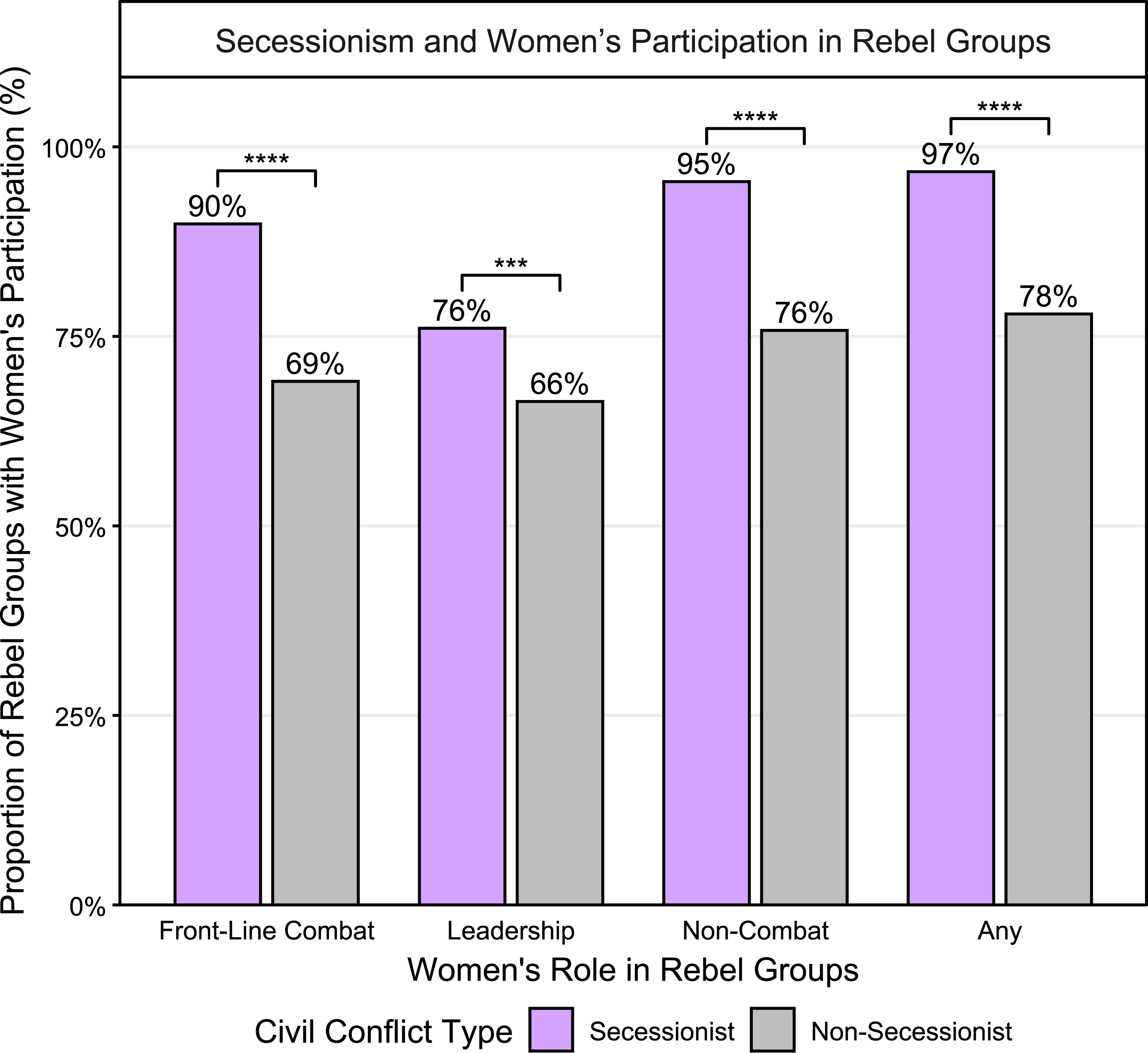
From secessionist rebels’ perspective, SV is thus undesirable as it would alienate an important group of potential supporters and “conflict with their self-image” (Wood 2006, 329). This is especially so as pervasive state-directed SV encourages women to align themselves with secessionist crusades (Alison 2009; Hedström 2017). 3 For example, the LTTE, with public commitments to women’s liberation and emancipatory ethnonationalism, drew significant numbers of women to its secessionist cause and benefited from their support (Alison 2009). Unsurprisingly, the group effectively prohibited SV in particular despite its frequent targeting and forced displacement of non-Tamil villagers (Wood 2006, 2009). While secessionists might sexually violate civilians not envisioned as part of the new polity (Wood 2009, 141), exercising restraint in SV against these populations also helps legitimize secessionist ideology as the “disciplined bearers of a new, more just, social order for all citizens” (Wood 2006, 249). This ideological commitment serves secessionist rebels’ overarching goal of legitimate statehood via consistent intelligence and recruitment, as well as favorable domestic and overseas support (Fazal 2018b; Jo 2015; Wood 2009). As “no ‘successful’ secession is complete until it has become institutionalized in a new government, legitimate at home and recognized abroad” (Wood 1981, 133), secessionist rebels have uniquely stronger incentives than others to stifle SV against non-combatants.
Secessionist rebels are not only more willing but also better able to restrain SV against civilians than their non-secessionist counterparts. With the majority of their members being self-determined, secessionist rebel groups develop “governance structures of impressive sophistication” (Mampilly 2011, 217) that mediate “the conscious effort by the groups’ political wing to exercise restraint” (Jo 2015, 31). Moreover, secessionist rebel organizations that extensively integrate women into both rank-and-file and leadership positions are less influenced by misogynistic and gendered norms and can more effectively implement policies that ensure women’s security and empowerment (Mehrl 2022), foremost of which is to avert opportunistic SV and its acceptance as a tolerated social practice. Especially given that women and girls often join secessionist rebel groups in response to state-perpetrated SV and gendered discrimination, it becomes crucial for these groups to regulate SV against female non-combatants through proactive oversight—such restraint distinguishes them from incumbent governments and signals their capacity for civilian governance (Fazal 2018b; Wood 2009). As such, women’s broad-based participation in secessionist ventures drives “changes in rebel group authority” (Sawyer et al. 2021, 397), leading secession-oriented movements to develop well-honed disciplinary frameworks against SV in particular.
The PKK, for example, recruits “highly disciplined and committed individuals” (Haner et al. 2019, 400), including many women who “voluntarily [join] the PKK” and are empowered to assume “all leadership positions in military units” (Haner et al. 2020, 289, 291). 4 The PKK leadership, with “women in all executive positions” and a strong emphasis on gender awareness (Haner et al. 2020, 291–292), enforces strict disciplinary regimes under a uniform code of ethics to socialize members against SV. This prohibition forbids capturing or detaining female civilians “under any circumstances due to the risk of accusations of sexual assault, harassment or rape,” which “would not conform with the group’s ideology and could potentially harm [its] ability to recruit and then socialize members effectively” (Haner et al. 2019, 398). Out of concern for the group’s reputation and relations with supporters (Haner et al. 2019, 410–411), the PKK administration also upholds a zero-tolerance policy against SV (Haner et al. 2020, 294). In a similar vein, the LTTE, with substantial numbers of women “active in policymaking and leadership roles,” maintained discipline among its fighters by establishing “legal protection against sexual harassment, rape, and domestic violence” (Gonzalez-Perez 2008, 61–65; Wood 2009). The preceding discussion yields my first hypothesis:
Rebel forces commit less SV against civilians in secessionist conflicts than in other civil conflicts.
State governing bodies perceive secessionist threats inside their jurisdictions as harbingers of wider fragmentation or cascading autonomy demands. Consequently, incumbent powers commonly use force to repress secessionists despite domestic and international condemnation. Even if the cost of repression outweighs the value of contested territories, central authorities fight to signal the onerousness of secession and thereby discourage other potential secessionists from rallying for independence (Walter 2009). From the vantage point of incumbent governments, SV can be an “extremely effective tool for conveying the message” (Hayden 2000, 32) because of its enduring socio-psychological effects on victims of SV and their secession-oriented communities (Sharlach 2000)—“a signaling logic ... intended to demonstrate to other potential secessionist groups that declaring independence would be extremely costly” (Cohen 2016, 154–155). Indeed, in Sri Lanka’s decades-long secessionist civil war, state forces wielded widespread SV against women, men, and children to “coerce confessions, degrade them, and discourage broader Tamil involvement with the LTTE” (Human Rights Watch 2013, 1; Traunmüller et al. 2019). The Tatmadaw, Myanmar’s army, has also directed barbaric SV against civilians amid self-determination movements in various regions as “a mainstay terror tactic to punish a community more broadly for perceived sympathies with the insurgents” (Lang 2002, 66). Likewise, during its secessionist conflict, the Nigerian Army perpetrated grievous SV against Biafran women as an “oppressive machinery ... on account of their ethnic nationality or identity,” and its call for mass rape of the population reverberated across the airwaves as the “war jingle of the federal Kaduna Radio of Nigeria” (Eze and Jonas 2023, 56).
Importantly, in secessionist conflicts, mass rape of non-combatant women by state forces can more patently function as a weapon of emasculation against the enemy than in other contexts (Seifert 1994, 62–64; Sjoberg 2013, 219–224). Such gendered violence, Skjelsbæk (2001, 225) contends, “ascrib[es] power to the warring parties ... by feminizing both the sex and the ethnic/religious/political identity to which the victim belongs ... [and masculinizing] the perpetrator’s sex and ethnic/religious/political identity.” It is thus “by no means just acts of senseless brutality, [but those] with a strategic rationale” (Seifert 1994, 64) that cripple the resilience of the communities under attack (Sharlach 2000; Sjoberg 2013, 221–222). Consequently, state-sponsored SV in secessionist conflicts causes “collateral damage in the tactical communication of the message that states’ feminized others are not only destructible but destroyed” (Sjoberg 2013, 224). Particularly because secessionist rebel groups extensively integrate women into their membership and broader base of support, incumbent governments are strongly motivated to exploit women’s bodies as “legitimate sites of political violence” (Davies and True 2017, 16) and “tablets for sending messages” (Sjoberg 2013, 222). To illustrate, amid their secessionist conflict with the PKK, Turkish forces relentlessly violated the Kurdish community’s attachment to “the ‘honour’ of its women” as a “tool by which [they could] control dissent” (Amnesty International 2003, 13). Similarly, West Pakistani troops’ widespread sexual targeting of Bengali women and girls during East Pakistan’s secession was portrayed as an “especially effective ... tactic of genocide” that imposed extreme shame on the “ethnic purity” of their communities (Sharlach 2000, 94–96) and as “a calculated policy of terror amounting to genocide against the whole Bengali population” (Quaderi 1972, 158).
As such, incumbents facing state-seeking rebels have stronger incentives to weaponize SV to terrorize, demoralize, and fracture societies aligned with territorial and identity-based secessionism, compared with those in non-secessionist conflicts that prioritize regime survival and have weaker incentives to perpetrate large-scale SV for community-wide destruction. Although state SV in secessionist conflicts may also be tolerated rather than explicitly employed, it is strategic insofar as “commander tolerance strongly suggestive of permission can morph into a policy of violence through subordinates’ professional self-awareness” (Eriksson Baaz and Stern 2013, 47–48; Ju 2022, 22–23; Wood 2018, 525–528). Moreover, while many explanations for SV as a strategy ipso facto infer strategic intentions from its effects (Aranburu 2010; Eriksson Baaz and Stern 2013, 46–49), I argue that the distinct pattern of state SV in secessionist contexts underscores its central role in repressive strategies: in light of Gutiérrez-Sanín and Wood’s (2017) framework, it forms part of incumbents’ extensive repertoire of violence targeting wide communities tied to secessionism with overwhelming prevalence and deliberate techniques such as forced impregnation that ravages the reproductive autonomy of ethnic and religious groups (Davies and True 2015; Fisher 1996; Selth 2018; Sharlach 2000). Incumbent troops often detain pregnant victims “until abortion [is] no longer possible,” openly stating their intent to use the gestation and eventual birth of enemy-fathered children to undermine secession-minded populations (Fisher 1996, 108–113; Sharlach 2000, 97). This strategy imperils the survival of secessionist societies because—in Fisher’s (1996, 132–133) words—“[i]f their wombs are occupied, the reproductive self-determination of [the] people is eviscerated.” Notably, “as part of a strategy to demoralize and weaken ethnic nationality populations,” the Tatmadaw has forced numerous non-Burman women to “bear ‘Burman’ babies, known as a campaign of ‘Burmanization’” (Apple and Martin 2003, 45; Selth 2018).
State-directed SV targeting secessionist aims and identities coincides with non-sexualized violence during repressive campaigns. While SV may entail greater reputational costs than other abuses, states often use allegations of despicable SV to repair their reputation amid irrefutable evidence of civilian victimization in secessionist conflicts. For example, when strategically expedient, the Sri Lankan government prosecuted its own forces for select high-profile SV incidents to “salvage some legitimacy ... by evidencing its professed intolerance for state-perpetrated war crimes” (Loken et al. 2018, 759). The government sacrificed offenders accused of repugnant SV on the altar of public opinion as ensuing judicial interventions could “instrumentaliz[e] women’s perceived victimhood and norms of gendered protection” (Loken et al. 2018, 752). Ironically, such selective accountability reveals incumbents’ capacity but unwillingness to control state SV otherwise, suggesting that, by default, they strategically allow—whether explicitly or tacitly—widespread SV to persist in secessionist conflicts (Eriksson Baaz and Stern 2013, 61–62). However, despite blatant state-sanctioned human rights violations amid secessionist challenges, “outside governments are loath to become involved in other countries’ internal affairs, and even more so when only a principle—and nothing of tangible importance to them—is on the line” (Coggins 2014). The broader international community’s influence on incumbents’ hardline coercion against secessionism is also limited (Selth 2018). Consequently, while central governments must contend with domestic and international scrutiny over their repression of secessionist campaigns—including the use of SV—they readily navigate and bear this burden because “that is seen to be the cost of preserving [national] stability, sovereignty, and independence” (Selth 2018, 38). The foregoing discussion underpins my second hypothesis:
State forces commit more SV against civilians in secessionist conflicts than in other civil conflicts.
In short, the differential incentives of state-seeking rebels and incumbent governments shape their distinct patterns of SV in secessionist conflicts relative to non-secessionist conflicts. I propose that secessionists eschew SV against civilians to bolster support and recognition inside and outside their claimed territorial boundaries. If this proposition holds, secessionist rebels should also have greater incentives than their non-secessionist counterparts to suppress reports of rebel SV that may turn domestic and international audiences against their cause. 5 In late 2003, for example, when police attempted to arrest an LTTE affiliate charged with raping and killing a woman, “the LTTE themselves took [the culprit] to their area and blocked the arrest, giving the impression that they would punish him themselves” (University Teachers for Human Rights 2004, 10). As it happens, despite occasional claims and allegations of SV against secessionist rebel group members, one is hard-pressed to find clear references or reports of such SV in the context of secessionist hostilities (Cohen 2016, 149–151; Knight and Narozhna 2005, 93; Wood 2006, 313, 2009, 146–149). This constraint is compounded by the challenges humanitarian and civil society workers face in reaching “difficult-to-access areas (non-government controlled zones) that remain sites of intense civil conflicts and discrimination” amid secessionist struggles (Davies and True 2017, 6).
I also posit that incumbents employ dehumanizing SV against non-combatants as a communicative instrument of oppression, signaling the costs associated with secessionist endeavors. It stands to reason, then, that one should have less trouble detecting state SV in secessionist conflicts than in non-secessionist conflicts. Furthermore, secessionist rebels can be more motivated than their non-secessionist counterparts to draw public attention to heinous state-perpetrated SV against “peaceful protesters” to galvanize their cause and malign incumbents’ legitimacy (Fazal 2018a, 118). By way of illustration, one legal expert described reports of state SV in Sri Lanka’s secessionist conflict as “the greatest weapon Prabhakaran [LTTE leader] use[d] to instill absolute faith in him and his cause in the minds of suicide bombers, a large percentage of whom [we]re females” (Hemantha Warnakulasuriya under the pseudonym Mudliyar 1996). The specialist elaborated at the time: “[T]he Tamils will always entertain a fear that there is an organized movement by the majority to condone such dastardly crimes. ... Prabhakaran revels in situations like this. This not only helps his cause but hordes of others will join his brigade for the cause of Eelam.” In summary, compared respectively with rebel and state SV in non-secessionist contexts, secessionist rebels’ SV is more likely to evade publicity, while incumbent troops’ savage SV is less likely to do so.
To be sure, SV reporting dynamics are not solely determined by secessionists’ legitimacy-seeking and incumbents’ repression. Most importantly, while human rights groups often prioritize reporting on state-inflicted SV and neglect empirical evidence of SV by non-state actors, this bias is particularly pronounced in secession-oriented contexts due to the shock factors associated with egregious state SV that flouts international humanitarian law (Davies and True 2017; Human Rights Watch 2013). Regarding SV in Myanmar’s Kachin State, one INGO representative recounts forcefully: “[a]s far as the women’s groups are concerned, the Tatmadaw are the key perpetrators and that’s our focus for advocacy” (Davies and True 2017, 14). International Crisis Group (2007, 31) once described a similar circumstance during Sri Lanka’s secessionist conflict: “[t]he government’s human rights abuses have tended to take some attention away from LTTE violations. The lack of media access to LTTE areas also plays a part.” As such, compared with its counterpart in non-secessionist contexts, SV by secessionist rebels more frequently falls into a humanitarian blind spot, while systematic SV by incumbent troops bound to international conventions draws severe moral vitriol and attracts greater human rights scrutiny. This discussion leads to another set of hypotheses:
Rebel SV is more likely to go unreported in secessionist conflicts than in other civil conflicts.
State SV is less likely to go unreported in secessionist conflicts than in other civil conflicts.
When secessionist rebels are motivated to conceal SV reports and incumbents deploy extensive SV to crush secessionist supporters, victims of SV face severe barriers to reporting due to chronic impunity, inadequate domestic policies, and constraints on transnational actors (Davies and True 2015, 2017; Knight and Narozhna 2005; Traunmüller et al. 2019). In Myanmar, for instance, neither the Tatmadaw nor the non-state armed actors have been adequately charged with SV, as victims and concerned parties have been reluctant to report SV incidents for fear of stigmatization, retaliation, and targeted repression (Davies and True 2015, 2017; Traunmüller et al. 2019). In the context of Sri Lanka’s secessionist conflict, for similar reasons, “it [was] hardly surprising that few Tamil individuals would be willing to come forward with sexual violence allegations against the LTTE [and the state forces]” (Davies and True 2015, 172). This consideration reinforces H3 because rebel SV in secessionist contexts may go even more undetected. Yet it works against H4 because some state SV in secessionist contexts may be unreported. This countervailing mechanism, albeit legitimate, holds less sway insofar as researchers—including myself—use ordinal SV metrics based on general descriptions to capture broad patterns and relative scales of SV across conflicts, recognizing victim perspectives and addressing validity concerns over count-based indicators (Cohen 2016, 66–67; Cohen and Nordås 2014, 419–420; Dawkins 2021, 1110–1112).
Before outlining my research design, I make two clarifications. First, attentive readers may worry that rebel-perpetrated SV appears less prevalent in secessionist conflicts than in non-secessionist conflicts because it is more likely to go unreported, and that state-perpetrated SV appears more prevalent in secessionist conflicts than in non-secessionist conflicts because it is less likely to go unreported. I address this crucial concern with statistical analysis that separately estimates prevalence and reporting dynamics; it evaluates H1 and H2 conditional on the likelihood of observing SV, demonstrating that H1 and H2 hold when examined distinctly from H3 and H4, respectively. Second, I compare SV in secessionist and non-secessionist conflicts because analyzing the impact of secessionist conflict on SV necessitates variation in the explanatory focus. Specifically, I show that secessionist rebels better regulate SV than non-secessionist rebels, while state troops perpetrate greater SV in secessionist conflicts than in non-secessionist conflicts. Even though state SV is thus more prevalent than rebel SV within secessionist conflicts (e.g., Cohen 2016; Knight and Narozhna 2005; Wood 2006, 2009), demonstrating this corollary falls outside the purview of my quantitative analysis. This article lays the theoretical and empirical foundations that allow accumulated qualitative accounts to yield larger gains on that front.
Research Design
To test my hypotheses, I estimate the impact of secessionist conflict on reports of rebel- and state-perpetrated SV using observational data from 230 conflict dyads in 119 civil conflicts spanning 74 countries between 1989 and 2011, for which my variables of interest are available. 6 The cross-national dataset comprises a total of 1,037 dyad–year observations.
Outcome Variables
My outcome variables, illustrated in Figure 2, are derived from four-part ordinal measures of the reported prevalence of Rebel and State SV from the Sexual Violence in Armed Conflict (SVAC) dataset, which documents SV committed by armed organizations against out-group individuals—many of whom are civilians—regardless of gender. The SVAC measures range from 0, indicating “no mention” of SV in reports from the United States Department of State (US DoS), Amnesty International (AI), or Human Rights Watch (HRW), to 3, indicating “massive” SV (Cohen and Nordås 2014, 420–421). When these three sources code a particular observation differently, I use the maximum prevalence level of SV to mitigate the disproportionately high number of unsourced zero observations in the conservatively coded SVAC dataset (Cohen and Nordås 2014, 422; Ju 2023). Even so, both rebel and state SV data exhibit zero-inflated patterns due to severe challenges in reporting and documentation (see, inter alia, Cohen and Nordås 2014; Davies and True 2015, 2017; Ju 2023; Wood 2006). I address this zero inflation in my models, as I elaborate below. Distributions of Outcome Variables. Note: Prevalence level of 0 = No mention of SV in annual/special reports from US DoS, AI, and HRW (“None”); 1 = “Isolated” reports of SV; 2 = Reports of widespread SV (“Numerous”); and 3 = Reports of systematic SV (“Massive”). Data points are “jittered” to avoid overlaps. Percentages are rounded to the nearest integer and may sum to 99 or 101 percent due to rounding. Figure A.1 plots source-specific distributions.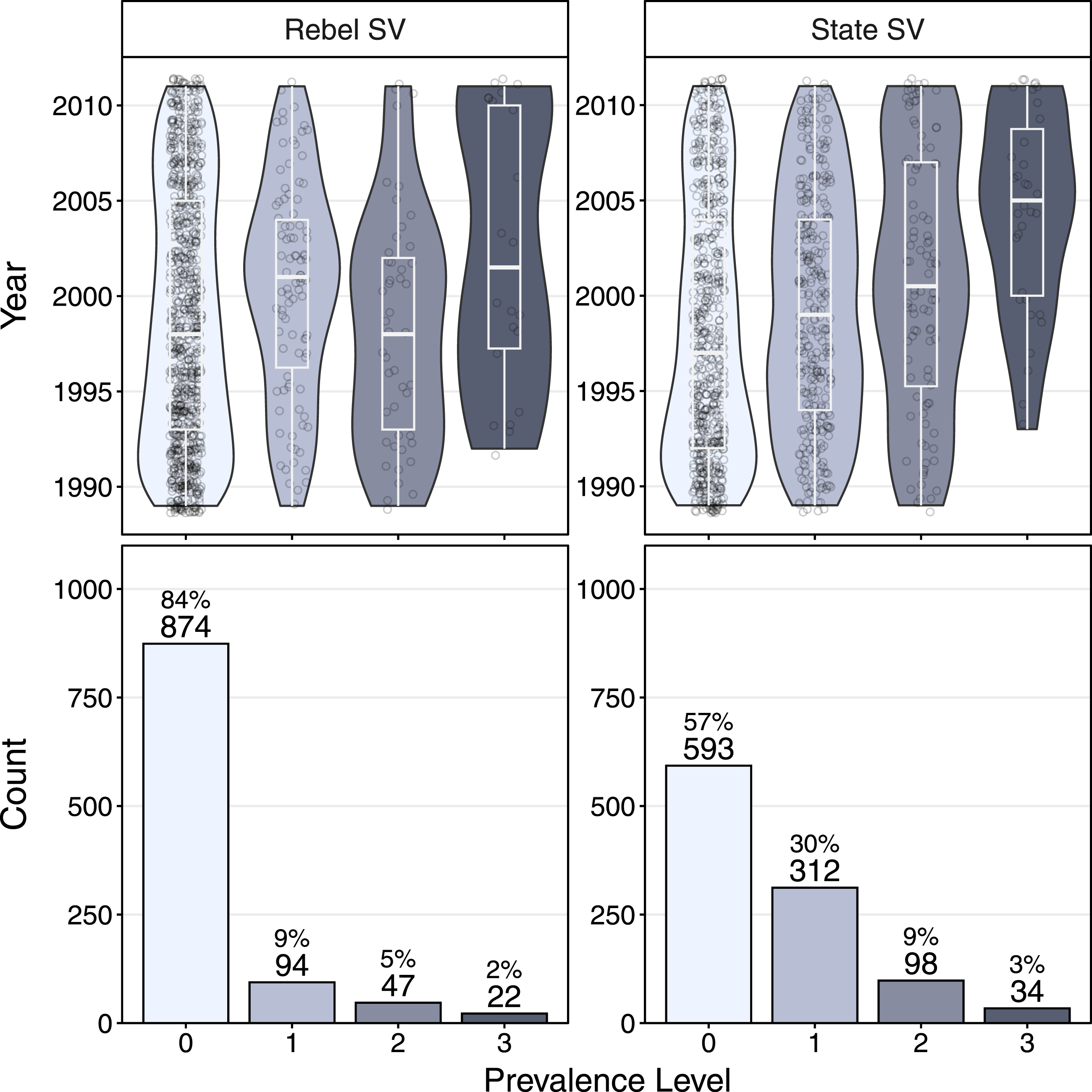
Explanatory Variables
To operationalize armed groups involved in secessionist strife in my dyadic data, I follow recent quantitative studies of wartime SV (e.g., Doctor 2021, 74; Faulkner and Welsh 2022, Online Appendix, 3) and construct a binary measure of Secessionist Conflict using information on civil conflicts with secessionist motives from the NSA dataset (Cunningham et al. 2013).7, 8 Specifically, I leverage the NSA classification of civil conflict types, which distinguishes secessionist conflicts from conflicts driven by communist rebellions, coup d’états, ethnic disputes, terrorism, etc. While these categories are not mutually exclusive, the NSA dataset assigns each conflict a single primary type.
Explanatory Variables in Main Analysis.
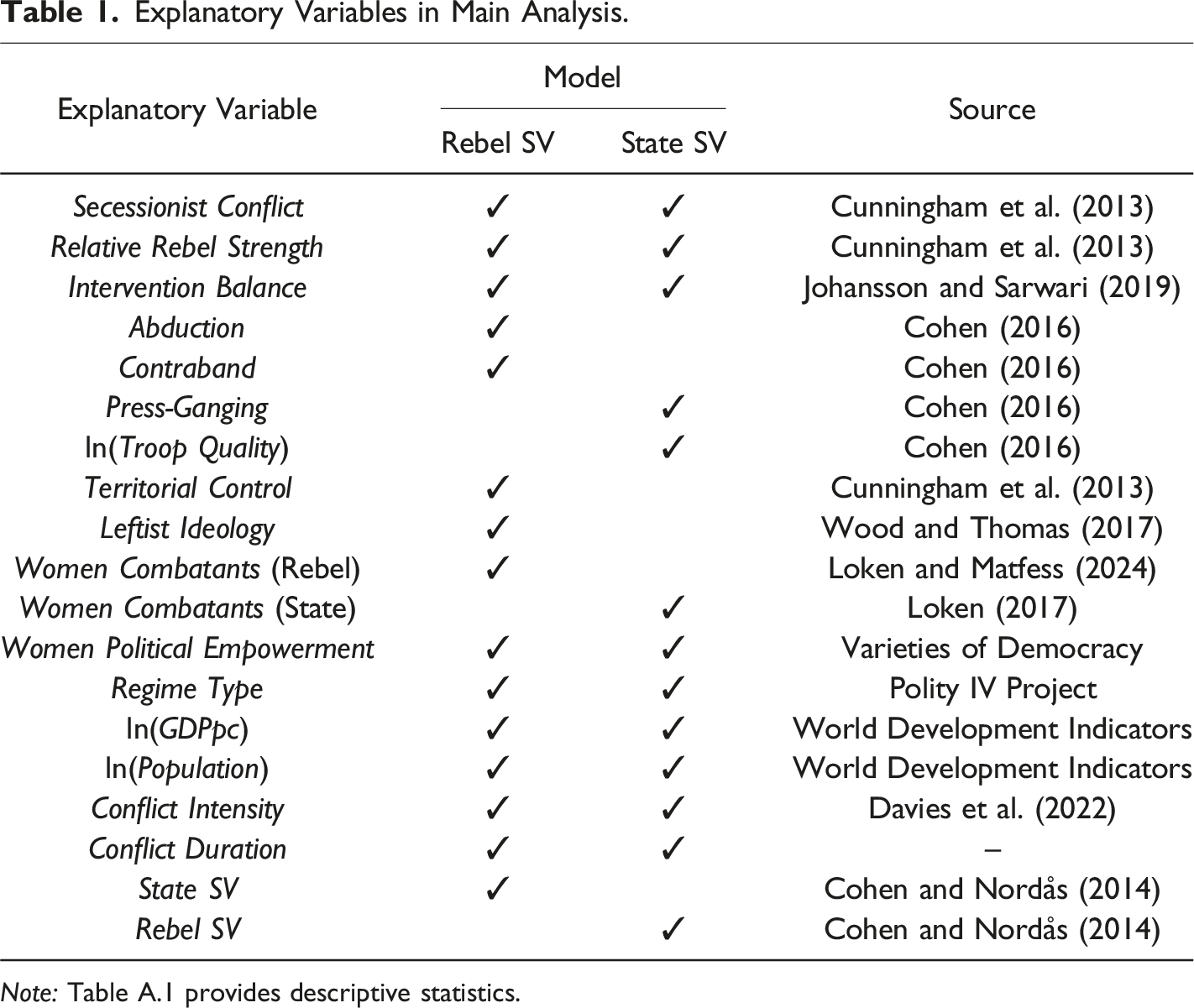
Note: Table A.1 provides descriptive statistics.
Estimation
I employ ZIOP estimations to account for excessive dual-nature zero observations in the ordinal outcome measures of wartime SV (Ju 2023). The SVAC prevalence indicators, though the most reliable metrics available, conflate a true absence of SV with an unknown presence of SV under the zero-level prevalence (i.e., “no mention” of SV in US DoS, AI, or HRW reports) (Cohen and Nordås 2014, 420). Since many zero-level observations in the SVAC dataset obscure high incidences of wartime SV (Ju 2023, Online Appendix B), I herein use the term “inflated 0s” for SV that occurred but went unreported, as opposed to “true 0s,” which indicate that SV did not occur and was reported as such. Conventional ordered probit (OP) regressions can neither distinguish between the two classes of zeros nor account for their preponderance (Ju 2023), incurring information loss and inferential bias.
ZIOP estimations differentiate the two classes of zeros in two underlying processes illustrated in Figure 3. The Underlying Processes of ZIOP Models.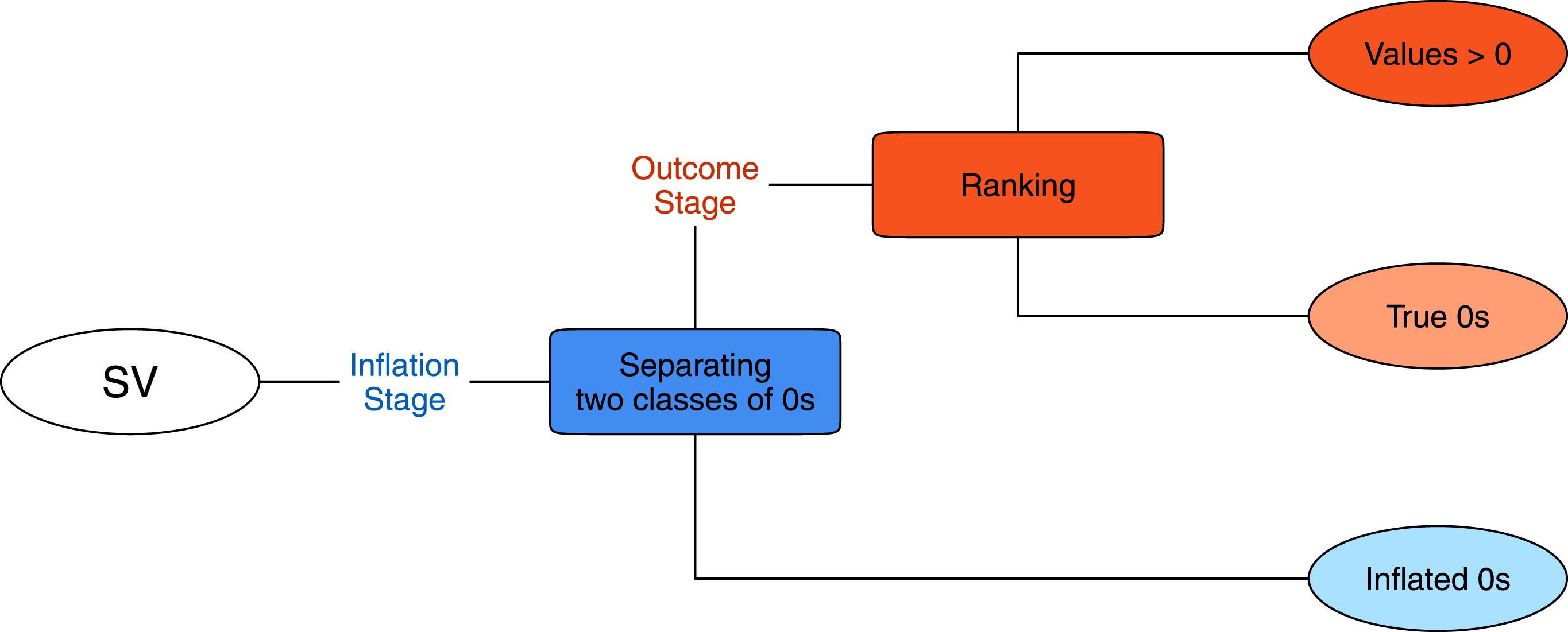
Results
Main Findings
Figure 4 displays the results from my ZIOP analyses of rebel and state SV.
9
I use the same set of explanatory variables for the two stages of each of my ZIOP models. I also cluster robust standard errors by conflict dyad to account for potential dependencies arising from within-dyad correlations. Overall, I find substantial support for my theoretical priors. Secessionism and Wartime SV. Note: Lines indicate 90 percent confidence intervals around raw coefficient estimates. Robust standard errors are clustered by conflict dyad. Tabular results are reported in Table E.1.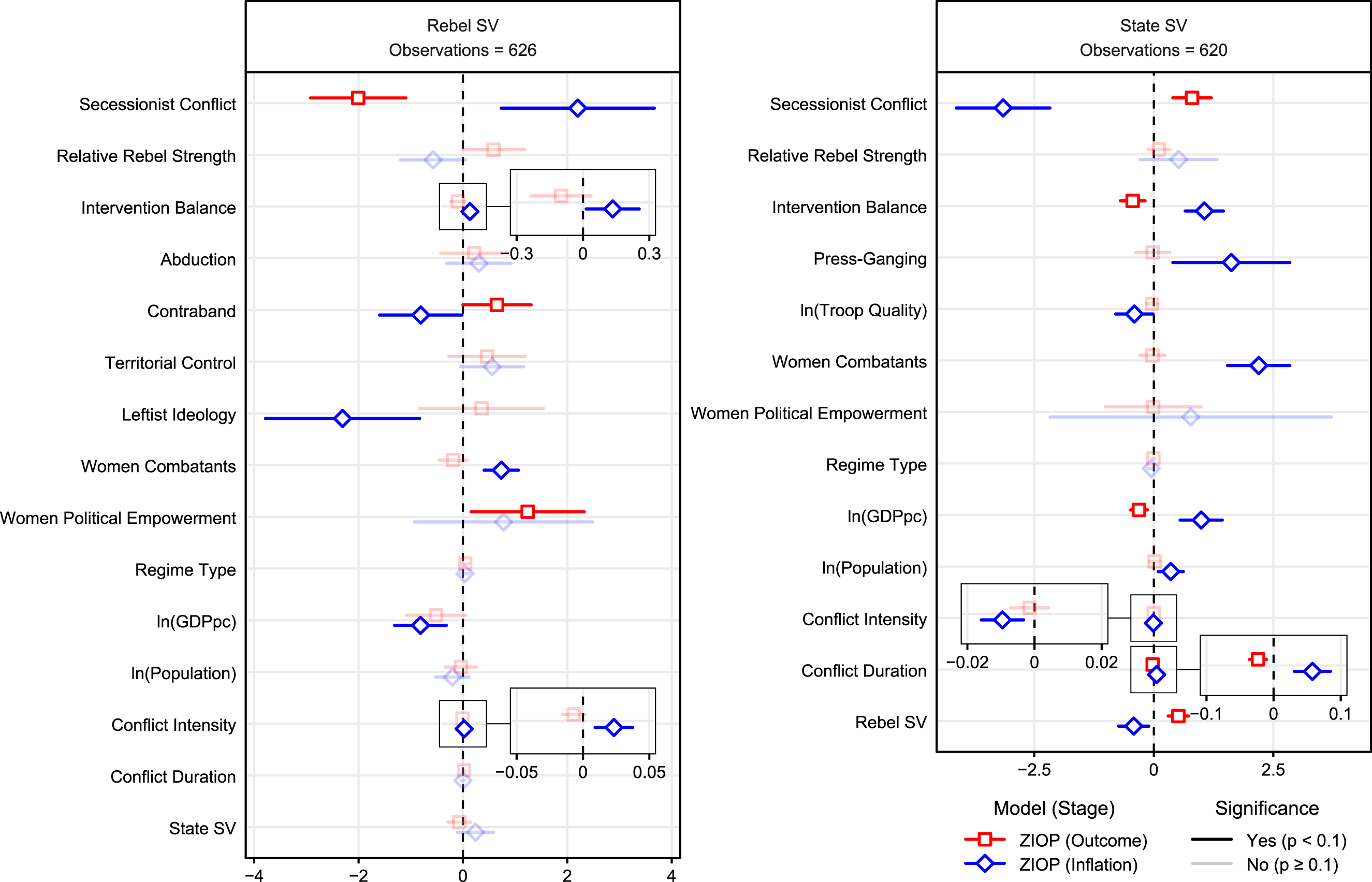
Consistent with H1, my outcome-stage analysis shows that secessionist conflict is associated with a significant reduction in the prevalence level of rebel SV. Arguably, curbing SV against non-combatants is essential for secessionist rebels’ legitimacy and ultimate independence because restraint preserves broad-based empathy with their cause. This cross-national quantitative evidence corroborates qualitative case studies highlighting the rarity of SV by secessionist rebels, such as those in Chechnya (Knight and Narozhna 2005), the Armed Forces for the National Liberation of East Timor (Cohen 2016), and the LTTE in Sri Lanka (Wood 2006, 2009). Additionally, my inflation-stage analysis finds that secessionist conflict raises the likelihood that rebel SV goes unreported. This result aligns with H3; secessionist rebels tend to protect the semblance of their legitimacy from reports and allegations of SV, while media and humanitarian agencies struggle to access areas under secessionists’ control.
H2 and H4 are also supported. My outcome-stage coefficient shows that secessionist conflict positively correlates with the prevalence of state SV. Central governments employ large-scale SV to convey their determination and dampen secessionist aspirations. Besides aforementioned reports of pervasive state SV in secessionist conflicts, similar accounts abound, such as in Chechnya, where Russian troops raped the Chechen populace as a “tool of war” (Knight and Narozhna 2005, 93); in Kashmir, where Indian forces sexually abused civilians in repressive crackdowns (Butt 2017, 112–114); and in Myanmar’s Rakhine State, where the Tatmadaw has “commanded, orchestrated, and perpetrated” widespread SV for “humiliating, terrorizing, and collectively punishing the Rohingya community” (Davies and True 2017; Selth 2018, 29–31). These extensive accounts coincide with my inflation-stage finding that secessionist conflict decreases the likelihood of unreported state SV; state SV in secessionist contexts is immense enough to gain notoriety and draw significant humanitarian focus, while secessionist rebels leverage reports of horrific state SV to bolster their cause.
Questions may arise about whether incumbents confronting secessionist crises are motivated to suppress reports of state-sponsored SV. Although states do “[take] great pains to disguise the full extent of their involvement” (Cohen 2016, 160–161), heavy-handed sexualized coercion often attracts publicity amid heightened human rights attention. Consequently, credible evidence frequently unveils state SV even within clandestine detention centers. As a case in point, during Sri Lanka’s secessionist conflict, the United Nations Secretary-General (2011, 50) reported numerous authenticated videos and photographs showing clear signs of sexualized screening that took place in internment camps “without any transparency or external scrutiny.” The frequent revelation of state SV even in such secretive settings indicates the sheer degree of vicious state SV in secessionist conflicts that gains prominence under the disproportionate humanitarian spotlight.
In Online Appendix C, I report and discuss a series of robustness checks. In summary, the results regarding my hypotheses remain consistent across various model specifications: using an alternative measure of polity-level gender relations (Figure C.1); modeling time trends in SV reporting (Figure C.2); capturing temporal dependence in SV (Figure C.3); applying factorized forms of ordinal covariates (Figure C.4); and excluding state-level covariates (Figure C.5). In addition, given the limited temporal variations in certain variables used in my analysis, I follow Cohen (2016, 94) in conducting cross-sectional analysis using data collapsed across time (Figure C.6). My central conclusions also remain robust in this aggregate robustness check. To maintain focus on my primary predictor, I discuss findings related to covariates in Online Appendix A.
Substantive Effects
In Figure 5, I scrutinize the predicted probabilities for each prevalence level of rebel and state SV in secessionist and non-secessionist conflicts. Predicted Probabilities of SV by Prevalence Level across Secessionist and Non-Secessionist Conflicts. Note: Covariates are held at their means. Dots indicate post-estimation predicted probabilities. Probabilities are converted to percentages rounded to the nearest integer and may sum to 99 or 101 percent due to rounding. Confidence intervals are omitted for visual comfort. Figure B.2 displays 90 percent confidence intervals.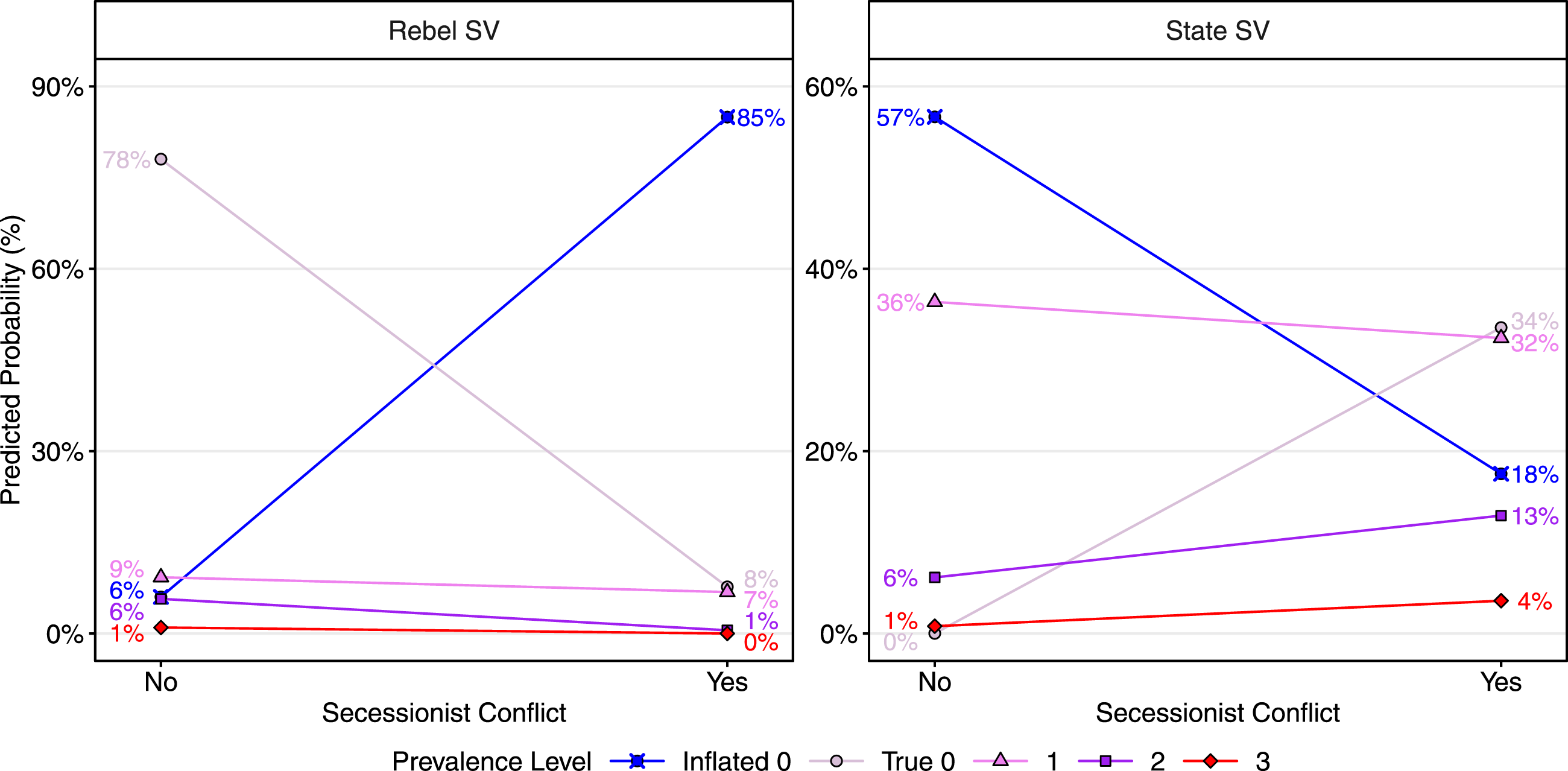
Secessionist conflict reduces the probabilities of non-zero levels of rebel SV. Specifically, it lowers the probabilities of prevalence levels 1, 2, and 3 from 9, 6, and 1 percent, respectively, to 7, 1, and 0 percent. The probability of an inflated 0 increases from 6 percent in non-secessionist conflicts to 85 percent in secessionist conflicts. True 0 accounts for a smaller share of the probability space in secessionist conflicts than in non-secessionist contexts, decreasing from 78 percent to 8 percent. 10 Given the high proportion of zero observations in rebel SV data (see Figure 2), it is unsurprising that the two classes of zeros constitute a significant portion of the probability distribution.
Secessionist conflict raises the probabilities of prevalence levels 2 and 3 of state SV from 6 and 1 percent to 13 and 4 percent, respectively. It reduces the probability of prevalence level 1 from 36 to 32 percent. In other words, compared with those in non-secessionist conflicts, state forces in secessionist conflicts are more likely to carry out “numerous instances” of “extensive” SV and “systematic” SV as a “weapon” but less likely to commit “isolated” incidents of SV (Cohen and Nordås 2014, 420). The probability of an inflated 0 drops from 57 percent in non-secessionist conflicts to 18 percent in secessionist conflicts. True 0 occupies a larger share of the probability space in secessionist conflicts than in non-secessionist contexts, rising from 0 percent to 34 percent. 11
In short, compared with their counterparts in non-secessionist conflicts, secessionist rebels are less disposed to engage in SV, while incumbent governments are more inclined to commit pervasive SV, with rebel SV receiving less recognition and state SV garnering more publicity.
Longitudinal Analysis
The findings from my analysis thus far comport robustly with my theoretical premises. I now subject the proposed dynamics of my theory to longitudinal analysis.
First, although secessionist rebels limit SV throughout conflicts to augment legitimacy (H1), their ability to obfuscate reports of rebel SV and humanitarian agencies’ relative indifference to rebel SV (H3) are expected to decrease as conflicts drag on. Central governments under prolonged duress may seek to concoct and publicize narratives of rebel SV in order to deflect some blame from their own sexualized attacks on civilians and to undercut perceptions of secessionist legitimacy. Simultaneously, transnational media platforms and humanitarian groups that cover appalling episodes of state SV in secessionist conflicts may seek greater access to and enhanced reporting on clandestine rebel SV over time, since “public confidence in advocacy organizations that face drama/credibility conflicts may erode as organizational antagonists expose [lopsided] information” (Cohen and Hoover Green 2012, 454). For example, “[w]hen criticised by the international community for its failings on human rights, the [Sri Lankan] government argue[d] that international rights groups and others [had] failed to condemn LTTE atrocities in the past,” leading to the International Crisis Group’s (2007, 7, 31) increasing recognition that “there [was] a need for continued pressure on the rebels to change their behavior and begin accepting fundamental human rights.”
Second, while state-directed SV comes to light throughout secessionist conflicts due to its drastic nature and humanitarian groups’ continued focus on broadcasting abhorrent incidents (H4), the prevalence of state SV (H2) is anticipated to grow with the duration of secessionist conflicts. Difficulties caused by transformative political developments such as new secessionist threats and evolving secessionist capabilities (Fearon 2004; Walter 2009), coupled with the accumulated costs of fighting and diminishing resources that limit available courses of action, may compel incumbent governments to mete out far more systematic SV under escalating secessionist pressures over time. Such growing predicaments can also raise the specter of state military officers’ enduring tolerance of brutality, which often gradually transmutes into an “implicit policy of illegal violence, including rampant rape” (Ju 2022, 23). “Even if specific orders were not given,” Selth (2018, 30) elaborates with respect to SV by the Tatmadaw, “the tolerance of atrocities and the consistent failure of the military system ... have been enough to let troops know that they are free to abuse civilians whenever they are sent on operations. ... [S]oldiers in the field have often been ordered by their officers, directly or indirectly, to ignore humanitarian law and the Tatmadaw’s code of conduct.”
My analysis in Figure 6 corroborates these implications using an interaction term between secessionist conflict and conflict duration. First, rebel-perpetrated SV becomes less likely to go unreported as secessionist struggles progress. This finding points to secessionist rebels’ decreasing ability to protect their legitimacy from reports of SV as conflicts unfold. Second, the prevalence of state-perpetrated SV increases with secessionist conflict duration. This finding indicates state militaries’ propensity to escalate SV in long-running secessionist conflicts. Taken together, these patterns illuminate the evolving dynamics that rebels and incumbents navigate in secessionist conflicts over time. Secessionist Conflict Duration and Wartime SV. Note: Lines indicate 90 percent confidence intervals around raw coefficient estimates. Robust standard errors are clustered by conflict dyad. Full graphical and tabular results are presented in Figure D.1 and Table E.8.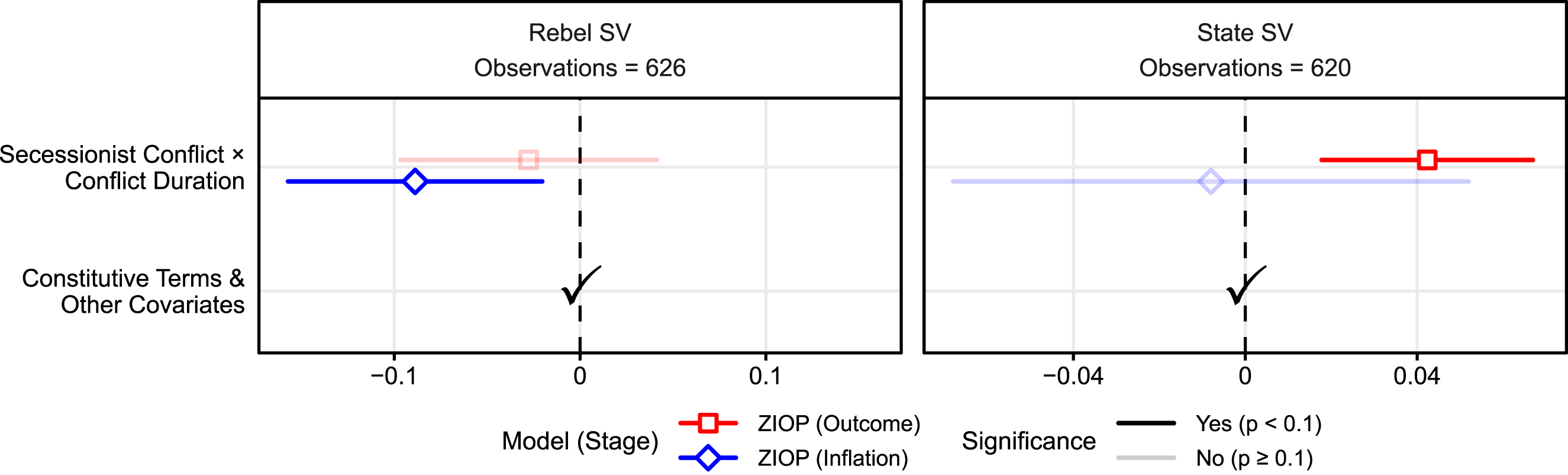
Given that conflict duration has a statistically significant effect on the reporting of rebel SV and the perpetration of SV by state troops in secessionist conflicts, Figure 7 examines the temporal trends in the predicted probabilities of inflated and true 0s for rebel SV and of positive outcomes for state SV over the course of secessionist conflict. First, each year that elapses since the start of the secessionist struggle is associated with a non-linear decrease in the probability of unreported rebel SV (inflated 0), with a rapid decline between five and 20 years into the conflict—stages at which international media and human rights organizations may begin to spotlight some secessionist rebel SV alongside state SV. Zero observations during later secessionist conflict periods are then more likely to indicate an actual lack of rebel SV (true 0). Second, secessionist conflict duration increases the probabilities of widespread and massive state SV (coded 2 and 3). In particular, the probability of massive state SV (coded 3) increases exponentially over time. By contrast, the probability of isolated reports of state SV (coded 1) increases during the first 20 years of the secessionist conflict and then decreases. In other words, state forces embroiled in protracted secessionist crises are more likely to employ systematic acts of SV rather than sporadic ones; secessionist conflicts that endure over the long haul would prompt incumbents facing persistent strife to increasingly rely on a sexualized coercive apparatus. Overall, these results extend my theoretical claims by highlighting additional observable implications. Predicted Probabilities of Rebel SV (Inflated and True 0s) and State SV (Non-Zero Outcomes) across Secessionist Conflict Duration. Note: Secessionist Conflict Duration = Secessionist Conflict × Conflict Duration. Covariates are held at their means. Dots indicate post-estimation predicted probabilities. Probabilities are converted to percentages. Confidence intervals are omitted for visual comfort. Figure D.2 displays all prevalence levels.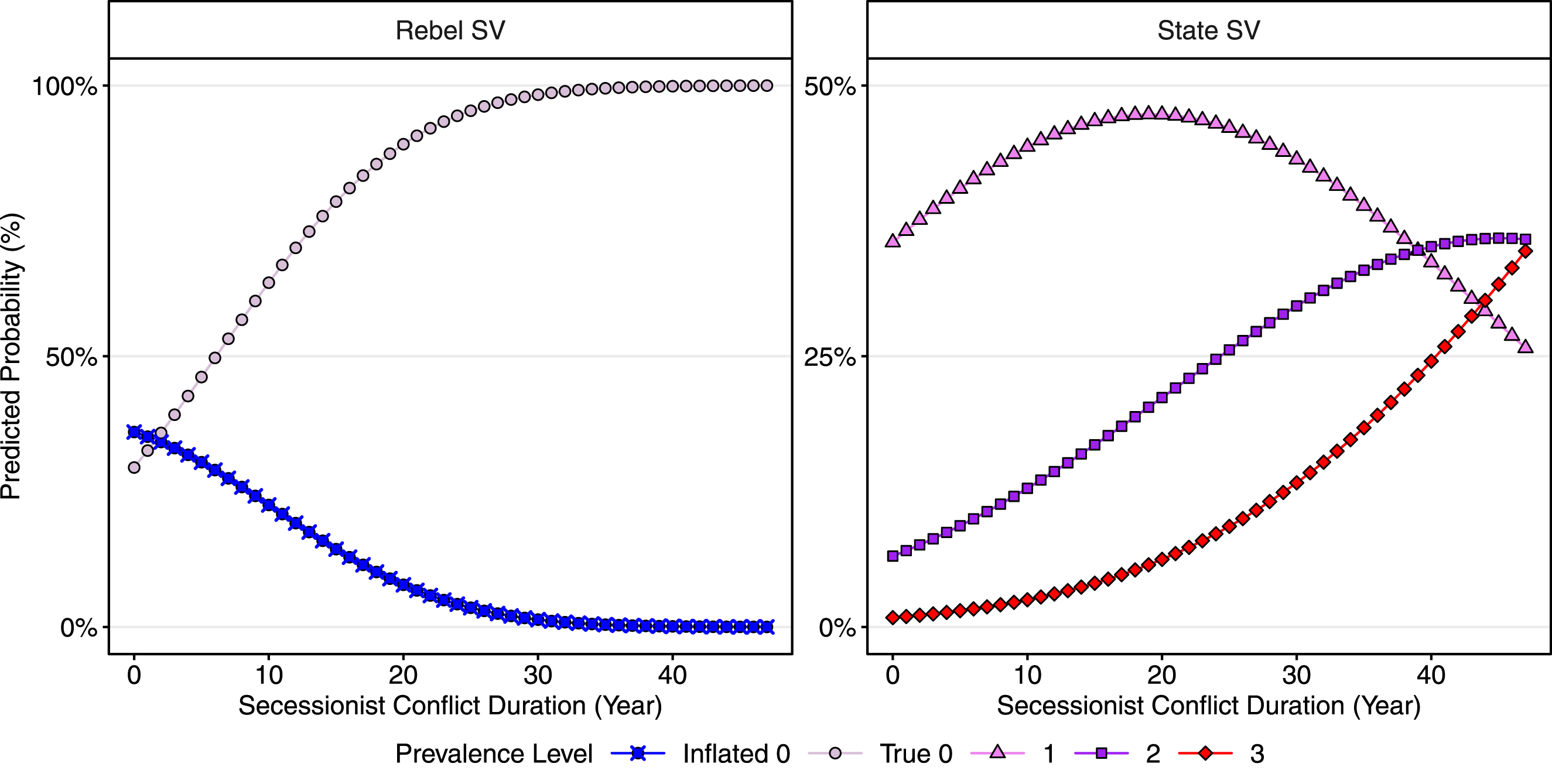
Conclusion
Previous research paints a complicated picture of how secessionist conflict impacts rebel and state SV, where claims from theoretical and large-N statistical analyses are inconsistent with case-based narratives. In this article, I provide a theory of secessionism and wartime SV that is congruent with in-depth qualitative accounts and substantiate it with cross-national quantitative evidence. I show that, compared with their counterparts in non-secessionist conflicts, secessionist rebels better restrict SV to pursue domestic and international legitimacy, while central authorities confronting secessionist crises wield more SV to repress and discourage fragmenting movements. I also demonstrate that, in secessionist conflicts relative to non-secessionist conflicts, rebel SV is more likely to go unreported, whereas state SV is less likely to go unreported. These patterns reflect secessionist rebels’ legitimacy-seeking and international agencies’ disproportionate attention to repressive state SV. Post-estimation analysis examines dynamics over time, illuminating rebel groups’ declining ability to defend their legitimacy against reports of SV and state militaries’ growing inclination to deploy extreme SV in prolonged secessionist conflicts. On balance, my theory and findings contribute systematic knowledge about secessionism and wartime SV while imparting unique insights into the likelihood of SV reporting.
This article offers a foundational schema upon which further qualitative investigations into secessionism and wartime SV may proceed to generate new perspectives or revisit preexisting ideas. In addition to informing future studies on secessionist strife and SV, my analysis contributes to evolving recognitions and paradigms in wartime SV research and beyond. In particular, my differential theoretical predictions and statistical results regarding how secessionist conflict influences rebel- and state-perpetrated SV highlight the burgeoning realization in conflict studies that a single factor can distinctly shape civilian suffering inflicted by opposing belligerents (e.g., Ju 2023; Phayal and Prins 2020). Additionally, the implications of dual-nature zero observations in SV data lend themselves to analyses of zero-abundant data across a broad spectrum of conflict-related phenomena, including girl soldiering and women’s participation in rebellion (e.g., Haer and Böhmelt 2018; Loken and Matfess 2024; Wood and Thomas 2017) as well as various human rights violations such as civilian killings, torture, detention, forced recruitment, and peacekeeper misconduct during and after conflict (e.g., Dawkins 2021; Ju 2023; Walsh et al. 2024). Taking stock, the contributions made in this article have the potential to advance not just our understanding of wartime SV but also the broader field of conflict research.
Supplemental Material
Supplemental Material - Secessionism and Wartime Sexual Violence
Supplemental Material for Secessionism and Wartime Sexual Violence by Changwook Ju in Journal of Conflict Resolution
Supplemental Material
Supplemental Material - Secessionism and Wartime Sexual Violence
Supplemental Material for Secessionism and Wartime Sexual Violence by Changwook Ju in Journal of Conflict Resolution
Footnotes
Acknowledgments
I thank Sam Bell, Hyeran Jo, Harry W.S. Lee, Hilary Matfess, Robert Nagel, Johanna Rodehau-Noack, Harold Trinkunas, Elisabeth Wood, the 2023 ISA Repression, Detention, and Disappearances Panel, the 2023 MPSA Repression and Sexual Violence Panel, and the editors and anonymous reviewers at the Journal of Conflict Resolution for their constructive feedback.
Declaration of Conflicting Interests
The author declared no potential conflicts of interest with respect to the research, authorship, and/or publication of this article.
Funding
The author received no financial support for the research, authorship, and/or publication of this article.
Data Availability Statement
Replication files are available in the Supplementary Material section of the article’s webpage and on Harvard Dataverse at https://doi.org/10.7910/DVN/KK4SCA ( ).
).
Supplemental Material
Supplemental material for this article is available online.
Notes
References
Supplementary Material
Please find the following supplemental material available below.
For Open Access articles published under a Creative Commons License, all supplemental material carries the same license as the article it is associated with.
For non-Open Access articles published, all supplemental material carries a non-exclusive license, and permission requests for re-use of supplemental material or any part of supplemental material shall be sent directly to the copyright owner as specified in the copyright notice associated with the article.
