



Abstract
We present a game-theoretic model of the repression–dissent nexus, focusing on preemptive repression. A small group of instigating dissidents triggers a protest if each dissident participates. The dissidents face random checks by security forces, and when an individual dissident is caught while preparing to participate, he or she is prevented from doing so. Each dissident can invest in countermeasures, which make checks ineffective. For large benefits of protest, higher preemptive repression in the form of a higher number of checks has a deterrence effect and makes dissidents less prone to invest in countermeasures, decreasing the probability of protest. For small benefits of protest, higher preemptive repression instead has a backfiring effect. Both myopic and farsighted governments avoid the backfiring effect by setting low levels of preemptive repression (velvet-glove strategy). However, only a farsighted government is able to exploit the deterrence effect by maintaining a high level of preemptive repression (iron-fist strategy).
Keywords
What is the effect of repression on dissent? The literature (see Davenport 2007a; Earl 2011 for overviews) suggests a deterrence effect where higher levels of repression deter dissent (Hibbs 1973, 82-93, and more recently Olzak, Beasley, and Olivier 2002), a backfiring effect where higher levels of repression encourage dissent (Muller and Opp 1986, and more recently, e.g., Almeida 2003), or a combination of these two effects (Lichbach and Gurr 1981; Muller and Weede 1990; Opp 1994). While the empirical literature on the impact of repression on dissent faces identification problems (Ritter and Conrad 2016b), the consensus is that the two effects apply in different contexts, which may include short- or long-run time frames (Rasler 1996), different national contexts (Francisco 1995) and political orders (Davenport 2007a), different political opportunities (Brockett 1991), or different types of repression (Earl 2011). Identifying which effect applies in which context requires theoretical underpinnings, but theories have so far been scarce (Pierskalla 2010).
Existing models of the deterrence and backfiring effects are predominantly based on the idea that repression makes dissidents perceive the government differently. On the one hand, the fact that the government represses may inform dissidents about government resolve and lead them to abstain from dissent (cf. the game-theoretic models of Crescenzi 1999; Pierskalla 2010). 1 The psychological perspective on such a mechanism is that repression leads to fear (e.g., Siegel 2011). On the other hand, the fact that the government represses may inform dissidents about the true nature of the regime and make them conclude that it is worthwhile to dissent. The psychological perspective then is that repression leads to anger (e.g., Gurr 1970, 238).
We identify four main disadvantages of such models. First, repression is considered as exogenously given. However, government repression may respond to the current level of dissent, meaning that both dissent and repression are endogenous (Pierskalla 2010; Ritter 2014). Moreover, the government may anticipate how repression affects dissent: if the government knows that repression deters dissent, it may maximize repression, in what we term an iron-fist strategy; if on the contrary the government knows that repression backfires, it may minimize repression, in what we term a velvet-glove strategy. When testing existing models of the effect of repression on dissent, not taking into account the endogeneity of repression leads to biased estimates.
Second, as criticized by Nordås and Davenport (2013), Danneman and Ritter (2014), and Sullivan (2016), the focus is on reactive repression in response to overt dissent. Yet most of what makes overt dissent successful may lie in dissidents’ preparatory mobilization efforts. Given this fact, a government that sets repression strategically may invest in preemptive repression to thwart dissidents’ preparations. Existing empirical literature may operationalize repression in ways that conflate preemptive and reactive repression or that ignore certain forms of preemptive repression (Ritter and Conrad 2016b). Theories are needed that differentiate between these different forms of repression, as they may have fundamentally different effects (Koopmans 1997).
Third, the fact that dissent is a collective action problem does not play any role. 2 Yet an intuitive explanation for the backfiring effect is that a repressive government makes dissidents unify against a common enemy (cf. Chang 2008; Gupta, Singh, and Sprague 1993; Koopmans 1997; Khawaja 1993). 3 The deterrence effect may be explained by an opposite intuition saying that common enemies in some instances create disunity rather than unity (Stein 1976). Fourth, it is not clear when precisely the backfiring and deterrence effects apply. For example, as pointed out by Lichbach (1987, 270-71), one could argue that anger dominates for low levels of repression, until repression becomes so harsh that fear takes over, leading to an inverse U-shaped effect of repression on dissent; yet one could also argue that only large levels of repression anger dissidents, leading to a U-shaped effect.
We present a game-theoretic model that attempts to counter each of these four disadvantages. First, our model does not only allow for dissidents who strategically respond to repression but also for a government that strategically sets repression in response to dissidents’ behavior. Second, our model focuses on preemptive repression taking place at the preparatory phase of dissent, when a small group of instigating dissidents is preparing a protest rather than looking at the protest phase itself, which for simplicity we consider as given. The strategic decision that our dissidents face is whether or not to invest in countermeasures that make the government’s preemptive repression ineffective. Third, our results are driven by the fact that dissidents face a collective action problem, namely, the problem of achieving joint investment in countermeasures. In our analysis, increased preemptive repression may either make it easier for dissidents to solve this problem (successful protest becomes more likely: backfiring effect) or more difficult (successful protest becomes less likely: deterrence effect). 4 Fourth, our model makes clear predictions about the contexts in which our backfiring and deterrence effects apply.
While dealing with the problems identified in existing theories, our model imposes additional challenges for hypothesis testing. First, the fact that repression and dissent are considered as interdependent makes such testing more difficult. We consider this as an inevitable problem as such interdependence cannot be ignored. The advantage of explicitly modeling interdependence is that it provides theoretical underpinnings for estimation strategies that deal with it. Second, actual protests and protest policing in response to it are more easily observed than preemptive repression and dissidents’ countermeasures. We will argue that in spite of this observational problem, our model still leads to testable hypotheses.
We start by modeling how dissidents invest in countermeasures in response to exogenously given levels of preemptive repression (“dissident game with exogenous preemptive repression”). We next investigate how the government sets its level of preemptive repression in response to exogenously given investments in countermeasures. We proceed to model the strategic interaction of government and dissidents (“dissident–government game”), where we consider both a myopic government that best responds to current investments in countermeasures and a farsighted government that fixes the level of preemptive repression for a longer period, anticipating how this affects investments in countermeasures in the long run. 5 Finally, we suggest ways in which our model may explain existing empirical observations and ways in which our model could be tested in new empirical work.
Dissident Game with Exogenous Preemptive Repression
The Game
We first treat a game (based on the model of cooperation in harsh environments by De Jaegher and Hoyer 2016) that explains the mechanisms of interest as parsimoniously as possible and then show that these mechanisms are maintained in more realistic but also more complex extensions. In our model, in any dissident group, two instigating dissidents are preparing to participate in a protest. Each instigating dissident obtains common expected benefits V from the protest if both instigating dissidents participate and zero common expected benefits if at least one of them does not participate, meaning that the participation of each of the two dissidents is pivotal. V is the benefit that the individual dissident expects to obtain after it has become clear that both dissidents in his or her group participate and implicitly includes the payoffs from all possible scenarios resulting from the protest (regime change, accommodation, crackdown,…) and their attached probabilities. The model may be seen as a simplified version of the threshold model of collective action (Granovetter 1978), where collective action takes place as soon as a critical mass of instigating dissidents participates (cf. Marwell and Oliver 1993). The role of follower dissidents in our model is entirely passive, and we therefore refer to instigating dissidents in short as dissidents.
Preemptive repression in our model is aimed at preventing individual dissidents from participating in the protest and takes the form of random checks by security forces (e.g., random searches of dissidents or attempts at detention or arrest; Boykoff 2007; Starr et al. 2008). In particular, any pair of dissidents faces the same exogenously given level of preemptive repression (in short: repression level) R, with R ≥ 1. R measures the number of times security forces check the two dissidents. The checks, when seen as a statistical process, take the form of random sampling with replacement. This means that when performing several checks, security forces may by coincidence check the same dissident several times. Consider one specific dissident. The probability that only this dissident is checked equals 1/(2 R ): with only one check, the probability that he or she is checked equals ½; with two checks, the probability that he or she is checked twice equals ¼; and so on.
The individual dissident decides whether to invest at cost c in countermeasures against repression or whether not to invest (where countermeasures may consist of efforts to avoid searches and to avoid detention or arrest). A dissident who is checked 1 or more times but invested is still able to participate in the protest. A dissident who is checked at least once and did not invest is caught in the act of preparing for the protest and is prevented from participating. However, a dissident who does not invest but happens not to be checked is not caught and is still able to participate. As represented in Table 1, it follows that if both dissidents in a pair invest, each dissident’s payoff equals V − c, where we assume that V > c. If exactly one dissident invests, each dissident obtains expected benefits
Dissident Game with Exogenous Preemptive Repression.

We assume that any considered group of two dissidents is drawn from a large dissident population. Specifically, in each of many consecutive periods, the dissident population is randomly matched in pairs, where each pair is involved in a separate protest and separately plays the game in Table 1, but faces the same repression level R. Over many periods, our dissidents gradually adapt their strategies in the direction of the best response strategy (the so-called payoff monotonic updating; Bowles 2004, 70). The underlying idea is that dissidents learn their optimal strategy given their own and others’ experience. In particular, let a fraction py − 1 of the dissident population invest in period (y − 1). This means that any given dissident with probability py − 1 faces an investing dissident, and with the complementary probability a noninvesting dissident. If, given py − 1, any dissident’s expected payoff is higher when investing than when not investing, then we assume that in period y,
We finally assume that in the initial period 0 any p0 is equally likely, which occurs when p0 is uniformly distributed. When there are multiple equilibria, the probability with which each equilibrium is learned depends on the size of its basin of attraction, defined as the range of initial p0 for which the equilibrium is learned. In this argument, the actual learning phase is considered short compared to the time the dissident population spends at an equilibrium.
Equilibria and Basins of Attraction
For small repression levels, it can be checked that the game in Table 1 has a unique joint investment equilibrium when benefits of protest are large (V > 2c) and has a unique joint noninvestment equilibrium when benefits of protest are small (V < 2c). For large repression levels, the game has a joint investment, a joint noninvestment, and a mixed equilibrium where a fraction of exactly
with large benefits of protest (V > 2c), a repression level R* (with R* ≥ 1) exists such that for low repression levels R ≤ R*, the joint investment equilibrium is learned with probability 1; for high repression levels R > R*, the joint investment equilibrium is learned with probability
with small benefits of protest (V < 2c), a repression level R** (with
These results are best understood by looking at the extreme cases of minimal (R * 1) and maximal repression (R approaching infinity). For minimal repression, the expected payoff to an individual dissident in case of joint investment equals V − c, and equals V/2 in case he or she unilaterally does not invest; the expected payoff to an individual dissident in case of joint noninvestment equals zero, and equals V/2 − c in case he or she unilaterally invests. The change in expected payoff of investing rather than not investing is therefore the same independently of whether or not the other dissident invests. It follows that with minimal repression, if benefits of protest are sufficiently large the joint investment equilibrium is learned with probability 1, while it is learned with probability 0 when benefits are sufficiently small. As shown in Proposition 1, this result extends to a range of low repression levels.
For maximal repression, the expected payoff to an individual dissident in case of joint investment still equals V − c but approaches zero when he or she unilaterally does not invest; the expected payoff to an individual dissident in case of joint noninvestment continues to equal zero but approaches −c when he or she unilaterally invests. Therefore, for high repression levels, the game in Table 1 has both a joint investment and a joint noninvestment equilibrium. Clearly, for a sufficiently high fraction of investing dissidents, the individual dissident is better off investing rather than not investing, and we are in the basin of attraction of the joint investment equilibrium; similarly, for a sufficiently low fraction of investing dissidents, we are in the basin of attraction of the joint noninvestment equilibrium. Moreover, for some intermediate critical fraction
Figure 1 represents all possible initial fractions p0 of investing dissidents including the intermediate fraction
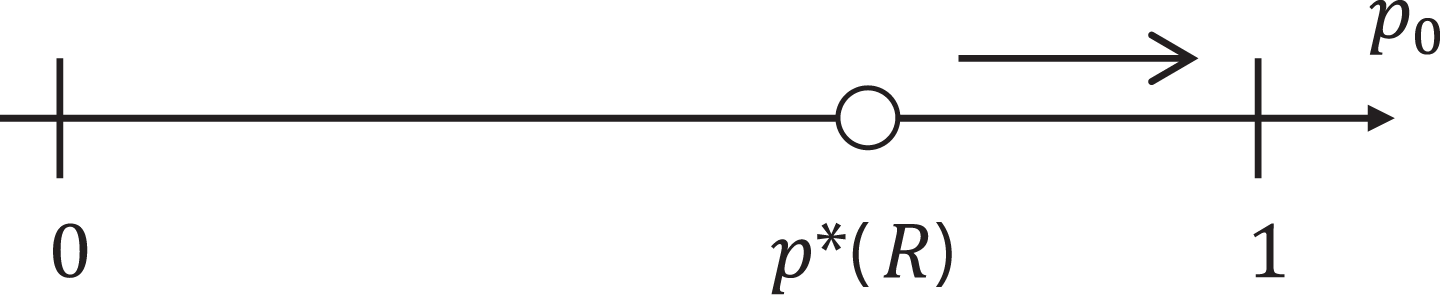
Basin of attraction of the joint investment equilibrium equal to [1
Backfiring and Deterrence Effects
In Proposition 2, we look at the effect of an increase in the repression level on the basin of attraction of the joint investment equilibrium. The direction of this effect is already clear from Proposition 1. With large benefits of protest, the game moves from having a single joint investment equilibrium to having both a joint investment equilibrium and a joint noninvestment equilibrium, suggesting that a higher repression level leads to a deterrence effect, as confirmed in Proposition 2a. Similarly, for small benefits of protest, Proposition 1 suggests a backfiring effect, where a higher repression level means a higher probability that the joint investment equilibrium is learned, as confirmed in Proposition 2b.
for large benefits of protest (V > 2c), dissidents are less likely to learn the joint investment equilibrium the higher the repression level (deterrence effect);
for small benefits of protest (V < 2c), dissidents are more likely to learn the joint investment equilibrium the higher the repression level (backfiring effect). 7
The results in Proposition 2 are illustrated in Figure 2, which represents the critical probabilities p*(R) (measured on the x-axis) for different levels of repression (measured on the y-axis), for both the cases of large and of small benefits of protest. The arrows denote in which direction dissident learning takes place. In the case depicted in Figure 2, the change in p* caused by an increase in R becomes smaller for larger R (put otherwise, p*(R) flattens out for larger R). As shown in Online Appendix A, 8 p*(R) always has this form.
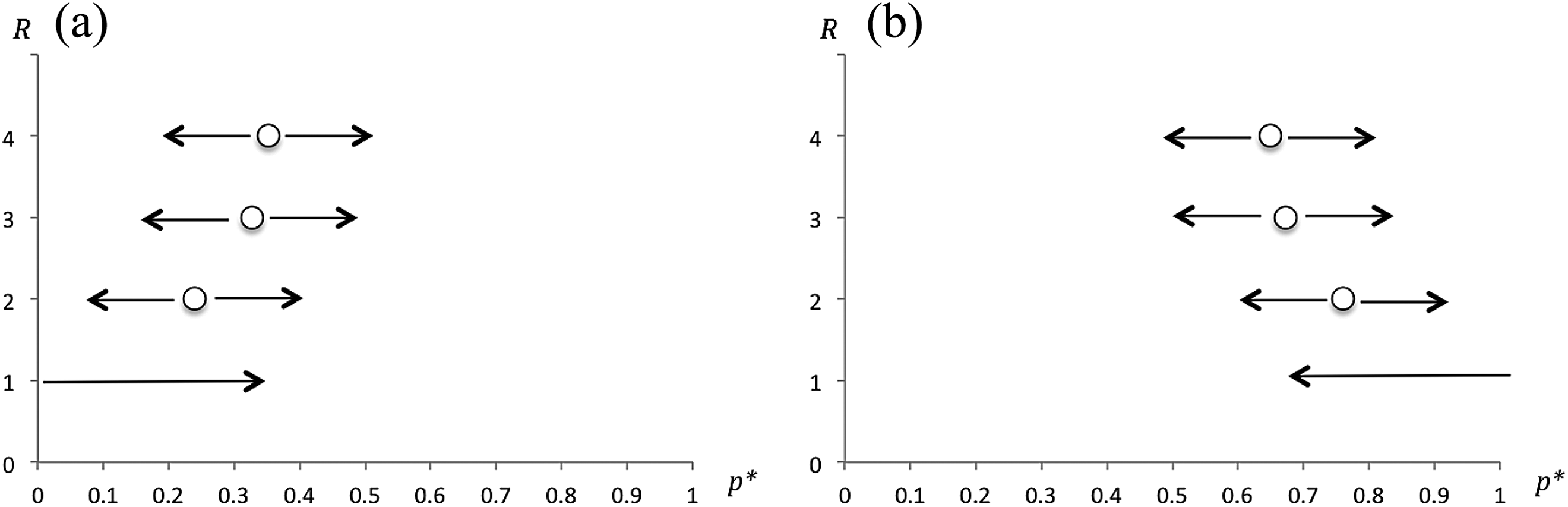
Critical probabilities p* (x-axis) for different levels of preemptive repression R (y-axis). For several levels of R, analogously to Figure 1, the critical probability p* is represented by a dot.
The intuition for the results in Proposition 2 is the following. An increase in the repression level has two effects. First, it becomes less attractive for the individual dissident to deviate from joint investment by not investing. This is because the higher the repression level, the more likely it is that the individual dissident is checked at least once. Second, it becomes less attractive for the individual dissident to deviate from joint noninvestment by investing. The higher the repression level, the more likely it is that the other dissident, who continues not to invest, is checked at least once, so that the fact that the individual dissident invests does not make any difference. For small benefits of protest, the former effect dominates: as the repression level is increased, it is still not worthwhile to invest unilaterally, but it does become worthwhile, and more and more attractive, to invest when the other dissident in one’s pair is investing; for this reason, a backfiring effect is obtained. For large benefits of protest, the latter effect dominates: as the repression level is increased, it continues to be worthwhile to invest when the other dissident is investing as well, but it stops being worthwhile, and becomes less and less attractive, to invest when the other dissident is not investing; for this reason, a deterrence effect is obtained.
Extensions
Given the simplicity of the game above, we investigate whether our results are robust to extensions that relax our simplifying assumptions. The following ten extensions are formally treated in Online Appendix B, which shows that the results are robust when: one dissident in a pair is more likely to be checked than the other; a higher repression level means a higher ability of security forces to identify dissidents that do not invest in countermeasures rather than implying a larger number of random checks; dissidents are matched in multiplayer groups rather than in pairs; with a positive probability, a dissident’s investment in countermeasures fails, and he or she is still prevented from participating when checked; a first participating dissident in a pair already contributes to the benefits of protest, so that a second participating dissident is not completely pivotal (though a second participating dissident continues to contribute more than a first participating dissident); a dissident who does not invest in countermeasures and is checked incurs an additional cost, for example, because of arrest (as long as these costs are not excessively large); not only the number of random checks varies but also the intensity of each check; on top of the individualized preemptive repression modeled in our basic game (searches, attempts at detention or arrest), there is also collective preemptive repression (e.g., prohibitions on assembly, or curfews; Ritter and Conrad 2016b). each group of dissidents contains only a fraction of active dissidents; the government does not know which dissidents in a group are active, but any active dissident who is checked and did not take countermeasures betrays which other dissidents in the group are active; dissidents not only decide whether or not to invest in countermeasures but also decide whether or not to participate in the protest in the first place.
Extensions (ix) and (x) deserve separate attention, as they affect the interpretation of our results. In extension (ix), preemptive repression may also be interpreted as surveillance, where security forces use random checks to identify active dissidents; countermeasures may be interpreted as countersurveillance (e.g., using coded communication, using alternative routes to go to a meeting; Boykoff 2007; Hafez and Hatfield 2006; Starr et al. 2008). 9 In extension (x), investment in countermeasures continues to be a driving factor, as shirking by not investing in countermeasures is more tempting than shirking by not participating (the latter undoes the benefits of protest in any case, the former need not undo these benefits), and for this reason, our results are maintained. In the joint noninvestment equilibrium of our model, dissidents may therefore be interpreted as not only not investing in countermeasures but also not in protest. Similarly, dissidents in the joint investment equilibrium may be interpreted as investing both in countermeasures and in protest itself.
Government Best Response Preemptive Repression
In the previous section, we modeled dissidents as setting the level of countermeasures for exogenously given repression levels. Yet the government may at the same time strategically set its repression level and adapt to current investments in countermeasures. We assume that the government at any given point in time faces a population of dissidents who have been randomly matched in pairs as specified in the dissident game with exogenous preemptive repression. For each pair of dissidents where both dissidents participate in a protest, the government obtains benefit −V; for each pair where at least one dissident is prevented from participation, the government obtains benefit 0. The government is therefore worse off the higher the expected benefit dissidents in a pair obtain. Additionally, the government incurs costs kR from setting a repression level R against an individual dissident pair.
The government knows the fraction of investing dissidents p in the dissident population but does not know whether or not individual dissidents invest. It therefore sets the same repression level R for each individual pair of dissidents (where we assume that R ≥ 1).
10
Given this fact, we may see the government as setting its optimal repression level for a representative dissident pair in which each dissident invests with probability p. Given p, when the government sets repression level R, the expected payoff it obtains from a representative dissident pair equals
The repression level set by the government is a hill-shaped step function of the level of countermeasures p, as represented in Figure 3 and as shown in Proposition 3. Intuitively, when the level of countermeasures is low, a low repression level suffices to undo the benefits of protest; when the government checks a single dissident, this is likely to be one who did not invest in countermeasures, in which case the benefits of protest are reduced to zero. As opposed to this, when the level of countermeasures is high, the government also sets a low repression level because the government’s benefit from repression is small compared to its cost; when the government checks a dissident, this is likely to be one who invested in countermeasures, so that repression is ineffective. Only for intermediate levels of countermeasures does the government set higher repression levels.
11
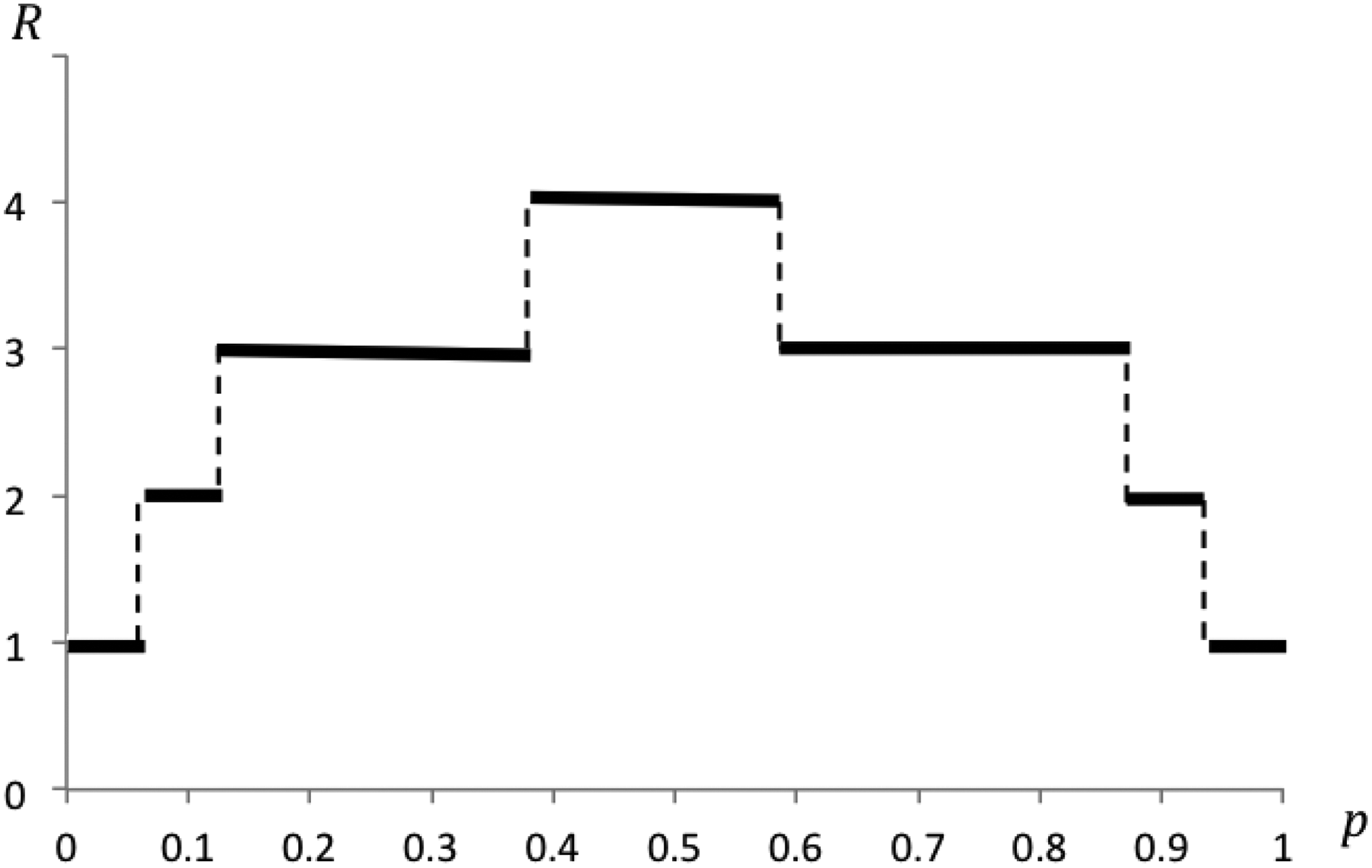
Government best response preemptive repression R as a function of the probability p that the individual dissident invests in countermeasures. In the given example, V = 11 and k = 0.03.
Dissident–Government Game
In the dissident game with exogenous preemptive repression, we considered the repression level as fixed and looked at the probability that different equilibria are learned by dissidents. We next derived the government’s best response to any given fraction of investing dissidents. We now bring these two previous parts of our analysis together and consider strategic interaction between dissidents and the government in what we refer to as the dissident–government game.
Myopic Government
We first analyze the dissident–government game with a myopic government. We continue to assume that in each of many consecutive periods, the fraction of investing dissidents adapts in the direction of the best response (payoff monotonic updating). The government, however, is assumed to adjust its repression level only every t periods, where t refers to the delay until the government can set its best response. In other words, if the period y is divisible by t, the government sets
for large benefits of protest (V > 2c), dissidents learn to play the joint investment equilibrium;
for small benefits of protest (V < 2c), dissidents learn to play the joint noninvestment equilibrium.
Given that it may take time before either of these equilibria is achieved, the dissidents and the government may spend considerable time in disequilibrium, and it is of interest to look at the dynamics on the way to these equilibria. We do so by means of a graphical example in Figure 4. This figure combines the critical probabilities
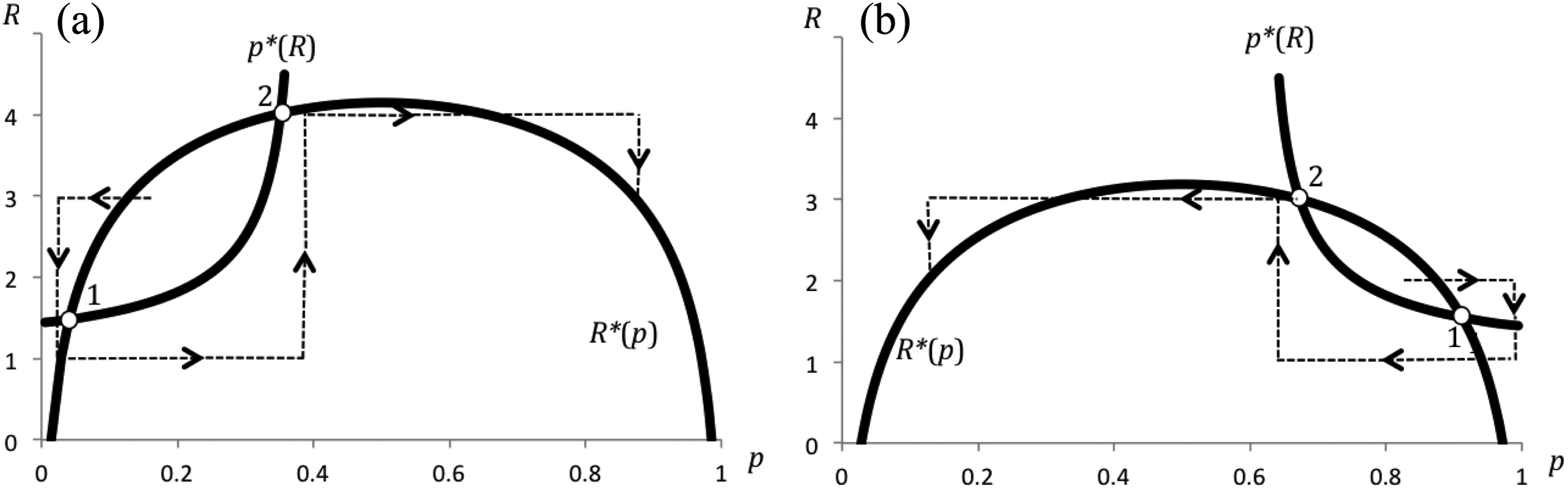
Myopic government: optimal government repression level R* as a function of the level of countermeasures p, and critical probability p* in the dissident game as a function of the repression level R (continuous approximations), for (a) large benefits of protest and (b) small benefits of protest. Arrows represent examples of dynamics with continuous dissident learning/delayed government best response.
The case where p*(R) lies everywhere above R*(p) (not represented in Figure 4) is trivial. Since the government always chooses a repression level along the curve R*(p), and since R*(p) fully lies in one of the two basins of attraction delineated by p*(R), the dissident population can only learn in one direction. Figure 4 represents the more interesting case where p*(R) intersects R*(p). Online Appendix A shows that the case in Figure 4, where the continuous approximations of p*(R) and R*(p) intersect each other twice, is general. Downward- and upward-pointing arrows in Figure 4 depict the direction in which the government adjusts its repression level, whereas rightward- and leftward-pointing arrows depict the direction in which dissidents learn.
The following insights can be gained from the dynamics represented in Figure 4. For large benefits of protest (Figure 4a), in line with Proposition 2, it would be in the government’s long-run interest to maintain a relatively high repression level, so as to keep the basin of attraction of joint noninvestment large (iron-fist strategy). As indicated by the arrow pointing to the left, for a high repression level, in line with the deterrence effect, indeed the fraction p of investing dissidents may decrease. Yet once p is sufficiently low and once the myopic government can again adapt its best response, as indicated by the downward-pointing arrow, it will adopt its short-run best response of setting a low repression level. This undoes the deterrence effect, and the fraction of investing dissidents grows again, as indicated by the arrow pointing to the right. As long as the delay until the myopic government can again adapt its best response is long enough, one inevitably ends up at the equilibrium where all dissidents invest and where the government sets a low repression level. The myopic government is therefore unable to maintain an iron-fist strategy to exploit the deterrence effect.
For small benefits of protest (Figure 4b), following Proposition 2, it would be in the government’s long-run interest to keep the repression level low, so as to avoid the backfiring effect (velvet-glove strategy). Suppose that, instead, the myopic government sets a high repression level. Then as indicated by the arrow pointing to the right, in line with the backfiring effect, the fraction p of investing dissidents increases. Yet the myopic government is shielded against this effect: once p has become large and once the myopic government can again adapt its response, as indicated by the arrow pointing downward, it adopts its short-run best response of setting a low repression level. This undoes the backfiring effect and p decreases again, as indicated by the arrow pointing to the left. If the delay until the government can once more adapt its best response is now sufficiently large, we inevitably end up in the equilibrium where no dissident invests and where the myopic government sets a low repression level. The myopic government is therefore fully able to maintain a velvet-glove strategy and avoid the backfiring effect. 12
Farsighted Government
We finally look at the dissident–government game with a farsighted government. In this game, the government moves first and sets its repression level. Next, dissident learning takes place. The government considers each initial fraction of investing dissidents as equally likely and considers the learning phase as short compared to the time dissidents spend in equilibrium. The results are straightforward and are summarized in Proposition 5. Since with small benefits of protest, the basin of attraction of the joint investment equilibrium increases when R is increased, the government has nothing to gain by increasing R, and fixes a minimal repression level (velvet-glove strategy), which in the long run leads dissidents to learn with probability one not to invest. For large benefits, the government sets its repression level weighing the benefit of a smaller basin of attraction of the joint investment equilibrium, against the cost of higher repression. For sufficiently small repression costs, this leads the government to set a high repression level (iron-fist strategy) in order to discourage countermeasures and thereby increase the probability that individual dissidents are prevented from participating in the protest.
for large benefits of protest (V > 2c), when the cost of repression k is sufficiently small, the government sets a nonminimal repression level (R > 1), and the probability that dissidents learn the joint investment equilibrium is reduced (iron-fist strategy);
for small benefits of protest (V < 2c), the government sets a minimal repression level (R = 1), and dissidents learn the joint noninvestment equilibrium with probability one (velvet-glove strategy).
We have modeled the farsighted government as setting a repression level, anticipating how this will affect dissident learning. Yet what does the farsighted government do once dissidents have learned to play one of the equilibria? An answer is found when extending our model with the realistic assumption that dissident behavior is noisy, such that the individual dissident with a small probability plays the other strategy than the one determined by payoff monotonic updating. In this case, the results in Proposition 5 continue to apply after an equilibrium has been learned. For large benefits of protest, when in spite of the government’s iron-first strategy dissidents learn to play the joint investment equilibrium, a farsighted government that maintains an iron-first strategy makes the basin of attraction of the joint investment equilibrium small and increases the probability that noise moves dissidents to the basin of attraction of the joint noninvestment equilibrium. When the dissidents instead learn to play the joint noninvestment equilibrium, the iron-first strategy makes it less likely that noise pushes dissidents into the basin of attraction of the joint investment equilibrium.
Empirical Implications
We now look at the empirical implications of our model, looking both at the extent to which existing empirical results confirm our predictions and at new ways in which our predictions could be tested. A first challenge is that the two strategic variables in our model, namely, dissidents’ investments in countermeasures and governments’ investments in preemptive repression, may only be partly observable. In the first instance, we deal with this problem by looking at the predictions that our model makes for observable measures such as protest levels or reactive repression in the form of protest policing. Our model leads to predictions about protest levels, as dissidents who are either not checked or checked but invested in countermeasures, successfully participate in the protest. Moreover, our model leads to predictions about levels of protest policing, when the so-called law of coercive responsiveness (Davenport 2007a) is applied: this says that, in general, higher levels of protest are met with higher levels of protest policing. Finally, our model leads to predictions for measures of overall repression, which include both preemptive and reactive repressions, if these two types of repression move in the same direction.
A second challenge is to operationalize the two parameters that determine our results, namely, the size of the benefits of protest and the degree of government farsightedness. We conjecture that democracies tend to correspond to our case of small benefits of protest and autocracies to our case of large benefits of protest, so that the size of the benefits of protest can be operationalized by the negative of the Polity IV scale (Marshall and Gurr 2014). Dissidents who want to instigate regime change in democracies tend to have legitimate channels of achieving this (Regan and Henderson 2002, 120-21), such as elections or court cases, and for this reason, their benefits may tend to be smaller. This contrasts with dissidents who aim to instigate regime change in autocracies and for whom alternatives to protest may not exist.
Moreover, we conjecture that the degree of government farsightedness can be operationalized by its expected tenure length. Following Cheibub (1998), expected tenure length may be estimated by the survival probability of chief executives, as determined by their time in office, previous trends in leadership change, and economic growth. A government with short expected tenure length will discount the future to a higher extent (Cheibub 1998) and will myopically care about the short-run effect of increasing the repression level rather than about the long-run effect. 13
Problematic about these operationalizations is that the degree of democracy and expected tenure length may have additional effects to those predicted by our model and that these variables may moreover be correlated. Indeed, as pointed out by Chiozza and Goemans (2004), expected tenure length tends to be larger in autocracies than in democracies. Moreover, as argued by Ritter and Conrad (2016a), dissidents’ benefits of protest may be larger the longer the government’s expected tenure, further strengthening the correlation between large benefits of protest/autocracy, on the one hand, and expected tenure length, on the other hand. Yet as long as there are enough autocracies with short and democracies with long expected tenure, our results continue to be relevant. A problem with the operationalization of large benefits of protest (higher V) as a high degree of autocracy is that, due to fewer institutional constraints, autocracy also has the effect of decreasing the government’s costs of preemptive repression in the form of random checks (lower k), and at the same time of increasing dissidents’ costs to make such preemptive repression ineffective (higher c), as each individual check may be more intensive. Yet as long as we accept that benefits of protest tend to be larger relative to dissident costs in autocracies than in democracies, our analysis predicts categorically different outcomes for these political orders, and our predictions are not qualitatively changed by other effects that changing the political order may have.
Within-country Time-series Data
While our results are formulated in terms of equilibria, the dynamic system that leads to these equilibria may be subject to regular shocks. The effects of such shocks are predicted by our model to differ depending on the government’s expected tenure length and on whether it is an autocracy or a democracy. A way to test our results is therefore to use time-series data to investigate whether the predictions of our model about protest levels and repression levels are confirmed for individual countries with a low/high Polity IV score and with low/high expected tenure length. Such time-series data (which typically come from newspapers) either look broadly at hostile and accommodating actions by both government and dissidents, in which case hostile government actions may pick up both reactive and preemptive repressions (e.g., the Intranational Political Interactions data as used by Shellman 2006 and Carey 2006), or look more narrowly at specific instances of collective action (protests, sit-ins, strikes,…), and the reactive repression in response to this (e.g., Francisco 1995; Rasler 1996; Koopmans 1997). For the former case, we look at the extent to which our results lead to predictions about overall repression levels, for the latter case to predictions about reactive repression only.
For each of the four cases coming forward from Propositions 4 and 5 (democracy/autocracy; short/long expected tenure), we consider a disequilibrium situation where all dissidents prepare for a protest, but only a fraction of them invests in countermeasures. 14 Consider first a democracy with short expected tenure, where in equilibrium, there is minimal preemptive repression, and no protest and therefore no reactive repression. Such a government reacts to the disequilibrium situation by increasing both reactive repression and preemptive repression. This has the short-run effect of decreasing the probability of successful protest, as for given investments in countermeasures the probability of successful protest is reduced, but has a long-run backfiring effect, where increasing numbers of dissidents invest in countermeasures, so that the probability of successful protest increases again (and with it reactive repression). 15 Once many dissidents invest in countermeasures, preemptive repression is no longer effective, and the government reduces it. This undoes the backfiring effect and leads back to the long-run equilibrium where dissidents do not invest in countermeasures and do not prepare protests, and therefore do not face reactive repression. Given the fact that over the entire protest cycle, high overall repression levels are associated with high dissent, and low overall repression levels with low dissent, our predictions here are in line with literature that predicts a backfiring effect for democracies (e.g., Carey 2006). If the democratic government instead has long expected tenure, in response to the mentioned disequilibrium situation, the government consistently keeps preemptive repression low and avoids a backfiring effect.
Consider next an autocracy with short expected tenure. In equilibrium, investments in countermeasures and protest levels are maximal, so that reactive repression is also large; preemptive repression, however, is minimal. The government responds to the mentioned disequilibrium situation by setting higher preemptive repression, which has the short-run effect of decreasing the probability of successful protest and decreasing the attached reactive repression. In the long term, preemptive repression has a deterrence effect that goes in the same direction, where fewer dissidents invest in countermeasures, thus further decreasing the probability of successful protest and diminishing reactive repression. Once few dissidents invest in countermeasures, the government responds by reducing preemptive repression, as little of it is needed to preempt protest. The low level of preemptive repression undoes the deterrence effect and leads back to the long-run equilibrium with low preemptive repression and high reactive repression. Given the fact that over the entire protest cycle, low preemptive repression and high reactive repression are associated with high dissent, and high preemptive repression and low reactive repression with low dissent, we do obtain unambiguous predictions here for measures of protest policing but not for measures of repression that include reactive as well as preemptive repression.
Compare this to an autocracy with long expected tenure, where preemptive repression is consistently high, and for long stretches of time protest levels are either high (with low attached reactive repression) or low (with high attached reactive repression). Depending on the starting point, the mentioned disequilibrium situation means either an increase in dissent (with more reactive repression) or a decrease (with less reactive repression). The government keeps preemptive repression high, which may again lead the dissidents either to learn to all invest in countermeasures and protest or not to invest in countermeasures and not protest. In short, the dynamic interpretations are ambiguous here, since high protest levels, high reactive repression, and high preemptive repression, on the one hand, and low protest levels, low reactive repression, and high preemptive repression on the other hand, can each be the starting point and the end point.
It is tempting now to look for individual real-world instances that confirm our predictions, when compared across the four cases. For instance, the different predictions for democracies with short and long expected tenure could explain why the aftermath of May 1968 was relatively short in France (Lammert 2013), where the presidential system makes tenure length long, and protracted in Italy (Tarrow 1993), which has typically had governments with short expected tenure length. Moreover, considering countries from the Soviet bloc as autocracies with long expected tenure, our model may explain why student protests of 1968 were short-lived in Poland (Katsiaficas 1987). Finally, our model may explain why in spite of the domestic democratic peace result (Davenport 2007b), which says that in general there is more repression in autocracies than in democracies, some democracies still have high levels of repression (following Young 2009, one may consider the examples of Colombia, Pakistan, or Haiti); this may be due to the myopic response to shocks if these democracies have short expected tenure. Yet a thorough analysis of the effect of the degree of democracy and of expected tenure length requires a systematic cross-country comparison, which is the next type of studies we look at.
Cross-country Data
We now look at what our results, along with the proposed operationalizations, imply for cross-country comparisons of repression and protest levels. At a country level, for protest levels, one may use the Cross-National Time-Series Data Archive (Banks and Wilson 2017). For repression levels, one may use the Political Terror Scale (PTS; Gibney et al. 2016) or the Cingranelli-Richards (CIRI) Human Rights Data Set (Cingranelli, Richards, and Chad Clay 2014). These measures may pick up not only reactive but also preemptive repression, in as far as dissidents are not always successful in eluding preemptive repression.
Following Young (2009), one may regress the PTS or CIRI on Polity IV measures, expected tenure length, and a number of control variables. For short expected tenure length, the degree of democracy should have a large negative effect, since our model predicts that for myopic governments, a switch from large benefits of protest (autocracy) to small benefits of protest (democracy) has a large negative effect on reactive repression. In the former case, protest constantly takes place in equilibrium, with large attached reactive repression and with minimal preemptive repression. In the latter case, in the long run, no protest takes place and therefore also no reactive repression; preemptive repression is again minimal.
For long expected tenure length, the degree of democracy should on the contrary have only a smaller negative effect. With a farsighted government, our model predicts that for large benefits of protest (autocracy), preemptive repression is high; dissidents learn either to coordinate on taking countermeasures (in which case protest levels and the attached reactive repression are high) or do not coordinate (in which case protest levels and the attached reactive repression are low). For small benefits of protest (democracy), just as in the case of short expected tenure length, protest and the attached reactive repression take place with zero probability in equilibrium, and there is no preemptive repression. Since with autocracy, dissident coordination does not always take place with long expected tenure length, the effect of degree of democracy on reactive repression is predicted to be smaller for long than for short expected tenure. Our analysis thus calls for including an interaction effect between the degree of democracy and expected tenure length in the type of cross-country regression as performed by Young (2009).
Our model may explain why some studies observe “more murder in the middle” (Fein 1995; Regan and Henderson 2002), that is, that political orders in between democracy and autocracy have higher repression. If such so-called anocracies, which have been described as unstable, tend to have shorter expected tenure, then the more murder in the middle result is explained by the expected tenure length rather than the political order per se. Indeed, in line with our predictions, Johnson and Thyne (in press) find higher protest levels in countries where more coups take place (and where expected tenure length is therefore shorter). 16 Our model suggests that this observation may be explained by fact that governments with short expected tenure cannot credibly commit to high levels of preemptive repression that would reduce the probability of protest. The fact that such unstable governments may be in low-income countries and may simply not have the means to invest in preemptive repression shows that including control variables is essential.
Discussion
The model we have treated in this article is extremely simple. While Online Appendix B to this article extends the model in several ways to show that our results are robust, it does not deal with the key simplification we make, namely, to consider only the strategic interaction between preemptive repression and dissidents’ investments in countermeasures and not between protest and reactive repression. We make this key simplification in order to gain insight into the specific manner in which preemptive repression and dissidents’ countermeasures against it strategically interact.
Given the insight obtained in this article on how this interaction operates in isolation, a direction for future research is an extension where the strategic interaction between the dissidents’ decision to participate in the protest and the government’s reactive repression in response to protest (or on the contrary the government’s decision to accommodate) is integrated into the model. Such a model may integrate existing game-theoretic models of the interaction between protest and protest policing. Additional insights that come from such an extension may be the following. Dissidents may substitute between effort put in countermeasures and effort put in the protest. Given the presence of preemptive repression, the fact that dissidents need to invest in countermeasures may leave them with fewer remaining resources for the actual protest (Hafez and Hatfield 2006). Apart from this, dissidents facing preemptive repression may change the type of dissent they engage in (Starr et al. 2008), and preemptive repression may imply that only radical dissidents act as instigators (Ritter and Conrad 2016b), which may in turn affect the type of mobilization that takes place. Moreover, the government may from its side substitute between preemptive and reactive repression. If a farsighted government, in order to avoid the backfiring effect, commits to a long-run low level of preemptive repression, this may leave the government with more resources for reactive repression in the form of protest policing; the velvet-glove strategy in preemptive repression would then be combined with an iron-fist strategy in protest policing. In the same manner, if a farsighted government, in order to benefit from the deterrence effect, commits to a long-run high level of preemptive repression, this may leave the government with fewer resources for protest policing, in which case an iron-fist strategy for preemptive repression would be combined with a velvet-glove strategy for protest policing. Further modeling is required to predict the circumstances in which such substitution effects occur.
Supplemental Material
Supplemental Material, Online_Appendices_A_and_B - Preemptive Repression: Deterrence, Backfiring, Iron Fists, and Velvet Gloves
Supplemental Material, Online_Appendices_A_and_B for Preemptive Repression: Deterrence, Backfiring, Iron Fists, and Velvet Gloves by Kris De Jaegher, and Britta Hoyer in Journal of Conflict Resolution
Footnotes
Acknowledgments
We thank two anonymous referees and the editor for helpful and constructive comments.
Declaration of Conflicting Interests
The author(s) declared no potential conflicts of interest with respect to the research, authorship, and/or publication of this article.
Funding
The author(s) disclosed receipt of the following financial support for the research, authorship, and/or publication of this article: Britta Hoyer’s work on this article was partially supported by the German Research Foundation within the Collaborative Research Centre “On-the-Fly Computing” (SFB 901).
Supplemental Material
Supplemental material for this article is available online.
Notes
References
Supplementary Material
Please find the following supplemental material available below.
For Open Access articles published under a Creative Commons License, all supplemental material carries the same license as the article it is associated with.
For non-Open Access articles published, all supplemental material carries a non-exclusive license, and permission requests for re-use of supplemental material or any part of supplemental material shall be sent directly to the copyright owner as specified in the copyright notice associated with the article.
