




Abstract
United Nations peacekeeping operations (UN PKOs) increasingly engage with local communities to support peace processes in war-torn countries. Yet, while existing research tends to focus on the coercive and state-building functions of UN PKOs, their concrete local activities with community leaders and populations remain, empirically and theoretically, understudied. Thus, this study investigates how peacekeepers’ community-based intergroup dialogue activities influence communal violence. It argues that facilitating dialogue between different communal identity-based groups locally can revive intergroup coordination and diminish negative biases against other groups, thereby reducing the risk of communal conflict escalation. This argument is tested using a novel data set of intergroup dialogue activities organized by the UN PKO in Côte d’Ivoire across 107 departments from October 2011 to May 2016. Bivariate probit and matching address the nonrandom assignment of these interventions. The analyses provide robust evidence that the UN PKO mitigated communal violence by organizing intergroup dialogues.
Keywords
In countries emerging from war, state capacity is often weak. State-building efforts can take decades to bear fruit. In contrast, local community leaders may retain high levels of legitimacy (Baldwin and Mvukiyehe 2015) and local conflict resolution mechanisms tend to appear remarkably resilient (De Juan 2017). This begs the question: can international actors advance postwar peacebuilding by engaging with local communities and their conflict resolution mechanisms? 1
Contemporary UN peacekeeping operations (UN PKOs) are often mandated to engage in conflict management at the local level, as in Côte d’Ivoire, the Central African Republic, or Sudan. Intergroup dialogues represent one of the most prominent tools for doing so. They are organized by the civilian components in UN PKOs and involve community leaders and ordinary citizens of different ethnic groups (United Nations Department of Peacekeeping Operations [UN DPKO] 2012, 167-73). Yet, despite the importance of changes in local norms and behavior for sustainable peacebuilding (Stedman 2002, 20) and the centrality of local conflict resolution capacity for peaceful political development (e.g., Tajima 2013; Wig and Kromrey 2018), research has neglected these activities with community leaders and populations locally. Do UN peacekeepers’ local intergroup dialogues help reduce violence after war?
This study suggests that UN PKOs’ local intergroup dialogue activities help decrease communal violence. First, intergroup dialogue activities offer an opportunity for community leaders of different groups to meet and discuss local conflict issues, sometimes with the help of direct mediation by civilian peacekeepers. In so doing, these activities facilitate intergroup information sharing and coordination on intergroup agreements to maintain social order locally. Second, intergroup dialogue activities may reduce negative feelings and biases toward “out-groups” by providing opportunities for positive contact between members of different groups living in the same locality and by promoting norms of peaceful intergroup relations. Overall, intergroup dialogue may thus mitigate violent communal conflict. 2
I test this observable implication with novel spatially and temporally disaggregated data on intergroup dialogue activities organized by the UN PKO in Côte d’Ivoire. The data set was created based on thousands of UN press releases published between October 2011 and May 2016. In this period, the United Nations Peacekeeping Operation in Côte d’Ivoire (UNOCI) carried out 777 intergroup activities in different towns and villages. Peacekeepers organized these activities in response to or in anticipation of violent conflict. To address the nonrandom selection of the locations and timing of intergroup dialogues, the research design uses matching and bivariate probit models.
Postwar Côte d’Ivoire is an ideal case for studying how intergroup dialogues affect communal violence. First, violence in Côte d’Ivoire is often motivated by community-level cleavages and aided or abetted by civilians (Balcells 2017). Therefore, a substantive proportion of the violence in this country is the type that can be addressed by local-level intergroup dialogue. Second, disputes over resources, and particularly over land, are an important root cause of communal violence in Côte d’Ivoire. Because similar resource conflicts are on the rise on the African continent (Boone 2014; Straus 2012), findings may inform peacebuilding interventions in other settings. Third, potentially confounding context factors do not change in Côte d’Ivoire during the period of analysis, thereby reducing the risk of omitted variable bias. That is, informal authorities assume the primary responsibility for resolving local disputes. The state is largely inactive in postwar reconciliation processes (Pritchard 2016, 269), and the UN PKO is the main international actor engaged in local peacebuilding (International Crisis Group 2014, 17). Fourth, interventions organized by UN peacekeepers exhibit the necessary temporal and spatial variation over the period of analysis.
The article makes three contributions to the peacekeeping literature. First, it fills an important research gap and contributes to our explanations for why peacekeeping works. Existing studies propose that peacekeeping is effective because peacekeepers can monitor belligerents, use coercion to punish their violent behavior (Hultman, Kathman, and Shannon 2013, 2014), rebuild failed state institutions (Doyle and Sambanis 2000; Fortna 2008, 98-102), and facilitate communication between belligerents locally (Fortna 2008, 96-98; Wall and Druckman 2003; Ruggeri, Dorussen, and Gizelis 2017). This study theoretically draws on the proposed mechanism of facilitating communication locally and adds to it in three ways: it shifts the focus from armed groups and political elites to community leaders and local populations as interlocutors of peacekeepers. It emphasizes how peacekeepers can strengthen locally rooted conflict resolution mechanisms. It evaluates preventive dialogue activities at the local level, whereas prior studies tend to explore peacekeepers’ reactive efforts in facilitating communication in response to violent accidents. A second contribution is that this article adds nuance to accounts of peacekeeping failure. Several case studies have recently emphasized peacekeepers’ inability to engage locally, their overt concern with the national realm and elections, and their neglect of local-level conflict resolution (e.g., Autesserre 2009). Examining peacekeepers’ engagement in local conflict resolution processes provides a different perspective. Third, the article provides a novel monthly data set on intergroup dialogue activities in Côte d’Ivoire. Analyzing these local-level data produces initial systematic insights into subnational and temporal variation in a prominent civilian activity of UN PKOs and directly tests one local-level peacekeeping pathway. The results yield actionable implications for how peacekeepers’ local interventions may complement their traditional deterrence functions.
Peacekeeping and Local Conflict Resolution
Recent conflict studies emphasize the importance of local mechanisms and institutions for peaceful relations in society. Yet, research on peacekeeping remains surprisingly silent on the topic. Drawing on the small but growing body of literature on local peacekeeping interventions and studies of social engineering in postwar societies, the present article highlights UN PKOs’ ability to revive local conflict resolution capacity and thus complements existing explanations of peacekeeping effectiveness.
A recent trend in conflict studies has been to explore the local capacity for resolving conflict and maintaining order. Where state institutions are absent (Herbst 2000) or collapse during civil war (Tajima 2013), informal community-based institutions fill the governance vacuum and often play a major role in local conflict resolution processes (De Juan 2017; Baldwin 2014). Community-based institutions help deter and punish individual violations of the social order (Wig and Kromrey 2018). Informal punishment mechanisms alleviate the need for self-defense and prevent the escalation of conflicts into communal violence (Fearon and Laitin 1996). Crucially, the findings suggest that strengthening conflict resolution capacity likely contributes to keeping local peace.
Yet, how peacekeepers engage with these locally rooted conflict resolution mechanisms remains theoretically and empirically under-researched. Most explanations for peacekeeping effectiveness center on peacekeepers’ impact on armed groups, political elites, and state structures. First, scholars propose that UN military and police deployments impose physical and reputational costs for coercive acts and thereby reduce violence both subnationally (Fjelde, Hultman, and Nilsson 2019) and across countries (Hultman, Kathman, and Shannon 2013, 2014). Conversely, peacekeeping deployment also heightens the rewards of peaceful behavior through international legitimacy, aid, and direct economic benefits (Fortna 2008, 89-93). Second, peacekeeping operations rebuild or replace state capacity and reduce political abuse—for example, by supporting reconstruction efforts, unifying the army, or holding elections—thereby decreasing political incentives to renew violence (Doyle and Sambanis 2000; Fortna 2008, 98-101). Third, peacekeepers can monitor belligerents’ behavior and call out violent perpetrators, consequently reducing fear and uncertainty about violations that could otherwise renew violence (Fortna 2008, 93-96). Fourth, peacekeepers can prevent and control local accidents and involuntary defections by facilitating communication between belligerents, providing on-the-spot mediation and arbitration, and investigating incidents of noncompliance (Fortna 2008, 96-98; cf. also Wall and Druckman 2003). Adding to this latter mechanism, this study investigates how peacekeepers ease communication between community leaders and local populations of different ethnic groups and engage preventively to strengthen locally rooted conflict resolution mechanisms.
While the policy-oriented literature has started to describe the benefits and challenges of UN peacekeepers’ initiatives to strengthen local conflict resolution (Bernstein and Kugel 2017), only a few academic studies have investigated these interventions. Menkhaus (1996, 52-54) analyzes the UN Operations in Somalia (UNOSOM) and proposes that mediation support for customary leaders (clan elders) and assistance in implementing locally rooted mechanisms for managing interclan disputes contributed to reducing local violence despite the many flaws in such international efforts and the failure of the national-level peace process. Mvukiyehe and Samii (2017) explore the efforts of the UN Mission in Liberia (UNMIL) to educate voters and establish an electoral violence early warning system together with local communities. These community-based interventions led to more enthusiasm for elections and greater sensitivity to voter intimidation. In line with this research agenda, the present article puts peacekeepers’ efforts around local conflict resolution at the center of the analysis.
Several studies problematize the interaction between international peacekeepers and local leaders and populations. For instance, peacekeepers’ state-building activities redistribute political power locally. As a consequence, the losing side of redistributional policies may show a hostile reaction toward peacekeepers’ activities (Paris and Sisk 2008; Dorussen and Gizelis 2013). Another prominent argument is that peacekeepers are ignorant of local knowledge—that is, knowledge of local history, culture, authority structures, language, local modes of conflict resolution, and so forth. Consequently, peacekeeping interventions are frequently inefficient, ineffective, and counterproductive (Autesserre, 2014) and even undermine local mechanisms for peaceful dispute settlement (Pouligny 2000, 31, 416 ff.). These arguments on peacekeepers’ local knowledge deficit help explain peacekeeping failures. Yet, they do not account for temporal and within-country variation in local peacekeeping success.
Intergroup dialogues convened by UN PKOs are essentially social engineering interventions aimed at influencing groups of people to change their behavior. A growing number of studies find that social engineering has peace-inducing effects. A randomized control trial in postwar Liberia shows that alternative dispute resolution trainings in local communities organized by civil society and the UN helped resolve individual land conflicts (Blattman, Hartman, and Blair 2014) and decreased violence in the three years after the intervention (Hartman, Blair, and Blattman 2018). In postwar Sri Lanka, peace workshops and education interventions for youth leaders of different ethnic groups contributed to an increase in interethnic behavioral empathy (Malhotra and Liyanage 2005; see also Salomon 2004). Mass education interventions appear to change not only individuals’ attitudes but also collective behavior. For instance, Collier and Vicente (2014) show that a voter education campaign in Nigeria decreased incidents of violence. Given these optimistic results, it is timely to investigate social engineering on the part of UN peacekeepers to promote local conflict resolution.
The Case of Côte d’Ivoire
The argument on the relationship between UN PKOs’ intergroup dialogue activities and communal violence is evaluated in Côte d’Ivoire, a West African country of approximately twenty-three million people. In the 1970s, a drop in worldwide agricultural export prices, increasingly scarce land resources, and unclear land ownership rights led to conflicts between indigenous western groups or “autochtones,” nonindigenous Ivorian migrants or “allochtones,” and West African migrants or “allogènes” (Babo 2013). 3 In the early 1990s, the introduction of multiparty politics provoked the ethnicization of these land conflicts and their violent escalation (Bah 2010). Ethnic tensions fueled the first Ivorian civil war between 2002 and 2004 (Langer 2005). In 2004, the peacekeeping operation in Côte d’Ivoire (UNOCI) was deployed. Despite its presence, contested elections in 2010 led to large-scale postelection violence and renewed fighting.
Socioeconomic pressures, the experience of large-scale violence, and xenophobic politics have diminished the capacity of customary authorities to independently act as mediators and weakened norms of interethnic tolerance that have historically supported peaceful conflict resolution through local customary mechanisms (International Crisis Group 2014, i). In the western part of Côte d’Ivoire, which was most severely affected by violence, “prominent local figures are distrustful and downhearted. Some customary, security and economic leaders hold entrenched political positions and are not open to compromise” (International Crisis Group 2014, 13). Yet, as state institutions remain weak, people in Côte d’Ivoire nonetheless rely on customary dispute resolution mechanisms to prevent the violent escalation of private or communal conflicts (Babo 2018; Pritchard 2016, 269). With the goal to strengthen the capacity of locally rooted conflict resolution, UNOCI, sometimes in partnership with the government, local civil society organizations, and other international actors, regularly convened intergroup dialogues targeting community leaders and people of different ethnic groups locally.
Côte d’Ivoire is an ideal case for assessing the impact of these intergroup dialogue activities. First, violence in Côte d’Ivoire is overwhelmingly localized and “direct” (Balcells 2017, 165), which means that it is perpetrated with small arms and light weapons (rather than heavy weapons) and its organization depends on local information and cooperation (Balcells 2011, 399-400). This violence, which is aided or at least abetted by civilians, is the type of violence that can be addressed by the local intergroup dialogue activities of UN PKOs. Second, studying peacekeeping in Côte d’Ivoire informs conflict resolution in other African countries because the character and root causes of communal violence are not specific to Côte d’Ivoire. Violent conflict over land and other resources is on the rise on the continent (Straus 2012). Third, statistical analysis can isolate the effect of peacekeeping intervention locally because the domestic context has not changed during the period of analysis. Local disputes are usually first addressed by village leaders and other local authorities: chiefs, notables, land chiefs, and members of traditional village land committees. The governmental Commission for Dialogue, Truth, and Reconciliation and its successor organizations have remained largely inactive in local conflict resolution, and state-sponsored land reforms, including the establishment of land management committees, have had little impact on the prevalence of customary conflict resolution procedures (Pritchard 2016, 269). UNOCI stands out as the most significant outside actor involved in local conflict resolution (International Crisis Group 2014, 17). Finally, UNOCI organizes intergroup dialogues in different parts of the country and at different times. This variation is exploited in the empirical analysis.
Theory: UN Peacekeeping, Intergroup Dialogue, and Local Peace
The argument explaining why UN PKOs’ intergroup dialogue activities reduce communal violence builds on both rationalist and social–psychological accounts of violent conflict. Both accounts suggest that a lack of intergroup exchange increases the risk of intergroup violence. To link the lack of intergroup exchange to violence, rationalists highlight information and coordination problems, while social–psychological accounts emphasize biases and negative emotions regarding other groups. By promoting intergroup exchange, UN PKOs’ dialogue activities may help groups overcome these obstacles and revive locally rooted conflict resolution.
The Lack of Intergroup Exchange and Communal Violence
Rationalist explanations of violent conflict start from the premise that the expectation or experience of opportunistic violations—for instance, the illegal occupation of a piece of land—can lead individuals to take violent action to protect themselves if state authority is too weak to enforce order (Fearon 1995). In divided societies, individuals’ opportunistic violations sometimes escalate into intergroup violence because ethnic or other identity-based group divisions limit exchange and give rise to violence-inducing information problems among groups. Without intergroup exchange, it becomes difficult for the victim of a violation to obtain reliable information on the perpetrator’s identity, other than that he or she is a member of another ethnic group. Such information and coordination problems between groups can trigger collective punishment against the other group (Fearon and Laitin 1996). Yet, communal violence is not omnipresent in divided and weak states. Local communities have often established procedures of intergroup exchange to solve information and coordination problems. Hereby, community leaders assume the role of “professional mediators”. Through exchange with their counterparts in other groups, they can obtain the necessary information on violations of intergroup order and design adequate solutions—for example, compensation and punishment packages (Fearon and Laitin 1996, 279 ff; Babo 2018 for evidence from Côte d’Ivoire). Yet, the experience of war and divisive national politics, especially government bias toward specific ethnic groups, can disrupt this intergroup interaction between community leaders and make it difficult to organize intergroup dialogue to identify and punish perpetrators and compensate victims of intergroup order violations (International Crisis Group 2014; Brosché 2014 on government bias). In some places in Côte d’Ivoire, for example, the experience of war has severely reduced the number of people willing to take on a mediation role; customary leaders and prominent civil society figures have come to hold entrenched political positions or have become distrustful and downhearted (International Crisis Group 2014, 13-14). In sum, a lack of intergroup exchange and the resulting information and coordination problems among community leaders interrupt locally rooted conflict procedures and make violent conflict escalation more likely.
Beyond the information and coordination problems emphasized in rationalist accounts, social–psychological explanations of violent intergroup conflict emphasize how negative biases and emotions—especially if manipulated and mobilized by politicians—can trigger violent attacks against members of the “out-group” (Fearon and Laitin 2000). In Côte d’Ivoire, for instance, communal conflict during election periods is often fueled by fears of local land grabs perpetrated by other ethnic groups—threat perceptions and negative emotions that are deliberately exacerbated by politicians to increase election turnout among their own constituency (Klaus and Mitchell 2015). The experience of war and a resulting lack of intergroup exchange can solidify biases and stereotypes (Hewstone and Greenland 2000, 140) and exacerbate negative emotions, such as fear and resentment, and the perceived threats posed by the “out-group” (Pettigrew et al. 2011, 277). If people lack possibilities for positive intergroup exchange, they have no means to verify the credibility of politicians’ claims about dangers posed by other groups and overcome their biases and negative feelings. Therefore, people may be more inclined to engage in or support violent attacks against other groups locally.
Linking Intergroup Dialogue to Peaceful Intergroup Relations
Building on these accounts, I argue that UN PKOs can help prevent violent communal conflicts by facilitating intergroup exchange in war-torn societies. While the pathways through which intergroup dialogue events reduce local violence may not be exhaustive of all possible mechanisms and overlap in practice, it is helpful to analytically distinguish two plausible pathways: (1) solving information and coordination problems and (2) reducing negative feelings and biases.
First, intergroup dialogue activities may help overcome information and coordination problems among community leaders of different ethnic groups, thereby strengthening locally rooted modes of peaceful conflict resolution. Existing research highlights that UN peacekeepers can ease communication, alleviate uncertainty, and build trust between belligerents because of their function as impartial third-party arbiters (Fortna 2008, 93-98). As civilian peacekeepers are not entangled in everyday local politics, they can initiate inclusive intergroup dialogues in cases where war-related atrocities and divisive politics have made community leaders distrustful and reluctant to meet (Nomikos 2018). Furthermore, intergroup dialogues are sometimes jointly organized by local civil society groups and civilian components of UN PKOs. That is, civilian peacekeepers strengthen or help realize local initiatives for dialogue by providing logistical, organizational, and financial support—for example, transportation for participants, meals for the event, or administrative assistance (e.g., Menkhaus 1996, for a similar argument). Finally, civilian peacekeepers sometimes directly mediate between community leaders during intergroup dialogue events. Professional mediation helps community leaders identify solutions to lingering intergroup conflicts (e.g., Wall and Druckman 2003, 695). For example, in the village of Kountiguisso in April 2016, UNOCI’s Civil Affairs officers made suggestions to the village chiefs for settling a dispute over the allegedly illegal acquisition of land. The intergroup dialogue ended with the signing of a document that stipulated mutual concessions (UNOCI News 2016). Overall, facilitation through impartiality, organizational support, and mediation provided by UN PKOs may help community leaders to overcome information and coordination problems. Thus, intergroup dialogues have an added value for restoring locally rooted conflict resolution capacity.
Second, intergroup dialogue activities may also reduce stereotypes and negative feelings regarding other groups and consequently generate support for local nonviolent conflict resolution. That is, UN PKOs’ dialogue activities create the right conditions for making intergroup contact between ordinary citizens and community leaders from different groups beneficial to intergroup peacebuilding. Participants in dialogues are afforded equal status as rightful citizens in a particular locality or as leaders in their respective communities; work toward the common goal of local peace; are required to cooperate to attain this goal; enjoy the support of other customary authorities and local governments, which are also invited to intergroup dialogue events; and are offered opportunities for friendship through common activities such as meals, theatre, and sports matches (Allport 1954; Pettigrew 1998). These favorable conditions enable community leaders and members to correct mistaken views about the other groups, form emotional ties, reconsider their group’s superiority, and refute alleged threats posed by other groups (Malhotra and Liyanage 2005; Salomon 2004; Pettigrew 1998). Moreover, civilian peacekeepers promote values of reconciliation, emphasize the importance of these values for local development and peacebuilding, and highlight the authority of community leaders and the legitimacy of local conflict resolution mechanisms. These messages may alter the perceived utility of vigilante justice and the violent contestation of wrongdoings (Blair, Blattman, and Hartman 2014). As positive intergroup contact and the promotion of norms of peaceful intergroup relations reduce biases and negative emotions, community members should become less likely to engage in or encourage communal violence.
While additional mechanisms may explain the effectiveness of intergroup dialogues in upholding local peace, solving information and coordination problems and reducing biases and negative feelings are two intuitively plausible pathways. Yet, as discussed in the next two sections, the positive effects of intergroup dialogues are limited to communal forms of violence, and they could be offset by unintended negative consequences of international intervention in local contexts, especially the drowning out of legitimate peacebuilding actors.
Intergroup Dialogue and Different Types of Violence
Intergroup dialogues are expected to influence violence that is aided and abetted by local community members and related to a communal incompatibility. This is because intergroup dialogues target local community members—local elites and ordinary citizens—rather than violence specialists, and intergroup dialogues aim to address communal incompatibilities—for example, conflict between self-identified indigenous people and migrant groups over land access. As such, intergroup dialogues should first and foremost prevent communal violence perpetrated by groups of local community members, such as clashes between youths from different ethnic groups. Yet, the effect of intergroup dialogue activities may not be limited to communal violence by groups of civilians. Instead, intergroup dialogues may also influence violence that is related to a communal incompatibility but perpetrated by nonstate armed actors. We know that local civilians often act as suppliers of information, material resources, and recruits for armed groups (Kalyvas 2003, for the general argument; Balcells 2017, for evidence from Côte d’Ivoire). For example, intelligence from community members helped pro-opposition militias in Côte d’Ivoire identify the houses of alleged pro-government supporters (International Crisis Group 2014, 20-21; United Nations Security Council 2012, para. 2). Furthermore, extant research also shows that civilians influence armed group violence not only by refusing collaboration but also through active resistance, for example, by convincing armed groups to not enter a village or by occupying strategic positions to block armed attacks on other groups (Krause 2017, 278-79). By facilitating peaceful solutions to communal conflicts, intergroup dialogue activities may discourage community members from lending support to armed groups for addressing communal incompatibilities and encourage resistance.
Not every coercive act on the part of an armed group is carried out jointly with community members and related to a communal incompatibility. For violence that does not fulfill these two criteria, intergroup dialogues should make little difference. Whether a violent event has been organized with local civilian support and relates to a communal incompatibility is hard to observe. Yet, there are some plausible types of violence that likely do not fulfill these criteria: criminal violence by armed groups, violent attacks by foreign armed groups with an ideological agenda, and violent acts by security forces against opposition mobilization are, at least partially, motivated by profit, ideology, and national politics, respectively. As intergroup dialogues, however, aim at solving communal incompatibilities, violence of these kinds should be less affected by these interventions. Thus, the analyses focus on communal violence by groups of civilians and armed groups.
Why Local Peacekeeping May Fail to Mitigate Communal Violence
The effectiveness of intergroup dialogues depends on peacekeepers’ ability to meaningfully engage with and persuade local community leaders and citizens. This ability is debated. First, external sponsorship of local peacebuilding bears the danger of drowning out bottom-up peacebuilding efforts. International support for some community leaders—potentially those who speak a European language and share liberal peacebuilding goals—may discourage more legitimate actors from engaging in local conflict resolution (Pouligny 2005, 499). Second, UN peacekeepers may lack the knowledge and intercultural understanding to effectively engage with local authority structures (Autesserre 2009, 2014). In the worst case, they may introduce new norms of conflict resolution that undermine functioning dispute resolution mechanisms (Pouligny 2000).
Nevertheless, I expect that intergroup dialogues organized by UN PKOs can overcome these challenges. First, civilian peacekeepers do not have to convince community members of fundamental change. Instead, intergroup dialogues build on well-established norms and conflict resolution mechanisms that are already deeply rooted in local communities. Second, the Civil Affairs unit of the UN deliberately warns against the drowning-out effects of UN PKOs’ local activities and proposes mechanisms for civilian personnel to address this challenge—that is, prior careful analysis of the local context (UN DPKO 2012, 181-82). Thus, it is plausible to expect that intergroup dialogues convened by UN PKOs help mitigate communal violence.
Research Design
The analyses use monthly information on UN peacekeepers’ intergroup dialogue activities across 107 departments (third-tier administrative units) in Côte d’Ivoire between October 2011 and May 2016. 4 The time period has been chosen for three reasons. First, large-scale violence and fighting after the 2010 elections may have prevented the organization of intergroup dialogues in the most violent localities. Second, intergroup dialogue became more regular after the postelectoral crisis, with similar numbers of events in the years 2012 to 2016. Third, source data for UNOCI’s activities were only available until May 2016.
To capture local intergroup activities, I rely on 8,302 French and English press releases published on the UNOCI News web page between January 2006 and May 2016 (UNOCI News 2017).
5
Naive Bayesian classification (with multinomial distribution and a uniform prior) based on a hand-coded sample was used to classify the press releases into two groups: press releases describing UNOCI’s intergroup dialogue events and press releases on other topics.
6
Intergroup dialogues are defined according to three criteria: (1) these activities invite community leaders and “ordinary” citizens from different ethnic groups in one or more villages or towns within a department, (2) they are organized by civilian personnel from UNOCI, and (3) civilian personnel facilitate dialogue between different ethnic populations, sometimes with the help of direct mediation, and promote norms for peaceful intergroup relations. The final sample includes 586 department-months with at least one intergroup dialogue activity and 777 intergroup dialogue activities in total between October 2011 and May 2016. For example, a report on intergroup dialogue activities in May 2013 outlines the process as follows: The United Nations Operations in Côte d’Ivoire (UNOCI) and the Commission for Dialogue, Truth, and Reconciliation (CDVR) initiated on 28 May 2013 an intercommunity dialogue in Diéhiba…This initiative targets the re-establishment of confidence between the communities in Diéhiba and the respect for the rule of law, as per Annie Michelle Wabo from the section Civil Affairs and Mohamed Siedien from the section Human Rights in the UNOCI office in Duékoué. Francois Batahi, a member of the CDVR, requests the management of misunderstandings by the chiefs and, if necessary, the local administrative authorities. […] The different traditional community leaders embraced social cohesion and promised to continue working in this direction. Workshops were initiated on [conflict] resolution and recommendations were made for consolidating reconciliation and cohesion between the Diéhiba communities in the Duekoué department. (UNOCI News 2013)
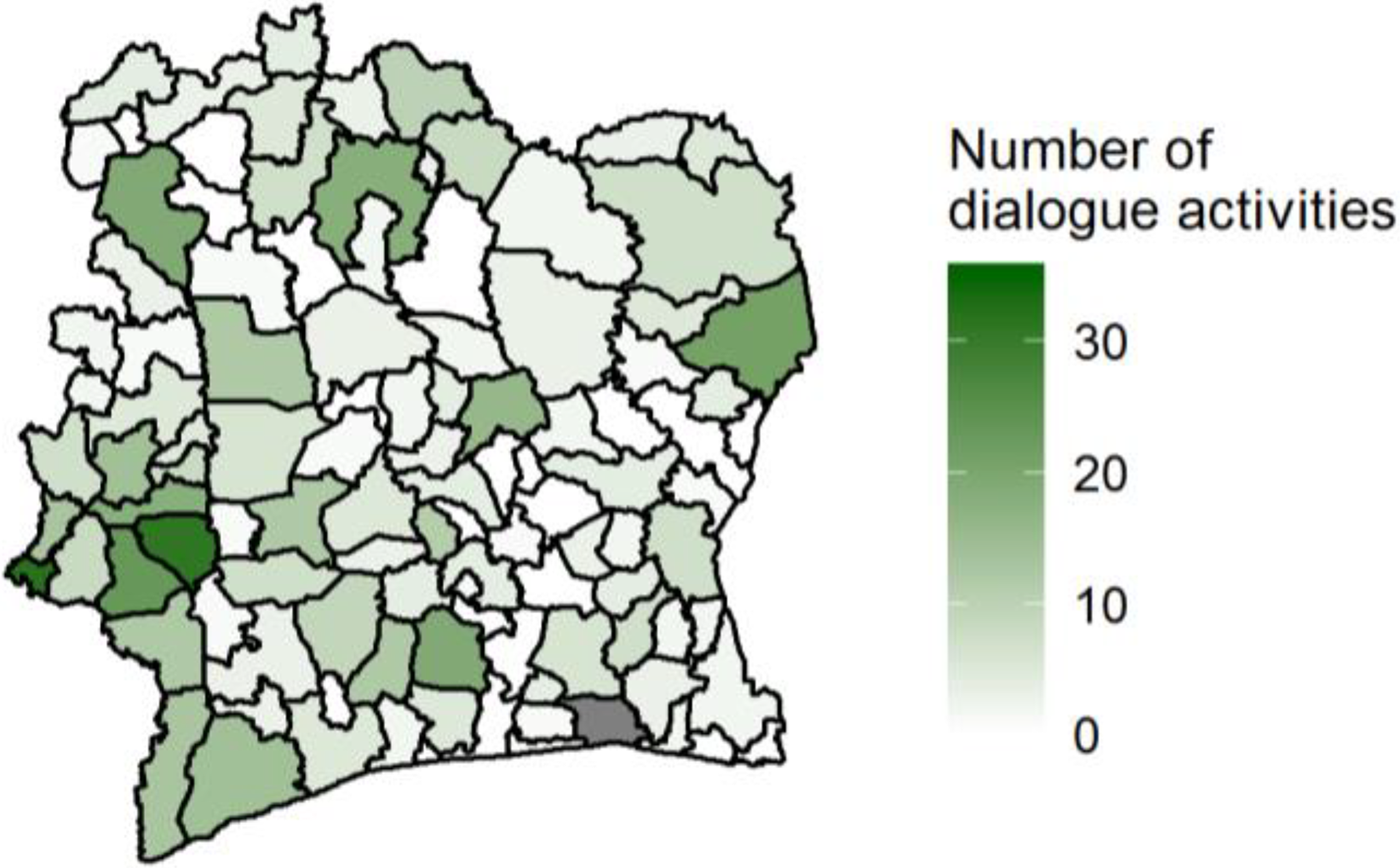
Spatial variation in dialogue activities.
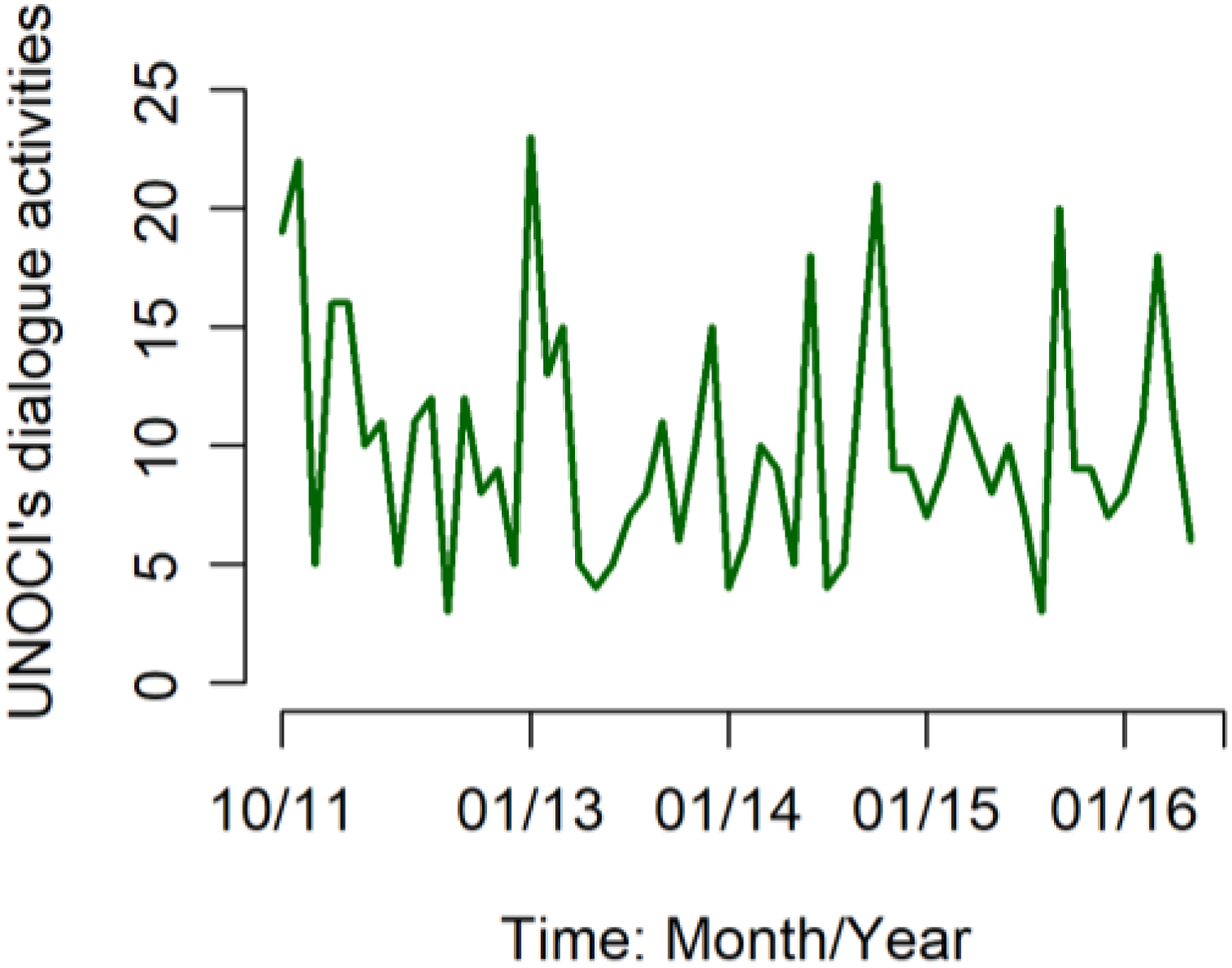
Temporal variation in dialogue activities.
To measure the outcome variables, I employ information from the African Conflict Locations and Events Dataset (ACLED) collected from news reports (Raleigh et al. 2010). To maximize validity, ACLED only records the hard facts of violent events (location, date, and actors) rather than difficult-to-measure casualty numbers or the motivations of perpetrators. These media-based data, however, may not be independent of UNOCI’s activities because journalists may become more attentive to violence in specific locations due to press releases on UNOCI’s activities. Yet, a positive correlation between UNOCI’s intergroup dialogues and violent events reported in ACLED should make it more difficult to find evidence for the argument and the proposed negative relationship between dialogues and violence.
The analyses use two binary dependent variables for communal violence. The first dependent variable measures communal violence involving groups of civilians (in ACLED: violence by rioters or communal militias). The second dependent variable captures communal violence perpetrated by nonstate armed groups (in ACLED: violence by political militias and rebel groups where the event description makes reference to the communal identity of target or perpetrator). 7 Communal violence by groups of civilians and communal violence by nonstate armed groups account for 48 percent and 25 percent of all violent events in Côte d’Ivoire (2012 to 2016), respectively. The secondary literature suggests that Côte d’Ivoire is not an outlier in terms of the prevalence of communal violence. Similar communal violence triggered 31 percent of all ethnic civil war onsets between 1945 and 2008 (Fearon and Laitin 2011). Thus, intergroup dialogues address a significant threat to peace. The events that are not classified as communal violence (27 percent) are perpetrated by either government agents or criminal and foreign armed groups without communal identity or ties. 8 Analyzing the counts of these noncommunal events tests the argument that the effect of intergroup dialogues is specific to communal violence (see Online Appendix C). The temporal and spatial distribution of the main dependent variables is shown in Figures 3 and 4, respectively.
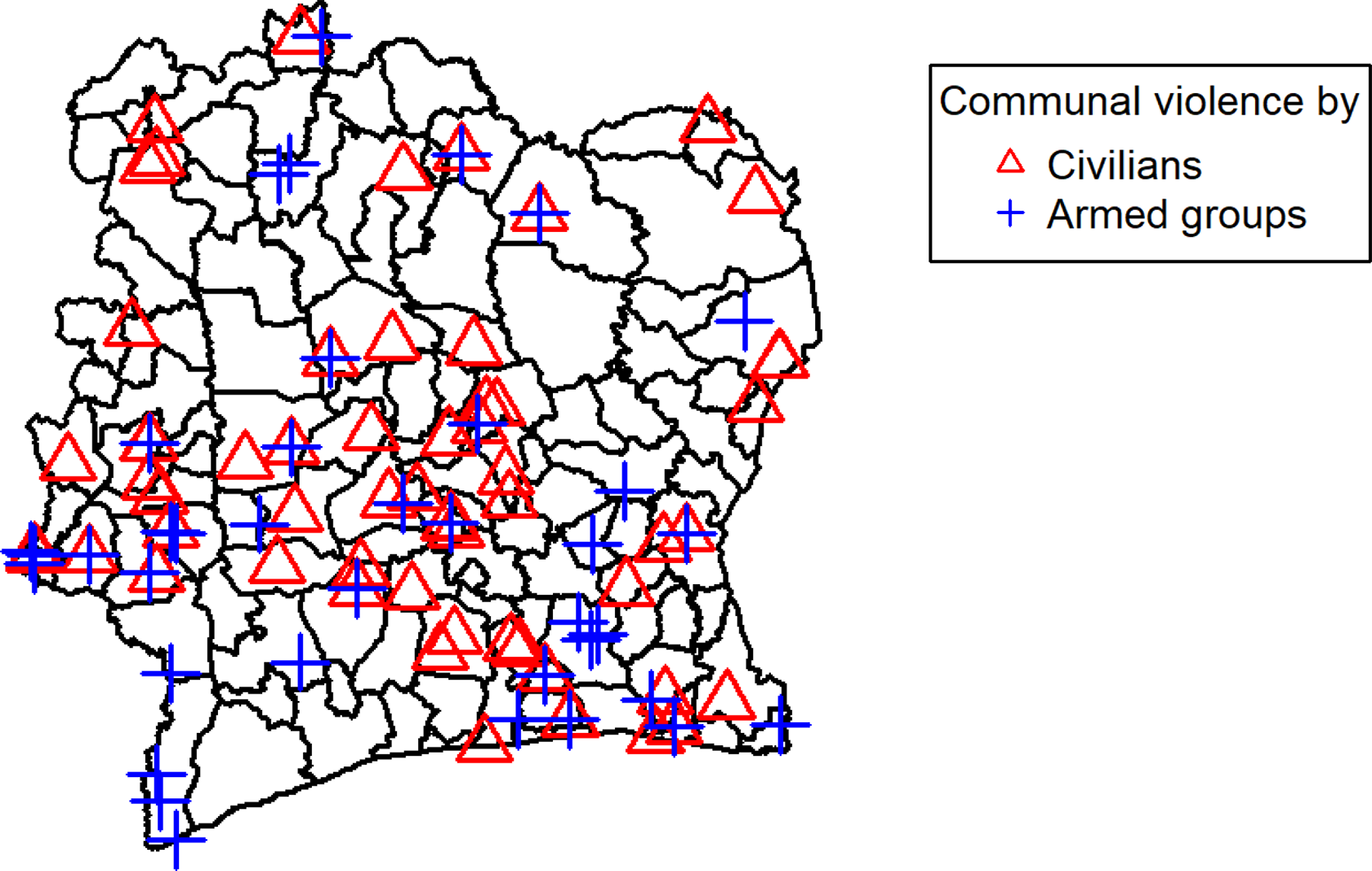
Spatial variation in violent events.
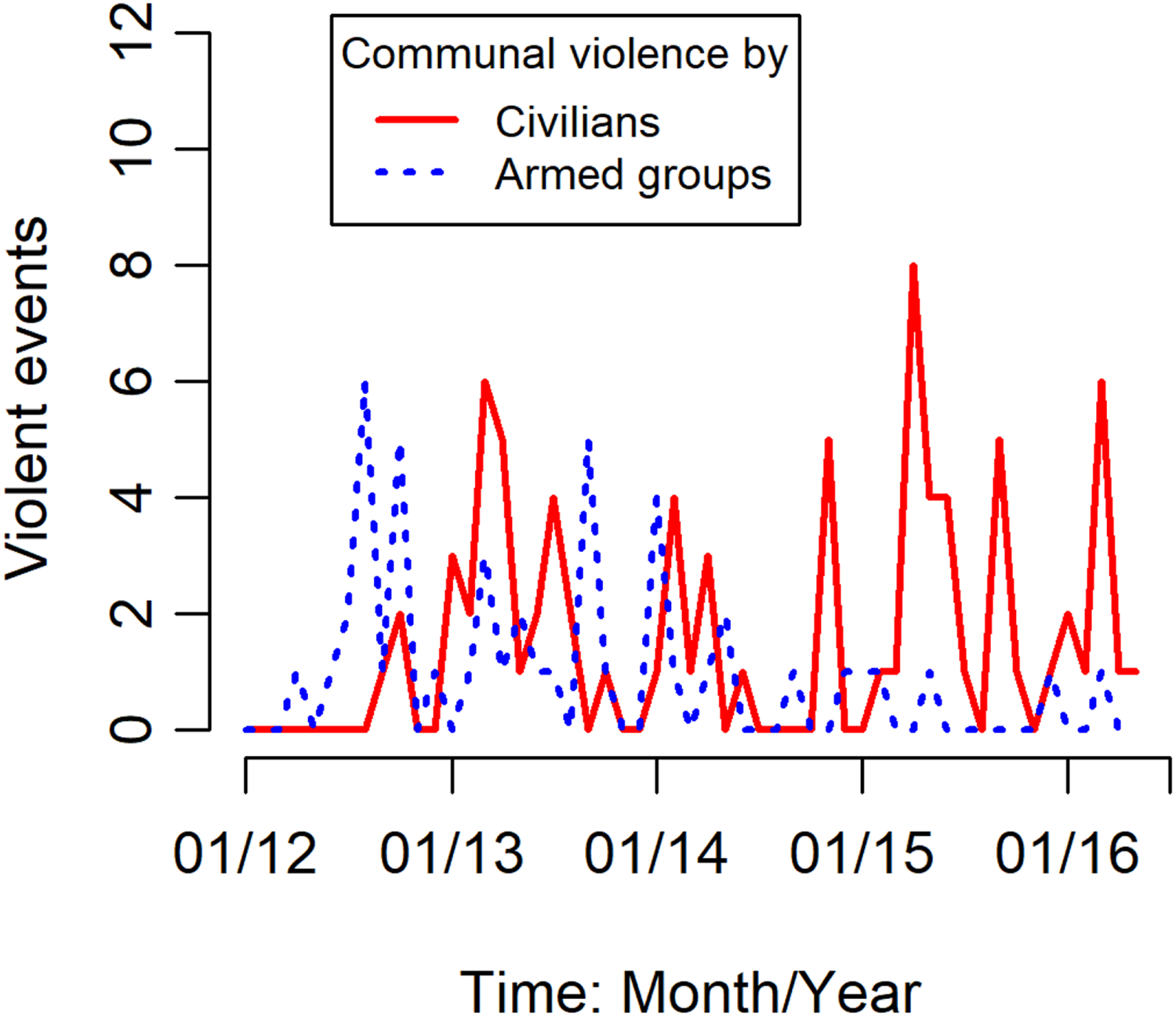
Temporal variation in violent events.
The analyses control for factors that may influence the relationship between intergroup dialogue activities and communal violence. First, I control for peacekeeping capacity in the form of subnational deployment of UN police and UN military. 9 UN security personnel may decrease incidents of violence and, consequently, increase activities organized by UN civilian staff. I collected personnel data myself using the methodology developed by Ruggeri, Dorussen, and Gizelis (2017). 10 Furthermore, election months likely influence intergroup dialogue activities by either increasing such activities to prevent election violence or diverting UN resources to other election-related tasks. Elections may also increase communal violence by heightening competition (Klaus and Mitchell 2015). I also add a measure for competitiveness—that is, the margin of victory in each department in the last presidential election (Balcells 2017). 11 Competitiveness likely influences violence and, by extension, peacekeeping efforts. Geographical features should influence peacekeepers’ ability to travel and organize activities on the one hand and, on the other hand, state capacity and the risk of violent conflict (Ruggeri, Dorussen, and Gizels 2017). First, I include travel time , which provides an estimate of the average travel time (in minutes) to get from a department to the nearest major city of over 50,000 inhabitants by land (Uchida and Nelson 2009). Second, I add border distance , which is the distance from the center of each department (centroid) to the border of the nearest neighboring country (in kilometers; Weidmann, Kuse, and Gleditsch 2010). The analysis controls for the mean infant mortality rate in the department (using data from the year 2000) to approximate socioeconomic development (Storeygard et al. 2008; Center for International Earth Science Information Network [CIESIN], Columbia University 2005). Infant mortality rate, border distance, and average travel time come from the PRIO-GRID data frame (Tollefsen, Strand, and Buhaug 2012). Finally, the population size of a department should determine the likelihood of violence and, consequently, efforts by UN peacekeepers. 12 The latter four variables are standardized. Summary statistics are provided in Online Appendix A.
Statistical analyses based on observed data likely underestimate the violence-reducing impact of intergroup dialogue activities because UN PKOs tend to concentrate their resources in violence-prone places (Fjelde, Hultman, and Nilsson 2019; Ruggeri, Dorussen, and Gizelis 2017). To approximate the causal effect of local intergroup dialogues, I use two strategies. First, a recursive bivariate probit model simultaneously estimates whether a department hosted an activity (equation 1), whether violence has occurred in a given month (equation 2), and the correlation between the errors of these equations. The correlation of errors accounts for the possibility that unobserved factors (e.g., PKO intelligence) determine both dialogue activities and violence.
Estimating a bivariate probit model requires an instrument, an exogenous variable explaining variation in the location and timing of intergroup dialogues. I use the interaction term between the supply of international Human Rights and Civil Affairs personnel to UNOCI (civilian personnel) 13 and the standardized driving distance from each department’s center to the nearest human rights field offices of UNOCI (distance to field office). 14 Increasing civilian personnel allows UNOCI to organize more intergroup dialogue activities, while the UN PKO may find it more difficult to organize activities at a greater distance from its field offices given transport costs or missing knowledge about remote locations. Civilian personnel numbers only change over time. The distances to field offices only vary across space. Yet, the interaction (Personnel × Distance) is space- and time-varying and therefore a suitable instrument for the location and timing of UNOCI’s intergroup dialogues.
The interaction between civilian personnel and the distances to field offices fulfills the conditions for an instrument. First, it strongly correlates with intergroup dialogue activities. The analyses show that additional staff members have a significantly larger effect on the occurrence of intergroup dialogues at a greater distance from field offices (see Online Appendix B). Second, the organizational logic of UNOCI (rather than the dependent variable—communal violence—or omitted correlates) likely explains the interaction effect or why increasing personnel resources makes UNOCI organize intergroup dialogues in more distant places whereas increasing personnel resources does not affect UNOCI’s activities near field offices. Finally, the interaction only affects the dependent variable through UNOCI’s intergroup dialogue activities. This is plausible because the interaction term—the greater effect of changes in civilian personnel in more remote places further away from field offices—is very specific to UNOCI’s organizational logic (see Ruggeri, Dorussen, and Gizelis 2017, 177, for a similar interaction term as instrument).
Second, I account for pretreatment observable confounding factors using the Coarsened Exact Matching (CEM) method developed by Iacus, King, and Porro (2011). CEM creates a quasi-experimental sample in which potentially confounding factors—variables that bias the effect of intergroup dialogue activities because they influence both these activities and communal violence—are equally distributed across “treated departments” with prior intergroup dialogue activities and “control” departments without this engagement. CEM discards observations that are too different from treated observations. For the remaining cases, CEM produces weights that adjust remaining imbalances in the distributions of potential confounders.
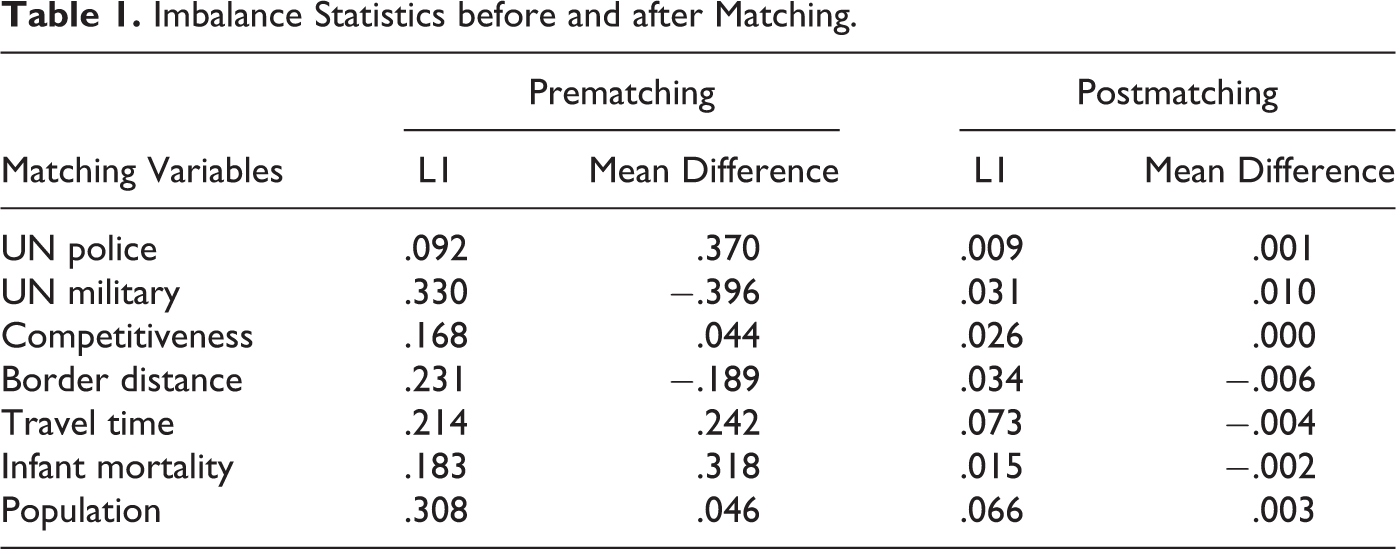
Table 1 shows the prematching and postmatching imbalance measures L1 and the difference in means for each matching variable between the group of treated observations with intergroup dialogue activities and the group of control observations without such activities. The imbalance measure L1 for a specific variable can be understood as the nonoverlapping area of two histograms, one for the distribution of treated observations and another for the distribution of control observations of this variable. The univariate imbalance improved for all matching variables. Moreover, the overall multivariate imbalance L1 substantively decreased from 0.57 to 0.15 after matching. Thus, department-months where UNOCI conducted local intergroup dialogue activities now look much like those without such activities.
Imbalance Statistics before and after Matching.
Finally, Beck, Katz, and Tucker (1998) show that binary cross-sectional time series data are identical to grouped duration data and likely violate the independence assumption. To account for the fact that the length of a period without violence influences the probability of subsequent violent conflict, all models include the number of months that have passed between violent events (peace spell) as well as the squared term (peace spell^2) and cubic term (peace spell^3 ) of this variable (Carter and Signorino 2010).
Findings
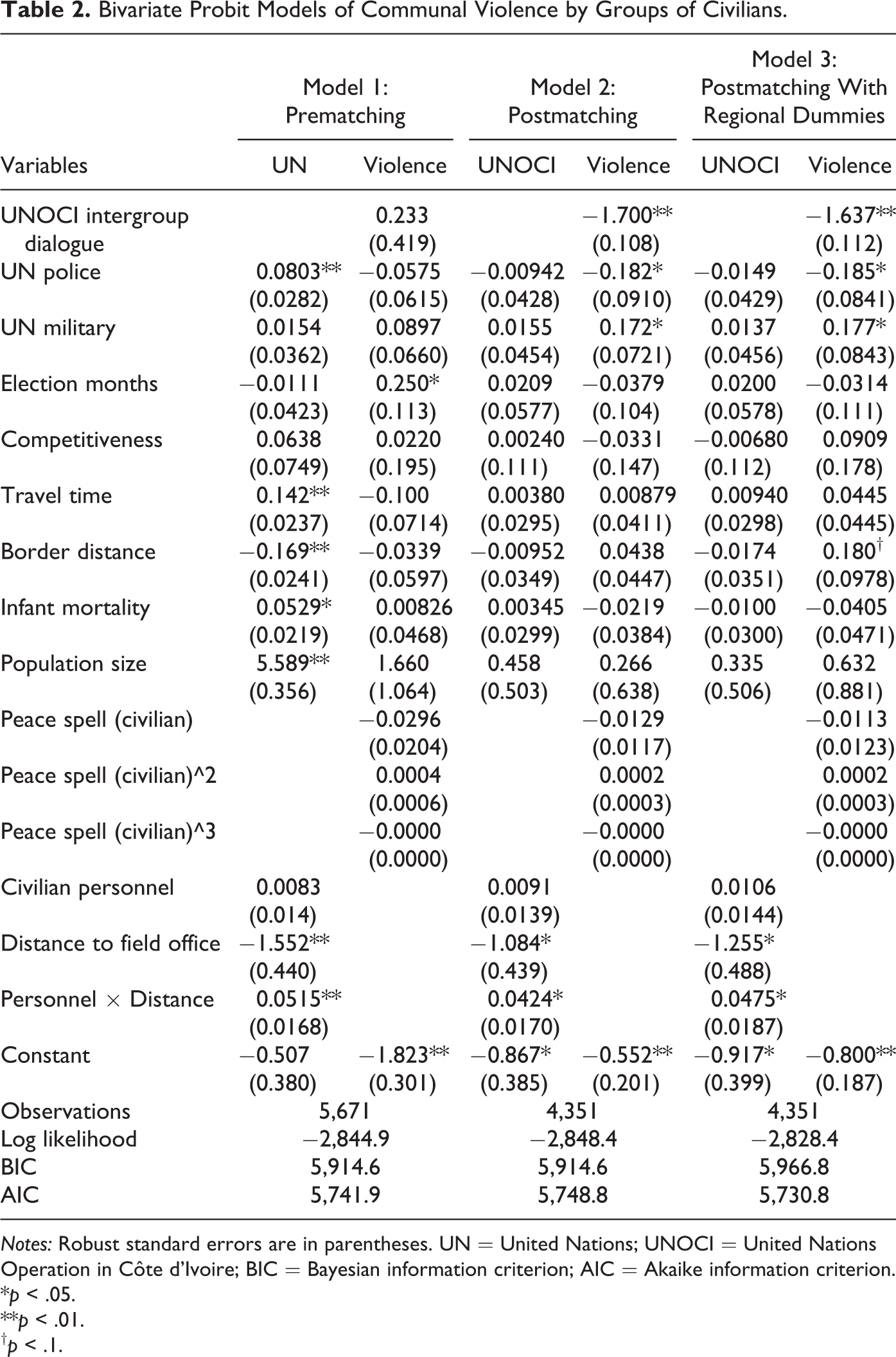
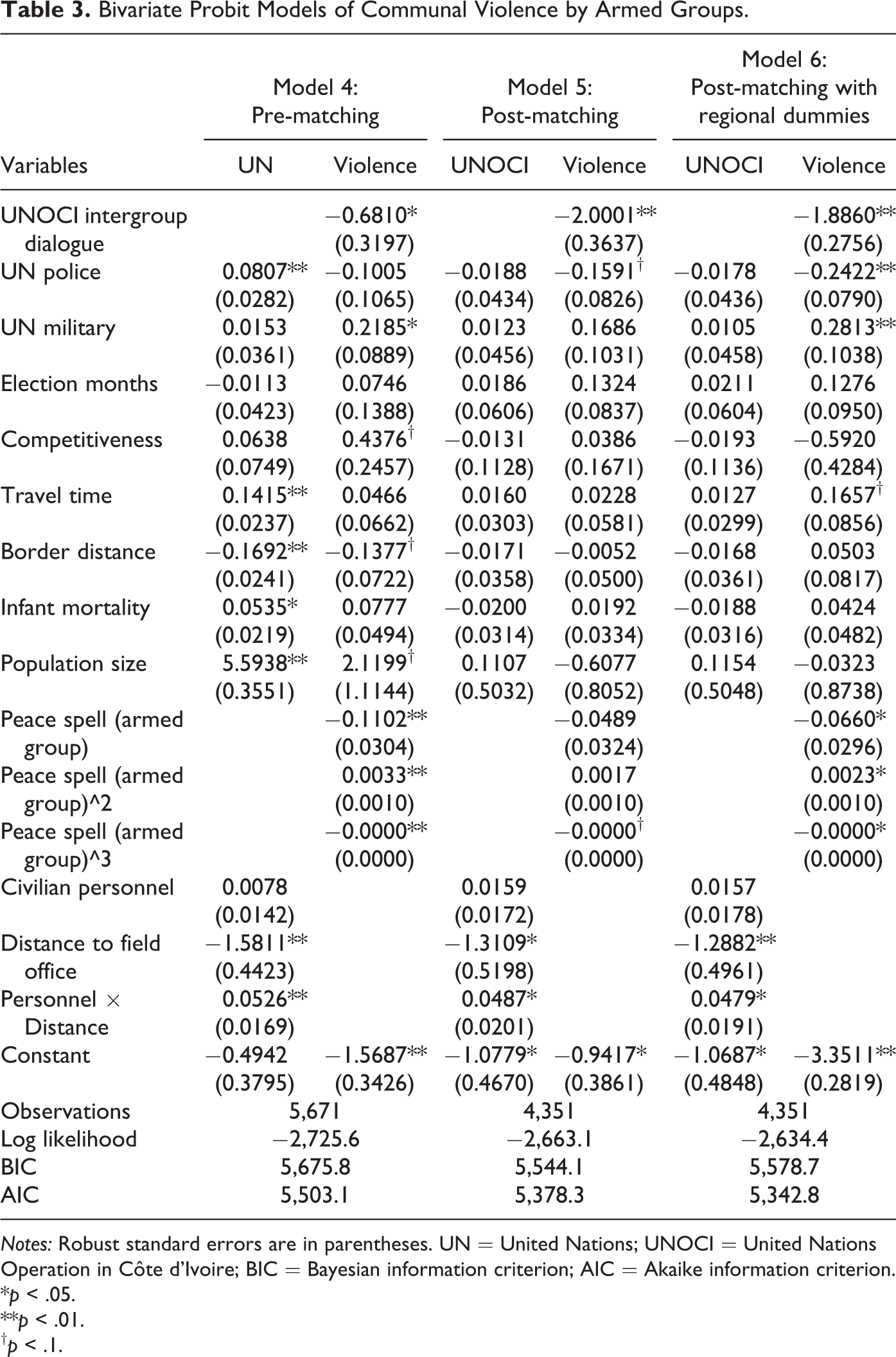
The statistical analyses of communal violence by groups of civilians (Table 2) and armed groups with local ties (Table 3) in Côte d’Ivoire support the argument. Local intergroup dialogue interventions significantly reduce the probability of communal violence (Hypothesis 1), while anecdotal evidence shows the plausibility of the proposed mechanisms explaining this effect: solving information and coordination problems and reducing biases and negative feelings.
Bivariate Probit Models of Communal Violence by Groups of Civilians.
Notes: Robust standard errors are in parentheses. UN = United Nations; UNOCI = United Nations Operation in Côte d’Ivoire; BIC = Bayesian information criterion; AIC = Akaike information criterion.
*p < .05.
**p < .01.
† p < .1.
Bivariate Probit Models of Communal Violence by Armed Groups.
Notes: Robust standard errors are in parentheses. UN = United Nations; UNOCI = United Nations Operation in Côte d’Ivoire; BIC = Bayesian information criterion; AIC = Akaike information criterion.
*p < .05.
**p < .01.
† p < .1.
Before turning to the effect of UNOCI’s intergroup dialogues, I examine the effects of the control variables in the prematching analyses (models 1 and 4). 15 Departments that are more rural (travel time ), closer to international borders (border distance), economically less marginalized (infant mortality rate), and more populous (population size) have a greater chance of seeing intergroup dialogues. While travel time, border distance, and infant mortality rate have no effect on violence by groups of civilians, population size has a positive and significant coefficient (model 1). Population size also tends to increase communal violence by armed groups with local ties. In addition, departments closer to international borders exhibit a significantly higher risk of communal violence by armed groups (model 4). Overall, the significant effects suggest that UNOCI convenes more intergroup dialogues in places and times more prone to communal violence.
The other control variables have mixed effects. UN police and UN military have positive coefficients in the equation for intergroup dialogue activities, though only police deployment is a significant predictor of UNOCI’s activity. Yet, UN police and UN military are not associated with communal violence. It is important to note, though, that police and military are likely deployed in more violence-prone areas. Therefore, the effects should not lead to the conclusion that the UN police and military are ineffective in reducing communal violence (see Online Appendix G). The variable for election months does not affect intergroup dialogues, but it increases the risk of violence involving civilians. Competitiveness has a positive but nonsignificant effect on intergroup dialogue interventions. While competitiveness does not influence violence involving civilians, its coefficient is positive and significant in the equation for communal violence by armed groups. Overall, the effects of the controls match prior expectations.
Thus, I now turn to the main effect of interest—that is, how UNOCI’s intergroup dialogue activities influence communal violence. In the prematching analyses (model 1) for communal violence by groups of civilians (Table 2), the coefficient for UNOCI’s intergroup dialogue activities fails to reach conventional levels of significance. In the postmatching analyses, however, the coefficient for UNOCI’s intergroup dialogue activities is negative and significant. On average, one or more dialogue events within the previous three months subsequently decrease the probability of violence by groups of civilians by 25.4 percentage points (model 2) and, when controlling for regional heterogeneity, by 21.6 percentage points (model 3).
The findings are very similar for communal violence by armed groups, presented in Table 3. In the prematching analysis (model 4), UNOCI’s dialogue activities have a significantly negative coefficient, yet the marginal effect is not significant. In the postmatching analyses, however, UNOCI’s dialogue activities are associated with a significant reduction in the risk of communal violence by armed groups. All else equal, intergroup dialogues reduce the risk of communal violence by armed groups by 26.9 percentage points (model 5) and, when the analyses control for regional heterogeneity, by 17.8 percentage points (model 6).
With these statistical analyses, it is not possible to empirically distinguish between the two mechanisms—(1) strengthening information sharing and coordination and (2) reducing biases and negative feelings—or to test plausible alternative or complementary pathways through which UNOCI’s dialogue activities may influence communal violence. But qualitative evidence from UN press releases supports the plausibility of both mechanisms. As an illustrative case, I examine the intergroup dialogue event on September 23, 2015, in Bayota and a follow-up event in Gagnoa. The two towns are located in the center-west of Côte d’Ivoire (United Nations Security Council 2015, 3).
In line with the proposition that intergroup dialogues facilitate information exchange and coordination, this meeting led to an agreement among chiefs to set up a mechanism for resolving future disputes. After the intergroup dialogue meeting, the chief of the canton Nékédji (traditional administrative unit) that comprises the town of Bayota, Boti Koudou affirmed that “[a]s a representative of this population, I’m making a firm commitment that we are going to live in harmony here in Bayota […]. We have suggested to the deputy prefect that we set up a tripartite commission comprising members of the indigenous and immigrant communities, as well as local government, that will be in charge of raising the alarm with the deputy prefect at the first sign of any trouble. This would mean that from chief to chief, official to official we can put out the fire” (UNOCI News 2015a). In line with the theoretical expectation, this intergroup dialogue activity in Bayota led to improved coordination among community leaders (and prefects) and their commitment to solve communal disputes peacefully.
There is also evidence supporting the second mechanism. The intergroup dialogue in Bayota, which included 350 community leaders and ordinary citizens from different sections of society, led to a reaffirmation of peaceful norms for intergroup relations. Intergroup dialogue reduced participants’ negative feelings toward other ethnic groups and increased their perception of greater benefits from communal peace. A women’s leader said that “[a]fter discussions with our sisters and after we had made our apologies, we made a commitment that we would do our best to ensure that in Bayota, we would live in perfect harmony from now on and work for the development of our town” (UNOCI News 2015a). In a follow-up meeting on October 8, 2015, in Gagnoa, the next largest town near Bayota and the seat of Gagnoa Department, community leaders committed to spreading peaceful norms in their locality. Chief Koudou Denis said “they were already on a peace mission in their department and will be working on this every day” (UNOCI News 2015b). 16 This anecdotal evidence buttresses the plausibility of the second mechanism: that intergroup dialogues reduce biases and negative feelings toward other groups and encourage behaviors that support peaceful intergroup relations—for example, apologies, public commitments to peaceful behavior, and advocacy for local peacebuilding.
Testing Alternative Explanations
In this section, I seek to eliminate rival explanations. The first is that the effect of dialogue activities originates from the presence of UN personnel rather than their intergroup dialogue activities. Yet, Online Appendix D shows that the inclusion of the sum of military and police personnel (UN personnel ) does not change the effect of UNOCI’s intergroup dialogue activities. UN personnel is also not associated with communal violence by groups of civilians and has a positive coefficient in the model for communal violence by armed groups. This suggests that the type of activity rather than UN PKOs’ presence matters (see also Online Appendix G).
A second rival explanation is that UN peacekeepers’ intergroup dialogue activities do not reduce violence but rather displace violence to neighboring departments. Online Appendix E provides evidence to reject this possibility. Interventions in neighboring departments do not increase violence. If anything, the nonsignificant negative effect of the spatial lag of intergroup dialogue activities and its interaction with the number of neighboring departments indicate potential peace-inducing spillover effects benefiting intergroup peace nearby.
The third alternative explanation for the negative correlation between intergroup dialogues and communal violence is the argument that UN intergroup dialogues temporally delay communal violence. Violent perpetrators may just stay inactive for a few months after an intervention to avoid drawing further international attention to the community. The evidence presented in Online Appendix F leads me to reject this argument. None of the temporal lags of intergroup dialogue interventions four to twelve months previously significantly increase communal violence. On the contrary, the results indicate that previously organized intergroup dialogue activities have an added violence-reducing effect for up to nine months.
Conclusion
In 2013, more than half of the residents (52 percent) in the violence-prone region Western Comoé reported improved intercommunal relations (Pritchard 2016, 271). Civilian peacekeepers may have contributed to this result. This study provides robust evidence that UNOCI’s efforts to strengthen local conflict resolution capacity through intergroup dialogue activities decreased the average risk of communal violence. Its findings should encourage international and national organizations that local intergroup dialogue can meaningfully complement national-level peacebuilding initiatives.
The article provides a novel argument for how outside interventions can contribute to peace in postwar environments. Existing studies argue that peacekeeping works to reduce violence by monitoring belligerents’ behavior, imposing costs for coercive acts, replacing dysfunctional state structures, and de-escalating local conflicts through facilitating communication between political and armed group leaders. Adding to this latter mechanism, this study examines peacekeepers’ intergroup dialogue activities and, thus, shifts the focus from political and armed groups to community leaders and local populations as well as from reactive responses to peacekeepers’ more preventive engagement in order to strengthen the locally rooted mechanisms and norms for peaceful dispute settlement. Furthermore, while conflict research tends to prioritize civil war–related violence by governments and nonstate armed actors, local-level “everyday” or “peacetime” violence after war can also undermine peacebuilding processes (Autesserre 2009). Examining possible solutions is therefore important and the focus of this article. Empirically, the article analyzes a novel data set containing spatially and temporally disaggregated information on UN peacekeepers’ intergroup dialogue activities. While recent research has significantly advanced our knowledge about coercive peacekeeping mechanisms at the local level (Ruggeri, Dorussen, and Gizelis 2017), this study is the first to systematically evaluate how civilian peacekeeping activities on the ground influence collective violence.
The study can be extended in several ways. First, my findings are limited to Côte d’Ivoire. It is beyond the scope of the article to test the validity of the argument in different war-torn countries. However, case evidence from Somalia (Menkhaus 1996), Ethiopia (Hagmann 2007) and Liberia (Hartman, Blair, and Blattman 2018) suggests that UN peacekeepers’ efforts to strengthen local conflict resolution mechanisms may also work in other war-torn countries. Second, it is difficult to test the persistence of the effects of intergroup dialogue activities because intergroup dialogues occur frequently over time and there is no sustained period without intervention following an intergroup dialogue event. Yet, additional analyses suggest that intergroup dialogues held up to nine months previously still reduce communal violence if we hold constant the more or less frequent interventions in the meantime. Third, despite some anecdotal evidence, the article has to remain agnostic about the microlevel mechanisms through which intergroup dialogue interventions work. Interviews with peacekeepers and community leaders, surveys of participants in UN activities, and similar individual-level data would help to empirically untangle the causal story. Despite these limits, the study constitutes a crucial step forward in understanding peacekeeping mechanisms. In their recent article exploring the effect of subnational deployment of UN peacekeepers, Ruggeri, Dorussen, and Gizelis (2017, 182) recognize that we “lack information about the precise actions and policies implemented locally by UN peacekeepers” and conclude that “[a]rguably, these policies are crucial for winning the peace locally.” This article provides some of the missing evidence on peacekeepers’ actions and policies, confirms the authors’ intuition, and shows that it is also through strengthening conflict resolution locally that peacekeeping contributes to a reduction in violence.
Supplemental Material
Supplemental Material, Replication_files - United Nations Peacekeeping Locally: Enabling Conflict Resolution, Reducing Communal Violence
Supplemental Material, Replication_files for United Nations Peacekeeping Locally: Enabling Conflict Resolution, Reducing Communal Violence by Hannah M. Smidt in Journal of Conflict Resolution
Supplemental Material
Supplemental Material, SupplementaryMaterial_2019-6-4_(002) - United Nations Peacekeeping Locally: Enabling Conflict Resolution, Reducing Communal Violence
Supplemental Material, SupplementaryMaterial_2019-6-4_(002) for United Nations Peacekeeping Locally: Enabling Conflict Resolution, Reducing Communal Violence by Hannah M. Smidt in Journal of Conflict Resolution
Footnotes
Acknowledgments
I would like to thank Felix Haaß, Belén Gonzalés, Julia Grauvogel, Yves Kizito Menanga, Adam Scharpf, Lea Smidt, the participants of the Election Violence Research Workshop at the University of Amsterdam (1/2018), the research program Peace and Security seminar at the GIGA German Institute of Global and Area Studies (2/2018), the 18th Jan Tinbergen European Peace Science Conference (6/2018), the Speaker Series at the Department of Peace and Conflict Research at the University of Uppsala (1/2019), the Folke Bernadotte Academy Research Seminar (1/2019), and two anonymous reviewers for their helpful comments. Remaining errors or omissions are my own.
Author’s Note
Hannah M. Smidt is also affiliated to University of Zurich, Department of Political Science, Zurich, Switzerland.
Declaration of Conflicting Interests
The author(s) declared no potential conflicts of interest with respect to the research, authorship, and/or publication of this article.
Funding
The author(s) received no financial support for the research, authorship, and/or publication of this article.

Notes
Supplemental Material
Supplemental material for this article is available online.
References
Supplementary Material
Please find the following supplemental material available below.
For Open Access articles published under a Creative Commons License, all supplemental material carries the same license as the article it is associated with.
For non-Open Access articles published, all supplemental material carries a non-exclusive license, and permission requests for re-use of supplemental material or any part of supplemental material shall be sent directly to the copyright owner as specified in the copyright notice associated with the article.
