




Abstract
Growing affective polarization, or animosity between competing ideological groups, threatens to tear apart democratic societies worldwide. In nations that are facing external conflicts, the threat arising from these conflicts may boost internal cohesion and potentially reduce the internal threat of fragmentation. However, in the current study, we analyze survey datasets from two societies embedded in intractable conflicts, South Korea (N = 897) and Israel (N = 504), and demonstrate that gaps in the perception of the external threat between competing ideological groups are related to higher levels of affective polarization within these societies. We also find support for a mechanism that explains this trend: an internal threat from the ideological outgroup. We discuss the implications of our findings for the study of conflicts' impact on intragroup processes, specifically affective polarization, and for the understanding of how such processes might perpetuate the conflict itself.
Affective polarization, the mutual antagonism between supporters of competing parties or opposing ideological groups (Iyengar et al. 2019), is considered one of the most pressing socio-political challenges of the twenty-first century (Finkel et al. 2020). The cross-party dislike and lack of willingness of political opponents to interact have been on the rise in recent decades (Iyengar et al. 2019), damaging political stability (e.g., Hetherington and Rudolph 2015) and fragmenting the social fabric (e.g., Chen and Rohla 2018) of societies around the globe.
Numerous democratic countries are challenged by affective polarization, including countries in North America (e.g., Iyengar et al. 2019), South America (e.g., Segovia 2022), Europe (e.g., Reiljan 2020), Asia (e.g., Lee 2015), and Oceania (Satherley, Sibley, and Osborne 2020). All these countries—whether they have a bi- or multiparty political structure (Wagner 2021), whether their cultural orientation is individualistic or collectivistic (Lee, Rojas, and Yamamoto 2022)—are struggling with ramifications of severe hostility between supporters of competing ideological groups. It seems that regardless of the diversity of contextual factors, all these countries are facing the same socio-political challenge that threatens to tear them apart from the inside.
Some contextual factors could potentially help to reduce affective polarization. One is a conflict with an external enemy. Various theories (the conflict cohesion hypothesis – Coser, 1956; the societal belief of unity – Bar-Tal, 2007) suggest that intergroup conflicts, and particularly the experience of threat resulting from external conflict, would lead groups to unite in order to cope with the threat more effectively (Barclay and Benard 2020; Dovidio 2013; Stein 1976). Empirical evidence for the unifying effect of external threats (a threat that comes from outside the society) can be found as early as the canonical Robbers Cave Experiment (Sherif et al. 1961), and in more recent studies (e.g., Bauer et al. 2016; Theelen and Böhm 2020). In the same vein, also in the political sphere, scholars suggest that cooperation between supporters of competing ideological groups should increase and that mutual animosity should decrease when facing external threats (Van Bavel et al. 2020).
While in some cases, external threats indeed lead to greater cohesion within groups, this is not always the result of such a dynamic. Various examples from recent history demonstrate the persistence of affective polarization between competing ideological groups in countries involved in threatening intractable interstate conflicts (i.e., conflicts that are prolonged, destructive, and resistant to de-escalation – Kriesberg 2016), such as South Korea (e.g., Lee 2015), Taiwan (e.g., Huang and Kuo 2022), and Israel (e.g., Bassan-Nygate and Weiss 2022). Recent scholarly work demonstrates that external threats do not necessarily decrease cross-party animosity and, in some cases, might even increase it. For example, Myrick (2021) experimentally simulated how a security threat posed by China to the US impacts affective polarization in the US and found that it did not reduce polarization. Similarly, Jahani and colleagues (2022) showed that exposure to an Iranian threat increased Republicans' antagonism toward Democrats in the US. Renström and colleagues (2022) reported that in Sweden as well, an external threat—posed by immigrants—increased affective polarization among society members.
These examples counter the traditional assumption about the unifying effect of such threats and suggest that in the context of intergroup conflicts, an intragroup conflict between competing ideological groups might also emerge or escalate (Harel, Maoz, and Halperin 2020). However, very little is known about the relationship between these two levels of conflict—external threats and affective polarization within society, and particularly about the mechanisms that might associate them together (see Figure 1). In the current study, we seek to fill this gap by presenting a theoretical framework that demonstrates how inner conflicts within societies arise in the context of intractable interstate conflicts, and empirically testing this framework in two real-world contexts. The figure outlines two conflict levels: Intergroup conflict between states and intragroup conflict between political groups within a state. In this model, a member of Political Group A has two hierarchical outgroups: 1. Primary/external—State A; 2. Secondary/internal—Political Group B. We explore how an external threat from the primary outgroup is related to interactions with the secondary outgroup, namely polarization among political groups within the state.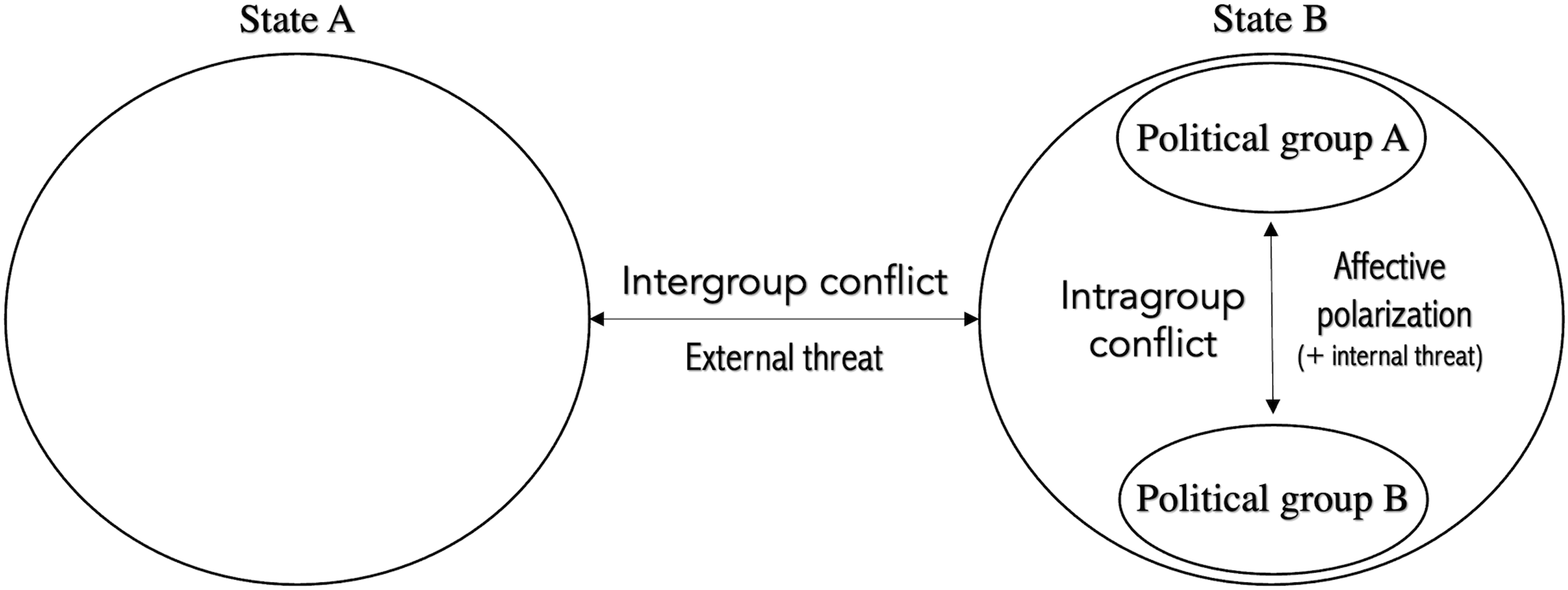
From External Conflict to Internal Polarization – The Proposed Mechanism
Threat perception—the notion that one’s group is in danger—is an integral component of intergroup conflicts (Stephan, Renfro, and Davis 2008). Previous studies show that such threats have severe ramifications for intergroup relations, as they heighten negative attitudes, emotions, and behaviors toward the threatening outgroup (Riek, Mania, and Gaertner 2006). In terms of external threats' implications for intragroup dynamics, as mentioned above, the common assumption is that they will lead to increased cohesion, a sense of unity, and greater solidarity within each side of the conflict (Dovidio 2013; Stein 1976).
Notably, for external threats to induce such a unifying effect, Coser (1956) suggested that there should be some consensus among group members regarding the conflict, and particularly that group members should all recognize the external threat as a menace to the whole group. But such a consensus exists only in some cases; on many occasions, not all group members perceive the threat identically. In fact, it is well established that threat perception is not an objective experience; and that under the same circumstances, individuals within the group might perceive the threat differently (Smith and Ellsworth 1985). Among other differences, group members can vary in the way they evaluate the likelihood of the threat to materialize (Leshem and Halperin 2021), in their perception of the threat as endangering the whole group or them personally (Weisel and Zultan 2021), and in the weight they give to realistic (e.g., physical security threat) versus symbolic (e.g., collective identity threat) aspects of the threat (Kubin, Kachanoff, and Gray 2022). Finally, and as we suggest in the current study, group members can differ in how they perceive the level of threat (high vs. low).
Differences in threat-level perception can result from interpersonal variations in dispositional threat sensitivity (Carver 2009), which is often associated with another individual difference factor that is highly relevant to the political sphere: political ideology. Previous work suggests that right-leaning conservatives generally tend to be more sensitive to the experience of threat (Jost et al. 2007). Alternatively, Kahn and colleagues (2021) hold that both ideological groups are sensitive to threats, but each is sensitive to a different type of threat—rightists are more sensitive to security threats, and leftists to threats to democracy. Similarly, Renström and colleagues (2021) observed that right-wing individuals in Sweden consider the increase in the number of refugees as a greater threat compared to left-wing individuals, while left-wingers consider the threat to democracy as more concerning compared to right-wingers. Either way, political ideology plays a pivotal role in how individuals assess and experience threats, irrespective of the type of threat; it holds true for sudden unfamiliar threats, such as the eruption of a new pandemic (Kubin, Kachanoff, and Gray 2022), as well as for threats that are prolonged and consistent in individuals' lives, such as the threat posed by intractable conflicts (Leshem and Halperin 2021).
Compared to other types of threats, with intractable conflicts there is even greater potential for group members to develop divergent attitudes regarding the level of the threat since these conflicts usually include cycles of escalation and moderation in which the objective level of threat is frequently changing (Kriesberg 2016). Whenever the threat is more moderate (and this occurs more often among high-power groups in asymmetrical conflicts - Kamans, Otten, and Gordijn 2011), there is more room for subjective evaluation of the situation, which many times persists even when the conflict escalates. This subjective evaluation is based, among other factors, on the individual's political ideology (Maoz and McCauley 2008), creating a spectrum of perceptions regarding the external threat within society.
We suggest that this spectrum of threat perceptions results in a gap in external threat perception between competing ideological groups. In the context of conflict, the perception of threat has a crucial role in shaping individuals' worldviews and, to a certain extent, even their identities (Oren and Bar-Tal 2014). We suggest that such a gap in external threat perception within society might indicate to individuals that there is a substantial disagreement (and maybe even an inherent difference) between them and their political opponents, which is difficult to bridge and can have devastating consequences. Therefore, we offer that members of the society who recognize that such a gap exists, meaning they acknowledge that there is a difference in the way they perceive the external threat and the way their political opponents perceive it, will also hold more negative attitudes and feelings toward the competing ideological group, i.e., will experience higher levels of affective polarization.
Notably, previous work has demonstrated that individuals tend to inaccurately evaluate perceptions held by their ideological out-party, also known as meta-perceptions, and that these inaccuracies intensify affective polarization and have destructive results such as dehumanization of opposing partisans (Kubin, Kachanoff, and Gray 2022) and support for the use of violence against them (Mernyk et al. 2022). In the current context, such an inaccurate meta-perception about the level of threat experienced by the political opponent can also lead to an exaggeration in the estimation of the gap in perceived external threat between the ideological groups and, as a result, the incorrect perception (Lees and Cikara 2020) would cause an even more extreme form of inter-party hostility.
To further explain this relationship between the perceived gap in external threat perception and affective polarization, we offer a potential mechanism: internal threat from the competing ideological group (i.e., a threat that comes from within society). We suggest that the perception of a gap in external threat perception will be interpreted as a severe internal disagreement between group members— specifically at a time in which broad agreement within the group is highly needed as the group simultaneously coping with an external conflict (Fisher 2000)—therefore would induce a sense of threat among them (Marques and Paez 1994). As a result, the threat posed by ingroup members, which is known to damage trust and cohesion within groups (Greenaway and Cruwys 2019), would lead to an increase in affective polarization. Figure 2 illustrates this suggested theoretical framework. Theoretical framework explaining the rise in affective polarization in the context of intractable conflict.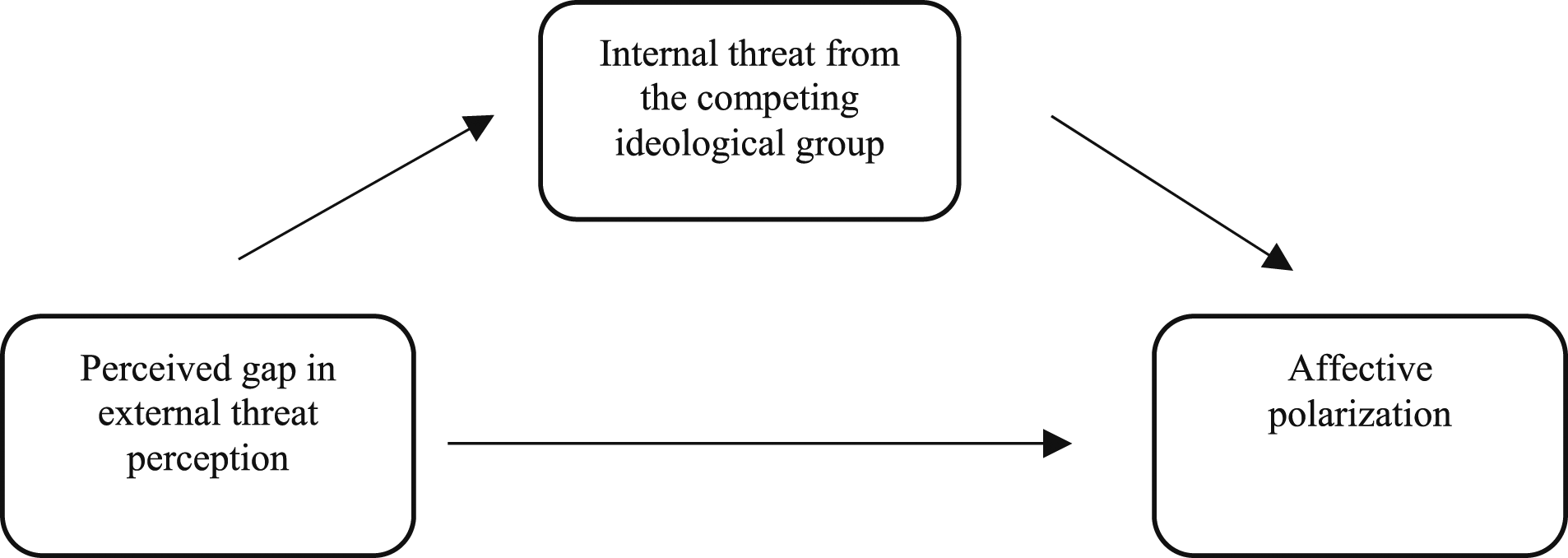
The Current Study
The current study examines the relationship between perceived threats resulting from intractable interstate conflicts and intragroup affective polarization between competing ideological groups, and the mechanism that explains this relationship: an increase in internal threat from the competing ideological group (See, Figure 1). Specifically, our two main hypotheses are as follows: first, the perceived gap in external threat perception is positively associated with affective polarization (H1), and second, this association is mediated by higher levels of internal threat, i.e., a threat from the competing ideological group (H2).
To explore these propositions, we collected survey data in two societies involved in intractable conflicts: South Korea (Study 1) and Jewish-Israeli society (Study 2). As the two case studies are considered contexts of asymmetrical conflict, it is important to note that in both, we are focusing on the high-power group in terms of material assets (e.g., military strength, economic status) and in terms of international recognition and status: Israel (Ramsbotham 2022) compared to the Palestinians and South Korea (Nir, Halperin, and Park 2022) compared to North Korea. Whereas it is reasonable to assume that members of high-power groups in conflict will experience lower levels of threat, previous work suggests that in situations of conflict, both high- and low-power groups can perceive themselves as weak, resulting in a high threat perception regardless of the objective power relations (Rouhana and Fiske 1995). Furthermore, among high-power groups, there is more room for inner disagreements about the levels of the external threat (Kamans, Otten, and Gordijn 2011). Relying on a correlative design, we aimed to test both hypotheses and obtain empirical evidence of the relationship between external and internal conflict.
In both studies, participants were asked about their personal threat perception related to the external conflict in which their society is involved and about their meta-perceptions regarding the same threat perception among the adversary ideological bloc in their society (conservative and progressive in South Korea; rightists and leftists in Israel). Based on both questions, we calculated each participant's perceived gap in external threat perception (IV). Participants also answered questions regarding their perception of the threat posed by the ideological outgroup (mediator) and questions measuring affective polarization (DV). Finally, to rule out alternative explanations for affective polarization, we controlled for a known predictor of it (Mason 2015)—the strength of ideological identification—as well as other demographic variables (all results remained the same when we did not control for these variables).
Study 1 – South Korea
Historically, the Republic of Korea (“South Korea”) and the Democratic People's Republic of Korea (“North Korea”) used to form one nation. After World War 2, the peninsula was divided between the North (under Russian rule) and the South (under American rule), and this temporary partition became a tangible reality in 1948 when two independent states were formally established (Ha and Jang 2016). In 1950 the Korean war between the North and the South erupted and lasted for 3 years, in which more than 2 million people lost their lives, most of them civilians (Cumings 2011). The war halted with a permanent division of the Korean Peninsula between the communist state in the North and the democratic state in the South. The relationship between the two has remained tense, including continuous security clashes threatening both societies (Kim 2020).
While North Korea has evolved into an enclosed dictatorship, South Korea successfully overcame its authoritarian period in the late 1980s, and since then, it has been considered a modern democracy (Cotton 1989). South Korea is a presidential representative democratic republic, with two main ideological blocs competing for political power: Conservatives and Progressives (alongside a large portion of the population that identifies as holding moderate ideology; Lee 2015). A prominent issue that differentiates the blocs, and provides a source for fierce debates, is the relationship with North Korea: Conservatives support unification with the North, while Progressives support the independence of South Korea (Chae and Kim 2008). In the last decade, there has been a rise in political polarization in South Korea, a phenomenon that is termed “the south-south conflict” (Mosler and Chang 2019). Specifically, there is evidence of a surge in affective polarization between the two ideological blocs (Lee 2015).
Method
Participants and Procedure
All the materials (including the data file and analysis code of Studies 1 and 2) can be found at https://osf.io/djy9q/?view_only=9ff19fc693f24d859851414e6f813167. We ran our survey as part of a larger research project conducted by the Korea Institute for National Unification, a government-founded South Korean think-tank (https://www.kinu.or.kr/eng/index.do), and in collaboration with academic researchers. This research has been conducted yearly since 2014, investigating the underlying psychology of the Korean conflict among South Koreans. Data were collected in April 2021, through an online survey, and consisted of responses of 1600 South Korean participants (49 percent female, M age = 44.39). They were asked about their ideological identification on a 7-point scale ranging from definitely conservative to definitely progressive, with the midpoint indicating moderate. Participants who identified as moderates (n = 704) 1 were then asked whether they would choose the conservative or progressive bloc if forced to make such a choice. We generated two sample sets for our analyses. Following a common practice in affective polarization studies (e.g., Banda and Cluverius 2018), the first dataset excluded participants who did not identify with one of the main ideoligical blocs (i.e., the moderates), resulting in 896 participants (46.3 percent female, M age = 45.6, 63.7 percent progressive). The second dataset included the full sample (n = 1,600) while assigning moderates to one of the ideological blocs based on their forced choice (63.2 percent progressive). Since the results of both samples were similar, we present below only analyses and results of the sample without moderates. The full sample results can be found in the SM. Notably, the data did not consist of any missing values, as a complete response was a requirement of the main research project in which we incorporated our measures for the current study.
Measures
The questionnaire included dozens of items, most related to other research projects (see full questionnaire at https://osf.io/djy9q/?view_only=9ff19fc693f24d859851414e6f813167), while we had limited space to incorporate the main variables needed for an initial examination of the theoretical framework. The specific items we used were translated into Korean by the local research team and presented to participants in the local language. We provide here the translation to English for all relevant variables.
Political Ingroup/Outgroup
Each participant's political membership was assigned based on the ideological identification item; for participants who chose 1–3, the ingroup was conservative and the outgroup progressive, and for those who chose 5–7, the ingroup was progressive and the outgroup conservative. As mentioned, participants who identified as moderate were forced to choose with which ideological bloc they identified most, and their ingroup and outgroup were assigned accordingly in the analyses of the full sample.
Perceived Gap in External Threat Perception
The perceived gap was calculated as follows. The score of the meta-perception about the perceived threat amongst the outgroup was measured with a single item: “What would be the thoughts of the political outgroup (conservatives/progressives) regarding North Korea’s actual threat to the existence of South Korea? The outgroup would think that North Korea [1 = cannot pose any/6 = definitely poses] an existential threat to South Korea”. Then this score was subtracted from the score of self-threat perception in absolute value (“Do you think that North Korea poses a serious existential or fatal threat to South Korea?” [1 = definitely not, 6 = definitely]). This way, the measure captures only the gap without additional information about whether the outgroup is perceived to have a higher or lower threat perception than the self.
Internal Threat from the Ideological Outgroup
The internal threat was measured by participants' dis/agreement with three statements: “The political outgroup (conservatives/progressives) (1) poses a serious threat to South Korea and her people; (2) will continue to pose a threat to a reunified Korea; (3) is causing harm to South Korea’s democracy” (1 = definitely disagree, 6 = definitely agree) (αfull sample & sample without moderates = 0.94).
Affective Polarization
Affective polarization was assessed using the feeling thermometer and social distance, capturing attitudinal and behavioral dimensions, respectively (Druckman and Levendusky 2019). For the feeling thermometer, participants rated their feelings towards their ideological ingroup and outgroup. Scores from 51 to 100 represented warm-hearted feelings (with 100 being the warmest), scores from zero to 49 represented cold-hearted feelings (with zero being the coldest), and a score of 50 indicated neutral feelings. We calculated the difference score between the ingroup's and outgroup's ratings to capture affective polarization. For measuring social distance, we used two items from the standard scale (Druckman and Levendusky 2019), asking participants how comfortable they would feel if someone who supports their ideological ingroup or outgroup moved into their neighborhood or married their son or daughter (outgroup’s r full sample = 0.77, r sample without moderates = 0.74; ingroup’s r full sample = 0.85, r sample without moderates = 0.84). Again, we subtracted the rating of social distance toward the outgroup from the rating toward the ingroup, and the difference score represents affective polarization.
Covariates
Strength of Ideological Identity
For this measure we used a single item adapted from Huddy and colleagues' (2015) partisan identity scale: “How important is the identity as a conservative/progressive to you?” (1 = not at all, 7 = definitely).
Demographics
Participants provided basic demographic information, including gender and age.
Results
Means, Standard Deviations, and Correlations.
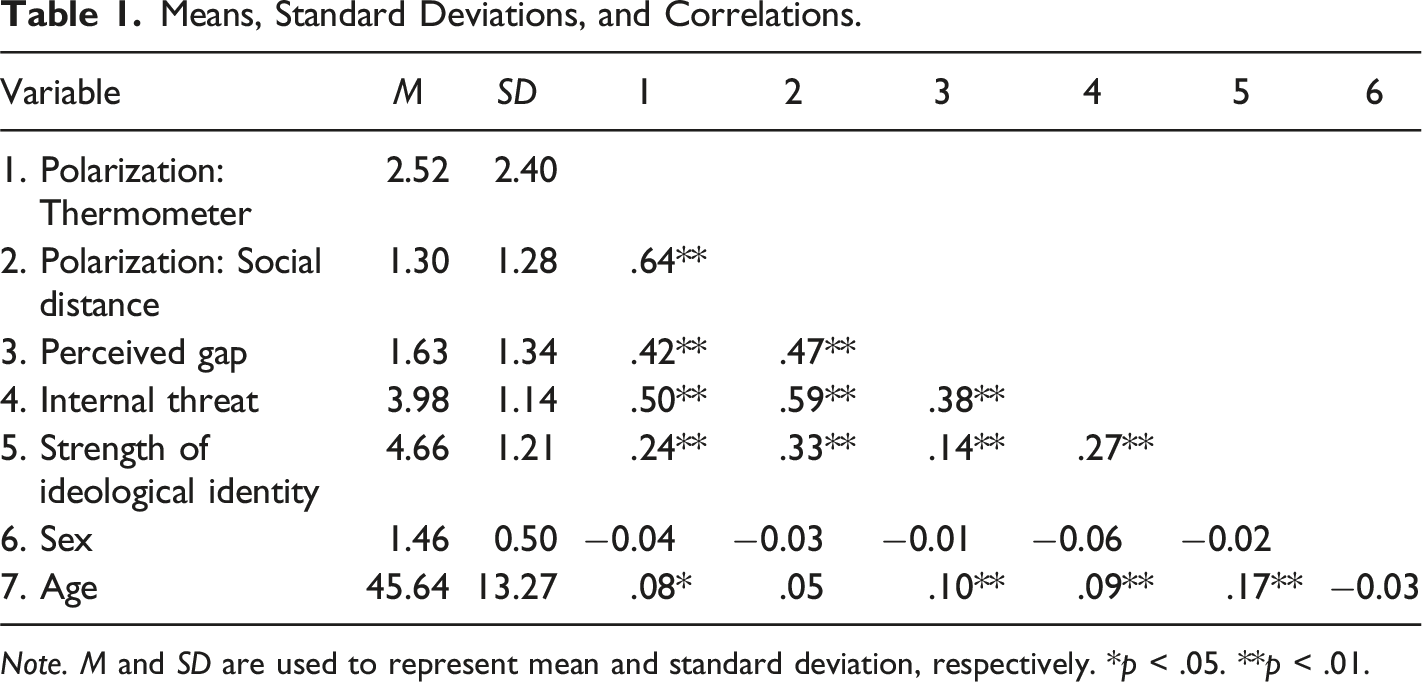
Note. M and SD are used to represent mean and standard deviation, respectively. *p < .05. **p < .01.
Next, we performed a linear regression analysis to examine whether the association between the perceived gap in external threat perception and affective polarization remains significant after controlling for the strength of ideological identity—which provides an alternative explanation for affective polarization—and for age. All variables were mean-centered before being entered into the regression. Results show that participants who perceived a larger gap between their own threat perception and their meta-perception of the political outgroup’s threat perception also reported higher levels of affective polarization in terms of the feeling-thermometer ratings (b = 0.39, SE = 0.03, CI [0.33, 0.45], t = 12.87, p < .001) and in terms of social-distance ratings (b = 0.44, SE = 0.03, CI [0.39, 0.50], t = 15.30, p < .001) (see Tables 1 and 2 in SM). These results remained the same without controlling for the covariates (feeling thermometer: b = 0.42, SE = 0.03, CI [0.36, 0.47], t = 13.70, p < .001; social distance: b = 0.48, SE = 0.03, CI [0.42, 0.54], t = 15.97, p < .001).
Although not part of our main hypothesis, we examined whether the relationship between the perceived gap in external threat perception and affective polarization is moderated by political orientation. We found that for the feeling-thermometer score, the interaction was not significant (b = -.08, SE = 0.06, CI [-0.20, 0.04], t = −1.31, p = .190); and for social-distance scores, the interaction was significant (b = -.18, SE = 0.06, CI [-0.29, −0.06], t = −2.99, p = .003) so that the positive relationship between the perceived gap and social distance was significant for both ideological groups, but stronger for conservatives than progressives (conservatives: b = .54, SE = 0.04; progressives: b = 0.36, SE = 0.04) (see Figure 1 in SM).
Lastly, we conducted a mediation analysis, using the “Lavaan” package in R (Rosseel 2012), to examine whether the internal threat from the competing ideological group mediates the relationship between the perceived gap in external threat perception and affective polarization. We tested the model while controlling for age and strength of ideological identity (all results remained the same without controlling for the covariates; see Figures 2(A) and 2(B) in SM). The total effect of the gap in external threat perception on the feeling thermometer (b = 0.39, SE = 0.03, z = 12.9, p < .001) was partially mediated by the internal threat from the competing ideological group, as both the direct (b = 0.26, SE = 0.03, z = 8.78, p < .001) and indirect (b = 0.13, SE = 0.02, z = 8.22, p < .001) effects were significant (see Figure 3(A)). Similarly, the total effect of the gap in external threat perception on social distance (b = 0.44, SE = 0.03, z = 15.33, p < .001) was partially mediated by the internal threat from the competing ideological group, as both the direct (b = 0.29, SE = 0.03, z = 10.68, p < .001) and indirect (b = 0.15, SE = 0.02, z = 9.15, p < .001) effects were significant (see Figure 3(B)). These results suggest that the association between the perceived gap in external threat perception and affective polarization can be explained partially by a perception of an internal threat posed by the ideological outgroup. Mediation model of the relationship between the perceived gap and affective polarization (A - feeling thermometer, B - social distance), mediated by an internal threat from the competing ideological group.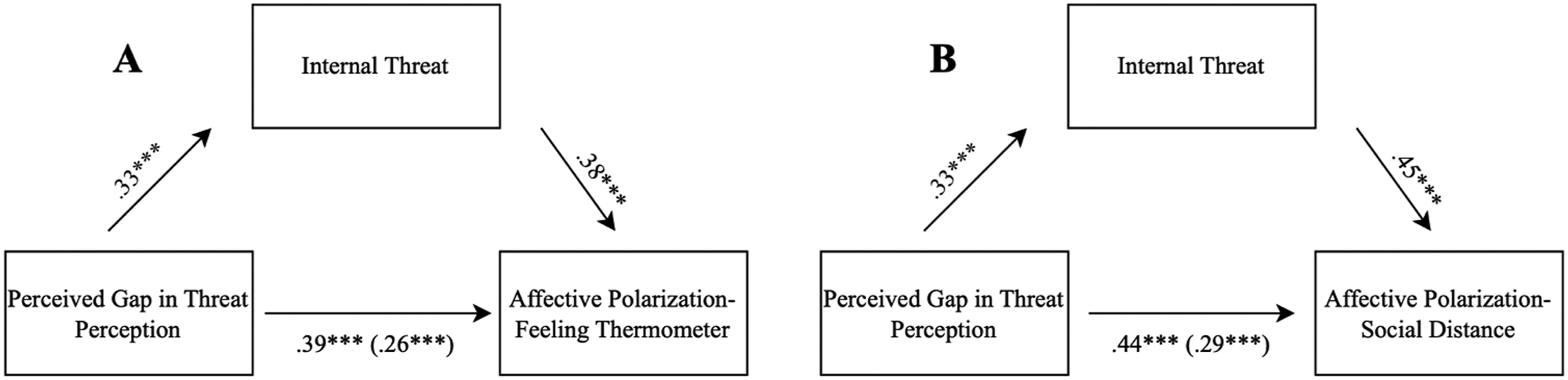
Discussion, Study 1
Study 1 provides initial support for both our hypotheses. We found a significant positive association between the perceived gap in external threat perception and affective polarization, and this association was partially mediated by perception of an internal threat posed by the ideological outgroup. These results have some limitations. Primarily, it needs to be examined if they will replicate in other contexts and if they can be generalized beyond South Korea. Korea poses a unique setting of intergroup conflict, as both parties share the same language, ethnicity, and past history. Additionally, since the number of items we could include in Study 1’s questionnaire was restricted, our measurement instruments were limited, and for some of the constructs, we had to rely on single items. Therefore, we sought to examine our theoretical framework in another society involved in an intractable conflict and experiencing high levels of affective polarization. This way, we could establish the current findings while improving the measurement.
Study 2 – Israel
Study 2 aimed to further examine our theoretical framework and to replicate the findings of Study 1 in another context with similar characteristics: Israel. The Israeli-Palestinian conflict is intractable (Bar-Tal 1998), lasting for more than a century. What started under the British Mandate as a civil struggle between two competing national groups (Palestinians and Jews) who strived for an independent state reached its peak in 1948 when formal war erupted and ended with the establishment of the Jewish state of Israel. After the war, a minority of Palestinians received Israeli citizenship, while the majority were deported or came to live under Jordanian or Egyptian rule in Gaza Strip and the West Bank, territories Israel later occupied in the 1967 war (Ramsbotham 2022). As Israel is still present and governs large parts of the West Bank, the Palestinian struggle for an independent state continues. All attempts to resolve this conflict through diplomatic negotiation over the years have failed (Eriksson 2022), and the area continues to suffer from violence, with hundreds of civilians killed yearly, mainly on the Palestinian side (UN News 2022).
For years, the Israeli-Palestinian conflict was the primary source of disagreement among competing ideological groups in Israel; supporters of the left tend to support compromise and peaceful resolution of the conflict, while those on the right tend to oppose compromise and support more militant solutions (Maoz and McCauley 2008). Alongside the ideological disagreement, in recent years there has been growing evidence of intense affective polarization between ideological groups within Israeli society (Bassan-Nygate and Weiss 2022). Once again, we were interested in whether the perceived gap in external threat perception is associated with affective polarization between the two ideological groups, and if the perception of internal threat from the competing ideological group mediates this relationship.
Replicating the study also allowed us to explore a potential specification of the mechanism we have revealed in Study 1. Inspired by Kubin and colleagues (2022) who demonstrated that rejection of different types of threats—specifically realistic and symbolic threats—is related to affective polarization, we hypothesized that each of these types might be more influential in explaining affective polarization for each ideological group based on different threat sensitivities characterizing each group. Following Kahn et al.’s (2021) findings in Israel, we specifically hypothesized that for right-leaning partisans—who are more concerned by security issues (e.g., whether Israel can respond firmly enough to the external threat), the perception of the ideological outgroup as threatening the security of the common ingroup would mediate the association between the perceived gap and affective polarization (H3). For left-leaning partisans—who are more concerned by moral and ethical questions (e.g., whether Israel uses unnecessary violence in the external conflict), we hypothesized that the perception of the ideological outgroup as threatening the moral image of the common ingroup would mediate this relationship (H4).
Method
Participants and Procedure
Participants were recruited through an Israeli survey company, Ipanel, which compensated them for filling out the online questionnaire. Data were collected in April 2022, a month in which several violent attacks committed by Palestinians occurred within Israel (Ministry of Foreign Affairs 2023), enhancing the sense of threat among Israeli society. The survey began with a set of demographic questions, including an ideological identification question that used a seven-point self-placement scale ranging from extremely rightist (1) to extremely leftist (7). Participants who identified as centrists (choosing 4 on the seven-point scale) were directed out of the survey at this point (n = 51, no data were collected for those participants). In addition, participants who failed an attention check were excluded from the survey by the survey company immediately after the attention check. The final sample consisted of 509 Israeli-Jews (M age = 44.21, 60.5 percent female, 50.3 percent leftists). Six participants who did not complete all relevant measures were excluded from the analyses described below, resulting in a sample size of 503 participants for all reported results.
Similar to Study 1, we measured self-perceived threats related to the external (Israeli-Palestinian) conflict, meta-perceptions about perceived threats related to the external conflict within the ingroup and amongst the outgroup, and the internal threat from the competing ideological group. We utilized feeling-thermometer ratings for both groups, social-distance ratings for both groups, the strength of ideological identity, and demographics. Unlike Study 1, this time we used multi-item scales to measure most of the variables, and we were able to avoid order bias by counterbalancing the questions' order, so that half of the participants answered first about their ideological ingroup, and half began with their outgroup. The questionnaire is presented in the SM (Appendix B).
Measures
Political Ingroup/Outgroup
As in Study 1, political ingroup and outgroup were set based on the ideological identification question. For participants who chose 1–3, the ingroup was rightists and the outgroup leftists, and for those who chose 5–7, the ingroup was leftists and the outgroup rightists. Whereas studies examining affective polarization in a two-party political system focus on partisan identity, in Israel, which has a multiparty political system, ideological identity (based on “political blocs”) is often considered the primary social identity (Bassan-Nygate and Weiss 2022).
Perceived Gap in External Threat Perception
This was measured the same as in Study 1, only this time with scales composed of eight items each. We first created a scale for the meta-perception about the perceived threat amongst the outgroup (α = .96) and for the self-threat perception (α = .92), and then we subtracted the former from the latter in absolute value.
Internal Threat from the Competing Ideological Group
In Study 1 we measured a general internal threat, and for Study 2 we composed ten items aiming to capture two distinct types of threat: security threat and moral-image threat. An explanatory factor analysis showed that a two-factor model fits the data, with high loading scores for each factor (see Table 6 in SM). Security threat was measured with six items (e.g., “To what extent do you agree that supporters of the political outgroup (right/left wing) are hurting the security of the State of Israel?” [1 = not at all, 6 = totally agree]) (α = .95). Moral-image threat was measured with four items (e.g., “To what extent do you agree that supporters of the political outgroup (right/left wing) damage our moral image?” [1 = not at all, 6 = totally agree]) (α = .94).
Affective Polarization
This was measured with the feeling thermometer (same as in Study 1) and social-distance scores (measured this time using 5 items). We first created a social-distance scale for the ingroup (α = .95) and outgroup (α = .94), and then we subtracted the latter from the former.
Covariates
Strength of ideological identity
We used four items adapted from the partisan identity scale (Huddy, Mason, and Aarøe 2015) (α = .88).
Demographic Questionnaire
All participants answered questions about gender, age, level of education, and level of religiosity.
Results
Means, Standard Deviations, and Correlations.
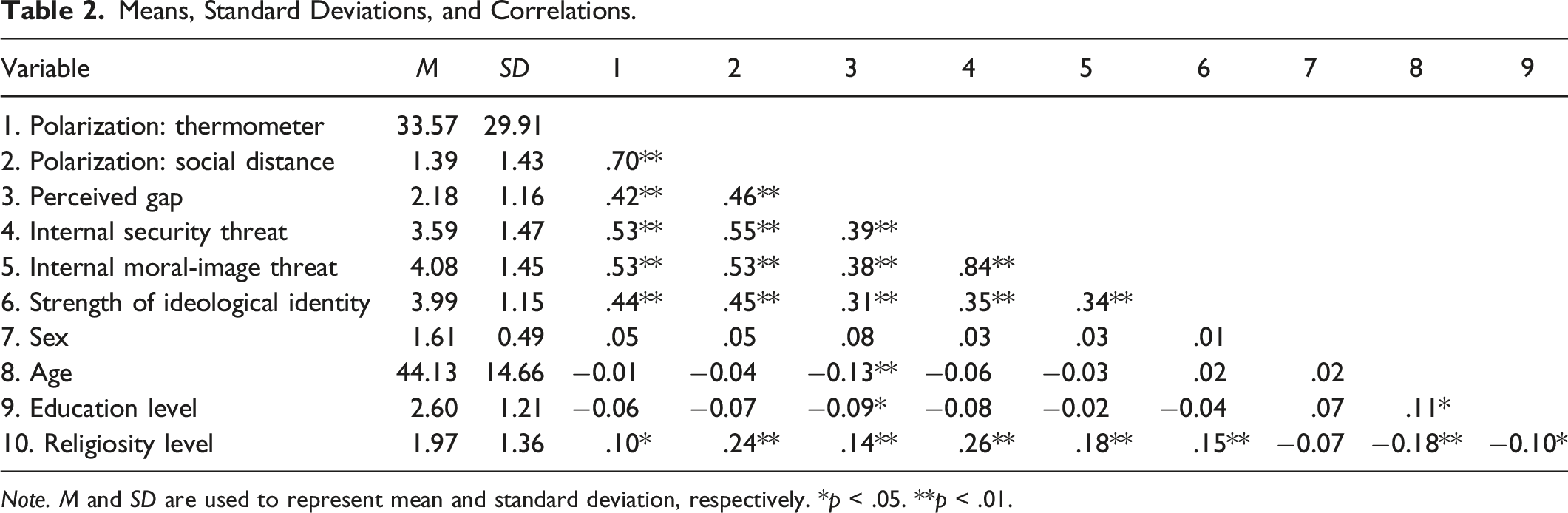
Note. M and SD are used to represent mean and standard deviation, respectively. *p < .05. **p < .01.
After mean-centering all variables (and dummy-coding gender), we examined the association between the perceived gap in external threat perception and affective polarization in a linear regression analysis while controlling for the strength of ideological identity and level of religiosity. Results show that the perceived gap in external threat perception predicted the scores of affective polarization in terms of the feeling thermometer (b = 0.31, SE = 0.04, CI [0.23, 0.39], t = 7.67, p < .001) and the social-distance ratings (b = 0.34, SE = 0.04, CI [0.27, 0.42], t = 8.91, p < .001) (see Tables 7 and 8 in SM). These results remained the same without controlling for the covariates (feeling thermometer: b = 0.42, SE = 0.04, CI [0.34, 0.50], t = 10.24, p < .001; social distance: b = 0.46, SE = 0.04, CI [0.38, 0.54], t = 11.66, p < .001)
As in the first study, we also tested for interaction with political orientation. Results show that for the feeling thermometer, the interaction was not significant (b = -.12, SE = 0.08, CI [-0.29, 0.04], t = −1.47, p = .143), and for social-distance scores the interaction was significant (b = -.19, SE = 0.08, CI [-0.35, −0.03], t = −2.37, p = .018), so that the positive relationship between the perceived gap and social distance was significant for both ideological groups, and stronger for rightists (rightists: b = 0.40, SE = 0.05; leftists: b = 0.21, SE = 0.07) (see Figure 6 in SM).
Finally, we tested the mediation model, this time with two mediating variables representing two types of internal threats (security and moral-image threats), examining their mediating role among each ideological group. This analysis can be presented in two ways, either with a moderated-mediation model, where political orientation is inserted into the model as a moderator, or using two separate models, one for each ideological group. For the sake of simplicity, we present here two separate models, and the results of the moderated-mediation model can be found in the SM (Figures 7 and 8). Since the two different mediators were highly correlated (r = 0.84), we first tested the variance inflation factor in a linear regression predicting the feeling-thermometer scores only with the perceived gap (IV), internal security threat (M1), and internal moral-image threat (M2). This statistic did not show strong evidence for multicollinearity (VIFsecurity = 3.46; VIFmoral image = 3.41); therefore, we decided to include both mediators in the mediation model. Next, we conducted the multiple mediation analysis using the “Lavaan” package in R (Rosseel 2012), examining whether the association between the perceived gap and affective polarization is mediated by two types of threat, security and moral image, among each ideological group. We controlled for the strength of ideological identity and level of religiosity (all results remained the same without controlling for the covariates, see Figures 9(A), 9(B), 10(A), and 10(B) in SM).
We found that among rightists, the total effect of the gap in external threat perception on the feeling thermometer (b = 0.40, SE = 0.05, z = 7.52, p < .001) was partially mediated by the internal security threat from the ideological outgroup, as both the direct (b = 0.22, SE = 0.05, z = 4.30, p < .001) and indirect (b = 0.11, SE = 0.04, z = 2.86, p = .004) effects were significant; but it was not mediated by internal moral-image threat, as the indirect effect was not significant (b = 0.06, SE = 0.04, z = 1.83, p = .067) (see Figure 4(A)). Among leftists, we did not find a significant effect, but there is an initial indication for the opposite trend: the total effect of the gap in external threat perception on the feeling thermometer (b = 0.27, SE = 0.07, z = 3.90, p > .001) was not mediated by the internal security threat from the ideological outgroup. While the direct effect was significant (b = 0.20, SE = 0.06, z = 3.16, p = .002), the indirect effect of security threat was not significant (b = 0.01, SE = 0.02, z = 0.59, p = .554). However, the indirect effect of moral-image threat was marginally significant (b = 0.06, SE = 0.03, z = 1.93, p = .054), tentatively supporting the claim that moral-image threat might provide a partial explanation for the association between the perceived gap and feeling thermometer among supporters of the left wing (see Figure 4(B)). Mediation model of the relationship between the perceived gap and feeling-thermometer scores among the two ideological groups (A - rightists, B - leftists), mediated by both types of internal threat from the competing ideological group.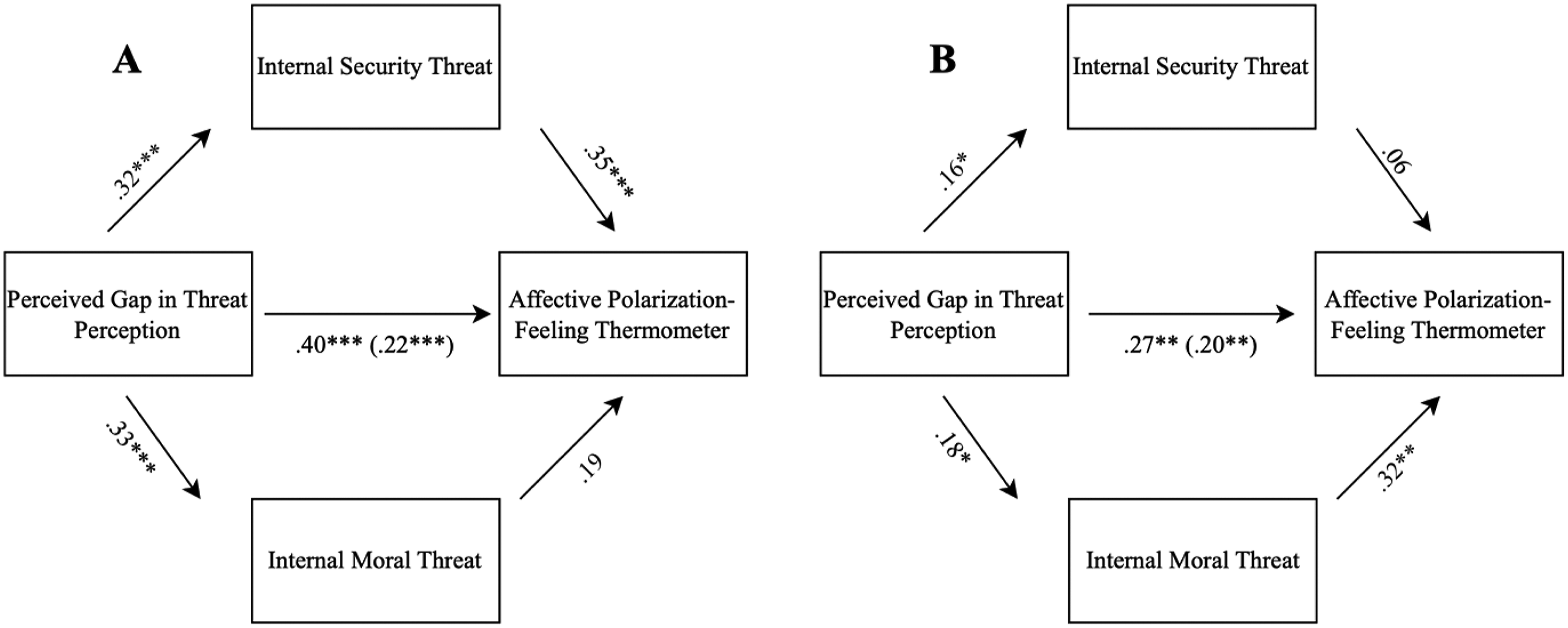
Testing the model that examines whether security and moral-image threat mediate the association between the perceived gap and affective polarization in terms of social distance revealed a different pattern. We found that among rightists, the total effect of the perceived gap on social-distance scores (b = 0.46, SE = 0.05, z = 8.60, p < .001) was partially mediated by both threats, as the two indirect effects (security: b = 0.09, SE = 0.04, z = 2.37, p = .018; moral image: b = 0.08, SE = 0.04, z = 2.11, p = .035) and the direct effect (b = 0.30, SE = 0.05, z = 5.48, p < .001) were all significant (see Figure 5(A)). However, in the leftist sample, the two indirect effects were not significant (security: b = 0.03, SE = 0.02, z = 1.59, p = .111; moral image: b = 0.03, SE = 0.02, z = 1.44, p = .150; see Figure 5(B)), indicating that a different mechanism presumably explains the relationship between the perceived gap and the behavioral aspect of affective polarization among this ideological group. Mediation model of the relationship between the perceived gap and social distance among the two ideological groups (A - rightists, B - leftists), mediated by both types of internal threat from the competing ideological group.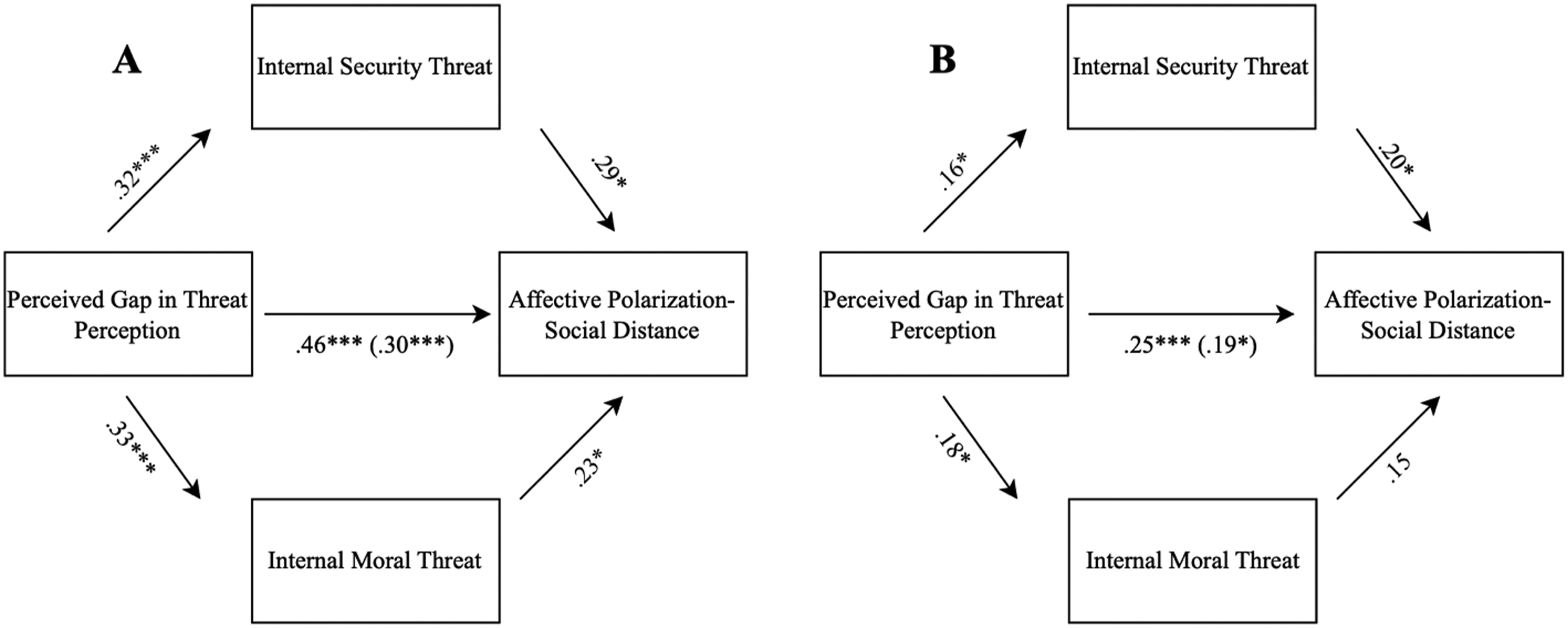
Discussion, Study 2
Study 2 replicates the findings of Study 1 and provides additional support for the first hypothesis. We found a positive association between the perceived gap in external threat perception and affective polarization, indicating that Israelis who perceived a wider gap in external threat perception between them and their political opponents also held more negative attitudes toward members of the competing ideological group.
We also found initial indications that support hypothesis 3 and establish the need for further exploration of hypothesis 4. Overall, the findings demonstrate that not all types of internal threats are equally relevant for explaining the relationship between the perceived gap in external threat perception and affective polarization among each ideological group. Specifically, results show that for rightists, the association between the perceived gap and the feeling-thermometer scores was partially mediated by a perception of an internal security threat posed by the ideological outgroup but not by an internal moral-image threat. For leftists, however, neither of the internal threats significantly mediated the association. Still, there was a marginally significant indirect effect of moral-image threat, suggesting a differentiation between the types of threat also for leftists, which deserves further exploration. In contrast, we did not find similar support for these hypotheses when trying to explain the association between the perceived gap and social distance. For rightists, both types of internal threat partially mediated the association, while for leftists, neither mediated the association. The different results found for the mediation models of the feeling thermometer and social distance can imply that there is indeed an inherent difference between the attitudinal and behavioral aspects of affective polarization (Druckman and Levendusky 2019), as it seems that for each distinct outcome, a different mechanism is relevant.
The mediation analysis, where the feeling thermometer was the outcome variable, revealed how the mechanism of internal threat functions. Interestingly, we found that for the two ideological groups, the perceived gap in external threat perception was positively associated with both types of internal threat, implying no interaction with political ideology in this part of the model. However, for each ideological group, only one type of threat was related to affective polarization toward the ideological outgroup, indicating an interaction with political ideology in this part of the model. This supports Kahn and colleagues' (2021) findings, according to which each ideological group is more sensitive to a distinct type of threat. For rightists, only the internal security threat was related to attitudinal affective polarization, whereas for leftists, only internal moral-image threat was related.
Notably, results of the mediation analysis where social distance was the outcome variable revealed a different pattern: for rightists, the two types of internal threat are meaningful for predicting social-distance intentions, and for leftists, neither is meaningful. This suggests that when it comes to the behavioral aspect of affective polarization, there is no distinction between the types of internal threat. Uncovering the reason for this different trend requires further research.
Finally, the results demonstrate an ideological variance in the effect of the perceived gap in external threat perception on affective polarization, with the effects being more pronounced for rightists. One possible explanation, supported by the research data (see Table 9 in Supplementary Material), is that rightists are more sensitive to threat (Jost et al. 2007), and thus the higher levels of threat—both external and internal—exacerbate affective polarization.
General Discussion
A common assumption among political scientists, social psychologists, and sociologists is that external threats lead to greater cohesion and cooperation within groups (Barclay and Benard 2020; Dovidio 2013; Stein 1976). However, the current research and other recent studies (e.g., Jahani et al. 2022; Myrick 2021) demonstrate that this is not guaranteed. Specifically, internal conflict between competing ideological groups seems to continue to occur even when people are exposed to common external threats due to society members' perceptions of differences in threat perceptions between their ideological group and the opposite group (Kubin, Kachanoff, and Gray 2022). This finding calls for reconsidering the potential ramifications of external threats to intragroup relations.
The current study explored this trend in two real-world contexts and examined a mechanism that explains how societies remain affectively polarized even in the presence of external threat. To do so, we presented a theoretical framework suggesting that a perceived gap in external threat perception is related to increased levels of internal threat from the competing ideological group, and that this internal threat is associated with higher levels of affective polarization. We tested the framework using public opinion surveys in two societies burdened by intractable interstate conflicts: South Korea and Israel.
The research findings indicate that in both countries, the suggested theoretical framework can explain how affective polarization is maintained even in the face of an external threat. In both case studies, we focus on high-power groups caught in intractable interstate conflicts, but we note meaningful differences between the two nations as an observation on generalizability. First, the defining characteristics of each society, such as religion, cultural values, and political structure, are different. Second, the features of the external conflict are different. In Korea, the two competing groups share a common identity, whereas in the Israeli-Palestinian conflict, the two sides are distinct. Yet in both cases, we found that individuals who perceived a wide gap between themselves and their ideological opponents in terms of external threat perception also reported higher levels of affective polarization, reflected in the attitudinal (feeling thermometer) and behavioral (social distance) aspects of affective polarization.
In both South Korea and Israel, an internal threat from the competing ideological group partially explained the relationship between the perceived gap in external threat perception and the feeling-thermometer scores, and in South Korea and among rightists in Israel, it also partially explained the relationship between the perceived gap and social distance. Initial and partial indications that support the specification of the mechanism suggest that different types of internal threats might explain the relationship between the perceived gap and affective polarization among each ideological group, based on each group’s threat sensitivity (Kahn, Björklund, and Hirschberger 2021). Specifically, we found that for rightists, internal security threat partially mediated this relationship, and for leftists, internal moral-image threat partially mediated this relationship. As these results were limited, this line of research requires further exploration.
Though we did not predict an interaction between the perceived gap in external threat perception and political ideology when predicting affective polarization, we decided to explore this possibility. We found no such interaction in either study when the outcome variable was the feeling thermometer, whereas in both cases, we found an interaction when predicting social distance. This finding aligns with previous work that distinguishes between the attitudinal and behavioral aspects of affective polarization (Druckman and Levendusky 2019), and it implies that the two should be examined separately in future studies. Regarding the interaction itself, while the relationship between the perceived gap and social distance was positive and significant for both ideological groups, it was stronger for rightists, aligned with previous work showing that right-wing ideology is associated with higher tendency for avoidance behavior (Shook and Fazio 2009). Our finding suggests that when it comes to the behavioral aspect of affective polarization, the two ideological groups differ in their response to the perceived gap in external threat perception, highlighting the possibly asymmetrical nature of affective polarization (Jahani et al. 2022).
Alongside the results outlined above, the current research has broader implications. By probing the relationship between the two layers of conflict—the external intergroup conflict and the internal polarization—and by demonstrating how one conflictual context can contribute to the escalation of the other instead of to its moderation, the present study illuminates the importance of examining reciprocal influences between intergroup and intragroup processes (see also Greenaway and Cruwys 2019), as they sometimes operate differently from what one would expect. Furthermore, as Dovidio (2013) emphasized, the integration of research of intergroup and intragroup processes is vital, as they are inherently inseparable, but even more importantly, such integration is essential for “understanding and improving intergroup relations” (Dovidio 2013, 17).
Inspired by this, we indeed hold a goal to better understand intergroup relations within society, specifically between competing ideological groups. Traditional theories that refer to cohesion (Coser 1956), cooperation (Barclay and Benard 2020) or unity (Bar-Tal 2007) in response to external threats rely on different operationalizations of the “cohesive” outcome when describing or studying the phenomenon. It is possible that if we had chosen to focus on other social groups within society, e.g., ethnic or religious groups, or on other outcomes in the political sphere, such as shifts in political attitudes, we would have found different associations with the perception of external threats that would better align with and support traditional theories.
Nonetheless, our focus on affective polarization as the outcome of an external conflict was intentional. Societies involved in intractable conflicts demand functioning leadership to cope with the unstable conditions created by the conflict (Rosler 2016), and individuals living in the conflict zone depend on the resilience of the society and society members to maintain a routine “normal” life (Bar-Tal 2007). In that sense, an increase in affective polarization, as we found in the current research, can be highly destructive to societies in conflict, as it is well established that affective polarization hurts these aspects precisely—it undermines political stability (e.g., Orhan 2022), fuels segregation within society (Iyengar et al. 2019), and damages society members' wellbeing (Nelson 2022).
The current study has implications for intergroup relations between the conflicting groups involved in interstate conflict. Numerous studies in recent decades demonstrate that affective polarization hinders decision-making processes and limits policy-making procedures in democratic countries (e.g., Hetherington and Rudolph 2015; McCoy, Rahman, and Somer 2018). Accordingly, it limits the ability to carry out new and necessary policies. Therefore, heightened affective polarization in these societies might also hinder attempts to resolve the external conflict. The result is a vicious feedback loop: external conflict increases internal affective polarization, which prevents societies from reaching a solution to the external conflict.
Finally, it should be highlighted that ideological disputes within society are essential for a healthy democracy (Finkel et al. 2020). It is vital to allow debates and disagreements, especially in societies involved in conflicts; otherwise, there is a danger of creating consensus around the continuity of the conflict. Without leaving room for voices calling for the end of wars, wars would probably last forever. The challenge that arises from the current research is how to enable the ideological debate while avoiding the destructive social effects of affective polarization in the form of hostility and hatred between individuals in society. This challenge is more urgent in societies in conflict, and future research should be devoted to addressing it.
Limitations and Future Research
The current study contributes to the understanding of the relationship between intractable interstate conflicts and affective polarization, but its limitations should be noted. First, the study is correlational, so we cannot ensure a causal relationship between the perceived gap in external threat perception and affective polarization. To determine the directionality of this relationship, future studies should examine our model using an experimental design and manipulate the perceived gap in external threat perception.
An additional issue that might arise regarding external validity of the study findings is the fact that we analyzed data while referring only to the two main ideological blocs within each society. While this practice is common in affective polarization research (Banda and Cluverius 2018), also in multi-party contexts (Bassan-Nygate and Weiss 2022), it raises questions about how well the findings reflect the political reality in those societies and regarding the findings' practical generalizability. Future work can address this concern by including moderates and centrists in the sample and referring to them as a third political bloc or by adopting a different approach suitable for multi-party systems and measuring affective polarization between pairs of parties (similar to Gidron, Adams, and Horne 2022).
Finally, future research could explore the relationship between perceived external threat and affective polarization in low-power groups. We tend to assume that among low-power groups, there will be a broader consensus about the level of the external threat, resulting in a narrower gap in external threat perception, since the imbalance of power creates an objective higher level of threat that is probably perceived as such by a majority of society members. However, there can be other gaps in the interpretation of the external threat that will affect the group response to the threat (Kamans, Otten, and Gordijn 2011) and potentially also the group internal dynamics.
Aside from overcoming these limitations, future studies can aim to improve the theoretical framework tested here. Specifically, since we found that the direct path between the perceived gap in external threat perceptions and affective polarization remains significant in the mediation models, examining additional mediators that operate as part of the mechanism can be valuable. For example, it is possible that perceiving the opposing ideological group as assessing the external threat inaccurately might appear foolish, naïve, biased (Lee and Ward 1996), or even unethical (Kubin, Kachanoff, and Gray 2022), and either of these assessments might fuel affective polarization. Alternatively, the perceived internal gap can lead to an emotional response of disappointment, anger, or disgust, potentially strengthening the inner divide. Further exploring the mechanism can provide valuable knowledge for designing interventions for addressing intractable interstate conflicts and mitigating the escalation of affective polarization within societies, enhancing the applicability of the current research findings for researchers, policymakers, and practitioners.
Conclusion
The current study offers an explanation as to why societies involved in intractable interstate conflicts are also facing internal conflict between competing ideological groups. By identifying the role of the internal threat from the competing ideological group in explaining this trend, the study demonstrates how external conflict can increase intragroup tensions, potentially fueling fragmentation and segregation. Obviously, this polarized result is especially destructive for societies that face a conflict with a rival outgroup and need all the social resources available for this struggle. Maybe even more importantly, this result is destructive for attempts to resolve the external conflict. Therefore, by better understanding the relationship between the two layers of conflict—the intergroup and the intragroup—the current study makes a significant contribution to both the study of affective polarization and scholarly work on conflict resolution, as well as to practical attempts at conflict resolution.
Supplemental Material
Supplemental Material - A Threat to Cohesion: Intragroup Affective Polarization in the Context of Intractable Intergroup Conflict
Supplemental Material for A Threat to Cohesion: Intragroup Affective Polarization in the Context of Intractable Intergroup Conflict by Tal Orian Harel, Nimrod Nir, Daan Vandermeulen, Ifat Maoz, and Eran Halperin in Journal of Conflict Resolution
Supplemental Material
Supplemental Material - A Threat to Cohesion: Intragroup Affective Polarization in the Context of Intractable Intergroup Conflict
Supplemental Material for A Threat to Cohesion: Intragroup Affective Polarization in the Context of Intractable Intergroup Conflict by Tal Orian Harel, Nimrod Nir, Daan Vandermeulen, Ifat Maoz, and Eran Halperin in Journal of Conflict Resolution
Footnotes
Declaration of Conflicting Interests
The author(s) declared no potential conflicts of interest with respect to the research, authorship, and/or publication of this article.
Funding
The author(s) received no financial support for the research, authorship, and/or publication of this article.

Data Availability Statement
Supplemental Material
Supplemental material for this article is available online.
Note
References
Supplementary Material
Please find the following supplemental material available below.
For Open Access articles published under a Creative Commons License, all supplemental material carries the same license as the article it is associated with.
For non-Open Access articles published, all supplemental material carries a non-exclusive license, and permission requests for re-use of supplemental material or any part of supplemental material shall be sent directly to the copyright owner as specified in the copyright notice associated with the article.
