




Abstract
In this article, we suggest rethinking the conflict resolution agenda among seemingly latent intractable communal conflicts by moving toward a constructive transformation of these conflicts. We connect Coser's theorization on social conflict and Lederach's conflict transformational ideas to, first, offer an alternative way of reconceptualizing conflict in ways that focus on harnessing the inherent potentialities of conflicts while changing the negative relational patterns among disputants; second, we propose emancipation from the local turn in peacebuilding to a local-local turn that will create a sense of local ownership, legitimize the process and increase the likelihood of acceptable and durable outcomes. To substantialize our argument, we present phenomenologically generated evidence from the Nkonya–Alavanyo conflict, which persists for over a century despite several attempts at its resolution. The conflict revolves around two truths derived from two maps and two tales and is overshadowed by mutual accusations and historically conditioned distrust of mediators.
Keywords
Introduction
The social scientific literature on conflict has since the 1950s been dominated by conflict resolution—addressing and transforming the very origins of deep-rooted conflicts (Ramsbotham et al., 2016)—theories that, for the best part, designate conflicts as undesirable and in need of resolution (Austin, 2019; Burton, 1997, 1990; Novais & Carneiro, 2016; Oliveira, 2021; Ramsbotham et al., 2016; Väyrynen, 2001). As John Paul Lederach (1996, p. 16) notes, sometimes “resolution may conceptually and subtly promote the impression that conflict is undesirable and should be eliminated or at least reduced.” However, conflict is neither undesirable nor avoidable, as it reflects incompatibilities and lack of resources, material and otherwise. Conflict can, but does not necessarily have to, result in violence. Even if it results in “political violence,” this violence has “functions … in national and international relations” (Väyrynen, 1991, p. 1), which remain underexplored in the literature. We are not criticizing the focus on conflict as such, but the negative social functions attributed, often implicitly, to conflict in large parts of the academic literature, let alone press releases. While we agree that violent conflict should be resolved, conflict as such can help improve social relations among and between groups of people. Although some conflicts erupt in violence, the extent to which individuals and groups resort to violence to deal with conflict seems exaggerated, especially on the microsociological level (see Collins, 2008). We argue, therefore, that in focusing on conflict's negative functions, parts of the literature provide a biased perspective on conflict, thus failing to take full advantage of all possibilities conflict offers for constructive conflict transformation. Although we recognize the enormous work done by conflict resolution experts, including Coleman’s (2011) theoretical contributions, especially as they relate to the resolution of even the 5% most difficult conflicts globally, what happens when a conflict remains insoluble despite all attempts and approaches? In such cases, we argue, not only the conflict but also attempts at its resolution tend to become intractable.
In this article, we are making a case for conflict transformation, which according to Mitchell (2002, p. 3) “takes the business of coping with destructive protracted conflicts beyond the cessation of violence, the achievement of a compromise settlement or even the joint creation of an acceptable solution to the issues currently in conflict between the adversaries—in other words, beyond resolution.” This is further justified by the idea that “…conflicts are generally not solved … What survives after a conflict has disappeared from the agenda is conflict energy reproduced and produced by the conflict. Then energy does not die … it attaches itself to one or more conflicts, possibly also the old one…” (Galtung, 1995, p. 53 as cited in Mitchell, 2002, p. 1). Our interest here is in the possible transformation of the conflict by channeling the dormant conflict energies to the advantage of the disputants by reconceptualizing a positive view of the conflict, which remains less explored not only in peace and conflict studies but also in international relations generally. Whatever else a conflict is, it is a social relation which can be capitalized on to improve the relationship among the parties to the conflict. Our context is everyday latent communal conflicts, not deemed problematic enough to warrant foreign intervention, due to, among other things, the relatively small number of casualties and the limited geographical scope of the conflict but troublesome enough to evade every resolution attempt. We argue that the failure of the many years and attempts at resolution is enough to turn toward transformation. Whatever else a conflict is, it is a social relation which can be capitalized on to improve the relationship among the parties to the conflict
In doing so, we first connect sociological conflict theory with conflict transformation perspectives; second, we reconceptualize the Nkonya–Alavanyo conflict in Ghana as a classic example of a conflict that has defied all resolution attempts for over a century; third, we show that even a long-standing conflict such as the one discussed here possesses inherent potentialities that can be capitalized on to the advantage of the conflicting parties; and finally, we suggest a turn toward the very conflicting parties that we designate as the local-local in the transformation journey, thus engaging and further developing the recent local turn in peacebuilding. Applied to the Nkonya–Alavanyo conflict, our approach could help disrupt the conflict, ameliorate relations among the conflicting groups and potentially interrupt patterns of migration caused by violence. To be clear, we do not assume or claim at this point that our conflict transformation approach succeeds in fact as it has not yet been tried; the failure of all attempts at resolving the Nkonya–Alavanyo conflict, however, necessitates a conceptual-theoretical rethinking of these attempts to which our article contributes. Rethinking precedes application; application requires rethinking. Both are important elements of the conflict transformation literature.
Accordingly, the article is organized as follows: the next section provides a critical engagement with the ideas of Lewis Coser and Lederach. In the following method section, we position this article within the recent qualitative and ethnographic turn in International Relations and Peace and Conflict Research, by which we refer to qualitative methods exploring the local and the local-local and explain our phenomenological and interview-based approach. This will be followed by a cursory look at the Nkonya and Alavanyo conflict and attempts at its resolution. Afterward, we make trips to Nkonya and Alavanyo and pay attention to the voices of mistrust (of mediators) and desperation from the disputants, discussed considering the theoretical literature.
Toward a Journey of Transformation
In this article, we draw on the thinking of Coser (1956) on the functions of social conflict. At the core of Coser's argument, much of which is based on and presents a rereading of the interactionist position of Georg Simmel, is the contention that “far from being necessarily dysfunctional, a certain degree of conflict is an essential element in group formation and the persistence of group life” (Coser, 1956, p. 31). Conflicts can establish the uniqueness of groups while preserving their identity (Coser, 1956, p. 38) and relationship “by setting free pent-up feelings of hostility” (Coser, 1956, pp. 47–48). Conflict also diminishes its disruptiveness by acting as a safety valve for the discharge of tension (Coser, 1956, p. 48). Conflict with an outgroup can develop cohesion, identity, and awareness within the in-group. Conflict also “revitalizes existent norms and creates a new framework of norms within which the contenders can struggle” (Coser, 1956, p. 125). Thus, “whether internal conflict promises to be a means of equilibrium of social relations or readjustment of rival claims, or whether it threatens to ‘tear apart,’ depends to a large extent on the social structure within which it occurs” (Coser, 1956, p. 152). Therefore, rather than being a byproduct of conflict, it is the unbending nature of the conflict that damages the social structure.
Conflict can be positively functional for intragroup relations (see above), but it can also be positively functional for intergroup relations and help readjust them. Because conflict, as a social relation, can improve intergroup relations, we want to connect Cosser's insistence on the constructive elements of social conflict with Lederach's emphasis on the “centrality of relationships” in peacebuilding (2005, p. 35). We engage with Lederach’s (1996, 1997, 2005, 2014 1 ; see also Lederach & Maiese, 2009) notion of conflict transformation, an approach that emerged in the twilight of “the search for an adequate language to explain the peacemaking venture” (Lederach, 1996, p. 17). It aims primarily at changing the relations, positions, and, if possible, the very fabric of the society that allows conflict to breed (Miall, 2004). This approach envisages and reacts “to the ebb and flow of social conflict as life-giving opportunities for creating constructive change processes that reduce violence, increase justice in direct interaction and social structures, and respond to real-life problems in human relationships” (Lederach, 2014, chpt 3). This definition visualizes conflict as an everyday occurrence with great potential for constructive change despite its potential destructiveness. Such a view thrives on a deliberate bias of approaching conflict as a catalyst for development and change (Lederach, 2014). Conflict transformation best applies in cases where disputants have a long-standing history with the potential for further future engagements (Lederach & Maiese, 2009). In dealing with a long-standing conflict, we are guided by the need to disrupt the patterns of violence among disputants and replace it “with respect, creative problem-solving, increased dialogue, and non-violent mechanisms for social change” (Lederach & Maiese, 2009, p. 10), which can potentially change parties, their issues, and anticipations while ultimately diminishing the threat of violence (Wallensteen, 1991). Consequently, we are called upon to morally “imagine and generate constructive responses and initiatives that, while rooted in the day-to-day challenges of violence, transcend and ultimately break the grips of those destructive patterns and cycles” (Lederach, 2005, p. 29).
In summary, we align Coser's ideas of changing society through conflict with Lederach's ideas about changing the relational patterns of groups in conflict (conflict transformation) to suggest a practical and innovative tool to constructively transform conflicts in ways that cannot be done by looking at them exclusively either through Coser's lens or Lederach's transformational lens. Our article will thus help create an alternative avenue to reconceptualize seemingly latent communal conflicts to disrupt violence and improve both relations among conflicting groups and their living conditions.
Method
Methodologically, this article responds to the fresh impetus for the recent qualitative and ethnographic turn in peace research (Millar, 2018a, 2018b) necessitated by the local turn in peacebuilding—a shift away from the international to local agencies involved in peace processes in conflict and postconflict settings (Ljungkvist & Jarstad, 2021; Mac Ginty & Richmond, 2013). By qualitative and ethnographic turn, we do not merely refer directly to ethnography as a method but also, and more specifically, to those qualitative methods that seek to engage the local and even beyond the local (local-local) in the local turn. Indeed, the local turn grew out of the many failures of the UN and the international community in brokering peace internationally through liberal, interventionist peacebuilding (Mac Ginty & Richmond, 2013; Paffenholz, 2015). Consequently, “engagement with local communities” came to be regarded “as a way of embedding the intervention locally, and thereby tailoring it to local needs and cultural expectations” (Ljungkvist & Jarstad, 2021, p. 2211). Despite the theoretical strength of the local turn, however, there exists a huge degree of “frustration with regards to the conceptual fuzziness of ‘the local’, and with the continual failures of international interventions in actually taking into account local perspectives, promoting local agency and establishing local ownership” (Ljungkvist & Jarstad, 2021, pp. 2209–2210). Intervention is still often unidirectional rather than being based on or aimed at dialogue and mutual learning. Our work thus in practice supports and deepens the very recent literature that criticizes the conceptualization and even fetishization of the local in this local turn (Lee, 2020; Ljungkvist & Jarstad, 2021; Mac Ginty, 2015).
Intervention is still often unidirectional rather than being based on or aimed at dialogue and mutual learning.
To research the Nkonya–Alavanyo conflict and to explore the local-local, we use phenomenology, understood as “a form of qualitative research that focuses on the study of an individual's lived experiences within the world” (Neubauer et al., 2019, p. 90), as our method. Our sense of phenomenology is also derived from Max van Manen’s (1997, p. 53) characterization of phenomenological research as “the life, the world of lived experience.” Therefore, by using phenomenology, we emphasize individual disputants’ lived experiences (Giorgi et al., 2017), especially as they help in eliciting more nuanced information than quantitative approaches do (Rich & Ginsburg, 1999).
Accordingly, we draw on in-depth field interviews phenomenologically generated among 24 participants (12 participants for each group) between 2014 and 2020 in Nkonya-Tayi, Alavanyo-Kpeme, and Alavanyo-Wodidi in Ghana, which record the highest incidence of violence among the two groups (Agyei, 2021). In recruiting the 24 participants, we relied on snowball and convenience sampling methods. In both communities, the selection criteria were (a) resident natives, or outsiders with long-term resident status, (b) farmers who farmed around the disputed land, and (c) individual landowners or family heads in charge of lands in the area. All participants, aged from 18 to 92 years, were interviewed for approximately 45–60 min on average in a safe and comfortable space often chosen by them where the purpose of the interview was explained before and after the interviews. These interviews took an open-ended and conversational format where issues related to, among other things, the intractability and previous resolution attempts in the conflict were discussed. The interviews, which were conducted in three languages: English and Twi in Nkonya and English and Ewe in Alavanyo, were taped with the permission of the participants and thoroughly transcribed at the end to form the data. There were special attempts at securing gender parity in the selection process, although some women occasionally deferred to their husbands.
In a bid to secure the ethical conduct of research, we have strictly adhered to the relevant guidelines set by the Ethical Committee of Tampere University. In the data generation, permission was sought from the traditional leaders in Nkonya and Alavanyo. The study ensured the informed consent of participants (both written and oral) and took steps to explain the work to the interviewees. The study also followed the rules set by the Finnish National Board on Research Integrity TENK especially concerning the privacy of participants and data storage.
The Nkonya–Alavanyo Conflict and Previous Resolution Attempts[PA(12]
The Nkonya-Alavanyo conflict is a tale of two truths and two maps, overshadowed by accusations and counter accusations from both groups. The conflict is arguably one of the most enduring intractable conflicts of all times, having persisted against several attempts at resolution in its centennial journey with no hope in sight (Agyei, 2021; Gariba, 2023, 2021). The Nkonyas (ethnically Guans) and Alavanyos (ethnically Ewe) are believed to have been in occupation at their current location since the 16th and 18th centuries, respectively (see Agyei, 2021; Dzathor, 1999; Gariba, 2021). The Alavanyos, according to Paul K. Dzathor (1999, p. 52), who were fugitives fleeing persecution, met the Nkonyas at their present location who welcomed them with open arms. Although Dzathor (1999) is from Alavanyo, his account is accepted by both communities. There is, however, a point of disagreement based on each communal interpretation. Whereas the Nkonyas believe they are the original settlers and by default, the landowners (Gariba, 2021), the Alavanyos argue that the original portion of land given them was uninhabited and therefore could not have been owned by the Nkonya people. 2 This individual position is at the heart of their respective claims to a land—measuring approximately 6460 acres, which is deemed to be rich in mineral resources, including gold and bauxite (Agyei, 2021; Gariba, 2023)—which remains at the core of the current conflict. With each group promoting what they believe constitutes the real truth of ownership, we designate this as a tale of two truths of origin. Evidence of their peaceful coexistence exists, however, such as periods during which joint endeavors such as intertrading, intermarriages, and intercultural exchanges were encouraged and practiced (Gariba, 2023). However, by the turn of the 20th century, their relationship had soured, and since then, peace has remained elusive. Although it is difficult to ascertain the actual number of fatalities, according to Penu and Essaw (2019), 10 deaths were officially recorded between 1992 and 2017.
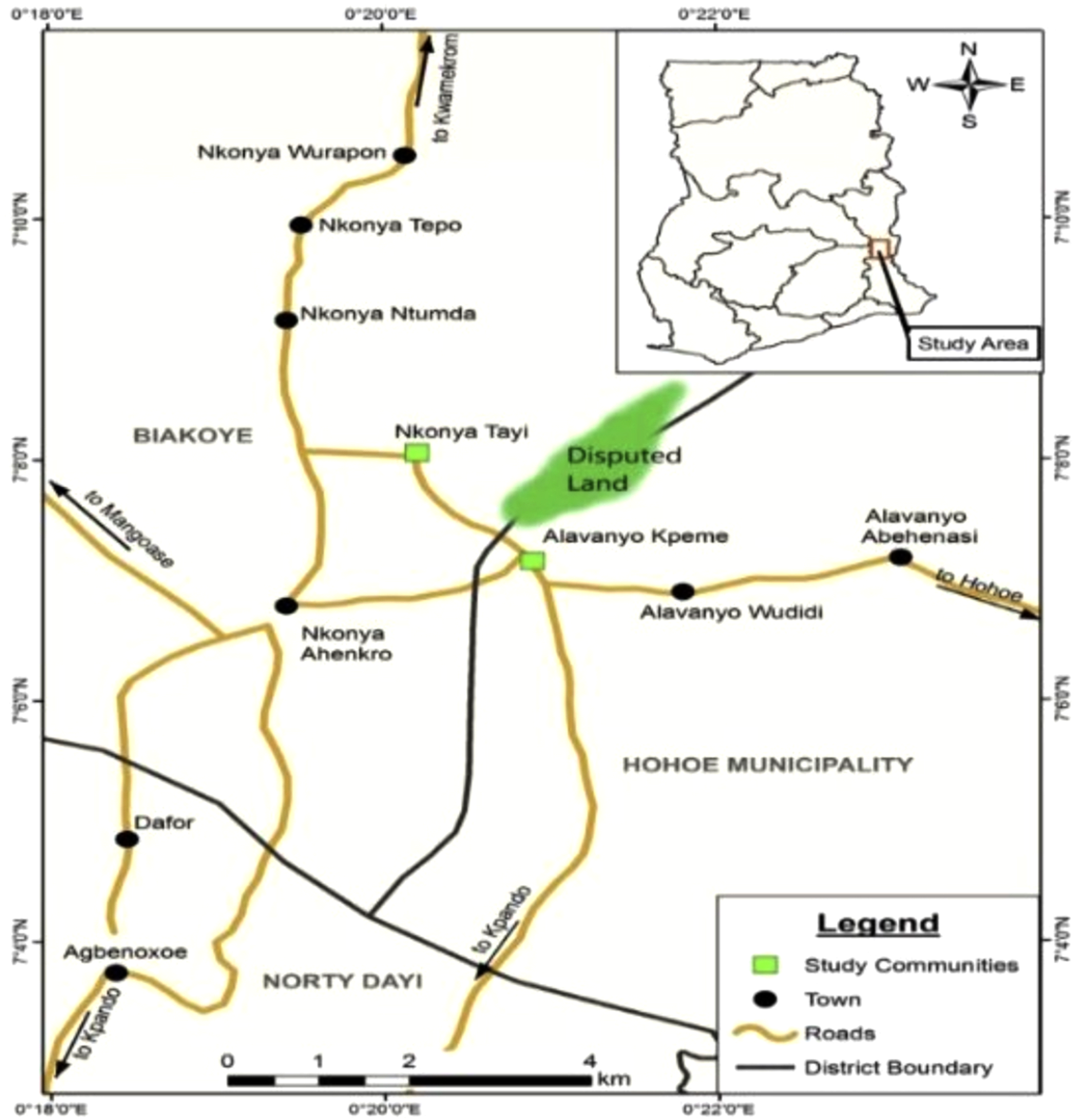
A cartographic illustration of the disputed area between Nkonya and Alavanyo (Penu & Essaw, 2019, p. 100).
Despite all attempts at resolution, the Nkonya–Alavanyo conflict persists (Agyei, 2021; Gariba, 2023). Some of the notable attempts include traditional Ghanaian approaches done primarily through the chiefs and their elders not just from both sides but also at the regional level (see Yakohene, 2012). However, the earliest known official attempt at resolving the conflict was the commissioning of the 1905 Karte von Togo (map of Togo) and 1913 Karte des Sechsherrenstockes (map of the Sechsherrenstock) by Hans Grunner, a colonial administrator in Misahöhe in the then German Togoland whose job included the demarcation of boundaries among the people in his district (Gariba, 2023; Nugent, 2019). Arguably, the most conspicuous and yet contentious resolution attempt is the 27 years (1953–1980) of litigation in which Nkonyas argued their case for the land with the Karte des Sechsherrenstockes—and related concrete pillars planted to mark the boundaries between their neighboring communities, while the Alavanyos relied on the 1905 Karte von Togo and a local boundary plant called Anyaa ( Paul Kojo Anane [Regent of Nkonya Tayi] and others v Kwasi Asigbetse and others, 1953 ). In the end, the court supported Nkonya's claim while rejecting the Alavanyo bid. We describe this litigation journey as a tale of two maps.
Successive governments have equally made various interventions. Often, these are done through the constitution of committees such as the G. K. Acquah Committee of 1992, the S. K. Mireku Committee of 1995, and more recently the 2004 Nkonya–Alavanyo Mediation Committee, which was seen as a clear example of an Alternative Dispute Resolution (ADR) mechanism. However, given that ADRs are supposed to be an alternative platform expected to be pursued before litigation (Ibrahim et al., 2022), their use here after a note of finality has been pronounced on the land issue in court ( The Republic v Stool Lands Boundaries Commission, Ex Parte Agya-Atta, 1980 ) undermined their legitimacy and consequently their effectiveness.
These interventions aside, other interested parties, such as civil society organizations, churches, youth groups, and diasporan communities, continue to maintain some form of influence along the side lines. Despite keeping the communications somewhat active, all the interventions have not been able to produce the needed peace (see, Agyei, 2021; Gariba, 2023; Yakohene, 2012). Some of these interventions have been viewed positively in parts of the literature. For instance, while Afua Yakohene (2012) has commended the West Africa Network for Peacebuilding (WANEP) for their role in the 2004 Nkonya–Alavanyo Mediation Committee, Perpetua Francisca Midodzi and Razak Jaha Imoro (2011), in contributing to the ADR literature, reference the success of ADR in the Nkonya–Alavanyo conflict. However, the subsequent flaring of the conflict and collapse of the mediation efforts cast doubts on the mediation process and its reported gains. With the apparent loss of trust from disputants, ADR mechanisms are still viewed with some suspicion among the Nkonya–Alavanyo people (Agyei, 2021).
Responding to the above failures, our work presents an alternative approach by reconceptualizing the conflict in ways that not only allow disputants to be at the center of their own business but also help them to take advantage of the conflict—which remains deeply unexplored in the literature—while transforming the negative relational patterns
Mistrust in “mediators” and Desperation Among the Disputants
While conflict with out-groups tends to increase the coherence of the in-group (Coser, 1956, pp. 87–95), neither the Nkonya nor the Alavanyo articulates the wish to capitalize on the conflict and to keep it alive to strengthen their internal cohesion. Rather, they are invariably interested in peace and all that promises to bring it. Transforming the conflict may increase the in-group's incoherence by, for example, rendering the narratives more complex and less homogeneous that people tell about the conflict, thus allowing alternative narratives to emerge that may render the overall narrative more variegated. There is, however, some commonality of voices from both sides inherent in their mistrust of the mediators—used loosely to refer to all third parties seeking to join in the conversation for peace—and unanimity in faulting either in part or in their entirety the many attempts at building peace. Earlier attempts at peacebuilding appear as the condition of impossibility for peace, as a part of the problem rather than the solution, contributing to the conflict instead of transforming it. As a result, there is a huge sense of mistrust of not only the mediators but also the various interventions. This translates into huge disillusionment and raises significant questions and concerns from disputants, of which our interviews offer empirical evidence. A case in point is the abrupt end of the 2004 Nkonya–Alavanyo Mediation Committee due to mistrust from the conflicting parties, especially the Nkonyas (see Yakohene, 2012). The views of an Nkonya participant, recorded during an interview session in January 2014 in Nkonya-Tayi, capture the sentiment from the ground: Earlier attempts at peacebuilding appear as the condition of impossibility for peace, as a part of the problem rather than the solution, contributing to the conflict instead of transforming it. Our proposal was to go for the Grunner demarcations and court rulings. It was there that we were told by Mr Bombande
3
“not to be slaves to court rulings and maps.” I made reference to Solomon's famous judgment in the bible about the dead and the living child, and it was there that Rev. Livingston Boamah
4
retorted that “Look at the way they talk like peasant farmers brought to the church to sing.” So instead of leaving the Nkonyas and Alavanyos to negotiate, the two of us ended up struggling with the mediators.
Even the court that was expected to be an impartial arbiter stands accused among the Alavanyo people who challenge the credibility of the judgments against them, especially when they believe that the Grunner map used in the judgments has been discredited in several cases (see Agyei & Odartey-Wellington, n.d). As a participant from Alavanyo argues in June 2019, “there was a case between New Ayomah and Akpafo Adoko. There was a judge on the panel, Justice Francoise. They ruled against the use of the Grunner map to determine the boundary between New Ayomah and Akpafo. So, we ask where is the justice?” Such perceptions, we argue, have been a huge impediment in the search for peace, especially as mediators are bound by the ethics of their profession to exude a high degree of neutrality and impartiality (Väyrynen, 2013). As Agyei (2021, p. 626) notes, “unless mediators are deemed fair among disputants, their efforts will at best distant the groups instead of bringing them together.” However, the shared mistrust of mediators could also serve as a connecting link between the two communities, as something they have in common and on which alternative conflict transformation attempts could be built. Conflict transformation is always a search for relationships and commonalities.
Conflict transformation is always a search for relationships and commonalities.
Related to mistrust is the general dissatisfaction with the various attempts at achieving peace. As one participant notes with respect to previous attempts, “I think they have not really made any difference” (Nkonya Participant, Nkonya-Tayi, January 2014). The view is not different from another who retorted that “…We (Nkonya) also saw that the committee was biased in favour of Alavanyos, so we pulled out of it” (Nkonya Participant, Nkonya-Tayi, January 2014). The Alavanyos also expressed similar sentiments. A participant claimed that “…those who want to intervene are not hitting the nail at the head. They are taking sides” (Alavanyo Participant, Alavanyo-Kpemi, July 2019). Such thinking is enough perhaps for another to conclude that “…people are fed up with the peace processes. Even I decided not to pursue the peace process again” (Alavanyo Participant, Alavanyo-Kpemi, July 2019). When asked about the resolution attempts thus far, another participant contended that “…for so long, everything has been reduced to just talking. After a while the killing resumes. People are getting fed up” (Alavanyo Participant, Alavanyo-Kpemi, July 2019). These views, first, embody disputants’ recognition of the several attempts at resolution; second, they reflect the seeming mistrust and a profound degree of frustration with these efforts, which, like the conflict, appear intractable.
Our article is therefore a response to the failure of all the resolution efforts practiced as well as the calls of mistrust, dissatisfaction, and frustration with these attempts among the parties to the conflict, taking these people's voices seriously. In doing so, we want to tap into their many years of fruitful coexistence and engagements to build trust from within and among themselves while placing the people right in charge of these engagements.
A Walk Toward Transformation
In an interview in June 2019, an Alavanyo leader narrates how he paid an unannounced visit to the paramount chief of Nkonya, who had called prior to informing him of his sickness. The interviewee speaks of how he was attacked for not seeking official approval before the visit from a senior member of the Nkonya royal court and got himself defended by his host, who simply asks, “…He is my brother. He has come unannounced so what do you care?” In this same conversation, the Alavanyo leader speaks of his Nkonyaness, with his maternal family members coming from and actively living on the other side of the divide. Reflecting on these shared interrelational connections, we argue, it is important to draw attention not only to their differences but also to appeal more to their shared past, current, and future relational patterns as critical connections and intersections that can be leveraged when disputants reopen genuine channels of communication to aid the transformation of the conflict.
In their concluding remarks on the Nkonya–Alavanyo conflict, Mensah et al. (2016, p. 14) make a case aimed at “building peace and resolving conflict to transform it from negativity into long lasting enduring positive change in individuals, communities and structures.” To them, such a journey will require rigorous peace education with a sustainable outlook that will endeavor to sensitize people from within the communities and beyond. They also call for an open and inclusive strategy that builds from among the conflicting parties. We support the reasoning above but go deeper than the proposition of Mensah et al. (2016). Our approach is aimed not at resolution per se but strictly at conflict transformation. Although like Azar (1990, pp. 18–28), Lederach (1997, p. 60) endorses middle-level leadership (Track II)—a position he has since revised and replaced with a web approach (Lederach, 2005, pp. 75–86)—which is alleged to have the best possibility for hosting an infrastructure capable of sustaining peacebuilding, our approach goes beyond existing ones. This is because, similar to international actors, “local actors and contexts can be partisan, discriminatory, exclusive and violent … contain power relations and hierarchies that favour some above others” (Mac Ginty & Richmond, 2013, p. 770), as demonstrated by our case in context. The local is not local enough, as they remain detached from the very people (local-local) and by extension their experience. Take Emmanuel Bombande, a Ghanaian and a distinguished peacebuilder/mediator with considerable years of experience, especially in the West African Sub-region, for example. His Ghanaianness qualifies him as a local mediator as per the literature on the local turn (see Lee, 2020; Ljungkvist & Jarstad, 2021; Mac Ginty & Richmond, 2013). However, he is, and is indeed considered, an outsider among the Nkonya and Alavanyo people, thus placing him outside the local-local and underscoring our contention that the local does not go local enough. A case in point is when a leading member of Nkonya-Tayi asked Mr. Bombande to go and solve all the conflicts in his area and leave Nkonya-Alavanyo matters alone. 5 The local-local thinking thus will require that every conflicting community will need its own Bombande (local-local facilitator or mediator).
Accordingly, we suggest moving from the local turn to a local-local turn (Track III), which reflects many claims made in the local turn but substantializes them by, among other things, adding an emancipatory element to the local in peacebuilding—emancipatory, that is, with regard to external mediators. The issue here, thus, is not merely one of increasing dialogue between mediators and local communities or strengthening local voices in what remains an essentially top-down endeavor but, rather, one of strengthening dialogue among local communities. The local-local turn reflects the high level of distrust of mediators among the parties to the conflict and places many responsibilities in the hands of the disputants themselves. Such local ownership of the processes will reduce the incidence of bias from mediators (real or perceived) and increase the likelihood that the ultimate outcome of the engagements becomes locally owned, perceived as legitimate and, by extension, acceptable and durable. Paradoxically, then, the commonality of local voices with regard to the failure of earlier conflict resolution attempts can serve as a connecting link between the groups and strengthen their relationship. Now, it could be argued that the failure of earlier communal attempts explains why external mediators intervened in the first place. While this may have been so, the repeated failure of external mediation can be expected to increase, once again, the sense of local ownership of both the conflict and its transformation. The issue here, thus, is not merely one of increasing dialogue between mediators and local communities or strengthening local voices in what remains an essentially top-down endeavor but, rather, one of strengthening dialogue among local communities.
We also associate ourselves with the reasoning that while conflict resolution aims at providing an immediate resolution to a situation, conflict transformation is “a way of looking and seeing and it provides a set of lenses through which we make sense of social conflict” (Lederach & Maiese, 2009, p. 7). These metaphorical lenses help us in visualizing the “immediate situation,” gives us a view of the “deeper relationship patterns” and finally a conceptual “framework” that connects them, presenting a wholistic comprehension of the conflict while acting at the same time as a podium for addressing both the immediate issues and the relational patterns (Lederach, 2014; Lederach & Maiese, 2009, p. 8). In the Nkonya–Alavanyo conflict, we are confronted by the kind of lenses that can give us a sense of the immediate situation and the relational context in which the conflict is expressed, help us to visualize a potential and desired future outcome and to address the conflict “as the development of change processes that attend to the web of interconnected needs, relationships, and patterns” (Lederach & Maiese, 2009, p. 8).
The Nkonya–Alaavanyo conflict is about the ownership and usage of disputed land in the service of the dominant agrarian enterprise pursued by both communities. Coser explains that a “conflict over the ownership of a piece of land implies that both parties to the conflict accept the idea of property rights and the general rules regarding the exercise of those rights. What they are fighting about is not the principle, but its application in the specific case” (1956, p. 123). Conflict, even an occasionally violent conflict, is a social relationship, followed or accompanied by “other types of relations” (Coser, 1956, p. 122). Indeed, this conflict, when viewed through specific lenses during its centenary journey, has metamorphosed to encompass such social relations as pressing, and sometimes not so pressing, land-related matters, revenge, justice/injustice, ethnic solidarity, and polarization as well as everyday insecurities and related violence (Agyei, 2021; Gariba, 2017a). Understanding these positionalities requires the use of a specific lens at every given time, as no specific lens can explain the conflict in its entirety. By shining light on specific aspects of the conflict, we (disputants, researchers/theorists, mediators, and by extension governments) will be able to paint a vivid picture that will point potentially toward the immediate and pressing concerns that need to be “resolved through problem solving and negotiations” (Lederach & Maiese, 2009, p. 7), as well as those concerns that fundamentally require attention to change the destructive patterns. In a sense, the transformation platform is anticipated to become responsive in the short term and strategic in the long term (Lederach & Maiese, 2009, p. 10). By subdividing the conflict into its ingredients, we can address these ingredients individually and on their own terms without neglecting connections and interrelations.
By subdividing the conflict into its ingredients, we can address these ingredients individually and on their own terms without neglecting connections and interrelations. Thus, we must pay attention to how changes in one ingredient (even desired changes) affect other ingredients. For instance, while it is unthinkable to tackle the question of (in)justice without a fuller appreciation of the entire legal processes and their resultant judgments (see Agyei & Odartey-Willington, n.d.), it is entirely possible to attend to the violence and insecurities that bedevil the everyday life of the communities (which then, in turn, may help address larger questions). This can be achieved through the injection of law enforcement agencies to provide a sense of safety and normality.
6
Such an approach lays a solid ground for attending to other related issues. For practical execution of his transformational ideas, Lederach (2014, chpt 8 see also, Lederach & Maiese, 2009) implores us to:
deliberately conceptualize current problems/happenings in conflict as windows for critical consideration for what lies beyond/behind them, delve into the issues by creating deliberate platforms that connect multiple time frames, develop the ability to visualize dilemmas and paradoxes as a symbiotic part of an intricate situation, embrace complications as friends rather than enemies, pay attention to the voices of differences/identity.
Accordingly, we propose a reconceptualization of this and related conflicts. In the context of the Nkonya–Alavanyo, there is a direct call to perceive the current issues in consideration and, where necessary, solve them through a problem-solving platform, for example, if they require immediate fix but crucially pay attention to details in ways that the issues at play can mirror underlying potential issues that are equally necessary for the transformation of the conflict. This means that rather than just visualizing the land factor as a current problem that will ordinarily end the conflict by just going through the general litigation process or using other local mechanisms, we can hold the land question as a window. Through this window, we would be able to critically engage the people and go beyond that, including ascertaining the bond and ties between the people and the land (Gariba, 2017b). Such an approach not only privileges long-term strategic considerations but also acts responsively to short-term needs. Coser (1956, p. 80) notes that conflicts “may serve to remove dissociating elements in a relationship and to re-establish unity” on condition that they “do not contradict the basic assumptions upon which the relation is founded.” Establishing as the basic assumption upon which the relationship between the Nkonya and Alavanyo is based that social conflicts should and can be addressed without recourse to violence is a first step toward conflict transformation.
Doing so responds to Lederach's call to pose energies of conflict as dilemmas. This means we must avoid the contradictory framing of the conflict (in this instance still using the land as a point of reference) as done among both the disputants and refrain from referring to the conflict in terms of Nkonya versus Alavanyo (or Alavanyo vs. Nkonya), thus emphasizing the unifying potentialities of social conflict (see Coser, 1956, pp. 121–137): it is the conflict that connects the Nkonya and the Alavanyo with each other; conflict, even a violent one, is a social relation. If there are limits to violence, “there already exists a socializing factor even though only as the qualification of violence,” Simmel explains (cited in Coser, 1956, p. 121), which can be capitalized on to further improve social relations by, for example, looking for mutually acceptable positions regarding some of the component parts of the overall narrative while acknowledging that the overall patterns are mutually exclusive for the time being. Furthermore, even if some issues seem contradictory, not all issues are, some issues only seem contradictory or are constructed as such for a variety of reasons. Transformative approaches focus on those positions that offer space for reconciliation. Thus, we must, for example, ask the question, how do we respond to Nkonya's claim to the land backed by their court wins while at the same time responding to Alavanyo's counter claim and subsequent rejection of the court rulings ( Agyei, 2021 )? How do we respond to positions that seem to be mutually exclusive? In doing so, we are also able to address inherent and manifest complications. While these complicities are tolerable to a certain degree, once they overwhelm us, they become our enemies. In the service of the transformational agenda, we are called on to embrace them as friends instead of foes. This can be done by believing in the ability of the relational system to create potential change avenues, pursuing changes that are most constructive in their outlook, and finally by learning to avoid unresponsive and unproductive ideas.
The final step is paying attention to the views of the various parties. Often, voices of identities that relate to a group and how they define themselves, interests, and positions in relation to others are likely to be submerged in a loud conflict environment despite remaining central to our understanding of the conflict. The job of conflict transformation in a sense is to establish safe arenas that encourage the Nkonya and Alavanyo to eloquently showcase a constructive sense of identity to each other instead of in reaction to them. In times of uncertainty, reducing reactivity and blame while promoting the predisposition toward the identification of self and place must be encouraged. This can be achieved by deliberately giving recognition to these voices of difference (seeing and hearing), including within the respective communities, and secondarily, coming to terms with the identity factor in the conflict.
Regardless of the strategy, this transformational journey cannot be executed in isolation. The government has a part to play and must demonstrate its commitment in that regard. Allegations of unfair considerations as bias as exist from both sides must be addressed. Thus, by following the steps above, this conflict may be used as an outlet to emit tension and violent disagreements. This may ultimately constructively change the fortunes of the conflict by, among other things, providing an avenue for the Nkonya and Alavanyo people to reimagine themselves, socially engaging each other in ways that give meaning to the ideas of Coser (1956) and Lederach (2014; Lederach & Maiese, 2009).
Conclusion
In this article, we have drawn attention to the quantitative and qualitative unevenness of the significance assigned to conflict, as it appears in the available literature, which spends considerable time on discussing the negative aspects of conflict and considerably less time on the constructive aspects of conflict. Drawing on Coser’s (1956) reasoning on the importance of social conflict and engaging with Lederach’s (1996, 1997, 2005) relational and transformational ideas, we have argued that regardless of their potentially devastating effects, conflicts of all forms have some innate benefit that can always be harnessed for the benefit of the disputants to transform their dysfunctional relationship and improve social relations. Accordingly, we propose a rethinking of the old conflict resolution order by moving toward a constructive transformation of the many intractable communal conflicts in ways that privilege justice and reduce violence. In this transformational journey, we further suggest a turn away from the local to a much more local-local, which we argue can increase the sense of local ownership, give legitimacy to the process, and increase the acceptability and durability of the outcome. We provide empirical evidence on the failure of previous resolution attempts and the voices of mistrust, dissatisfaction, and disillusionment among the conflicting parties to the Nkonya–Alavanyo conflict to substantiate our call for a rethinking of the status quo—from resolution to transformation.
Our analysis demonstrates that there are instances and cases where conflict transformation might not necessarily work or might simply prove unnecessary; sometimes a simple conflict resolution approach such as a problem-solving platform might suffice. However, when the conflict concerns people or groups with intergenerational connections and attachments as well as possible future engagements as the Nkonya and Alavanyos have, conflict transformation becomes the most effective way of dealing with the conflict (Lederach, 2014). This makes conflict transformation more appropriate, although hardly simplistic. It will require, we reckon, a carefully calibrated and choreographed template—between local-local facilitators and disputants—that pays attention to the immediate concerns that require a simple resolution as well as the underlying relational factors, including differences in their identities made manifest due to the many years of unresolvable hostilities. Such close engagements stand to repair the damage to their relationship and create a platform for trust as well as new pathways for peaceful coexistence.
Footnotes
Declaration of Conflicting Interests
The author(s) declared no potential conflicts of interest with respect to the research, authorship, and/or publication of this article.
Funding
The author(s) received no financial support for the research, authorship, and/or publication of this article.
