




Abstract
A growing line of research examines causes and consequences of militant group competition. However, empirical work on these topics has limitations. Most quantitative research uses relatively rough proxies for competition, such as counts of groups in a country. Other work uses dichotomous indicators, ignoring the intensity or degree of rivalries. Additionally, many studies examine either terrorist organizations or rebel groups, overlooking cross-type rivalry (e.g., terrorist vs. rebel). We address these issues by introducing time-varying dyadic rivalry data on hundreds of groups – rebels, terrorists, and pro-government militias – in Africa and Asia, 1990-2015. Rivalry levels include denouncements, threats, and violence. After presenting the data, we test the “outbidding” hypothesis: the notion that inter-organizational competition leads to more terrorism. This argument has found support in qualitative analyses, but quantitative tests using rivalry proxies show mixed results. Using our data we find support for the hypothesis. We conclude with research questions that could be addressed with the data.
Introduction
A new wave of research focuses on competitive relationships between militant groups. While terrorism and civil conflict research has traditionally studied the interaction between militant groups and governments, scholars increasingly seek to understand intergroup relationships. Existing studies examine intergroup rivalries, intragroup fractionalization and fratricide, as well as the consequences of such competition (Mendelsohn 2021; Metelits 2009; Nemeth 2014; Tokdemir et al. 2021). Terrorism researchers have also examined the phenomenon of “outbidding,” when terrorist groups use violence to outbid one another for public support (Belgioioso 2018; Bloom 2005; Conrad and Greene 2015; Conrad and Spaniel 2021; Farrell 2020). Many of these studies, however, reach mixed conclusions regarding how competition influences violence, as well as what leads to competition in the first place. For instance, while the logic of outbidding appears to be sound, empirical support is inconsistent (Abrahms, Ward, and Kennedy 2018; Findley and Young 2012).
The lack of a reliable source of data on intergroup competition has been one of the most important challenges for scholars. This paper introduces a new data source, the Violent Non-State Actor Rivalry (ViNSAR) Dataset, which provides information on intergroup competitive behavior among nearly 500 terrorist organizations, rebel groups, and pro-government militias comprising 3,704 dyads in Africa and Asia between 1990 and 2015. The dataset can assist researchers in more rigorously assessing research questions related to competition among such groups.
Previous studies have used a range of measurements to capture intergroup competition. The most popular approach has been to simply count the number of groups in a country, conflict, or grid cell (e.g., Belgioioso 2018; Conrad and Greene 2015; Dowd 2019; Stewart 2018; Tokdemir et al. 2021; Welsh 2022). Nemeth (2014) improves on the basic count approach by developing a measure of “market share” for each group. But these measurement solutions have one thing in common: they are ultimately indicators of potential competition among groups (i.e., the number of groups that could conceivably compete with one another). The purpose of the ViNSAR data, by contrast, is to offer a measure of actual, observed competition between groups, as well as other relevant information.
The ViNSAR project offers several improvements over previous efforts to measure competition between organizations. First, information is collected and coded at the dyadic level. Instead of measuring a single group’s competitive behavior (e.g., Fjelde and Nilsson 2012; Phillips 2015), the data indicate whether specific pairs of groups engaged in observable competitive behavior with one another. Second, the ViNSAR data move beyond simple identification of competition to include a variety of relevant information about the groups themselves and the contexts in which they operate. Users can find information about ideological relationships between groups as well as the locations of their interactions and behavioral manifestations of their competition. Behavioral manifestations can include (1) public denouncements, (2) threats of violence, or (3) actual violence against other groups and their supporters. Information on these three manifestations of rivalry allows researchers to study patterns of escalation, among other topics. The ViNSAR data therefore offer more fine-grained information than other rivalry measures (e.g., Blair et al. 2020; Raleigh et al. 2010).
Additionally, the data include all pairs of militant groups in African and Asian countries between 1990 and 2015. As such, the project captures the universe of potential and actual competitive relationships in these countries over time, as well as changes within these relationships. 1 Most dyads never engage in competitive behavior, but a significant number begin rivalries, intensify or deescalate their competitive behavior, and end their rivalries within the data’s time period. Finally, we do not restrict our data collection to only terrorist groups or only rebel groups, as some other projects do (Fjelde and Nilsson 2012; Phillips 2015; Stein and Cantin 2021). The ViNSAR data include information on groups described as terrorists, insurgents, or pro-government militias, which provides a large sample of overlapping group types, yet also allows for analyzing important sub-samples.
In the next section, we outline the structure of the data and the rivalry coding process. Then, we describe the data and offer visualizations. Following this, we conduct an empirical analysis, evaluating one of the most widely-discussed arguments related to militant group competition: the outbidding hypothesis (Bloom 2005). We find a robust relationship between a pair of groups having a rivalry and civilian victimization by those groups. We also find some support for a connection between groups in non-violent rivalry (denouncing or threatening each other) and civilian victimization. Interestingly, we find mixed evidence of a relationship between the number of groups in the country (the measure of intergroup competition used by many previous scholars) and civilian victimization (e.g., Belgioioso 2018; Conrad and Greene 2015; Dowd 2019). This suggests that measurement is crucial for understanding the relationship between competition and civilian targeting. There seems to be a substantial difference between simply co-existing in the same geographic area and actual intergroup rivalry. We conclude by suggesting many research questions that can be addressed with the data.
Data Structure
The ViNSAR project offers data on militant group competition in more than one format, but the unit of analysis is the same across versions of the data. Each observation in the data is a militant-group dyad year. As an example, the Lord’s Resistance Army (LRA) and the Allied Defense Forces (ADF) form a militant group dyad in 2004. There are two different versions of the data currently available. The first version, known as the “Basic Dataset,” includes only the militant-group dyad years where a rivalry actually occurred. In total, this dataset includes 562 observations. The second dataset, which is much more expansive, is a non-directed dyadic version of the data. In other words, this “Full Dataset” includes all possible pairings of groups, whether or not they actually engaged in a rivalry in a given year. This version of the data includes 17,797 observations. Both versions of the data are useful for specific research questions. As an example, the Full Dataset is particularly suited for research questions examining the determinants of rivalry (i.e., where rivalry is the dependent variable).
The list of groups included in the dataset was compiled from multiple sources, but each group falls into one or more of the following categories: terrorist organizations, rebel groups and/or pro-government militias. The list of rebel groups is drawn from the Uppsala Conflict Data Program’s (UCDP) Armed Conflict Dyadic Dataset, which has long been a reliable source of data on actors in civil conflict situations. A rebel group is listed as active in a given year when a “contested incompatibility that concerns government and/or territory where the use of armed force between two parties, of which at least one is the government of a state, results in at least 25 battle-related deaths” (Gleditsch 2002a). This is the threshold for a civil conflict, and so the non-state organizations involved in such contexts are conventionally thought of as rebel groups.
Much of the literature on intergroup competition has focused on terrorist organizations specifically and ViNSAR includes these groups, compiled from information in the Global Terrorism Database (GTD) (START 2016). The GTD is the most widely used public database with information on terrorist incidents and groups. Because the emphasis is on incidents, however, the data ultimately include a number of ‘transitory’ groups that may have little significant political activity. Many groups listed by the project also exist for very brief periods of time, sometimes less than a single year. Such groups may not even be considered formal organizations in many cases, although one or more people may claim that an organization exists. The ViNSAR dataset drops any groups listed in the GTD that were associated with fewer than 10 attacks during the entire period of between 1990 and 2015. This ensures more comparability with the list of rebel groups, in terms of the level of activity of each group. Additionally, ViNSAR excludes many of the groups in the GTD that clearly are not formal organizations. For instance, the GTD attributes attacks to “groups” such as “students” and “gunmen.”
Finally, the project incorporates groups from the Pro-Government Militia Data (PGMD), where applicable. PGMs are defined as organized, armed groups that are “pro-government” or “sponsored” by the government that are also not part of the “regular” security forces (Carey, Mitchell, and Lowe 2013, p. 5). While PGMs are not typically included in the same category as rebel groups or terrorist organizations because of their affiliation with governments, the ViNSAR data include PGMs to allow researchers the opportunity to examine a wide range of research questions. Additionally, the data is constructed in a way that makes it a simple process to exclude certain types of groups from a given analysis. While rebel groups and terrorist organizations are available for the full time period of the ViNSAR data (1990-2015), data on the PGMs is only available through 2007 (when the Carey, Mitchell, and Lowe (2013) data end). Researchers should note that the sample beginning in 2008 is therefore restricted to terrorist groups and rebel groups.
To create the final structure for the ViNSAR data, the list of groups and their years of existence was compiled from the three sources. UCDP enter the ViNSAR data the first year that they appear in the UCDP. For groups in the GTD, they enter the data on the first year that they are listed as responsible for a terrorist attack. PGMs enter the data in the year of the group’s “formation” according to Carey, Mitchell, and Lowe (2013). The final year of activity for each group is the last year that it meets the 25-battle related deaths threshold (UCDP), commits a terrorist attack (GTD) or the last year of activity (PGMD). In the case where a group exists in more than one dataset, the ViNSAR data use the earliest and latest years across the three datasets. Once the years of operation for each group was compiled, observations were created from all the possible pairings of groups for each year.
The inclusion rules for the original UCDP and GTD datasets (and to a lesser extent, the PGMD dataset) introduces a possible selection effect that researchers should understand. Groups only appear in those datasets if they have already engaged in violence, and they also exit the datasets when their violence falls below some given threshold. The groups included in our final dataset, therefore, are violent groups by default. The violence that qualifies them for inclusion in UCDP and GTD, however, is violence against the state and/or violence against non-combatants. Those datasets are not capturing intergroup violence specifically. And although every group in our data is violent by default, violence between groups is actually rare. In the full version of our data, which includes all possible dyadic combinations, only 3 percent of all observations involve some kind of intergroup rivalry, and less than 3 percent involve violent rivalry specifically. While violence is a requirement to enter the data, intergroup violence is not. Nevertheless, researchers should always be aware of this original inclusion criteria depending on the research questions that they plan to explore.
For instance, while ViNSAR may tell us much about the characteristics and correlates of existing rivalries, the dataset is limited in its ability to explore the emergence of competitive relationships among groups in the early days before they became violent militant organizations. Including both UCDP and GTD groups does mean that it is possible to trace certain groups over a longer timeframe than would be possible with only one dataset. For instance, some groups exist in the GTD years before they appear in UCDP. This offers the possibility of examining rivalry behavior as a group develops from a smaller group into a more capable organization that challenges the government directly. However, these are a minority of cases in the data, and researchers should use caution when making claims across the datasets. Fortunately, our dataset gives researchers the opportunity to drop dyads according to their data source(s), offering built-in robustness tests if they are concerned about making such comparisons.
Coding Rivalry
We operationalize rivalry as competition between organizations that manifests itself through denouncements, threats, or violence. This differs from some definitions of rivalry in the inter-state conflict literature, which tend to focus on specific concepts like enduring rivalries (Diehl and Goertz 2001) or strategic rivalries (Thompson 2001). We are more interested in a general notion of rivalry, and what could be called rivalrous behavior. Data coders on the project were given the full list of militant group-dyad years – the list of potential rivalries – and then asked to identify any instances of observed competitive behavior. These behaviors were divided into three distinct categories, although the categories are not mutually exclusive: denouncements, threats and violence. ViNSAR includes a separate variable for each behavior, which are dichotomous (coded ‘1’ if the behavior occurred in a given year, and ‘0’ otherwise). The general Rivalry variable, also dichotomous, indicates if there was evidence that the militant group dyad engaged in any of the three behaviors in a given year. More information on our coding rules can be found in the Appendix.
Militant groups were coded as engaging in Denouncement against one another if the group, its representatives or its supporters publicly criticized, condemned or denounced the other group in the dyad. While denouncements typically come from leaders or members, they can be aimed at a number of different targets including the “actions, policies, leaders, members and/or supporters linked to the other group” (Conrad, Greene and Phillips 2021). A Threat between the members of the dyad is coded when one group publicly threatens physical violence against the other group. Like denouncements, threats of violence can be directed at members, leaders or supporters of the other group. In the case of the latter, supporters must be targeted explicitly because of their support for the organization. The last category, Violence, indicates when one group uses physical violence against the other. Again, this can include proper intergroup violence among members, or when supporters are targeted with violence explicitly because of their association. If coders did not find credible evidence that civilians were targeted because of their affiliation with a group, then this is not considered an instance of intergroup violence.
We draw researchers’ attention to the fact that when one of these rivalry variables is coded as ‘0,’ it should be interpreted as ‘no evidence found.’ Although we applied exhaustive search criteria during the data collection process, there is of course the possibility that coders were unable to find evidence of a behavior, even when it occurred (especially if it was never reported in the media). A number of studies have demonstrated the presence of statistical bias resulting from data sources collected from news reports (e.g., Drakos and Gofas 2006; Weidmann 2016; Dietrich and Eck 2020; Karstens, Soules, and Dietrich 2023). Fortunately, many of these studies also suggest techniques to overcome, or at least mitigate, this bias. Researchers should therefore be aware of these limitations, and consider ways to address them according to their particular research question. For instance, if they believe that underreporting of intergroup behavior may occur in states outside of formal civil conflict, it would be a good first step to control for the presence of such conflicts. Researchers might also take advantage of measures of domestic and international media coverage, as well as the time period, to account for spatial and temporal variance in media penetration. With these considerations in mind, researchers can rigorously use the ViNSAR to address a range of research questions.
Where available, additional information about intergroup violence is included, such as the location of violence during the year, listed as geographic keywords, such as “Algiers” or “Sidi Moussa.” Although casualty data is notoriously unreliable, the project includes an ordinal variable, which captures the “level” of deaths that resulted from intergroup violence in a given year. The highest value of this variable indicates that 50 or more people were killed.
All observations in each version of the data are non-directed, so each dyad only appears once in a given year. However, many research questions related to militant competition are likely to require a specification of the directionality of competitive behaviors. The dataset therefore includes a series of variables indicating the source and target of each of the three behaviors: denouncement, threat and violence. These Symmetry variables have unique codes that identify whether the first group in the dyad targeted the second group, or vice versa. Another code indicates whether the behavior was “symmetrical,” a case where both groups appear to have targeted each other with denouncements, threats or violence in the same year. The Symmetry variables are useful for examining a range of questions that focus on the initiator of competitive behavior, as well as the target. Researchers can use the information to construct more deliberate empirical models of the strategic intentionality of militant group actors in competitive situations.
Perhaps of most interest to the widest group of researchers, however, is the variable that aggregates all of the competitive behaviors included in dataset. While each individual category of competitive behavior is coded separately in the ViNSAR data, the general Rivalry variable captures whether any of the behaviors occurred within a given dyad that year. In other words, the variable captures the overall presence or absence of dyadic competitive behavior. The variable can only equal ‘1’ if at least one of the constituent behaviors occurred in a given year. Since the variable is explicitly linked to the observation of these individual categories of competitive behavior, it provides an advantage over previous attempts to capture rivalries empirically. Rather than simply indicating that groups operate in the same space together, the ViNSAR Rivalry variable indicates observed verbal and/or physical contestation between specific groups. Additionally, the data include a variable, Maximum Rivalry Level, which captures the maximum “level” or “intensity” that the rivalry reached during the year. This variable assumes an ordinal progression of rivalry intensity from the lowest intensity (verbal denouncements) through threats of violence to the highest level of intensity (actual violence). This variable allows researchers the opportunity to examine rivalry escalation and de-escalation, among other topics.
In addition to the central set of variables that provide information on dyadic competitive behavior, the ViNSAR data also include a range of variables that are useful in understanding the full context in which groups interact with one another. Each group in the dataset is associated with a specific ideological “field,” and this information is available in both versions of the data. The concept of a group’s field in the context of militant competition, and intrafield and interfield rivalry, was introduced by Phillips (2015). These ideas have since been used by other researchers (Bacon 2018; Feyyaz 2017; Malkki 2022). A group’s field describes the central motivation or strategic goal of the organization, and these motivations typically link the group to a broader social movement. In the ViNSAR data, groups are classified as belonging to a single primary field, but secondary fields are also listed. These categories include ethnic, religious (non-Islamist), Islamist, left-wing, right-wing, pro-government, anti-government and “other.” Although a group can only be listed as belonging to one primary field, it can have a secondary field or fields, and the categories are not mutually exclusive. Ultimately, a group can be described as primarily right-wing, but secondarily as religious and anti-government. In addition to the topline “field” variables, additional keywords are provided that offer more specific information related to the group’s motivation or strategic goals. For instance, a group that is categorized in the Primary Field variable as “ethnic” may be listed with the keyword “Tutsi” to more accurately specify its motivation.
Another variable, Extraterritorial, provides additional information on the location of a particular dyad. Although groups are associated with a “home” country, they can appear in more than one country due to the coding rules of the existing databases used to compile the list of groups. The Extraterritorial variable is therefore used to indicate whether either group in a dyad was operating outside of its designated “home” country. As an example, Al Qaeda in the Islamic Maghreb (AQIM) is associated with its home country of Algeria. AQIM has been active, however, in the neighboring country of Mali. So whenever it is paired with groups in Mali, those dyads are coded as extraterritorial dyads.
The data were collected and refined during a 4-year period by teams of undergraduate students across two universities. While the undergraduate students were responsible for the day-to-day collection activities, they were supervised by a graduate student and/or a senior researcher on the project. The coders received training and ongoing instruction on how to find evidence of competition between groups, and how to exhaust relevant sources in locating such evidence. The primary sources for the project were news sources, including international and local publications. 2 These were accessed through large-scale news databases including Nexis Uni, Access World News, and Global Newsstream. Students also searched ancillary sources including academic studies and government and NGO reports. They also used general Internet search engines to conduct targeted searches. Each coder worked independently to ensure that they captured as much information as possible, which was then processed and reconciled in team meetings with senior personnel. A formal measure of intercoder reliability was therefore not feasible, given that students were not always working from the same sources. They were tasked with finding the credible sources and coding them independently. Nevertheless, our data collection process involved several steps to ensure the reliability of the data. First, the team of coders met regularly with a graduate student or principal researcher to identify any disputes or discrepancies in their coding. Second, in the case of particularly challenging questions about how to code an observation or set of observations, the principal researchers met and reached a final consensus. Third, once the final data were collected and coded, a random sample was evaluated by the project’s researchers and by students who were not responsible for collecting the original sample.
Given the inherent difficulties in collecting this type of information from open sources, the ViNSAR data also offer an indicator of confidence in specific coding decisions. This variable, Certainty, captures the level of certainty of the coding based on the source of information and the amount of information available. 3 The variable allows researchers the ability to filter observations according to the number of confirming sources, the perceived bias of any of the sources, and whether the timing of the competitive behavior or the identity of the groups was in question. If researchers are uncomfortable with competitive behavior that was only confirmed by one source, for instance, they can simply drop those observations from their analysis. As an additional benefit, when a user downloads the dataset, they can also download the extensive notes that justify each of the coding decisions. These notes files number in the hundreds of pages, and provide highly detailed information on each rivalry and the specific behaviors that are captured in the data.
Patterns of Militant Group Rivalries
The ViNSAR data consist of 17,797 dyad-years. In total, we record 562 dyad-years that feature militant group rivalry. Overall, militant group rivalry is relatively rare, occurring in roughly 3 percent of dyad-years. To get a better sense of the temporal dynamics of militant group rivalry, we plot the number and proportion of rivalry dyads each year from 1990 to 2015 (Figure 1). There does not appear to be a clear pattern in the number of rivalries over time. The number of rivalry dyads appears to ebb and flow. For example, we see a positive trend from the early 1990s until 2000, then a relative drop off until 2005. However, looking at the proportion of dyads involved in rivalries (right panel) paints a slightly different picture. It appears that the likelihood of groups engaging in rivalry was highest in the early 1990s and steadily declined over the next decades. Since 2012 the proportion of dyads engaging in rivalry has begun to increase, though still not reaching the levels seen in the 1990s. Militant group rivalries over time.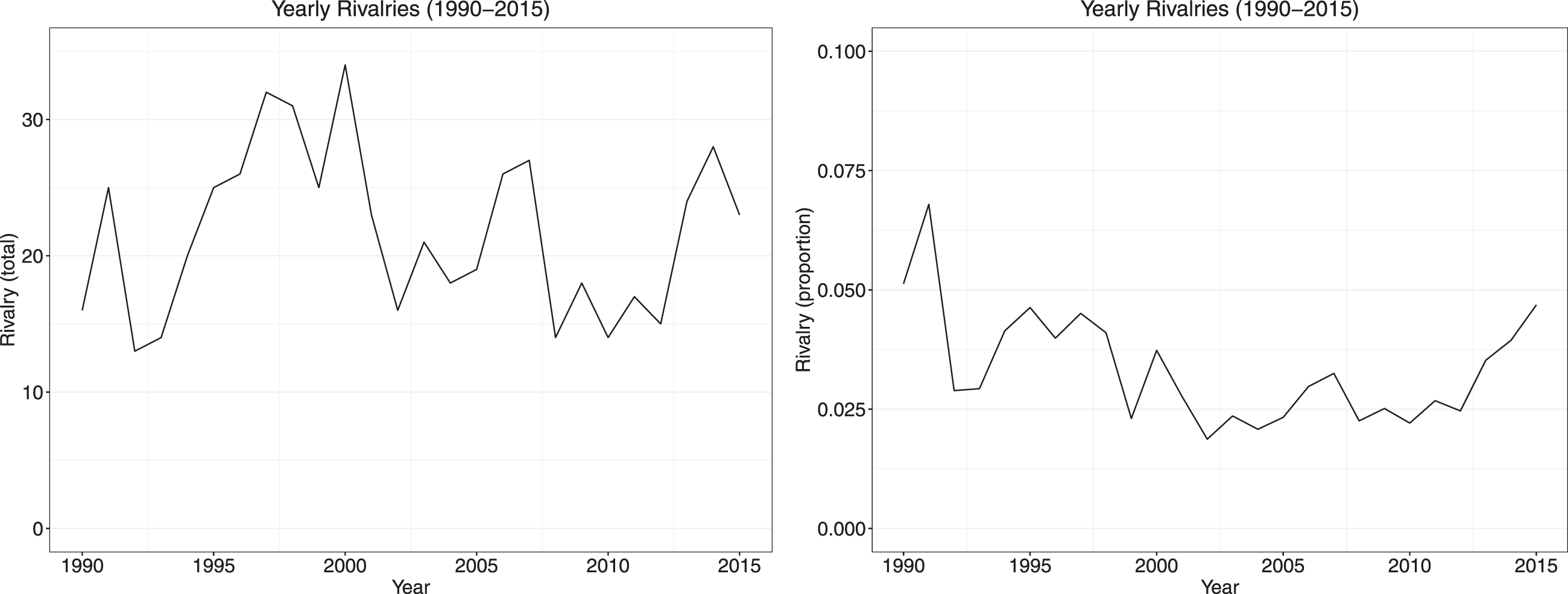
The ViNSAR data also provide information on the intensity of a given rivalry. Intensity ranges from the lowest level (verbal denouncements) through threats of violence to the highest level of intensity (actual violence). The majority of rivalries involve an exchange of violence between groups. In roughly 40 percent of rivalries, we record an instance of groups issuing verbal condemnations, while groups issuing threats of violence are relatively rare. These results are displayed in Figure 2. Militant group rivalry intensity.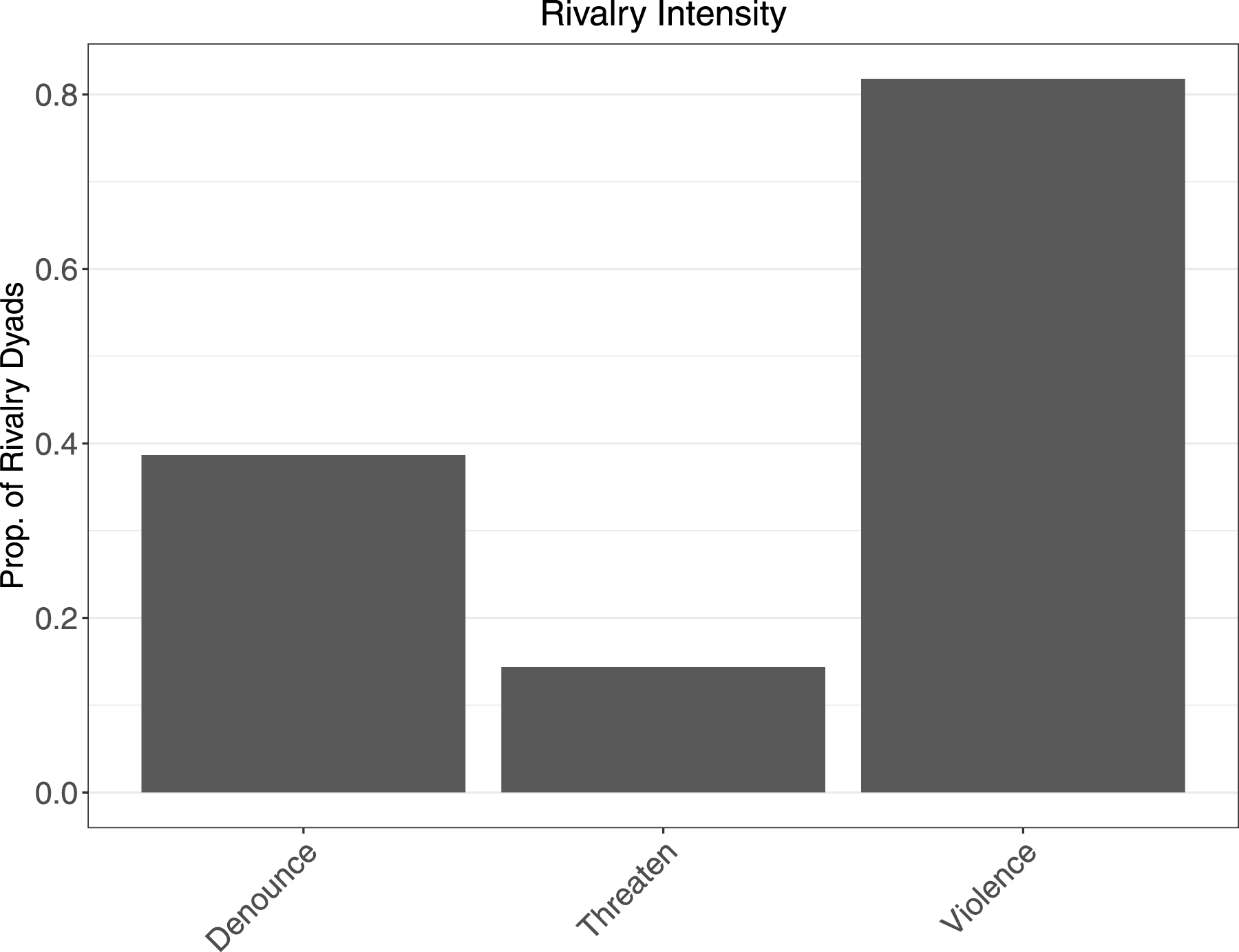
As noted previously, the ViNSAR data distinguish between different types of rivalries. Consistent with past work (Blair et al. 2020), we separate rivalries that are material, involving violent conflict between groups, and those that are rhetorical, involving verbal threats or condemnations. Among rivalry dyads, roughly 82 percent are recorded as involving an exchange of violence between the two groups, while 44 percent involved rhetorical rivalries. 4 In 26 percent of rivalry dyads, we recorded instances of both material and rhetorical rivalry.
While overall material rivalries are more frequent, in recent years both the number and proportion of rhetorical rivalries have begun to increase (Figure 3). In 2015, for the first time in our data, rhetorical rivalries were more frequent than material rivalries. A partial explanation for this change might be the increased presence of militant groups on social media, allowing for new opportunities to criticize competitors. Militant group rivalry, material and rhetorical, over time.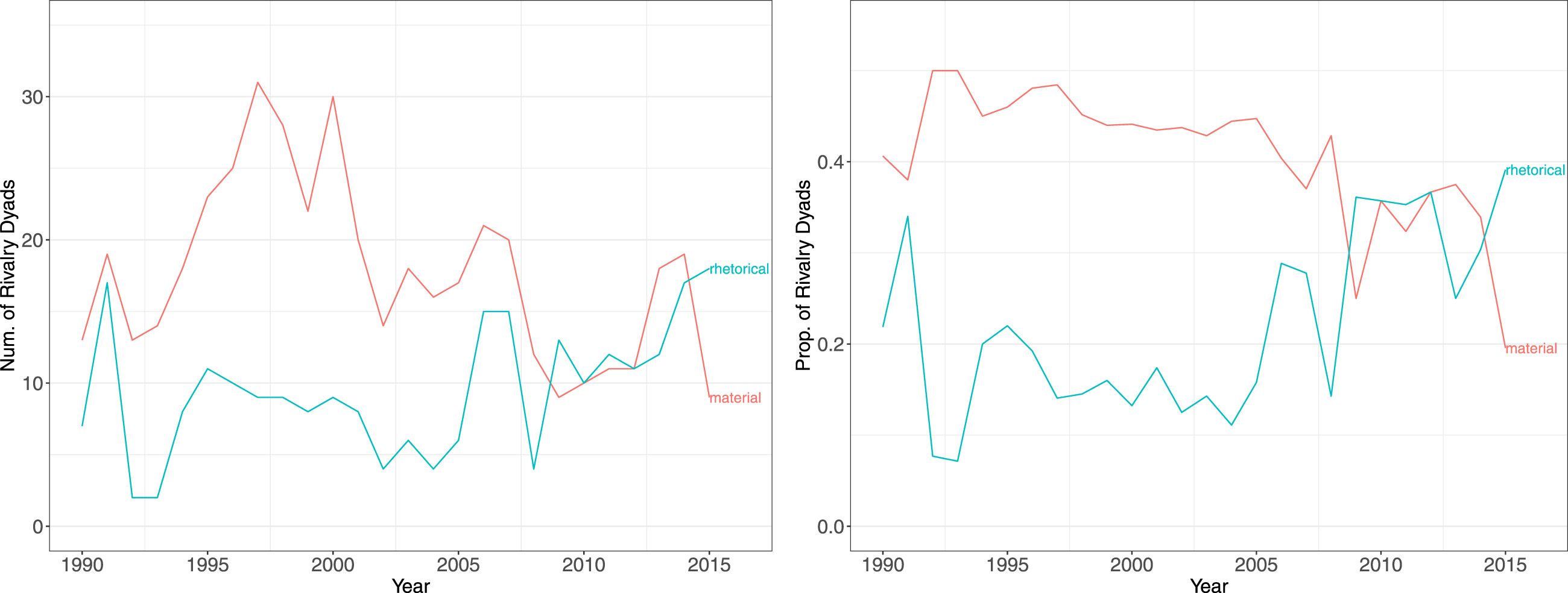
The ViNSAR data contain militant groups from three sources: UCDP, GTD, and PGMD. For each rivalry dyad, we calculate the proportion that contain at least one group from UCDP, GTD, or PGMD. We find that roughly 84 percent of rivalry dyads involve a group from GTD, while 79 percent include a group from UCDP, and 54 percent contain a group from PGMD. 5 While groups from GTD and UCDP appear in rivalries at similar levels, PGMs appear to engage in fewer rivalries.
To further investigate the types of groups involved in rivalries, we examine the likelihood of seeing dyads made up of particular combinations of group types. Figure 4 indicates that the largest amount of rivalry dyads involve two GTD groups. However, dyads containing mixed sets of groups such as UCDP-PGM or GTD-UCDP have similar likelihoods of rivalry. Conflicts between groups in civil wars (UCDP groups) and between PGMs account for the fewest rivalry dyads. The proportion of rivalry dyads from each data source.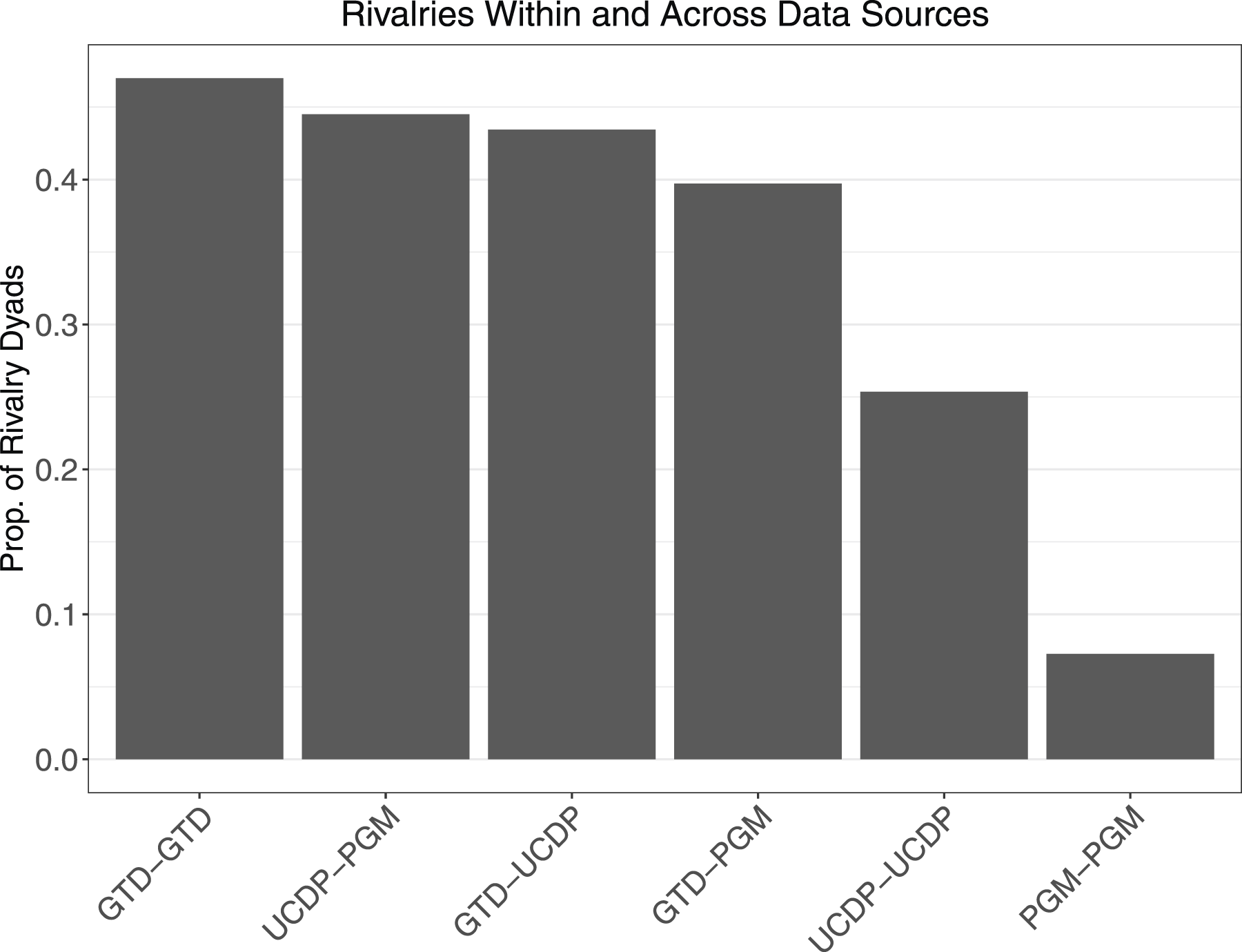
The ViNSAR data include information on militant group rivalries in Africa and Asia. In total, we record 46 countries that contain at least two groups (the smallest set to form a dyad) from either UCDP, GTD, or PGMD. We record instances of rivalry in 34 countries. At the country level, the mean number of rivalry dyads is roughly 12, while the median is 5.
Figure 5 indicates where rivalries are most likely to occur. It highlights the ten countries with the largest number and proportion of rivalry dyads. First, it is worth noting that there is little overlap between the countries that have the highest total number of rivalry dyads and those with the highest proportion of rivalry dyads (only Algeria and Sri Lanka). For instance, India, which has the most rivalry dyads with 111, also has over 7500 total dyads. Interestingly, the country with the highest proportion of rivalry dyads, South Africa, features relatively few militant groups. The high proportion is due to conflicts between the Africa National Congress (ANC) and pro-government militias in the early 1990s. Militant group rivalry in Africa and Asia: The top countries.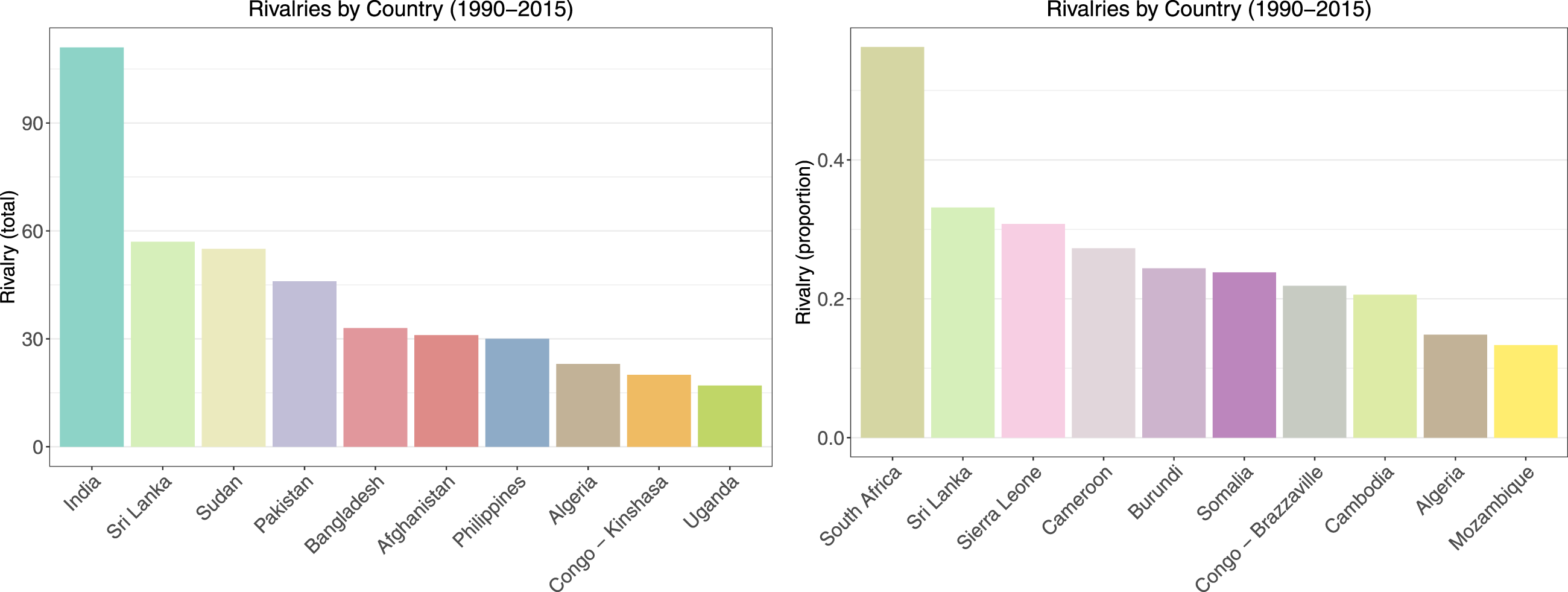
Analysis: Is Rivalry Related to Civilian Targeting?
Data and Key Independent Variables
To further demonstrate the utility of the ViNSAR data, this section describes analysis of the outbidding hypothesis, discussed in the introduction. To reiterate, this is one of the most prominently discussed arguments in terrorism and civil conflict studies. 6 The basic argument is that intergroup competition leads to more violence and more extreme types of violence. It has been evaluated qualitatively with mixed results (Bloom 2004; Brym and Araj 2008), and quantitative studies have looked at groups monadically - for example, studying if a group’s count of rivals is associated with more terrorism or specific types of violence like suicide attacks (Asal, Phillips, and Rethemeyer 2022). Quantitative studies have often measured rivalry through the number of groups in a country (Findley and Young 2012), even though groups on opposite sides of a large country, or of orthogonal ideologies (e.g., one ethnonationalist, one leftist) might not compete in a meaningful way.
To more directly test the relationship between intergroup rivalry and extreme violence, this section describes analyses of pairs of militant groups in Africa and Asia, 1990-2015. Analyses look at non-directed “relevant dyads,” all pairs of groups in the same country, to see if rivalry is associated with civilian victimization by these groups. The unit of analysis is the militant group dyad-year.
The full non-directed dyadic data used here include combinations of hundreds of groups across 37 countries, for a total of up to 10,108 observations. This is a lower number of observations than the total ViNSAR data due to missing data on the dependent variable or other variables, and a year of data lost due to a temporal lag. In this section, the data is frequently subsetted by data source (e.g., only GTD groups). Because of this, as well as the inclusion of control variables, the subsequent sample sizes vary.
Each group is paired in dyads with every other group in the same country. We use countries as a reasonable limit since, from our analyses, the vast majority of militant group interactions are among groups within the same country. There are obviously exceptions, but limiting potential rivals to those within the same country is comparable to research on inter-state conflict only analyzing “politically-relevant dyads” (Lemke and Reed 2001). 7 Including dyads combining militant groups in Mozambique with those in Myanmar, for example, would massively inflate the number of observations, mostly with irrelevant observations. However, because the GTD covers a large number of groups that are active in a given country, even if they do not meet UCDP’s inclusion threshold, we are still able to capture conflicts between groups that occur across multiple countries.
Our primary independent variable, Rivalry, equals ‘1’ if the groups in the dyad directly engaged in rivalry with one another in a given year, and ‘0’ otherwise. The largest sample size in this study, with dyads from GTD, PGM, and UCDP, has 10,108 observations. Of these observations, 384 (3.8 percent) include at least some observed competitive behavior. 8 A rivalry is considered to be active if one or more of the groups verbally denounced the other, threatened the other with violence, or if the groups engaged in violence. However, we also show models that only include non-violent rivalry – only denouncements or threats (i.e., rhetorical rivalry).
Since previous studies have measured rivalry or competition with the number of active groups in each country year, we also include the variable Groups in country (count). It is noteworthy that Rivalry and Groups in country (count) are not positively correlated. The correlation is about −0.15, depending on the sample used. This variable is compiled by counting the total number of groups when including all UCDP and GTD groups. Depending on the sample used, this variable is either the total of all groups in the country, total UCDP groups, total GTD groups, or total PGMs.
Dependent Variable
The dependent variable capturing civilian victimization by the groups in each dyad is compiled using both the UCDP and GTD projects. 9 The UCDP One-Sided Violence data provides counts of the number of civilian deaths caused by each group (Eck and Hultman 2007). The data include high, low, and “best” estimates for each group year. We use the best estimate. The GTD database also provides counts of the number of people killed by each attack, which allows us to create a total number killed by each group in a given year. To create our dependent variable, we then take the minimum number killed by each group across the two datasets. Finally, we create a single dyadic measure of civilian victimization by summing the death counts for each group. In our largest sample, this value ranges from 0 to 5,016, although the mean is around 21. 10
One potential concern with using these dependent variables is that they might be biased in favor of support for the outbidding hypothesis. That is, if the ViNSAR data are primarily capturing violent rivals (dyads that attack each other) then such rivalry could be correlated with higher counts of civilian deaths, particularly if the civilian-targeting data are capturing the same events. However, the GTD project explicitly says that “Intra/Inter-group conflict” violence is not included in their definition of violence (START 2016). Likewise, UCDP explicitly includes only violence committed against “unarmed people who are not active members of the security forces of the state, or members of an organized armed militia or opposition group” (Petterson 2014). This eliminates a large number of incidents that might be considered intergroup violence. Although we are confident that the dependent variables in our analysis are capturing a different kind of violence – demonstrative violence against non-combatants – we nonetheless explore this issue further in the empirical analysis by examining the influence of non-violent rivalry on civilian deaths.
Control Variables and Estimator
In addition to the variables capturing competition, we also account for broader state-level factors, including the state’s GDP per capita, its population size, and level of democracy. We use GDP per capita data from Gleditsch (2002b), population data from World Bank (2015), and the measure of democracy is the “revised polity score” from the Polity Project (Gurr, Marshall, and Jaggers 2010). The latter measure is a scale from ‘-10’ to ‘10,’ with higher scores indicating more democratic states and lower scores indicating more autocratic ones. Some scholars argue that civilian targeting should be especially likely in democratic countries (Eck and Hultman 2007; Hultman 2012; Stanton 2013). 11
For the models including only UCDP groups, we include additional dyad-level variables. We create a measure, Territorial control, which equals ‘1’ if either group in the dyad controlled territory at some point during the conflict, and ‘0’ otherwise. The Territorial control variable is calculated using information from the Non-State Actor data project (Cunningham, Gleditsch, and Salehyan 2012). Although all groups that appear in the NSA data appear in the UCDP data, the reverse is not true. Additionally, the measures are limited to dyads in which both groups are drawn from the UCDP data, so the sample size is significantly smaller in these models. For robustness purposes, we dropped this control variable from the analysis, and the results are comparable to those included in the tables. We also include a binary measure, Same ethnic field, which indicates whether both groups in the dyad represent the same ethnic group. Sharing an ethnic motivation may influence both civilian victimization, as well as the potential for rivalry (Asal and Rethemeyer 2008; Hafez 2020). This variable is created using information on the primary ideologies or motivations (i.e., “fields”) of groups, which is available in the ViNSAR dataset. Finally, we include a lagged dependent variable (Prior civilian victimization) in all models to control for the effect of inertia in civilian victimization, and to further isolate the partial effect of rivalry on violence.
To estimate all models, we use a negative binomial approach, ideal for statistical analysis when the dependent variables are counts (Long and Freese 2001). The negative binomial is also preferred over the standard Poisson model because it accounts for overdispersion of the data, which can result in biased standard errors. Results from the models included below indicate that the data are, in fact, overdispersed. However, results using ordinary least squares regression or zero-inflated negative binomial regression return similar results.
Results
Militant Group Rivalry and Civilian Victimization.
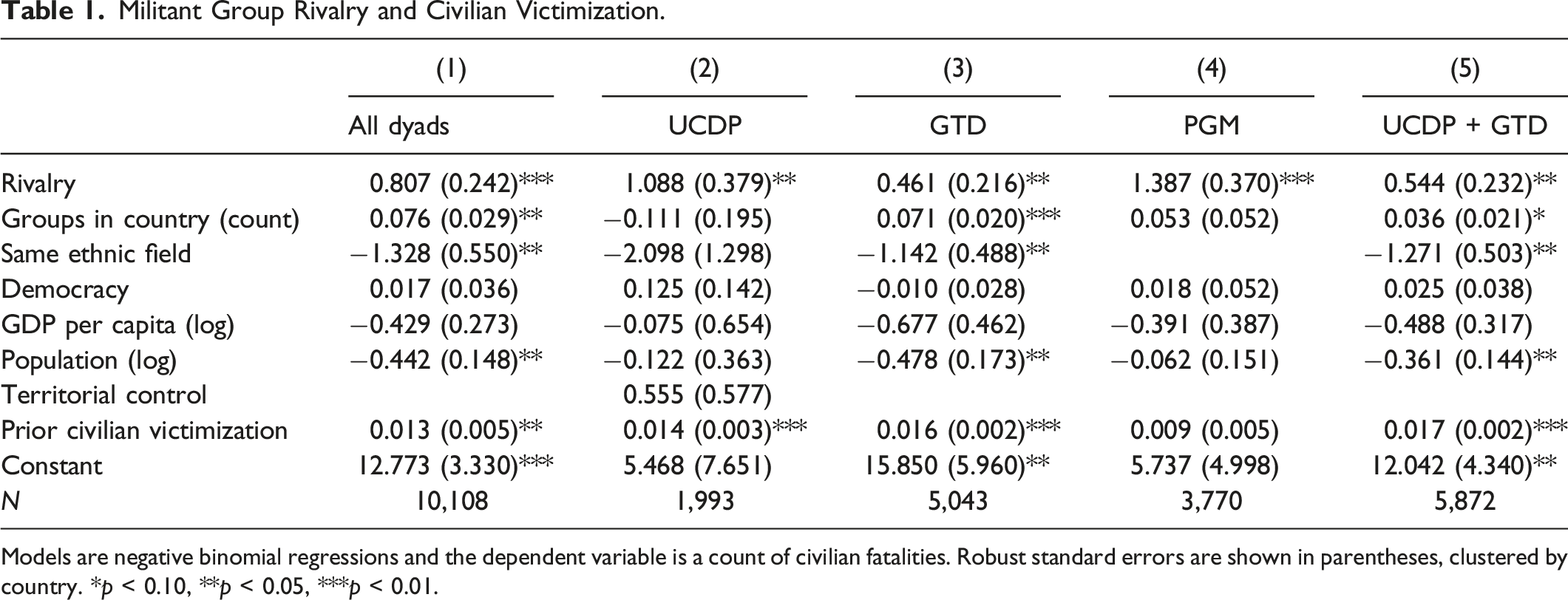
Models are negative binomial regressions and the dependent variable is a count of civilian fatalities. Robust standard errors are shown in parentheses, clustered by country. *p < 0.10, **p < 0.05, ***p < 0.01.
Figure 6 plots the expected civilian fatalities associated with non-rivalrous dyads as opposed to rivalrous dyads, with other variables held at their means. This comes from Model 1 of Table 1. The relationship is substantively strong. A dyad not in rivalry is associated with about 12 civilian fatalities, but a dyad in a rivalry is associated with approximately 26 civilian fatalities. Rivalry among militant groups is associated with a more than doubling of civilian deaths. Effect of rivalry on civilian victimization.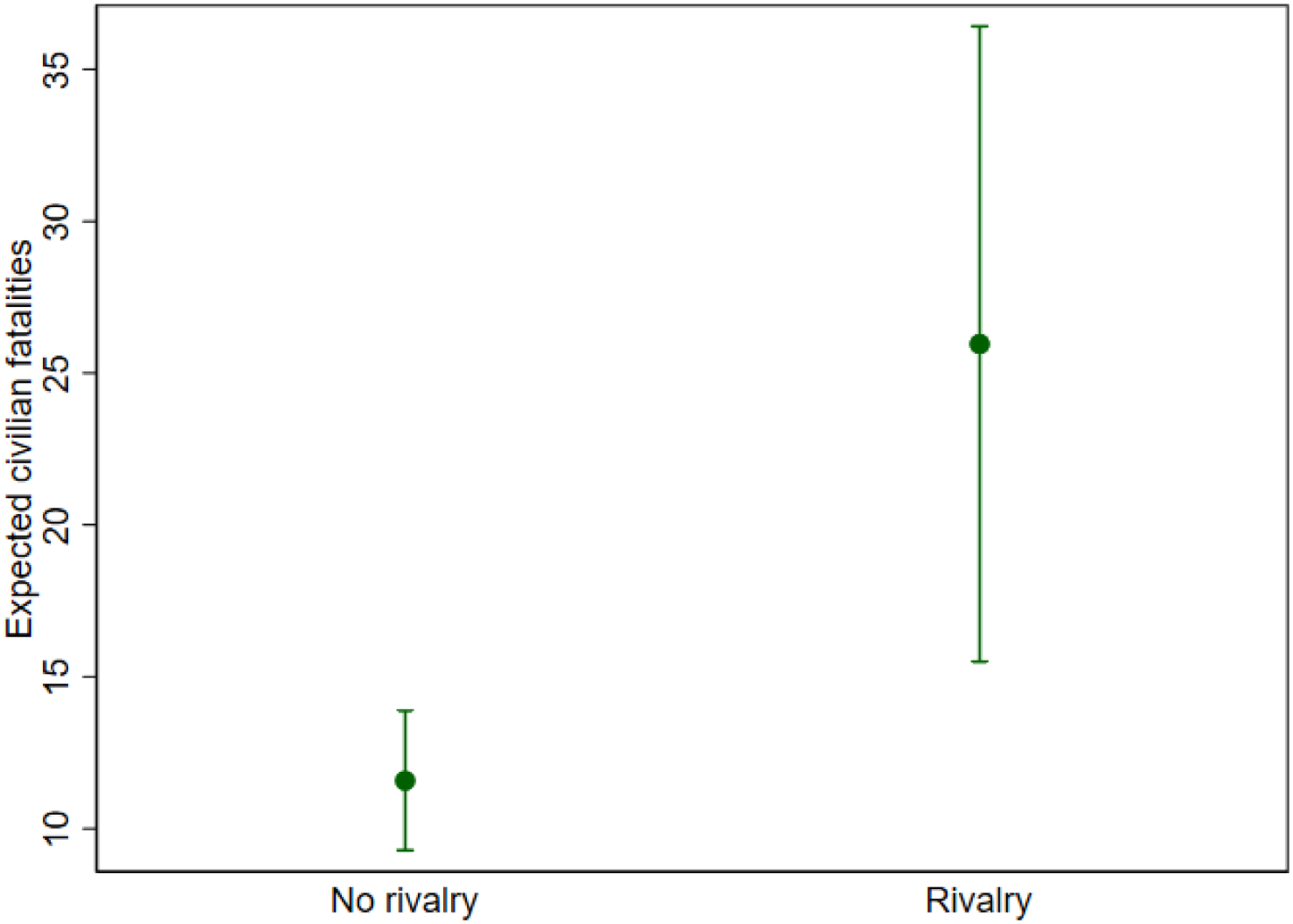
Regarding Groups in country (count), the measure often used to proxy rivalry or competition, results are mixed. It is only statistically significant and positively signed in models 1 and 3, and marginally in model 5. The inconsistency across the three models is analogous with the mixed results in the literature attempting to identify evidence of the outbidding effect using counts of groups in an area (Findley and Young 2012).
It is also useful to note the effects of the control variables included each of the models. In three of the four models in which it is included, Same ethnic field is statistically significant and negatively signed. 12 This suggests that when two groups represent the same ethnic group, civilian victimization is lower, on average. Democracy is statistically insignificant across all models. Some research finds democracy associated with civilian victimization, but the models seem to suggest dyadic variables are more important. 13 GDP per capita (log) is statistically significant in all models. Population (log) is statistically significant and negatively signed in most of the models, suggesting dyads in more populous states are associated with less civilian targeting. It is unclear why this might be the case. Perhaps in these states, militants are more focused on targeting the state or each other. Territorial control, included in the UCDP model, fails to achieve statistical significance. Finally, the lagged version of the dependent variable, Prior civilian victimization, is positively associated with civilian victimization as expected.
Militant Group Rivalry and Civilian Victimization: Additional Models.
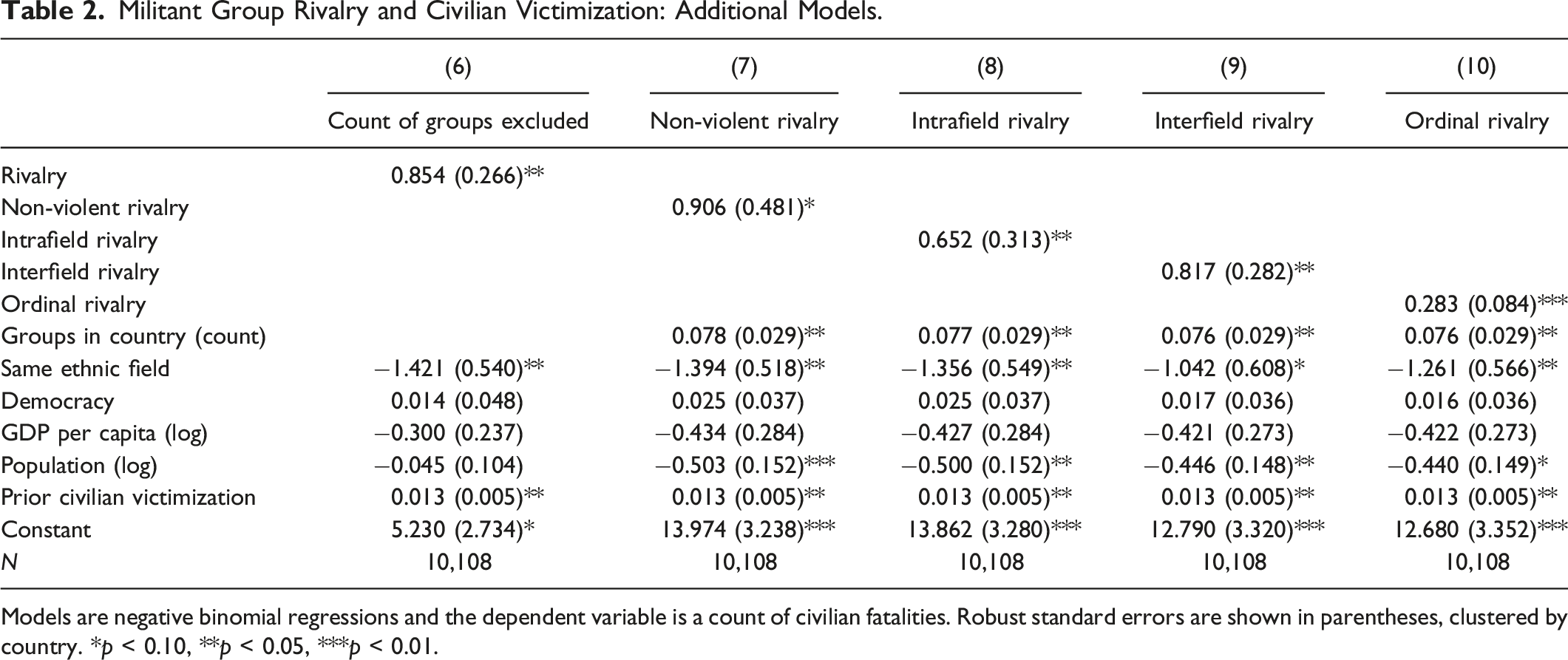
Models are negative binomial regressions and the dependent variable is a count of civilian fatalities. Robust standard errors are shown in parentheses, clustered by country. *p < 0.10, **p < 0.05, ***p < 0.01.
Models 8 and 9 include more specific measures of competition, Intrafield rivalry and Interfield rivalry. While many analyses of outbidding uses measures of competition generally, Bloom’s (2005) argument is technically about competition among groups seeking to represent the same broader population – such as Palestinian militant groups, or Tamil militant groups. This has been referred to as intrafield rivalry (Bacon 2018; Phillips 2015), and can be contrasted with interfield rivalry, competition among groups with opposite or orthogonal motivations. The ViNSAR data include a variable indicating whether each dyad is interfield or intrafield, and we use that to create the variables in these models. In a final robustness check in Table 2, we include the ordinal measure of rivalry where 0 indicates no evidence of rivalry, ‘1’ is denouncements, ‘2’ is threats, and ‘3’ is violence between the groups in the dyad. In case there are multiple types of rivalrous behavior in the same year, the higher value is used. Thus, it is the maximum rivalry value for the dyad-year.
Across all models of Table 2, rivalry is associated with civilian victimization. Rivalry in general, non-violent rivalry, intrafield rivalry, interfield rivalry, and an ordinal measure of rivalry are all associated with more civilian victimization by the groups in the rivalry. One slight exception is that the coefficient on the measure of non-violent rivalry is marginally statistically significant (p = 0.059). However, as noted, we view this measure as a hard test of the outbidding argument, since rivalrous denouncements, for example, might not be expected to lead to violence. Most other results in Table 2 are similar to those of Table 1, suggesting similarity between the rivalry measures and stability across models. Overall, rivalry – measured many different ways – is associated with higher levels of civilian abuse.
Conclusion
Scholars increasingly study contentious relationships among militant organizations, examining topics such as outbidding, fragmentation, and fratricide. This paper introduced the ViNSAR data, a source with fine-grained information on hundreds of rebel, terrorist, and pro-government militia organizations in Africa and Asia between 1990 and 2015. We demonstrated variation in the data, showing interesting trends across time and space. We also conducted preliminary analysis of the outbidding argument, and found a robust relationship between rivalry and civilian victimization. There are numerous ways other scholars can use this data to contribute to the literature.
First, scholars can use the data to better understand the roots of rivalry (e.g., Conrad et al. 2021). Research seeking to explain rivalry has tended to either only examine rivalry within civil war (Fjelde and Nilsson 2012) or among terrorist groups (Phillips 2019) separately. Other research has looked at single countries or conflicts (Gade, Hafez, and Gabbay 2019; Hafez 2020; Mendelsohn 2021). However, the ViNSAR data allow scholars to examine hypotheses about sources of rivalry among multiple types of militant groups, across many countries.
Second, research can exploit the ViNSAR data to evaluate arguments about the consequences of rivalry. Our empirical exercise in this paper suggested the data can be helpful for clarifying associations between competition and civilian targeting. Beyond this relationship, scholars have suggested competition should be related to a variety of outcomes, such as violence against sexual minorities, territorial control, or recruiting female fighters (Henshaw 2023; Stewart 2018; Tschantret 2018). The ViNSAR data can help to evaluate claims related to all of these topics.
Third, the fine-grained nature of the data is suited for analysis of topics such as rivalry escalation, rivalry longevity, and non-violent rivalry, in particular. Why do some militant group rivalries remain at the level of denouncements and threats, while others escalate to violence? Why are some rivalries fleeting, while others remain active for many years? This is relevant for scholarship on enduring rivalries (Diehl and Goertz 2001), and our data could be used to study enduring rivalries among militant organizations. Regarding non-violent rivalry in particular, why do militant groups sometimes threaten each other? What are the consequences of such threats? How often are militant group threats followed by violence?
Finally, in addition to causes and consequences of rivalry, the data can be useful for understanding rivalry in particular contexts, such as PGM-rebel rivalries in civil war, terrorist group rivalries in the shadow of the ISIS-Al-Qaida global competition, or rivalries in particular countries such as India or Sudan. Why is the presence of PGMs sometimes associated with intense rivalries against rebels, and sometimes not? Do PGM-rebel rivalries hasten the end of conflict, or do they delay it? Regarding ISIS and al-Qaida, how did the discourse of these groups affect rivalry among terrorist groups in Africa or Asia? Regarding countries such as India and Sudan, how have government policies affected rivalries in these countries? How have rivalries affected civilians? How have peacekeeping efforts affected rivalries? Overall, the data can be used to address many questions related to the important topic of competition among militant organizations.
Supplemental Material
Supplemental Material - Introducing ViNSAR: Dyadic Data on Violent Non-state Actor Rivalry
Supplemental Material for Introducing ViNSAR: Dyadic Data on Violent Non-state Actor Rivalry by Justin Conrad, Kevin T. Greene, and Brian J. Phillips in Journal of Conflict Resolution
Supplemental Material
Supplemental Material - Introducing ViNSAR: Dyadic Data on Violent Non-state Actor Rivalry
Supplemental Material for Introducing ViNSAR: Dyadic Data on Violent Non-state Actor Rivalry by Justin Conrad, Kevin T. Greene, and Brian J. Phillips in Journal of Conflict Resolution
Footnotes
Acknowledgments
We thank Victor Asal, Karl Rethemeyer, and Suzanne Weedon Levy for helpful discussions on the project and support with data. Previous versions of the paper were presented at the University of Konstanz and the University of Essex, and we thank participants for their feedback. We also thank the research assistants who helped gather data: Melanie Bannout, Cheich Biteye, Stephanie Cannon, Samantha Daly, Qutaiba Enaya, Maria Garcia, Ahmad Hill, Nahim Kashani, Diana Maruri, Alexandria Norman, Austin Parker, Yesika Sorto Andino, and Morgan Ward.
Declaration of Conflicting Interests
The author(s) declared no potential conflicts of interest with respect to the research, authorship, and/or publication of this article.
Funding
The author(s) disclosed receipt of the following financial support for the research, authorship, and/or publication of this article: This material is based upon work supported by, or in part by, the National Science Foundation through award numbers 1658043 and 2001330.

Supplemental Material
Supplemental material for this article is available online.
Notes
References
Supplementary Material
Please find the following supplemental material available below.
For Open Access articles published under a Creative Commons License, all supplemental material carries the same license as the article it is associated with.
For non-Open Access articles published, all supplemental material carries a non-exclusive license, and permission requests for re-use of supplemental material or any part of supplemental material shall be sent directly to the copyright owner as specified in the copyright notice associated with the article.
