




Abstract
The Battle of Mosul (2016–2017) was one of the most grueling urban warfare campaigns in recent memory. The fighting quickly concentrated in West Mosul, where civilians prevented by the Islamic State from leaving their homes experienced airstrikes and indiscriminate shelling by government forces. Utilizing the as-if-randomness of severe damage or destruction of people’s homes, this paper examines the impact of war exposure on the endorsement of moral foundations among a large and diverse sample of Mosul residents (N = 1027). Home damage increased binding morality but had a larger impact on individualizing morality, heightening concerns about fairness and protection from harm. A survey experiment in which the sectarian identity of the target was randomly assigned further revealed a strong association between individualizing morality and parochial altruism. Challenging conventional wisdom, both individualizing and binding morality reinforce group cohesion in ways that are functionally adaptive and responsive to the damage wrought by war.
Keywords
Introduction
Moral considerations underlie most of our social interactions and reasoning (Haidt 2001), and humans are sometimes referred to as “the Moral Animal” (Wright 1995). By regulating the balance between individual and collective interests, morality underpins systems of cooperation and interdependence (de Waal 1996; Curry, Mullins, and Whitehouse 2019; Tomasello 2016; Tomasello and Vaish 2013). That is, morality is a functional adaptation to group life (Durkheim 1912; Haidt 2012; Tooby and Cosmides 2010), and as such is expected to respond to the challenges posed by different socio-environmental contexts.
Like much work in the social sciences, research on the role of moral foundations in political and social life is largely conducted in stable, predominantly WEIRD 1 societies (Henrich 2020). Under such conditions, morals appear resistant to change (Graham et al. 2011). But do moral foundations, and the systems of social cooperation they support, adapt to powerful shocks such as the experience of war violence? A handful of studies in political psychology have investigated the impact of perceived threat on moral foundations (Alper et al. 2020; Tamborini et al. 2017; 2020; van de Vyver et al. 2016; Wright and Baril 2013). However, to our knowledge none examine the impact of actual war exposure on morality.
To address this gap, we examine new data collected in Mosul shortly after the Battle of Mosul (2016–2017), which was one of the most intense episodes of urban combat in recent decades. The city experienced prolonged street fighting and heavy aerial and artillery bombardment, resulting in widespread and indiscriminate housing destruction. Given the acute salience of basic needs and economic concerns in Mosul at the time of the study, the impact of losing one’s home is likely to have profound social-psychological consequences. Moral Foundations Theory (MFT; Haidt 2007) has identified two clusters of person-oriented (“individualizing”) and group-oriented (“binding”) moral themes (Graham, Haidt, and Nosek 2009). This paper utilizes the as-if-random home destruction or severe damage caused by the bombardment to examine the impact of war exposure on the endorsement of individualizing and binding moral foundations among a large and diverse sample of Mosul residents (N = 1027). Using a survey experiment in which the ethnoreligious identity of the target was randomly assigned, we further address how moral foundations relate to perceived threat, empathy and altruism within and across sectarian lines.
Our results indicate that indiscriminate war exposure was positively associated with increased endorsement of moral foundations overall, but had a particularly strong impact on individualizing morality concerned with fairness and the prevention of harm. This finding is partly at odds with the literature on Conservatism as Motivated Social Cognition (Jost et al. 2003), which argues that people’s endorsement of binding morality increases, and individualizing morality decreases, in the aftermath of terrorist attacks such as 9/11 (Bonanno and Jost 2006) and the 2005 London bombings (Van de Vyver et al. 2016). Moreover, and in contrast to previous research on moral expansiveness suggesting that individualizing foundations are associated with a broader, more inclusive moral circle (Crimston et al. 2016; 2018), we find that greater endorsement of individualizing morality resulted in a significant increase in parochial altruism, whereas binding morality had no such effect. In the discussion section we propose several distinct but complementary explanations for our findings for future research to explore, including the particular social ecology of Mosul during the war, the context-dependent effects of different violence types, the non-WEIRDness of our sample, and the minority status of Sunni Arabs in the Iraqi context.
Our findings shed light on how war exposure shapes morality. The experience of war has significant implications for individuals' moral preferences, as the values and norms that sustain cooperation and social relationships during peacetime may become ineffective or even counterproductive during periods of conflict. Understanding how war impacts morality is therefore crucial for effective peacebuilding and reconciliation efforts. Morality facilitates prosociality, yet it can also motivate a wide range of negative intergroup attitudes and behaviors such as ingroup bias in helping behavior (Mikani, Tabataei, and Azadfallah 2022), derogation of outgroup members (Smith et al. 2014), and prejudice against religious minorities following terrorist attacks (Van de Vyver et al. 2016). In extreme cases morality can motivate violence, be it to rearrange unfair social relationships (Fiske and Rai 2014), or to pursue abstract moral ideas (Atran and Ginges 2012; Ginges 2019). While a growing literature addresses the role of morality in motivating violence, much less is known about how violence affects morality. By addressing this question, this paper sheds light on the moral intuitions that guide behavior in post-war settings – information that can help promote the success of post-war reconstruction efforts by, for example, ensuring that policies and programs are communicated effectively and with sensitivity to people’s ‘moral taste receptors’ (Haidt 2012).
The paper proceeds as follows. In the next section, we review the relevant literature on moral foundations and the factors that shape them. Thereafter we take up the literature on war and social cooperation, highlighting the lack of attention to the moral foundations that underlie patterns of postwar social cooperation. The next two sections present our methods and the results. We conclude the paper with a discussion section in which we point out the limitations of our study and highlight multiple avenues for future research on moral foundations in post-conflict settings.
Moral Foundations Theory
Cultural psychologist Richard Shweder suggested conceptualizing morality as a triad composed of distinctive ethics of autonomy, community, and divinity (Shweder et al. 1997). Building on Shweder’s work, Moral Foundations Theory (MFT; Haidt 2007, 2012) differentiates between binding moral foundations (Loyalty, Authority, and Sanctity) that ensure group cohesion and social stability; and individualizing foundations (Care and Fairness) concerned with personal autonomy and individual welfare (Graham, Haidt, and Nosek 2009). These foundations constitute the fundamental “moral taste receptors” (Haidt 2012) that we rely upon to make our moral judgments, and came about as evolutionary responses to recurring adaptive challenges faced by our ancestors (Graham et al. 2013). However, the universal challenges that human morality responds to are bound to specific socio-ecological contexts and historical processes, producing the rich cross-cultural variation that characterizes groups and societies across the world. For example, people in WEIRD societies tend to place individual rights at the center of their moral worldview, whereas non-WEIRD societies generally ascribe higher value to the collective and endorse group-oriented morality to a greater extent (AlSheddi, Russell, and Heggarty 2020; Graham et al. 2011; Vauclair, Wilson, and Fischer 2014). Although research on moral psychology still relies disproportionately on WEIRD samples, recent studies have explored differences in moral foundations across cultures, including for example Iran (Atari, Graham and Dehghani 2020), Turkey (Alper et al. 2020; Yilmaz et al. 2016) and Saudi Arabia (AlSheddi, Russell, and Heggarty 2020). Exploring the cultural variability of moral foundations on a broader scale, Atari et al. (2023) compared the nomological network of morality across 25 societies, finding that the way in which moral foundations relate to each other, and the centrality of each foundation within those networks, differs across cultural contexts. This finding underscores the importance of investigating moral foundations and their relation to social outcomes in non-WEIRD settings.
Moral foundations are relevant to different social challenges that often require simultaneous consideration, and therefore function as coactive, rather than mutually exclusive domains. The weight ascribed to each foundation may vary between cultural contexts (Atari et al. 2023) and from person to person, but despite being more variable than dispositional traits (Haidt, Graham, and Joseph 2009), moral foundations are generally treated as stable. Consequently, much of the existing literature examines how moral foundations impact other more malleable constructs, such as attitudes towards social groups (Graham et al. 2011) and political partisanship (Graham, Haidt, and Nosek 2009), while dedicating far less attention to the study of contextual circumstances that shape their endorsement.
Stronger reliance on binding morality has been found to underlie conservative attitudes, while endorsement of individualizing morality is associated with a liberal political orientation (Graham, Haidt, and Nosek 2009; Graham et al. 2011). Binding and individualizing moral concerns are also differently implicated in intergroup attitudes and behaviors. Based on research conducted in WEIRD contexts, MFT contends that person-centered, individualizing morality acts as a “centrifugal” force that expands the circle of moral regard independently of group membership, whereas group-oriented, binding morality is “centripetal” in that it narrows the scope of moral concerns to more stringently defined in-group members (Crimston et al. 2016; 2018; Graham et al. 2017; Hadarics and Kende 2018; Waytz et al. 2019). The relationship between moral foundations and prosociality has been studied in a US sample by Clark et al. (2017), whose findings suggest that a higher ratio of individualizing over binding foundations is associated with higher levels of overall prosocial behavior when the identity of the recipient is left unspecified. In line with the expectations derived from MFT, research conducted in Sweden by Nilsson, Erlandsson, and Västfjäll (2020) found that individualizing foundations predicted altruistic behavior towards out-groups, while binding foundations predicted prosocial behavior directed at the in-group. Obtaining similar results in a sample of Iranian Muslims, a study conducted by Mikani, Tabatabaei, and Azadfallah (2022) suggests that individualizing foundations are associated with lower ingroup bias in helping, while binding foundations have the opposite effect.
Remarkably little is known about how violence impacts moral foundations, however. Unique research in this direction has been conducted by Van de Vyver et al. (2016), who surveyed a representative sample of UK citizens before and after the 2005 London bombings. Consistent with the predictions derived from MFT and Conservatism as Motivated Social Cognition (Jost et al. 2003), their results indicate that respondents increased their endorsement of binding foundations and lowered their support of individualizing foundations in the aftermath of the attack, while also increasing prejudice towards Muslims and immigrants. In another recent study, Alper et al. (2020) find a similar conservative shift taking place in response to changes in perceived geopolitical risk in Turkey. In two separate studies, Tamborini et al. (2017, 2020) found that exposure to news about terrorist attacks increased the endorsement of the binding foundations of authority and purity (but not loyalty) among US undergraduate students. This shift was accompanied by decreased intentions to engage in prosocial behavior towards outgroups, but had no effect on prosociality towards ingroup members.
The relevance of morality for intergroup attitudes and behaviors notwithstanding, to our knowledge no research has yet examined the impact of moral foundations on intergroup cooperation in the context of armed conflict, nor the effects of direct exposure to wartime violence on moral foundations. Given that threats have been found to increase the endorsement of binding morality and decrease the weight ascribed to individualizing morality, major shocks such as indiscriminate violence experienced during war might impact the adherence to moral foundations in the direction of the aforementioned conservative shift, increasing threat perceptions and ingroup bias in the process. However, recent research on posttraumatic growth and altruism born of suffering highlights the role of empathy in overcoming group boundaries in the aftermath of victimization, offering an alternative view.
War and Social Cooperation
War has long been viewed as having detrimental effects on social capital and psychological well-being. However, major life crises and war-related victimization may also elicit positive psychological changes that include a prosocial reorientation and the pursuit of more compassionate ties with others, as evidenced by the literature on posttraumatic growth (PTG; Tedeschi and Calhoun 2004). In line with the PTG perspective, increased cooperation and prosociality have in fact been observed in the aftermath of war. For instance, a positive effect of wartime exposure to violence on post-war participation in civil society was found in Sierra Leone (Bellows and Miguel 2009), and among ex-combatants (Blattman 2009) and former child-soldiers (Bauer, Fiala, and Levely 2018) in Uganda. Bauer et al.’s (2016) meta-analysis of 16 relevant datasets shows that war generally improves indicators associated with prosocial behavior, suggesting that survival threats increase cooperation. Consequently, postwar recovery tends to involve the implementation of more fair-minded social policies.
Indeed, exposure to violence can beget what is referred to as “altruism born of suffering” (ABS; Staub and Vollhardt 2008), which entails increased empathy and compassion, leading to altruism (Vollhardt 2009; Vollhardt and Staub 2011; Vollhardt, Nair, and Tropp 2016). Rather than being limited to other members of the ingroup, compassion for other people’s suffering may reduce in-group bias and encourage “inclusive victim consciousness” (Vollhardt 2015; Vollhardt, Nair, and Tropp 2016), which promotes prosocial relations and caring for others across victimized groups, displaying the “moral expansiveness” associated with individualizing morality (Crimston et al. 2016; 2018).
For instance, Vollhardt and Staub (2011) assessed the incidence of volunteering and the responses to the South-Asian tsunami of 2004 among U.S. undergraduates, finding that participants who had suffered from adverse life events displayed decreased in-group bias and more prosocial attitudes and behaviors toward outgroups in need. Carrying out a quasi-experiment in the lab with Jewish and non-Jewish university students in the U.S., Vollhardt (2013) found that the acknowledgement of suffering during the Holocaust increased prosocial attitudes of Jewish participants toward other victimized groups.
A growing number of field studies provide empirical support for the potentially inclusive nature of ABS. A survey conducted in Rwanda, Burundi, and Eastern DRC found that recognizing that outgroup members had suffered in similar ways as the ingroup led to greater willingness to stop others from treating outgroup members unfairly (Vollhardt and Bilali 2015). Similarly, inclusive victim consciousness was positively associated with support for pro-refugee policies and prosocial behaviors towards refugees in Hungary (Szabó, Vollhardt, and Mészáros 2020). In post-war Liberia, exposure to wartime violence increased Liberians' willingness to host Ivorian refugees, including members of ethnic outgroups, particularly those deemed to be especially vulnerable and in need of care (Hartman and Morse 2020). Nonetheless, the extent to which war and suffering can promote a generalized sense of compassion that overcomes group boundaries is a matter of ongoing debate (Bauer et al. 2016). Indeed, research on parochial altruism (Bernhard, Fischbacher, and Fehr 2006) suggests that intergroup conflict and competition over scarce resources may enhance altruism, albeit in a biased, in-group directed manner (Choi and Bowles 2007; Rusch 2014; Döring and Hall 2023). Some scholars have interpreted this phenomenon as an indication of group-oriented binding morality, where value is ascribed to acts of compassion and altruism reserved to members of one’s own group (Nilsson, Erlandsson, and Västfjäll 2020; Waytz et al. 2019). However, these latter studies have been conducted in WEIRD settings, and it is not clear whether the prosocial effects of war violence are part of a simultaneous conservative shift, or rather reflect an increased sensitivity to care and fairness that may, or may not, be parochial in nature. Furthermore, different mediating factors have been found to influence prosocial behavior during intergroup conflict. Among them, exposure to wartime violence is known to promote hypervigilance and increase threat sensitivity (e.g., Canetti et al. 2013), which leads to more negative emotional responses to outgroup targets (Canevello, Hall, and Walsh 2022; Hall and Kahn 2020) and decreased altruism towards threatening out-group members as a result (Hall et al. 2021).
In light of the contradictory perspectives drawn from the previous literature, in this paper we rely on two research questions to investigate the role of morality in the wartime transformation of society. First: how does indiscriminate war violence impact adherence to individualizing and binding morality? Second: how does morality shape altruism towards ingroup and outgroup members in a war setting, and what are the social psychological mechanisms involved?
Method
To address our research questions, we carried out a survey experiment with a large and heterogeneous sample of residents of Mosul, Iraq (N = 1027). The Islamic State (IS) took control of Mosul in 2014 in pursuit of their ambition to establish a global Islamic caliphate. At the height of their power in 2015–2016, IS controlled a large swath of territory across Iraq and Syria, including the two major cities of Mosul and Raqqa. The Battle of Mosul (2016–2017), the aim of which was to retake the city from IS, was one of the most grueling campaigns of urban warfare in recent memory. During the campaign, fighting quickly concentrated on West Mosul, where IS threatened residents with execution to reduce displacement, and forcefully confined non-combatants to their homes in order to act as human shields. Disregarding this environment created by IS violations of international humanitarian law, government forces launched attacks on densely populated urban areas in Mosul, substantially contributing to the civilian death toll (Amnesty International 2017).
Due to heavy bombardment and generally poor housing construction in West Mosul, the likelihood of any given individual’s home being destroyed or severely damaged can be considered as-if-random, particularly when looking at the variation within neighborhoods. 2 Aerial or artillery bombardment was unlikely to have targeted a specific individual or household. Exploiting this exogenous variation for causal inference, we examine the impact of indiscriminate violence, and in particular the severe damage or destruction of one’s home, on morality as measured by individuals' responses to the moral foundations questionnaire.
To investigate the impact of morality on altruism within and across group lines in a war setting, we leverage an experiment embedded in our survey in which participants randomly assigned to either an ingroup or an outgroup condition completed a hypothetical welfare tradeoff task (WTT; Kirkpatrick et al. 2015). Following the WTT, the participants were also asked to indicate the extent to which they perceived the same target individual they were presented with in the WTT as threatening and to report their emotional reactions to the target. This design allows us to address potential underlying mechanisms. The “conservative shift” argument (e.g., Bonanno and Jost 2006; Jost et al. 2003) assumes that group-oriented morality is associated with greater perceived threat of, and bias against, outgroup members. Meanwhile, positive emotions such as empathy are thought to explain altruism born of suffering and inclusive victim consciousness in the ABS literature (e.g., Staub and Vollhardt 2008), and to underlie the moral expansiveness associated with individualizing foundations (Crimston et al. 2016; 2018; Graham et al. 2017).
Our analytical strategy includes linear regression analysis with neighborhood fixed effects and extensive robustness checks. To examine the impact of indiscriminate violence on morality, we regress our measures of individualizing and binding morality on severe damage or destruction of one’s home, controlling for a rich set of individual background characteristics. To examine the impact of moral foundations on altruism towards ingroup and outgroup members (and the mechanisms of threat and emotion) in a war setting, we first regress our measures of altruism, perceived threat, and positive emotional response to the target in the welfare tradeoff task on target ethnoreligious identity, individualizing and binding morality. To examine the extent to which parochialism depends upon individual differences in individualizing and binding morality, we include bivariate interactions between target ethnoreligious group and each measure of morality, controlling for individual background characteristics.
Participants
These data were collected as part of a large-scale survey experiment in a naturalistic setting in which the subjects are residents of Mosul. The project was approved by the ethical review board in Uppsala (Dnr. 2018/163) and informed consent was obtained for all participants. To safeguard anonymity, the survey was completed on personal tablets provided by our team. Although the security situation made door-to-door random sampling infeasible, we designed our sampling approach to ensure access to a large and diverse sample (see online appendix for details). The study aimed to reach a sample size of 1000 participants. Based on this aim, and the number of relevant and inhabited neighborhoods, we sampled 20–25 individuals in 41 neighborhoods in West Mosul during October-November 2018, for a total sample size of 1027 (52.51% female), recruited via trust networks established by our local field team. The data represent a stratified sample of all populated neighborhoods in West Mosul based on six different characteristics that may impact the degree of violence experienced by its inhabitants: ethnic composition of the neighborhood prior to the IS takeover in 2014; the size of the neighborhood; the number of households; the length of major roads; whether the neighborhood experienced major security incidents prior to IS control in 2014; and whether a neighborhood had IS sleeper cells—insurgent safe-houses—prior to the defeat of local Iraqi Government forces in 2014 (see appendix for further details).
Almost all participants in our study self-identified as Sunni (1,013 out of 1,027) and Arab (1,008 out of 1,027). The sample was skewed towards younger participants, with the median age group being 35–44. The median education level was 9 years of schooling (6.76% reported having no formal education, while only 2.75% reported attending university). The participants' relative self-positioning in Iraqi society was assessed by asking them to move a 10-point slider representing their socio-economic status from ‘worst off’ (0) to ‘best off’ (10) at two different points in time: prior to the onset of the Iraq War in 2003 (M = 4.39, SD = 1.30) and before IS took control of Mosul in 2014 (M = 3.37, SD = 1.29).
Procedure
The survey instrument, implemented in Qualtrics, was constructed in close collaboration with local contacts in Mosul. After translation from English to Arabic, the questionnaire was cross-checked so that words, concepts and potential misunderstandings could be identified, clarified and edited. Several rounds of revisions took place to ensure that each question was sensitively worded and contextually appropriate. A pilot of the survey questionnaire was conducted, after which the questionnaire was revised. Before finalizing the questionnaire, a feedback session was organized with the field research team to approve the question wording of the entire instrument and to ensure that fielding the survey would not put the enumerators themselves at any undue risk.
Measures
Exposure to Violence
Our main theoretical interest concerns indiscriminate violence, which we operationalized as having one’s house destroyed or severely damaged. House damage, as noted above, was largely as-if-random in West Mosul, particularly at the neighborhood level. This feature allows for stronger causal inference to be drawn from our data. However, we also control for several other types of exposure to violence that would be relevant in this setting. This survey question was designed to allow for disentangling the violence based on the perpetrating actor. Exposure was measured with the following items: “Have you experienced any of the following by Daesh 3 members, Iraqi forces or airstrikes?” Participants were given the option to answer with Yes or No to statements describing four different types of violence: “Physically injured by [Daesh members/Iraqi forces/airstrikes]”; “Family member physically injured by [Daesh members/Iraqi forces/airstrikes]”; “Family member killed by [Daesh members/Iraqi forces/airstrikes]”; “Home destroyed or severely damaged by [Daesh members/Iraqi forces/airstrikes].” Simple balance tests suggest that all these violence types were largely independent of the observable demographic and background characteristics of participants (see appendix). Nevertheless, we include a set of control variables in our main analyses.
To be able to assess whether our results are robust to excluding those that believed they were targeted as individuals, we included a self-reported measure of perceptions of selective vs. indiscriminate violence. Specifically, we asked: “Was the violence directed at you and your family?” Responses included Yes (Directed at me and/or my family specifically) or No (Directed at members of my sect more broadly/affected me by chance). We do not include this measure in the main analysis, but it was utilized for the robustness checks reported in the appendix. Only about 10% reported that they had been intentionally targeted. Given that severe damage or destruction of one’s home largely occurred at the hands of government forces in West Mosul, in the main analysis we do not disaggregate exposure to violence by actor. However, we include an analysis of the impact of violence disaggregated by actor (IS versus government forces) in the appendix, which strongly supports the findings of the main analysis.
Moral Foundations
Moral Foundations were measured using the 20-item version of the Moral Foundations Questionnaire (MFQ-20; Graham et al. 2011). The MFQ-20 is composed of two parts that assess moral relevance and moral judgments for each of the five moral foundations, for a total of five subscales consisting of four items each, to be evaluated on a six-point Likert scale. The first two foundations, Care/Harm and Fairness/Cheating, form the basis of the individualizing morality measure; while the latter three, Loyalty/Betrayal, Authority/Subversion and Sanctity/Degradation, form the basis of the binding morality measure.
The first part of the MFQ-20 asks participants to rate the relevance of ten items in response to the following question: “When you decide whether something is right or wrong, to what extent are the following considerations relevant to your thinking?” Statements include, for example: “Whether or not someone cared for someone weak and vulnerable” (moral relevance of the Care/Harm foundation), and “Whether or not someone did something to betray his or her group” (moral relevance of the Loyalty/Betrayal foundation). Response options range from 1 (not at all relevant) to 6 (extremely relevant). The second part asks participants to express their level of agreement with ten items capturing moral judgments related to each of the five foundations. Statements include, for instance: “Justice is the most important requirement for a society” (moral judgment based on Fairness/Cheating), and “Respect for authority is something all children need to learn” (moral judgment based on Authority/Subversion). Response options range from 1 (strongly disagree) to 6 (strongly agree). 4
Graham et al.’s (2011) original factor analysis of MFQ data suggested a marginally better fit of a five-factor model over the two-factor model. However, all five-factor models displayed model-fit values below what is commonly considered ‘acceptable’ (CFIs ≤0.88; Table 10; Graham et al. 2011). A similar pattern emerged in independent replications conducted in Italy (CFI = 0.88; Bobbio, Nencini, and Sarrica 2011), New Zealand (CFI = 0.83; Davies, Sibley, and Liu 2014), Korea (CFI = 0.68; Glover et al. 2014), Sweden (CFI = 0.68; Nilsson and Erlandsson 2015), Turkey (CFI = 0.78; Yilmaz et al. 2016), and in a recent 27-country study using the MFQ-20 (CFIs = 0.70; Iurino and Saucier 2020). As a consequence, a two-factor model consisting of a binding and an individualizing domain is commonly used in MFT research.
Following the procedure of previous research (e.g., van Leeuwen and Park 2009; Smith et al. 2014), we formed an aggregate measure of the mean of the Sanctity/Degradation, Loyalty/Betrayal, and Authority/Subversion subscales to obtain a measure of the endorsement of binding morality. Likewise, we obtained an aggregate measure of individualizing morality by calculating the mean of the Fairness/Cheating and Care/Harm subscales. The two resulting measures range from 1 to 6. For both measures, there were 1021 observations; Individualizing (M = 3.65, SD = 0.68, α = 0.68), and Binding (M = 3.83, SD = 0.58, α = 0.68).
Altruism
To measure altruism towards ingroup and outgroup members, we rely on an experiment in which we randomized individuals to an ingroup or outgroup condition. Participants were presented with a hypothetical target individual in relation to which they completed a Welfare Tradeoff Task (WTT; Kirkpatrick et al. 2015). The ethnoreligious group affiliation, gender, and age of the other individual was randomly assigned using a 2 (ethnoreligious group affiliation: Sunni Arab/Shia Arab) X 2 (gender: Male/Female) X 2 (age: 25 year-old/65 year-old) between-subjects design. While ethnoreligious group affiliation is a relevant ingroup/outgroup distinction in this setting, we also included age and gender in the design since these factors have been shown to be of importance for evaluating others (e.g., Fiske and Neuberg 1990; Brewer and Lui 1989; Hall et al. 2021). Age and gender are not of primary interest for our analyses, but we nevertheless control for them in our statistical models.
The WTT involved a series of decisions regarding the allocation of money to oneself and the target individual. Participants made 13 individual decisions about whether to allocate a hypothetical sum of money to themselves or the other individual. The amount allocated to the other person remained constant in all 13 decisions, but the allocation to the participant varied. The welfare tradeoff ratio (WTR) is defined as the point at which the participants switched to preferring allocating money to the other individual rather than to themselves. By dividing this sum by the sum allocated to the target individual, we generate a measure of the weight a participant places on the other individual’s welfare relative to their own. The resulting WTR measure ranges between −1.67 and 2.67 (N = 1,022, M = 0.43, SD = 0.88), with higher values indicating that greater value is placed on the welfare of the target individual relative to one's own (see appendix for further details). The mean WTR in our sample is comparable to WTR levels observed in laboratory studies (e.g., Kirkpatrick et al. 2015), but substantially lower than what has been observed in other conflict affected populations, such as among refugees (e.g., Hall et al. 2021; Hall and Kahn 2020).
Threat Perceptions
Following the Welfare Tradeoff Task, participants were asked to report the extent to which they perceived the target individual in the survey experiment as threatening. The perceived threat measure was based on an instrument from Cottrell and Neuberg (2005). Each participant was asked to imagine an individual of the same description as above, and then asked to evaluate on a scale from 1 (strongly disagree) to 9 (strongly agree) whether they considered that person to pose a threat to their community in terms of values, jobs and economic opportunities, physical safety, and spread of disease. The aggregate threat perception measure was obtained by calculating the mean of the four individual threat items, resulting in a variable ranging from 1 to 9 (N = 960, M = 4.65, SD = 1.56, α = 0.80), where higher values indicate higher perceived threat.
Emotions
Participants also reported their emotional response to the target individual in the survey experiment. The measurement of positive emotions was likewise based on an instrument devised by Cottrell and Neuberg (2005) to measure emotional responses to different groups. Participants were asked to indicate on a scale from 1 (not at all) to 9 (extremely) to which degree they experienced each of five emotions in relation to the target individual: fear, anger, disgust, empathy and respect. To obtain the positive emotions measure, the mean of the five items (with fear, anger and disgust reverse coded) was calculated. This results in a measure ranging from 1 to 9 (N = 1,019, M = 5.72, SD = 1.42, α = 0.77), where higher values indicate more positive emotions.
Results
The Effect of Indiscriminate Violence on Moral Foundations
While many expect threatening events to drive a conservative shift, boosting the endorsement of the binding moral foundations, the literature on altruism born of suffering gives grounds to hypothesize that war exposure might increase the endorsement of the individualizing moral foundations in post-war settings instead. To examine the impact of indiscriminate violence on morality, we run separate neighborhood fixed-effects linear regression models for binding and individualizing morality respectively. By doing so, we control for any neighborhood-specific factors that might otherwise confound the relationship between indiscriminate violence and morality. In our empirical strategy, we first regress each moral domain on reported experience of severe damage or destruction of one’s home. In a second model, we add additional measures of exposure to violence, including personal injury, family member injured, and family member killed. We add further individual-level controls in our third model, including gender, age, education, perceived SES before the start of the Iraq War in 2003 and perceived SES before the IS occupation in 2014. Finally, as robustness tests, we run one model where we exclude individuals who reported on our survey that they were individually (i.e., intentionally, as opposed to indiscriminately) targeted by violence, and one model with only these individuals for comparison. The reason for this is to make sure that it is not the perception of being selectively targeted that is driving results, but rather the experience of indiscriminate violence itself. These robustness tests are reported in Tables S7-S8 in the appendix. To ease interpretation, Figure 2 plots the effects of severe damage or destruction of one’s home for both binding and individualizing morality for these models. Below we report in more detail the results of model 3, which includes controls for a rich set of individual background characteristics, including additional types of war exposure. However, the results remain robust over all the different model specifications, except for the model with only deliberately targeted individuals, where the tendency remains, but the reduced sample size weakens results. This model is therefore excluded in Figure 2, but can be found in the tables in the appendix.
Figure 1 visualizes the bivariate relationship between the severe damage or destruction of one’s home and endorsement of person-oriented versus group-oriented morality. Two important patterns emerge from this figure. First, the baseline moral psychological disposition of our sample drawn from West Mosul displays an overall “conservative” pattern, i.e., on the whole participants express more support for binding than individualizing morality. Second, at first glance the severe damage or destruction of one’s home appears to result in a balancing of person-oriented and group-oriented moral concerns. Violin plot showing the distribution and kernel density plots of individualizing and binding morality for participants whose houses were not damaged versus damaged or destroyed.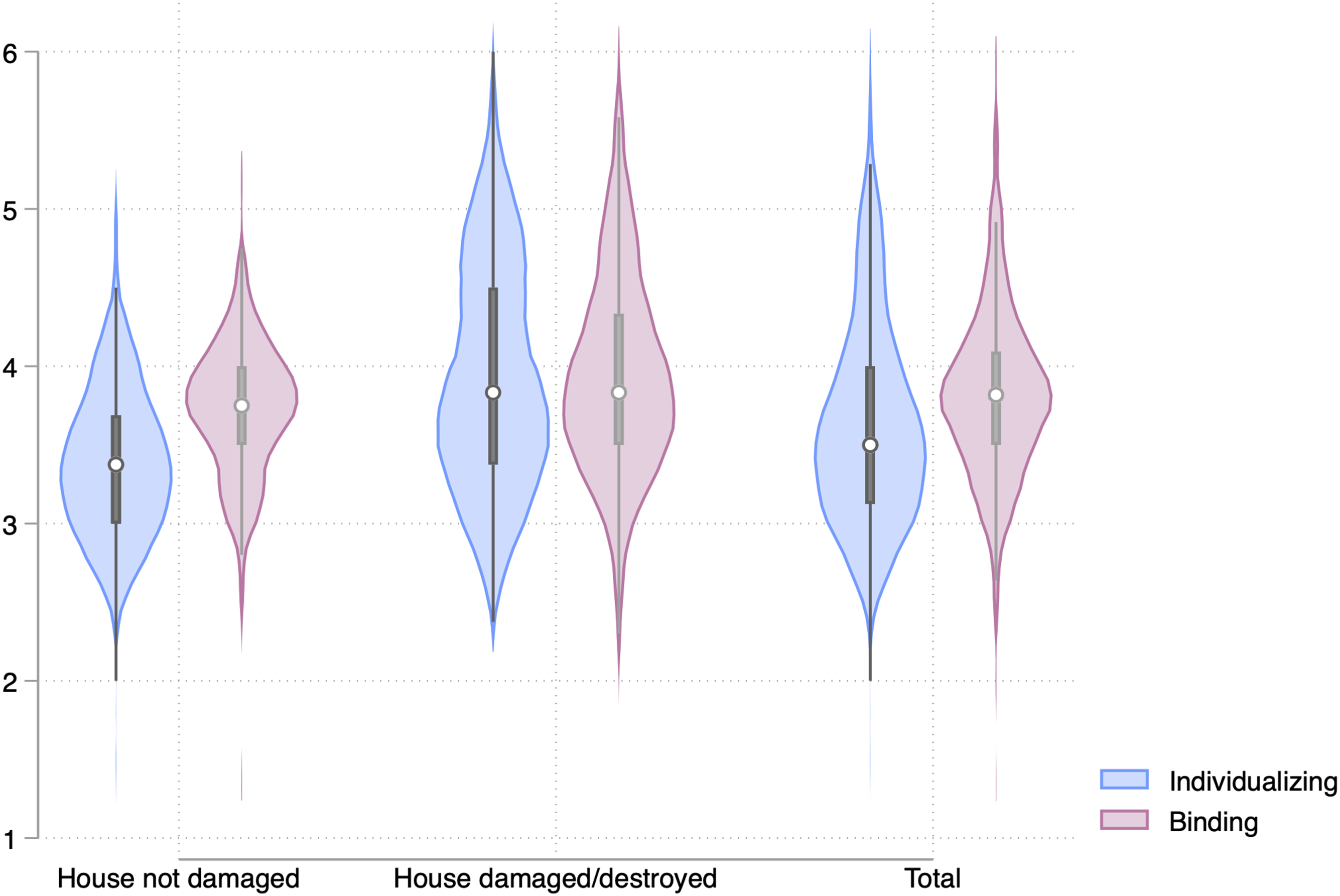
Turning to the results of our regression analyses, and starting with binding morality, the results reveal the expected significant positive effect of indiscriminate violence on morality. Those whose homes were severely damaged or destroyed during the campaign to retake the city from IS report higher endorsement of binding morality (M = 3.95, SE = 0.03) than those that did not (M = 3.71, SE = 0.03), (b = 0.242, p < 0.001). This represents an effect of approximately 6.5%, suggesting that there is a moderate effect of the severe damage or destruction of one’s home in the direction of a conservative shift, roughly consistent in size with what was observed by Van de Vyver et al. (2016). None of the other violence types has an effect at standard significance levels, while only female gender has a small negative effect among the individual-level controls (b = −0.093, p = 0.007).
Continuing with the individualizing moral domain, the results again show a significant positive effect of indiscriminate violence on people’s moral foundations. Those that lost or suffered severe damage to their homes report higher endorsement of individualizing morality (M = 3.87, SE = 0.03) than those that did not (M = 3.45, SE = 0.03), (b = 0.42, p < 0.001). While these effect sizes may seem modest, they are nevertheless notable considering that moral foundations are commonly regarded as stable traits. The severe damage or destruction of one’s home results in approximately 12.2% higher endorsement of individualizing morality. As illustrated in Figure 2, the effect of housing damage/destruction is thus nearly twice as large for individualizing compared to binding morality. Again, none of the other types of violence have any significant effect. The only significant effects among the individual level control variables are a small positive effect of age (b = 0.035, p = 0.032), and a small negative effect of perceived SES in 2003 (b = −0.063, p = 0.002). Effect sizes for the effect of severe damage or destruction of one’s home on individualizing and binding morality across all model specifications. The results discussed in the text refer to the full model.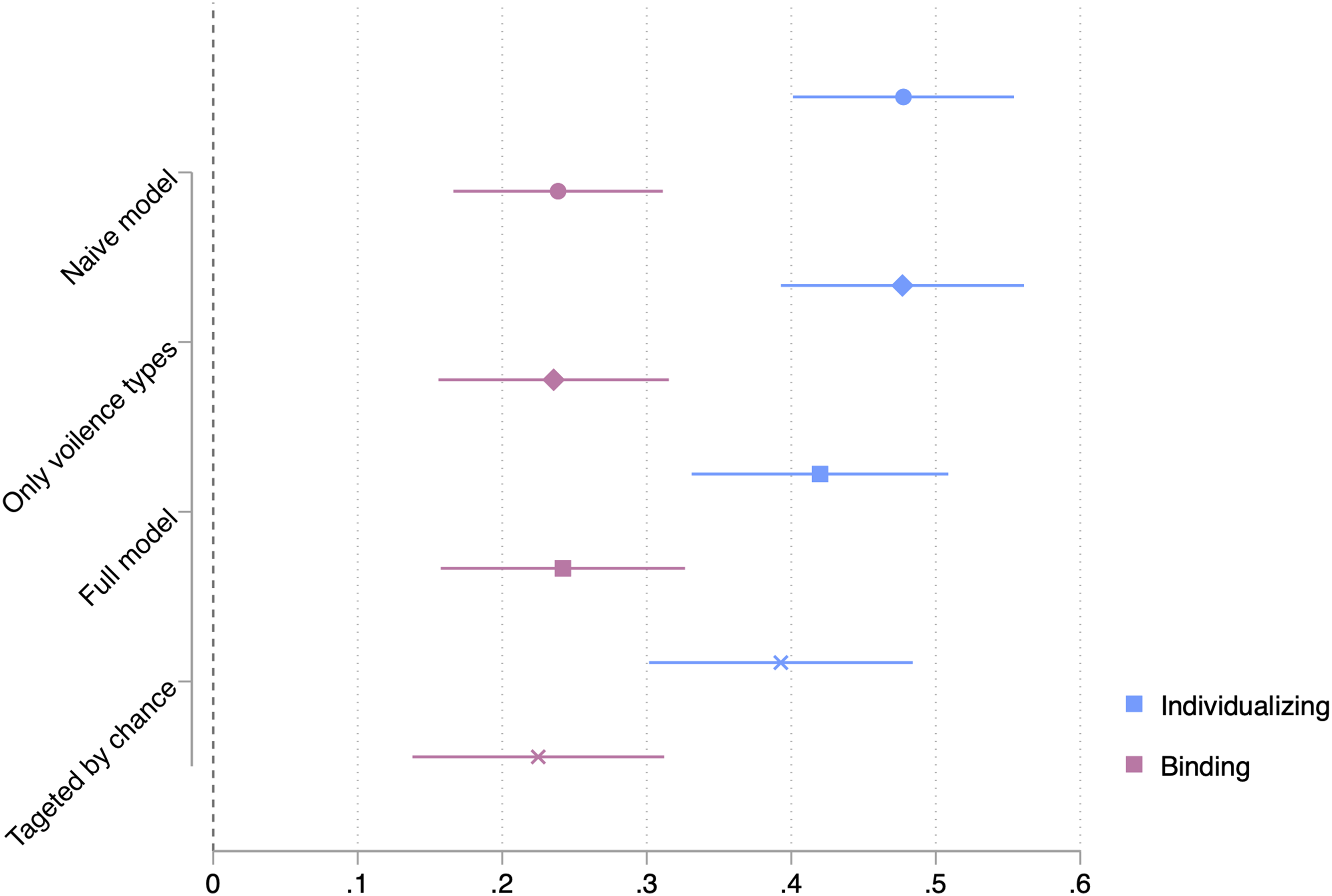
We also ran analyses for each of the five distinct moral foundations. The results of these analyses, which can be found in the appendix, show that our results hold also for the distinct foundations, with a particularly substantial effect for the Care/Harm foundation.
To summarize, the results suggest that experiencing having one’s home severely damaged or destroyed during the Battle of Mosul resulted in increased moral concerns across the board, but had a particularly strong effect on individualizing morality. Given that the baseline level of endorsement of binding morality in the sample is higher than the baseline endorsement of individualizing morality, the widespread property damage caused by airstrikes and indiscriminate shelling by ground forces resulted in a balancing of person-oriented and group-oriented moral concerns in the city of Mosul.
Moral Foundations and Altruism
In the following analyses, we leverage our survey experiment to investigate the impact of the endorsement of each moral domain on altruism towards ingroup and outgroup members as well as the mechanisms of threat and emotion derived from the conservative shift and altruism born of suffering literatures. Our analytical strategy again involves neighborhood fixed-effects linear regression analyses. The analysis unfolds in two steps. First, we test the main effects of target group, individualizing morality, and binding morality on altruism, perceived threat, and emotion, controlling for individual background characteristics. In the second step we test whether individualizing and binding morality moderate the effects of target group on altruism, perceived threat, and emotion by adding the relevant product terms to the regression models tested in step one. To keep the ingroup/outgroup identity of the target group consistent, only participants who self-identified as Sunni Arab are included in these analyses (N = 1000).
There were main effects of target group on altruism (WTR), (b = 0.134, p = 0.014), threat (b = −0.603, p < 0.001) and emotion (b = 0.311, p < 0.001). Individualizing morality had an effect on emotion (b = 0.467, p < 0.001), but not on altruism (b = 0.024, p = 0.665) or threat (b = 0.054, p = 0.593). The main effects of binding morality on altruism (b = −0.023, p = 0.704), threat (b = −0.127, p = 0.239) and emotion (b = 0.000, p = 1.000) were small and not significant. Thus, in line with the literature on parochial altruism (Bernhard, Fischbacher, and Fehr 2006), participants exhibited a clear ingroup bias. Furthermore, individualizing morality was associated with more positive emotional regard for others in general.
However, we are mainly interested in the extent to which the effects of target group are moderated by morality. There were significant interactions between individualizing morality and target group for altruism (b = 0.197, p = 0.043), threat (b = −0.932, p < 0.001) and emotion (b = 0.588, p < 0.001). There were no significant interactions between binding morality and target group for any of the measures: altruism (b = 0.081, p = 0.483), threat (b = 0.242, p = 0.229) or emotion (b = 0.099, p = 0.560). In interpreting these results, it is important to remember that while the emotion and threat measures range from 1 to 9, the altruism measure ranges between −1.67 and 2.67. Thus, a straight comparison between effect sizes is not possible. Comparing the marginal effects of target group at one SD above and one SD below the mean of individualizing morality for altruism, perceived threat and positive emotions, we find that they are 0.267 and −0.001 for altruism, −1.283 and −0.014 for perceived threat, and 0.708 and −0.093 for positive emotions. As this suggests, individualizing morality plays a big role in explaining parochialism, and these are all substantial effects, particularly for altruism.
Among the controls, there were significant effects of SES in 2003 and 2014 for altruism (b = −0.065, p = 0.031, and b = −0.051, p = 0.057 respectively), threat (b = 0.118, p = 0.022, and b = 0.088, p = 0.064) and emotion (b = −0.252, p < 0.001, and b = −0.123 p = 0.002). Beside these, the only other significant controls were education for altruism (b = 0.074, p = 0.006), and gender for emotion (b = 0.183, p = 0.023).
Analyses for each distinct emotion and threat type, which strongly support the findings of our main analysis, can be found in the appendix.
We also conducted a mediation analysis to further explore if the moral foundations may act as mediators of the effect of severe damage or destruction of one’s home on altruism, perceived threat and emotion. The findings suggest that the severe damage or destruction of one’s home does indeed shape altruism, perceived threat and positive emotional regard in expected ways, and that these effects are mediated in part by individualizing morality and moderated by the group affiliation of the target. The results of the mediation analysis can be found in the appendix.
Overall, the results suggest that parochial tendencies are greater among those higher in individualizing morality, which can be appreciated by examining Figure 3. Outgroup targets were on average met with less altruism, more perceived threat, and less positive emotional regard than ingroup targets, which was exacerbated by higher endorsement of person-oriented moral concerns. It can be noted that while the figure suggests that there is a positive relation between endorsement of individualizing foundations and positive emotions toward outgroup members, albeit weaker than for ingroup members, this effect’s difference from zero is only marginally significant (p = 0.087). Linear predictions of altruism (WTR) (top panel), perceived threat, and positive emotional regard for Sunni targets and Shia targets, over individualizing morality.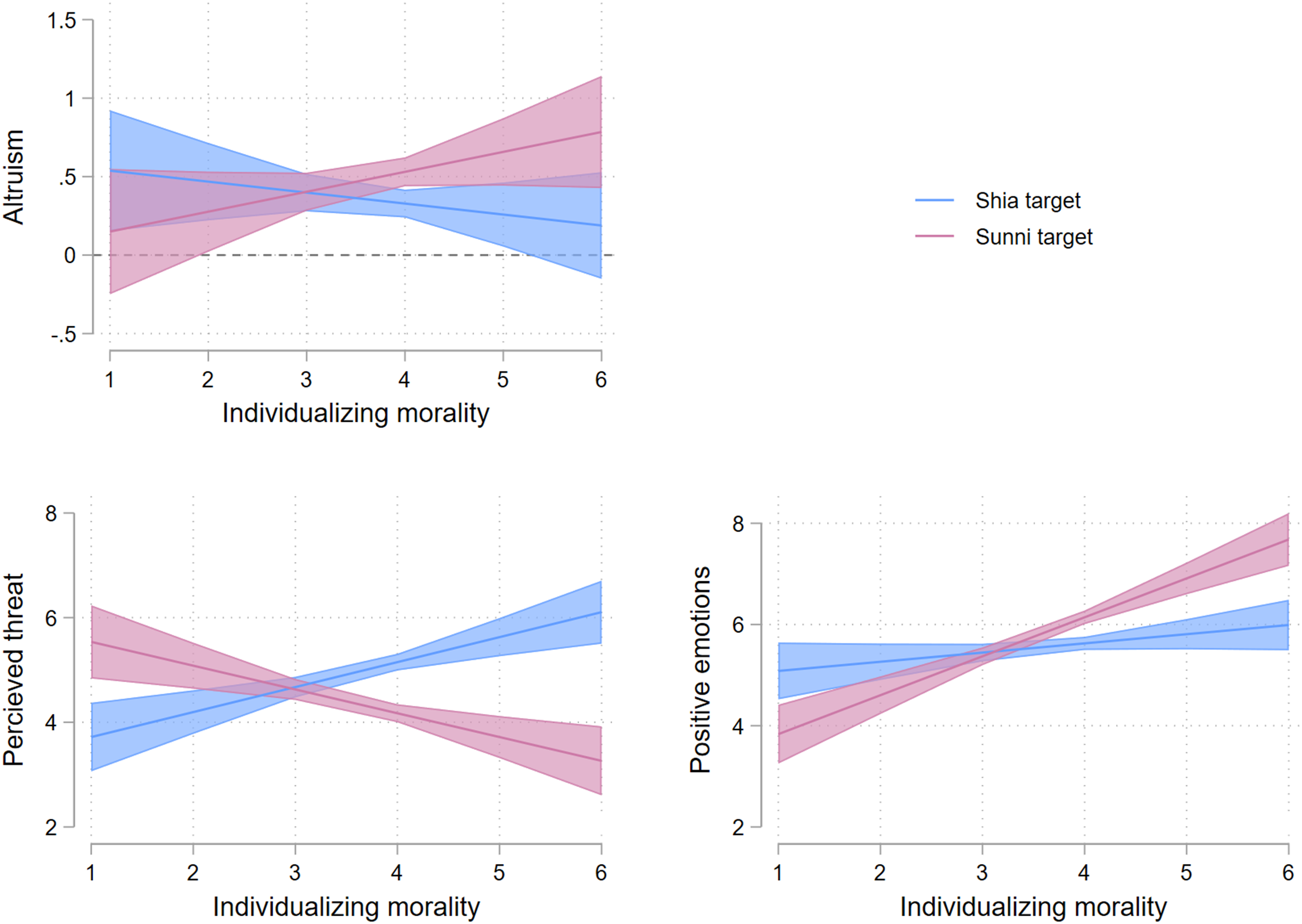
In sum, the results suggest a somewhat different picture than either strand of the existing literature would have us expect. On the one hand, we find that individuals whose houses were destroyed or severely damaged exhibit increased endorsement of group-based morality, as would be expected from the conservative shift literature (Bonanno and Jost 2006; Jost et al. 2003; Nail and McGregor 2009). At the same time, we observe an even bigger increase in the endorsement of person-oriented morality, suggesting an enhanced concern for fairness and care for weak and vulnerable others, which is what might be expected from the ABS literature (e.g., Staub and Vollhardt 2008). In the second step of the analysis, leveraging our experiment we investigate the impact of group-oriented and person-oriented morality on altruism towards ingroup and outgroup members. The results suggest that participants are less altruistic towards, perceive as more threatening, and express less positive emotional regard towards outgroup members than ingroup members. Moreover, this parochial tendency is stronger among those scoring higher in individualizing morality, but not binding morality. The results thus highlight the moral mechanism of person-oriented, individualizing morality as a driver of parochial altruism in war-affected communities.
Discussion
In this study we addressed two central questions regarding war and morality: How does exposure to indiscriminate violence impact moral foundations? And how do moral foundations impact altruism within and across group lines? The literature on “altruism born of suffering” (Staub and Vollhardt 2008) would suggest that the experience of indiscriminate violence would increase victims' endorsement of individualizing morality and the “moral expansiveness” associated with it (Crimston et al. 2016), resulting in less parochialism and ingroup bias. In contrast, research rooted in MFT suggests that exposure to existential threats should enhance binding morality while decreasing individualizing morality, producing a “conservative shift” (Jost et al. 2003) characterized by stronger parochialism and ingroup bias. Our results provide partial confirmation of both perspectives.
Based on data obtained from a large and diverse sample of Mosul residents who lived through the 2016–17 Battle of Mosul, we found that the severe damage or destruction of one’s home was positively associated with the endorsement of moral foundations overall. Moreover, this impact was nearly twice as large for individualizing morality compared to binding morality. Because participants expressed greater endorsement of binding morality than individualizing morality at baseline, the severe damage or destruction of one’s home resulted in a balancing of group-oriented and person-oriented moral concerns among victims. No such effect was found for the other types of violence.
Furthermore, we found that greater endorsement of binding morality had no effect on decision-making in the welfare tradeoff task, whereas greater endorsement of individualizing morality was associated with a significant increase in parochial altruism. Participants that scored higher on individualizing morality also perceived outgroup members, but not ingroup members, as more threatening and expressed less positive emotional regard towards them. In sum, the experience of indiscriminate violence in Mosul did enhance victims' concerns for fair treatment and protection of the weak and vulnerable, as ABS would predict, but it also contracted the scope of individualizing morality to exclude members of the threatening outgroup, which is more in line with the ‘conservative shift’ literature.
Our study is limited by the fact that it was carried out in a single postwar context. Material conditions and social and cultural institutions differ across contexts in ways that might impact the relationship between war exposure and morality. Moreover, the moral foundations questionnaire does not take into account the importance of minority status, which might shape how war exposure impacts morality. Below we outline these limitations in more detail and suggest ways for future research to address them.
The extreme poverty experienced by Mosul residents, made acute by protracted armed conflict and the severe damage or destruction of one's home, may play a crucial role in explaining these novel findings. The availability of material resources has been shown to function as a buffer against adverse and distressing life events (Vohs, Mead, and Goode 2008). Lack of material resources, in contrast, was found to increase people’s sense of vulnerability to the harmful behavior of others, leading to harsher moral judgments of infractions that directly threaten personal wellbeing, but not of more symbolic transgressions against purity, loyalty, and authority (Pitesa and Thau 2014). Property damage following a natural disaster was also found to increase parochial altruism by inducing intergroup competition over scarce resources (Vardy and Atkinson 2019). The increased moral concern for fairness and prevention of harm, and the parochial altruism associated with it, may thus be a functional response to the loss of material resources caused by the severe damage or destruction of one’s home under conditions of extreme scarcity in Mosul. Future research concerning the links between resource scarcity and different forms of indiscriminate war violence could investigate this question further.
The widespread material deprivation that inhabitants of West Mosul had to live through may also help explain why we find strong effects for severe damage or destruction of one’s home but not for other types of violence routinely classified as more severe (e.g., Munjiza et al. 2017). Rather than being a consequence inherent to a certain type of violence, the severity and psychosocial impact of a given experience — and the social-psychological adaptation to it — may be context-dependent. For instance, when surrounding socioeconomic conditions are poor, unfulfilled basic needs such as lack of shelter and access to clean water can mediate the effect of potentially traumatic events on mental health (Miller and Rasmussen 2010), and even predict higher rates of psychological distress than the experience of severe interpersonal violence, as shown in a sample of Darfuri refugees (Rasmussen et al. 2011). Losing one’s home may thus be less traumatic when housing alternatives and infrastructural support are available, and more traumatic when such resources are lacking and homelessness coincides with increased vulnerability in an already dire setting. This may also help explain why our results differ from those of studies that found a conservative shift in response to terrorist attacks in WEIRD countries (e.g., Bonanno and Jost 2006; Landau et al. 2004; Nail and McGregor 2009; Van de Vyver et al. 2016). We suggest that the chronic salience of unmet basic needs may increase the importance of individualizing moral concerns. In contrast, terrorist attacks in WEIRD societies may not pose comparable threats to individual survival, and may therefore trigger less person-oriented morality in response (e.g., Cottrell and Neuberg 2005; Tamborini et al. 2017; 2020).
Differences in social and cultural institutions may further influence people’s moral adjustment to war. As argued by Henrich (2020), war activates our coalitional psychology, strengthening our adherence to existing social norms and driving us to invest in the interdependent networks and institutions that we rely on most. In individualistic, WEIRD societies, this may mean following impersonal rules and supporting the nation-state. This is in line with previous findings on Conservatism as Motivated Social Cognition (Jost et al. 2003). In non-WEIRD, kin-based societies like Iraq, this may instead entail a narrowing of the scope of person-oriented moral concerns to extended kinship networks and respecting traditional norms of loyalty to clan or kindred. Our findings seem to support this idea, and imply that war may affect moral foundations differently depending on the social and cultural environment. Future research combining quantitative measures with a qualitative examination of the culturally specific content attributed to each moral foundation could clarify how cultural and environmental factors interact in shaping people’s moral-psychological responses to war exposure.
A further limitation of our study is that the moral foundations questionnaire does not account for the relative status of minority groups in the national context. Davis et al. (2016) found that moral foundations may relate differently to religiosity and conservatism across majority and minority groups in the USA. Similarly, our sample of Sunni Arabs in a Shia Arab-majority country may have different moral responses to indiscriminate violence than a majority-population sample, such as Shia Arabs in Baghdad. Future research with more representative samples of post-war populations could test this hypothesis.
Until now, MFT has been applied mostly to WEIRD and peaceful contexts, and has not examined the impact of war on morality. The present research constitutes the first step towards addressing this gap. Our results shed light on how indiscriminate wartime violence, and in particular the severe damage or destruction of one’s home, distinctly impacts moral foundations in ways that differ in part from what previous research would have predicted. The results not only support the notion that morality is shaped by the experience of indiscriminate war violence, but also suggest that such effects are adaptive to the socio-environmental context. These insights provide an important impetus for future research on war and morality. Rather than eliciting a unidirectional shift, war violence may drive morality in a contextually appropriate direction depending on, for example, the type of violence experienced, the availability of material resources, the group’s prevailing cultural institutions and interdependent networks, the nature of social cleavages, minority-majority relations in a given war setting, and the social position of the participants within that setting. Furthermore, under conditions of scarcity direct exposure to the material costs of war may alter the commonly observed relationship between individualizing foundations and increased moral expansiveness, making individualizing concerns more contingent on in-group membership instead. Establishing the conditionality and directionality of these shifts, as well as their validity across cultural contexts, seems an important and fruitful avenue for future research.
Supplemental Material
Supplemental Material - The Impact of War Exposure on Morality: Evidence From the Battle of Mosul
Supplemental Material for The Impact of War Exposure on Morality: Evidence From the Battle of Mosul by Jonathan Hall, Eric Skoog, and Phaidon Vassiliou in Journal of Conflict Resolution
Supplemental Material
Supplemental Material - The Impact of War Exposure on Morality: Evidence From the Battle of Mosul
Supplemental Material for The Impact of War Exposure on Morality: Evidence From the Battle of Mosul by Jonathan Hall, Eric Skoog, and Phaidon Vassiliou in Journal of Conflict Resolution
Footnotes
Acknowledgments
Jonathan Hall gratefully acknowledges the financial support of the Swedish Research Council (2015-06564).
Declaration of Conflicting Interests
The author(s) declared no potential conflicts of interest with respect to the research, authorship, and/or publication of this article.
Funding
The author(s) disclosed receipt of the following financial support for the research, authorship, and/or publication of this article: Hall gratefully acknowledges the financial support of the Swedish Research Council (2015-06564). Theory development is based on work supported by Riksbankens Jubileumsfond (M21-0002).

Data Availability Statement
The data given in this article and the replication materials are available at Harvard Dataverse (Hall et al., 2023).
Supplemental Material
Supplemental material for this article is available online.
Notes
References
Supplementary Material
Please find the following supplemental material available below.
For Open Access articles published under a Creative Commons License, all supplemental material carries the same license as the article it is associated with.
For non-Open Access articles published, all supplemental material carries a non-exclusive license, and permission requests for re-use of supplemental material or any part of supplemental material shall be sent directly to the copyright owner as specified in the copyright notice associated with the article.
