




Abstract
With global changes, large-scale natural hazards are more frequent and intense, posing a particular challenge for groups in conflict. Do these shared external threats influence group willingness to cooperate and assist the adversary, and how? The literature suggests inconsistent expectations, from increased intergroup cooperation, to exacerbated animosity, to no discernable impact. We explore this question in the Israeli-Palestinian conflict amid the COVID-19 pandemic, a joint exogenous threat for both sides. Using multiple surveys and a conjoint experiment, we examine whether and how COVID-19 threat perceptions affected Jewish-Israeli preferences for collaborating with the Palestinians against the pandemic, including a novel exploration of concrete policy priorities. We find that greater COVID-19 threat perceptions have little effect on collaborative policy preferences, corroborating politics-as-usual arguments: support for out-group assistance, cooperation, and cost-sharing is polarized by ideological orientation. Our findings outline both constraints and opportunities for intergroup collaboration policies in conflicts facing joint outside challenges.
Keywords
Introduction
The growth of global human connectivity, globalization, and climate change have increased the occurrence and intensity of large-scale hazards such as extreme weather conditions, global pandemics, and various natural disasters (CRED 2020; Institute for Economics & Peace 2020). Their implications disregard political boundaries and pose shared threats to neighboring communities. Effective policy responses, accordingly, often depend on intergroup cooperation and assistance. This challenge is particularly weighty in active conflicts, where out-group members are perceived as enemies, intergroup collaboration is uncommon, and power relations are often asymmetric. Do joint external threats affect the willingness of in-group members to work together with rival groups in conflict? In such contexts, which types of policies are supported and by whom?
The literature provides conflicting and partial answers to these questions (Gleditsch 2012; Ide and Scheffran 2014; Koubi 2019; Meierding 2013; Theisen 2017). Some studies suggest that shared external threats can promote de-escalation, superordinate identities, and intergroup cooperation in active conflicts (e.g., De Juan and Hänze 2021; Giannakakis and Fritsche 2011; Kelman 2012; Kreutz 2012; Pyszczynski et al 2012). Others, conversely, argue that such threats are likely to exacerbate intergroup tensions and competition over limited resources (e.g., Berrebi and Ostwald 2011; Brancati 2007; Greenberg et al 2016; Heslin 2021; Nel and Righarts 2008; Von Uexkull et al 2016). Finally, still others claim that these threats lack discernible impact, positive or negative, on conflicts’ prior dynamics and tensions (e.g., Bergholt and Lujala 2012; Gadarian, Goodman, and Pepinsky 2023; Omelicheva 2011; Theisen, Gleditsch, and Buhaug 2013; Vergani et al 2019). This uncertainty deepens further due to scholarly inattention to the concrete types of intergroup collaboration, tradeoffs, and impositions that in-group members are willing to consider under joint threats. Such multidimensional preferences are especially consequential for facilitating realistic collaborations in conflicts facing shared challenges.
In this paper, we address these questions by suggesting extended hypotheses that go beyond the binary willingness to collaborate or not and which propose specific mechanisms within each competing explanation. Importantly, we argue that these mechanisms—intergroup solidarity, self-interest, in-group favoritism, out-group harm, and partisan orientations—imply different preferences about the exact type of intergroup action to be taken under a shared exogenous threat. We then test these hypotheses using original survey data and a conjoint experiment collected in Israel during the first year of the COVID-19 pandemic, a shared external threat posed to both Israelis and Palestinians. We focus on Jewish-Israeli public opinion, which offers particularly useful conditions for our purposes: as the stronger group in the asymmetric Israeli-Palestinian conflict, Jewish Israelis can consider many possible policy options with varying degrees of cooperation, unilateral force, and in-group and out-group benefits and costs. 1
Our findings show that a greater sense of threat from the pandemic has no real influence, positive or negative, on Jewish Israelis’ preferences to assist the Palestinians contain COVID-19. This result repeats in both general support for assistance and specific policy priorities. Instead, we corroborate the third explanation in the literature: even under a salient mutual danger that risks both communities and can transmit between them, long-standing partisan orientations are the best predictors of support for intergroup cooperation and policies with varying degrees of solidarity, self-interested cooperation, avoidance, or plain out-group harm. At the same time, our findings also discover some shared priorities across partisan lines, outlining the limits of out-group solidarity among left-wingers and resentment among right-wingers when facing shared external threats with the adversary.
The paper contributes to a growing, and hitherto unsettled, debate about conflict and intergroup relations in a world with increasingly frequent and large-scale external threats. In addition to testing the literature’s primary competing hypotheses in a new and salient context, we also broaden the discussion’s theoretical scope to include concrete policy preferences about intergroup action. Whereas past studies primarily examine general willingness to collaborate or not, real-life policy dilemmas involve choices between various degrees of cooperation with different priorities and tradeoffs regarding the in-group’s and out-group’s interests. Our analysis, therefore, provides a useful framework for multiple types of threats and conflicts.
Our conclusions, moreover, paint a complex picture of the intensifying challenge of outside threats in conflicts. On the one hand, our findings provide a sobering perspective on the optimistic expectation that joint exogenous threats alleviate past rivalries and partisan identities in active conflicts. Right-wing views, in particular, can obstruct cooperative solutions in favor of one-sided, self-interested, and even belligerent policies with suboptimal outcomes. On the other, contrary to pessimist arguments, we identify some silver linings. First, the partisan barriers to collaboration are not uniform: leftist, and to some extent centrist, in-group members are open to cooperative solutions that promote both sides’ interests. Second, even right-wing partisans, who tend to prioritize their group interests more strictly, reject policies that actively harm the out-group and are open to partial collaboration. These patterns leave room, even if limited, for domestic and international actors to tailor nuanced messaging and policies that accommodate these structural biases and advance better collective outcomes.
We proceed by outlining the three competing explanations suggested in the literature and follow to suggest extended hypotheses of the mechanisms and policy preferences within each. We then discuss our case study and introduce our data and research design. We subsequently discuss our findings and their scope conditions and close with several conclusions and takeaways.
The Literature: Three Competing Expectations
Intergroup relations in violent conflicts are typically analyzed by their intrinsic threats and contentions. Yet, in recent years, a large body of work has explored the influence of shared external threats—climate anomalies, pandemics, and other natural disasters—on intergroup relations in conflictual settings (Gleditsch 2012; Ide and Scheffran 2014; Koubi 2019; Meierding 2013; Theisen 2017). These studies provide contradictory expectations and findings, which can be grouped into three primary theories: greater cooperation, greater hostility, and politics as usual.
Cooperation theories posit that shared external threats can lessen existing animosities in conflicts, foster greater intergroup collaboration, and help advance diplomatic initiatives. Several explanatory mechanisms underlie this expectation. First, a shared threat can increase empathy and solidarity with out-group members undergoing similar negative experiences and implications (Adam-Troian and Bagci 2021; Nir, Halperin, and Park 2022). This sense of shared fate can weaken perceived intergroup divisions and help establish superordinate identities and trust (De Juan and Hänze 2021; Flade, Klar, and Imhoff 2019; Giannakakis and Fritsche 2011; Pyszczynski et al 2012). Second, when shared threats are addressed better collaboratively, intergroup cooperation can also be driven by self-interest (Ker-Lindsay 2000; Kreutz 2012). Moreover, such collaboration can establish longer-term networks and local institutions to regulate recurring problems and common risks (Linke et al 2018; Long 2011; Tubi and Feitelson 2016). Indeed, empirical works in this vein find that shared threats and natural disasters raise the probability of ceasefires and peace talks and lower the chances of violence in active conflicts (Kelman 2012; Salehyan and Hendrix 2014; Slettebak 2012). Furthermore, such moments can increase popular support for collaboration, particularly when considered effective against outside threats and when initial intergroup violence levels are low (Akcinaroglu, DiCicco, and Radziszewski 2011; Halperin, Porat, and Wohl 2013).
Other research, however, expects the opposite implications. Hostility theories argue that shared outside threats are likely to worsen intergroup relations, hinder cooperation, and incite greater violence for several reasons. First, external threats tend to increase in-group identification as a defense mechanism against uncertainty, loss of control, and fear of death (Fritsche et al 2013; Greenberg et al 2016; Wohl, Branscombe, and Reysen 2010). This tendency projects negatively on the out-group, often amplifying hostility, stereotypical thinking, dehumanization, and blame attribution (Cuddy, Rock, and Norton 2007; Dionne and Turkmen 2020; Greenberg et al 2016). Second, joint threats frequently deepen intergroup competition over limited resources necessary to deal with the crisis (Brancati 2007; Heslin 2021; Nel and Righarts 2008; Von Uexkull et al 2016), especially when it widens existing economic and political inequalities between rival groups (De Juan, Pierskalla, and Schwarz 2020; Montalvo and Reynal-Querol 2019; Von Uexkull et al 2016). Third, outside threats and disasters can weaken state institutions, lowering the cost of violence for challenger groups that seek to contest the status quo and recruit supporters (van Baalen and Mobjörk 2018; Heslin 2021; Linke et al 2018). Backing these expectations empirically, experimental and survey analyses find that salient outside threats and disasters increase out-group hostility, reluctance to collaborate, and support for violence (Brewer 2000; Hirschberger, Ein-Dor, and Almakias 2008; Nir, Halperin, and Park 2022; Wohl, Branscombe, and Reysen 2010). Additional large-n and case-study analyses identify higher violence levels, greater probability for strife over resources, and aggressive border control measures in existing conflicts facing such crises (Berrebi and Ostwald 2011; Breckner and Sunde 2019; Eastin 2018; Golunov and Smirnova 2022; van Weezel 2019).
Whereas the first two theories disagree about the direction by which external threats change intergroup relations in conflicts, politics-as-usual theories expect that they have no meaningful influence in either way. According to this perspective, new joint threats rarely change the deep ethnic, economic, institutional, and ideological divisions through which groups in conflict interact and confront new challenges. Even when shared goals are identified, they are insufficient to establish intergroup trust and superordinate identities (Brewer 2000). Similarly, some studies show that outside threats change intergroup dynamics only when the out-group is substantively linked to the source of threat (Adler et al 2022; Brown and Marinthe 2022). The result, according to several empirical analyses, is neither newfound solidarity nor greater hostility but a continuation of the conflict’s core divisions, prejudices, and violence levels even under new joint threats (Bergholt and Lujala 2012; Gadarian, Goodman, and Pepinsky 2023; Omelicheva 2011; Theisen, Gleditsch, and Buhaug 2013; Vergani et al 2019).
Given the three competing expectations and mixed findings, some studies seek contextual factors that can explain intergroup willingness to collaborate or escalate in some but not other cases (e.g., Heslin 2021; Koubi 2019; Meierding 2013; Pape and Price 2023; van Baalen and Mobjörk 2018; Von Uexkull et al 2016). These works focus on structural outside conditions, such as economic development, state capacity and institutions, the type and magnitude of the threat, or prior political cleavages. Little attention, however, is given to variations in the outcome, i.e., the type of intergroup action. Instead, the literature examines either conflict-level consequences (e.g., diplomatic contact or violence levels) or individual-level attitudes about the out-group and general cooperation. Yet, in reality, the choice is not binary but set between different levels and types of intergroup policies with different tradeoffs, considerations, and gains and losses for the in-group and the out-group.
These details are cardinal for popular support for certain actions under shared threat. Indeed, studies on other issue domains, such as income redistribution or immigration, demonstrate that attitudes about specific policies vary by their perceived benefits and costs (Busemeyer and Garritzmann 2017; Hainmueller and Hopkins 2015; Häusermann, Kurer, and Traber 2019; Valentino et al 2019). Nevertheless, we lack similar analyses of preferences for different types of intergroup action in conflicts facing joint outside hazards. Hence, we are faced with an even deeper puzzle: do shared external threats shape support for particular intergroup actions over others? In what follows, we address this question by extending these theories and mapping several internal considerations and testable implications within each.
Support for Different Types of Intergroup Actions Under Shared Threats: Theoretical Expectations
Extended Hypotheses: The Influence of Shared External Threat Perceptions on Intergroup Policy Preferences.
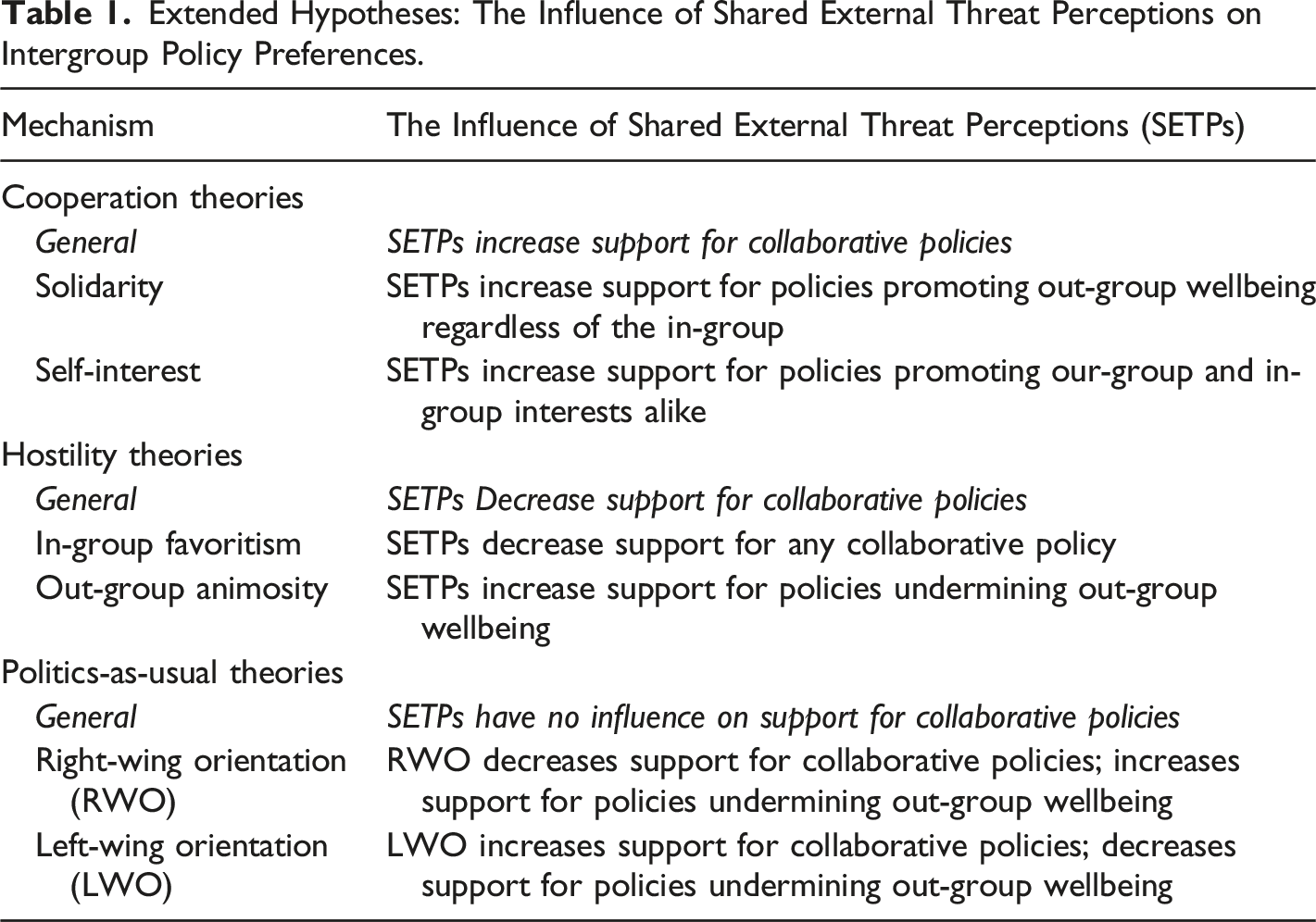
Cooperation theories posit that a greater sense of shared external threat should increase support for collaborative actions assisting the adversary. Yet this general tendency can reflect two distinct motivations. On the one hand, a common threat can establish feelings of shared fate, solidarity, and superordinate identities (Adam-Troian and Bagci 2021; De Juan and Hänze 2021; Flade, Klar, and Imhoff 2019; Giannakakis and Fritsche 2011; Nir, Halperin, and Park 2022; Pyszczynski et al 2012). In this case, past animosities should fade and out-group members should seem worthy of assistance similar to in-group members. Hence, by this mechanism, greater threat perceptions should increase support for cooperative policies addressing the out-group’s well-being as an end in itself, for example through medical assistance or economic aid, even when the in-group does not benefit directly and possibly bears some costs.
On the other hand, collaborative efforts to deal with a shared threat may also promote the in-group’s self-interest (Ker-Lindsay 2000; Kreutz 2012). Certain cooperative actions can pool resources, address mutual challenges across geographical and group boundaries (e.g., cross-border ecological systems or virus transmission), or establish mechanisms for future problem-solving and higher certainty—all of which surpass what the in-group can achieve on its own. Empirically, this consideration implies that a greater sense of external threat should increase support for cooperative policies that benefit both the in-group and out-group. However, contrary to solidary actions, we should not see support for components that primarily aid the latter.
In contrast to cooperation, hostility theories expect that greater perceived external threats would increase opposition to any collaborative actions. This general hypothesis, too, masks two separate motives. According to one, a greater sense of external threat increases tribal identification with the in-group and focuses attention inward (Greenberg et al 2016; Hirschberger, Ein-Dor, and Almakias 2008; Wohl, Branscombe, and Reysen 2010). This in-group favoritism could grow further given high uncertainty, increased demand for limited resources, and concerns about unequal access or exclusion (Brancati 2007; De Juan, Pierskalla, and Schwarz 2020; Heslin 2021; Nel and Righarts 2008; Pape and Price 2023; van Baalen and Mobjörk 2018; Von Uexkull et al 2016). Accordingly, by this logic, a greater sense of external threat should lower support for any active involvement, positive or negative, with the out-group.
A second mechanism, however, emphasizes greater out-group animosity. In such a case, the external threat also increases hostility and scapegoating toward the adversary (Cuddy, Rock, and Norton 2007; Dionne and Turkmen 2020; Greenberg et al 2016). Contrary to avoidance of any action, such feelings could motivate active aggression against the out-group. Hence, this mechanism implies that a greater sense of external threat should increase support for policies that unilaterally benefit the in-group while undermining the adversary’s interests. Such actions, for example, could involve the prevention of access to resources, targeted movement or border restrictions, geographical takeover, or actual violence.
Finally, politics-as-usual arguments suggest that a greater sense of shared external threat should not have a meaningful effect on support for collaborative policies. Instead, even under joint outside threats, the key explanans of intergroup policy preferences should remain prior attitudes about the out-group and the conflict (Bergholt and Lujala 2012; Gadarian, Goodman, and Pepinsky 2023; Omelicheva 2011; Theisen, Gleditsch, and Buhaug 2013; Vergani et al 2019). Support for action, therefore, should vary by individual-level orientations.
Social psychologists link such out-group attitudes with a host of individual factors, including personality (Adorno et al 1950), early socialization into symbolic stereotypes (Kinder and Sears 1981), a predilection for in-group status and social dominance (Pratto et al 1994), and a sense of out-group threat (Blumer 1958; Quillian 1995). These orientations are often organized as part of partisan moralities: studies show that right-wingers/conservatives are more authoritarian and sensitive to in-group status and perceived out-group threat, while left-wingers/liberals prioritize universal fairness and harm avoidance across group lines (Graham, Haidt, and Nosek 2009; Jost et al 2003; Kugler and Jost 2014). Hence, according to the politics-as-usual view, right-wing orientation should lead to a lower willingness to support collaborative policies and/or preference for harmful actions. Conversely, left-wing orientation should increase support for intergroup collaboration and assistance and rejection of out-group discrimination in such situations. The sense of outside threat, meanwhile, should have little influence.
In what follows, we test which of these expectations is most pronounced. We do so by examining the influence of the COVID-19 pandemic’s external threat on Jewish-Israeli attitudes about different intergroup policies involving the Palestinians. We now turn to elaborate on this context.
Case Study: The COVID-19 Pandemic and the Israeli-Palestinian Conflict
Pandemics and COVID-19 As Shared External Threats
The literature on external threats considers a host of natural disasters and events. One common definition of natural disasters, articulated by the Center for Research on the Epidemiology of Disasters’ Emergency Events Database (CRED EM-DAT), describes them as “a situation or event that overwhelms local capacity, necessitating a request at the national or international level for external assistance; it is an unforeseen and often sudden event that causes great damage, destruction and human suffering” (CRED 2023, 13). The database counts such events if they involve either ten or more casualties, over a hundred affected people, a declared state of emergency, or a call for international assistance.
Large-scale pandemics fit this definition and often fulfill all four conditions. Nevertheless, within this category, each disaster type has slightly different characteristics. Highly contagious diseases stand out in two meaningful ways. First, they progress slowly, a trait that increases and prolongs uncertainty and threat levels compared to quicker disasters (Pape and Price 2023). On the one hand, the high uncertainty and cumulating damages can worsen intergroup competition over limited resources, such as protective gear, medical treatment, and funds for collateral economic damages. Similarly, it puts palpable pressure and uncertainty on state institutions, whose limited powers, resources, and attention are diverted to contain the transmission and its consequences (Boin, Lodge, and Luesink 2020). On the other hand, the slow pace may dampen violence as organized actors seek more information and certainty (Pape and Price 2023). Moreover, the prolonged pressures may also incentivize greater collaboration and pooled resources across groups and states.
Second, pandemics are also unique in their human transmission. This attribute can increase intergroup scapegoating, especially when the disease is popularly associated with particular ethnic or social groups (Dionne and Turkmen 2020; Nelkin and Gilman 1988; Reny and Barreto 2022). It also increases the public salience of physical borders and movement restrictions on outsiders and disliked groups (Gadarian, Goodman, and Pepinsky 2023; Golunov and Smirnova 2022; Kenwick and Simmons 2020). Nevertheless, the broad spread across groups and common experience may also raise the sense of shared fate, empathy, and dependence on other groups’ successful containment efforts (Adam-Troian and Bagci 2021; Nir, Halperin, and Park 2022).
Pandemics, therefore, match the broader literature’s mixed intuitions. Empirical analyses of conflicts during COVID-19 reaffirm this inconclusiveness. The largest pandemic in over a century, COVID-19 spread globally since December 2019, infecting, by estimates, more than 648 million people worldwide and causing 6.5 million deaths as of December 2022. 2 In its first year, before the introduction of vaccines, many governments reacted with strict movement and activity restrictions that caused severe social and economic ramifications for both domestic and global markets (Bosancianu et al 2020; Nicola et al 2020).
Recent studies identify cross-conflict and regional variation in conflict dynamics under COVID-19 (Bloem and Salemi 2021; Ide 2021). Some conflicts, for example in the Middle East, experienced increased friction (Mehrl and Thurner 2021). These tensions are attributed to rebel exploitation of weaker state institutions amid insufficient international attention (Ide 2021), intergroup strain due to the pandemic’s economic costs and deepening inequalities (Gottlieb and LeBas 2020), and greater xenophobia (Dionne and Turkmen 2020; Reny and Barreto 2022). In other regions, however, such as Europe and East Asia, the pandemic was followed by lower violence rates, mostly explained as a strategic hiatus given fewer opportunities and greater uncertainty (Ide 2021; Mehrl and Thurner 2021; Pape and Price 2023). Mixed patterns were also found at the individual level, with conflicting feelings of intergroup solidarity and anger depending on the context (Adam-Troian and Bagci 2021; Adler et al 2022; Brown and Marinthe 2022; Nir, Halperin, and Park 2022). Considering these mixed results, Polo (2020) suggests that COVID-19, despite its global magnitude and enormous implications, has not changed existing violence patterns around the world.
The Israeli-Palestinian Context
One of the world’s longest-active conflicts, the Israeli-Palestinian conflict has been raging for over a century and involves contentions over territory and self-determination. The Palestinian territories under dispute include the West Bank and the Gaza Strip, both occupied by Israel in 1967. Under the current status quo, which was established in the incomplete Oslo peace process in the 1990s, these territories comprise three administrative areas: Area A (most Palestinian cities and villages) under full Palestinian control, Area B under Palestinian control of civil matters and overriding Israeli security control, and Area C (most Israeli settlements) under full Israeli control.
Since 2007, the Palestinian regime has violently split into two contentious factions. The West Bank, which includes fuzzier borders, Israeli settlements, and ongoing Israeli Defense Forces (IDF) presence, is governed by the Palestinian Authority (PA). The PA is headed by Fatah, a more moderate faction that previously engaged in negotiations with Israel and maintains regular coordination with the IDF. The poorer and denser Gaza Strip, meanwhile, is governed by Hamas, an extremist Islamist organization with hostile positions and recurring violent clashes with Israel. Nevertheless, both regions remain unified around the same national goal, are similarly involved in the conflict with Israel, and are typically perceived as a single group.
COVID-19 was first diagnosed in Israel in February 2020 and soon spread exponentially. The Israeli government responded with a series of aggressive state-wide lockdowns, movement restrictions, and border closures (Maor, Sulitzeanu-Kenan, and Chinitz 2020). The first cases of COVID-19 in the Palestinian territories were diagnosed in early March 2020, not long after Israel. Although its initial spread was slower, it gained quicker traction over the summer, particularly when the pandemic reached the Gaza Strip. The Palestinian authorities, too, enacted periodic lockdowns and movement, distancing, and quarantine measures (AlKhaldi et al 2020; Qutob and Awartani 2021). During the pandemic’s first year, 428,510 Israelis and 139,223 Palestinians were infected, 3,356 Israelis and 1,418 Palestinians died, and many more experienced meaningful economic losses (Dong, Du, and Gardner 2020). Both societies’ seven-day rolling averages of daily new infections per million people throughout 2020 are presented in Figure 1. New confirmed COVID-19 cases per million (7-Day Smoothed) in Israel and Palestine, February-December 2020. The shaded areas mark the period that each survey was in the field. Data source: CSSE.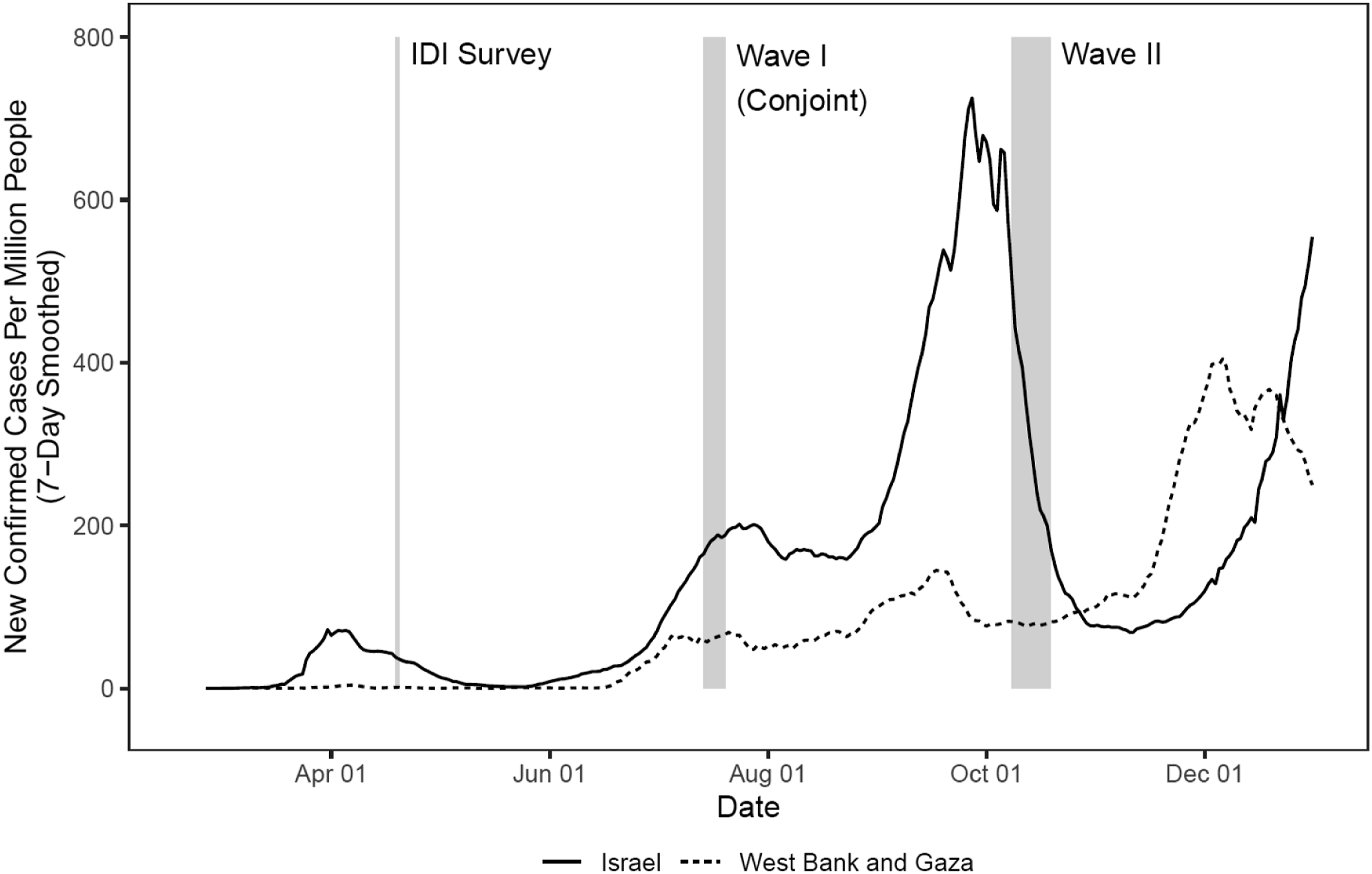
Case Study Fit
This context offers a particularly fitting case study for the influence of external threat perceptions on the willingness to assist and collaborate with an adversary under an external shared danger. First, although much has been written about the Israeli-Palestinian conflict, its dynamics are predominantly analyzed by its core contentions and geopolitics. 3 The COVID-19 outbreak, by contrast, is a strictly exogenous threat to both sides. Moreover, the slow-rolling and uncertain nature of pandemics should prolong and deepen the sense of external threat, especially before the introduction of vaccines.
Second, while they reside separately, the two populations are geographically contiguous and come in regular contact through Israel’s military occupation, Jewish settlements in the West Bank, and tens of thousands of Palestinian Laborers who cross into Israel daily from the West Bank and Gaza. In a pandemic threat, these links increase the shared threat of intergroup transmissions and could further accentuate the various considerations discussed above (e.g., shared fate, self-interest, in-group focus, or out-group scapegoating).
Third, the conflict is asymmetric: Israel has more resources and military power, occupies parts of the West Bank and entry points to the Gaza Strip, and controls various infrastructural, civil, and economic aspects of Palestinian lives. This puts Israelis in a unique position to express their actual preferences on a broad array of collaborative or imposed policies with little concern about the adversary’s counteractions. Given Israel’s control of the territories, some Israelis might also feel legally or morally obligated to help the Palestinians, a point that we revisit in the paper’s conclusion. Importantly, during the pandemic’s first year, the Israeli government did not publicly outline clear policies regarding COVID-19 in the Palestinian territories, minimizing concerns of recency or status-quo bias among Israeli respondents. Together, these conditions provide a unique opportunity to test which of the different explanations and mechanisms is most pronounced in an active conflict under a shared external threat.
Data and Explanatory Variables
To examine which of the competing hypotheses summarized in Table 1 fits Jewish Israelis’ preferences, we collected original survey and experimental data during the first year of the pandemic. Our data and analysis comprise two parts. First, we use three surveys to examine the literature’s general hypotheses about more or less willingness to assist the other side’s efforts. Second, we use a conjoint experiment to delve deeper into the extended hypotheses about policy priorities for such interventions.
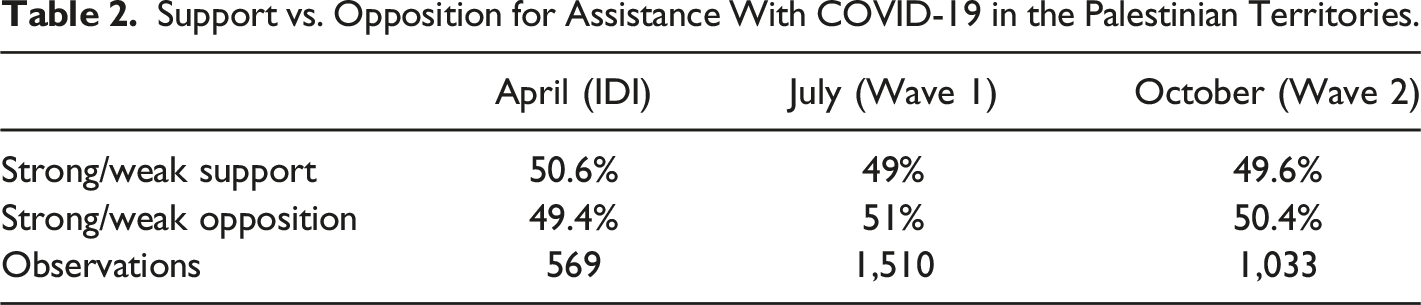
We focus on the pandemic’s first year as it involved higher levels of anxiety and uncertainty and predated the introduction of vaccines. Our data are from two sources at three points in time. First, we fielded a two-wave online survey of Jewish Israelis on July 14–20, 2020 (survey wave 1) and October 8–19, 2020 (survey wave 2). The first wave included both a questionnaire and a conjoint experiment, on which we elaborate later, whereas the second wave featured only a standard questionnaire. The two-wave survey was conducted by iPanel, an Israeli online-polling firm, using quota sampling representing Israel’s adult Jewish population. 4 Wave 1 includes a sample of 1,510 respondents out of 7,086 panelists who were invited to participate, while the second wave revisits 1,033 first-wave respondents using similar representative quotas. Second, we complement these data with an earlier poll fielded by the Israel Democracy Institute (IDI) on April 19–20, 2020, using a representative sample of 569 Jewish Israelis. Together, we have three representative surveys conducted 3 months apart at particularly tense moments: two surveys (April and October) were fielded amid strict national lockdowns during or after pandemic waves and the third (July) during a peak in new cases foreshadowing a resurgence. The data collection dates are shaded in grey in Figure 1.
Our primary explanatory variables measure COVID-19 threat perceptions from both prospective and retrospective angles. First, we gauge prospective health concerns by asking respondents about the degree to which they are worried that COVID-19 would harm their or their close family members’ health. Second, we ask a similar question about prospective economic concerns, i.e., worry that respondents or close family members would be hurt economically by the pandemic. Third, we measure retrospective health-related harm by asking respondents whether they, their family members, or their close friends were diagnosed with COVID-19. Fourth, we also ask whether they were placed in home quarantine after exposure to a COVID-19 patient. Finally, we measure retrospective economic loss by asking whether respondents’ economic status improved or worsened in the past few months. The IDI survey, which was fielded when the pandemic was still in its infancy, only asks about forward-looking concerns.
In addition to threat perceptions, the politics-as-usual hypotheses emphasize respondents’ ideological orientation. We measure ideology using left-right self-identification on a 7-point scale from Left to Right. Because the IDI poll does not ask about ideological self-identification, we instead recode respondents’ self-reported party vote in the March 2020 election by three ideological blocs: Left, Center, and Right. 5
General Willingness to Help the Palestinians
Dependent Variable
We begin our analysis by examining the influence of outside threat perceptions on the general willingness to assist the Palestinians contain COVID-19 in April, July, and October 2020. We measure this outcome using one of two questions, depending on the survey. The IDI survey (April) includes the following question: “In your opinion, to what extent should Israel assist the Palestinian authorities in the West Bank/Judea and Samaria in dealing with the Coronavirus pandemic in the territories under their control?” Our two surveys (July and October) ask: “Some think that Israel should refrain from taking any steps regarding the coronavirus situation in the Palestinian territories and focus only on the pandemic within Israel. Do you agree or disagree?” Both questions use a 4-point scale of agreement or disagreement. 6
Support vs. Opposition for Assistance With COVID-19 in the Palestinian Territories.
Findings
To examine which of the literature’s three general hypotheses best predicts support for Israeli involvement, we regress these measures on respondents’ COVID-19 threat perceptions and partisan identification/vote. We control for gender, age group, income, education (unavailable in the IDI survey), and religiosity. The full questions and descriptive data appear in SA Section 2.
The Influence of COVID-19 Threat Perceptions on General Willingness to Address COVID-19 in the Palestinian Territories (OLS Regression).
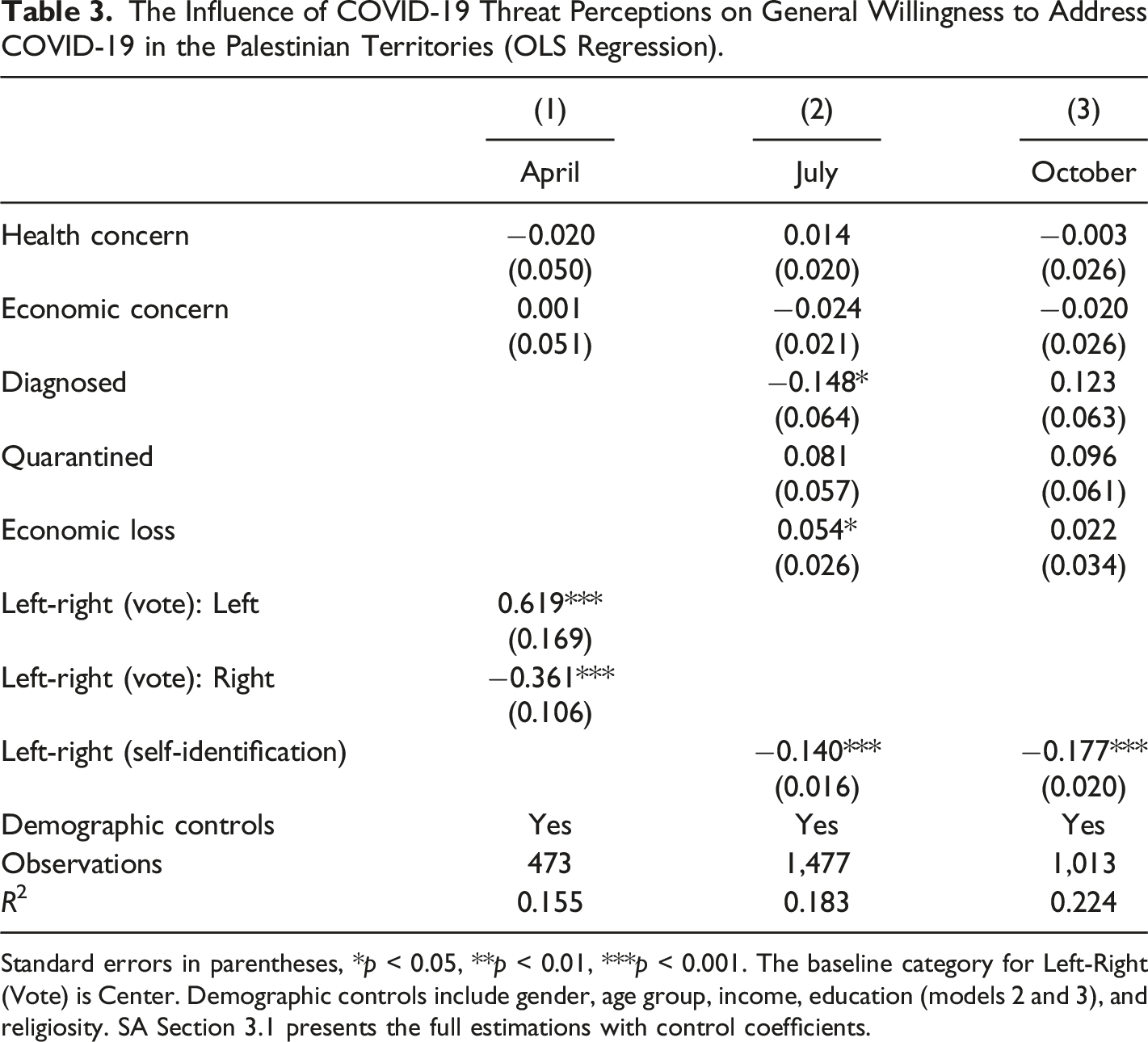
Standard errors in parentheses, *p < 0.05, **p < 0.01, ***p < 0.001. The baseline category for Left-Right (Vote) is Center. Demographic controls include gender, age group, income, education (models 2 and 3), and religiosity. SA Section 3.1 presents the full estimations with control coefficients.
The insignificant influence of COVID-19 threat perceptions is corroborated by several robustness tests, detailed in SA Section 4. First, leveraging our panel data, we re-estimated our models using individual-level change in COVID-19 threat perceptions between July and October. Yet, like their absolute levels, changes in threat perceptions do not correlate with respondent preferences. Second, by matching respondents’ localities with municipal-level COVID-19 cases, we verify that objective local COVID-19 levels are also insignificant predictors. Third, to consider whether COVID-19 threat perceptions depend on greater geographic proximity to the Palestinians, we re-estimated our models only with Jews residing in Jerusalem and West Bank settlements. The null results hold. Finally, we fail to find meaningful interactions between COVID-19 threat perceptions and ideological orientation, ruling out a heterogeneous effect by ideology. We also confirm that COVID-19 attitudes and exposure do not correlate with partisanship, as they did in some other countries, by regressing both subjective perceptions and objective local cases on partisanship. We find no significant correlation.
Specific Policy Priorities
Experimental Design
Thus far, we examined what affects respondents’ general support for or against Israeli involvement. However, such questions tell us little about mechanisms and concrete intergroup policy priorities when sensing a shared external threat. To unpack these aspects and examine their relationships with COVID-19 threat perceptions, we included a conjoint experiment in the first wave of our survey (July 2020). This experimental technique asks respondents to select their preferred option out of pairs of hypothetical policy choices with randomly assigned attributes. Using logistic regressions, we can leverage the random assignment of attributes to isolate how each independently influences the probability to prefer a policy (Bansak et al 2021; Hainmueller, Hopkins, and Yamamoto 2014).
Our conjoint design asked respondents to choose from pairs of suggested Israeli policies regarding COVID-19 containment on the Palestinian side. Respondents were shown a prompt noting the concurrent pandemic outbreak in Israel and the Palestinian territories and asking them to place themselves in the Israeli government’s shoes as it decides on a proper policy. 7 They were subsequently presented with five pairs of policies with randomly assigned components. After each pair, they had to choose their preferred alternative.
Conjoint Experiment Attributes.
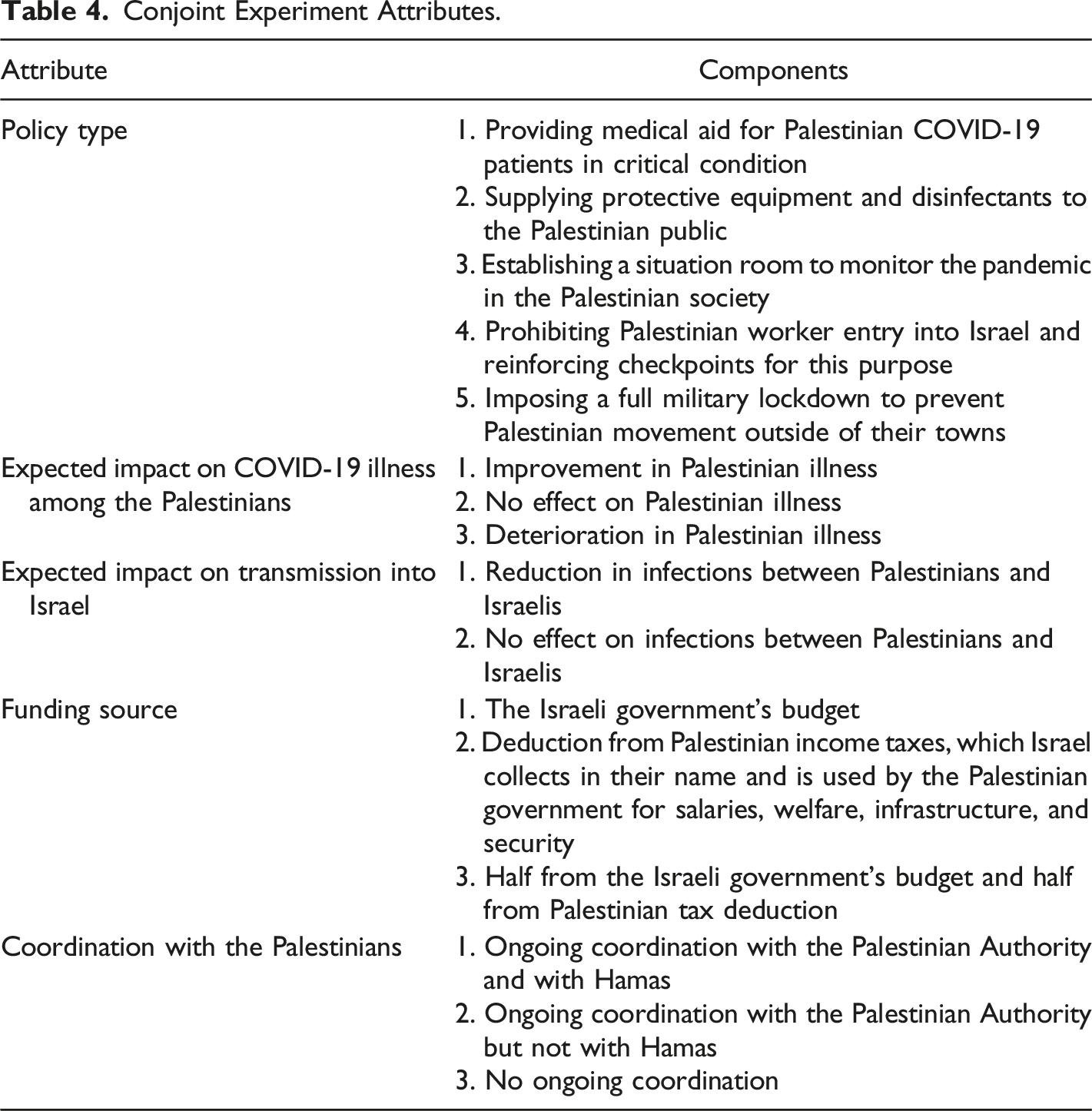
To further isolate respondents’ consideration of in-group and out-group interests, the second and third attributes detail each policy’s expected impact on Palestinian illness and transmission into Israel. The former randomizes whether the policy is expected to improve, have no effect, or deteriorate COVID-19 illness levels on the Palestinian side, while the latter states whether the policy is expected to mitigate or have no effect on cross-border infections into Israel. We avoid the possibility of worse transmission rates into Israel, which no government would propose. To maintain plausibility, our design includes two constraints on these attribute combinations. First, we do not allow a contradictory mix of Israeli medical aid that causes worse Palestinian illness. Second, we prohibit scenarios describing improvement in Palestinian well-being due to passive monitoring.
The fourth attribute examines the extent to which respondents are willing to bear in-group costs. We include three options. On the one extreme, we suggest that Israel fully fund the policy from its national budget. On the other, we propose that Israel deduct the policy’s full costs from Palestinian income tax funds, which are collected regularly by Israel before being transferred to the Palestinian government. Interference in this technical procedure, which was done before by Israeli governments as a sanction, forces the full costs onto the Palestinians without consent. To ensure that respondents are aware of the implications, we explicitly mention that these tax funds are earmarked for various Palestinian public services. In between, we include an option that splits the costs equally.
Finally, the fifth attribute probes the preferred level of direct cooperation with different Palestinian factions in the policy’s implementation. As such, it provides a stricter test for the influence of collaboration with the out-group and sensitivity to different types of adversaries. We include three alternatives: full coordination with both the PA and Hamas, limited coordination only with the PA but not the more extremist Hamas, and no coordination at all.
Findings
To analyze our conjoint experiment, we estimate the marginal means (MMs) of each attribute component, reflecting the probability that respondents would prefer a policy with this feature over others (Leeper, Hobolt, and Tilley 2020). MM values of 0.5, the grand-mean probability of choosing one of any two options, serve as the baseline null effect. Accordingly, MMs higher or lower than 0.5 indicate a greater or smaller probability, respectively, of preferring a policy with that attribute level. This analytical approach is especially useful when comparing respondent subgroups, as we do below.
Before delving into the effect of our independent variables, Figure 2 presents an overview of the full sample.
8
The preferences for policy type are relatively minor: we see a slight preference for denying worker entry alongside opposition to full military lockdowns and passive monitoring. Positive assistance policies are not discernibly favored or rejected. The second and third attributes show that most respondents prefer positive outcomes for both sides: they prioritize policies that lower Palestinian illness and oppose those that cause deterioration, and, similarly, prefer policies that decrease intergroup infections to those that make no difference. There is a clear objection to funding interventions solely with Israeli money and a strong preference to impose all costs on the Palestinians, or, to a lesser extent, split them. Finally, on average, respondents prefer to collaborate only with the PA and tend to reject uncoordinated policies. Hence, aggregately, Jewish Israelis do not have a strong preference for the exact type of assistance policy, so long as it can help both sides but also lower in-group costs and include coordination only with moderates. Descriptively, these patterns reflect some willingness to cooperate out of self-interest, not pure solidarity or overt hostility. Marginal means of different policy attributes, full sample. The dots and horizontal lines indicate point estimates with 95% confidence intervals. Standard errors are clustered by respondent. Attribute titles are presented in all caps and parentheses.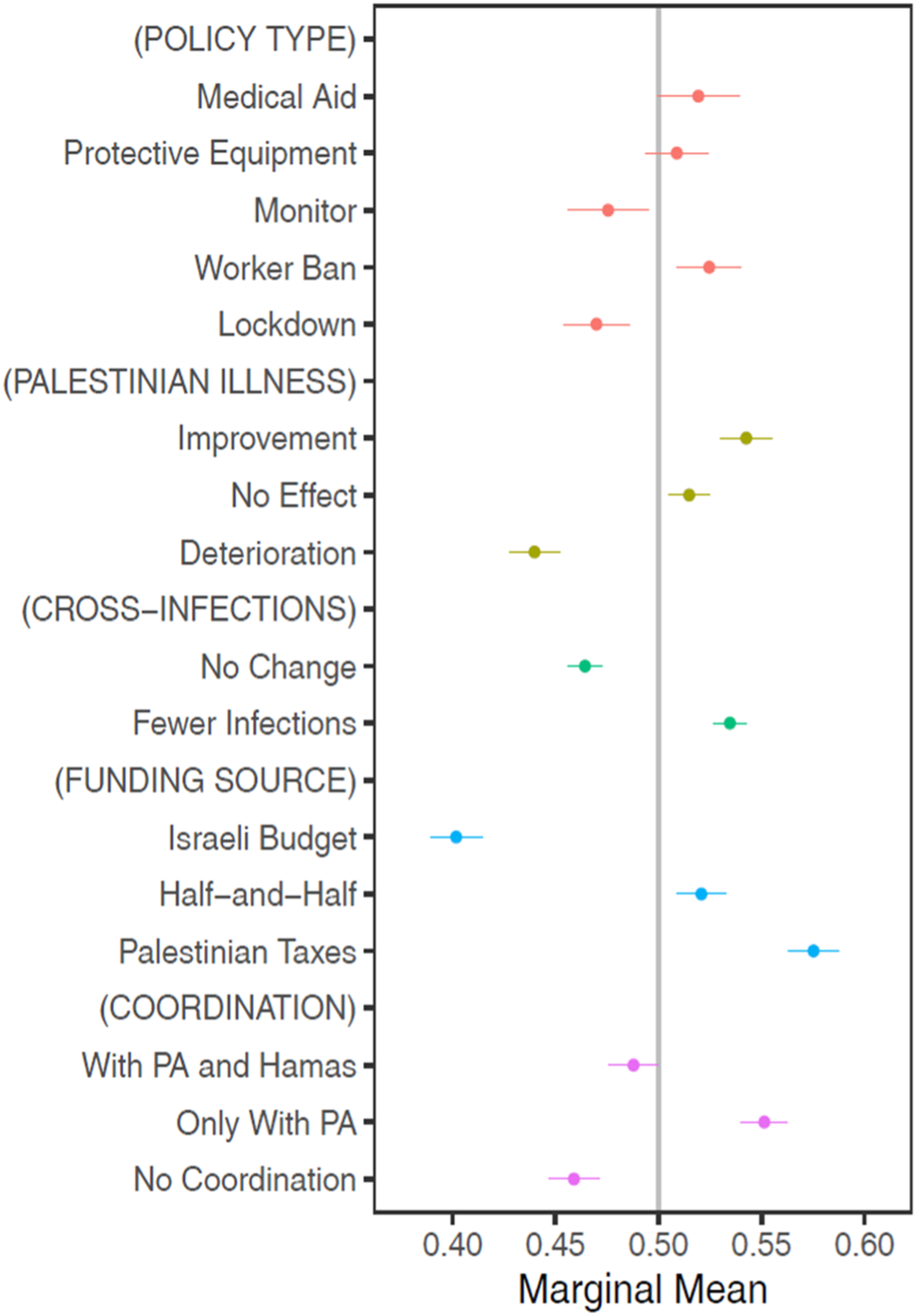
Nevertheless, are these presences related to the shared threat? To examine this question, Figure 3 separates the marginal means by different levels of health and economic concerns.
9
Consistent with our earlier results, we do not see meaningful subgroup differences in either a positive or negative direction. Instead, all subgroups cluster together across attributes. Indeed, an omnibus F-test rejects subgroup differences in either health (F = 1.34, p = 0.08) or economic (F = 0.8, p = 0.8) threat perceptions at the 95% level. A robustness test, presented in SA Section 4.1, rules out a significant interaction between threat perceptions and partisanship. Hence, the conjoint analysis, too, rejects the cooperation and hostility hypotheses: a greater sense of outside threat does not affect respondents’ preferences in either a cooperative or a hostile direction. Marginal means of different policy attributes by health and economic COVID-19 threat perceptions. The dots and horizontal lines indicate point estimates with 95% confidence intervals. Standard errors clustered by respondent. Attribute titles are presented in all caps and parentheses.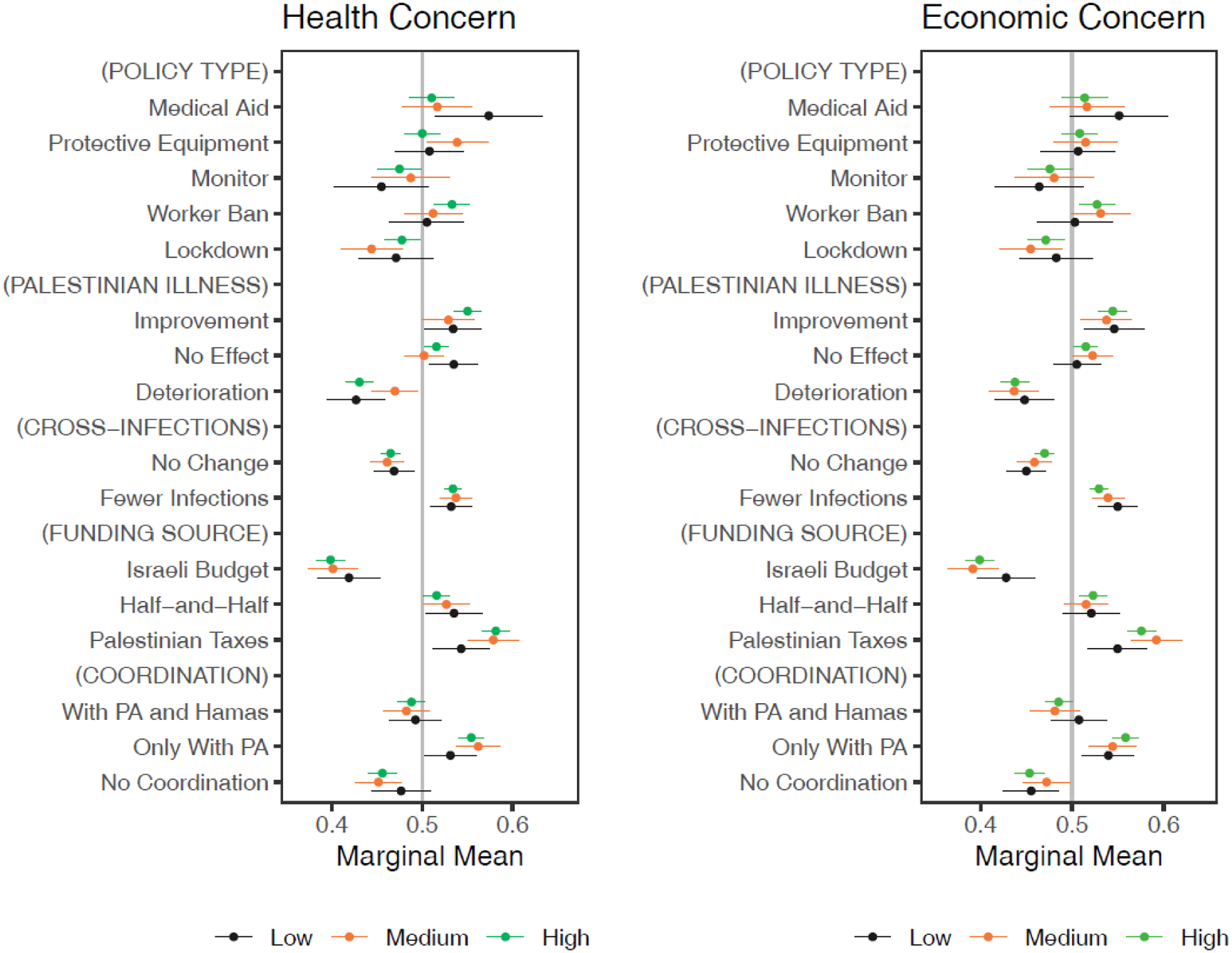
If threat perceptions do not affect policy priorities, what does? Figure 4 plots the marginal means by left-right self-identification, which we collapse to Left, Center, and Right based on the original 7-point scale.
10
Consistent with the politics-as-usual hypotheses, we see clear differences in policy preferences by partisan ideology, supported statistically by an omnibus F-test (F = 6.96, p < 0.001). Leftist respondents are more likely to prefer humanitarian provision of medical aid and protective equipment, which reflect both solidary and self-interest mechanisms, and oppose hostile policies involving military lockdowns and worker entry bans. Rightist voters, conversely, are less prone to support solidary medical aid and are apathetic regarding mutually serving cooperation. Instead, they are likelier to prefer a unilateral entry ban and have no objection to military lockdowns. Centrists position in between. Marginal means of different policy attributes by political ideology. The dots and horizontal lines indicate point estimates with 95% confidence intervals. Standard errors clustered by respondent. Attribute titles are presented in all caps and parentheses.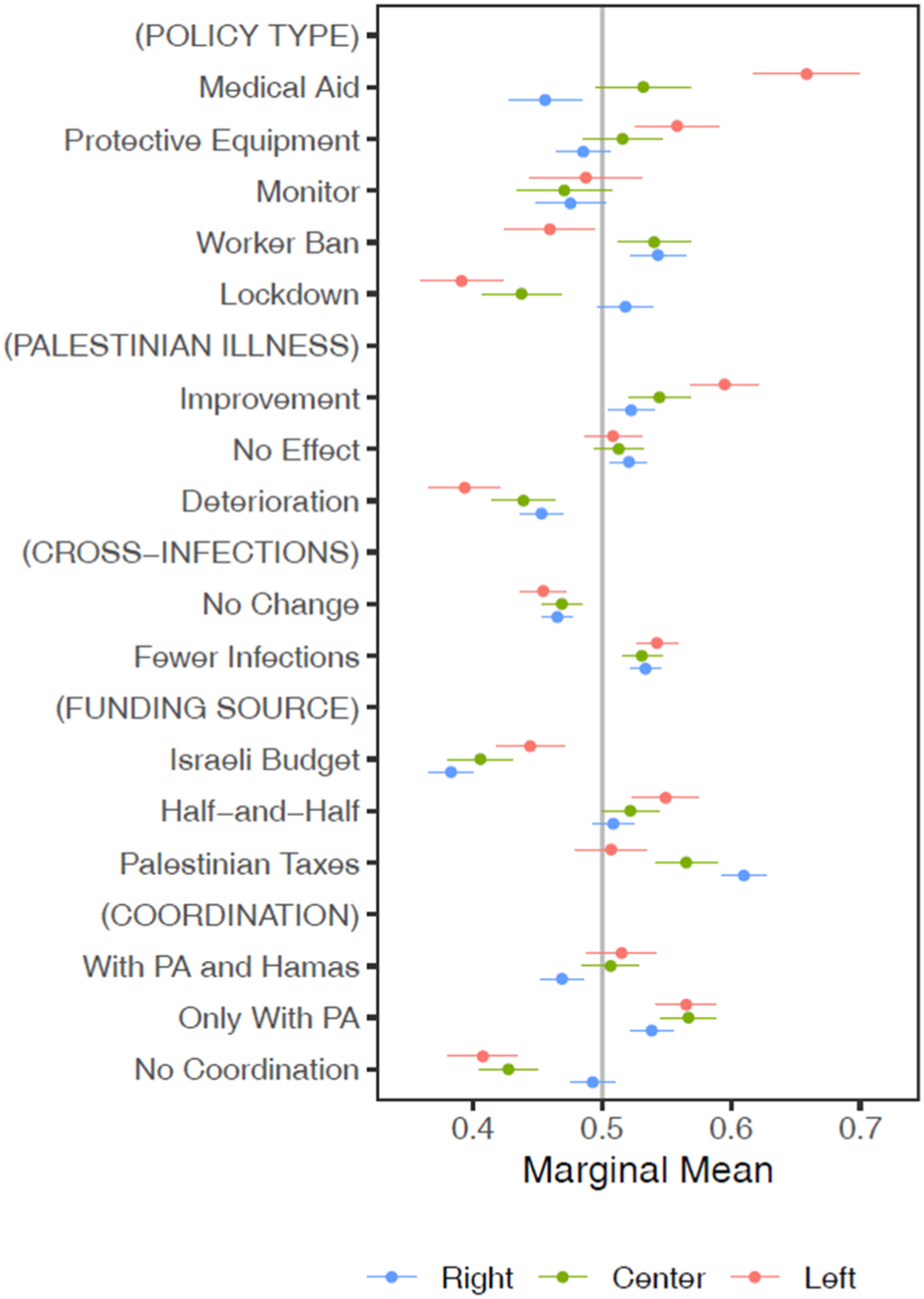
Similar differences are found in attributes related to Palestinian well-being and coordination. Leftists are more likely to support policies that improve Palestinian illness and reject policies that exacerbate it. They also prefer splitting the costs to imposing them on the Palestinians and coordinating with the PA than not at all. Rightists, by contrast, are indifferent to improvement in Palestinian well-being, although they oppose policies that would worsen it. They are also more likely to prefer policies imposing all costs on the Palestinians and more strongly oppose coordination with Hamas. Centrists are closer to the left in their preference for coordination, closer to the right in their preference to shift all costs to the Palestinians, and in between regarding Palestinian well-being. The findings, therefore, strongly support the hypotheses on ideological orientation within the politics-as-usual argument: left-wingers tend to prefer cooperative policies reflecting both solidarity and self-interest and right-wingers are likelier to favor actions that disregard and even harm the other side’s interests.
Interestingly, the analysis also reveals aspects on which all ideological subgroups agree, even if at different magnitudes. All subgroups are likely to reject policies worsening Palestinian illness and prefer mitigation of infections into Israel and coordination only with the PA. In addition, all oppose using only Israeli funds. Hence, we can also see the boundaries of Jewish Israelis’ ideological differences: leftists, too, seek to protect in-group resources and infections and are unexcited about collaborating with extremist factions; and rightists, too, do not wish to actively worsen the out-group’s well-being and prefer coordination with moderate Palestinians over no collaboration regarding the shared threat.
Scope Conditions and Broader Lessons
Our analysis leverages a particular case study, which helps us provide deeper insights into mechanisms and attitudes and hold constant background conditions. Yet how do the patterns we find inform the broader debate about intergroup collaboration in conflicts facing joint external threats? While a single case study cannot address cross-case heterogeneity, our findings outline additional scope conditions that can inform past and future research about similar and different cases. Hence, while suggestive, we find it useful to briefly reflect on the structural attributes that may reinforce our results.
Two contextual aspects are particularly relevant: the structural attributes of the conflict and those of the external threat. Interstate and intrastate conflicts can differ by several traits, including longevity, intensity, power asymmetry, and territorial versus center-seeking goals. On these dimensions, the Israeli-Palestinian conflict stands out as a highly protracted territorial conflict with cyclical rounds of violence and significant military and economic asymmetry. Due to the conflict’s longevity, members of both groups are socialized from a young age into their in-group’s nationalist ethe, out-group stereotypes, and sense of intergroup threat (Bar-Tal 2013). This may help explain the rigidity of deep-seated dispositions toward the out-group even when facing a large-scale global pandemic. Hence, milder or newer conflicts may display more malleable group boundaries and resentments (e.g., Liu, Power, and Xu 2022). Moreover, the Israeli-Palestinian conflict’s routine violence may also hinder empathy and de-escalation compared to calmer cases (Akcinaroglu, DiCicco, and Radziszewski 2011).
However, why did these conflict attributes not lead to greater hostility during COVID-19? One possibility is that the conflict’s territorial nature, as opposed to center-seeking contentions, softens perceptions of intergroup competition over shared resources and potential Palestinian challenges to the Israeli government amid the crisis. Another is the lack of clear stereotypes tying the Palestinians to COVID-19, which may lower context-dependent blame attribution (Adler et al 2022; Brown and Marinthe 2022). Finally, Israelis’ privileged position in the conflict may enable them to cognitively separate the crisis from the conflict’s dynamics. Accordingly, it is equally important to examine the perceptions of weaker and more dependent groups in asymmetric conflicts and the types of assistance that they would be willing to accept given external threats. An incongruence between the policy priorities of high-power and low-power groups can add further constraints when seeking to cooperate against collective challenges.
The second contextual aspect of our analysis is the type of external threat. As discussed earlier, pandemics have a slower trajectory. Contrary to acute onset disasters, these traits create longer levels of anxiety and uncertainty—our data indicate no real decline in COVID-19 threat perceptions between April and October—that may keep attention inward to in-group protection at the expense of out-group empathy and collective recovery. Isolated or shorter hazards, such as large-scale earthquakes or hurricanes, may therefore enable greater (and possibly short-lived) compassion (Akcinaroglu, DiCicco, and Radziszewski 2011; De Juan, Pierskalla, and Schwarz 2020).
The risk of COVID-19 infection, moreover, spreads relatively broadly across borders and groups, which may increase intergroup trust according to recent research on droughts (De Juan and Hänze 2021). However, the broader implications of COVID-19 also depend on access to healthcare, economic resources, and population density, all of which differ greatly between Israelis and Palestinians. These unequal conditions, therefore, may hinder Israelis’ sense of shared fate with the Palestinians when facing the pandemic. Accordingly, we may see a greater influence of threat perceptions in contexts where these disparities are smaller, either positively (due to closer experiences) or negatively (due to greater competition over similar resources).
Finally, COVID-19 spreads through interpersonal contact, lending particular importance to intergroup interaction levels. As noted, Israelis and Palestinians are interconnected systematically but are also segregated residentially, which may weaken the link between out-group assistance and in-group interests. Our results, therefore, emphasize the importance of the joint threat’s geographical range and spread and how they correspond with political and local units.
Conclusion
Large-scale natural threats are becoming more ubiquitous in recent years, increasing the need for collective action, particularly among rival groups in conflict. Nevertheless, we only partially understand popular support for intergroup actions against such threats in conflictual settings. In this paper, we explored this issue in the Israeli-Palestinian conflict during COVID-19, a case study of a salient external threat to both sides in an active conflict. Specifically, we examined whether and how greater concern about COVID-19 affected the willingness of Jewish Israelis to collaborate with the Palestinians against the pandemic. Our study finds a null relationship consistent with politics-as-usual explanations: greater threat perceptions do not influence support for various intervention policies. Instead, these preferences remain dominated by longstanding partisan worldviews regardless of the shared danger. This outcome replicates across different measures, surveys, and policy dimensions.
In doing so, we provide a novel exploration of the mechanisms and concrete policy preferences underlying public attitudes about cooperation under these conditions. We find that respondents on the ideological left, which is associated with a greater value for fairness and equality, seek mutually beneficial solutions, whereas respondents on the ideological right exhibit defensive group perceptions of a zero-sum game. Yet we also identify some common ground: leftists remain protective of in-group interests and rightists do not seek to actively hurt the out-group. These findings indicate that both intergroup solidarity and out-group resentment are limited in such situations.
This insight is particularly important as we face a future with intensifying climate-related disasters and other global crises. These challenges require collective efforts that will inevitably confront territorial, ethnic, and other active conflicts. Our research indicates that such shared threats are insufficient to change existing conflictual dynamics on their own. Policymakers and advocates of collaborative action in conflictual regions must be mindful of this hurdle and work with and around conflict-related worldviews, in-group biases, and intragroup partisan camps. Accordingly, more research is needed on appropriate policy design and messaging that could soften these stances. In Israel, our findings imply that such actions can gain greater public support if they emphasize in-group interests, low/shared in-group costs, and collaboration only with moderates on the other side. While out-group well-being is a relatively minor consideration, avoiding harm is also important to most people.
Our analysis also carries legal and moral implications given Israel’s military control over large parts of the Palestinian territories. According to the Fourth Geneva Convention, an occupying force is responsible for the occupied population’s public health. However, we find this sense of duty missing from many Jewish Israelis’ policy preferences during the pandemic. Indeed, the internal ideological cleavage underlying our findings also polarizes opinions about whether Israel’s control constitutes an occupation. According to a Peace Index survey from May 2017, only 35% of Jewish Israelis, most of whom vote Left, think or are certain that it can be defined as such. Thus, existing intragroup divides about the conflict extend from policy preferences to deeper perceptions of legal and moral obligations to assist weaker groups under a shared threat. Further research on these perceptions is warranted as part of the growing debate about collective action in conflicts facing such challenges. With recent global changes, confronting these collective problems may prove to be one of the most important political challenges of our times.
Supplemental Material
Supplemental Material - Public Preferences for Intergroup Assistance in Conflicts Facing Joint External Threats: Lessons From COVID-19 in Israel
Supplemental Material for Public Preferences for Intergroup Assistance in Conflicts Facing Joint External Threats: Lessons From COVID-19 in Israel by Liran Harsgor and Alon Yakter in Journal of Conflict Resolution
Supplemental Material
Supplemental Material - Public Preferences for Intergroup Assistance in Conflicts Facing Joint External Threats: Lessons From COVID-19 in Israel
Supplemental Material for Public Preferences for Intergroup Assistance in Conflicts Facing Joint External Threats: Lessons From COVID-19 in Israel by Liran Harsgor and Alon Yakter in Journal of Conflict Resolution
Footnotes
Acknowledgments
We thank Marc Lynch, Katharina Pfaff, Omer Yair, Yael Zeira, and the JCR editor and reviewers for their helpful comments and suggestions. Earlier versions of this paper were presented at the annual meetings of the European Political Science Association (in 2021), the International Society for Political Psychology (in 2021), the Israel Political Science Association (in 2021), and the Jan Tinbergen European Peace Science Conference (in 2021) as well as at the Open University of Israel (2021) and the Project on Middle East Political Science (POMEPS) research workshop (2021).
Declaration of Conflicting Interests
The author(s) declared no potential conflicts of interest with respect to the research, authorship, and/or publication of this article.
Funding
The author(s) disclosed receipt of the following financial support for the research, authorship, and/or publication of this article: This research was supported by the Israel Science Foundation (Grant No. 2976/21).

Notes
References
Supplementary Material
Please find the following supplemental material available below.
For Open Access articles published under a Creative Commons License, all supplemental material carries the same license as the article it is associated with.
For non-Open Access articles published, all supplemental material carries a non-exclusive license, and permission requests for re-use of supplemental material or any part of supplemental material shall be sent directly to the copyright owner as specified in the copyright notice associated with the article.
