




Abstract
A growing literature has documented widespread variation in the extent to which insurgents provide public goods, collect taxes, and regulate civilian conduct. This paper offers what is, to our knowledge, the first study of the long-term economic legacies of rebel governance. This effect is theoretically unclear. Rebel governance may generate incentives for households to expand production and accumulate resources. However, rebel rule may be too unstable to maintain such incentives. We explore empirically the effect of rebel rule on households’ economic resilience using a longitudinal dataset for Colombia. Results show a positive relation between wartime rebel rule and the ability of households to cope with weather shocks in the post-war period. Households in regions where armed groups were present but exercised limited or no intervention fare worse. This effect is associated with infrastructure improvement led by armed groups, their intervention in dispute adjudication, and their close interactions with local populations.
A growing literature on rebel governance has documented widespread variation in the extent to which combatants provide security, collect taxes, regulate civilian conduct, and provide goods and services (Arjona 2016; Arjona, Kasfir, and Mampilly 2015; Cunningham and Loyle 2021; Mampilly 2011; Revkin 2021; Sánchez de la Sierra 2020; Stewart 2018; Weinstein 2007; R. M. Wood 2010). These studies have illustrated the complex behaviors armed groups display towards civilians, ranging from violence, extortion and predation to the establishment of order and rule over civilian affairs and the exercise of state-like functions. This research has also advanced our understanding of the factors that shape such variation in armed group behavior as well as in civilians’ responses.
Yet, research on the consequences of rebel rule on the lives of civilians during and after violent conflicts is still limited. With millions of people living under the rule of non-state armed actors across the world, understanding the effects of this type of wartime institutions is crucial to both our knowledge of the legacies of civil war and policy debates about post-conflict reconstruction.
This paper studies the long-term economic legacies of rebel rule. An implicit assumption in the literature is that the long-term effects of armed conflict on households and communities are shaped by their exposure to different levels, forms, and intensity of violence (Blattman and Miguel 2010; Justino 2009, 2012; Verwimp, Justino, and Brück 2019). But other conflict dynamics beyond violence shape post-war economies and societies. Of key importance is the profound institutional change brought by armed groups in areas they (attempt to) control (Arjona 2009, 2014; Justino 2013, 2018; E. J. Wood 2008). To date, only a few studies have explored the legacies of these institutional changes, and none of them focus on their economic consequences. This paper is, to our knowledge, the first attempt to trace the economic effects of rebel governance.
We focus on the long-term consequences of rebel rule for household economic resilience in the post-war period. A large literature in peaceful settings has shown that strong institutions and clear rules are essential for economic development (North 1990; North, Wallis, and Weingast 2013). If an armed group creates such conditions in areas where it operates, households living under its rule may fare better than those located where an armed group is present but intervenes less—or not at all—to regulate civilian affairs or provide public goods. It is, however, unclear whether rebel governance can produce the same effects of peacetime governance, as different kinds of shocks can make these local regimes unstable and short-lived. Even if communities living under rebel governance do benefit from clear rules and service provision, those who live under the presence of rebels but are not ruled by them may not necessarily be worse off: other local actors may govern, and may do so just as well, better, or worse, than rebels would. Households living under rebel rule would not, therefore, necessarily do better.
We seek to better understand these complex relationships empirically using an innovative mixed-methods approach that combines a longitudinal household survey we designed and implemented in four conflict areas in Colombia in 2010, 2013 and 2016 as well as detailed qualitative and quantitative data on whether, and how, armed actors ruled each community throughout the war. We define rebel rule as “the set of actions insurgents engage in to regulate the social, political, and economic life of non-combatants during war.” This includes the provision of public goods as well as institutions to regulate behavior (Arjona, Kasfir, and Mampilly 2015). 1 Following a methodology developed by Arjona (2016), we collected detailed yearly information for each armed group present in the sampled communities throughout the conflict and built a rebel rule index (along the lines of the rebelocracy index developed by Arjona (2016) to measure the scope and level of intervention exercised by armed groups in each community sampled in the longitudinal survey).
We concentrate on a sample of rural communities where non-state armed groups were present during the Colombian conflict for at least one year and estimate the effect of household exposure to different levels of armed group rule, conditional on armed group presence, on their resilience to income shocks in the post-conflict period. To this purpose, we exploit two exogenous weather shocks that affected Colombia during the period under analysis: extreme rainfall caused by La Niña between July 2010 and April 2011, and extreme droughts caused by El Niño between May 2015 and May 2016. We focus on two dimensions of household economic resilience in the post-conflict period: household production and consumption and the use of survival migration strategies.
The main results show that households who lived during wartime in communities with stronger rebel rule exhibit stronger resilience to economic shocks in the post-war period, when compared with communities where armed groups were present but established weaker or no systems of rule. 2 Overall, household exposure to weather shocks reduced agricultural production and consumption levels, pushing households to resort to survival migration to substitute for income losses. In communities where armed groups during the war established stronger forms of rule, the negative impact of the shocks on agricultural production and on aggregate consumption is less severe, as is their need to rely on survival migration. These results appear to be driven by the improvement of infrastructure fostered by rebel groups, their closer interaction with civilians and, to a lesser extent, by their involvement in the adjudication of disputes. Interestingly, civilians’ perceived level of uncertainty does not seem to explain the positive effect of strong rebel rule on households’ economic resilience.
The positive effects we find do not necessarily imply that armed conflict, as a whole, generates economic benefits. What these results suggest is that, despite the threat of violence and the fear they cause, when armed groups establish institutions to regulate civilian affairs, they may provide better conditions for improved household economic resilience than when they are present but intervene less in local communities. Ceteris paribus, communities living under stable rules created by armed actors may benefit from stronger institutional settings that, as in peacetime, may be more conducive to economic recovery in the long run (North, Wallis, and Weingast 2013; Olson 1993).
How Does Rebel Rule Shape Long-Term Economic Resilience?
Observations from the field have identified a large variation in the ruling strategies armed groups adopt towards local communities. They may create order by following clear rules or foster disorder by behaving in unpredictable ways (Arjona 2014, 2016), they may set up more or less efficient systems of civil administration (Mampilly 2011), govern in more or less comprehensive ways (Arjona 2016), be more or less inclusive (Stewart 2018), and allow for more or less representation (Weinstein 2007). When they rule, these organizations may adopt a wide range of roles, such as security providers and de facto rulers, and take on a wide array of practices, including offering protection, collecting taxes, adjudicating disputes, promoting a particular ideology, providing public goods, and regulating civilian economic, social, and political activities. 3
The literature on rebel governance has identified several factors that may explain whether armed groups rule local communities, and how, at particular times and locations. 4 Some are attributes of the armed groups, such as their initial resource endowments (Weinstein 2007), institutional and financial capacity (Wood 2010), ideology and long-term political objectives (Justino and Stojetz 2018; Mampilly 2011; Stewart 2018), and internal discipline (Arjona 2016; Weinstein 2007). Contextual factors can also influence armed groups’ decisions. For example, the possibility of taxing particular commodities (Sánchez de la Sierra 2020), and the presence of armed competition and state counterinsurgency measures (Arjona 2016; Kalyvas, Shapiro, and Masoud 2008; Wood 2010). The attributes of countries and local communities can also matter, such as the presence and reach of state institutions (Mampilly 2011; Wood 2010), the quality of pre-existing local institutions, local governance and civilian collective action (Arjona 2016; Krause 2018), and civilians’ preferences for state rule (Mampilly 2011; Revkin 2021).
These and other accounts suggest that the varied governance approaches often respond to short-term military objectives such as controlling local territories and their populations, extracting resources, and recruiting new members, but may also be driven by long-term goals related to signalling political authority and the capacity to govern, building effective institutional reach, putting their ideologies into practice, and winning hearts and minds as preconditions to successfully waging irregular warfare or ruling in the post-war period.
These institutional dynamics of armed conflicts and the resulting interactions between non-state armed groups and local populations are likely to shape the economic, social, and political realities of local communities once the conflict is over, as several scholars have hypothesized (Arjona 2009, 2014, 2016; Huang 2016; Justino 2012, 2013, 2018; E. J. Wood 2008). Yet, researchers have only recently started to empirically investigate specific legacies of rebel governance, with a focus on post-war democratization (Huang 2016), trust and social cooperation (Cárdenas et al., 2021), attitudes towards, and reliance on, state and non-state legal orders (Lazarev 2019; Rickard and Bakke 2019), preferences for democracy and the rule of law (Arjona et al., 2021), socio-political identities (Kubota 2017), and the behavior of former fighters (Justino and Stojetz 2018; Martin, Piccolino, and Speight 2021). To our knowledge, no studies to date have investigated how rebel governance may affect economic outcomes. We seek to advance this research by studying the impact of rebel governance on the economic resilience of citizens in the post-conflict period.
Extant research on rebel governance and institutional economics lead to competing expectations about whether, and how, rebel governance may impact the economic situation of households in the aftermath of war. The literature on rebel governance suggests that one advantage of rebel rule, and ensuing social and political order, is the establishment of clear rules, increased security and a predictable normative framework that regulates both armed group and civilian behavior—a social contract of sorts (Arjona 2016). Another crucial aspect of rebel governance is the provision of public goods and services (e.g. (Arjona 2016; Arjona, Kasfir, and Mampilly 2015; Heger and Jung 2017; Mampilly 2011; Stewart 2018). A stable regulatory framework allows civilians to know how to behave and operate without risking their lives unnecessarily. Clear rules also allow them to better anticipate the outcomes of alternative choices, form expectations, and make decisions under less uncertainty, similarly to peacetime (North, Wallis, and Weingast 2013). In some cases, the existence of stable rule also allows civilians to set up frameworks to negotiate with armed groups, influencing local governance in ways that benefit the local population.
By creating stability, reducing uncertainty, and providing goods and services, stronger forms of rebel rule may generate incentives for households to continue to invest, expand agricultural production, and accumulate wealth. This ensures that households continue to access livelihoods during the conflict, whilst also guaranteeing the access of armed groups to rent extraction and taxes (Justino and Stojetz 2018; Olson 1993; Sánchez de la Sierra 2020). The stronger institutional environments and clearer rules that often come with rebel governance may also support stronger markets and economies. In the aftermath of the conflict, households who lived under strong forms of rebel rule may, therefore, be on a higher income trajectory than those living under minimal or no rebel intervention. If these better economic and institutional conditions persist, households under higher levels of wartime rebel rule may show stronger economic resilience in the longer term. These observations allow us to outline our first two hypotheses:
Households under stronger levels of rebel rule during civil war experience higher economic resilience in the post-war period.
Stronger rebel rule during wartime may result in positive long-term economic effects when it: (i) places households in higher income trajectories by creating conditions for more investment and productivity; and/or (ii) improves the institutional strength of communities.
Yet, there are also theoretical reasons to expect that living under stronger forms of rebel governance does not translate into better economic outcomes. First, the expected positive effects of rebel rule are based on arguments on how strong institutions and clear rules of the game are essential for economic growth and development in state-run communities during peacetime (North, Wallis, and Weingast 2013). There are several reasons why this reasoning may not apply to areas ruled by non-state armed groups and whether these effects will persist in time. This is because rebel rule is an unstable form of political order. As Kalyvas (2006) has shown, local territories often fall under the military control of different armed actors during conflict. Shocks such as resource scarcity, ideological or military competition, stalemates or ceasefires, changes in leadership, natural disasters, the arrival of international humanitarian actors or aid, changes in international commodity prices, and a public health crisis like the COVID pandemic, may also increase the instability of rebel rule (Al-Tamimi 2015; Arjona 2016; Berti 2018; Furlan 2020; Kalyvas 2015; Ladbury et al. 2016; Mampilly 2011; Sánchez de la Sierra 2020; Weinstein 2007). By making rebel governance volatile and short-lived, these shocks can prevent households that lived under rebel rule from accumulating enough economic benefits that will see them through shocks in the long run. In addition, civilians may learn that rebel regimes are short-lived, which would prevent the advantages associated with the stability of the rules of the game from materializing.
Second, nothing ensures that when non-state armed actors regulate economic activities—which sometimes includes asset redistribution—they do so with the aim of increasing aggregate efficiency. The establishment of patronage relations and alliances may be more useful (Kalyvas 2015; Reno 2015; Stewart 2018). Ideology may also drive their choices in ways that negatively affect economic outcomes (Gutiérrez-Sanín and Wood 2014).
Finally, even if stronger rebel governance does create better conditions for economic resilience, the situation of communities living under lower levels of rebel intervention may not necessarily be worse. Several studies have shown that armed organizations are not the only sources of authority in conflict zones. Even when a rebel group has full military control of a local territory, other actors such as public officials, traditional authorities, and civic leaders may preserve their authority and continue to rule in various ways (Arjona 2016). Several studies have also shown that rebels often govern by allying with, or coopting, different types of local actors (Arjona 2016; Förster 2015; Reno 2015; Stewart 2018). In these cases, although rebels may not establish rules or provide services directly, their allies do, and may do so better, than armed actors.
If any of these arguments is correct, we would expect the following hypothesis to be true:
Households living under stronger levels of rebel rule during civil war do not experience different levels of economic resilience in the post-war period than households living under lower levels of such rule.
The remainder of the paper is dedicated to adjudicating between these hypotheses.
The Colombian Conflict and the Role of Non-State Armed Actors
Colombia has faced more than 50 years of armed conflict. After enduring a devastating conflict in the mid-twentieth century, Liberals and Conservatives signed a power-sharing agreement in 1956. The end of violent confrontations between parties did not, however, translate into the end of violence. Liberal guerrilla and self-defense groups remained in isolated regions of Colombia (Sánchez and Meertens 1983). In 1964, some of these groups created the Revolutionary Armed Forces of Colombia (Fuerzas Armadas Revolucionarias de Colombia, or FARC), a left-wing guerrilla group. In 1963, the National Liberation Army (Ejército de Liberación Nacional, or ELN), a left-wing guerrilla group, emerged as well. Other insurgent movements were born in the 1970s and 1980s, including the M19 (Movimiento M19), the EPL (Ejército de Liberación Popular) and the Quintin Lame Armed Movement (Movimiento Armado Quintin Lame).
By the end of the 1980s, the conflict intensified considerably. Some guerrilla groups expanded their presence to wealthier regions of Colombia to fund combat activities by extracting rents through kidnapping and extortion (González 2014). Illicit coca production provided additional financial resources for some of the rebel groups to expand their geographic outreach. As a response, drug dealers, some large landowners, and peasant communities created self-defense groups in several regions of the country. In 1997, most of these right-wing groups came together under the United Self-Defense Forces of Colombia (Autodefensas Unidas de Colombia, or AUC). The Colombian armed forces launched major counterinsurgent operations and, in some regions, colluded with paramilitary groups and even participated in their creation (CNMH 2013, 2018). While some insurgent organizations demobilized in the context of peace agreements with the government in the 1990s, others continued to fight. Violence against civilians reached unprecedented levels. Between 1985 and 2015, more than 166,000 people died due to the armed conflict and 1,982 massacres were perpetrated by armed groups (CNMH 2013). Eight million people were officially recognized by the Colombian state as victims of the conflict. 5
In the 2000s, the balance of military power shifted after several years of large investments in the government’s armed forces. In 2006, most paramilitary groups demobilized and, in 2016, the FARC signed a peace agreement with the government that led to their demobilization and transition to a political party. However, new criminal and neo-paramilitary organizations, FARC dissidents, and the ELN continue to operate in some regions, and drug-trafficking continues to thrive. Thus, although violence has substantially decreased, it remains high in several pockets across Colombia.
Guerilla and paramilitary groups intervened heavily in the communities they controlled. Armed groups regulated private life, imposed social norms, restricted mobility, dictated political behavior and limited freedom of speech (Acemoglu, Robinson, and Santos 2013; Arjona 2016; CNMH 2011; Gutiérrez-Sanín and Barón 2005; Ronderos 2014). Armed groups also transformed and captured local institutions to further their political agenda, collect information, and control the population (Arjona 2016; Gáfaro, Ibáñez, and Justino 2014; Ronderos 2014). In communities with weak state presence, rebel groups often operated de facto courts, adjudicating over disputes and land property rights (Arjona 2016; García Villegas et al. 2008; González 2014). Their influence over economic life was also often substantial. Armed groups collected taxes, enforced environmental regulations, regulated salaries and working conditions, pushed for the cultivation of certain crops, including coca, and invested in public goods (Arjona 2016; CNMH 2014; Gutiérrez-Sanín and Giustozzi 2010; Ronderos 2014) The goal of these interventions was to increase territorial control, extract economic rents, and earn political legitimacy among the population (Arjona 2016; Gutiérrez-Sanín and Giustozzi 2010). We will analyze in the next sections the long-term economic legacies of such actions.
Datasets and Main Variables
The empirical analysis in this paper is based on a longitudinal household dataset – the Colombian Longitudinal Survey of the Universidad de los Andes (Encuesta Longitudinal Colombiana de la Universidad de los Andes, or ELCA). The survey was designed to understand the impacts of conflict on household economic conditions and behavior. ELCA was conducted in 2010, 2013, and 2016 among 4,555 rural households. The 2010 sample covers four regions, 17 municipalities, and 224 rural communities. We selected regions and municipalities to maximize variation in conflict intensity. The sample is representative of four regions: Middle-Atlantic, Coffee Region, Cundi-Boyacense and Southern Tolima. In the follow-up surveys, we resurveyed households and, if they had split off or migrated, we tracked the household core group (head, spouse, and children under nine in 2010) in their new households or host communities. This allows us to build a very detailed picture of migration in Colombia during the period of the surveys. The attrition rate for 2016 was a reasonable 13.5%.
The household questionnaire contains information on social and economic characteristics, as well as a detailed module on the incidence of economic shocks and direct exposure to violence across the three waves of the survey. In addition, we conducted a questionnaire among community leaders in a focus-group discussion setting. The purpose of this exercise was to collect community-level information on public infrastructure, institutions, delivery of public services, and incidence of violent events. The questionnaire also contains a module on the presence of armed groups and the history of conflict during the 10 years prior to the baseline and three years prior to the follow-up surveys. Other control variables are compiled from the CEDE municipal panel and the Agricultural Census of 1970.
We conducted additional fieldwork to gather detailed information on how armed groups behaved towards, and ruled, the communities they entered and controlled, based on the methodology developed by Arjona (2016). The information collected in the community questionnaire in 2010 allowed us to identify communities with prolonged presence of non-state armed actors between 2000 and 2010. We contacted community leaders before starting fieldwork to find out whether armed groups had been present for at least six consecutive months during the conflict, a fact reported in 35 communities. We visited these communities and identified specific individuals with in-depth local knowledge to participate in key informant interviews, historic memory workshops, and quantitative surveys. The interviews elicited information on armed group behavior, including the imposition of rules to regulate economic, political, and social conduct in the community; the provision of public goods and security; and social interactions between civilians and combatants. For each dimension, we collected yearly information for each armed group on a range between two and five variables. We also collected information on the conditions before each group arrived in the community. 6
We built an index that measures the scope of armed group intervention in each community. The construction of the index is explained in the Online Supplement. An index equal to zero means that interventions were restricted to the basic provision of security and imposition of taxation, while an index equal to one means that the armed group intervened across all dimensions, acting effectively as a quasi-state.
Our main research question asks how levels of rebel rule during the conflict affected the economic resilience of civilians in the post-conflict period. We therefore restrict the sample to communities with armed group presence and focus the analysis on the intensive margin – the impact of rebel rule intensity, conditional on the presence of armed groups. The final sample contains 33 rural communities and 527 households observed in three time periods (2010, 2013 and 2016). 7 To check for attrition bias, we estimated the probability of a household exiting the sample, conditional on household and community characteristics. Table B1 in the Online Supplement shows that attrition is not correlated with observable characteristics and is thus unlikely to bias the results. The communities included in the study did not experience the presence of non-state armed groups between 2010 and 2016, although some did experience common delinquency. 8
Rebel Rule in 33 ELCA Communities: Descriptive Statistics.
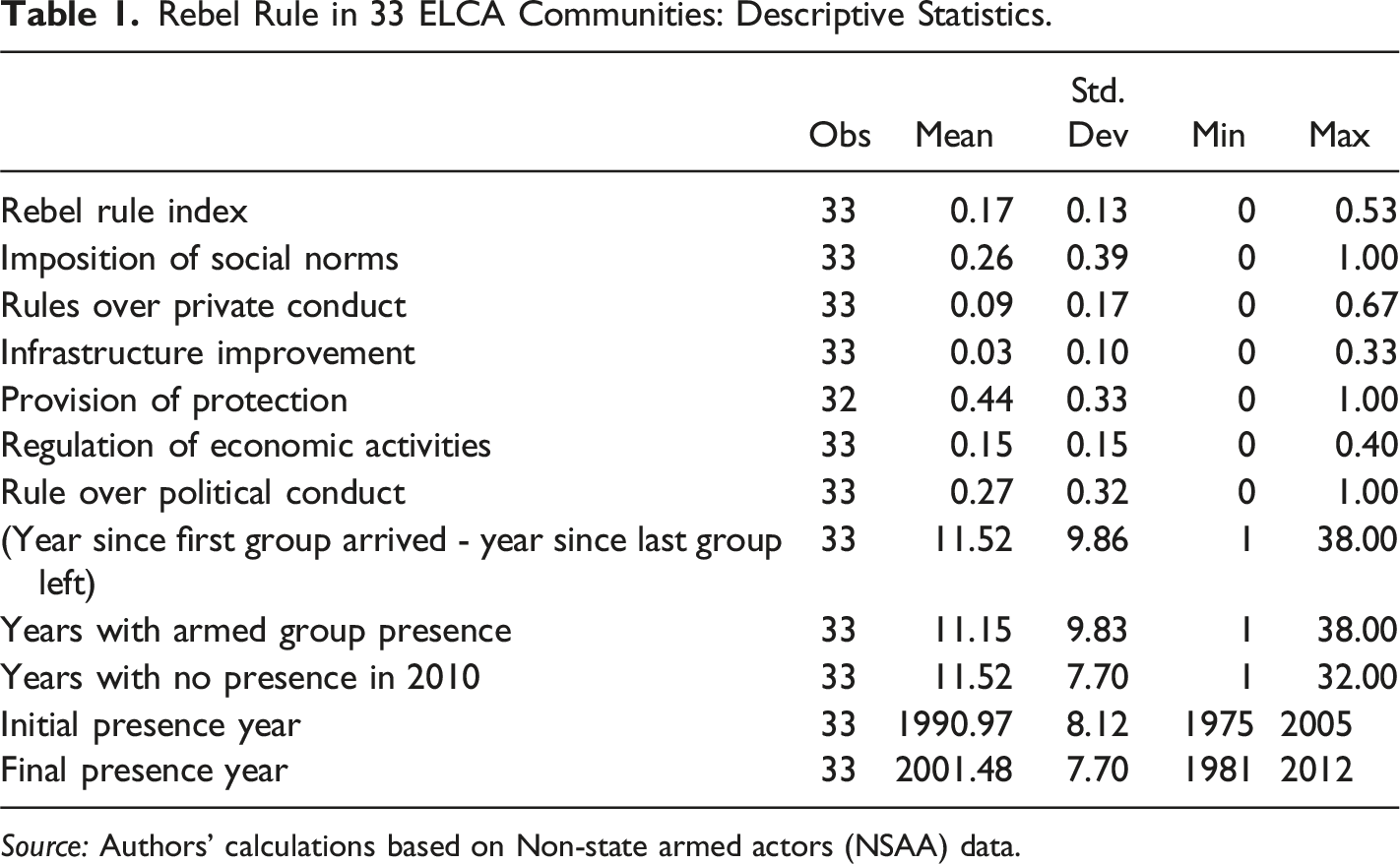
Source: Authors' calculations based on Non-state armed actors (NSAA) data.
The strongest dimensions of the rebel rule index in a scale from 0 to 1 are the provision of protection (0.44), the imposition of social norms (0.26), and ruling over political conduct (0.27) (Table 1). When it comes to the specific governance roles that armed groups adopted, the most common where the regulation of population mobility, which happened in 71.9% of the communities, and the restriction of freedom of speech, which took place in about half of the communities. Regulation of economic activities, albeit weaker, was also important: in nearly one-third, economic activities were regulated. In 30.3% of all communities, armed groups adjudicated disputes, and in 9.1% armed groups improved community infrastructure (Table A1 in Online Supplement).
We merged the ELCA dataset with daily data on rainfall collected between 1980 and 2016 in 1,365 monitoring stations of the Institute of Hydrology, Meteorology, and Environmental Studies (IDEAM). Using the geographic coordinates included in ELCA, we merged each household to the three closest weather stations. 9 The number of weather stations for our sample is not correlated with the rebel rule index nor with violence, 10 hence our results are not attenuated due to poor coverage in communities with less state presence (Schultz and Mankin 2019).
These data allow us to calculate excessive rainfall and drought shocks for two extreme weather events that occurred in Colombia between 2010 and 2016. In July 2010, after we finished collecting the ELCA baseline, La Niña started and lasted until April 2011. La Niña caused rainfall well above historical averages and reached maximum historical levels in some regions. To estimate the index of excessive rainfall, we: (i) calculated the monthly historical averages and standard deviations per monitoring station; (ii) calculated the monthly number of days per monitoring station in which the rainfall was 1.5 standard deviations above the monthly historical averages during the three years before each wave; 11 and (iii) averaged the number of rainfall days for the three monitoring stations. The excessive rainfall index measures the average number of days with rainfall which are 1.5 standard deviations above the historical mean. We conduct robustness tests using 0.5 and one standard deviation above the historical mean later in the paper with no change to the main results.
The second weather event took place in May 2015, when the second strongest El Niño since 1950 began in Colombia. High temperatures lasted until May 2016 and caused severe droughts, as well as a significant reduction in river flows and reservoir water levels. The droughts severely affected agricultural production, reducing food supply, and causing a sharp increase in food prices. We use the Standardized Precipitation Index (SPI) to measure the extent of this drought shock. We calculate the monthly SPI for each monitoring station and define that a drought shock occurs in a monitoring station when the SPI is less than minus one. We define a household having had a month with a drought shock if at least two of the three monitoring stations had a SPI lower than minus one. The drought index for each household measures the number of months with a drought shock during the three years before each wave. We test the robustness of the results to alternative definitions of the index and results remain unchanged. Table B2 of the Online Supplement reports the descriptive statistics for each shock.
Empirical Strategy and Results
This section tests the hypotheses outlined above. First, we measure effects on household consumption and agricultural production. Second, we examine how households make use of survival migration strategies, a common coping strategy in rural communities to manage extreme economic shocks.
Household Consumption and Agricultural Production
To identify the impact of weather shocks on household consumption and agricultural production, we estimate the following regression
The rainfall shock
One concern with the regression above is that some of the conditions that favored the establishment of rebel rule may have also influenced household economic conditions and their ability to respond to weather shocks. Because armed groups left on average 11.2 years before the baseline survey, reverse causality is unlikely to bias our main results. However, omitted variables may be a problem. To address this, we first exploit the panel data nature of the data and control for household fixed effects
Second, other unobservable dynamics correlated with rebel rule may bias our coefficient estimates. For example, the state may decide to invest more funds in communities with high levels of rebel rule once armed groups leave as a counterinsurgency strategy, or other competing armed groups may take advantage of the power vacuum left by the departed group and take over. To control for these potential confounders, we include municipality fixed effects
Third, one critical variable – violence – may affect both the economic characteristics of households and be potentially correlated with rebel rule. The household fixed effects we mention above control only for direct exposure to violence while armed groups were present in the community. To account for the more general exposure to violence of households during the conflict, we control also for the number of different violent incidents experienced in the community in the year before each survey
Lastly, we control for household characteristics that change over time.
Effect of Excess Rainfall and Drought on Household Annual Agricultural Production and Annual Aggregate Consumption – Fixed Effects Regressions.
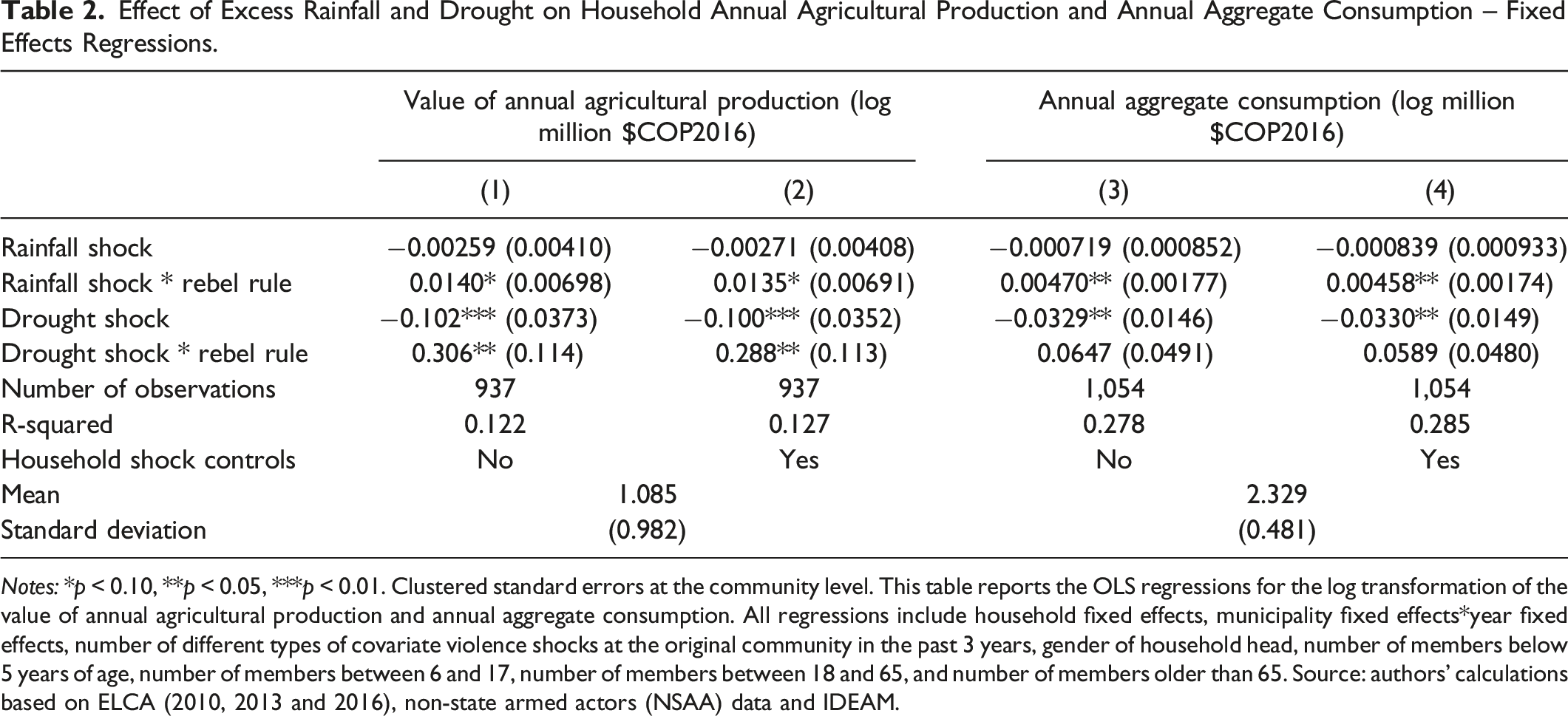
Notes: *p < 0.10, **p < 0.05, ***p < 0.01. Clustered standard errors at the community level. This table reports the OLS regressions for the log transformation of the value of annual agricultural production and annual aggregate consumption. All regressions include household fixed effects, municipality fixed effects*year fixed effects, number of different types of covariate violence shocks at the original community in the past 3 years, gender of household head, number of members below 5 years of age, number of members between 6 and 17, number of members between 18 and 65, and number of members older than 65. Source: authors’ calculations based on ELCA (2010, 2013 and 2016), non-state armed actors (NSAA) data and IDEAM.
In line with the first hypothesis, Table 2 shows that the impact of both shocks is lower among households living in communities that experienced stronger levels of rebel rule during the conflict. Evaluated at the mean level for the rebel rule index, the impact of the drought shock on household agricultural production is reduced by 0.17SD for these households. The effect of the rainfall shock is similar, albeit of lower magnitude and not statistically significant. These households are also better able to insure consumption against both adverse economic shocks. The negative impact of the drought on consumption in communities under stronger rebel rule (in relation to communities where rebel rule was not implemented) is reduced by 0.08SD when evaluated at the mean of the rebel rule index. These results are robust to using alternative definitions for the two weather shocks (Table B4 in the Online Supplement).
Coping with Weather Shocks
Another way of measuring the economic resilience of households is to examine how well they cope with adverse shocks. To compensate for the loss of income, rural households often rely on private transfers, such as loans or the sale of assets (Munshi and Rosenzweig 2016; Rosenzweig and Stark 1989). If access to financial markets is limited or the support from social networks is not sufficient, households may resort to migration, either by sending some household members to nearby towns to earn additional income or migrate in its entirety (Dillon, Mueller, and Salau 2011; Gröger and Zylberberg 2016; Halliday 2006; Jessoe, Manning, and Taylor 2018).
We test whether stronger forms of rebel rule during wartime shapes the reliance of households on survival migration, using a similar empirical strategy as above
Overall, Urban, and Rural Migration – Linear Probability Model.
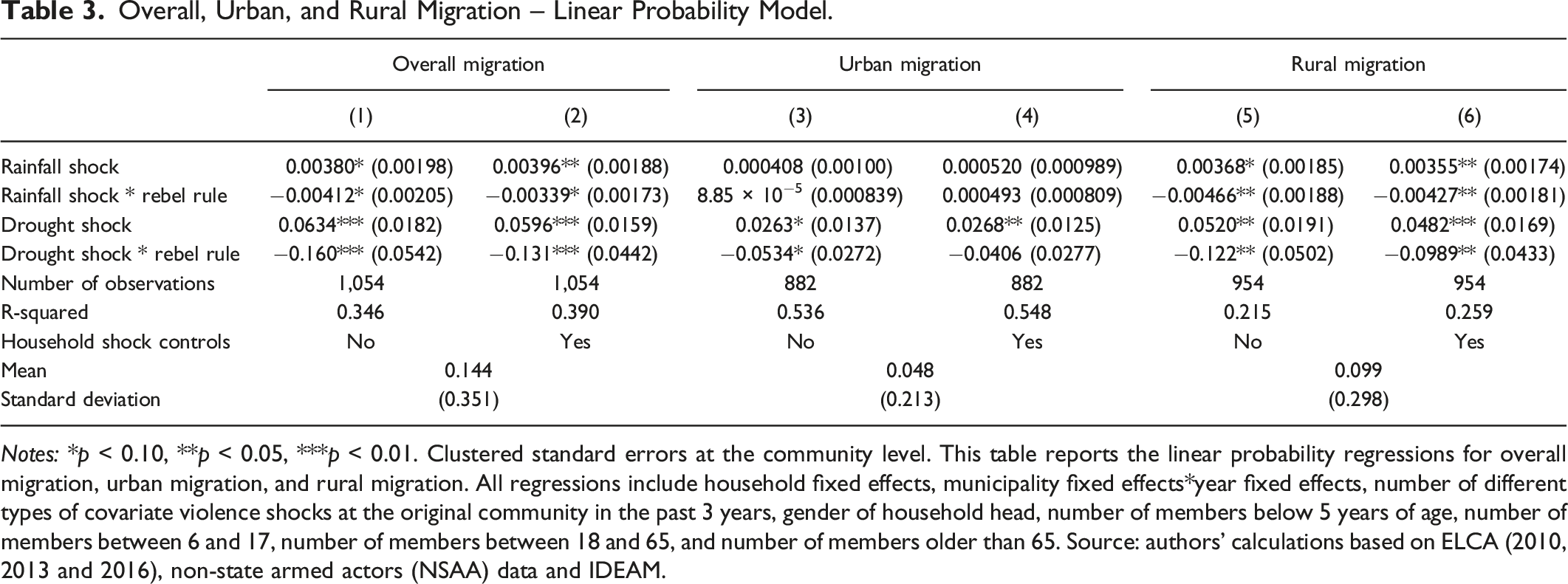
Notes: *p < 0.10, **p < 0.05, ***p < 0.01. Clustered standard errors at the community level. This table reports the linear probability regressions for overall migration, urban migration, and rural migration. All regressions include household fixed effects, municipality fixed effects*year fixed effects, number of different types of covariate violence shocks at the original community in the past 3 years, gender of household head, number of members below 5 years of age, number of members between 6 and 17, number of members between 18 and 65, and number of members older than 65. Source: authors' calculations based on ELCA (2010, 2013 and 2016), non-state armed actors (NSAA) data and IDEAM.
Consistent with Hypothesis one, we observe that households living in communities that experienced higher levels of armed group rule during the conflict are less prone to migrate in response to weather shocks in the post-conflict period. Relative to households with lower levels of rebel rule, the impact on household migration of a one standard deviation increase in rainfall and drought shocks is reduced by 2.4 percentage points and 8.2 percentage points, respectively, when evaluated at the mean of the rebel rule index (0.183). This is equivalent to, respectively, a 15.7% and 40.2% reduction in migration compared to households where the rebel rule index is equal to zero. These results are robust to the alternative definitions of weather shocks (Table B4 in the Online Supplement).
Taken together, we interpret the results above as supporting Hypothesis one: stronger levels of armed group rule during the conflict are associated with better economic resilience of households in the post-conflict period, in comparison to households living in communities where armed groups were present during the war but exercised limited rule.
Potential Endogeneity and Robustness Testing
While suggestive, the results described above might not be causally driven if specific initial conditions in a community drive long run economic resilience and shape the incentives armed groups have to maintain high levels of rebel governance. The main identification threat faced by our results lies in the possibility that some of these community-level omitted characteristics are causing both higher levels of rebel rule and better long-run economic conditions. This could certainly be the case if, as Mampilly (2011) argues, greater state penetration leads to more efficient rebel administration or, as documented in (Sánchez de la Sierra 2020), higher community wealth and the capacity to tax it explains the emergence of rebel governance. 16 In this section we present the results of several robustness tests meant to evaluate if our results are in fact being driven by either initial levels of state presence or community wealth
State presence
One important potential confounding variable is state presence. First, lack of state presence in many parts of the world is an enabling factor for non-state armed groups to operate, provide state-like services, and establish governance regimes. Second, once armed groups leave the territory, the state may establish its presence and increase investment as a counterinsurgency strategy. Third, armed groups and local populations alike may behave differently in relation to each other depending on the reach and strength of state presence across different communities. The inclusion of municipality fixed effects interacted with year dummies in our main regressions partially controls for these dynamics. We also include as controls more granular variables that measure state presence levels before the arrival of armed groups in each community and in 2010. Table B5 presents these results for two measures of initial levels of state presence. First, we collected information on state presence in each community the year before the first non-state armed group arrived along six dimensions of state presence and capacity: police presence, health centers, phone services, paved roads, military presence, and court presence. We created an index of state presence by adding up these six variables. The coefficient estimates for both shocks are robust to the inclusion of this variable as an additional control. Second, we measure state presence at the community level in 2010 by using variables that indicate the provision of public social services: child day care, nutrition programs, primary and secondary schools, and a functioning health center. Controlling for this form of state presence in 2010 increases the magnitude of the coefficient estimates of both weather shocks, which suggests that we may be underestimating the effects of wartime rebel rule on household economic resilience.
Initial community wealth
Conflict-affected households may be more resilient to income shocks in the long term not only because they were exposed to stronger forms of rebel rule but because they lived in communities that were initially wealthier and with stronger institutions before the arrival of rebels. We include two municipal-level controls that intend to measure wealth levels before non-state armed groups arrived in each community and interact these proxies for municipal wealth with both weather shocks. The two variables related to agricultural production and rural wealth are: (i) the percentage of land plots over 500 ha in 1984; and (ii) the percentage of land used for agricultural production in 1970. Table B5 in the Online Supplement reports the coefficient estimates for the interaction terms between both weather shocks and levels of rebel rule for the baseline regressions and for regressions where we include each of the two variables in a separate equation. We report the coefficient estimates for the three main outcomes: value of annual household agricultural production, aggregate annual household consumption and overall household migration. 17 The coefficient estimates for both shocks are robust to controlling for these initial wealth conditions.
Violence and Community networks
An additional potential source of selection on unobservables might come from the possibility that rebel governance is more likely to be established in areas where it is easier to exercise monopolistic territorial control and, for the same reason, where there is less violent conflict among armed groups. Any positive economic benefits ascribed to rebel rule might be just in fact due to lower violence levels during wartime. Relatedly, the effects of rebel rule may be also reflecting the effects of communities that experienced higher forced out-migration during conflict times becoming more tightly knit after conflict ends. Solidarity among members of these communities might be stronger, generating incentives for people to migrate less (Munshi and Rosenzweig 2016; Rosenzweig and Stark 1989).
While we do not have information on the number of violent actions that took place in each community during the period of rebel-group presence, we use i) the total number of internally displaced persons in the municipality during the years that armed groups were present in the community, and ii) the total number of years during which there was violent competition across armed groups within each of our communities, as proxy variables for the intensity of violence during the conflict years. 18 As shown in Table B5, including these two variables interacted with both weather shocks as controls in our main specification does not affect the magnitude or precision of our coefficients of interest.
Possible correlation between rebel rule and weather shocks
Non-state armed actors seek to control territories with strategic military value, as well as those that have potential for rent extraction or are characterized by features that enable the safe establishment of a stronghold (Arjona 2016; Mampilly 2011; Olson 1993; Sánchez de la Sierra 2020). These characteristics that make communities attractive to armed groups seeking to rule may be correlated with weather shocks if communities that experience less extreme weather shocks, and thus less income variation, have higher income levels as a result. Although household fixed effects control for historical weather conditions across communities, past levels of rebel rule and current weather events could still be correlated. Figure B3 in the Online Appendix explores whether this is the case. We plot yearly rainfall and drought shocks from 1966 to 1976, before armed groups arrived in ELCA communities: (i) with and without armed group presence (panel A); and (ii) with levels of rebel rule below and above the median levels (panel B). Yearly rainfall shocks are almost identical for communities with and without armed group presence, while for drought shocks this is the case from 1972 onward.
What Dimensions of Rebel Rule Matter?
Not all dimensions of rebel rule are likely to matter in the same way for long-term household economic resilience. Although our sample size is not sufficiently large to allow for a robust test of which dimension—or combination of dimensions—is driving the results, we explore the effect of each dimension on our main variables of interest and probe potential mechanisms for the dimensions with a statistically significant association. We estimate in this section the baseline regressions between the three outcomes of interest and each of the six dimensions that compose the rebel rule index.
Figure 1 shows the coefficient estimates for the interaction term of each dimension and the rainfall shock (panel A) and drought shock (panel B). Table B6 in the Online Supplement reports the regression estimates. We observe three relevant results. First, the estimates indicate that the long-term economic legacies of wartime rebel rule are strongly associated with the improvement of infrastructure by non-state armed groups. In communities where armed groups either directly improved infrastructure, or pressured local authorities to do so, the negative impact of both weather shocks on agricultural production is smaller and the need to resort to survival migration is less frequent. We need to interpret these results with caution because the prevalence of infrastructure improvement by armed groups in our sample is quite limited (Table 1). However, this result is not surprising given that public goods provision has been shown to increase the productive capacity of households and generate incentives for investing (Besley and Persson 2009, 2010).
19
Coefficient estimates 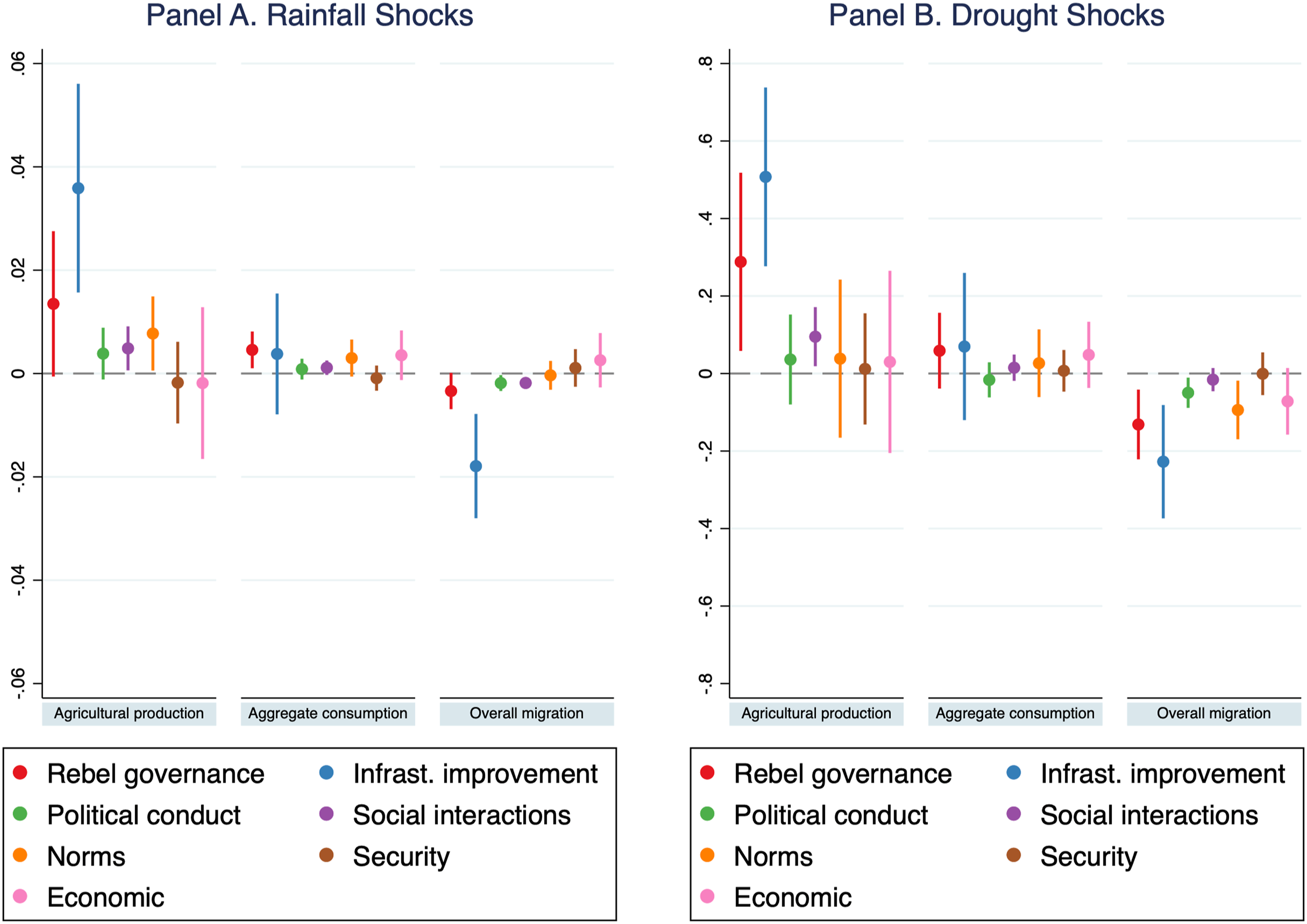
Second, the political dimension of the rebel rule index (labelled as political conduct) also partially explains these long-term legacies, although the effect is weaker and less precise. This effect is driven largely by the adjudication of disputes. 20 It is plausible that the observed importance of this component is due to the fact that the efficient adjudication of disputes might i) foster an environment of predictability that might increase the incentives to invest and thus boost long-run productivity, and ii) foster social cooperation in the community and thus facilitate the achievement of common economic and political goals (Arjona 2016). It could be the case, however, that the establishment of external dispute resolution mechanisms leads to the erosion of locally conceived dispute adjudication arrangements. Rebels providing external dispute adjudication services might have crowded out local institutions in such a way that, once armed groups leave, communities are made worse off due to their lack of installed capacity for conflict resolution. If this were indeed the case, we would expect communities where armed groups have left recently to be worse off than communities where groups have been gone for longer since the latter have had a longer time to rebuild their local conflict resolution mechanisms. Regressions shown in Table B12 in the Online Supplement, where we include an additional interaction term for the amount of time elapsed since rebels left a community, show instead that the effect of rebel rule—and of the political conduct component in particular—is actually higher the less time has passed since rebel presence, and that these effects decrease in time. We take this result as suggestive evidence that the crowding-out of dispute-resolution mechanisms is not likely happening in our sample of communities.
Third, more frequent social interactions between community members and armed groups present in the area, and the imposition of explicit social norms by these groups, are also associated with the positive economic legacies of rebel rule on production and migration. These results are consistent with the idea that closer engagement between armed groups and local populations may foster greater certainty and less fear (Justino and Stojetz 2018) which could potentially increase their resilience in the face of future shocks.
Finally, stronger rebel governance may create better conditions for economic resilience by reducing the overall uncertainty civilians face. We explore whether civilians’ perception of lower levels of uncertainty are associated with higher consumption and production as well as less migration after the weather shocks. We measure civilians’ perception of uncertainty with three dichotomous variables indicating whether, at any point during the war, civilians (i) felt that there were no clear rules, and anything could happen (unpredictability); (ii) did not know the rules combatants had to follow in their treatment of civilians (uncertain combatant behavior); and (iii) felt either somewhat or very insecure (insecurity). We estimated the effect of the interaction between each of these variables and each weather shock on the three main outcomes. Although the coefficient of these variables has the expected sign in most models, its magnitude is rather small and not statistically significant. We also explored whether an index of perceived uncertainty that aggregates these three variables (uncertainty index) is associated with households’ economic resilience and did not find a robust effect. 21 These results may indicate that higher levels of rebel governance created an advantage for households mostly because of service provision and dispute resolution rather than stability in the rules of the game. It is of course possible that these variables fail to capture well the variation in civilians’ perception of uncertainty during the war, an issue that future research and data collection need to address in more detail.
Mechanisms: Household productivity or local institutions?
As stated in Hypothesis two, rebel rule might be impacting long-term economic resilience through two channels: increases in household productivity, and/or an improvement in local institutions. Although we are not able to fully test these competing explanations, we attempt to provide suggestive evidence arguing that both mechanisms are at play. First, regarding household productivity, Figure 2 reports the coefficient estimates of a regression of each of the dimensions of the rebel rule index on a measure of land productivity in 2010. These regressions include household controls, the incidence of weather shocks three years before the survey, and municipality fixed effects. Although not a causal effect, the results suggest a strong positive correlation between the component of infrastructure improvement and the value of land productivity, suggesting higher investment and productivity in regions with higher levels of rebel rule.
22
The main infrastructure improvement supplied by armed groups in Colombia, in particular by the FARC, were roads,
23
which allowed them to control the territory by geographically integrating regions, extract taxes from the population, leverage the support of the population and connect rural producers to markets (Otero-Bahamon, Uribe, and Peñaranda-Currie 2022). The effects of rebel-led infrastructure improvement on agricultural productivity are consistent with the well-documented observation that, by reducing domestic trade frictions, road improvements allow rural households to specialize and increase their productivity (Sotelo 2020). Coefficient estimates for rebel rule, provision of public goods and political conduct on land productivity. Notes: This figure plots the coefficient estimates for regressions of each of the 6 dimensions that compose the rebel rule index on household’s land productivity at the baseline year (2010).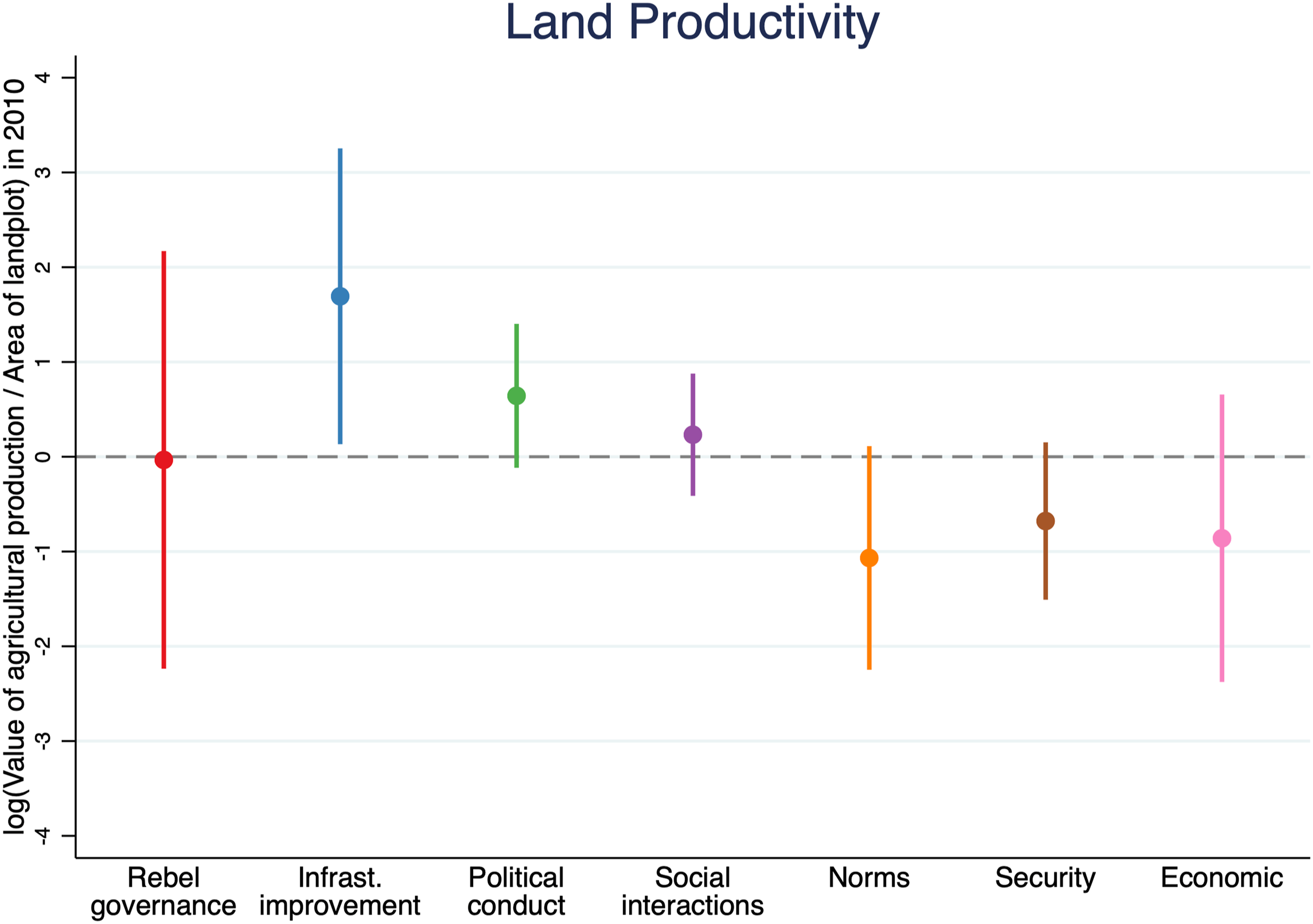
Besides the ‘direct’ impact that infrastructure improvement might have on productivity, these interventions may also have long lasting economic effects if they strengthen local institutions. The delivery of better road infrastructure may strengthen local institutions through better access to markets and outside social networks (Müller-Crepon, Hunziker, and Cederman 2021). It might be that once a rebel group demands local authorities to carry out infrastructure improvements communities become better accustomed to demanding and expecting interventions of this sort in the future. Similarly, considering the infrastructure needs of communities might become more institutionalized in the municipal bureaucracy once an armed group initially pressures authorities to do so. Finally, infrastructure improvement might boost long-run collective action in communities where armed groups demand community members to contribute their own labor to the project.
We explore whether these institutional channels may be playing a role in explaining increased productivity levels by controlling for the current state of road infrastructure in each community. We create a dummy variable equal to one when the community has paved roads in good condition, paved roads in bad condition, or dirt roads in good condition, interact this dummy with both weather shocks and include it as an additional control in our main specification. Results in Table B6 show that the coefficient estimates for the interaction term of weather shocks and the rebel rule index are robust to controlling for road conditions, which indirectly suggests that, even in places where roads at the time of the weather shock are in bad condition, communities where rebel groups led infrastructure improvement projects still have higher economic resilience levels. The long-lasting, positive economic legacies of rebel rule seem to operate not only through direct impacts on long-run productivity, but also through improvements in the institutional capacity of local communities. Although only suggestive, these results add to the evidence that rebel rule may have lasting economic legacies through the (relatively) better institutional environment it produces.
Discussion and Conclusions
This paper studies the long-term economic legacies of rebel governance. The main results show that households living in communities with stronger levels of rebel rule during the civil war in Colombia are better able to cope with adverse economic shocks caused by extreme weather events in the post-conflict period. These effects seem to be driven by rebel-led improvement of infrastructure, their involvement in dispute adjudication, and their level of social interaction with local populations. Against our expectations, lower levels of uncertainty and insecurity—as perceived by locals—fail to be associated with the improvements brought by higher levels of rebel rule.
It is, however, important to note that the marginally better conditions of these households do not necessarily translate into an overall positive economic impact of conflict. It is paramount not to forget that these communities were affected by armed conflict, where rules are imposed under the threat of violence and curtail several rights and liberties. Also, because these armed group interventions are unstable and arbitrary, these marginally improved economic conditions come at a cost. Using the same data, we find in two complementary studies that enduring the rule of armed groups leads communities exposed to higher levels of armed group rule to have weaker preferences for the rule of law (Arjona et al., 2021), and trust other community members less (Cárdenas et al., 2021).
These results have nonetheless important implications. First, they illustrate the complexity of conflict zones, beyond typical portrayals as areas of violence, destruction, and anarchy. In Colombia, as in many other conflict-affected contexts, non-state armed groups rule and interact with communities as part of their attempts to advance control over the national territory. These interventions may leave important economic and institutional legacies over the long term. Second, internal conflict is often perceived as ‘development in reverse’. The findings in this paper indicate that conflicts are also areas of institution building, where institutions are created and transformed (Justino 2013), affecting the economic conditions of communities well after armed groups leave the territory. Additional research to understand the economic legacies of armed group behaviors during wartime is important.
Our paper concentrates on a particular context and with a dataset that is representative of four regions in Colombia. In order to gauge the external validity of our results, new research in other countries is required. Future research should also concentrate on better understanding the distributive implication of these interventions. Non-state armed groups create new elites, adjudicate property rights, force opponent households to relocate, and impose taxes on particular groups, with critical yet under-researched implications for state and peace building processes in the aftermath of violent conflicts. Also, we concentrated in this paper on households that stayed in the conflict-affected regions and are thus missing an important component of the economic impact of rebel governance: the consequences for households that were forced to migrate under threat of violence. Despite these caveats, this paper will hopefully inspire interest in better understanding how a more nuanced portrayal of the institutional impacts of armed conflict may contribute to the design of better post-conflict policies.
Supplemental Material
Supplemental Material - The Long-Term Economic Legacies of Rebel Rule in Civil War: Micro Evidence From Colombia
Supplemental Material for The Long-Term Economic Legacies of Rebel Rule in Civil War: Micro Evidence From Colombia by Ana María Ibáñez, Ana Arjona, Julián Arteaga, Juan C. Cárdenas, and Patricia Justino in Journal of Conflict Resolution
Supplemental Material
Supplemental Material - The Long-Term Economic Legacies of Rebel Rule in Civil War: Micro Evidence From Colombia
Supplemental Material for The Long-Term Economic Legacies of Rebel Rule in Civil War: Micro Evidence From Colombia by Ana María Ibáñez, Ana Arjona, Julián Arteaga, Juan C. Cárdenas, and Patricia Justino in Journal of Conflict Resolution
Footnotes
Acknowledgements
María Adelaida Ortega provided excellent research assistance. We are grateful to Sara Zamora and Camilo Corredor for their outstanding work collecting the detailed qualitative and quantitative data on the conflict communities. We gratefully acknowledge funding from the International Development Research Centre (IDRC). Diego Bautista, Steve Boucher, Michael Carter, Markus Gottsbacher, Francisco Gutiérrez, Alyssa Prorok, Elisabeth Wood, and participants in the AARES Annual Conference, CEDE seminar, ICESI, FBA Research and Policy Dialogue, LACEA Labor Network workshop, London School of Economics, Princeton University, University of California at Davis, University of Southern California, and Yale University provided valuable comments.
Declaration of Conflicting Interests
The author(s) declared no potential conflicts of interest with respect to the research, authorship, and/or publication of this article.
Funding
The author(s) disclosed receipt of the following financial support for the research, authorship, and/or publication of this article: This work was supported by the International Development Research Centre, 107221-001.

Supplemental Material
Supplemental material for this article is available online.
Notes
References
Supplementary Material
Please find the following supplemental material available below.
For Open Access articles published under a Creative Commons License, all supplemental material carries the same license as the article it is associated with.
For non-Open Access articles published, all supplemental material carries a non-exclusive license, and permission requests for re-use of supplemental material or any part of supplemental material shall be sent directly to the copyright owner as specified in the copyright notice associated with the article.
