




Abstract
Contest theory analyses an anarchic economy where agents use resources for consumption or acquisitive conflict, and explores conditions under which peace or conflict prevail in equilibrium. History suggests that peacekeepers in the shape of kings, dictators or states arise endogenously in such circumstances. I analyse a model where each of the potential contestants first has the option of contributing some resources to a neutral peacekeeper, and then allocates her remaining resources between arms and consumption. If one of the contestants subsequently attacks the other, then the peacekeeper joins its resources with the agent that is attacked. I show that, for less unequal resource distributions, contribution to peacekeeping is positive and leads to peace in equilibrium. These equilibria are pareto-superior to the corresponding equilibria of the pure Tullock contest except in a narrow range. When the distribution is too unequal, no contributions are made and conflict occurs in equilibrium.
Introduction
THE final cause, end, or design of men (who naturally love liberty, and dominion over others) in the introduction of that restraint upon themselves, in which we see them live in Commonwealths, is the foresight of their own preservation… Hobbes, Leviathan, Chapter XVII
The first and fundamental precondition of civilised society is the suppression of violence and maintenance of peace between citizens. Rulers throughout history have derived their legitimacy and authority from the ability to perform two functions: those of peacekeeper and protector. The primary legitimacy of the contemporary nation-state is also founded on these roles. Citizens, even individually powerful citizens, pay taxes to the state to enable it to curb their natural tendencies to encroach on each other, and of outsiders to encroach upon them. Conversely, a mechanism that keeps these tendencies in check among citizens and outsiders satisfies the rudimentary definition of a state, enhances the well-being of those citizens, and provides a foundation for the concept of property.
In the absence of a mechanism to protect property, warring adversaries are likely to engage in destructive conflict, or expend substantial resources to repel aggression. Thus agents have a common interest in collaborating to develop an enforcement mechanism to discipline their mutual aggressive inclinations. Security of property is also inseparable from internal order, which has historically been fundamental for the stability of kingdoms. The prosperity of the Roman Empire was founded upon a lasting peace between its subject states, which allowed trade and commerce to flourish. During the feudal period in England, potential conflict between great lords was held in check by the Crown, funded by tribute from those very lords. Local markets and trade fairs extended this peace to merchants and traders. 1
This paper focuses on peacekeeping; protecting property rights and keeping peace between agents who might otherwise engage in conflict. In order to maintain peace in a potentially predatory setting, a ruler or state must possess two characteristics. First, it must generate adequate resources from its subjects to be able to contain conflict, and ideally to dissuade it before it occurs. Secondly, it must be in the peacekeeper’s interest to use the resources to indeed contain conflict, rather than for the purposes of self-aggrandisement. I explore the first condition—circumstances in which potential contestants voluntarily contribute sufficient resources to maintain a central peacekeeping mechanism. The second function is better analysed in a dynamic model using folk-theorem-like arguments, and is not addressed here. Thus this paper highlights the ‘demand side’ of the market for peacekeeping, and ignores the ‘supply side’.
In the related literature, conflict has been widely analysed within the framework of the rational contest model (Tullock 1980). Competing agents can use resources in their possession to engage in production, or to wrest away resources from other agents—the “butter versus guns” decision. Consequences of various formulations of the nature of contests are explored in Hirshleifer (1991, 1995), Skaperdas (1992), Grossman and Kim (1995) and others. 2 A primary concern in this literature is to investigate technological conditions that determine whether there is active conflict or peaceful coexistence. Grossman and Kim (1995) consider investments that are earmarked for aggression (e.g., cannons) or defence (e.g., fortification) and obtain equilibria in which peace sometimes prevails. In Hirshleifer’s (1991) formulation, resources devoted to conflict can be used both for aggression and defence; thus an investment to dissuade the adversary also provides incentive for aggression (see also Powell 1993). 3 Pre-existing productive relationships between agents also predispose them towards peace. The pioneering paper by Hirshleifer (1991) presumed that output was jointly produced by the two contestants, who devoted some of their resources to production and the rest to acquire a bigger share of it. Skaperdas (1992) analyses a similar model in which contestants’ resources are complements in producing a consumption good. Peace occurs when the productivity of resources in production is sufficiently larger than their effectiveness in conflict. 4
Surprisingly, however, very few contributions in this literature explore the viability of peacekeeping institutions or self-enforcing cooperative arrangements to deter aggression. Meirowitz, Morelli, Ramsay, and Squintani (2019) explore how third-party institutions that resolve or mitigate the consequences of destructive disputes influence the conflict strategies of contestants. McBride, Milante, and Skaperdas (2011) is one of the few papers that explore the possibility that contestants can invest in the establishment of a state, which then protects a fraction of resources from conflict (see also McBride and Skaperdas, 2007). Konrad and Skaperdas (2012) analyze a scenario where a community of producers face the threat of extortion from external aggressors (‘bandits’), and compare collective provision of security with provision of security for profit by a private provider. The profitability of private provision (a “king”) is also explored in Grossman (2002). This is not an exhaustive list, but the underrepresentation of publicly funded peacekeeping arrangements is nevertheless striking, given that such arrangements have held sway across much of human civilization over much of historical time.
This paper extends the Tullock contest game to incorporate the possibility that the contestants may voluntarily (and non-cooperatively) endow a peacekeeper which dissuades them from engaging in conflict with each other. The two potential contestants choose to make contributions that are transferred to the peacekeeper, which uses those resources to arm itself. In the subsequent subgame each contestant can allocate its resources to consumption, or to acquire private arms which can be used both for defence and attack. If one of the contestants chooses to be an aggressor (and the other does not), then the peacekeeper adds its resources to the defence of the victim. The fruits of successful aggression is the capture of the adversary’s consumption, while failure results in one’s own consumption resources being forfeited. If neither player attacks, then they consume their respective remaining resources in peace.
It follows that a potential aggressor would be dissuaded from attacking if the peacekeeper and the defender together have sufficient arms to render aggression unattractive. If a sufficiently large fraction of battle resources is in the possession of the peacekeeper, then it serves to dissuade both agents. Here the model has similarities with Grossman and Kim (1995), where agents can invest separately in defensive and aggressive arms. In our case the same defense serves to protect both agents against aggression. Thus peace with a peacekeeper is less costly than peace with mutual deterrence, even when the latter is possible.
Now suppose that the peacekeeper receives enough resources such that each contestant finds it unattractive to be the aggressor, even when his rival devotes no resource to arms. Then it is an equilibrium for neither agent to arm, and we must have peace in this equilibrium. Anticipating this, each contestant must find it more profitable to make the corresponding contribution to peacekeeping, which allows him to consume his remaining resources, rather than to acquire arms and prepare for a contest. If one agent contributes less than the required amount, then the deterrent effect of the peacekeeper is reduced, and that agent also has more resources available to arm and attack. Thus there are tradeoffs, and non-trivial strategic concerns involved.
I find nevertheless that peace prevails except when there is extreme inequality in initial endowments between the agents. Further, the only peace equilibria are of the class where the peacekeeper is endowed with adequate deterrent capabilities and neither contestant devotes any resources to arms. However, when the intital allocation of resources is extremely unequal, agents no longer contribute to peacekeeping in equilibrium.
The peacekeeper in this paper is an exogenous agent that I do not attempt to rationalise. However, it is discernably a very rudimentary instance of a modern state. I have refrained from using the term “state” because that is a more complicated construct than a mere peacekeeper, and such usage will likely confuse more than it will illuminate. Nevertheless, in our model, the peacekeeper has a monopoly on the legitimate use of violence. Legitimate use occurs when it is necessary to quell an aggressive agent, and not for self-aggrandisement. We do not address the mechanisms that restrain the peacekeeper from self-aggrandisement; we abstract from this question by constituting the peacekeeper as a programmed mechanism rather than a maximising agent. An important insight of this paper is that even voluntary contributions–without recourse to involuntary taxation–can yield disarmament and an arms monopoly of the state. 5 , 6
Two further observations are of interest (see the Equilibria and Efficiency section). First, there are multiple peace equilibria for a large range of parameter values, but the most efficient equilibrium is always the one in which the richer agent makes the largest contribution. If we interpret contributions as taxes to maintain the state, then the most efficient taxation scheme turns out to be the most progressive one. Secondly, we find that there is a range where allocation of resources is sufficiently unequal, (but not so extreme that peacekeeping breaks down) in which a peace equilibrium prevails, but armed conflict would in fact be more efficient. In this case an inefficiently large peacekeeping force is maintained in equilibrium by contributions from the rich agent, who stands to lose from conflict.
This paper complements earlier works which find that conflict is more likely when there is high inequality between the agents. 7 Some of the intuition in the present paper is close to Beviá and Corchón (2010), who consider the possibility that the defending agent may transfer some of her wealth to the aggressor in order to avoid conflict. Such transfers reduce inequality and therefore the likelihood of conflict. We come back to this in the Transfers Between Agents section. Our model is similar in some ways to Genicot and Skaperdas (2002) who also allow each contestant to invest in conflict management in addition to“guns” and “butter”, but the content and timing of conflict management there is different from investment in peacekeeping here.
The next section describes the model. The Peace, War and Deterrence section analyses the game. The Tullock Contest With no Peacekeeper: Γ2|(
The Model and Preliminaries
There are two agents in the economy, 1 and 2. N = {1, 2} is the agent (or player) set. The economy is endowed with a quantity R of resources, which is normalised to unity. The resources are initially distributed between the agents as R1 and R2, with R1 + R2 = 1, and
Each agent i ∈ N can allocate her resources between three uses: (i) contributions to public peacekeeping denoted by g i , (ii) private arms to attack the other agent or defend against such attacks, denoted by x i , and (iii) the remaining resources R i − (g i + x i ) to consumption goods. The actual consumption enjoyed by an agent is determined by the outcome of the game described below.
Informally, the game proceeds as follows. First, each player chooses a contribution g i to peacekeeping. The sum of these contributions determine the resources at the disposal of the peacekeeper, which are converted into arms. Then each player may choose to devote some or all of his remaining resources to private arms. Finally, each player that has devoted strictly positive resources to private arms decides whether to attack the other.
The objective of each player is to maximize her final consumption. If neither player attacks, then each player consumes her remaining resources and the game ends. If both players attack, then they play a Tullock contest over the sum of the remaining resources using their private arms, and the peacekeeper remains neutral. 8 However, if player i attacks and player j does not, then the peacekeeper adds its arms to the private arms of player j the victim of attack, and the same Tullock contest is played for the remaining resources with these arms. The winning player receives the sum of the remaining consumption resources of both i and j. 9 We emphasise that the peacekeeper is part of the game form and not a player; it passively follows the rules. Thus this paper does not provide a theory of the state, only a rationale for citizens to fund the state’s peacekeeping function willingly.
The Game
The players play a one-shot, three-stage game with complete information. After each stage, they observe each others’ actions and proceed to the next stage.
Game Form
(game Γ): Each agent i ∈ N simultaneously chooses an amount g
i
∈ [0, R
i
] to contribute to peacekeeping. A pair Let w
i
= R
i
− g
i
; then w
i
is agent i’s remaining resources after contributions are made. Denote the post-contribution allocation by We will denote wmin = min{w1, w2} and wmax = max{w1, w2}.
(subgame Γ2|
(subgame Γ3|(
Payoffs
Given a play z of the game, payoffs Π(z) are determined in the following way.
If neither player attacks the other, then each player consumes his remaining resources, and the peacekeeper plays no role:
(a1, a2) = (0, 0) ⇒ Π i (z) = R i − g i − x i , i ∈ N.
If both players attack, then the peacekeeper also plays no role. Each player wins with a probability determined by the arms deployed by the two players. Specifically, the probability that player i wins is given by the contest success function

The winner captures the sum of their remaining resources. Thus

If one player attacks and the other does not, the winner is again determined as in the previous case, except that now the peacekeeper adds its arms to that of the player that did not attack.
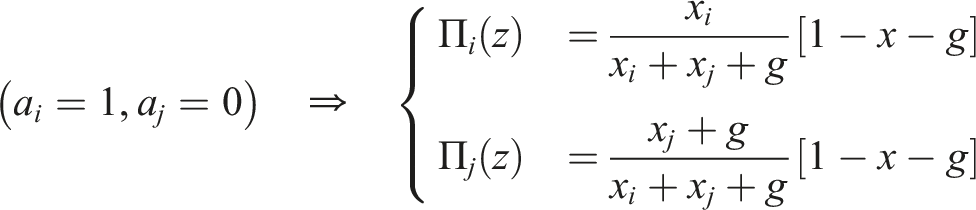
Equilibrium
A strategy for player i is therefore a triple s
i
= {g
i
, x
i
(
Note that, given
Each agent tries to maximize his payoff which is his final consumption. σ = (s1, s2) is an equilibrium if it is a subgame-perfect Nash equilibrium of the game Γ. The corresponding play z(σ) is an equilibrium outcome.
A player does not have the option to “not enter” the game and thereby retain his initial endowment.
Preliminary Observations
Consider the subgame Γ3 after an arbitrary history (
Let
[All proofs are in the appendix.]
Lemma 1 says that if a positive peacekeeping contribution has been made and one player attacks, then the other is better off not attacking since he gets the benefit of the public defence. Further, for tie-breaking reasons we assume
Given ( The assumption posits that agents are not inherently warlike. An agent engages in conflict only when it is strictly beneficial, the expected prize is strictly larger than her consumption when she does not attack. This leads to the following lemma
11
Given ( Next, suppose that in an equilibrium one player attacks in the last stage. Then this would be anticipated in the second-last stage, and both will choose their arms optimally. These best responses are catalogued in Lemma 3.
These expressions are derived by choosing each agent’s arms expenditure to maximize her payoff, and noting i is designated as the attacker. Of course, in order to be consistent, the choices must be such that i satisfies the condition in Lemma 2.

Discussion
Modelling Choices
The contest success function used here is a simplified version of the more general one proposed by Skaperdas (1996)
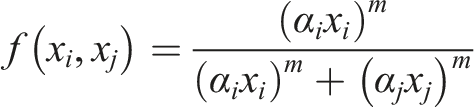
Instead our focus is on the consequence of variations in wealth inequality between the two agents, captured in their initial endowments (R1, R2). Inequality induces asymmetry between the agents because each agent’s investment in conflict is constrained by her initial endowment. I therefore make this constraint “hard”. An agent cannot invest more resources in arms than he initially possesses, as indicated by the resource constraints g i + x i ≤ R i .
Bargaining and Settlement Without Warfare
The model does not explicitly incorporate bargaining to avoid active conflict, which would seem natural in this multi-stage setting. However, note that while arming is costly in the model, conflict is not destructive. Hence if one contestant declares an intention to attack, the resultant payoffs may be obtained through a peaceful transfer of consumption funds as specified by the payoff function, rather than as the outcome of actual conflict. Thus the critical assumption is that guns cannot ex post be transformed into butter. In this interpretation, arms and the peacekeeper change the threat-points of the bargaining game that arises in the final stage, and yield the same outcome as we find here.
Peace, War and Deterrence
We are particularly interested in equilibria in which neither player attacks the other. The Tullock Contest With no Peacekeeper: Γ2|(
Correspondingly It follows that if
The Tullock Contest With no Peacekeeper: Γ2|(g = 0)
The canonical Tullock contest consists of the subgame Γ2 that follows the contribution profile
Let σ be an equilibrium of the pure contest Γ2|( (i) (ii) If R1 ≠ R2 then exactly one player attacks. (iii) σ is a peace equilibrium if and only if (iv) The payoffs to the two players are as follows (recall we have assumed wlog that R1 ≤ R2):
If
Note that when R1 = R2, the players invest as in the best response war efforts (Lemma 3), and are subsequently indifferent between war and peace. The peace equilibrium is unique only as a consequence of our Assumption 1. The pure contest payoffs of each player as a function of the player’s initial endowment, described in Proposition 1 part (iv) above, will be useful later, and are plotted in Figure 1 below. Note that for an endowment It is useful here to point out the effect of the endowment constraint on the outcomes of the game. Compare the outcome here with a game where agent i’s choice of x
i
is not constrained by endowment. Players choose arms, and player i’s expected payoff is
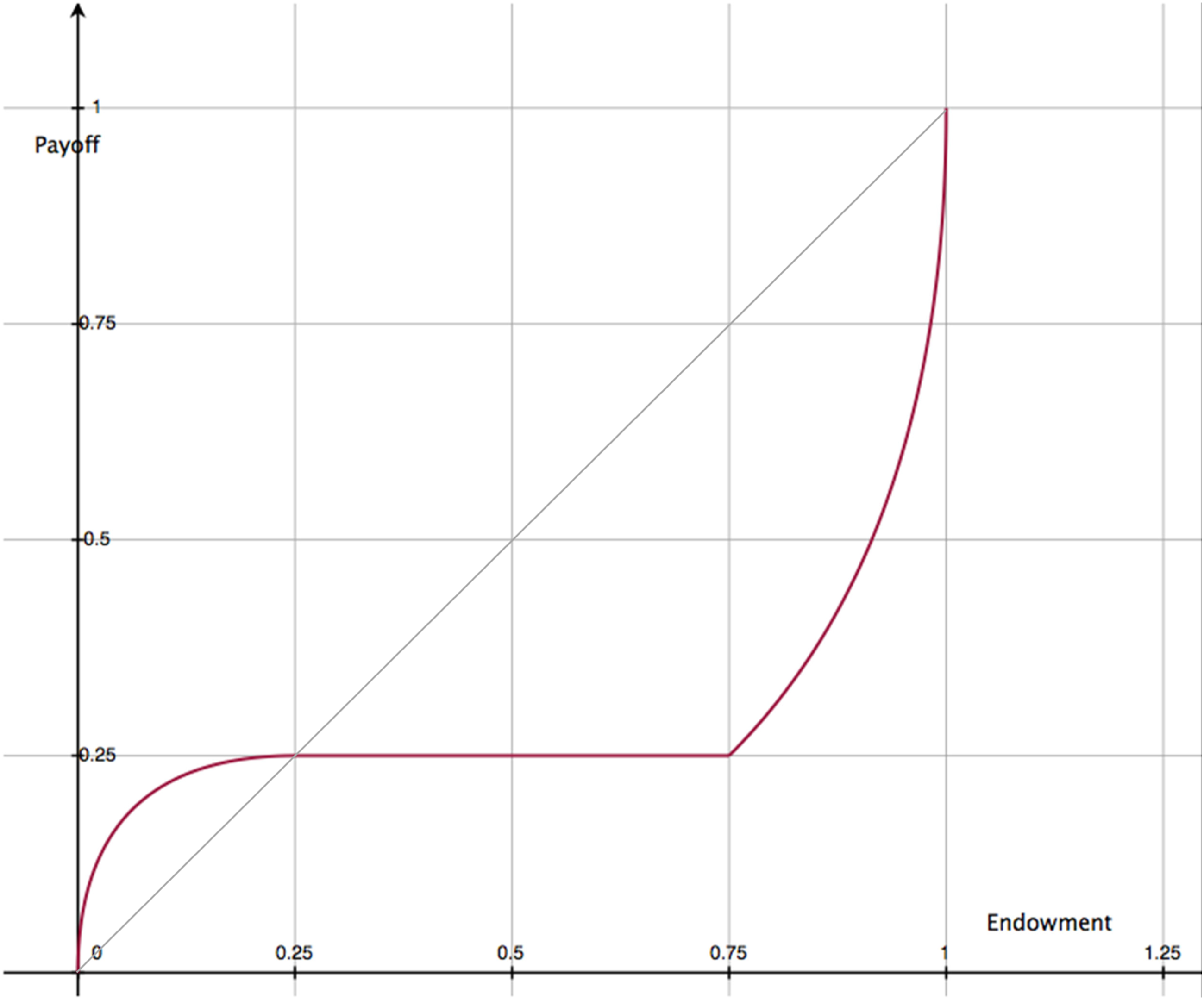
Equilibrium pure contest payoffs for an individual contestant plotted against endowment.
The Subgame Γ2 With Positive Contributions (g > 0)
In this section we turn to the characterization of equilibrium outcomes of the subgame Γ2 when positive contributions to peacekeeping are made in the first stage. The significance of positive contributions g > 0 is that it may dissuade one or both players from investing in private arms, and therefore pre-empt the possibility of war. We show that for each initial endowment vector there is a locus of contribution profiles that are minimal full-deterrent. We establish two primary propositions. First, if a full-deterrent contribution is made, then in the ensuing subgame there is a unique peace equilibrium with no investment in private arms by either agent. Secondly, if the contribution profile is not full-deterrent, then in the subsequent subgame there are no peace equilibria.
Consider an arbitrary contribution profile
Recall from Lemma 2 that player i will only attack if
The profile is minimal full deterrent if A player that retains more resources w after contributions is deterred by a smaller peacekeeping contribution, since the player has more to lose if he loses the contest, and less to win. In order to ensure full deterrence, it is therefore sufficient to deter the player who has the smaller remaining resource endowment wmin after contributions. Further, the minimum contribution needed for full deterrence increases as wmin falls. Hence it is intuitive that full-deterrence is attained with the smallest peacekeeping force when both players retain equal resources after contributions. In our closed-form model, the specific configuration that yields this outcome is
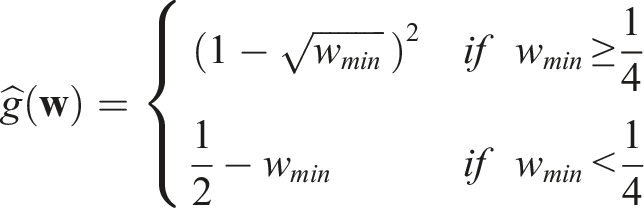
If In Assumption 1 we asserted that agents have a predisposition for peace. In the same spirit we make the further tie-breaking assumption that if
If Lemma 4 and Assumption 2 lead to the following results.
If (a) there is a peace equilibrium with (b) there is no peace equilibrium with x ≠ 0, a = 0, and (c) there is no war equilibrium. So if a full-deterrent profile of contributions is made in the first-stage, then in the subgame the only equilibria are disarmament equilibria, and there is always such an equilibrium. What if a full-deterrence contribution is not made in the first stage? It must then be true that at least one of the players is not deterred by the contribution, and would attack if the opponent did not acquire further arms. However, a priori it is possible that the other agent arms and, together with the public contribution, has a sufficient defence to deter the first player. Hence it is possible that we could have a peace outcome with less than full-deterrent public contributions and positive private arms. The following lemma assures us that such an outcome is not an equilibrium.
If g is not full-deterrent, then there is no peace equilibrium in the subgame Γ2| Together these imply that a full deterrent contribution is necessary and sufficient to ensure a unique disarmament (hence peace) equilibrium in the subsequent subgame, as the following proposition summarises.
There is a peace equilibrium in the subgame Γ2| It therefore follows that, in equilibrium, either there is war, or a full-deterrence contribution is made and neither player acquires arms.
14
In the former case, it is rational for a player to invest in peacekeeping only if she will not subsequently attack, and even then her contribution could not exceed the amount she would invest in private defense in the absence of public resources. The following proposition formalises this intuition.
If σ is an equilibrium of Γ, then either (i)
Deterrence Outcomes
Proposition 3 tells us that two kinds of outcomes are possible in equilibrium: either the players receive their pure (Tullock) contest payoffs, or they contribute enough to peacekeeping to achieve a disarmament outcome. We already know how endowments map into payoffs under pure contest. In this section we map endowments to feasible disarmament payoffs. The next section will identify the endowment distributions for which peace and war prevail, respectively, in equilibrium.
Pick
Consider post-contribution allocations (w1, w2) and associated total peacekeeping contributions g = 1 − (w1 + w2). Let w
min
= min{w1, w2}, and w
max
= max{w1, w2}. Then g is full-deterrent if and only if Replacing the inequalities in equation (2) with strict equalities yields the full-deterrence frontier, which is the locus of the maximal post-contribution allocation pairs that are consistent with peace outcomes in the subgame Γ2. Of course, these correspond to minimal full-deterrence contributions. This is graphed in Figure 2. The straight line from (0,1) to (1,0) in Figure 2 shows the feasible initial endowments. The curved locus from Agents are restricted to non-negative contributions, and transfers between agents are not allowed.
17
Therefore, starting from any initial endowment point, the attainable post-contribution allocations lie in the southwest quadrant relative to that point. The allocations that result from minimal full-deterrence are those attainable allocations that lie on the frontier, and are not dominated by another attainable allocation also on the frontier. For example, starting from the initial distribution R″, all post-contribution allocations in the quadrant ER″D are attainable. However, allocations outside the frontier are not compatible with full-deterrence. Allocations on the frontier that lie on the horizontal section to the left of B are pareto-dominated by B, and each point strictly inside the frontier is dominated by one or more points on the frontier. Thus the minimal full-deterrence outcomes starting from an initial endowment vector R″ are those on the segment BD on the frontier. If the initial endowment is R, however, then there is only a unique attainable mfd allocation A. A corresponding statement is true for any initial endowment with Let G( In Figure 2, if Consider the range of consumptions player i can feasibly enjoy in a minimal full-deterrence outcome starting from a specific initial endowment. First, suppose he has a small endowment Between these two extremes, when both endowments are between one-quarter and three-quarters, a total contribution of These bounds are plotted in Figure 3. The solid (red) line plots the remaining endowment of player i as a function of R
i
, assuming that he makes the minimum contribution consistent with full-deterrence. The dotted (blue) line does the same for when he makes the maximum contribution. Note in particular that for Proposition 5 below formally summarises this.

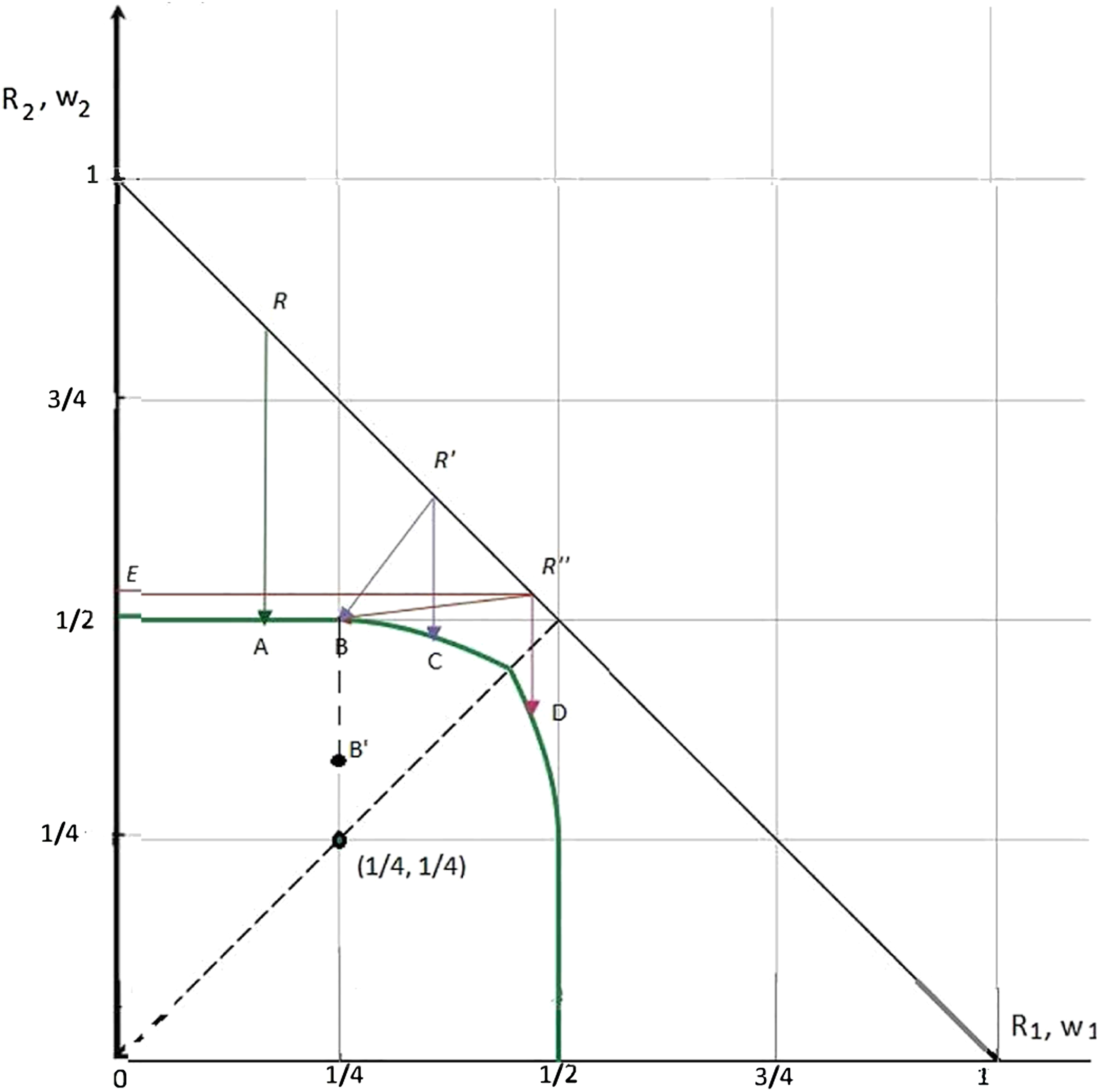
Payoff frontier with full deterrence.
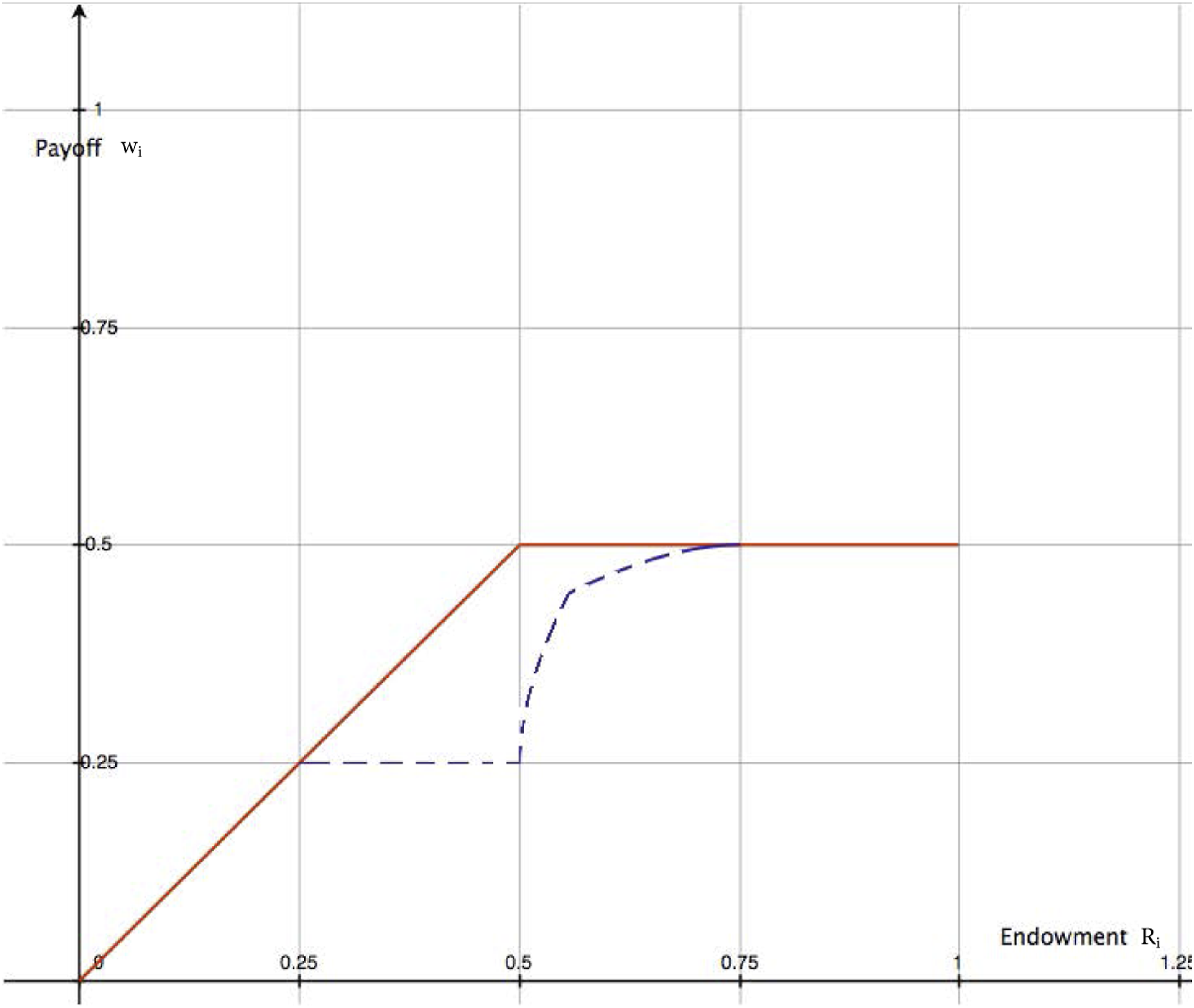
Upper and lower bounds of full-deterrence payoffs plotted against agent’s endowment. The solid (red) line shows the remaining resources of the agent when the sum of contributions ensures minimal full-deterrence, and this agent makes the smallest possible contribution. The dashed (blue) line shows the resources he retains if he makes the largest contribution. The two coincide when the initial endowment is less than
Let W(
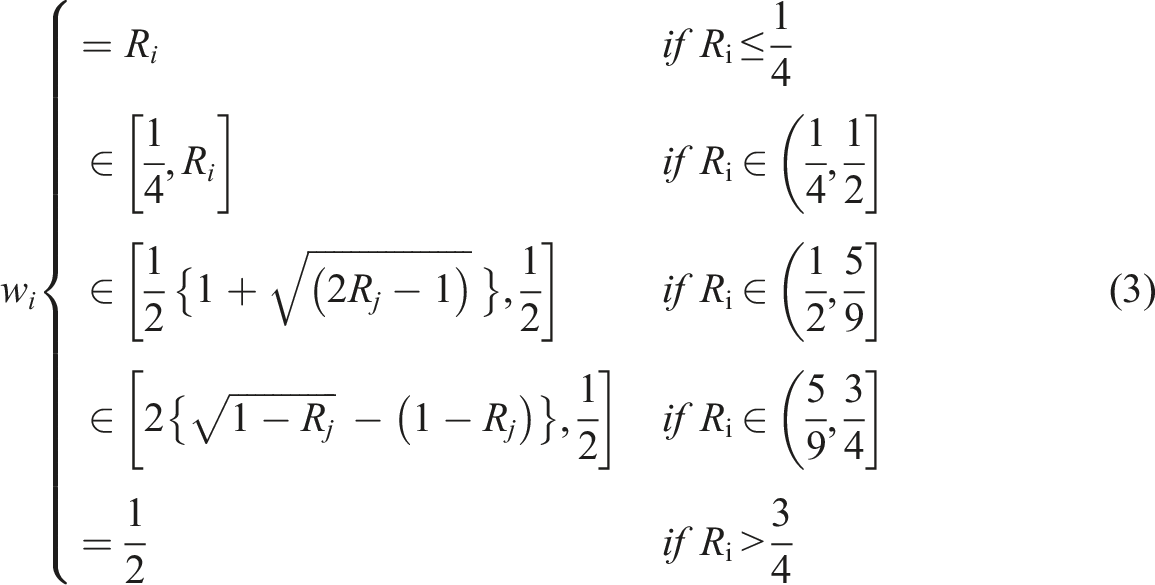
Equilibria and Efficiency
This section presents the main results of this paper. Proposition 5 above describes the contribution profiles and consequent allocations that correspond to minimal full-deterrence outcomes. By Proposition 2, if these contributions are made, then a disarmament equilibrium will prevail in the subgame, and players will receive these allocations as payoffs. Observe that the richer player must always contribute to a full-deterrence outcome. The poorer player may not contribute, and will indeed not contribute at all when his initial resource endowment is less than
Starting with an arbitrary endowment
Consider an individual player i. Figure 4 superimposes the full-deterrence payoffs (Figure 3) to player i on the pure contest payoffs (Figure 1) for each level of the initial endowment. The pure contest payoffs are strictly greater than full-deterrence payoffs for Comparison of payoffs under pure contest and full deterrence.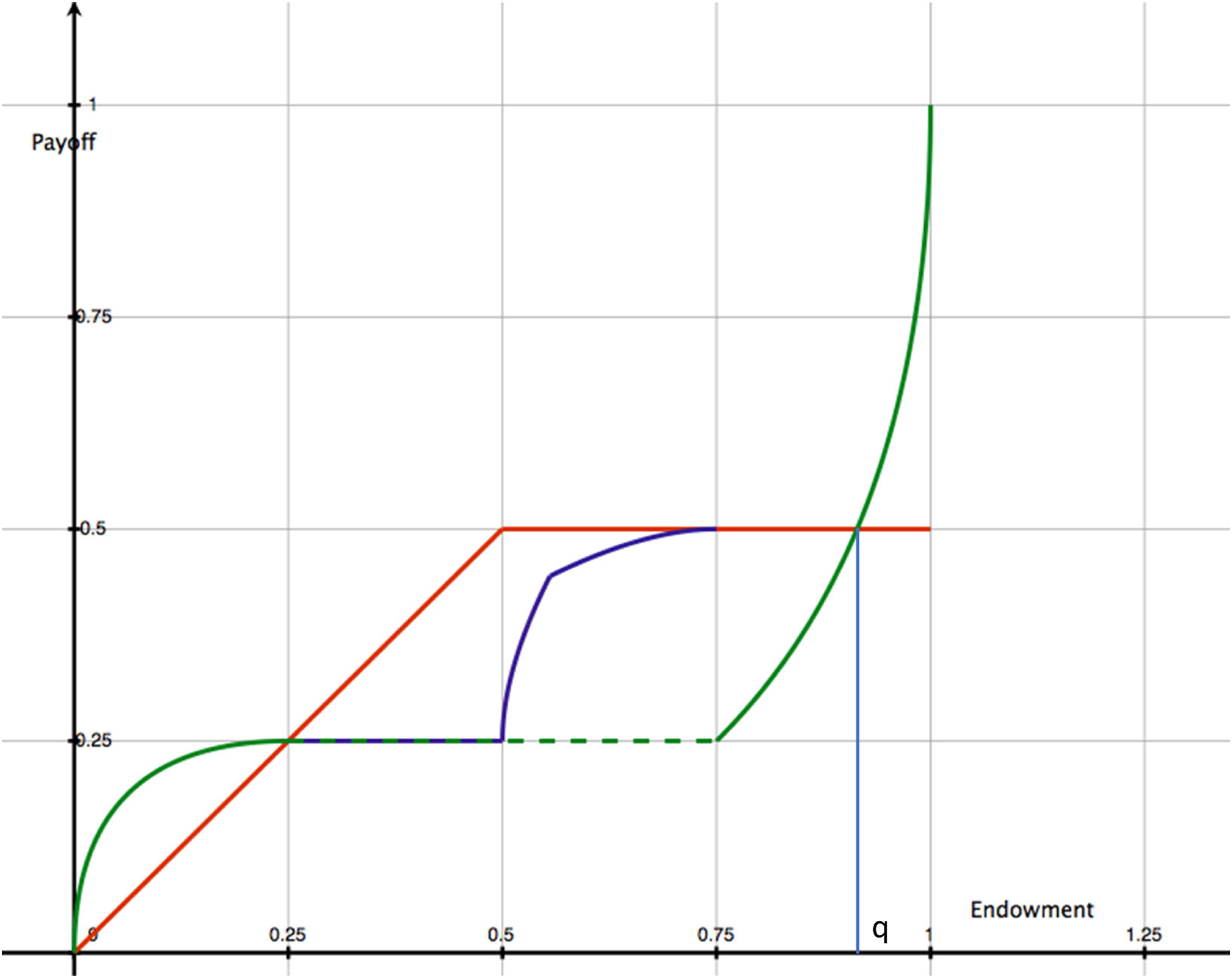
When R
i
∈ (q, 1], player j has an endowment
Note that
Finally, for
This establishes the equilibria corresponding to the different resource endowments, summarised in the following result.
Note that if R1 ≤ (1 − q), then R2 ≥ q, and conversely. For a given initial distribution of resources within the appropriate interval, each deterrence equilibrium is efficient, since under minimal full deterrence either only one player contributes (when We can compute c in the pure conflict outcome corresponding to each distribution of resources. In full-deterrence equilibria x = 0, so c = 1 − g. Hence the equilibrium that maximizes aggregate consumption is the one that minimizes g. But since g is strictly negatively related to (wmin), this is equivalent to maximizing the smaller of the two incomes wmin subject to full-deterrence. This can be restated as

The proof follows directly from Lemma 4, and is omitted. Theorem 2 says that, for efficient full deterrence, the richer agent must make the maximum contribution consistent with full deterrence. If contributions were levied as taxes by a public authority, then the proposition indicates that the most efficient taxation scheme is one that is most progressive subject to incentive-compatibility. Finally we note that full deterrence is not efficient over the entire range in which it is an equilibrium. There is an interval where the larger endowment max{R1, R2} is just less than
The intuition is that in this range the richer player unilaterally pays for deterrence in equilibrium, because for her the deterrence payoff is larger than the conflict payoff. However, if there were war, the poorer player would gain more than the richer player will lose, relative to the peace equilibrium. Thus contest is more efficient in aggregate, but peace is enforced in equilibrium by the richer player. Note that the nature of equilibria and the resulting degree of efficiency are determined by the initial inequality in the distribution of endowments. Observation 2 summarises this aspect of theorems 1 and 3 in economically relevant terms. Let
Observation 2 (Inequality and Conflict)
(i) When the endowment distribution in the economy is moderate, all equilibria in the economy are disarmament equilibria, and every equilibrium generates greater total consumption than does pure contest. (ii) When the endowment distribution is extremely unequal, the unique equilibrium is a pure contest (with no resources devoted to peacekeeping), and this generates greater total consumption than any feasible peace outcome. (iii) However, when the endowment distribution is highly unequal but not extremely unequal, in equilibrium there is peace, but this generates less total consumption than pure contest (war).
Two Variations
A Confiscating Peacekeeper
Throughout this paper I assumed that if there is conflict the peacekeeper sides with the defender against the aggressor, and if the aggressor is defeated the spoils of war are awarded to the defender. However peacekeepers, be they governments or international organizations, do not often reduce to a mercenary army at the service of the defender.
19
Some or all of the aggressor’s wealth may be confiscated by the peacekeeper, and he may be subjected to penalties or sanctions. Fortunately the equilibrium outcomes in our model are preserved if we modify the payoff function to accommodate this consideration. Consider the following alternative specification of payoffs (i) If there is no conflict, or if both agents attack, then the payoffs are as before. (ii) If there is conflict and there is a single aggressor, then any peacekeeping contributions are pooled with the arms of the agent that is attacked. If the aggressor loses, then his remaining wealth is confiscated by the peacekeeper and destroyed. In particular, the defender is not awarded the aggressor’s remaining resources.
Define the game Γ′ as the game form described in The Model and Preliminaries section with these payoffs, which translates to the payoff function Π′ described below
If (a1, a2) = (0, 0), then

If (a1, a2) = (1, 1) then
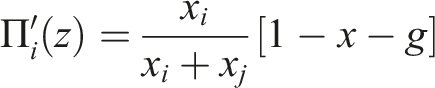
If a
i
= 1 and a
j
= 0, then
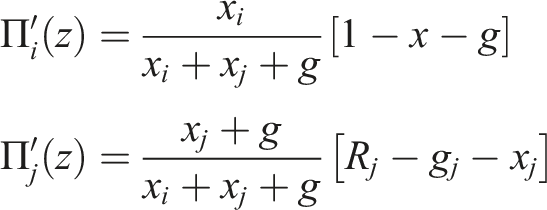
Note that the only difference between the two payoff functions is in j’s payoff when a i = 1 and a j = 0, where j now only retains her remaining resources after contributions and arms, but does not acquire the consumable resources of the attacker. Then there is a correspondence between the equilibria in Γ and Γ′ as follows:
A strategy profile σ* is a war equilibrium of Γ′ if and only if it is a war equilibrium of Γ, and We omit the proof, but provide the intuition here. The change in payoffs between Γ and Γ′ does not affect the players’ equilibrium payoffs in a full-deterrence peace equilibrium. The only payoffs that change in such an equilibrium are off the equilibrium path, where one agent does attack. In this case the defending agent receives a smaller payoff under Γ′ than under Γ. A reduction in a player’s payoff off the equilibrium path cannot destroy the equilibrium. Thus a peace equilibrium under the old rules must remain an equilibrium under the new rules. The converse is also true, since an attacker’s payoff remains the same under both rules, so a change in the defender’s payoff cannot induce an agent to change his strategy and attack. In a war equilibrium, this change from Γ and Γ′ does not affect the aggressor’s incentives and best responses, since if he is defeated then he loses his remaining resources under this amended payoff function just as he did under the original one, and his payoff is no different if he wins. We therefore need to examine how the change affects the defender. For the defender, it is now less attractive to contribute to peacekeeping. Recall from Proposition 3 that, in a war equilibrium under the original payoff rules, if there is a positive peacekeeping contribution at all then it comes only from the defender, who is indifferent between putting his defensive resources into the peacekeeper and into his private arms. With the amended payoff function he is no longer indifferent, and puts his entire defensive resources into private arms. Conversely, in a war equilibrium in Γ′, neither player invests in the peacekeeper. Thus all war equilibria are pure contests that are not dominated by a peacekeeping outcome, and it is easy to see that these would continue to be equilibria in Γ. Thus the set of payoffs that correspond to equilibrium outcomes do not change if the peacekeeper confiscates the aggressor’s resources rather than channeling them to the defender.
20
With the reformulation of the payoffs in Γ′, we only lose those war equilibria in which the defender deployed part of her defensive forces as peacekeeping contributions (see Proposition 3), when they would serve exactly the same purpose if deployed as private arms.
21
Transfers Between Agents
We saw earlier that resources required for deterrence increase as the smaller of the post-contribution endowments declines. Further, we know that in a deterrence equilibrium, the richer agent must always contribute to peacekeeping. It is therefore natural to ask if it may not be more attractive for the richer agent to transfer some resources to the poorer one, instead of contributing those resources to peacekeeping. This question is similar to Beviá and Corchón (2010), who explore the effectiveness of inter-player transfers for avoiding war. In the main specification of their model, for a range of parameters the (richer) potential defender transfers resources to the (poorer) potential attacker until the latter is indifferent between war and peace, which leaves the defender better off.
In the present model, there is a range of endowments in which the rich defender is indifferent between transferring resources to the peacekeeper or the attacker, and if he does transfer to the attacker then the latter is better off. In the rest of endowment range the defender prefers to make the same contributions to the peacekeeper, or not transfer to either the peacekeeper or to his rival. In both cases the equilibria that we identified remain unaffected.
(i) For R
j
∈ (0, 1 − q), player i will make no transfer to player j, and the equilibria in the remainder of the game are unaffected. (ii) For (iii) For We outline the (straightforward) intuition rather than provide a formal proof. For R
j
< 1 − q, we know that i prefers a contest to peacekeeping. In the contest j is the one that has the incentive to attack, putting all his resources into arms. A transfer to j that still leaves him in this range would only increase j’s arms and hence reduce i’s expected payoff. A transfer that lifts j into the range R
j
+ t
ij
> 1 − q, on the other hand, would produce a peace equilibrium in the subgame, with i receiving a payoff of In the range Once R
j
(or R
j
+ t
ij
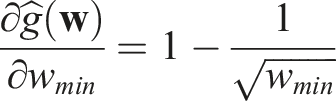
) rises above Recall that in this range there are multiple equilibria, all of them full-deterrence, with the two players contributing different amount of the total which is determined by the smaller of the remaining resource endowments. Let us fix an equilibrium of the original game, and ask if transfers can produce a pareto-improvement. The observations above show that this is not possible. Thus when inequality is extreme, the possibility of transfers does not rescue the economy from anarchy. Voluntary inter-agent transfers can reduce inequality to produce a pareto-superior outcome in economies that are just this side of anarchy, where inequality is somewhat less than extreme. However, these possibilities decline as the gap between the incomes narrows, and disappear by the time the poorer agent’ income rises to
Conclusion
This paper re-examines a standard model of contest in anarchy, where two agents possess resources that can be devoted to consumption or to acquisitive warfare. In the simplest version of that economy, the equilibrium necessarily involves conflict. However, since war is wasteful, it is likely that one or both agents would be willing to precommit some resources to avoid conflict, even if such precommitment is somewhat costly.
This is a natural context to discuss the genesis of peacekeeping. I use a simple model of an exogenous peacekeeper which must be endowed with resources by the potential contestants. I find that, when inequality is moderate (in a sense made precise), all agents find that the existence of a public peacekeeper is in their interest. Hence agents voluntarily commit sufficient resources to the peacekeeper, and the resultant equilibrium is characterised by the absence of conflict. For higher inequality, enforcement is contrary to the interest of the poorer agent, but the richer agent unilaterally endows the peacekeeper. In part of this range, peace is less efficient than pure conflict. At very high levels of inequality, a peacekeeper is incompatible with the interests of either agent, and there is conflict. We should thus expect to see the least conflict in more equal societies and the most in very unequal ones. Some of these results, summarised in Observation 2, may arguably reflect the shapes of some troubled states, where law and order is either absent, or enforced by militias that are maintained by wealthy overlords at great cost to contain the dissent of a discontented population.
There are important questions that this paper does not address. I have assumed throughout that the peacekeeper acts impartially, even though it may be funded entirely or largely by the richer agent. If instead the agent that contributes more to the peacekeeper can bend the latter to his own purposes, then to that extent the peacekeeper is less impartial, and the nature of the equilibria must be affected. The analysis here needs to be supported by a political theory of the nature of the state. A concern that naturally springs to mind is that, in order to gain legitimacy, even a government funded entirely by the elite must distance itself to some extent from that elite and assume some semblance of impartiality. Another relevant concern is the number of contestants and the weight of each in the pool of resources yielded up to the peacekeeper. In the introduction I have also alluded to the long-term interests of the peacekeeper, whose future revenue streams may well be dependent on the security of property among the subjects and the resulting commercial activity that is generated. Finally, the peacekeeper may also act as a “true” state, providing productive public goods or effecting redistribution using the contributed resources, once it is ascertained that the players have not invested in arms. We leave these concerns for future consideration.
Footnotes
Acknowledgements
I would like to thank the Institute for Economic Development at Boston University, the Max Planck Institute of Tax Law and Public Finance, and Hitotsubashi University for their hospitality at different stages of development of this paper. DVP Prasada provided research assistance in the early stages. I am grateful to Kai Konrad and four referees for comments on earlier versions. I have also benefited from comments by seminar participants at Boston University, the Max Planck Institute, Monash University and UNSW, by participants at the Journées LAGV conference in Aix-en-Provence, and conferences at ISI Delhi, Jadavpur University Kolkata, and the Econometric Society World Congress 2020.
Declaration of Conflicting Interests
The author(s) declared no potential conflicts of interest with respect to the research, authorship, and/or publication of this article.
Funding
The author(s) received no financial support for the research, authorship, and/or publication of this article.
