




Abstract
United Nations peacekeeping operations (UNPKO) have been deployed in conflict-affected countries for decades. While we thoroughly understand what UNPKOs are mandated to do, there is little research on what activities peacekeepers actually do upon deployment in their host countries and in which sequence, if any. To address this gap, we formulate descriptive hypotheses about the number of implemented peacekeeping activities, the expansion toward new activity categories, and the sequencing of implemented activities. We use the novel Extended Peacekeeping Activity Dataset to evaluate our theoretical expectations for all UNPKOs deployed after the end of the Cold War until 2017. Our findings show that UNPKOs implement more activities over time. Yet, the expansion of UNPKOs’ activities into new activity categories by generation (second, third, and stabilization) is not as clear-cut in practice as expected. Instead, there is a notable expansion of activities within activity categories—especially during third-generation UNPKOs. Finally, we find a security-first sequencing for second- and third-generation UNPKOs, while stabilization UNPKOs implement a high share of security activities long after initial deployment.
Introduction
United Nations Peacekeeping Operations (UNPKOs) are one of the international communities’ most prominent tools to promote conflict resolution and mitigate violence. Research from the last two decades shows that peacekeeping works. UNPKOs contribute to reducing various forms of violence, prolonging peace, strengthening the rule of law, and improving household’s wellbeing (for an excellent review, see: Walter et al., 2021). However, we know relatively little about how exactly and why peacekeeping works (Howard, 2019). To answer those questions, we need a better understanding of what peacekeepers actually do upon deployment. Yet, implemented activities—especially the types of implemented activities—and their sequencing have not been described systematically across countries and over time (Otto et al., 2022; Smidt et al., 2022).
Instead, we have a general understanding of how peacekeeping mandates have developed over time. Early missions, so-called “traditional missions,” were mandated to monitor ceasefire agreements between two states, and their main mandated tasks concerned border control and documentation of ceasefire agreement violations. Most recent UNPKOs, however, so-called “stabilization missions,” are also mandated to restore and maintain order and support local authorities. Novel data collections on mandated tasks show that they increased steadily especially since the end of the Cold War (Di Salvatore et al., 2022; Lloyd, 2021). Due to these developments, practitioners and scholars have criticized UNPKO mandates as “Christmas tree” mandates because they are “overloaded with too many disparate tasks” (Security Council Report, 2020: 2). Even the UN suspects mandates have become “at times less realistic or manageable” and “less achievable” (HIPPO, 2015: para. 173, 47), thereby increasing the risk of UNPKOs to fail in building peace (HIPPO, 2015, viii). Furthermore, overloaded mandates “frustrate efforts at prioritization and sequencing during implementation” (HIPPO, 2015: para. 174, 47) and hence risk reducing peacekeeping effectiveness. In short, practitioners doubt that UNPKOs can implement more and more activities and fear that broad mandates hamper meaningful sequencing of activities. Nevertheless, we lack a systematic assessment to decide if this is true. 1
This article aims to shed light on what peacekeepers do upon deployment. We explore how implemented activities have developed over time and across UNPKOs and whether their implementation follows a sequencing logic. 2 We draw on the literature on mandated tasks to formulate descriptive hypotheses about how the implementation of peacekeeping activities should have evolved. As such, our hypotheses focus on (1) the evolutionary trajectories of peacekeeping activities (quantity changes over time), (2) the changes in the nature of activities (different activity categories), and (3) the sequencing of peacekeeping activities. Empirically, we rely on the Extended Peacekeeping Activity Dataset (EPACT) to evaluate our hypotheses. EPACT contains information on 36 implemented activities for 40 UNPKOs between 1989 and 2017 across the Americas, Europe, Africa, and Asia. These data allow us to present for the first time global patterns on the evolution of implemented peacekeeping activities and explore their sequencing.
The contribution of our article is four-fold. First, we foster our understanding of how UNPKOs work by exploring what peacekeepers do upon deployment. While some studies have used PACT 1.0 to trace selected peacekeeping activities in Africa (e.g. Smidt, 2021, on elections), our article is the first one to trace multiple peacekeeping activities in all world regions—our overview interests policymakers and students alike who wish to learn more about peacekeepers in action. Second, descriptive knowledge about what peacekeepers do is the foundation for evaluating existing theories on the causes and consequences of peacekeeping activities and formulating new ones. Third, we are among the few who attempt to explore empirically the sequencing of peacekeeping. Whether sub-optimal sequencing of activities might affect peacekeeping effectiveness (Mueller et al., 2021) is a pressing question. Our study is one step toward learning whether activities are implemented in a specific order. Fourth, our analysis also speaks to a broader literature on how geopolitics shapes peacekeeping agendas—not only during the planning and deployment stage but also on the ground. Our results suggest that changes in the implementation of peacekeeping activities reflect normative changes in peacebuilding orders shaped by global powers (e.g. Jütersonke et al., 2021).
What do we know about peacekeeping activities?
First and foremost, we are interested in the activities that peacekeepers implement on the ground (rather than mandated tasks in the UN Security Council (UNSC) resolutions that authorize a UNPKO, which we refer to as mandated tasks in this article). We define peacekeeping activities as substantive, legal, and observable activities to fulfill the UNPKO mandate and contribute to the overarching goal of providing security and building peace (Otto et al., 2022: 14, 15). Our definition of peacekeeping activities excludes illegal activities and routines understood as “unconscious, automatic, unthought” activities (Autesserre, 2014: 29), or the perception of peacekeeping activities. We review the literature with this definition in mind.
Implementing peacekeeping activities
Peacekeeping activities are prevalent in theories of peacekeeping effectiveness, but they are seldom researched empirically. Mostly quantitative-orientated scholars theorize about how broadly understood tasks (e.g. monitoring ceasefires, documenting human rights violations, mediation, separating combatants) affect the duration of peace and the level of violence (Doyle and Sambanis, 2006; Fortna, 2008; Hultman et al., 2020). Others focus on the micro-foundations and develop mechanisms about how local-level activities such as patrolling, monitoring, or mediation affect local-level peace (e.g. Fjelde et al., 2019; Ruffa and Ruggeri, 2020). Despite their theoretical importance, data constraints have led researchers to rely on proxies, such as the mere presence of UNPKOs or troop numbers, neglecting the actual implementation of theorized activities. Case studies offer detailed analyses for individual or few PKOs, allowing a granular understanding of on-ground operations (e.g. Katayanagi, 2002; Van der Lijn, 2006). However, they fall short in systematically comparing numerous cases across varied temporal and spatial contexts.
To address this gap, some scholars have focused on mandates to understand peacekeeping tasks across host countries (Diehl and Druckman, 2018; Di Salvatore et al., 2022; Hellmüller et al., 2024; Lloyd, 2021; Mullenbach, 2013). Although these studies illuminate UNPKO mandates and their evolution, they do not reveal if and how peacekeepers implement mandated tasks. For instance, while UNPKOs may be mandated to protect civilians, empirical evidence shows a discrepancy between these mandates and their real-world implementation (Blair et al., 2022; United Nations General Assembly, 2014). Anecdotal evidence also indicates that UNPKOs sometimes go beyond their mandates. For example, the United Nations Angola Verification Mission II in Angola observed elections as mandated and—beyond its mandate—provided logistical and education-related assistance to the 1992 polls. Therefore, it is important to shift our focus toward the implementation of activities to understand better what peacekeepers do.
Recent studies have begun to combine robust theoretical frameworks with new data on implemented peacekeeping activities. Researchers like Ruffa (2017) have employed field research to study activity types in Lebanon and Afghanistan, while Smidt (2020) utilized UN Press releases for data on specific peacekeeping activities in Côte d’Ivoire. Pioneering collected data based on the UN Secretary-General (UNSG) progress reports, some scholars analyze how on the-ground activities by peacekeepers influence peacebuilding outcomes (Blair, 2021; Blair et al., 2022, 2023; Gledhill et al., 2021). However, they are not only restricted to Africa but also to the specific types of activities (i.e. rule of law, democracy promotion, and development) or highly aggregated activity categories. While insightful, these initial explorations underline the need for a more comprehensive and comparative understanding of peacekeepers’ actions across diverse operations and timelines.
Sequencing peacekeeping activities
The sequencing of peacekeeping activities remains an under-explored dimension in peacekeeping research, contrasting sharply with the democratization literature. In that literature, a vibrant debate exists between proponents of a preconditioned approach—emphasizing socioeconomic and institutional prerequisites (Mansfield and Snyder, 2007) and stability (Zürcher et al., 2014)—and a universalist approach which rejects the need for a particular sequence of developments to achieve democracy (Berman, 2007).
In peacekeeping literature, sequencing discussions have predominantly been focused on broad trends (e.g. institution-building before democratization, Paris, 2004) or concentrated on UNPKO mandates, often sidelining the sequencing of implemented activities. The so called Bahimi Report (United Nations, 2000) and the HIPPO Report (2015) both championed sequenced mandates for enhanced situational efficacy (Gorur and Sharland, 2016; HIPPO, 2015). Security Council Report (2020: 2) further underscoring the need for mandates to adapt dynamically to ground realities. A shift in policy perspectives now advocates for a more field-driven approach to sequencing rather than a purely mandate-driven one (Gorur and Vellturo, 2020). Yet, theoretical frameworks around UNPKO activity sequencing are conspicuously scant. For instance, Diehl and Druckman (2018) call for recording activity sequences but do not formulate any theoretical expectations. Moreover, all these discussions are primarily normative and do not try to empirically trace different peacekeeping activity sequences in different countries over different time periods.
To sum up, despite their theoretical significance, a comprehensive understanding of peacekeeping activities—which activities are implemented and how they are implemented and sequenced—remains elusive. This study endeavors to fill this gap, providing a detailed analysis of implemented activities across UNPKOs over time.
The evolution of peacekeeping
UN peacekeeping has evolved since its inception in 1948. The first UNPKO, the United Nations Truce Supervision Organization, was tasked with monitoring the Israel-Arabic Armistice. One of the youngest UNPKOs, the United Nations Multidimensional Integrated Stabilization Mission in Mali deployed in 2013, emphasizes stabilization, civilian protection, reduction of inter-communal violence and re-establishment of state authority, and basic social services provision. These two examples illustrate the claims of the progressive expansion of peacekeeping mandates in the literature. We combine the qualitative literature that describes the transformation of peacekeeping based on policy documents with insights from quantitative data collections on UN mandates to identify the major trends concerning the evolution of UN peacekeeping and its mandated tasks. Empirically, we assess whether the evolution of implemented activities matches the identified trends in mandates.
The “generations of peacekeeping” heuristic is a useful starting point to describe the evolution of UN peacekeeping. “First-generation” UNPKOs deploy lightly armed military observers with strict engagement rules, using force only for self-defense deployed to post-ceasefire or post-peace agreement countries. Their primary mandated tasks are establishing buffer zones, monitoring ceasefires, verifying demilitarized areas, and overseeing borders (Bellamy et al., 2010; Kenkel, 2013). As such, first-generation UNPKO mandates focus solely on security tasks.
With the Cold War’s end and the Security Council’s bipolarity blockades easing, “second-generation” peacekeeping emerged. During this period, UNPKOs followed a liberal peacebuilding agenda emphasizing “participatory governance and political/civil rights” (Jütersonke et al., 2021). UNPKO mandates expanded to include institutional peacebuilding tasks like election support or security sector reforms and promoting individual rights like human rights. Their mandated security tasks also broadened, including disarmament, demobilization, and reintegration. Thus, second-generation UNPKOs transitioned from a sole security focus to a broader peacebuilding scope and are termed multidimensional UNPKOs due to their multifaceted roles (keeping the peace, promoting rights, and building peace, Oksamytna and Karlsrud, 2020: 5).
They maintained narrow engagement rules, using force mainly for self-defense.
“Third-generation” peacekeeping, emerging around the 2000s, underwent two pivotal shifts. First, the stance on using force evolved from strict self-defense mode to a means of operation. The use of force is set, however, clear boundaries and aims to deter threats rather than proactively confronting parties to the conflict (UNDPKO/DFS, 2017). The so-called “robust turn” based on Chapter VII of the UN Charter is closely linked to the UN’s prior failures in Rwanda, Bosnia, and Somalia (Bellamy and Hunt, 2021; Doyle and Sambanis, 2006), the global emphasis on counter-terrorism (Karlsrud, 2019), and to the emergence of the protection of civilians (PoC) as a central peacekeeping goal. Second, the peacebuilding mandate transitioned from institutional to people-centered tasks, emphasizing reconciliation, public health, and socioeconomic rights, addressing the root causes of conflicts (Jütersonke et al., 2021; Karlsrud, 2019).
Recent shifts in peacekeeping highlight the emergence of “stabilization” peacekeeping. 3 Driven by global anti-liberal trends like Brexit and Trump’s US election success and a renewed emphasis on hierarchical governance (Jütersonke et al., 2021), these UNPKOs are said to prioritize re-establishing authority in “failed states” (Karlsrud, 2015). The focus has shifted from keeping peace toward establishing “legitimate” authority, institution-building, and delivering key state services, which can be complemented with a military force. In addition, the mandate permits offensive force against threats to target armed actors that challenge state authority to stabilize a country (Curran and Hunt, 2020: 48). Peacebuilding now emphasizes state-centered tasks to bolster state authority (Gledhill et al., 2021). Unlike robust multidimensional PKOs, stabilization UNPKOs are notably partial, deployed in conflict zones, and the offensive use of force explicitly mandated (Bellamy and Hunt, 2015: 1282).
Figure 1 illustrates the transformation of mandated peacekeeping tasks over time, emphasizing the progression of mandated tasks by the two peacekeeping domains, security and peacebuilding, for the different generations. Each domain comprises categories representing the overarching mandated tasks for each generation. The visualization clarifies that the categories and, hence, the number of respective mandated tasks have increased from generation to generation. 4 Initially, UNPKOs had clearly defined security tasks, but they have evolved into complex interventions with increasingly mandated tasks. Notably, systematic data on UNPKO mandates support this trend: Di Salvatore et al. (2022) reports a 3.5-fold increase in tasks for African UNPKOs between 6 mandated tasks in 1989 and 21 activities on average for the five newest UNPKOs. Lloyd (2021) identifies a similar surge in mandated tasks since the post-Cold War period, “highlighting the emergence and subsequent dominance of large mandates” for UNPKOs (p. 1155).
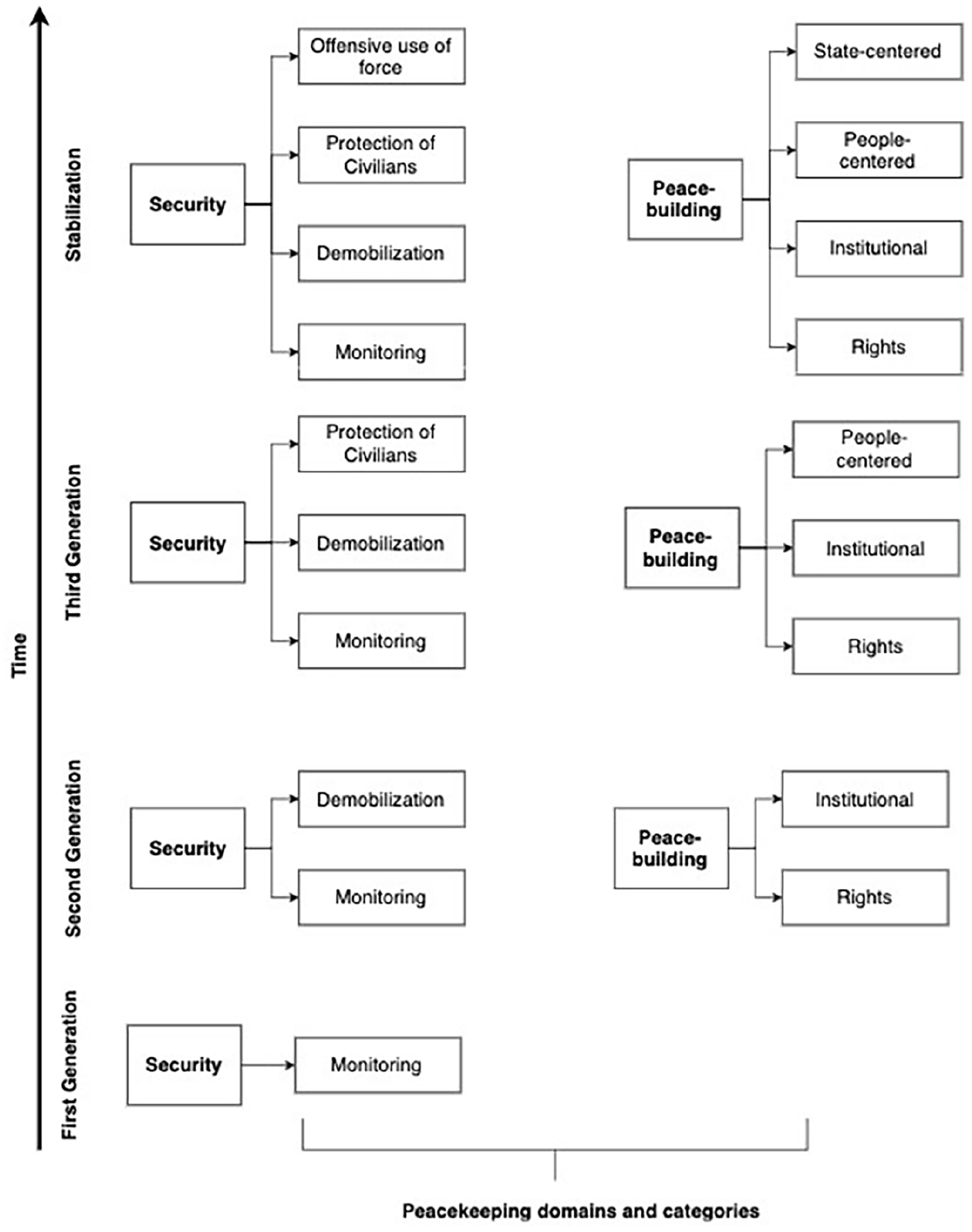
Evolution of mandated peacekeeping tasks by generations. Figure set up by authors.
What does the number of mandated tasks tell us about the number of implemented activities? First and foremost, mandates serve as political and legal road maps for peacekeepers. Yet, they often present broad guidelines rather than specific instructions for task implementation. This ambiguity means that peacekeepers’ interpretations determine how tasks materialize in their theaters of intervention (Ruffa and Rietjens, 2023). This flexibility might result in activity variations across UNPKOs with the same mandate. Moreover, the growing expansion of mandates, sometimes termed “Christmas tree” mandates, reflects many stakeholders’ interests but raises concerns about the feasibility of implementation (Security Council Report, 2019; Williams, 2020). These reasons might lead to a discrepancy between mandated tasks and implemented activities. However, existing oversight mechanisms contribute to peacekeepers doing their best to implement the mandate faithfully. Consequently, we anticipate a positive relationship between the number of mandated tasks and the number of implemented activities, albeit possibly in phases. We thus present our first descriptive hypothesis.
H1. The number of activities peacekeepers implement has increased over time.
The description of peacekeeping generations in Figure 1 highlights the evolution of UNPKO mandates toward new activity categories. Within each domain, we see the addition of new categories over time. Concerning the security domain, first-generation UNPKOs were tasked to primarily utilize their military skills for monitoring and verification with force reserved for self-defense (Fortna, 2008: 80). The mandates of subsequent generations of UNPKOs encompass a spectrum of new security categories, from non-lethal interventions (demobilization) to defensive use of force (PoC) to offensive use of force against disruptive armed actors. Likewise, the peacebuilding domain has also broadened over time. Second-generation UNPKOs mandates primarily included institution-building and individual rights activity categories (UNDPKO/DFS, 2017: 8). Over time, mandates have extended to encompass people-centered and state-centered activity categories.
Given the evolution in mandates toward new categories, it is reasonable to assume that this happened also on the ground. Yet, several factors could hinder the translation of diversified mandates into more implemented activity categories: the need for the UN and its peacekeepers to acquire the expertise to implement new tasks; potential conflicts between the tasks desired by UNSC members, and the preferences of key stakeholders like troop-contributing countries; and the overwhelming variety and number of tasks have been shown to hamper mandate implementation (Blair et al., 2022). Despite these potential obstacles, mandates remain important legal frameworks with imperfect but important enforcement mechanisms. In addition, mandates guide budget and resource negotiations, and hence, UNPKOs with broader mandates should receive the personnel and equipment to implement more activity categories. As such, the diversification of mandated tasks should generally result in a more diverse range of implemented activities. Based on our argumentation, we propose our second descriptive hypothesis:
H2. Implemented peacekeeping activities have expanded into new categories over time.
The sequencing of peacekeeping
What does sequencing mean? In the realm of peacemaking, Heldt (2009: 133) describes sequencing as the designated order of different mediation tools. Others interpret it as the “logical progression” of activities (Security Council Report, 2020: 2). We follow Diehl and Druckman (2018: 39) defining sequencing in peacekeeping merely as the specific order of activity implementation without delving into its temporal aspects or underlying rationale.
While peacekeeping scholars allude to sequencing, most discussions are more prescriptive than descriptive. For instance, Paris (2004) contends that prioritizing early elections can be counterproductive unless prior peacekeeping efforts have established economic and political stability. Likewise, Mueller et al. (2021) supports a “security first” approach, believing it enhances the effectiveness of subsequent activities. Similarly, Katayanagi (2002) and Månsson (2001) suggest that successful human rights promotion depends on the foundational security provided by peacekeeping forces. However, other scholars critique the “security first” strategy, particularly when paired with the use of force by UNPKOs, as it may exacerbate conflict and hinder political processes (dos Santos Parra, 2019). Practitioners, like Jernberg (2021), caution that development should be viewed as integral to security, not just its outcome. They warn that an exclusive focus on security can erode trust with local communities. 5 Others argue that development initiatives like reintegration programs for ex-combatants can foster peace without relying on force (Schulhofer-Wohl and Sambanis, 2010: 33, para. 83).
The UN, especially during planning, emphasizes sequencing peacekeeping activities and often suggests a “security first” approach. The DPKO-DFS Planning Toolkit indicates that the sequence of activities should align with political priorities, particularly stabilizing specific regions in host countries (Department of Peacekeeping Operations, n.d.: 39ff.). Anecdotal evidence points in the same direction, suggesting that UNPKOs often establish security through uniformed personnel before civilian staff implement peacebuilding activities. For example, Gorur and Vellturo (2020: 14, 15) detail how the United Nations Multidimensional Integrated Stabilization Mission in the Central African Republic (MINUSCA) and the United Nations Organization Stabilization Mission in the Democratic Republic of the Congo (MONUSCO) followed this pattern when they reopened access to a Muslim cemetery in the PK5 neighborhood of Bangui in 2016 or responded to the Yumbi massacre in 2018 and herder–farmer tensions in Minembwe in 2019 (Gorur and Vellturo, 2020: 14, 15). In analyzing the United Nations Organization Mission in the Democratic Republic of the Congo (MONUC), Mueller et al. (2021) found that while security-related activities were prioritized (ceasefire monitoring and disarmament, demobilization, and reintegration), their failure adversely affected subsequent peacebuilding efforts. Studies by Blair et al. (2022) and Smidt et al. (2022) reveal that security activities are prioritized in conflict situations, whereas peacebuilding or human rights-related activities are more prevalent during post-conflict. Gledhill et al. (2021) also note that stabilization UNPKOs in active conflict zones prioritize security over development. Drawing from these findings, we propose our third descriptive hypothesis.
H3. Upon deployment, UNPKOs tend first to implement security-related activities before implementing peacebuilding activities.
We do not claim that UNPKOs only implement peacebuilding activities once security or stability is established throughout the country. Instead, we expect that UNPKOs’ general strategy encompasses an initial emphasis on security-related activities upon UNPKO deployment, followed by a focus on peacebuilding activities. Although many activities may overlap in time, there should be a discernible trend in which some are prioritized and implemented before others.
Data
Though widely acknowledged, the expansion and evolution of peacekeeping activities are seldom empirically and systematically evaluated. We analyze the Extended Peacekeeping Activities (EPACT) dataset, which includes PACT 1.0 covering Africa (Blair, 2021; Blair et al., 2022) and the novel PACT 2.0 covering Asia, the Americas, and Europe, evaluate our descriptive hypotheses. 6 Overall, the dataset encompasses activities by 40 UNPKOs in civil war-affected countries from 1989 to 2017. We provide descriptive statistics in the Appendix 1. This dataset records 36 implemented activities spanning different categories within the security and peacebuilding domains (see Figure 3). Each activity is coded either as 1 (implemented) or 0 (not implemented) during a given month for a given UNPKO. 7 The dataset draws on UNSG progress reports, which describe the UNPKOs’ undertakings in typical reporting intervals of 3–6 months. If a report mentions an activity, it is assumed to be implemented throughout each month in the reporting period.
While the EPACT is the most comprehensive dataset on implemented peacekeeping activities, it has its limitations. The reports, intended to brief the Security Council on field developments, are more political than operational, focusing on describing the general situations in the UNPKO host country and detailing how the UNPKO fulfills its mandate. However, we believe misreporting of activities is unlikely for two reasons: First, UNPKOs have strong incentives for being seen as fulfilling their mandates, reducing their incentive to under-report activities. 8
Second, over-reporting is also improbable given the scrutiny of public UNSG reports by various “watchdog” groups, for example, international and domestic media, and civil society groups, who would likely flag unimplemented but reported activities (see also for data quality discussions: Blair et al., 2022; Smidt et al., 2022).
Analysis
We now turn to the analysis. First, we discuss the evidence for hypotheses 1 and 2 regarding the patterns of activities that generations of UNPKOs have implemented after the end of the Cold War until today. Second, we turn to our analysis of hypothesis 3, which expects an over-time sequence of activities prioritizing security after deployment over peacebuilding activities.
Patterns of implemented peacekeeping activities
To evaluate hypothesis 1, we plot in Figure 2 the average number of peacekeeping activities (Y-axis) per year (X-axis). The trend in Figure 2 supports overall our hypothesis of an increase in activities over time. Between 1989 and 1992, the average number of implemented activities seems to follow an upward trend from 4.2 (in 1990) to around 8.7 average activities per UNPKO. This trend, however, is reversed in 1994, likely due to UN peacekeeping setbacks in Rwanda, Bosnia, and Somalia, and remains stable at around 6.5 activities per UNPKO. By 2000, the average number of activities doubles to 11.7, marking the onset of the third generation of peacekeeping. The number further rises to around 15 activities per UNPKO by 2005, peaking at 17.2 in 2015. Comparing mandated to implemented tasks, second-generation PKOs generally met their mandates. As Di Salvatore et al. (2022: 936) note, in the early 1990s, African PKOs had an average of 5.8 mandated activities, aligning with the actual implemented activities. Despite the increase in implemented activities, recent PKOs are less effective in implementing the average number of mandated tasks of 21 (Di Salvatore et al., 2022: 936), suggesting the challenge of fulfilling expansive mandates. Yet, modern PKOs still manage to implement 7085% of their tasks. 9 In summary, there has been a consistent rise in implemented activities over time. While modern PKOs grapple with more expansive mandates, leading to a less pronounced increase in activities. Yet, the data support Hypothesis 1.
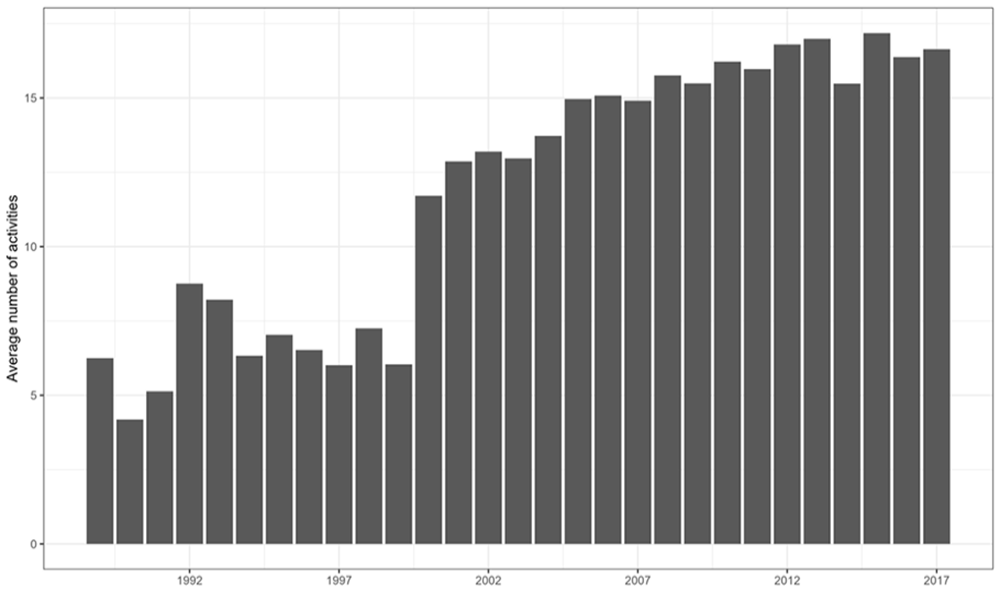
Average number of implemented activities across all UNPKOs between 1989 and 2017.
According to Hypothesis 2, we expect that UNPKOs’ activities expand toward new categories over time. Using Figure 3, which represents implemented activities (black squares) across chronologically ordered PKOs (by the first deployment year), we discern trends within the peacebuilding domain (by category: rights, institutional, people-centered, and state-centered) and security domain (by category: offensive force, protection of civilians (PoC), and classical security). 10
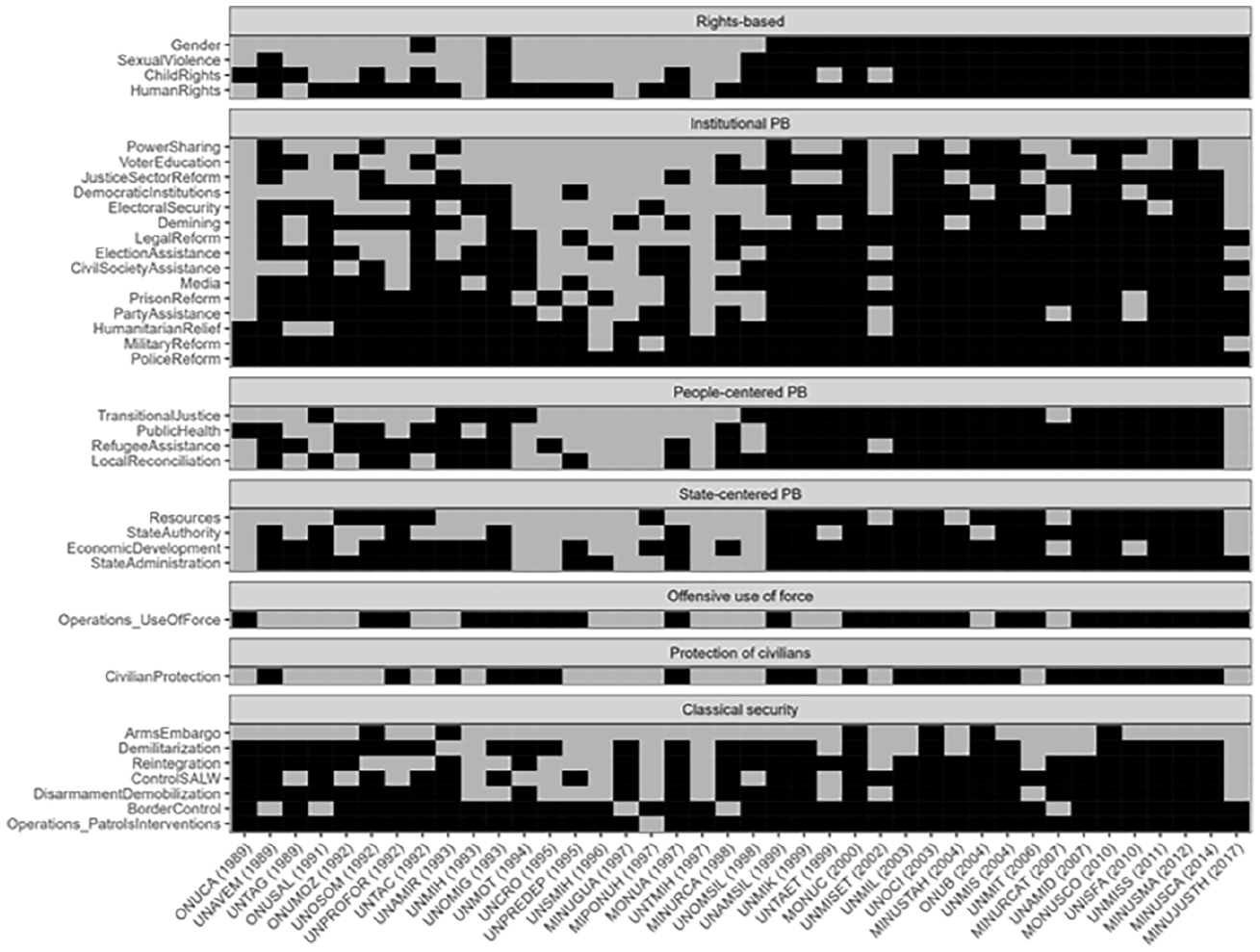
Implemented activities over UNPKO lifespan (black). UNPKOs are ordered chronologically by UNPKO’s deployment year.
As we will elaborate, the expansion toward new categories over time is not as clear-cut in practice as anticipated. In line with our expectations, the second-generation UNPKOs of the early 1990s primarily executed rights-based (human rights) and institutional peacebuilding activities—first and foremost, police reform, military reform, and humanitarian relief activities, alongside classical security activities. In contrast to our theoretical expectation, however, people-centered activities (especially local reconciliation, refugee assistance, and public health), state-centered peacebuilding activities (especially state administration and economic development), PoC, and offensive use of force activities were already implemented during the first half of the 1990s. 11 During the late 1990s, however, the diversity of activities implemented by UNPKOs substantially diminished, especially within the peacebuilding domain (between 1994 and 1998). This reduction is probably a consequence of the tragic failures in Bosnia, Rwanda, and Somalia.
Figure 3 illustrates that third-generation UNPKOs’ activities multiplied within theoretically expected categories. In the category of rights-based activities, general human rights activities were complemented with children’s rights, protection from sexual and gender-based violence, and promotion of gender equality. In the institutional peacebuilding category, activities diversified, for instance, including power-sharing and justice sector reform after 2000. Contrary to our expectations, third-generation UNPKOs have already adopted state-centered peacebuilding and offensive use of force activities, which we expected to see exclusively in the latest generation of “stabilization” UNPKOs. Also, contrary to our expectations, we do not observe another expansion of activities within each category during the stabilization of UNPKOs. Overall, regarding activity categories, the distinction between third-generation and stabilization UNPKOs is more blurred than expected. Taken together, although UNPKOs began incorporating activities from all activity categories in the early 1990s, there has been an evident diversification of activities within activity categories over time. We interpret this within-category expansion as partial support for H2.
However, Figure 3 only captures whether an activity was implemented at least once during a UNPKO lifespan. It does not consider to what extent each category was implemented over time. Therefore, some trends might be masked. Figure 4 addresses this issue by presenting smoothed over-time trends of the share of implemented activities by category. For each month, we calculate the overall number of activities implemented by all UNPKOs in each category and divide it by the number of activities within each category multiplied by the number of active PKOs per month. Imagine two active UNPKOs in a given month. UNPKO 1 implements activity A, and UNPKO 2 implements activity B from the classical security category, which consists of seven activities. The share of implemented activities in the classical security category for that month is 0.14, which we calculate as 2 (activity A + activity B) divided by 14 (the number of possible activities in the classical security category (7) * the number of active UNPKOs in that month (2)). For each activity category, the share of implemented activities thus ranges between the values 0 if no activity was implemented in a given month and 1 if all possible activities of a category were implemented, averaged across all active UNPKOs in the respective month. This procedure allows us to compare the share across categories and over time, although the number of activities per category and the number of UNPKOs per month varies.
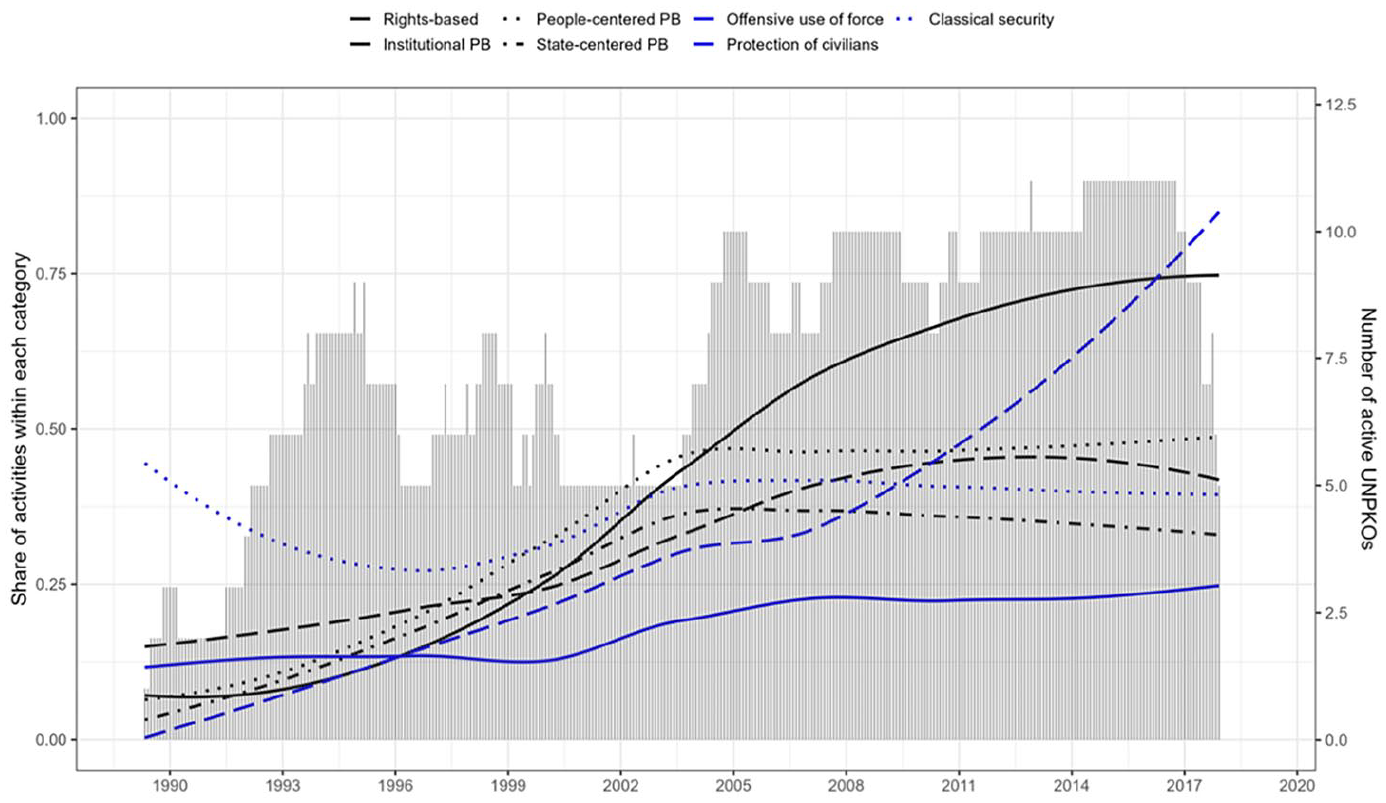
Share of implemented activities within each category per month (line diagram, left Y-axis) and the number of active UNPKOs (bar plot, right Y-axis) between 1989 and 2017.
The classical security activity category (blue dotted line) has developed over time as we anticipated. The share starts at about 0.43 in 1989; it drops in the mid-1990s to 0.26, rises to around 0.42 in 2005, and remains stable afterward. On average, three classical security activities were implemented in 1989, two during the mid-1990s, and around three again since 2005. The findings reflect what we observed in Figure 3: some classical security activities were consistently implemented.
The trends of the share of implemented activities in the right-based activity category (black solid line) and institutional peacebuilding activity category (long dashed line) align with our expectations. The share of implemented rights-based activities starts low at 0.06 in 1989 but steadily rises to 0.75 in 2017. Indeed, less than one of the four possible rights-based activities is implemented on average in the early 1990s, but three of the four rights-based activities are implemented on average in 2017. Between 1989 and 1999, the share of implemented institutional peacebuilding activities increases from 0.14 to 0.22. The share doubles to 0.44 in 2010 and remains relatively stable. In 1989, on average, two institutional peacebuilding activities were implemented, while around seven activities from this category have been implemented since 2010.
The development of the implemented share of activities in the people-centered activity category (black dotted line) aligns with our expectation that people-centered activities have become most prominent during third-generation UNPKOs. In contrast, the evolution of the share of implemented activities in the state-centered activity category (black dot-dashed line) diverges from our expectations. It reaches its highest share already during third-generation UNPKOs and even somewhat declines during “stabilization” UNPKOs. Both categories begin with low implementation rates in 1989 (0.06 and 0.03, respectively), peaking by 2005 (0.47 and 0.37, respectively). While Figure 3 shows that these activities were already implemented by second-generation UNPKOs, Figure 4 reveals that they were actually rarely implemented before the third-generation UNPKOs. In addition, we do not see a particular decline in shares of implemented activities in the activity categories of the peacebuilding domain during the period of “stabilization” peacekeeping. It is good news that the implementation of peacebuilding activities does not decline during stabilization UNPKOs as highlighted by (Curran and Hunt, 2020).
While the share of implemented activities in the PoC activity category (blue long-dashed line) matches our expectations, the share of implemented activities in the offensive use of force category (blue solid line) diverges from our expectations. PoC was almost unimplemented in 1989; the share was at 0.03. However, the share steadily increases to 0.2 in 1999, rises to 0.33 in 2005, and grows starkly post-2008 to 0.85 in 2017. Between 1989 and 2001, the share of implemented activities in the offensive use of force activity category is stable at around 0.12 and doubles to roughly 0.23 between 2002 and 2008 without any further increase. Our empirical data do not support the expectation that “stabilization” UNPKOs have become more offensive, but instead, they have become robust concerning the defensive use of force to protect civilians.
Combining the insights from Figures 3 and 4, the expansion into new categories is evident. Still, it does not follow a neat chronological pattern as we anticipated. While the study expected certain categories of activities to emerge in specific generations of UNPKOs, such as people centered activities in the third generation, the data show that activities from various categories were implemented earlier than theorized. For example, activities in the state-centered peacebuilding activity category and the PoC activity category were already present in the first half of the 1990s. However, within these categories, the share of implemented activities grew steadily, especially during the third-generation UNPKOs. In this light, our findings partially support hypothesis 2.
Sequencing of peacekeeping activities
Finally, we explore our sequencing hypothesis, which states that activities from the security domain are generally implemented before activities from the peacebuilding domain. Given our expectation, we presume to see the following trend: A steady or increasing implementation of security activities quickly upon UNPKO deployment, followed by an expansion of peacebuilding activities. Given that logic, we focus our analysis on implemented activities in the first 24 months after initial deployment. In addition, to address the changes in contexts in which UNPKOs intervene, we evaluate the hypothesis in each peacekeeping generation separately.
Figure 5 exhibits a smoothed trend of the share of implemented activities by security (blue line) and peacebuilding (black line) domain per month (Y-axis) for UNPKOs’ deployment time (X-axis). The second-generation UNPKO panel demonstrates a discernible emphasis on security-first sequencing. The share of implemented activities in the security domain initiates at 0.2, steadily advancing to 0.3 by the 17th month, subsequently experiencing a gradual decline. Conversely, the share of implemented activities in the peacebuilding domain commences at notably low levels (approximately 0.11). It exhibits an increase to about 0.19 after 12 months, maintaining relative stability throughout the second year of deployment. These findings align with our initial expectations, reflecting the primary focus on the security domain among second-generation UNPKOs. Activities in the peacebuilding domain represent a novel dimension of second-generation UNPKOs, but traditional security endeavors still occupy a central role. Consequently, the trends observed in Figure 5 align closely with our security-first expectation.
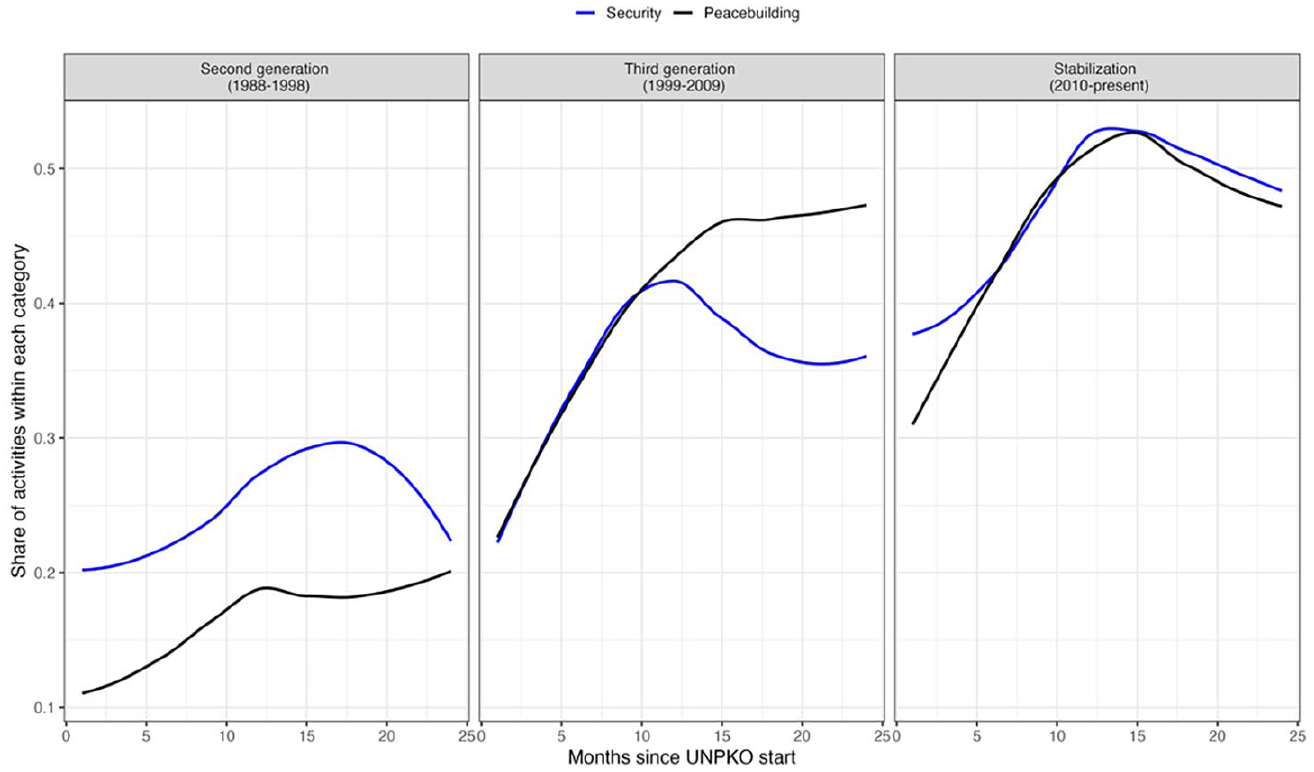
Share of activities implemented within peacebuilding and security domains by UNPKO generations. The X-axis shows the months since UNPKO started.
The trends observed in third-generation UNPKOs (middle panel) exhibit distinctive characteristics that nevertheless align with a security-first approach. For the first year, the share of implemented activities in the security and peacebuilding domains witness rapid increases, nearly doubling from approximately 0.22 to 0.42 by the 10th month. Subsequently, during the second year following deployment, the share of the security domain experiences a minor decline while the share of peacebuilding activities continues to ascend. Thus, we maintain our contention that the security-first sequencing remains a salient feature of third-generation UNPKOs. These UNPKOs have undergone a profound paradigm shift: the introduction of PoC mandates authorizing military means for securing civilians in 1999. Therefore, we might see a parallel trend in the share of implemented activities in both the security and peacebuilding domains during the initial deployment phase of an average PKO.
The right panel offers insights into the sequencing dynamics of stabilization-focused UNPKOs, and it shows—if at all—only a short-lived security-first sequencing approach. Initially, the share of implemented security activities starts at approximately 0.38, peaks after 12 months at 0.52, and then experiences a gradual decline. Concurrently, the share of implemented activities from the peacebuilding domain begins at 0.32, peaks around 0.52 in the 15th month, and subsequently exhibits a slight decrease. While the share of security activities is higher than the share of peacebuilding activities in the initial 3 months after deployment, the shares of implemented activities from both the security and the peacebuilding domain follow the almost exact trend afterward. 12 In contrast to the trend among third-generation UNPKOs, there is a parallel decline in the share of implemented activities from both the peacebuilding and security domain during the second year of deployment among stabilization UNPKOs. Our analysis suggests an increasing reliance on the continuous implementation of security activities for the execution of peacebuilding initiatives. This observation aligns with the operational context of stabilization UNPKOs within protracted conflict settings.
Conclusion
We know that UNPKOs effectively contribute to peace and stability in many respects. Yet, there is a limited understanding of how and through which mechanisms UNPKOs work. Our study fills this gap by systematically exploring the global trends and patterns of implemented peacekeeping activities from the end of the Cold War to the present, offering valuable insights into these operations’ changing nature.
We find that UNPKOs have implemented more activities over time. Yet, the expansion of UNPKOs’ activities into new activity categories like people-centered peacebuilding is not as clear-cut in practice as anticipated. While we expected the diversification of peacekeeping activities to occur among third-generation UNPKOs from 2000 onward, the second generation.
UNPKOs already began implementing activities from a more diverse range of activity categories in the early 1990s. However, there has been an evident multiplication of activities within all peacebuilding activity categories among third-generation UNPKOs. Among stabilization UNPKOs, activities in the PoC and rights-based activity categories continued to be increasingly implemented. Interestingly, however, the implementation of activities usually associated with stabilization UNPKOs (i.e. offensive use of force and state-centered peacebuilding activities) did not increase. Finally, our data reveal a security-first sequencing of activities for second- and third-generation UNPKOs. Stabilization UNPKOs, in contrast, continuously implement a high share of security activities long after initial deployment. A trend that speaks to the fact that the latest generation of peacekeeping takes place in theaters of ongoing war and violence.
Our findings provide the ground for future research into peacekeeping effectiveness and international organizations’ policy priorities. First, the drastic evolving nature of peacekeeping activities calls for a fresh approach to conceptualization and measurement of peacekeeping success. One way to do so would be to focus on the extent to which PKOs implement mandated tasks. Combining the PACT 2.0 dataset with the PEMA dataset (Di Salvatore et al., 2022) would allow researchers to assess whether implementing mandated tasks contributes to their intended outcomes. For example, researchers could explore how mandated and implemented activities in one category (e.g. human rights) affect the corresponding outcomes (e.g. respect for human rights). Second, our study highlights the importance of further investigating the sequence of peacekeeping activities and its impact on the levels of violence and other peacebuilding-related outcomes like the quality of democracy or rule of law. Third, the article introduces a novel dataset, PACT 2.0, covering UN peacekeepers’ activities from 1989 to 2018 across four world regions. These data can enhance existing studies on peacekeeping effectiveness by empirically exploring which of the theorized activity-related mechanisms (e.g. Hultman et al., 2020) contribute to peace and security.
Practitioners and policymakers can use our data to understand when and where UNPKOs can engage in a given activity category and learn about peacekeeping success and failure. The data allow to figure out whether peacekeepers tried to do something (e.g. human rights work) but failed (e.g. to improve the human rights situation) or did not try to engage in an activity category at all. In addition, we highlight the recent shift toward rights-based and people-centered peacebuilding activities, emphasizing the need for improved training in intercultural understanding and grassroots peacebuilding skills. Finally, our methodology, which relies on UNSG reports, provides a systematic overview that can assist host governments, opposition parties, media, and (I)NGOs in monitoring and providing feedback for continuous improvement in peacekeeping efforts. Ultimately, our work represents a significant step toward enhancing the effectiveness of UN peacekeeping.
Footnotes
Appendix 1
Funding
The author(s) disclosed receipt of the following financial support for the research, authorship, and/or publication of this article: We are greatful for generous funding from the Swedish Research Council for the project “The civilian dimension of peacekeeping operations and human rights promotion” (2018-01224).
