




Abstract
Does war affect support for incumbent leaders and parties? The literature is divided with studies reporting negative, positive, or null-effects. Many studies analyze the consequences of foreign intervention, and less is known about the political costs of wars fought close to home. Building on theories of retrospective voting, we theorize that wars inform voters about leader’s competence, and in turn affect mass attitudes and behaviors. Leveraging the unexpected onset of the 1973 Yom Kippur war which interrupted an ongoing Israeli public opinion poll, and voting records from four national elections linked with Israeli military fatality data, we demonstrate that despite the ultimate military victory, the war and its casualties reduced support for incumbent parties and leaders, and increased support for the opposition. By moving beyond foreign interventions, we provide strong evidence that wars over a country’s core territory can be politically costly for incumbent leaders and parties.
Introduction
Wars can have profound political consequences for democratic leaders. Understanding these consequences, and especially how voters reward or punish elected officials for their war performance, can shed light on the circumstances under which leaders are willing to use force. That said, the existing literature, which has focused almost entirely on US and UK foreign interventions, does not reach a clear conclusion regarding the political effects of war.
Indeed, many studies report that wars and their costs are detrimental for leaders’ public support (Croco 2011; Karol and Miguel 2007). In contrast, theories relating to the ‘rally-round-the-flag’ effect (Baker and Oneal 2001), and frameworks emphasizing citizens’ sensitivity to past costs of conflict (Boettcher and Cobb 2009), suggest that wars and their fatalities can increase support for incumbents. Furthermore, others argue that wars and fatalities–by themselves–do not affect support for leaders, and that instead partisanship and elite discourse shape how voters assess leaders’ war performance (Berinsky 2007). These diverging findings, and the the limited consideration of cases other than US and UK foreign interventions, motivate additional attention which can enhance our understanding of whether, when, and how wars affect political attitudes and behaviors.
Building on theories of retrospective voting which have mostly been used to link between economic performance and support for incumbents (Healy and Malhotra 2013), we argue that wars and their costs provide voters with information about leaders’ competence. Accordingly, voters observe the dynamics of war and its outcomes, and attribute the consequences of wars to the performance of elected officials. Based on this attribution, voters form beliefs about the competence of their leaders, which in turn shape their political attitudes and behaviors. We apply this model to generate hypotheses about how war and its costs lead voters to withdraw support from incumbents, and instead support the opposition. To test our hypotheses, we focus on Israeli voters reaction to the Yom-Kippur war.
The Yom Kippur war is especially informative because it was unanticipated by the Israeli public and many of its leaders, and it provided a strong negative shock to Israelis’ sense of security. Moreover, the war broke out during an election year, and interrupted an ongoing national public opinion poll. This provides us with a rare opportunity to examine how the experience of an interstate war affects political attitudes. We further leverage the fact that national elections took place 2 months after the end of the war to examine the effect of military casualties on local election patterns in the immediate aftermath of the war as well as 4 years after its conclusion.
Together, our empirical analyses of public opinion data and voting records surrounding the Yom-Kippur war provide strong support for our theoretical framework of retrospective voting. Specifically, comparing pre- and post-war survey respondents we find that the Prime Minister’s popularity dropped by over 19 percentage points in the post-war surveys. In addition, the overall support for the incumbent party dropped by over 10 percentage points after the war, whereas support for the main opposition party surged by a similar magnitude. We further demonstrate through a difference-in-difference analysis of newly digitized voting records and geographically disaggregated fatality data that localities suffering from military casualties decreased support for the incumbent party by 9 percentage points, and increased support for the opposition party by over 8 percentage points. This latter finding emphasizes the retrospective nature of voters which turned against the incumbent when confronted with a salient consequence of war which can easily be attributed to the incumbent government.
We make four contributions to the literature on wars and support for incumbents. First, unlike many of the previous studies that focus primarily on Western foreign interventions in territories that are far away from a states’ borders (e.g. Mueller 1971; Gartner, Segura, and Wilkening 1997; Gartner and Segura 1998; Gelpi, Feaver, and Reifler 2006; Karol and Miguel 2007; Kriner and Shen 2007; Gartner 2008; Boettcher and Cobb 2009; Johns and Davies 2014), we examine the Israeli case of Yom Kippur war–a conflict that was fought over Israel’s home territory. In contrast to foreign interventions, public willingness to fight and sustain sacrifices is often higher in wars over a country’s immediate territory because of the higher stakes involved (Johnson and Toft 2014; Toft 2014). However, proximity to population centers imposes higher costs on citizens, including exposure of many civilians to the fallout of fighting. It follows, that the effects of such close-to-home wars on incumbent support may cut both ways. Yet, the minimal attention of previous studies to wars over home territory, limits our understanding of how citizens react to wars fought close to home. Therefore, we address this limitation by testing the link between war and support for incumbents in the context of a war fought over Israel’s home territory.
Second, we address inferential challenges which are common in the existing literature by triangulating multiple identification strategies. We analyze five waves of a historical election study which was interrupted by the Yom-Kippur war, and we employ difference-in-difference models to analyze the effect of local military casualties on voting. Together, our evidence all suggest that voters are retrospective, and that electorally minded leaders should focus on minimizing conflict costs by increasing preparedness. Our empirical approach is necessary since the decision to participate in a war is endogenous to the leader’s level of political support (Oakes 2012). Indeed, leaders may avoid military engagements that they deem to be politically costly, and thus it is not surprising that in some cases public support for leaders increases even in response to war fatalities (Koch 2011). Furthermore, in parliamentary democracies (such as Israel), governments can trigger elections in response to successful military campaigns (Smith 2004), imposing further challenges for causal identification. 1 Due to the strategic selection into war, and in some cases into elections, a simple examination of election results, public opinion data, or leader’s survival following military campaigns is subject to serious empirical limitations. Our empirical approach allows us to address these limitations and provide more credible evidence regarding the link between war and support for incumbents.
Third, we contribute to the literature on the political costs of war by employing a more sensitive measurement of political consequences. Many previous studies focus on support for war (e.g. Larson 1996; Gartner, Segura, and Wilkening 1997; Gartner and Segura 1998; Gartner 2008; Schott, Scherer and Lambert 2011; Althaus, Bramlett, and Gimpel 2012; Kriner and Shen 2012), but do not examine whether policy disapproval translates into assessment of leaders and into costly political behavior (i.e. voting). Other studies focus on the political survival of leaders (e.g. Croco 2011; Debs and Goemans 2010; Chiozza and Goemans 2004; Bueno de Mesquita and Siverson 1995). However, the Yom Kippur war is a case that shows how leaders can incur political costs without immediate removal from office. Such costs are also consequential as they may involve reshuffling of senior cabinet members and precede more profound shifts in leadership. 2 Therefore, we join recent studies which have been largely focused on the U.S. (e.g. Karol and Miguel 2007), and employ a more nuanced measure of political costs–using both public opinion and voting data. In doing so we emphasize the aggregate measures of support for war and survival can understate the political implications of wars.
Finally, our evidence from the Yom Kippur war, in which Israel ultimately prevailed, provides important theoretical insights for frameworks of conflict and retrospective voting, emphasizing that incumbents can incur political costs regardless of a war’s outcome. This stands in contrast to theories regarding the positive effects of war on support for incumbents (Baker and Oneal 2001; Boettcher and Cobb 2009). While many theoretical frameworks focus on how military losses lead to a decline in public support for leaders, we show that the high costs of war are politically-consequential, even if the war ends with a military victory. Our theory and evidence suggest that focusing on a war’s outcome rather than its costs may result in an underestimation of political repercussions, emphasizing the importance of research designs that allow scholars to fully appreciate the consequences of war.
War and Support for Leaders
Existing evidence suggests that wars can be politically costly for popularly-elected incumbents that rely on voters’ support to remain in power. 3 In line with this insight, Bueno de Mesquita and Siverson (1995) find that while military victory increases political survival of leaders who are involved in wars, higher total battle-related deaths increase the chances of leaders’ removal. Croco (2011) shows that leaders who initiate wars are more likely to suffer adverse political consequences if they lose them. Similarly, democratic leaders are more likely to be involved in wars earlier in the electoral cycle, decrease their war participation closer to election periods (Gaubatz 1991), and fight weaker opponents against whom they have a higher chance of winning (Bueno de Mesquita et al. 1999)–in line with the idea that war participation can be politically costly. In addition, democracies are less likely to contribute troops to peacekeeping missions abroad before elections, arguably in an effort to minimize political risks when electoral accountability is higher (Marinov, Nomikos, and Robbins 2015). Finally democracies–especially those with military conscription–suffer from fewer war fatalities–consistent with the argument that fatalities are politically-sensitive (Vasquez 2005).
War fatalities “are the most salient, visible, and systematic measure of a war’s cost” (Gartner 2008, 96). Several studies–mostly based on the US experience–suggest that higher war casualties often lead to a decline in popular support for war and for the political leaders associated with it. For example, US public support for military involvement in Vietnam declined as a function of American military casualties (Mueller 1971). Existing research suggests that local fatalities are especially costly for incumbents. For example, state-level US military fatalities in the Iraq war reduced Bush’s vote-share in affected states by 2 percent in the 2004 election relative to the 2000 election (Karol and Miguel 2007), a substantially significant effect especially in close races. Local war deaths also reduced vote-shares of Republican Senators and Representatives (Gartner, Segura, and Barratt 2003; Grose and Oppenheimer 2007; Kriner and Shen 2007). In line with these findings, other studies emphasize the recency of fatalities (Gartner, Segura, and Wilkening 1997), and the importance of trends in forming expectations about future losses (Gartner and Segura 1998). Aside from the direct effect on public support for incumbents, fatalities can have political consequences through increased turnout in elections, by bringing to the ballot box the previously less-politically-active voters (Koch and Nicholson 2016).
In contrast to the findings above, others argue that casualties’ impact is conditional on contextual factors. One such factor is elite consensus about the war that makes voters more tolerant towards fatalities–as in the case of the US in the First Gulf War (Larson 1996). Conversely, military fatalities in combination with elite disagreement, especially if the opposition objects to the war, may weaken public support for the incumbent (Arena 2008). Elite disagreement may also lead the public to adopt partisan views regarding conflict participation, regardless of fatalities (Berinsky 2007). In addition, individual perceptions of war–such as beliefs about the likelihood of success and whether the country was right to enter the conflict–could also condition how voters interpret war deaths (Gelpi, Feaver, and Reifler 2006; Gribble et al. 2015).
Finally, war fatalities under some circumstances may increase popular support for war and for the leaders associated with it. This may happen when some voters view military casualties as an investment. Such a perspective is theorized to encourage voters’ support for ongoing conflict and sustain the current course of action, in order to redeem casualties and not to let them “die in vain” (Boettcher and Cobb 2009; Koch 2011; Schott, Scherer, and Lambert 2011).
Taken together, these studies imply that voters may be sensitive to the costs of war, and especially to military fatalities. However, there are conflicting findings as to whether the effects of wars and fatalities on incumbents’ political fate are positive, negative, or conditional on contextual factors. These conflicting findings may be the result of variation in contextual features across existing cases examined in the literature, or challenges to causal identification (i.e. strategic selection into conflict and elections), which may introduce bias to existing estimates.
For example, if it is common for leaders to select into conflict only when it is electorally advantageous for them, previous findings likely under-estimate the negative effects of wars. Alternatively, if low-quality leaders are more likely to select into war, than the link between war and electoral failure may be over-estimated. These examples emphasize that testing existing theories regarding the political consequences of war requires carefully curated research designs which can address concerns regarding strategic selection into war and elections. Before proceeding with the empirical analysis that addresses these issues, we introduce our theoretical framework that is grounded in existing studies of retrospective voting.
Theoretical Framework: Retrospective Voting After War
What explains how wars shape post-war political attitudes and behavior? As our discussion of the existing literature demonstrates, there are numerous reasons why voters might update their attitudes and behaviors in response to interstate war. However, we argue that wars provide information to voters about incumbent quality and performance in office. In turn, such information leads voters to punish incumbents that demonstrate incompetence when dealing with the challenges of war (Ashworth 2012; Fiorina 1981; Healy and Malhotra 2013).
Generally, retrospective voting is a challenging endeavor for citizens because it requires processing complex information, and evaluating incumbent’s competence based on their performance (Fiorina 1981; Healy and Malhotra 2013). Oftentimes, indicators of performance may be noisy, and voters’ might be unable to attribute a specific outcome to a leader’s policy choice. More so, partisan motivated reasoning may further inhibit voters’ ability hold leaders accountable for their incompetence (Bolsen, Druckman, and Cook 2014).
However, unlike evaluation based on economic performance, which has been the main focus of the retrospective voting literature, the experience of war is often far more salient. More so, the consequences of conflict are often detrimental, temporally isolated, and thus easily attributed to a particular incumbent. Accordingly, we expect that citizens who witness their country get entangled in an interstate conflict will be less supportive of incumbent leaders and parties. Therefore, We hypothesize that:
: The experience of witnessing war over a country’s homeland will reduce voters’ support for the incumbent.
: The experience of witnessing war over a country’s homeland will increase voters’ support for the opposition. Our theoretical framework further suggests that the reason for the general negative effect of wars on support for incumbents relates to the costs of war. High costs are an indication of the leaders’ poor performance and incompetence. Therefore, when the costs of wars are visible and salient to the public, voters are more likely to turn against the incumbent. As emphasized above, military fatalities constitute one of the most salient costs of war. Unlike military spending, fatalities are much more visible to voters. Moreover, previous studies highlight the important role of local casualties in shaping post-war political behavior and attitudes (e.g. Karol and Miguel 2007). Finally, the literature on economic voting also highlights the importance of local conditions to voters’ electoral decisions (Healy and Malhotra 2013). Indeed, some studies show that voters are more responsive to worsening local rather than national circumstances. In light of this, we hypothesize that:
: Local military fatalities will reduce support for incumbents in the communities of origin of fallen soldiers.
: Local military fatalities will increase support for the opposition in the communities of origin of fallen soldiers. As emphasized above, our general expectation is that wars reduce support for incumbents. More so, since fatalities serve as an indicator of incumbent quality, local fatalities will further reduce support for incumbents in the post-war era. However, the negative effects of a war and its costs might be driven by citizens punishing incumbents for their poor performance, or by citizens rewarding opposition parties and leaders for their alternative policy platforms and and qualities. Credibly isolating these individual level motivations is rather challenging. However, we attempt to trace these alternative motivations by leveraging survey data that helps us examine the individual level motivations leading wars and their costs to reduce support for incumbents. In order to test our hypotheses, and shed light on whether, how, and why wars affect public support for incumbents, we focus on Israeli voters responses to the Yom-Kippur war. Before turning to describe our data, empirical strategy, and results, we provide a brief overview of our case.
The Yom Kippur War and the 1973 Elections
The Yom Kippur war began with a surprise Egyptian-Syrian attack against Israel on October 6, 1973. The political and military leadership in Israel, let alone the general public, did not anticipate the war despite ample indicators of a looming threat. 4 The main reason for the surprise was the deep-rooted belief in Israel’s military and the political establishment that Syria would not start a war without Egypt, and that Egypt was not ready to fight because it had not yet received the required offensive weapons from the Soviet Union. This belief shaped the interpretation of numerous pieces of evidence on war preparations in Egypt and Syria (Handel 1977; Klagsburn 2017; McDermott and Bar-Joseph 2017; Shalev 2010).
During 1973, Israel partially mobilized its troops in response to large-scale Egyptian maneuvers (Handel 1977, 483). However, the financial cost of mobilization, together with alert fatigue, and the fear of self-fulfilling prophecy, deterred the government from calling up the reserves despite the mounting evidence indicating a possible attack. Israeli leaders’ firm belief in the ability of their intelligence organizations to provide a sufficient alert in case of an attack further contributed to the government’s unwillingness to mobilize troops in the absence of a clear alert (McDermott and Bar-Joseph 2017).
The higher military and political echelons concluded that an attack was imminent only eleven hours before the outbreak of the war (Kam 1988, 23). During the Army’s General Staff meeting on October 5, 1973 (one day before the outbreak of the war), the head of the military intelligence corps indicated that the chances of an Egyptian or Syrian attack were “low, and even lower than low” (Aderet 2018; McDermott and Bar-Joseph 2017). 5 In line with this assessment, there were no preparations for combat up until a few hours before the Syrian and Egyptian attacks (Betts 1982, 77-78). The army revised its assessment and began preparing for war in the morning of October 6, following information received from Mossad agent Ashraf Marwan that war would begin later that day (Mintz and Schneiderman 2018).
Even then, as late as 6 hours before the attack, the Israeli government decided against a preemptive strike and against mobilization of reserves for attack purposes in order not to appear aggressive in the eyes of the international community, and not to jeopardize the chances of receiving American support during war, should it break out (Druckman 2010). The Minister of Defense Dayan vehemently opposed launching a preemptive strike, and believed that Egypt might “change their mind” about the attack in the last minute (Mintz and Schneiderman 2018). This further underscores the surprising nature of the attack. Mobilization of reserve army personnel began 4 hours before the attack–not enough to deploy sufficient number of forces to stop the advancement of the Egyptian and the Syrian armies (McDermott and Bar-Joseph 2017).
In the initial stages of the war Israel sustained heavy losses, with 724 Israeli soldiers killed in the first 36 hours (Bar-Joseph 2005, 225). The timing of the attack–on the Jewish Day of Atonement–especially contributed to the initial setback since most of the military personnel were away from their bases and disconnected from radio and telephone. 6 Importantly, the timing of the attack on a Jewish religious holiday was chosen to maximize the surprise and unpreparedness (Betts 1982; Kam 1988), and was therefore unrelated to the level of political support for the government.
Israel ultimately succeeded in pushing the opponents back–to some extent thanks to massive military assistance from the US (Eriksson 2013, 40). Fighting ceased in the end of October. Militarily, Israel was in control of more territory than it controlled prior to the outbreak of the fighting, 7 but the country paid a heavy toll with over 2200 soldiers killed, and 7251 injured. The unanticipated attack, together with the heavy initial losses in the war, traumatized many Israelis, and shook their confidence in the invincibility of the Israeli army (Eriksson 2013, 29). In Israel, the failure to anticipate the attack is often referred to as “the blunder” (ha-mehdal) (Bar-Joseph 2005, 6).
National elections–initially scheduled for October 29–were postponed to December 31 due to the war. The incumbent Labor party and Likud–the chief opposition party–were the main competitors, with the incumbent enjoying a strong lead in polls before the outbreak of the war (Arian 1975). For example, in the INES survey in September–one month before the war–52% of the respondents indicated they would have voted for the Labor party if elections were held that day. This number dropped to 43% and 42% in the November and December polls, respectively. The actual Labor vote-share in the elections that were held in the end of December was 39.6% of the total vote (Knesset 1973)–very close to what the INES polls had predicted. The economy was growing well with over 9% increase in GDP per capita in 1972, and the unemployment rate standing below 3% (International Labour Organization 2019). Pre-war Labor campaign ads featured the incumbent Prime Minister Golda Meir and referred to the excellent security conditions in the country (Klagsburn 2017, 609). During the war, the opposition refrained from attacking the government (Klagsburn 2017, 640), but their post-war campaign accused the government of ‘criminal negligence’ due to the lack of preparedness.
Election results partially reflected this mood: while the incumbent party still formed the new government, with Meir continuing as the Prime Minister, Labor’s number of seats in the parliament decreased from 56 to 51, and the main opposition party’s seats increased from 32 to 39 (Knesset 1969, 1973). However, within a month Meir resigned from her posts as the Prime Minister and the leader of the Labor party. Her resignation was prompted by the public release of the interim report of the National Inquiry Commission established to investigate the war and the events that led to it.
Although the report did not explicitly blame the government for the failure to anticipate and prepare for the attack, Meir resigned in light of the criticism voiced against her both in the general public and within her coalition. The Labor party formed another government, headed by Yitzhak Rabin. The eventual political turnover in Israel materialized only after the 1977 elections when the opposition party Likud formed the government for the first time. In the 1977 campaign, the opposition accused the incumbent government of complacency and failure to prepare properly to the war despite the available information (The National Library of Israel 2019). Our empirical examination of the post-war political developments in Israel, which we now turn to describe, suggests that the Yom Kippur war not only imposed immediate political costs on Meir and the Labor party, but also sowed the seeds of a complete political turnover down the road.
The Effects of the Yom Kippur War on Israeli Voters
In this section, we describe the analyses implemented to test our hypotheses regarding the general effects of war on public support for incumbents, and the particular effects that the cost of war have on voting behavior. As we further detail below, our test of Hypothesis 1a-b leverages the INES which was interrupted by the unexpected onset of the Yom-Kippur war. Our test of Hypothesis 2a-b, employs a difference-in-difference design to recover the effects of military fatalities on voting behavior. After testing our main analyses, we analyze a final post-war public opinion survey, to explore the individual level mechanisms driving our main effect. Together these studies allow us to consider the general political effects of war over a country’s homeland, and the extent to which the effects of such a war are driven by a central cost of war – military fatalities.
INES Public Opinion–Empirical Strategy
The eighth national Israeli election was planned to take place in the end of October 1973. In anticipation of this election, the INES conducted two survey waves – in May and in September (waves 1 and 2, respectively), interviewing representative samples of urban adult Jewish respondents. 8 Following the war in October, and the election’s postponement until the end of December, the INES fielded two more surveys – in November (wave 3) and in December before the elections (wave 4), similarly interviewing a representative sample of the urban adult Jewish population. An additional survey wave was conducted in January (wave 5), and focused on post-election interviews of a similarly-representative sample.
We leverage the unanticipated interruption of INES surveys by the Yom Kippur war, and compare responses of similar Israeli citizens to identical questions in pre-war (waves 1 and 2) and post-war surveys (waves 3 and 4). Specifically, we consider respondents participating in the pre-war surveys as a control group which did not witness the war, and respondents participating in the post-war surveys as a treatment group – exposed to the occurrence of interstate war. In our empirical strategy we assume that respondents in the control group were unaware of the upcoming war, and that given the attempt to collect data from representative samples of respondents in each wave, treatment and control groups should be similar in their observable and unobservable characteristics (Muñoz, Falcó-Gimeno, and Hernández 2020).
We substantiate the first assumption regarding the unexpected nature of the war through our qualitative exploration of this case, which suggests that the war was unexpected–at least by the individual respondents as well as some of the decision-makers in Israel. To further address the comparability of our treatment and control groups, we examine our pre- and post-war samples in the Appendix. In Table A1, we demonstrate that for the most part pre-treatment covariates are similar across both groups. However, since some slight imbalances exist in several covariates, all our models include basic demographic and political controls.
9
For our main analysis of survey data, we estimate the OLS regression depicted in equation (1) to identify the effects of the war on support for political leaders and parties.

INES Public Opinion – Results
In Figure 1 we report results from OLS models identifying the effects of the war on support for Israeli leaders and parties.
11
In our analyses we focus on how the Yom Kippur war affected domestic support for key incumbent and opposition leaders, as well as their parties. Specifically, we consider how the war shaped citizens’ appreciation of Prime Minister Meir, Minister of Defense Dayan, and Opposition Leader Begin, as well as support for the ruling party (Labor) and the main opposition party (Likud). In line with Hypothesis 1a, the results of Figure 1 suggest that public support for the Israeli incumbent leaders and the Labor party dropped significantly following the war, with a decline of 19 and 10 percentage points in the favorability of the Prime Minister and the Defense Minister respectively, and a decline of over 10 percentage points for the Labor party. In line with 1b, we find that the favorability of the hawkish opposition Likud Party increased by almost 10 percentage points, however we do not detect a precisely estimated change in the support for the Opposition Leader Begin. War effects on public opinion–Each point estimate and its corresponding confidence intervals represent the war’s effect on our main outcomes of interest. Leader OLS models depicted in this figure analyze respondents from waves 2 and 3 of the INES survey–one month before and after the war. The models include indicators to control for gender, age-group, income group, religiosity, education level, origin, ethnicity and self-reported vote choice in 1969. Party OLS models depicted in this figure analyze respondents from waves 1-4 of the INES survey and include similar controls as well as an additional survey wave fixed-effect.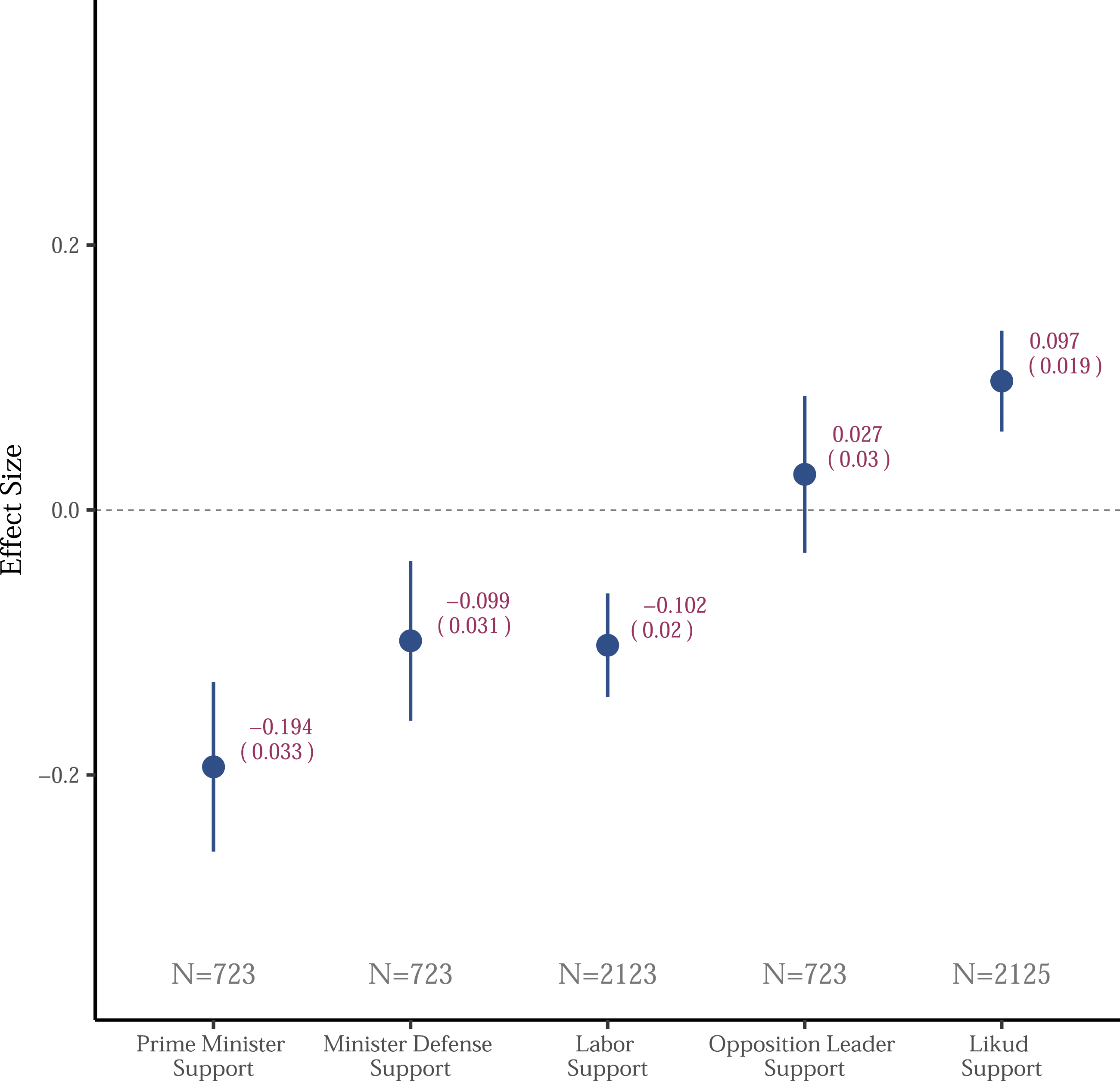
In the Appendix, we show that these results are robust to matching on demographic attributes of the respondents, and employing alternative model specifications. It is interesting to note Prime Minister Golda Meir suffers a larger decrease in popularity than the Minister in Defense. Indeed, there is a statistically significant difference between the point estimate relating to decreased support for Prime Minister Meir and Minister of Defense Dayan. 12 One possible interpretation is that female leaders are punished more harshly than male leaders. Another interpretation may suggest that punishment is larger for politicians higher in the command chain. Both these interpretations are plausible, and future research should focus on how gender and rank condition the extent to which the public sanctions incumbents.
Military Fatalities and Voting: Empirical Strategy
Thus far we have demonstrated that the general experience of the Yom Kippur war reduced public support for incumbent leaders and parties, and increased public support for the main opposition party. We now turn to test the second hypothesis (H2a-b), and examine whether conditional on experiencing the war, proximity to the war’s costs further reduced support for the incumbent and increased support for the opposition. To do so, we retrieved geolocated data regarding the origin of all Israeli military fatalities from 1973, as well as geographically desegregated voting records at the locality level. To ensure that our analyses are comparable with the public opinion results, we focus on urban localities.
In our analysis, we adapt a difference-in-difference empirical strategy, estimating the effects of 1973 locality-level military fatalities on locality-level support for the ruling party and for the main opposition party.
13
This strategy allows us to consider within locality changes in voting over time as a function of military casualties in 1973, while accounting for time-invariant locality confounders, as well as time-variant confounders which are constant across all studied localities. In line with our theoretical framework, we hypothesize that local military fatalities reduce support for the incumbent party (H2a), and increase support for the opposition (H2b). In our main specification, we estimate the OLS regression reported in equation (2)

In the appendix, we present parallel trends plots to substantiate the central assumption underlying our empirical approach (Figure A2). To further test the robustness of our results, we consider alternative measurements of our treatment. These include a binary indicator for localities above the top 75 th percentile of military fatalities, as well as a continuous measure of fatalities relative to eligible voters. In addition, since our general measure of localized casualties is based on a yearly count of locality military fatalities (including fatalities arising before or after the war), we demonstrate that our results hold when focusing on an alternative measure of casualties occurring only during the days of Yom Kippur war. Our results are robust to all the above alternative specifications.
Military Fatalities and Voting: Results
We report the effects of military casualties on support for the Labor and Likud parties in Figure 2.
14
Specifically, we consider the effects of military fatalities on the 1973 and 1977 elections separately and combined. In line with our theoretical expectations, the results suggest that support for Labor declined in localities suffering from military fatalities. This decline is precisely estimated in the analysis of the 1977 election, as well as in the pooled analyses where support for Labor declined by over 9 percentage points. One reason why the negative effects of fatalities on the 1973 Labor vote share is not precisely estimated at conventional levels, might relate to the report of the National Inquiry Commission which was only released following the elections. Thus, voters were not fully certain of the extent of the government’s war mismanagement to change their vote, although the negative impact of the war on public support for the incumbent is already evident in the analysis of the public opinion data presented above. Combatant death effects on voting 1965-77 – Each point estimate and its corresponding confidence intervals represent a difference-in-difference estimator from OLS models controlling for locality level conflict victims, eligible voters, and year fixed-effects. Standard errors are clustered at the locality level.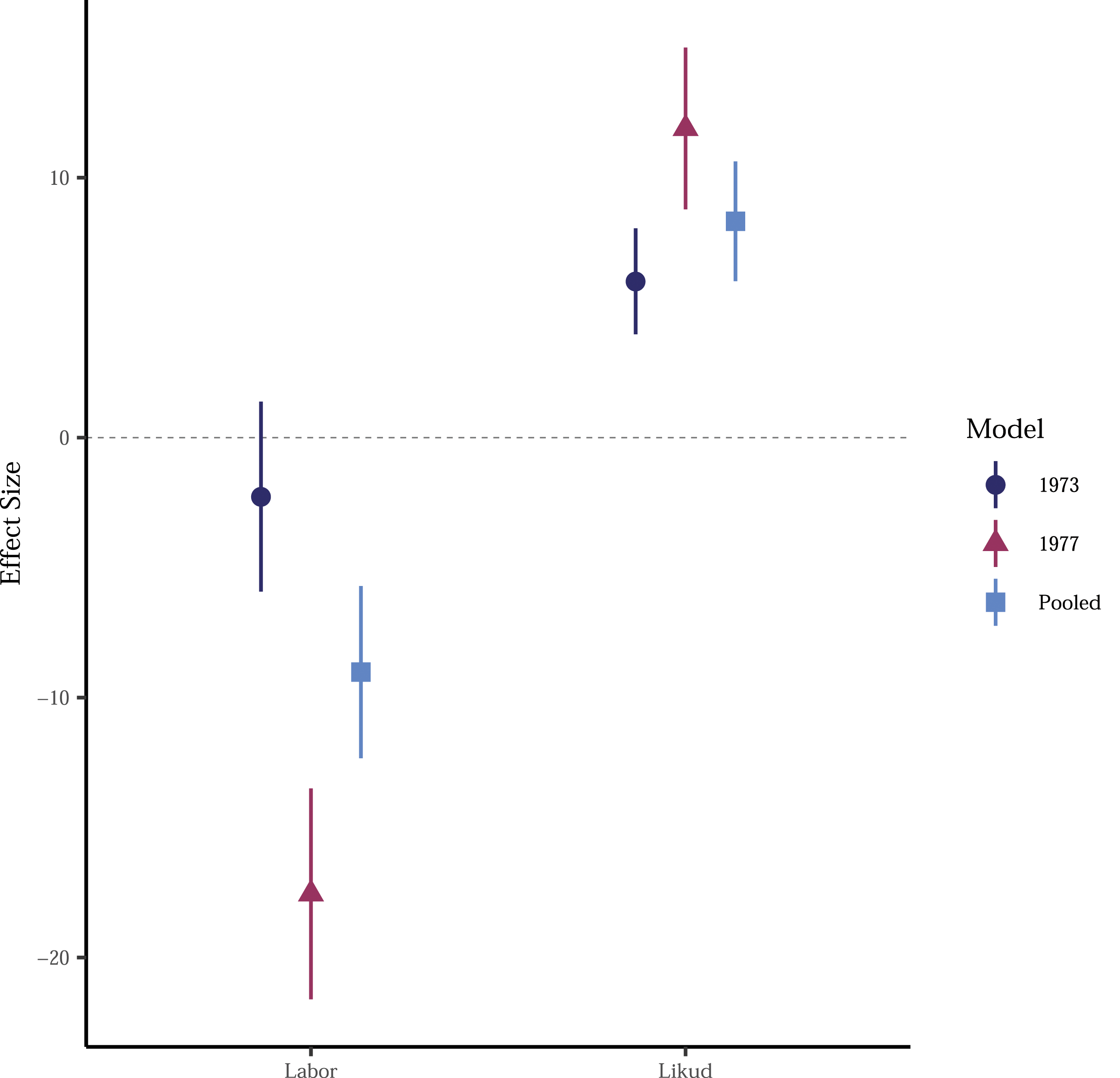
In contrast to the negative effects on the incumbent Labor party vote share, military fatalities had an immediate and lasting positive impact on the opposition party’s vote-shares, as expected in Hypothesis 2. This increase is statistically significant when analyzing the 1973 and the 1977 elections separately and together. Indeed, in the pooled analysis, local military fatalities cause an 8 percentage point increase in support for the Likud opposition party. These findings from the Israeli context of the Yom Kippur war are notable as they emphasize that even in a context where the war is salient to all voters (given the proximity of the battlefield (Karol and Miguel 2007)), and many voters are aware of mounting casualties (unlike in the U.S. where awareness might vary across local media markets), localized military casualties still reduce support for incumbents.
Exploring the Mechanisms Behind the Retrospective Voting
The patterns we identify above emphasize that in response to the Yom-Kippur war Israeli voters turned away from the incumbent Labor party towards the Likud. However, as we emphasize in our theoretical framework, the effects of war on support for incumbents may be driven by at least two different, albeit related, individual level motivations. The first is a punitive mechanism by which voting behavior is largely motivated by an attempt to punish incumbents for incompetence and poor performance. The second is a selective mechanism in which voters use elections to select parties and leaders who offer policies and skills that are perceived to be most effective.
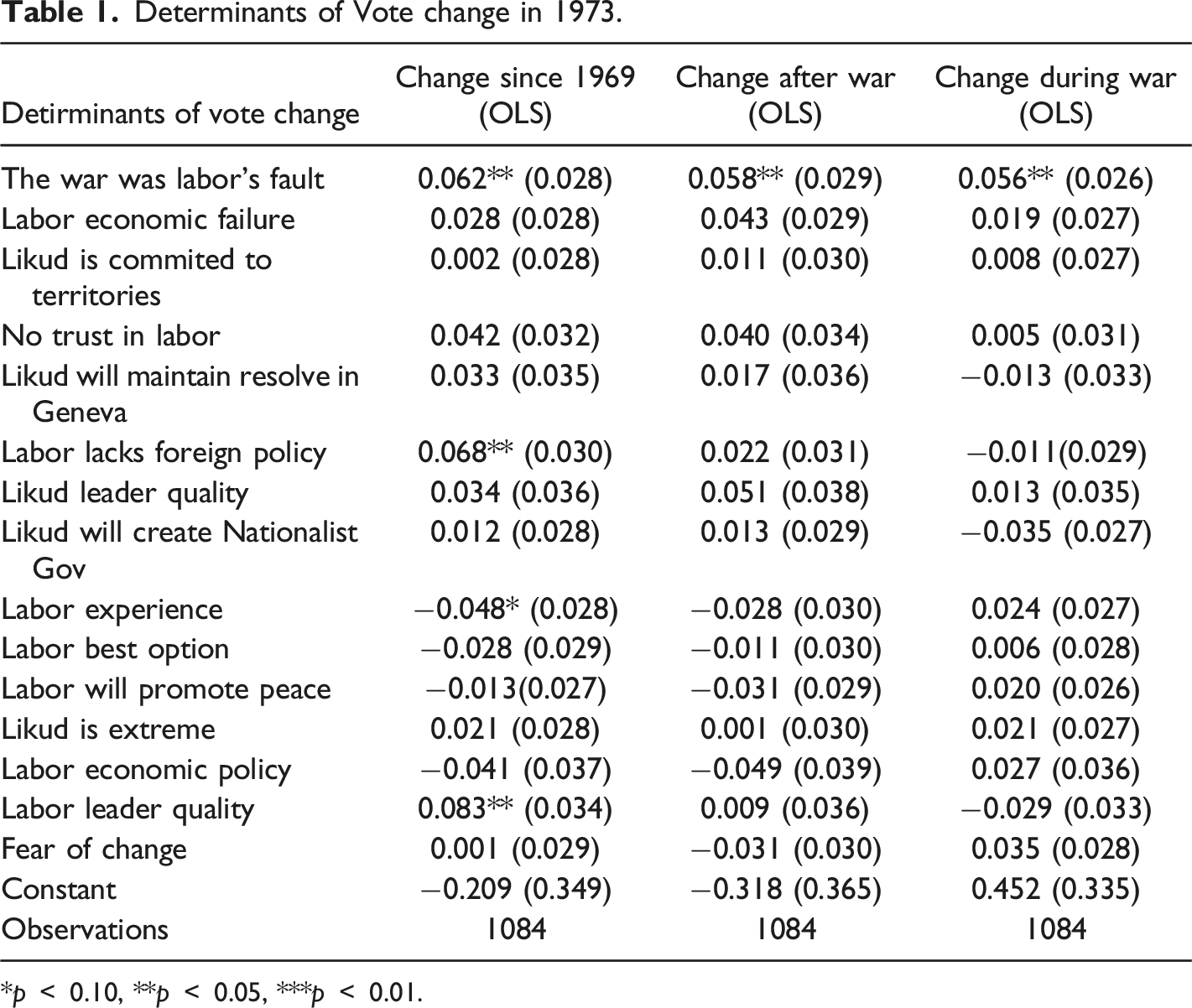
Determinants of Vote change in 1973.
*p
The voting rationales examined, include Likud party qualities (e.g. international resolve, ideological extremity, leader quality), Labor party qualities (e.g. governing experience, dovish ideology, leader quality), and past Labor performance relating to security and economics. 17 Results from Table 1 suggest that the only voting rationale which is consistently correlated with self-reported vote change, is the voting rationales related to Labor’s security failure during the war. In contrast, other voting rationals relating to Likud policy, leader quality, or resolve, and Labor competence, experience, or economic performance, do not consistently predict self reported vote change. We cautiously interpret the results in Table 1, as evidence that a central reason for voters’ reduced support for incumbents relates to punishment of incompetent performance during the Yom Kippur war. 18
This table presents the correlation of self reported vote change with voting rationales. All regressions include indicators to control for gender, education, age, income, religiosity, locality, and father’s country of origin.
Discussion
In this paper, we draw on frameworks of retrospective voting to develop a set of expectations regarding the links between war, the costs of war, and support for incumbents. We test our expectations in the context of the Yom Kippur war, by leveraging an unexpected interruption in an ongoing public opinion survey, as well as historical records of military fatalities and locality voting behavior which allow for a difference-in-difference empirical design. By triangulating multiple data sources and identification strategies, we demonstrate that the war decreased public support for the incumbent leader by 19 percentage points, and its costs reduced incumbent party vote shares by 9 percentage points. Similarly, the war increased public support for the challenging party by almost 10 percentage points, and increased the party’s vote share by 8 percentage points. Suggestive evidence from post-war surveys suggest that our identified negative effects are likely driven by voters seeking to punish the incumbent Labor party for mismanaging the war effort.
We make several contributions to the existing literature. First, we demonstrate that wars over a country’s core territory–even if eventually victorious–can be politically costly for incumbents. This finding is noteworthy since most recent studies focus on foreign interventions. We build on those studies, and demonstrate that voters are also sensitive to wars fought close to home. Indeed, our point estimates suggest that the effects of war in our case are substantively large, and may extend well after a war is over. More so, we demonstrate that in our case reduced support for incumbents directly translates into increased support for the incumbent’s main challenger.
Second, we advance on previous studies by adapting research designs that address the fact that leaders may strategically select into war, and that exposure to the costs of war may be endogenous to community level characteristics. To do so, we combine two different analytical strategies: An analysis of a multi-wave survey interrupted by a surprise attack, and a difference-in-difference design identifying the effects of local casualties on voting. Our analyses provide strong evidence regarding the effects of war on public opinion and voting behavior. However, our analytical approaches require a set of identifying assumptions, which we critically evaluate in this article and in the Appendix. More so, our voting analyses focus on community level changes rather than individual level changes in vote choice. Therefore, We encourage scholars to build on our analytical approach and findings, and further examine the links between war and voting focusing on other cases, and using other research designs that may further substantiate the links between war and voting.
Third, by focusing on changes in public opinion and locality level vote shares, we advance the literature on the political costs of war. Specifically, we introduce more sensitive measures that suitably capture the price that leaders pay for the conflicts in which they engage. Doing so reveals that in a counterfactual world without the war, or with fewer casualties, the Labor party would have likely performed better, especially given the impressive economic growth and low unemployment since the preceding elections. It follows, that an analysis of the war and its political costs, which focuses on leader survival alone, would wrongly infer that the Yom Kippur war did not affect the incumbent leader and party since both survived in office in the aftermath of the first post-war election. Lastly, we contribute to the retrospective voting literature by demonstrating that incumbents can incur political costs regardless of a war’s outcome. We emphasize that wars, regardless of their outcomes, are a costly endeavor for incumbent leaders, because they produce tangible and attributable costs (i.e. fatalities), and they generate opportunities for leaders to reveal their incompetence.
Beyond these general contributions, our analyses bear important contextual insight to the study of Israeli politics. Our evidence indicates that the Yom Kippur war catalyzed long-lasting political changes that ultimately led to the first governmental turnover in Israel’s history. Previous analyses of Israeli politics pointed to demographic changes and to socio-economic dynamics as causes of the 1977 turnover (Arian and Shamir 1992). In this article, we further link the origins of the 1977 turnover with the Yom Kippur war – a dramatic event that put an end to almost thirty years of Labor party rule.
Do our conclusions apply beyond the case of Israel to other instances conflict? Answering this question requires replication of similar studies in different context (McDermott 2011). We encourage researchers to build on our designs and analyses, and explore the extent to which wars and their costs affect voting behavior in other instances of war over home territory.
Supplemental Material
Supplemental Material - Interstate Conflict Can Reduce Support for Incumbents: Evidence from the Israeli Electorate and the Yom Kippur War
Supplemental Material for Interstate Conflict Can Reduce Support for Incumbents: Evidence from the Israeli Electorate and the Yom Kippur War by Anna Getmansky and Chagai M. Weiss in Journal of Conflict Resolution
Footnotes
Acknowledgments
We thank Adeline Lo and Micheal Masterson for insightful comments and suggestions. We are also grateful to participants in the Department of Political and Social Sciences seminar at the European University Institute in Florence; LSE Political Behaviour seminar; LSE Security and Statecraft workshop; Carlos III - Juan March Institute of Social Sciences; Comparative Politics Working Group at UW-Madison; 2017 European Political Science Association meeting; 2019 panels at Midwest Political Science Association and International Studies Association meetings for helpful comments. This research is based upon work supported by the British Academy/Leverhulme Small Research Grants scheme under Grant No. DLB6500 [Getmansky].
Declaration of Conflicting Interests
The author(s) declared no potential conflicts of interest with respect to the research, authorship, and/or publication of this article.
Funding
The author(s) disclosed receipt of the following financial support for the research, authorship, and/or publication of this article: This study was supported by British Academy; DLB6500.

Supplemental Material
Notes
References
Supplementary Material
Please find the following supplemental material available below.
For Open Access articles published under a Creative Commons License, all supplemental material carries the same license as the article it is associated with.
For non-Open Access articles published, all supplemental material carries a non-exclusive license, and permission requests for re-use of supplemental material or any part of supplemental material shall be sent directly to the copyright owner as specified in the copyright notice associated with the article.
