



Abstract
This article introduces the Deadly Electoral Conflict dataset (DECO): a global, georeferenced event dataset on electoral violence with lethal outcomes from 1989 to 2017. DECO allows for empirical evaluation of theories relating to the timing, location, and dynamics of deadly electoral violence. By clearly distinguishing electoral violence from related (and sometimes concurrent) instances of organized violence, DECO is particularly suitable for investigating how election-related violence is connected to other forms of violent political contention. In the article, we present the theoretical and methodological underpinnings of the data collection and discuss empirical patterns that emerge in DECO. We also demonstrate one potential use of DECO by examining the association between United Nations peacekeeping forces and the prevalence of deadly electoral violence in conflict-affected countries.
Introduction
Almost all countries in the world hold elections to fill the highest office of the state. Ideally, elections are vital opportunities to peacefully adjudicate between society’s diverse political preferences through the ballot box and decide the right to rule (Schumpeter 1952; Dahl 1989). However, many elections are tainted by widespread violence, which undermines democratic practices, denies people their right to cast their vote under free and fair circumstances, and unduly affects electoral results. Electoral violence is sometimes an isolated phenomenon in otherwise peaceful societies. Zambia and Malawi are two cases in point that feature limited instances of electoral violence, but both countries have escaped large-scale communal violence or civil war. However, a significant share of electoral violence is committed in societies where different forms of violence co-exist, including civil war, communal conflict, criminal violence, or government repression (Harish and Toha 2017; Staniland 2014). For example, in Nigeria and India, electoral violence occurs in parallel to major and long-standing armed conflicts and is often part of the trajectory of large-scale communal violence.
To date, existing cross-national data sources on electoral violence have not been able to clearly separate electoral violence from other forms of organized violence. This data gap has restricted our understanding of how electoral violence intersects with and is shaped by other forms of violence and their trajectories. This is a significant limitation that raises questions about both the broader correspondence between theoretical definitions of violence and the more specific empirical scope of existing studies of electoral violence.
To remedy this data gap, this article introduces the Deadly Electoral Conflict dataset (DECO), which provides global data on election-related violent events from 1989 to 2017. In short, DECO records lethal incidences of violence that are substantially linked to an electoral process or its outcome. It is coded as a derivative of the more comprehensive compilation of events of organized political violence provided by the Uppsala Conflict Data Program Georeferenced Event Dataset (UCDP GED; Sundberg and Melander 2013). For all events that are deemed to have a substantive link to an ongoing electoral process, DECO codes a range of variables that characterize the event’s relationship to the election and the features of the violence. For example, DECO incudes the type of targets, whether perpetrators are associated with the incumbent side, and whether the event is tied to pre- or post-electoral contention.
DECO’s comprehensive coverage of lethal events of electoral violence over the past three decades has the potential to move the research agenda on electoral violence forward in significant ways. First, by clearly distinguishing electoral violence from related (and sometimes concurrent) instances of organized violence, DECO accommodates research on how election-related violence is connected to other forms of violent political contention. Second, actor identification following UCDP templates allows DECO to be combined with a number of other datasets on the characteristics and behavior, including non-violent behavior, of armed actors. Third, through its high spatial and temporal resolution, DECO enables researchers to capture escalatory and de-escalatory dynamics within and across locations, during and outside of election cycles. For example, the data collection is not bound to a predetermined temporal window around each electoral event. DECO instead captures electoral violence independent of when in the electoral cycle it occurs and offers an important complement for researchers to move beyond more aggregated country-year or electoral-round analyses. Jointly, the features of DECO can underpin a more comprehensive picture of who commits violence against whom, when, and where, and enable deeper understanding of the driving forces behind electoral violence.
We begin by presenting the existing data sources used by scholars of electoral violence. Next, we outline the central definitions and scope of DECO, describe the data collection procedure in more detail, situate the new dataset in relation to other available electoral violence data sources, and discuss the quality of the data. The following section presents patterns of lethal electoral violence emerging from DECO. We also illustrate how the data can be used in an empirical examination of the association between the presence of United Nations peacekeeping and the prevalence of electoral violence during or after conflict. We conclude by charting some fruitful avenues for research based on the DECO data.
Existing Data
Elections feature in a variety of institutional settings ranging from consolidated democracies to highly authoritarian regimes and across competitive and noncompetitive contexts (Donno 2013; Schedler 2002). In autocracies and hybrid states, elections provide rulers the legitimacy associated with adhering to a form of democracy and also serve as an instrument of control and power-sharing that prolong the regime’s duration (Magaloni 2008; Schedler 2002). In democracies, elections provide a peaceful mechanism for determining issues of governance by means of a vote by the people and thereby serve the dual purpose of distributing formal decision-making power and giving the people a voice (Przeworski 2005; Schumpeter 1952).
Across regimes, elections have been shown to contribute to peace and democracy: they are events leading, for example, to more open societies (Davenport 1998), democratization (Lindberg 2006), and conflict mitigation (Bartusevičius and Skaaning 2018). However, many elections are held in the midst of violence, which has prompted scholarly interest in the causes, dynamics, and consequences of electoral violence. The growing literature on election-related violence draws from various data sources, including survey data, qualitative case-material, and event data from individual countries. 1 Many studies have also used cross-national quantitative analyses to facilitate comparisons among countries over time and allow for more generalizable findings. Most of these studies draw on existing datasets that capture broader categories of contention, such as armed conflict or urban unrest but recent efforts also seek to capture the specific dynamics of electoral violence.
Initially, a number of studies relied on large-N data on civil conflict such as the UCDP/PRIO armed conflict dataset to study cross-national variation in the relation of elections to outbreaks of large-scale political violence (e.g., Brancati and Snyder 2013; Cederman, Gleditsch, and Hug 2012; Collier, Hoeffler, and Söderbom 2008; Flores and Nooruddin 2012). 2 This aggregate approach is suitable for studying the general connection between elections and violence, but it introduces noise if the purpose is to explore violence specifically linked to the electoral process or related electoral outcomes. Thus, to approach the specific dynamics around electoral contention, studies have relied on event data from, for example, UCDP GED (Sundberg and Melander 2013) or the Armed Conflict Location and Event Dataset (ACLED) (Raleigh et al. 2010), but applied the criterion of proximity to election day to determine whether or not the violence is election related (e.g., Daxecker 2012; Goldsmith 2015). Although this approach is better suited to establishing the connection of a violent event to electoral dynamics, the appropriate time frame is difficult to ascertain; electoral cycles differ across countries, and violent electoral events can occur both very early and late in these cycles. Some datasets go further toward establishing a substantive link to the electoral environment. The Social Conflict Analysis Database (SCAD) provides an issue-based classification of each event from news reports, allowing researchers to focus on a sub-sample of data specifically tied to electoral dynamics (see, e.g. Daxecker 2014; Fjelde and Höglund 2016; Salehyan and Linebarger 2015; Smidt 2016). This feature is an important contribution to the study of electoral violence, since not all political violence during electoral periods is linked to the election per se. However, since SCAD focuses on social contention and explicitly excludes events related to organized rebellions and civil war, it might underestimate fatal electoral violence in conflict-affected countries. 3
As an alternative source of data for cross-national comparisons, datasets focused more broadly on electoral dynamics and electoral conduct, including electoral violence, provide data at the level of each country-year or electoral round. Prominent among these is the National Elections across Democracy and Autocracy (NELDA) dataset. NELDA uses data from qualitative sources and newswire services to assess, for each national election from 1946 to 2015, the existence of significant violence involving civilian deaths and any evidence of government harassment of the opposition or violence against protesters (Hyde and Marinov 2012). 4 Varieties of Democracy (V-Dem) provides the most comprehensive temporal and geographical scope, with global data from 1900 to date on more than 350 indicators pertaining to democratic institutions and governance, including the prevalence of electoral violence (Coppedge et al. 2020). 5 In this source, electoral violence is measured on a four-point ordinal scale (converted to interval by V-Dem’s measurement model) ranging from “peaceful” to “widespread violence” either throughout the electoral period or for an intense period, across large swaths of the country, and resulting in a large number of deaths or displacements. A clear advantage of these sources is their comprehensive time series, which allow global comparisons across different electoral regime types, for example, or analyses of how changes to institutional features affect electoral violence. Meanwhile, although both V-Dem and NELDA variables provide nuance in terms of the intensity and scope of the violence, they do not allow for more fine-grained temporally or spatially disaggregated analyses beyond the level of the country-year or electoral round. 6
Addressing some of these limitations, two comprehensive data collections on electoral violence that evolved in parallel to DECO have recently been released. The Electoral Contention and Violence (ECAV) dataset (Daxecker, Amicarelli, and Jung 2019) contains information on all election-related contention for all countries with unconsolidated regimes that held competitive elections from 1990 to 2012. Election-related contention is defined as “public acts of mobilization, contestation, or coercion by state or non-state actors used to affect the electoral process, or arising in the context of electoral competition” (Daxecker, Amicarelli, and Jung 2019, 716). ECAV covers a time frame of six months before and after elections and codes all events in newswire search strings falling under the definition above. The dataset of Countries at Risk of Electoral Violence (CREV) starts from a list of 101 countries at risk of electoral violence and codes the occurrence of ten different forms of electoral violence in these countries from 1995 to 2018 (Birch and Muchlinski 2020). CREV also limits its focus to six months before the election month and three months following. The data are drawn from the Integrated Crisis Early Warning Systems event data, which are coded using an automated search routine applied to a broad range of media sources.
For researchers interested in electoral violence, both these data sources have the advantage of applying a broad criterion for electoral contention by not restricting themselves to lethal events. Their high level of temporal and spatial resolution also facilitates disaggregated analysis to an extent not possible using aggregated election data. Fine-grained information also allows researchers to break data down into relevant sub-categories such as pre- versus post-electoral violence, involvement by state or non-state actors, and lethal versus non-lethal outcomes. DECO joins this effort to provide fine-grained event data of electoral violence. Below we discuss the conceptual and operational definitions and coding procedures of DECO. To guide users in their choice of dataset, we also outline the main differences between DECO and existing cross-national datasets on electoral violence. Depending on the particular research project, these datasets have different comparative advantages.
Definitions
As a conceptual starting point, DECO defines electoral violence as violence that is substantially linked to an electoral contest. A central part of the definition is the direct connection of violence to features of the electoral process and dynamics through political parties, voters, candidates, polling, or the institutional arrangements surrounding elections. Thus, DECO is concerned with cases of violence that would most likely not have occurred or would have manifested themselves differently in the absence of an electoral contest.
We define an electoral contest as a formal contest to fill political offices, where the public is involved in casting the vote. 7 While most datasets on electoral violence (including NELDA, V-Dem, ECAV, and CREV) focus on national elections for the legislative and executive branches of government, DECO also includes events related to electoral contests for subnational elections to fill regional and local governments. In addition, we include events that are linked to national and subnational referenda on issues relating to constitutional matters, since these situations also invite and mobilize the electorate to vote on matters relevant to their governance. Admittedly, referenda could be seen as theoretically distinct from elections for political office, and events pertaining to referenda could easily be separated out for studies that would not fit the current theoretical scope.
The focus on a substantive link to elections directs our attention away from looking at the temporal connection, to make a more qualitative assessment of the type of violent event. To ascertain a substantive connection between violence and electoral contests, we assess—in terms of its perpetrators, targets, and reported purpose—whether the violence is related to a specific election. The definition makes it possible to distinguish between violence that, for example, increases actors’ bargaining position in the electoral contest and violence levied to influence the military bargaining position of parties engaged in an armed conflict, even if both forms occur during electoral periods.
An important feature of DECO is its focus on lethal electoral violence. Many studies of electoral violence adopt a very broad definition of violence, from intimidation and hate speech to threats to ban the opposition, militant posturing, curfews, attacks on property, forced displacement, and domestic violence (e.g., Bardall 2013; Birch and Muchlinski 2020; Burchard 2015). Election-related violence has also been studied as a form of electoral irregularity, fraud, or corruption (Chaturvedi 2005; Collier and Vicente 2012; Lehoucq 2003; Mares and Young 2016; Schedler 2002). Such behaviors may also be classified as contentious, but they fall outside the scope of DECO.
Importantly, the focus on lethal violence is not intended to downplay the importance of other forms of physical violence, threats, and intimidation. Lethal violence is also not necessarily a good proxy for overall patterns of political violence (Gutiérrez-Santin and Wood 2007). But the actual loss of lives imposes an important and irreversible qualitative shift in conflict dynamics (Wallensteen 2012, 267). To the benefit of conceptual clarity, fatalities offer a transparent and relevant conceptual boundary for included events, while still allowing the analysis of patterns of violent events across a range of parameters such as intensity (fatality estimates), forms of organized violence, time, and space. Thus, DECO provides scholars interested in the causes, dynamics, or consequences of lethal electoral contention data on conceptually comparable instances of electoral violence. 8 Admittedly, unless combined with other data sources, DECO will be less relevant for scholars primarily interested in non-lethal forms of violence.
Practical concerns also underpin DECO’s focus on lethal electoral violence. It allows us to take the well-reputed and comprehensive data collection efforts of the UCDP GED as the backbone of our own coding efforts (see more detail on coding procedures below). Our ambition to produce a global event dataset on electoral violence from 1989 forward is attainable to a large extent because we can utilize UCDP to identify candidate events for inclusion and focus our own coding efforts on assessing the substantive link between each event and the electoral contest and to add qualitative information about each event. Thus, this limitation comes with specific advantages in terms of allowing us greater spatial and temporal coverage, as described later in the article.
Finally, a focus on lethal violence has advantages from a methodological perspective. Fatalities arguably offer a transparent criterion for capturing election-related violence and clear cutoff points for establishing the prevalence of serious instances of electoral violence across cases and over time. There are good reasons to expect that public information on lethal violence suffers from fewer inaccuracies and less underreporting than other forms of violence. For instance, news reporting on casualty rates is generally accurate even for remote areas (Weidmann 2015), and biases raised in and by reports of lethal violence are due mainly to the scale of the reporting of a certain event or case in the first place (Sundberg and Melander 2013). Non-fatal violence resulting, for example, in injuries, have proven more difficult to collect systematically (Schneider and Bussman 2013). Hence, event datasets that purport to capture both lethal and non-lethal forms of violence, such as harassment and intimidation, without other criteria related to magnitude, are likely to contain other and more forms of underreporting.
Comparison with Existing Cross-National Data Sources on Electoral Violence
DECO is different from existing cross-national data sources on electoral violence in several regards. In addition to its focus on lethal events, DECO includes a different geographical and temporal scope. First, to identify electoral violence, DECO uses all violent events featured in the UCDP event data, rather than the election itself, as the point of departure in assessing whether the events are election related. DECO is also not restricted to national elections, but covers events related to all relevant types of electoral contests, including subnational elections and referenda. By contrast, ECAV and CREV include electoral periods for national legislative or executive elections only, and both datasets delineate temporal windows around the elections that, although they capture the most contentious phase of the electoral process, might still miss significant violence outside of this scope or in other types of elections. Second, DECO is global in scope and does not have specific criteria for inclusion of countries into the sample. This contrasts with ECAV and CREV, which focus only on “high-risk” countries and exclude consolidated democracies (Daxecker, Amicarelli, and Jung 2019, 719; Birch and Muchlinski 2017, 2).
Cross-national datasets on elections and democracy that contain information about violence associated with the elections—notably NEDLDA and V-Dem—share the global scope of DECO and also cover longer time periods than all-event datasets. For instance, NELDA covers 1946 to 2015 and V-Dem covers 1900 to 2019. However, in contrast to DECO, these datasets code violence only at an aggregate level for each electoral round and do not contain information for each event.
The specific features of DECO make it relevant for probing many research questions of interest to the scholarly community. Its compatibility with UCDP GED is particularly useful. First, DECO can be used to evaluate theories that apply to only one form of violence, but where one might also want to control for alternative forms of violence as a possible confounder. With DECO coded as a subset of the different forms of violence captured by the UCDP, users can easily distinguish between electoral and non-electoral violence in the same country. For example, the design of electoral rules and bodies of electoral oversight in post-conflict societies could be one variable where expectations would not be the same for electoral violence and regular warfare. Second, since DECO relies on the same actor and dyad identification as UCDP GED, it is useful for researchers interested in the links between electoral violence and other forms of organized violence. By combining the two sources, researchers could, for example, examine the conditions under which rebel groups resort to electoral violence and when they refrain from doing so, and whether rebel groups that refrain from targeting civilians are also less likely to use violence to influence electoral contests. While ECAV has undertaken the important task of including “additional information on coding decisions for each country experiencing a UCDP armed conflict” and provide the names of identified UCDP actors (Daxecker, Amicarelli, and Jung 2019, 717-718), there is no straightforward way to compare events across the two data sources.
Coding Procedures
For DECO, we draw on both the coding procedures and the event data collected as part of the production of the UCDP GED (Sundberg and Melander 2013). UCDP GED provides spatially and temporally disaggregated event data for three forms of organized violence: state-based conflict (between an organized non-state actor and a government), non-state conflict (between formally or informally organized non-state actors), and one-sided violence (between state or non-state organized actors and unarmed civilians). 9 The UCDP defines an “event” as “an incident where armed force was used by an organized actor against another organized actor, or against civilians, resulting in at least one direct death at a specific location and a specific date” (Högbladh 2019, 4). 10 This definition of an event is adapted in DECO to include the additional criteria that the event should be substantially linked to an electoral contest. For each event, UCDP GED records the parties involved, the number of fatalities, the date, and the geographical location. This information is carried through to DECO, meaning that the dataset provides temporal and geographic references for each event at a high level of resolution. In addition to actors, fatalities, and the time and place of the event, DECO codes a range of additional variables including the electoral targets, the link to the incumbent side, and whether the event reflects pre- or post-election contention.
To be included in the publicly released version of UCDP GED, the events need to fulfill additional criteria related to aggregate fatality thresholds (>25 fatalities/year), incompatibility (for state-based conflicts), and organizational criteria for the actors involved. For DECO, however, the main focal point for an event’s inclusion into the dataset is its relation to the electoral process. Hence, we adopt a more lenient application of the definitional criteria related to fatality thresholds, degree of actor organization, and incompatibility in assessing events for inclusion into DECO. As a consequence, DECO contains both events included in the published UCDP GED and those not previously published, but relevant for DECO based on our individual review of each event. We describe our coding procedure in more detail below.
Our point of departure is the back-end database of UCDP GED, which included roughly 231,000 events at the time of extraction (October 2017). We reviewed these events for inclusion into DECO in several steps. The first step entailed an automated search through the entire database to identify events that could be election related based on a search string containing a wide range of election-related nouns and noun-verb pairs found in a dictionary. 11 This search was applied to the information columns describing the event (often the original source in full-length or excerpts). In a second step, the retrieved events (N = 6,355) were systematically reviewed by human coders to ascertain any substantial link to the electoral contest. Specifically, coders qualitatively assessed each event based on several markers that individually or in combination establish a substantive link to electoral dynamics. A total of 4,233 lethal events were identified as electoral violence and are included in DECO.
We used the following types of information in the assessment:
12
Perpetrator affiliation: Do the actors involved in perpetrating the violence have explicit ties to a political party, candidate, or side in an electoral contest or are they identified by their party affiliation? Nature of the target: Is the violence directed at election-related targets, for example, against voters at a polling station, political candidates standing for election, election observers, or security forces deployed to ensure security at elections? Reported purpose: Is the reported purpose of the violence to influence the outcome of an electoral process or an electoral outcome? The purpose is primarily inferred from statements issued by the perpetrators of violence. For instance, if a perpetrator of violence issues a statement claiming that the purpose of the violence is to destabilize or halt elections, we code such events as election-related violence, even if the target or the perpetrators are also involved in violent events in a more general civil war context. In some instances, DECO also draws on case expertise for information about the alleged intention of the violence.
It is important to note that in our coding a basic criterion for inclusion is that the purpose of the event must relate to a specific election, not just to more general demands for democracy. DECO also include events concerning canceled or postponed electoral contests and contention arising from the results of the vote. For instance, if government forces crack down on protesters demanding that the results of an election be overturned, that event would fall within our definition.
As a final step, DECO also considers specific events that occur within longer periods of electoral violence (spells). In some instances, identified events of lethal electoral violence have been followed by other violent incidents and reprisals by the same or closely affiliated actors, in the same or related locations, which extend beyond the initial events. If events are considered with high certainty to be election related, we code other events within the same spell as electoral violence, although we assign that coding decision a higher degree of uncertainty. The cutoff point for the end of a spell is decided mainly by a notable change in dynamics, which is ultimately assessed by the coder based on a more comprehensive reading of the case. 13 When there is a clear temporal break in the violence, new events of violence are not classified as part of the initial spell of electoral violence.
Approximately 63 perccent of the events in DECO are included in the published UCDP GED dataset. However, a significant proportion of DECO events (37 percent = 1,553/4,233) are not included in UCDP GED because they do not meet criteria such as fatality threshold, organization, or incompatibility. The main determinant for an event’s inclusion in DECO is its substantive link to an electoral contest.
In addition to classifying an event as election related or not, DECO provides additional information based on a qualitative assessment of the event. For example, we include fine-grained classifications of the two sides involved in an event (e.g., security forces, voters, supporters of government, or supporters of opposition) and make an overall assessment of both sides’ links to the incumbent side and whether the event has a clear perpetrating person or group. DECO also records the targets of violence and the type of election the violence is associated with.
DECO is released as a georeferenced event dataset to allow users of the data maximum flexibility to aggregate data by their theoretically relevant unit of analysis (e.g., subnational regions, pre-election country-month) and choose the operationalization of violence that makes most theoretical sense for their purpose (e.g., dichotomous variable, fatalities, or events).
Discussion of Data Quality
DECO’s compatibility with UCDP GED offers some clear advantages for researchers interested in the relationship between electoral violence and other forms of political violence. However, our reliance on the UCDP GED database for the initial list of candidate events might also introduce some bias. 14 One source of bias is related to conceptual validity for scholars interested more broadly in electoral violence. Lethal violence, as already noted, represents only a subset of behaviors commonly associated with contentious elections. Of the 10,975 violent events recorded in ECAV over the 1989 to 2012 period, for example, more than half of the events (6026/10975) had no recorded fatalities. Scholars who use DECO to study electoral violence should be cognizant of these specific scope conditions and what they entail, for example, in terms of comparability to extant work and applicability of existing theories. Other datasets such as NELDA and ECAV include non-lethal manifestations of electoral violence and could thus be more applicable when theoretical expectations deal with contentious elections more broadly. Importantly, the absence of events related to an election in DECO does not necessarily mean that election was free from violence or coercion. In all the elections included in ECAV from 1989 to 2012, for example, about 37 percent had violent contention that did not lead to fatalities. 15 This means that 63 percent of the cases experienced violent contention with lethal outcomes, and in an overwhelming majority of these cases (83 percent) lethal and non-lethal events occurred alongside each other. This suggests that variation is sufficiently large, however, for users of DECO to recognize the scope conditions entailed by focusing on lethal violence only.
Another source of bias is related to the reliability of the data. UCDP GED focuses on lethal organized violence, giving core attention to conflict dyads where fatalities reach a threshold of 25 deaths. While the database as a whole includes all the events considered for inclusion, the fatality threshold might still imply that what are initially deemed as very isolated incidents of fatal violence, even when political in character, might not be included. As noted above, however, the focus on lethal events still enhances the reliability of our data collection, as these are events with a higher baseline probability of being reported across different political and media contexts.
Another limitation of DECO, which we share with the other event datasets, stems from UCDP’s strong reliance on newswires. At present, about 70 percent of all the events in the released UCDP GED dataset are from media sources, and the rest from non-media sources, such as civil society organizations and case studies by country experts (Dietrich and Eck 2020). Despite UCDP’s reliance on multiple sources and efforts to identify and triangulate information through non-media sources, the heavy use of newswires might introduce bias in both what is reported and how it is reported. Our effort to establish a substantive link between an event and an election is based on a qualitative assessment of the individual event from information in the UCDP GED. Thus, the reliance on news reporting makes the coding sensitive to the news frame applied by the media at the time and place in question, as well as the quality and availability of media reports (see, e.g. Sollenberg and Öberg 2011; von Borzyskowski and Wahman 2021). The reporting of events may, for instance, be shaped by the same factors that influence the risk of electoral violence, such as the competitiveness of elections and the area’s past experience of electoral violence. In areas with previous electoral violence, local and international monitoring is more likely to be in place, which in turn increases the likelihood that violent events will be picked up by news media. The characteristics of the perpetrator of violence may also influence whether the reported purpose of the violence can be established or not. For example, armed actors who object to elections and use violence to disrupt them have more interest in justifying their use of electoral violence than armed actors affiliated with political parties, who may have a greater interest in publicly disassociating themselves from violence.
Patterns of Deadly Electoral Violence
DECO includes a total of 4,233 events of lethal electoral violence resulting in close to 24,000 deaths during the time period covered by our data. Figure 1 shows the geographical distribution of all DECO events globally during 1989 to 2017. Electoral violence is found across the world. However, when we look at regional distribution in terms of absolute numbers, DECO events appear more frequently in Africa (1,955 events) and Asia (1,644 events) than the Middle East (251 events), Europe (61 events), and the Americas (322 events). Some particularly affected countries, identifiable by the maps in Figure 1, include Colombia, Nigeria, Kenya, South Africa, Pakistan, Afghanistan, India, Bangladesh, and the Philippines.
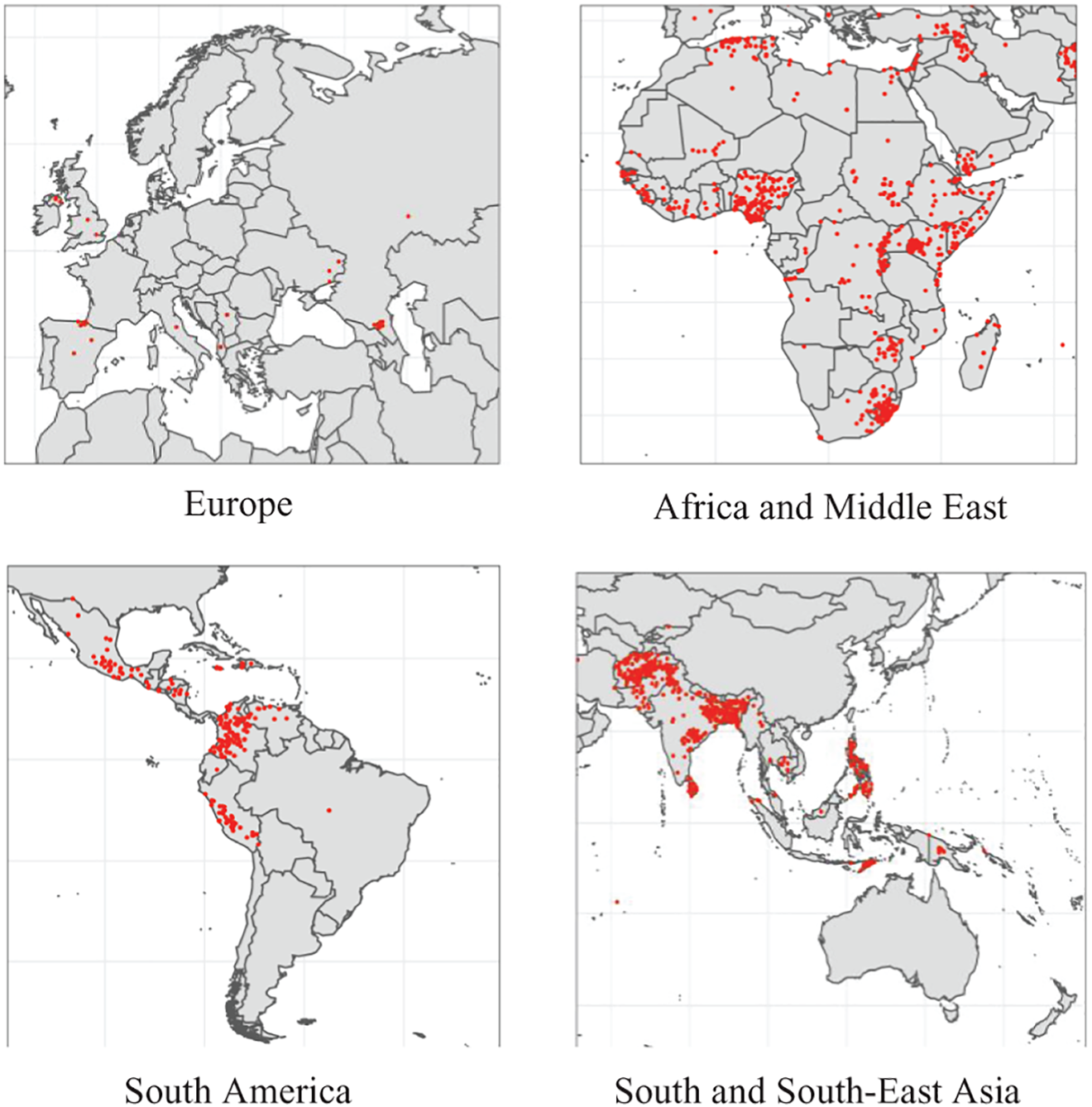
Map of DECO events by region, 1989 to 2017.
One advantage of DECO is its compatibility with the georeferenced event data in the UCDP GED, which allows users to examine direct links between organized violence and electoral contestation and the broader dynamics of political conflict. Figure 2 shows the events included in DECO classified according to the three forms of violence recorded by UCDP GED: state-based violence between a government and an armed non-state actor, non-state violence between armed non-state actors (e.g., rebel groups, political parties, or ethnic groups), and one-sided violence, in which an armed state or non-state actor targets unarmed civilians. DECO also includes a significant share of a fourth type events: violence between an organized armed actor (predominantly state forces) and civilians. These events were excluded from the one-sided violence category of UCDP GED because the civilians were armed in some form, but were not sufficiently organized to represent a non-state armed actor. In accordance with Svensson, Schaftenaar, and Allansson (2021) we label this category of DECO events violent political protest in Figure 2, since events in this category are dominated by electoral protests that turn into armed clashes.
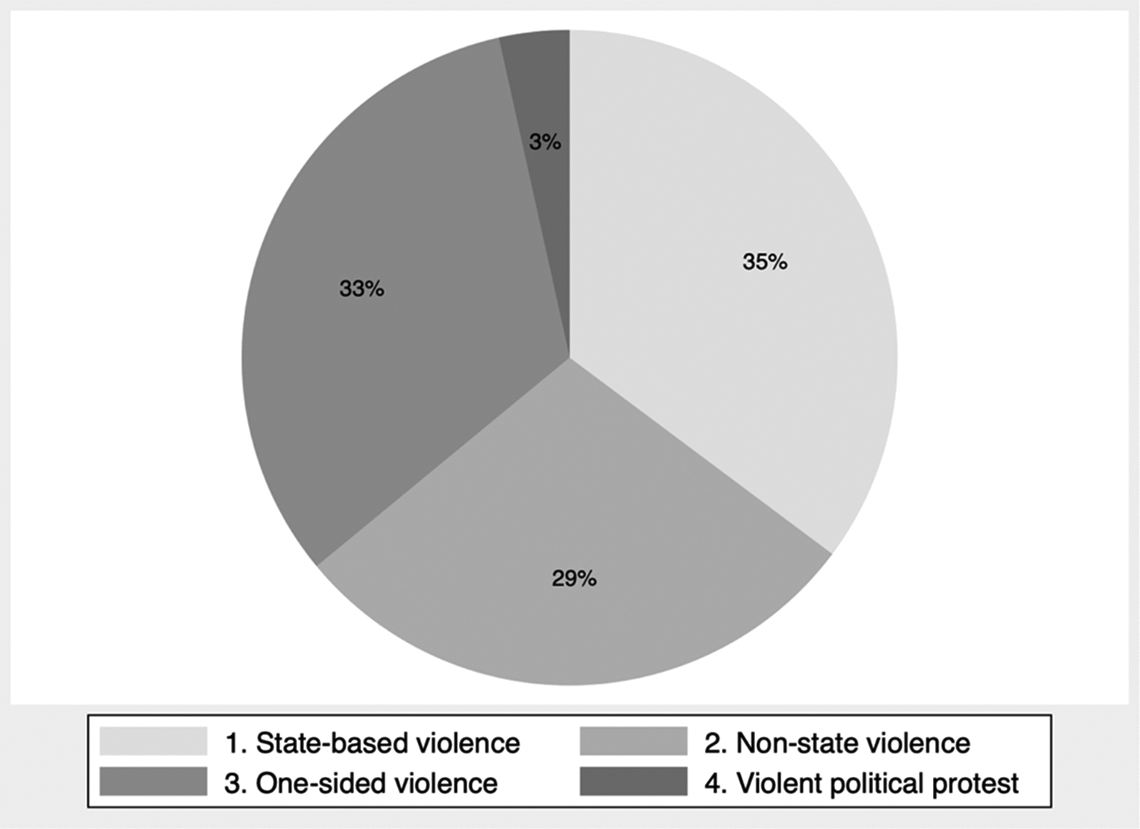
DECO events by type.
As seen in Figure 2, violent electoral contestation manifests in all four forms, with a considerable share of DECO events overlapping with state-based violence (35 percent of all DECO events). This overlap indicates that many civil war actors also pursue their aims in the arena of electoral contestation. In some countries, such as Algeria in 1991 and Côte d’Ivoire in 2010, electoral violence between the government and opposition arises as part of escalatory processes in what eventually become full-fledged civil wars. In other cases, such as Angola and Democratic Republic of Congo, electoral violence occurs as part of a war-to-peace transition, where the same actors that waged war face each other as political contenders in elections. State-based lethal electoral events are also perpetrated by armed actors already engaged in armed conflict with the state, who use violence to challenge the security of elections or to undermine the credibility and legitimacy of electoral results. Attacks on polling stations or election workers in Peru and punitive attacks by the Lord’s Resistance Army in Uganda represent such dynamics.
DECO also contains many events of non-state violence. This category includes, for example, clashes between supporters of opposing political parties (or particular candidates), exemplified by the violence between African National Congress and Inkatha Freedom Party supporters in South Africa in the early 1990s. This category also includes violence between members of different ethnic groups seen as supporting opposing political parties. Nigeria and Kenya are two countries where much of the electoral violence recorded in our data occurs between communal groups.
Many events in DECO also belong to the one-sided violence category. This category includes instances where government forces kill unarmed civilians in direct and deliberate attacks, such as government killings of activists in Zimbabwe or security force attacks on post-election demonstrations in Côte d’Ivoire. It also includes violence by non-state actors. These can be rebel groups (elections in Senegal’s Casamance region during the 1990s were fraught with insecurity due to attacks by the Movement of Democratic Forces of Casamance rebels on civilians to prevent them from voting) or armed non-state militias that are particularly active during elections, such as the Mungiki in Kenya.
As described above, we provide additional relevant information on all events in DECO to explore patterns of lethal electoral violence. As an example, Figure 3 shows a simplified classification based on DECO target categories. Events with multiple targets have been collapsed into one residual category in the graph.
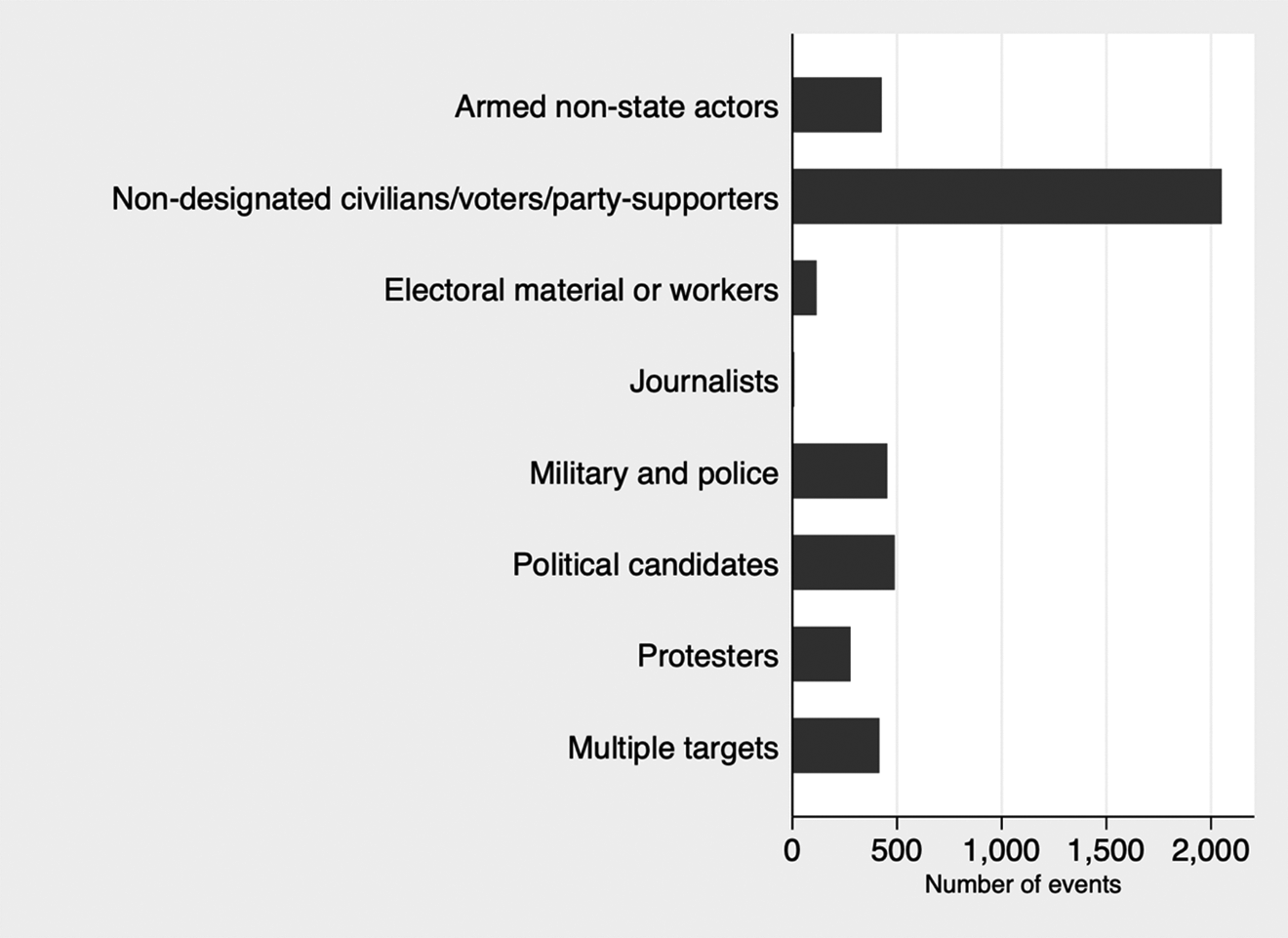
Number of DECO events by targets.
As seen in Figure 3, a majority of all events in DECO have civilian targets. Some of these are voters targeted on election day, others are identified as party supporters, and some are non-designated civilians (meaning that we have no more identifying information on why they were targeted) killed by organized armed actors. Attacks on electoral workers, electoral materials, and polling places represent the largest cause of civilian fatalities.
Empirical Application
To illustrate how the DECO data can be used, we now turn to a simple empirical examination of the role of United Nations peacekeeping forces in reducing the risk of electoral violence. Whereas the role of peacekeepers traditionally has been to uphold peace and prevent the resumption of armed hostilities between warring actors, a majority of all contemporary peacekeeping missions is now mandated to oversee or even administrate elections (Fortna 2008; Smidt 2020b). Many of the peacekeepers’ efforts are specifically directed at upholding electoral security, for example, through armed deployments at polling stations, protecting electoral targets, including political figures and election materials, and monitoring and preventing violent electoral disputes. In spite of the importance of electoral security in the war-to-democracy transition, we have limited knowledge about the role of peacekeepers in the prevention of electoral violence.
Studies by Brancati and Snyder (2013) and Flores and Nooruddin (2012) suggest the importance of peacekeepers, however, by showing that post-conflict elections have a lower likelihood of relapsing into civil war if peacekeepers are present. Smidt (2020a), using the aggregate electoral violence measure from NELDA, shows that where peacekeepers have election-related mandates, more troops reduce the risk of violence associated with electoral rounds. None of these studies, however, make the important distinction between electoral and civil war violence. This distinction is important since election periods may incentivize actors already at civil war to engage in even more violent acts (e.g., Harish and Little 2017).
To examine how UN peacekeepers influence the risk of electoral violence, we identify electoral violence as a particular subset of all political violence recorded in the UCDP GED. We combine information from the NELDA dataset v. 5 (Hyde and Marinov 2012) with data from the UCDP GED (Gleditsch et al. 2002) to construct the unit of analysis. Starting with all elections held for national political offices during intrastate armed conflict or within two years after hostilities ceased, we observe election violence six months before and six months after each election. For our independent variable, we use data from Kathman (2013) on the monthly deployment of United Nations peacekeepers to intrastate armed conflicts over the 1990 to 2011 period, focusing on the number of military troop personnel present in any given month (estimated in hundreds). There are many ways to assess peacekeepers’ effectiveness in reducing electoral violence. In this application, we show results with three dependent variables: a dichotomous coding of any electoral violence events coded that month versus none, a count variable of the number of electoral violence events that month, and a count variable of the number of fatalities from electoral violence that month.
To account for potentially confounding variables, we control for country-level gross domestic product per capita, population, and the level of democracy, using the Polyarchy variable from the V-dem dataset (Coppedge et al. 2020). We also control for the prevalence of civil war violence using the number of (non-DECO) civil war events from UCDP GED and number of DECO events in the previous month. 16 We run linear regression models, with fixed effects at the country level to account for unobserved heterogeneity across countries. The inclusion of fixed effects implies that our estimates draw on within- rather than cross-country variation in the variables of interest to highlight the impact of a change in peacekeeping presence. The results are reported in Table 1, Models 1 to 4.
UN Military Troops and Electoral Violence.
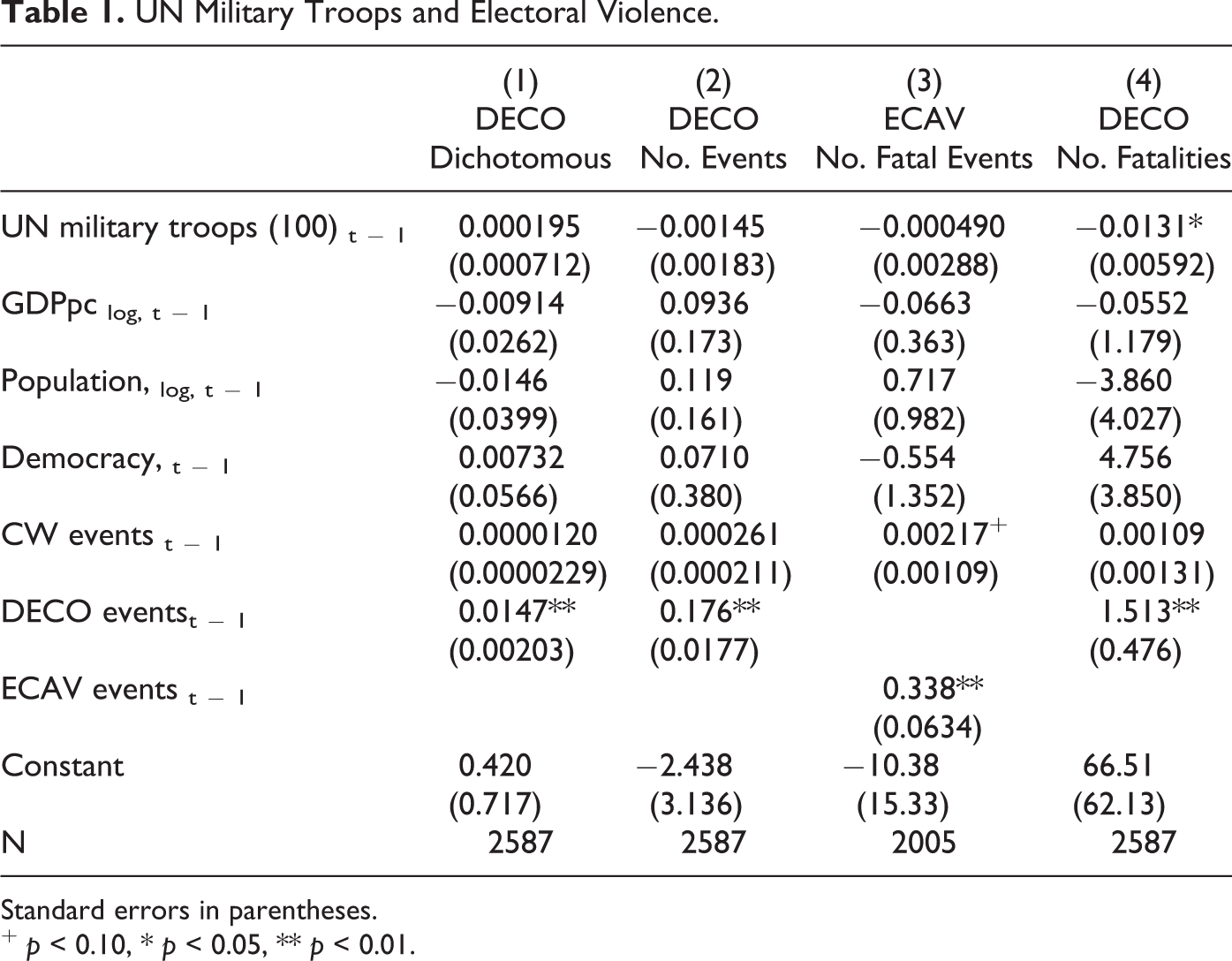
Standard errors in parentheses.
+ p < 0.10, * p < 0.05, ** p < 0.01.
The estimated relationship between UN peacekeepers and the prevalence of electoral violence varies across our different dependent variables. The results suggest no significant relationship between a change in the presence of peacekeepers in the country and the dummy variable marking the occurrence of any deadly electoral violence (Model 1) or for the number of events of deadly electoral violence (Model 2). In Model 3, we, for comparison, re-run the previous model, but using the number of fatal electoral events in ECAV as our dependent variable. The number of observations drops slightly, as ECAV excludes consolidated democracies. The results are the same. In Model 4, we focus instead on the number of fatalities from electoral violence recorded in DECO. Here, we find a negative and significant relationship between a change in the number of peacekeepers and the fatalities from electoral violence. This result suggests that as the number of peacekeepers in a country increases, the fatalities from electoral contestation is reduced. These results cannot be identified using ECAV, as this source does not contain specific fatality counts. 17
Is the association between peacekeepers and lower fatalities a result of the non-random deployment of peacekeepers? Most research on UN force deployment suggests that UN troops are deployed in the most challenging, not the easiest, areas where violence might occur (Ruggeri, Dorussen, and Gizelis 2018; Fjelde, Hultman, and Nilsson 2019). Although these studies have not focused specifically on electoral violence, the conditions under which peacekeepers are deployed to post-conflict countries suggest that the selection problem would be less pronounced for this form of violence. Electoral violence often manifests only after initial deployment decisions have been made, and in many instances electoral security might still be secondary to conventional peacekeeping. In sum, the results from the application indicate that peacekeepers may not totally prevent electoral violence in conflict-affected countries, but they may nonetheless be important in reducing the intensity of such violence as measured by the number of fatalities.
Conclusion and Outlook
For the foreseeable future, violence is set to remain a pervasive phenomenon of electoral contests. Many countries worldwide face democratic regress and a turn to authoritarianism (Lührmann and Lindberg 2019). In regimes such as electoral autocracies or countries with a conflict-ridden past, intimidation, harassment, and outright violence can become institutionalized features of electoral dynamics.
DECO equips scholars with data that can advance knowledge on important questions related to the causes, dynamics, and consequences of electoral violence that to date have been difficult to study systematically. One major advantage of the DECO dataset is its compatibility with the UCDP family of datasets on political violence. By combining these data sources, researchers can gain new traction when probing the interlinkages between different forms of political violence, both during and outside of electoral periods. We can learn more, for example, about the conditions under which lethal electoral contention might serve as a precursor to renewed civil war in post-conflict societies. Researchers can also better understand the strategic choices of armed actors in countries that hold elections by studying whether and how state and non-state actors resort to violence to influence the electoral processes. Our use of DECO to probe the impact of peacekeepers’ presence on electoral violence furthermore illustrates how the data could be applied to evaluate whether interventions (military, observers, education and training, institution building etc.) to reduce and prevent electoral violence may have similar or divergent effects on other forms of violence.
Researchers interested in understanding the broader causes and consequences of electoral violence can also benefit from DECO. Due to its high spatial and temporal disaggregation, the data can, for example, be linked with georeferenced survey data on citizen attitudes before or after electoral events to investigate how violence exposure (defined by temporal and/or spatial proximity) influences survey responses. Because DECO covers close to three decades, violence can be traced across multiple electoral rounds in the same locality to explore changes over time. Subnational data, for instance, on election results and the boundaries of electoral districts is becoming more accessible (e.g., Kollman et al. 2017, 2019). These developments will enable scholars to probe subnational features of elections in tandem with local violence dynamics. Researchers can also utilize the qualitative information provided for each electoral violence events such as perpetrators, targets, and links to the incumbent side to understand target selection and other dimension of electoral violence dynamics.
Supplemental Material
Supplemental Material, sj-do-1-jcr-10.1177_00220027211021620 - Introducing the Deadly Electoral Conflict Dataset (DECO)
Supplemental Material, sj-do-1-jcr-10.1177_00220027211021620 for Introducing the Deadly Electoral Conflict Dataset (DECO) by Hanne Fjelde and Kristine Höglund in Journal of Conflict Resolution
Supplemental Material
Supplemental Material, sj-dta-1-jcr-10.1177_00220027211021620 - Introducing the Deadly Electoral Conflict Dataset (DECO)
Supplemental Material, sj-dta-1-jcr-10.1177_00220027211021620 for Introducing the Deadly Electoral Conflict Dataset (DECO) by Hanne Fjelde and Kristine Höglund in Journal of Conflict Resolution
Supplemental Material
Supplemental Material, sj-dta-2-jcr-10.1177_00220027211021620 - Introducing the Deadly Electoral Conflict Dataset (DECO)
Supplemental Material, sj-dta-2-jcr-10.1177_00220027211021620 for Introducing the Deadly Electoral Conflict Dataset (DECO) by Hanne Fjelde and Kristine Höglund in Journal of Conflict Resolution
Supplemental Material
Supplemental Material, sj-pdf-1-jcr-10.1177_00220027211021620 - Introducing the Deadly Electoral Conflict Dataset (DECO)
Supplemental Material, sj-pdf-1-jcr-10.1177_00220027211021620 for Introducing the Deadly Electoral Conflict Dataset (DECO) by Hanne Fjelde and Kristine Höglund in Journal of Conflict Resolution
Footnotes
Acknowledgments
The most updated version of the DECO dataset and the codebook can be downloaded from the UCDP Dataset Download Center at  . This project has benefited tremendously from collaboration with the Uppsala Conflict Data Program. Mihai Croicu offered invaluable assistance in the automated coding procedure. We are grateful for excellent research assistance from Gudlaug Olafsdottir and Tom Renvall, as well as Paulina Cruz Velasquez in the pilot coding phase. This project has benefited from comments by the editor and reviewers, and insights from participants at the APSA Conference in San Francisco (2017), the Election Violence Research Workshop, University of Amsterdam (2018), and the FBA Research Workshop on Elections in Emerging Democracies (2018).
Declaration of Conflicting Interests
The author(s) declared no potential conflicts of interest with respect to the research, authorship, and/or publication of this article.
Funding
The author(s) disclosed receipt of the following financial support for the research, authorship, and/or publication of this article: The data collection was funded by Riksbankens Jubileumsfond, grant P16-0124:1 and the pilot coding by the Norwegian Research Council, grant 217995/V10.
Supplemental Material
Supplemental material for this article is available online.
Notes
References
Supplementary Material
Please find the following supplemental material available below.
For Open Access articles published under a Creative Commons License, all supplemental material carries the same license as the article it is associated with.
For non-Open Access articles published, all supplemental material carries a non-exclusive license, and permission requests for re-use of supplemental material or any part of supplemental material shall be sent directly to the copyright owner as specified in the copyright notice associated with the article.
