




Abstract
How can areas of potential agreement be identified and endorsed by citizens in protracted conflicts? In an effort to answer this question, the article introduces a conjoint experiment across the ethnically and territorially split communities of Cyprus and tests a range of hypotheses about the structure of public opinion with respect to a future settlement. We test hypotheses on security and credible commitments, the legacy of past negotiations, as well as transitional justice mechanisms following United Nations plans to mediate the conflict between Greek and Turkish Cypriots. Contrary to conventional wisdom, we demonstrate that a zone of possible agreement (ZOPA) exists from a public opinion perspective. We specifically explore power-sharing in the context of security, provisions for the internally displaced, federal courts, and territorial readjustments and highlight their relative importance for public opinion interventions across conflict-ridden societies.
Keywords
Introduction
This article investigates the question of intractability from the perspective of citizens and public opinion research in ethnically and territorially divided societies. While there has been an extensive literature on peace settlements and their effects (Hartzell and Hoddie 2007; Lederach 1997; Walter 2002), little work has so far incorporated the role of citizen preferences in peace mediations (for exceptions see, Tuathail et al. 2006; Bar-Tal et al. 2010; Tellez 2019 and Dyrstad et al. in this special feature section). 1 Public opinion research can take place at different temporal orders and stages of a peace agreement (see Haass et al. introduction to this special feature section) and might have different impacts on the broader peace process depending on the nature of civil society-state interactions and broader institutional setting. Establishing the extent of public support for the terms of a negotiated settlement is a key element of peacebuilding projects yet public opinion surveys often take place only after the introduction of a peace agreement thus failing to incorporate public opinion at an earlier stage. 2 This article focuses instead on the pre-settlement stage of peace negotiations specifically intracommunal divergences or possible zones of agreement by investigating political attitudes among citizens in the two main conflictual communities in Cyprus.
Peace settlements ending these types of intractable conflicts could contain multiple dimensions, for instance, provisions on power sharing, the protection of human rights, the location and management of internal (federal) or/and external borders and international guarantees, and support for property compensations and/or reconstruction. Because of their inherent complexity involving interrelated areas of bargaining, peace agreements are more often described as the product of elite compromise than of grassroots involvement or public consultation (Agarin et al. 2018; MacGinty and Richmond 2013; McEvoy 2018). A key policy priority is adding other voices to such processes. Referendums and traditional surveys cannot identify the dimensions of a peace settlement that are most troubling for ordinary citizens or detect the types of compromises or trade-offs they might support. To address this problem, this article introduces the use of conjoint analysis in ongoing peace negotiations to investigate areas of potential agreement between two ethnically divided communities. The type of survey experiment that we propose in detail below is unique in applying a conjoint design to an ethnic conflict, surveying each side’s preferences, and then identifying the spaces of divergence and agreement. The technique permits us to answer three important questions about public support for peace settlements: the elements of peace settlements most important to citizen support overall; the main divisions between communities with opposing interests; and the location and extent of compromise positions or zones of possible agreement (ZOPAs) between different groups. We explore these issues in the context of Cyprus, often held up in the literature as representative of UN failures in negotiating and implementing a power sharing federal settlement (Loizides 2016; McGarry 2017; Yakinthou 2009).
Theoretical Motivation
We define peace settlements as multi-issue, multi-party agreements about how a country or region could be governed after prolonged conflict. They are the result of formal or informal compromises between two or more groups representing different communities, and they inevitably contain multiple dimensions, including political institutional, security, border, and economic components (Coakley 2017; Darby and Mac Ginty 2002; McGarry and O'Leary 2009). Each of these components can be designed and presented differently. For example, political institutions can enforce power sharing to different degrees using presidential or parliamentary formats (McGarry 2017); federal or regional borders could facilitate the return of the internally displaced or provide protections to certain communities (Belloni 2005); courts could apply local, national, or international standards of human rights (McCrudden and O’Leary 2013); finally, external actors could be involved through legal arbitration or security guarantees, or by contributing to compensation and reconstruction funds (McGarry and Loizides 2021).
Negotiation theorists have developed extensive practical knowledge about the processes and mechanisms that enable negotiating parties to maximize gains in related mediations, minimize critical uncertainties, and build credible commitments for future interactions (Bazerman and Neale 1992; Dixit and Nalebuff 1991; Fisher and Ury 1981; Raiffa 1982). The literature makes a clear distinction between distributive and integrative (i.e., win-win) negotiations. The former usually involves a single issue – a “fixed-pie” – in which one side gains at the expense of the other; in the latter, the contending sides advance and trade over multiple issues which they often value differently (Bazerman and Neale 1992:16–22). Little thought has been given to empirically testing the perspectives of citizens on these negotiation approaches and whether the concept of win-win negotiations, often put forward by elites and mediators, could be understood, measured and endorsed by the public.
We contend that citizens, like negotiating parties in a peace mediation, can envision and inform peace linkages and trade-offs in integrative negotiations. We investigate the impact of different potential peace settlement options and their individual elements on citizens’ views and the overall acceptability of a potential agreement. We examined zones of possible agreement and asked whether citizens can maximize their gains by making concessions on issues they care less about in exchange for not making concessions on issues of greater personal importance (Lohmann 1997: 39). In an integrative negotiation, expanding the “fixed pie” often requires reconfiguring linkages, even by tying together issues “that are not necessarily related in any functional sense” (ibid). Mediators emphasize new links among issues previously thought to be separate (Martin 2002: 57; Axelrod 1984: 132) as a way of satisfying both communities on their key priorities while enabling mediators (and their publics) to assess the overall benefits and obligations generated by the agreement.
Linkages across issues allow sides to be compensated for possible losses in one issue with favourable re-adjustments in another, thus preserving the initial benefits derived from a negotiated settlement (Courtney et al. 1997; Ringland 1998). Re-adjustments could take the form of financial compensations, which we assume will be popular to all communities. However, they might also involve a wider array of highly sensitive issues (e.g., territorial readjustments and security). (Economic) incentives in the form of linkages can be powerful instruments in turning conflict into cooperation (Dorussen 2001: 251; Gasiorowski and Polachek 1982; Cortright 1997; Rothchild 1997; Dixit and Nalebuff 1991: 302–325), but they can also act as safeguards for the effective and credible implementation of an agreement (Fearon and Laitin 1996; Raiffa 1982: 187–204). For example, a security/power-sharing linkage could stabilize majority-minority relations under different scenarios by compensating each community for adverse concessions and their effects. Legal and human rights provisions should combine practical, identity, and security dimensions, particularly when addressing worst case scenarios for both communities and individuals.
International experience suggests several examples of effective linkage strategies, from Sinai Peninsula in the Camp David negotiations to environmental politics in contested Kashmir (Lohmann 1997) and transitional justice processes (Kovras 2012). Yet the existing studies usually provide post-facto interpretations of successful mediations and do not incorporate the role of public opinion (and trade-off preferences) ahead of peace talks. To address this gap, as noted above, we used conjoint analysis in Cyprus to capture community level preferences for different features of a peace agreement and for the overall agreement.
Hypotheses
In this study, we focused on public support for alternative peace trade-offs. A crucial issue is whether a zone of possible agreement (ZOPA) exists at the grassroots public opinion level of two communities with alleged divergent preferences. While this is a fundamental question for all societies experiencing protracted conflicts, it is even more relevant to “hard cases” such as Cyprus, often referred to as the “graveyard of diplomats” following repeated efforts by all UN Secretary Generals to resolve the dispute (Lindahl 2019). A comprehensive settlement has yet to be reached in the island’s negotiations despite the High-Level Agreements in 1977–1979 when both sides endorsed the main parameters of a federal arrangement, the existence of a positive incentive structure, and the proactive involvement of regional and international organizations, including the European Union and the United Nations. We tested four competing hypotheses to investigate whether a ZOPA exists: credible commitments (the status of the two communities as double or nested minorities), restorative justice (the presence or absence of compensations), path dependency (the legacy of past negotiations), and “graveyard of diplomats” (unresolvable conflict).
We began by testing one of the most substantive issues in negotiations and one of the core claims in the conflict resolution literature on credible commitments and “nested/double minorities” i.e., groups whose majority-minority status varies according to the administrative, state, or regional level (Fearon and Laitin 1998; Walter 2002). When power structures, beliefs, economic settings, and demographic balances between two groups are not stable, at least one of the groups cannot effectively reassure the other that it will not break their agreement in the future (ibid). On this point, leaders’ memoirs from Cyprus peace talks recognize Fearon’s nested minorities pattern and absence of credible commitments (e.g., Clerides 1991: 211). We argue that a peace settlement involving double minorities would benefit from “safeguards” designed to render current negotiated agreements self-enforceable in the future. Based on this reasoning, a peace settlement with higher third-party involvement in the areas of guarantees, compensations, and judicial arbitration is more likely to be endorsed by Greek and Turkish Cypriots.
Citizens – from both communities – are more likely to support settlements that include provisions involving third parties/the international community [credible commitment]. The second hypothesis (H2) draws on transitional justice, specifically, questions of reparations and due process (see Mironova and Whitt in this special feature). Restorative justice is hypothesized to be more effective in areas involving victims of displacement when wide post-conflict remedies can be applied to ensure the return of the displaced or compensations for them (or for affected current property owners). Our survey experiment simultaneously included compensations for owners and users of contested properties. So far, the two communities (and foreign donors) seem to agree that the more compensation available to owners and users, the better. However, we don’t know the precise impact of alternative compensation packages and whether their presence could convert a marginally rejected settlement into a mutually acceptable one.
Citizens are more likely to support settlements that include provisions for compensation [reparation] Our next hypothesis (H3) is drawn from the legacy of past negotiations and asks whether citizens are less likely to accept settlement packages that have been rejected by their leaders in the past. A path dependency theoretical reasoning could apply to peace negotiations assuming that citizens are more likely to reject or endorse arrangements that resemble trade-offs previously agreed upon or rejected by their leaders (or the communities themselves in the 2004 referendum). Validation of this hypothesis would suggest that citizen views generally follow the legacy and outcomes of past negotiations.
Citizens are less likely to accept settlements that have been rejected in the past [legacy] Finally, hypothesis 4 (H4) tests the “graveyard of diplomats” hypothesis, in other words, whether the Cyprus issue is unresolvable. The two communities may have diametrically opposing views of at least one main issue, and the gap between them cannot be closed, even with compensations on other dimensions. This could be any of the main issues involving territory, security, or power-sharing. For example, the literature suggests demographic majorities will be less in favour of power-sharing arrangements than demographic minorities (Horowitz 2014). This expectation is based mainly on security and power considerations, whereby minorities will feel more secure if they have a voice in government and can veto majorities, whereas majorities will feel more secure if they are able to exclude or limit the minority from government participation (McEvoy 2014; McCulloch 2018). In the Cypriot case, however, there may be a more salient divergence on the issue of territorial readjustments. As in the Israel/Palestine peace talks, any return of land across the future border (to accommodate Greek Cypriot returnees) implies a permanent loss for Turkish Cypriots. Thus, Greek and Turkish Cypriots seem likely to have diametrically opposing views on this issue. We were also interested in whether territory (or another dimension) is important enough to sink the boat overall.
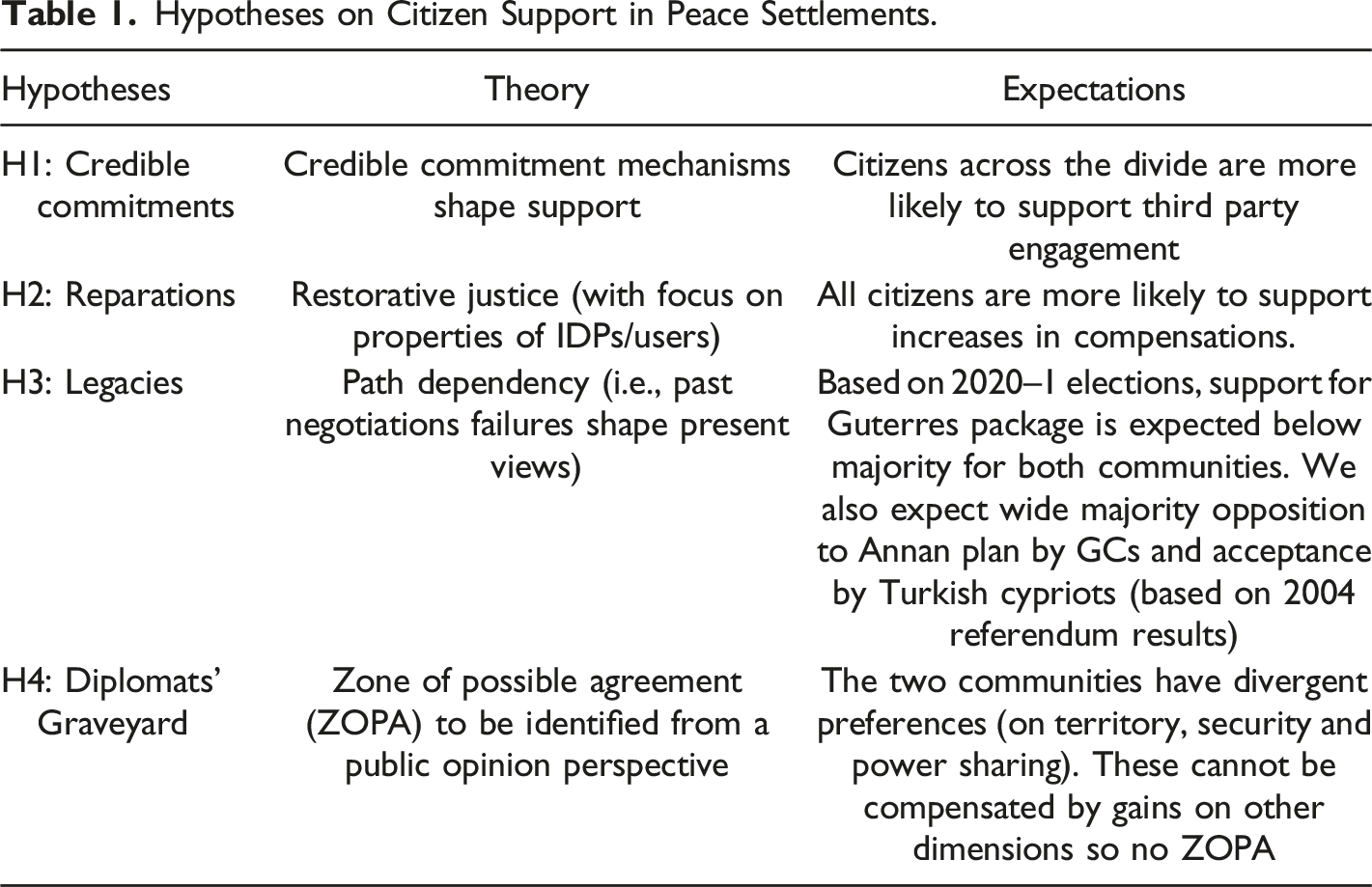
Cross-community divergence on one dimension of the settlement leads to stalemate [graveyard of diplomats] Table 1 outlines our main hypotheses, including their theoretical assumptions and expectations.
Hypotheses on Citizen Support in Peace Settlements.
The Cyprus Case
Through the long history of the Cyprus peace talks, a variety of options has been presented and modified, including details of the governing, territorial, and security arrangements. Thus, there is a rich set of negotiation legacies and alternatives not only for Cypriot citizens to consider but also to inform negotiations elsewhere. Interestingly, these proposals have been endorsed by the UN Security Council including Russia and the US and could apply ceteris paribus to other conflicts e.g., Ukraine and Georgia enabling at the minimum a set of internationally acceptable standards for mediations across divided societies. As noted by a UN official commenting on the results of our conjoint experiment in Cyprus, 3 the logic of the survey fits the UN’s mediation style and philosophy as well as the specific format of the Cyprus peace talks. Compromises, especially those supported by citizens, could become a focal point in inter-group negotiations and provide a theoretically informative understanding of (win-win) integrative negotiations involving give and take across issues discussed in parallel. A fundamental concern with integrative negotiations is that citizens in societies deeply divided by a history of conflict are unlikely to endorse new settlements particularly following past unsuccessful attempts to reach mutually beneficial compromises.
In 1959, for instance the governments of the United Kingdom, Greece, and Turkey reached a compromise on an independent Cyprus. The arrangement included significant constitutional and security guarantees for the Turkish Cypriot (TC) community; Greek Cypriots (GC) were to elect the President of the Republic and Turkish Cypriots the Vice-President. The United Kingdom and the two “motherlands” (Greece and Turkey) gained the right to intervene in Cyprus through unilateral action if there was a need to re-establish a balanced state of affairs (Necatigil 1989; Xydis 1973). In 1963, fighting broke out between the two communities, ending Turkish Cypriot participation in the Cyprus government, and in 1974, Turkey invaded Cyprus in response to a coup 5 days earlier by the Greek Junta. The Republic of Cyprus lost control of about 37% of its territory, including a number of large villages with homogenous Greek Cypriot populations, the town of Morphou, and the suburb of Varosha in Famagusta, previously the most economically vibrant urban area in Cyprus but now an abandoned “ghost city.” Since 1974, Greek Cypriots have pointed to their displacement (about a third of their population), missing persons, and suffering following the invasion, emphasizing the illegality of the Turkish army-controlled areas in the north. Meanwhile, although Turkish Cypriots gained a disproportional amount of territory in 1974, they found themselves trapped in a legal jurisdiction not recognized by any state other than Turkey and facing political and economic isolation. 4
A consociational/federal solution—one in which two main communities share power—has been the basis of every solution proposed since 1974. The High-Level Agreements of 1977 and 1979 specifically set out the agreed parameters for UN mediation and a prospective negotiated settlement that would incorporate two federal units and a shared administration at the central government. The agreement on a “bi-zonal” and “bi-communal” federation (BBF) pointed to a general convergence on sharing power, although, admittedly, the details and substance of a future settlement remained to be resolved. UN mediation also called for compromises. Against the wishes of Turkish and Turkish Cypriot hardliners, the UN attempted to re-establish Cyprus as a unified state with significant territorial re-adjustments in favor of the Greek Cypriot side to enable the maximum number of returnees among the post-1974 victims of ethnic cleansing. Contrary to the wishes of Greek Cypriot hardliners, UN mediations adopted ethnic federal structures recognizing significant autonomy for the future Turkish Cypriot constituent state and political equality within the central government. The UN proposals aimed at establishing a form of power sharing and designated community rights, thereby preventing the Greek Cypriot majority from out-voting Turkish Cypriots on issues of vital political concern either through a consensual parliamentary system stipulated in the outvoted 2002-2004 Annan Plan provisions and/or an integrative presidential cross-voting arrangement agreed upon by Cypriot leaders Mehmet Ali Talat and Dimitris Christofias in 2009 and reaffirmed by their successors Mustafa Akinci and Nicos Anastasiades in 2015–2019.
Under the proposed 2002–2004 UN plan (the “Annan Plan”), Greek and Turkish Cypriots would have retained autonomy over most of their affairs under a decentralized federal system. Turkish Cypriots would agree to major territorial readjustments (Varosha, Morphou, and 50 villages in the Green Line) in areas occupied by the Turkish military in 1974 in exchange for power-sharing and federal status within a reunited Cyprus. 5 In the twin 2004 referendums on the Annan Plan, Greek Cypriots voted in the south and Turkish Cypriots voted simultaneously in the north (Sözen and Özersay 2007). Although the Plan initially had the support of the two main Greek Cypriot political parties representing two thirds of the electorate, it was rejected by a landslide 76% of Greek Cypriots, while 65% of Turkish Cypriots approved it.
Despite this failure, public endorsement has been at the centre of all peace initiatives, and since 2014, it has been a mandatory step in any future peace process. The pro-unification camps on both sides have won elections leading to a number of new proposals in the negotiations. The latest UN peace talks, held in summer 2017, engaged both sides with some of these alternatives, albeit tentatively.
Widely known as the UN Secretary General (UNSG) Antonio Guterres Package, the new six-point UN proposals paved the way for new ideas for a comprehensive settlement. The core concept introduced by Guterres was that of an implementation monitoring mechanism, which would go beyond security and replace the guarantee system proposed in the Annan Plan. While the UN attempted to abolish Greek and Turkish unilateral guarantees for intervention, significant disagreements remained as to the timing and conditions for the complete withdrawal of Turkish troops. In November 2019, in a statement in Berlin, both sides confirmed commitment to the Guterres package, emphasizing participation by both communities and political equality in a reunited Cyprus.
Missing throughout the negotiations has been the question of public endorsement of a potential framework and its alternative re-iterations. We suggest through our experimental design below the need for a peace agreement to closely reflect people’s expectations and what they are willing to accept. Public opinion is critical in mediations involving aspiring federations/consociations in general, and it is even more important in cases such as Cyprus because of a pre-existing two-party agreement stipulating that “united Cyprus federation shall result from the settlement following…approval by separate simultaneous referenda.” 6 Earlier attempts to negotiate a settlement in the island have not met this requirement, most notably the 2004 Annan plan which received Turkish Cypriot support in a referendum but failed in the Greek Cypriot community. Since then, some of the key political actors have offered lukewarm support for the federal option or expressed readiness to accept it, but only “with the right content,” thus implying minimal concessions. Conventional wisdom suggests that while there is a rhetorical commitment for a federal Cyprus, the interpretations of the two sides could be very different, perhaps irreconcilable.
Yet in this article, we demonstrate considerable levels of cross-community agreement in sub-packages of the Guterres framework. Interestingly, the results of our conjoint experiment suggest compromises that could be supported simultaneously by both the Greek and Turkish Cypriot publics. We also show how individual elements making up a compromise can affect the likelihood of selecting a specific compromise, thus drawing a revised roadmap for Cyprus and demonstrating the value of conjoint experiments across communities negotiating multi-issue peace settlements.
Experimental Design and Analysis
The University Centre for Field Studies of the University of Cyprus gathered a representative sample 7 of the Greek Cypriot population (n = 817) aged 18+ with voting rights. LIPA consultants collected a representative sample of the Turkish Cypriot population (n = 804) aged 18+ with voting rights. The method of sampling was multistage stratified random sampling; a confidence of 95% which allowed for a margin of sampling error of 3% in each community. According to a power analysis for conjoint experiments, 8 the predicted statistical power to detect an effect size of 0.05 in both communities was appropriate for this exercise (87%). Data collection took place from November 2019–March 2020.
Respondents were presented with pairs of hypothetical peace agreement packages and asked to choose one. Each agreement had five attributes
9
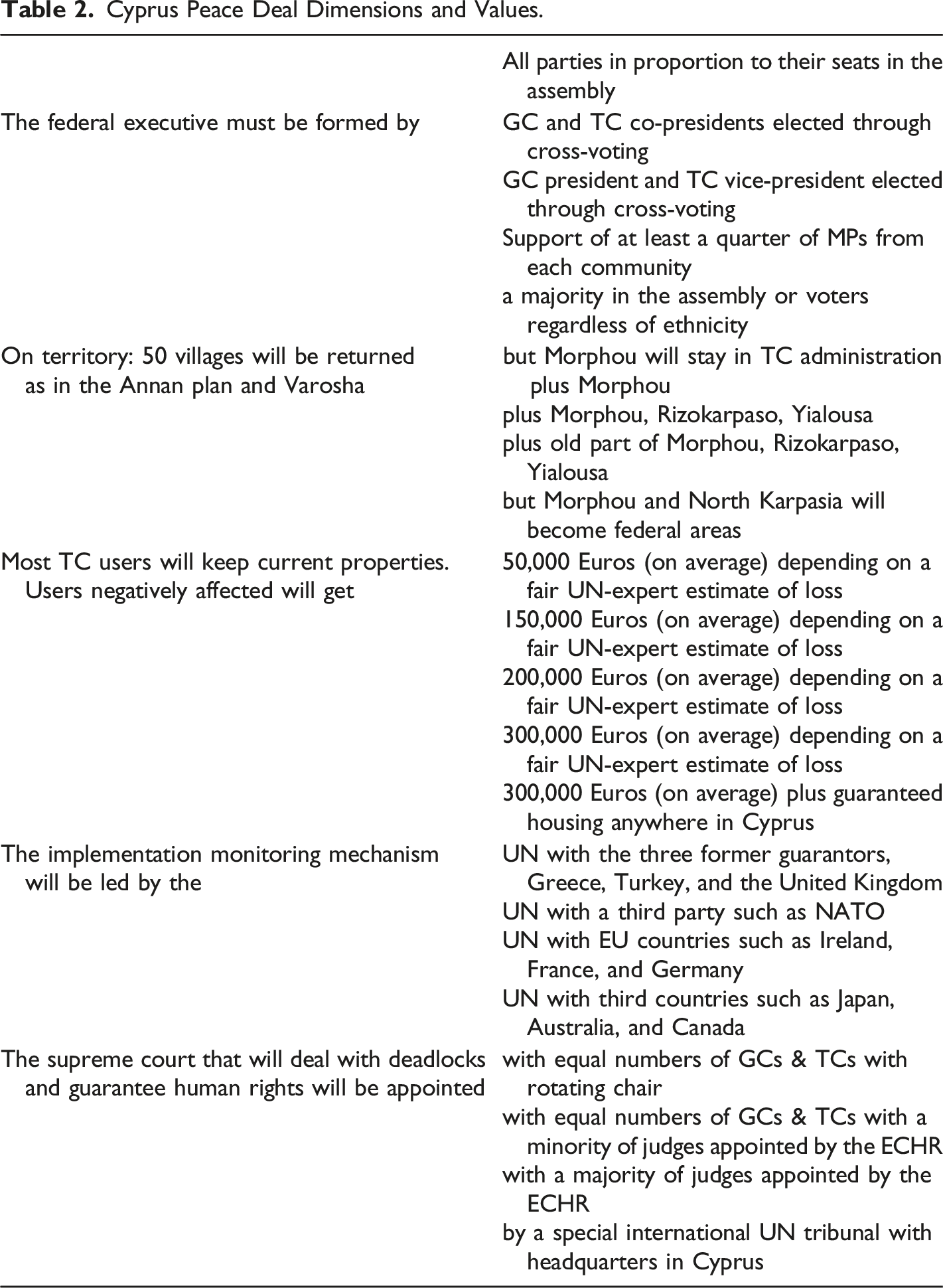
mirroring the key dimensions of the future peace package arrangements to be agreed upon: Federal executive Territorial readjustments Compensations for users and owners of properties Implementation monitoring mechanism Supreme Court composition
Each attribute had between four and five values, proposing alternative solutions. Table 1 reports the list of dimensions and corresponding values, and Figure 1 shows an example of paired choices. Overall, respondents saw five pairs of package settlements in separate screens and were asked to make a choice between the two options in each pair, for a total of 10 potential agreements evaluated by each individual.
10
Sample pair of peace packages.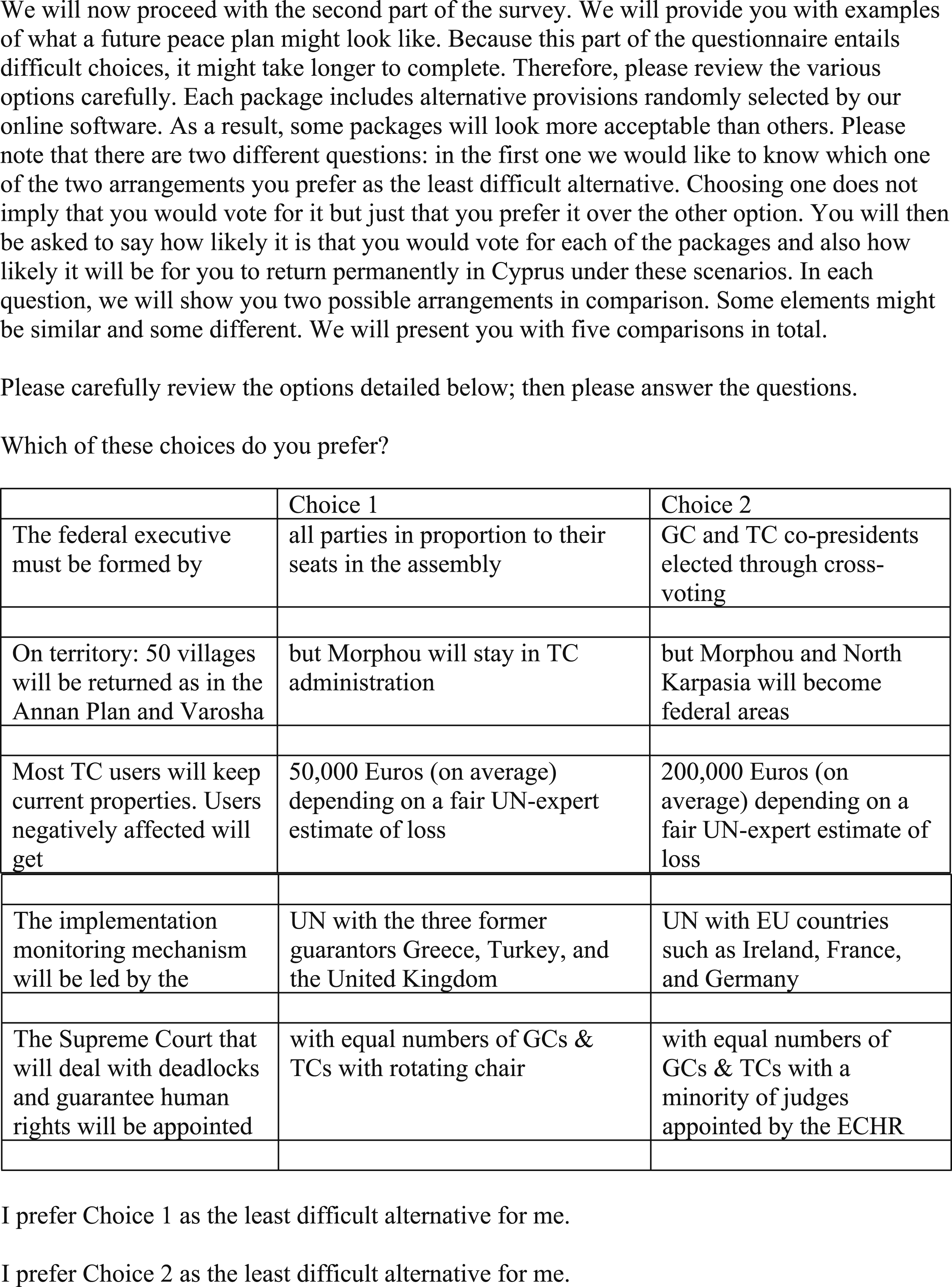
The primary outcome of interest is the binary variable “peace package preferred.” This takes the value of 1 when respondents select the settlement and 0 otherwise. We estimated the marginal effects of the attributes’ values – coded as dummy variables - using a linear probability model following Hainmueller et al. (2014). We clustered the estimates’ standard errors by respondent to account for intra-subject correlation in Stata 15.
As we were primarily concerned with how preferences on peace packages diverge or converge across communities, we present comparative results for Greek Cypriots (817 individuals) and Turkish Cypriots (804 individuals) in Figure 2. The figure gives clear evidence that the implementation mechanism and territorial readjustment are strongly defined by community identification. Across these two particular dimensions, preferences of Greek Cypriots and Turkish Cypriots are unsurprisingly divergent. Turkish Cypriots are opposed to an arrangement that excludes Turkey, but interestingly, UN and NATO monitoring is as desirable to TCs as the existing guarantor powers. For Greek Cypriots, the combinations of three countries that do not include Greece, Turkey, or the UK seems appealing. They also see UN and NATO monitoring as a significant improvement over the existing guarantor states situation. Effect of peace package in Cyprus: Respondents by community.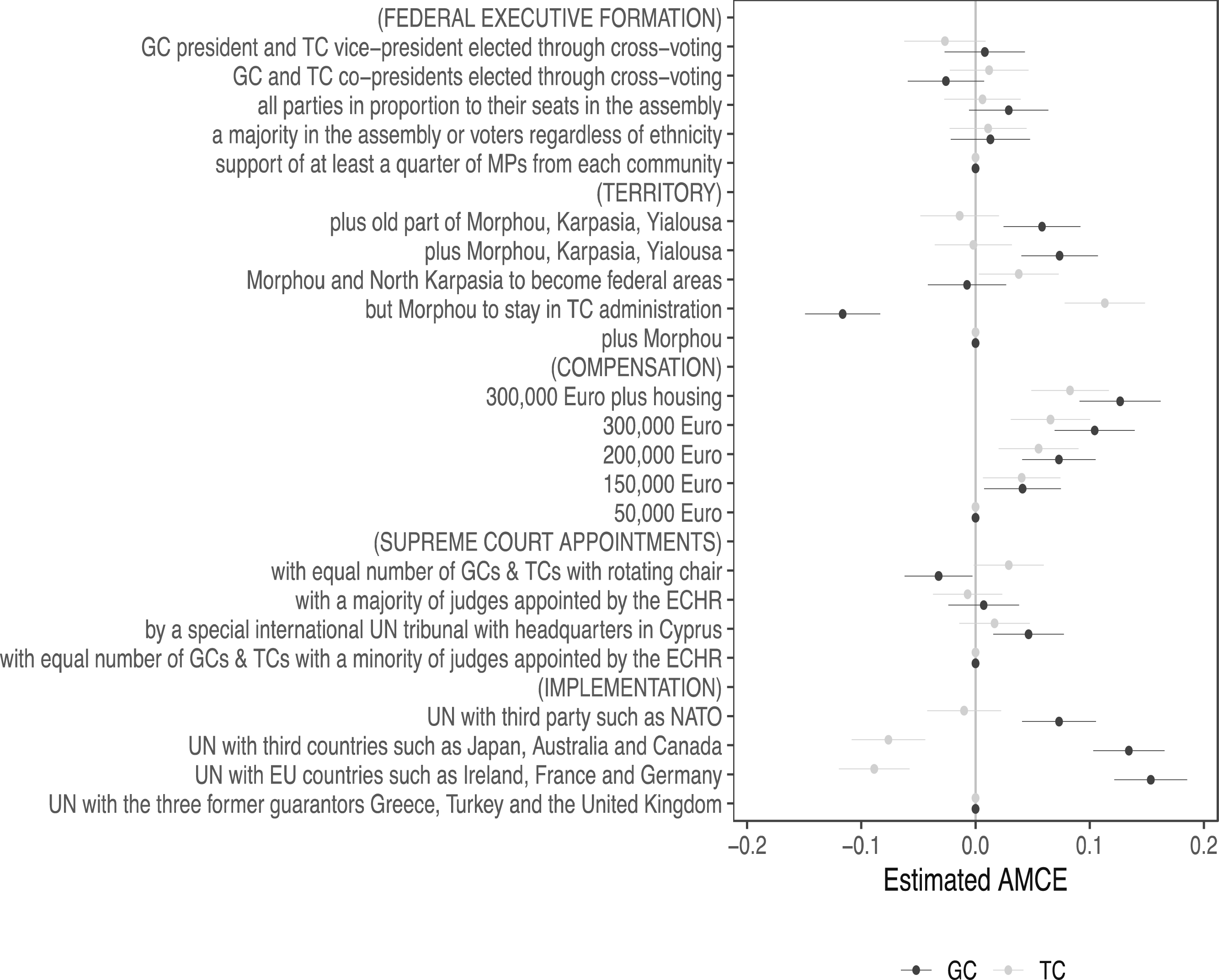
Turning to territorial readjustments, we find the return of Morphou is one of the most divisive elements. However, the prospect of both Morphou and north Karpasia becoming federal areas (instead of being returned to Greek Cypriots) could elicit additional support from Turkish Cypriots without harming the support from Greek Cypriots. Importantly, the return of Rizokarpaso and Yialousa to Greek Cypriots gains support from Greek Cypriots without further reducing the support from Turkish Cypriots.
The two communities seem to agree that the more compensations available to owners and users the better. Surprisingly, we do not see big divisions in the issue of power sharing, with a number of options being largely indifferent to both communities.
As for the composition of the Supreme Court, the preferences of Greek Cypriots are not so different from those of Turkish Cypriots. The provision of a special UN tribunal in Cyprus gets more support in both communities than the proposition included in the 2004 Annan Plan. The idea of a UN tribunal/seat in Cyprus was introduced by European Parliament MEP Takis Hadjigeorgiou as a supplement to the Guterres framework. 11 It was welcomed by political and civil society networks as a way of maximizing security for both sides via the permanent (and symbolic) presence of the UN in Cyprus. This UN-led institution would also support the Supreme Court in a reunited Cyprus and ensure neutral arbitration if major disagreements over power-sharing arise in the future. It would also provide training and logistical support for UN missions in the region and globally.
All in all, the implementation mechanism, territorial issue, and compensations emerge as equally important to both communities. The first two are issues of divergence, and the latter is an issue of convergence. Greek Cypriots are 11% less likely to support an arrangement if Morphou is not returned and Turkish Cypriots are 11% more likely to support such an arrangement if Morphou is not returned to Greek Cypriots. Similarly, the replacement of the existing guarantees system with UN and EU countries (Ireland, France, and Germany) adds 15% more support in the Greek Cypriot community and takes 8% away from the Turkish community. However, none of these issues is significant enough by itself to derail the peace process. Therefore, H4, the “graveyard of diplomats” hypothesis, cannot be substantiated.
Importantly, in both communities, 300,000 Euros (on average) plus guaranteed housing anywhere in Cyprus for owners and users adds 12% for Greek Cypriots and 8% for Turkish Cypriots respectively. This finding is supportive of restorative justice approaches (H2) which focus on identifying compensation schemes for the internally displaced persons and current users. All citizens are more likely to support increases in compensations, especially Greek Cypriots, who view this issue as fundamental in addressing wrongdoings of the past. While these findings are expected, what is interesting is the degree to which compensations could play a role. Therefore, international mediators need to pay close attention to identifying the most effective negotiation formulas to ensure the interests of both displaced persons and current users are taken into consideration.
In the Appendix, we report our robustness tests, including our models controlling for socio-demographic characteristics and sample weighting. The reference categories which represent the last value in each dimension in Figure 2 (e.g., UN with three former guarantors Greece, Turkey and the United Kingdom) do not imply convergences. To allow for comparison among different values, we provide below the results of alternative simulations as well as our interactive toolkit that allows users to create and recreate packages to estimate the level of public support. 12
Discussion: Simulations of alternative peace packages
The picture painted above is one of relative agreement across the two communities along some dimensions. In this section, we use these results to map areas of convergence and divergence in preferences, simulate the degree of public support for politically plausible outcomes, and identify the settlement packages that both communities can agree upon. In so doing, we outline an empirical approach to understanding public preferences for peace settlements that can be used to determine the degree of support for similar institutional arrangements in other divided societies.
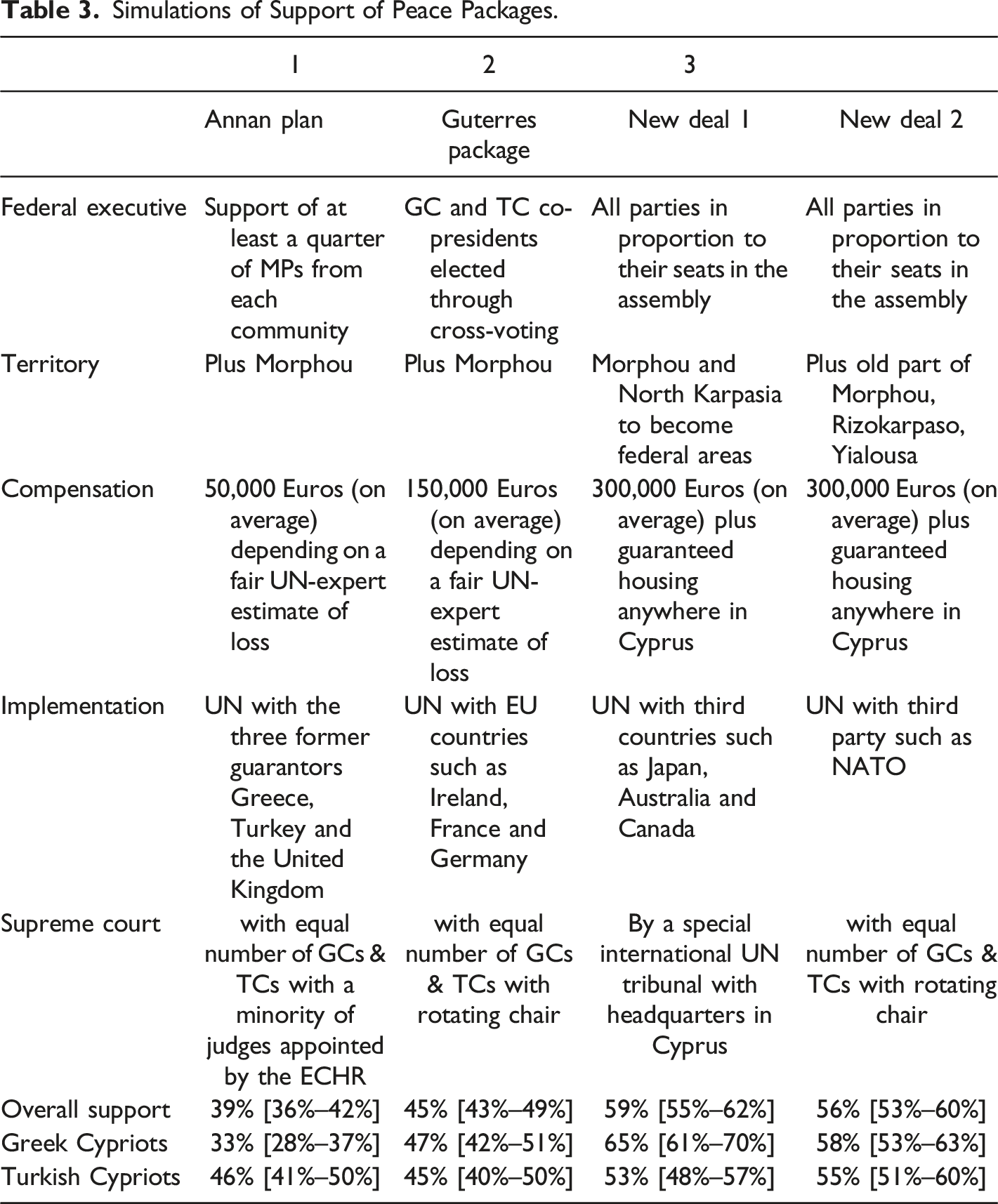
We use the 2004 Annan Plan as the point of reference and compare it to the Guterres package and to our proposed “New Deal 1” and “New Deal 2,” aiming to estimate the support these alternative arrangements would get by community and overall. Our main finding is particularly informative as to the value of institutional design; overall support for a settlement increases from 39% to 59% as a result of win-win amendments in the peace package, including increased compensations for affected users or owners of disputed properties.
Cyprus Peace Deal Dimensions and Values.
Simulation 1 explores the likelihood of support for an Annan Plan scenario; interestingly, support is slightly higher now than it was in 2004 when the Plan was rejected. As demonstrated in Psaltis et al. (2021), some voters have changed their views and are more inclined to vote for a renewed settlement. In an Annan scenario, the territorial readjustments are similar to those proposed in 2004 (including a return of Morphou but not Karpasia to Greek Cypriots), and Greece, Turkey, and the UK maintain their guarantor status in matters of security. Despite the slightly higher support, this is the least preferred option overall (39% support) and by community (Greek Cypriots 33%, Turkish Cypriots 46%). While low popularity among Greek Cypriots is to be expected, a predicted support of merely 46% among Turkish Cypriots suggests an Annan Plan outcome will not satisfy the majority of this community either. The conclusion here is that H3 (past negotiation failures shape present views) is only partly supported, as citizens have changed their views considerably over time (the most significant is the Turkish Cypriot decline in support for Annan-style arrangements).
Simulation 2 explores the evolution of UN mediations in the Guterres package. At Crans-Montana, the Secretary General proposed that the Treaty of Guarantee was “unsustainable” and introduced a key innovation – an international implementation monitoring mechanism – that would replace the Treaty of Guarantee. Increased levels of compensation in Guterres reflect improved work done by dedicated technical committees. 13 The specific arrangement stipulated in our survey is supported by 45% of all respondents, but most of the progress is made on the Greek Cypriot side: the Guterres framework receives more Greek Cypriot support (47%) but keeps Turkish Cypriot support at similar levels as in the Annan scenario (45%). (Note that Turkish Cypriot leader Akinci supported this package in the October 2020 elections and received 48% of the Turkish Cypriot vote.) Both solutions would therefore pose challenges to the peace process, as their legitimacy among the two communities is below the 50% threshold requirement for approval.
Simulation 3 (New Deal 1) provides much generous compensations to affected owners and users. An idea on territorial readjustments that was briefly discussed at the beginning of the Guterres negotiations and proposed by bicommunal leaders earlier found its way into this package. Specifically, during the peace talks, the possibility of assigning federal areas was debated; these would include Morphou and parts of Karpasia. The option would maximize the number of returnees and minimize the number of current users to be relocated. New Deal 1 is the most integrative of the alternatives, suggesting the communities have a positive image of each other (Psaltis et al. 2019). It is also the most international in its orientation, with security guarantees provided by major countries outside the EU. Moreover, the UN would establish a seat in Cyprus to support the peace process locally and regionally. Under this scenario, wherein security and arbitration are internationalized, majorities of Greek Cypriots (65%) and Turkish Cypriots (53%) would be satisfied; overall support is also high (59%). While these possibilities have been proposed, they have never been considered as part of a package and their effectiveness in the domain of public opinion has not been assessed.
This package supports H1 and the view that citizens – from both communities – are more likely to support settlements that include provisions involving third parties and the international community. Conventional wisdom often assumes that Turkish and Greek Cypriots will be suspicious of the “great powers” because of their past history and the failures of the international community to support them in times of need (McGarry 2017; Novosseloff 2021). Despite entry to the EU (essentially Greek Cypriots) and several steps towards closer relationships between Turkish and Greek Cypriots, this seems to be a major concern of foreign mediators. Yet our findings contradict conventional wisdom and support H1: citizens are more likely to support scenarios with an external outlook, thereby suggesting that international diplomacy could still be a catalyst for the settlement of the Cyprus conflict.
Simulation 4 revises this scenario of high compensation with the addition of NATO as a guarantor. Turkish Cypriots (and Turkey) are more likely to accept this scenario. However, it reduces Greek Cypriot support. NATO type arrangements are likely to be rejected by at least one major political party in the Greek Cypriot community for ideological reasons. Under New Deal 2, areas in Morphou and Karpasia are divided to minimize population movements and maximize return of displaced persons, while political parties adopt a Northern Ireland style of power-sharing publicly proposed by an expert on the UN team advising the negotiations (McGarry 2017). Interestingly, this UN proposal received very little attention among players in Cyprus, even though it makes some marginal gains in the direction of liberal consociationalism (McCulloch 2014) and could be more attractive to the right-wing parties currently leading the negotiations (McGarry and Loizides 2015). In our theoretical section, we argued important power-sharing institutions are related to other dimensions of a future settlement. Here and in a related comparative survey in Northern Ireland (Sudulich et al. 2021), we find other considerations trump power-sharing, suggesting overall different motivations for elites and the general public. Scenario 4 slightly boosts support among Turkish Cypriots (55%) and maintains support among Greek Cypriots (58%). Overall support is under that for Scenario 3 (56%). It seems both sides would welcome increased compensations, and related provisions move the lower confidence intervals of all the estimates safely above the 50% bar for each community and overall.
These simulations suggest ways to design consociational and federal arrangements in Cyprus to secure societal agreement and attract the overall support of both groups. Institutional design is crucial: overall support for a settlement increases about 20% with win-win amendments (improved property arrangements).
Simulations of Support of Peace Packages.
Conclusion
In this paper, we used a conjoint experiment to explore the viability – among members of the public - of a number of potential solutions to the conflict between Greek and Turkish Cypriots. Although the dispute in Cyprus has generally been seen as an example of an intractable conflict, our findings show majorities of both sides of the divide would support certain compromises and even detailed options for a mutually-agreed peace settlement. As noted earlier, past proposals to resolve the Cyprus problem have been for the most part endorsed anonymously by UN Security Council members and therefore carry important legal and political significance in setting the internationally agreed standards for mediations across conflict-ridden and deeply divided societies. This article’s findings add public opinion to international and UN endorsements including the nuances of citizen preferences highlighting how the conflict-mitigating institutions and trade-offs assessed here could inspire and support peace mediations across conflict zones.
In a nutshell, the four hypotheses we tested tell an informative tale about conflict resolution in deeply divided spaces. H4 (graveyard of diplomats) is rejected from a public opinion perspective. In spite of two highly divisive issues (territorial adjustments and monitoring mechanisms), at least two fairly detailed peace packages could concentrate majority support in both communities. This finding might be or not replicable in other intractable conflicts (see Kriesberg 1993; Bar-Tal 2007; Halperin et al. 2013), nonetheless our application of a conjoint experiment offers a new tool to test the limits of intractability in public opinion across a wide range of post-conflict situations. H1 (credible commitments) is supported. Unlike past mediations, the public now appears more receptive of international involvement. In terms of the future approaches in international peacekeeping, this finding implies the need for rethinking the entanglement of international guarantors and politics (Putnam 1988; Walter 2009) in peace mediations aiming to create additional value through security provision to parties in conflict. H2 (reparations) is also supported (see Leckie 2007, Sert 2010, Mironova and Whitt, in this special issue); citizens are more likely to support increases in compensations, and related provisions could transform packages rejected in peace talks into successful mediation plans. This finding suggests new directions for international mediators emphasizing economic restitution (Meertens and Zambrano 2010). Those could be supported by grassroots and victim-oriented consultations to safeguard the rights of those affected by conflicts, for example, by introducing census platforms to collate property data and preferences for compensation, exchange, or restitution, across dispossessed property owners and users and by targeting international aid for displaced persons and refugees. While several studies have pointed to the impact of historical legacies on public opinion we know very little about the interaction of legacies with other variables (Grossman et al. 2015; Shkliarov et al. 2021; see also Haass et al. Introduction to this special feature section).
Peace agreements are typically negotiated by elites, with little popular involvement. Elites make tradeoffs on issues that matter the most to them. Interestingly, our findings on power-sharing tend to support this point. Provided that political equality is maintained, our findings suggest that alternative power-sharing arrangements make little difference in the way citizens choose alternative packages; more important issues are territory, compensations, and security. These findings align with those of Gates et al. (2016) and suggest a pattern where human rights (federal courts) appear to influence decisions more decisively among the public even if this issue has not been salient in the mediations.
In conclusion, our study demonstrates the utility of conjoint analysis to examine public opinion in divided societies. In Cyprus and across divided societies, it suggests serious consideration of the parameters of UN peace mediations, including those deals that include greater involvement (and commitments) by international actors. Such deals entail higher levels of compensations (usually supported by donor countries) for citizens in deeply divided societies but with the added benefit of maximising local support and signalling a peace breakthrough. When we can pinpoint the relative importance of different elements of potential settlements, we can identify solutions that might mitigate disagreements over individual policy issues. Securing cross-community support is vital to any form of settlement in a post-conflict society. This study shows conjoint experiments can provide rich insights into which solutions are likely to secure such support.
Footnotes
Acknowledgements
The authors gratefully acknowledge the comments and advice of Erik Gahner Larsen, Alexandros Lordos, Huseyin Cakal and Ilke Dagli, John McGarry as well those of the special issue editors Caroline Hartzell, Martin Ottmann and Felix Haass as well as our anonymous reviewers. Turkish Cypriot negotiator Ozdil Nami provided extensive feedback on our survey design while we benefited extensively from dedicated meetings on the project with the UN team in Cyprus (April 8th, 2018) and New York (June 30th, 2020) as well as public presentations with stakeholders in both communities in Cyprus. Isik Kuscu and Feargal Cochrane as PI/CO-I in funded projects leading to this article contributed to data collection and the design of the questionnaire. Andrea Nicolaou, Andreas Aristeidis and Eliz Tefik advised the questionnaire and data collection. The usual disclaimer applies.
Author Contributions
NL, EMJ, LS and CP contributed to the conceptualisation, design, interpretation and writing up of this study. RP and CP and carried out the statistical analysis while TB provided the technical support on the execution of fieldwork.
Declaration of Conflicting Interests
The author(s) declared no potential conflicts of interest with respect to the research, authorship, and/or publication of this article.
Funding
The author(s) disclosed receipt of the following financial support for the research, authorship, and/or publication of this article: the authors gratefully acknowledge the financial assistance of the University of Kent Faculty of Social Science Research Support Fund, the United States Institute for Peace (Grant no. 350 2261) and British Academy (Grant no. AF160002). The opinions, findings, and conclusions or recommendations expressed in this publication are those of the authors and do not necessarily reflect the views of the funders.
Ethical Approval
Ethical approval for this study was granted under the University of Kent’s ethics governance protocols (Faculty of Social Sciences Research Ethics Advisory Group for Human Participants) on 18 December 2018 (Ref No 0101819).

Notes
Appendix
Below we report: Full model estimates in Table A1. Table A1 reports the estimates for 817 GCs with a total N of 8170 (817*10) and 804 TCs with a total N of 8040 (804*10). Estimates for weighted versus unweighted samples in Figure A1. Estimates by community, with controls for age, gender, education in Figures A2 and A3. Estimates of a multiplicative model by community in Table A2.
Sampling Weight by Community. Weighted versus Unweighted Samples.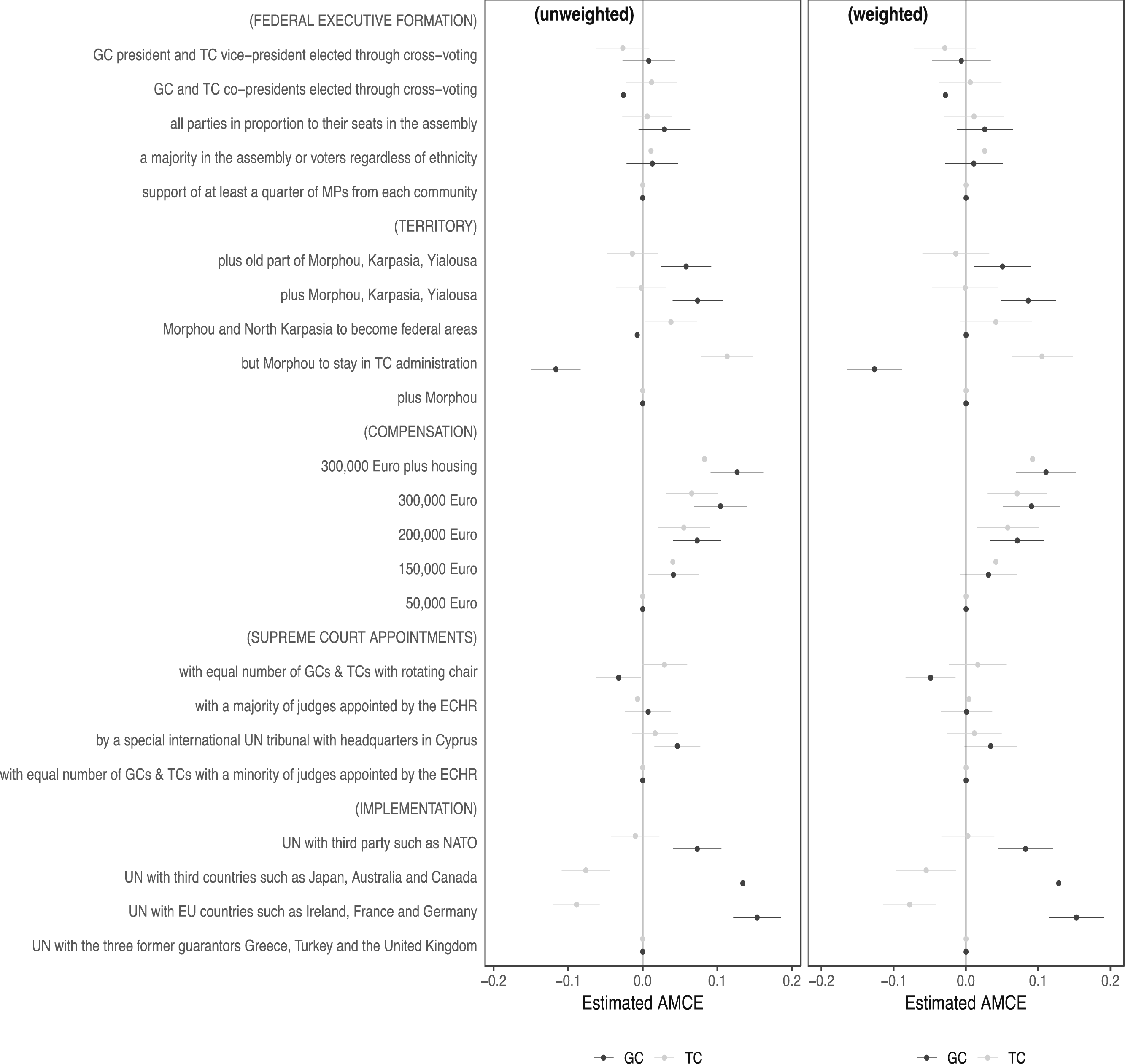
Models with controls: Greek Cypriots.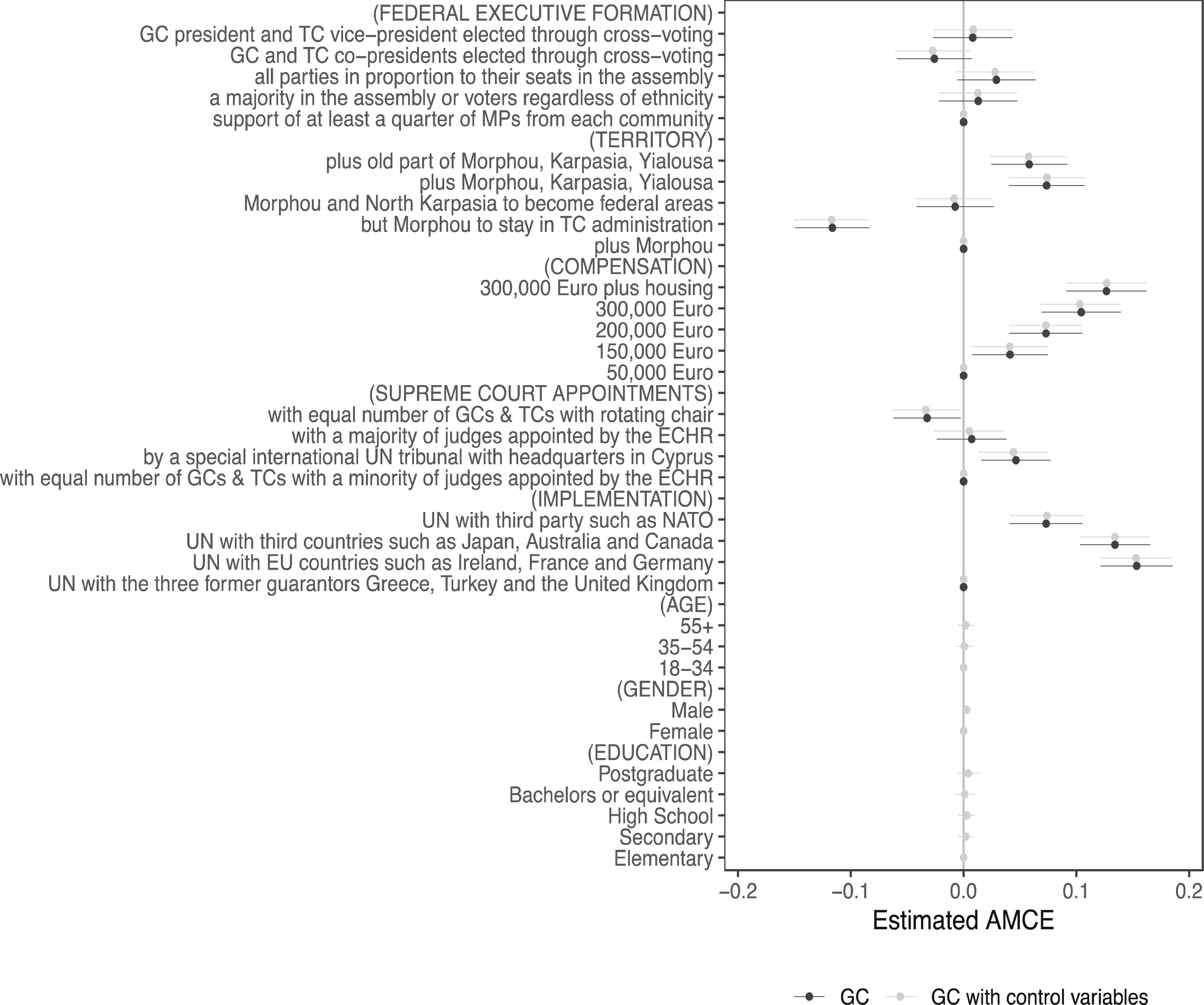
Models with controls: Turkish Cypriots.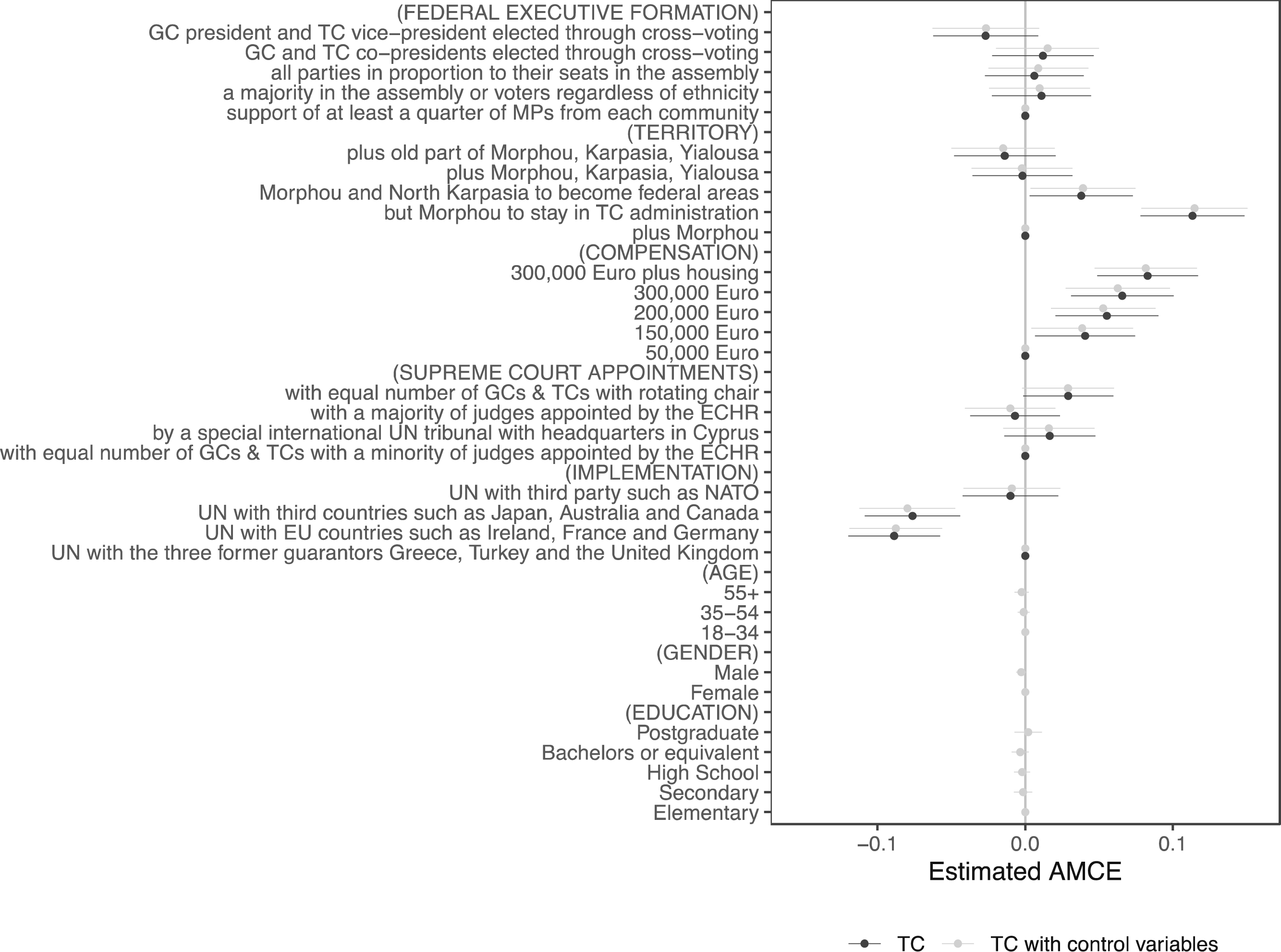
Full Estimates for Models Reported in Figure 2. Robust ci in parentheses. ***p < 0.01, **p < 0.05, *p < 0.1.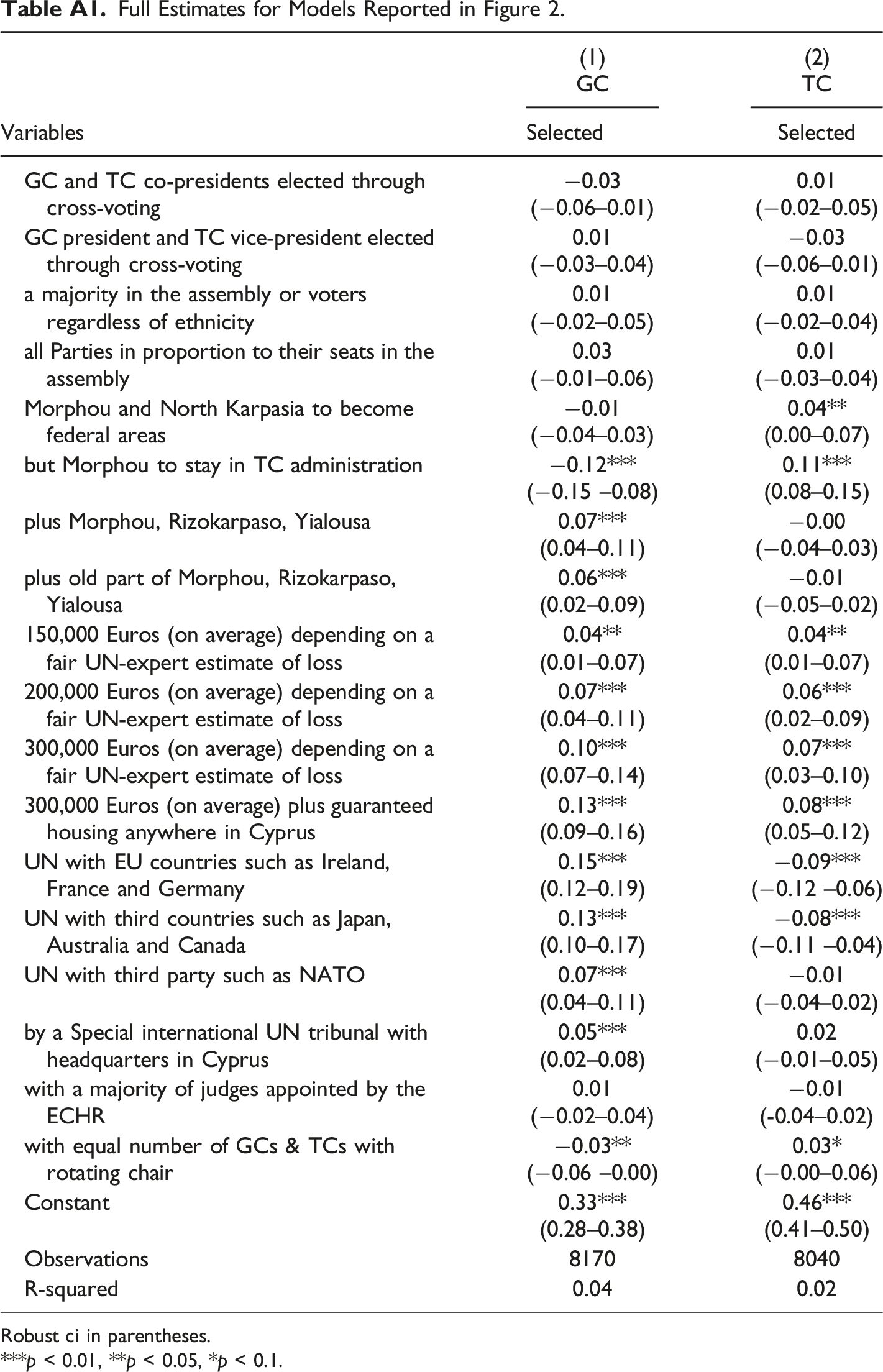
Variables
(1) GC
(2) TC
Selected
Selected
GC and TC co-presidents elected through cross-voting
−0.03
0.01
(−0.06–0.01)
(−0.02–0.05)
GC president and TC vice-president elected through cross-voting
0.01
−0.03
(−0.03–0.04)
(−0.06–0.01)
a majority in the assembly or voters regardless of ethnicity
0.01
0.01
(−0.02–0.05)
(−0.02–0.04)
all Parties in proportion to their seats in the assembly
0.03
0.01
(−0.01–0.06)
(−0.03–0.04)
Morphou and North Karpasia to become federal areas
−0.01
0.04**
(−0.04–0.03)
(0.00–0.07)
but Morphou to stay in TC administration
−0.12***
0.11***
(−0.15 –0.08)
(0.08–0.15)
plus Morphou, Rizokarpaso, Yialousa
0.07***
−0.00
(0.04–0.11)
(−0.04–0.03)
plus old part of Morphou, Rizokarpaso, Yialousa
0.06***
−0.01
(0.02–0.09)
(−0.05–0.02)
150,000 Euros (on average) depending on a fair UN-expert estimate of loss
0.04**
0.04**
(0.01–0.07)
(0.01–0.07)
200,000 Euros (on average) depending on a fair UN-expert estimate of loss
0.07***
0.06***
(0.04–0.11)
(0.02–0.09)
300,000 Euros (on average) depending on a fair UN-expert estimate of loss
0.10***
0.07***
(0.07–0.14)
(0.03–0.10)
300,000 Euros (on average) plus guaranteed housing anywhere in Cyprus
0.13***
0.08***
(0.09–0.16)
(0.05–0.12)
UN with EU countries such as Ireland, France and Germany
0.15***
−0.09***
(0.12–0.19)
(−0.12 –0.06)
UN with third countries such as Japan, Australia and Canada
0.13***
−0.08***
(0.10–0.17)
(−0.11 –0.04)
UN with third party such as NATO
0.07***
−0.01
(0.04–0.11)
(−0.04–0.02)
by a Special international UN tribunal with headquarters in Cyprus
0.05***
0.02
(0.02–0.08)
(−0.01–0.05)
with a majority of judges appointed by the ECHR
0.01
−0.01
(−0.02–0.04)
(-0.04–0.02)
with equal number of GCs & TCs with rotating chair
−0.03**
0.03*
(−0.06 –0.00)
(−0.00–0.06)
Constant
0.33***
0.46***
(0.28–0.38)
(0.41–0.50)
Observations
8170
8040
R-squared
0.04
0.02
Multiplicative Model by Community. Robust ci in parentheses. ***p < 0.01, **p < 0.05, *p < 0.1.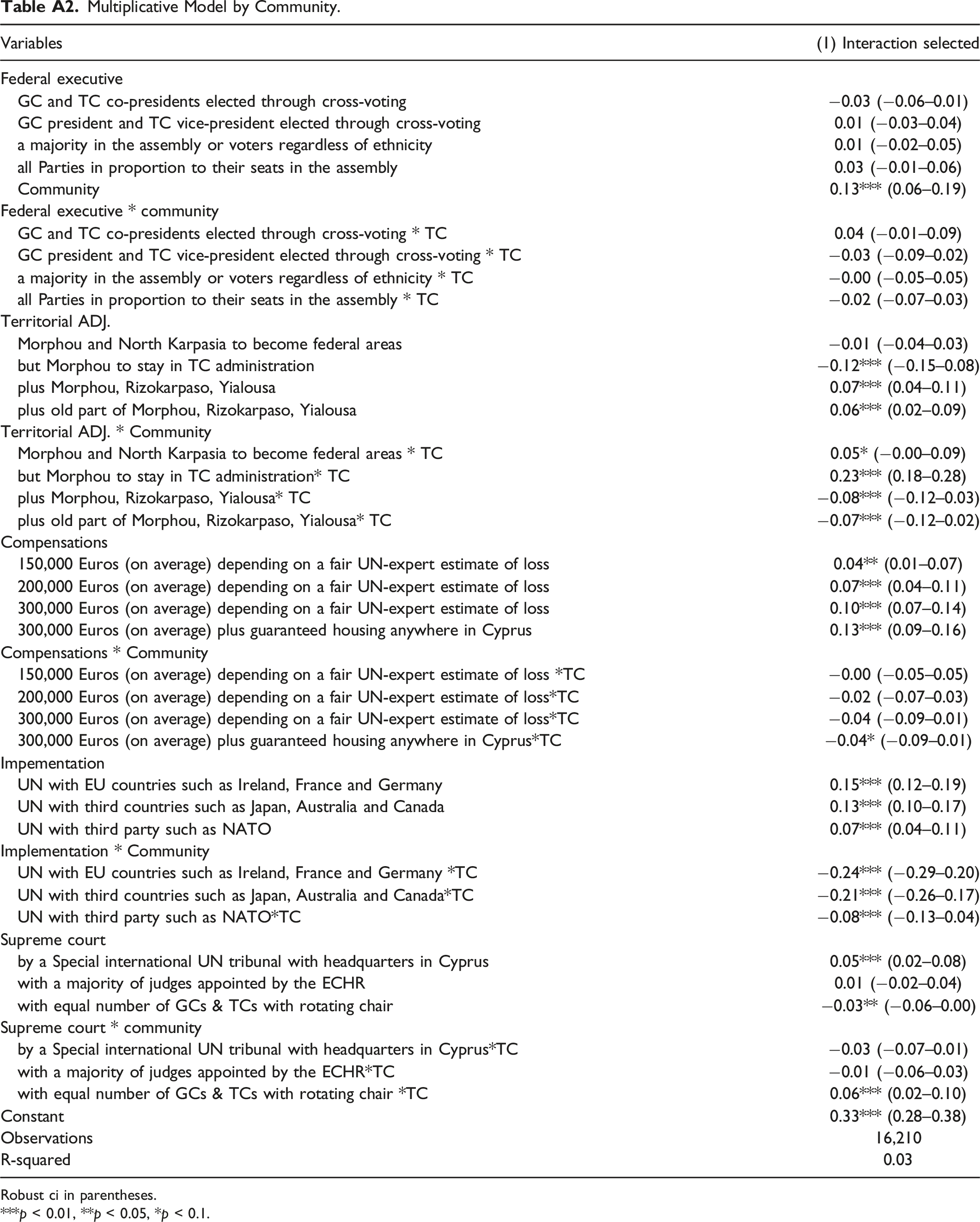
Variables
(1) Interaction selected
Federal executive
GC and TC co-presidents elected through cross-voting
−0.03 (−0.06–0.01)
GC president and TC vice-president elected through cross-voting
0.01 (−0.03–0.04)
a majority in the assembly or voters regardless of ethnicity
0.01 (−0.02–0.05)
all Parties in proportion to their seats in the assembly
0.03 (−0.01–0.06)
Community
0.13*** (0.06–0.19)
Federal executive * community
GC and TC co-presidents elected through cross-voting * TC
0.04 (−0.01–0.09)
GC president and TC vice-president elected through cross-voting * TC
−0.03 (−0.09–0.02)
a majority in the assembly or voters regardless of ethnicity * TC
−0.00 (−0.05–0.05)
all Parties in proportion to their seats in the assembly * TC
−0.02 (−0.07–0.03)
Territorial ADJ.
Morphou and North Karpasia to become federal areas
−0.01 (−0.04–0.03)
but Morphou to stay in TC administration
−0.12*** (−0.15–0.08)
plus Morphou, Rizokarpaso, Yialousa
0.07*** (0.04–0.11)
plus old part of Morphou, Rizokarpaso, Yialousa
0.06*** (0.02–0.09)
Territorial ADJ. * Community
Morphou and North Karpasia to become federal areas * TC
0.05* (−0.00–0.09)
but Morphou to stay in TC administration* TC
0.23*** (0.18–0.28)
plus Morphou, Rizokarpaso, Yialousa* TC
−0.08*** (−0.12–0.03)
plus old part of Morphou, Rizokarpaso, Yialousa* TC
−0.07*** (−0.12–0.02)
Compensations
150,000 Euros (on average) depending on a fair UN-expert estimate of loss
0.04** (0.01–0.07)
200,000 Euros (on average) depending on a fair UN-expert estimate of loss
0.07*** (0.04–0.11)
300,000 Euros (on average) depending on a fair UN-expert estimate of loss
0.10*** (0.07–0.14)
300,000 Euros (on average) plus guaranteed housing anywhere in Cyprus
0.13*** (0.09–0.16)
Compensations * Community
150,000 Euros (on average) depending on a fair UN-expert estimate of loss *TC
−0.00 (−0.05–0.05)
200,000 Euros (on average) depending on a fair UN-expert estimate of loss*TC
−0.02 (−0.07–0.03)
300,000 Euros (on average) depending on a fair UN-expert estimate of loss*TC
−0.04 (−0.09–0.01)
300,000 Euros (on average) plus guaranteed housing anywhere in Cyprus*TC
−0.04* (−0.09–0.01)
Impementation
UN with EU countries such as Ireland, France and Germany
0.15*** (0.12–0.19)
UN with third countries such as Japan, Australia and Canada
0.13*** (0.10–0.17)
UN with third party such as NATO
0.07*** (0.04–0.11)
Implementation * Community
UN with EU countries such as Ireland, France and Germany *TC
−0.24*** (−0.29–0.20)
UN with third countries such as Japan, Australia and Canada*TC
−0.21*** (−0.26–0.17)
UN with third party such as NATO*TC
−0.08*** (−0.13–0.04)
Supreme court
by a Special international UN tribunal with headquarters in Cyprus
0.05*** (0.02–0.08)
with a majority of judges appointed by the ECHR
0.01 (−0.02–0.04)
with equal number of GCs & TCs with rotating chair
−0.03** (−0.06–0.00)
Supreme court * community
by a Special international UN tribunal with headquarters in Cyprus*TC
−0.03 (−0.07–0.01)
with a majority of judges appointed by the ECHR*TC
−0.01 (−0.06–0.03)
with equal number of GCs & TCs with rotating chair *TC
0.06*** (0.02–0.10)
Constant
0.33*** (0.28–0.38)
Observations
16,210
R-squared
0.03