




Abstract
The coronavirus pandemic has fundamentally shifted the way human beings interact, both as individuals and groups, in the face of such a widespread outbreak. This paper seeks to investigate the effects of COVID-19 on intergroup emotions and attitudes within an intractable intergroup conflict, specifically, through the lens of the Korean conflict. Using a two-wave, cross-sectional design, this study was able to track the profound psychological changes in intergroup emotions and attitudes both prior to the pandemic and during its onslaught. Results of these two wave representative samples show that South Korean citizens demonstrated higher levels of fear of their neighbors in North Korea after the outbreak of COVID-19 than before. In turn, this led to increased societal support of hostile government policies towards North Koreans. Conversely, the same participants exhibited higher levels of empathy towards North Koreans during the pandemic, which led to a higher willingness to collaborate with their outgroup. This dual effect on intergroup emotions within intractable conflicts brings forth new avenues from which societies may be able to restrain the destructive influence of the COVID-19 threat on intergroup relations — as well as harvesting its constructive potential for reconciling warring intergroup relations.
Keywords
The Dual Effect of COVID-19 on Intergroup Conflict in the Korean Peninsula 1
The COVID-19 pandemic poses a serious threat to the health and wellbeing of humanity, with the full extent of its ripple effects still unknown. Beyond its influence on various aspects of our lives such as in health and economy, the pandemic may also see dramatic effects on relations between groups within an intractable conflict. Such conflicts usually involve members of warring groups who have already— without the added impetus of coronavirus— experienced a variety of both psychical and psychological threats that stem from the very nature of violent, chronic disputes (Coleman 2003). In order to cope with such threats, group members adopt socio-psychological beliefs, emotions and attitudes aimed at preserving their wellbeing and positive self-image (Bar-Tal and Halperin 2011). While these constructs may be effective in helping individuals cope with a threatening reality, they also act as powerful barriers that stand in the way of intergroup reconciliation (Halperin 2015).
Exploring the influence of external threats on intergroup relations is a major crusade for social scientists, given that tragic outcomes of intractable intergroup conflicts are not confined to warring groups alone, but may spread to threaten and undermine international stability. In light of this, this study seeks to reveal the implications of COVID-19 on intergroup emotions and, in turn, on citizens’ attitudes relating to intergroup escalation and reconciliation, using the divided Korean peninsula as a litmus test.
The main question driving the current work is whether external threat such as the COVID-19 outbreak, may lead to both constructive (i.e. intergroup cooperation) and destructive (i.e. intergroup hostility) intergroup outcomes, and whether those seemingly contradicting effects are mediated by social identification and intergroup emotions – in the context of the Korean peninsula.
Intergroup Conflicts in the Face of COVID19
Threatening events can substantially influence attitudes and behaviors (Heine et al. 2006; Xu and McGregor 2018), as they generate ‘compensatory responses’ (Brandt and Crawford 2020; Jonas et al. 2014) such as cognitions, emotions and behavioral shifts in both personal and social contexts. These responses provide individuals with some relief from anxiety and uncertainty (Mirisola et al. 2014), but at the same time may also undermine more tolerant attitudes towards outgroups (Van Bavel et al. 2020). On the other hand, external threats may not always lead to pejorative behaviors towards outgroups. When faced with collective danger and threat (e.g. shared enemy), people sometimes demonstrate a tendency to seek affiliation and proximity, express mutual aid, and act collaboratively, suggesting that one possible collective response to the pandemic may also be alliance when under threat (Adam-Troian and bagci 2020; Bodenhausen et al. 2000).
Thus, social psychological theories regarding people’s reactions to threats, such as COVID-19, can be generally divided into two classifications (Cruwys et al. 2020); with one approach emphasizing the increase in intergroup hostility as a response to such threats (Van Bavel et al. 2020), while the other highlighting the role of unity and cooperation, leading to more inclusive and collaborative intergroup behaviors (Bodenhausen 2000). Although these approaches appear to imply contradictory responses towards outgroups in the face of external threats, they also converge on the adaptive functions of socio-psychological responses to pandemics; with one serving the avoidance of the spread of disease, and the other encouraging group level aid and cooperation against a common threat (Smith and Gibson 2020). Indeed, recent findings from Turkey have revealed that the COVID-19 threat has increased both negative (through perceptions of immigrant threat) and more positive attitudes (through a sense of common identity) towards Syrian immigrants (Adam-Troian and Bagci 2020).
However, to the best of our knowledge, the role of group based emotions in mediating the effects of COVID-19 on intergroup conflict outcomes has yet to be explored. As group based emotions play a major role in determining escalation and reconciliation of intergroup conflicts (Halperin 2015; Halperin and Nir 2019), and are highly receptive to threatening events; a better understanding of the ways in which group based emotions might affect socio-psychological responses to the COVID-19 threat, may be of high importance for both theoretical and applied venues.
In what follows, we will first discuss the role of intergroup emotions in intractable conflicts, before addressing our main focus in the current work; illuminating two potential influence paths of COVID-19 on intergroup escalation and reconciliation. This will be examined through the prism of the Korean conflict and explored through both social and emotional mechanisms.
Group Based Emotions in Intergroup Conflict
An external threat, such as the COVID-19 pandemic, may amplify all psychological factors (e.g. collective memory, societal beliefs, cognitive biases) that usually preserve and perpetuate intractable conflicts (Bar-Tal and Halperin 2011). However, as the effects of group based emotions in conflict on aggressive and conciliatory intergroup policies is more proximate than the one of other psychological phenomena (Halperin 2015), and, as new threats carry some intense emotional reactions, the current work will focus on the emotional barriers in intergroup conflict and their potentially mediating effect on intergroup hostility or collaboration, all under the threat of the COVID-19 pandemic.
It is known that emotions are not felt only on the individual level. Vast empirical research stemming from intergroup emotions theory has established that people feel emotions on behalf of their group (Mackie, Devos and Smith 2000; Mackie and Smith 2002). Smith, Seger and Mackie (2007) suggests that when group memberships are salient, people can feel emotions on account of their group’s position, even if they have had little or no personal experience of the actual intergroup situations themselves. According to this approach, group-based emotions are sentiments that are dependent upon an individual’s membership in a particular social group and occur in response to events that have perceived relevance for the group as a whole (Mackie et al. 2000; Smith et al. 2007).
Often, these aggregated experiences of short term negative emotional reactions turn into emotional sentiment, which refers to enduring negative feelings toward the outgroup or the conflict itself, that are not contingent upon specific action or behavior of that group (Halperin and Gross 2011). The transformation of momentary individual-level and intergroup emotions into long-term sentiments is one reason that intractable conflict reconciliation is so difficult to address; as these intergroup emotional sentiments serve as a powerful force that motivates and sustains conflicts between societies and countries (e.g. see Halperin 2014; Maoz and McCauley 2008). These emotional barriers lead to the formation of intergroup negative attitudes (Hewstone, Rubin and Willis 2002; Stephan and Stephan 1985), motivate support for destructive intergroup policies, and bias group membership (Cole, Balcetis and Dunning 2013).
A recent study, conducted in the context of the Korean conflict, revealed that the effect of South Koreans' group based hatred on support of military action against North Korea as well as on support for conciliatory policies, went above and beyond various variables, such as ideology and group identification, (Halperin and Nir 2019). Emotions can be explained as mental states of readiness (Scarantino and de Sousa 2018), incorporating motivation and directed action towards a certain target (Bagozzi et al. 1999). As such, their role as mediating factors between social reactions to COVID-19 and intergroup escalation and cooperation may be especially important.
Amongst these group based emotions, group based fear and intergroup empathy are the natural candidates for mediating the potential dual effect of the pandemic threat on intergroup conflict. While fear is a product of threat and induces intergroup hostility (Oh et al. 2016), empathy requires a certain degree of perspective taking and sense of intergroup commonality, and induces intergroup cooperation and conciliatory attitudes (Batson and Ahmad 2009). We shall discuss the roles of each intergroup emotion, before presenting the theorems and findings underlying the potential routes of an encompassing social reaction to COVID-19.
The Destructive Path: COVID-19 Increases Intergroup Hostility
Various theories and findings predict that when facing an external threat such as the COVID-19 pandemic, individuals' identification with their ingroup will increase, as well as their hostility towards the outgroup (Cruwys et al. 2020). From an evolutionary psychology perspective (Sorokowski et al. 2020), outgroup distancing may be especially adaptive for avoiding infections, since outgroup members are more likely to carry pathogens to which members of the ingroup have not yet developed immunity (Murray et al. 2013). Hence, in response to a pandemic threat, people who share social identities will perceive each other as more similar and as less likely to infect them, compared to outgroups members, triggering greater ingroup favoritism and outgroup bias (Cruwys et al. 2020).
According to Terror management theory (Greenberg, Pyszczynski and Solomon 1986), humans are overwhelmed by their own mortality; the thought that one’s life is subject to an end that may be sudden, unpredictable and unavoidable. Individuals affected by death anxiety cannot function normally, as their defenses are impaired and they are vulnerable to many dangers (Becker 1973). According to TMT, cultures and groups can provide an escape from death anxiety, as they integrate individuals into something larger than themselves — a culture group that existed before they were born and will continue to exist long after they die. Numerous studies adopting a TMT approach found that when made to think about their own mortality, people tend to render especially harsh judgments of those who violate ingroup cultural standards, and favor those who uphold their standards (Landau et al. 2004; Solomon, Greenberg and Pyszczynski 2000). Thus, group members under threat— especially in the face of a realistic health and economic risk— will increase identification with their ingroup as a means to decrease existential anxiety, all the while further distancing themselves from their outgroups.
From an emotional perspective, both the COVID-19 threat and the increased intergroup biasness it promotes, may have substantial influence on group based fear. Fear refers to a subjective emotional state that arises in situations perceived as threatening or dangerous and accompanied by a physiological response (Halperin 2008). Often, fear is accompanied by a perception of weakness and relative fatigue as well as a low potential for cooperation with the threatening event (Roseman 1984). Fear can be perceived as a social phenomenon, experienced by the individual within the cultural-social context; as it may be aroused by a threat to one’s personal or social status, as well as one’s identity and beliefs (Shaver et al. 1987). However, the most significant fear factor is the threat to one’s physical existence (Jarymowicz and Bar-Tal 2006), such as in the case of COVID-19.
At the group level, when people experience high levels of fear—which is part and parcel of an intergroup conflict— they may respond with aggressive behavior, even if that behavior is perceived as counter-productive (Maoz and McCauley 2008). Studies show that fear strengthens relations within the ingroup (Wohl, Branscombe and Reysen 2010), and that extreme fear can lead to cognitive “stagnation” (Kruglanski 2004), preventing mental flexibility and activating automated systems of defense and cognitive rigidity (Cohen et al. 2014); a process that allows for selective retrieval of fear-related knowledge and prevention of openness to new ideas (Clore, Schwarz and Conway 1994). Studies conducted on the intractable Israeli-Palestinian conflict found that group based fear was associated with decreased openness to new information (rather, reinforced conflict-supporting beliefs), increased perceptions of outgroup members as dangerous and increased support of intergroup aggression (Cohen et al. 2014).
The threat posed by COVID-19 may increase group based fear in the following ways. The fear of COVID-19 may be generalized as fear of the outgroup, while the threat of the pandemic may enhance the sense of ingroup vulnerability - increasing the intensity of the perceived threat by the outgroup. Further, in the context of the Korean conflict, where the North Korean regime reveals no solid data regarding the magnitude and severity of the COVID-19 outbreak, all the while sharing a border with the South, the fear of the COVID-19 may be directly intertwined with the fear of the outgroup (i.e. fearing that the North’s poor dealing with the pandemic will cause a widespread outbreak in the South). Group based fear, in turn, may lead to higher levels of hostility towards the outgroup.
The Constructive Path: COVID-19 Induces Common Ingroup Identity
Although various models of reaction to threats predict higher levels of ingroup social cohesion and identification, they rarely specify which ingroup is targeted by these mechanisms. For instance, responding to threat via increased identification as residents of a certain city or country, could extend to inhabitants with an immigrant background (Adam-Troian and bagci 2020). This aforementioned point alludes to the necessity of incorporating other group-level aspects of pandemics that may predict changes in intergroup attitudes. Accordingly, beyond some immediate effects of COVID-19 on deescalating intergroup conflict due to reprioritization, restrictions and reallocation of resources 2 , COVID-19 may have a meaningful, sustainable and positive impact on groups engaged in conflict. When facing a collective threat, people may perceive themselves as more interdependent on others sharing that same threat, and therefore seek their affiliation and proximity, and exhibit mutual assistance – suggesting that one possible socio-psychological response to pandemics may be increased cooperation under threat (Alonso-Ferres et al. 2020; Mawson 2005; Van Bavel et al. 2020).
The very foundation of intergroup relations is the identification of individuals as group members; but the borders of these social groups may be malleable under certain circumstances (Haslam et al. 1997). Social Identity Theorists (Tajfel 1978
Other examples include international cooperation between countries donating each other surpluses, medical care and equipment. In fact, the UN Department of Economic and Social Affairs recently published that it considers COVID-19 to be a transformative event that can reduce social inequalities through expanding systems for the universal provision of quality public services, and encouraged the sharing of knowledge and scientific findings across the world; in essence, calling for international and national unification while fighting the pandemic. Lately, other theoretical work has also drawn attention to the importance of investigating COVID-19 from a social identity approach, focusing on a shared group membership emerging from pandemics (Cruwys, Stevens and Greenaway 2020; Drury, Reicher and Stott 2020; Templeton et al. 2020). Due to its global nature as an infectious disease, COVID-19 is a prototypical example of an external threat that is likely to trigger identification with an inclusive common ingroup.
Returning to the emotional perspective, the COVID-19 threat and its social reaction of re-categorization may activate positive emotions towards former outgroup members. Intractable intergroup conflicts generate group based empathy towards other ingroup members (Halperin 2015), based on perceived commonalities, similarities and a shared fate and goals (Stürmer et al. 2006). The threat of COVID-19 and its inclusive social reaction by which members of opposing groups share a common fate and mutual goals, facing the same threat together, may induce stronger empathy to former outgroup members, now “in it together” with the ingroup - and in turn lead to increased willingness to cooperate with, and give assistance to, the outgroup (Batson and Ahmad 2009; De Vos et al. 2013).
According to Davis (1994), empathy is an array of emotional and cognitive structures that link one person’s responses to another’s experiences. These responses include an emotional experience, positive or negative, similar to that experienced by others, as well as cognitive (perceiving the other’s point of view) and behavioral responses (Decety 2015). Empathy involves sharing and understanding the emotional states of the other, and is associated with pro-social collaboration in the context of interpersonal relations and within a group (Batson et al. 1997), as reflecting a shared fate or “feeling with” a group or another person (Singer & Lamm 2009). As such, empathy plays a significant role in intergroup relations living under ongoing conflict, as it is linked to the willingness to alleviate the suffering of outgroup members (Pagano and Huo 2007) and may lead to support of conciliatory policies towards outgroups within an intractable conflict (Halperin 2015). A study conducted by Maoz and MacCauley (2008), revealed that Jewish Israelis' empathy for Palestinians was associated with their willingness to compromise. Todd, Bodehausen and Galinsky (2012) revealed that empathy towards the outgroup is positively associated with reducing prejudice and racism, while increasing support of intergroup reconciliation.
However, inducing empathy towards outgroup members, especially in the context of intergroup conflict, is a challenging task. As empathy requires a certain degree of taking one’s own perspective and engaging with one’s inner state— a task easier to undertake alongside those who are similar to us— it is not surprising that people often feel less empathy towards strangers who belong to a different group (e.g. racial, political, or social group), as compared to strangers who are identified as ingroup members (Batson and Ahmad 2009; Davis 1994; Hornstein 1991). This phenomenon was previously described as “the intergroup empathy bias” (Bruneau, Cikara and Saxe 2012).
But not all out-groups elicit the intergroup empathy bias to the same extent, and the bias is demonstrably subject to context effects (e.g. Gutsell and Inzlicht 2010, 2013). One of the major findings eliciting such contextual effects on intergroup empathy, and is especially relevant to our present context, was demonstrated. The findings revealed that the formation of a common ingroup leads to increased empathy towards former outgroup members. Additional findings reaffirm that when a more inclusive social categorization is made salient; empathetic behavior is extended to those who were previously identified as out-group members (Levine et al. 2005). As COVID-19 is a borderless, global pandemic where different groups members' share a common threat, all the while promoting a more inclusive common ingroup identification; its existence may increase empathy towards former outgroup members, now experiencing a similar reality.
In the case of the Korean conflict, where both sides already share several similarities and common characteristics (ethnicity, language, history, geographical borders), common threat is more likely to induce South Koreans to feel more empathetic towards North Koreans; and in turn, encourage greater support for intergroup cooperation. We shall address these unique characteristics of the Korean conflict, before presenting our current work.
The Korean Conflict
The Korean peninsula provides a unique socio-psychological context in which the two proposed outcomes of COVID-19 may be examined. South Koreans maintain an ambivalent attitude toward North Korea with both favorable and hostile feelings saliently mingled together. The root of the South Korean people’s ambivalence lies in their common ethnic identity (i.e. Koreans) and national identity (i.e. South Korean). Before the division of the two Koreas in 1945, South and North Korea had been a nation state for a thousand years, in which “the great majority of people [were] aware of the fact that they had a shared culture” (UNESCO 2019).
In modern reality, however, the two Koreas have been divided for over 70 years with two completely different political regimes in place. After the Korean war, which ended in 1953, North Korea has never ceased to be a tangible threat to the South. Therefore, it appears to be rather natural that people living in South and North Korea have distinct national identities. However, findings on national identity as a differentiated factor from the ethnic identity began to appear in South Korea only recently (Jung, Hogg and Choi 2016; Park and Kim 2019).
These characteristics of the Korean conflict are especially relevant to our suggested influence paths; While the destructive effects of an external threat (i.e. COVID-19) on intergroup relations were widely established in various contexts (e.g. Cruwys et al. 2020; Lantos and Molenberghs 2021) – the activation of the constructive path may demand some basic shared characteristics and similarities between warring group members' – which may increase the likelihood of a superordinate, common, group categorization (Batson and Ahmad 2009).
As South Koreans identify both as ethnic Koreans and as national South Koreans, the Korean conflict may be a prominent case study of the dual effects of COVID-19, through parallel group identifications and group based emotions on conflict related attitude. Moreover, eliciting ways to strengthen the common ethnic Korean identification is a key mission in achieving reconciliation in the Korean peninsula.
The Current Study
Various theoretical frameworks and recent findings have revealed the potential dual effect of the COVID-19 threat on intergroup relations. However, most of these findings fail to address the context of intractable intergroup conflicts, rather focusing on more moderate, albeit tense, intergroup relations between majority-minority groups. Moreover, although the role of group based emotions is widely established as central to the processes of intergroup escalation and reconciliation—and as these emotional mechanisms are highly correlated to both external threat and to ingroup boundaries— they still have yet to be explored as possible mediators of the COVID-19 influence on intergroup escalation and cooperation.
Given the above, we hypothesized that the COVID-19 pandemic will increase South Korean participants' national identification (compared to a similar sample taken a year prior to the outbreak), therefore enhancing group based fear, and, consequently, leading to greater hostility towards the North Korean outgroup. Simultaneously, we hypothesized that South Korean participants will exhibit higher ethnic identification as Koreans (compared to a pre COVID-19 outbreak sample), leading to increased outgroup empathy, which, in turn, will enhance their willingness to collaborate (i.e. to give assistance and to cooperate) with their North Korean outgroup.
Method
Finally, participants were asked to fill in several scales measuring their policy preferences towards the North Korean outgroup, including one item measuring hostility; (South Korea should be hostile towards North Korea.
Results
The Means, SDs and the Zero-Order Correlations Between the Measured Variables of Both Samples: The Left Side of the Table Presenting Correlations of Sample Collected Prior to the COVID-19 Outbreak, Whereas the Right Side of the Table Presents these Correlations in the Sample Collected During the COVID-19 Outbreak.
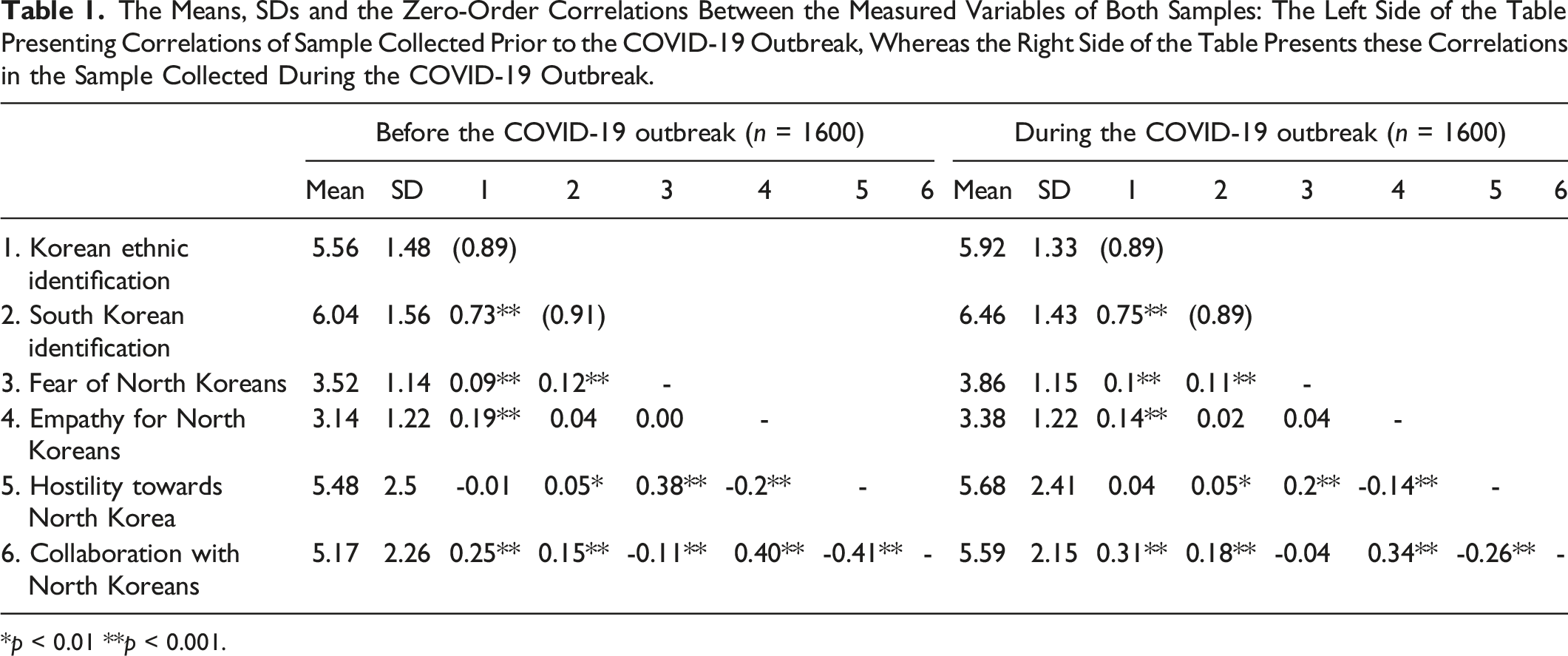
*p < 0.01 **p < 0.001.
Variables Means and Mean Differences Between the Two Waves of Data Collection Before/After COVID-19 Outbreak.
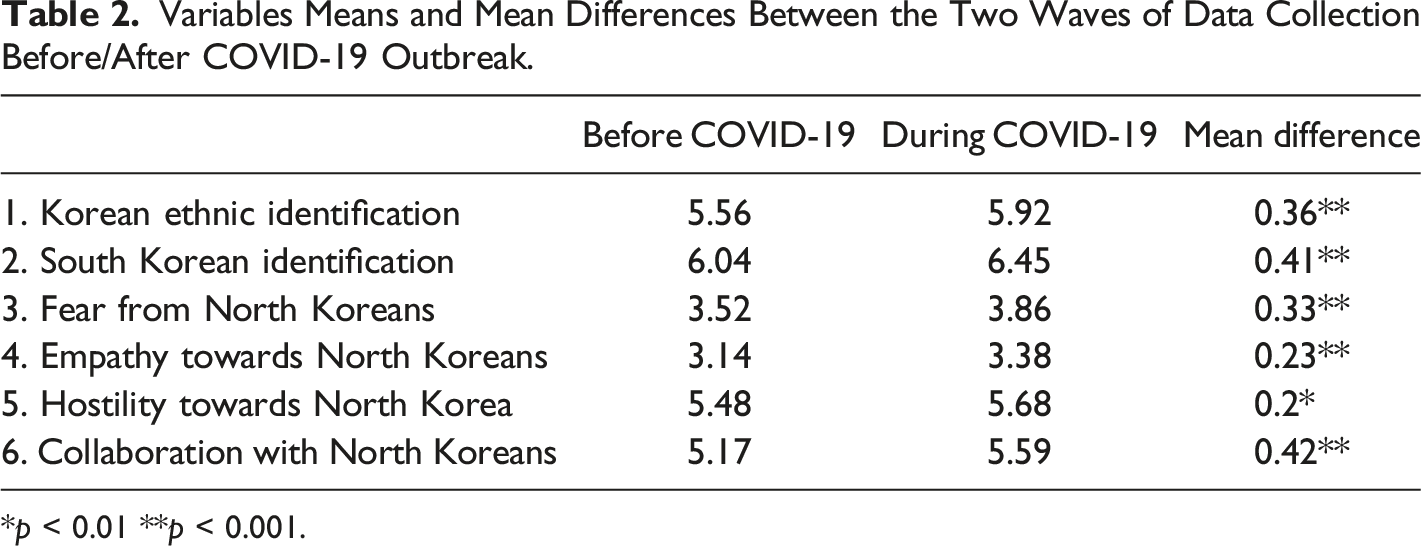
*p < 0.01 **p < 0.001.
It is important to note, that while empathy, fear, hostility and cooperation significantly increased between the 2019 and 2020 sample – there were no significant differences across samples in various other group based emotions (e.g. intergroup hatred), nor in participants' support of additional intergroup policies and attitudes (e.g. caution, blame). This provides strong indications that the changes over time stem from actual changes in people’s emotions and attitudes due to the Covid-19 eruption, rather than from between surveys differences in sampling and measurements.
Mediation Analyses
To further examine our hypothesized paths of influence, we have conducted a mediation analyses using bootstrapping Process for SPSS (Model 6), which enabled us to examine the mechanisms for each path of the COVID-19 influence on intergroup attitudes, via identifications and group based emotions.
Group Based Fear Mediates the Relations Between COVID-19 and Intergroup Hostility
First we examined a serial multiple mediation model using Hayes (2013) bootstrapping Process for SPSS (Model 6), with collection time (before/after COVID-19) serving as the independent variable, South Korean identification as the first mediator, outgroup fear as a second mediator, and hostility towards the outgroup as our outcome variable. The regression results indicate that the outbreak of COVID-19 was associated with stronger South Korean identification (a1: b = 0.4, SE = 0.05, t = 7.32, p < 0.01), higher levels of outgroup fear (a2: b =0.3, SE = 0.04, t = 6.9, p < 0.01) and stronger support for hostility towards the outgroup (c: b = 0.2, SE = 0.09, t = 2.2, p < 0.05), as compared to the data collected prior to the pandemic. Stronger South Korean identification was associated with higher levels of outgroup fear (b = 0.09, SE = 0.01, t = 6.17, p < 0.01) and stronger hostility towards the outgroup (b1: b = 0.08, SE = 0.30, t = 2.9, p > 0.05). Fear of the outgroup was linked to stronger support for hostility towards outgroup (b = 0.6, SE = 0.04, t = 15.7, p < 0.01). As we initially hypothesized, the direct effect of the time factor (before/during COVID-19) was non-significant once the mediators (outgroup fear) were entered to the model (c': b = −0.008, SE = 0.08, t = −1, p = 0.92) as well as the effect of South Korean identification on hostility towards outgroup, (b1: b = 0.03, SE = 0.03, t = 0.93, p = 0.34). Thus revealing a full serial mediation effect linking COVID-19 outbreak to hostility towards the North Korean, through fear of the outgroup; both directly (x->m2->y: b = 0.18, SE = 0.03, 95%, CI [0.12, 0.24]), and via increased South Korean identification (x->m1->m2->y: b = 0.02, SE = 0.01, 95%, CI [0.01, 0.03]). 4
Group Based Empathy Mediates the Effect of the COVID-19 on Intergroup Collaboration
To test our second hypothesized path, we conducted a second serial multiple mediation analysis, again using Hayes (2013) bootstrapping Process for SPSS (Model 6), with collection time (before/during COVID-19) serving as the independent variable, ethnic Korean identification as a first mediator, outgroup empathy as a second mediator, and willingness to collaborate with the outgroup as our outcome variable (Figure 1). Mediation model linking COVID-19 to hostility towards outgroup, via south Korean identification and fear from the outgroup. *p < 0.05. **p < 0.01.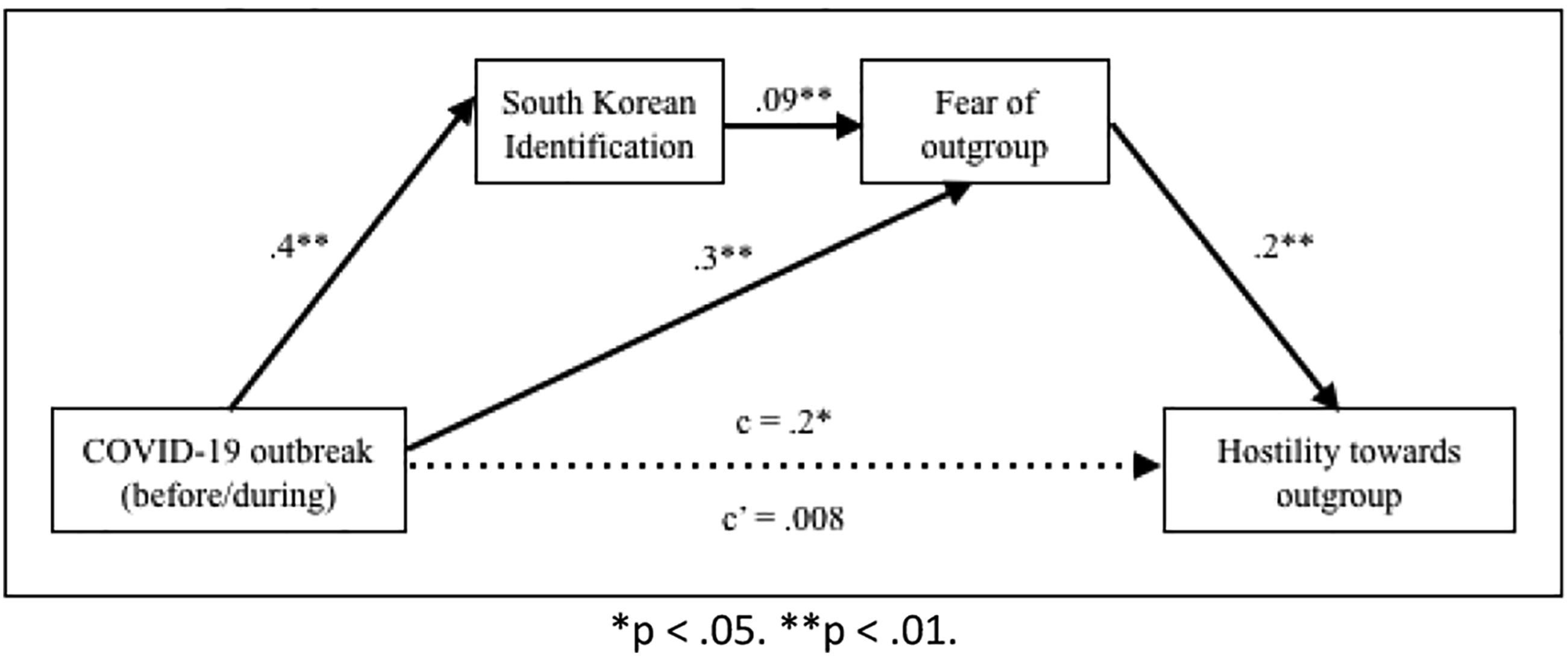
The regression revealed that the outbreak of COVID-19 is associated with stronger ethnic Korean identification (a1: b = 0.36, SE = 0.05, t = 6.7, p < 0.01), higher levels of outgroup empathy (a2: b = 0.19, SE = 0.05, t = 4.1, p < 0.01) and stronger support for collaboration with the outgroup (c: b = 0.42, SE = 0.08, t = 5.15, p < 0.01), as compared to the data collected prior to the pandemic. Stronger ethnic Korean identification is linked to higher levels of outgroup empathy (b = 0.14, SE = 0.01, t = 8.77, p < 0.01), and willingness to collaborate with the outgroup (b1: b = 0.36, SE = 0.03, t = 13.3, p < 0.01). As presented in Figure 2, the direct effect of the time collection on our outcome variable was substantially reduced (yet remained significant) once our hypothesized mediators were included in the analyses (c': b = 0.15, SE = 0.05, t = 2.09, p < 0.05, 95%, CI [0.10, 0.31]), exposing a partial mediation effect of the COVID-19 on intergroup collaboration, via both ethnic identification (b1: b = 0.13, SE = 0.01, 95%, CI [0.04, 0.07]) and outgroup empathy (b2: b = 0.14, SE = 0.01, 95%, CI [0.02, 0.07]).
5
Mediation model linking COVID-19 to collaboration with outgroup, via ethnic Korean identification and empathy towards the outgroup. *p < 0.05. **p < 0.01.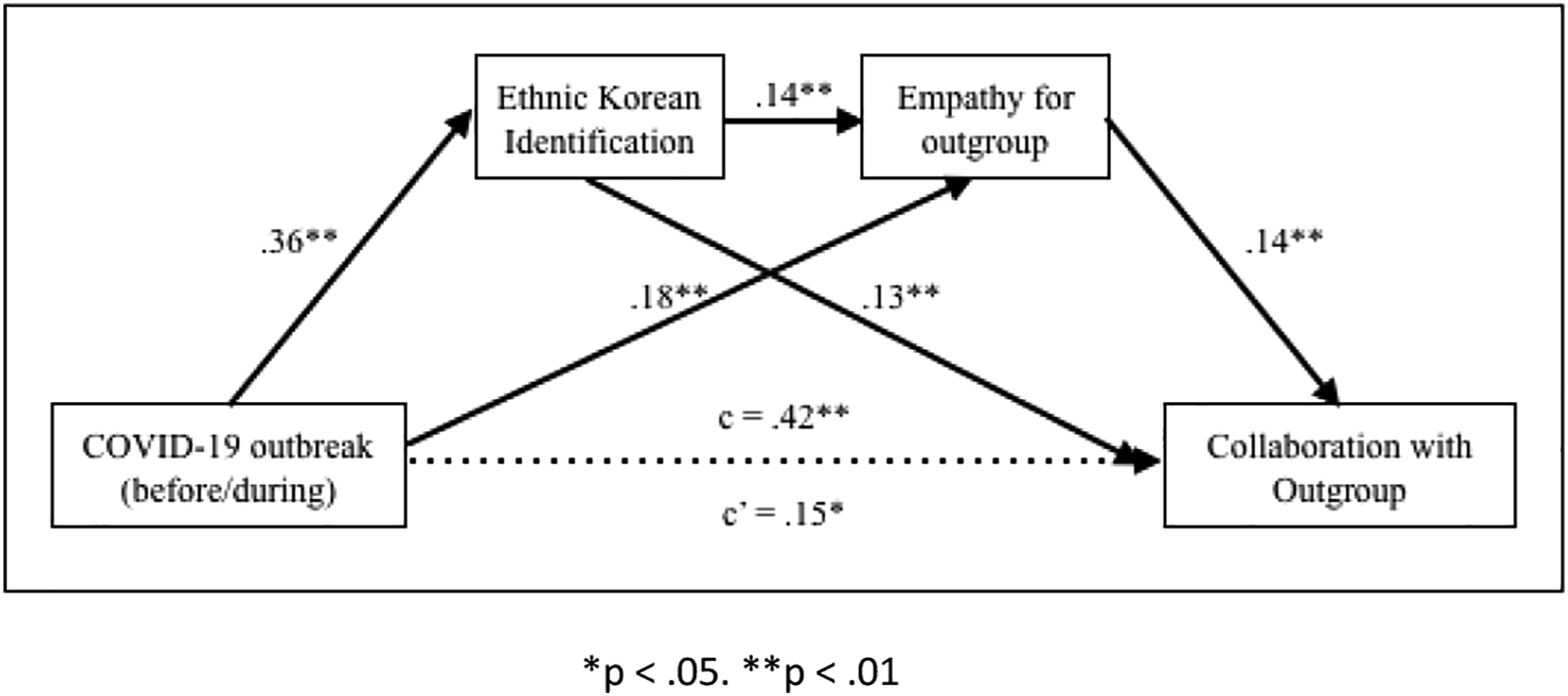
Discussion
This paper aimed to reveal the underlying emotional mechanisms of this dual influence as a further step towards maximizing the potential of the COVID-19 in terms of improving relations of groups in conflict, as well as inhibiting its destructive effect on such conflicts. Through a two-wave cross sectional design, conducted before and during the pandemic outbreak (but still during the pandemic itself), we have compared the social identifications, group based emotions, and intergroup attitudes of South Korean participants. This allowed us to inspect the effects of the COVID-19 outbreak on these multi-dimensional intergroup attitudes, and to explore the underlying mechanisms connecting the outbreak to increased intergroup hostility, as well as the increased willingness to collaborate (i.e. assist to, and cooperate with) with the North Korean outgroup. Aggregating social identity theories of reactions to threat (Bodenhausen et al. 2000; Cruwys et al. 2020; Greenberg, Pyszczynski and Solomon 1986; Tajfel 1978, 1981), with findings addressing socio-psychological barriers standing in the way of intergroup reconciliation (Bar-Tal and Halperin 2011), we have postulated that the COVID-19 had a dual effect on intergroup attitudes via social identification and group based emotions.
Following the outbreak of COVID-19, South Korean participants exhibited stronger identification as South Koreans; corresponding with social identity theories suggesting that when facing a threat, group members consolidate, strengthening ingroup cohesion as a response to that threat. Extending previous research on socio-psychological barriers in intergroup conflicts, South Korean identification was linked to fear from the outgroup, which, in turn, corelated with more support of aggressive, hostile policies towards the North Koreans. Paradoxically, and aligned with the common ingroup theory and findings, these same South Korean participants identified stronger with their ethnic group (Koreans), which corelated with higher levels of empathy to the outgroup, which, in turn, was linked to stronger support of collaboration with the North Koreans.
Although these findings appear contradictory, both of these paths serve different functions in aiding human beings to cope when facing a threat such as the COVID-19 pandemic; while the first addresses fears of spreading infection and an enhanced sense of vulnerability, the other strives for greater inclusiveness in cooperation against the threat. The current findings demonstrates that these processes may occur even in the context of violent, chronic, intractable conflicts between groups; thus, revealing that the COVID-19 pandemic may have dramatic bearings on the probability of war and peace between groups in conflict. Moreover, we have revealed the central mediating role of group based emotions on the association between the COVID-19 threat and intergroup conflict escalation (intergroup hostility), as well as reconciliation (intergroup collaboration).
The above findings are further corroborated by a nationwide survey undertaken in South Korea in March 2020. Pertaining to our study, the results from Daegu city and the Gyeongbuk Province, where residents are known for exhibiting some of the more negative attitudes towards North Koreans, are particularly illuminating. At the time of the survey, those areas were hit hard by the virus. Surprisingly, yet aligned with the findings of this study, the survey revealed increasingly positive attitudes from the South towards their Northern brethren. Following the outbreak of the virus, residents even expressed support for government aid to be delivered from Seoul to Pyongyang. The researchers concluded that the harsh experience of COVID-19 in these areas may have encouraged South Koreans living in Daegu and the Gyeongbuk Province to feel sympathy towards the suffering of North Koreans (National Unification Advisory Council 2020).
From an applied perspective, by emphasizing the commonality of the COVID-19 threat (and others) on warring groups, social scientists, political and social leaders and organizations may promote cooperation between nations and groups in conflict. The commonality of the threat, leads to heightened accessibility of a superordinate social identity which includes both warring parties – sharing “the same boat” in the face of the storm. In contrast, emphasizing the boundaries of the national group in dealing with the pandemic may lead to escalation of these conflicts.
A recent example of the latter is a statement made in July 2020 by North Korea’s leader, Kim Jung Un, claiming that the first COVID-19 patient was detected in the DPRK after infiltrating the country from South Korea. As previous findings established the effectiveness of various interventions aimed at reducing group based fear (Halperin, Sharvit and Gross 2011), as well as increasing group based empathy; incorporating such interventions within the context of the COVID-19 threat, may serve as practical means of activating the constructive influence path, as well as inhibiting the destructive path.
As intriguing as these findings may be, the current work has several limitations that demand further examination beyond the scope of this essay. For example, although the two Koreas are still technically at war and experience various threats from their respective bordering outgroup, there has been no physical violence on a massive scale since the Armistice in 1953, maintaining a de facto “negative peace” (Jang 2010). In addition, and unlike similar cases of intergroup conflict, South Korean ideology hinges largely on their attitude toward North Korea, rather than the other way around (Han 2016). But perhaps the most unique characteristic differentiating the Korean case from most intractable intergroup conflicts is the fact that the warring parties share a common ethnicity, language and remote history. Although recent studies (Adam-Troian and Bagci 2020) have demonstrated that the COVID-19 outbreak may lead to positive attitudes towards outgroup members (in non-intractable conflicts) – even when these groups share little in common – it is important to replicate the current findings in the contexts of prolonged intractable conflicts. Thus, in order to validate and generalize the current findings, it is important to explore the avenues through which re-categorization of a common ingroup may occur amongst other warring groups; groups who do not share the aforementioned similarities, and whom are engaged in active violent disputes.
Another limitation of the current work regards the underlying mechanisms via which COVID-19 may increase willingness for intergroup collaboration. While group based fear was a full mediator in the relations between the COVID-19 threat and hostility to outgroup; the effect of COVID-19 outbreak (before/during COVID-19) on collaboration with the outgroup remained significantly above and beyond ethnic identification, as well as group based empathy; alluding to the possibility that they may be further mechanisms involved in this conciliatory path. Examining the dual path by which this global pandemic may activate social, emotional and behavioral responses in the context of other intractable intergroup conflict, as well as including other possible moderators and mediators of socio-psychological responses to the COVID-19 threat, may help to further utilize the COVID-19 threat as a powerful reconciliation tool between groups engaged in intractable conflicts.
Finally, given that power relations between groups engaged in intractable conflict were widely established as a substantial socio-psychological dimension of intractable conflict - as the high power and the low power groups differ in their needs, motivations and emotions (Schnabel & Nadler 2008; Saguy et al. 2012) - the current findings may be a-symmetrically confided to the high power (i.e. South Koreans), but not to the low power (North Koreans) group. Although our findings corroborate previous psychological theorems and findings which are indicative to the universality of the potential dual effect found in the current work – the assumption that the COVID-19 has similar effects on both the high power and the low power groups – calls for further validation. This is especially true because since conducting academic studies amongst North Korean participants is currently unattainable.
Footnotes

Declaration of Conflicting Interests
The author(s) declared no potential conflicts of interest with respect to the research, authorship, and/or publication of this article.
Funding
The author(s) disclosed receipt of the following financial support for the research, authorship, and/or publication of this article: This work was supported by the Korea Institute for National Unification.