




Abstract
Domestic debates about trade have increased the salience of international economic cooperation among the public, raising the question of whether, and how, domestic support can be rallied in support of international trade agreements. We argue that institutional features of trade agreements provide important cues to domestic audiences that shape support, particularly the membership composition and voting rules for multilateral deals. We use two survey experiments to show that the US public is more supportive of trade when it is negotiated with like-minded countries. We also find that the voting rules shape support for trade agreements, but differently across partisan audiences. Republican voters strongly favor the home country having veto power, whereas Democrats prefer agreements with equal voting rules. These differences are largely driven by perceptions of the agreement’s benefit for the nation and the public’s trust of the negotiators and perceived fairness of the rules.
Keywords
The international trade system is built upon a dense network of trade agreements ranging from immense multilateral agreements such as the General Agreement on Tariffs and Trade (GATT) to bilateral trade deals such as the US-Korea Free Trade Agreement. While trade was often a back-burner issue for the public, domestic political discourse has increasingly focused on trade, thus increasing public exposure to the issue and facilitating the formation of public attitudes that can affect both domestic politics and international trade policy. Across countries, scrutiny of trade deals has increased, with New Zealand seeking to exclude investor-state dispute settlement (ISDS) provisions from the Regional Comprehensive Economic Partnership (RCEP), and Nigeria first rejecting then joining the African Continental Free Trade Area (AfCFTA). In the US, trade became a central issue in the 2016 presidential campaign, with President Trump proclaiming that “There’s no way to fix TPP. We need bilateral trade deals” (Trump 2016), a position that reflected and amplified public apprehensiveness towards globalization and opposition to trade agreements leading up to the election. 1 Once elected, the rhetoric became policy with Trump’s withdrawal from the TPP, unilateral push to renegotiate NAFTA and the US-Korea Free Trade Agreement, and escalation of tariffs against allies and adversaries. The changing landscape of international trade policy has made it a central issue for many governments, with the European Parliament debating responses to US tariffs on steel and aluminum, 15 countries in Asia signing the RCEP, and countless other examples as well.
The political salience of trade in the public domain has contributed to diverse and varying attitudes toward trade agreements and international economic institutions amongst the public (Walter 2021). In the US, public opinion has shifted from rising support of protectionism in the early 2000s (Guisinger 2017: 69), to a recent surge in public support for trade agreements in 2019 (Helm, Smeltz, and Hitch 2019). In the European Union, opinions on the domestic impact of trade vary by country and by political party affiliation (Stokes 2018). Given shifting public attitudes toward trade and international cooperation, the question remains whether, and how, leaders will be able to rally sufficient domestic support to maintain and expand the network of liberal international trade agreements that underpin the global economic system. To address this question, this paper examines how the institutional features of trade agreements influence domestic support for them, and how the contours of public support for agreements shape the political coalitions supporting international economic cooperation.
To better understand how domestic attitudes toward international trade agreements are formed, we draw insights from scholarship that explores how institutional variation in international agreements and international organizations provides cues to the public and shapes support for international agreements. International institutions have the ability to shape domestic public opinion by signaling information to domestic audiences. For example, United Nations Security Council (UNSC) decisions change perceptions of the legitimacy of the use of force among the public (Voeten 2005) and IO endorsements have been shown to provide a valuable “second opinion” that can increase public support for the use of force in controlled survey experiments (Grieco et al. 2011). The public also expresses higher support for international climate change agreements when such agreements are designed to be consistent with principles of fairness and reciprocity (Bechtel and Scheve 2013). There is also strong evidence that public support for the Transatlantic Trade and Investment Partnership (TTIP) was shaped by attitudes toward the design of the dispute settlement process (Brutger and Strezhnev forthcoming; Hahm et al. 2019). European public mobilization against TTIP focused on the specific rules of the agreement, with the public being opposed to private arbitration known as ISDS. In fact, concern about TTIP’s rules became so salient that the European Commission received about one hundred and fifty thousand online comments reflecting broad opposition to ISDS provisions. 2 The findings that the design of international agreements and IOs shape public support for international cooperation across issue areas highlight the value of understanding how distinct dimensions of institutional design affect public opinion, and the importance of extending this research agenda to other design features of trade agreements.
This paper contributes to the growing research connecting institutional design to public support for international cooperation by theorizing and testing how the design of trade agreements shapes public support for trade. The paper makes three primary contributions. First, we contribute to the institutional design literature by developing a theory of how membership and voting rules for international trade agreements affect public support for trade deals. As recognized by Hahm et al. (2019), institutional design of trade agreements has rarely been incorporated into the study of public opinion on trade. While the membership composition of trade agreements has gained some attention in the recent literature (Carnegie and Gaikwad 2021; Chiang et al. 2020; Steiner 2018), we incorporate another equally important institutional dimension into our theory, that of decision rules in the negotiation process.
Secondly, our paper theorizes and demonstrates that the public reacts differently to the features of international trade organizations and agreements as opposed to the same design features in the security realm. Research in the security realm shows the public responds positively to IOs with neutral (diverse) groups of members, because the public perceives military engagements endorsed by such groups to be more legitimate (Thompson 2006). By contrast, we find that the public favors trade agreements when the membership is comprised of similar (like-minded) groups of countries, and that like-minded membership enhances the perceived benefits of the agreement and the public’s trust in the negotiation process.
Lastly, we integrate insights from political psychology to theorize how political ideology and partisanship affect public reactions to the features of international trade agreements. We argue that conservatives and liberals, and in the US context Republicans and Democrats, are driven by distinct concerns when it comes to how they evaluate international trade agreements. Republicans tend to prioritize protecting their country’s relative position and exercising control in the negotiations, which leads them to trust the negotiators more when the US has a veto vote. By contrast, Democrats place a greater emphasis on fairness and equality, and the US having a veto leads them to lose trust in the negotiators and undermines how fair they believe the negotiated agreements are. Incorporating ideology and partisanship into our theory of trade support allows us to better understand the political coalitions that are likely to form and the strategic incentives of leaders who provide information and cues throughout the negotiation process.
We proceed by first presenting our theory connecting the design of trade agreements to public opinion and how these factors interact with partisanship. We then discuss our approach to testing the theory, which uses two national survey experiments fielded in the United States. One experiment uses the context of an agreement negotiated in the WTO, while the other uses a more general multilateral trade proposal. In each, we randomize the voting rules and the composition of members to the agreement allowing us to isolate the causal effect of varying these features of the trade agreement. We then discuss our results, which show that trade agreements with like-minded countries receive higher support, but the public is divided in its reaction to the US having a veto vote in the negotiations. We explore the mechanisms underpinning these findings by testing how the design features shape perceptions of sociotropic concerns, self-interest and perceptions of trust, legitimacy, and fairness. We conclude with a discussion of the implications and avenues for future research.
Institutional Design and Public Support for Trade Agreements
International institutions can play an important role in shaping domestic public support for international cooperation. We know from existing research on the design of trade agreements that the public prefers trade deals with balanced concessions (Brutger and Rathbun 2021) and that the public also cares about the type of dispute settlement in multilateral trade deals (Hahm et al. 2019). In this paper, we turn our attention to two additional features of the design of trade agreements, analyzing how these design features affect public support. First, we consider the membership of the agreement, specifically whether the membership is comprised of like-minded or diverse countries. Second, we evaluate the decision rules for the agreement, focusing on whether the countries have an equal vote or whether the home country has a veto.
We argue that these design features provide cues to the public that shape public support for trade agreements. Although most of the public is unlikely to seek out this type of information on their own, the media and political elites regularly transmit information about trade agreements to domestic audiences. Political leaders and the media emphasize various aspects of international agreements (Brutger and Strezhnev forthcoming), which provide cues to the public about the agreement and negotiation process. This is known as “strategic information transmission” and has been employed by leaders who use neutral IO endorsement to bolster international support (Thompson 2006: 3), or choose to solicit or block information from IOs (Fang 2008).
Salience of Design Features
While the media and elites draw attention to various international negotiations and agreements, an important consideration is whether design features are known to the mass public. We expect design features to vary in salience across contexts. For example, publics in different countries vary significantly in their level of political engagement and knowledge (Dellmuth 2016), and some trade agreements receive more media coverage and public attention than others. That said, for the most important trade agreements, especially those that become contested election issues such as NAFTA, TTIP, and the TPP, there is significant attention paid to specific features of the trade proposals. 3 Additionally, even when the public’s preferences regarding trade are not especially strong, there is evidence that “representatives respond to diffuse public opinion as a preemptive measure” (Carnegie and Gaikwad 2021), and that this is especially likely when poorly informed voters may be mobilized in the future (Bailey 2001) and when electoral competition is high (Verdier 2021). Thus, we expect the public to be receptive to information about trade agreements, and we show below that the design features are often leading points of information in the public discussion about trade agreements.
Our first dimension of institutional design—the membership of a trade agreement—almost always draws elite and public attention. The countries party to a multilateral trade agreement is one of the main pieces of information about the agreement that is included in government announcements and media reports. Even when reports are relatively brief, the members of a trade agreement are part of the information distilled and communicated to the public. Consider, for example, recent coverage of the Dominican Republic-Central America free trade agreement (CAFTA-DR) by the Florida Daily, a news source in Florida that targets state-wide readership. It summarized the FTA as “First signed by President Bush in 2005, the Dominican Republic-Central America FTA (CAFTA-DR) is a free trade agreement between the United States and Costa Rica, El Salvador, Guatemala, Honduras, Nicaragua, as well as the Dominican Republic.” 4 Similarly in Japan, the membership of the TPP was critical to shaping both elite and public support of the agreement, which we discuss in more detail in §8 of the online appendix. Specifically, when the United States decided to enter into the TPP negotiations, the Yomiuri Shimbun, one of five national newspapers in Japan, stated that “If [Prime Minister] Noda had not announced Japan’s participation in the TPP talks, the nation would have fallen behind Canada and Mexico, and created a serious situation,” specifically referring to the fact that Mexico and Canada both announced their intent to become members of the TPP. Surveys also highlight membership information as a salient feature when collecting public opinion on trade agreements, such as the NBC/WSJ surveys that ran prior to 1994 to measure public support for NAFTA, 5 and the POLITICO-Harvard poll that measured American’s attitudes towards free trade with individual countries in 2016. The latter survey specifically asked respondents whether they believe free trade with particular individual countries would hurt the US or help the US, which resulted in distinct levels of support for trade with each country (POLITICO-Harvard T.H. Chan School of Public Health 2016). 6 As these examples highlight, and we elaborate upon in the online appendix, when trade agreements are discussed in the media and by politicians, the membership of the agreement is one of the most salient dimensions.
The voting rules of international agreements do not always rise to the same level of salience as the membership of agreements, though they often become key points raised by media and political elites. For example, during the TTIP negotiations, Greece publicized its veto power, threatening to block TTIP if it failed to increase protection for agricultural geographical indications such as “feta cheese.” 7 Concerns about transparency in the negotiation process and about the ISDS mechanism also prompted Georgios Katrougkalos, then deputy minister for administrative reform, to tell EURACTIV Greece that “Athens will use its veto to kill the proposed trade pact.” 8 Politicians, such as Katrougkalos, choose to emphasize their veto power, in part, to demonstrate their bargaining power to domestic audiences and to reassure their constituents that they will only agree to a deal that is in their country’s interest.
Furthermore, a “veto” design in trade agreements often captures the attention of the media, raising the salience of the decision rules for the public. For example, a clause in the United States–Mexico–Canada Agreement (USMCA) that essentially allows the US to veto free trade deals that Canada negotiates with a “non-market country” was dubbed by Canadian politicians as the “Trump veto” and reported by the media as such. The Toronto Star produced a piece with the title “Is USMCA really a ‘good day for Canada?’; New agreement gives the United States a bit more power,” which highlighted the clause that gives “Trump veto power over any such deal” that Canada aspires to sign with China. 9 A piece written by The Canadian Press’s Mike Blanchfield, “PM affirms China aspirations; Canada committed to pursuing deeper trade ties with global player,” which discussed concern over the “Trump veto,” was published in at least 15 local newspapers in Canada, such as the Ottawa Citizen, Montreal Gazette, Calgary Herald, Vancouver Sun, Edmonton Journal, The London Free Press, Subury Star, Victoria Times Colonist, and Sault Star. 10 In the US, The Washington Post also published a similar piece, which called the “Trump veto” one of “the most significant elements of the new [USMCA] agreement.” 11 These examples highlight the importance that media coverage and politicians place on veto power in negotiations, which creates an information environment where the public is likely to learn about key voting rules, particularly for the most important trade agreements.
Membership and Voting Rules
Given the variation in public attention and concerns toward international trade agreements, we argue that information about the member countries and decision rules of international trade agreements alters public support for trade and shapes the domestic political coalitions for trade agreements.
To develop a theory of how the public responds to the design of trade agreements, we first consider how and why the public would respond differently to features of trade agreements and institutions than they would to the same design features when applied to security issues. 12 In the security realm, domestic publics perceive international organizations with heterogeneous members as more neutral and their decisions as more legitimate (Thompson 2006). Thompson (2006) defines IO membership as “neutral” when the membership is heterogeneous and includes a wide distribution of policy preferences that are representative of the international community. While “neutrality” is a useful concept when considering the alignment of countries and IOs in the security realm, the term is less intuitive when applied to the realm of trade and economic agreements. 13 We conceptualize heterogeneous groups of countries in international trade agreements and institutions as being “diverse”—representing numerous policy preferences—and groups of more homogeneous states as being “like-minded” or similar.
We argue that information about who an agreement’s members are, and whether they are viewed as diverse or like-minded, ought to shape domestic attitudes toward trade agreements and policies, as is the case for security agreements in both the UNSC and NATO (Chapman 2011; Fang 2008). Membership is a highly salient institutional aspect of trade agreements, and affects public perceptions of trade deals (Chiang et al. 2020; Steiner 2018). While the public reasonably seeks cues about the legitimacy of the use of force and the likelihood that a broad set of countries share the burden of security operations, we expect that the public is more likely to be supportive of other countries benefiting from trade agreements when they are like-minded countries. When the public perceives partners to potential trade deals as having more proximity to their own country in terms of socio-economic, ideological, political, or cultural characteristics, they are more willing to cooperate with such countries in terms of trade. For example, Spilker, Bernauer, and Umaña (2016) show that the public prefers signing preferential trade agreements with countries of similar cultures and religions. Furthermore, if the public believes the parties to the agreement are like-minded countries, the public should infer that the home country will get a better deal since its interests are more likely to be well represented in the trade deal. 14 Particularly for democracies, the public is likely to view countries with similar political systems to share common interests (Russett and Oneal 2001) and to make more credible commitments to trade (Chen, Pevehouse, and Powers 2019). They would also be more likely to trust these countries, which leads to a higher degree of willingness to engage with them on trade liberalization (Kaltenthaler and Miller 2013). In contrast, the public is less willing to cooperate with more dissimilar countries on trade, since such countries tend to be regarded as sharing less common interests and less likely to be credible trade partners.
Furthermore, the public’s perceptions of the benefits of trade agreements change depending on which countries are parties to an agreement. Past research has shown that ethnocentrism and out-group anxiety lead to less support for free trade (Mansfield and Mutz 2009). It is also the case that Americans prefer that trade benefits their in-group, not just in terms of absolute gains but also in terms of gains relative to the out-group (Mutz and Kim 2017; Mutz and Lee 2020). We expect that a more diverse membership to an agreement signals to the public that out-groups are benefiting, and gives rise to more competitive attitudes in trade, thereby reducing support for proposed trade agreements. This could be due to ethnocentrism (Mutz and Lee 2020), but may also be due to the public’s concern that trade could lead to security concerns by providing more resources to adversaries (Carnegie and Gaikwad 2021; Gowa and Mansfield 1993). A diverse set of countries is also likely to have heterogeneous preferences and interests, which will raise concerns among the public that the agreement is not in line with the national interest, or that it would require too many concessions to appease such a diverse set of countries. The concerns voiced by the Australian Council of Trade Unions, Australia’s representing body for trade unions, against the RCEP emphasized such considerations. The organization objected to RCEP on the grounds that it legitimizes the military dictatorship in Myanmar and fails to protect labor rights despite lack of workers rights in countries such as China and Indonesia. 15 Whereas the public values a diverse IO endorsing the use of force because it signals that a broad range of countries view the operation as legitimate, we expect in the trade realm that a more diverse membership will reduce domestic support and increase concerns that the home country is getting a worse deal.
We also consider the effect of voting rules on public support for international trade agreements. Our study of the effects of voting rules on public opinion opens up a new direction to take the literature connecting institutional design to public opinion. While voting procedures are recognized as important to public perception and relevant to institutional reform (Chapman 2007, 2009, 2011), we are not aware of any empirical studies testing the effect of different decision rules for international trade agreements. Chapman (2011) mentions voting rules as a key fixed characteristic of international organizations that affects whether IOs are perceived as altruistic, neutral, or biased, but does not go into depth about how specific variations in the voting rules will affect public opinion. We argue that the public’s perception of the decision making procedures, whether formalized through an IO or the more informal practices used when negotiating free trade agreements, will shape public support for trade agreements. Since voting procedures are a relatively clear signal to the public, which can be strategically emphasized by political leaders who want to highlight their control of the negotiations (veto power) or the fairness of the procedures (equal voting rights), we expect the public to form opinions about the benefits and legitimacy of the trade agreement based, in part, on the rules used to reach the agreement. When different voting rules are used in negotiations, or emphasized by political leaders, the voting rules frame the relative influence and control of the home country in the negotiations.
We argue that voting rules may lead to two potentially divergent reactions among domestic audiences. First, we expect that there are some audiences who will prioritize their country’s influence and control in the negotiations, and that this group will prefer that their country has veto power in the negotiations. This is consistent with work by Brutger and Clark (2020), who find that portions of the American public (conservatives) have greater support for the World Bank when they learn about the United States’ influence in the organization. When it comes to trade, Mutz and Lee (2020) find that some members of the public view trade through a competitive lens, where they prefer that their nation’s interests are prioritized. Having a veto vote should act as a strong signal to the public that the country can protect its interests and wield significant control in the negotiation, which should be appealing to many members of the public.
However, not all members of the public view trade through such a strong ethnocentric lens. As Brutger and Rathbun (2021) show, many members of the public evaluate trade agreements based on the principals of equality and equity. Thus, we expect that there are some audiences who place a greater emphasis on equality and fairness in the decision making process, and these audiences will prefer when the voting rights are equal among the member countries. Given that Brutger and Rathbun (2021) show that the public prefers trade agreements where the concessions and benefits are distributed equally, we expect that the public may apply similar judgments when evaluating the process of the negotiations, including their evaluation of the voting procedures. This second mechanism is consistent with public concerns for procedural fairness and legitimacy emphasized in the security IOs literature. We therefore expect that among audiences that prioritize fairness and equality, there will be greatest support when trade agreements are reached through equal voting rules.
While there are theoretical reasons to expect some people will value control and power in trade negotiations, while others will prioritize fairness, it remains an empirical question whether the public at large is more concerned with the former, the later, or is relatively balanced in its distribution of preferences. Indeed, the relative distribution of those prioritizing control in negotiations versus fairness is likely to vary across countries and time, and thus we present the two separate hypotheses for voting rules, though we develop more specific expectations in the next section by taking into account the ideology and partisanship of the audience.
Integrating Ideology and Partisanship
Our third contribution is to integrate perspectives from political psychology to theorize and assess how ideology and partisanship interact with information about trade agreements and institutional design to shape public support for trade deals. Although many factors influence support for trade, we focus on the role of ideology and partisanship because they are salient sorting mechanisms for domestic politics, and liberals and conservatives draw on different values that shape their interpretation and response to international negotiations, which in turn shapes the contours of political coalitions supporting trade agreements. Furthermore, there is increasing evidence that politics does not stop at the waters edge (Ahn 2011; Beinart 2008; Trubowitz and Mellow 2005) and that partisanship and ideology play a critical role in shaping public support in international negotiations (Brutger 2021).
We theorize that ideology and partisanship are significant factors that influence how individuals view international trade negotiations. We argue that liberals and conservatives are likely to react differently to the design of trade agreements, given that they have divergent priorities and concerns when it comes to how they interpret the benefits of agreements, trust in the negotiation process, and perceive the legitimacy of the negotiations. These considerations are especially important in the United States, where we field our survey experiments, where ideology and partisanship are politically salient factors. Although the liberal-conservative ideological spectrum is based on ideological self placement and not political affiliation (Jost 2006; Jost, Nosek, and Gosling 2008), Mason (2015) shows that changes in partisan and ideological alignment have “brought our ideological and partisan identities into agreement, and this new alignment has increased the strength of those identities” (p. 131). Thus, our theoretical expectations for liberals and conservatives should apply to Democrats and Republicans in the US context, and we proceed accordingly. The importance of partisanship in international relations was emphasized by Guisinger and Saunders (2017) who show that partisanship can be “a powerful filter, shaping perceptions even in the face of expert knowledge or basic facts” across a range of issues including attitudes toward international institutions like the WTO (p. 431).
Evaluating how ideology and partisanship shape reactions to institutional design is particularly useful because it gives us a path to understanding why the public reacts in particular ways, even when they have relatively little knowledge of the specific details of trade agreements. When faced with a complex situation, such as trade negotiations, individuals often resort to cognitive shortcuts, known as heuristics, to help them interpret and evaluate the situation (Gigerenzer 2008). When it comes to foreign policies and international negotiations, liberals and conservatives draw on different values that help them evaluate the situations they are considering (Brutger 2021; Casler and Groves 2021). Conservatives place greater emphasis on social dominance and preserving their place in the social hierarchy. Specifically, in the US, conservatives tend to have stronger concerns about their country’s place in the international hierarchy, believing that “the United States is and should be superior to others in an international hierarchy of power” (Rathbun 2007, p. 381). This concern for hierarchy is consistent with self-enhancement values that emphasize relative success and dominance over others (Schwartz 2012), which are strong predictors of foreign policy orientations (Rathbun et al. 2016). Building from these core values, we expect that conservatives and Republicans will prefer when the United States exercises more control and influence in international negotiations and international institutions. The more control that the United States exercises over the negotiation process, the less likely that US interests will be threatened or America’s position in the international order jeopardized.
Unlike their conservative counterparts, liberals place less emphasis on hierarchy and instead are more likely to embrace egalitarian values both at home and abroad (Rathbun 2007). We expect that this divergence will lead liberals and Democrats to be more concerned about the fairness of the negotiation process, particularly the voting rules used to reach agreement and the rules’ ability to provide equal representation to all. When it comes to international negotiations, liberals are also more likely to identify with the needs of other parties and have a less restrictive view of their in-group (Brutger 2021). The combination of valuing others’ needs in negotiations, which is consistent with self-transcendence values that emphasize the welfare and interests of others (Schwartz 2012), and liberals heightened concern for equality should result in liberals being more open minded to supporting trade agreements with a diverse set of countries and preferring trade agreements where all parties are equally represented through the voting procedures.
Taken together, the contrasting values and concerns of liberals and conservatives should result in divergent reactions to the institutional features of trade agreements. We expect the greatest effect of ideology and partisanship to emerge when considering the voting rules used in the negotiations, since this is where formal power and dominance are most prominently in play in the negotiations. In the US context, we expect to see Republicans favoring agreements where the US has veto power. Having a veto vote will signal to Republicans that the US has control in the negotiations and that the country’s interests and dominance in the negotiations are protected. By contrast, we expect that Democrats in the US should be less supportive of the US having a veto, since it is inconsistent with their concern for equality. Instead, Democrats should favor equal voting rights that are consistent with liberal egalitarian values.
Methods
To examine how the membership and voting rules for an international agreement affect domestic support for the agreement, we employ two survey experiments that randomly vary the composition of countries involved in the negotiation and the voting rules employed. This approach allows us to isolate the effects of our key variables of interest, which is not possible with observational data. This approach builds from a substantial literature that has experimentally examined how IOs shape public opinion in the security realm (Chu 2018a, 2018b; Grieco et al. 2011; Tago and Ikeda 2015), and allows us to test whether membership composition and voting procedures play a similar role in the increasingly salient area of trade politics.
Our studies were fielded in the fall of 2017 and in the summer of 2020 by Survey Sampling International/Dynata on national samples of 3696 and 3292 Americans, respectively. 16 Both studies provided diverse and broadly representative groups of respondents based on key demographics. 17 Using multiple experiments allows us to examine whether the results are robust across time and variations in experimental design.
Both studies began by informing respondents that they “will now read about a hypothetical international negotiation between the United States and other countries. You will be asked to provide your opinions about what you read.” In the study fielded in 2020, respondents were told:
In the membership treatments, the experiment randomly assigned respondents to either a diverse or like-minded condition. The two treatments are identical to one another, other than changes to the countries included. For both the like-minded and diverse country group treatments, respondents read that the United States, Great Britain, and three more countries were parties to the negotiation, and the three additional country names were randomly drawn from a group of similar or diverse countries. 18 The potential countries for the like-minded treatment were Germany, France, Australia, and Canada. For the diverse treatment, the candidate countries were Brazil, Hungary, South Africa, and China. 19 The classification of like-minded and diverse countries was validated through numerous tests, as we discuss below and in the online appendix, §3.1 and §3.2.
The 2020 study also included a set of voting treatments that randomly varied the voting procedures for the agreement. In the control condition, there was no mention of voting rules. In the treatments, respondents were either shown the veto treatment, which said “The international organization gives the United States a veto, so the US would have to support the agreement for it to be passed” or the equal vote treatment, which said that “The international organization gives each country an equal vote, so a majority of the countries would have to support the agreement for it to be passed.”
After reading the brief paragraph about the proposed trade agreement, respondents were presented a bulleted summary of the description and were then asked whether they supported, opposed, or neither supported nor opposed the proposed agreement. They were then asked how strongly they supported or opposed the agreement, or if they selected neither they were asked if they leaned either way. This resulted in a seven-point dependent variable measuring the degree of support from each respondent.
In addition to our main dependent variable, we also asked respondents a series of questions about the agreement. These questions were designed to help us understand how the IO’s membership and voting rules affect public opinion toward the trade agreement. The first set of questions asked respondents to evaluate how fair they believed the agreement was and how much they trusted who proposed/negotiated the agreement. The second set of questions examined perceptions of individual and national interest, and asked the respondents to evaluate how good they believed the agreement was for them and for the United States. These questions draw from literature on trade and public opinion that have found that altruism (Lü, Scheve, and Slaughter 2012), trust for other nations (Brewer et al. 2004), concerns for fairness (Brutger and Rathbun 2021), personal economic interests (Mayda and Rodrik 2005; Rho and Tomz 2017; Scheve and Slaughter 2001) and sociotropic concerns (Mansfield and Mutz 2009) are determinants of how supportive individuals are of trade with other nations. 20
The experiment fielded in 2017 followed the same structure as the 2020 study, but instead of using generic language about an unspecified IO and agreement, it used language from a real negotiation that took place at the WTO in preparation for the WTO’s eleventh ministerial conference. The negotiation was still described as hypothetical to respondents, since not all aspects of the vignette were consistent with the actual practices of the WTO. We also debriefed respondents after the survey and directed them to an article that provided a detailed description of the proposed reforms. 21
The 2017 study presented respondents with an abbreviated news story about a proposal at the WTO to reform farm subsidies, which is one of the most contentious areas of trade policy. The full text of the scenario is presented in §4.2 of the online appendix. We select agricultural policy as the issue area for our 2017 experiment because it is a hard and significant test for our theory. Agriculture is a sector where trade liberalization has been limited by long-standing special interests and protectionist measures (Davis 2004; Davis and Oh 2007), and is also an issue area where the public in advanced industrial societies has broadly supported protectionist measures (Naoi and Kume 2011). It is therefore non-trivial if evidence shows that certain institutional features can enhance public support for liberalizing agricultural policies.
Consistent with the 2020 study, the 2017 study randomly varied information about the voting rules used to reach the agreement, with the veto and equal vote treatments identical to those in the 2020 study. 22 The 2017 study also randomly assigned respondents to either a diverse or like-minded condition. Both treatments included the United States and Great Britain, with the diverse membership treatment group including Mali, China, and Hungary, and the like-minded membership treatment group also including Germany, France, and Canada. 23 Randomization in both studies achieved a well-balanced sample across treatment conditions, as is shown in §2 of the online appendix.
To confirm our treatment countries captured our theoretical concept of interest, we fielded an additional survey measuring perceptions of how similar countries are to the United States. The study was fielded on Amazon Mechanical Turk and asked 677 respondents “On a scale of 1–5, where 1 is very similar and 5 is very different, how similar or different is each of the following countries to the United States?” The results confirmed that the countries in our like-minded treatment were viewed as significantly more similar to the US than Mali, China, and Hungary. Details on the results of this survey are in the online appendix, §3.1. Furthermore, in the 2020 study we asked respondents how similar the countries involved in the agreement were to the United States and found respondents treated with the like-minded membership treatment perceived the countries to be significantly more similar to the United States (0.34, p < .00), showing that our membership manipulation had the intended effect.
More specifically, the MTurk study also asked respondents to rate on the same 1 to 5 scale the ideological, cultural, political, and economic development differences of these countries with the United States. The responses show that the like-minded treatment group countries are viewed as significantly more similar to the US than the diverse treatment group countries across these four dimensions. One exception is that China is viewed as relatively economically similar to the US, but with an average (dis)similarity score of 4 on other dimensions, its categorization as a “diverse” country for the US public is justified. 24 In addition, we further confirmed that the like-minded countries are more politically similar to the US as measured by the degree of political affinity of a given country with the United States through UN voting records coded by Bailey, Strezhnev, and Voeten (2016). For this test, consistent with our conceptualization of diverse preferences, the diverse treatment countries-group votes in agreement with the US close to 30% less often than the like-minded treatment countries-group (Germany, France, Canada). We elaborate on these results in the Online appendix, §3.2.
Results
Effects of IO Membership and Voting Rules.
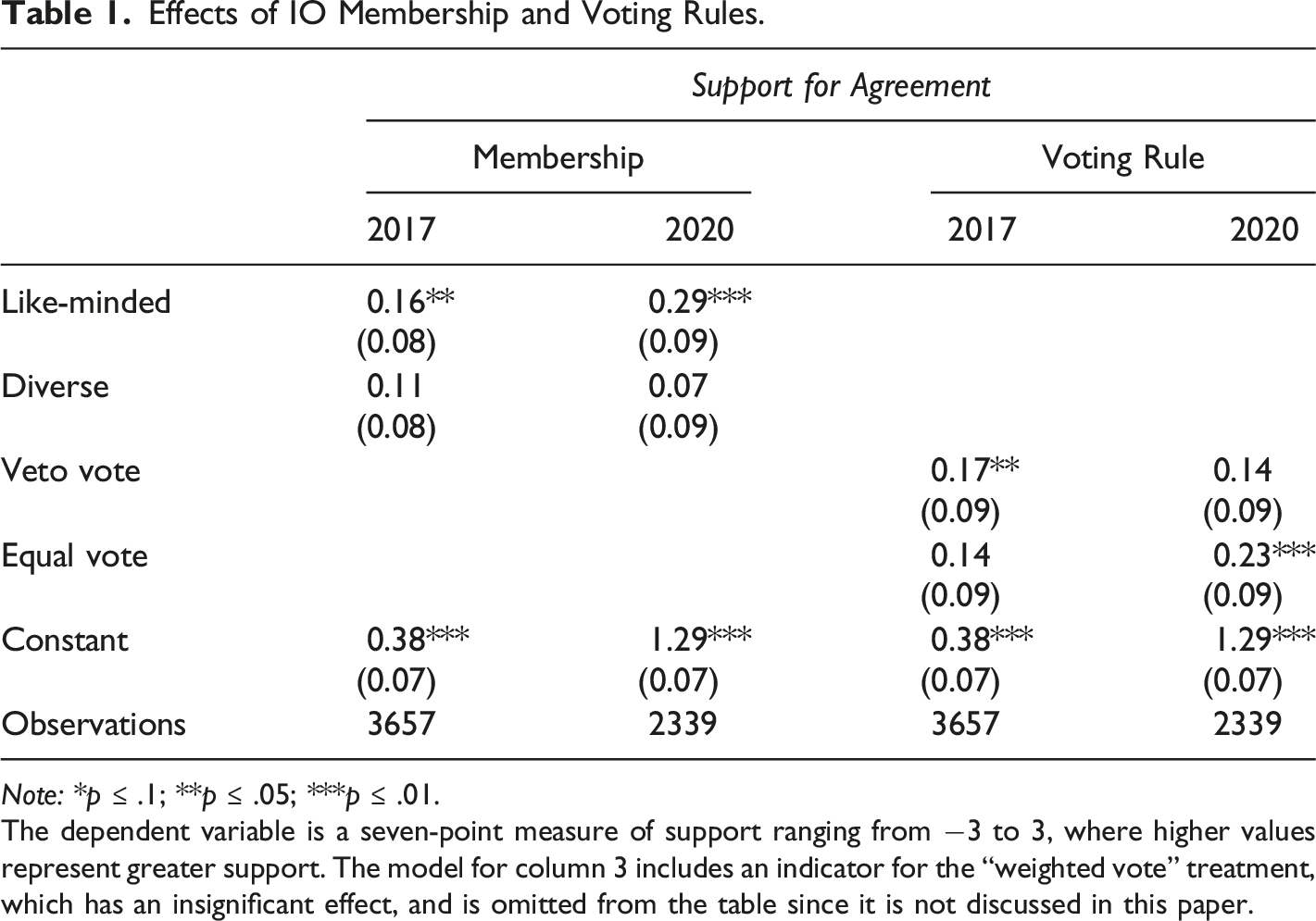
Note: *p ≤ .1; **p ≤ .05; ***p ≤ .01.
The dependent variable is a seven-point measure of support ranging from −3 to 3, where higher values represent greater support. The model for column 3 includes an indicator for the “weighted vote” treatment, which has an insignificant effect, and is omitted from the table since it is not discussed in this paper.
We also find that learning about the voting rules used to reach a trade agreement has a significant effect on support for the agreement, though the results are more nuanced across the studies. We find that the equal and veto vote treatments have a positive effect on support for the agreement in both studies, as shown by the positive coefficients in Table 1. However, the magnitude and significance of the effects fluctuates. In the 2017 study, the American public responded strongly to their country having veto power, with the veto treatment increasing support by 6.3 percentage points (p < .02). In the second study, the veto treatment has a positive, but insignificant effect, with 3.2% more respondents supporting the agreement (p = .25). This result, combined with our finding that the like-minded membership treatment also generates increased support, suggests that respondents—or at least some of them—are more likely to support a trade agreement when their interests are most likely to be protected.
We also find that the equal vote treatment has a generally positive effect on support for the agreement. The effect is most highly significant in the second study as shown in column 4 of Table 1. The effect of the equal vote treatment in the 2020 study results in support being 8.0 percentage points higher for the agreement in the equal vote treatment than the control (p < .01). Although the effect is smaller in the 2017 study, the equal vote treatment still results in an increase of 6.0 percentage points compared to the control condition (p = .02). While the voting rules have a generally positive effect across both studies, the fluctuations in significance are partly due to the fact that Democrats and Republicans have divergent preferences, and so the main effects of the vote treatments is partially canceled out by partisans’ opposing preferences, as we discuss in the following section.
Effects of Ideology and Partisanship
We now turn to the question of how ideology and partisanship conditions the effects of voting rules on support for trade agreements. Our analysis begins by testing the partisan hypothesis, which expects that Republicans will be more supportive than Democrats of trade proposals when the US holds veto power, as opposed to trade proposals with equal voting rights. To test this hypothesis, we compare the effect of being in the veto treatment, as opposed to the equal vote treatment, among those who self identify as Democrats or Republicans.
Figure 1 shows how partisanship shapes reactions to the voting rules. We see clear differences between Democrats and Republicans. In both the 2017 and 2020 studies, Republicans respond significantly more favorably than Democrats to the veto vote treatment, compared to the equal vote, with the differences being 0.40 (p < .02) and 0.32 (p < .04). These results provide strong support for our partisan hypothesis and are consistent with Republicans’ and conservatives’ desire to maintain influence and secure their in-group’s interests and Democrats’ and liberals’ preference for agreements with equal representation. Partisanship and Voting Rules. Note: *p ≤ .1; **p ≤ .05; ***p ≤ .01. Figure 1 shows the bootstrapped distributions of average treatment effects of being in the veto treatment, compared to the equal vote treatment, measured on a seven-point scale, from 1500 draws. The veto vote treatment generates a significantly more favorable reaction from Republicans than Democrats in both studies.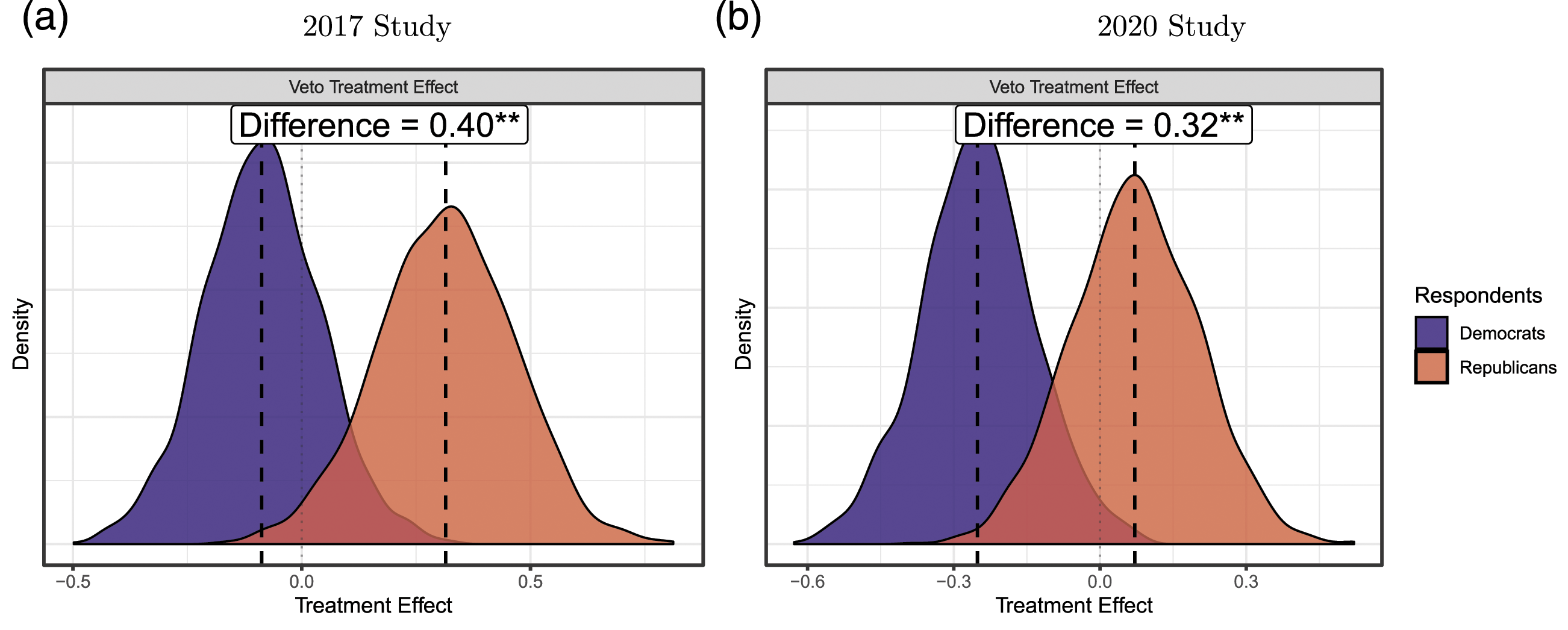
Divergent Effects of Voting Rules by Party.
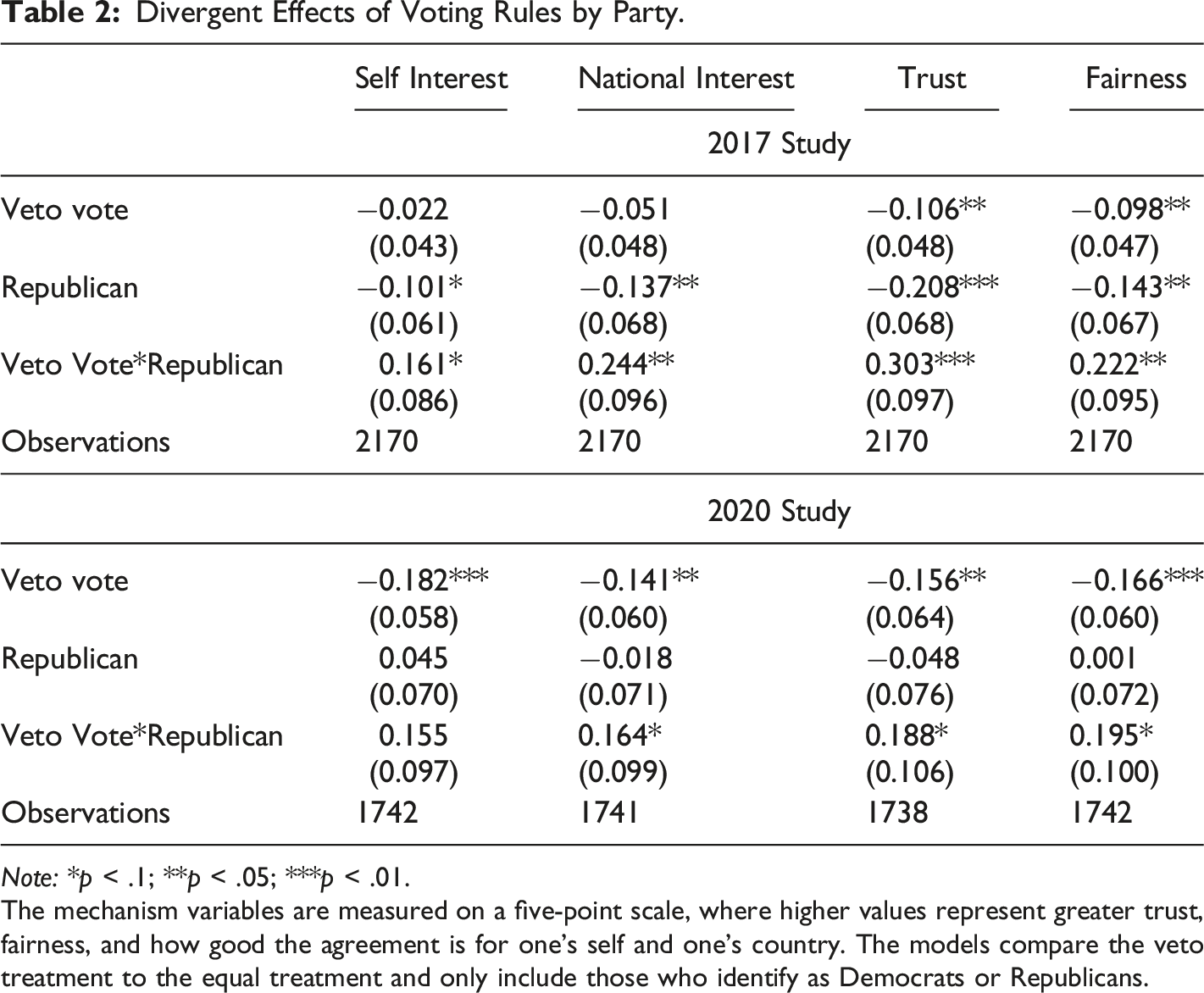
Note: *p < .1; **p < .05; ***p < .01.
The mechanism variables are measured on a five-point scale, where higher values represent greater trust, fairness, and how good the agreement is for one’s self and one’s country. The models compare the veto treatment to the equal treatment and only include those who identify as Democrats or Republicans.
The results are quite striking, with Republicans and Democrats having opposite reactions to the veto treatment. When compared to the equal treatment, the veto treatment results in Democrats believing the agreement is worse for themselves and their country, and they have significantly less trust in the negotiators and believe the agreement is much less fair. The results are generally consistent across studies, though the magnitude of the effects are more pronounced for Democrats in the 2020 study, especially for how good they perceive the agreement to be for themselves and the country. While Democrats had negative reactions to the veto vote in both studies, the results suggest that by 2020—the last year of Trump’s presidency—Democrats were more likely to believe giving the US a veto in the negotiations was not in their or the national interest. By contrast, Republicans generally believe the agreement will be better for themselves and their country when the US has a veto, and they are much more likely to trust the negotiators and believe the agreement is fair when the US has a veto, as opposed to when it does not.
To further probe how partisans think differently about voting rules, we also present results from the free responses provided by respondents, broken down by their political party and the voting treatment to which they were randomly assigned. The free responses were gathered in the 2020 study after respondents answered whether they supported the proposed trade agreement, and then they were asked to “Please take a moment to explain your opinion toward the trade agreement.”
As shown in Figure 2 many of our respondents justified their support (or lack thereof) in ways consistent with our partisan hypothesis. Among Democrats, we find that many assigned to the veto treatment believe it is “one-sided” and “unfair,” while others expressed a belief that “all parties should have equal rights.” By contrast, Democrats assigned to the equal vote treatment expressed support for the voting rules, noting “I like that each country will have an equal vote” and “allowing all countries to have a say in the decisions … is very fair.” These responses highlight Democrats’ concern for fairness and a preference for equality in the design of voting rules used to reach trade agreements. Free Responses by Party and Vote. Note: Figure 2 shows free responses from survey respondents broken down by political party and vote treatment. The results demonstrate that many partisans interpret voting rules through the lenses of fairness versus control/power as predicted. (Typos were corrected for the responses.)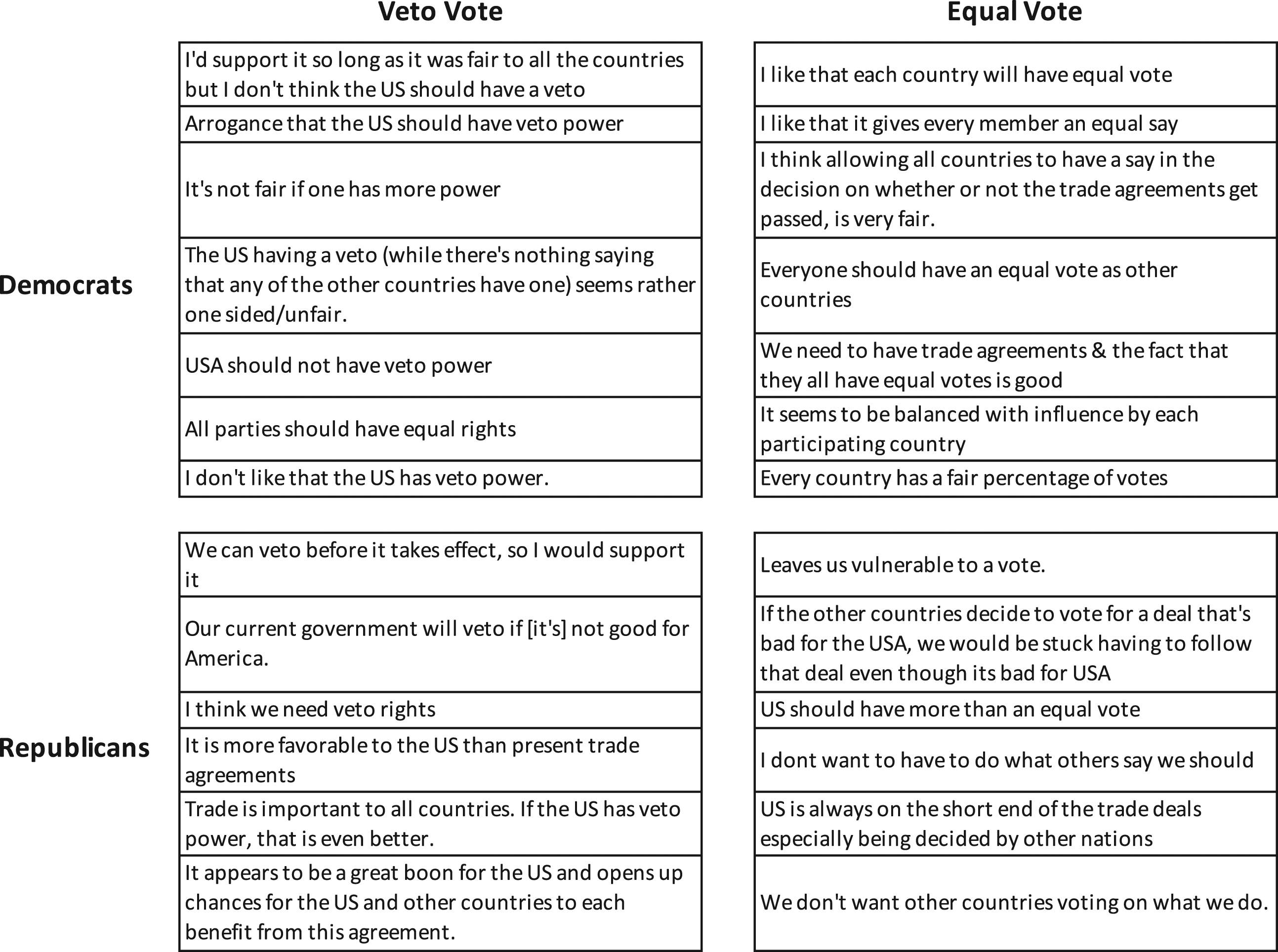
When considering the justifications provided by Republicans for their support of the agreement, we often see the opposite logic invoked. Republicans assigned to the veto treatment note that they support the agreement because “Our current government will veto if [it’s] not good for America” and “Trade is important to all countries. If the US has veto power, that is even better.” By contrast, Republicans assigned to the equal vote condition are concerned that it “leaves us vulnerable to a vote” and that “If the other countries decide to vote for a deal that’s bad for the USA, we would be stuck having to follow that deal even though its bad for USA.” The free responses clearly show that many Republicans are concerned about having control in the negotiations and ensuring that their home country’s interests are represented, which is consistent with our theory of partisan preferences toward voting rules.
Robustness to Potential Moderators & Alternative Mechanisms
In this section, we explore potential competing explanations that could be driving our results. A potential concern is that trade with China became highly politicized and so the results could be contingent on having China in the diverse treatment condition. First, it is worth noting that our strongest and most consistent result is for the effect of the like-minded membership compared to the control condition, neither of which include China, so it is unlikely that attitudes toward China are driving our main membership result. That said, we test how the inclusion of China in the diverse treatment affected results using the 2020 study, which randomized the countries included in the diverse treatment as described above. This allows us to test whether the results are significantly different when China is, or is not, included in the diverse treatment.
To test whether the effects of membership are robust when China is not included, we leverage the diverse treatment condition where China was excluded, which consisted of Hungary, Brazil, and South Africa as the randomly assigned countries. If China is driving the results, we expect that this would present more of a concern in the 2020 study since US trade relations with China become increasingly politicized in the course of the Trump presidency, with the first set of US tariffs on solar panels and washing machines that directly affected China imposed in January 2018. However, we do not find any evidence that China is driving our results. We test whether the average level of support for the trade agreement is different between respondents who either receive the diverse membership treatment that includes or excludes China, and find there is no significant difference ( − 0.03, p = .75). 25 This analysis gives us greater confidence that our results are not contingent on China’s inclusion in the diverse membership treatment.
An additional concern that may be raised for these studies is that the treatments may primarily affect those who are not politically knowledgeable or politically engaged. If those who are highly knowledgeable already have more stable attitudes toward trade, or, in the case of the 2017 study, if they already know more about the WTO and its members, then our treatments would only have an effect on those with little political knowledge who are less likely to be engaged in politics. 26 To address this concern, we included a battery of questions assessing respondents’ political knowledge. 27 We find that the treatment effects are actually stronger amongst those with high political knowledge. For example, the effect of the like-minded treatment in the 2017 study is 0.31 (p = .04) for high-knowledge respondents and only 0.12 (p = .54) for the low-knowledge respondents. Similarly in the 2020 study, the effects are 0.46 (p < .01) for high-knowledge respondents and 0.19 (p = .40) for low-knowledge respondents, showing that the treatment effect among high-knowledge respondents is more than double the effect among low-knowledge respondents. These results suggest that information about a trade agreement can and does influence those who are most likely to know about and engage in politics.
Lastly, since the 2017 study focused on agricultural policy, we recognize that in the US agricultural policy preferences exhibit a partisan divide, with farmers and other residents in rural areas primarily identifying with the Republican party. We expect these factors to be well-balanced across conditions, so we do not expect them to affect the validity of our findings. However, to empirically test whether respondents’ connection to agriculture, or their community’s dependence on agriculture, affects our results, we examine whether or not treatment effects among Republicans and Democrats are different in states where agriculture is significant for people’s livelihoods. 28 We do not find significant effects of agricultural states on how partisanship interacts with the treatments. Most notably, Republicans and Democrats in agricultural states do not respond differently to the veto vote treatment (p = .77) or diverse membership treatment (p = 0.43) as compared to those in non-agricultural states, 29 suggesting that the agricultural issue is not priming the respondent in a way that would affect our interpretation of treatment effects.
Conclusion
Our study examines how the design features of trade agreements affect domestic support for international trade cooperation. We show that both membership composition and decision rules of an international agreement affect how the public perceives the agreement and their level of support for it. Using two national survey experiments, one based on a generic trade agreement and another based on a real proposal put forth in the WTO, we find that the design of international institutions has a significant effect on public support for trade. When a trade agreement is negotiated with like-minded members the American public is more likely to support the trade deal. We also find that partisanship shapes how the public responds to institutional features, with Republicans favoring agreements where the US has veto power and Democrats preferring agreements when there are equal voting rights.
We advance the argument that institutional design of international institutions matter for “variation in institutional effects” (Martin and Simmons 1998: 757) by showing that the institutional features of membership and decision rules provide important cues to the public on the nature of international trade agreements and shapes public support. We contrast our findings with the literature on the importance of design of international institutions for public opinion in terms of international security organizations (Chapman 2007, 2009, 2011; Fang 2008; Thompson 2006; Voeten 2005) and military interventions (Chu 2018a, 2018b; Grieco et al. 2011), making the case that there are key differences in how the public reacts to design features for trade, as opposed to security, institutions. Lastly, we show that ideology and partisanship can be a powerful lens through which the public perceives information on trade agreements, leading to diverging preferences for the design of multilateral trade agreements.
Practically speaking, our study advances understanding of the microfoundations of public opinion towards international trade. While we recognize that many factors shape support for trade, the evidence put forth shows that the membership and decision rules of agreements are influential in shaping attitudes toward trade, and are often emphasized by political leaders and the media. Because multilateral trade agreements are generally negotiated in two-level games where agreement needs to be reached by states at the international level and approval gained by each state from their respective constituency (Putnam 1988; Trumbore 1998), sustaining a domestic coalition is critical to the maintenance of the international trade system. Although trade has sometimes been a back-burner issue for the public, its increased salience, particularly for the most important trade deals, has reinforced what trade representatives and other stakeholders in international trade negotiations have often been aware of—that “governments negotiate under the watchful eye of public opinion” (The Cercle européen of Confrontations 2001).
Our results suggest that governments should be intentional about choosing the most effective framing and negotiating forums for trade agreements as a strategy of eliciting public support. Public preferences for trade agreements are not only a function of individuals’ prior opinions on trade and the characteristics of the agreement; the international institutional framework in which the trade agreement is proposed affects public support for the agreement, with the public more inclined to support agreements with like-minded countries and voting rules that are consistent with their core values. While public support for globalization and multilateral trade cooperation has been waning in many developed Western countries (Goldstein 2017), there is reason to believe that trade agreements backed by international institutions that enhance public perceptions of trust of the proposer and the benefits to the public can still elicit strong public support.
Supplemental Material
Supplemental Material - Institutional Design, Information Transmission, and Public Opinion: Making the Case for Trade
Supplemetary Material for Institutional Design, Information Transmission, and Public Opinion: Making the Case for Trade by Ryan Brutger and Siyao Li in Journal of Conflict Resolution
Footnotes
Acknowledgments
We thank the many individuals who provided support and feedback for this project.
Declaration of Conflicting Interests
The author(s) declared no potential conflicts of interest with respect to the research, authorship, and/or publication of this article.
Funding
The author(s) received no financial support for the research, authorship, and/or publication of this article.

Supplemental Material
Supplemental material for this article is available online.
Notes
References
Supplementary Material
Please find the following supplemental material available below.
For Open Access articles published under a Creative Commons License, all supplemental material carries the same license as the article it is associated with.
For non-Open Access articles published, all supplemental material carries a non-exclusive license, and permission requests for re-use of supplemental material or any part of supplemental material shall be sent directly to the copyright owner as specified in the copyright notice associated with the article.
