




Abstract
This paper puts forth a theory explaining domestic backlash against international investment law by connecting media coverage—specifically the bias in the news media’s selection of international disputes—to public opinion formation towards international agreements. To test our theory, we examine both the content and effects of the media’s reporting on international disputes, focusing on the increasingly controversial form known as investor-state dispute settlement (ISDS). We find that newspaper outlets in both the United States and Canada have a bias in favor of covering disputes filed against their home country as opposed to those filed by home country firms. Using two national survey experiments fielded in the United States and Canada, we further find that the bias in news story selection has a strong negative effect on attitudes towards ISDS and related agreements, especially among highly nationalistic individuals.
Keywords
Introduction
An important area of international law known as investor-state dispute settlement (ISDS) is facing an acute crisis of domestic backlash, which is threatening to destabilize the international investment regime. The expansion of ISDS provisions in bilateral and multinational trade agreements during the 2000s and early 2010s has placed increasing scrutiny on this once obscure area of international law. In the United States, the issue garnered significant attention from a wide range of media outlets and politicians during the debate over whether to ratify the Trans-Pacific Partnership (TPP). Senator Elizabeth Warren bluntly summed up her concern about ISDS’s inclusion in the TPP, noting that “Agreeing to ISDS in this enormous new treaty would tilt the playing field in the United States further in favor of big multinational corporations. Worse, it would undermine U.S. sovereignty” (Warren, 2015). Similar backlash has extended across the political spectrum, with Republican congressmen arguing for the removal of ISDS from NAFTA because they view it as “undermining our sovereignty and threatening our system of federalism with a form of international preemption” (Donovan, Fitzpatrick, and Joyce, 2017). Furthermore, the successor agreement to NAFTA, the U.S.–Mexico–Canada Agreement (USMCA), has much more limited ISDS provisions in place between the U.S. and Mexico, while Canada has withdrawn from the ISDS chapter entirely (Debevoise & Plimpton, 2020). Likewise, the New Zealand Prime Minister announced in the wake of the TPP negotiations that her Cabinet had “instructed trade negotiation officials to oppose ISDS in any future free trade agreements” (New Zealand Government, 2017).
While investor-state dispute settlement is included in more than 3000 international agreements, a substantial growth in the number of claims being filed (Hafner-Burton, Puig, and Victor, 2016) and the push to incorporate investment provisions within bilateral and multilateral trade liberalization agreements has increased media, political, and public attention on the issue. Recent scholarship has shown how this expansion of claims has led states to alter their behavior: limiting their participation in new investment agreements (Poulsen and Aisbett, 2013), while renegotiating their existing commitments (Haftel and Thompson, 2018). This is often done with the aim of narrowing their obligations through greater precision in treaty language (Manger and Peinhardt, 2017) in light of the growing scope of investor claims (Pelc, 2017). 1 Legal scholarship has long debated the question of ISDS legitimacy and whether the arbitration system is suffering a general legitimacy crisis as a consequence of its structure and its decision-making outputs (e.g., Franck, 2004; Giorgetti, 2013; Waibel et al., 2010). However, what explains the backlash to ISDS among the mass public remains an open question.
The argument we propose focuses on the link between the international disputes, media coverage of the disputes, and the resulting domestic attitudes toward international law and ISDS. We argue that when states enter into international legal disputes, domestic audiences update their beliefs about whether international institutions and international law are beneficial or harmful to their and their country’s interests. While research on international institutions and domestic public attitudes and mobilization initially focused on pro-compliance mobilization (Simmons, 2009), recent work emphasizes that domestic responses to international law often mobilize both pro- and anti-compliance groups (Chaudoin, 2016). Our argument emphasizes that anti-ISDS attitudes are facilitated by the media’s coverage of international disputes and that not all types of disputes are created equal. We argue that the media plays a critical role in determining which disputes receive attention and influences domestic attitudes.
Our focus on public attitudes toward international institutions and international law comes at a time when public opinion has played an increasing role in shaping important aspects of foreign policy and national elections. From both the left and the right, the public turn against policies promoting global economic liberalization has been a defining feature of politics in many advanced industrial democracies. 2 In the United States, between 2002 and 2008 the net favorability of American attitudes toward the WTO dropped by 15 percentage points according to the Chicago Council’s polling. 3 In the EU public opinion played a major role in shaping the recent Transatlantic Trade and Investment Partnership (TTIP) negotiations. As we discuss in greater detail below, the European Commission received nearly one hundred and fifty thousand online comments reflecting broad opposition to investor-state arbitration provisions, which eventually led the Commission to abandon its ISDS position. 4 To help explain the backlash to ISDS and domestic reactions to the rulings of international judicial bodies, we argue that public attitudes toward international law are shaped, in part, by the media’s coverage of international legal proceedings.
We argue that media coverage of disputes filed by home country firms (the beneficiaries) will increase support for ISDS and international legal agreements, while coverage of disputes filed by foreign firms against a home country government will reduce support. We find that major media outlets, specifically newspapers and network television channels in the United States and Canada, are much more likely to report on ISDS disputes when their home country is sued as opposed to when a home-company sues another country. We also employ two national survey experiments. One conducted on 544 United States registered voters and another conducted on 3098 Canadian adults to test the effect of the media’s coverage of international legal disputes. We find that American respondents exposed to a news article about a Canadian firm filing a suit against the United States were on average 12.7 percentage points less likely to indicate support for ISDS provisions compared to those exposed to a news article about a U.S. firm filing a suit against Canada. Likewise, Canadian respondents exposed to a vignette discussing a U.S. firm filing a suit against Canada were on average 19 percentage points less likely to indicate support for ISDS compared to those exposed to a vignette discussing a Canadian firm filing a suit against the United States. Combined with our analysis that shows the news media has a significant bias in favor of reporting on disputes where the home country is the defendant, we find strong evidence that the media’s selective coverage of international economic disputes can significantly reduce the public’s support for ISDS provisions and the agreements that include them, showing how the actions of international institutions, filtered by the media’s selection of content, can cause a backlash against international law.
Our theory also argues that certain types of people will be most likely to react strongly to media coverage of international disputes. Because international law often invokes concerns about sovereignty, 5 we expect that highly nationalistic members of the public will react most strongly when they are exposed to media coverage of disputes filed against their country. While international investment disputes are unlikely to invoke sovereignty concerns as strong as territorial disputes or military engagements, making them a harder test of our theory, media attention over the inclusion of ISDS in the negotiations over TPP exemplifies some of the sovereignty concerns that ISDS can spark. The Huffington Post ran an article with the headline “The Big Problem With The Trans-Pacific Partnership’s Super Court That We’re Not Talking About,” arguing that ISDS allows foreigners to erode the sovereign laws of the home country (Dayen, 2016). Such concerns about ISDS provisions are common across countries (Ankersmit, 2016; Hamamoto, 2015), and our study tests what activates such concerns over ISDS and who is most likely to turn against the use of international law.
Theory of Media Coverage, Public Opinion and ISDS
In building our theory connecting the media’s selection of international economic and legal news coverage to the public’s attitudes toward international law, we begin by recognizing that the media disproportionately chooses to cover stories where international law is used against the home country. We then make three major claims. First, we argue that the selection of negative coverage creates the potential for backlash against international law. Second, we argue that media coverage provides cues to the public about who wins and loses in international legal disputes, and that coverage of international disputes is particularly salient when emphasizing an “us” versus “them” divide. Finally, we theorize that different types of people will respond differently to media coverage. Those who have high perceptions of national superiority will be most likely to be affected by news coverage that reports on their country being sued in international disputes. We discuss each of these points throughout the remainder of this section.
For international law to mobilize domestic audiences, the public must learn about and react to international disputes. Recent work by Pelc (2013, 652) used an innovative measure of behavioral responses to WTO disputes—google searches about the dispute—which showed that American constituents react strongly to disputes when their country is sued, but the results were mixed when the U.S. sued another country. Our theory’s focus on the media as a filter for information provides an explanation for the asymmetry in the public’s response to international disputes. Although there are a number of avenues through which the public can gain information about international disputes, we argue that one of the most important is through media coverage. The mass media serves as an important conduit through which individuals learn about political events (Graber, 2004). But the media does not simply provide a stream of consumable information, the mere fact of coverage makes a particular issue more relevant for a viewer or reader (Iyengar and Simon, 1993). Moreover, media coverage “primes” individuals to draw more readily on the issues and topics being presented when forming political opinions and drawing inferences about the world (Iyengar and Kinder, 2010). The media therefore sets the terms for what information individuals will draw on when evaluating events and drawing inferences about the world. Importantly, the media does not cover every event. Just as individuals are selective about what news they consume, media outlets are likewise selective about what issues and events they choose to cover. This means when Buzzfeed chooses to run a 10,000 words series about ISDS provisions entitled “The Court That Rules the World” (Hamby, 2016) and John Oliver chooses to have a feature story on the tobacco industry’s ISDS claims on HBO’s Last Week Tonight (Parker, 2015), it raises the salience of ISDS for the public and provides cues that shape public opinion about ISDS, international law, and the agreements that include such provisions. 6
In the case of ISDS, major media outlets disproportionately choose to cover disputes where the home country is sued by a foreign firm, but they are much less likely to cover disputes when a firm from the home country sues a foreign country. Broadly, this is consistent with the media’s focus on negative events (Fogarty, 2005; Ju, 2008; Soroka, 2006). In other areas of international economic and legal news, similar patterns have been identified. For example, Guisinger (2017, chp 7) analyzed television coverage of the U.S. trade balance and found there to be a significant bias in favor of reporting when there was a decline in the balance of trade, as opposed to an improvement in the balance of trade. Similarly, Chaudoin (2014) found that WTO cases filed against the U.S. generated a significant increase in media coverage of the contested issues. 7 The media not only has a preference for reporting on negative events, but also sets their agenda based off of the political agenda and politicians’ priorities, and vice versa (Bennett, 1990; Green-Pedersen and Stubager, 2010; van der Pas, van der Brug, and Vliegenthart, 2017). Given politicians increasing concerns over ISDS and their focus on the sovereignty costs of being sued by foreign firms, politicians have provided significant fodder for the media’s disproportionate coverage of ISDS disputes where the home government is sued, as opposed to disputes where a home firm sues a foreign country. Through this selection process the media helps shape the public’s “picture” and perceptions of these issues (McCombs and Shaw, 1972; Mutz, 1992).
The second step in our theory is connecting the media’s choice of coverage to public attitudes toward international law and international institutions. We build from studies of mass attitudes towards foreign policy and trade policy, which highlight the importance of attitudes towards in-groups and out-groups for how individuals react to international economic phenomena (Brutger and Rathbun, 2020; Mansfield and Mutz, 2009; Mutz and Kim, 2017). In the context of international trade, Mutz and Lee (2020, 1181) note that “nations serve as highly salient group memberships” such that international economics (trade agreements) generates “ethnocentric valuation,” which we expect to be highly salient in ISDS. Therefore, the public uses news coverage about who initiates the dispute and who is the defendant as a cue to who ultimately wins and losses when international law is applied. When international law is employed by the home government or a domestic firm to sue foreign governments, the public will tend to interpret it as a good thing for the home country and view international law as working to their advantage. In contrast, when the domestic government is sued by foreign countries or companies, the public will view this negatively and is more likely to oppose international law. In this manner, even if the public has only a superficial understanding of the disputes, media coverage of international disputes provides informational cues to the public about who is able to take advantage of international law, and who benefits or loses from international institutions.
A more nuanced understanding of ISDS also yields a similar conclusion. ISDS is an asymmetric institution—firms bring claims and states act as defendants. 8 When faced with an ISDS claim, a state can, at best, win the case and be reimbursed its legal fees—a return to status quo ante. At worst, the state can lose and be required to pay damages averaging $508 million (Wellhausen, 2016) in addition to millions in legal fees. 9 What then, do countries gain by exposing themselves to the risk of litigation? While emerging economies may see ISDS treaty provisions as a way to signal to foreign investors and make credible commitments not to expropriate, thereby potentially increasing FDI inflows (Neumayer and Spess, 2005), this logic does not hold as well for states with strong domestic property rights protections and independent judiciaries. To the extent that there are domestic benefits to ISDS, they accrue to home country multinational firms who are able to directly pursue legal claims against foreign governments without needing to lobby the state to take action. 10 Given this imbalance in ISDS disputes, for any individual case the potential benefits are concentrated in the firm that files the suit. This means that a sophisticated consumer of news who understands these intricacies will update their beliefs about who is likely to benefit based on who is the claimant and who is the defendant. However, even an unsophisticated news consumer can easily interpret the cue that it is bad when their home government is sued and better when a firm from their country sues another country.
Although the typical individual, or the company they work for, will not be directly engaged in an international dispute, a growing literature argues that concerns for the national well-being play a prominent role in shaping attitudes toward foreign policy and trade, which suggests that the public will draw inferences from international events even when they are not directly impacted. When a domestic firm sues another country using ISDS provisions, the public will see that the system is benefiting that firm. Whether due to compatriotism (Mutz and Kim, 2017) or broader sociotropic concerns (Brutger and Rathbun, 2020; Mansfield and Mutz, 2009), we argue that the public will believe the system is benefiting their nation when one of their country’s firms uses ISDS to sue another country. Conversely, when a foreign firm sues the domestic government, the public will see the system as working against their country and will have more negative views toward international economic engagement.
Media coverage of ISDS disputes initiated against the home country will decrease domestic support for ISDS provisions and related international agreements more broadly, relative to media coverage of ISDS disputes initiated by home-country firms against other countries.
We also expect there to be heterogenous effects of media coverage on members of the public. Individuals who are particularly nationalistic, specifically those high in national superiority, should be most concerned with how domestic firms and the home country as a whole are faring in the international legal system, whereas those who have low levels of national superiority should be more likely to identify with how international law affects those in both home and foreign countries. Recent research shows that individuals with high levels of national superiority care more about who wins and loses from trade (Mutz and Kim, 2017), and we suspect that beliefs about national superiority are even more important when countries engage in legal challenges that not only affect who wins and loses, but also challenge ideas about sovereignty. We theorize that those who believe their nation is superior to others are most susceptible to ethnocentric valuation and are most likely to respond unfavorably to “foreign” courts telling their country how to set policy, and thus, we expect the greatest treatment effects among this group. It is also worth noting that the United States has never lost an investor-state dispute (McBride, 2018), which means that the U.S. is a hard test of our theory, since the public has not been exposed to ISDS rulings against them. Thus, we would expect that the effects of the home country being sued would be even greater in other countries, where there is a precedent of ISDS panels ruling against the home country.
Media coverage of ISDS disputes will have a greater effect on individuals high in national superiority than those who are low in national superiority.
Given our hypotheses regarding the impact of media coverage on attitudes toward international law and international institutions, we expect the effects of different types of suits and the associated media coverage to result in a general shift toward disapproval and skepticism toward ISDS and international law for a number of reasons. First, the media disproportionately covers disputes that harm the home country, so the public is most likely to learn about international law when it is being used against their country. Furthermore, a broad literature shows that negative information has a greater impact on people’s impressions than positive information (Meffert et al., 2006; Ronis and Lipinski, 1985; Singh and Teoh, 2000; Vonk, 1993, 1996). Since a foreign firm suing one’s country has negative implications for the home country, we expect this information to make a stronger impression than when a domestic firm sues another country. This type of asymmetric information processing has been shown to play a significant role in the political arena, with negative information playing a greater role in voting behavior (Aragones, 1997; Kernell, 1977) and presidents being more likely to be punished for economic downturns, but not reaping comparable rewards for economic upturns (Bloom and Price, 1975; Claggett, 1986; Nannestad and Paldam, 1997). Taken as a whole, our theory gives us leverage to explain part of the rise in skepticism toward international law and expanding sovereignty concerns in both the United States and abroad. While some dismiss public attitudes as irrelevant to the making of governments’ international economic policies, there is increasing evidence that public opinion has reshaped the trajectory of ISDS in international law.
11
The case of the European Union’s turn away from ISDS and support for a permanent investment court system helps illustrate how public opposition has influenced policy outputs, particularly in the area of trade and investment law. As the United States and the European Union began negotiations over the Transatlantic Trade and Investment Partnership (TTIP) in 2013, public mobilization against the agreement began focused heavily on concerns that it was being negotiated in secret and “behind closed doors” without any meaningful input from civil society (Gheyle and De Ville, 2017). In response, the European Commission began a series of “transparency initiatives” to address this criticism and expand consultation with a greater variety of stakeholders throughout the negotiation process. Among the controversial topics that drew outrage from anti-TTIP groups were the treaty’s ISDS provisions. The European Commission received nearly one hundred and fifty thousand online comments reflecting broad opposition to investor-state arbitration provisions.
12
Anti-ISDS activists in particular cited concerns that ISDS could infringe on domestic rule of law and governments’ ability to regulate. Skepticism towards ISDS was particularly high among the German public, where a high-profile ISDS case was initiated by the Swedish power firm Vattenfall after the German government’s decision to phase-out nuclear power plants in the wake of the Fukushima nuclear disaster (Chan and Crawford, 2017). Indeed, by 2016, in a nationally representative survey conducted by German public broadcaster ARD, 70% of respondents believed TTIP would be bad for the country, an increase of 15 percentage points from a similar survey conducted in 2014.
13
The lack of support from the public and key national political elites eventually forced ISDS out of the European negotiating position. In lieu of decentralized arbitration, the European Commission’s position on investment protection shifted towards a more formal, permanent investment court as a means of addressing concerns over ISDS′ legitimacy (Venzke, 2016; Dietz, Dotzauer, and Cohen, 2019). In a statement outlining the EU’s proposed Investment Court System (ICS), European Commissioner for Trade Cecilia Malmstrom explicitly cited public opinion as the motivation behind the Commission’s abandonment of ISDS, stating: ISDS has been one of the most controversial issues in my brief. I met and listened to many people and organisations, including NGOs, which voiced a number of concerns about the old, traditional system. It’s clear to me that all these complaints had one common feature – that there is a fundamental and widespread lack of trust by the public in the fairness and impartiality of the old ISDS model. This has significantly affected the public’s acceptance of ISDS and of companies bringing such cases.
14
The EU’s experience in opening up consultations over TTIP and ISDS to a broad audience is not an outlier. Concerns over the lack of legitimacy in the crafting of foreign economic policy in many democracies have increased demands for greater public involvement in the treaty negotiation process. For example, U.S. Senator Elizabeth Warren has advocated for altering the framework by which U.S. trade negotiations are conducted to incorporate more public comment on draft agreements and to expand the representation of labor, environmental and consumer activist groups in the process (Linskey, 2019). Overall, this reflects a change in the nature of international trade negotiations away from the low-hanging fruit of tariff reduction to more complex questions regarding “non-tariff barriers” and domestic regulatory space. In this sense, international trade and investment governance is not simply a foreign policy issue. Rather, it is one that directly implicates questions of domestic politics where the public advocates for democratic control and accountability.
Media Coverage, Public Opinion, and Selection of Content
To examine the role of news media in shaping public attitudes toward international institutions, we focus on attitudes toward ISDS and related international economic agreements. We conduct multiple types of analyses that build a strong connection between media coverage and the public’s skepticism of international economic policies. First, we examine our core assumption about the selection of news coverage by the media with an analysis of leading news sources, specifically digital and print newspapers and prominent television news broadcasts in the United States and Canada, to determine whether the news media has a significant bias in selecting which types of international economic disputes they cover. We show that there is a strong tendency of national news media sources to more frequently report on investor-state disputes when the home country is sued, demonstrating that the media plays a significant and biased role in determining what stories are covered. 15 We connect this variation in coverage to individual attitudes using two survey experiments that test whether and how the media’s selection of which international investment disputes to report on impacts public attitudes toward international law and international agreements. Taken as a whole, we find that the media exhibits a strong bias in selecting which stories to report on and, in controlled experiments, the selection of news stories has a large impact on support for international investment dispute provisions and trade agreements.
Media Bias and ISDS
We begin our discussion of media coverage with a brief overview of the history of coverage of ISDS. To evaluate the extent of coverage we carried out a search for all news sources mentioning either “investor-state dispute settlement,” “investor-state dispute mechanism,” or “investor-state dispute system” using Nexis Uni. Prior to and during the early 2000s there was almost no media coverage of ISDS, with only 203 news stories appearing from 2001 through 2010. However, ISDS saw a dramatic increase in coverage after 2010, with just over 5000 stories in the next five years. Finally, in the five years from 2016 through 2020 there were nearly 7000 stories about ISDS, demonstrating there has been a dramatic rise in the salience of the issue and media attention paid to ISDS. To ensure that the trends in coverage are not an artifact of different language being used over time to discuss ISDS, we also searched news coverage using a broader set of terms, which yielded consistent results, as discussed in section 1.1 of the Supplemental material. Although there was a time when ISDS was largely hidden from the public, it has become an increasingly salient issue.
To assess whether the media selects coverage of ISDS in a biased manner, we need to examine coverage of a comparable set of investor-state disputes. To do so, we narrow our focus to the frequency with which major Canadian and U.S. newspapers and television news outlets reported on investor-state disputes filed under Chapter 11 of the North American Free Trade Agreement (NAFTA), which allows us to fix the overall pool of cases to those filed under a single legal instrument while varying the nationality of the media sources and the direction of suit.
We collected data on all disputes filed under NAFTA’s investment chapter (Chapter 11). This list was obtained from the United Nations Conference on Trade and Development’s dataset on treaty-based investor-state arbitrations. 16 As of September, 2016, there had been 25 known notices of arbitration filed against Canada, 16 against the United States, and 18 against Mexico. Of these 59 initiated disputes, 30 have resulted in awards being rendered by the arbitral tribunal—10 cases with Canada defending, 9 cases with the U.S., and 11 cases with Mexico. U.S. and Canadian firms are the primary users of Chapter 11, filing 41 and 17 disputes, respectively. Aside from two cases filed by Canadian claimants against Mexico, nearly all of the cases involving Canadian claimants are filed against the United States. Conversely, of the 41 cases involving U.S. claimants, only 25 were filed against Canada.
Given a common set of disputes, we are interested in comparing how coverage in national media sources differs across claimant and respondent nationality between Canadian and U.S. news sources. 17 To obtain comparable samples of high-readership newspapers in both countries, we consulted two surveys on daily newspaper circulation conducted within roughly the same timeframe: the 2013 Newspapers Canada Daily Newspaper Circulation Report and the 2013 Alliance for Audited Media’s 2013 Snapshot Report. For each list, we sampled the top-25 paid newspapers with the highest average circulation (both print and digital). We then checked whether these newspapers had accessible archives in the LexisNexis database. Eighteen of the twenty-five top Canadian papers had accessible archives along with twelve of the top United States newspapers. 18 We also include in our samples transcripts from major television news sources that were available via LexisNexis. See the Supplemental Material, section 1.1 for details on the specific sources selected, and section 1.4 for alternative measures of media coverage.
We then carried out a narrower search of our media corpus to only those articles mentioning “NAFTA” and/or the “North American Free Trade Agreement” along with the term “dispute” and either “investment” or “investor.” To match articles to individual disputes, we then conducted further automated and manual inspections to ensure the article referenced the ISDS dispute in question, which is described in more detail in the Supplemental Material, section 1.1.
We find a significant bias in both countries, such that the media is more likely to report on disputes filed against the home country. Among Canadian news that covers U.S.–Canada NAFTA disputes, 74% of mentions involve a dispute where Canada is sued by a U.S. firm, while only 26% involve a Canadian firm suing the United States. While Canada has been sued more often than the U.S., only 62.5% of U.S.–Canada ISDS disputes involve a U.S. investor suing Canada. Relative to the expected coverage rates, Canadian media exhibits a tendency to cover disputes against Canada with greater frequency (p < 0.01). 19 The U.S. media has a similar pattern of significantly over-reporting when the U.S. is sued (p < 0.02), with 59% of mentions involving disputes where the U.S. is being sued, and only 41% about a U.S. firm suing Canada, even though the U.S. is sued in only 37.5% of U.S.–Canada disputes. 20 In total, we find that for any given NAFTA dispute between the U.S. and Canada, when the home country is sued, as opposed to a domestic firm suing the foreign country, coverage is 1.71 times greater among the Canadian media and 2.36 times greater for the U.S. media.
How News Content Affects Support for ISDS and Trade
To test the effect of media coverage of international disputes on attitudes toward international law, we fielded two survey experiments. The first was fielded in the spring of 2016 on a sample of 544 U.S. registered voters recruited by Survey Sampling International (SSI). The second was fielded in the summer of 2020 on a sample of 3098 Canadian adults recruited by Dynata (formerly SSI). 21 In the experiments, each respondent was presented with a news story about an investment dispute. The treatment conditions varied who initiated the ISDS dispute and who was the defendant, allowing us to test the effect of the media’s bias in favor of reporting on disputes against the home country on support for ISDS and related international agreements.
Each experiment included three conditions, though our primary quantities of interest are based on whether the respondent read a news story where a Canadian firm sued the U.S. in an investment dispute versus a news story where a U.S. firm sued Canada. After the news story, respondents were asked about their support for ISDS provisions and support for broader international agreements containing ISDS provisions (TPP and CETA). Each experiment also included a third condition that allows us to measure respondents’ attitudes when their home country is not referenced in a dispute so that we can evaluate the direction and magnitude of shifts in public support. In the U.S. study, the third condition had a Canadian firm suing Mexico, whereas in the Canadian study, the third condition is a pure control. The full wording of the treatment conditions are displayed in the Supplemental Material, sections 1.5 and 1.6, and the number of respondents assigned to each condition are fully presented in the Supplemental Material, section 1.2.
The first study, fielded in the United States, presented a news story based on the dispute between Canadian firm TransCanada and the U.S. Government over the Keystone XL pipeline. 22 Since the pipeline was a highly politicized issue, the words “Keystone XL” and “Pipeline” were stripped from the news report. 23 In the first study we chose to use language from an actual dispute and media coverage to replicate the real-world environment in which the public learns about international events, though we show the results are consistent when using a more generic news story in the second experiment.
The second study, fielded in Canada, followed the same general structure as the first study. However, the second study used a news story that did not mention specific company names, and also included a pure control treatment. Like the first study, our main analysis focuses on the difference in support based on whether respondents are told that a Canadian firm sues the U.S. or an American firm sued Canada in an investment dispute. The experiment also included a control that included information about international investment law, which was based on language used in actual media reports. The information in the control was also included in the treatments, so the treatment effect isolates the difference in respondent attitudes caused by the additional information about an investment dispute taking place between the U.S. and Canada, and the specific direction of the suit. The full wording of the experiment is included in the Supplemental Material, section 1.5.
The Canadian study also included an additional treatment for a subset of the respondents, which specified that the dispute was due to the other country’s “new environmental protection regulations.” This treatment allows us to evaluate whether concerns for protecting the environment, and maintaining domestic autonomy to do so, have an independent effect on attitudes toward ISDS and related agreements. We found no evidence that the environmental protection treatment had an effect.
After reading the full news report, a summary of the report was displayed and then respondents were asked a series of questions about ISDS, the TPP (for the U.S. experiment) or CETA (for the Canadian experiment), and related topics. 24 The primary questions of interest asked the respondents their level of support for the their country signing more agreements with investor-state dispute resolution provisions and their support for U.S. ratifying the TPP in the first experiment or for Canada and the European Union creating “a new permanent international court to oversee investor-state disputes” as part of CETA. The study also included a set of questions on demographics and respondent-level characteristics.
In order to assess support for investor-state dispute settlement mechanisms, we first reminded respondents of the basic definition of ISDS, describing it as a mechanism “whereby investors from one country can sue foreign governments in private arbitration.” We also told respondents that, “In recent years, countries have signed numerous agreements containing investor-state dispute settlement provisions.” Afterwards, we asked respondents whether they “support or oppose [their country] signing more agreements with investor-state dispute resolution provisions.” Respondents could select from a seven-point scale ranging from strongly oppose to strongly support.
Although we measured support on a seven-point scale, we analyze a simplified measure of support by grouping respondents who selected “slightly support,” “support,” or “strongly support” as being in favor of ISDS being incorporated into future treaties and the remainder (including the neutral group) as being not in favor of ISDS.
25
Panels A and B of Figure 1 plot the shares of respondents that indicated they support ISDS based on whether they were in the treatment condition where the foreign firm sued their home country or the condition where the home firm sued the foreign country. In the U.S. experiment, we estimate that respondents who read about TransCanada suing the U.S. were on average 12.7 percentage points less likely to indicate support for ISDS relative to the baseline treatment of Bilcon suing Canada (p < 0.01). Similarly, in the Canadian experiment, we estimate that respondents who read about a U.S. firm suing Canada were on average 19.1 percentage points less likely to indicate support for ISDS compared to those given the treatment involving a Canadian firm suing the United States (p < 0.001). These results provide strong support for our first hypothesis. Furthermore, in the Supplemental Material, section 1.7, we analyze the direction and magnitude of shifts in support relative to the baseline treatment conditions, which confirms that the home country being sued results in a much larger negative shift in support than the positive effect of a home-country firm suing the foreign country. Overall, the results point to a sizable shift in negative sentiment towards ISDS provisions when respondents were exposed to a story featuring the home country as defendant as opposed to a home firm acting as complainant. Effect of exposure to news coverage on investor-state dispute settlement support. (a) US Study (b) Canada Study. Density plots denote bootstrapped sampling distributions for the response probability under each treatment (20000 iterations).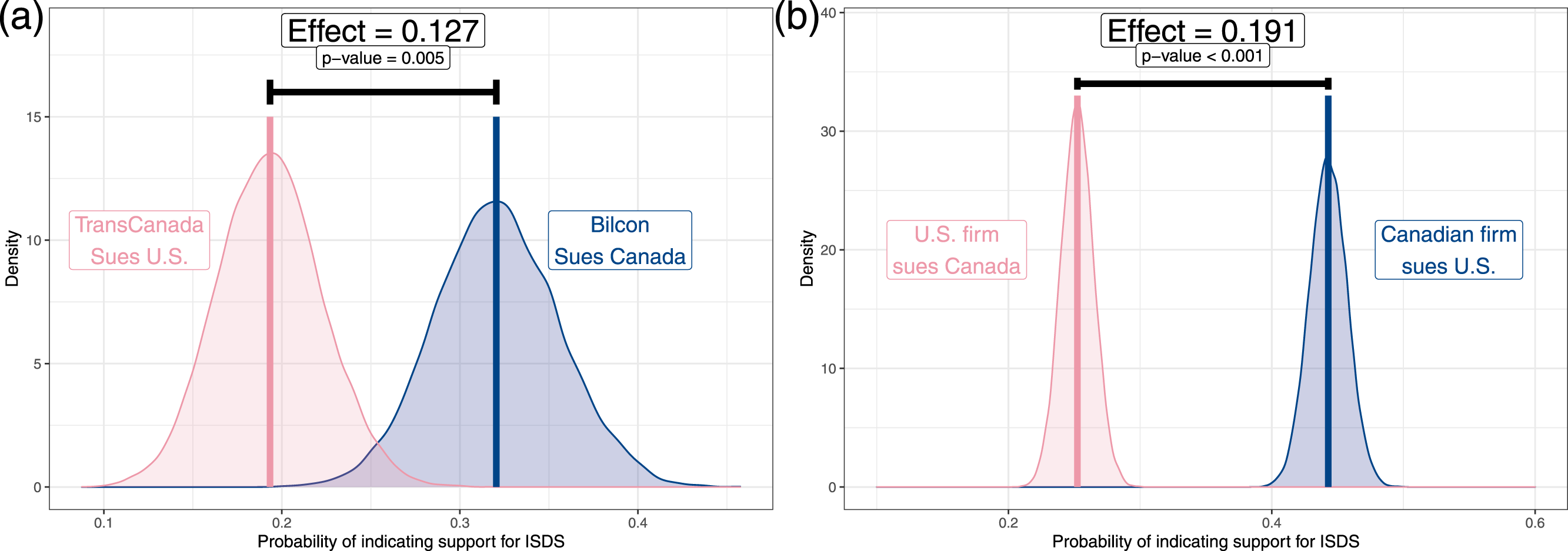
While the direct impact of media coverage of investment disputes on ISDS provisions is of interest on its own, we also examine whether media coverage has further effects on support for related agreements, specifically the Trans-Pacific Partnership in the case of the U.S. and the Canada–European Union Comprehensive Economic and Trade Agreement (CETA) for the Canadian study. We asked about these agreements because they were actively being discussed at the times of our surveys, and each included provisions for investment disputes. In the U.S. experiment, respondents were first told that the Trans-Pacific Partnership (TPP) was a potential trade deal that includes the U.S., other countries, and also an investor-state dispute settlement provision. They were then asked, “Do you support or oppose the U.S. ratifying the TPP?” 26 For the Canadian experiment, we asked specifically about the implementation of the proposed “investment court” system included in CETA, which was designed to address many of the criticisms of ISDS by establishing a more formalized dispute resolution mechanism. Respondents were told that “As part of the Comprehensive Economic and Trade Agreement (CETA), Canada and the European Union are considering creating a new permanent international court to oversee investor-state disputes between Canada and the European Union.” They were then asked “Do you support the creation of this permanent international court?”
We find weaker evidence that exposure to a news article where the U.S. is being sued rather than a U.S. firm filing a suit reduces support for the TPP. As shown in panel A of Figure 2, respondents in the “TransCanada sues U.S.” condition were about 9 percentage points (p = .06) less likely to express support for the TPP relative to the “Bilcon sues Canada” treatment. In the Canadian experiment, we detect an effect of comparable magnitude at 9.6 percentage points (p < .001), as shown in panel B. Again, the treatment effect on the spillover outcome is smaller than the effect on the main outcome of interest, but the results do suggest that in both the U.S. and Canada, media coverage of ISDS also has downstream effects on attitudes towards related trade agreements and international cooperation in other areas. Effect of exposure to news coverage on TPP and CETA support. (a) US Study (b) Canada Study. Density plots denote bootstrapped sampling distributions for the response probability under each treatment (20,000 iterations). For the U.S. study it is the probability of supporting the TPP and for the Canadian study it is for CETA.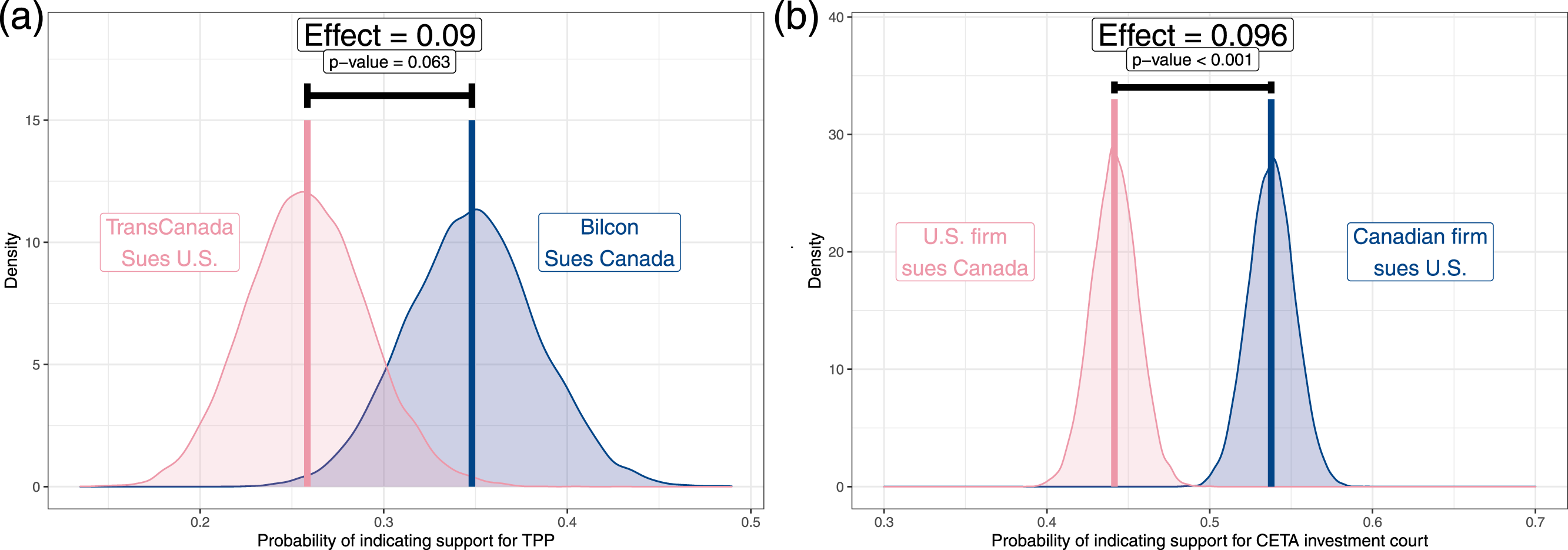
National Superiority Moderates the Effect of Media Content
Our theory also predicts that certain types of individuals will be more responsive to media coverage. Stories that depict the home country as being negatively affected by foreign actors will likely have the strongest effect among nationalists who assign a high value to their country’s dominance in global affairs. Our hypothesis is that those who are high in national superiority, are most likely to react negatively to reports about their country being sued by foreign actors. To test this, we construct a measure of national superiority using questions drawn from Kertzer and McGraw (2012) and estimate a regression model that allows the effect of treatment to vary across levels of the measure.
We measure national superiority using respondents’ answers to two questions: “How superior is the [United States/Canada] compared to other nations?” and “How many things about [America/Canada] make you ashamed?” Each question had a four-level ordered response which we aggregate to yield a 2 to 8 point scale of national superiority with higher values denoting greater national superiority.
For ease of interpretation, we coarsen this scale into three levels: low, moderate, and high national superiority. Respondents falling below the 33rd percentile (4 or lower) are considered low in national superiority, those at or above the 66th percentile (6 or greater) are considered high in national superiority. Table 3 of the Supplemental Material summarizes the number of respondents in each stratum.
The results are consistent with our hypothesis, as shown in Panel A of Figure 3, which plots the estimated treatment effects for each of the national superiority strata in the United States. Consistent with our second hypothesis, those with high levels of national superiority exhibited stronger negative reactions to ISDS when exposed to the news report where the home country was being sued compared to the report where a domestic firm sued the foreign government (p = 0.048 for U.S. sample, and p = 0.002 for the Canadian sample). While the effect of the foreign firm suing the home country treatment for the high superiority sub-group, roughly 20 percentage points, is nearly twice that of the effect for the overall sample, the effect for the low superiority sub-group is effectively zero for the U.S. sample. Individuals’ attitudes about national superiority clearly play an important role in shaping how respondents interpret the treatments. Effect of exposure to news coverage on investor-state dispute settlement support–National superiority moderator. (a) US Study (b) Canada Study. Density plots denote bootstrapped sampling distributions for the response probability under each treatment (20,000 iterations).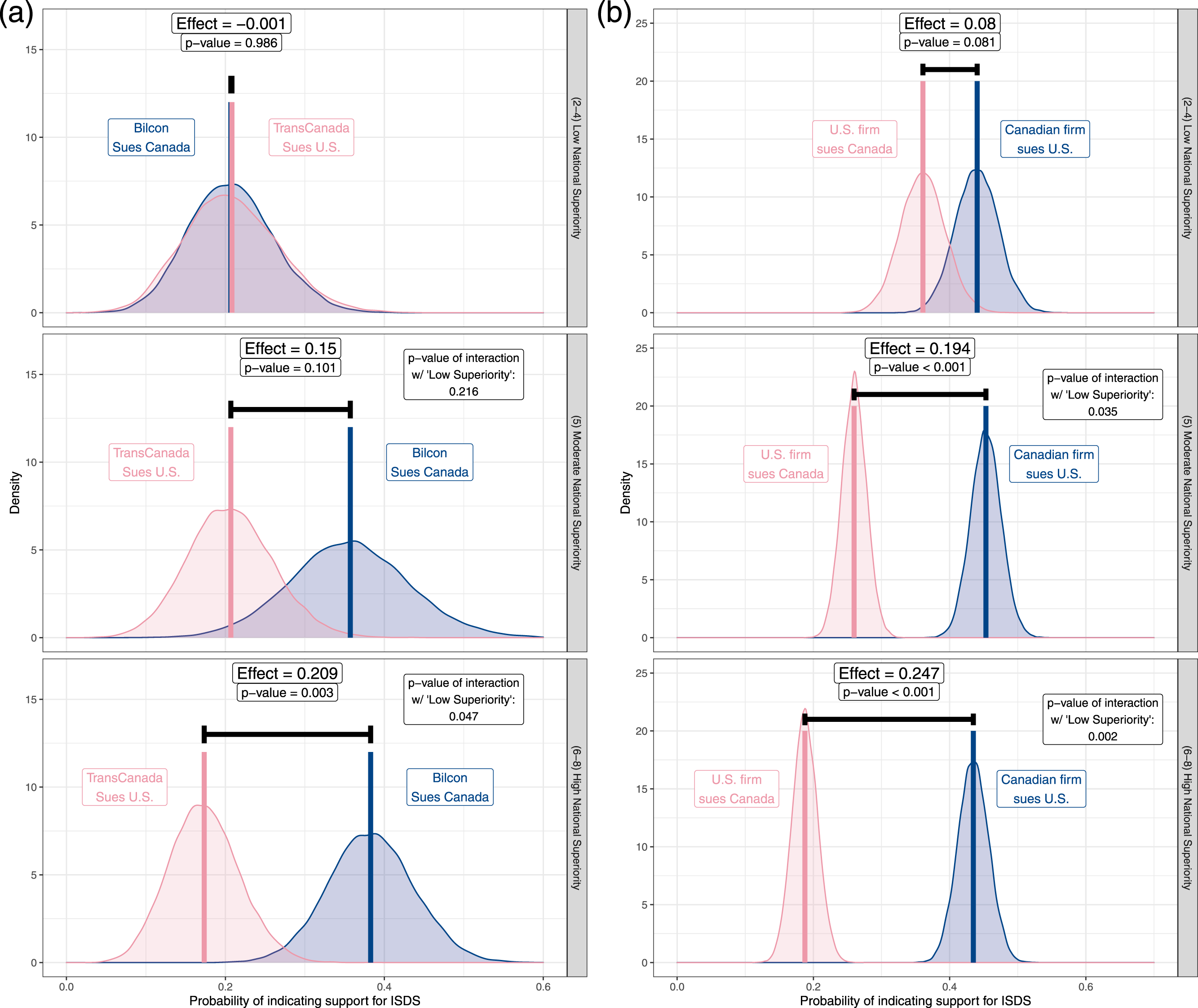
We find similar patterns among respondents in the Canadian experiment, shown in panel B of Figure 3. Those having the highest levels of national superiority had a much more adverse response to exposure to the vignette involving a U.S. firm suing Canada compared to one where a Canadian firm sued the United States than those among the “low superiority” subset. Interestingly, the effect in the Canada study seems to be driven by respondents in the “foreign firm sues home country” condition becoming more hostile to ISDS—respondents at all levels of national superiority have similar levels of support for ISDS when given the “Canadian firm sues U.S.” vignette. This contrasts with the U.S. experiment where it appears that the home firm (Bilcon) suing the foreign country condition is driving the change in response behavior. Overall, the results are consistent with other findings in the literature, particularly Mutz and Kim (2017) who find that individuals with a greater sense of national superiority tend to favor trade agreements that not only benefit the in-group, but also negatively affect the out-group, such that their own status relative to others is improved.
Conventional Predictors of Political Engagement do not Moderate the Effect of Media Content
One concern regarding our findings is that they may be driven by effects on a particular sub-group of respondents that would otherwise have relatively weak opinions on trade or are unlikely to be politically engaged. We therefore consider whether the treatment effect is moderated by factors that are predictive of political activity and preferences for international economic policy. Research on trade attitudes has consistently found that education is a strong correlate of pro-trade opinion (Hainmueller and Hiscox, 2006). It is also one of the strongest predictors of political engagement and activism (Brady, Verba, and Schlozman, 1995; Shields and Goidel, 1997; Sunshine Hillygus, 2005). Moreover, past research (Hiscox, 2006) suggests that less educated individuals’ attitudes on international trade are generally less stable. Therefore, we would expect well-educated individuals to be the least likely to be influenced by our treatments, while also being the most important political audience to mobilize. However, we find that well-educated individuals respond strongly to the treatment, and we do not find that individuals with a college degree responded differently to the treatment compared to individuals without a college degree. Figure 4 subsets the U.S. and Canadian samples into degree and non-degree-having respondents and plots the shares of individuals who indicated support for ISDS in the treatments. We find no statistically significant interaction between the treatment and education in either study. Indeed, the estimated effect is slightly larger for respondents with college degrees than for those without. Effect of exposure to news coverage on investor-state dispute settlement support–Education moderator. (a) US Study (b) Canada Study. Density plots denote bootstrapped sampling distributions for the response probability under each treatment (20,000 iterations).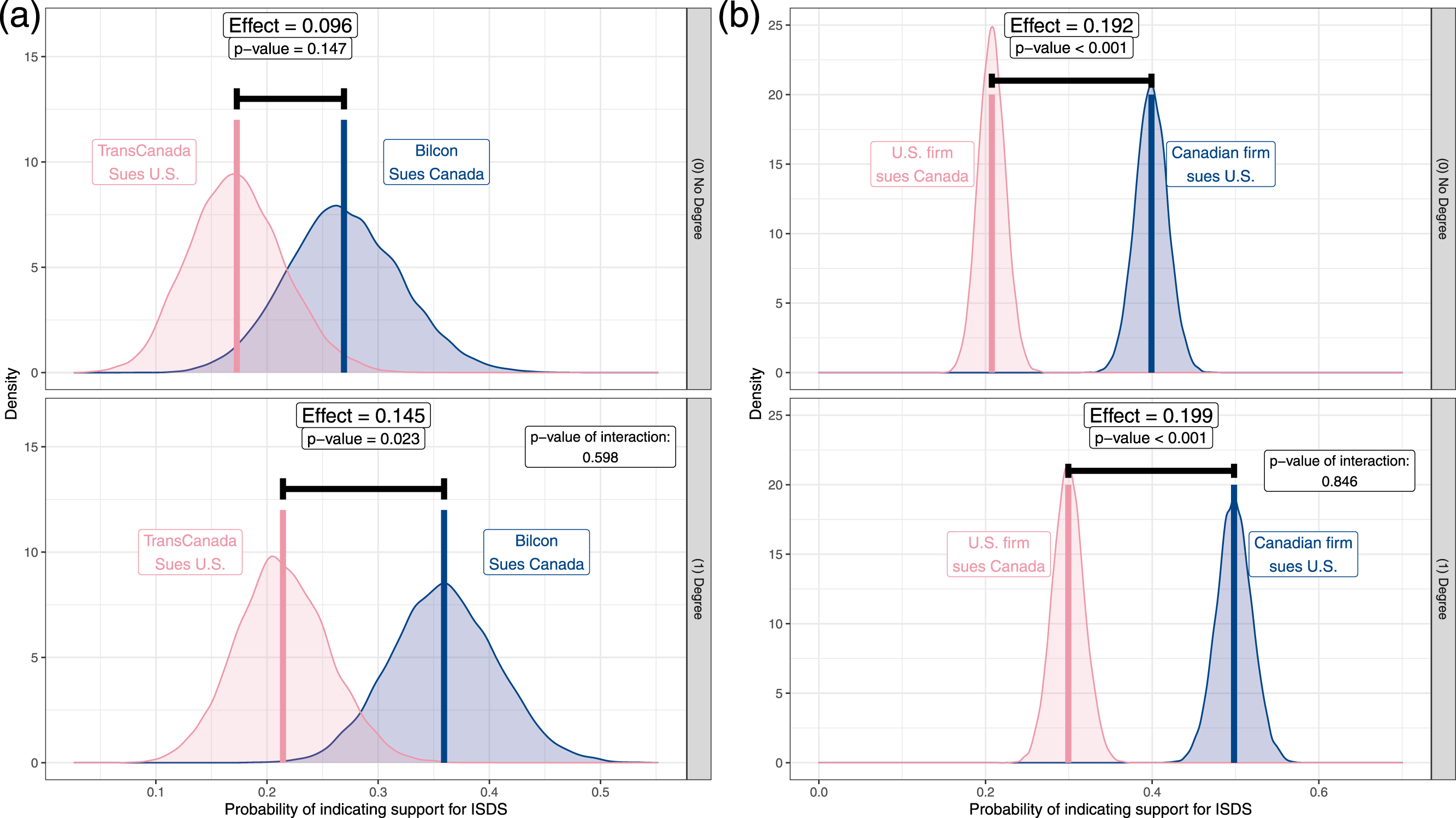
We find furthermore that the treatment effect among college-educated respondents is much larger than the observed difference in support between college and non-college respondents in both the United States and Canada. On average, respondents in the U.S. study with college degrees were about 8.5 percentage points more likely to say they support ISDS compared to respondents without college degrees. This gap is slightly larger in the Canadian experiment (9.8 percentage points). However in both studies, exposure to the “foreign firm sues home country” condition lowered college-educated respondents’ willingness to support ISDS by about twice the college/non-college gap: about 14 percentage points in the U.S. experiment and about 20 percentage points in the Canadian experiment. Given education’s prominence in the literature on what factors explain support for trade agreements and globalization, the fact that our effect overwhelms the degree/non-degree difference suggests that media coverage also plays an important role in the formation of attitudes towards ISDS and related agreements.
In addition to education, income is also a strong positive correlate of political engagement (Brady, Verba, and Schlozman, 1995; Brady, Schlozman, and Verba, 1999). Wealthier individuals are both more likely to contribute to political campaigns and to actually run for office. Moreover, research suggests that it is the policy preferences of the wealthy that tend to be reflected in legislation in the United States (Gilens and Page, 2014). However, much like education, we do not find evidence that income moderates the effect of our media treatments. Figure 5 presents the estimated effects for different income brackets. In the U.S. experiment, respondents are split based on household incomes of up to $50,000 USD annually and respondents with household incomes of more than $50,000 USD annually. This division corresponds roughly to a comparison of below-median income respondents and above-median income respondents.
27
Again, while wealthier respondents are somewhat more likely to express support for ISDS, the treatment effect is positive among both groups and the difference in the two is not statistically significant. We use 75,000 CAD as our cut-point for the Canadian experiment which splits the sample roughly in half. As in the U.S. experiment, we find no effect heterogeneity driven by income. Effect of exposure to news coverage on investor-state dispute settlement support–Income moderator. (a) US Study (b) Canada Study. Density plots denote bootstrapped sampling distributions for the response probability under each treatment (20,000 iterations).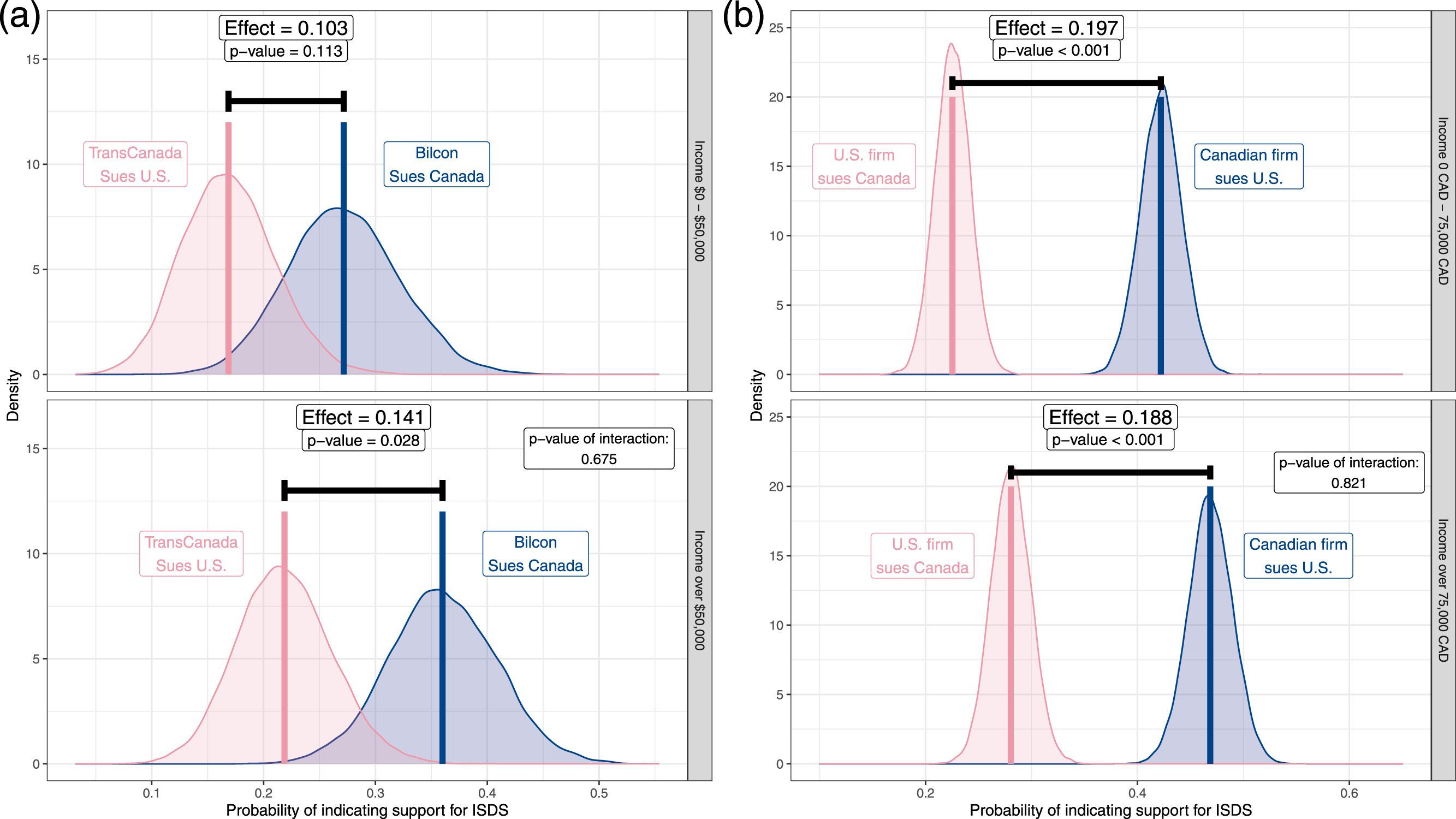
We also test for heterogenous effects based on respondents’ political party identification, since partisans may have reacted differently to the treatments. As is shown in Figure 1 of the Supplemental Material, there is not a significant difference in how Republicans and Democrats reacted to the treatment (p = 0.93) in the U.S. study. Nor is there a difference between supporters of the Conservative Party in Canada and those who support the Liberal Party or NDP. In both countries, members of all parties express consistently higher support for ISDS when exposed to media coverage of the home firm suing the foreign country as opposed to a home country being sued.
We find that the conventional set of factors likely to be associated with economic attitudes and political participation are not strong moderators of the effect of media content. Indeed, we find significant treatment effects among respondents at low and high levels of both education and income and across the political spectrum. In fact, what slight difference there is between those education and income groups points in the direction of more politically active respondents being the most likely to be influenced by media content effects. These findings not only highlight that the media’s coverage of international disputes shapes mass attitudes across the socioeconomic spectrum, but also suggests that elites within society—those with more education and higher incomes—may be most responsive to the types of media coverage we analyzed.
Conclusion
Given the growing media attention and public scrutiny of ISDS, it is increasingly important that we understand how the public forms opinions about international law and ISDS specifically. We show that media coverage of international disputes plays an important role in shaping perceptions of who wins and loses and generating public skepticism toward ISDS. Employing survey experiments on U.S. and Canadian samples, we find that news reports of the home country being sued through ISDS significantly decrease support for the inclusion of ISDS provisions in future agreements and decrease support for the Trans-Pacific Partnership and CETA. These findings illustrate how the public processes news about international law and helps explain public backlash against ISDS.
The significance of our findings is heightened by the selection process of major media outlets when choosing which international disputes to cover. In both the United States and Canada, major newspapers are much more likely to report on international disputes when their home government is being sued, as opposed to when a domestic firm is suing another country. This bias in reporting, coupled with the dramatic rise in media reports on ISDS, means that members of the public are much more likely to learn about their country being sued by a foreign firm, which drives backlash against ISDS provisions and international agreements. The media selection process is so strong in the U.S. that 60% of the NAFTA chapter 11 dispute initiations that receive coverage are suits against the U.S. In contrast the U.S. is actually responsible for initiating over 65% of these disputes against other countries, highlighting the unrepresentative nature of media coverage of international disputes. 28 The combination of the media’s selection bias and the public’s propensity to react more strongly to negative news results in a significant drop in support for ISDS and the agreements that include it. Taken together, our results show that the information environment is conducive to generating a backlash against international law and leads the public to be more skeptical of international economic cooperation. This has already contributed to some countries turning away from ISDS, or reducing their commitments, and has made it more challenging to build domestic supporting coalitions for new international economic agreements.
Our findings also speak to the importance of factors other than economic interest for trade and economic policy preferences. We present new evidence in favor of theories that emphasize individual characteristics, such as national superiority, and their role in shaping foreign policy attitudes. Conversely, we found that factors such as education, income, and partisanship did not moderate the effect of media coverage. While varying the direction of the international dispute in our experiment had a strong main-effect on the public, we also note that news of the dispute had a much stronger effect on individuals high in national superiority, suggesting that challenges to U.S. law by foreign actors are particularly off-putting to this segment of the public. Knowing that individuals high in nationalism are very responsive to news stories about international disputes, coupled with the media’s propensity to selectively cover disputes against the home country, has set the stage for a strong backlash against international law framed in nationalist rhetoric. For scholars who have examined the importance of in-group versus out-group perceptions in foreign policy, this may not be surprising; however, for the extensive literature that has primarily focused on the role of economic interests in shaping attitudes toward trade and globalization, these results highlight the importance of psychological foundations in shaping economic foreign policy preferences.
Overall, we find that public attitudes toward international law are responsive to news reports on international disputes, especially those that challenge the home country. This suggests that theories of foreign policy preference formation ought to take into account how individuals gather and process new information about their country’s role in the international system, and that media coverage is an important component in that process. Furthermore, when considering the role of domestic mobilization with regard to international law, it is important to move beyond questions of compliance for specific rulings or issues, and ask how mobilization can affect the stability and longevity of the international legal system. If negative disputes receive most of the attention by media outlets, and domestic audiences are most likely to be mobilized by such disputes, then the political climate is ripe for domestic audiences to shift away from supporting the use of international law and the institutions that employ it. Although media reporting and the public’s processing of news coverage is only one factor influencing the direction and strength of domestic mobilization, it is an increasingly important component as we have seen with rising media coverage of ISDS.
Supplemental Material
sj-pdf-1-jcr-10.1177_00220027221081925 – Supplemental Material for “International Investment Disputes, Media Coverage, and Backlash Against International Law”
Supplemental Material, sj-pdf-1-jcr-10.1177_00220027221081925 for “International Investment Disputes, Media Coverage, and Backlash Against International Law” by Ryan Brutger and Anton Strezhnev in Journal of Conflict Resolution
Footnotes
Acknowledgments
We thank the many individuals who provided support and feedback for this project.
Declaration of Conflicting Interests
The author(s) declared no potential conflicts of interest with respect to the research, authorship, and/or publication of this article.
Funding
The author(s) received no financial support for the research, authorship, and/or publication of this article.

Supplemental Material
Supplemental material for this article is available online.
Notes
References
Supplementary Material
Please find the following supplemental material available below.
For Open Access articles published under a Creative Commons License, all supplemental material carries the same license as the article it is associated with.
For non-Open Access articles published, all supplemental material carries a non-exclusive license, and permission requests for re-use of supplemental material or any part of supplemental material shall be sent directly to the copyright owner as specified in the copyright notice associated with the article.
