



Abstract
Reputations for resolve are said to be one of the few things worth fighting for, yet they remain inadequately understood. Discussions of reputation focus almost exclusively on first-order belief change—A stands firm, B updates its beliefs about A’s resolve. Such first-order reputational effects are important, but they are not the whole story. Higher-order beliefs—what A believes about B’s beliefs, and so on—matter a great deal as well. When A comes to believe that B is more resolved, this may decrease A’s resolve, and this in turn may increase B’s resolve, and so on. In other words, resolve is interdependent. We offer a framework for estimating higher-order effects, and find evidence of such reasoning in a survey experiment on quasi-elites. Our findings indicate both that states and leaders can develop potent reputations for resolve, and that higher-order beliefs are often responsible for a large proportion of these effects (40 percent to 70 percent in our experimental setting). We conclude by complementing the survey with qualitative evidence and laying the groundwork for future research.
[In bargaining situations], each party’s strategy is guided mainly by what he expects the other to accept or insist on; yet each knows that the other is guided by reciprocal thoughts. The final outcome must be a point from which neither expects the other to retreat; yet the main ingredient of this expectation is what one thinks the other expects the first to expect, and so on. Somehow, out of this fluid and indeterminate situation that seemingly provides no logical reason for anybody to expect anything except what he expects to be expected to expect, a decision is reached. —Thomas Schelling (Schelling 1960, 70) Can both sides simultaneously have images of high resolve or is there a zero-sum element involved? —Robert Jervis (Jervis 1978, 199)
Introduction
Navigating an international crisis can require incredibly complex inferences. Even seemingly straightforward strategies can backfire dramatically. Suppose that persons A and B are playing Chicken, the game in which two cars race toward each other and the goal is to get the opponent to swerve first. One popular strategem says that A should throw her steering wheel out of the window in order to convince B that she cannot swerve, thereby compelling B to do so. 1 Yet suppose that B incorrectly believes that A hid a spare steering wheel under her seat. If A does not know that B believes this, she may surrender her ability to swerve without actually becoming committed in B’s eyes, raising the chances of a tragic crash. Or suppose that A incorrectly believes that B believes that A has a spare steering wheel. This belief might prevent A from using a tactic that would have improved her odds of victory.
Much of the complexity in international crisis bargaining is attributable to higher-order beliefs—beliefs about beliefs (Schelling 1960; O’Neill 1999). While these complications are perhaps most apparent in hypothetical games like Chicken, examples abound in real-world international crises as well. For instance, in the years prior to the Berlin crisis, Premier Khrushchev had deliberately exaggerated the Soviet Union’s capabilities, and widely-discussed American concerns about a “missile gap” had convinced him that the Americans had fallen for the ruse. “[O]n the assumption that the Americans believed the Soviets were ahead in the arms race,” Khrushchev chose to escalate tensions over Berlin (Kaplan 1983, 304). Khrushchev was forced to back down, however, when he learned that US policymakers did not believe this at all—a fact that the Americans purposely signaled via intelligence leaks to NATO units that the US knew to be compromised by Soviet agents (Schlosser 2014, 284). Higher-order beliefs thus played a critical role in both the onset and resolution of one of the most significant crises of the Cold War.
In this article, we examine the theoretical and empirical import of higher-order belief dynamics for two crucial phenomena in international relations: resolve and reputations for resolve. Reputations, especially for resolve, have been a long-standing topic of scholarship, but most studies consider only first-order beliefs: whether and how B updates his beliefs about A on the basis of A’s behavior. We argue that taking higher-order beliefs into account substantially amplifies the importance of reputations for resolve. This is because resolve is interdependent: one side’s (perceived) resolve can affect the other side’s (perceived) resolve, meaning that small initial changes in beliefs can spiral into large overall changes, with potentially decisive consequences.
We evaluate our theory using a survey experiment conducted on a sample of quasi-elites recruited through Stephen Walt’s Foreign Policy blog. We begin by corroborating reputation scholars’ core assertion: states that behaved resolutely in the past are perceived to be more highly resolved in the present. We find that the effect of reputation on perceived resolve is larger than any other experimental manipulation, including the effect of material capabilities, and persists across a range of informational conditions and subgroups.
We then go a step further, advancing scholarship on reputations for resolve by demonstrating that respondents also form higher-order beliefs in line with our argument. Exogenous increases in A’s perceived resolve, induced by providing information about A’s behavior in disputes with states other than B, produce decreases in B’s perceived resolve, even though respondents learned nothing about the usual factors said to affect B’s resolve. The size of the parameter estimates we obtain suggest that higher-order beliefs can account for as much as 70 percent of the reputational manipulation’s effect on the balance of resolve, with a lower bound of roughly 40 percent. We thus answer Robert Jervis’s longstanding but still open question: there is indeed a strong zero-sum element to resolve.
Our design also permits a direct test of a competing hypothesis linking higher-order beliefs to resolve, which Jervis has referred to as the “domino theory paradox” and Daryl Press as the “never again theory”: if A backed down in a recent dispute, B will believe that A will expend extra effort to restore its tarnished reputation for resolve, and therefore that A will be more rather than less resolved in subsequent disputes (Jervis 1991; Press 2005). Our evidence is contrary to these hypotheses.
Our results reinforce recent studies demonstrating the importance of reputation in the domains of conflict, finance, and alliance politics, among others (see Crescenzi 2017, for a review). These studies all focus on the first-order effects of reputation. 2 We show, however, that the story does not stop there. In doing so, we join a number of others who place higher-order beliefs at the center of international relations specifically (Schelling 1960; O’Neill 1999; Morrow 2014) and social, economic, and political life more broadly (Kuran 1995; Chwe 2001). These beliefs are what make resolve interdependent, and are therefore crucial to the onset and resolution of crises and wars.
Resolve, Reputation, and Higher-Order Beliefs
Much of international politics pivots around perceptions. A state’s ability to persuade, deter, and compel depends in large part on how that state is perceived—whether others consider its military capable, its threats credible, its promises reliable. As a result, states and leaders are motivated to act in ways that favorably shape others’ perceptions and expectations, i.e. to cultivate reputations for desirable qualities or behavioral tendencies.
One of the most important kinds of reputation in international politics is a reputation for resolve. We define resolve as follows:
We briefly explain how this behavioral definition relates to other common conceptualizations of resolve. Formalized mathematical models of crisis bargaining often define resolve as a state’s “value for war,” which is said to be a function of material factors such as military capabilities, the issue under dispute, and domestic audiences (see, e.g. Morrow 1989; Powell 1990; Fearon 1994; Sartori 2016). Psychological accounts of resolve instead emphasize internal traits such as dispositional determination, willpower, or “sticktoitiveness” (Kertzer 2016, 8-9). Here, we define resolve in terms of states’ behavior in a crisis, in which states may either back down or stand firm. 3 In this sense, a state’s “value for war” and its dispositional traits are important factors that affect resolve—the probability that an actor stands firm—but they may not be the only ones, so they do not define resolve. 4
Understanding resolve in behavioral terms has several benefits. 5 By clearly specifying what kind of behavior is (in)consistent with being resolved, our definition makes resolve measurable and facilitates empirical analysis. More importantly, our definition allows scholars to directly incorporate another essential determinant of whether A will stand firm in a crisis with B: A’s beliefs about B’s resolve. As exemplified by Chicken, that A’s crisis behavior depends on her beliefs about B’s resolve is what makes interstate crises complex strategic interactions. This relationship also speaks to the literature on reputations for resolve, which we briefly review below.
Building Reputations for Resolve
International crises can often be understood as “contests of resolve” (Morrow 1989, 941-42) in which the outcome is determined by one side’s ability to convince the other that it will not back down. In such contests, a history of resolute past behavior can be a valuable asset. We say that actors have a reputation for resolve when observers have formed beliefs about that actor’s tendency to stand firm in a certain class of disputes on the basis of that actor’s past behavior (Dafoe, Renshon, and Huth 2014). 6
The effect of a reputation for resolve remains a subject of debate. Proponents contend that reputations offer a path to successful commitment, deterrence, and compellence (Huth 1997), as costly past actions can corroborate threats and promises that might otherwise be dismissed as “cheap talk” (Fearon 1995; Trager 2017). These scholars argue that an “undesired image can involve costs for which almost no amount of the usual kinds of power can compensate” (Jervis 1970, 6), and so reputations are “one of the few things worth fighting over” (Schelling 1966, 124). In support of this position, a number of recent studies find evidence that states’ past behavior shape how other states act toward it. 7
Others, however, dispute the link between past actions and present behavior. For instance, Mercer argues that the desirability of an action conditions how people interpret the disposition of its initiator, concluding that “people do not consistently use past behavior to predict similar behavior in the future” (Mercer 1996, 45-47, 212). Similarly, Press claims that “blood and wealth spent to maintain a country’s record for keeping commitments are wasted,” since opponents form assessments of credibility largely based on their perceptions of states’ interests and capabilities, not their past behavior (Press 2005, 10). Detractors also aver that evidence of reputational effects is largely observational and often indirect, and is therefore inconclusive.
Thus, one contribution of our article is to bring experimental methods to bear on a basic question: do observers use a state’s past behavior to predict what it is likely to do today?
8
In addition, we also seek to advance the reputation debate beyond
Reputational Effects and Higher-Order Beliefs
Consider a hypothetical dispute between states A and B, in which B is considering whether to escalate. Initially, B has some sense of how likely A would be to stand firm (A’s resolve), though he cannot be sure. B then observes A behaving resolutely in some other dispute, and after considering that A might, say, be more militarily capable than B originally thought, B updates his beliefs about A’s resolve accordingly. We can call this a first-order reputational effect, in which one side updates its beliefs about its opponent’s characteristics or behavioral tendencies solely on the basis of that opponent’s past behavior.
In many cases, however, higher-order reasoning further complicates the story. For example, A might know that B was paying careful attention to her behavior in the other dispute. If so, A might conclude that, since she stood firm, B has become less resolved, and this could further embolden A to also stand firm against B. If B expects A to be thinking along these lines, he might conclude that there is little he can do to make A back down, further reducing B’s resolve. If actors make inferences in this way, the first-order reputational effect will be joined by higher-order effects. These two effects together make up the total reputational effect, i.e. the full shift in the balance of resolve between two actors due to a single initial reputational shock (see Section “Do Higher-Order Beliefs Contribute to Reputational Effects?” for a formalization). Indeed, higher-order beliefs can theoretically produce large substantive effects, as relatively small first-order reputational effects cascade through higher-order belief chains into large changes in the balance of resolve.
Put another way, our argument is that resolve is a function of not just the material factors emphasized in the modeling literature or the internal traits emphasized in psychological accounts, but also states’ beliefs about their opponents’ resolve—A’s resolve is decreasing in (her beliefs about) B’s resolve, and vice versa. In short, resolve is interdependent. Furthermore, that resolve is interdependent implies that higher-order beliefs may play a central, albeit under-appreciated, role in international crises—A’s beliefs about B’s resolve (which dictate A’s own resolve) are themselves a product of A’s higher-order beliefs about B’s beliefs about A’s resolve, and vice versa. To express our arguments in terms of reputations, we contend not just that states and leaders can possess reputations for resolve, but also that these actors are aware that such a reputation may decrease the likelihood that their opponents stand firm during crises, and so update their own resolve accordingly. In short, states may expect that their reputations precede them.
There are two principal reasons why we may not expect this hypothesis to hold. First, states may not form higher-order beliefs if they lack the ability to do so. Kertzer, for example, argues that in many situations with higher-order uncertainty about resolve “the complex nature of the decision-making environment actors face stretches far beyond the limits of human cognition” (Kertzer 2016, 149; see also Mercer 2012). And even if they have the ability, states may be insufficiently confident in their higher-order beliefs to incorporate them into their assessments of resolve. If this were the case, we would expect to see no evidence of interdependence.
Second, An actor who has had to back down once will feel especially strong incentives to prevail the next time in order to show that the domino theory is not correct, or at least does not apply to him. In other words, an actor who believes the domino theory—or who believes that others accept it—will have incentives to act contrary to it. Indeed, statesmen sometimes respond to a defeat by warning others that this history will make them extremely resistant to retreating again. Furthermore, if others foresee this, they will expect a defeated actor to be particularly unyielding in the next confrontation.
Research Design
The scientific study of reputations is limited by their inaccessibility. Reputations consist of perceptions, which exist in people’s minds and are not directly observable. Even records of private deliberations, free of any incentives to dissemble, may lead us astray. To the extent that an opponent’s reputation is a constant during a crisis and is common knowledge among decisionmakers, discussions are likely to focus on new information such as troop movements even if reputation matters (Weisiger and Yarhi-Milo 2015). Reputational inferences, given their evolutionary importance, may also be so automatic that they are made subconsciously (Bowles and Gintis 2011). These difficulties were acknowledged by Snyder and Diesing, who noted that their inability to find much evidence of reputational inferences in case histories “may be only an artifact of the record” (Snyder and Diesing 1977, 496).
To overcome these challenges, we employ a scenario-based survey experiment. Respondents are told about a scenario, features of which are randomly varied or omitted, and then asked about their opinions or beliefs. Survey experiments are especially suitable for research questions about how people incorporate, interpret, and act on particular types of information (Mutz 2011), and these are precisely the questions in which scholars of reputation are interested. Below, we review the survey design and the sample in more detail.
Survey Vignette
Respondents read an abstract scenario about two countries (A and B) engaged in a serious territorial dispute. The features of the scenario are presented in a bullet list format, each assigned with some probability independent of each other (a full factorial design). Each feature has several different levels, including its omission. For the full text of the survey and treatment allocations, see Online Appendix B.
Respondents were first informed of each country’s regime type, either democracy or dictatorship (some received no information on regime type). Respondents then learned about the military capabilities of each country, with A having either “substantially stronger military forces” than B, being “about equally strong,” or B being substantially stronger (again, some received no information about capabilities). In all conditions except no information, respondents are also told that neither country has nuclear weapons.
The respondent then reads the reputational feature of the scenario, State A’s history of crisis interactions. This bullet involves two variables: whether A stood firm or backed down in past crises, and whether A’s previous conflicts were against B or other countries.
10
According to most impartial observers, of the three most recent major international crises that Country A has faced against [other countries/Country B], Country A [did not back down and Country A achieved its aims/backed down in each crisis and failed to achieve its aims].
Lastly, the vignette includes several other experimental features related to the history of the dispute, as well as recent threats and promises.
11
The scenario concludes by stating that the crisis is serious and that many observers consider major military action in the near future likely. Respondents are then asked the primary outcome question for both countries: What is your best estimate, given the information available, about whether Country A/B will back down in this dispute?
Before detailing our sampling strategy, we briefly address the benefits and drawbacks of our abstract survey design. Our survey vignette describes a crisis between two abstract states, A and B, and the scenarios respondents read were typically no more than 150 words. The benefit of this approach is its flexible simplicity; short vignettes are less taxing for respondents, and abstracting away from real-world states may permit cleaner manipulation of the concepts of interest (though not necessarily; see Dafoe, Zhang, and Caughey 2018). The attendant drawback is a decreased level of realism in abstract survey scenarios, relative to vignettes that feature actual countries (Tingley 2017). Reassuringly, however, recent research employing both abstract and real-world crises scenarios recovers reputational effects of a very similar magnitude to those presented below (Renshon, Dafoe, and Huth 2018).
Regardless of the design, it is of course not possible to create environments akin to those faced by real-life decision-makers through surveys alone, and it is therefore best to complement survey experiments with other kinds of evidence. Though more systematic observational work will have to await future research, we offer some preliminary supportive evidence for our claims in Section “Discussion: Interdependent Resolve in Real Life,” and discuss the conditions under which evidence of interdependent resolve is most and least likely to be found.
Sample
We administered the survey to a convenience sample of respondents recruited through Stephen Walt’s Foreign Policy blog. On August 1st, 2011 Walt posted a blog entry inviting readers to “Become a data point!” (see Online Appendix B.1). From this advertisement, over 1,000 respondents took the survey.
This sampling strategy was intended to mitigate potential biases that may arise from using regular citizens to proxy for elite policymakers. The general concern is that elites are better informed about and more experienced with foreign policy decision-making than the average citizen—as a result, they are more likely to employ higher-order strategic reasoning and consider their opponents’ perspective (Hafner-Burton, Hughes, and Victor 2013; Hafner-Burton et al. 2014). Ideally, then, one would run our experiment on key decision-makers, such as military leaders, foreign policy advisors, and politicians. Unfortunately, such subjects are rarely accessible, and even if they are it is usually as part of a small convenience sample.
To approximate our elite population of interest, we instead sought to recruit a sample of quasi-elite respondents who are abnormally well-informed about and interested in foreign policy, whose backgrounds and world views more closely parallel those of high-level elites. We expected a sample drawn from Walt’s Foreign Policy readership to be highly educated and knowledgeable of foreign policy, and that is indeed the case. Of those 87 perccent who answered the demographic questions, 83 percent reported having a college degree or higher, and 50 percent a postgraduate degree. Moreover, 60 percent claimed to have “particular expertise with foreign affairs, military affairs, or international relations.” Politically, the group leans Democratic, as 89 percent claimed to agree more with the policies of Democrats (11 percent more with those of Republicans). The respondents were 88 percent male, which is far from representative of the general population but not obviously unrepresentative of foreign policy elites. More details about the sample are provided in Online Appendix A.
To be sure, then, our sample remains an imperfect approximation of foreign policy elites. Still, we argue that these imperfections will likely lead us to underestimate the effect of reputation and higher-order beliefs on perceived resolve. To start, the Democratic bias should cut against our proposed hypothesis, as liberals are generally less likely than conservatives to invoke concerns over credibility, reputation, and honor in international affairs (Trager and Vavreck 2011). And while respondents may also hew closer to Stephen Walt’s particular foreign policy views, Walt has repeatedly argued against the importance of reputation. 13 Lastly, our sample likely remains less experienced with actual foreign policy decision-making than true elites. But as mentioned above, experience is linked to higher-order strategic reasoning, and Tingley and Walter (2011) show that experienced players care more about reputation than inexperienced ones. If anything, then, our results likely underestimate the reputational effects that would be found among actual elites.
In short, given the cost and difficulty in obtaining elite samples, our sampling design is a reasonable first step toward the empirical study of higher-order beliefs in international crises. 14 Importantly, we think it highly unlikely that our sample would produce an opposite effect of reputation on perceived resolve relative to true elites—our respondents may be less attentive to reputation, but this should only depress the magnitude of reputational effects, not reverse their direction.
Results
To preview our results, we reach two main findings. First, reputations for resolve matter; when respondents learn that a state has stood firm in past crises, they consider it much more likely to stand firm today. Second, resolve is interdependent; we find that increases in A’s perceived resolve are associated with decreases in B’s perceived resolve, and estimate that higher-order belief updating is responsible for a large proportion of the total observed effect of past behavior on the balance of resolve. 15
Can States Build Reputations for Resolve?
We begin with
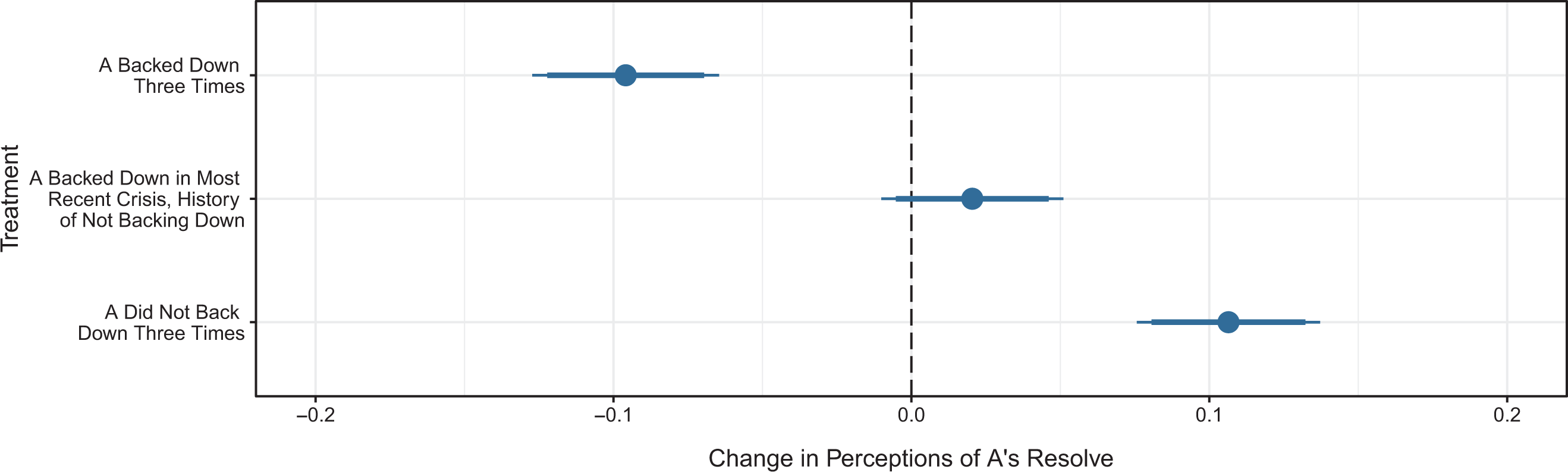
Effect of A’s past behavior on perceptions of A’s resolve, relative to respondents that received no information about past behavior (baseline probability of standing firm
Moreover, this reputational treatment has the largest effect of all manipulations in the survey. The effect of going from a history of backing down to a history of standing firm is about 20 percentage points, which represents a quarter of the resolve variable’s total range. 16 This reputational effect is roughly twice the size of the second-largest effect, information about power: shifting from B having “substantially stronger military forces” to A having “substantially stronger military forces” increases perceptions of A’s resolve by roughly 10 percentage points. 17
Readers may wonder whether this potent reputational effect is driven only by a subset of respondents. Reputation skeptics contend that even if past behavior matters, it does so only to the extent that “a decision maker uses an adversary’s history of keeping commitments to assess the adversary’s interests or military power” (Press 2005, 21). An observable implication of this view is that we should only see effects of past behavior on respondents that lack information about the balance of power. We find, however, that the reputational effect persists among respondents who were told about military capabilities (Figure 12, Online Appendix C.1).
18
And while the reputational effect decreased slightly as scenario complexity increased,
19
it remained above 10 percentage points even among respondents who received the maximum amount of information about the scenario (Figure 11, Online Appendix C.1). Reputational effects also persist across state leaders and across demographic subgroups, including gender, education, political affiliation, and cultural background. In sum, we find strong support for
In contrast, we find no evidence for
Do Higher-Order Beliefs Contribute to Reputational Effects?
Typically, reputational effects like the ones reported above are interpreted in terms of first-order updating: A takes an action, and observers update their beliefs about A. Yet as discussed in Section “Reputational Effects and Higher-Order Beliefs,” the total reputational effect of A’s past behavior on A and B’s resolve may also consist of higher-order effects. To test this idea, we need a treatment that affects beliefs about A’s resolve, but cannot affect B’s resolve through any channel except (beliefs about) A’s resolve. If such a treatment affects B’s resolve, then we can conclude that perceptions of B’s resolve are influenced by perceptions of A’s resolve—in other words, that respondents form higher-order beliefs and that resolve is interdependent (
It is useful to define the relevant estimand and identifying assumptions more formally. Let Ri denote the resolve of agent i, k denote a level of belief updating, and
Now, suppose that observers go through two levels of belief updating following reputation treatment T (this updating process is shown graphically in Figure 2). Our argument suggests that we should see
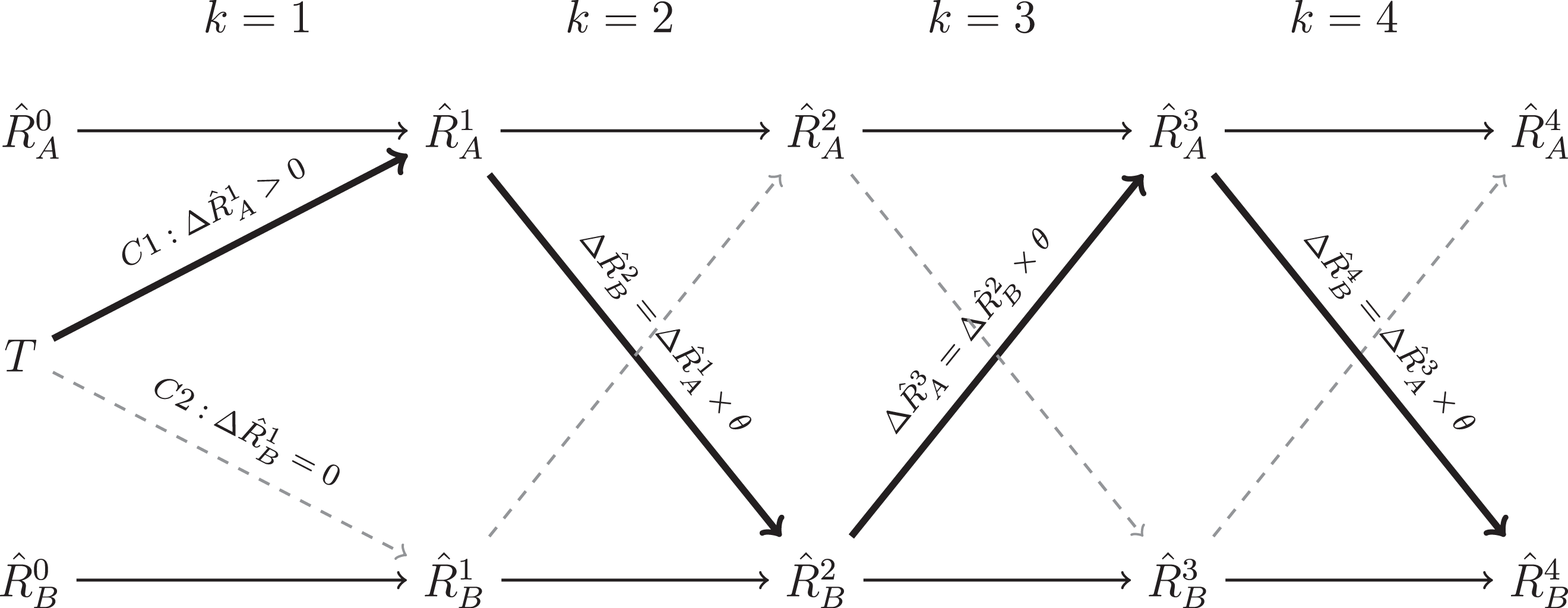
A model of belief updating, where k denotes the level of belief updating,
As mentioned above, our treatment must fulfill two conditions for this estimation strategy to succeed, analogous to the identifying assumptions in instrumental variable analysis: (C1)
However, information about A’s past actions against another country is a treatment that likely satisfies C2. 21 When told about A’s extra-dyadic behavior, observers can make inferences about how much A values its reputation, whether A’s domestic public is liable to punish leaders for backing down, or any other factor that shapes A’s resolve. But the treatment is uninformative about the A-B relationship, the territory under dispute, or other factors that could reasonably shape perceptions of B’s resolve—except, that is, perceptions of A’s resolve. This treatment, then, allows for a clean test of our interdependence hypothesis.
The results of this test are displayed in Figure 3. We find that A’s behavior against other countries significantly affects perceptions of B’s resolve as expected—respondents who were told that A stood firm against other countries in the past assess B’s resolve to be roughly 7 percentage points lower relative to baseline, and A backing down against other countries leads to a similar increase in perceptions of B’s resolve. For A standing firm in extra-dyadic crises,
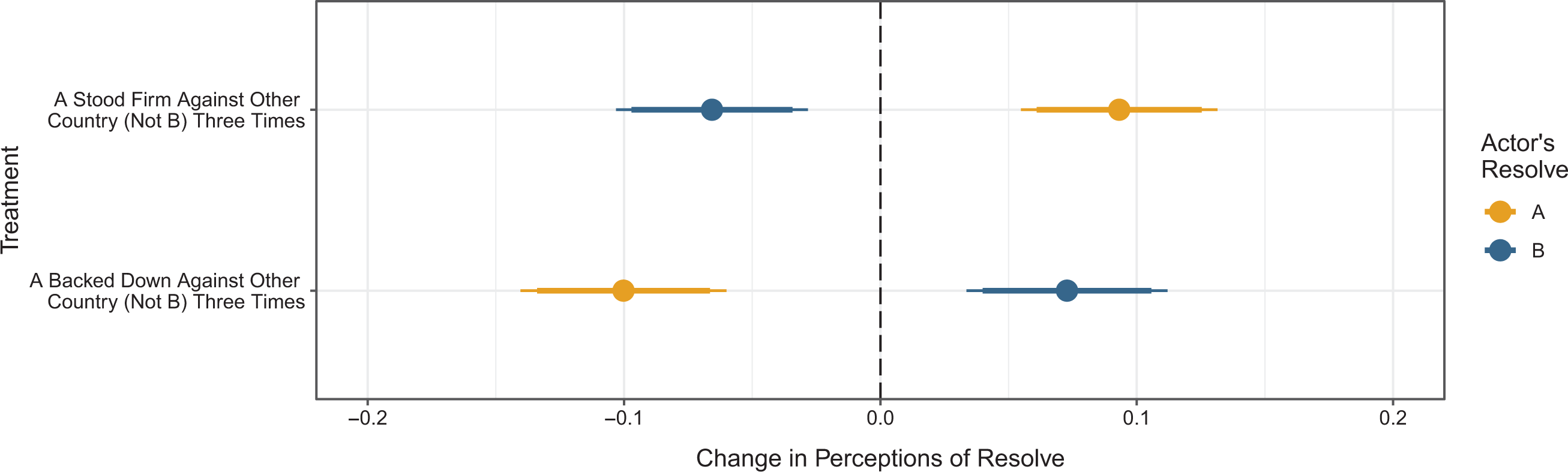
Effect of A’s past behavior against “other countries” (not B) on perceived resolve, relative to respondents that received no information about past behavior (A’s baseline probability of standing firm
The Interdependence Multiplier
These results offer compelling evidence that reputational effects exist, and that they are compounded by higher-order beliefs. Still, we have yet to specify precisely how important are higher-order beliefs. Can we estimate the proportion of the total reputational effect—the effect of past behavior on the overall difference in resolve between A and B—that is attributable to higher-order belief updating?
To help us answer this question, define the interdependence multiplier (
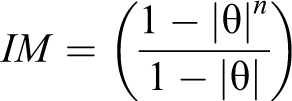
which converges to
Figure 4 plots the magnitude of the
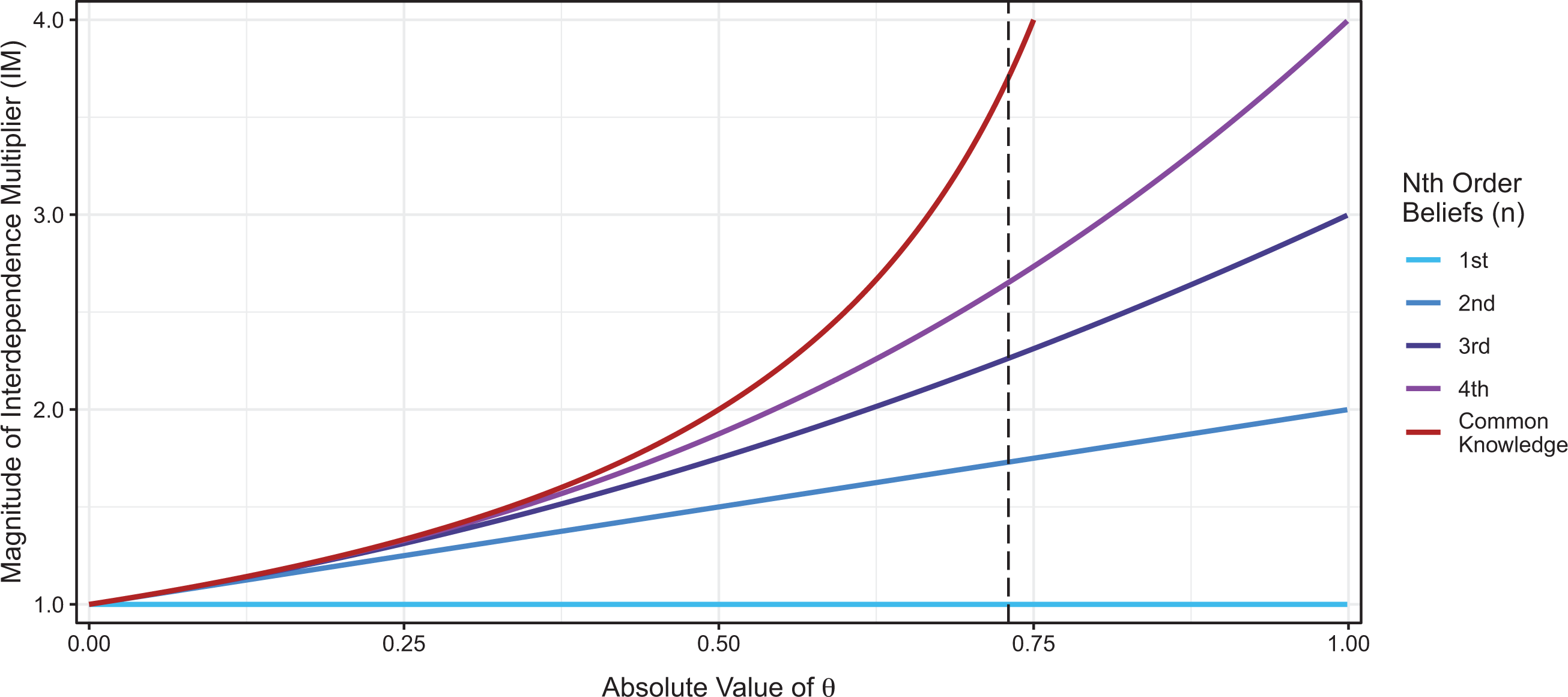
We can now use the
We can also more intuitively verify this result by beginning with the first-order effect, and then building out via
This estimation strategy is limited by our inability to directly observe n, respondents’ level of higher-order reasoning—we assumed
Second, numerous other studies and examples discussed in Section “Higher-Order Beliefs” suggest that at least some degree of higher-order reasoning, be it conscious or intuitive, is a regular feature of human cognition in political, economic, and social settings—though higher-order belief chains can become prohibitively complex,
In sum, we find clear evidence that higher-order beliefs are responsible for a large portion of our observed reputational effects—even restricting the calculations to a minimal level of higher-order reasoning, the proportion approaches 50 percent. In the next section, we move beyond our survey data to discuss real-world applications and implications of our argument.
Discussion: Interdependent Resolve in Real Life
Above, we provided evidence of higher-order reputational dynamics, and argued that the magnitude of these effects depends on the order to which people form beliefs (n) and the degree of interdependence (
Higher-Order Beliefs
As discussed in Section “Reputational Effects and Higher-Order Beliefs,” one broad issue is whether decision-makers engage in higher-order reasoning (Kertzer 2016; Mercer 2012). If they do not, our arguments have little relevance to the real world. Fortunately, evidence from a variety of contexts suggests that explicit and implicit higher-order reasoning is common, and does not require especially sophisticated agents.
First, experimental evidence from behavioral economics suggests that most people often form at least second-order beliefs, and many reach higher orders as well (e.g. Nagel 1995; Camerer, Ho, and Chong 2004). In psychology, researchers have found that the magnitude of the famous “bystander effect” depends on whether the context allows bystanders to form beliefs about other bystanders’ beliefs (Thomas et al. 2014, 2016). A third example comes from a recent field experiment in Benin, where voters who learned information about politicians’ behavior punished and rewarded performance only when they thought that others knew this information as well, suggesting a higher-order understanding of coordination dynamics (Adida et al. 2020). Many other studies also find significant effects from interventions targeted at higher-order beliefs (Bicchieri 2016; Mildenberger and Tingley 2019).
Moreover, scholars have produced abundant evidence of higher-order reasoning among policymaking elites in high-stakes situations. At the domestic level, autocrats faced with potentially unsatisfied publics go to great lengths to create impressions of widespread support for their rule, or, if that fails, at least keep everyone guessing about each other’s beliefs (Kuran 1995; Chwe 2001, 20-21). Internationally, as McManus (2014, 726) illustrates with the case of Israel-US bargaining over Iran’s nuclear program, states often attempt to stake their allies’ reputation on supporting them, believing that their allies will then believe themselves bound to act (see, e.g. Jervis 1978, 180; Trager 2017, Ch. 1, for more examples). And conflicts are often said to end only when “opponents succeed in coordinating their expectations” (Slantchev 2003, 621; see also Carter 2017). In these and many other examples, beliefs about beliefs are the driver and focus of significant strategic contention.
To be clear, our argument does not require that actors always run through every step of the inferential process in a deliberate or conscious way. Higher-order beliefs can be incorporated into decision-making heuristically, implicitly, and subconsciously. As Chwe (2001, 78) argues for the case of driving, “I stop at a red traffic light out of habit, but a fully specified argument for doing so would involve an infinite regress: I stop because I think that other people are going, and I think that other people are going because I think that they think that I am stopping, and so on.” Developmental psychologists have found that children display a great degree of higher-order understanding early on in life, implicitly engaging in complex theorizing about the mental states of others long before they can explicitly articulate their reasoning (Wellman 2014). Higher-order belief dynamics also often become embedded in cultural and legal norms (O’Neill 1999; Ridgeway 2011; Morrow 2014).
The Degree of Interdependence
While it is therefore clear that real-world actors do engage in higher-order reasoning, the extent to which first-order reputational effect are amplified also depends on the degree to which resolve is interdependent, i.e. the extent to which an initial change in A’s resolve affects B’s resolve. Here, contextual factors are likely to play a large role. We identify and discuss four such factors.
First, the degree of interdependence depends on the extent to which the context resembles a prototypical contest of resolve. The central features of such contests are (1) the costs of conflict are so great that losing is preferred to both sides standing firm, but (2) the issue under dispute is sufficiently valuable for a coercive victory to be preferred to a peaceful compromise (Morrow 1989, 941). We expect resolve to be most interdependent in conflicts that most closely approximate these conditions. Nuclear crises are often cited as the quintessential examples of such contests (Schelling 1966; Powell 1990), but they are by no means the only ones. In the 1898 Fashoda Crisis, for example, France dispatched a mission to Egypt in an attempt to force Britain to make concessions, but withdrew when it became convinced that Britain was more resolved than it initially believed (Trachtenberg 2012, 13-16). 26
More contemporary examples can be found in proxy conflicts like the ongoing Syrian civil war. Direct conflict between the U.S. and Russia over Syria seems prohibitively costly, yet Damascus remains a valuable prize. In these circumstances, resolve can be highly interdependent. Indeed, this interdependence featured regularly in debates about U.S. intervention in Syria. Critics argue that Obama’s failure to enforce the infamous chemical weapons red-line in 2013 undermined U.S. deterrence, paving the way for Russian intervention in 2015—Putin might have been compelled to stay out, were it not clear (to both parties) that the U.S. was irresolute. At the same time, Obama’s reluctance to engage in Syria resulted in part from his belief that Russia would counter-escalate in response to limited U.S. intervention, especially after Russia stepped up its involvement in 2015. 27 In other words, U.S. lack of resolve fueled Russian resolve, further depressing U.S. resolve.
Second, interdependence is also affected by the extent to which actors are able to act strategically, conditioning their behavior on what they think others are likely to do. Actors may fail or be unable to do so for various reasons. A prominent example is found in the expansive literature on credible commitments, which discusses commitment devices that may leave actors unconditionally resolved in a crisis. The moment actors truly commit to a strategy—when they throw their only steering wheel out of the window—they have effectively set their interdependence coefficient to 0: even if they subsequently change their beliefs about their opponent’s resolve, their own course of action is already set. That said, absolute commitments are exceedingly difficult and risky to make. 28 In the real world, then, resolve is almost always interdependent at least to some extent.
A third and related factor is the concentration of decision-making authority: when leaders have the ability to change course quickly, their resolve is likely to depend more on the other side’s resolve. If, on the other hand, authority is diffuse, it will be difficult for a country to change course in the face of new information. One example is the delegation of military decision-making to local commanders, who can then choose to stand firm or back down in their theater of operations. Such delegation may be necessary from a practical perspective, but it also means central decision-makers have less flexibility. Another obstacle to short-term policy change in response to belief updating is the number of veto players in a political system (Tsebelis 2002). To the extent that this number is correlated with regime type, there is reason to think that the resolve of democracies is less interdependent than that of their autocratic counterparts.
Lastly, a fourth factor affecting the degree of interdependence is the observability of resolve. An actor’s resolve is more likely to influence its opponents calculations when it is readily observable. Resolve is likely to be more observable the more an actor’s deliberative processes are public, or when opponents share a cultural understanding of the meaning of certain behaviors or events (O’Neill 1999, 153-54). Strategic intelligence can also play an important role. The interdependence of resolve was on clear display, for example, during the Washington Disarmament Conference in 1921, when the United States was able to break Japan’s ciphers and read Tokyo’s private diplomatic communication. One such message stated the absolute minimum naval tonnage ratio that the Japanese government would be willing to accept. “Knowing how far Japan could be pushed…allowed the United States to do so with full confidence, merely waiting for the Japanese to give in” (Bauer 2013, 211). When Japan’s (lack of) resolve became perfectly observable to the US, American resolve dramatically increased in response.
In sum, we expect actors’ resolve to be most interdependent in real-world contexts that resemble prototypical contests of resolve, where actors are strategic and have centralized decision-making structures, and where resolve can be inferred with confidence. When interdependence is high, higher-order amplification of first-order reputational effects can produce especially large swings in the balance of resolve. It is in these circumstances, then, that beliefs about beliefs should be most consequential for crisis outcomes. These intuitive sources of variation in the interdependence of resolve could themselves be the object of empirical study, but for now, we leave this task for future work.
The Power of Beliefs
Each party is the prisoner or the beneficiary of their mutual expectations.
Reputations for resolve have long been the subject of debate: some see them as indispensable assets, while others dismiss past actions as irrelevant to current crises. Using an experimental approach, this article strongly reinforces the former view—states and leaders can form reputations for resolve and leverage them to their advantage during crises. Moreover, we emphasize that higher-order beliefs play an under-appreciated yet crucial role in this process, as first-order reputational effects are amplified by actors’ beliefs about their opponents’ beliefs. In this sense, international contests of resolve hinge not merely on past actions, but on actors’ combined expectations about the implications of past actions for present behavior.
In conclusion, we make several suggestions for further empirical research on higher-order beliefs and interdependent resolve in international politics. As mentioned earlier, one limitation of our study is that we lack direct knowledge of the level of higher-order reasoning at which respondents analyzed the crisis scenario. A number of studies in behavioral economics measures “k-level reasoning” directly in laboratory game settings (see Hafner-Burton, Hughes, and Victor 2013, for a review), but these measures are rarely found in survey research on international politics. Future studies could adapt such techniques to shorter survey formats, where they could serve as useful individual-level measures of strategic competence.
We also highlight several interesting avenues for future research. One promising idea is that opponents’ perceptions of a leader’s competence could influence their higher-order inferences about that leader’s likely beliefs, consequently shaping their own bargaining behavior. Some leaders are understood to be especially experienced, calculating, or wise, whereas others may be seen as inexperienced, impulsive, or even wholly incompetent. Not only could variation in leader competence directly affect a state’s behavior, but the perception of competence or ineptitude might also shape others’ higher-order expectations about that leader’s beliefs and world view, with implications for their own behavior during crises.
Moreover, there are also strong reasons to expect that beliefs about beliefs matter in contexts far beyond crisis bargaining, including collective action and coordination on many important international issues, such as climate change and international law (Mildenberger and Tingley 2019; Morrow 2014). Schelling’s argument that sets of beliefs can act as prisons (or paradises) matters as much to problems like gender inequality as it does to international conflict (Ridgeway 2011). Along these lines, the study of higher-order belief dynamics also presents an exciting opportunity for collaboration across research fields. Such dynamics can only be understood by combining the insights and methods of psychological, cultural, and strategic approaches—whether and how one actor forms and acts on beliefs about another actor’s beliefs depends on cognitive processes, systems of social meaning, and the anticipated consequences of different courses of action (O’Neill 1999). And once they are understood, insights on higher-order beliefs are likely to travel across many domains and issue areas.
In short, higher-order beliefs are an incredibly rich area for future studies of broad applicability and substantive importance. This article offered some theory and a novel methodological framework for diagnosing the effects of higher-order beliefs, which we hope will contribute to a vibrant sub-literature on this topic in international relations scholarship.
Supplemental Material
Supplemental Material, sj-csv-1-jcr-10.1177_0022002721995549 - Reputations for Resolve and Higher-Order Beliefs in Crisis Bargaining
Supplemental Material, sj-csv-1-jcr-10.1177_0022002721995549 for Reputations for Resolve and Higher-Order Beliefs in Crisis Bargaining by Allan Dafoe, Remco Zwetsloot and Matthew Cebul in Journal of Conflict Resolution
Supplemental Material
Supplemental Material, sj-pdf-1-jcr-10.1177_0022002721995549 - Reputations for Resolve and Higher-Order Beliefs in Crisis Bargaining
Supplemental Material, sj-pdf-1-jcr-10.1177_0022002721995549 for Reputations for Resolve and Higher-Order Beliefs in Crisis Bargaining by Allan Dafoe, Remco Zwetsloot and Matthew Cebul in Journal of Conflict Resolution
Supplemental Material
Supplemental Material, sj-pdf-2-jcr-10.1177_0022002721995549 - Reputations for Resolve and Higher-Order Beliefs in Crisis Bargaining
Supplemental Material, sj-pdf-2-jcr-10.1177_0022002721995549 for Reputations for Resolve and Higher-Order Beliefs in Crisis Bargaining by Allan Dafoe, Remco Zwetsloot and Matthew Cebul in Journal of Conflict Resolution
Supplemental Material
Supplemental Material, sj-r-1-jcr-10.1177_0022002721995549 - Reputations for Resolve and Higher-Order Beliefs in Crisis Bargaining
Supplemental Material, sj-r-1-jcr-10.1177_0022002721995549 for Reputations for Resolve and Higher-Order Beliefs in Crisis Bargaining by Allan Dafoe, Remco Zwetsloot and Matthew Cebul in Journal of Conflict Resolution
Footnotes
Acknowledgments
We would like to thank Stephen Walt for generously agreeing to advertise the survey, Tyler Bowen and Mojmir Stehlik for research assistance, and for help on this and related work, Sophia Hatz, Maria Hjelm, Susan Hyde, Josh Kertzer, James Morrow, Barry O’Neill, Jonathan Renshon, Todd Sechser, Steve Weber, Alex Weisiger, Keren Yarhi-Milo, the participants of the Department of Peace and Conflict Research workshop at Uppsala University and the Division of Social Science seminar at Hong Kong University of Science & Technology, and especially Robert Trager.
Declaration of Conflicting Interests
The author(s) declared no potential conflicts of interest with respect to the research, authorship, and/or publication of this article.
Funding
The author(s) received no financial support for the research, authorship, and/or publication of this article.

Supplemental Material
Supplemental material for this article is available online.
Notes
References
Supplementary Material
Please find the following supplemental material available below.
For Open Access articles published under a Creative Commons License, all supplemental material carries the same license as the article it is associated with.
For non-Open Access articles published, all supplemental material carries a non-exclusive license, and permission requests for re-use of supplemental material or any part of supplemental material shall be sent directly to the copyright owner as specified in the copyright notice associated with the article.
