



Abstract
States often intentionally stall crisis negotiations, hoping to build arms or attract allies to achieve a more favorable bargaining position. Why do their adversaries tolerate delay in some cases, but attack upon delay in others? I argue that this is because states cannot perfectly distinguish between intentional and unavoidable delays. This presents a strategic tension: a state prefers to attack preventively if the delay is intentional, but prefers to avoid costly war otherwise. To study this tension, I build a formal model of crisis bargaining with delay tactics, showing that rising states may mask bargaining delays behind natural exogenous delays to complete a peaceful power shift. I find that uncertainty over the source of delay may decrease the risk of war under some conditions, and increase the risk of war under others. I discuss the implications of my theoretical model for the causes of war and power shifts in historical cases.
Introduction
In August 1903, Japan and Russia entered negotiations over control of Manchuria. Displeased with Russia’s refusal to remove troops from southern Manchuria, Japanese diplomats sought to locate a compromise. However, negotiations stalled. Blaming bureaucratic procedure, illness among the royal family, and the Emperor’s holiday plans, Russian diplomats were slow to produce responses and counter-proposals. The Japanese quickly became convinced that the excuses were a mere pretense for Russia to increase its military power in the region, allowing Russia to bargain from a strengthened position. Fed up with the delays and convinced their opponents were no longer negotiating in good faith, Japan terminated negotiations and formally declared war on Russia in 1904.
Just over a decade later, in January 1915, Japan again found itself locked in delayed negotiations. This time, Japan sought to consolidate and expand its position and solidify dominance over China by delivering a list of twenty-one demands in an attempt to establish effective control over vital functions of the Chinese government. Chinese foreign minister Lu Tseng-Tsiang drew out the negotiations, citing his own ailing health and need to consult with President Yuan Shih-Kai. Instructing his staff to serve tea and cigarettes to placate Japanese diplomats during the weeks of three-hour meetings, Lu secretly worked with other Chinese diplomats outside the meetings to rally international support for China. Unlike in the previous decade’s negotiations with Russia, Japanese diplomats did not believe that the delay tactics were intended to buy time for China to improve its position. Consequently, Japan took a conciliatory stance, continuing to negotiate instead of using military force. However, by May 1915 it became clear that China had secretly rallied the West to its aid, having disclosed the most onerous demands to Britain. In the face of widespread international support for China, Japan was left with no choice but to scale back its demands, eventually agreeing to a settlement that left it worse off than at the outset.
These historical negotiations highlight variation in how states respond to bargaining delays. In some cases, delay is met with aggression, as in the Russo-Japanese War. In others, delay is tolerated and negotiations continue, as in the Twenty-One Demands Negotiation. What accounts for this difference? I argue that the answer arises from an important and previously unacknowledged type of uncertainty: a negotiator’s uncertainty over the reason for delay. Diplomats cannot always distinguish whether these delays are genuine, or simply a pretense for stalling negotiations so that an opponent can improve its position. How does the strategic tension created by this uncertainty impact decisions to negotiate or fight?
To answer this question, I develop a game-theoretic model of crisis bargaining with delay tactics. My model formalizes the idea that delay may be either an unintentional circumstance out of a state’s control, or an intentional ploy to bring about a favorable shift in bargaining power. Uncertainty about the reason for delay allows opportunistic states to mask intentional delay behind a commonplace reality. In the Marshall Mission (1946), the Chinese Communist Party intentionally delayed peace talks but blamed delays on the lack of communication and transportation tools; in the Twenty-One Demands (1915), the Chinese government delayed the negotiation to buy time to garner international support but framed delays as an innocuous result of shared cultural routines and plausibly exogenous factors.
Meanwhile, there are many exogenous reasons why real-world bargaining might be drawn-out. Domestic turmoil and external intervention delayed the Sino-Belgium Treaty negotiation (1927) and the Northeast Flag Replacement in China (1928) respectively; bureaucratic obstruction delayed U.S.’ trade agreements with Panama, Colombia and South Korea; limited communication and transportation delayed the Treaty of Nerchinsk (1689) and Franco-Russian alliance (1894). Thus, my model assumes that states cannot distinguish the sources of delay that are genuine and unavoidable from the sources of delay that are purposeful and intentional. This paper contributes to a long-standing literature on crisis bargaining by modeling such delay and studying its effects on the conflict process.
The equilibrium analysis yields two main findings. First, when there is uncertainty about the sources of delay, states may tolerate delays that allow large power shifts. When a state knows that delays are intentional, it infers that delays are specious and in turn employs a “bluff calling” strategy, attacking with some positive probability at least after observing intentional delays. When the reasons for delays are unknown, a state’s responses to delays critically depends on ascertaining whether the delay is intentional. When states can not distinguish the real source of delays and believe their opponents have no incentive to cause any delay per se, they may erroneously perceive that delays are unexpected circumstances that bear no impact on relative power. Consequently, an opponent whose power will increase in the future and who would thus benefit from a delay, maintains plausible deniability about intentional stalling and obtains more power through employing delaying tactics.
Second, I find that beliefs about the reason for delay are key to understanding why delay is met with aggression in some cases but not others. If the delay is an uncontrollable circumstance that will not lead to an underlying shift in bargaining power, costly military action is undesirable and states prefer to engage peacefully. Conversely, if the delay is likely a pretense for secret arming or solicitation of external support and designed to bring about a shift in power, then the other side prefers to attack to forestall those adverse events. Under some conditions, states’ inability of identifying real sources of delay has the unexpected effect of increasing the chance of peaceful power shifts while decreasing the risk of war. This is because knowing delays are intentional tactics helps states calibrate strategy against its opponent—those who will benefit from such delays will not be given the opportunity. In contrast, the difficulty in ascertaining delay sources, under some conditions, causes states to attribute intentional ploys to exogenous circumstances, therefore allowing the opportunistic state to grow peacefully.
My theory of crisis negotiations with delay tactics advances several literatures in international relations. By examining strategic responses to bargaining delay, I bring a new perspective to the literature on dynamic, shifting-power commitment problems as a cause of war. Prior theoretical models have shown that large power shifts are either forestalled by preventive attacks (Fearon 1995; Powell 2004, 2006), or bargained away peacefully (Chadefaux 2011; Coe 2018; Spaniel 2019). Meanwhile, empirical studies have found mixed results about the relationship between power shifts and war (Bell and Johnson 2015; Lemke 2003). I contribute to the theoretical literature by highlighting delay tactics as an important tool for states to accomplish a power rise without being the target of preventive conflicts, as long as their adversaries cannot completely distinguish these tactical delays from unavoidable exogenous ones. On the empirical side, my model shows that given one of the many ambiguities in the real-world negotiations, it may make sense that the relationship between power shifts and war is more intricate and complex than existing empirical studies suggest.
My theory also enriches our understanding of endogenous power shifts, arming, and alliance formation. As in the present study, earlier work on these topics focuses on costly or risky attempts to alter the balance of power. In particular, scholars have highlighted delay as an important factor in the politics of arming and alliance formation. Bas and Coe (2016) and Coe (2018) assume that the military investment of weak states may not yield immediate success, which causes delay in possessing unconventional arms. Benson and Smith (2022) assume that an alliance may fail to be implemented immediately, which causes delay in altering the balance of relative power. In their work, the delay is assumed to be caused by some exogenous difficulties in the progress of power shifts, such as technological trial and error, imperfect intelligence gathering, unexpected contract disruption, and slow coordination of joint military effectiveness. Unlike these studies, which take delay as an exogenous impediment to arming, I focus on delay as a bargaining tactic. In my setting, delay may arise endogenously as a means to bring about a power shift. This new perspective on delay thus serves to complement existing work on shifting-power commitment problems.
Finally, my theory contributes to the literature on uncertainty and war by identifying a novel source of asymmetric information that drives bargaining and conflict outcomes. The existing literature has focused on asymmetric information concerning the distribution of power, the cost of fighting, or both as a cause of war (Debs and Monteiro 2014; Fearon 1995; Fey and Ramsay 2011; Powell 2012; Wolford, Reiter and Carrubba 2011). I focus on a novel source of uncertainty: asymmetric information about whether an opponent is negotiating “in good faith”. I find that when there is uncertainty about the source of bargaining delay, significant power shifts may occur peacefully and the risk of war (weakly) decreases. As such, the results are related to those of Debs and Monteiro (2014), who show that unobserved investment in military capabilities can sometimes succeed. Like their work, I consider a setting in which there is initial uncertainty over whether a power shift will occur. However, I introduce a novel mechanism—uncertainty over the sources of bargaining delays, demonstrating that this additional source of uncertainty makes peace more likely under some conditions, but makes war more likely under others. Therefore, my work also complements existing work that shows increasing the amount of uncertainty in a crisis bargaining can reduce the likelihood of conflict (Debs and Weiss 2016; Joseph 2021; Tarar 2023).
Model
I model bargaining across two stages between State 1 and State 2. At the outset of the game, Nature determines whether State 1 is a Rising or Static type, T1 ∈ {R, S}. The prior probability of a rising type is r ≡ Pr(T1 = R). This prior distribution is common knowledge, but State 2 does not learn State 1’s type realization until the second stage. The rising type State 1 can potentially achieve a power rise in the second stage, whereas the static type State 1 can not. In each stage of the game, the two states bargain over a prize whose value is normalized to 1.
In the first stage, State 1 makes the first move, choosing the action Delay or Not Delay. If State 1 chooses Not Delay, then Nature causes a delay with probability α > 0. I label the delay caused by State 1 as Intentional Delay, and the delay caused by Nature as Exogenous Delay. If either type of delay occurs, State 2 chooses to Fight or Wait. If State 2 fights, then the game ends, and the players receive present and future values (w1, w2) that represent their war payoffs. If State 2 waits, then players receive the present value (q, 1 − q) as status quo payoffs that represent the existing condition of affairs before any settlement is reached between states, and the game proceeds to the second stage. If instead there is no delay in the first stage, then State 2 offers x1 ∈ [0, 1] to State 1. If State 1 accepts, they receive the present value (x1, 1 − x1), and the game moves to the second stage. If State 1 rejects, then players receive war payoffs whose present and future values are (w1, w2). 1
In the second stage, State 2 first learns State 1’s type, then offers x2 ∈ [0, 1] to State 1 who accepts or rejects. Either way, the game ends at this point. If State 1 accepts, then players receive (x2, 1 − x2). If State 1 rejects, they receive war payoffs that now depend on State 1’s type. If State 1 is the static type, then war payoffs are still (w1, w2). Otherwise, then war payoffs are
States have common discount factor, δ ∈ (0, 1). In each state’s final utility, its first–stage payoff is multiplied by 1 − δ and its second–stage payoff is multiplied by δ, so that δ captures the weight states place on long–run outcomes. To model the inefficiency of war, I assume w1 + w2 < 1 and Game tree for the interaction, assuming State 1 is a rising type.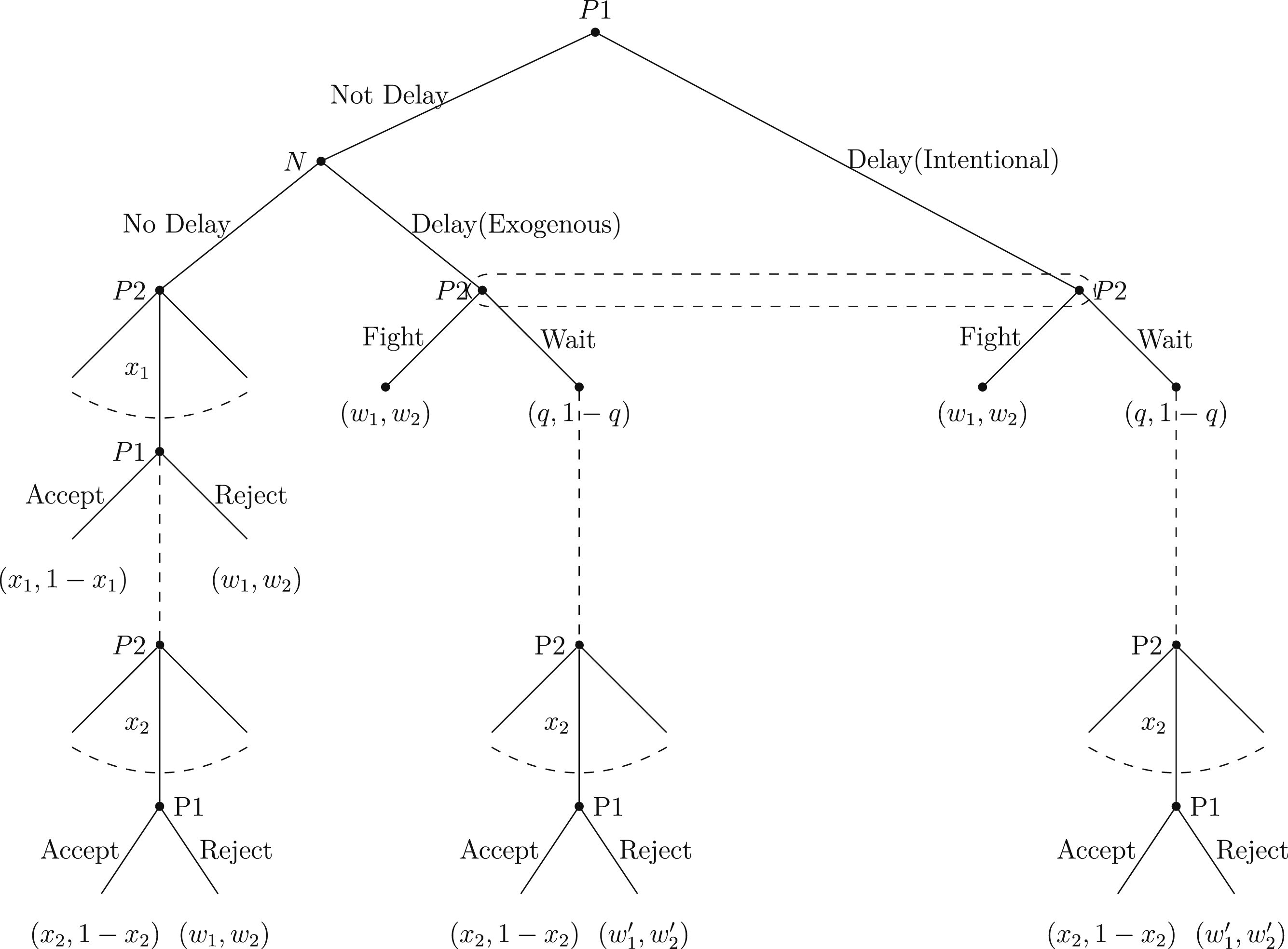
Key Features of the Model
The model incorporates the essential feature of existing theoretical work on the commitment problem—that the expectation of a large power shift could induce the declining state to fight before it is completed (Fearon 1995; Powell 2004, 2006). I innovate by modeling two important features of bargaining that are overlooked by previous shifting-power models: bargaining may be delayed for various reasons, and states may be uncertain about the sources of the delay. In fact, the limiting case of my model with no uncertainty about State 1’s type and the source of delay is a standard shifting-power model.
Delay can be a tactical choice by a state to gain bargaining power in the interim. For example, in 1996, the Peruvian government intentionally stalled negotiations with the Tupac Amaru Revolutionary Movement in a hostage event, to gain time and collect information for a raid (Schemo 1997). In the fifth and sixth rounds of the Six-Party Talks, North Korea used many delaying tactics to exhaust South Korea and the United States until they were ready to concede (Zhou and van Wyk 2021). In the Marshall Mission of 1946, the Chinese Communist Party intentionally delayed peace talks with the Chinese Nationalist Party in order to consolidate its power and foothold in Northeast China. 3
Factors outside of a state’s control may also prolong negotiations. Two primary categories of exogenous factors are (1) obstacles that arise to bargaining itself and (2) unexpected interruptions from home and abroad. As an example of the first category, obstacles to communication and transportation were key to delays in reaching the 1689 Treaty of Nerchinsk between Russia and China. Likewise, disagreements on the terms of negotiation and long-distance travel were responsible for delays in the negotiations of the 1894 Franco-Russian alliance and the 1955 U.S.-Republic of China defense pact (Benson and Smith 2022).
External factors such as domestic turmoil, bureaucratic obstruction and external intervention may also result in bargaining delays. In the Sino-Belgium Treaty negotiations of 1927, the success of the Northern Expedition led by the Chinese Nationalist government intensified the uncertainty in China’s domestic politics, and China’s domestic turmoil delayed the negotiation between China and Belgium (Martin 1980, 133). The U.S. negotiated and signed free trade agreements with Panama, Colombia, and South Korea, but all three agreements were delayed in Congress due to the opposition from labor, environmental groups and import-competing industries (Haftel and Thompson 2013). In July 1928, Japan disrupted negotiations over the unity of China between Zhang Xueliang and the Chinese Nationalist government for 3 months. Neither the warlord nor the central government anticipated the explosive reaction of Japan (Taylor 2009, 84).
I extend earlier work by recognizing that it is difficult for states to distinguish whether any given delay is caused by exogenous circumstances or tactical decisions. There are many sources of exogenous delay, and states that seek a tactical delay could fabricate plausibly exogenous factors to mislead its adversary about the underlying causes, making attribution difficult. For instance, in the negotiations over the Twenty-One Demands, China framed its delays as an innocuous result of shared cultural routines. In the Marshall Mission, the Communist representatives stalled peace talks but attributed delays to their widely dispersed personnel, poor communication equipment, and the lack of transportation tools. 4
If the delay is initiated by states whose power will improve over time, it may serve the purpose of secretly arming, seeking external support or forming alliances to improve bargaining power. However, exogenous causes of delay offer a natural cover for states to stall bargaining in many circumstances. A state that is unable to discern the real source of delay will therefore also be uncertain whether a power shift is afoot. To formalize the ambiguity in the sources of delay, I model the occurrence of delay as a move that is unobservable to State 2. To capture the resulting uncertainty over shifts in relative power, I assume that only the rising type State 1 could achieve a power rise after bargaining delay.
Analysis
I solve the model for Perfect Bayesian Equilibrium (PBE). Perfect Bayesian Equilibrium requires that players act optimally at each information set in the game and that players update their beliefs using Bayes Rule whenever possible, given their knowledge about the strategies of other players. I demonstrate that uncertainty about the reasons for delay facilitates states to obtain bargaining power. As a baseline, I first show that State 1 can not leverage the intentional delay to achieve its power rise peacefully when State 2 can distinguish whether delays are exogenous or intentional. I then show that State 1 can exploit State 2’s uncertainty about the source of delay to initiate the intentional delay, increasing its chance of ascent.
Throughout the analysis of the two-stage game, I focus on conditions under which the rising type State 1 would gain enough power to provoke war in a standard commitment problem model, as this is where my model yields the most starkly novel results. Assumption 1 formalizes this condition.
Assumption 1. If Assumption 1 fails to hold, then the magnitude of power shifts is inconsequential to State 2’s decision-making: State 2 would tolerate a slight power rise of State 1 rather than prevent it with fighting. Assumption 1 is closely related to the war condition in existing literature (Fearon 1995) and is a straightforward simplification of the general condition for wars in infinite horizon models (Powell 2004, 2006).
Distinguishable Sources of Delay
To illustrate that State 2’s inability to discern the source of delay is important for the possibility of a peaceful power shift, supposing instead that at this moment State 2 can discern between the two possible sources of delay. Two properties emerge from all equilibria of the game.
First, the rising type State 1 can not peacefully achieve its power rise anyway when State 2 strongly believes that State 1’s strength will benefit from bargaining delays. This is because State 2 fears the loss of bargaining power that follows both exogenous delays and intentional delays, and will choose to fight regardless of their reasons. Thus, the model with a high prior chance of power shifts is analogous to the existing shifting-power commitment problem models in which the opponent will rise significantly and war ensues (Fearon 1995; Krainin 2017; Powell 2004, 2006).
Second, the rising type State 1 can not cause bargaining delays to peacefully improve its power even if State 2 believes that State 1 is unlikely to benefit from them. State 2 always fights upon the intentional delay with a positive probability, knowing that the rising type State 1 wants to craft delays to obtain power. This “bluff calling” strategy drives the rising type State 1 to imitate the static counterpart who lacks the incentive for delaying. In equilibrium, the rising type State 1 either attempts the intentional delay that accompanies the risk of preventive war, or gambles on the window of opportunity when the bargaining is disrupted by exogenous factors, sacrificing control over its rising process. I term such equilibrium outcomes as partial power shifts.
Indistinguishable Sources of Delay
I now analyze the main model, in which State 2 cannot distinguish delays initiated by State 1 from delays caused by exogenous factors (Nature). In contrast to the baseline model, it is now possible for State 1 to peacefully complete its power rise through the intentional delay, which is summarized in the following proposition regarding the properties of all equilibria.
Proposition 1. Define • If • If Denote State 2’s prior belief about State 1 being the rising type as r. If State 2 cannot independently verify the source of delay, it will be uncertain about the impacts of delay on future negotiations and not able to employ targeted responses to delays. Then State 2 relies on its prior belief to assess the real source of delay and infer the consequence of its responses. When State 2’s prior belief that State 1 will obtain power from bargaining delays is high enough— When State 2 strongly believes that State 1 does not have inherent incentives to cause delays—
Proposition 2. When • The static type State 1 chooses Not Delay; the rising type State 1 chooses Delay. • Facing delays, State 2 chooses to Wait. • There is a peaceful power shift between State 1 and State 2 When State 2 believes that State 1 is unlikely to obtain power after delays, there is a unique Perfect Bayesian Equilibrium in which State 1 adopts a separating strategy profile and each type of State 1 takes its preferred action. The intuition is that the rising type State 1 can stall for time to complete its power rise, meanwhile fabricating excuses and blaming the delay on those fake reasons. Still, State 2 chooses to wait because it is not concerned about the artificial delay that brings about adverse shifts in bargaining power. As a consequence, both types of State 1 obtain its ideal outcome: the static type State 1 has the best chance of obtaining a fair revision of the status quo; the rising type State 1 peacefully improves its bargaining power via the most efficient means and avoids the preventive attack, establishing the power shift as a fait accompli. Thus, the equilibrium outcome is a peaceful power shift when Previous work tends to highlight the provocative implications when there is uncertainty about shifts in relative power, suggesting that power shifts usually involve a positive probability of war (Debs and Monteiro 2014), or power shifts will be disrupted or limited by containment measures such as preventive fighting or sanctioning (Bas and Coe 2016; McCormack and Pascoe 2017; Yoder 2019a). My model investigates the impact of unobservable causes of delay, and identifies the specific condition under which heightened uncertainty about power shifts arising from delaying sources does not necessarily cause preventive wars and may facilitate peaceful shifts in power. Now, I summarize how uncertainty about the reasons for delay influences the outcomes of crisis bargaining. The comparison between the baseline and the main models illustrates the add-on effect of the uncertainty about the reasons for delay on the likelihood of preventive war as well as peaceful power shifts. The finding is concluded in the proposition below.
Proposition 3. Uncertainty about the reasons for delay has the following effects on the equilibrium outcomes: • When • When • When When In contrast, in the main model when State 2 cannot discern the real source of delay, the rising type State 1 attempts the intentional delay since delaying is not informative about its type. State 2 still waits upon delay with unknown sources since its prior belief is sufficiently low. Consequently, the probability of war drops to zero, as the dashed line of Figure 2(a) shows. In fact, State 2 mistakes the intentional delay caused by the rising type State 1 as the exogenous delay triggered by the static type State 1 and Nature. Consequently, the rising type State 1 peacefully accomplishes its power rise with certainty through the intentional delay when State 2 holds a sufficiently low prior belief. The dashed line of Figure 2(b) corroborates that the probability of peaceful power shifts becomes higher after introducing uncertainty about reasons for delay. However, when r∗ < r < r*, uncertainty about the real source of delay loosens the conditions for preventive war. The intuition is that State 2’s inability to identify the real reason for delays induces the rising type State 1 to delay intentionally, therefore aggravating State 2’s concern about the adverse power shift following delays in this intermediate range of beliefs. Anticipating that the rising opponent would exploit its uncertainty, State 2 becomes more cautious about waiting and fights more often than it would otherwise in order to avert the unfavorable shift in bargaining power. Thus, uncertainty about reasons for delay makes the probability of war higher and the probability of power shifts lower when r falls into this middle range, as can be seen in Figure 2(a) and (b). Finally, when r > r*, uncertainty about the reasons for delay has no impact on the chance of war and power shifts, simply because the ex ante risk of adverse power shifts is sufficiently high such that State 2 will fight regardless of the real source of delay. Proposition 3 implies that asymmetric information over whether the opponent is obtaining power can cause peace where war would otherwise have occurred, which is opposite to conclusions in prior work (Debs and Monteiro 2014). My distinct modeling assumption is that there are two dimensions of uncertainty faced by State 2: (1) whether State 1 will be more powerful intrinsically, and (2) whether the observed delay is intentional or exogenous. With uncertainty over only the first dimension, the information about the cause of delay facilitates State 2’s responses to delays that it never wait with full assurance as long as State 1 can possibly benefit from intentional delays. Introducing uncertainty over the second dimension leads to peace, because it can make State 2 mis-attribute the real source of bargaining delay and forgo the timing of preventive attacks. This effect complements previous findings that increasing the amount of uncertainty in a crisis bargaining can reduce the likelihood of conflict (Debs and Weiss 2016; Joseph 2021; Tarar 2023).
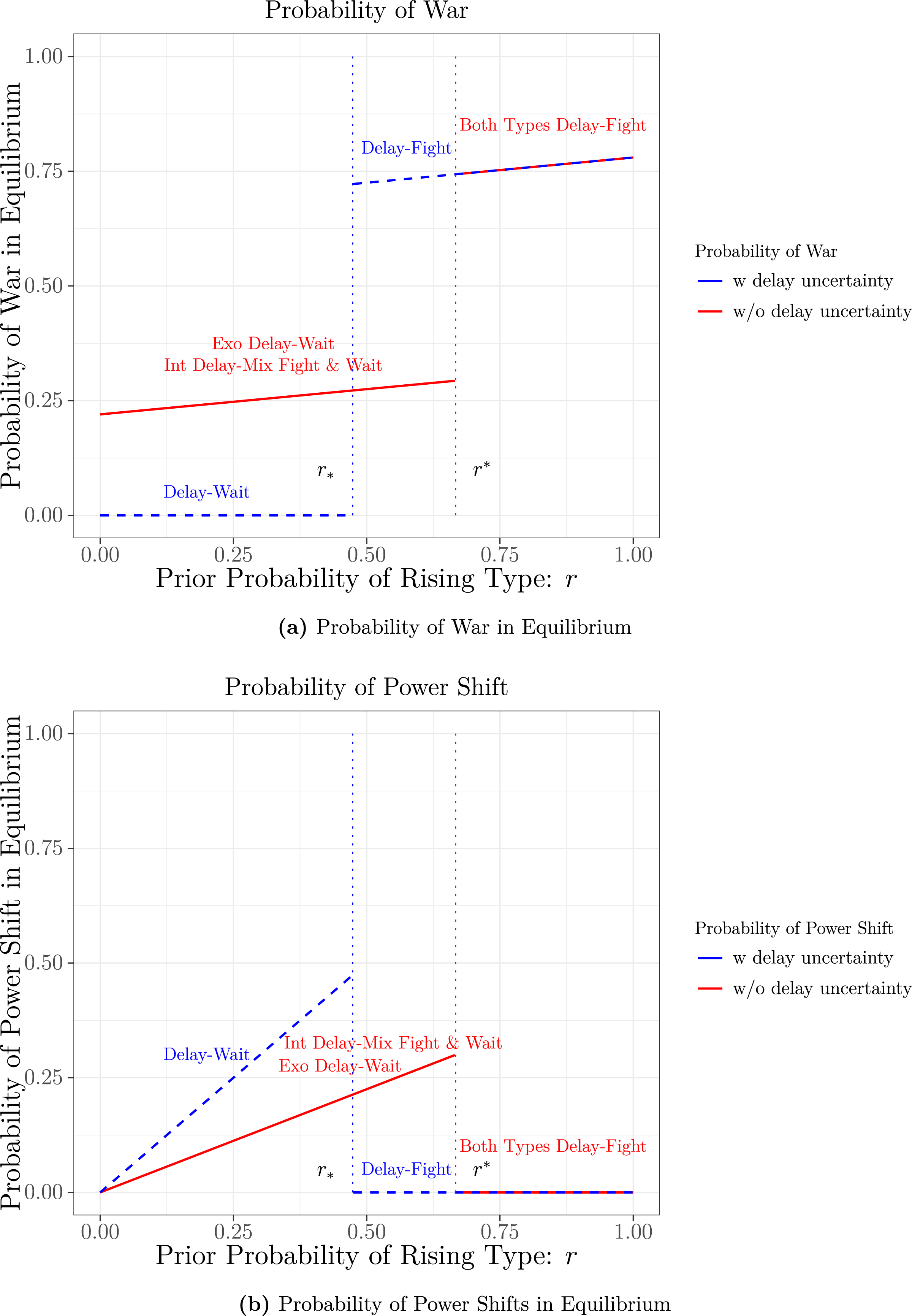
Comparison of the probability of war and power shifts between models with and without uncertainty about reasons for delay. w1 = 0.35, w2 = 0.5, q = 0.3, δ = 0.8, α = 0.45,
Historical Evidence
My theoretical results allow us to better understand historical examples of war that take place during power shifts. In this section, I demonstrate how uncertainty over the sources of bargaining delay resulted in a peaceful power shift in the Twenty-One Demands (1915) negotiation between China and Japan but produced the preventive war between Russia and Japan in 1904. In the former case, Japan did not think it was likely that China’s power was rising and did not recognize that the delay was intentional. In the latter, Japan realized that Russia was intentionally delaying the negotiation to buy more time, and believed Russia’s power would rise if delays continued. In analyzing these historical cases, my theory helps account for the reasons why power shifts might occur in some circumstances whereas they might instead result in preventive wars under different circumstances. I refer to evidence from both primary and secondary sources to track the strategic thinking of key decision-makers when possible (Goemans and Spaniel 2016; Lorentzen, Fravel and Paine 2017).
The Negotiation of Twenty-One Demands (1915)
The negotiation over the Twenty-One Demands illustrates how uncertainty over the sources of delay can result in peaceful power shifts. In January 1915, China was aware that Japanese demands could create frictions between Japan and Western countries. Thus, China’s strategy was to intentionally delay the negotiation while seeking international support, namely by leaking the details of the demands to the U.S. and Britain. Japan consistently believed it was unlikely China’s power would rise and did not recognize that China was intentionally stalling the talks. The resulting uncertainty drove Japan to tolerate bargaining delay and provided a window of opportunity for China to garner external support. By the time Britain and the U.S expressed strong opposition, Japan had to accept the fait accompli that world opinion had shifted in China’s favor. Consequently, Japan dropped the most objectionable demands. Consistent with my theoretical analysis, Japan’s uncertainty over the rise of China and the cause of delay led to a rapid and significant power shift in China’s favor.
The core features of my model are present in the negotiations over the Twenty-One Demands. China was certain that disclosing those demands would invite international opposition to Japan, leading to an increase in China’s bargaining power. Japan could have easily used military means to coerce China into accepting the demands, but eventually failed because China managed to endanger the Anglo-Japanese Alliance and the U.S-Japan relationship. Thus, China and Japan respectively played the roles of a rising State 1 and a declining State 2.
This case is closely related to Proposition 2, which shows the conditions under which a state can delay bargaining to obtain power without triggering preventive war. Two crucial conditions are (1) the declining State 2 cannot distinguish whether the delay is intentional or exogenous, and (2) the declining State 2 must believe its adversary is unlikely to benefit from delays. When these hold, a state can intentionally delay bargaining, but fabricate exogenous reasons to cover the use of delaying tactics. Evidence from primary and secondary sources substantiate the mechanism of my model—Japan failed to ascertain that China’s power would grow over time and China employed delaying tactics.
In the eyes of Japanese elites, 1915 was a unique opportunity to realize complete mastery over China. First, European countries were completely absorbed in World War I, and Japan believed that no Western country could spare any effort for affairs in the Far East (Gowen 1971). Second, other Western governments’ initial reactions seemed weaker than Japan had expected. In the early stages of the negotiation, British politicians still held a relatively favorable view of Japan and suggested that none of the demands were particularly problematic, 6 giving Japan the impression that the Western countries had retreated from Far East affairs (Best 2016; Nish 2002, 99). It is plausible that these initial attitudes by Western powers led Japan to disregard the possibility of external intervention in favor of China.
Upon seeing the initial Twenty-One Demands in January 1915, the Chinese government was aware that practically every item in Group V conflicted with treaty engagements between China and Western nations. Lu Tseng-Tsiang, the Chinese foreign minister, tried every means to delay the bargaining process, which gave the Chinese government time to stoke international objections and solicit outside support. To this end, Lu fabricated exogenous reasons to relax Japan’s suspicion about the cause of delay. Consequently, Japan was not certain that the delay was due to stalling tactics by the Chinese government.
For instance, Lu persuaded the Japanese minister in Peking to meet three times a week rather than on a daily basis, claiming that he needed sufficient time to study the demands in their entirety, that his personal health could not withstand intense meetings, and that his work schedule had been fully filled. At each three-hour meeting, Lu instructed the Chinese staff to serve tea and cigarettes in excessively polite and careful manners that usually took an hour, leaving only 2 hours for formal discussions. The Japanese diplomats did not complain about these gestures, which appeared to be rooted in the cultural routines of Asian countries (Koo, 1983, 33). During the formal discussions, Lu sought to appear either vaguely agreeable or evasive about any agreement by demanding that he had to first consult President Yuan Shih-kai. The Japanese diplomats could not push too hard because it seemed reasonable that any substantive agreement had to be permitted by President Yuan in the first place (Shi 1999, 163-164).
Had Japan realized that China was deliberately stalling, would Japan have resorted to military coercion instead of peaceful negotiation? Predictions from formal models are well-suited for considering such counterfactual outcomes (De Mesquita 1996; Fearon 1991; Levy 2008). Analysis of distinguishable sources of delay makes a prediction in the hypothetical counterfactual: the declining state never wait for the intentional delay with full assurance. This suggests that those Japanese politicians who believed that China was stalling should have advocated for the use of force. There was indeed a different voice within the Japanese government: a section of the Japanese military authority was exasperated by the delay and demanded the use of military force instead (Blumenthal and Chi 1970, 42). However, the Japanese government resisted the use of force and insisted to push through all 21 demands via negotiations (Dull 1950; Takeuchi 2010). Given this, it is plausible that Japan would have used military force had the key decision-makers been able to identify the root cause of delay.
Consistent with the prediction of Proposition 2, the rising State 1 will peacefully improve its bargaining power through the intentional delay, by then the declining State 2 has to accept the power shift as the fait accompli and correspondingly make concessions in the negotiation. Below I provide direct evidence that China obtained international support and sympathy through delaying the talks, and that Japan was compelled to scale back its demands because world opinion had shifted in China’s favor.
While negotiations were stalled, President Yuan Shih-kai instructed Chinese diplomats to secretly leak the demands that threatened Western interests, especially those regarding China’s independence and equal opportunity of trade. As Japan’s ambitions gradually came to light, Western countries changed their tune and grew increasingly distrustful of Japan. The Chinese government managed to shift world opinion as more critical and sensational press about Japan began to appear (Lowe 1969, 244). Britain decided to support China in late April, indicating that “perseverance in the Group V demands could destroy the Anglo-Japanese alliance.” 7 In early May, Britain and the United States explicitly requested that Japan remove Group V. 8 Diplomatic pressure and the threat of intervention by Britain and the U.S. effectively persuaded Japan to moderate its demands. The final demands were much lighter than the initial ones since Japan modified them to mollify many objections raised by the Chinese government (Dull 1950).
My theory shows that China achieved a peaceful power rise through employing delay tactics, allowing it to reduce the scope of Japan’s demands, and this was possible because Japan did not recognize the underlying cause of delay and did not expect Chinese power to grow over the course of negotiations. It complements the existing studies on this case: some historical accounts credit the effectiveness of China’s delaying strategy (Blumenthal and Chi 1970, 41-42; Craft 2014, 36-37); others point to the ineptitude of Japanese diplomacy and Japan’s inability to recognize the intentional delay (Best 2016).
The Russo-Japanese War (1904)
My theory predicts that a declining State 2 will wage a preventive war if it believes that its adversary is becoming more powerful with time and deliberately delaying negotiations. The Russo-Japanese War illustrates this strategic dynamic. Russia was confident in its gradually growing power in Manchuria and was not interested in reaching a hasty agreement with Japan. Thus, Russia’s strategy was to delay negotiations as much as possible until its improving power naturally solved the issue in its favor. Japan lost its patience after realizing that Russia would grow stronger over time and intentionally delayed the talk to tilt the balance of power. Therefore, Japan became determined to fight as fast as possible to prevent Russia from taking a dominant position in the negotiation.
Negotiations between Russia and Japan reflect the essential components of my theoretical model. Russia was confident that the advancement and completion of Trans-Siberian railroads would help Russia gradually annex Manchuria (Kowner 1998, 215). By the same token, Japan stood to lose its existing advantages in Manchuria and Korea if Russia was given more time to grow without check (White 2015, 95). Russia and Japan respectively played the roles of a rising type State 1 and a declining State 2.
Consistent with my theoretical analysis, Japan decided to launch a preventive war when it believed that Russia would become more powerful in the foreseeable future and the negotiation was intentionally delayed to buy time (Nish 2014, 211). Below, I provide direct evidence that Russia purposely stalled negotiations to enhance its military establishment in Manchuria, and Japan resorted to military force to settle the question when concluding that the stalemate would significantly curtail its bargaining power.
The Russian Emperor was convinced that Russia’s power in the Far East stood to increase enormously with every year of peace (Kowner 1998, 217). In an internal meeting of late December 1903, the Russian Emperor explicitly said that time was on the side of Russia and that its position would be strengthened each year (White 2015, 114). After formal exchanges began, Russia delegated some bargaining power from the highest level of authority in St. Petersburg to Port Arthur (White 2015, 72-73). The dual management of negotiations considerably delayed Russia’s diplomatic replies to Japan, as each reply had to go through a cumbersome and dispersed administrative process before it could be formulated and transmitted (Gurko 1939, 281-284; White 2015, 110). The bureaucratic procedure is obviously a crafted reason for delay, as the Russia viceroy at Port Arthur, Yevgeni Alekseiev, suggested: “the negotiation should be prolonged to allow Russia time to reinforce its military strength in Manchuria, and Russia’s geographical position and military strength will gradually solve the question in Russia’s favor as the insufficiency of its land forces is remedied in the course of time” (White 2015, 111, 126).
Japanese decision-makers, however, suspected that Russia’s military power would increase with time. By mid-1903, there appeared to be ample reasons to suspect Russia’s true motives: Russia refused to proceed with a promised evacuation of troops from Manchuria, allowed the ongoing construction of railways to two strategic ports in the Far East, and continued the permanent establishment of civilian and military bases in northern Korea under the disguise of protecting its economic interests (White 2015, 95-99; Malozemoff 2020). Shortly after the begin of formal talks, Russia pressured China and Korea to revise existing treaties and lease new territories in Manchuria and the north of Korea (White 2015, 104). These aggressive acts made it difficult for Japan to reconcile the bargaining delay with the claimed exogenous reasons. 9
Japan decided to fight when it found that the delay was caused by Russia’s desire to significantly improve its bargaining position. In January 1904, Japanese politicians unanimously agreed that Russia refused to enter into negotiations over Manchuria, while simultaneously trying to build up its military strength there, and if Japan had to go to war, it should do so immediately. 10 The Japanese sentiments are explained by Ito Hirobumi’s memorandum in February: “There is no question but that Russia’s aim was from the start to increase her military and naval forces and then reject Japan’s demands. In this way she could fulfill her ambitions in Manchuria and Korea without interference. This being so, if Japan does not now go to war and defend her threatened interests, she will eventually have to kowtow to the Russian governor of one of her frontier provinces” (Nish 2014, 207). While some time would be required to finish the power shift, it was obvious that further delay would only play into Russia’s hands (Romanov 1947, 241). In February 1904, Japan ended diplomatic talks and formally declared war on Russia.
With a close examination of Russia’s delay tactics in negotiations, I show that war followed a preventive logic on the part of Japan. My conclusion concurs with previous historical studies pointing out Japan’s concern about the growing economic and military power of Russia prior to the Russo-Japanese War (Langer 1960, 172), and my model highlights the consequences of intentional delay tactics as a key mechanism underpinning the causes of the war.
Conclusion
This paper identifies a puzzle in international bargaining: why would states tolerate extensive delay in some crisis negotiations, but not others? My answer is that the sources of delay are ambiguous to states. This information asymmetry causes declining states to misperceive the real causes of delay and end up tolerating stalling tactics. Thus, opponent states often try to delay bargaining to buy time to complete a power shift, but claim that exogenous forces are in fact responsible for the delay. Especially, rising states can obtain power peacefully via delaying tactics when declining states can not ascertain the real reason for delay and hold lower prior beliefs about their opponents being the beneficiaries of delays.
The model extends our theoretical understanding of why states accomplish power rise without being the targets of preventive wars. I identify conditions under which a state can achieve a power rise peacefully and completely (Proposition 2). Previous work suggests that rapid and significant power shifts would not be peaceful or complete, either because other states take preventive measures like war and sanctions (Fearon 1995; McCormack and Pascoe 2017; Powell 2004, 2006; Yoder 2019a), or because power shifts are bargained away peacefully with compensation (Chadefaux 2011; Coe 2018; Spaniel 2019). My model yields a clean equilibrium outcome of peaceful power shifts which does not depend on sophisticated assumptions about power dynamics (Bas and Schub 2017), nor involves noisy signals (Bas and Coe 2016; Debs and Monteiro 2014).
On the empirical side, my findings suggest avenues for future research on how uncertainty about power shifts influences the risk of interstate conflicts. One of my theoretical results implies that aggravated uncertainty about potential power shifts, arising from asymmetric information about the reasons for delay, can weakly decrease the risk of war and increase the prospect for peaceful power shifts. This is distinct from conventional results regarding the provocative effect of asymmetric information on international conflicts. My theoretical model is intended to capture and formalize certain aspects of international bargaining, and the results emerging from it only hold under specific conditions and do not carry over into other contexts. Despite the scope conditions, my theoretical results highlight the importance of accounting for the uncertainty about power shifts in evaluating states’ incentive of preventive fighting, calling for more empirical efforts to examine the relationship between power shifts and war.
Although there are extensive theoretical studies on shifting-power commitment problems, empirical investigations on the relationship between power shifts and war remains insufficient. Existing studies focus on measuring the size of potential power shifts and corroborate its positive correlation with war initiation, but overlook quantifying the uncertainty about power shifts (Bell and Johnson 2015). Since my study suggests a more intricate and complex relationship between power shifts and war, future empirical research should (1) spend efforts on measuring the uncertainty about power shifts using existing or novel data sources, and (2) investigate whether uncertainty about power shifts is associated with a higher risk of war, and unpack the specific conditions under which increasing this kind of uncertainty may or may not induce more conflicts.
Supplemental Material
Supplemental Material - The Politics of Delay in Crisis Negotiations
Supplemental Material for The Politics of Delay in Crisis Negotiations by Haonan Dong in Journal of Conflict Resolution
Footnotes
Declaration of Conflicting Interests
The author(s) declared no potential conflicts of interest with respect to the research, authorship, and/or publication of this article.
Funding
The author(s) received no financial support for the research, authorship, and/or publication of this article.

Data Availability Statement
Data sharing not applicable to this article as no datasets were generated or analyzed during the current study.
Supplemental Material
Supplemental material for this article is available online.
Notes
References
Supplementary Material
Please find the following supplemental material available below.
For Open Access articles published under a Creative Commons License, all supplemental material carries the same license as the article it is associated with.
For non-Open Access articles published, all supplemental material carries a non-exclusive license, and permission requests for re-use of supplemental material or any part of supplemental material shall be sent directly to the copyright owner as specified in the copyright notice associated with the article.
