




Abstract
Research on rebel behavior during conflicts has traditionally focused on the use of violent tactics. However, evidence from several intrastate wars suggests that armed groups also occasionally employ general strikes—a method of civil resistance that has typically been associated with nonviolent groups. But when do rebels resort to general strikes? I argue that these tactics have a particular function which can offset potential risks for rebels after they have suffered losses in previous battles: Through general strikes, rebels signal sustained authority to the local population. The argument is tested for districts in Eastern India using newly compiled, disaggregated data on contentious action during the Maoist conflict. The paper contributes to a burgeoning literature on wartime civilian activism in two ways: First, it shows that armed groups themselves rely situationally on civilian mobilization. Second, it investigates the effect of conditions endogenous to the conflict on these tactical choices.
Introduction
We typically conceive of intrastate armed conflicts as exceptional political situations in which nonstate actors challenge the authority of the government with organized violence. However, rebel groups sometimes employ tactics beyond the mere use of armed force, involving forms of popular mobilization that are usually characteristic of nonviolent movements: Groups across diverse ideological and geographical contexts ranging from Nepal’s and India’s Maoist rebellions (Swain 2010; Mishra 2017) over separatist conflicts in Aceh and Kashmir (Keller 2017) to ethnic and religious conflicts in Iraq (Kamber and Glanz 2008) have repeatedly enforced general strikes in the course of predominantly violent insurrections. In some instances, such as the Nepalese civil war and the First Congo War, rebel-sponsored general strikes even decisively marked the final episodes of the respective conflict, leading to either concessions or regime change (Keller 2017; McGreal 1997). Despite their sometimes massive impact, though, general strikes are a hitherto unexplained variation of rebel behavior that has received relatively little attention in the academic debate.
The use of general strikes or civil resistance methods more generally by armed actors represents a puzzle. After all, the mobilization of civilians for contentious performances in public spaces departs considerably from tactics of insurgent warfare, which are usually characterized by clandestine and small-scale operations. This paper aims to explore how conflict dynamics affect rebel groups’ propensity to employ general strikes during an ongoing violent campaign. I assume that insurgents operate in a strategic context in which tactical decisions are made based on their costs and benefits in a given situation. The implementation of general strikes can draw attention to an area, requires the diversion of resources, and runs the risk of backfiring if insurgents fail to enforce compliance. I argue, however, that particularly in cases where rebels experience battlefield losses in a certain locality, general strikes can outweigh these drawbacks by signaling ongoing local control and operational capacity to the local population. I test this argument in a systematic, subnational study using novel data on the implementation of general strikes during India’s ongoing Maoist insurgency. While this conflict has predominantly been portrayed against the backdrop of the surge in violence, the militant Communist Party of India-Maoist (CPI-Maoist) has relied heavily on popular mobilization as a contentious performance alongside the use of armed force since the very beginning of the insurgency.
In particular, the Maoist rebels frequently rely on bandhs, a form of civil disobedience in South Asian countries that falls into the broader category of general strikes and implies the complete shutdown of all public and economic life in a specific region (Sinha, Sinha, and Shekhar 2006; McHenry 2006). The results from linear probability and logistic regression models show that rebel casualties increase the probability of rebel-initiated general strikes. These findings remain robust across different model specifications, including the use of different estimation strategies, the omission of influential cases, and alternative operationalizations of the independent variable. Moreover, I assess the plausibility of the supposed causal direction from battlefield losses to general strikes and discuss alternative explanations, which both strengthen confidence in the theoretical argument.
The paper contributes to the existing research on rebels’ tactical choices in three ways: First, by showing that armed groups strategically employ civil resistance alongside violent methods, it sheds light on a hitherto undertheorized variation of rebel behavior. The study thereby adds to a burgeoning strand of literature that moves beyond the strictly dichotomous understanding of groups relying on either armed force or civil resistance (e.g. Cunningham, Dahl, and Frugé 2017). Second, the finding that rebels increasingly resort to civil resistance methods in the wake of battlefield losses highlights the importance of factors endogenous to the conflict as crucial drivers of tactical variation. This also has practical implications: interpreting the absence of a clear relationship between prior losses and subsequent attacks as a sign of rebel inactivity may prove misleading, as armed groups may instead simply shift to unconventional tactics of civil resistance. Lastly, the observation that rebels use general strikes in particular allows for a more nuanced understanding of the functional differences across various forms of civil resistance. The article shows that general strikes’ specific quality of signaling sustained presence and control to local civilians makes them a particularly useful tactical choice in reaction to battlefield losses as compared to other forms of civil resistance such as protests or demonstrations.
Previous Research on Rebel Tactics and Civil Resistance
Insurgent groups’ tactical choices have been central to the study of rebel behavior. Existing research has particularly focused on explaining variations in the use of violent tactics, including violence against civilians (Weinstein 2007; Hovil and Werker 2005; Staniland 2012a; Humphreys and Weinstein 2006). A thriving literature on rebel governance has yet demonstrated that rebel behavior often exceeds the mere use of violence, sometimes even resulting in the establishment of wartime institutions (Kasfir 2005; Metelits 2010; Mampilly 2011; Staniland 2012b). In addition, recent research in the field of contentious politics implies that even militant groups occasionally mobilize civilians for public protests—a tactic traditionally associated with nonviolent movements (Keller 2017; Asal et al. 2013; Arves, Cunningham, and McCulloch 2019). Related studies highlight the need for a broader perspective on rebel tactics beyond violence, but focus mostly on explaining variation between individual rebel groups rather than tactical variation over time.
Only few studies have attempted to explicate the conditions under which individual groups employ violent and civil resistance tactics at different points in time. Cunningham, Dahl, and Frugé (2017) demonstrate that short-term objectives such as garnering popular support, increasing visibility within the movement, withstanding repression, or increasing leverage can lead individual resistance organizations to switch dynamically between tactics. This idea builds on earlier works that remain deliberately agnostic on the character of organizations and instead assume that groups strategically use either violent or nonviolent modes of contention depending on the state’s prior actions (Moore 1998; Lichbach 1987).
Turning to civil war studies, however, we still know little about how specifically rebel groups change to civil resistance tactics under the conditions of armed conflict. Disaggregated studies on individual civil wars have focused on both spatial and temporal factors to explain rebels’ tactical variation. With regard to spatial variation, some studies have found local constituency bases (Ottmann 2017; Fjelde and Hultman 2014), preexisting networks and support (Holtermann 2016; Balcells 2011), the level of local control (Kalyvas 2006), or the presence of competition with other armed groups (Metelits 2009) to be significant determinants for the use of violence against civilians. In terms of temporal variation, some authors have foregrounded explanations connected to the war dynamics themselves, specifically with regard to shifting balances of power (Holtermann 2016) or the degree of state repression (Shellman, Levey, and Young 2013; Asal et al. 2019). Horowitz, Perkoski, and Potter (2018) demonstrate that violent state response and intergroup competition enhance the tendency for tactical diversification among armed groups. Similarly, both Hultman (2007) and Wood (2014) show that armed groups increasingly target civilians after battlefield losses.
These studies highlight the importance of factors endogenous to the conflict for explaining tactical variation, but restrict their focus largely on variations of violence. By contrast, works in the field of contentious politics have highlighted the analytical value of broadening the perspective on groups’ repertoires to include violent and nonviolent tactics alike. However, the specific strategic rationale behind armed groups’ use of civil resistance methods in individual conflicts has remained underspecified. This study aims to address both shortcomings and to contribute to a better understanding of the factors determining why actors that primarily rely on the use of violence occasionally employ civil resistance methods.
Theoretical Framework
In the following, I address the relationship between conflict dynamics and insurgents’ use of civil resistance with specific reference to general strikes. A general strike is understood here as a contentious performance in which all people in a specific area are called upon to withdraw from their daily activities and thereby bring the public and economic life to a standstill (Sharp 1973). As opposed to purely military tactics, general strikes as a method of civil resistance are characterized by the mobilization of unarmed civilians beyond the immediate core of armed fighters (Schock 2005). Although typically associated with nonviolent movements, examples of general strikes called by Islamist insurgents in Iraq (Parker 2004) over the left-leaning Sandinista National Liberation Front (FSLN) in Guatemala (Washington Post 1979) to the separatist Acehnese rebels in Indonesia (Dutter 2003) suggest that also armed groups resort to this method—regardless of their political alignment, goal or the geographic context. But why do rebels use general strikes?
At the heart of my argument lies the assumption that general strikes possess a functional feature that can be advantageous for armed actors under certain conditions: General strikes signal continued authority over a given locality to the local population, which makes it a rational tactical choice in situations when this very authority is jeopardized.
Local Control and Rebel Behavior
Maintaining authority in a given geographical area represents a key strategic imperative for many rebel groups. Local control decreases civilians’ incentives to defect and, in turn, increases incentives to collaborate with the insurgents (Kalyvas 2006). This aspect gains particular salience in asymmetric conflicts, when rebels become highly dependent on civilian support in order to offset the military disadvantage vis-à-vis the state (Balcells and Kalyvas 2014).
Given its potential to diminish a particular group’s authority, any threat to the current state of local control is thus likely to be taken seriously by that group. Particularly when control is incomplete or disputed, these threats stem most directly from changes in the balance of power between the combatants. Each battle-related casualty carries the potential to impact local perceptions about the further trajectory of war in the region. If the local population perceives the fortunes of war to turn against the rebel group and anticipates that the government will regain control in the area, the incentives for defection will increase and the very power base on which the insurgency is built can be undermined. Battlefield losses in a given locale are thus likely to prompt rebels to react in the very same location with the intent to signal the maintenance of authority there to the local population.
In order to signal sustained authority in the wake of battlefield losses, rebels sometimes react with punitive actions against the civilian population (Wood 2014). However, especially indiscriminate violence can easily backfire and alienate the civilian population (Kalyvas 2006), which may eventually contribute to a further loss of authority. Instead of using military coercion, rebels that already enjoy a certain degree of local control thus occasionally resort to nonviolent or political actions in order to demonstrate sustained authority. For example, some militant groups develop elaborate institutions or provide basic services, which can serve as a powerful testament for the groups’ local dominance and the state institutions’ lack of authority in a given area (Mampilly 2011). These specific endeavors certainly require a longer-term time horizon on the rebels’ part and may be unsuitable as reactions to situational threats to local authority. However, rebel governance comprises a much broader set of attempts to engage with civilians for public purposes (Kasfir 2015, 21). These efforts often produce structures enabling rebels to mobilize civilians for individual public actions—typically with the aim of bolstering local control (Huang 2016; Cunningham and Loyle 2021). In some instances, rebels mobilize civilians for acts of civil resistance, including protest rallies and general strikes (Keller 2017). In the following, I will explain why specifically the latter are a political action used by rebels in reaction to battlefield losses and a perceived loss of control.
The Strategic Advantage of General Strikes in the Context of Ongoing Conflict
General strikes aim at the comprehensive popular mobilization of (nearly) all segments of society—including the employees of public institutions and infrastructural facilities (Sinha, Sinha, and Shekhar 2006; Spivak 2014; Crook 1934). They can inflict significant economic damage (Sharp 1973). However, arguably more important is the signal sent by a general strike: If a group manages to enforce a complete standstill in a given area (and occasionally determine exemptions of the strike), it displays its own authority and at the same time demonstrates the state’s incapacity and powerlessness to the population (Schock 2005; Crook 1934). Lakier’s report from a general strike by a Nepali movement organization illustrates this logic, as the strike demonstrated the organization’s ability “to subvert the government’s control over roads, markets, and offices and to establish in its place their own, albeit temporary, authority over those spaces” (Lakier 2014, 155).
This goal is not necessarily tantamount to the aim of achieving genuine popular support. Lakier notes that “rather than unpersuasive demonstrations of popular support, what bandhs and protests like them function to symbolically demonstrate is the power (rather than the popularity) of their organizers” (Lakier 2014, 11). It is here were general strikes can differ markedly from other forms of civil resistance such as demonstrations, which primarily aim at raising awareness on an issue and garner support from the public, but do not necessarily disrupt state control (Sharp 1973, 114). By contrast, the potential to bring all public life to a standstill makes general strikes particularly suitable to convey the image of state incapacity. In some instances, the aim of showing authority can even lead organizers to resort to coercion in order to enforce compliance, as examples from noncooperation campaigns in Lebanon, India, Myanmar, Malaysia and South Africa demonstrate (D. Horowitz 2001; Seidman 2000).
Given that general strikes are a powerful means to signal local state incapacity, they can be a rational choice for rebels especially in situations when their own authority is jeopardized. The successful mobilization of civilians to refrain from their everyday activities signals the local population’s continued submission to the rebels’ commands without necessarily risking the alienating effect of indiscriminate violence. Moreover, the rebels’ power to suspend all public services such as schools or offices serves as a vivid demonstration of the government’s inability to enforce control in a specific area—even if the state has managed to inflict military losses on the rebels.
Evidence from different conflict contexts corroborates the assumed rationale of general strikes as signals of local rebel authority. For instance, groups such as the Free Aceh Movement (GAM), the CPI-Maoist, and insurgents in Kashmir have repeatedly called for complete shutdowns within their strongholds on national holidays. These performances served as acts of open defiance to symbols and rituals associated with the state, often accompanied by symbolic shows of allegiance with the rebels through the hoisting of flags (Ahmad 2005; Japan Economic Newswire 2002). A Fatah-led call for a general strike in Hamas-controlled areas in 2007 has even been explicitly linked by the organizers to the aim of “undermin[ing] Hamas’s power and rally[ing] the support of the Palestinian street” (Abu Toameh 2007).
We also find evidence for the assumption that these strike calls are often responses to setbacks on the battlefield. In fact, rebels’ strike calls frequently legitimize protest actions with the prior killing of members in clashes with security forces (e.g. Liberation Tigers of Tamil Eelam (LTTE), Xinhua General News Service 2005) or opponents’ military advancements in own territory (e.g. Revolutionary Armed Forces of Colombia (FARC), Ferrer 2001). General strikes can be a preferred tactical choice for the aim of undermining state capacity particularly after major losses, as rebels can simultaneously signal strength and avoid further direct military confrontations with security forces. Chakrabarty et al. describe a situation during an insurgent-enforced general strike in India that illustrates this rationale: …during the Naxal blockade, the police were completely on the back foot. Other than patrolling, there was nothing that the police could do, and even patrolling could not prevent the Naxals from going ahead with their agenda. Of course, the police may claim that there were no major casualties reported, but bloodshed was not on the Naxal agenda. (2014a, 188).
Rebel groups typically claim responsibility for the strike already a priori by announcing the date, location and sometimes exempted sectors. This includes in many cases explicit threats against those who intend to defy the strike call, like the FARC warning that strike resisters will “face the consequences” (BBC Summary of World Broadcasts 1998). The preparation of the strike is moreover often accompanied by coordinated actions, including the distribution of leaflets and the felling of trees in order to obstruct the movement of traffic. During the strike itself, rebel groups typically enforce the shutdown either through threats or personal presence, and by setting up road blocks and barricades. During a Fatah-led general strike in Hamas-controlled Gaza strip, for instance, militants interrupted school sessions sending teachers and children home (Bazak 2006), while armed strike enforcers from the Basque Fatherland and Freedom (ETA) and LTTE reportedly patrolled the streets enforcing the closure of still running shops or forcing people to remain indoors (Deutsche Presse-Agentur 2000; Xinhua General Overseas News 1990). In many instances, the mere threat of violence suffices to ensure widespread compliance with the general strike (see, for instance, Lakier 2014).
In sum, general strikes signal a group’s local authority to locals, while retaining the strategic advantage of avoiding direct confrontations with security forces and the potential backlash from indiscriminate violence. Given these strategic advantages, why do rebels yet only occasionally resort to this form of civil resistance?
The Strategic Costs of General Strikes in the Context of Ongoing Conflict
Despite the potential benefits, general strikes are also associated with costs that restrict their strategic advantage for rebel groups. First, the intended effect of demonstrating local authority can backfire if the local population defies the strike call. This may be the case when civilians perceive the personal damage inflicted through the strike to be higher than the costs of non-compliance. When the Maoist insurgents in Nepal called for a general strike at a time of crucial student exams, for example, public outcry led the rebels to concede and postpone the planned protest action (Krämer 2003). Particularly when the frequency of strike calls rises, the risk of widespread defiance increases, and the intended effect of showcasing local authority can be undermined. In a strong testament of this concern’s salience for rebels, the CPI-Maoist in an internal review reportedly recognized the growing frustration among the local population, who “lost interest [to participate in protest actions] when we started calling bandhs every few days” (Bhattacharya 2016).
Second, the public exposure required for the implementation of civil resistance methods more generally makes insurgents an easy target for potential state actions. Especially rebels engaged in asymmetric conflicts typically attempt to compensate for their relative disadvantage in capabilities with a strategy that builds on swift surprise attacks and the avoidance of enemy encounters (Kalyvas and Balcells 2010). Both the mobilization for and implementation of civil resistance methods require a degree of public preparation and exposure that counteracts the assumed advantages of clandestine action (Keller 2017). General strikes do not necessarily require the concentrated assembly of people in confined places, which mitigates the problem of exposure. Nonetheless, the announcement of general strikes—including location and timing—inevitably draws attention to a specific location, which conflicts with traditional tactics of insurgent warfare.
Third, methods of civil resistance typically require resource investments that are comparatively costly for armed actors. Horowitz, Perkoski, and Potter (2018) argue that militant groups generally refrain from diversifying their tactical repertoires, as it usually entails the diversion of resources away from proven capacities. Deviations from well-established military procedures to forms of popular mobilization can, on the one hand, evoke intra-organizational resistance and increase the probability of splits (Keller 2017, 78). On the other hand, civil resistance methods require mobilization capacities that may simply not be at the disposal of a clandestine organization specialized in insurgent warfare. This is particularly true for noncooperation and protest tactics (Cunningham, Dahl, and Frugé 2017). Apart from costs stemming from potential intra-organizational disagreement about the diversion of resources, armed groups may thus simply lack the capacities necessary for conducting civil resistance methods.
Given these drawbacks, I expect rebel groups to only use general strikes under conditions that make their use particularly valuable from a tactical viewpoint—that is, to demonstrate sustained authority after losses in the battlefield. From these considerations follows the hypothesis:
Research Design
Scope Conditions and Case Selection
The scope of the argument encompasses conflicts that are characterized by three conditions: First, the rebel group seeks to establish or maintain local control. Through governance processes, insurgents are often capable to mobilize civilians for political actions—including general strikes (Huang 2016). However, especially when insurgents do not rely on civilians—for example because they draw from external assistance or income from natural resources—governance may be a subordinate strategic priority (Weinstein 2007; Kasfir 2015). Empirical evidence suggests that particularly these groups are less likely to resort to political actions (Huang 2016), but to the contrary are more likely to use violence against civilians than other groups (Wood 2014). My argument is thus likely to apply only to groups that attempt to establish control over civilians.
Second, the rebel group’s strategic decisions are embedded in an environment of high external pressure from the state. While a certain degree of local control is necessary in order to mobilize civilians for general strikes, my argument stipulates that rebels will likely resort to these means when their acquired control is threatened or contested by an opponent. Third, the group has the organizational capacity to carry out both violent and civil resistance tactics. The previous section emphasized that rebels’ use of civil resistance tactics is associated with risks related to the distribution of organizational resources. Therefore, I expect rebel groups to be particularly likely to use civil resistance tactics when their organizational structure already reflects the designation of some resources to the implementation of political actions, that is, when the group has a political wing (Keller 2017).
I use the case of India’s Maoist insurgency to test my theoretical proposition. The study focuses on the most recent wave of the ongoing conflict, which started in September 2004 with the merger of two formerly independent militant groups and the CPI-Maoist (Chakrabarty 2014a). The organization’s operational radius has increased rapidly ever since, with occasional attacks being reported in almost all parts of the country. However, the vast majority of both Maoist attacks and counterinsurgency operations have remained confined to six states: West Bengal, Bihar, Jharkhand, Odisha, Chhattisgarh, and Andhra Pradesh (Chakrabarty 2014b).
The conflict represents a typical case with regard to the outlined scope conditions: First, the CPI-Maoist has underscored its ambition to seek and maintain local authority through the development of governance structures, including “People’s Governments” and the provision of services (Kennedy 2014; Suykens 2015). Second, the military capabilities of the belligerents are highly asymmetrical, a condition favoring the diversification of rebel tactics. As a country with relatively stable political institutions that has witnessed strong economic development in the recent past (World Bank 2018), India possesses significant aggregate capacities to address domestic armed insurrections. At the same time, however, India exhibits an extraordinarily high number of individual conflicts in different parts of the country. Among these, the Maoist insurgency has been the largest, in terms of both geographical spread and the number of armed fighters (according to the Non-State Actor Dataset v.3.4). Accordingly, the central government has placed an emphasis on combating the insurgency, labelling it the country’s “single biggest internal security challenge” (Singh 2006). Alongside targeted development and capacity-building programs (Dasgupta, Gawande, and Kapur 2017), military operations and increased troop presence in Maoist-affected areas have remained a key pillar of the central and state governments’ counterinsurgency efforts (Shapiro et al. 2017; Chakrabarty 2014a). The conflict context thus exhibits a high degree of external state pressure on the rebel group, even in districts with strong rebel control. I expect this to be a prime condition driving tactical decisions to use general strikes.
Third, although the CPI-Maoist’s strategic approach explicitly builds on insurgent warfare (Ramana 2014), the group consists of a separate political wing alongside its military branch and has demonstrated its ability to carry out general strikes since the very beginning of the insurgency (South Asia Terrorism Portal 2017; Suykens 2010; Chakrabarty 2014a). A peculiarity of the case is that the analysis of India’s Maoist insurgency allows us to largely cancel out external factors other than the state. Most importantly, several authors have pointed to the importance of competition with other nonstate groups challenging the state as a driver of tactical diversification (Horowitz, Perkoski, and Potter 2018; Cunningham, Dahl, and Frugé 2017). Although the conflict has historically been connected to other armed groups within the broader Naxalite movement, no larger armed contender in the movement apart from the CPI-Maoist has exhibited relevant activities after 2004. 2
Data and Variables
The unit of analysis is the district-week for the observation period 2006–2009. The start date marks the year in which the conflict intensified markedly following the breakdown of negotiations between the insurgent group and the Indian government (UCDP Conflict Data Program 2019). My theoretical argument is that battlefield losses yield the expected effect because they constitute a perceived threat to local control. I therefore restrict the analysis to those districts of the six most-affected states that actually exhibited a high degree of rebel control prior to the investigation period.
For this purpose, I rely on the Ministry of Home Affairs’ (MHA) assessment of Maoist-affected districts, which is obtained from Mukherjee (2018). The data is particularly useful for capturing the phenomenon of interest as the exposure to prior violence is only one among five criteria for districts to be included, the other factors being organizational consolidation (i.e., the operation of parallel administrations through the establishment of “liberated areas” or “guerrilla zones”), the presence of armed squads as an indicator of the rebels’ capacity to carry out violent acts, the presence of mass organizations providing logistical support, and the active engagement of the police or the administration in the district to win back control (Mukherjee 2018).
The restriction to such districts ensures four baseline conditions: First, all districts exhibit a sufficiently high degree of prior Maoist control, which means battlefield losses are not perceived as isolated events but rather as a threat to the Maoists’ local presence. Second, the presence of armed squads opens up the possibility that general strikes are carried out not as a result of insufficient local capacity, but rather as an alternative to purely violent tactics. Third, the criterion of organizational consolidation increases the probability that the rebels are capable of mobilizing the civilian population for the purpose of carrying out general strikes in the first place. Lastly, the criterion of active engagement by local security forces safeguards against potential selection bias stemming from the possibility that districts with a stronger Maoist presence (and likewise mobilization capacity) are more likely to be targeted by the state. Figure 1 shows the sixty-five districts included in the sample. 3
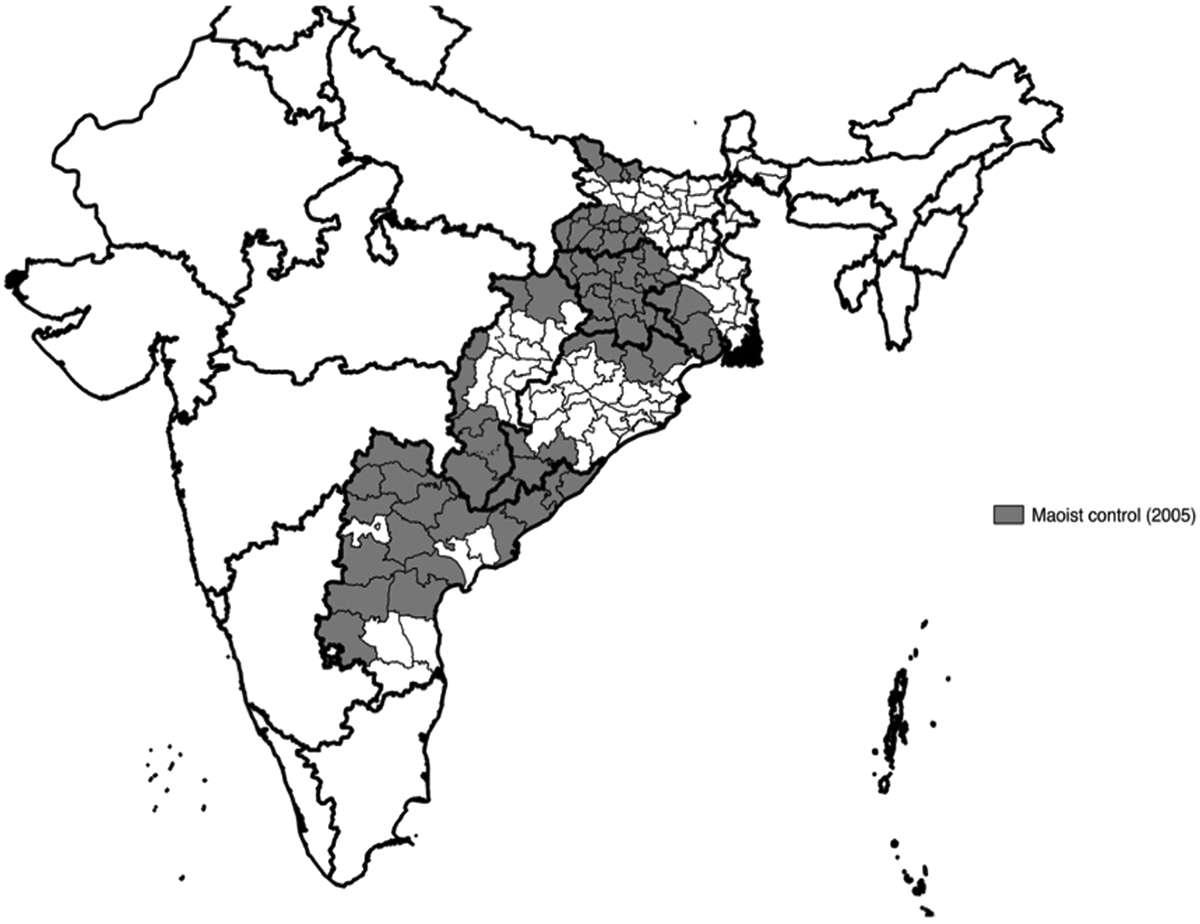
Indian districts considered for the analysis (baseline 2006).
I use original event data on Maoist general strikes for measuring the outcome of interest. The data were obtained through the manual coding of newspaper articles from the Times of India, The Hindu and Hindustan Times via Factiva. These publications represent the major English-language dailies with the highest circulation in India, thus ensuring an appropriate coverage of events across states. Individual events were coded with regard to the tactics used, the actors involved, the issue at stake, the date and location, the local impact and—if applicable—the date of announcement.
Based on these information, I considered events meeting the following three criteria for the dependent variable: First, I have focused on bandhs, shutdowns, general strikes, hartals, and economic blockades as phenomena representing a set of contentious activities with largely congruent traits that capture the type of protest relevant to my argument. Bandhs, as well as the almost identical form of agitation called hartal, are usually subsumed under the broader category of general strikes (see, for instance Schöttli, Mitra, and Wolf 2006; Suykens 2010; Sharp 1973). 4 It is important to note that these performances are not confined to militant groups. They represent frequent forms of protest used by social movement organizations and political parties across various ideological orientations throughout South Asia (Dhavan 2006; Chatterjee 2016; Lakier 2014).
Second, being interested in testing how battlefield losses affect rebels’ propensity to carry out general strikes, I have decided to include only those event locations for which an actual impact has been reported. This usually takes the form of sabotage acts, road blockades, closed shops or institutions, or disrupted traffic. Third, I have only considered events for which the CPI-Maoist or its closely affiliated outfit, the People’s Committee against Police Atrocities, has been clearly named as the actor, thus excluding actions by front organizations or Naxalite groups not engaged in violent conflict with the state, such as the Communist Party of India (Marxist-Leninist). A clear identification of the actors was facilitated by the fact that the implementation of strikes has usually been preceded by an announcement.
From these data, I have constructed a dummy variable indicating whether the CPI-Maoist carried out a general strike in a district-week, which resulted in a total of 240 positive outcomes for the sample of districts used here. It should be noted that observations with general strikes are relatively rare due to the fine-grained level of aggregation. In total, the onset rate is 1.78 percent. Using a binary outcome has several advantages over using a count variable for the present case. First, it better reflects my ambition to explain the occurrence rather than the intensity of rebel-sponsored general strikes. Second, multiple strike events per district-week occur very rarely, with 91 percent of the positive outcome cases only containing a single event. Third, the fact that strikes sometimes span several days makes it hard to distinguish individual general strike events within a single district-week.
The independent variable measures the sum of rebel casualties in the same district from the previous week. The data is obtained from Hoelscher, Miklian, and Vadlamannati (2012), who compile timely and spatially disaggregated event data on Maoist-related violent events resulting in at least one fatality from the South Asian Terrorism Portal (South Asia Terrorism Portal 2016), the Global Terrorism Database (National Consortium for the Study of Terrorism and Responses to Terrorism 2016), and the Worldwide Incident Tracking System (National Counter Terrorism Center 2010; Wigle 2010). In total, 252 observations (1.86 percent of all observations in the sample) show at least one Maoist casualty, with a maximum of twenty-four deaths.
Given the reliance on media-based data, a potentially substantive source of bias could result from specific reporting patterns. With regard to the independent variable, the triangulation of different sources in Hoelscher, Miklian, and Vadlamannati’s (2012) data compilation at least mitigates this concern. The measurement of the dependent variable is potentially more problematic, as the reporting of strike locations could gravitate toward districts in which violence has previously been reported. However, most general strikes, including those in the targeted locations, have typically been publicly announced beforehand. As a result, and contrary to violent events, their reporting should be considerably less dependent on news outlets’ prior awareness of specific regions or insufficient diffusion of information from heavily affected districts.
I use linear probability and logistic regression models with district fixed-effects as the main estimation approach. Fixed-effects models discard all time-invariant factors from the analysis. The effect of battlefield losses on the outcome is thereby inferred only from variation within individual districts, which reduces omitted variable bias stemming from stable, unobserved heterogeneity between individual districts (Firebaugh, Warner, and Massoglia 2013). This includes also relatively slowly changing, district-specific attributes that could potentially influence the conjectured relationship such as economic development or the share of marginalized ethnic communities. In addition, I control for longer time trends by including year-dummies in all models.
I furthermore add several time-varying covariates that could potentially affect the presumed relationship between the independent and dependent variables. The number of police or paramilitary casualties per district-week (taken from Hoelscher, Miklian, and Vadlamannati (2012)) accounts for the possibility that the overall conflict severity in a district drives the presumed relationship. Dummies for election dates and public holidays in the same week control for periods of potentially heightened conflict and strike activity. In order to control for serial autocorrelation, I include a variable (plus its squared and cubic polynomial) indicating the time passed since the last strike event in the district (Carter and Signorino 2010). A spatial lag to account for spatial autocorrelation is included by constructing a dummy variable indicating whether a general strike occurred in the previous week in any adjacent district.
Empirical Analysis
Table 1 reports the findings from the linear probability (models 1 and 2) and logit models (models 3 and 4) with robust standard errors clustered at the district level. Models 1 and 3 only estimate the relationship between the independent and dependent variables with district- and year-dummies, while models 2 and 4 add the control variables. In all instances, the results point to a positive and significant effect of rebel casualties in the previous week on the probability of general strikes. In substantive terms, the predicted probability of experiencing a rebel-sponsored strike increases from 1.7 percent in the absence of any Maoist casualty to 9.4 percent for nine casualties and 16.3 percent for seventeen fatalities according to model 2 (left-hand side of Figure 2). 5 Turning to the logit model (model 4), the predicted probability increases at a similar rate for relevant values of the independent variable, from a baseline of 2.3 percent for zero casualties to 10.9 percent for nine casualties (right-hand side of Figure 2).
Regression Results for the Association between Prior Rebel Casualties and the Implementation of General Strikes.
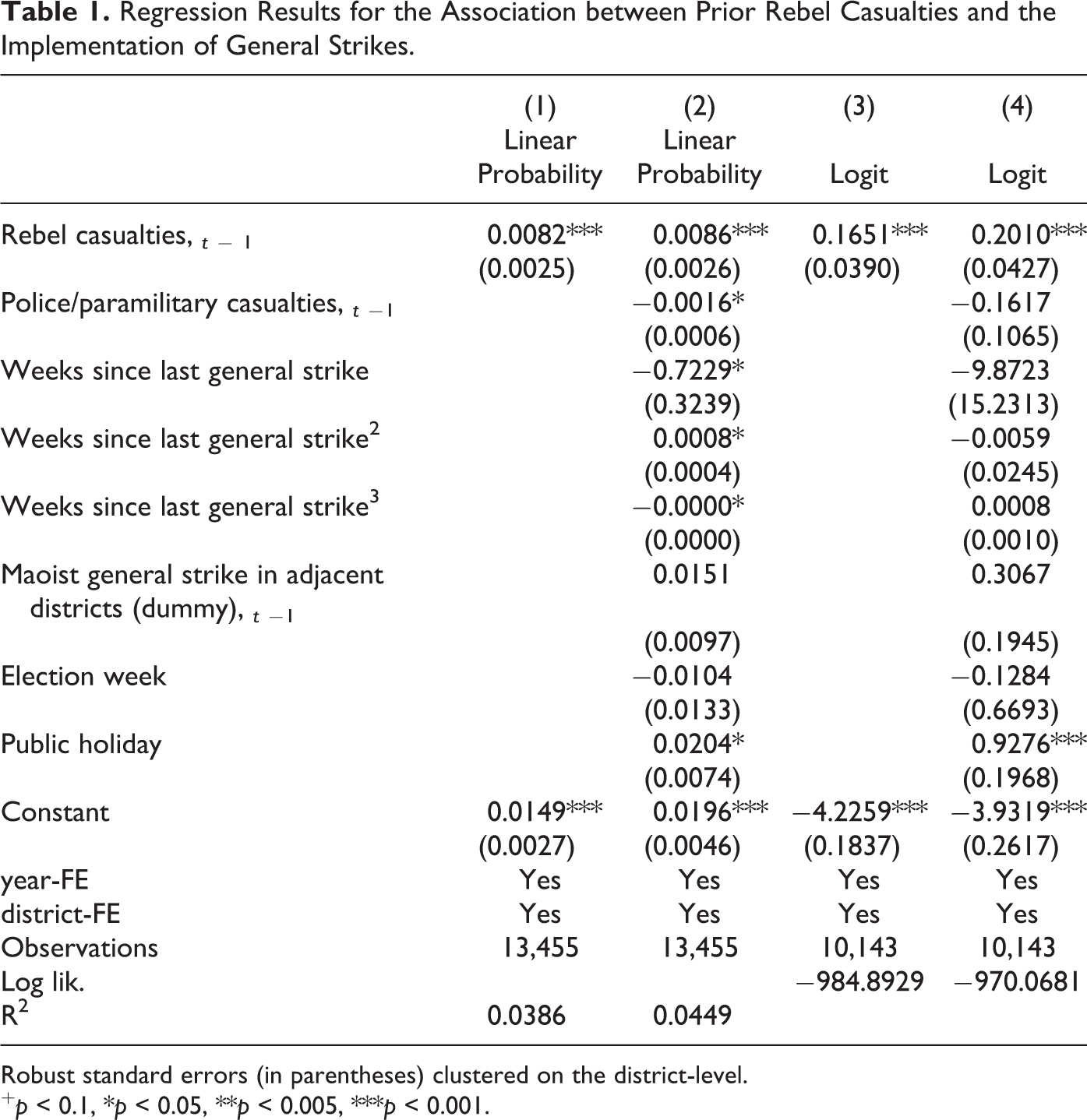
Robust standard errors (in parentheses) clustered on the district-level.
+p < 0.1, *p < 0.05, **p < 0.005, ***p < 0.001.
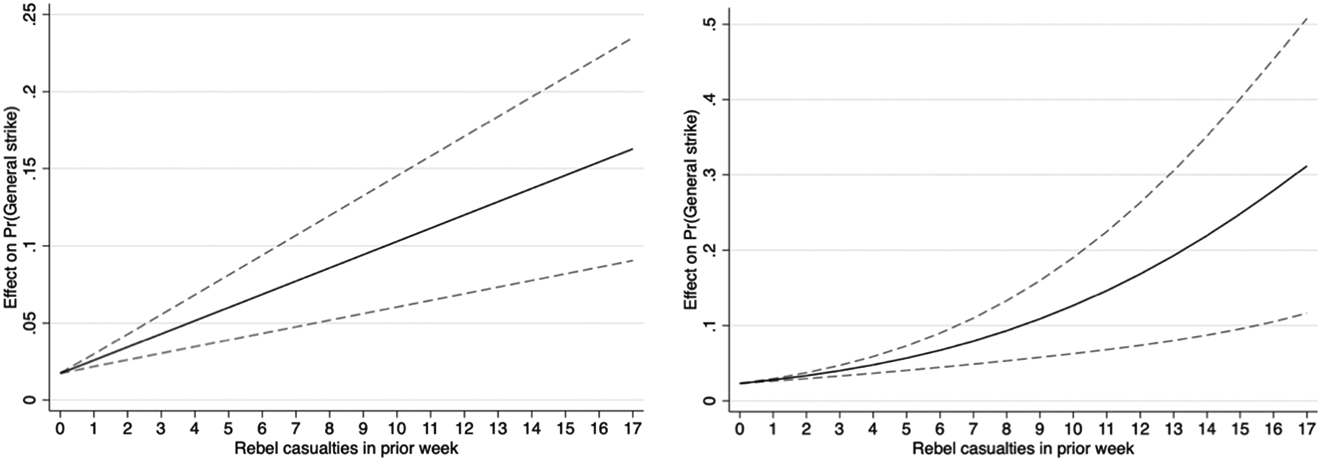
Predicted probabilities of general strikes following Maoist casualties with 90 percent CIs (Table 1, models 2 and 4).
In order to validate the results, I conduct a series of robustness checks that repeat the main findings from models 2 and 4 using alternative estimation strategies, sample sizes and independent variables. In a first step, I test whether the results still hold after using a more liberal approach that allows for variation across districts. I have opted for a multilevel model with district-week observations nested in federal states (models A1 and A2). A set of time-constant covariates are included here in order to control for potential omitted variable bias stemming from differences on the district-level. These include the districts’ gross domestic product in 2006, total population (log-transformed) and the share of urban population based on data from 2001 (Planning Commission of the Government of India 2014), access to infrastructure, forested area and percentage of Adivasis (the potential Maoist support base) in the total population (obtained from Hoelscher, Miklian, and Vadlamannati (2012)). The independent variables’ coefficients remain virtually identical when compared to the main analysis.
In order to test to which extent the results are driven by cases influencing either the independent or the dependent variable, I discard those districts with the highest number of events involving Maoist casualties (A3 and A4) and general strike events (A5 and A6), respectively. 6 After discarding the districts with most casualty events, the effect remains significant for the logit model (A4), whereas the independent variable’s significance drops slightly below conventional levels for the linear probability model (A3). It is important to note, however, that the excluded cases account for nearly half of all incidents in which Maoists suffered casualties. The results remain stable after excluding districts with frequent general strike events (A5 and A6).
In a final step, I aim to assess the degree to which the models are sensitive to changes in the independent variable. First, I use a log-transformed variant of the predictor (A7 and A8). Second, I use the UCDP Georeferenced Event Data (GED) (Sundberg and Melander 2013) as an alternative measure (A9 and A10). More specifically, I extract the number of Maoist casualties and the corresponding killings of security personnel to construct variables comparable to the previously used variables. For both alternatives, the coefficient for the number of rebel losses remains positive and significant. Lastly, I account for longer-term time trends in rebel casualties. It is possible that the salience of recent losses is dependent on the trajectories of civil war. Rebels may show a stronger tendency to carry out general strikes following isolated defeats as compared to high losses at the end of successive encounters with the government. In order to account for this possibility, models A11 through A18 use the change in the independent variable from the previous week as well as from the mean of the prior three, four and eight weeks as the predictor. The results remain stable even after longer-term trends on the battlefield are factored in.
Discussion of the Causal Sequence and Alternative Explanations
This section discusses the results with regard to the assumed causal sequence of the argument and tests alternative explanations for the observed relationship. The theoretical argument suggested that battlefield losses increase the probability that rebels will carry out general strikes. However, it is also plausible to surmise that security forces explicitly target districts where a general strike is anticipated. The fact that the CPI-Maoist often publicly announces general strikes beforehand lends particular weight to this caveat.
This possibility cannot be ruled out entirely, yet descriptive evidence from the individual general strike events provides at least suggestive support for the causal direction proposed in this study. As a first indication, a closer investigation of the events’ issue types reveals that a substantial share of 71.74 percent of all rebel-sponsored general strike events actually refer to prior counterinsurgency measures by the government; 37.27 percent even specifically name losses in the course of preceding encounters as the reason for the strike call. This shows that general strikes indeed frequently occur in reaction to prior casualties.
The majority of these strikes only vaguely refers to recent encounters. However, some cases allow us to trace the cause of the strike back to a particular preceding battle event. On average, the instances refer to encounters that date back 9.41 days, which corresponds to the chosen time lag of the preceding week. It may nonetheless still be the case that general strikes only indirectly lead to higher Maoist casualties by attracting the attention of security forces. In order for this explanation to be plausible and result in the observed correlation, we would expect that the time period between the strike announcement and the actual implementation tends to be considerably large. If we only consider instances of strike announcements from the data, we see no evidence supporting the alternative causal sequence: on average, rebel-sponsored general strikes occur shortly after they are announced (2.21 days on average). It is therefore less plausible to assume that strike calls are—at least in the short run—a trigger for increased Maoist casualties rather than vice versa.
In order to probe the plausibility of the presumed causal sequence beyond descriptive evidence, I repeat the analysis with several lags and leads of the independent variable (for a similar approach, see Autor (2003) and De Juan (2020)). The rationale is as follows: If general strikes are primarily a reaction to rather than a consequence of battlefield losses, the probability of general strikes will only increase for the first lag variable (corresponding to losses in the previous week), but not for the lead-variables. A challenge confronting the application of such an event-study approach to the present study is the fact that the majority of districts in the sample contains multiple observations with at least one Maoist casualty. This means it is problematic in many cases to determine whether a general strike occurs after the last casualty-related event or prior to the next casualty-related event.
In order to address this problem, I exclude observations if more than 1 event resulting in Maoist casualties occurred 4 weeks around the observation (two weeks prior, two weeks afterward). On the downside, this eliminates 26.59 percent of all observations for which the independent variable shows a positive value, but it facilitates the estimation of the strike probability around a casualty event with reduced ambiguity. Figure 3 displays the results of the linear probability (left-hand side, models 5 and 7) and logit models (right-hand side, models 6 and 8), including four lags and four leads of the main independent variable (corresponding regression tables in the appendix). The coefficient estimates are ordered according to their distance to the event—the number of Maoist fatalities at t0—with leads representing weeks prior to the event and lags corresponding to weeks after the event. The upper-row panels present the results from the baseline models, which shows that the likelihood of general strikes increases in the week immediately after Maoist casualty events occurred, but not before, thus corroborating the initial conjecture. Apart from this observation, however, there appears to be a significant and positive correlation between general strike occurrence and Maoist casualties two weeks ago. As noted earlier, yet, there exists the possibility of consecutive violent events, so I repeated the analysis in the lower-row panels excluding all observations with at least one additional casualty event occurring two weeks prior or two weeks afterward. In this updated version, we see that only the coefficient for the week immediately after the casualty event remains significant. The results thus back the theoretical argument proposed here, while lending less evidence for the alternative causal sequence.
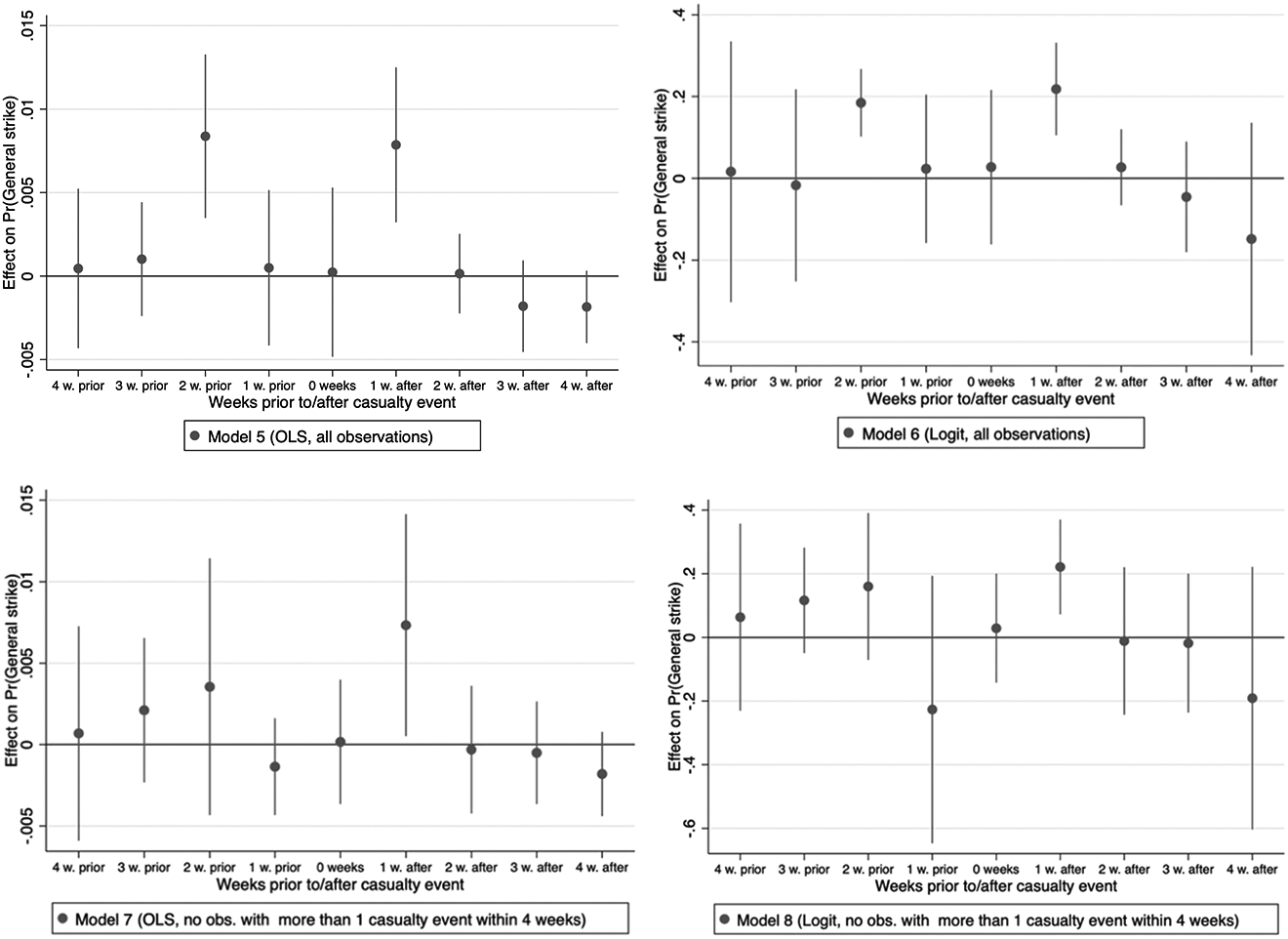
Estimates for the correlation between different lags and leads of Maoist casualties and general strike occurrence (90 percent CIs).
In the next step, I address several alternative explanations that could account for the identified relationship apart from battlefield losses (Table 2). Reported are only results from the linear probability models, while logit estimations can be found in the appendix. First, the findings could be driven by the intensity of fighting rather than by Maoist losses in particular. The observation of increased casualties could be a result from rebels stepping up their activities in a district. The fact that there is a fairly strong correlation (r = .59) between the number of battles in a district-week and the number of Maoist casualties lends further weight to this concern. Casualties may then not necessarily signal rebel weakness, but counterintuitively reflect rebel strength. Against this backdrop, model 9 repeats the main models including the (lagged) number of battles as an additional control. Model 10 furthermore includes the deviation from the average number of battles in the past four weeks in order to account for short-term trajectories of Maoist activity. The results do not support the alternative explanation that general strikes increase merely in the course of prior battles. By contrast, the coefficient remains insignificant and—even more remarkable—the coefficient for prior battlefield losses even increases if we hold previous incidents constant in the model. 7
Alternative Explanations.
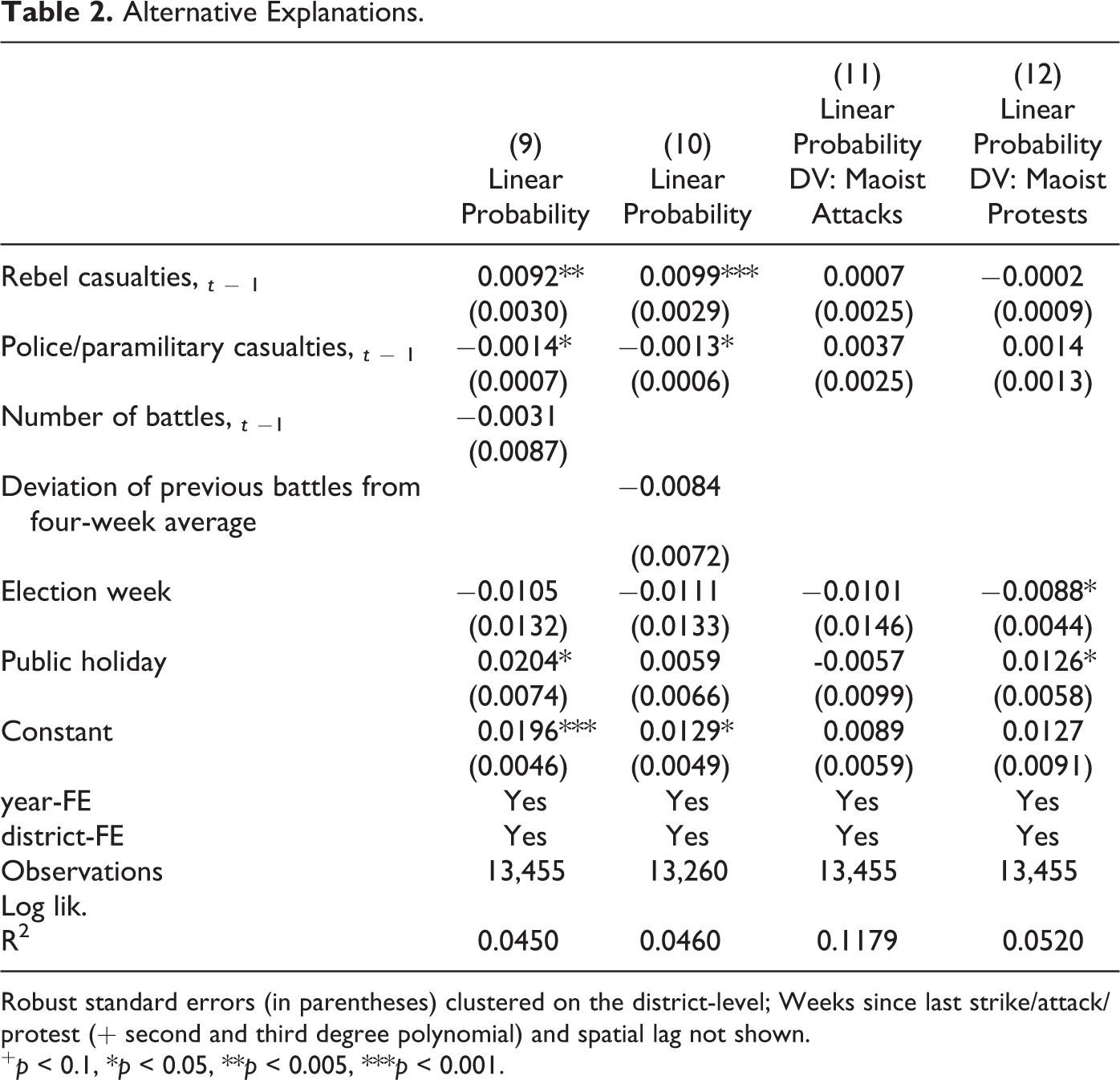
Robust standard errors (in parentheses) clustered on the district-level; Weeks since last strike/attack/protest (+ second and third degree polynomial) and spatial lag not shown.
+p < 0.1, *p < 0.05, **p < 0.005, ***p < 0.001.
These findings also decrease the plausibility of a second alternative mechanism, namely that general strikes are rather spontaneously emerging as a result of surging grievances among the civilian population. In this scenario, general strikes would not be directly affected by prior Maoist losses, but indirectly through civilian casualties accompanying violent incidents. The failure to find any evidence of a relationship between battle intensity and general strikes yet significantly decreases the likelihood of this alternative mechanism.
Qualitative evidence from individual strike instances further corroborates the assumption that rebel-initiated general strikes are rather deliberate tactical choices than spontaneous popular uprisings in support of the Maoists. As a first indication, the majority of reports on general strikes in the data indicate a previous announcement of the general strike by the rebels themselves—alongside date, location, and exemptions—for example, in the following form: We appeal to the people to express their protest against this onslaught by closing down educational and commercial institutions, banks, railways, transport etc. (We are exempting the exams of the students and emergency services like health care from this Bandh) (Communist Party of India (Maoist) 2013).
A vivid illustration of the degree of rebel organization in these situations is provided by journalist Snigdhendu Bhattacharya, who reports from a travel to Lalgarh, which was then controlled by the Maoist People’s Committee against Police Atrocities. He describes entering the Maoist-controlled area, which was under a blockade for the fourth time in seven months: The officer warned us against removing the blockades and reiterated that we must return whenever asked to do so by the Maoists and PCAPA members. We obeyed. Whenever we approached a blockade, we exited the car, showed the locals our identity cards and persuaded them to talk to Mahato [the PCAPA spokesperson]. The tree would then be removed, our car would pass and the obstruction would be put back in place. (Bhattacharya 2016)
In a last step, I test two alternative explanations by using different outcome variables. First, general strikes following losses may not necessarily reflect a deliberate choice to demonstrate sustained presence in a given region, but could rather result from a decreased capacity to launch further violent acts. In the latter case, we would expect a significantly decreased probability of violent attacks in the aftermath of rebel casualties alongside a higher propensity for general strikes. In order to probe this mechanism, I repeat the main model using a dummy indicating whether any Maoist attack occurred as the dependent variable (model 11). The results remain inconclusive, which weakens the plausibility of the decreased-capacity argument. Lastly, the observed correlation could simply mirror an increased propensity on the part of the rebels to diversify their tactical repertoire more generally, and not point to a specific choice for general strikes. To test this, model 12 takes Maoist protests beyond general strikes as the dependent variable. However, the coefficient remains insignificant.
Conclusion
The article investigated the conditions under which armed groups use tactics of civil resistance. Examining the case of India’s Maoist insurgency, I have argued that rebels are more likely to use general strikes in the aftermath of own battlefield losses. I assumed rebels to perceive casualties as a challenge to local authority, with general strikes providing a rational tactical choice given their potential to undermine local state capacity and demonstrate local control. I have tested this proposition on a spatially and temporally disaggregated level using a newly compiled data set on Maoist activism. The results from the regression analysis lend evidence to the theoretical argument.
I have further attempted to probe the causal sequence relying on descriptive evidence and employing an event study. Although these findings should be treated with caution as they provide only suggestive evidence, they nonetheless lend stronger support to the proposed direction of causality from prior losses to general strikes than vice versa. Further analyses did not support the plausibility of possible alternative mechanisms such as popular grievances, decreased capacity, or increased overall activity.
The study contributes to an ongoing discussion in the literature on tactical variation and buttresses previous research that moves beyond a strictly dichotomous view of actors and the tactics they employ. In particular, the finding that rebel groups use methods of civil resistance in reaction to factors endogenous to the conflict carries important implications: First, it points to the possibility that armed groups draw from repertoires of contention that are primarily associated with nonviolent groups. Second, it shows that the use of these tactics by rebels can vary over time. Therefore, the increased reliance on civil resistance tactics may not necessarily signal that the group does not have the capacity to sustain the armed rebellion, nor does it indicate a general strategic shift from violence to nonviolence. The study has shown that tactical choices appear to be rather situation-dependent phenomena.
I want to close with a discussion about the generalizability of the findings. In principle, I expect the findings from India’s Maoist insurgency to be transferable to other conflict contexts in which similar scope conditions apply— that is, high external pressure from the state, some degree of local control, and the presence of a political wing for carrying out respective actions. According to the Reputation of Terror Groups Dataset, around 18.74 percent of all militant organizations both engage in governance (operationalized here in its maximalist terms as public goods provision) and have a political wing or affiliated party (Tokdemir and Akcinaroglu 2016), which gives an impression about the potential extent. Almost all rebel groups mentioned throughout the paper as examples of general strike-employing organizations fulfill both requirements in the data set, including the Free Aceh Movement, FSNL, Al-Fatah, Hamas, the Maoists in Nepal and India, FARC and LTTE. Others like the Kashmiri rebels and ETA fulfill at least one of the outlined scope conditions. Inferences drawn from the case of India’s Maoist insurgency therefore show a potentially high applicability to other armed conflicts that meet these scope conditions and may offer useful insights on the phenomenon of general strikes more broadly. While this study has specifically focused on the effect of clashes between the state and rebels, future research may deal more thoroughly with the impact of conflict dynamics in contexts of multiparty conflict. For example, competition with rival armed groups or social movement organizations could similarly be a source of external pressure triggering the use of civil resistance.
Supplemental Material
Supplemental Material, sj-do-1-jcr-10.1177_0022002721995547 - The Tactical Use of Civil Resistance by Rebel Groups: Evidence from India’s Maoist Insurgency
Supplemental Material, sj-do-1-jcr-10.1177_0022002721995547 for The Tactical Use of Civil Resistance by Rebel Groups: Evidence from India’s Maoist Insurgency by Roman Krtsch in Journal of Conflict Resolution
Supplemental Material
Supplemental Material, sj-dta-1-jcr-10.1177_0022002721995547 - The Tactical Use of Civil Resistance by Rebel Groups: Evidence from India’s Maoist Insurgency
Supplemental Material, sj-dta-1-jcr-10.1177_0022002721995547 for The Tactical Use of Civil Resistance by Rebel Groups: Evidence from India’s Maoist Insurgency by Roman Krtsch in Journal of Conflict Resolution
Supplemental Material
Supplemental Material, sj-pdf-1-jcr-10.1177_0022002721995547 - The Tactical Use of Civil Resistance by Rebel Groups: Evidence from India’s Maoist Insurgency
Supplemental Material, sj-pdf-1-jcr-10.1177_0022002721995547 for The Tactical Use of Civil Resistance by Rebel Groups: Evidence from India’s Maoist Insurgency by Roman Krtsch in Journal of Conflict Resolution
Footnotes
Acknowledgments
I thank Charles Butcher, Kathleen Gallagher Cunningham, Alexander De Juan, Annekatrin Deglow, Juan Masullo, Jonathan Pinckney, and Johannes Vüllers for their support and feedback on earlier versions of this paper. I am also grateful for valuable comments and suggestions from the two anonymous reviewers and the editor of the Journal of Conflict Resolution, Paul Huth, as well as from the participants of the “Civilian Activism in Civil Wars” workshop at University of Konstanz, the CIDCM/IR workshop at University of Maryland, the Nuffield Workshop on Conflict Dynamics at University of Oxford, and the panel “Civilians in Armed Conflict” at ISA 2018. Finally, I also thank Kristian Hoelscher for sharing the violence data, as well as Johannes Heinemann and Mohamed Moheeb for their assistance in the data coding process.
Declaration of Conflicting Interests
The author(s) declared no potential conflicts of interest with respect to the research, authorship, and/or publication of this article.
Funding
The author(s) disclosed receipt of the following financial support for the research, authorship, and/or publication of this article: Funding for this research was provided by the German Research Foundation (grant VU 96/1 -1) project “Raise your voices! The occurrence of nonviolent campaigns in civil wars.”

Supplemental Material
Supplemental material for this article is available online.
Notes
References
Supplementary Material
Please find the following supplemental material available below.
For Open Access articles published under a Creative Commons License, all supplemental material carries the same license as the article it is associated with.
For non-Open Access articles published, all supplemental material carries a non-exclusive license, and permission requests for re-use of supplemental material or any part of supplemental material shall be sent directly to the copyright owner as specified in the copyright notice associated with the article.
