




Abstract
The effects of climate variability and change on security are debated. While this topic has received considerable attention in both policy circles and academia, the microlevel pathways and conditions under which climatic shocks increase conflict risks are poorly understood. We suggest that household resilience provides one key to understanding these relationships. Using novel household survey data from two conflict-affected regions in Eastern Democratic Republic of the Congo, we study variation in the support for violence related to reported exposure to drought and resilience metrics. Using comprehensive multifaceted objective and subjective indicators of resilience, we find that less resilient respondents who report having experienced drought and associated losses are more likely to be supportive of the use of political violence. In contrast, our findings suggest that there is no general association between reporting drought exposure and support for violence.
Keywords
Concerns about the security implications of climate change are growing, and United Nations Security Council members and the European Union have called for action to address the climate–security nexus (Fetzek and van Schaik 2018). However, the burgeoning academic literature on climate and internal armed conflict suggests that linkages are more indirect and complex (Mach et al. 2019; Busby 2018). Recent empirical work made important advances in identifying under what circumstances security implications are more likely to be expected. Overall, existing research points to climate-related increases in conflict risks in specific vulnerable contexts characterized by ongoing conflicts, political marginalization, and economic reliance on agriculture (Koubi 2019).
Yet, there are still important gaps in understanding causal mechanisms and microlevel variation (cf. Mach et al. 2019). Armed conflict is a rare phenomenon. Although there are regions where many structural risk factors concur, taking up arms should not be the default, and not even a frequent, response to a climate-related hazard. Even in the most violent wars, active participation in fighting tends to be confined to a rather limited share of the local population (Cunningham, Gleditsch, and Salehyan 2013). Structural indicators pointing to high-risk areas or countries are therefore insufficient to guide interventions that require a more fine-grained understanding of variations in communities and individuals at risk.
Addressing this lacuna, we suggest that accounting for household resilience as a multidimensional characteristic will allow us to better understand the drivers of participation in violence in a high-risk context following climate-induced shocks. In order to assess the merit of this argument, we use survey data of a representative sample of 1,724 households in Rutshuru and Masisi Territories in the North Kivu province of Eastern Democratic Republic of the Congo and study individual-level variation in support for the use of political violence. Our findings indicate that less resilient respondents, based on objective and subjective indicators of resilience, are more likely to be supportive of political violence when they report having been exposed to drought, while there is no consistent general direct link between reported drought shocks and attitudes to violence. By focusing on North Kivu, where both food insecurity and violence are widespread, we provide unique insights on the variation of the individual propensity to use political violence in a situation of protracted violent conflict. Reviews of recent research suggest that convenience and accessibility have shaped the geographic focus of research on climate–conflict relationships (Hendrix 2017). Knowledge from this kind of protracted crisis is thus not only important from a policy perspective but also fills important empirical knowledge gaps in the scientific literature.
Point of Departure
Since preindustrial times, the temperature on the planet has risen by about one degree (Intergovernmental Panel on Climate Change 2018). Climate-related hazards’ adverse effects on agricultural production are already visible and are projected to increase in the future (Calzadilla et al. 2013). Hot temperatures and rain deficiencies lead to failing harvests, but also heavy rains and floods can destroy crops (Ray et al. 2015). Similarly, fire, heat stress on animals and human labor, and local increases in plant diseases and insect pest populations can lower agricultural productivity (Cohn et al. 2017). Due to these implications, climate-related shocks have major impacts on agricultural livelihoods. Smallholder farmers, who rely on rainfall for livestock and crop production, face particularly large negative impacts from climate change (Morton 2007; Cohn et al. 2017).
Underpinned by these climate impacts on production and livelihoods, a large share of the literature investigating security implications of climate change relies on the opportunity cost model of conflict as an indirect pathway to violence (Vestby 2019; Koubi 2019). Many armed conflicts have a rural dimension, and farmers and landless rural laborers provide the primary base of popular support and recruits (Desai and Eckstein 1990; Kalyvas 2004). The opportunity cost model suggests that when expected returns from fighting outweigh income from regular economic activity, an individual’s inclination and motivation to join a militia or rebel group increases (Grossman 1991; Collier and Hoeffler 2004; Hirshleifer 1995; Dal Bó and Dal Bó 2011). Participation in militia groups often comes with benefits of selected material incentives, such as a salary, food, or looting opportunities (Lichbach 1994). According to the model, these benefits from participation are weighed against the alternative options. In the face of individual hardship related to loss of employment, reduced wages, and rising living costs, participation in a violent organization associated with such material benefits can thus become relatively more attractive.
Indeed, in line with the opportunity cost model, there is mounting evidence that climate shocks can affect armed conflict risks (Mach et al. 2019; Koubi 2019). For example, a recent study by Vestby (2019) finds support for a link between deteriorating living conditions and the use of violence based on a household survey in thirty-five African countries. However, most recent studies indicate that there are important conditioning factors affecting where climate, or income shocks in general, increase conflict risks. At a macro-level of countries, regions, or societal groups, the institutional context is important (Linke et al. 2015; Linke et al. 2018; Detges 2017). Patterns of political marginalization help indicate which groups are most at risk (Detges 2017; von Uexkull et al. 2016). Armed conflict itself is a major source of vulnerability. For example, Detges (2017) shows in a survey-based study that respondents who had seen recent violence and discrimination were more likely to support violence following drought.
Similarly, at the individual or community level, research findings are not always in line with the opportunity cost framework. There are several studies from conflict-affected countries suggesting that poverty and employment opportunities shape participation in rebellion (Humphreys and Weinstein 2008; Blattman and Annan 2016). However, a large survey-based study conducted in three countries found no support for unemployment leading to participation in violence (Berman et al. 2011). Existing empirical work concludes that there are many different explanations of participation that can be present in the same conflict or even in the same individual (Humphreys and Weinstein 2008; Arjona and Kalyvas 2011; Guichaoua 2010; McDoom 2013; Wood 2003). Collectively, these explanations highlight the importance of networks and social ties, such as families and ethnic bonds, that facilitate collective action. They also point to the fact that taking up arms may come with security benefits for participants, and other nonmaterial benefits such as status, or the pleasure of agency of rising up against perceived injustices.
The mixed findings on unemployment and poverty suggest that we cannot assume that increased mobilization for conflict is a default, or even a frequent, response to economic hardship even in contexts that have structural conditions that make them more violence prone. Understanding microlevel variation will instead require both attention to the ability of households to cope with climatic and livelihood shocks and the determinants of a violent response.
Agricultural Production Shocks, Resilience, and Participation in Violence
Addressing this gap in existing literature, we argue here that accounting for resilience, rather than poverty or wealth only, will allow us to better identify variation in individual propensity to participate in violence following climate-related shocks to agriculture. Ultimately, the core of the opportunity cost model is individual expectations of the future benefits from being part of a militia group compared to other alternatives, and not current employment or wealth. Not only the present—potentially temporary status—of an individual is important but also the longer-term perspective. For example, in a case study, Blattman and Annan (2016) found that Liberian ex-fighters participating in a livelihood strengthening program were less likely to be willing to engage in fighting in neighboring Sierra Leone. Importantly, their findings also suggest that individuals waiting to start the program were less willing to engage in fighting than other ex-fighters. Thus, the ex-militants’ decision was not only based on their current income or livelihood opportunities but also on their expectations for the future with those expecting a better future due to enrolment in the program being less likely to engage in fighting.
This forward-looking perspective leads us to the concept of resilience, the capacity of a household to bounce back to a previous level of well-being after a shock (United Nations Food and Agriculture Organization [FAO] 2016). Resilience is a multifaceted concept that emphasizes the agency to absorb, adapt, and transform livelihoods. Resilience derives from general capacity to bounce back in the face of different shocks or a collection of stressors (Jones 2019). The disturbance could be a catastrophic event shared by a large group of people (covariate shock) or a shock experienced only within a given household or community (idiosyncratic shock). Shocks can be man-made (such as those related to markets, conflict, or technology) or naturally occurring (such as droughts, floods, cyclones, or epidemics).
If we expect participation in conflict to be, at least in part, driven by opportunity costs, individuals that have the capacities to withstand shocks and to bounce back—and ideally also “bounce forward”—should be less likely to see violence as an attractive strategy even if they see their livelihood temporarily threatened and their income reduced. Due to their capacity to bounce back, and perception that these shocks are temporary and improvement can be expected soon, a violent option should be less attractive. Hence, we would not expect resilient individuals to see violence as a viable coping strategy in the wake of a shock, even if they momentarily see their income depressed or food security challenged.
Importantly, resilience goes beyond simple measures of poverty. In fact, resilience is not necessarily positively correlated with well-being: some studies that explore the relation between resilience and poverty reduction even note the existence of a potential trade-off between resilience and well-being (Béné et al. 2014). Households may have managed to strengthen their resilience but only to the detriment of their own well-being or self-esteem. We therefore believe the study of resilience as multidimensional characteristic contributes to understanding the impact of climate and other agricultural production shocks.
While “objective” socioeconomic characteristics, such as social networks, access to basic services (ABS), and assets (AST), have been shown to be associated with higher resilience (FAO 2016), we suggest that the subjective perception of resilience should be important for the support of the use of violence as well. When deciding about the viability of enlisting in a militia in the wake of a shock, the individual makes a subjective assessment of alternative options. In addition to actual capacity to bounce back, subjective perception of being resilient oneself should play an important role in determining whether exposure to livelihood shocks would lead individuals to support the use of violence to redress a situation of misery.
Subjective and objective resilience overlap but do not perfectly match. While both approaches share many of the same underlying factors, there are notable differences, particularly with regard to specific drivers of resilience. In fact, socioeconomic factors that are key in resilient measurement are relatively poor predictors of subjective resilience (Jones 2019). Instead, internal factors such as mental state, aspirations, previous exposure to shocks, and psychological resilience are fundamental in shaping an individual’s reaction to an external shock (Cox and Perry 2011). Recent findings also show a moderate correlation between subjective and objective resilience measures (Jones and d’Errico 2019). This is not surprising, as an objective measure of quantities (e.g. livestock) may or may not overlap with the subjective perception that someone has of its value, duration, vulnerability, and importance. Notably, similar discrepancies between subjective and objective assessments have been identified in other socioeconomic domains. For example, the degree of objective economic inequalities and the subjective perceptions of these may differ—with important implications for conflict risk (Rustad 2016; Hillesund et al. 2018).
To summarize our argument as visualized in Figure 1, we expect that (1) climate shocks adversely affect agricultural production, (2) resulting shocks to agricultural livelihoods in turn lower the opportunity costs of violence, (3) how much these shocks actually translate into lower opportunity costs for violence is conditioned by the level of resilience determining the capacity to bounce back, and (4) all else being equal low opportunity costs result in a higher likelihood that an affected individual would support the use of violence and participate in conflict in a high-risk context. While not all individuals who support the use of violence actually engage in violent behavior, the opposite should be true. Those who actually participate should also support it (cf. Linke et al. 2018).
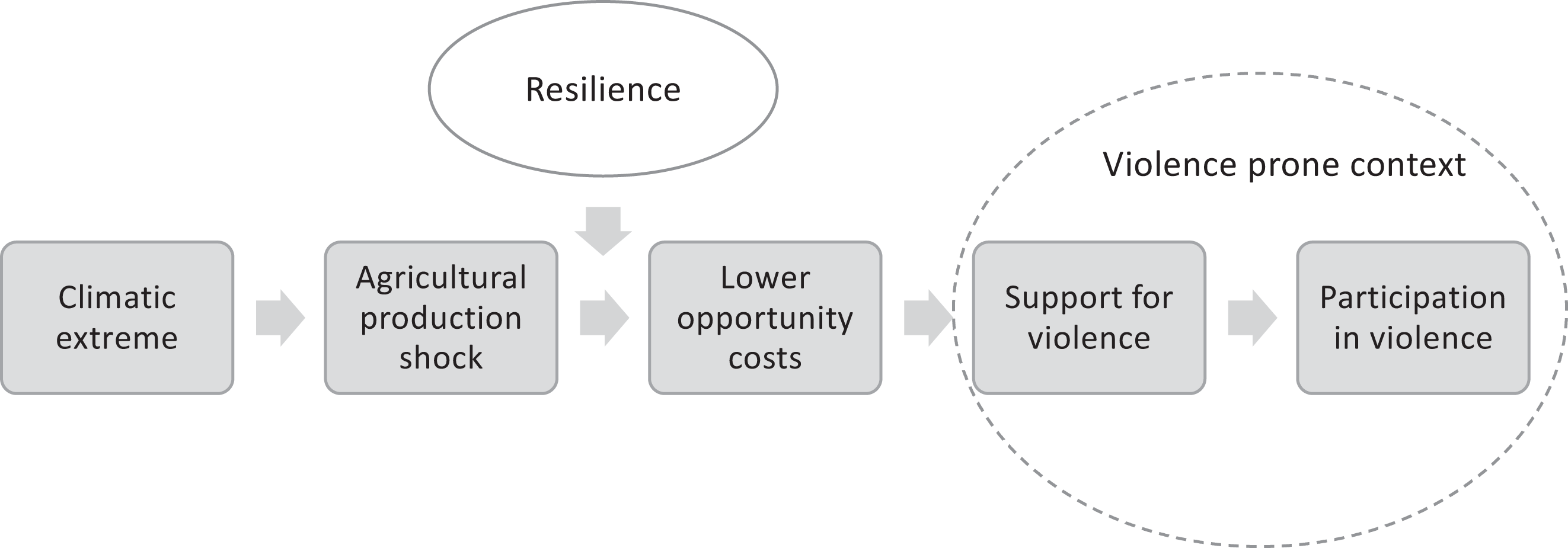
Pathway from climatic extremes to a higher likelihood of participation in violence in high-risk environments.
We summarize our expectations in two hypotheses relating to the general support for the use of violence, which is the actual outcome we investigate in our empirical analysis.
Research Design
Characteristics of Study Region and Sampling Strategy
Matching our expectations on microlevel variations, we rely on household survey data to investigate the relationship between reported drought shocks, resilience, and support for violence. The survey data were gathered in face-to-face interviews by FAO in July/August 2017, in the context of the planning stages for a program targeted at alleviating food insecurity and strengthening resilience in collaboration with the World Food Programme (WFP) and the International Fund for Agricultural Development (IFAD). The FAO team used population-based stratification to collect enough observations to be statistically representative at the territorial administrative level. The Masisi and Rutshuru Territories were selected as primary sampling units. In total, these two areas have a population of 2.9 million inhabitants. The health center zones (administrative units) within the two territories were chosen as secondary sampling unit each comprising 170,000 to 530,000 inhabitants.
A random sample of households was selected in each village according to the following procedure. The survey supervisor asked the chief or village elder about the number of households living in the village or obtained this information in a household list where available. The total number of households was divided by the number of interviews needed from the village to achieve a representative sample calculating the sampling interval (SI). Each enumerator randomly chose a number between 1 and the SI, the random start (RS). They then started counting the households moving in one direction and selecting the RS; then RS + SI; then RS + SI + SI…until the required number was reached. To give an example, suppose there is a village composed of sixty households and six interviews are needed. The enumerator divided 60/6 (=10, the SI). The enumerator then randomly selected a number between 1 and 10 (3, the RS). Accordingly, they selected the household number 3, 13, 23, 33…walking into one direction while counting households. For each health center zone, an additional 10 percent attrition rate for future collection of panel data plus an additional 10 percent for data collection errors was collected. The final sample comprises 1,724 households and provides statistically representative information for the selected areas. In each of the selected household, enumerators asked to interview the household head. If the household head was not present at the time of the interview, another adult household member was interviewed.
This survey data from North Kivu is relevant for informing the literature on climate change and conflict for several reasons. Importantly, the survey area was affected by a drought shock in the twelve months preceding the data collection, allowing us to study its impact on respondents in our sample. The region is characterized by an 1,800 mm average annual rainfall over two rainy seasons (from September to December and from mid-February to May), but soil quality and climate vary due to mountainous terrain. Main food crops are maize, beans, potatoes, sweet potatoes, and rice (WFP, FAO, IFAD 2017). The FAO Global Information and Early Warning System (GIEWS) indicates that drought is not very frequent in this area and less than five severe droughts took place since 1984 based on the agricultural stress index. However, in the first growing season of 2017, 22 percent of croplands in North Kivu were in severe drought conditions according to the same measurement (FAO/GIEWS 2019). Media reported resulting lowered harvests, pests, or complete crop failure (Agence Congolaise de Presse 2017b). The drought had also other implications such as a doubling of grain prices (Agence Congolaise de Presse 2017a). These impacts have to be seen against the backdrop of high levels of chronic food insecurity with the vast majority of the population in these territories relying on agricultural livelihoods (FAO 2019).
Moreover, the ongoing violence provides a particularly relevant context. In this context, participation in local existing militias or rebel groups may indeed be a viable option in response to an agricultural production shock. North Kivu has for a long time been a major hot spot of violence, an “African powder-keg” (Jourdan 2004). Since the beginning of the First Congolese War in 1993, until the defeat of local rebel group M23 in 2013, the North Kivu province saw very high levels of violence (Lyall 2017). While violence has decreased since, the region is still very insecure and harbors a myriad of armed actors. According to the Armed Conflict Location & Event Data Project (ACLED) data set, 138 fatalities occurred in Rutshuru Territory and 58 in Masisi Territory in the twelve months preceding survey implementation (Raleigh et al. 2010). Fighting occurred between organized militias and communal groups and also involved the targeting of civilians including mass rape, kidnapping for ransom, and abductions (United Nations 2017).
Dependent Variable
Support for Violence
Inquiring about participation in and support for violent activities is very sensitive. The risks for respondents who admit participation in violence are high. Similarly, enumerators inquiring about such sensitive issues face risks. Studies on participation in violence have therefore either used indirect ways of asking, such as survey experiments, or questions about the general support for violence (Velitchkova 2015; Rustad 2016; Linke et al. 2015). We adopt the latter approach adopting a question from the Afrobarometer survey routinely conducted in many African countries, which was also used in previous studies on climate change and conflict (e.g., Linke et al. 2015; Vestby 2019). Specifically, we ask respondents what statement is closest to their opinion: “The use of violence is never justified in Congolese politics,” or an alternative statement, “In this country, it is sometimes necessary to use violence in support of a just cause.” In addition, there is an option to refuse to answer or to not agree with either statement. As our dependent variable, support for violence, we code individuals who agree, or very much agree, to the second statement as supportive of violence “1” and individuals who agree to the first statement as not supportive “0.” We specifically inquire about political violence in order to assess the propensity of respondents to support engagement in organizations that are responsible for armed organized violence rather than, for example, petty crime or domestic violence. There is a relatively large share of respondents who refused to answer or did not agree with any of these statements (630 respondents). It seems to be the less resilient who are less likely to voice their attitudes. See pairwise correlation of variables in Table A2 in the Supplementary Material. These observations are dropped from the model.
Naturally, individuals who support the use of political violence may not act upon their attitudes. However, research in social psychology finds that questions on attitudes to specific behaviors predict actual behavior in many domains reasonably well (Ajzen and Fishbein 2005). This is also true for the use of violence. For example, using the same measure on support for violence that we adopt, Linke, Schutte, and Buhaug (2015) show that armed conflict violence is more likely to spill over to subnational regions where the local population expresses higher support for violence. Bhavnani and Backer (2007) find that many factors that are associated with reported participation in violence are also linked to attitudes to violence in sub-Saharan Africa, such as mistrust toward government institutions and perceptions of exclusion, which could suggest that our results may be informative for the larger literature on participation.
Naturally, respondents are not always able or likely to use violence themselves even if they support it. They could, for example, be too old or otherwise physically not capable to engage in violence. Young men are generally seen as the most likely group to participate in conflict (Collier and Hoeffler 2004). However, the resilience and livelihoods of household members are tightly linked, and household heads, who were the primary target of the survey, often make economic decisions for children and relatives living under the same roof. Whether the senior members in the household support or reject the use of violence will thus have a bearing on other household members, even in the cases where the household heads themselves are not taking up arms. For example, in a study on the Rwanda genocide, whether other household members and neighbors participated in violence was an important predictor of whether individuals participated themselves (McDoom 2013). This micro-space of social influence is therefore important for understanding whether respondents, or their relatives and friends, are likely to participate in political violence.
Independent Variables
Resilience capacity index
In recent years, there has been a proliferation of approaches and metrics for measuring resilience. A review of indicators for resilience measurement published by the Overseas Development Institute in 2015 identified seventeen separate indicator frameworks (Schipper and Langston 2015). We adopt one of the most widely employed approaches for measuring resilience, known as Resilience Index Measurement and Analysis (RIMA; FAO 2016). The RIMA, now in its second version, is an econometric approach for estimating household resilience to food insecurity at the household level. The approach focuses on households as it is the decision-making unit where the most important decisions are made on how to manage risks, including those affecting food security. The index’s suitability to reflect capacity to withstand shocks has been demonstrated empirically. For example, data from Uganda and Tanzania showed that resilience measured using the RIMA framework is associated with decreased probability of suffering a food security loss following a shock and a quicker recovery after losses (d’Errico, Romano, and Pietrelli 2018).
RIMA estimates resilience capacity based on four “resilience pillars” as illustrated by Table 1. Access to basic services (ABS) accounts for the household’s access to enabling institutional and public services environments. The Assets (AST) pillar includes income and nonincome-related assets that enable a household to make a living. Social safety nets (SSN) refer to the network upon which a household can rely when faced with a shock. Adaptive capacity (AC) refers to household ability to adapt to the changing environment in which it operates. The estimation follows the resilience analysis routinely done by FAO in many empirical contexts.
Resilience Measurement Pillars.
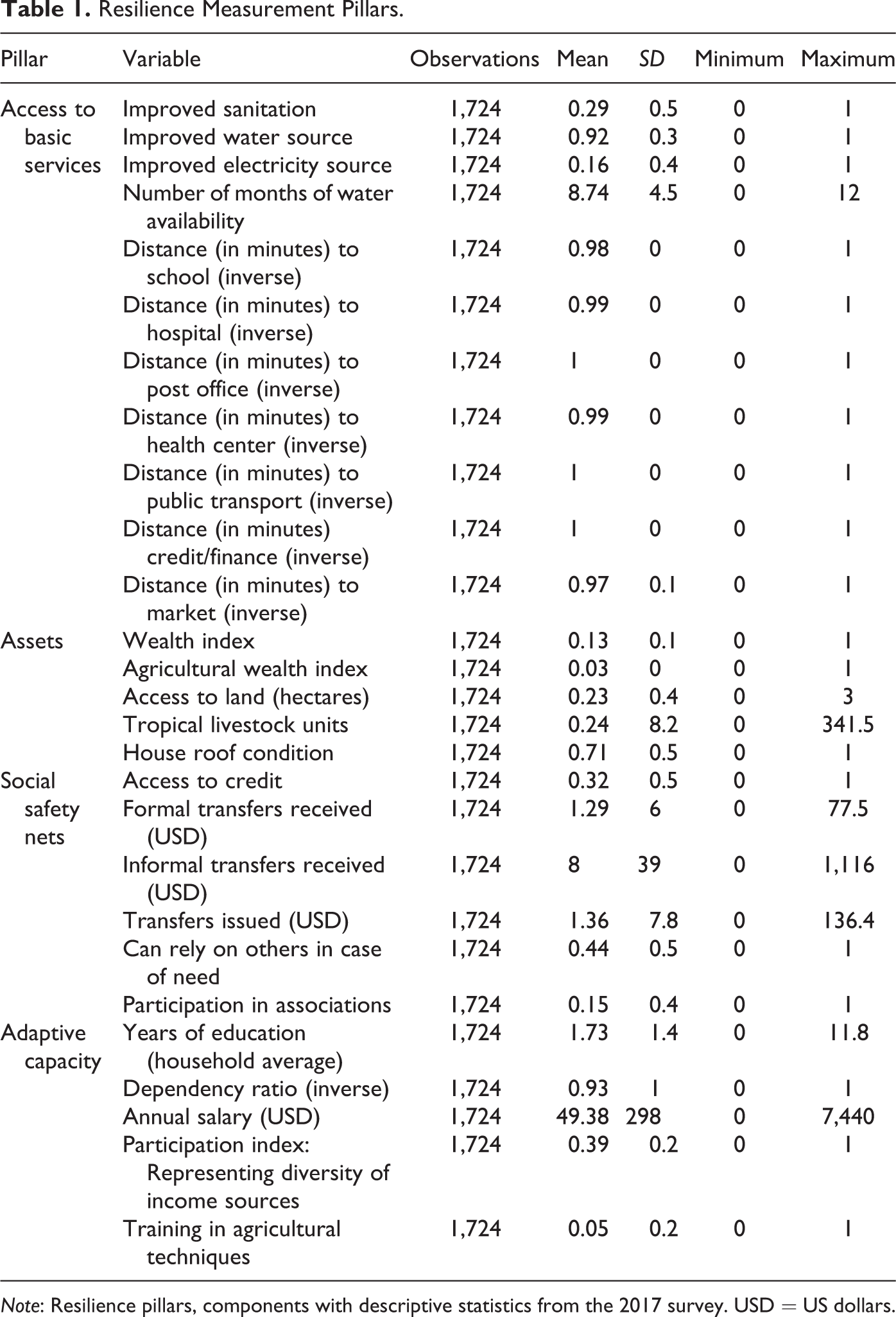
Note: Resilience pillars, components with descriptive statistics from the 2017 survey. USD = US dollars.
Subjective resilience
For the subjectively evaluated resilience, we use questions from the Subjectively self-Evaluated Resilience Score (Jones and d’Errico 2019). We use a subset of the nine resilience-related characteristics based on Bahadur et al. (2015), which comprises of anticipatory, absorptive, and adaptive capacities in relation to a shock of relevance to the local population. Here, we focus on a question relating to rainfall irregularities (Table 2).
Subjective Resilience Measurement.
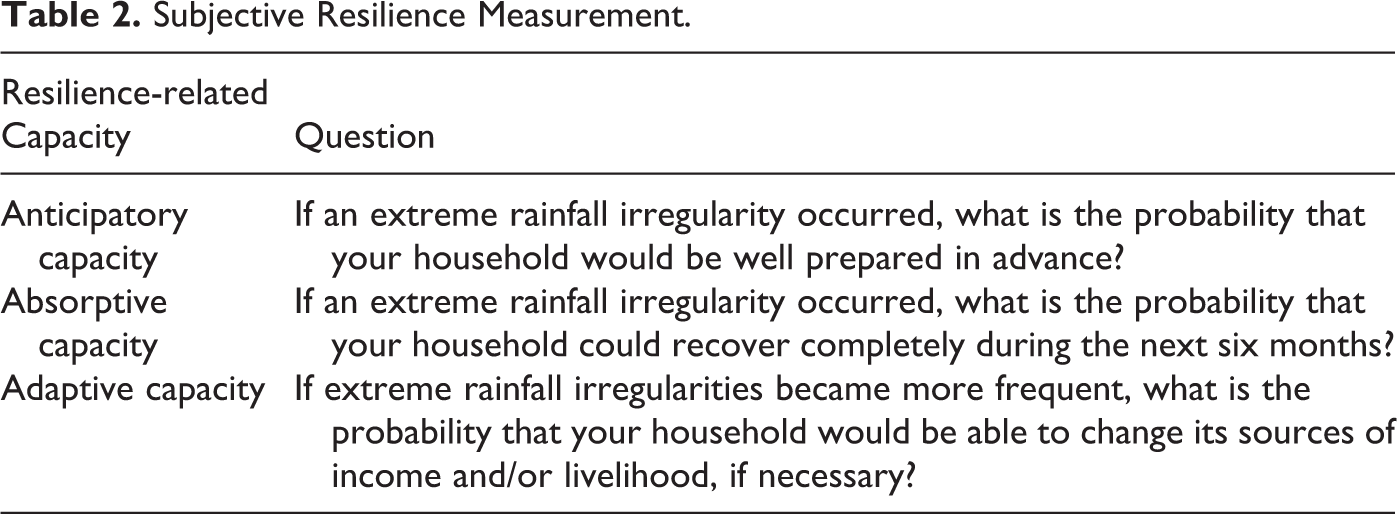
Response options are given on a four-point scale “very unlikely,” “unlikely,” “likely,” and “very likely” that we recode into binary variables coded “1” for respondents who assess it likely or very likely that they possess the respective capacities and “0” for unlikely or very unlikely (anticipatory, absorptive, and adaptive). Notably, the more objective resilience capacity index and the subjective indicators are only moderately correlated with pairwise correlation ranging r = .09–.17. This suggests that both objective and subjective resilience dimensions are important to account for as they partly capture different characteristics.
Drought
We intend to capture the effects of climate-related agriculture production shocks. Specifically, we focus on exposure to drought. Drought is by far the most frequently reported shock in our survey with 45 percent reporting exposure for themselves or household members in the past twelve months, whereas, for example, only 2 percent reported exposure to floods (Table A3, Supplementary Material). While different respondents may conceptualize drought differently, media reports from the region suggest significant economic impacts on the population such as decreasing harvests and increasing food prices during 2017 (Agence Congolaise de Presse 2017a, 2017b).
Our main measure (drought) is coded “1” if a household reports exposure to drought in the past twelve months and “0” otherwise. While meteorological drought conditions are often similar for larger geographic areas, various factors (such as those related to soil quality, land use, water abstraction, and crop variety) influence whether meteorological drought lead to local agricultural losses (Van Loon et al. 2016). Variation in satellite-based measures of vegetation health suggests that farms were not exposed equally to drought (Figure A1 and A2, Supplementary Material). This is also reflected in the spread of reported drought exposure across the surveyed region ranging from around 30 to 60 percent averaged over administrative region reporting exposure (Figure 2).
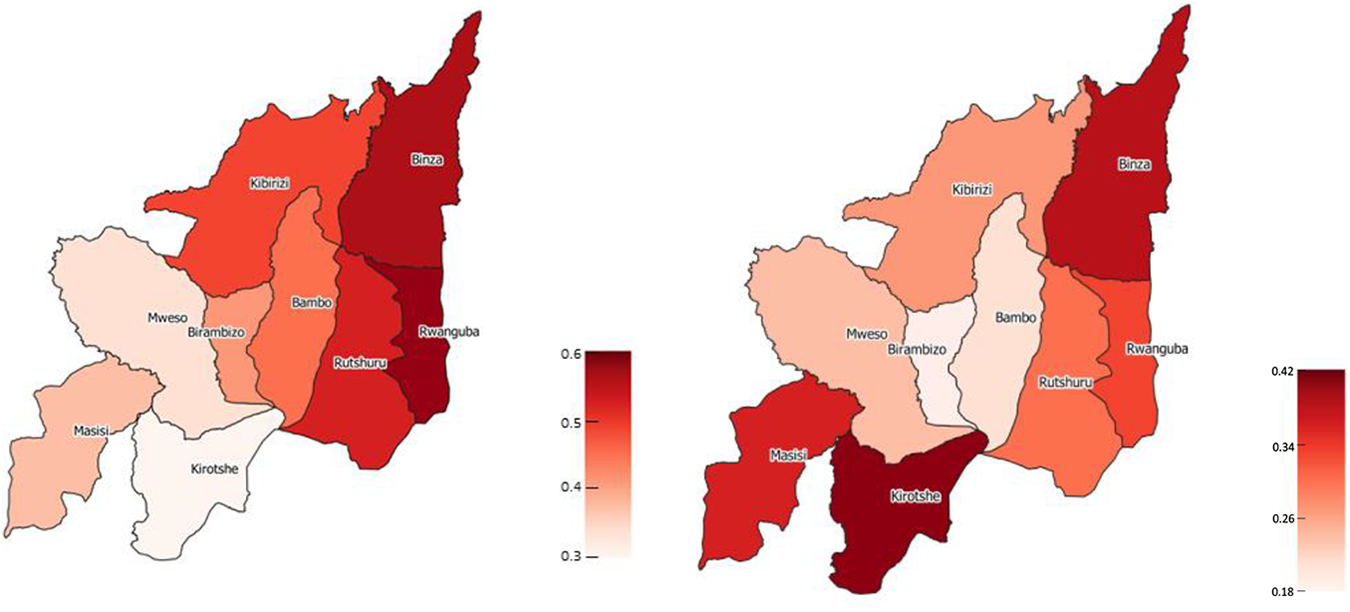
Variation of reported drought (left) and resilience capacity index (right) across the study region. Values averaged by administrative units (health center zones).
As an alternative measure, we use the self-reported monetary losses from drought. Drought loss gives the logged self-reported estimates of losses incurred by the respondent due to drought in the past twelve months in Congolese Francs. For further validation of the relevance of drought for livelihoods and opportunity costs, we report the correlation between drought exposure and perceived living conditions. In the survey, households were asked about their perceptions of their own living conditions on a five-point scale ranging from “very bad” to “very good.” We find that drought-exposed individuals report worse living conditions than others (Table A8, Supplementary Material).
Control Variables
While temporal and spatial variation in drought exposure is largely exogenous to conflict behavior and attitudes to violence, resilience is linked to a number of characteristics that could be associated with support for violence. Moreover, as we rely on self-reported data on drought exposure, perceptions of drought conditions could also be related to characteristics of the household. We strive to isolate the impact of drought, moderated by resilience levels, by controlling for relevant variables as described below.
In Eastern DR Congo, mineral and precious metal mines are often targeted by armed groups and therefore could make local populations more exposed to violence (Rustad, Østby, and Nordås 2016; Koubi et al. 2014). Based on data from the International Peace Information Service (IPIS), we include a measure of artisanal mining sites. The IPIS data are based on field visits and interviews (IPIS 2018). We include a binary variable for the location of mines within 10 km radius of a household as a control variable in our models (mines).
Conflict exposure often decreases household resilience. For example, as Brück, d’Errico, and Pietrelli (2019) show, household resilience capacity declined among Gazan households as a result of the Israeli–Palestinian conflict in 2014. This was mainly due to a reduction of the local populations’ AC, driven by the deterioration of income stability and income diversification. We control for previous exposure to violence in order to minimize the risk of reverse causality using several alternative measures. We account for whether the individual answers affirmatively to the question whether he or she or household members witnessed violence in the past twelve months (witness). This variable is a very comprehensive indicator capturing variation in experiencing violence of any kind, including related to crime, intercommunal conflict, and disputes among neighbors. All of these types of violence might affect resilience levels by reducing assets and affecting social ties. As an alternative measure, we include the longer-term trend of observed violence in the vicinity of the household location. Specifically, we include the logged number of fatalities resulting from political violence within a 10 km radius from the household location in the past five years based on data from the ACLED data set (ln_fatal; Raleigh et al. 2010). Exact GPS coordinates are missing for 365 households due to poor connection of the tablets used to collect the survey responses. In those cases, the average fatalities over the administrative division is used. The data reveal that 16 percent of the respondents reported that they or their household members witnessed violence in the past year. The conflict data from ACLED show that in five years preceding the survey, all households have been in the vicinity of violent events. We drop individuals who have reported they have been displaced in the past twelve months in the main models as it is impossible to measure any of the geographic variables for them.
In addition, gender aspects are important to account for. Women in the region traditionally take on caring roles (Slegh et al. 2012), and this might affect their attitudes to violence. We control for female respondents including a dummy variable (female). The data specifically focus on household heads who tend to be male in this area. A minority (14 percent) of respondents are female.
It is important to note that most of the variables included in our model, both attitudes and experiences, are self-reported. This is both an advantage and a limitation. By relying on self-reported exposure to violence and drought, for example, we can be assured that the individual respondents are actually aware of changes in the physical environment and events. It also allows us to use losses attributed to drought in alternative specifications. In addition, self-reported exposure to drought is not always reflected in meteorological data and picks up microlevel variation (cf. Linke et al. 2018). The disadvantages of reliance on self-reported responses are potential biases. For example, as the survey was implemented by FAO, respondents might believe they will get more assistance if they report being worse off than they are. In order to control for characteristics that are linked to biased responses of this kind, we include a question on whether respondents thought their life would be better (“1”), same (“2”), or worse (“3”) in the next year (fut_worse). Individuals who hoped to receive assistance from FAO and partnering organizations presumably would not answer that they thought their life would be better.
Analytical Methods
As a first step, we estimate a multidimensional resilience index as a latent construct in a two-step procedure following the RIMA framework (FAO 2016). First, four separate factor analyses are performed with the observed indicators assigned to each of the four RIMA pillars (Table 1). Second, the resilience capacity index is estimated in a multiple indicators, multiple causes (MIMIC) model—a type of structural equation model (Bollen et al. 2010). The MIMIC model (Figure 3) sets up a system of equations that specifies the relationships between an unobservable latent variable (resilience capacity), a set of outcome indicators (food security indicators), and a set of attributes (the pillars). It minimizes the distance between the sample covariance matrix and the covariance matrix predicted by the model. Food security indicators, which are observed in the survey data for each household, are assumed to be determined by the factor loading Λ i for the latent resilience construct as follows: Food security i = Λ i resilience + ∊ i . Λ i is restricted to unity so that one standard deviation in resilience results in one standard deviation in the food security indicators. The three food security indicators used are standard measures, reflecting the value of food consumed per capita, the diversity of food consumed during the past seven days, and food expenditure (FAO 2019).
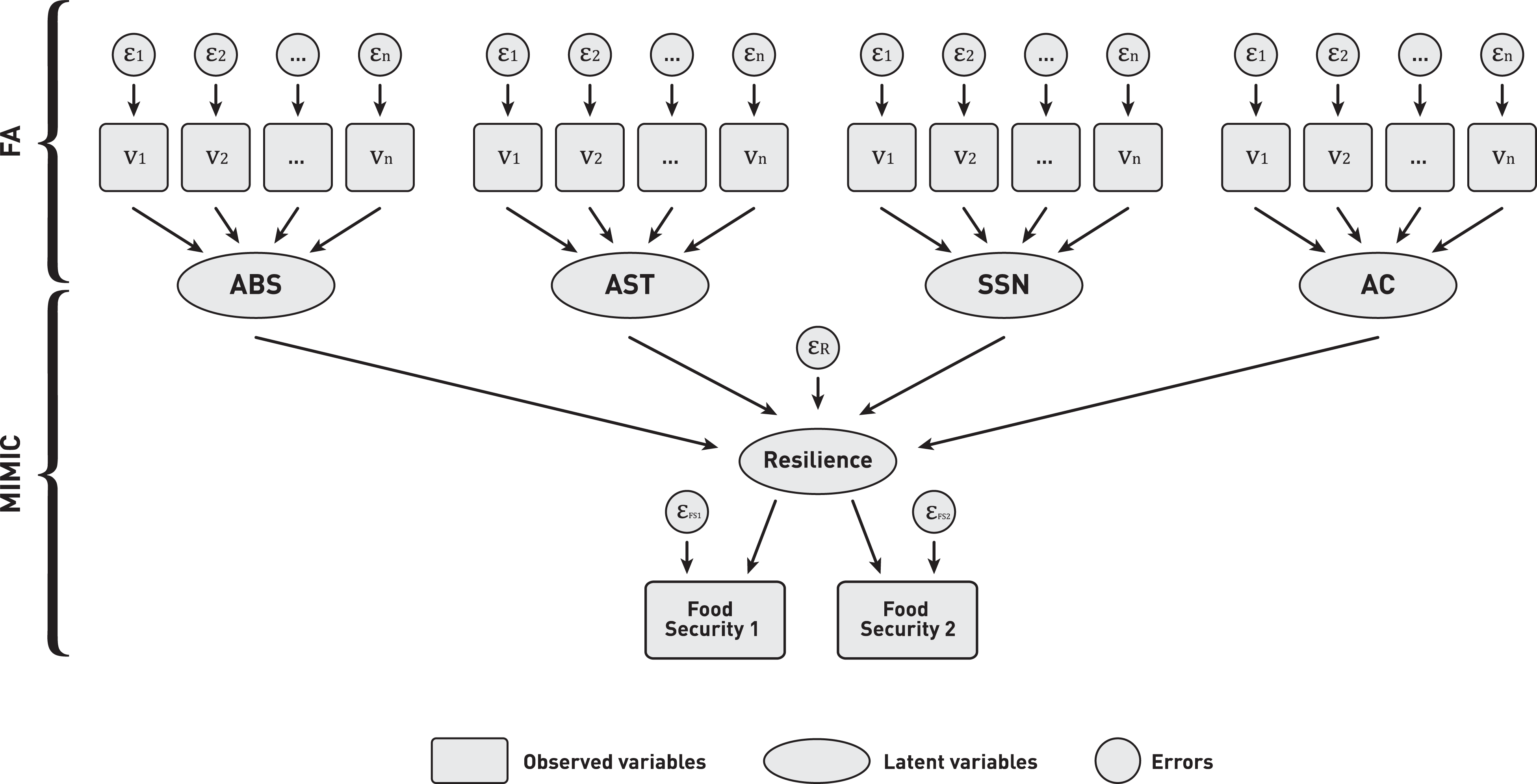
Generalized Resilience Index Measurement and Analysis model. Estimation in two-stage procedure, with first stage estimated using factor analysis (FA) and second step estimated using a multiple indicators, multiple causes (MIMIC) model using observed food security indicators. ABS = access to basic services; AST = assets; SSN = social safety nets; AC = adaptive capacity.
The resulting resilience capacity index is normalized and ranges from “0” (lowest resilience) to “1” (highest resilience) using a min–max normalization procedure. Overall, the factors load in the expected way and with adequate statistical significance (Table A7, Supplementary Material). A more detailed presentation of the methodology can be found in FAO (2016); d’Errico, Romano, and Pietrelli (2018); and Brück, d’Errico, and Pietrelli (2019).
In the main analysis, we estimate logistic regression models. For each survey respondent, support for the use of violence is modeled as

where y is the observed binary outcome (support for violence) for respondent i, α is the intercept, β is a vector of coefficients for a set of respondent-specific variables (including interaction terms) x, v is a fixed effect for the administrative unit j the respondent is embedded in (health center zone), and ∊ is the error term. The fixed effects allow us to estimate within area variations and thus account for the spatial correlation of some of the variables. Specifically, areas toward the east of the region seem to be to a larger degree exposed to drought (Figure 2). As we add fixed effects, our estimates are based on within-area variations.
Results
We start by estimating a naive model of direct effects of reported drought exposure on support for violence in Table 3, model 1. The coefficient for the drought indicator is positive as expected. However, it fails to be statistically significant at conventional levels. Although we observe statistically significant relationships in some alternative model specifications, we thus conclude that there is no robust direct relationship of reporting drought exposure and support for violence in this sample. However, model 1 shows that objective resilience is related to support for violence as we would expect.
Drought, Resilience, and Support for Violence.
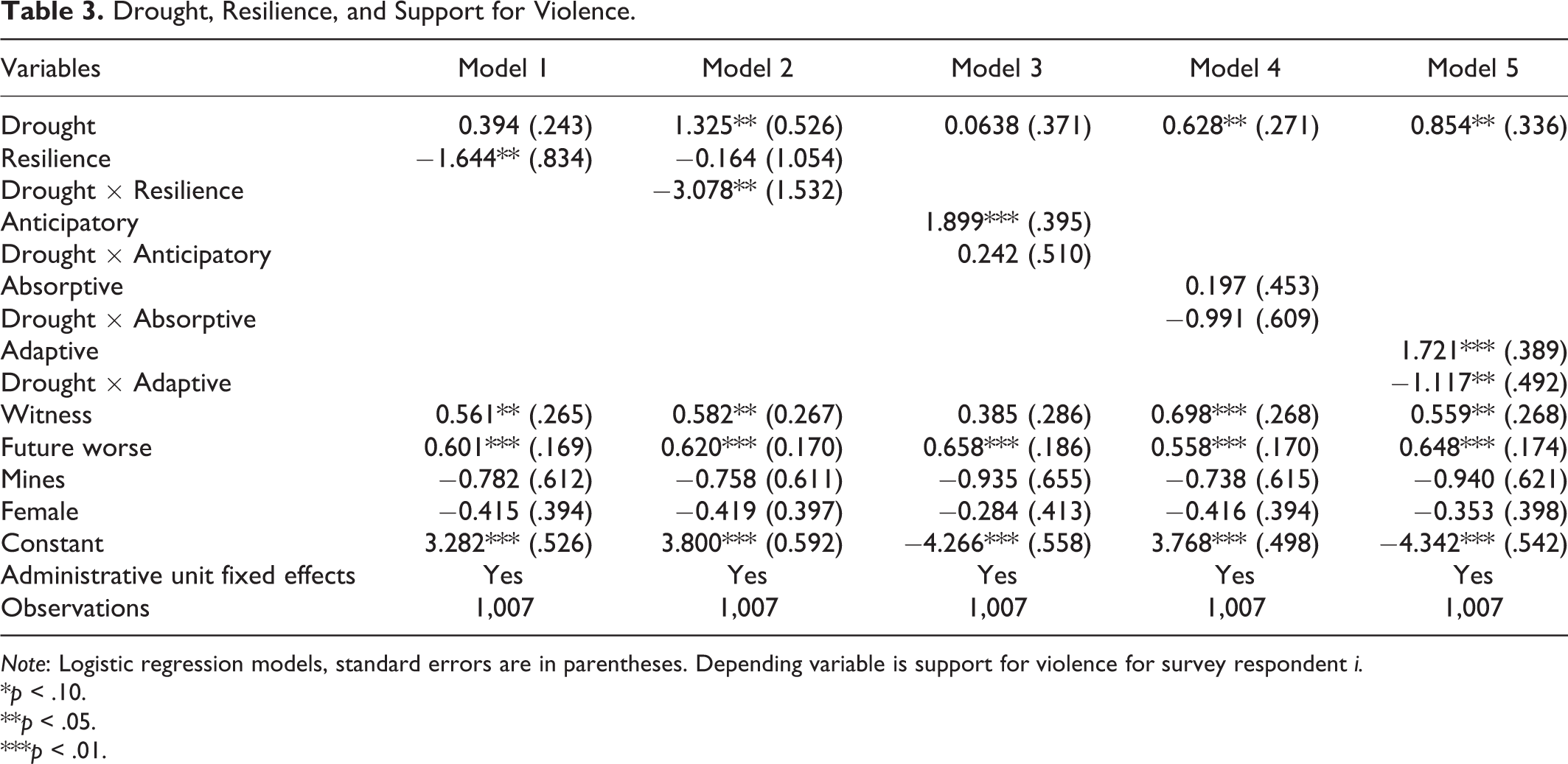
Note: Logistic regression models, standard errors are in parentheses. Depending variable is support for violence for survey respondent i.
*p < .10.
**p < .05.
***p < .01.
In model 2, we add an interaction term between the resilience capacity index and reported drought exposure, which is negative and significant in line with our theoretical expectations. While for the least resilient reported drought exposure is associated with a higher likelihood of supporting violence, this is not the case for more resilient respondents. This is visualized in Figure 4 showing average marginal effects for the drought variable at different stages of resilience with all other variables set to their mean. The least resilient respondents with a resilience capacity index of .25 or lower who report drought exposure are substantively more likely to support violence than those that do not. In the light of only 9 percent of the sample reporting support for violence, a change of 6–14 percentage points on the response scale range from 0 to 1 is a strong effect. Yet, as visible in the overlaid histogram showing the distribution of the observations, only the minority of respondents fall in this category. Moreover, the confidence intervals are relatively wide including both values closer to 0 and increases by over 25 percent. Thus, the uncertainty around these estimates is quite substantial.
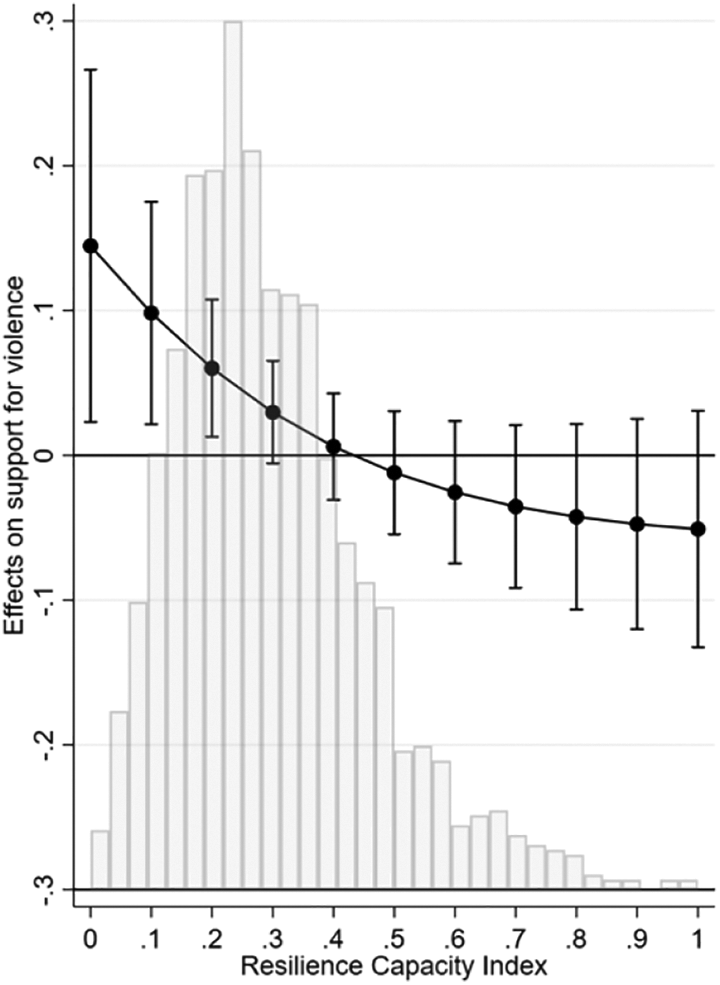
Estimated marginal effects of reporting drought exposure with 95 percent confidence interval for different values on the objective resilience measure with all other variables held at their mean values. Estimates are based on Table 3, model 2. The histogram shows the distribution of the observations.
We move on to assess the role of subjective resilience indicators. Mirroring model 2 on objective resilience, models 3–5 instead add interaction terms of drought exposure with subjective resilience indicators to the baseline model. As subjective resilience is coded as binary variable in these models, the constituent coefficient for drought indicates the association with support for violence for those perceiving themselves to lack of resilience. In two of three of these models, the coefficient for drought is positive and significant implying that for individuals who do not perceive themselves to be resilient, reported drought is also associated with a higher likelihood of being supportive of violence. However, only the interaction term for subjective perceptions of AC is significant. This means that while drought is significantly linked to support for violence for those that report no subjective resilience according to all three questions, for two of the three indicators, the difference to subjectively resilient respondents is not statistically significant. We thus conclude that there is some support for the proposition that subjective resilience is a moderating factor for the drought–violent attitudes relationship. Holding all other variables at their mean values, for those that do not perceive themselves to have absorptive or adaptive capacities reported drought exposure is associated with an increase in likelihood of supporting violence by around 4–5 percentage points as displayed in Figure 5.
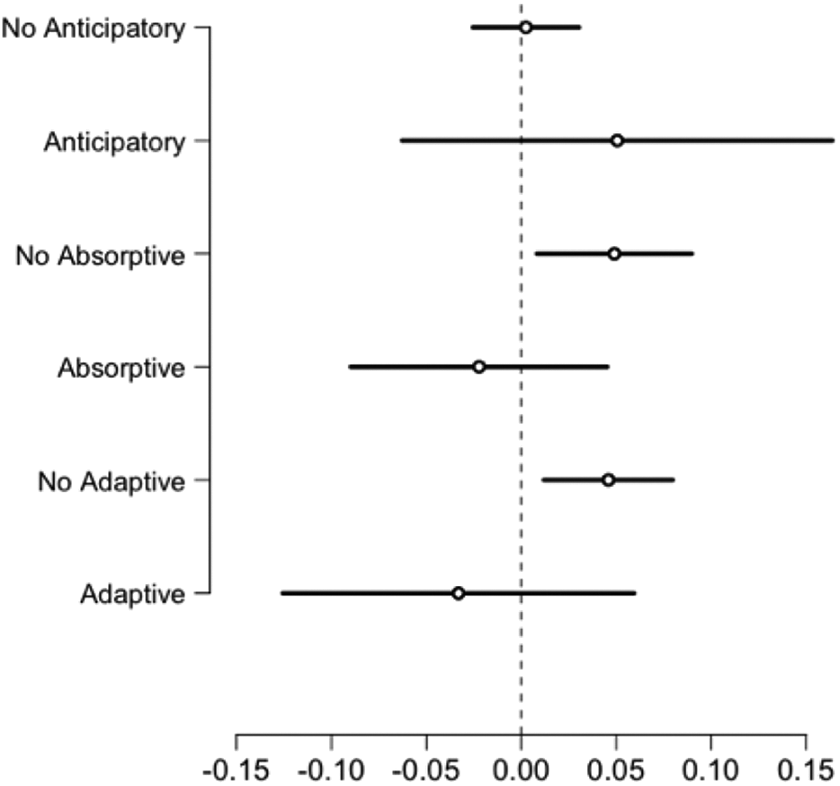
Estimated marginal effects of reported drought on attitudes to violence for respondents by degree of subjective resilience with all other variables held at their mean values. Estimates are based on Table 3, models 3–5.
For assessing the substantive importance of drought, it is important to consider the endogenous relationship of drought and resilience. Individuals in our data who are severely exposed to drought likely also see their resilience capacity depressed. This relationship will be even stronger for the households that were not very resilient before the drought hit. While we do not observe a strong relationship of reporting drought and the resilience capacity index, our results may underestimate the effect of drought, if the effect is partly indirect via other factors included in the model.
Among control variables, it is notable that the variable indicating the expectation that the future will be worse is highly significant and positive throughout. Although not specifically tested, this result is in line with our theoretical framework emphasizing the importance of considering resilience and expectations for the future rather than present status alone. Also, in line with expectations, witnessing violence is associated with support for violence in most models.
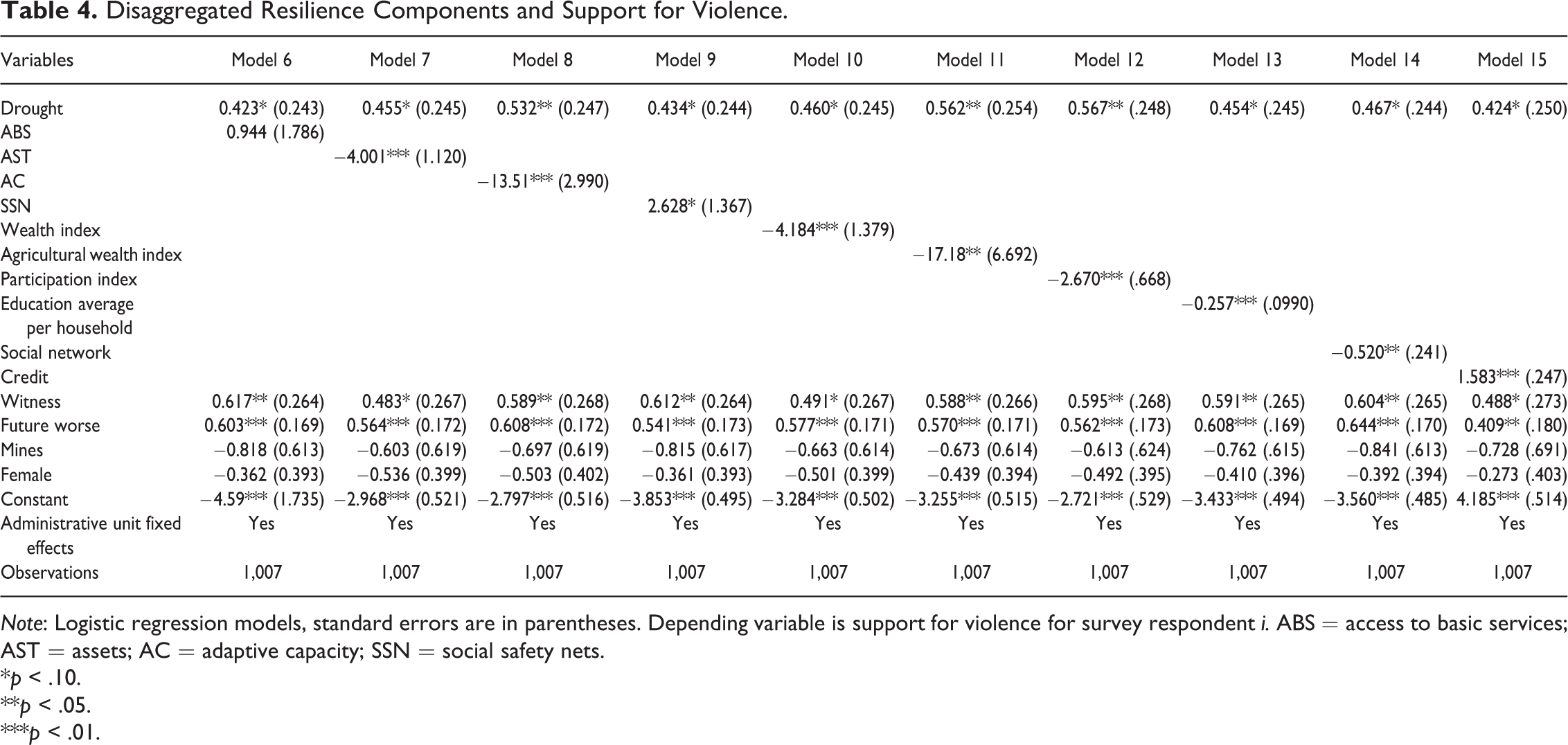
While we prefer the resilience index that best reflects the multidimensional character of resilience, it may still be interesting to disaggregate it in order to identify which dimensions of resilience matter to support for violence in general. Table 4 below provides evidence of the role played by these components of resilience. We display here the four resilience pillars of the RIMA model in addition all components of the resilience capacity index that are significantly linked to support for violence.
Disaggregated Resilience Components and Support for Violence.
Note: Logistic regression models, standard errors are in parentheses. Depending variable is support for violence for survey respondent i. ABS = access to basic services; AST = assets; AC = adaptive capacity; SSN = social safety nets.
*p < .10.
**p < .05.
***p < .01.
The analysis of the pillars indicates that ABS (model 6) and SSN (model 9) are not significantly linked to attitudes to violence. The coefficients are positive, against expectations, but not significant at conventional levels. Interestingly, these pillars also contribute the least to resilience capacity as a latent construct (Table A7, Supplementary Material). In contrast, both AST (model 7) and AC (model 8) are significantly associated with lower support for violence. Disaggregating the pillars further, the two wealth indices (general wealth, model 10, and agricultural-specific wealth, model 11) are negatively correlated with support for violence. In addition to this, households with a higher average level of education (model 13) and stronger social networks (model 14) are less likely to support violence. Overall, these results are in line with the earlier tests of the opportunity costs framework emphasizing the role of income and education (Collier and Hoeffler 2004). Further, we note that those who have a more diversified portfolio of income-generating activities as indicated by the participation index (model 12) are also less likely to support violence. While the resilience components are correlated and we cannot make strong inferences from the results, this model may suggest that diversification provides credible outside options short of the use of violence in the wake of shocks. Somewhat surprisingly, there is a positive association of access to credit and support for violence (model 15). A closer investigation reveals that those who have been provided with access to credit have less resilience capacity overall. Hence, they seem to be a particularly marginalized part of the population and thus perhaps more susceptible to shocks and support for violence.
Robustness Checks
To further probe the robustness of our results, we add a set of additional tests that are presented in more detail in the Supplementary Material. Given the disaggregated results presented in Table 4, one may be concerned that our approach using a multidimensional resilience measure is as good as a simple wealth- or income-based approach. As an alternative specification, we interact drought with a variable measuring wealth, that is, owning assets like a house, a motor bike, or a water tank (Table A4, Supplementary Material). In line with the results for resilience, households with more wealth are less likely to report support for violence following drought. However, additional models show that resilience (both objective and subjective) still adds important information to the analysis. When replicating the main analysis including a control variable for wealth, the interaction of drought and the resilience capacity index is still significant. This result supports the theoretical underpinning of our expectations that not only present wealth matters but also the general capacity to recover from a shock in the future.
In addition, we could be concerned that some respondents generally pick more extreme answers in a household survey, which could bias our results. However, this does not seem to be the case. There is great variation in reported exposure to shocks with reported exposure to many shocks being very low (such as related to diseases, damage to stored products, fires; Table A3, Supplementary Material).
Additionally, we present alternative model specifications. We alter the drought specification so that we focus on self-reported losses from drought instead of just exposure. We also add additional control variables. Overall, the results support the findings of the main models (Tables A5 and A6, Supplementary Material).
Discussion and Conclusion
To our knowledge, this is the first study systematically investigating the relationship between drought, household resilience, and support for violence in a conflict-affected area using household survey data. By focusing on North Kivu, where both food insecurity and violence are widespread, we provide unique insights on the variation of the individual propensity to use violence in a situation of protracted crisis. The findings of this article suggest that objectively, more resilient households are less likely to support political violence and thus potentially participate in violence in this context. The reported experience of a drought is associated with support for political violence for the least resilient individuals. Yet, objective resilience and, to some degree, subjective resilience dampen the estimated security effects of reporting drought shocks. We also show that the explanatory power of resilience goes beyond conventional measures relying on assets or income. These findings are in line with qualitative evidence on the role of violence in North Kivu, portrayed as an opportunity for social mobility, a new identity, and livelihood, in a situation of social and economic crisis (Jourdan 2004; WFP, FAO, IFAD 2017).
The conclusions that can be drawn from our findings come with limitations. Due to data limitations, such as access to only one survey round, further disentangling the sequence of events in exposure to drought, shocks to livelihoods, and resilience is not possible. Future research should probe the relationships we outline here using panel data, which would allow for the study of indirect pathways and facilitate exploiting observed temporal variation in environmental conditions for estimating the impacts of shocks on changes in attitudes and livelihoods in the same individuals over time. Caution is also warranted when using the results of this work for making inferences for the use of political violence. While we study attitudes to violence, rather than actual participation, pro-violence attitudes have been shown to facilitate the spread of violence (McDoom 2013; Linke, Schutte, and Buhaug 2015). In this specific context, the ongoing instability and numerous violent actors active in the study region imply that joining or supporting a group is not a far-fetched idea but instead may present itself as a viable response to economic hardships. It is thus plausible to presume implications of our findings for participation in violence in this high-risk context. This nevertheless remains an assumption we cannot test with the available data.
Another important area for further research is the extension to other contexts. The omnipresence of conflict likely shapes the linkages and relationships we identify here. In North Kivu, internally displaced and host households are in a particularly dire situation and farming activities are often hampered by conflict. With prolonged conflict, economic considerations and questions of survival tend to become more important than political preferences (Kalyvas 2006). This may suggest that the link between agricultural production shocks, resilience, and propensity to engage in political violence could be particularly pronounced in areas of protracted crises in general. Providing the evidence base from more diverse contexts could have important implications on the design of resilience-supporting interventions and how these interact with other localized peacebuilding approaches.
Notwithstanding limitations, these findings are relevant to assessing the security implications of climate change. There is a great need for identifying pathways through which climate affects conflict risks (cf. Mach et al. 2019). In this study, we provide nuanced and fine-grained analysis of the effect of climate-related shocks in one of the most fragile regions globally and show how reported natural hazard impacts are moderated by resilience. Our findings are also important for development and humanitarian policy makers supporting more resilient individuals and communities. In terms of design of policies and programs, a key finding of this study is that a member of a resilient household is less likely to support the use of political violence. This provides encouragement for investments in enhancing resilience of rural populations by both the international community and national governments, particularly in protracted crises, with the caveat that findings from this context cannot automatically be transposed to other situations.
Agriculture remains the main source of food and income for the majority of those caught up in protracted crises (FAO et al. 2017); rapidly restoring local food production and investing in building and strengthening resilience are critical to tackling food insecurity. Protecting and restoring sustainable livelihoods is essential to the integrity of societies that depend on farming, livestock, fishing, forests, and other natural resources. The overarching theory of change is that investments in resilience will help address some of the root causes of hunger and malnutrition, having a lasting impact on vulnerable populations who face increasingly severe and frequent shocks. Being sensitive to conflict and doing no harm are the prerequisite for good programming. Yet, our findings could point toward the potential of an added value for investments in resilience with regard to local peacebuilding in reducing the probability that people will engage in violent behavior.
Supplemental Material
Supplemental Material, sj-pdf-1-jcr-10.1177_0022002720923400 - Drought, Resilience, and Support for Violence: Household Survey Evidence from DR Congo
Supplemental Material, sj-pdf-1-jcr-10.1177_0022002720923400 for Drought, Resilience, and Support for Violence: Household Survey Evidence from DR Congo by Nina von Uexkull, Marco d’Errico and Julius Jackson in Journal of Conflict Resolution
Supplemental Material
Supplemental Material, sj-zip-1-jcr-10.1177_0022002720923400 - Drought, Resilience, and Support for Violence: Household Survey Evidence from DR Congo
Supplemental Material, sj-zip-1-jcr-10.1177_0022002720923400 for Drought, Resilience, and Support for Violence: Household Survey Evidence from DR Congo by Nina von Uexkull, Marco d’Errico and Julius Jackson in Journal of Conflict Resolution
Footnotes
Authors’ Note

Acknowledgments
We thank three anonymous reviewers, Geoffrey Dabelko, Yannick Pengl, and Ralph Sundberg, and participants in the research paper seminar at the Department of Peace and Conflict Research at Uppsala University, as well as the Resilience Measurement and Evidence and Learning Conference 2018, for comments on an earlier version of the article and Agnese Loy for excellent research assistance.
Declaration of Conflicting Interests
The author(s) declared no potential conflicts of interest with respect to the research, authorship, and/or publication of this article.
Funding
The author(s) disclosed receipt of the following financial support for the research, authorship, and/or publication of this article: Nina von Uexkull acknowledges funding from Swedish Research Council, SIDA, and FORMAS, grant no. 2016-06389, and Research Council of Norway, grant no. 268135/E10. Data collection was part of the Canada-funded resilience initiative taking place in Niger, Somalia and the Democratic Republic of the Congo by the Food and Agriculture Organization, the International Fund for Agricultural Development and the World Food Programme.
Supplemental Material
Supplemental material for this article is available online.
References
Supplementary Material
Please find the following supplemental material available below.
For Open Access articles published under a Creative Commons License, all supplemental material carries the same license as the article it is associated with.
For non-Open Access articles published, all supplemental material carries a non-exclusive license, and permission requests for re-use of supplemental material or any part of supplemental material shall be sent directly to the copyright owner as specified in the copyright notice associated with the article.
