




Abstract
When confronted with mass uprisings, governments deploy their security forces for crowd control or repression. However, sometimes security agencies choose to side with the opposition movement. Recent work shows that “fragmentation” contributes to defection: fragmenting the security forces into parallel units leads to oversight problems and grievances among soldiers, which raises the risk of members of the security forces defecting to the opposition movement. However, I argue that the effect on defection is strongly moderated by the circumstances under which states choose to fragment their military: fragmentation for the purpose of security specialization, called “differentiation,” even decreases its risk. Employing Bayesian multilevel modeling, the findings corroborate this distinction. The study contributes to the fundamental discussion on civil–military relations, shedding light on why some conflict situations see security defections while others do not. Understanding this phenomenon is a pivotal element to explaining how conflicts develop, escalate, and end.
“Loyalty” is paramount for military success (see Chenoweth and Stephan 2013; Nepstad 2011; Stephan and Chenoweth 2008; Peaty 2002; Brinton [1938] 1965), which is why insubordination and desertion are persecuted and severely punished—this was the case centuries ago and remains true today. Despite harsh countermeasures, disobedience is a recurring phenomenon in all militaries, which is why an identification of the conditions under which soldiers are more likely to defect is as relevant as ever. In addition, these cases of secession cause more than “just” military ineffectiveness: they pose a threat to the underlying command structure as a whole, and therefore to the fundamental civil–military relations within a state.
Especially, governments that take extensive measures to ensure their military’s allegiance (“coup-proofing”) have to expect an increased likelihood of military defections during (non)violent uprisings (Dahl 2016b; Lutscher 2016). One of these coup-proofing measures refers to a fragmentation of the security apparatus and is called “counterbalancing”: a government that fears a coup d’état to happen fragments its security forces into multiple independent command structures, hence if one unit turned rogue, other loyal units could be deployed to “counterbalance” it. In their pioneering work, Dahl (2016b) and Lutscher (2016) find that such counterbalancing induces frustration, oversight problems, and ineffectiveness in the security apparatus, leading to more defections. I extend their work by arguing that features like frustration and ineffectiveness stem from the government’s desire to coup-proof and not from “fragmentation” itself. There are many countries maintaining a highly fragmented security apparatus without any coup-proofing intentions. Such fragmentation instead aims at a specialization of individual force segments in different security tasks (e.g., counterinsurgency vs. conventional warfare) and is herein called “differentiation.” In contrast to counterbalancing, differentiation bears positive implications for effectiveness and capacity (Dworschak 2019). Consequently, while previous studies shed light on the link between coup-proofing measures and defection, I inquire “how does military differentiation influence the likelihood of defections during (non)violent uprisings?”
This article proceeds as follows. First, I conceptualize military defection and review different causes. Second, I explain the two types of fragmentation, “counterbalancing” and “differentiation,” and develop an argument explaining how the latter yields opposite implications for defection during internal conflict. Security forces that are divided into multiple parallel units, each specifically trained and equipped to conduct a distinct security task, are expected to experience a lower likelihood of defection. This is because grievances among soldiers are lowered, and civil unrest is effectively countered without it posing a threat to the government’s survival. Third, the hypothesis that higher differentiation leads to a lower propensity of defection is evaluated using a Bayesian multilevel logistic analysis, which yields results in line with my theory. Subsequent robustness checks provide further corroboration. I conclude with a summary of my findings and avenues for further research.
Defection in the Security Apparatus
Military disobedience has many faces and may refer to defections, coups, mutinies, or desertions. Past research on either of them has often failed to acknowledge previous work on any of the other concepts despite them being so closely related. In this subsection, I provide a short overview of the conceptual differences in order to unambiguously demarcate the definition of defection as it is used for this article and to start bridging the gap between the different strands.
Studies on desertion mostly offer in-depth descriptions of historical cases. In his monograph on desertion during World War I, Chen (2016, 1) details that “[u]nlike cowardice (if a soldier turns his back on the enemy and runs away), desertion was subsequent absence from the scene of danger with intent of avoiding danger” (emphasis original; definition based on Peaty [1999, 199]). Mutinies on the other hand occur both during conflict and peacetime and have seen a recent surge in contemporary case studies and quantitative investigations. The concept represents “collective revolts by soldiers that are not focused on taking control of the state[,…but instead] to convey soldiers’ grievances” (Dwyer 2017, 4). Emphasizing some of its possible dimensions, Rose (1982, 561) defines a mutiny as “an act of collective insubordination, […] both active and passive[,…] with or without violence.” The key difference to deserters is that mutineers normally stay within the state’s security apparatus and do not seek to evade their superiors but instead aim at openly confronting them with certain demands, oftentimes trying to draw as much (public) attention to their cause as possible (Dwyer 2015, 7). This may lead, for example, to soldiers seizing their barracks or occupying a city (see, e.g., Burke 2017) in order to voice their grievances about payment issues (Schiel, Faulkner, and Powell 2017). Finally, individuals can desert unilaterally, while mutinies are collective endeavors that require coordination between soldiers.
While defection is sometimes used synonymously with desertion (see, e.g., McLauchlin 2015), I employ a more narrow approach and build on the operationalization by Dahl (2016b) and Lutscher (2016). Specifically, I understand defection to be a mixture of both desertion and mutiny: defecting soldiers leave the state military, in order to go into open rebellion against it. During civil conflict, this means that part of the security apparatus breaks away from the government and actively sides with the opposition movement (“side-switching”; cf. Dahl 2016a, 2016b,; Lutscher 2016). 1 Prime examples constitute militaries siding with the protesters in Egypt and Tunisia during the Arab Spring in 2011 (Brooks 2017). In order to address the imminent research gap and properly connect to the threads of Dahl (2016b) and Lutscher (2016), this article solely applies this narrow definition of “defection.” 2
Coups d’état constitute the largest rupture in civil–military relations and may be seen as “severe forms” of defections. 3 However upon closer inspection, their similarity proves superficial. First, defections are different from coups in that they require much less coordination (Dahl 2016b, 45-47). While coups have to be orchestrated and are directed at the center of power, defections often happen in the periphery and can be perpetrated by individuals. Second, defections require an active opposition to which the soldier(s) can defect to, while coups may happen outside of active conflict environments (Lutscher 2016). 4 Third, building on the distinction drawn above, defecting soldiers leave the military, while coup participants often wish to conserve the military’s structure and keep (or increase) their ranks, “only” aiming for a seamless turnover in state leadership ( Derpanopoulos et al. 2016; Thompson 1975, 485-86).
Following T. Lee (2009, 646-47), and reiterated by Lutscher (2016, 356), one important factor determining defection is bandwagoning: when segments of the military recognize that they are fighting on the “losing side,” that is, that their government will inevitably succumb to the domestic opposition (possibly paired with international pressure), the risk of defection surges. Similarly, Nepstad (2013) suggests that perceived fragility of the regime is a key driver for disobedience and mutiny: an unwillingness of international allies to help a struggling government may signal security forces that their principal will not prevail. An example of this is Gorbachev’s decision to stay idle over the 1989 uprisings in East Germany, spurring large-scale defections (p. 340). However, bandwagoning is not only a substantial explanans for individual-level defections due to security forces avoiding to fight a losing battle but also because of their organizational preference for cohesion: Pion-Berlin, Esparza, and Grisham (2014) indicate that military leadership eschews ordering deployments that may be divisive among soldiers and that could lead individual units to break away from the force. Uncertainty over the regime’s survival, as well as suppressing (especially nonviolent) insurrections, critically endanger such internal cohesion and increase group-level defections (Lutscher 2016, 356; Pion-Berlin, Esparza, and Grisham 2014, 233-35).
Finally, Dahl (2016a, 2016b) shows how major incidences of military personnel siding with the opposition movement are rendered more likely when a state employs counterbalancing. “Counterbalancing” is a tool that is employed in countries which are at risk of experiencing a coup d’état: it refers to the purposeful fragmentation of the military so that power is not concentrated within a single command structure, and individual segments can be used against each other in case of one staging a coup (Quinlivan 1999, 141; Belkin and Schofer 2003, 613, 2005, 147-50). According to Dahl (2016b), counterbalancing fosters grievances in the security apparatus and impedes effective monitoring, both of which enable defections. Lutscher (2016) adds to these findings, showing that the relationship between counterbalancing and defection is U-shaped: while he agrees that low and high degrees of counterbalancing lead to an increased likelihood of defection, a medium level of counterbalancing however sees a decrease. This is because at a medium level of counterbalancing, its originally intended effects (preventing military segments to turn against the government) are most prominent, thus hampering defection (pp. 355-58).
Expanding the Discussion: Military Fragmentation
I propose a new approach to explain the occurrence of defections. Beginning at the literature’s point of departure, I first review the implications of “counterbalancing” (cf. Dahl 2016b; Lutscher 2016) and then proceed to compare them to “pure” military fragmentation under no coup risk, which I call “differentiation.”
Two Types of Fragmentation
There are two distinct types of military fragmentation: counterbalancing and differentiation. This difference becomes apparent when considering the fact that force fragmentation occurs in various states with both high and low coup risk, indicating that such fragmentation may not solely serve coup-proofing purposes. Instead of coup-proofing, a common reason for establishing multiple parallel militaries is specialized task sharing: while one army may be trained and equipped for interstate warfare, the other is employed for internal pacification. Although this difference in intentions for fractionalizing the security apparatus may seem subtle, it has profound implications for military effectiveness (Dworschak 2019) and, as I argue in this article, the likelihood of defection.
Previous research has considered the effect of counterbalancing on the likelihood of defection, while disregarding this other type of force fragmentation (Dahl 2016a, 2016b; Lutscher 2016). I seek to remedy this gap by hypothesizing counterbalancing and differentiation to have contradicting influences on the likelihood of defection, leading to a unified framework of the relationship between fragmentation and defection during conflict.
Counterbalancing
Broadly speaking, a government faces two “extraordinary” (noninstitutionalized) threats to its survival: on the one hand, interventions by the elite, which are commonly referred to as coups d’état, and on the other hand popular uprisings, ranging from large-scale protests up to violent insurgencies (Roessler 2016; Svolik 2012, 3-10; Acemoglu and Robinson 2001). States are aware of these threats and adapt their security apparatus accordingly.
Starting with the first type, especially authoritarian regimes face a higher risk of experiencing coup attempts (Böhmelt, Ruggeri, and Pilster 2017, 225). In order to minimize this risk, they can implement various coup-proofing strategies, one of which is called counterbalancing: based on the idea “divide and conquer” (Belkin and Schofer 2005, 147-48), the state leadership divides its military into multiple subunits with separate command structures as to avoid concentrating too much power within few commanders. In addition, it raises associated coordination problems in case a military commander wants to topple the government, and it allows the leadership to deploy the remaining loyal parallel militaries against the renegade unit (to “counterbalance” it). 5 Counterbalancing is generally accompanied by a set of other coup-proofing measures, which are outlined by Quinlivan (1999) in light of cases in Saudi Arabia, Syria, and Iraq: when in fear of coups, the leadership generally seeks to hamper forces’ capacity and resolve and tends to foster military promotions not based on merit, but instead on ethnic, religious, or family ties, in an attempt to secure their commanders’ allegiance. Joint training exercises, another important feature for military effectiveness, are also discouraged as they could serve to overcome the purposefully induced coordination problems.
In summary, governments that face a heightened coup risk perform coup-proofing, which includes counterbalancing. 6 However, as an externality of this behavior, these governments may simultaneously render themselves more susceptible to the second type of threat: popular uprisings (Roessler 2016). As Biddle and Long (2004, 532) point out (see also Powell 2012a, 140-45), hampered resolve and training, as well as partisanship in the promotion of staff, lead to a decrease in human capital, military ineffectiveness, and generate frustration among many personnel—which is one of the reasons why coup-proofing is thought to increase the risk of defection (Dahl 2016b, 214). Another coup-proofing feature is the constant rotation of top officers, which aims at preventing “alternative power bases from developing,” but again increases risks of partial defections due to impeded oversight (p. 216).
Differentiation
In this article, I seek to accommodate the fact that coup-proofing is not the sole reason for states to fragment their security apparatus and that this difference is meaningful when estimating the likelihood of defections. The main alternative reason for governments to pursue military fragmentation, other than counterbalancing, is to achieve specialization. For example, India has a highly fragmented security apparatus but a low structural coup risk. 7 In this context, high fragmentation does not take place in order to forestall a coup but to have multiple security forces trained and equipped in different tasks: for one, India has a need to maintain conventional military capacity (large, mechanized forces) in light of the contestation with Pakistan and to deter other potential interstate challengers (Ladwig 2015; Kapur 2008). Additionally, however, the Indian government faces several insurgencies, which generally require nonconventional mobile units that are specially trained and equipped for asymmetric warfare (Pilster, Böhmelt, and Tago 2016; Lyall and Wilson 2009; Dworschak 2019). Therefore, the fact that India maintains multiple parallel security forces is not a result of coup-proofing but of task specialization.
While there is a consensus that counterbalancing and many of the abovementioned coup-proofing measures are detrimental to military effectiveness, motivation, and cohesion (Roessler 2016; Powell 2012a; Biddle and Long 2004), these negative implications may not be shared by the type of fragmentation as in the case of India. On the contrary, the argument I bring forward assumes that an employment of multiple parallel forces for the purpose of tailoring their training and equipment to fulfill specific security tasks necessarily leads to an increase in their effectiveness and endowment (cf. Pilster, Böhmelt, and Tago 2016; Dworschak 2019). Such “pure” fragmentation that is distinct from counterbalancing, since it does not come with any other coup-proofing measures and does not aim at purposefully rendering the military less capable, is herein referred to as “differentiation.” 8
Differentiation and Bandwagoning during Conflict
In cases of defections during civil conflict, both types of “extraordinary” threats to regimes’ survival fall together, one from the masses and one from the elites: a popular (non)violent movement poses a bottom-up threat to the ruler, combined with parts of the government’s security forces joining this uprising. Therefore, these cases constitute an especially interesting setting to compare the influences of differentiation and counterbalancing on defection as each speaks to a different type of threat.
Security forces that are subjected to counterbalancing and other coup-proofing measures are less apt to confront an uprising, since governments facing high coup risk seek to hamper military capacity, allow less joint training, decrease human capital on both the officer and soldier levels, and impede communication and coordination (see, e.g., Powell 2012a, 140-45; Biddle and Long 2004, 532; Huntington 1957, 82-85). Soldiers however generally prefer not to fight on the losing side (Lutscher 2016, 356; Nepstad 2013, 340; T. Lee 2009, 646-47). When soldiers begin to appreciate that their efforts are futile and that they will not be able to end a seemingly successful revolt, they will rather “jump on the bandwagon” and side with the opposition, instead of remaining with a government that they expect to eventually be overthrown. Drawing on the fact that differentiation is associated with more specialized training and equipment, more endowments, and increased military effectiveness, this would indicate that the bandwagoning effect becomes reversed: a differentiated military is better able to counter revolts and insurgencies. This stifles the opposition’s chances to succeed, which in turn renders the security forces more prone to stay aligned with the government. Past literature mainly considers grievances and motivation as drivers of defection but tends to neglect the relevance of human resources in the military and its ability to confront an opposition movement. I argue that military ineffectiveness, or more specifically, being unfit to meet the challenge of an uprising, significantly adds to our understanding of the link between fragmentation and defection.
However, especially when facing nonviolent uprisings, the military’s motivation to support the regime remains a crucial factor determining their loyalty (Brooks 2017). Counterbalancing leads to decreased endowments and dissatisfaction among military personnel, which lead to an increased risk of soldiers and units to defect to the opposition (Dahl 2016a, 2016b; Lutscher 2016). Based on the notion that differentiation may be associated with increased funds, better training and equipment, and an overall increased leverage, it follows that differentiation decreases the risk of soldiers defecting. In summary, although both counterbalancing and differentiation refer to a fragmentation of the state’s security apparatus, they constitute very distinct concepts and have contradicting implications for security forces’ effectiveness and motivation. This results in opposite expectations regarding a force’s propensity to defect during conflict. See Figure 1 for a visual summary.
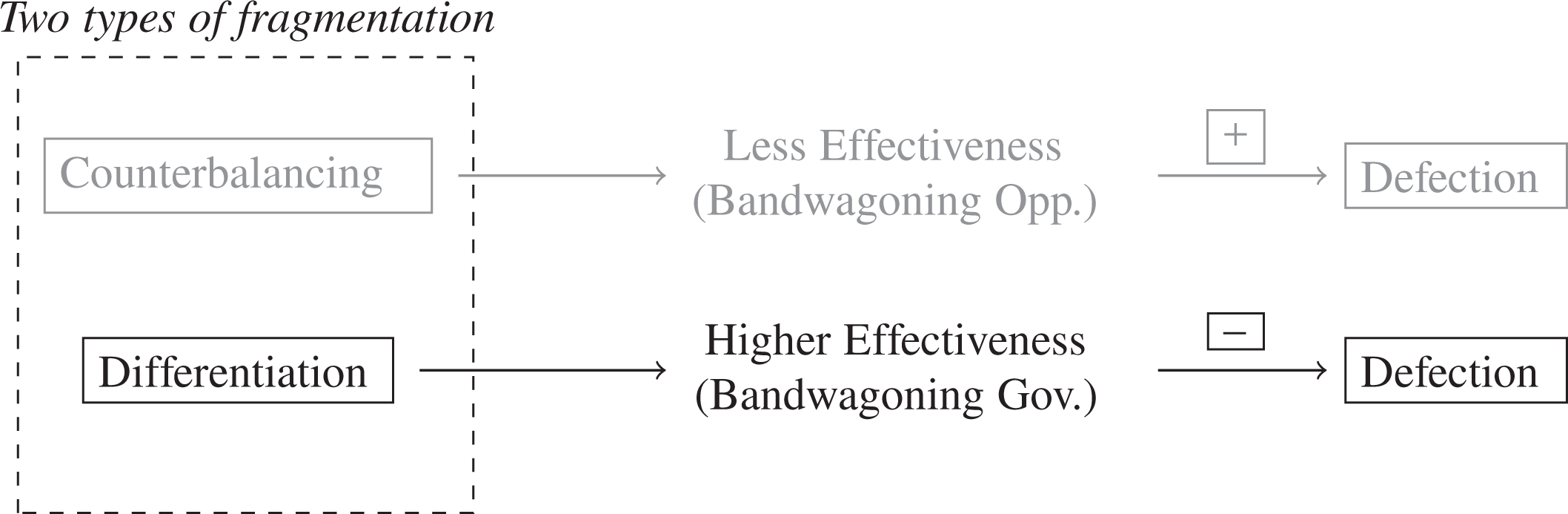
Theoretical overview. The grayed-out part, linking counterbalancing to an increase in defections, signifies the macro relationship that has been tested in the past. The lower part corresponds to my contribution.
One example that is particularly illustrative of this framework is the Tunisian army. President Habib Bourguiba, predecessor of Ben Ali, established civilian control as the central tenet of Tunisian civil–military relations: in this rapport, the military was fundamentally professional and “nonpolitical” (Barany 2011, 31). During his time, the Tunisian government perceived itself to be at a low coup risk, and while its military was highly fragmented, this was not particularly directed at counterbalancing or other coup-proofing purposes. On the contrary, the army was very well funded and granted a high capacity, and its three well-trained parallel brigades were allowed to engage in joint exercises (Pachon 2014, 525). In addition, the Interior Ministry maintained a large, parallel security apparatus especially trained and equipped for internal pacification, and the army would only be called in when these militarized police forces would become overwhelmed by an uprising (Barany 2011, 31). This professionalism and clear task separation added to the general reservation that most militaries hold against “policing tasks” (see Pion-Berlin, Esparza, and Grisham 2014, 234-35) and resulted in the Tunisian army resenting to be ordered to help quell the uprisings of 1978 and 1984 (p. 31). Despite this “situational frustration” however, there were no accounts of any insubordination as the army experienced no problems in countering the revolts and had an overall high motivation to keep Bourguiba in power due to their beneficial status (Pachon 2014, 521-23). 9
In contrast to this, Ben Ali purposefully kept his military small and underfunded and deprived it of essential resources (Brooks 2013, 208). Accordingly, the defections that have led to his eventual downfall in 2011 were committed by exactly those units that were least able to confront large-scale riots and that were deployed although they lacked the skill, training, and resources to face widespread protests (Pachon 2014, 528-29). This was quickly followed by other forces joining the defectors or resorting to idleness as there was little motivation to keep a ruler in power who systematically kept the military in a tight grip and marginalized (Brooks 2017, 7-8; Brooks 2013, 216). In summary, the security forces’ ability and motivation to counter an uprising constituted a crucial determinant for their propensity to defect. Differentiating the security apparatus, and thus maintaining specialized and well-equipped forces that are apt and willing to engage the security threat at hand, seems to be paramount to military cohesion.
Hypothesis
I argue that the adverse effect of counterbalancing on defection is not inherent to fragmentation itself but relates to the concomitants of coup-proofing. Shifting the theoretical focus on military effectiveness and bandwagoning, it becomes apparent that differentiation, that is, fragmentation for the purpose of security specialization instead of coup-proofing, may even lead to a decrease in defections due to the security apparatus being better able and more willing to overcome (non)violent uprisings. This leads to the directional hypothesis below, which I quantitatively evaluate in the following section.
10
Note that, in line with my theory and conceptualization, the analysis will interact a measure of fragmentation with structural coup risk, since the term “differentiation” implies fragmentation under low coup risk. This will be further explained in the operationalization below.
Research Design and Empirical Evidence
Variables and Data
Building on my earlier conceptualization, I measure the dependent variable using a binary indicator of whether a security defection occurred in a given campaign-year (unit of analysis) from the NAVCO version 2.0 data project (Chenoweth and Lewis 2013). “Security defection” refers to segments of the state security apparatus (elements of the military, paramilitaries, or police) switching sides and openly supporting the (violent or nonviolent) opposition campaign. Often, these cases involve military leadership, however, it may also be lower ranks or the police siding with the opposition. Sometimes multiple defections may happen over the course of one campaign. See Table 1 for summary statistics.
Data Summary.
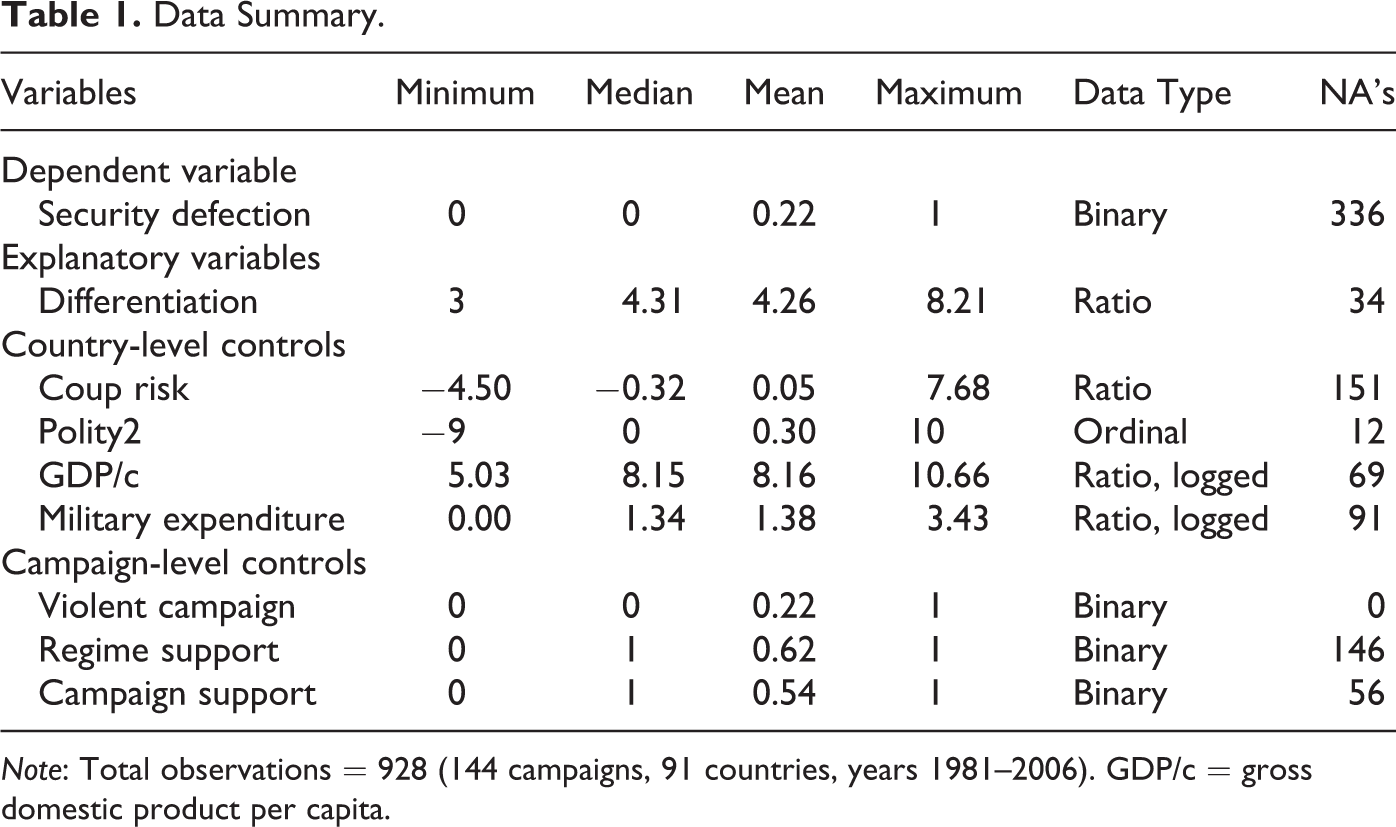
Note: Total observations = 928 (144 campaigns, 91 countries, years 1981–2006). GDP/c = gross domestic product per capita.
Based on Pilster, Böhmelt, and Tago (2016) and Dworschak (2019), fragmentation of the security apparatus generally refers to the number and ratio of rivaling ground-combat compatible
11
security organizations in a state. These include, for example, the regular army, marines, border police, and other kinds of paramilitaries (“auxiliary forces”; cf. Böhmelt and Clayton 2017, 1). In line with my conceptualization, and based on the distinction between counterbalancing and differentiation explained earlier, I adopt the adjusted differentiation index proposed by Dworschak (2019):
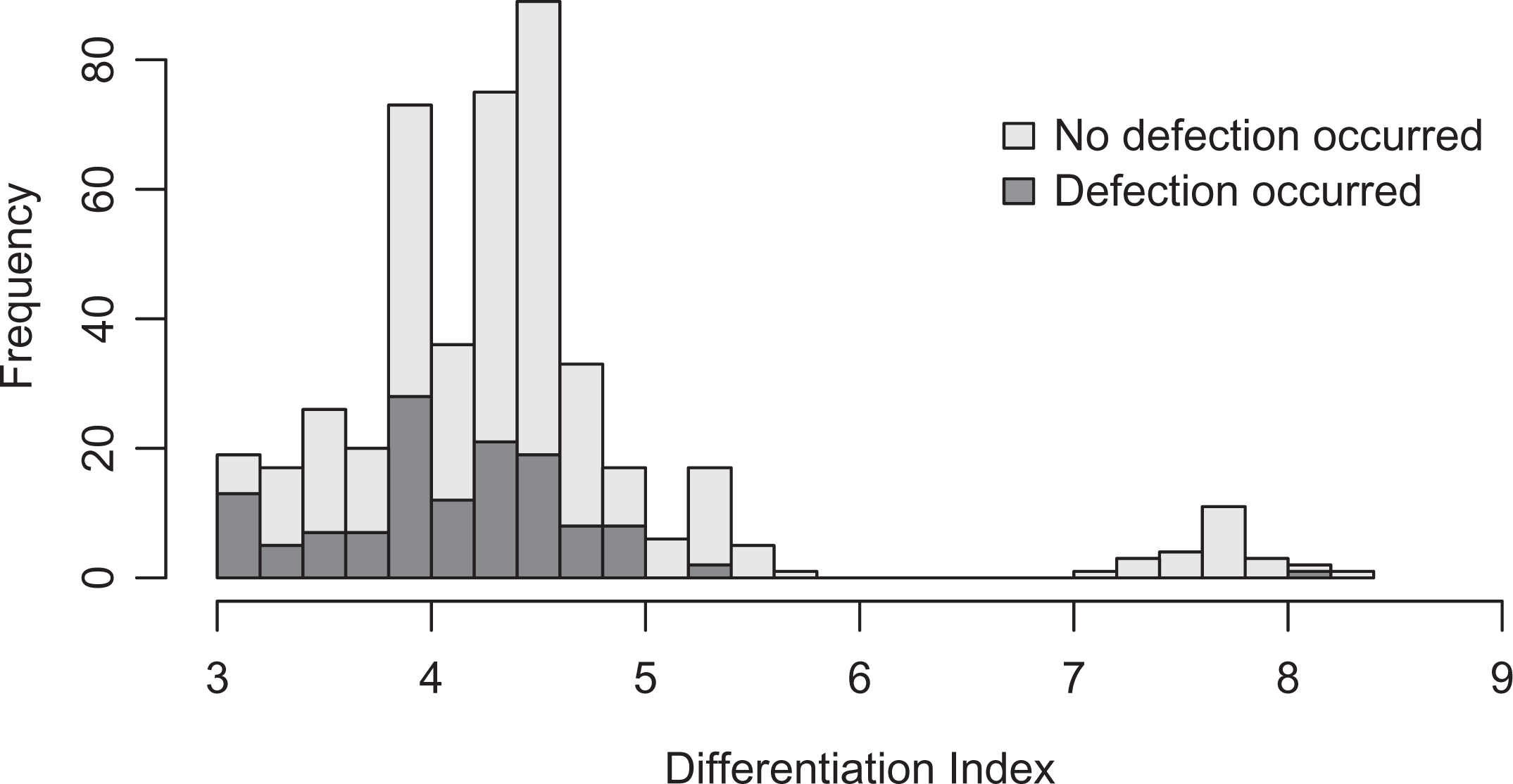
Security defection across differentiation.
Considering the theoretical expectation that differentiation and counterbalancing yield opposite effects on security defections, the crucial conceptual distinction between these two types of fragmentation also requires to be reflected empirically. This is accommodated in two steps. First, counterbalancing indices normally reward equal force sizes, meaning that countries with one small unit and one large unit receive a lower value on the counterbalancing scale than countries with two equally sized security organizations (Pilster, Böhmelt, and Tago 2016; Pilster and Böhmelt 2011). This logic is built on the notion by Quinlivan (1999, 141-42), emphasizing that for effective counterbalancing, the security forces must be “parallel militaries” instead of “paramilitaries,” referring to the necessity of them being “large enough” and equally well equipped in order to pose a credible threat to a deserting unit.
12
Using this theoretical approach, I turn the index around to instead reward unequal sizes: the existence of one small force next to a significantly larger one is probably not indicative of counterbalancing as the small unit could not provide enough firepower for posing a credible counterweight. However, it may very well imply a small strike force specialized in a security task other than conventional warfare. Comparing the conventional counterbalancing index with my adjusted differentiation index, they yield a correlation of
Therefore, second, I interact the differentiation index with a measure of structural coup risk (Dworschak 2019; Powell 2019). The coup risk index by Belkin and Schofer (2003) captures the underlying propensity of a coup d’état happening (see also Belkin and Schofer 2005; Pilster and Böhmelt 2011; Carey, Colaresi, and Mitchell 2016). It consists of measures of the strength of civil society, regime legitimacy, and recent coups (Belkin and Schofer 2003). The interaction allows the effect of the differentiation index on the propensity of security defection to vary across different levels of coup risk. This is useful because a high differentiation index value in a country with very low coup risk may safely be assumed to capture “pure” differentiation—which means that in accordance with my hypothesis above, under low coup risk, I would expect a negative index slope. In contrast, a high index value in a country with a high coup risk might partly be driven by counterbalancing, and thus, I expect the slope of the index in such strata to be attenuated or even turn positive (Dworschak 2019).
India constitutes an exemplary case that illustrates the substantial usefulness of drawing an empirical distinction between counterbalancing and differentiation. Despite multiple campaign involvements, India has not seen any security defections during the 1990s. However, past models by Dahl (2016a), assuming fragmentation to equate counterbalancing, would wrongly predict a high risk of defection. India’s security apparatus was (and is) highly fragmented, leading to a high counterbalancing index: its mean counterbalancing value during the 90s is within the highest quintile of the overall distribution. I argue that India’s fragmentation however is not aimed at hampering military resolve—on the contrary, it is the result of task separation among their armed forces, enabling specialized training and adaptation to local particularities (Dworschak 2019; Pilster, Böhmelt, and Tago 2016). This is empirically signified by a combination of a high differentiation index (India is the most extreme case in the data set) and a low coup risk. In conclusion, while India during the 90s shows high values for both counterbalancing and differentiation, the interaction with coup risk enables me to tell the two concepts apart and leads to predictions that are closer to reality. The same increase in accuracy may be expected for many other cases, including authoritarian regimes (cf. Lutscher 2016).
I employ several other control variables to further reduce the risk of bias. On the country level, a state’s regime type, overall wealth, and military expenditure might profoundly influence civil–military relations both in terms of the propensity of security defection and the structure of the military. The first two are measured using gross domestic product per capita [GDP/c] and the country’s Polity2 score, which are drawn from the replication data of Carey, Colaresi, and Mitchell (2016). Military expenditure is provided by Stockholm International Peace Research Institute (2017).
Another source of endogeneity that challenges my results’ validity is the general threat environment underlying a campaign. Differences in the population’s antagonisms and ease of mobilization, as well as the external support structure for both warring parties, might lead the state to adapt its security apparatus accordingly from the outset and to be fundamentally more (or less) prone to experience security defections. I address this omitted variable bias by including NAVCO version 2.0 covariates on the campaign level that may serve to jointly proxy this latent dimension. These include whether a campaign was violent or nonviolent 13 and whether the regime or the opposition movement relied on external support (Chenoweth and Lewis 2013). 14
Method
I employ a Bayesian two-level logistic regression with random intercepts and imputed missings. I briefly address each of these choices subsequently. First, considering the binary nature of my dependent variable, convention suggests the use of a logit or probit link. I choose the former due to a better interpretability of the coefficient estimates, although this has no substantial influence on the results. Second, since my analysis covers multiple countries from different regions around the world, I assume unobserved unit heterogeneity. This could lead to different base propensities for security defection and to nonspherical errors. A multilevel model with random intercepts on the country level (normally distributed) helps to increase efficiency. While a correlation between the unit-level heterogeneity and my covariates is probable, partialling this out using fixed effects is not feasible due to low within-variation. For the results presentation, I average over all intercepts. 15
Third, 29 percent of the original data is missing. This is mainly introduced by the merging process, since the data sets substantially differ in their overall temporal coverage: the data set by Carey, Colaresi, and Mitchell (2016) starts in 1981, while the fragmentation data goes back to 1970, and NAVCO version 2.0 even to 1945. Any kind of imputation over such large time periods seems questionable, which leads me to restrict the final data frame to only mergeable years and countries (corresponds to Table 1 on page 10). This final data include 9 percent unobserved values, some of which still originate from a lack of spatial and temporal congruency, while others were coded as missing in the original data sets. I choose to impute these 9 percent, since the missings are scattered across different variables (cf. Figure 1 on page 1 in the Online Appendix A), and “standard” list-wise deletion would lead to a severe information loss (decrease from 928 to 415 observations; Little and Rubin 2002, 53-54).
Since it is not obvious what may have driven certain values to be coded as “missing,” and it seems to be nonsystematic, I assume they originate from the same data generating process as the observed values (i.e., I conceptualize them to be “missing completely at random” [Mcar], Little and Rubin 2002, 11-13). 16 First, I reduce overall missingness to 8 percent by employing a combination of “last observation carried forward” (Locf) and “next observation carried backward” (Nocb) for all slow-moving variables (Differentiation, Coup Risk, Polity2, GDP/c, and Military Expenditure). Second, I allow Jags to impute the remaining missing values of the covariates based on approximate observed empirical distributions of my variables. 17
I prefer Bayesian inference over a frequentist approach for multiple reasons. Firstly, multilevel modeling is an intrinsic feature of Bayesian (McElreath 2015, 14). While random effects models would not converge using standard procedures due to a lack of within-variation, this does not pose a problem with Jags using (noninformative) priors. Secondly, in the Bayesian framework, the missings in my dependent variable are not merely imputed but are estimated as parameters and add to the overall uncertainty (Little and Rubin 2002, 200-03). Finally, Bayesian inference allows for a sensible probabilistic interpretation of the results (McElreath 2015, 4-17; P. M. Lee 2012, 139-40; Gill 1999).
Results
The main findings are listed in Table 2. As expected, the effect of differentiation on security defection is on average negative. In turn, the coefficient of the interaction term is positive: this means that the effect of the differentiation index is strongly negative under low coup risk but turns positive under high coup risk. This is in line with the aforementioned confounding influence of coup-proofing and corroborates my theory.
Jags Logistic Analysis.
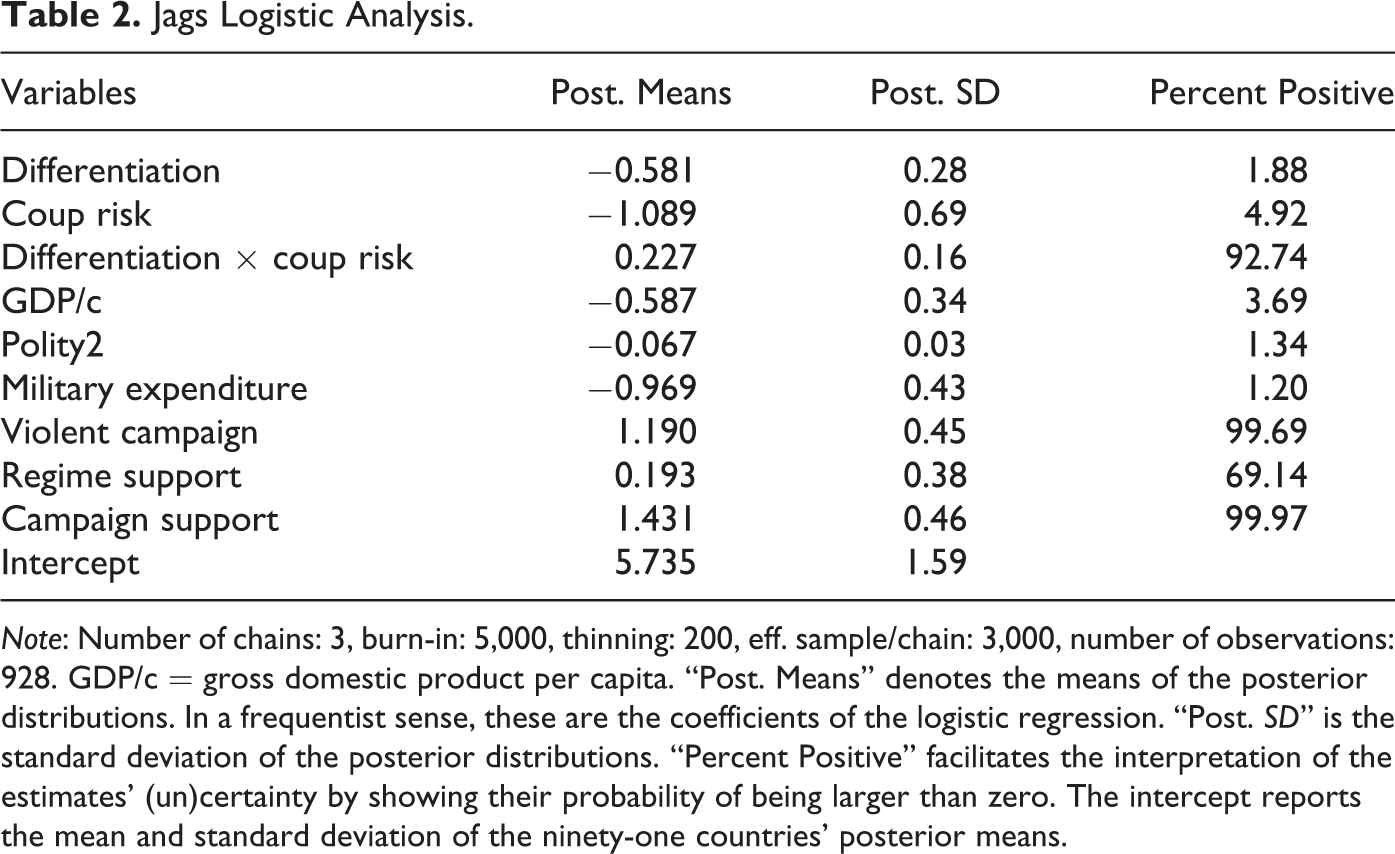
Note: Number of chains: 3, burn-in: 5,000, thinning: 200, eff. sample/chain: 3,000, number of observations: 928. GDP/c = gross domestic product per capita. “Post. Means” denotes the means of the posterior distributions. In a frequentist sense, these are the coefficients of the logistic regression. “Post. SD” is the standard deviation of the posterior distributions. “Percent Positive” facilitates the interpretation of the estimates’ (un)certainty by showing their probability of being larger than zero. The intercept reports the mean and standard deviation of the ninety-one countries’ posterior means.
In terms of uncertainty, these effects signify relatively low dispersion (high “statistical significance”). The probability that the differentiation index is indeed negative is about 98 percent, while the interaction term has a 93 percent probability of being positive. This means that based on these data, it is highly unlikely that these directional effects occurred by chance alone. Note however that even if the differentiation coefficient was centered on 0, this would not be indicative of the effects within the subsamples of high and low coup risk. Therefore, turning to the quantities of interest, Figure 3 shows the conditional marginal effects of differentiation. The density plot of the conditional posterior distribution of differentiation under low coup risk (minimum integer, −4) signifies a strong negative marginal effect. Under high coup risk (maximum integer, 7), the effect of differentiation moves much further to the right (more positive). I conclude that both (a) the negative effect of differentiation on defection and (b) the difference of the impact of differentiation under low versus high coup risk have a high probability of representing a systematic pattern.
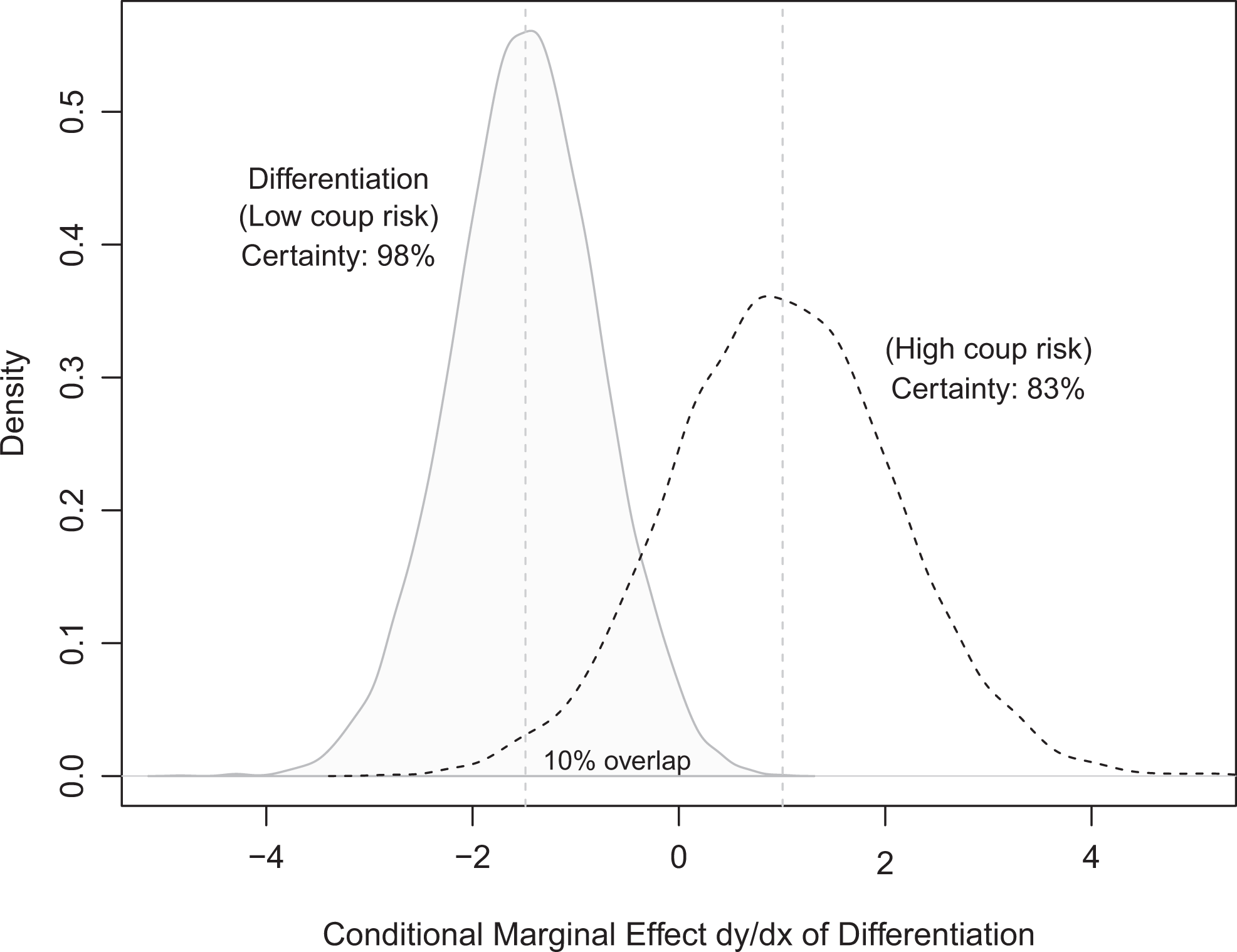
Marginal effects of differentiation on defection. Bandwidths = 0.1034 and 0.1596, n = 9,000. Densities represent the marginal effect of fragmentation at coup risk values of −4 (differentiation) and 7 (“counterbalancing”). The effect of differentiation has a probability of 98 percent to be below zero. The effect of “counterbalancing” has a probability of 83 percent to be above zero. Their joint overlap is 10 percent.
For a more intuitive visualization of the main effect, see Figure 4. 18 The nondotted lines correspond to the predicted probability of defection across different values of differentiation (low coup risk). 19 Assuming an average country (all other covariates are held at their median), it is apparent that differentiation strongly hampers the propensity for security forces to defect: while a state with minimal differentiation (3) has an absolute defection risk of 76 percent, an increase of differentiation to a medium level (5) already decreases this risk to 14 percent. Following my theory on differentiation as a means of force specialization, a possible interpretation of these findings is that even a basic degree of task specialization substantially increases effectiveness in internal pacification and thus renders defections much less likely. In contrast, the set of dotted lines represent the same scenario but under high coup risk. In this setup, the degree of fragmentation that my differentiation index captures may rather be driven by coup-proofing intentions and thus resembles counterbalancing. However, note that this is not the same as actual counterbalancing due to the adjustment in the index. Therefore, while the direction of the effect is highly suggestive and in accordance with the findings by Dahl (2016b) and Lutscher (2016), I refrain from interpreting the effect size as the actual impact of “counterbalancing.” These findings support my idea that the “intentions to fragment” the security apparatus (coup-proofing vs. specialization) matter substantially.
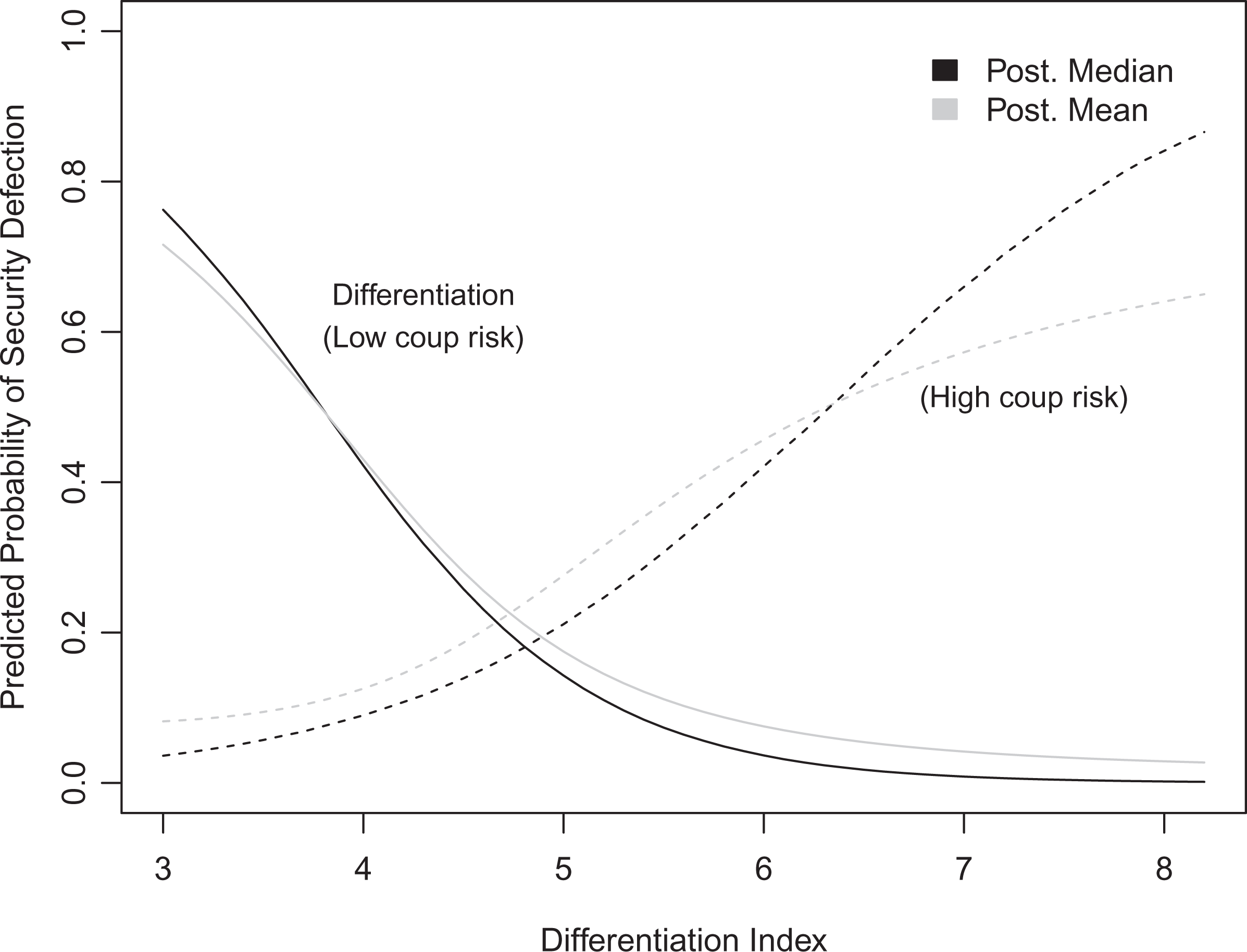
Differentiation and security defection.
Robustness
The results are robust to a number of alternative model specifications, which are listed and explained in the Online Appendix. Table 1 on page 4 in the Online Appendix B shows combinations of different model restrictions to assess model dependence and the predictive power of differentiation and the interaction term. The effect sizes remain similar, and differentiation and the interaction term increase predictive accuracy. Table 2 on page 8 in the Online Appendix B continues with a model with all covariates lagged one year, and two models including additional controls (military size and autocratic regime types), with the results remaining robust. Table 3 on page 9 in the Online Appendix B includes controls on more campaign features and population size as well as a model with a quadratic term, a model that omits India, and a model in which missing values in the dependent variable are not imputed. The model that omits India experiences a slight attenuation in the effect size and certainty, which is further discussed in the Online Appendix. Finally, Table 4 on page 10 in the Online Appendix B tests additional empirical implications, offering alternative operationalizations of the intention to coup-proof. Specifically, I compare the effect of differentiation between democracies and autocracies and between personalist and other kinds of autocracies, all of which are found to strongly differ in their coup risk. In combination with the index by Belkin and Schofer (2003), the results’ consistency across these distinct measures for coup risk increases confidence in my findings. In terms of sampling, all parameters’ MCMC chains in all models are well mixed. See Figure 2 on page 2 in the Online Appendix A, for example, trace plots of the main parameters and GDP/c of the main model.
Conclusion
How does differentiation of the state’s security apparatus influences the likelihood of defections during mass uprisings? In this study, I evaluate literature on militaries’ loyalties and internal structure and develop an argument surrounding military effectiveness and endowment. Past scholarship identifies fragmentation of the security apparatus as an important determinant for defections during mass uprisings. It is argued that parallel hierarchies in the military induce frustration and oversight problems, which in turn facilitate defections during conflict. I contend that these past findings apply to countries that engage in fragmentation for purposes of coup-proofing (“counterbalancing”) but not to countries that fragment their military for purposes of security specialization (“differentiation”). Distinguishing between these two types of fragmentation is crucial because it is associated with a stark difference in military effectiveness and endowment: counterbalancing commonly correlates with low military capability, inferior equipment, marginalized power, promotions that are not based on merit, and low interunit communication and coordination. Differentiation on the other hand is aimed at specially trained and equipped forces, increased resources, and at effectively accommodating different security challenges.
Assuming that soldiers do not want to fight a losing battle, I claim that the military’s ability to successfully confront a (non)violent uprising is a strong negative predictor for defection. Therefore, countries that engage in differentiation are expected to experience less defection. I evaluate this hypothesis by quantitatively comparing the levels of differentiation and the likelihood of defections across countries. To have a reliable empirical distinction between counterbalancing and differentiation, I adjust the index according to my theory and perform the analysis conditional on countries’ coup risk. Employing multilevel Bayesian logistic analysis, I find that countries that do not attempt to differentiate their security apparatus face an 80 percent probability of defection, while countries with maximum values of differentiation only experience a 5 percent probability of defection. The results are subject to fairly low uncertainty and robust to different model specifications. I therefore conclude that differentiation indeed leads to a lower likelihood of security defection during (non)violent conflict.
There are two main avenues for further research. First, merely controlling for confounding variables using macro data constitutes a rather weak identification strategy. Therefore, while my findings offer robust correlation with a high degree of generalizability, their internal validity requires future research on individual cases. Second, the extent to which data on horizontal fragmentation without explicit functional distinction can serve as a proxy for force specialization is questionable, and I expect comparably low estimation efficiency and attenuation bias. Thus, the development and testing of more empirical implications of my theoretical model are worthwhile.
This study’s contribution is threefold: it is the first attempt to quantitatively substantiate the intuitive notion of bandwagoning in conflict, that is, that soldiers do not want to fight on the losing side. The large effect size of differentiation underlines how “obvious” and unambiguous this mechanism is, rendering my findings a paramount corroboration of our intuitive understanding of military defections during conflict. Moreover, the article provides an important insight into the dichotomous nature of security force fragmentation and into the opposing implications of differentiation versus counterbalancing. Lastly, it yields policy-relevant information on civil–military relations and regime survival, highlighting the role of appropriate training for internal pacification and the double-edged effects of coup-proofing.
Supplemental Material
Supplemental Material, sj-pdf-1-jcr-10.1177_0022002720904763 - Jumping on the Bandwagon: Differentiation and Security Defection during Conflict
Supplemental Material, sj-pdf-1-jcr-10.1177_0022002720904763 for Jumping on the Bandwagon: Differentiation and Security Defection during Conflict by Christoph Dworschak in Journal of Conflict Resolution
Footnotes
Author’s Note
The author is solely responsible for all mistakes. Christoph Dworschak is also affiliated to University of Mannheim.
Acknowledgments
I am grateful for excellent comments by the editor and two anonymous reviewers. I am indebted to Kristian S. Gleditsch, Federica Genovese, Tobias Böhmelt, and Daina Chiba for their continuing support and great feedback. Moreover, I am thankful for many helpful suggestions by Marianne Dahl, Philipp Lutscher, Moritz Marbach, Adam Scharpf, Nils Metternich, Han Dorussen, Royce Carroll, Marina Petrova, Phillip Nelson, Marius Mehrl, Vanessa Meier, Julian Walterskirchen, Jakob Gilg, and Melvin John. Special thanks for great comments also go to the participants of the ISA annual conference 2019, the UCL advanced studies workshop, the CRS 2018, and the brown-bag seminars at the Kent Conflict Analysis Research Centre and the University of Konstanz.
Declaration of Conflicting Interests
The author(s) declared no potential conflicts of interest with respect to the research, authorship, and/or publication of this article.
Funding
The author(s) received no financial support for the research, authorship, and/or publication of this article.

Supplemental Material
Supplemental material for this article is available online.
Notes
References
Supplementary Material
Please find the following supplemental material available below.
For Open Access articles published under a Creative Commons License, all supplemental material carries the same license as the article it is associated with.
For non-Open Access articles published, all supplemental material carries a non-exclusive license, and permission requests for re-use of supplemental material or any part of supplemental material shall be sent directly to the copyright owner as specified in the copyright notice associated with the article.
