




Abstract
The International Criminal Court (ICC) has struggled with the perception that it is biased against Africans, especially in relation to its investigation in Kenya. But which Kenyans are most likely to believe the ICC is biased? Building on pluralistic models of public opinion and psychological studies, we aim to contribute to emerging research on attitudes toward international courts. We expect that group attachments will drive attitudes toward international institutions. Yet, we also theorize that exposure to violence makes individuals more likely to support international justice and reject narratives that would have the effect of insulating those who have committed crimes from being held accountable. Using new survey data from 507 Kenyans in the fall of 2015, we find support for our hypotheses.
The International Criminal Court (ICC) depends on the support of member states and their populace to function. This can create a legitimacy challenge for the ICC because it charges individuals with atrocity crimes when domestic governments are unable or unwilling to do so. Often, the push for accountability in situation countries invites a reactionary “us versus them” narrative. Since 2009, some African leaders, when confronted with the possibility of criminal accountability, have painted the Court as a neocolonial tool that is biased against Africans (Cole 2013; Verini 2016).
Kenyan leaders Uhuru Kenyatta and William Ruto began stumping against the ICC in 2010 after its prosecutor charged them with instigating attacks following the 2007 presidential elections. Attackers committed numerous sexual assaults, killed 1,100 citizens, and displaced more than 600,000 (Amnesty International 2014, 7). Kenyatta and Ruto claimed that they were not responsible for this violence but were instead victims of a biased ICC. Proposing few policies of redress for the real victims of violence, Kenyatta (a Kikuyu) and Ruto (a Kalenjin) joined together in 2012, forming the Jubilee Coalition to campaign for president and deputy president. A key campaign strategy was to invoke the ICC as the enemy. Referencing Africans’ history of Western domination, they asked citizens to reject another intrusion on Kenyan sovereignty. (Corporate Europe Observatory 2015; Mueller 2014).
In this article, we use evidence collected from 507 face-to-face surveys of Kenyan citizens in fall 2015 to explain why some Kenyans perceived the ICC as biased against Africa. We do not seek to evaluate whether the ICC is in fact biased as others have done (Smeulers, Weerdesteijn, and Hola 2015). Nor do we attempt to explain the outcome of the 2013 or 2017 presidential elections (Ferree, Gibson, and Long 2014).
Much of the emerging research on attitudes toward international courts contends that individuals’ perceptions are a direct function of group allegiances (Chaudoin 2016; Klarin 2009). According to one theory, people who share an identity with defendants are more likely to view international courts as biased (Chaudoin and Chapman 2017). Building on pluralistic models of public opinion and psychological studies, we theorize that exposure to violence also makes individuals less likely to agree that the ICC is biased against Africa.
Kenya is an ideal context for testing these theories given the presence of extensive ethnic-based clientelist networks. Because the country’s leaders conducted a public, derisive campaign against the ICC, group attachments should prove a powerful driver of political attitudes including toward international institutions. Indeed, our survey data show that Kenyatta’s and Ruto’s co-ethnics are more likely than others to agree that the ICC is biased against Africans.
However, one’s personal experience with violence exerts the reverse effect. Kenyans who identify as witnesses or victims of violence in 2007 are much less likely to agree that the ICC is biased against Africa. More surprising, this holds even if the respondent identifies as a co-ethnic of Kenyatta or Ruto. On this basis, we argue that exposure to violence is a primary determinant of attitudes toward the Court.
Our original survey data set has advantages that allow us to make a unique contribution to research on perceptions of the ICC. First, the sample includes respondents from poorer regions in the Kenyan countryside which were racked by violence. The data are drawn from randomly assigned face-to-face interviews in regions where Kenya’s 2007 postelection violence occurred as well as areas that were home to violence in the past. Second, the survey is fine-grained. It asked respondents about ICC bias against Africa, and it included other questions designed to sort through potential explanations for respondents’ perceptions of the Court. Third, we ran the survey in October and November 2015 while some of the Kenya cases were still pending at the ICC. Thus, the data are recent and also collected from respondents with generally high levels of information about the ICC in Kenya. Other studies of international institutions, by contrast, are troubled by lack of knowledge among respondents (Gibson and Caldeira 1995).
One potential disadvantage of our survey data is that it is specific to Kenya, which could limit its external validity. Nevertheless, our Kenya findings may repeat in other countries. Like Kenya, states most likely to experience an ICC intervention feature violent political conflict defined along ethnic or religious cleavages (Kersten 2016). This set of countries would also count among their domestic populace a number of suffering victims (Cody et al. 2015), as well as a portion of the population that evinces low trust in governing institutions (Afrobarometer 2014).
In the following section, we elaborate on the anti-ICC narrative that African leaders, including Kenya’s, expounded. Next, we examine the existing literature on individuals’ political attitudes in the domestic realm and toward foreign groups and institutions. We then introduce our theory about the psychological effects of exposure to violence, showing how it can cut across group identities and collective attitudes and significantly influence individual perceptions of the ICC. After our hypotheses, we present the results. The Conclusion section discusses the implications from our findings and directions for future research.
African Leaders Develop and Invoke the Anti-Africa Narrative
The ICC in Africa: The Narrative Develops and Gains Support
When the ICC was first created, African leaders were among its most avid supporters. Nearly half (twenty-seven of sixty) of the first states that ratified the Rome Statute were African. The predecessor organization to the African Union (AU) issued a resolution in May 2002 encouraging its members to join the ICC (Organization of African Unity 2002). African states now represent the second largest continental bloc of States Parties. Moreover, African states self-referred five situations to the ICC (Maunganidze and Louw 2012).
In recent years, however, some African leaders have reversed their support. The tide turned in March 2009 when the office of the prosecutor (OTP) issued the first arrest warrant for a sitting head of state, President al-Bashir of Sudan. Bashir responded to charges of genocide and crimes against humanity by calling the ICC a “colonial court” (Verini 2016). Since then, some African leaders have urged their fellow Africans to reject a Court that they say is biased against Africans.
Other criticisms have been leveled against the ICC. Some argue that prosecution can undermine peace (Akhavan 2009; Clark 2011). Others object that when the Court charges only “one side” to a conflict—as it did in Uganda—it fails to properly dispense justice (Branch 2007). However, the critique that the ICC is biased is unique for its resonance among African leaders who challenge the Court and its allies. Indeed, in February 2017, at Kenya’s urging, the AU issued a nonbinding resolution for African states to withdraw en masse from the Rome Statute (Dixon 2017). While not adopted unanimously, some leaders supporting the measure invoked the bias narrative (Nantulya 2017).
The ICC in Kenya: The Narrative in Full Force
The OTP turned its attention to Kenya after violence erupted following a hotly contested 2007 presidential election between Mwai Kibaki’s Party of National Unity (PNU) and Raila Odinga’s Orange Democratic Movement (ODM). Kibaki was pronounced the narrow winner after a controversial re-tally by the country’s electoral commission. Subsequent Deputy President Ruto, an ODM supporter, allegedly helped instigate attacks by rallying his Kalenjin supporters to assault Kibaki’s Kikuyu supporters. In response, former Deputy Prime Minister and current President Kenyatta allegedly mobilized pro-PNU Kikuyu youth, including members of the Mungiki gang, to terrorize ODM supporters in Nakuru and Naivasha (ICC OTP 2010).
In mid-2008, international mediation by former United Nations (UN) Secretary-General Kofi Annan created a coalition government headed by Kibaki and established the Commission of Inquiry to Investigate the Post-Election Violence (CIPEV)—the Waki Commission. Its members concluded that politicians and businesspeople had instigated ethnic violence (CIPEV 2008, 472). The Report recommended a Special Tribunal in Kenya to prosecute those responsible. Should Kenya fail to create that Special Tribunal, the Commission stated that it was prepared to forward “a list containing names of and relevant information on those suspected to bear the greatest responsibility” for the postelection violence to the ICC prosecutor (CIPEV 2008, 473). The Kenyan government never established the Special Tribunal, though it was given several extensions of the original deadline (Gettleman 2009). Nor did it institute any other domestic proceedings to prosecute any of the high-level officials (Brown and Sriram 2012).
In July 2009, Kofi Annan forwarded the list of names to the ICC prosecutor. The ICC’s chief prosecutor, Luis Moreno Ocampo, used proprio motu powers for the first time to mount a preliminary examination into Kenya’s postelection violence. In December 2010, Ocampo announced the names of the six prominent Kenyans (the “Ocampo Six”), including Kenyatta and Ruto, who would be charged with crimes against humanity (Kariuki and Mathenge 2010).
Kenyatta and Ruto fought the ICC. As Chaudoin argues, one of the ways that international organizations achieve either compliance or noncompliance is by motivating and mobilizing domestic actors to support or undermine the goals of the IOs (Chaudoin 2016). Part of the fight against compliance with the ICC involved two former political enemies teaming up to campaign for the country’s top leadership positions. That Ruto and Kenyatta would join forces to wage battle against the ICC was a surprise that hardly anyone predicted. The pair hired BTI Advisors, a British Marketing firm, to craft their message to voters in the 2013 presidential elections. The campaign criticized the ICC, claiming that (1) the ICC’s investigation was marred by bias and a lack of understanding given the ICC’s outsider status; (2) the ICC did not charge those most responsible for the violence, noting especially the absence of charges against Raila Odinga; and (3) the West’s insistence on prosecution threatened Kenya’s future stability (Lynch 2014, 105). By this account, the ICC targeted Kenya for political reasons without any understanding of what had happened or the negative effects that would follow from its external intervention in pursuit of accountability (Corporate Europe Observatory 2015, 34; Lynch 2014; Mueller 2014; Wolf 2013). During their campaign, Kenyatta and Ruto used slogans such as “a vote for us is a vote of no confidence in the ICC” (Nowrojee 2013). They explained the absence of charges against Odinga and his support for the Court by branding him a Western puppet who was politically linked to the Court (Lynch 2014; Wolf 2013). Kenyatta and Ruto attacked civil society actors on the same grounds, labeling them tools of imperialism for backing the ICC (Hansen and Sriram 2015).
While many Kenyans did not consider the ICC as the most important issue in the 2013 presidential campaign (Ferree, Gibson, and Long 2014, 9), 1 observers contend that this campaign changed many Kenyans’ minds (Lynch 2014; Wolf 2013). This argument appears rooted in facts. In mid-2010, for instance, polls showed that close to 70 percent of Kenyans wanted the Ocampo Six put on trial in The Hague and did not trust local judicial institutions to handle the cases. As Wolf (2013) points out, Jubilee operatives erased what was apparently an “unbridgeable lead” over Kenyatta and Ruto for the country’s leadership, essentially transforming their status of suspected heinous criminals into that of maligned victims of an evil and manipulative West. The coalition was at a minimum successful in winning the majority of Kikuyu and Kalenjin votes, notwithstanding the historical rivalry between those ethnic groups, who only six years prior waged campaigns of violence against one another following the 2007 election.
Some observers fault the ICC, not the Jubilee campaign, for the Court’s declining popularity among the Kenyan public. Among other things, the ICC’s failure to conduct significant in-person outreach meant that it did not get its message across to victims and others (Hansen 2016; Kenyans for Peace with Truth and Justice and Transitional Justice Institute 2017). The ICC cited security concerns to explain its lack of on-the-ground presence in Kenya (Dutton 2017). Even so, victims became disillusioned as they realized that the ICC process moved slowly and failed to provide them with immediate benefits (Hansen and Sriram 2015). In December 2014, the ICC suspended charges against Kenyatta, and in April 2016, the ICC suspended the proceeding against Ruto. In retrospect, critics blame this collapse on missteps by an ambitious prosecutor. The OTP counters that it was hindered by a Kenyan government that bribed, intimidated, and even killed witnesses (ICC OTP 2014).
However, this should not close the book on the Kenyan case. Jubilee’s anti-ICC narrative did not persuade all voters, and not all Kenyans believe that the project of international criminal justice is wrong. A study based on 2013 polling data showed that, compared to 2007, Kikuyu support for Kenyatta fell by 11 percent (from 94 percent to 83 percent) in 2013 (Ferree, Gibson, and Long 2014, 6-7). This is a break from the past because Kenyans are typically steadfast supporters of their co-ethnics (Jonyo 2003; Wrong 2009). Analysis of our 2015 survey evidence may help shed light on the slow erosion of support for Kenyatta, which continues in 2019 (Opalo 2019). But we can also seek to answer a larger question; particularly, what factors determine whether someone thinks the ICC is biased?
Existing Literature on Perceptions of International Courts
Outside of research specific to the International Criminal Tribunal for the former Yugoslavia (Arzt 2006; Clark 2009; Meernik 2015a; Meernik and King 2014), public attitudes toward international courts remain generally underexplored (Voeten 2013, 412). Our 2015 Kenya survey evidence provides a unique opportunity to assess the relationship between the ICC and domestic audiences. At play are ethnic loyalties, crosscutting political coalitions, democratic elections, winner-take-all politics, political violence, problematic domestic rule of law, an outside challenge to national political elites, and an information campaign against the ICC.
This research is about individual political attitudes, which are “general and enduring positive or negative feeling about some person, object, or issue” (Glynn et al. 1999, 105). American political scientists identify a number of factors that contribute to political attitudes, including those about international affairs. The “pluralistic model” of public opinion holds that individual attitudes derive from some combination of personality, self-interest, group attitudes, and values (Clawson and Oxley 2012, 153; Kinder 1983). Each of these factors might be conditioned on a person’s socialization or radically altered by life-changing experiences.
An emerging literature applies public opinion research to lesser developed, postconflict societies subject to intervention by international courts. Thus far, research has yielded four lessons. First, self-interest—or “tangible, relatively immediate, personal or family benefits of a policy” (Chong, Citrin, and Conley 2003, 542)—may not be the main driver of attitudes about international justice. For instance, in a study of ten postconflict countries, Meernik and King (2014, 14) find that individual preferences for international criminal prosecution are statistically unrelated to the material damages those individuals suffered during wartime. While victims of conflict typically seek reparation or restitution (Pham, Vinck, and Stover 2007), individuals do not necessarily judge the desirability of international criminal justice based on how it would benefit them directly.
A second lesson is that the work of international tribunals is filtered through rival group attitudes. Research on group attitudes focuses on the ways “prejudice toward, stereotypes about, and identification with social groups” correlate strongly with public opinion (Clawson and Oxley 2012, 166). Especially in contexts where political conflict involves competing identity-based narratives that lionize in-groups and demonize out-groups, any criminal assignation of blame to an individual will further entrench animosities. Group members will treat convictions of their co-ethnics with scorn, while celebrating convictions of ethnic rivals. Research in the former Yugoslavia has repeatedly demonstrated that individuals interpreted court operations through the prism of ethnic rivalries (Arzt 2006; Clark 2009; Ford 2012; Klarin 2009; Meernik 2015b; Milanović 2016; Steflja 2018).
A third lesson from the study of international criminal tribunals is that there is an inverse relationship between trust in domestic government and trust in international bodies in conflict-ridden societies facing judicial interventions. Those skeptical of home governments will support outside intervention. This is not true in developed countries, where a negative valuation of domestic governing institutions correlates with a negative orientation toward international institutions like the United Nations (Torgler 2008) and European courts (Voeten 2013). However, communities that have lived amid social breakdown distrust domestic institutions, which have repeatedly failed to solve internal crises. As a result, they evince greater hope in international involvement because it may alter course, or reform what is broken (Elcheroth and Spini 2009; Meernik and King 2014). In sum, extreme violence and low trust in domestic institutions should correlate with higher favorability toward outside institutions.
One caveat to this third lesson is that trust in outside institutions might depend on the availability of good information about a court’s operations. Studies suggest that individuals who possess more specific knowledge about international institutions, or who know more about a court’s functions, are more likely to consider facts when forming favorable or unfavorable opinions (Chaudoin and Chapman 2017; Lupu 2013; Meernik 2015a). The Special Court for Sierra Leone successfully addressed this issue with significant on-the-ground outreach toward the domestic public (Dutton 2017). By contrast, scholars have noted that a lag in commencing outreach with faraway domestic audiences negatively impacts perceived legitimacy, while allowing politicians and media the space to wage a disinformation campaign against the tribunal (Ellis 2011).
A fourth lesson is that education matters. In the United States, studies show that schooling can produce more civic-minded and politically active citizens (e.g., Andolina et al. 2003). In postconflict societies, some evidence suggests that formal education is related to more support for international criminal justice. In an analysis of the former Yugoslavia, Meernik (2015a, 584) discovers that “for each year of education an individual completes, she becomes 0.5 percent more likely to support the ICTY.” The reason is unclear, but this could relate back to knowledge. Data from other studies suggest that fluency in basic international legal obligations alters attitudes. In an experiment, Chilton (2014) finds that familiarity with human rights commitments makes respondents less supportive of solitary confinement, whereas Meernik and King (2014) show that rudimentary knowledge of the laws of war increases support for international justice. Cross-national empirical studies also demonstrate that educated people are more opinionated because they are imbued with an overall sense that their individual attitudes are meaningful (Weakliem 2002).
If we apply the lessons from this literature to the Kenyan case, then the least likely supporters of the ICC should be those who share an ethnicity with members of the ruling coalition, show trust in local governing institutions, possess little information on the Court’s operations, and have little formal education. These expectations inform the conventional wisdom regarding the ICC in Kenya. Analyses of the country—a middle-income semi-democracy with pronounced ethnic patronage networks—tend to presume that opinions toward the ICC is, as Stuart Ford calls it, a “negative sum game” between rival groups (Ford 2012, 410). That is, members of groups targeted by the Court move in lockstep, defending their own and criticizing the ICC. This makes sense. In Kenya, voters typically support their own ethnic leader’s bid for the presidency because presidents historically have shared the country’s spoils with their co-ethnics (Jonyo 2003; Wrong 2009). If losing one’s leader means losing money and influence to rival groups, then ethnic allegiance should have a doubly powerful influence on political attitudes.
However, in Kenya, the direct link between ethnic identity and attitudes is at once amplified and superseded by coalitional politics. One might expect that, following the formation of Jubilee, Kikuyu and Kalenjin rank and file would overcome their differences and support their joint leaders. As Chaudoin and Chapman (2017, 15) argue, “If a citizen thinks that a court’s action will target the government, and she supports that government, she is more likely to react negatively to an investigation in her country.” Extrapolating to the Kenyan case, those who benefit economically or otherwise under the ruling Jubilee regime should be more likely to follow the party line, trust the government, and advance whatever opinions of the ICC the government propagates.
While this version of events—that Kenya’s leaders exploited the group attitudes of their loyal and uninformed supporters to sway public opinion against the ICC—resonates, it may also omit some critical facts. First, in part because ICC intervention became a salient political issue, most of the respondents in our survey are knowledgeable about the Court: they knew the identities of the Ocampo Six, the alleged crimes for which they were being prosecuted, and the general status of the ICC’s Kenya cases. On the other hand, Kenyans did not generally have the benefit of ICC outreach—a source from which they may have been able to learn more about the Court’s operations, including how cases and individual suspects are selected for investigation and prosecution (Hansen 2016; Kenyans for Peace with Truth and Justice and Transitional Justice Institute 2017). Nevertheless, Kenyans’ high awareness and specific knowledge about the ICC’s Kenya cases make it difficult to treat Kenyans as low-information subjects. Second, Kenyans are relatively educated. According to World Bank data, in 2016, 79 percent of Kenyans completed lower secondary education. When compared to neighbors like Uganda, where only 26 percent of the public completed the same level of schooling, this is high (World Bank n.d.). Among Kenyans, then, we should expect to observe more individualist and opinionated people.
Most importantly, one final element is largely missing from the literature on perceptions of international courts and from most accounts of Kenyans’ attitudes toward the ICC: the potential influence of one’s exposure to violence. Common sense would dictate that a person’s outlook on the prospects for international justice might be tied to whether they were previously victimized or whether they personally witnessed atrocities.
Using the Kenyan case as a crucial test, we offer a theory about attitudes toward international courts that accounts for the complexity of the human psyche. We expect that individuals will incorporate a host of information when forming opinions. In the ICC case, we presume that individuals will be driven in part by self-interest, by group identities, and values. However, we hypothesize that exposure to violence will also play a role. Individuals who suffered violence should be less inclined to accept narratives of ICC bias, even compared to other individuals who belong to the same ethnic group or share the same values.
Exposure to Violence and Kenyan Attitudes toward the ICC
Researchers have started interrogating the link between experience of violence and attitudes toward criminal justice. Thus far, they have yielded disparate findings. Some studies argue that war-torn populations are likely to prioritize peace and security and show wariness toward risky strategies for resolving or addressing conflict (Kim and Lee 2014). In their risk aversion, those exposed to violence prioritize security needs over justice and accountability (Pham, Vinck, and Stover 2005) and approach trials of former combatants or atrocity criminals as needlessly dangerous to their fragile peace. For instance, Samii (2013) finds that a great number of Burundians, including some victims of violence, are willing to “forgive and forget,” rather than pursue punishment. In short, populations with a recent experience of mass violence might be more likely to question international criminal interventions.
Other studies, however, find that victims tend to have a psychological pull toward justice that causes them to be more supportive of (international) criminal prosecutions. Meernik and King (2014) argue that whether individuals choose punishment as the best strategy for confronting war crimes and other human rights violations depends on “the extent to which the war affected them and their community” (p. 5). In particular, they theorize that personal “experience with war increases the desire for justice, and in particular, international justice” (2014, p. 5). Their findings from cross-national survey evidence support their theory, showing that respondents “who have been most affected by war are those who are most likely to favor punishment for those perceived as the wrongdoers” (2014, p. 14). These findings are supported also by Meernik’s further analysis of public opinion in the Balkans: “those respondents who experienced traumatic events are more likely to support the Yugoslav Tribunal” (Meernik 2015b, 584).
Elcheroth and Spini (2009) offer and test a similar theory about the positive relationship between the lived experience of violence and support for international trials using data from surveys administered in four countries of the former Yugoslavia more than ten years after the wars in Croatia and Bosnia–Herzegovina. They find support for their theory that communities that experienced severe violence can become critical of the local authorities that failed to protect them and more supportive of international courts that prosecute those who abuse human rights. Further, they find that greater levels of experienced violence lead to greater levels of support for prosecution (Elcheroth and Spini 2009, 190, 208).
We take this research one step further, arguing that exposure to violence causes dissonance, interrupting the usual determinants of political attitudes. Psychological research into wartime trauma supports the notion that those exposed to extreme violence may undergo a kind of mental fracture that leads to social dislocation and produces an innate desire for justice. Examination of the stress caused by trauma hinges on the kind of mental state that is formed during a period of widespread human rights violations. Danieli (2005, 1636) characterizes victimization as a “rupture, a possible regression, and a state of being ‘stuck’ or ‘frozen’ in this free flow…” called “fixity.” If, after the cataclysm subsides, the postconflict milieu does not provide for some kind of restoration of order, or “restore a balance of justice between victims and offenders,” then those victims are “at risk of losing their fundamental trust in a (potentially) just and meaningful world” (Elcheroth and Spini 2009, 192). Whole communities that have experienced this kind of loss and “flouting of basic principles” will become “more supportive of international institutions that prosecute human rights violations” (Elcheroth and Spini 2009, 190).
Kenyatta and Ruto crafted the anti-ICC narrative to appeal to a majority of Kenyans. We hypothesize that, although this narrative apparently resonated with many (Lynch 2014; Wolf 2013), it was relatively weak among those who witnessed or were victimized by postelection violence. One-sided campaigns like Jubilee’s are more likely to succeed when people lack immediate experiences and need to rely on third-party information (e.g., media, politicians, analysts, or intellectuals) and social cues to form their own opinions. People who have felt directly harmed by the breakdown of established order, however, will find it easier to dissent from collective narratives. Thus, consistent with the literature discussed above, we expect that an individual’s experiences give them firsthand knowledge and information that will shape their opinions about the ICC.
This literature does not suggest that individuals who have experienced or witnessed violence will all act in unison. What it does show, though, is that individuals are affected by their exposure to violence: the impact of that experience can inform—and even change—their political attitudes. Kenyans who were exposed to violence, and who continued to live in communities that were distressed, displaced, or disrupted, should be less willing to adopt a critical stance toward the ICC because the Court aims to provide redress.
We expect that Kikuyu and Kalenjin supporters of the ruling Jubilee regime will be more likely to agree that the ICC is biased against Africa as compared with other ethnic groups. However, we depart in one key respect: we expect Kikuyu and Kalenjin who experienced or witnessed postelection violence will be more willing to go against the narrative promoted by their co-ethnic leaders. Members of the ruling ethnic coalition were also victims of violence: 69 of 507 (15.6 percent) of the respondents in our survey identified as either Kikuyu or Kalenjin and as having been personally exposed to postelection violence.
Research demonstrates that exposure to violence generates greater animosity to outside ethnic groups (Beber, Roessler, and Scacco 2014; Rohner, Thoenig, and Zilibotti 2013). Indeed, Kenyans exposed to postelection violence are more likely to demonstrate interethnic distrust (Dercon and Gutiérrez-Romero 2012). This means that victimized Kikuyu and Kalenjin might be less willing to join forces with a former rival ethnic group in bashing the ICC. Furthermore, individuals are sometimes willing to forego material interests to punish those who they think deserve it (Henrich et al. 2006; Herrmann, Thöni, and Gächter 2008). Those who experienced violence may believe that the ICC could be the only hope of achieving retributive justice. Some of those who are Kalenjin or Kikuyu and experienced violence may be willing to reject their co-ethnic leaders’ narrative in order to seek justice. We expect that those exposed to postelection violence will still show more favorable attitudes toward the Court than those insulated from postelection attacks.
While we expect that ethnic identity and exposure to violence will be a powerful determinant of attitudes toward the ICC, we also theorize that other factors are at play. Prior to the propagation of the anti-Africa ICC narrative in Kenya, a vast majority of Kenyans supported the Court’s intervention, likely because they did not trust their local institutions to bring perpetrators of the postelection violence to justice (Mwai 2011; Namunane 2010). Because local courts are perceived as corrupt or ineffective, Kenyans put more trust in international institutions. In fact, a researcher found that most ICC victim participants in the Kenyan legal cases preferred ICC investigations because Kenyan courts were “notoriously crooked” and easily ignore victims’ grievances (Cody et al. 2015, 56). We argue that the reverse may also be true: those who trust national courts may be more likely to perceive ICC bias against Africa. Those who identify with Jubilee—and its anti-African ICC message—will need to justify their belief with greater support for national courts. We predict an inverse relationship between trust in Kenyan courts and criticism of the ICC.
A fourth factor that might explain variation in Kenyans’ perceptions of the ICC is socialization through formal education. There are two mechanisms through which schooling may alter peoples’ opinions. The first is knowledge, and more educated Kenyans may be more likely to know about the ICC. Further, knowledge can translate to support for a court because those with more knowledge are arguably less susceptible to responses “triggered by cognitive biases” and are more inclined to consider a court to be impartial (Chaudoin and Chapman 2017, 14). Nonetheless, we have reason to be suspicious of this explanation, in part because our survey evidence shows a high degree of knowledge about the ICC intervention: we asked two basic, factual questions about the Kenya cases, and only 1 of 507 respondents answered all of those questions incorrectly.
Thus, we look to a second mechanism linking education level to attitudes: political socialization. Schooling might not change the amount of knowledge that individual Kenyans have of the ICC, but it could alter how they apply their knowledge of the Court. We already noted that Kenya is relatively well educated for the region. But it is hard to know whether school socialization would sway individuals toward a more favorable or a more critical view of the ICC. For this reason, we observe the effect of variations in level of education attainment on attitudes. We predict that more educated Kenyans will perceive less ICC bias for two reasons: first, these individuals may be less susceptible to claims based on group identity, and second, they may also have a more nuanced and factual understanding Kenya’s obligations under international law.
Findings
We test our theory with a face-to-face survey of 507 Kenyans living in five regions: Nairobi/Murang’a, Nakuru/Naivasha, Eldoret, Kisumu, and Mombasa. The regions, organized by the researchers in a multistage cluster sample, span 14 political districts that were chosen because they were hot zones for postelection violence in 2007 to 2008. In conducting the survey, organizers followed sampling methods typically used in the developing world, where conditions are less than ideal (N. Lupu and Michelitch 2018). Enumerators were sent out in mixed-gender pairs of two and followed a skip pattern in specifically defined neighborhoods. Although it overrepresents males, the sample achieves a fairly accurate representation of other population characteristics, both at the national and regional levels (see Online Appendix). We employ poststratification weights to account for overrepresentation of males.
We use two dependent variables. The first is whether a Kenyan citizen perceives that the ICC is biased against Africa (
For the sake of robustness, we also study the same six responses to another related prompt: “The International Criminal Court, the ICC, or The Hague has no right to charge Kenyans with any crimes.”
2
The response options to this prompt, which we call
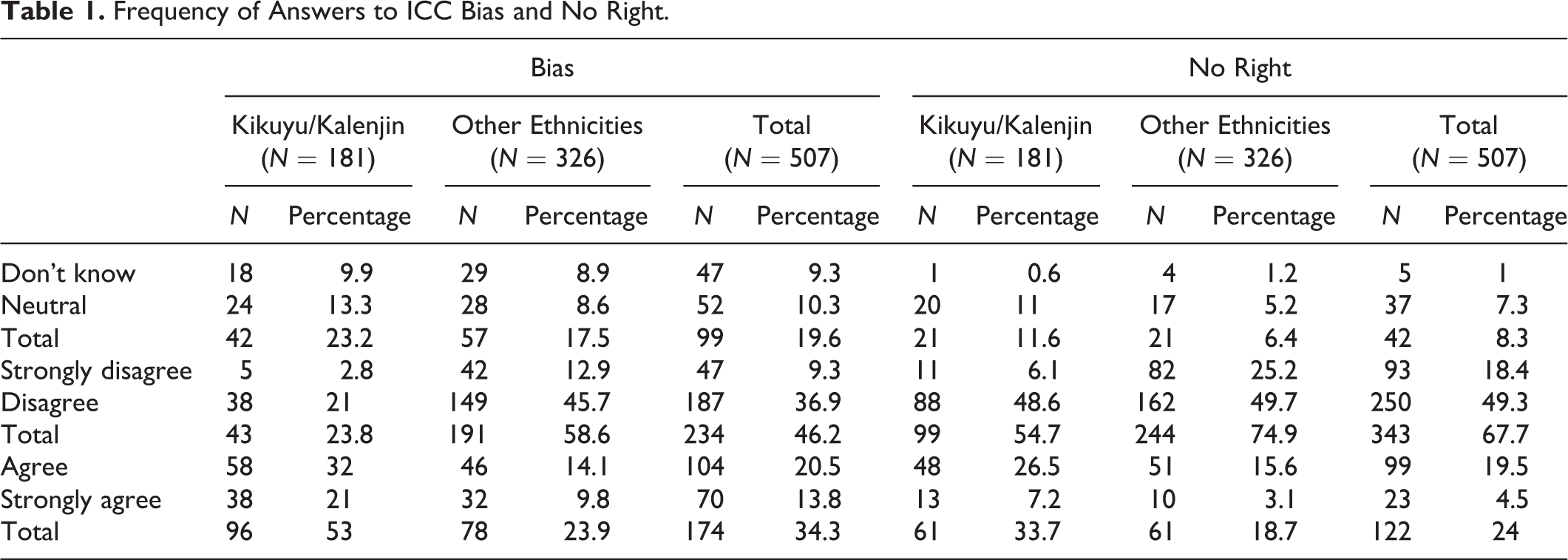
Because the responses form six different nominal categories, we use multinomial Logits (MNLs) to analyze the data. In essence, the MNL can be thought of as simultaneously estimating binary Logits for all possible comparisons among the outcome categories. A key assumption of MNLs is the independence of irrelevant alternatives (IIA), which “means that, all else being equal, a person’s choice between two alternative outcomes is unaffected by what other choices are available” (Cheng and Long 2007, 583–84). For example, the addition of a “strongly agree” category should not affect the choice between “agree” and “disagree.” However, we discover that, when all choices are included, the IIA assumption is in fact violated for both variables. We solve this problem by grouping the responses into four categories: (1) agree, (2) neutral, (3) disagree, and (4) don’t know. When recategorized in this fashion, the IIA assumption central to the MNL holds (see Table 1 for descriptive statistics).
Frequency of Answers to ICC Bias and No Right.
We are interested in how various personal characteristics predict the likelihood that a Kenyan will agree or disagree with ICC
The second independent variable is
One can also observe a clear ethnic divide in the descriptive data. Kikuyu and Kalenjin respondents are skeptical of the Court in comparison to other groups: 53 percent agree or strongly agree that the ICC is biased against Africans compared to only 23.9 percent of remaining respondents. The percentages flip when one observes disagree responses: 58.6 percent of people in other ethnic groups disagree or strongly disagree that the ICC is biased compared to only 23.8 percent of Kikuyu and Kalenjin respondents. These differences are also present in the “no right” data, but they are not as stark; 33.7 percent of Kikuyu and Kalenjin respondents agree or strongly agree that the ICC has no right to charge Kenyans, compared to only 18.7 percent of individuals of other ethnicities. However, a sizable portion of Kikuyu and Kalenjin (54.7 percent) disagree or strongly disagree with this statement. In short, a majority of ruling coalition co-ethnics in Kenya think the ICC has a right to charge Kenyans, but a majority also thinks that the Court exercises this right in a way that is biased against Africans.
To test Hypotheses 3 and 4, we include measures of trust and education.
It is possible that variation in attitudes is in large part explained by individuals’ familiarity with the ICC’s operations. To account for this possibility, we include two confounders.
Finally, we include six demographic controls in order to account for other sources of variation in our sample. We include indicators of
Model Results
The two MNL models produce five main finding (see Online Appendix Table A4 for full model results). First,
A third finding is that educated individuals are both more likely to agree and disagree that the ICC is biased; each one-unit increase in education comes with 62 percent higher odds increased likelihood of an “agree,” and 45 percent higher odds of a “disagree,” than a “don’t know” response. However,
Fourth, those who have directly experienced ICC outreach are far less likely to respond “don’t know” to either prompt. In fact,
Fifth and finally, most other variables, save for some regional controls, are not significantly related to attitudes about the ICC. Previous research by Chaudoin (2016) predicts that the impact of ICC intervention on Kenyan politics is most pronounced in areas with divided allegiances and weakest in areas where that show strong support for a particular leader or party. Our results support this theory to some extent. In the Bias model, all of the regional controls are negative for an “agree” answer. This suggests that subjects in all regions except for Nairobi are less likely to agree that the ICC is biased against Africans. In short, much of the concern for ICC bias is driven by respondents in Nairobi, which was closely divided between Odinga (49.4 percent) and Kenyatta (47.2 percent) supporters in 2013 elections. Respondents in rural areas of the Central and Rift Valleys were far less likely to agree that the ICC is biased. This suggests that even in regions where political allegiances are uniformly pro-Kenyatta, rural denizens who were more affected by election violence are less likely to agree that the ICC has an anti-African bias.
Figures 1 and 2 chart the predicted probabilities of the variables included to test our main fourth hypotheses. Each predicted probability reflects the change in the ratio of a particular response over the total number of observations, conditional on the value of an independent variable. For ease of presentation, we convert
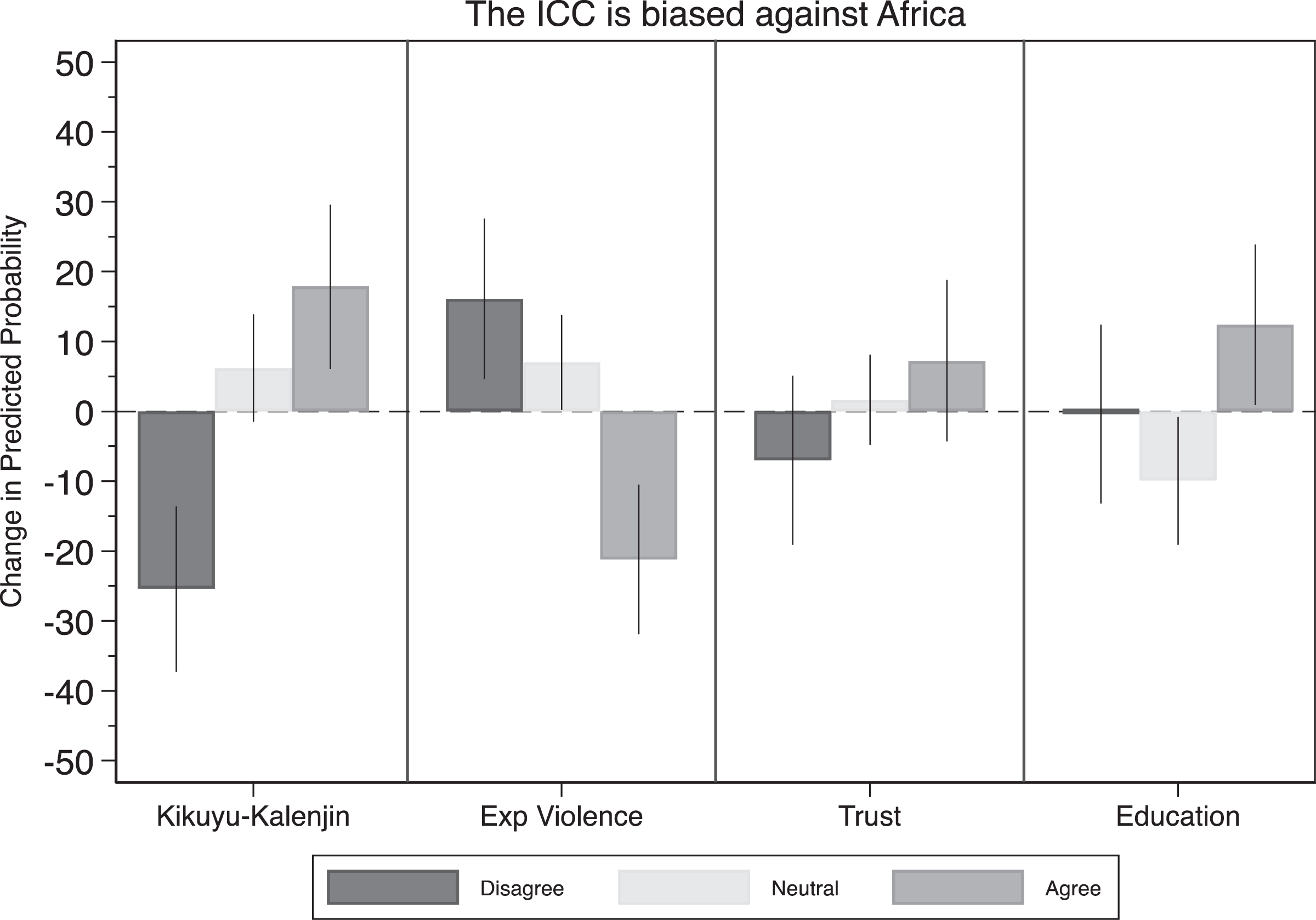
Change in predicted probabilities, the International Criminal Court is biased.
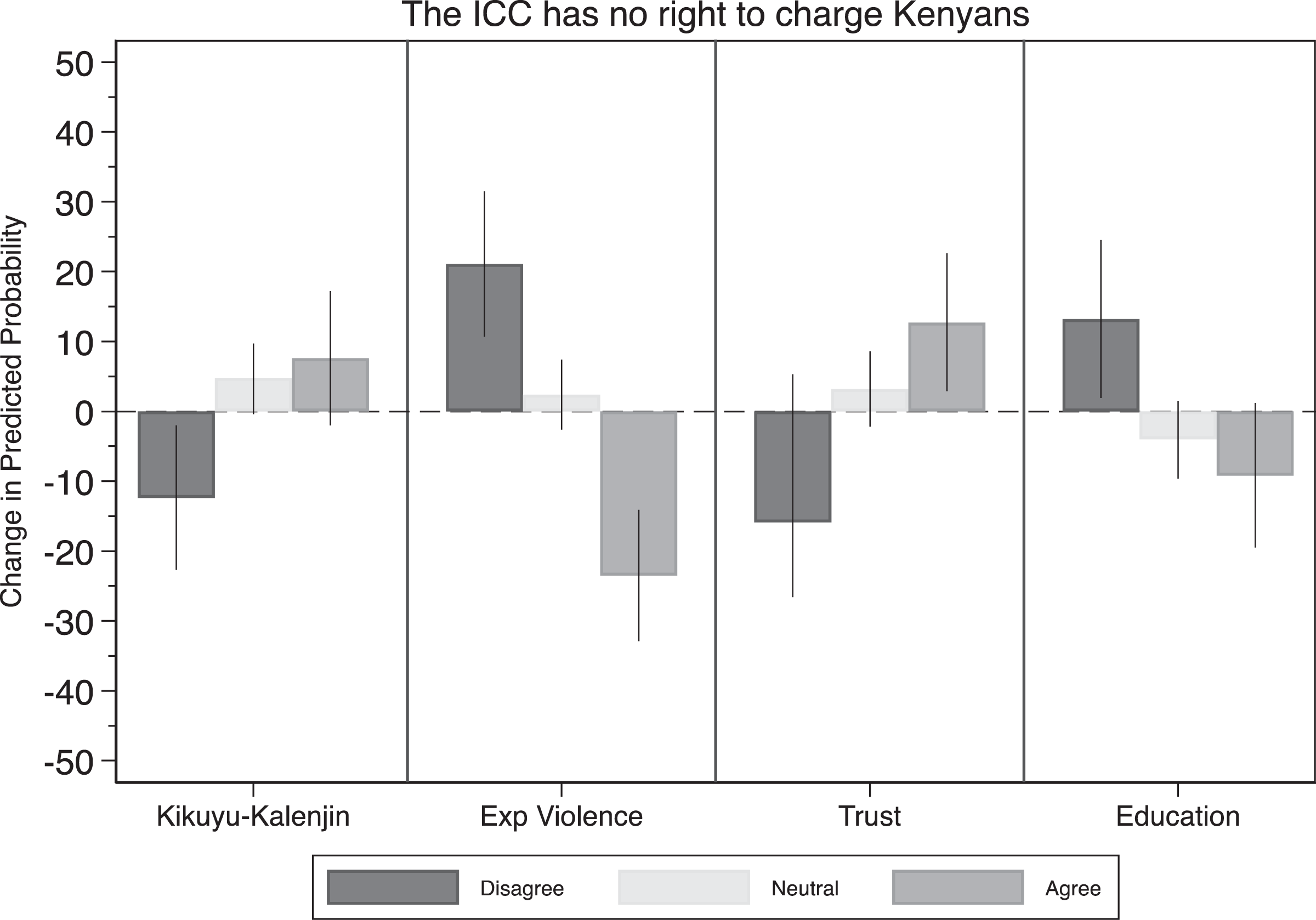
Change in predicted probabilities, the International Criminal Court has no right.
Figure 1 focuses in on probabilities associated with ICC bias. Kikuyu-Kalenjin decreases the probability of disagreeing with ICC bias by a little over 25 percent, but it increases the probability of agreeing by only around 18 percent.
Figure 2 demonstrates similar relationships with regard to
The picture that emerges from this presentation supports the main thrust of our theory: on the one hand, ethnic membership is a powerful predictor of respondents’ perceptions of ICC bias. On the other hand, a respondent’s direct experience of postelection violence dampens her attitudes of ICC bias. If group identity is the more powerful explanation behind belief in the anti-African ICC story, we would expect little variation within the ruling ethnic coalition. However, if exposure to violence intervenes on group attitudes, it should weaken enthusiasm for the narrative even among ruling co-ethnics (Hypothesis 2). The reason is that direct exposure to organized violence will create dissonance with critical elements of the state-sponsored version of events, which holds that Kenyatta and Ruto are the true victims. We test this by studying changes in predicted probabilities among Kikuyu and Kalenjin respondents, compared to all other respondents.
We conduct 10,000 simulations of the original MNL model on ICC
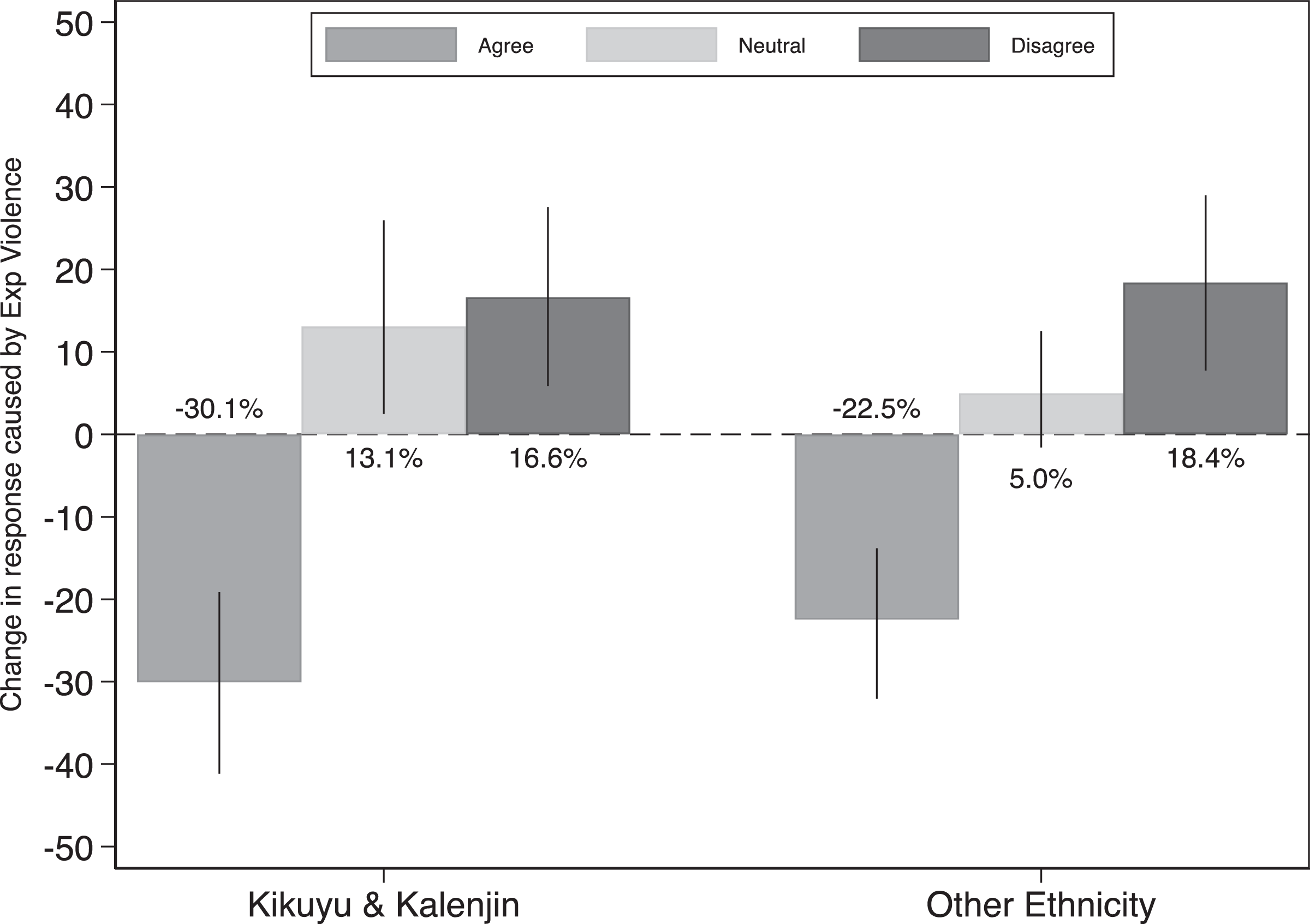
Change in predicted probabilities attributed to experience of violence.
These findings demonstrate that respondents who personally observed violence or were victimized following elections do not move in unison with the co-ethnics in the ruling coalition. They are more hesitant to buy the ICC bias story, even less so than members of other ethnic groups that saw violence. This suggests that co-ethnics are not merely rent seekers. As our psychological theory predicts, they are complex processors of experience.
While useful, these analyses cannot speak to the personal stories of individuals exposed to violence. They also cannot answer one additional question: why do some victims also agree that the ICC is biased against Africans? Although their numbers are few, and on average those exposed to violence are far less likely to support the notion that the ICC is biased, eleven victims still agree with this narrative. What does this subgroup have in common? To investigate, we reviewed the profiles of those eleven respondents. Only two were women. The group was more educated than the average Kenyan; seven of the eleven reported completing at least some university-level education, and three had at least some postgraduate education. Six of the eleven said they voted for ODM in 2013; three reported voting for the Jubilee Coalition (the rest did not answer). All but one respondent indicated they did not hear about the ICC from any outreach efforts by the Court itself. Instead, most said that they heard of the Court via Kenyan politicians. Five of the eleven emphasized the importance of Kenyan sovereignty when answering that either they agree or strongly agree that ICC had no right to try any Kenyan. But five also strongly disagreed with the claim, and an additional one agreed somewhat. This suggests that these victims are a heterogeneous group, and that one possible reason they perceive bias is that they think the ICC is not charging the correct individuals. In fact, seven of the eleven agreed or strongly agreed that the ICC “did not bring cases against the right individuals since it did not charge those most responsible for the violence surrounding the 2007 presidential elections.” All but one of the eleven strongly agreed or agree with the statement that “The International Criminal Court the ICC, or The Hague has shown bias in selecting the individuals to prosecute.”
One respondent presented a sophisticated alternative argument and wanted both to agree strongly and to disagree strongly that the ICC is biased against Africa. In an open-ended follow-up question, the respondent mentioned that the ICC was not prosecuting those responsible for atrocities in Syria and Iraq and was therefore biased. But the respondent also wanted to disagree strongly because all of the cases in Africa involved human rights violations. This raises the interesting interpretation of the question that the ICC is biased not because its Chief Prosecutor is biased, but rather because the ICC lacks jurisdiction over situations in countries like Syria and Iraq that are not Parties to the Rome Statute (except with UN Security Council referral). In short, belief in Kenyan sovereignty may be driving victims’ notions of bias, but it cannot likely explain the whole group’s views.
Conclusion
This article explored the question of how individuals in countries whose nationals the ICC is investigating form their impressions of the Court—especially when they are faced with a domestic narrative advanced by their own leaders painting the Court as biased. Specifically, which Kenyans agree or disagree that the ICC is biased against Africa? Our findings both depart from and add nuance to other extant theories seeking to explain political attitudes of domestic and international issues and institutions. The survey data provide support for our psychological theory and show that an individual’s perception of the ICC is constructed by a complex equation involving group attitudes and exposure to violence, foremost, but also education and trust in local institutions.
Most interesting, those who are victims of violence consider that profound experience and draw on it to shape their opinions about the ICC. This has two implications. First, after years of consistent anti-ICC campaigning on the part of Kenya’s elected leadership, and little or no ICC on-the-ground outreach, those who were exposed to violence still do not buy that the ICC is biased against Africans. Even in a place where it has struggled mightily, the ICC likely still has allies on the ground. Additionally, to the extent that our findings travel, anti-ICC bias narratives are more likely to succeed in countries where smaller percentages of the population suffered from mass atrocity violence and less likely to succeed in places where large percentages of the populations were victimized or witnessed such violence. This evidence shows that victims’ lived experiences make them less susceptible to rhetoric: they suffered injury and saw firsthand the violence that led to that injury. When denied justice locally, they may be willing to support the ICC’s quest to deliver justice and accountability.
Second, additional research would be useful to explore how Kenyans’ attitudes would interact with their willingness to support the Court in active ways such as testifying and giving evidence. Given the dangers Kenyans faced participating in the ICC’s proceedings, this is major step, one that would not necessarily follow from simply supporting the ICC. Further exploring whether these findings hold in other countries where the ICC operates is essential. In the constant back and forth between elite supporters and critics of the ICC project, often lost is the voice of ordinary people who are most affected by the prospect of international criminal justice. It is worth knowing what they think.
Supplemental Material
Supplemental Material, sj-do-1-jcr-10.1177_0022002719893740 - What Determines Perceptions of Bias toward the International Criminal Court? Evidence from Kenya
Supplemental Material, sj-do-1-jcr-10.1177_0022002719893740 for What Determines Perceptions of Bias toward the International Criminal Court? Evidence from Kenya by Geoff Dancy, Yvonne Marie Dutton, Tessa Alleblas and Eamon Aloyo in Journal of Conflict Resolution
Supplemental Material
Supplemental Material, sj-dta-1-jcr-10.1177_0022002719893740 - What Determines Perceptions of Bias toward the International Criminal Court? Evidence from Kenya
Supplemental Material, sj-dta-1-jcr-10.1177_0022002719893740 for What Determines Perceptions of Bias toward the International Criminal Court? Evidence from Kenya by Geoff Dancy, Yvonne Marie Dutton, Tessa Alleblas and Eamon Aloyo in Journal of Conflict Resolution
Supplemental Material
Supplemental Material, sj-pdf-1-jcr-10.1177_0022002719893740 - What Determines Perceptions of Bias toward the International Criminal Court? Evidence from Kenya
Supplemental Material, sj-pdf-1-jcr-10.1177_0022002719893740 for What Determines Perceptions of Bias toward the International Criminal Court? Evidence from Kenya by Geoff Dancy, Yvonne Marie Dutton, Tessa Alleblas and Eamon Aloyo in Journal of Conflict Resolution
Footnotes
Acknowledgments
The authors thank the anonymous reviewers, Geoffrey Lugano, Malini Laxminarayan, Jim Ron, Victor Owuor, and Conor Seyle for helpful feedback on earlier versions of this article and Nahashon Kariuki and the research assistants for assistance in conducting the surveys. The authors gratefully acknowledge funding support from The Hague Institute for Global Justice, and Dutton acknowledges support from the IUPUI Office of the Vice Chancellor for Research.
Declaration of Conflicting Interests
The author(s) declared no potential conflicts of interest with respect to the research, authorship, and/or publication of this article.
Funding
The author(s) disclosed receipt of the following financial support for the research, authorship, and/or publication of this article: The Hague Institute for Global Justice and IUPUI Office of the Vice Chancellor for Research.

Supplemental Material
Supplemental material for this article is available online.
Notes
References
Supplementary Material
Please find the following supplemental material available below.
For Open Access articles published under a Creative Commons License, all supplemental material carries the same license as the article it is associated with.
For non-Open Access articles published, all supplemental material carries a non-exclusive license, and permission requests for re-use of supplemental material or any part of supplemental material shall be sent directly to the copyright owner as specified in the copyright notice associated with the article.
