




Abstract
Reciprocity is one of the oldest principles of warfare, but humanitarian norms embedded in international humanitarian law (IHL) prohibit reciprocity over various wartime acts. When it comes to the treatment of prisoners of war (POWs), how do these conflicting norms shape public opinion? One perspective is that citizens who learn about IHL acquire an unconditional aversion to abusing POWs. Alternatively, people may understand IHL as a conditional commitment that instead strengthens their approval for reciprocal conduct. Survey experiments fielded in the United States support the latter view: people’s preferences depend on the enemy’s behavior, and this “reciprocity effect” is largest among those who believe that the United States is legally committed to treating POWs humanely. Puzzlingly, prior studies do not find a reciprocity effect, but this is due to their use of a no-information experimental control group, which led to a lack of control over the subjects’ assumptions about the survey.
Keywords
When motivated by reciprocity, people condition their behavior on the other side’s behavior. In one famous example, German and Allied troops during World War I formed a system of “live and let live” in which soldiers upheld cease-fires by reciprocating peace with peace and aggression with aggression (Axelrod 1984, chapter 4). On the issue of prisoners of war (POWs), pundits and politicians often argue that mistreating POWs can lead the enemy to reciprocate, endangering the well-being of a country’s own soldiers. Numerous studies on elites and citizens alike also show that reciprocity is a guiding principle across various foreign policy issues (e.g., Tingley and Tomz 2014; Kertzer et al. 2014; Kertzer and Rathbun 2015).
Despite the importance of reciprocity to warfare, the humanitarianism movement has sought to curtail its influence by promoting liberal principles of humanity, which deem behavior like the abuse of POWs to be unacceptable regardless of the circumstance. To establish these new norms, humanitarians have adopted political strategies such as establishing new laws; lobbying policy makers; and educating, informing, and mobilizing domestic publics. They have largely succeeded on the legal front, as international humanitarian law (IHL) via the Geneva Conventions fully rejects the logic of reciprocity over the treatment of the wounded, civilians, and POWs. A still-debated question, however, is whether and how domestic publics have internalized the humanitarian norms that are encoded in the law.
This article investigates the tension between reciprocity and humanitarian-legal norms in the context of American attitudes toward the (mis)treatment of POWs. Such a tension reflects an enduring debate on the role of norms in public attitudes toward war (e.g., Herrmann and Shannon 2001; Gelpi 2002; Press, Sagan, and Valentino 2013) and provides an opportunity to study the landscape of American values in light of conflicting norms and institutions. 1 One theoretical view is that the humanitarian principles contained in IHL, once learned, should replace existing norms of reciprocity. This suggests that international law not only reduces people’s overall enthusiasm for wartime torture but also reins in people’s willingness to engage in reciprocal mistreatment of POWs. An alternative argument is that IHL provides institutional focal points that instead reinforce the influence of reciprocity. Rather than serving as unconditional commitments, laws are rules that clarify the equilibria over which actors adopt strategies of behavior such as reciprocity (Axelrod and Keohane 1985; Morrow 2014). From this view, IHL may ultimately strengthen cooperation over the humane treatment of POWs, but it does so by facilitating reciprocal wartime acts.
These perspectives explicitly highlight the link among public opinion, IHL, and wartime conduct. For example, the International Committee of the Red Cross (ICRC), the authority on humanitarian law, has “always been explicit that it considers public opinion to be the only tool of enforcement of the Geneva Conventions” (Finnemore 1996, 83). And theories of international institutions have long observed the role of domestic public opinion and “audience costs” in enforcing legal agreements (Morrow 2000, 71-73). More generally, a great deal of research also demonstrates that the mass public influences foreign policy on war (Aldrich et al. 2006; Gelpi, Feaver, and Reifler 2009; Baum and Potter 2015).
To evaluate the relationship among IHL, reciprocity, and public opinion, this article analyzes a set of experiments embedded in surveys fielded in the United States. In the surveys, respondents were randomly assigned to read about a war in which a foreign country had either tortured American soldiers or kept them in humane conditions. The respondents were then asked whether they support using torture to extract military intelligence from the foreign country’s soldiers, along with additional questions about international law and war. 2
The data produce three main findings, which collectively support the institutional view that IHL reinforces reciprocity norms. First, reciprocity has a significant influence on American attitudes toward the treatment of POWs. Many Americans—both in the mass public and among influential groups like veterans and politically engaged partisans—are more likely to support torture in kind than against a country that has kept American soldiers in humane conditions. Second, Americans who understand that IHL prohibits torture are less likely to support torture when the other side does not use torture, but once the other side does use torture, they embrace torture at levels indistinguishable from those without knowledge of IHL. Thus, IHL has the net impact of increasing the reciprocity effect. Third, this study investigates why past survey experiments do not find a reciprocity effect. The discrepancy exists because previous experiments rely on a design in which using a “no-information” control group (i.e., a control group in which the respondent receives no information about the treatment of American POWs) generates substantial respondent uncertainty about the scenario. Accounting for the uncertainty recovers the reciprocity effect and also highlights a more general problem in experimental survey design.
These findings speak to the challenges of using international legislation as a strategy to place unconditional, normative prohibitions on wartime behavior. By uncovering the research design issue of problematic control groups, this study also gives a reason for why extant studies generate conflicting conclusions about the role of reciprocity in American public opinion. Thus, this article makes both a substantive contribution to the study of wartime norms and a methodological contribution to experimental research. The conclusion summarizes the study’s findings, discusses their theoretical implications, and then outlines avenues for future research.
Two Theories
Two theories give alternative explanations on how reciprocity and IHL affect people’s attitudes toward the treatment of POWs. The first argues that humanitarian-legal norms, when internalized, replace existing reciprocity norms. From this view, IHL transforms people’s preferences to match the substantive content of the law. A second perspective argues that people might understand IHL as conditional commitments that buttress, rather than supplant, their approval for reciprocal wartime conduct.
IHL as Internalized Humanitarian Norms
One perspective is that the public’s internalization of humanitarian norms enshrined in IHL should replace preexisting norms of reciprocity. Under the 1949 Geneva Conventions, wartime torture is never legal, and ever since, humanitarian law has increasingly institutionalized the normative prohibition on abusing POWs. These treaties mark the “legal death of reciprocity” (Best 1994, 146). Importantly, many transnational activists and nongovernmental organizations like the ICRC consider raising public awareness and mobilizing domestic publics to be a key part of holding governments accountable to international laws. This reflects a broader claim in the international relations literature that institutions like IHL could generate domestic constraints for political leaders (Risse and Sikkink 1999; Dai 2007; Simmons 2009).
In particular, the creation of institutions like the Geneva Conventions could empower norm entrepreneurs like the ICRC who seek to influence domestic public opinion on foreign policy. Indeed, research shows that international law affects the policy preferences of both ordinary citizens and policy makers: these audiences are more supportive of policies that abide by international laws than otherwise identical policies that are not required by the law (Tomz 2008; Wallace 2013). Additionally, mass publics are influenced by international law even after being told nonlegal arguments. In other words, appeals to international law give an additional persuasive boost to existing arguments for or against a policy (Tomz 2008).
International law provides activists with powerful tools of persuasion, which can not only affect people’s short-run attitudes toward policies, but also produce durable changes in their policy preferences. International (legal) norms can eventually become “internalized” by domestic audiences: through repeated exposure, persuasion, and dialogue, domestic publics eventually take norms such as the norm against torture for granted (Koh 1997; Finnemore and Sikkink 1998, 904-5). At an extreme, internalized norms against a particular behavior could even reach the level of being “taboo.” Taboo behaviors are understood to be so morally wrong or revolting that they are “unthinkable.” For example, some argue that the existence of a taboo explains the nonuse of nuclear and chemical weapons in warfare (Price 2007; Tannenwald 2007).
The anti-torture norm might not be considered taboo among the entire American public, evidenced by the debates over the United States’s use of torture during the George W. Bush presidency. Less strong of a claim, however, is that the anti-torture norms enshrined by the Geneva Conventions and other international treaties have been internalized by some nontrivial proportion of Americans. Indeed, much of the American public did react negatively to the revealed use of torture in the infamous Abu Ghraib scandal, and domestic and international backlash led to real policy changes. 3
Does international law influence American preferences for torture in the way these theories predict? Several testable implications arise from this discussion that address this question. Under the current international legal and normative regime, wartime torture is unconditionally illegal. Taking the theory to the logical extreme, a pair of implications that follows is that people should generally oppose the mistreatment or torture of POWs, and that enemy behavior has no significant effect on people’s support for torturing enemy POWs. However, these two implications establish a “tough” test for the norm internalization thesis. They assume that most of the population has internalized the unconditional norm against torture. A weaker pair of claims, but one that is perhaps a fairer test of the theory, is the following: those who understand IHL are less supportive of torture than those who do not share those beliefs. Additionally, the reciprocity effect is smaller among those who understand that wartime torture is illegal than among those who do not. In other words, knowledge about IHL supplants the instinct to engage in reciprocity with principles of humanitarianism, which unconditionally prohibit the maltreatment of POWs.
IHL as Institutional Focal Points
While the norms internalization view focuses on how IHL transforms the preferences of political actors, the institutional view emphasizes how IHL structures how political actors interact, ultimately implying that IHL can facilitate rather than obstruct reciprocal wartime behavior. In particular, institutional theories apply game theory to model how reciprocity and international law affect decision-making about wartime torture. These theories begin with the premise that the basic political interaction of wartime torture can be modeled as an Iterated Prisoners’ Dilemma between countries fighting a bilateral war and who are faced with multiple decisions of whether or not to torture the other side’s soldiers. 4
Morrow (2014) gives the seminal institutionalist treatment on how reciprocity and IHL influence wartime behavior on issues like the treatment of POWs. Like Axelrod (1984), Morrow observes that joint observance of reciprocity norms over the issue of wartime torture lead to an cooperative equilibrium (i.e., the nonuse of torture), but further argues such an equilibrium requires that both players’ strategies are mutual best replies and that they share an understanding about each other’s strategy (i.e., share a common conjecture). 5 Mutual understanding includes players’ shared beliefs about what constitutes upholding or violating the rules. But more specifically, Morrow shows that public law—or IHL—is especially useful for establishing these common understandings and clarifying the equilibria over which political actors play strategies of reciprocity. IHL provides a focal point for the types of wartime behaviors that should be met with reciprocal behavior. In the case of torture, IHL establishes that wartime torture constitutes breaking a rule, and thus actors should expect from one another that violations or observance of those rules will be reciprocated with mutual violation or observance.
The domestic public, at least in a democratic country, plays a role by introducing audience cost to leaders who renege on international commitments regarding wartime conduct (Morrow 2007, 561). 6 What remains an open empirical question is whether (or what proportion of) the domestic public would unconditionally punish leaders for violating international commitments (i.e., the commitment not to mistreat POWs) as opposed to conditionally punishing leaders for violating international commitments based on the enemy country’s behavior.
This theoretical approach implies that the public would support strategies of reciprocity for at least two reasons. First, if we assume that citizens are rational (at least in the aggregate), then the game theoretic predictions regarding reciprocity and IHL apply to individual citizens as well. 7 Second, evolutionary game theory provides an additional basis for predicting that people will mirror or reciprocate the behavior of others. Evolutionary pressures arising from natural selection under anarchy might favor individuals who hold the “reciprocity trait” and abide by reciprocity norms in their interactions with each other, since such individuals are more likely to deter non-cooperative behavior and reach cooperative outcomes (Axelrod 1984; Bendor and Swistak 1997).
In these evolutionary models, IHL could similarly facilitate strategies of reciprocity by providing focal points or common conjectures. If legal institutions affect preferences by creating conditional commitments, then IHL could also facilitate reciprocity by increasing the robustness of cooperative equilibria. That is, if IHL curbs people’s willingness to mistreat POWs if and only if other countries also do not torture, then IHL can help actors maintain a cooperative equilibria in which both sides refrain from using torture.
This theoretical discussion generates two main implications regarding American preferences for wartime torture. First, there is a general reciprocity effect. People are more likely to support the torture of POWs in kind than against another country that has kept American soldiers in humane conditions. Second, IHL facilitates (rather than supplants) reciprocity. The reciprocity effect is higher among respondents who understand that torture is illegal than among those who do not share that belief. Ultimately, IHL can lead to more stable cooperative equilibria (lower support for “defection” conditional on the other side’s good behavior), but it does so by buttressing people’s desire to engage in reciprocal wartime conduct.
Existing Evidence
The empirical record is mixed. In support of the norms internalization view, Flavin and Nickerson (2012, 10) analyze data from a randomized question-order experiment fielded to Americans and find that people’s preferences for torture are not conditional on whether they are first primed that “US soldiers are working in countries where torture is legal…[and] run the risk of being tortured.” This study suggests that views on torture are not conditional. However, it is not well suited to answer this article’s question of whether Americans are more supportive of torture in kind, and how IHL shapes existing reciprocity norms. Instead, it studies people’s general attitudes toward wartime torture in light of potential torture by other countries, and does not address the link between humanitarian and reciprocity norms.
Wallace (2013) provides a more direct test of this article’s research question. In a survey experiment, the study presents American respondents with a scenario involving war with another country. One of the experiments embedded in this scenario randomly assigned some respondents to read that the enemy country had tortured US soldiers and others to read nothing regarding the conditions of US soldiers. It finds that assignment to the reciprocity condition has no significant effect on people’s support for wartime torture (Wallace 2013, table 4, p. 122). 8
While the studies supports norm internalization hypothesis, it remains unclear whether the lack of a reciprocity effect actually reflects people’s insensitivity to opponent behavior or instead reflects an artifact of the survey design. Namely, respondents in the control group who were not told any information about the status of American soldiers could actually in a sense “assign” themselves to the treatment group (i.e., respondent noncomply) by assuming that American soldiers have been tortured. The proceeding empirical sections investigate this methodological question and show that the application of problematic control groups explain the null finding.
Turning to the institutional view, historical studies find that reciprocity influences wartime behavior, including the treatment of POWs (Morrow 2007, 2014; Wallace 2012). Morrow (2007) additionally finds that mutual ratification of the laws of war treaties facilitates reciprocity during war. While these are path-breaking studies, they do not speak directly to this article’s central research question regarding whether institutions affect domestic public norms. Also problematic, these studies cannot easily make inferences about the causal effect of reciprocity. Inferring from observational data on wars is challenging due to the existence of endogeneity, selection bias, and poor data quality. Recognizing these concerns, authors attempt to make more valid inferences using instrumental variable research designs, but such an approach requires stringent assumptions about the validity of the instruments (i.e., exclusion restriction). And even if this assumption is met, instrumental variable analysis only gives the local average treatment effect, which is substantively difficult to interpret given that the explanatory variable is an interaction term between IHL and reciprocity.
Also providing some support for the institutional view, though not on the substantive area of wartime torture, Chilton (2015) conducts a survey experiment to find that reciprocity influences people’s opinions about killing civilians during war. While the study finds a reciprocity effect, the substantive effect appears to be small—about 0.25 on a seven-point scale (Chilton 2015, 195). It is also unclear whether this effect would generalize to the issue of torture.
Method
As the evidence reviewed above shows, the question of how reciprocity and IHL affect citizen’s attitudes toward wartime torture has yet to be conclusively answered. Thus, to learn more about domestic norms and public opinion on wartime torture, this study fielded four original surveys experiments in the United States.
Survey #1 was administered by Survey Sampling International (SSI), an Internet-based survey firm that uses population targets to generate a diverse sample from its opt-in panel, in June 2014 to 1,237 American adults. In the survey, respondents read about a hypothetical scenario in which the United States and a foreign country are fighting a war, and both countries have captured soldiers from the other side. 9 The experimental component had two conditions: respondents were randomly assigned to read that the foreign country had either tortured American POWs or kept them in humane conditions. 10 Because the reciprocity condition is randomly assigned, other important variables such as beliefs about the effectiveness of torture and political ideology are exogenous and do not confound inference.
After reading about the scenario, respondents were asked: “Do you support or oppose the US using nonlethal torture on the POWs to get that military information?” The respondents can choose from six potential response options: support or oppose strongly/moderately/slightly. For interpretability, all of the results presented in this article use a collapsed, binary version of this dependent variable (either support or oppose), but replicating all of the analyses using the full dependent variable does not substantively change results.
Two features about the scenario were held constant across respondents. First, the importance of the military intelligence was fixed: respondents were told that the intelligence was “useful but non-critical.” This rules out cases in which the intelligence is either irrelevant or overridingly important. Second, the form of torture was fixed to be “nonlethal” and instrumental (i.e., to obtain information). This distinguishes torture from killing, and rules out torture for purely noninstrumental reasons such as sadism. These features of the scenario were fixed to focus the survey’s scope on the range of cases in which norms can be contested (i.e., gray-area cases). Relatedly, choosing this non-extreme scenario helps to avoid ceiling or floor effects due to extremely high or low baseline attitudes on the dependent variable. For example, if the intelligence were overridingly critical to US national security, many respondents would likely support using torture, so there would be little opportunity to discover a reciprocity effect even if there were one. (But to foreshadow, survey #4 removed this language to examine whether the results are sensitive to a higher stakes scenario, and the resulting data show that the main findings hold under such conditions.)
Survey #2 was conducted in January 2015 to 2,278 Americans, also over SSI. The survey itself was largely similar to survey #1, but with some key differences. Respondents in survey #1 read about a war with an unnamed “foreign country.” While using a generic foreign country, the survey avoids priming survey respondents about any specific country, which has led some researchers to prefer this design choice (e.g., Tomz and Weeks 2013). However, not naming a specific country could also lack realism, which has led other studies to do the opposite (e.g., Greico et al. 2011; Brooks and Valentino 2011). This study goes beyond the state of the art by randomizing between both approaches. Specifically, survey #2 used a scenario in which respondents were independently and randomly assigned to read about a war with Sudan, Yemen, or an unnamed foreign country. Note that because the country name is independently and randomly assigned from the reciprocity experiment, it does not confound inference about the effect of reciprocity on support for torture. 11 The scenario texts used in the surveys, which differ slightly in wording, are shown in Table 1.
Survey Information.
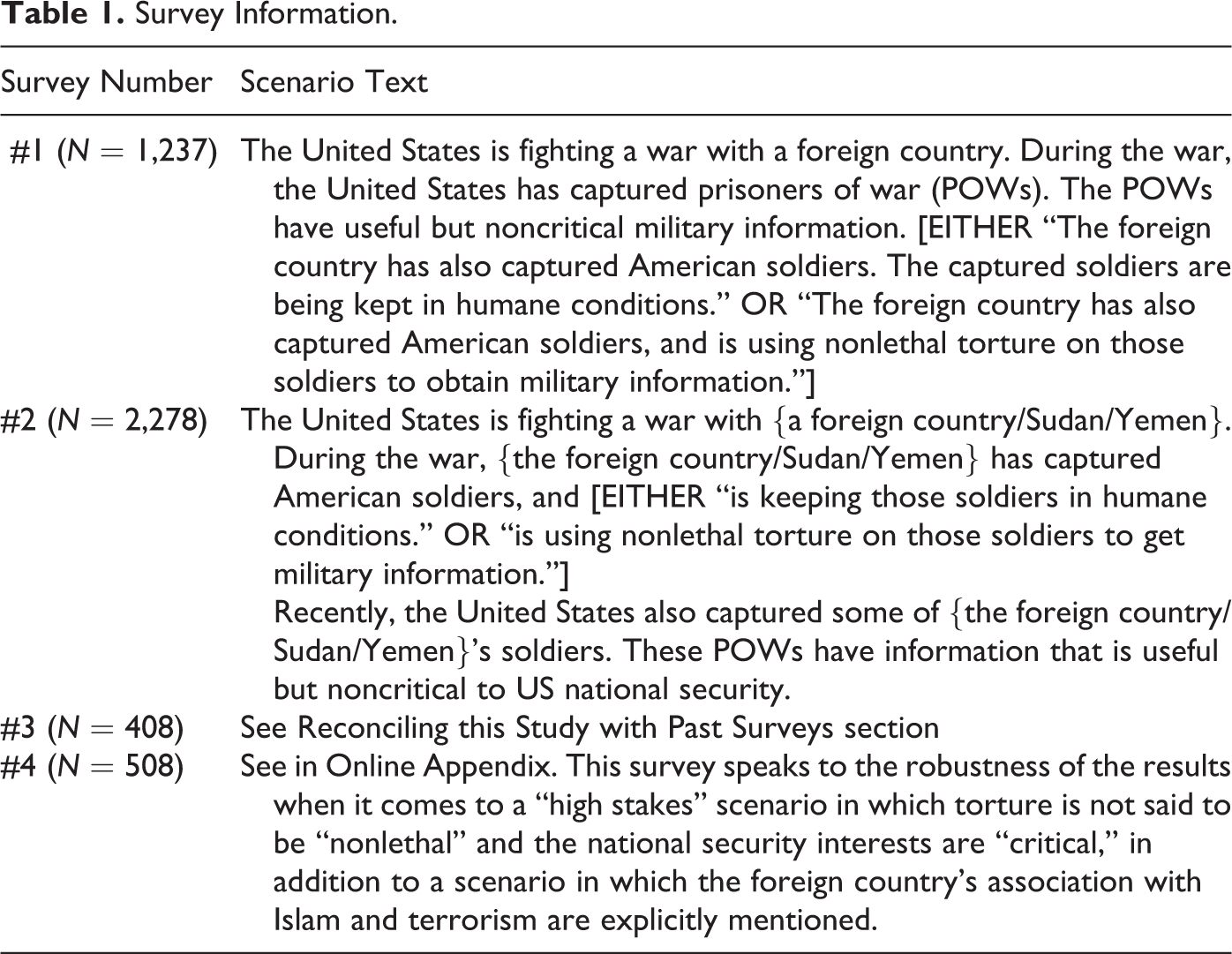
To test the hypotheses regarding the influence of IHL on reciprocity, survey #2 additionally asked a series of questions relating to international law. 12 The research design choice here is to measure people’s existing beliefs and knowledge about international law rather than experimentally give them information about the law, which might be appropriate for answering some research questions but not the one here. Specifically, one aim of this project is to evaluate the extent to which legal norms have diffused to domestic publics. Artificially exposing respondents to information about the law would thus be counterproductive.
Finally, surveys #3 and #4 were fielded in 2016 and 2018 to convenience samples of American adults on Amazon Mechanical Turk. Details on survey #3 are given in the section, “Reconciling This Study with Past Surveys,” and survey #4 is discussed in the Online Appendix. Survey #3 is used to investigate why this study discovers a reciprocity effect while past studies have not. Survey #4 is used to test the robustness of the findings. Respondent attributes for all of these surveys are also reported in the Online Appendix. 13
Is There a Reciprocity Effect?
Using the data from surveys #1 and #2, this section analyzes the main effect of reciprocity on public opinion on the treatment of POWs. Table 2 shows that reciprocity has a powerful effect on people’s support for torturing POWs. When American POWs are tortured, the proportion of supporters is about 64 percent. When American soldiers are treated humanely, about 51 percent of the respondents support torture. This translates to a reciprocity effect of about 13-percentage points. Speaking to the validity of the survey, the overall levels of torture are similar to other major surveys on torture (Gronke et al. 2010; Gutierrez, DeCristofaro, and Woods 2011, 1010). And speaking to the replicability of the results, the effect is nearly the same in both surveys.
Reciprocity Affects Support for Wartime Torture.
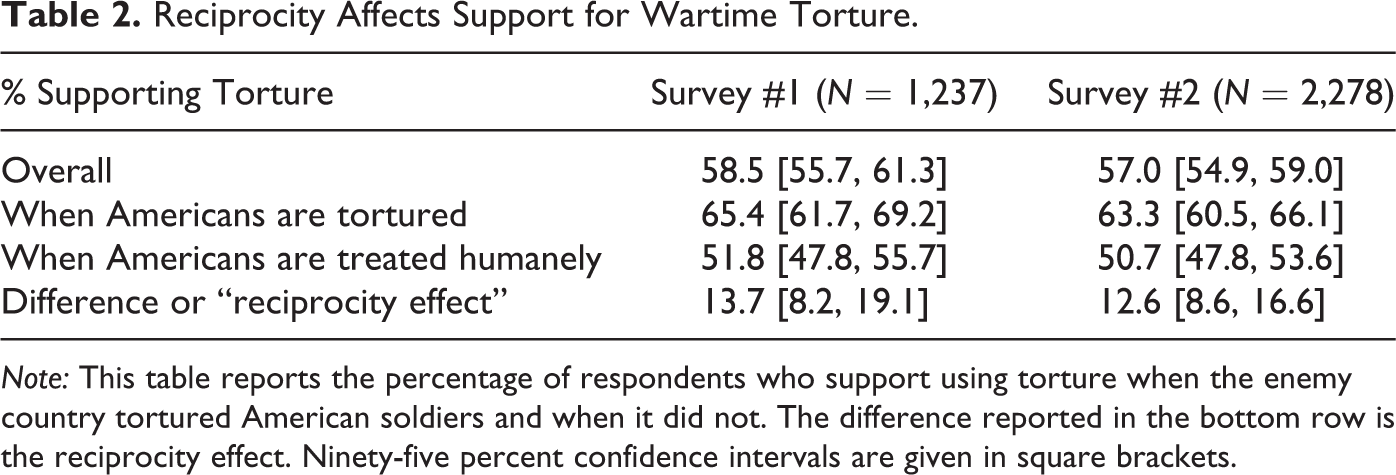
Note: This table reports the percentage of respondents who support using torture when the enemy country tortured American soldiers and when it did not. The difference reported in the bottom row is the reciprocity effect. Ninety-five percent confidence intervals are given in square brackets.
This reciprocity effect is robust. It is neither sensitive to survey text wording nor sensitive to whatever environmental factors that might differ between 2014 and 2015. Surveys #3 and #4, which are discussed below, likewise replicate the finding in 2016 and 2018. As reported in the Online Appendix, the reciprocity effect is also insensitive to specifying different country names for the enemy country (i.e., a generic foreign country, Sudan, or Yemen), and it consistently applies to subgroups of the US population like partisans and veterans (Feaver and Gelpi 2005).
How Do Beliefs about IHL Influence the Reciprocity Effect?
This section evaluates whether IHL affects mass opinion on the treatment of POWs, and whether IHL reinforces or replaces reciprocity norms among the public. To do so, Survey #2 measures people’s knowledge about IHL using the following question: “Do you think the US has signed any international treaties that make torturing POWs illegal?” 1,006 respondents replied either “probably/definitely no” and 1,271 replied “probably/definitely yes.” In other words, from a factual perspective, 1,271 or 56 percent of the sample correctly stated that the US has made legal commitment to not torture POWs. The first empirical test is to subset the sample based on respondents’ answer to this question and analyze the reciprocity effect among each subset.
Table 3 summarizes the results from this analysis and displays both the effect of reciprocity conditional on respondent beliefs about international law, and conversely, the effect of law conditional on reciprocity or the behavior of the enemy. Analyzing the column differences (row 4) reveals that the effect of reciprocity is 18.2 points among those who believe that the United States has made legal commitments to not use torture, and 6.1 points among those who believe that the United States has not made such commitments. Thus, effect of reciprocity is three times larger when citizens believe that torture is illegal. Why might the law play this amplifying effect?
Legal Commitments Curb Overall Support for Torture but also Amplify the Effect of Reciprocity.
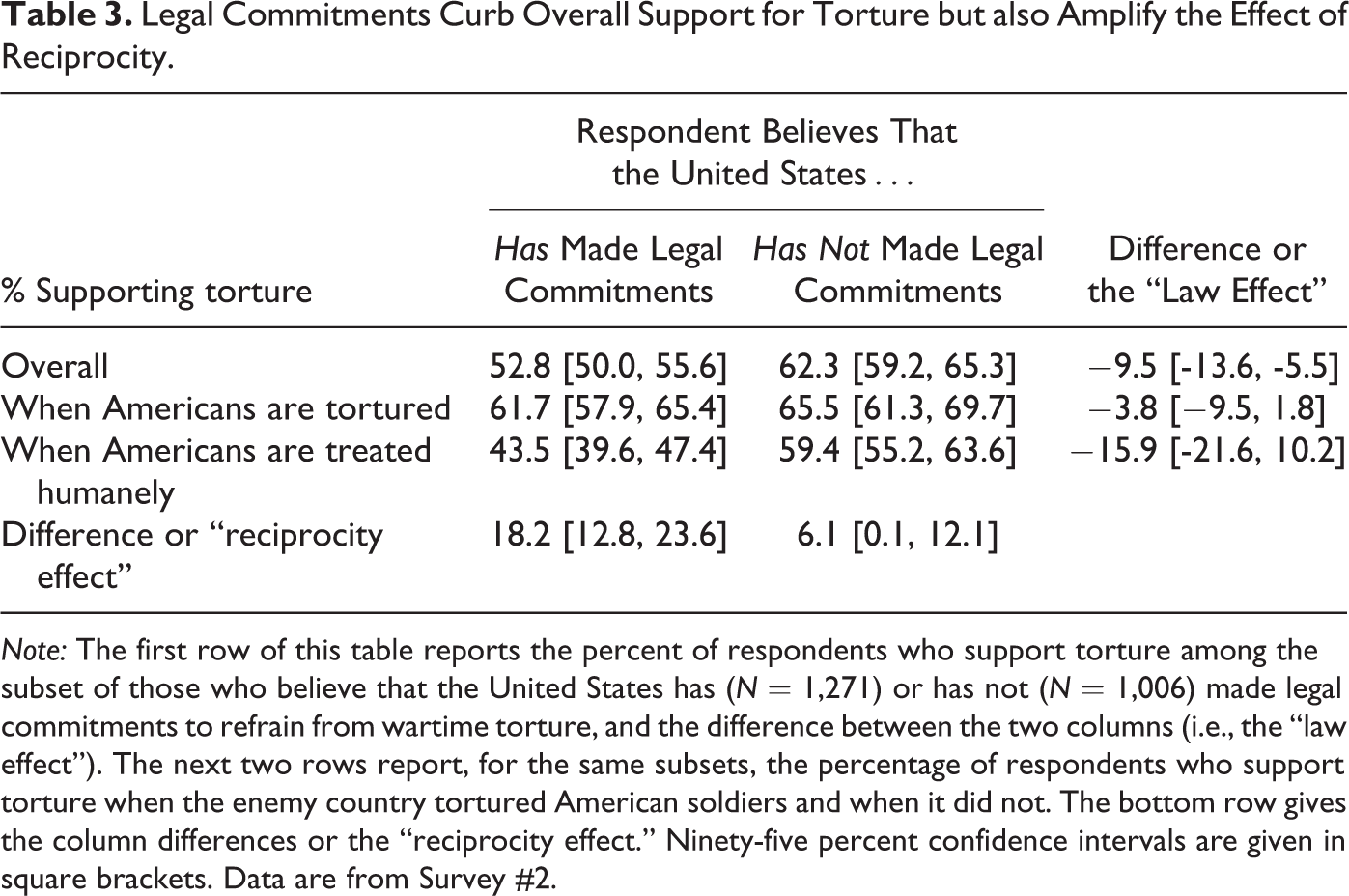
Note: The first row of this table reports the percent of respondents who support torture among the subset of those who believe that the United States has (N = 1,271) or has not (N = 1,006) made legal commitments to refrain from wartime torture, and the difference between the two columns (i.e., the “law effect”). The next two rows report, for the same subsets, the percentage of respondents who support torture when the enemy country tortured American soldiers and when it did not. The bottom row gives the column differences or the “reciprocity effect.” Ninety-five percent confidence intervals are given in square brackets. Data are from Survey #2.
Consistent with past studies (Wallace 2013), believing that the United States has made legal commitments to avoid torturing POWs decreases overall support for the use of torture by 9.5-percentage points (row 1: 52.8 − 62.3). As indicated by the confidence interval, this effect is statistically significant at the .05 level. However, the effect of international law is not consistent across scenarios. The ameliorating effects of international law only manifest when the enemy country has kept US soldiers in humane conditions (row 3: the difference is −15.9 points), but not when the other side has tortured Americans (row 2: the difference is statistically indistinguishable from zero.). In other words, those who believe that torture is illegal are less supportive of torture only when American soldiers are being treated humanely, but once American soldiers are tortured, those same respondents support torture at levels similar to those who do not believe that torture is illegal.
Table 3 shows that the effect of reciprocity depends on people’s knowledge about IHL: it is larger among those who believe that torture is illegal (18.2 points) than among those who believe torture is legal (6.1 points). The next step is to check whether the difference in differences is significant (i.e., the 18.2-point effect significantly larger than 6.1) by estimating the interaction effect of IHL and reciprocity on public support for torture. This interaction term speaks directly to whether international law diminishes or amplifies the effect of reciprocity on public support for war. Specifically, the analysis uses a probit model to regress “support for torture” on the reciprocity treatment, people’s knowledge about IHL, the interaction of reciprocity and IHL, and a set of potential confounding or control variables, which encompass demographic variables and important dispositional variables including retributiveness (Liberman 2013; Stein 2015) and internationalism (Herrmann, Tetlock, and Visser 1999).
Figure 1 reports the predicted probabilities from the estimated probit coefficients and their 95 percent confidence intervals. It produces results that are substantively similar to the ones shown in Table 3. The baseline category is the condition under which respondents believe that (1) the United States has not made international legal commitments to refrain from wartime torture and (2) are told that United States soldiers are treated humanely. Under that condition, the reciprocity effect is 0.07- or 7.0-percentage points. When Americans are being treated humanely (i.e., baseline condition), the effect of believing torture to be illegal (Illegal) is −.15 or a 15-percentage point decrease in support for torture. But as the interaction effect reveals, the effect of reciprocity increases by 12-percentage points among those who believe torture is illegal: the reciprocity effect among those who understand IHL is 19.0 points. All of these estimates are significant at the .05 level. Finally, the overall level of support for torture when Americans are being tortured is about the same whether or not respondents believe that the United States has made legal commitments. 14 Taken together, the evidence presented in Table 4 and Figure 1 support the claims that IHL curbs people’s overall enthusiasm for torture, but it also reinforces the effect of reciprocity on people’s support for torture. While the principles of humanity enshrined in IHL and reciprocity norms might seem at odds, this analysis shows that they actually reinforce one another. 15
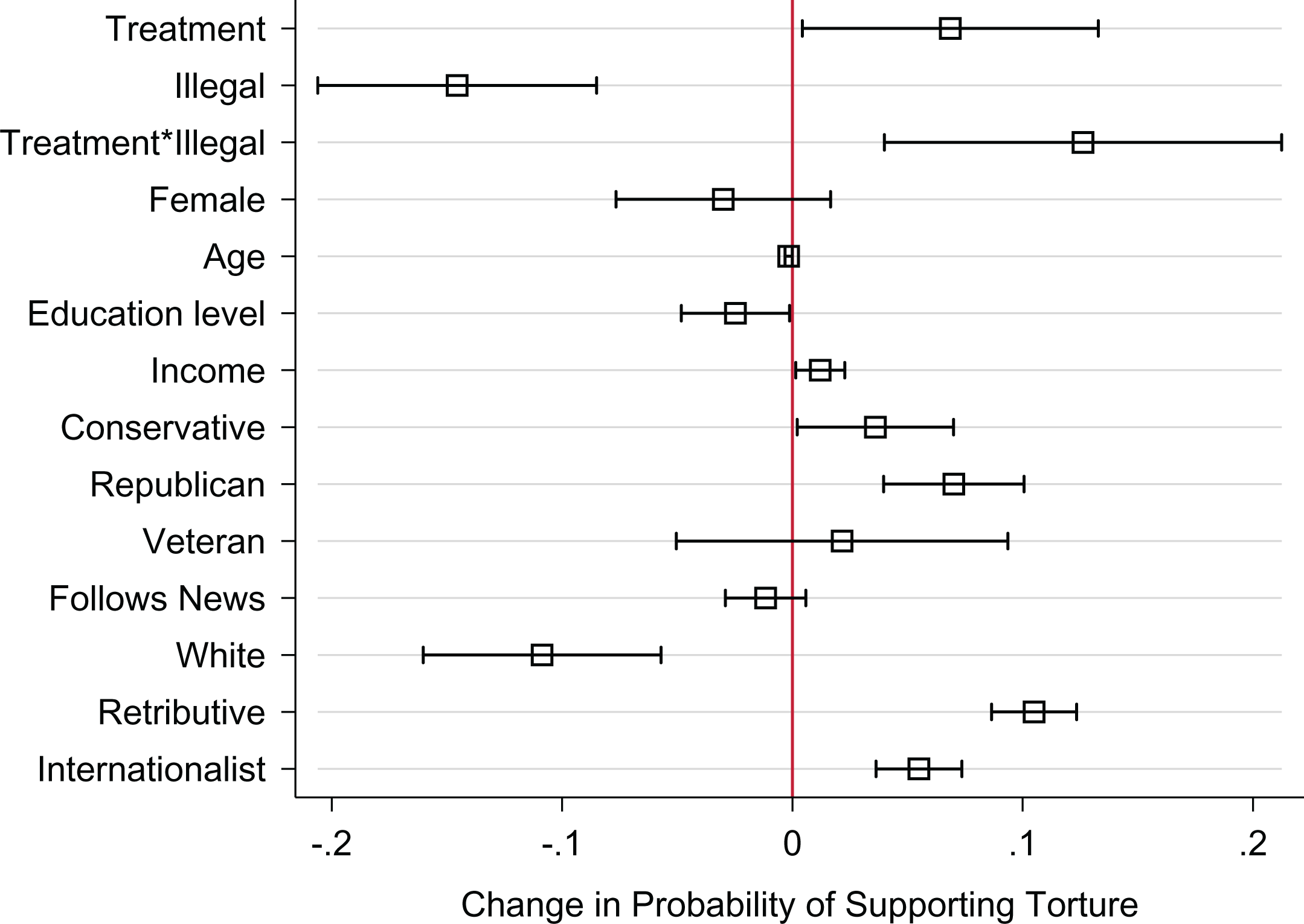
Believing that torture is illegal amplifies the effect of reciprocity. This figure shows the marginal predicted probabilities from probit coefficients of various independent variables on the dependent variable, Support for Torture. Support for Torture is binary and takes the value 0 if the respondent opposes torture and the value 1 if the respondent supports torture. The baseline category includes respondents who (1) are informed that the enemy country has treated American soldiers humanely and (2) believe that wartime torture is legal. The point estimates and 95 percent confidence intervals are displayed. Data are from Survey #2. N = 2,277.
Regardless of Legal Paradigm, the Effect of Reciprocity Is Larger among Those Who Believe that the United States Is Legally Committed to Not Using Torture.
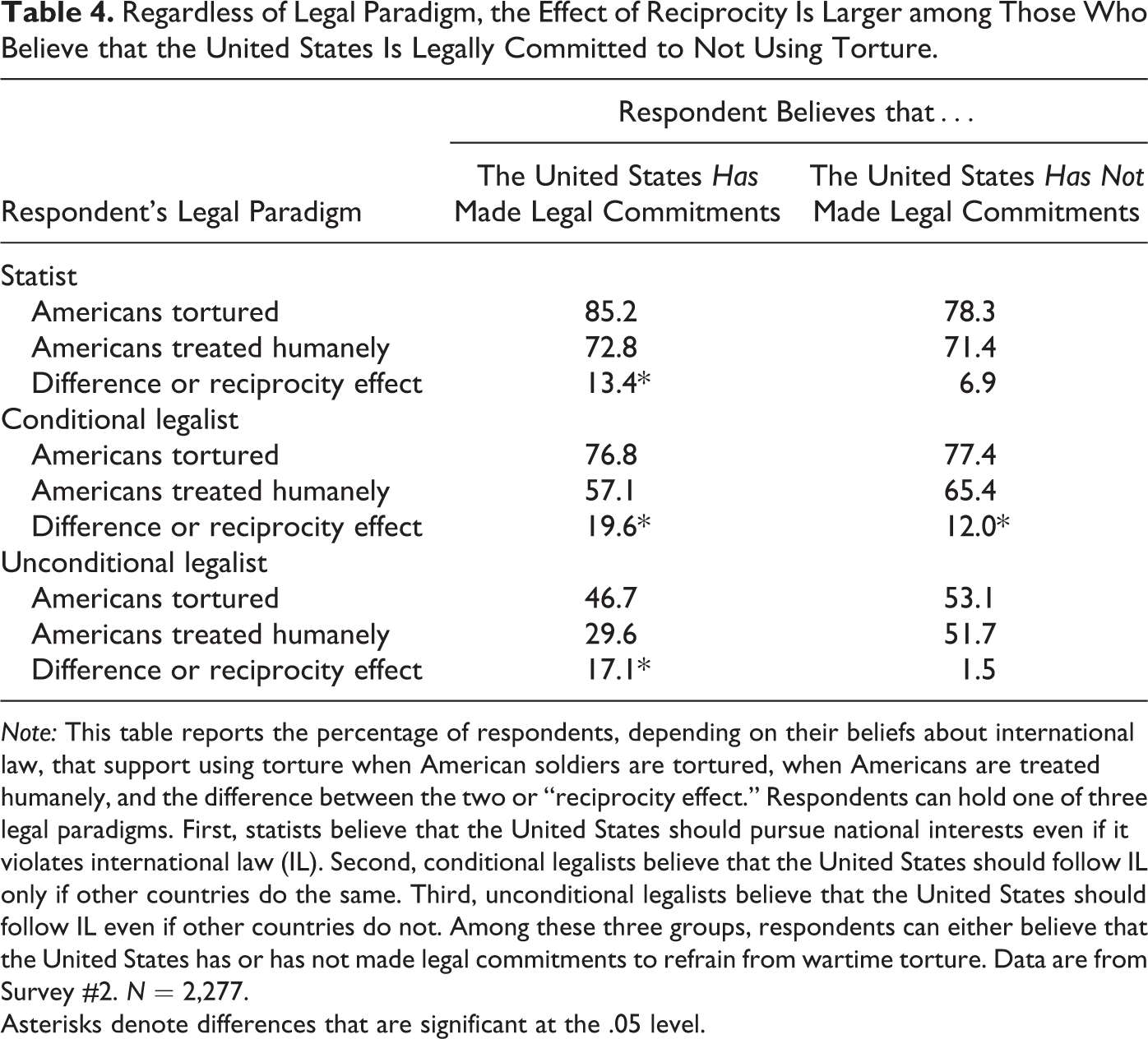
Note: This table reports the percentage of respondents, depending on their beliefs about international law, that support using torture when American soldiers are tortured, when Americans are treated humanely, and the difference between the two or “reciprocity effect.” Respondents can hold one of three legal paradigms. First, statists believe that the United States should pursue national interests even if it violates international law (IL). Second, conditional legalists believe that the United States should follow IL only if other countries do the same. Third, unconditional legalists believe that the United States should follow IL even if other countries do not. Among these three groups, respondents can either believe that the United States has or has not made legal commitments to refrain from wartime torture. Data are from Survey #2. N = 2,277.
Asterisks denote differences that are significant at the .05 level.
Legal paradigms and the effects of IHL
The previous analysis shows that IHL increases the effect of reciprocity on public support for the mistreatment of POWs. What if the effect of IHL is moderated by people’s general outlook or paradigm about the role of international law in foreign policy? For example, those who believe that torture is illegal might nevertheless hold a general disregard for international law or might only endorse following international law if other countries do the same. If this is the case, then believing that torture is illegal might not translate to an unconditional opposition to torture. To put it another way, different people might subscribe to different legal paradigms, which in turn moderates whether their knowledge of IHL influences their attitudes toward torture.
Here, I investigate how people’s legal paradigms, their beliefs about the legality of torture, and the enemy country’s behavior all interact to affect mass opinion. To measure people’s legal paradigms, I ask respondents: “Below are three commonly held views on international law. Which of the following most closely represents your own?” The potential answers, which were presented in a random order to avoid ordering bias, were: (1 = statist) “The US should do whatever necessary to pursue its national interest even if it means breaking international law”; (2 = conditional legalist) “The US should follow international law only if other countries do the same”; or (3 = unconditional legalist) “The US should follow international law even if other countries do not”. Two hundred fifty-five respondents or 18 percent of the sample answered (1 = statist), 322 respondents or 25 percent of the sample answered (2 = conditional legalists), and 724 respondents or 57 percent of the sample answered (3 = unconditional legalist).
With this data, along with the respondents’ belief about whether the United States has made legal commitments to avoid torture, I analyze the effect of reciprocity among six types of respondents. Corresponding with the above question, the six types of respondents are unconditional legalists, conditional legalists, and statist, who either believe or do not believe that the United States has made legal commitments that ban torture.
Table 4 summarizes the results from analyzing the reciprocity effect among these groups and finds that beliefs about the legal commitments consistently amplify the reciprocity effect regardless of one’s “legal paradigm.” Among respondents who believe that the United States has not signed international treaties banning torture (rightmost column), those who subscribe to either a “statist” or “unconditional legalists” paradigm are not significantly influenced by whether the enemy country tortures US soldiers or not (i.e., there is both a substantively small and statistically insignificant reciprocity effect). On the other hand, and perhaps not surprisingly, those who believe that the United States should follow international law only when other countries do the same (conditional legalists) hold preferences for torture that depend on the enemy country’s behavior.
In stark contrast, reciprocity wields a strong influence over those who believe that the United States has signed treaties banning torture (leftmost column) regardless of their legal paradigm. This is consistent with the institutional argument that international law facilitates reciprocity. Finally, providing a critical test for the legal norms diffusion view, unconditional legalists who believe that torture is illegal express generally low levels of torture, but they nevertheless substantially and significantly condition their support for torture on the enemy’s behavior (17.1-point reciprocity effect).
Reconciling This Study with Past Surveys: Problematic Control Groups
This study provides a general cautionary tale for researchers using survey experimental methodology: using no-information “control” groups could lead researchers to make incorrect inferences about the estimated treatment effect. To reach this conclusion, the study first observes that existing experiments on public support for wartime torture do not find a reciprocity effect. The fact that past studies did not find reciprocity to be significant is indeed surprising. As Wallace (2013, 122) notes, “The [reciprocity] non-finding is intriguing in light of attention devoted to reciprocal dynamics in much of the literature…. The weak results, however, are consistent with several studies that find publics are not necessarily predisposed toward reciprocity-driven motives.”
Are publics actually not predisposed toward reciprocity-driven motives? To the contrary, the extant null findings can be explained by differences in research design. In past survey experiments on reciprocity, respondents either (1) read that American soldiers have been tortured or (2) receive no information about the condition of American soldiers. The second treatment condition, which is used as a control group, is likely to produce ambiguous and difficult-to-interpret results because respondents who do not receive any information about the American soldiers are free to assume that Americans are being tortured (i.e., in a sense, assign themselves to the torture treatment group). Because noncompliance is one-directional (i.e., only respondents in the control group noncomply by joining the treatment group, but not vice versa), these studies may produce a downwardly biased estimate of the true treatment effect of reciprocity. 16
Here, I analyze data from a follow-up survey (Survey #3) to show that it is indeed the case that noncompliance explains the disparity in findings. In the follow-up survey, I use the same scenario regarding a war between the United States and Yemen. For the experimental treatment, I include the original two reciprocity treatment groups along with a third experimental group in which respondents do not receive any information about the status of American soldiers (they do not even read that American soldiers were captured). Respondents read the scenario and then express their support for torture. They then also answer the following question, “In the previous scenario regarding war between the United States. and Yemen, do you think Yemen had tortured American soldiers?” They have the option to answer either yes or no.
This survey allows us to calculate the level of support for torture among five groups. The first three groups include those who read that American soldiers are being tortured (tortured), those who read that American soldiers are being treated humanely (humane), and those who do not read about the fate of American soldiers (control_all). Splitting the third group creates two additional groups: those who believed that Yemen had tortured American soldiers (control_t) and those who did NOT believe that Yemen used tortured (control_h). Group Control_T are the noncompliers because they assumed that American soldiers are being tortured.
Figure 2 shows the results from this analysis. Replicating Surveys #1 and #2, people’s support for torture is higher when the enemy country tortured American soldiers than when the enemy treated Americans humanely (tortured–humane). But also replicating other survey experiments in the literature, the reciprocity effect disappears when comparing against a control group in which no reference is made to American soldiers (tortured–control_all). 17 The next two groups, however, reveal that this control group is actually significantly impacted by respondents’ assumptions about how American soldiers were being treated. Sixty-six percent of the control group assumed that Yemen tortured American soldiers (control_t), and among them, support for torture is nearly identical to the group of respondents who were explicitly told that Americans were being tortured. On the other hand, 34 percent of the control group assumed that Yemen did not torture American soldiers (control_h), and among them, support for torture is similar to those who were explicitly told that Americans were being treated humanely. After removing respondents in the control group who acted as if they received the treatment, the reciprocity effect is recovered. 18
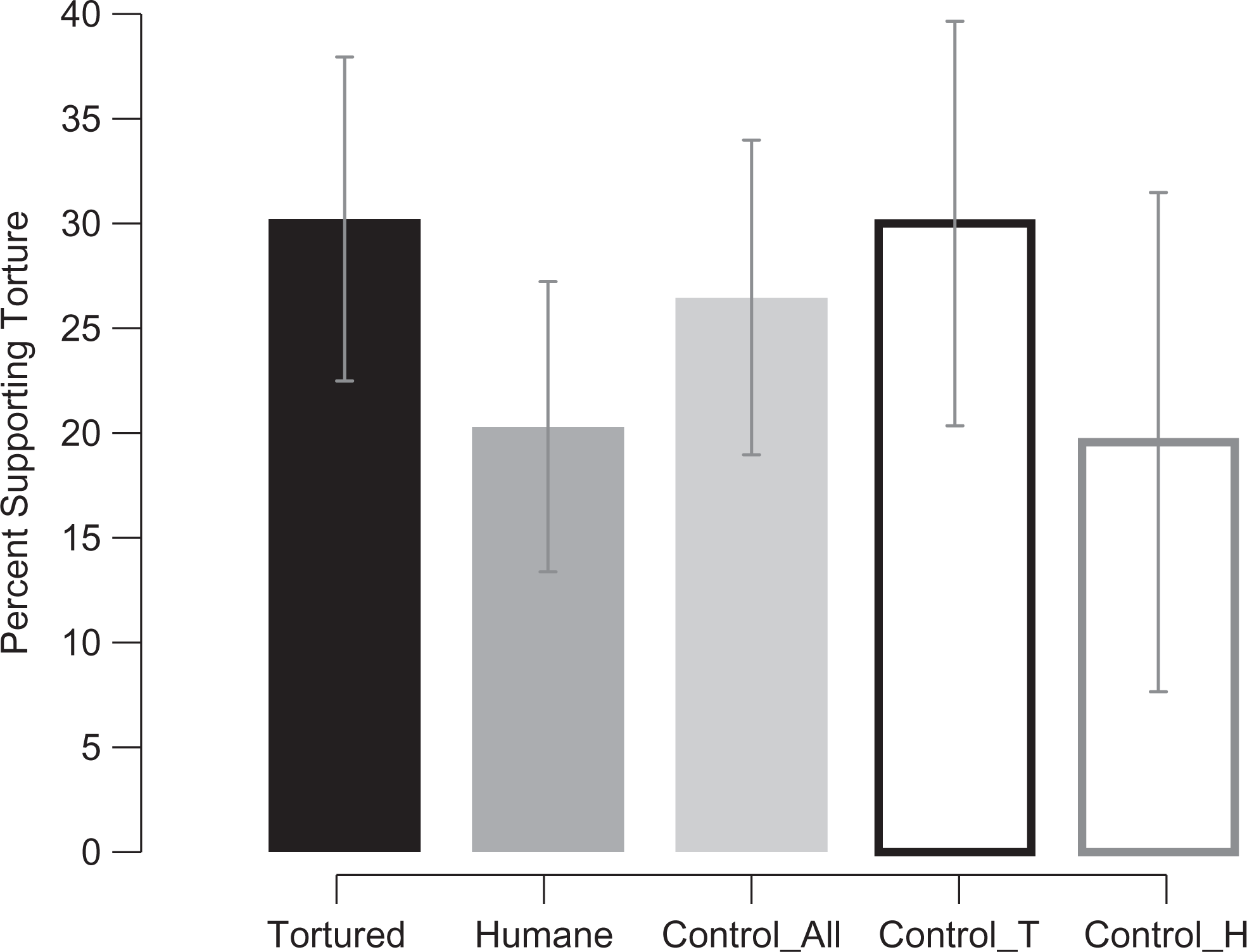
Ambiguous control groups explain why prior studies find no reciprocity effect. This figure shows the proportion of respondents supporting torture in five groups: Those who read that Yemen tortured Americans (tortured), those who read that Yemen treated Americans humanely (humane), those who read nothing (control_all), those who read nothing and believed that Yemen tortured Americans (control_t), and those who read nothing and believed that Yemen did not torture Americans (control_h). Ninety-five percent confidence intervals are given. Data are from Survey #3. N = 408.
Sensitivity Analysis: High Stakes Scenario and Retributiveness
The findings are not sensitive to changing contextual factors in the survey vignette. The full analysis is reported in the Online Appendix and summarized here. Data from Survey #4 show that the results regarding reciprocity and IHL hold when assessing a “high stakes” situations in which torture is not qualified to be nonlethal and national interests are “critical.” To account for factors salient in the post–9/11 era, Survey #4 also randomized whether the foreign country had an “Islamic society” or an “Islamic society that is said to engage in terrorism.” The data demonstrate that these contextual factors do not substantially alter the results. 19
Surveys #2 and #4 explored whether the effect of reciprocity is dependent on people’s disposition for retribution. An important body of scholarship shows that people’s appetite for revenge helps to explain their preferences for various foreign policies such as war and the use of torture (Liberman 2006, 2013; Stein 2012, 2015). Conceptually, retribution is made “regardless of its impact on future outcomes,” while reciprocity is a strategy to promote cooperation. But practically speaking, reciprocity and revenge are not mutually exclusive and can instead be mutually reinforcing. People’s retributiveness can enhance strategies of reciprocity. Thus, the analysis tested to see whether the reciprocity effect is significantly moderated by people’s penchant for revenge. To summarize what is elaborated in the Online Appendix, the data show that dispositional retributiveness is associated with greater support for torture (consistent with Stein (2012) and Liberman (2013)), but regardless of whether citizens are forgiving or vengeful, they still respond reciprocally to the behavior of the enemy government.
Conclusion
How do international norms and institutions affect people’s values and attitudes toward wartime conduct? What if those norms and institutions offer seemingly contradictory guidelines about how countries should fight? This article answers these questions by examining how reciprocity, the principle of returning good behavior with good behavior and bad with bad, and IHL, which attempts to prohibit reciprocity, affect American opinions on the treatment of POWs.
New evidence from a series of survey experiments support the institutionalist arguments on the laws of war (Morrow 2014), which argue that reciprocity still plays an important role in contemporary warfare and that IHL amplifies the existing effect of reciprocity. Specifically, the data show that a significant proportion of American citizens hold reciprocal preferences for the treatment of POWs: they are more supportive of torturing POWs in kind than against an enemy has kept American soldiers in humane conditions. 20 Furthermore, IHL decreases people’s overall support for mistreating POWs, 21 but it does so by reinforcing rather than diminishing the effect of reciprocity. Against an enemy that treats POWs humanely, IHL lessens American support for abusing POWs. But against an enemy that mistreats POWs, IHL has no pacifying effect.
In addition to advancing an important theory in international relations, this article resolves a major empirical discrepancy between macro- and micro-studies of wartime behavior. Existing country-level studies found an effect of reciprocity on wartime conduct, including the treatment of POWs (Valentino, Huth, and Croco 2006; Wallace 2012; Morrow 2007), while survey experimental studies of individual citizens found that publics do not hold reciprocal preferences (Wallace 2013; Flavin and Nickerson 2012). This article resolves the divergence by uncovering a design weakness in existing experimental research. Specifically, past studies employ a no-information control group in which respondents receive no information about the status of American soldiers, leading some of those respondents to assume that Americans were being tortured.
Accounting for the ambiguity arising from such control groups also illustrates a broader issue in experimental studies. Unlike subjects in a pharmaceutical trial, control group subjects in an informational survey experiment can easily “dose” themselves with the treatment and frustrate the researcher’s ability to make clear inferences.
This article opens several compelling avenues for future research. On the methodological front, researchers might apply the lessons learned about problematic experimental control groups to other issue areas. Turning to substantive issues, another extension would be to study how beliefs about the efficacy of torture affects citizen’s policy preferences, which has been a topic of great political salience. Scholars should also investigate the causal mechanisms that explain why reciprocity affects attitudes toward torture. For example, people’s willingness to reciprocate the mistreatment of POWs could depend on considerations about setting precedent and morality (see Press, Sagan, and Valentino (2013) and Tomz and Weeks (2013), respectively). Using methodologies in mediation analysis could facilitate the study of these mechanisms (e.g., Imai, Keele, and Tingley 2010; Imai et al. 2011).
Lastly, researchers should study the opinions of non-US citizens to explore the generalizability of the findings. Americans are known to be more hawkish than other publics, and the United States—as a global superpower—also has a significant history of contesting its obligations to international institutions. These factors may explain the ineffectiveness of IHL in curtailing support for the reciprocal use of torture. Of course, the US is an intrinsically important case given its dominant role in international warfare and impact in shaping international law and norms, but scholars can still benefit from going beyond the American context.
Ultimately, this study reveals that even in a democracy like the United States, citizens are unlikely to be a robust safeguard against wartime torture because they hold conditional preferences over the use of wartime torture. Activists against torture might continue promoting a broader acceptance of legal norms, but they should also recognize the shortcomings of this strategy. Their ability to legislate away people’s desire to engage in reciprocity, which may be embedded in more fundamental values about fairness, is limited. On the other hand, others have argued that legal prohibitions against torture are actually ineffective without the threat of reciprocity (Casey and Rivkin 2006). For these observers, this study might be less unsettling. IHL reinforces Americans’ willingness to adopt strategies of reciprocity during war, which could support international cooperation.
Supplemental Material
Supplemental Material, Online_Appendix - A Clash of Norms? How Reciprocity and International Humanitarian Law affect American Opinion on the Treatment of POWs
Supplemental Material, Online_Appendix for A Clash of Norms? How Reciprocity and International Humanitarian Law affect American Opinion on the Treatment of POWs by Jonathan A. Chu in Journal of Conflict Resolution
Supplemental Material
Supplemental Material, Replication - A Clash of Norms? How Reciprocity and International Humanitarian Law affect American Opinion on the Treatment of POWs
Supplemental Material, Replication for A Clash of Norms? How Reciprocity and International Humanitarian Law affect American Opinion on the Treatment of POWs by Jonathan A. Chu in Journal of Conflict Resolution
Footnotes
Author’s Note
All mistakes and views expressed are my own.
Acknowledgments
The author would like to thank Dan Altman, Kirk Bansak, Jeff Bonheim, Risa Kitagawa, Stanley Lam, Lindsay Hundley, Steve Krasner, Lily Lamboy, Scott Sagan, Ken Schultz, Paul Sniderman, Mike Tomz, and David Traven, the editors and reviewers for the Journal of Conflict Resolution, and panel participants at the International Studies Association and Harvard Experimental Working Group for their helpful feedback.
Declaration of Conflicting Interests
The author declared no potential conflicts of interest with respect to the research, authorship, and/or publication of this article.
Funding
The author disclosed receipt of the following financial support for the research, authorship, and/or publication of this article: The author also grateful for the support provided by Stanford’s Center on Philanthropy and Civil Society and Center for International Security and Cooperation, and the National Science Foundation Graduate Research Fellowship (Grant #DGE-114747).
Supplemental Material
Supplemental material is available for this article online.
Notes
References
Supplementary Material
Please find the following supplemental material available below.
For Open Access articles published under a Creative Commons License, all supplemental material carries the same license as the article it is associated with.
For non-Open Access articles published, all supplemental material carries a non-exclusive license, and permission requests for re-use of supplemental material or any part of supplemental material shall be sent directly to the copyright owner as specified in the copyright notice associated with the article.
