




Abstract
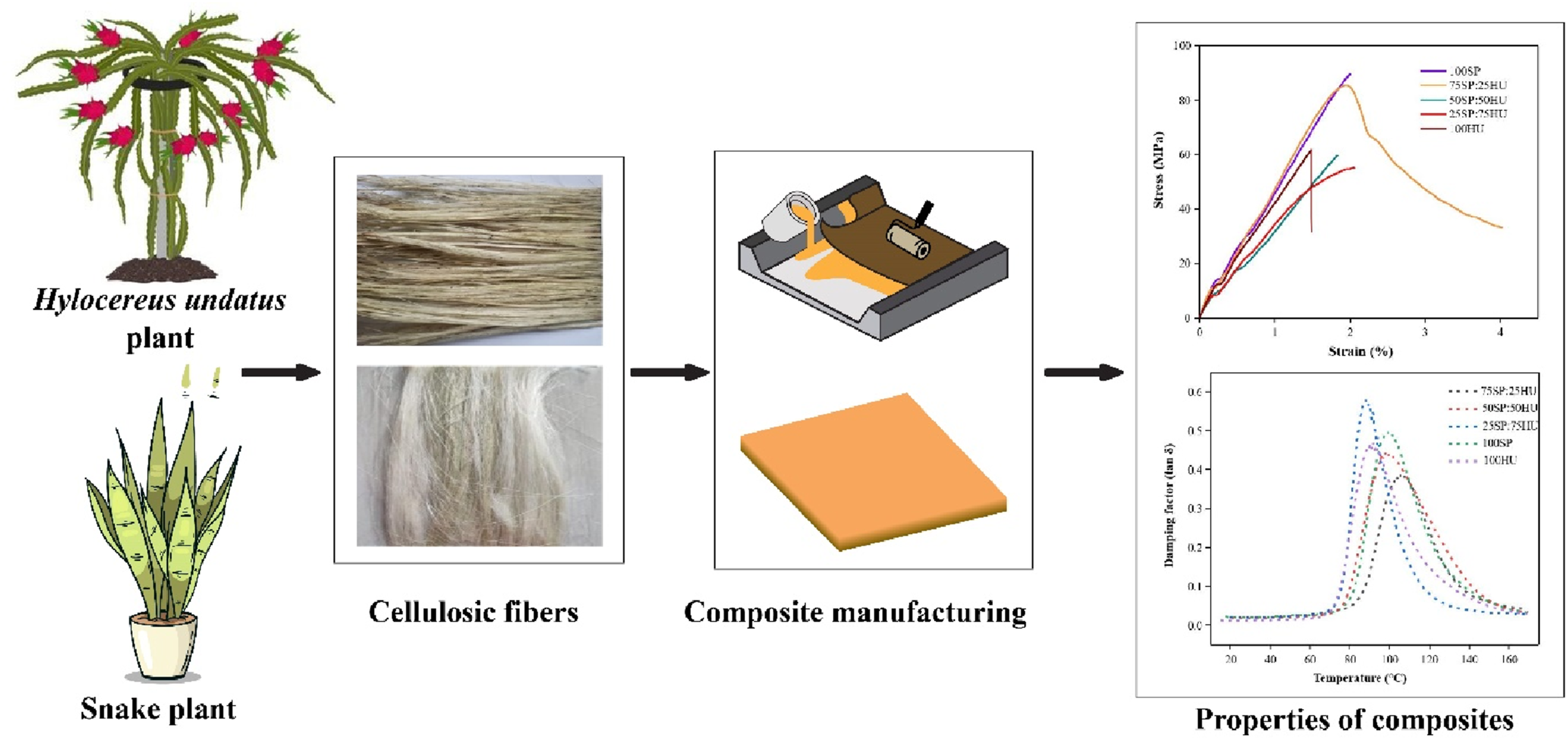
Natural-fiber-reinforced epoxy composites are attracting increasing attention as lightweight and sustainable alternatives for structural and semi-structural applications. In this study, epoxy composites reinforced with snake plant (SP) fiber and agro-waste-derived Hylocereus undatus (HU) fiber were fabricated at different fiber ratios (100/0, 75/25, 50/50, 25/75, and 0/100) by hand lay-up. Increasing HU content enhances tensile and flexural modulus, hardness, storage modulus, loss modulus, and damping because the higher intrinsic stiffness, higher lignin/hemicellulose content, and lower elongation of HU fibers restrict matrix deformation and improve resistance to elastic and viscoelastic strain. In contrast, increasing SP content improves tensile, flexural, and impact strengths, as well as the glass-transition temperature, because its higher cellulose content, finer morphology, and better wettability with epoxy promote stronger interfacial adhesion, more efficient stress transfer, and greater energy absorption during loading and fracture. Thus, HU fiber mainly acts as a stiffness- and damping-dominant reinforcement, while SP fiber mainly acts as a strength- and toughness-dominant reinforcement. Among the hybrids, 25SP:75HU shows the maximum stiffness, while 75SP:25HU demonstrates the highest strength. FTIR analysis of the 50SP:50HU composite confirms the coexistence of lignocellulosic and epoxy functional groups, while the broad O-H band suggests hydrogen-bond-assisted interfacial compatibility between the fibers and the epoxy matrix. These findings demonstrate that hybridizing SP and HU fibers provides a sustainable pathway to tailor the balance between stiffness, strength, impact resistance, and viscoelastic performance in epoxy composites.
Get full access to this article
View all access options for this article.