




Abstract
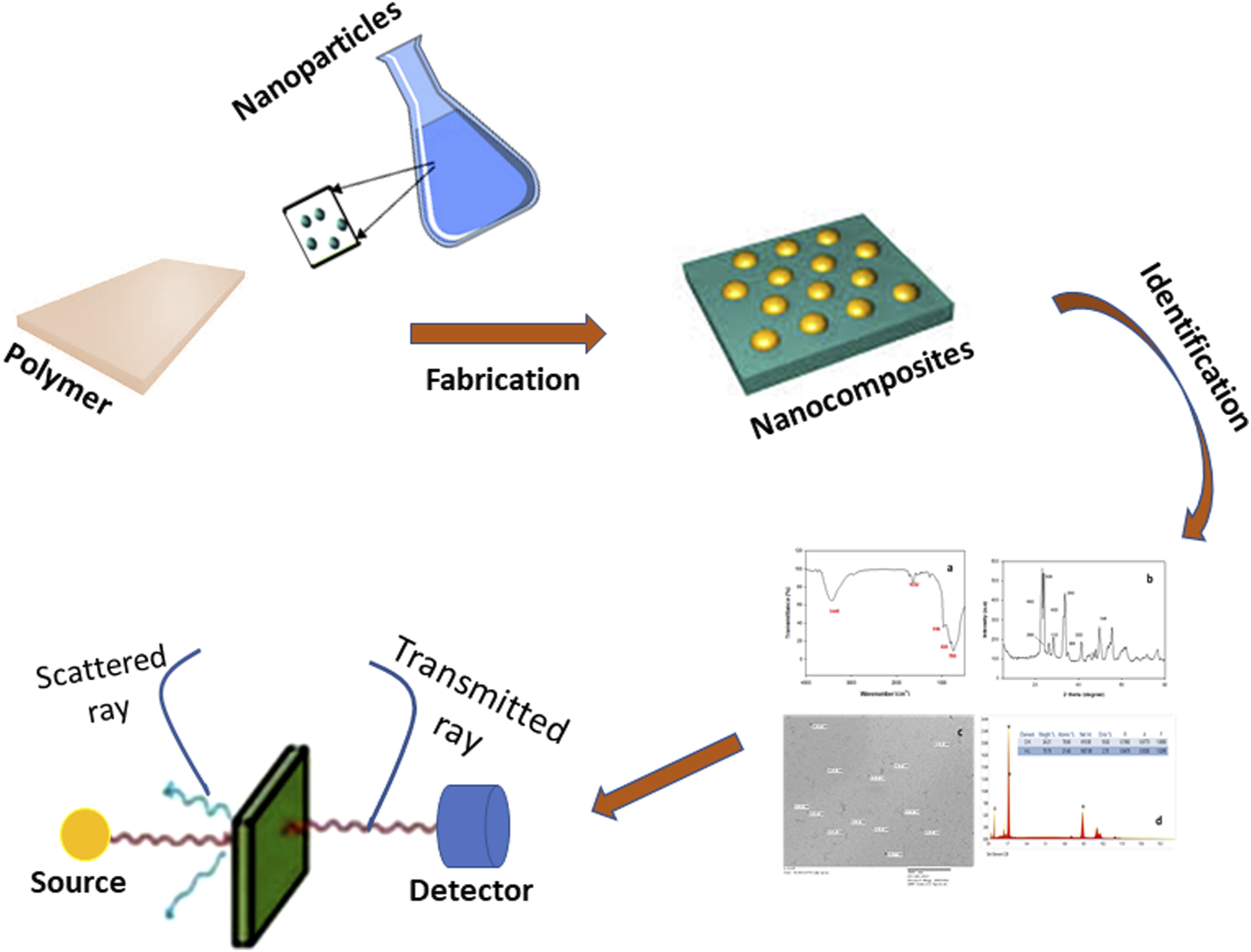
This study addresses the growing demand for efficient, versatile, and non-toxic radiation shields by developing a sustainable nanocomposite using waste bean fiber as a bio-based framework. A nitrile butadiene rubber (NBR) nanocomposite was prepared, containing 10 phr (parts per hundred rubber) of waste bean fiber (WF) and varying amounts of tungsten oxide nanoparticles (nano-WO3). The resulting materials were evaluated for their shielding performance against gamma rays from 137Cs (0.662 MeV) and 60Co (1.17 and 1.33 MeV). FTIR analysis confirmed the successful incorporation of nano-WO3 and effective silane coupling agent within the NBR/WF nanocomposites. The NBR5/50 kGy sample, incorporated with 7 phr of nano-WO3 and subjected to 50 kGy irradiation, demonstrated a pronounced enhancement in tensile strength (TS), rising from 2.04 to 9.66 MPa, alongside an increase in elastic modulus (EM) from 2.76 to 70.77 MPa. The crosslink density (υe) also exhibited a significant increase of 109%. These results demonstrate enhanced network formation and mechanical reinforcement. The gamma attenuation parameters (MAC, LAC, MFP, HVL, and TVL) were computed theoretically using Phy-X/PSD software and determined experimentally. The results reveal that there is agreement between theoretical and experimental results. The results indicated that incorporating nano-WO3 up to 7 phr led to notable improvements: the MAC (μ/ρ) increased by approximately 6–7.7%, while the HVL decreased by about 4.7–5.8% across the three energies. The combination of WF and nano-WO3 enabled the development of a novel, lightweight, and sustainable nanocomposite.
Get full access to this article
View all access options for this article.