




Abstract
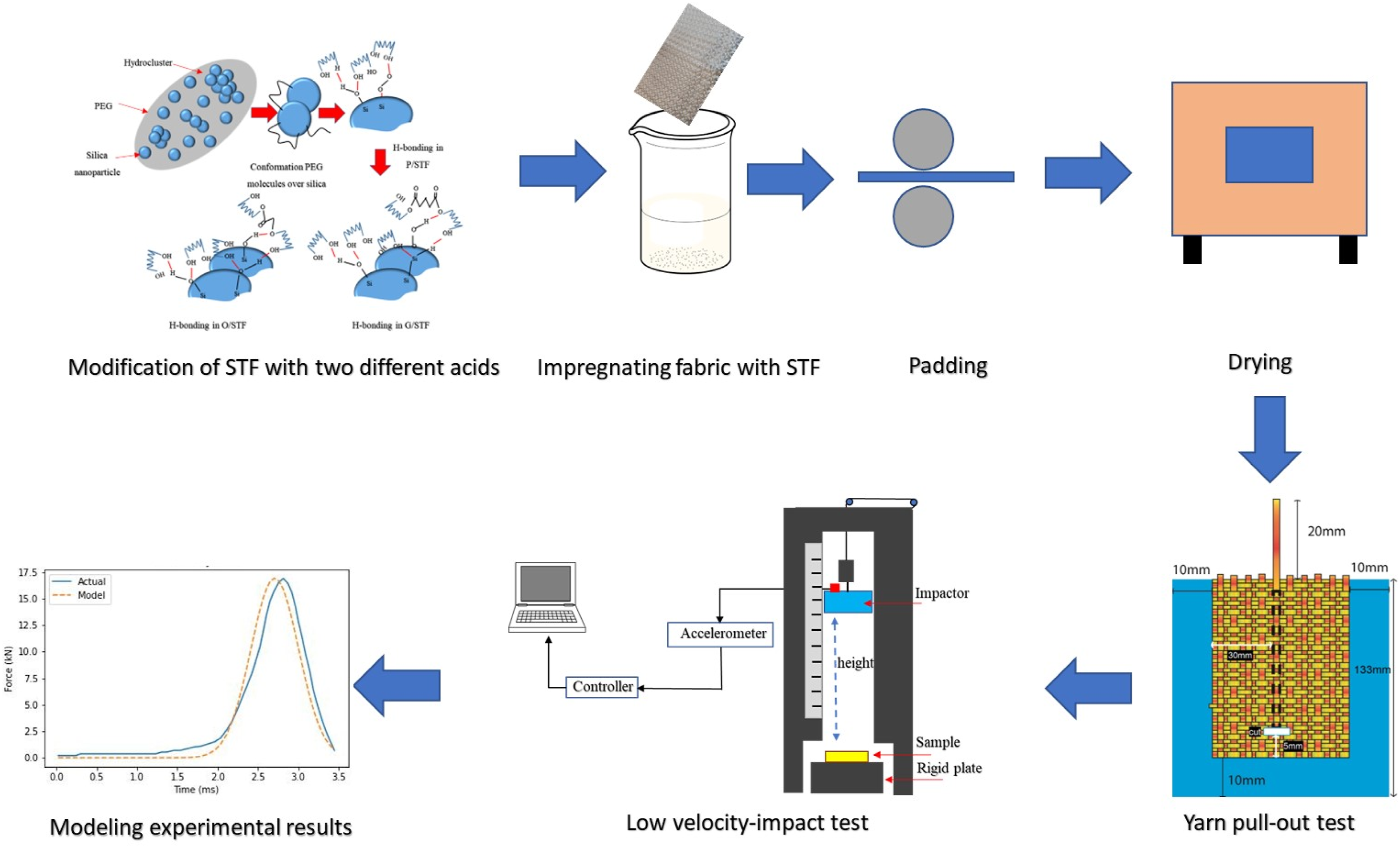
The influence of tailoring the carrier-fluid chemistry of shear-thickening fluids (STFs) on the dynamic response of three-dimensional (3D) E-glass fabric laminates is investigated. Silica-based STFs (50 wt%) were formulated in polyethylene glycol (PEG-400), and the PEG was further modified using diacid chemistry (oxalic and glutaric) to tune chain interactions and hydrogen-bonding density. Fabrics were impregnated via deep coating and the add-on was quantified. Rheology, surface morphology (SEM), yarn pull-out response, and low-velocity drop-weight compression were evaluated for 1-, 3-, 5-, and 7-ply stacks. Post-critical viscosity was increased by PEG modification, and larger apparent particle agglomerates were observed within yarn interstices relative to the unmodified STF, indicating strengthened fabric–fluid–particle interlocking. During yarn pull-out, inter-yarn friction and energy absorption were increased; relative to untreated E-glass, energy absorption gains of ≈25.95%, 31.08%, and 61.38% were obtained for pure-STF, oxalic-modified, and glutaric-modified STF composites, respectively. Under compressive impact, STF impregnation reduced the compressive peak force (CPF) and extended the force-duration window; CPF ratios of ∼0.85, 0.76, and 0.65 (relative to untreated fabric) were measured for pure-, oxalic-, and glutaric-modified STFs, with further improvements as ply count increased, while peak-force time and impulse duration were systematically shifted to later times. To interpret the cushioning dynamics, a compact regression model combining a Gaussian peak term (capturing peak force and timing) with linear components was established; material-specific parameterizations were shown to reproduce measured force–time histories and to enable prediction across ply counts. Overall, scalable improvements in energy dissipation, inter-yarn friction, and impact cushioning were achieved through modest PEG-chemistry modifications, enabling tunable protection for diverse engineering and armor applications.
Keywords
Get full access to this article
View all access options for this article.