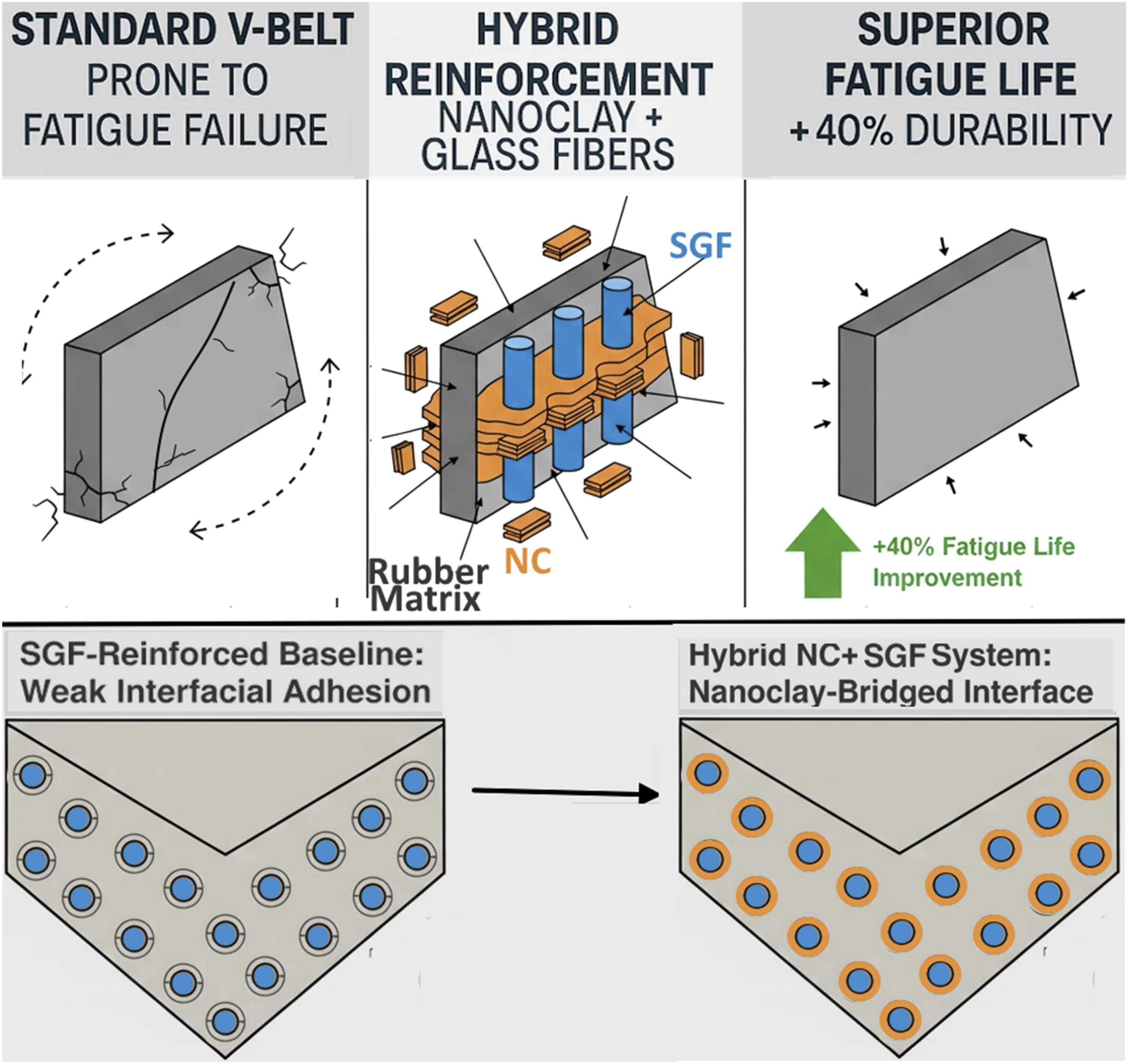
The service life of industrial V-belts is often curtailed by fatigue failure under cyclic loading. In this work, a styrene–butadiene/polybutadiene/smoked rubber (SBR/PBR/SMR) blend was reinforced with 5 phr Cloisite® 15A nanoclay and 5 phr short A-glass fibers. The composite was processed via Banbury mixing, calendaring, layering with PET cord, and vulcanization. Rheological analysis revealed distinct filler effects: short glass fibers (SGF) yielded the fastest cure rate (CRI), while the hybrid system achieved the highest final crosslink density (). Compared to the unfilled compound, the hybrid composite exhibited superior performance, including a 29% increase in tensile strength, a 14% improvement in abrasion resistance, and a 79% rise in glassy storage modulus ( at −80°C). Dynamic mechanical analysis (DMA) confirmed this reinforcement through a higher glass transition temperature () and revealed that the hierarchical filler network maximized energy dissipation (highest ), establishing a direct, quantitative link to fatigue performance. Consequently, the compound’s fatigue life increased by 42% (from 1.30 × 10⁵ to 1.85 × 10⁵ cycles), which translated directly into a 40% extension of the V-belt’s operational life (from 100 to 140 h) under multi-pulley dynamic testing. This work establishes a validated framework demonstrating that engineering viscoelastic and interfacial properties at the material level is a powerful strategy for developing more durable power transmission belts.
GárdonyiRKátaiZSzabóG. Efficiency improvements in V-belt drives: experimental and numerical investigations. Ind Eng J2018; 15(2): 105–114.
4.
SequenziaGCalabrettaMAssenzaI, et al.Dynamic behaviour modelling of an internal combustion engine water pump transmission belt drive. Int J Veh Perf2021; 7(1/2): 170.
5.
BlessingR. Hybrid reinforcement strategies in polymer composites: a review. Compos Sci Technol2013; 76: 87–93.
6.
KrawiecPUrszulaJNowakL. Degradation mechanisms of V-belts under cyclic loading. Wear2018; 402–403: 27–37.
7.
JinGQYanTChenCF. Study on the causes and prevention measures of shrinkage defects of heavy v-belt pulley in the production. Appl Mech Mater2014; 722: 231–234.
8.
JiJParkJKwonO, et al.Macroslip detection and clamping force control for a metal v-belt continuously variable transmission. Proc Inst Mech Eng - Part D J Automob Eng2014; 228(8): 943–954.
9.
MengQFanZYeY. Influence of groove angle and tension on V-belt service life. Wear2012; 288–289: 175–182.
10.
ZangY. Thermal effects in V-belt–pulley systems: a tribological study. J Tribol2010; 132(2): 021405.
MittalV. Polymer nanocomposites: present status and future perspectives. Des Monomers Polym2004; 7(3): 197–219.
13.
VaiaRAWagnerHD. Framework for nanocomposites: the science of nanoclay–polymer interactions. MRS Bull2004; 29(5): 360–365.
14.
GatosKGKarger‐KocsisJ. Rubber/clay nanocomposites: preparation, properties and applications. In: Rubber Nanocomposites. Wiley, 2010, pp. 169–195.
15.
QuangVPDungPNhiNT. Hybrid nanoclay and glass fiber reinforced SBR composites: mechanical and thermal properties. Compos B Eng2022; 245: 110099.
16.
BalachandranMBhagawanSS. Mechanical and thermal properties of chopped strand mat E-glass-reinforced styrene butadiene rubber composites. J Elastomers Plast2012; 44(6): 491–511.
17.
PraveenSChattopadhyayPJayendranS, et al.Effect of nanoclay on the mechanical and damping properties of aramid short fibre‐filled styrene butadiene rubber composites. Polym Int2009-10-19 2009; 59: 187–197.
18.
PraveenSChattopadhyayPKAlbertP, et al.Synergistic effect of carbon black and nanoclay fillers in styrene butadiene rubber matrix. Polym Compos2009; 30(11): 1638–1644.
19.
LinFWuQ. Morphology and properties of hybrid fiber–nanoclay polymer composites. J Polym Sci B Polym Phys2009; 47(18): 1865–1874.
20.
MalasADasC. Carbon black–clay hybrid nanocomposites based upon EPDM elastomer. J Mater Sci2012; 47: 2016–2024.
X-ray diffraction and the identification and analysis of clay minerals. Oxford University Press, 1997.
31.
StuartBH. Infrared spectroscopy: fundamentals and applications. John Wiley & Sons, 2004.
32.
“ASTM D2084-07, StandardTest Method for Rubber—Property—Vulcanization Using Oscillating Disk Cure Meter,” ASTM International, West Conshohocken, PA, 2007.
33.
“ASTM D412-16, StandardTest Methods for Vulcanized Rubber and Thermoplastic Elastomers—Tension,” ASTM International, West Conshohocken, PA, 2016.
34.
“ASTM D2240-15, Standard Test Method for Rubber Property—Durometer Hardness,”ASTM International, West Conshohocken, PA, 2015.
35.
“ASTM D5963-13, StandardTest Method for Rubber Property—Abrasion Resistance. Rotary Drum Abrader,” ASTM International, West Conshohocken, PA, 2013.
36.
“DIN 53512:1987, Testing of rubber — Determination of rebound resilience,” Deutsches Institut für Normung, Berlin, Germany, 1987.
37.
“ISO 4647:2010, Rubber, vulcanized — Determination of static adhesion to textile cord — H-pull test,” International Organizationfor Standardization, Geneva, Switzerland, 2010.
38.
“ASTM D5279-13, StandardTest Method for Measuring the Dynamic Mechanical Properties of Plastics in Tension,” ASTM International, West Conshohocken, PA, 2013.
39.
“ASTM D4482-11, StandardTest Method for Rubber Property—Extension Cycling Fatigue,” ASTM International, West Conshohocken, PA, 2011.
40.
ChoJKTjongSC. Dynamic belt fatigue testing under simulated service conditions. Polym Test2010; 29(4): 431–439.
HussainFHojjatiMOkamotoM, et al.Review article: polymer-matrix nanocomposites, processing, manufacturing, and application: an overview. J Compos Mater2006; 40(17): 1511–1575.
43.
AlexandreMDuboisP. Polymer-layered silicate nanocomposites: preparation, properties and uses of a new class of materials. Mater Sci Eng R Rep2000; 28(1-2): 1–63.
44.
QiuYHeX. Effect of nanosilica on the interfacial adhesion properties of glass fiber in SBR composites. Compos Sci Technol2010; 70(7): 1094–1101.
TomarP.GopeP. C., “Effect of glass fiber and nylon fiber reinforcement on the mechanical and thermal properties of styrene butadiene rubber mixed PMMA denture base material,” J. Mech. Behav. Biomed. Mater., vol. 150, p. 106308, Feb. 2024.
47.
ZengCWangSLiH, et al.Tribological properties of nanoclay/SBR composites. Tribol Int2013; 66: 148–154.
48.
VaiaRAGiannelisEP. Lattice model of polymer melt intercalation in organically-modified layered silicates. Macromolecules1997; 30(25): 7990–7999.
49.
SocratesG. Infrared and Raman characteristic group frequencies: tables and charts. John Wiley & Sons, 2001.
50.
BokobzaL. Influence of microstructure on the mechanical properties of natural rubber. Polym Int2007; 56(6): 613–619.
51.
Sinha RaySOkamotoM. Polymer/layered silicate nanocomposites: a review from preparation to processing. Prog Polym Sci2003; 28(11): 1539–1641.
52.
MadejováJKomadelP. Baseline studies of the clay minerals society source clays: infrared methods. Clays Clay Miner2001; 49(5): 410–432.
53.
LagaronJMOcioMJGordonSH. FTIR study of interlayer expansions in organoclay–polymer nanocomposites. Polymer2002; 43(8): 2299–2308.
54.
LinJWuJ. FTIR evidence for hydrogen bonding in organoclay-modified rubber. J Appl Polym Sci2009; 114(4): 2123–2130.
55.
SinclairAMZhaoTAL. Influence of reinforcing fillers on cure and mechanical properties of elastomer composites. Rubber Chem Technol1997; 70(2): 374–385.
56.
CoranAY. Chemistry of the vulcanization and protection of elastomers: a review of the achievements. J Appl Polym Sci2003; 87(1): 24–30.
57.
KrausG. Rheology of filled polymer systems: a review. Rubber Chem Technol1997; 70(3): 379–411.
58.
KimSWKimJHKimKJ, et al.Preparation and characterization of SBR/organoclay nanocomposite latices prepared by emulsion polymerization. J Appl Polym Sci2006; 101(3): 1950–1956.
59.
WuJJHanCDYangCQ. Effect of fiber‐surface treatment on interfacial adhesion in fiber‐reinforced rubber composites. Polym Compos1999; 20(1): 50–58.
AkbariMNaderiG. A study on the accelerating effect of modified nanoclays on the vulcanization of nitrile butadiene rubber. J Appl Polym Sci2006; 102(3): 2635–2642.
62.
FernàndezMSantarenJElviraC. Organoclay effect on cure kinetics and mechanical properties of EPDM nanocomposites. J Polym Sci B Polym Phys2005; 43(20): 2974–2985.
CarpenterCEHoldenBS. Effect of glass fiber on vulcanization kinetics and mechanical properties of rubber. Polym Eng Sci2005; 45(2): 253–260.
65.
PukánszkyBFeketeE. Synergistic effects in particulate filled polymers: a review. Polym Compos2000; 21(3): 359–373.
66.
PaillerDDuboisP. Synergistic effects of carbon black–clay hybrid fillers in natural rubber: dynamic mechanical behavior and reinforcement efficiency. Compos Sci Technol2002; 62(3): 387–396.
67.
RathanasamyRDasCK. Development of butyl rubber nanocomposites in presence and absence of compatibiliser. Plast Rubber Compos Macromol Eng2011; 40(8): 407–412.
68.
PayneAR. The dynamic properties of carbon black‐loaded natural rubber vulcanizates. Part I. J Appl Polym Sci1962; 6(19): 57–63.
69.
FukahoriY. General mechanism of rubber reinforcement by particulate fillers. J Appl Polym Sci2007; 105(6): 3466–3474.
70.
ChoiHJChoSKLeeSH. Effect of clay dispersion on dynamic mechanical and adhesion properties of rubber nanocomposites. J Appl Polym Sci2000; 78(10): 1796–1805.
71.
LiaoKAl-QureshiHAMonteiroPJM. On the relationship between damping and mechanical properties of fiber-reinforced polymer composites. Mater Sci Eng2007; 452–453: 674–678.
72.
BruneelGThierryAMarechauxMO. Effect of nanoclay on cure kinetics and dynamic mechanical properties of SBR compounds. Polymer2008; 49(22): 5233–5240.
73.
GentAN. Engineering with rubber: how to design rubber components. 3rd ed.Hanser Publishers, 2012.
74.
LakeGJLindleyPB. A critical review of crack growth, fatigue, and energy dissipation in rubbers. Rubber Chem Technol1988; 61(3): 500–514.
75.
KrausG. The Payne effect revisited. Rubber Chem Technol1997; 70(3): 316–324.
76.
ZengJLiGSchwartzG. Interfacial engineering in fiber-reinforced polymer composites: a review. J Mater Sci2013; 48(18): 6231–6242.
77.
ZhuCCLiuHTianJ, et al.Experimental research on the effect of structural parameters on the governing characteristics of a pulley-drive, continuously variable transmission. Proc Inst Mech Eng - Part D J Automob Eng2010; 224(6): 775–784.
78.
PraveenSThomasKJacobJ. Mechanical characterization of short glass fiber reinforced rubber composites. J Reinforc Plast Compos2009; 28(8): 987–1001.
79.
WilliamsRJJCarterJD. Hierarchical reinforcement in polymer composites. Polymer2009; 50(12): 2603–2614.
80.
HalasaAF. The relationship between tan delta and heat build-up in elastomeric vulcanizates. Rubber Chem Technol1991; 64(2): 245–256.
81.
LiRKTjongSC. Mechanical properties and morphology of hybrid composites containing glass fiber and nano-sized clay. Compos Appl Sci Manuf2002; 33(5): 651–658.
82.
SinclairIZhaoY. A new look at the Payne effect. J Mater Sci1997; 32(18): 4885–4892.