




Abstract
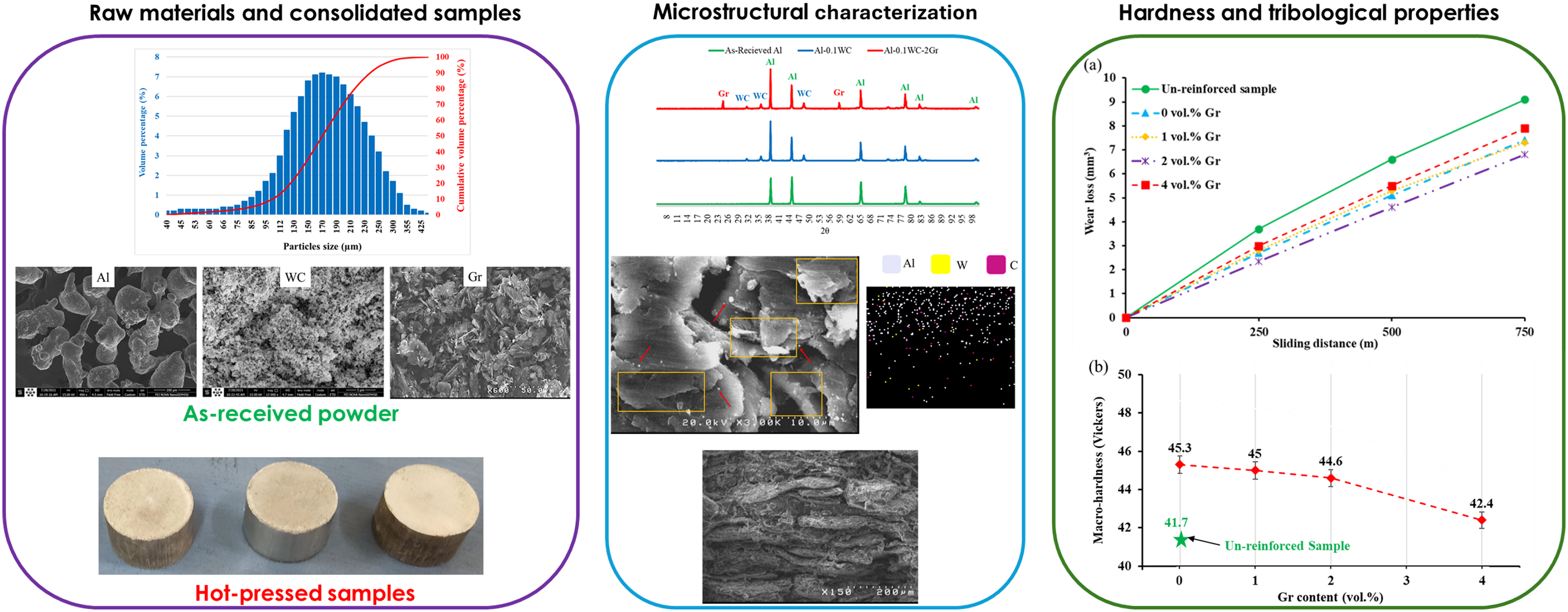
This study explores the effects of varying graphite (Gr) content on the microstructure, hardness, and tribological properties of aluminium–tungsten carbide (Al- 0.1 vol.% WC) nanocomposites containing 1 to 4 vol.% Gr. The findings revealed that adding up to 2 vol.% Gr modestly enhanced the relative density of the composites; however, increasing Gr to 4 vol.% resulted in a decrease in relative density. Compared to the base Al- 0.1 vol.% WC nanocomposite, all hybrid composites exhibited reduced macro- and microhardness due to the inherently softer nature of Gr. The addition of Gr notably improved wear resistance, with the optimal performance observed in the sample containing 2 vol.% Gr. Beyond this concentration, the wear rate increased. Friction coefficients were lower in the hybrid composites than in both monolithic Al and the Al- 0.1 vol.% WC nanocomposite, declining further as Gr content increased from 1 to 4 vol.%. The wear mechanisms evolved with increasing Gr content, transitioning from adhesive and delamination wear in Al- 0.1 vol.% WC to predominantly abrasive wear in composites with higher Gr content. The insights obtained from this study contribute to a deeper understanding of the role of Gr in tailoring the tribological behavior of Al-based hybrid nanocomposites. This understanding enables the design of materials with optimized wear resistance and frictional properties.
Get full access to this article
View all access options for this article.