




Abstract
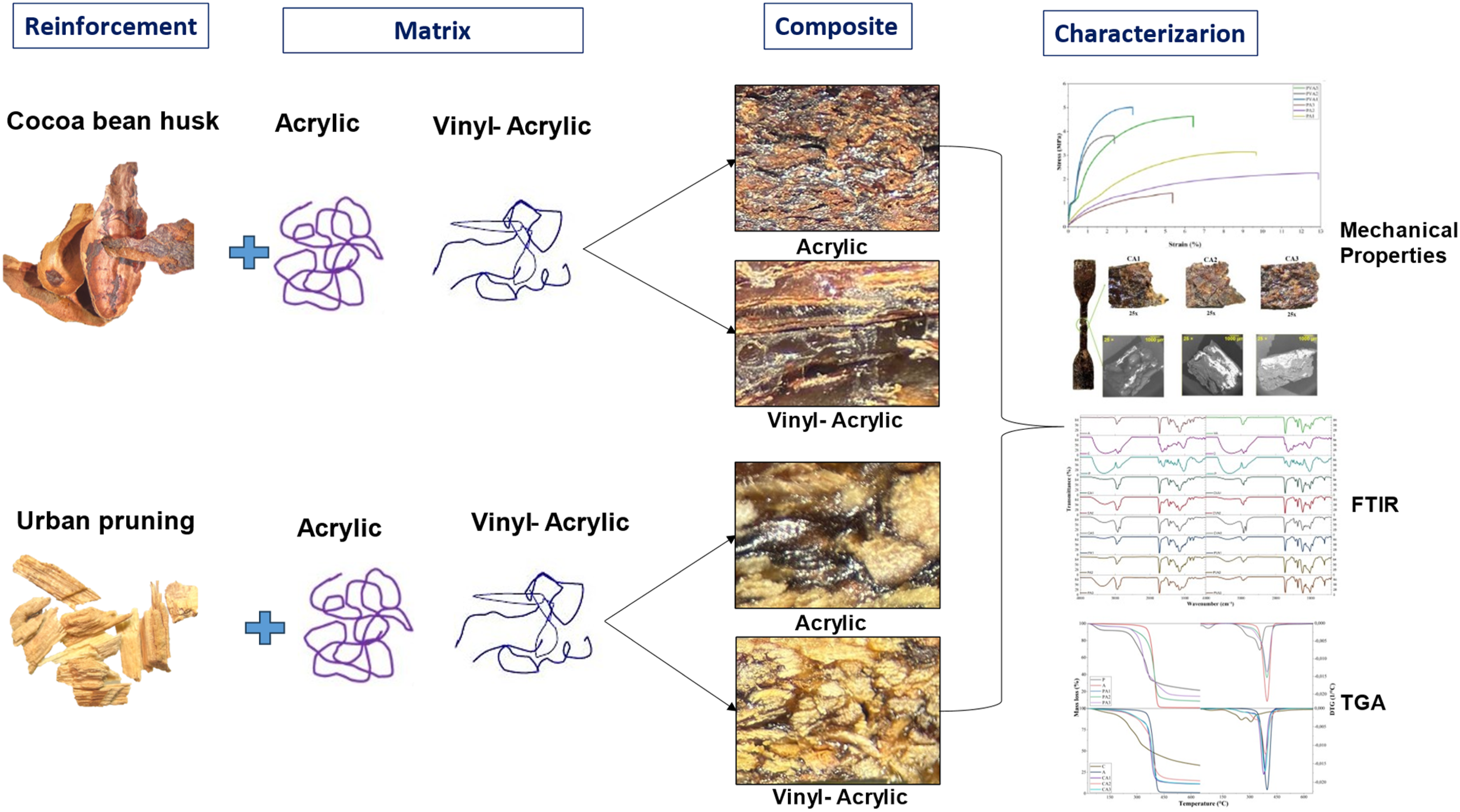
This study explores the valorization of lignocellulosic biomass from agro-industrial and urban gardening activities for the fabrication of acrylic-based matrix biocomposites. These materials were separately elaborated with two filler types (urban pruning and cocoa bean husk), three filler sizes (non-sieved, 1.70–2.00 mm, and 0.60–0.71 mm), and two matrices (acrylic and vinyl-acrylic) by means of 3 × 2 × 2 factorial design. For ease of comparison, the filler content in all composites was fixed at 40 wt %. Moreover, biocomposites were characterized in terms of their tensile, thermal, and spectrophotometric characteristics. Biocomposites with vinyl-acrylic matrix and cocoa bean husk reinforcement exhibited the best mechanical performance and thermal resistance, with CVA2 as the optimal formulation. Smaller particle sizes improved dispersion and interface adhesion. FTIR confirmed enhanced chemical compatibility, and TGA revealed superior thermal stability in vinyl-acrylic-based composites. These results highlight the feasibility of using lignocellulosic urban and industrial wastes in sustainable material development. Potential applications include eco-packaging, construction panels, and non-structural load-bearing components.
Keywords
Get full access to this article
View all access options for this article.