




Abstract
The prerequisite to equip structures with in situ electrical health monitoring systems in a meaningful manner is to estimate potential damage locations. In this context, an analytical approach to model the spatial and temporal evolution of transverse inter-fibre fractures (IFF) is exemplified for
Keywords
Introduction
Carbon fibre reinforced polymers (CFRP) are a preferred material in aerospace and automotive applications where light weight and durability are required in addition to mechanical integrity under continuous load cycles. In order to use CFRP structures more extensively in load-bearing conditions, the monitoring for structural failures in an economical manner is essential. Therefore, it is crucial to develop built-in sensing systems that allow continuous monitoring of the integrity of structures, thus enabling Structural Health Monitoring (SHM). SHM can be performed using e.g. optical fibre bragg grating sensors, infrared thermography testing,1–3 lamb wave based scanning techniques, 4 or ultrasonic arrays. 5 In the case of CFRP, electrically conductive carbon fibers are present in the structure, so that any damage that occurs can be detected via the measurable change in electrical properties.6–9
In any case, knowledge of possible damage locations and the development of damage over time is advantageous in order to integrate suitable measuring devices into the structure in a meaningful way. The location of the first occurring damage and the further development of damage depend in a specific manner on the considered structure and the loading. However, universally applicable criteria and methods are available that allow these data to be computed or experimentally determined for arbitrary structures. In 1981, Hashin 10 derived criteria for the failure in undirectional fibre composites under different loading conditions and separately modeled fibre and matrix damage modes. In the 1980s and 1990s, early analytical11,12 and numerical13,14 models were derived to capture transverse matrix cracking of composite cross-ply laminates under uniaxial tension. Since then different kinds of damage formulations with a varying degree of complexity were developed for composite laminates and are applied in the recent literature.15–17 Based on these damage formulations, the progressive fracture in composite laminates can be computed. The main focus is on the delamination of single composite layers18–20 and on the matrix cracking.21–24 Typically, experimental and numerical methods are used in these works, individually and in combination. However, the numerical computation of multiple damage locations with explicit modeling of the microstructure is time-consuming. 25
In this work, the identification of potential damage locations and the development of damage will be exemplified analytically using a CFRP beam consisting of a
An analytical model for this structure is developed, numerically evaluated and experimentally verified. For this purpose, a three-point bending test is used. Compared to a tensile test as an alternative, it results in clearly distributed IFF on just one side of the specimen. For the proposed model, the three-point bending configuration is further advantageous over a four-point bending configuration characterised by a sectionwise constant normal stress because an individual value of the normal stress is allocated to each position over the half-span of the specimen. This allows the highly accurate and temporally unambiguous identification of IFF during the experiment and provides reliable inputs for the introduced model. The above-mentioned properties are implemented in the model of the laminate, which is thus able to provide data on the spatial and temporal evolution of matrix damage in the lower layer of the CFRP cross-ply laminate. In this way, indications are obtained as to where measuring devices should be installed to monitor the structural condition. Experimental reference data from an earlier work of the authors 24 are used to tune the model parameters in an optimisation process.
The above should make it clear that the procedure described can be useful when designing structures that are to be equipped with SHM systems. The prerequisite is the existence of a model for the mechanical structure, an analytical or numerical model for the initiation and development of damage and, if necessary, an assumption about the spatial distribution of the material strength. The methodology used and the procedure explained here as an exemplary case can then be transferred to other structures, systems and laminate layups with 90°-layers.
The remainder of the manuscript is organised as follows. First, the authors’ experimental results, see also Linke et al. 24 , are briefly revisited. This is followed by the presentation of the analytical model of the mechanical system. Here, the stress distribution, the spatially heterogeneous distribution of strength and the modeling of the inter-fibre fractures are discussed. In the next section, the parameters included in the model are determined by an optimisation procedure. Finally, the results obtained with the model and the optimised parameters are presented and compared with experimental results. The main results of the work are summarised at the end.
Experiments
This section details the specimen manufacturing and the experimental procedure used for data collection. The information given in this section has been adopted from an earlier work of the authors. 24
Specimen manufacturing
The specimens for this work are manufactured from prepregs (Hexcel HexPly M21/34%/UD194/T800S) with an epoxy matrix and unidirectional carbon fibre reinforcement. Multiple plies of the prepreg are stacked in Specimen configuration for experimental testing and analytical modeling.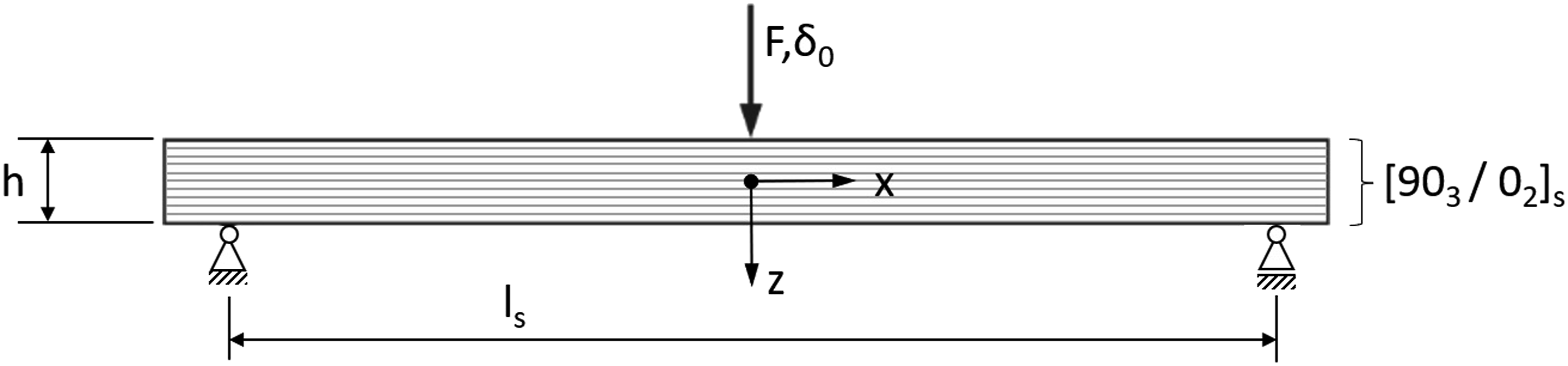
Setup and procedure
Prior to test, the specimens are observed with a Keyence VHX-5000 digital microscope to locate potential pre-cracks from the manufacturing process. For the four specimens tested, an amount of zero, one, two and four pre-cracks per specimen is detected. The three-point bending test is performend on a Tira Test 2810 testing machine. Supports of radius 2 mm and a 1 kN load transducer with a mandrel radius of 5 mm are employed. The support span l s is 55 mm and the velocity of the mandrel is set to 5 mm/min. Relevant data about time T, displacement of the mandrel δ0 and applied force F are sampled at a rate of 50 Hz. The specimens are not loaded to ultimate failure in order to avoid extensive permanent deformation. Only displacements δ0 ≤ 8.5 mm are used for evaluation. The specimen configuration with the origin of the xz-coordindate system in the centre is shown in Figure 1.
An infrared camera VarioCam from Infratec is installed at a distance of 100 mm from the side face of the specimen. It observes the experiment for potential IFF, that form at the bottom face of the specimen. The mechanical energy, that is introduced through the mandrel, is partially transformed into thermal energy and released during IFF formation. The increased temperature around an IFF, which is about 0.32 K,
24
can be detected using passive infrared thermography (PIRT). PIRT images are logged with a rate of 12 Hz and provide information about time of occurence T
IFF
as well as about the approximate horizontal position of new IFF. However, the deformation of the specimen is not considered in this measurement. After test, the specimens are observed again under the optical microscope to obtain the exact, individual position x
IFF
of every IFF that occured during the experiment. Previous data about pre-cracks are removed from the data set. In accordance with the reason for the selection of
Post-processing
In order to relate spatial (x IFF ) and temporal information (T IFF ) for each IFF, gathered data from the experiments are correlated. First, the approximate positions from PIRT are corrected with respect to the displacement δ0 of the specimen using a function as introduced by Linke et al. 24 Second, the true IFF position x IFF along the specimen from microscopic analysis is correlated with the temporal information T IFF from PIRT. Finally, this temporal information T IFF is correlated to force and displacement data (F-δ0) from the testing machine that are logged in discrete time steps. Thus, a complete picture of the spatial and temporal evolution of IFF in a CFRP specimen under three-point bending can be gathered that additionally provides information about mandrel displacement δ0 and applied force F in the moment of IFF formation.
Modeling
In this section, a first approach to model the IFF formation in the bottom 90°-layer of laminates under a three-point bending test is derived. This approach is based on two analytical functions. The first one describes a periodically varying function for the maximum allowable stress to consider material inhomogeneities. The second one applies a window function to the triangular normal stress distribution in bent beams to incorporate the impact of formed IFF.
Homogeneous normal stress distribution
Formation of IFF in specimens is caused by local tensile stresses exceeding a maximum allowable stress σmax(x). For the given configuration (see Figure 1), tensile stresses occur in the lower half of the deflected specimen. The effective stress directly depends on the local bending moment within the support span l
s
. It increases linearly (a) from the supports to the load introduction point, (b) from the horizontal symmetry plane of the laminate to the bottom 90°-layer via position z [−0.5 h ≤ z ≤ +0.5 h] and (c) with the applied force F.33–35 Since solely the stress at the bottom of the laminate is considered, z has a fixed value of 0.5 h. The resulting stress between the supports has the theoretical shape of a triangle. This triangular stress σ
tri
(x) is given by Experimental force–displacement curves of four specimens (black) and regression function (red).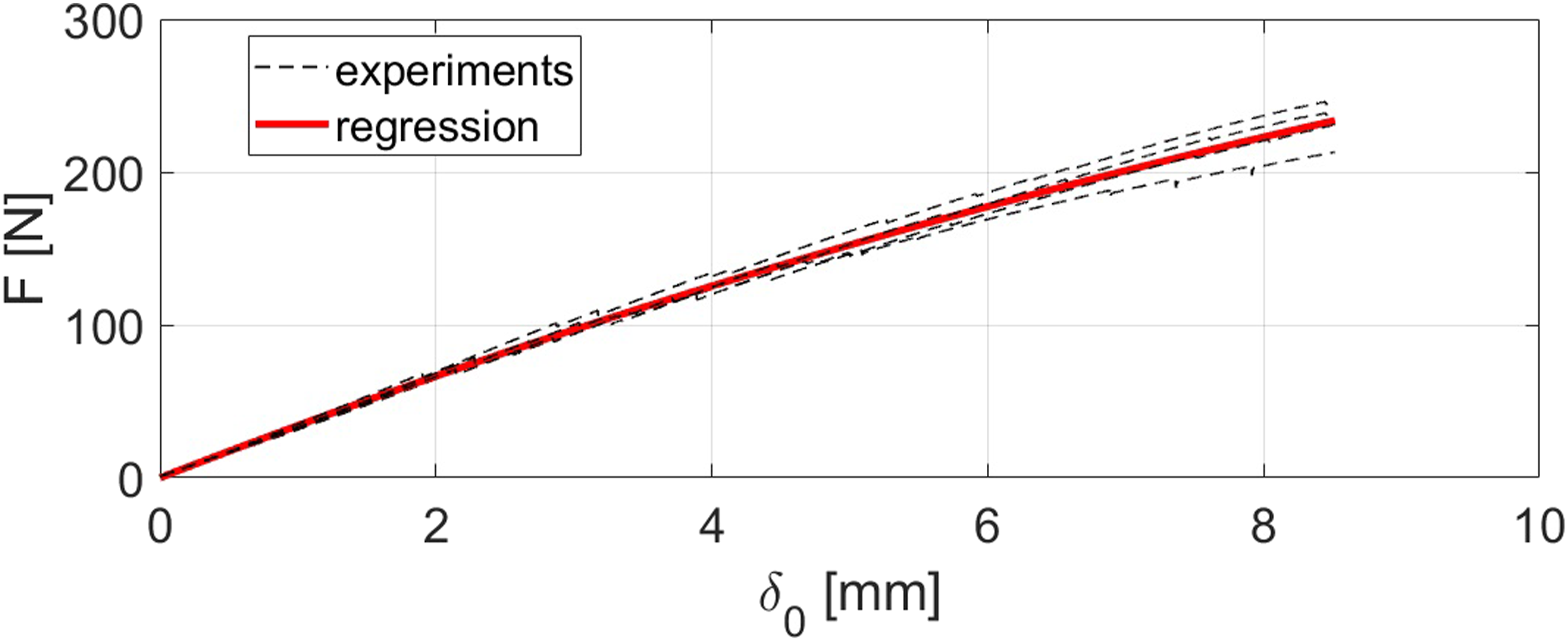


The applied force F is then plugged into equation (1) to make the triangular stress σ tri (x) dependend on the applied displacement δ0. The maximum displacement δ0, max is set to a nominal value of 8.51 mm which is the maximum covered by all the experiments.
Since the modeled system is statically determined (see Figure 1), there is no load redistribution after fracture.
Heterogeneous strength distribution
For a general imperfect specimen, as assumed in this work, randomly dispersed inhomogeneities such as voids, pre-cracks or resin-rich areas37–39 must be considered for the modeling process. They can affect the local damage formation threshold, e.g., the maximum allowable stress or strain.29–31 It is reported in the literature that the stochastic distribution of these intrinsic properties in the specimen has not necessarily a monotone trend.
29
Arai et al.
30
numerically obtained a non-uniformal distribution of the maximum stress in FRP and assumed, among others, a periodic microstructure. The current work takes up this approach and models the strength of the heterogeneous specimen via a periodic and harmonic sinusoid as given by

Modeling of IFF
The model in the unloaded condition (δ0 = 0 mm) is depicted Figure 3(a). In this state, the effective stress distribution σ
eff
(x) is equal to the triangular stress σ
tri
(x). It is important to note that the presence of pre-cracks is neglected in the current approach since the model aims to consider the mean experimental behavior from four tested specimens. The latter are characterised by individual amounts and positions of pre-cracks. In the course of the simulation, the model continuously compares the increasing effective stress σ
eff
(x) with the sinusoidal strength σmax(x) over the length of the specimen [−1/2l
s
≤ x ≤ +1/2l
s
]. An IFF forms at x = x
IFF
, when the stress locally exceeds the strength: σ
eff
(x
IFF
) > σmax (x
IFF
), see Figure 3(b) and (d). Visualisation of the triangular stress σ
tri
(x) and the effective stress σ
eff
(x) compared to the modeled strength σmax(x) for increasing displacements δ0 and number of IFF. All model parameters have an exemplary setting. (a) δ0 = 0.00 mm: No effective stresses σ
eff
(x) are present in the specimen. The strength σmax(x) is periodic. (b) δ0 = 2.03 mm: The first maxima (marked by ○) of the effective stress σ
eff
(x) reaches the modeled strength σmax(x). (c) δ0 = 2.04 mm: Formation of the first IFF forces the local stress σ
eff
(x) to zero and affects the stress in the vicinity. (d) δ0 = 2.62 mm: Another maxima (marked by ○) of the effective stress σ
eff
(x) reaches the modeled strength σmax(x).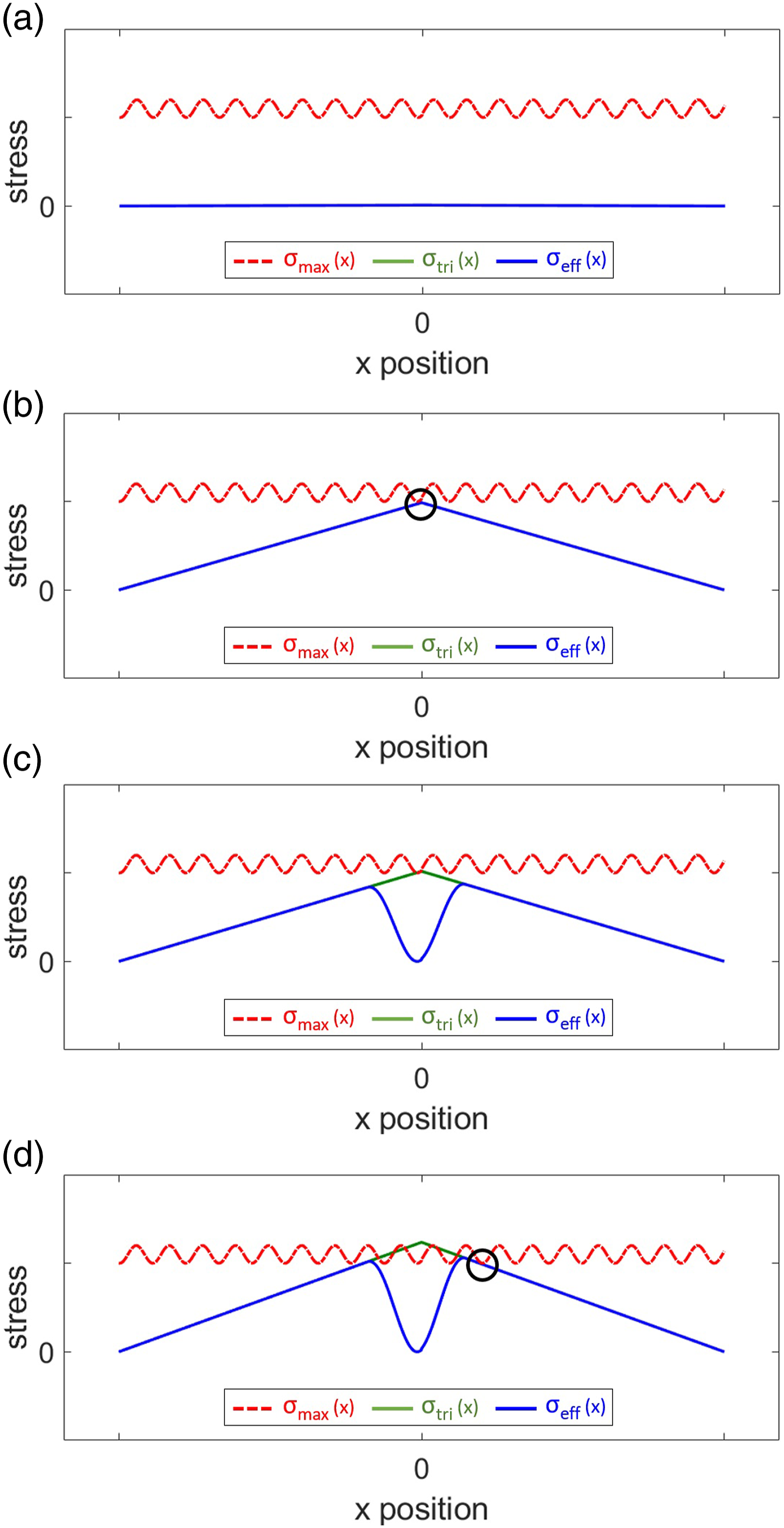
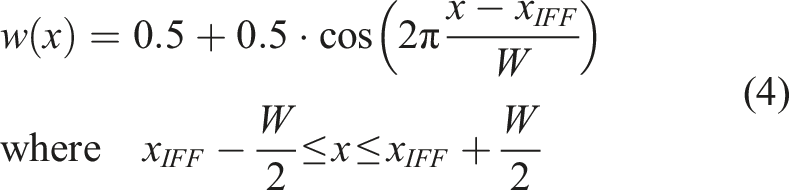
As the considered bottom layer of the composite fails, the effective stress σ
eff
(x) at the IFF location x
IFF
must be forced to zero.40–42 To model this constraint, a modified Hann window
Parameters
The presented modeling approach for the IFF evolution requires five input parameters. The following parameters characterise the sinusoidal strength σmax(x): (1) the defect threshold σ
def
offsets the baseline of the sinusoid along the stress axis, (2) the peak separation λ defines the distance in space between two adjacent strength maxima, (3) the peak amplitude σ
A
sets the extremal values with respect to σ
def
and (4) the offset ϕ shifts the periodic function along the longitudinal specimen axis starting from the centre. Further, (5) the length of the window W characterises the size of the reduced stress section in the vicinity of an IFF. These parameters are shown in Figure 4. Visualisation of the model including parameters to be optimised.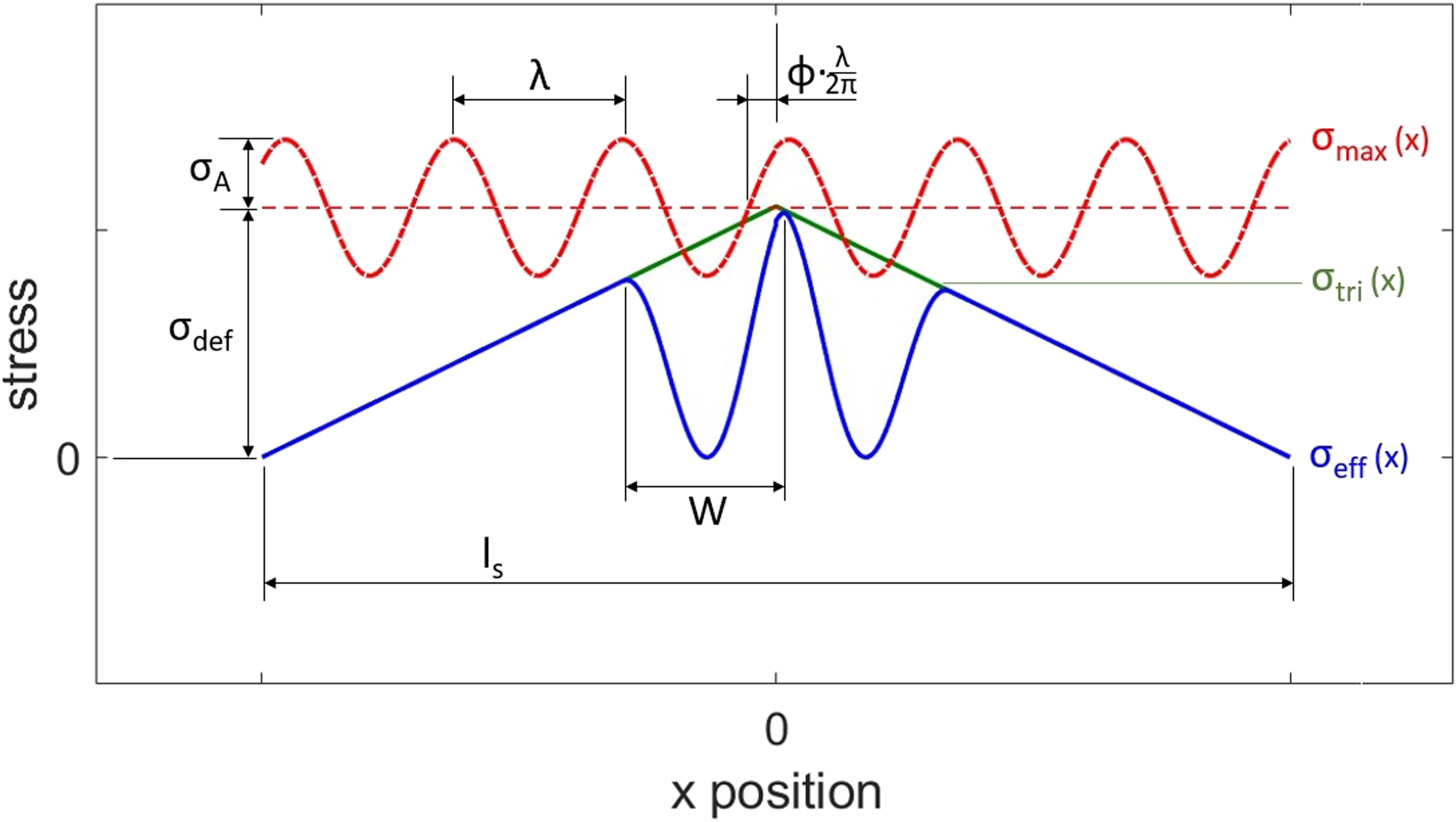
Parameter optimisation
In this section, an approach for the parameter optimisation is outlined. First, reasonable settings are selected for all model parameters based on mechanical considerations. The analytical model is then run for the chosen variety of parameter settings. To evaluate the model and to find the optimised settings, two figures of merit are introduced that consider the spatial distribution and the number of IFF at every displacement δ0. Finally, the optimised parameter set is discussed.
Parameter settings
The ranges and the step sizes for the model parameters used for optimisation are selected considering simple constraints, e.g., the peak amplitude σ A must be smaller than the defect threshold σ def and the peak separation λ should be far smaller than the support span l s . The defect threshold σ def is approximated using experimental IFF information and the triangular stress σ tri (x).
Model parameters with optimisation ranges and step size.
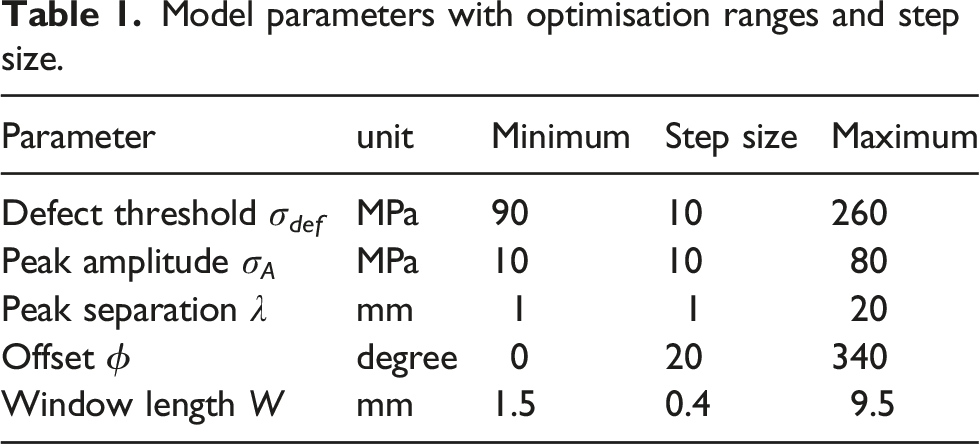
The optimised parameter settings will give an idea of the magnitude of each parameter and how the ultimate settings might be. Further, these settings will allow conclusions about the significance of each parameter on the model output and how they affect the latter.
Figures of merit
The optimisation of the model parameters is performed with experimental data as reference. Two different figures of merit are used. They are easily to determine and characterise the spatial and temporal IFF evolution. The first one is the current number of IFF (NOI). The second one is the IFF distribution width (IDW) which is the distance between the rightmost and the leftmost IFF at a particular displacement δ0.
To compare information about these figures of merit, two aspects must be considered. (I) Since NOI and IDW are measured in different units, a relative measure has to be introduced. (II) The mean values of the associated quantities over the entire experiment, 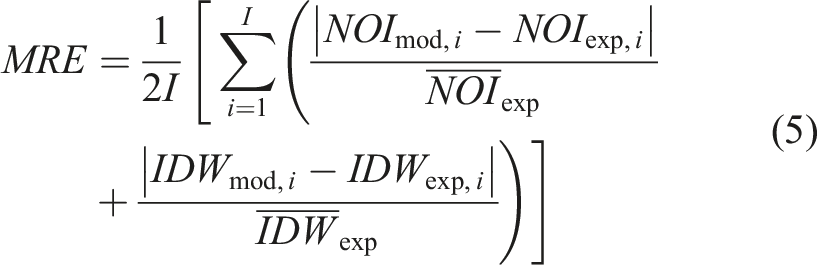
Results of the optimisation
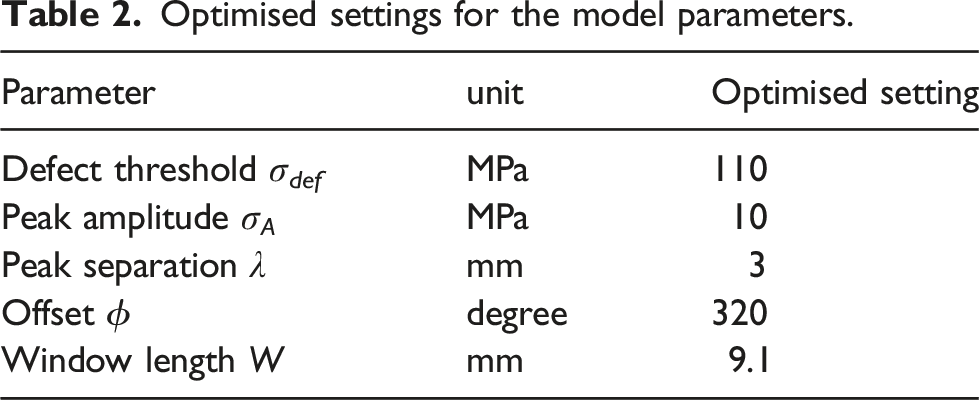
Optimised settings for the model parameters.
The model output as a result of the optimisation is plotted in Figure 5. Good agreement with the experimental average over the entire experiment is achieved. The vast majority of the data points are within the experimental boundaries, shaded in grey. Comparison between experimental data and analytical model as a result of the optimisation process. (a) Comparison of the number of IFF (NOI), (b) Comparison of the IFF distribution width (IDW).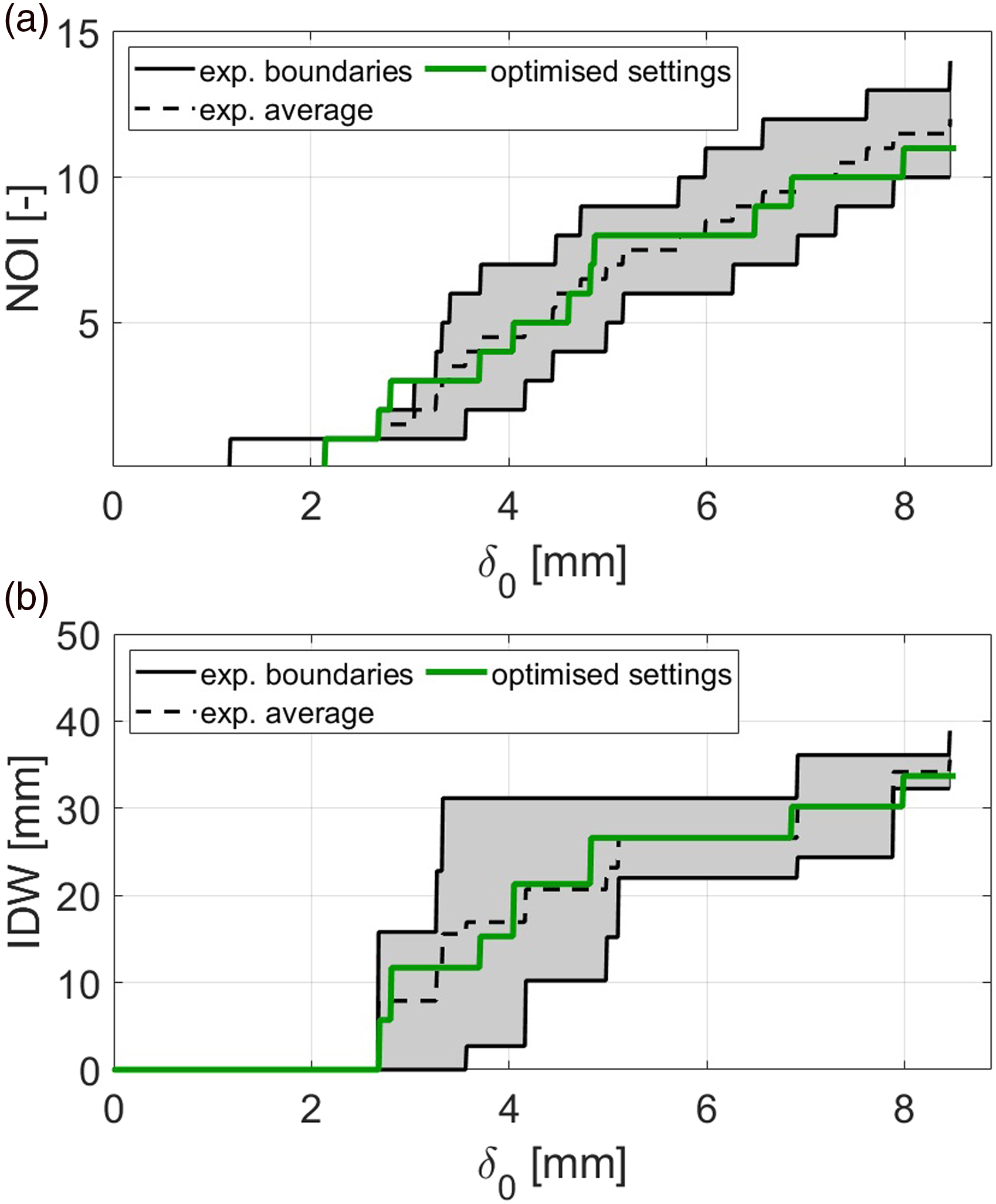
The results reveal some interesting aspects about the model. First, the optimised parameters for the peak amplitude σ A = 10 MPa and the defect threshold σ def = 110 MPa show that the main contribution to the strength σmax(x) comes from the latter. This is in accordance with the general idea of the modeling approach that a constant defect threshold is superposed with a moderate spatial variation due to inhomogeneities. This variation σ A is around 9% of the base value σ def . Thus, the material inhomogeneity is assumed to be relatively small.
Secondly, the optimised length of the window W is found to be 9.1 mm. This is more than a factor of 2.5 larger than the mean IFF spacing of 3.39 mm determined during the experiments. 24 The analytical model thus reveals that the window length W does not constrain the IFF spacing. New IFF can rather form within the weakened section around an extisting IFF. The reason for this behaviour is the application of the modified Hann window w(x) itself, which introduces an extra local maximum to the effective stress σ eff (x) (see Figure 3(c)) where new IFF may form.
Moreover, the combination of the peak separation λ = 3 mm and the offset ϕ = 320° gives the first IFF at x
IFF
= −0.4 mm. This is consistent with experimental observations that the first IFF occurs near the specimen centre.
24
Further, Figure 6 shows the effective stress σ
eff
(x) at the end of the simulation. The IFF positions are nearly uniformly distributed along the x-direction of the specimen. Their spacing mainly ranges from 2.7 mm to 3.6 mm, just one value of 5.3 mm is higher than the others. The resulting mean IFF spacing of the model is 3.37 mm, which is very close to the experimental reference value. It clearly correlates with the optimised setting for λ = 3 mm. The latter thus mainly defines the IFF spacing of the model. Accordingly, the offset ϕ defines the position of the first IFF based on the obtained peak separation λ. Effective stress σ
eff
(x) at the end of the simulation (δ0 = 8.51 mm) with optimised parameters. IFF positions are marked with a black square.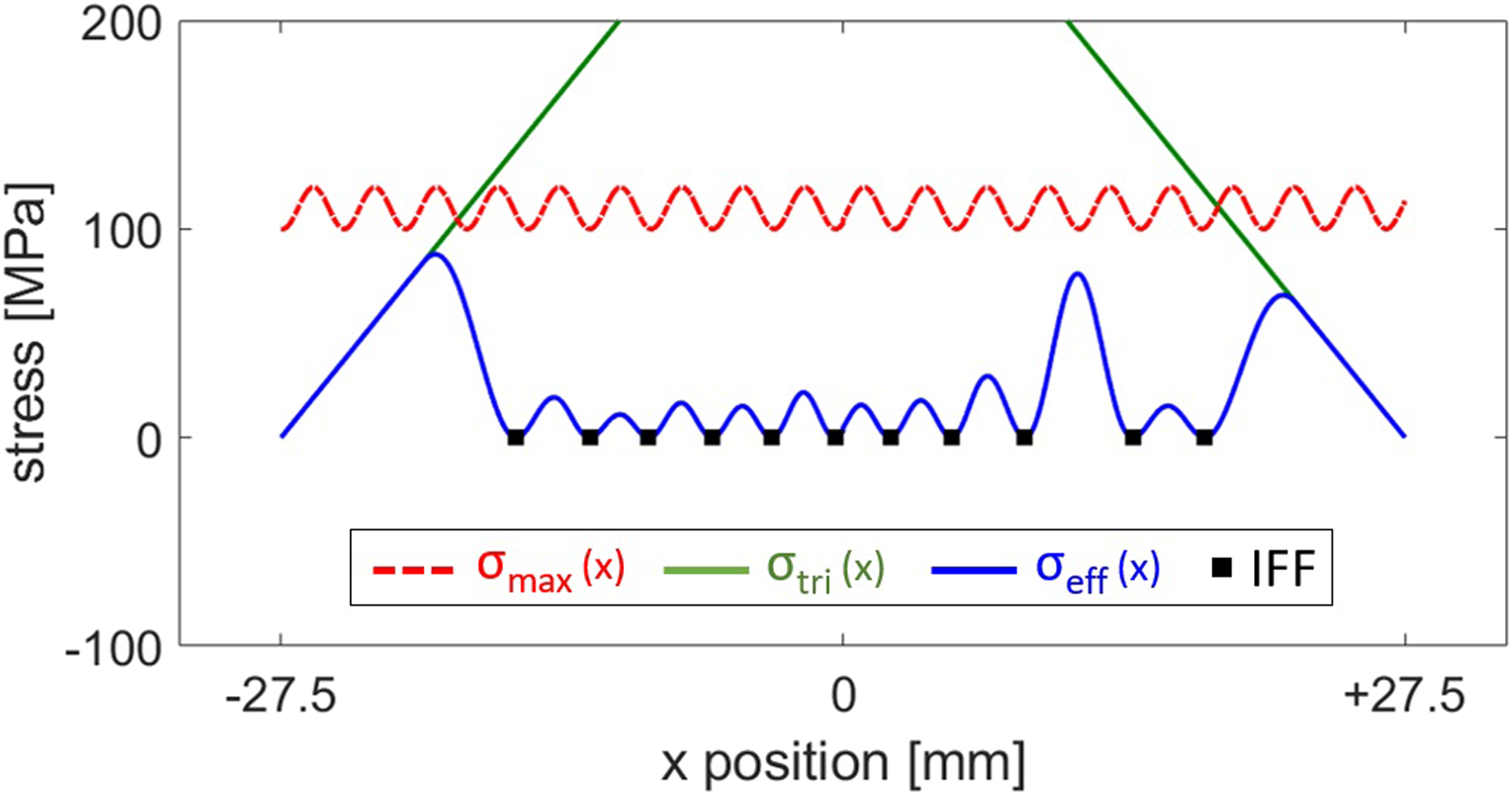
Finally, Figure 6 shows the increasing weakening effect due to existing IFF. The triangular stress σ tri (x), which assumes an undamaged specimen, exceeds the strength σmax(x) over a wide range (approximately 67% of the support span l s ). It outlines the necessity of the modified Hann window w(x) that significantly reduces the effective stress σ eff (x) in order to fit the simulation with the experiment for increasing damage.
The model with optimised parameters shows good agreement with the experimental data in Figure 5 that are included in the figures of merit for the optimisation process. In addition, the model confirms the experimental observation that the first IFF forms near the specimen centre. Further, the mean experimental IFF spacing matches the analytically obtained value. The latter directly results from NOI and IDW. In this context, Figure 7 compares the IFF evolution in terms of the position x and the critical displacement δ0 as a result of the analytical model (a) with the experimental data (b-e) from four experiments. The plots further reveal the NOI, the IDW as well as the IFF spacing. It is evident that qualitative agreement with respect to the spatial and temporal evolution is achieved. Thus, the presented analytical approach, characterised by a sinusoid-based and heterogeneous strength distribution, and the selected figures of merit are found to be well suited to model the spatial and temporal IFF evolution in Output of the analytical model and data from four experiments with respect to the position x and the critical displacement δ0 for each IFF. (a) Analytical model, (b) Experiment #1, (c) Experiment #2, (d) Experiment #3, (e) Experiment #4.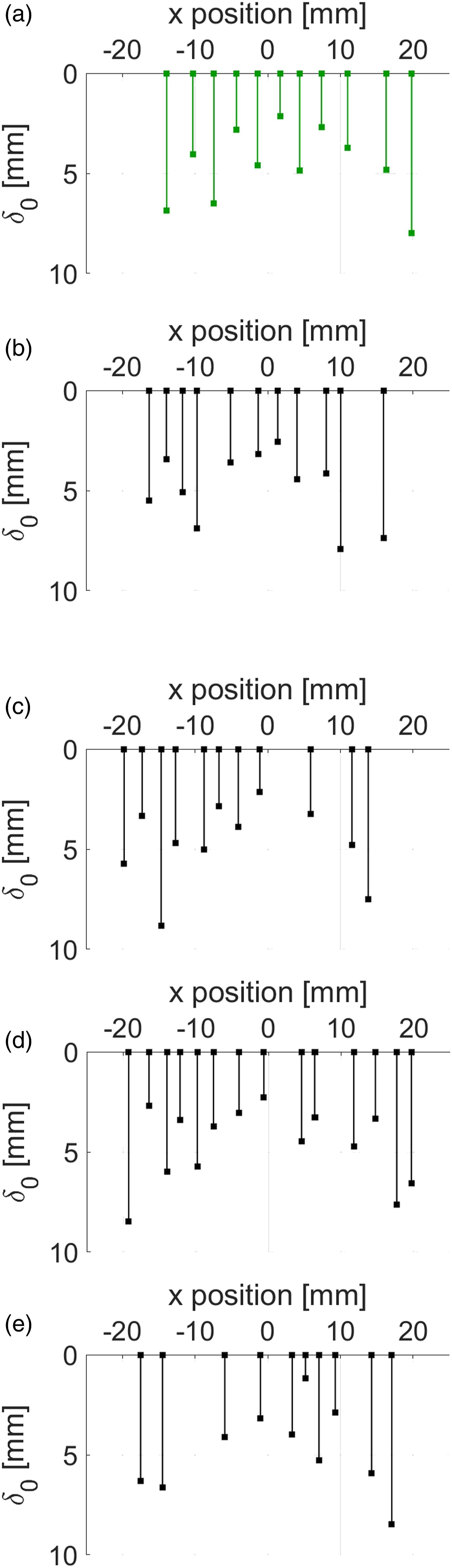
Conclusion
In this paper, an analytical approach to model the IFF distribution in the bottom 90°-layer of
Footnotes
Declaration of conflicting interests
The author(s) declared no potential conflicts of interest with respect to the research, authorship, and/or publication of this article.
Funding
The authors disclosed receipt of the following financial support for the research, authorship, and/or publication of this article: This work was supported by the Deutsche Forschungsgemeinschaft [grant number 3933868053].
