




Abstract
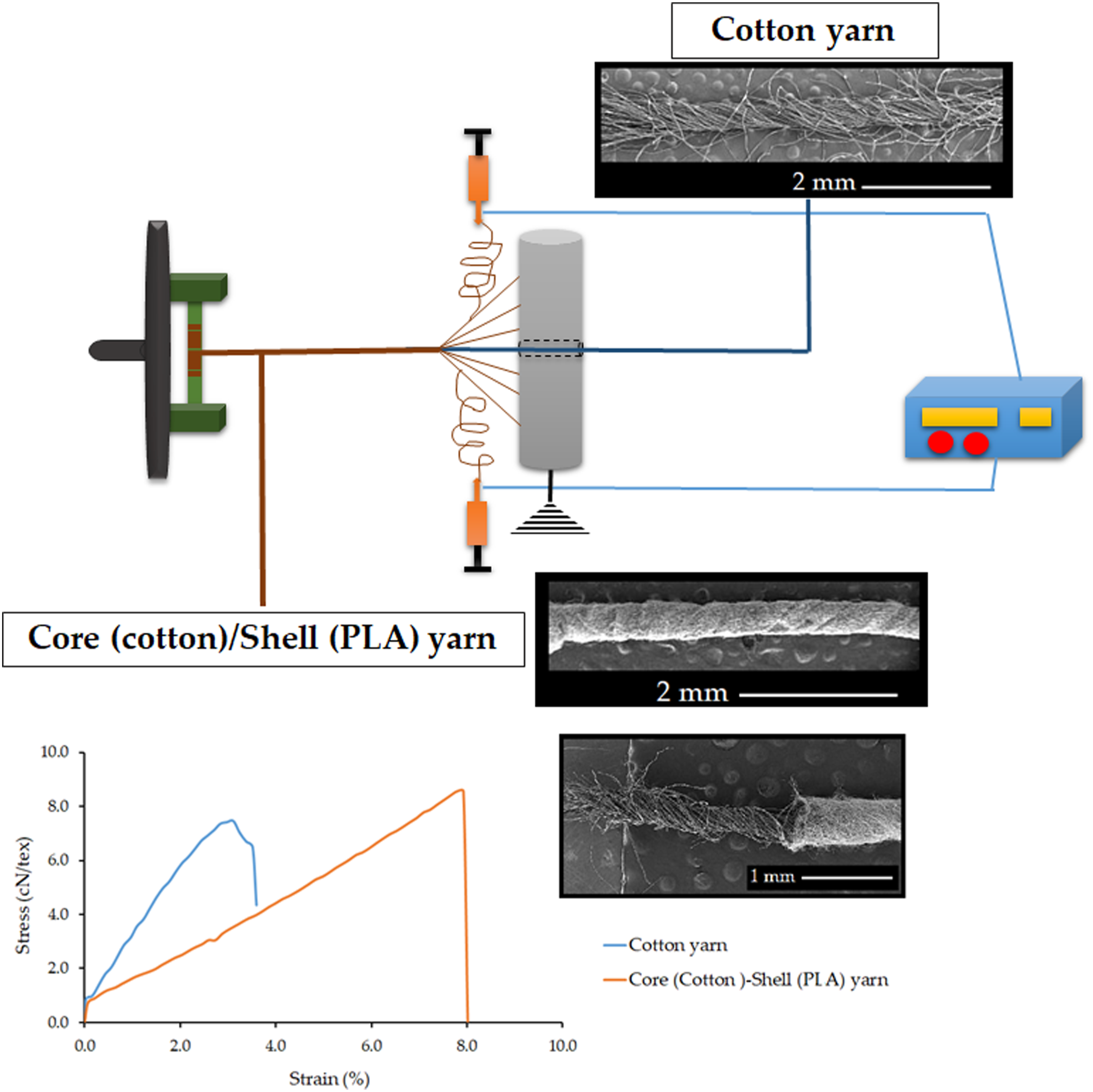
In this study, aiming to improve the mechanical performance of the Poly (lactic acid) (PLA)-based nanofibrous structures, the electrospinning method was employed to develop twisted yarns with core-shell structure. Within this process, a conventional ring-spun cotton yarn fed to the electrical field, where nanofibers covered it by a certain orientation owning to the twisting procedure. This approach combines the excellent biological and physical-mechanical properties of cotton with outstanding features of the PLA nanofibers for biomedical applications. The effects of the core and shell structures on the ultimate properties of the electrospun core-shell yarns were investigated. Scanning electron microscopy (SEM) demonstrated that relatively uniform and bead-free fibers with smooth surfaces were formed. SEM images also confirmed that the nanofibers were arranged around the core with a specific angle to the axis (with the angle range of 8–44 based on the twisting rate) to constitute a twisted core-shell yarn. The diameter of the electrospun yarns decreased (∼ 22%) by increasing the twist rate. The influence of the core on the mechanical behavior of core-shell yarn are also discussed. Improvements in mechanical performance of core-shell yarns were generally perceived at low twist levels of the core yarn (αe = 2.8), and electrospun shell (40 rpm).
Keywords
Get full access to this article
View all access options for this article.
References
Supplementary Material
Please find the following supplemental material available below.
For Open Access articles published under a Creative Commons License, all supplemental material carries the same license as the article it is associated with.
For non-Open Access articles published, all supplemental material carries a non-exclusive license, and permission requests for re-use of supplemental material or any part of supplemental material shall be sent directly to the copyright owner as specified in the copyright notice associated with the article.
