




Abstract
This article explores the idea of movement, namely oscillation, in Tashan Mehta’s The Liar’s Weave (2017). I trace this idea through an oscillation of locations (as “real” and “unreal”), of language (as familiar terms and as invented terms), and of free will (against a fixed destiny). Specifically, I explore how Zahan Merchant, the novel’s protagonist, is intricately engaged with all three manifestations of oscillation. With his unique ability to verbally lie new realities into existence, Zahan is able to move between the real and unreal, the known and the unknown, as well as act as an agent of free will within a system that precludes such agency. There is an overarching interest in the novel’s employment of the speculative genre — primarily articulated through Zahan’s ability to lie new realities into being and through the wild forest of Vidroha — although the focus of this article is not on arguing a specific case for the novel as speculative fiction. Instead, through a close reading of the text and with a focus on the idea of oscillation, I argue that the novel negotiates familiar as well as unfamiliar literary ground in relation to Indian writing in English and in turn, relates to the Indian post-millennial contemporary.
Keywords
Introduction
Published in 2017 by Juggernaut Books, The Liar’s Weave (2017) by Tashan Mehta has been marketed as “fiction/fantasy” (back cover) and has endorsements by Indian speculative fiction authors Samit Basu and Anil Menon on its cover. Juggernaut Books launched as an independent publisher in late 2015 with Chiki Sarkar, previously of Penguin India, as a co-founder. The company is both a digital and traditional publishing platform, publishing new “Indian stories” across genre fiction, literary fiction, and nonfiction. Mehta’s novel has circulated predominantly in the domestic market given its designation as being “for sale in the Indian Subcontinent only” (back cover), although some copies do circulate in the “used books” market in the UK and US (as of 2018).
The Liar’s Weave (2017) 1 explores a fantastical world in which birth charts take on enhanced societal and personal importance. Presented at the Ubedha ceremony at the age of 18, compiled and written by a professional astrologer known as an “in-between”, the birth chart reveals facts about the person’s life including his/her death date. Through the reading of the chart, the person is revealed to be a “fortunate” or a “hatadaiva” (“ill-fated”). The “in-betweens” are a group of elite astrologers presided over by the Dagdhavasta, the head of the University of Benaras and of the Sapta Puri universities. These “seven universities” have perfected the art of “reading the handwriting of the gods” (15) and it is those with the Gift, namely the “in-betweens”, who relate the readings of an individual’s birth chart on the day of the eighteenth birthday because “Everything happens as it should happen, because it has already happened” (13).
The idea of possibility is a defining feature of the protagonist, Zahan Merchant’s character because his own birth chart has revealed infinite futures, an impossibility in the history of the in-betweens’ sky readings until this point. These elite astrologers cannot imagine that such an error has been made by the gods, and yet Zahan seems to be evidence of such a miscalculation. Moreover, and crucially for the plot, Zahan creates the possibility of hope through his lies. With this specific locutionary act, Zahan weaves new realities and thus the status quo is shaken; the “fortunates” are struck by misfortune and moments of luck befall the hatadaiva (ill-fated).
In this article, I suggest that Mehta’s narrative is crafted through a constant oscillation between the known and the unknown. I employ the term “oscillation” in its scientific sense of a repeated movement or fluctuation between two states. Through close reading, I trace this movement principally through what I refer to as “linguistic play” manifest in Mehta’s creative use of language and anchored in the premise that language is a vehicle to perception — both physical (vision: what we see) and philosophical (in how we cognitively process and think through our life experiences). I also trace two other types of oscillation. First, is the idea of oscillation between the dominant locations of the novel, as it shifts repeatedly from one place to another. Second, readers encounter the idea of oscillation suggested by the novel’s speculative nature, given that the narrative moves between the real and the unreal (the two obvious motifs of the fantastical being Zahan’s ability to lie new realities into existence, and Mehta’s creation of the wild forest space of Vidroha). I will discuss each of these modes of oscillation in turn: “Oscillations of location” is followed by the discussion of “Linguistic oscillations” and, finally, “Oscillating ideas of free will”.
My choice to close read the text complements recent approaches to reading contemporary Indian fiction. Ulka Anjaria writes of reading “alongside texts rather than against their grain” as “an attempt to establish a new relationship between text and critic founded [. . .] in intimacy rather than distance” (2019: 21). My other work on post-millennial Indian fiction in English (Varughese, 2012; 2013) has looked to go beyond postcolonial readings of the texts because, as Anjaria writes: “the somewhat repetitive nature of postcolonial literary criticism as it has been practiced over the past two decades, subjects every new text to a similar, prefabricated critique and assumes that reading is a self-evident practice rather than one generated at least in part from the text itself” (2019: 21). In reading Mehta’s novel using close reading techniques, I suggest the idea of oscillation brings itself to the fore and allows a way into the text that appeals to a more creative, open reading practice akin to the new ways of reading Anjaria calls for: “a literary criticism that reads not from a critical distance of skepticism and mistrust but from a place of intimacy” (2019: 178).
I argue that the trope of oscillation is embedded in The Liar’s Weave through the use of various devices that I discuss below and that the novel performs and negotiates a new kind of post-millennial Indian speculative fiction, one which firmly moves beyond the “mythology-inspired” fiction of the recent post-millennial years (see Varughese, 2018; 2019; Chattopadhyay et al, 2019: 5–6) and yet expresses a strong identity of Indianness in its craft. Like other post-millennial speculative texts such as Vikram Balagopal’s Savage Blue (2016) and Prayaag Akbar’s Leila (2017), Mehta’s novel formulates its speculative story world through a literary register rather than a popular one which is more indicative of Amish Tripathi’s works, Sukanya Venkatraghavan’s novel Dark Things (2016), or Sarang Mahajan’s Inkredia series (2017). As a hardback book, retailing at 499 rupees, Mehta’s novel circulates in a particular market, being a more expensive purchase than the paperback “mythology-inspired” novels — by Tripathi, Ashwin Sanghi, and Ashok Banker as examples — priced at INR 250 or 300. The positioning of Mehta’s novel in the domestic Indian market in terms of its distribution (“for sale in the Indian Subcontinent only” [Mehta, 2017: back cover]) as well as its high price tag of INR 499 cannot be ignored when we consider the novel as one which develops ideas of Indianness. Familiar, commonplace motifs of Indianness in Mehta’s novel include the Parsi storyline, Hindi, Sanskrit (and Sanskrit-inspired) lexemes, the city of Bombay, and astrological readings. However, by close reading parts of the text, I hope to show how more subtle and nuanced ideas of difference with regard to Indianness are also presented in the novel. Moreover, in foregrounding what I see as oscillatory movement, I suggest that Mehta develops something of a fantastical Indianness both within and outside of the text; a literary Indianness that moves between familiar and unfamiliar cultural and literary ground. This familiar ground has been written about extensively post-2000 and includes work by scholars such as Priyamvada Gopal (2009) writing of the Indian novel and the nation; Tabish Khair (2001) of socio-economic alienation in Indian English fiction; Lisa Lau and Om Prakash Dwivedi (2014) of the re-orientalizing of Indian writing in English; Alex Tickell (2016) on contemporary transformations in form, aesthetic, and genre; and also Aysha Iqbal Viswamohan (2014) on the issues of English narration in the context of post-liberalization and IWE texts.
Oscillations of location
Although much of the idea of The Liar’s Weave lies in the heavens by way of astrology, the lives of all involved in Mehta’s story world are played out in and around 1920s Bombay, with brief sections of the novel set in Benares. The spaces in Bombay are specific locations: Hindu Colony, Parsi Colony, and, somewhere beyond the salt pans of Wadala, the jungle space of the hatadaiva known as Vidroha (Hindi: “rebellion”), the latter of these being a fictitious place. The salt pans of Wadala are a recognizable landmark of the city. Their flat, white, glinting plains are well known to the city’s residents, not least in the post-millennial years for the wrangling over the land as potential development for housing projects. With the novel being set in 1920s Bombay, it is easy to imagine the salt pans as an underdeveloped area of the city, a wilderness, opening out on to the mangroves and the creek. Vidroha therefore, might easily come to exist in the reader’s imagination as a known geographical space, as the famed salt pans of Bombay, whilst also a location that allows for a movement into the mythical mangroves and unknown forest spaces on the outskirts of the city. Furthermore, with the name Vidroha, the idea of this jungle and swamp land is quickly identified as a place of unrest and lawlessness given its Hindi appellation of “rebellion”. Mehta writes in the novel of this space: The ill-fated have lived in the forest for four years now. The first thing they tell newcomers is this: the forest eats. It is an ever-ravenous emerald and mud beast, moving through the air around you, seeking to move into you, root, bark and vine, hoping for that knob of shoulder, a hooked toe or a lightly crushed torso, marinated in bittersweet blood. (24)
It is these visceral descriptions of Vidroha that render it a threatening and grotesque place. It is simultaneously described as secretive and only accessible to those few who know of its existence. The two locations of Bombay and Vidroha act as an echo of Zahan’s split existence: he too experiences both the real and the unreal; he is both controlled and contained like the housing colonies of Bombay, whilst at other times flamboyant and untethered like the occupants of Vidroha. Moreover, in creating a vacillating movement between real and imaginary spaces, Mehta shows the reader Zahan’s ability to survive both locations. Zahan, in fact, acts as a bridge, connecting the two places with his capacity to lie new realities into being. Zahan’s words are as concrete as the documented (historical) existence of 1920s Bombay in the sense that he produces sounds of a language (English/Hindi) that communicate meaning, while the fact that these words are chosen to create a lie specifically means that the outcome of Zahan’s act of speech is as elusive and as undocumented as Vidroha itself.
The chapters in The Liar’s Weave are arranged chronologically, giving a year (and sometimes a date) as well as a location. Examples include: “1911. Parsi Colony, Bombay.” (3); “June 1920. Bombay.” (76); “January 1921. Vidroha, Bombay.” (119); “December 1922–1 January 1923. Tarachand’s house, Bombay.” (267). The usual pattern for the chapters is to oscillate between Bombay and Vidroha, real and imagined locations, throughout the entire novel. This juxtaposition of locations is often captured in this very sequence of the depiction of the two locations; the carnivalesque through which Vidroha is described set against the far more pedestrian and mundane settings of Parsi Colony, Hindu Colony, or “Mitra’s House, Calcutta” (202). This contrast, sometimes stark in its polarity, underpins the movement of oscillation that I suggest is at the heart of this novel. Interestingly, Zahan is often central — although not always present — to both locations. Thus the movement between the two story worlds is dependent upon Zahan’s existence, one that oscillates between a state of belonging and non-belonging.
The nexus of location and movement so central to Zahan’s character is, I suggest, embodied in the pencil marks on the rice paper of his birth chart readings. Tarachand, with fellow “in-betweens” Svasa and Krishna, sits down to the 500 birth charts Tarachand has so far formulated for Zahan over the preceding 14 years. After some time studying the charts together, Svasa suggests: “We need to look through the lens of chaos. It is not a language any more. We forget our symbols. Trust blankness. Trust the space. We bend.” (142). As he completes his work by joining chart two to chart one, and then to chart three, Svasa’s work reveals a particular form: “It is an almost perfect oval. No, it is sharper than an oval, its top more pointed than its base. An egg. The golden egg.” (142–143). As the form of the egg becomes more and more apparent across the charts, Tarachand is reminded of the mural at the University of Benares where all those with “The Gift” study. The mural is of the Hiranyagarbha — the beginning of all creation — and depicts “Brahma rising out of the cracked egg, swimming in a sea of darkness” (143). The eggs on Zahan’s charts are only rendered visible through the pencil marks made by the in-between’s hands as they plot the chart(s). These birth charts, despite their representation of apparent inherent chaos, vast changes in movement, oscillation, variance in Jupiter’s position, and the moon which moves in and out of sight, reveal a single truth, a single point of coalescence and form, indeed a location of sorts: the golden egg. This revelation is not taken forward by Mehta in any concrete way; rather she allows the appearance of the “golden egg” across his charts to act as an anchor point in Zahan’s otherwise precarious life. The golden egg steadies him whilst all around him, he changes and moulds the lives of others. Mehta’s choice to reveal Zahan’s birth chart as one which is illuminated by the visual motif of the Hiranyagarbha further contributes to the idea of Zahan as exceptional. The reference to the mural at the University of Benares, of Brahma emerging from the cracked egg, surrounded by a sea of darkness, makes connections with Zahan’s own existence, swimming in his own sea of lies and their related darkness. The presence of the Hiranyagarbha might be understood to reveal Zahan’s relationship to the “in-betweens” (and with Tarachand especially) whilst Zahan as “himself” breaks away from their rules and orthodoxy.
Linguistic oscillations
Although the roles of location and place are significant in The Liar’s Weave, it is creative language use which is the central tenet of the book. It is through creative and newly formed words that the narrative explores how language harnesses the ability to shape which reality is seen. With Zahan’s lies, supposedly a mere locutionary act, the world is changed. Crucial to the idea that language shapes what we “see” (what we perceive to be “true”) is the fact that Zahan, the one who tells the lie, cannot “see” (in terms of his sight/vision) the reality that results from his lie. In Mehta’s novel, the act of telling the lie is motivated by an almost selfless wish to “see” a better world, such as the returning of a much-loved box to Firoza Aunty or to fix the broken matki (large clay water vat) in the family home — these are some of the early examples of Zahan’s lie-telling. At the age of ten, he accidentally breaks the matki but doesn’t tell anyone in the house about what has happened. A couple of days later, Zahan’s older brother, Sorab, asks why Zahan can’t see the matki that is stored right next to them as they stand together in the kitchen: Sorab says: “What did you do to the matki?” “I broke it. Two days back. I lied, and fixed it again. I didn’t mean to — the words just came out. And now I can’t see the pot or the water.” “You didn’t mean to?” “They come now. The words, on their own. I think something, and then, before I can do anything, I’ve said it, with my tongue shivering and dancing, and it’s there. Out.” (56)
The locutionary act of the lie in The Liar’s Weave is more than simply words of repentance; it saves people from upset, it heals people and looks to better situations. Interestingly, this act of betterment is simultaneously distressing for Zahan as he can never see that which he lies into reality, and thus Zahan himself oscillates between a reality he knows and one that he creates, although it is one that he cannot directly experience by sight or touch or hearing.
Towards the end of the novel, when Zahan is telling the highly experienced in-between Tarachand (Hindi: “(silver)star”) about his ability to make people’s lives better through his lies, and about the most significant lie of his life so far — the one that brought his brother back to life — as well as the forests of Vidroha wherein live the hatadaiva, Tarachand muses to himself: “Creative destruction, in the boy’s tongue. Controlled, according to his will. Vishva, he creates maya — and yet he is here, crying in an in-between’s office. What have the gods done?” (234). Tarachand doubts whether he can believe what the boy is telling him — especially that he has brought his brother back to life — but it is this telling, the act of Zahan telling Tarachand the “truth”, that results in Tarachand never being able to know if Zahan is telling the truth because, as Zahan explains: “You cannot see him. I cannot see him. It is the only catch. Once you know the lie, it disappears” (235). Here, Mehta uses language as a vehicle not only to know but also to see the physical world. She plays with the idea of language as a vehicle to perception, both physical and philosophical, and its capacity for what she refers to as “creative destruction” (234).
As an extension of this idea, specifically that language in Mehta’s novel shapes what we “see”, I suggest that her use of code-switching within the text enables an exploration of the different facets of perception as she unsettles established cultural anchoring and religious rootedness through her invention of certain linguistic terms. Additionally, ambiguity around the meaning of some of her invented terms due to issues of transliteration also contributes to how we might understand perception; I discuss this in more detail below. Importantly, I use the term code-switching rather than “cultural marking” (Rockwell, 2003) given the novel’s distribution and circulation in the domestic Indian market. I also note that Mehta’s invented terms are not inspired by Indian Englishes (or dialects, following Talib, 2002); rather, the invented terms (the new linguistic “code”) are inspired by or anchored in Sanskrit. My suggestion here is that code-switching in The Liar’s Weave demarcates space and location, expresses ritual and cultural specificity, and crucially for my argument here, it underpins the basic theme of the novel — the known and the unknown. The novel is written in English but Hindi, Marathi, and Parsi/Zoroastrian terms are used generously as well as Sanskrit or Sanskrit-inspired terms, the latter being Mehta’s own linguistic inventions. In addition to signifying some cultural and religious specificities, I suggest that the use of the invented terms (and thus code-switching) invites a changed perception, an act which invokes a further oscillation of sorts as the reader moves between languages, altered semantics, “real” and “invented” terms. Examples of these are listed below:
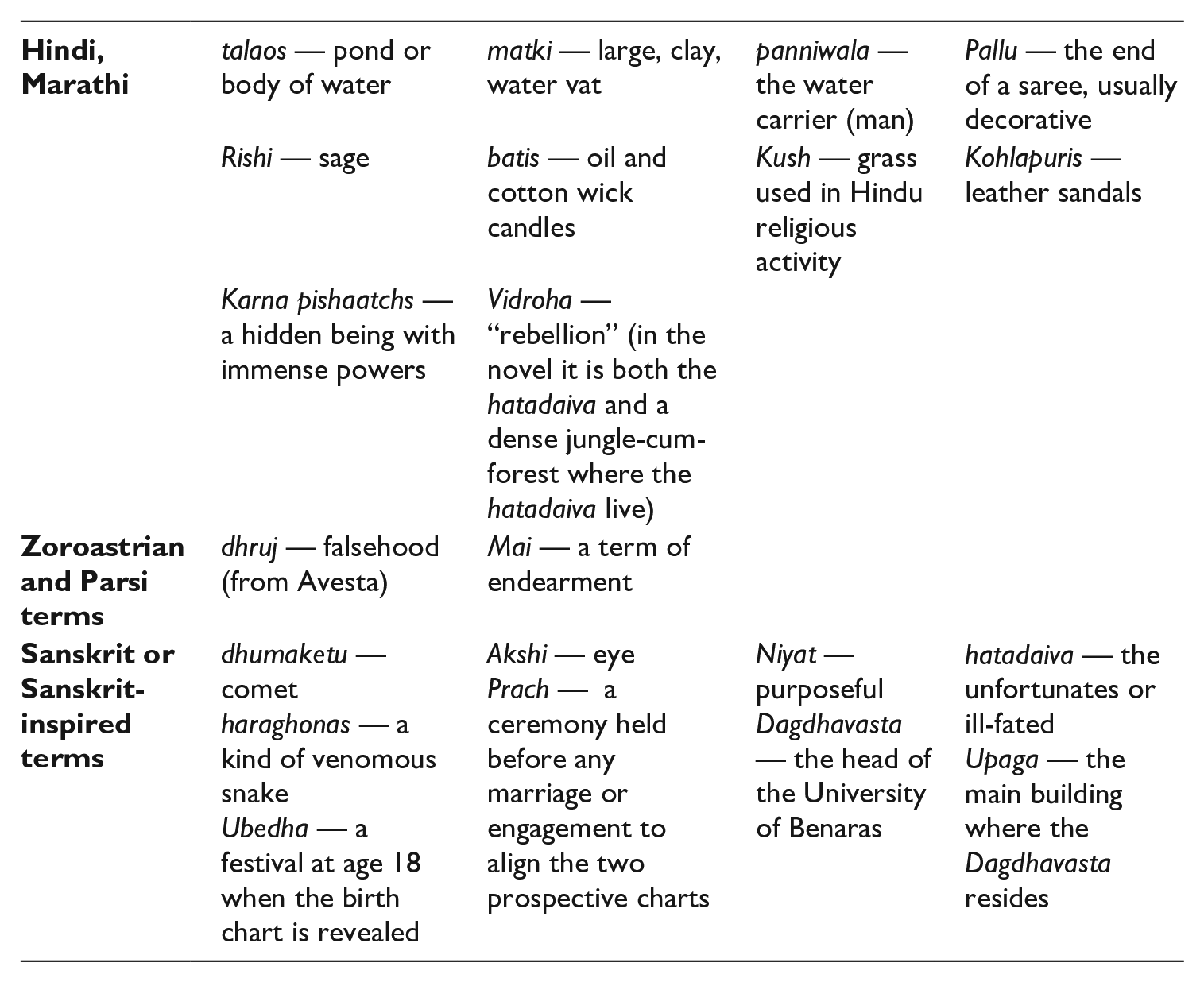
Mehta’s novel is recognisable as one that exemplifies what I have called elsewhere “linguistic dexterity” (Varughese, 2015: 89). In The Liar’s Weave a new linguistic code is created through Mehta’s invented lexemes which are typically nouns, linguistically rooted in Sanskrit. Mehta’s linguistic inventions destabilize the elevated status of Sanskrit and, consequently, the new terms force a movement away from the Hindu traditional, revered, and deeply historical — itihasa — into a place of novelty and progressiveness; in short, a movement away from an orthodoxy of Indianness as Hindu. Typical ideas of Indianness are thus challenged and reworked as the linguistic inventions speak both of a recognized Hindu Indianness whilst forging new ideas of Indianness embodied in lexemes that are not recognizably pure Sanskrit. As an extension of this linguistic appropriation, Mehta uses the term Sapta Puri for the seven institutions in her novel that are connected to the University of Benares. The Sapta Puri are commonly known to be the seven sites of Hindu pilgrimage in India, one of which is Benares (Varanasi). This shift complicates the idea that a site of Hindu pilgrimage might become a site of learning and knowledge production and in turn, we might read this as a connection to recent debates in Indian higher education. Regarding the state of higher education curricula, in a 2018 interview with Edward Anderson, Christophe Jaffrelot shares his concerns that “some disciplines are in greater danger than others. History is a case in point because of the way the ‘Vedic era’ and the medieval era may be taught one day” (Anderson and Jaffrelot, 2018: 473).
Through her invention of new terms, I suggest that Mehta encourages the opportunity for linguistic play and creativity. I note that this linguistic creativity is particularly well demonstrated in the transliteration of the invented, Sanskrit-inspired terms. Upaga, Ubedha, and Prach appear as nouns, identified as such through Mehta’s capitalisation of their first letter (just as nouns are capitalized in German, for example) and she signals to the reader on the first instance of the use of Ubedha and Prach that this word is specifically a noun by using the linguistic convention “n.” (see: “Ubedha. n.”, 2017: 12; “Prach. n.”, 2017: 202). These lexemes — Upaga, Ubedha, Prach — alongside Dagdhavasta, Sapta Puri, and hatadaiva are all Sanskrit or Sanskrit-inspired, invented terms and this provenance is marked through the transliteration of certain sounds such as the aspirated dha phoneme or the suffix vasta. Interestingly, the noun hatadaiva is never capitalized and given its meaning as the “ill-fated ones”, the term itself embodies the supposed lesser status of the hatadaiva through its lack of capitalization. The mindful use of smaller case for this invented noun places it outside of the norm and the (grammatical) system, this might be read as an echo of the physical, geographical location of the hatadaiva in Vidroha as discussed above.
As I have already suggested, Mehta’s Sanskrit-inspired terms locate the text within a broad Hindu Indian context whilst simultaneously destabilizing the Hindi or Sanskrit linguistic norms one might encounter, particularly in a religious context. This is achieved through Mehta’s invention of words — hatadaiva as a prime example — which exist in themselves as suspended terms, real and yet not real in the same moment, and thus I argue that such linguistic play contributes to the overall speculative feel of the novel. Such words exist in this specific “non-state” due to a) Mehta’s invention of the term itself, and b) due to the limits of transliteration when diacritics are not employed (as is the case in this novel). Relying on the Roman alphabet means that the pronunciation of hatadaiva, for instance, remains indistinct, even unknown: is hatadaiva pronounced with a dental, alveolar, or post-alveolar /t/? Depending on the place of articulation of the /t/, the meaning of hata- changes. And we might also consider -daiva as equally ambiguous: is the daiva here a transliteration of the word “god”, sometimes also seen transliterated as deva? If the hatadaiva are destined to be ill-fated by the gods then a pronunciation of daiva as deva sounds semantically plausible but it is this very uncertainty around these terms that locates and simultaneously displaces them, allowing the words to make sense whilst also avoiding any distinct or clear meaning. 2
The ambiguity that is brought about by this linguistic creativity further problematizes notions of Indianness, suggesting the complexity of reading identities within and outside of their original context. The absence of the diacritics and thus the potential for mis-reading and misinterpretation speaks to broader themes of Indian identities within India itself, as domestically the country grapples with saffronization and what it means to be Indian outside of a Hindu Indian rubric. Edward Anderson and Arkotong Longkumer contend that “Hindu nationalism now permeates into new spaces: institutional, territorial, conceptual, ideological” (2018: 372) whilst Meghnad Desai (2016) writes that Hindu nationalism “harbours the notion of two classes of citizens in which Hindus are the ‘original’ full members of a Hindu India while others — Christians, Muslims, Parsis — are on sufferance of the majority” (2016: 20). As I will argue further in the section below, The Liar’s Weave in its muddying of linguistic waters contributes to a complementary muddying of identity in terms of who — Parsi, Christian, or otherwise — might subscribe to and access what superficially appears to be Hindu tradition. Through the speculative nature of Mehta’s writing, the centrality of the birth chart in the novel as a predominantly Hindu practice is significantly disturbed when we learn that everyone (Hindus and non-Hindus alike) has a birth chart which reveals their (mis)fortune. We might understand the phenomenon of the in-betweens’ skyreadings and the birth charts they subsequently plot as being representative of a “pan-Indianness” in Mehta’s storyworld. Read in this way, the “birth chart” transcends ideas of Indianness as chiefly Hindu despite the prominence of the birth chart motif as “Hindu” in the present-day popular imaginary.
Oscillating ideas of “free will”
Although it is the act of lying in The Liar’s Weave which creates ideas of what might (and might not) be perceived, the novel is couched in the complementary, broader theme of “free will”. The importance of the birth chart in the novel ostensibly closes down narrative trajectories of free will, as we learn from the outset that one is either “fortunate” or “hatadaiva”: a life status that cannot be changed. This concrete and non-negotiable life trajectory is revealed by the professional “in-betweens” who read the charts. Of this unique profession, Mehta writes: “One hour you can have a fortunate, the next a hatadaiva. Nothing separates them but the second of their birth, and yet, for their lives after that, each moment is unimaginably different” (181).
Even for child characters in The Liar’s Weave, the inevitability of the Ubedha ceremony at the age of 18 restricts the unfolding of any story line of free will, given that their destiny, revealed at 18, will control all that they will be and do from then on. It is the character of Zahan, however, that suggests an alternative life trajectory and importantly, a move towards a life of free will. Towards the end of the novel, Zahan reaches the age of 18, and the moment for his own birth chart to be read arrives. It is Zahan’s mother who presents him with the birth chart because his father tells him: “Your mother asked to be the one to tell you” (193). Zahan has long suspected that his mother knows about his unusual birth chart and, moreover, that his mother and Tarachand — the family astrologer — have colluded to keep the truth from him. As the birth chart is presented to him, he notices the insignia — “blue with some sort of snake on the front” (195) — and realizes that this is not Tarachand’s insignia which is “pink, with Goddess Saraswati playing a sitar on a lotus” (195). As the family astrologer, Tarachand had read Zahan’s brother Sorab’s chart and, according to tradition, should have read his birth chart too. His mother tells him that Tarachand was too busy, and Zahan’s suspicion that a hack astrologer has compiled his chart begins to be confirmed. He flips through the book and says to his mother: “It says here that I play cricket.” “You do.” He doesn’t. It’s a lie he’s told her two years back so that he could go explore the city with Porthos. (195)
And so, it transpires that Zahan’s mother knows about his unusual birth chart, but she is unaware of his ability to lie situations into reality because, as Mehta writes: “Zahan offers her clean lies, as Sorab calls them — lies without his power, but with delicate craft” (45). It is only at the moment of his Ubedha that it is confirmed to Zahan that his mother has deceived him for the last 18 years since she has never revealed to him that she knows (from Tarachand) of his unusual birth chart, and thus of his unknown destiny. Concurrently, Zahan, living with and within that same deceit, has led a life that has increasingly through his teenage years become a web of lies and altered realities. It is only Sorab, Zahan’s elder brother, who accepts Zahan’s unusual ability, and moreover helps him to exist in the “weave” of his lies. Sorab brings his brother a notebook, announcing it as the “‘Notebook of Lies’” — “‘It’s code, so we can’t get caught’” (58). Sorab sees Zahan’s ability to lie different realities into existence simply as a “system”. He insists that all Zahan needs to do is use the notebook to “Record the world he can no longer see. Keep it safe in his words. Then he can walk among his lies, master of both the reality he sees and the one he has not created” (59). The recording of the lies acts as a repository of a reality that Zahan has created out of free will; an act of reality-making, independent of the gods’ hands and devoid of a sense of “written” destiny. In this way, the “Notebook of Lies” is a physical recording of Zahan’s oscillation between that which is known and that which is known but not perceived (through sight); a curious rendition of his “existence”. The bond of brotherhood between Zahan and Sorab speaks of a shared desire to welcome the unconventional. Sorab accepts Zahan’s unusual ability almost without question, and sees it as a progressive endeavour, a unique and positive aspect of his brother’s character. Not particularly concerned by the fact his brother has an unexplainable birth chart, Sorab embraces the possibilities that Zahan’s unorthodox life might foster. We might read such a hopeful, forward-looking attitude as indicative of India’s youth in the post-liberalized era where a combination of technology, consumerism, and infrastructure has opened up opportunities for increased personal wealth and better lifestyles (see Poonam, 2018). We might also note that Tashan Mehta, a city-based author who was in her mid-twenties at the time of the novel’s publication has only known a post-liberalized India and thus experienced an adolescence of post-millennial Indian politics and economic transformations.
As the novel progresses, Tarachand, with the knowledge of Zahan’s existence outside of the normal birth chart parameters, comes to represent a position of uncertainty and doubt in the gods’ great plans which puts both his career and his own spirituality into question. During a scene set in Hindu Colony, Bombay, Tarachand and his acquaintance Parineeta Banerjee (whom he later marries) watch devotees of Lord Ganesha place offerings at the deity’s feet. Mehta writes: They watch people place prasad and flowers at Ganesha’s feet, wishing for prosperity in a future already determined. Still, a mortal knows what a God cannot — the experience of the certain is a different cloth from the knowledge of it. (104)
This somewhat straightforward description of the act of offering prasad is complicated by Mehta’s larger narrative of birth charts and destiny as well as Zahan’s ability to lie “new” (unwritten) realities into being — and, crucially, Tarachand’s knowledge of this. Moreover, a commonplace, public act of devotion is destabilized by the presence of Tarachand, the in-between whose role as interpreter and intermediary places him between such an ordinary devotee and the deity. This particular scene calls into question the very purpose of offering prasad for a life that, according to Mehta’s storyworld, is already determined; good or bad, it cannot be changed or modified in any way. The anchoring of the novel’s starting point of “the birth chart” connects to long-established practices in mainly Hindu traditions, but it is Mehta’s invention of the Ubedha ceremony that shifts the notion of destiny into a somewhat dystopian realm. The certainty of the “death date” alongside one’s destiny as either “fortunate” or “unfortunate/ill-fated” (hatadaiva) imposes the idea of destiny as that which is inescapable in very real terms. As a departure from popular Hindu belief that a person’s future lives might be more favourable if certain practices and behaviours are fostered in the current life, 3 Mehta’s story world does not recognize such divine benevolence and thus unsettles core notions of Hindu Indianness. Rather, it is the definitive reading of one’s birth chart at the Ubedha ceremony which directs your life beyond any possible intervention that prasad-giving might offer.
In another scene, Mehta raises the possibility that a divine hand might incorrectly write a person’s fate when she describes Tarachand talking with a fellow in-between, Svasa, who asks Tarachand softly: “Would you agree with it? Arguing with the stars, if it is for a better world?” (181). In this moment, Svasa articulates what has been at the forefront of Tarachand’s mind since his reading of Zahan’s birth chart; the possibility of the gods making a mistake, of being “wrong”. As Tarachand muses Svasa’s question, he tells the reader that as an in-between: You read so many lives, you see them as stories — and then you begin to wonder, why can’t this story belong to this man? And that, to the other? Heaven knows, the lives do not always match the personalities. You see the work of the gods and you think, working on the ground, if I could only tweak this. (182; emphasis in original)
But to Svasa, he simply answers with: “It’s an argument that will get you nowhere. [. . .] Everything happens as it should happen, because it has already happened” (182). And to Tarachand’s reply, Svasa says: “Indeed” (182). Mehta’s creativity with language, through which Sanskrit-inspired terms problematize ideas of Hindu Indianness specifically, is echoed here as she plays with the idea of the astrological birth chart as a soothsayer of individual destiny. Once more, Mehta challenges Hindu tradition and orthodoxy by suggesting that a divine hand might incorrectly write a person’s destiny; that a higher being might, in essence, get it wrong. Such a possibility shakes the institution to the core; it changes everything. Zahan appears to us as the exception to the rule but rather in presenting him as a divergence from the conventional, Mehta’s narrative opens up ideas of an alternative life whereby one “belongs” differently and thus, I suggest, ideas of Indianness in their plurality.
Conclusion
It is perhaps Tarachand’s early readings of Zahan’s birth chart that communicate a sense of oscillation at its most evident and yet, simultaneously, at its most poetic, since the readings of the chart remind Tarachand of Lord Shiva appearing as the Nataraja; the lord of cosmic dance, of both creation and destruction. Mehta writes of Tarachand’s readings: It is a dance. Creation and destruction in one, appearing every nine charts in an endless number of futures. Multiple eggs and multiple dances: creative destruction, over and over again. Somehow, the boy is changing the lines. (187)
Here, we are invited to read Zahan’s life as one which oscillates between creation and destruction not simply at the level of his everyday interactions (and inherently, his lies) but also as a larger life narrative evidenced through the multiple readings of his birth chart, readings which reveal an oscillating pattern of creation and destruction in an “endless number of futures” (Mehta, 2017: 187). It is in Zahan’s unique oscillating pattern of creation and destruction that the idea of hope resides, against the backdrop of otherwise concrete and immovable destinies. Zahan is exceptional in his existence, borne out of an error on the part of the gods and yet, as the novel unfolds, despite this supposed “error”, it becomes clear that Zahan represents all that has previously not been possible. Zahan lives a life that is shaped by his choices; he is an agent of free will. Yet his own experiences of free will are tainted by the fact that the new realities he lies into existence are known, yet not ever visible to him. Despite this, the new realities he creates offer the idea of free will to others around him and thus his existence in the world, and the unique ability he has, serves a greater good than simply one that affords only him such a benefit. Just like the gods writing the destinies of the people, Zahan drops grains of free will into the lives of others in the novel, allowing a sense of hope to exist — perceived or not as it might be — in the lives of the characters. If Zahan is to be considered an agent of hope then we might read Mehta as the ultimate “author of hope” in her creation of Zahan as the one who surpasses the control meted out by the system of the birth charts. Mehta, as god-like, crafts the destinies of her characters, whilst also acting as an “in-between” herself, revealing their fate — favourable or otherwise — within her story world.
Through my presentation of the various manifestations of “oscillation” (location — linguistic — free will), I suggest in conclusion that Mehta’s novel develops a fantastical sense of Indianness both within and outside of the text. Within the text, the familiar (and less familiar) locations of Bombay and, importantly, the space of Vidroha draw upon and extend ideas of Indianness in terms of the Parsi communities, astrology businesses, and topographical features of Bombay and the city limits. Equally so, the centrality of Mehta’s linguistic inventiveness in the novel foregrounds various ideas of “linguistic Indianness” in established as well as in invented Indian language(s) terms. The anchoring of the novel in the birth chart and Mehta’s directing of a cultural lens on ideas of free will (versus destiny) also foreground, and destabilize, established Hindu motifs of Indianness.
The oscillation that The Liar’s Weave performs in terms of its negotiation of a new kind of post-millennial Indian speculative fiction is particularly noteworthy when we consider how the post-millennial (genre) fiction scene in India has been dominated by “mythology-inspired” fiction (see Varughese, 2016). I have argued elsewhere (Varughese, 2019) that a new body of Indian fantasy fiction, devoid of the mythology tropes which have been so pervasive in the post-2000 domestic Indian “mythology-inspired” body of fiction, is increasing in momentum, and Mehta’s The Liar’s Weave interfaces with this new, expanding body of work. Indeed, as I hope to have shown through the analysis above, Mehta destabilizes revered notions of the cultural and the (Hindu) religious through the content of the narrative as well as at the level of language. The speculative genre of the novel enables a fantastical space in which, through Zahan’s lies, alternate realities are created; and the jungle of Vidroha, the home of the hatadaiva, exists free from convention and Hindu orthodoxy (even though it is a product of the very same). This speculative register allows for the destabilizing of a Hindu hegemony out of which narratives of difference and varied ideas of Indianness are produced.
Despite the historical setting of 1920s Bombay in The Liar’s Weave, the novel’s concerns are particularly timely given the socio-cultural changes of India’s post-millennial years. As young Indians specifically negotiate new socio-cultural ground where individual choice is increasingly encouraged and catered to — from consumer branding, to banking, to food cultures — an increased sense of personal empowerment has been playing out in Indian society. Cultural and/or religious practices that have previously directed (or curtailed) personal choice and empowerment are being called into question as young Indians increasingly make decisions that are influenced by other sources of information which includes social media. Mehta’s protagonist evokes the idea of free will as an unstoppable force; against all the odds, Zahan overrides the orthodox birth chart system he is born into. Her choice to make a “young” Zahan the harbinger of change, representative of hope and free will, speaks to the post-millennial moment as certain demographics of young India are busy moulding and shaping the future of the nation. As Poonam writes: “Like it or not, young India is what it is — unsatisfied, unscrupulous, unstoppable” (2018: 249).
Zahan’s journey in The Liar’s Weave is primarily concerned with his identity, not his Parsi identity or even his Bombay identity (the city in which he was born and raised), but rather his identity as a young man with agency and choice. Zahan finally leaves Bombay, caught up by all that has been lied into reality. He leaves his home in order for his brother to live, and as he gets off the train in Calcutta, there is a palpable sense of hope and ambition that move him on, forward into his very own future.
Footnotes
Acknowledgements
The author would like to thank the reviewers for engaging so thoroughly with the article and for their insightful comments to improve it. Thanks also go to the JCL editors for processing the article during the challenging times of the Covid-19 pandemic.
Funding
The author received no financial support for the research, authorship, and/or publication of this article.
