




Abstract
This article brings together three seemingly disparate texts, namely, K.S. Jomo and Josie Zaini’s Meena: A Plantation Child Worker, K.S. Maniam’s Between Lives and Preeta Samarasan’s Evening is the Whole Day. By placing these narratives into conversation with each other as well as situating them against the complex history of Malaysia’s Indian minority, this essay sets into relief the legacies of the colonial plantation industry in Malaysia and its implications for this community. In the process of doing so, this article focuses its attention upon the particularly gendered implications that are illuminated by the ways in which these three texts imagine Malaysian-Indian estate girls. These renderings of both Malaysian-Indian estate girls and estate women disrupt more commonplace narratives about the ever mobile and cosmopolitan Indian diasporic subject. These texts invite us to consider those diasporic subjects who crossed oceans under the aegis of the British Empire to work in unfamiliar lands before it became de rigueur for Indian professionals to move to New York, Tokyo, London, Singapore, and so on. Importantly, when read against each other, these texts force us to contemplate what happens with a community mired in the persistent debris of decolonization while the new nation marches on.
Introduction
This article investigates the spectre of the colonial plantation industry via the multiple iterations of the Malaysian-Indian estate girl, as imagined in three very different texts. One, a humanitarian comic book called Meena: A Plantation Child Worker (Jomo and Zaini, 1984), was produced by the Institute for Social Analysis in Malaysia (INSAN) and aimed at increasing societal awareness of the brutalities of child labour. The second is a contemporary novel by Preeta Samarasan, Evening is the Whole Day (2008), which follows the lives of a privileged Malaysian-Indian family and their respective relationships with their maid, Chellam. Finally, I turn to Between Lives (2003), the most recent novel authored by the critically acclaimed K.S. Maniam. All three of these works illuminate the ways in which the Malaysian-Indian estate girl is an “uncommemorated reminder” (Hesse, 2002: 160) of the detritus of British colonialism in this former colony and the pitfalls of the kind of decolonization Malaysia experienced.
But first, what were the promises of decolonization? What was decolonization to mean for once colonized subjects? For Frantz Fanon, the philosopher and thinker who authored landmark texts that dissected colonialism, nationalism, and nation-building, the answer was unequivocally anti-colonial. Fanon stressed that decolonization “implie[d] the urgent need to thoroughly challenge the colonial situation” (1963:2). For Fanon, colonialism itself was an organized act of violence that would only “giv[e] in when confronted with greater violence” (1963: 23). At first glance, Fanon’s work on Francophone colonies may seem to be a peculiar frame with which to consider Malaysia. However, Adeline Koh and Frieda Ekotto’s “Frantz Fanon in Malaysia” (2007), powerfully demonstrates not only Fanon’s continued salience for postcolonial scholarship but the relevance of his analysis across different empires. They note that “what is most striking in the way in which Malaysia represents itself and has been represented in the post-independence Malaysian context is the striking silence on colonialism as an explanatory factor for its present society” (2007: 134). Indeed, Fanon’s unflinching attention to the resilience of colonial categories becomes particularly useful in unpacking its implications for the Malaysian-Indian minority. With specific reference to Asia during the early part of the twentieth century until the 1960s, historian Prasenjit Duara writes, “Decolonization represented not only the transference of legal sovereignty, but a movement for moral justice and political solidarity against imperialism” (2004: 2). Yet, Fanon’s revolutionary understanding of decolonization that saw it as an opportunity to make a complete and violent break from the ways of the colonial regime (as reflected in The Wretched of the Earth) and Duara’s reading of it as a moral movement against imperialism did not match the rhetoric of decolonization in then Malaya.
1
On 31 August 1957, the country’s first Prime Minister, Tunku Abdul Rahman, stepped forward to deliver a speech that was to rally the people of Malaya together on the occasion of their independence from British rule:
Thus today a new chapter opens in our relationship with Britain; our colonial status has given place to full equality but we are confident that, fortified by old associations, and linked by old memories, our ties with Britain will grow ever stronger and more durable. Britain will ever find in us her best friend and it is a source of much gratification to my Government that British Civil Servants will continues [sic] to serve in this country to assist us in the solution of the many problems which independence will present. (Tunku Abdul Rahman, 1957, Proclamation of Independence)
Rather than a total break from the colonial regime as Fanon imagined and insisted, newly independent Malaysia not only wanted to maintain a relationship with Britain but also sought counsel from its former colonial master in moulding this new country. Thus, this kind of decolonization was a transfer of political power and legal sovereignty that largely preserved British administrative thinking as well as the political and economic apparatus that had been set into place by the colonial power.
How did this absence of a radical break from the British empire during Malaya’s decolonization subsequently impact the Indian minority in this country? In this essay, I read the figure of the Malaysian-Indian estate girl in Meena: A Plantation Child Worker, Evening is the Whole Day, and Between Lives as powerfully illustrating the imperial legacies that affected working-class Malaysian-Indians owing to the mode of decolonization pursued in this country. Malaysia’s mode of decolonization kept the economic apparatus of the British plantation industry intact and this included preserving the labouring underclass of Indians in a cycle of impoverishment; this underclass was then looked upon with derision for being unable to shed the residues of life on the estates. Meena demonstrates the continued entrapment and exploitation of working-class Malaysian-Indians in estate labour. When they are not looked upon with derision, they morph into rescuable subjects, as the use of the estate girl’s narrative in a regional humanitarian comic represents.
Chellam of Evening is the Whole Day makes visible the tension between privileged Indians and these working-class subjects. Samarasan captures the multi-layered nature of this tension as the privileged Indians in her text struggle with their need both to save Chellam from her estate fate and to distance and distinguish themselves from her. For the Indian family that employs Chellam, her body speaks volumes. Everything from the oil she rubs into her scalp to her broken English is a reminder of that estate past. They want no such reminders. Here, the Malaysian-Indian estate girl memorializes the failure of the Malaysian nation-state to dismantle the colonial plantation industry and to bring the descendants of Indians who were originally transported to labour in this colony into the fold of the nation. However, it is Sellamma of Between Lives who transforms the “estate” from the site of dysfunction that it is in the educational comic and the epithet that it is in Samarasan’s novel into a space of renewal and potential. Sellamma (in fact, a variation of the name Chellam) opens up the possibility for the estate girl to be more than simply a rescuable or detestable subject in the Malaysian imaginary.
A brief history of colonial-sponsored Indian migration to Malaya 2
In his landmark study The Literature of the Indian Diaspora, Vijay Mishra draws attention to a blind spot in scholarly discussion of the Indian diaspora that has pivoted upon Indian communities in the global cities of New York, San Francisco, London, and Toronto and shaped these sites to be the “self-evidently legitimate archive with which to explore histories of diasporic subjectivities” (2007:3). The Malaysian estate girl is an integral diasporic figure that has yet to be closely examined, despite her capacity to destabilize hegemonic narratives that position Indian diasporic subjects as ever mobile and cosmopolitan global citizens and to shift that temporal and geographic focus to an earlier moment in diasporic migration.
The Malaysian estate girl is a descendant of the community of Indians that first traversed the great oceans of the world when the British empire deemed them suitable to work the plantations of its imperial domain. South Indians, in particular, were seen as a very attractive workforce for the British colonial economy in Malaya. In the now classic Indians in Malaya: Some Aspects of Their Immigration and Settlement, Kernial Singh Sandhu enumerates the reasons why this was the case at the time:
The South Indian labourer was preferred because he was malleable, worked well under supervision, and was easily manageable. He was not as ambitious as most of his northern Indian compatriots and certainly nothing like the Chinese…he was most amenable to the comparatively lowly paid and rather regimented life of estates and government departments…Acclimatization to Malayan conditions was comparatively easier for him as South India was not totally different from Malaya climatically. (Sandhu, 1969: 56)
In addition, the fact that both Malaya and India were British colonies drastically reduced any potential red tape that might have hampered this intra-empire migration. Simultaneously, for many Indians, Malaya was a thriving colonial outpost that represented new economic opportunity. In the excerpt above, the Indian labouring body in British Malaya is unmistakably male. According to Sinnapah Arasaratnam’s Indians in Malaysia and Singapore: “The kind of work available, the living conditions, and the attitudes of the time, were not conducive to the migration of females in any large number. This is reflected in the 1891 census, when there were 18 females per 1000 Indian males” (1970: 32).
This attitude began to change as the colonial government contemplated the advantages of having a domesticated work force. Stabilizing the sex ratios was imagined to be the panacea for the occurrences of violence among male labourers. The reality was that women would perform similar, if not identical tasks as male labourers, only to be paid less. Ironically, male recruiters across the British empire were paid more money when they recruited women to work in the colonies. This was especially the case when various administrative and colonial efforts were made in the mid-nineteenth century to fix the ratio of male emigrants to female emigrants. While Malaya was exempted from these fixed ratios, the differing compensations offered to recruiters based on a labourer’s sex began altering the demographics of the Indian population in Malaya. It has been noted (Arasaratnam, 1970: 32) that by 1911, there were 308 women to every 1000 men, in 1921, 406 women, 482 in 1931, and 692 by 1957.
Unsurprisingly, women were subject to the sexual advances of their male counterparts as well as those of colonial intermediaries and administrators. 3 Often enough, the presumption was that women who were willing to leave their homes to work in a foreign country were sexually available, or, at least, sexually vulnerable. British planters were typically discouraged from marrying in their first tour of duty. Thus, they often made use of the women on the plantation, engaging in consensual relationships or non-consensual sexual encounters. On paper, these men were encouraged to maintain a high standard of morality, and sexual improprieties with local women were threatened with official reprimands. However, in A Company of Planters: Confessions of a Colonial Rubber Planter in 1950s Malaya (2007), John Dodd recalls feeling unofficially initiated into the circle of planters once his colleagues discovered that he had contracted a sexually transmitted disease from a local woman. Despite official policy regarding the expected conduct of British planters and administrators, sexual relations with the local women who worked for them was seen as a rite of passage that drew the greenhorn fresh from England into the fraternal fold of his co-workers.
Indian estate workers typically lived on the plantations where they worked. The estate consisted of “accommodation for the workers, the residences of the manager and other subordinate administrative and technical staff, a factory, office, shop, dispensary and a toddy (liquor) shop” (Lal et al., 2006: 160). 4 There was a strict division on the plantations between the labouring Indians and the administrative class of Indians and Sri Lankans. This gulf was made visible in some of the mundane aspects of life on the plantation. For example, in The Devil’s Milk: A Social History of Rubber (2011: 275), John Tully notes that Indian labourers were expected to dismount their bicycles in front of their British managers and the administrative class of Indians and Sri Lankans. All this is particularly ironic since one of the lures of Malaya was the absence of an oppressive caste system like that seen in India at the time.
As the Malaysian economy made the transition from a purely export-oriented one to a service-oriented economy, plantations and the individuals that live and labour in them have become increasingly obsolescent. In 1991, former Malaysian Prime Minister, Tun Dr. Mahathir Mohamad outlined Wawasan 2020 or Vision 2020, a national goal to transform Malaysia into a fully developed country by the year 2020. Integral to this goal was creating a Malaysia that was both an industrial powerhouse and a technological hub for Southeast Asia. The thousands of hectares occupied by plantations became increasingly attractive options for megaprojects growing out of Malaysian cityscapes. 5 A political pamphlet published during Malaysia’s general elections called Election 2004: New Politics for Indian Malaysians, outlined the most pressing concerns for the Malaysian-Indian community. These included “the socio-economic inequality between the Indian poor and rich”, “low cost housing needs of the Indian poor”, “[a]ggressive displacement of Indian Malaysians”, and “the negative consequences of the final breakdown of the plantation economy on the Indian rural poor” (Group of Concerned Citizens, 2004: 4). Legacies of the plantation industry continue to be of immediate concern to the Malaysian-Indian community, particularly to the segments of that population that are most affected by those very legacies.
Parsing colonial legacies in Meena: A Plantation Child Worker
In August 1984, the Institute for Social Analysis in Malaysia, together with the Anti-Slavery Society in London, published Early Labour: Children at Work on Malaysian Plantations. The investigative work involved in Early Labour surfaced two true stories that were to become the artistic and intellectual inspiration for Meena: A Plantation Child Worker. This text is an early example of the robust genre that is the humanitarian comic. The humanitarian comic has gained momentum for both its teachability and dispersibility. It has the capacity to tell big stories quickly and in small, digestible bites. In 1996, the U.S. Department of Defense, DC Comics, and UNICEF collaborated to release a landmine awareness comic book in Bosnia, Kosovo, the former Yugoslavia, and Central America to inform children about the dangers of landmines. In 1997, the non-governmental organization “World Comics” established by Leif Packalen began encouraging the educational use of comics in developing countries and teaching grassroots activists how to draw cartoons that best addressed local conditions. Most recently, the European Commission printed more than 300,000 copies of Hidden Disaster (2010), which follows the lives of two employees of the EC’s Humanitarian Aid Department as they attempt to raise money for the earthquake-struck state (albeit fictional) of Borduvia.
At first glance, one might be tempted to read Meena as nothing more than the combination of two true stories. However, in “Human Rights and Comics: Autobiographical Avatars, Crisis Witnessing, and Transnational Rescue Networks” (2011), Sidonie Smith reminds readers of the sheer number of hands, eyes, and ears that mediate these true stories. In email correspondence with K.S. Jomo, the chief writer of Meena, he claimed not to have cared for some of the artistic touches of the cartoonist. This puts into perspective both the supposedly autobiographical underpinnings of this text as well as the multiple levels of mediation between the story told by the subject and the textual and pictorial narrative we eventually read. 6
The figure of Meena has the potential to be an unsettling one for the Malaysian nation-state. She illustrates that the route of decolonization pursued by the erstwhile leaders of Malaya has aided and abetted the preservation of the plantation industry that rules every move her body makes. Meena’s entrapment within the plantation industry is strikingly conveyed through the frames of the comic that contain her limbs and thoughts. It is a visible reminder that the race-based compartmentalization of this former British colony did not simply disappear with the three rallying cries of “Merdeka” or “Independence” on 31 August 1957 when the Union Jack was lowered. On 6 March 2011, Malaysia’s Deputy Minister of Plantation Industries and Commodities called on working-class Indians unable to thrive in the cities to return to the estates operated by government-linked companies such as Sime Darby or Guthrie. After all, they provide free housing, water, electricity, transport, playing fields, and medical benefits (The Malaysian Insider, 2011). Almost fifty-five years after independence, the only solution that the Malaysian nation-state can offer to impoverished working-class Indians is to reinstate them in the very estates in which the British first installed their ancestors, even as those estates are disappearing from the Malaysian landscape.
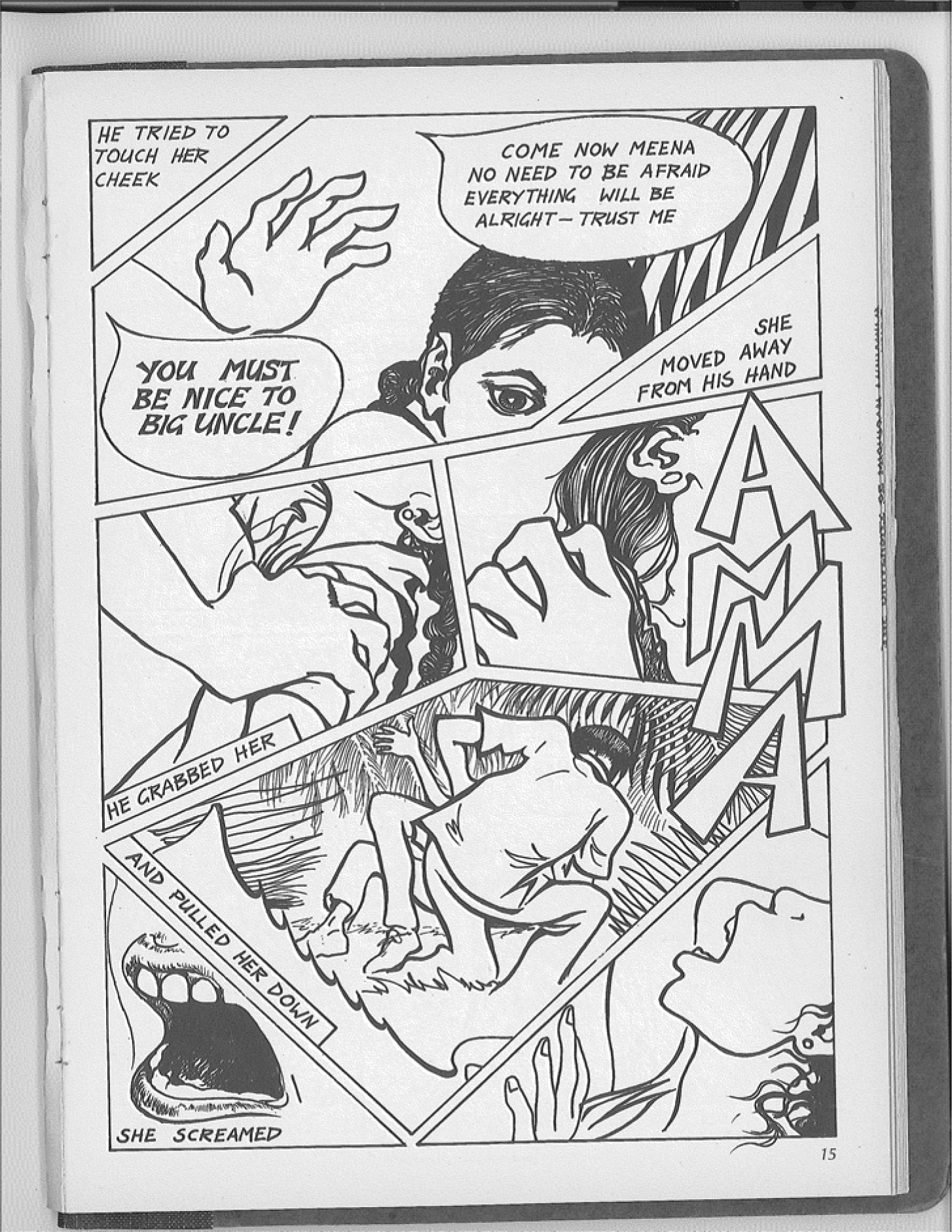
The colonial past imprints itself upon the most quotidian aspects of Meena’s daily life on the plantation. Late for the morning roll-call at the plantation muster ground, Meena runs to join her family as they await their work instructions for the day from the foreman. The muster ground, the very place in which the plantation administrative class once ventriloquized the expectations of the colonial master, continues to loom large in Meena’s existence. It remains a spatial symbol of the colonial master’s economic imperative. 7 As Meena struggles with her harvesting duties and thoughts of the inevitably low wages they are to garner from the day’s work, she cannot seem to get over the strange look that came over the foreman’s face when he saw her that morning at roll-call. It is significant that Meena is especially disturbed by the way that the foreman stares at her. While the colonial administrators are no longer present, that simultaneously erotic and economic gaze persists. Indeed, in this instance, we see the social hierarchy of colonial plantation life playing itself out upon Meena’s body. Turn the page and the frame of the comic can barely contain the leering foreman’s face. It takes up a quarter of the frame and his verbal advances threaten to explode off the page as the font grows larger and larger, thicker and thicker. The foreman bargains: “ ‘BIG UNCLE COULD MAKE YOU HAPPY TOO! YOU COULD HAVE YOUR OWN JOB! AN EASY ONE, OF COURSE, IF YOU MAKE BIG UNCLE HAPPY’” (Jomo and Zaini, 1984: 14). He offers Meena some potential measure of economic independence in exchange for sexual control of her body. As if responding to the dangerous explosiveness of the previous page, the adjoining page shatters into eight smaller, shard-like frames. Likewise, Meena’s body splinters into these frames as the foreman attempts to rape her. By the bottom of the page, Meena’s body has been reduced to her screaming mouth as she calls out for her mother in Tamil. When Meena’s mother informs her husband of the assault, emasculated by his own position within the plantation industry, he can only offer the patriarchal solution of protecting Meena by marrying her off. And when her mother protests that Meena is only thirteen, he, like the foreman, demands silence regarding the matter. The solution that Meena’s father tentatively offers is one that further entrenches the figure of the Malaysian-Indian estate girl within the self-enclosed plantation community. Her father’s solution is laughable in its inability to truly free Meena. However, Meena’s body as potentially caught between two patriarchal figures is reminiscent of the position of Indian plantation workers during decolonization in this country. Rather than a rethinking of the colonial plantation economy as a whole, these labourers were merely shifted from being under the control of the British to the control of government-linked companies under the aegis of the nation-state. This once again returns to the pitfalls of the kind of decolonization that maintains the machinery of the colonial master. Meena illuminates the dogged continuities of the colonial plantation economy in post-independence Malaysia and the position of labouring Indian women within that structure. Indeed, Meena is conscious of the inherited and multi-generational nature of her work. Frame after frame, Meena heaves her axe into the air before bringing it down upon the oil palm fronds. While the act in itself is repetitive, it is not mindless. Although the illustrations of her working body begin to blur into endless toil, Meena’s mind displays an acute awareness of the way in which the plantation as a structure has reproduced working classes and labouring women: “It had always been like this, working in the plantation, and so it would go on, no doubt, until she got married and had children of her own, then back to work in the plantation, just like her mother did – and her grandmother” (1984: 11). Just as that gendered and racialized history of labour repeats itself, it crops up again and again in the narrative. In the penultimate frame of the comic, Meena lies down to sleep and contemplates the respective pasts of the working bodies of her female ancestors and her own future as a gendered subject in the Malaysian plantation industry. Even in this most intimate moment of sleep, it is the centrality of her body to the functioning of the plantation industry that looms large, robbing her of what respite she has. And in Meena’s mind, generations past, present, and future are always already labouring subjects. This familiar colonial logic of women as reproducers and sustainers of life inscribes itself upon Meena and intrudes upon the very space in which Fanon imagined a colonized subject “jumping, swimming, running and climbing” free from the reality of colonization (1963: 15). Meena’s every bodily move is observed, measured, and controlled by the new representatives of a plantation industry that was hammered into the Malaysian social geography and was never taken apart during decolonization.
Estate as epithet in Preeta Samarasan’s Evening is the Whole Day
I’ve heard young Calcuttan women, anthropologists, talking about how they should relate (which is basically a U.S. discourse), as advantaged people, let’s say, for example, to the women in the tea gardens. And I asked the particular young woman the question, how do you deal with servants in your house in Calcutta? Why doesn’t that question arise? What are the construction, constitution, political feelings, history, relationship to the female servants in our households? I think that’s the most important question. (G.C. Spivak quoted in Bahri and Vasudeva, 1996: 73)
This excerpt from an interview conducted with Gayatri Spivak challenges scholars to grapple with the socio-economic and gendered dynamics that exist within the household unit, although it might be more commonplace and comfortable to interrogate one’s relationship with the women labouring in the tea garden or a plantation, as the case may be. A very crucial difference between Meena and Samarasan’s Chellam is that Chellam is not neatly hidden away within the world of plantations. One might describe Chellam as a Meena who has been saved, plucked out of the estates by the hands of humanitarianism. Chellam enters the cityscape and the domain of urban, middle-class Malaysian-Indians, where she becomes a living, breathing, speaking archive of disturbing cultural and national narratives that many wish to forget. While Meena: A Plantation Child Worker has the potential to articulate the powerful legacies of the colonial economy in a post-independence Malaysia, Samarasan’s novel draws upon the figure of the estate girl to interrogate the division between rural and poor Indians and middle- and upper-class Indians that was wedged into place during colonial rule. Indeed as Barbara Andaya puts it: “The history of Indians as an ethnic group in twentieth century Malaya/Malaysia has been the struggle to attain a measure of unity” (Andaya and Andaya, 1982: 180). Evening is the Whole Day follows the lives of the prominent Malaysian-Indian residents of the Big House on Kingfisher Lane. The narrative itself opens with the unceremonious departure of the maid named Chellam from the Rajasekharan household. 8
Like Meena, Chellam is a powerful memorial of Malaysia’s colonial past and the challenges of its particular decolonization. The perpetuity of the plantation industry and the continued exploitation of the Indian workers on these estates renders uncertain their citizenship as Malaysians. Chellam’s very existence as a Malaysian citizen seems uncertain in the following instance. When Chellam enters the lives of the Rajasekharan family, the first thing that comes into question is how old she is. The lady of the household questions Chellam regarding her age but Chellam simply repeats over and over again, “No birth cettificayte, Madam” (Samarasan, 2008: 323). Here, the reader is left wondering if Chellam is trying to hide the fact that she is as young as she looks. Simultaneously, the absence of a “birth cettificatye” recalls the statelessness of numerous Indians born on Malaysian plantations during the period in which the novel is set. In “Political Marginalization in Malaysia”, Chandra Muzaffar draws attention to an important moment in 1969 when the Malaysian government announced that all non-citizens would have to apply for work permits. He writes: “This affected Indians in the main, since thousands of them, especially plantation labourers, were actually stateless. In many instances, they failed to become citizens – though born and bred in the country – through sheer ignorance” (1993: 222). What Muzaffar does not say is that ignorance is bred from the self-sufficient structure of the plantation economy, which made it unnecessary for workers to engage with the world outside the borders of the estate. Thus, Chellam’s opening words in this novel bring to mind the unsettlingly precarious position of working-class Indians in the Malaysian body politic at the time.
The moment Chellam opens her mouth to speak, her “broken English” signals the decades of educational impoverishment on Malaysian plantations during the colonial era and after decolonization. Andaya and Andaya note in their discussion of the educational options available to Malaysian-Indians under British rule: “Any parent seeking higher education for his child had to turn to the English-medium schools, but fees were often prohibitively high for a common labourer” (1982: 223). One of the most devastating divisions on these estates was the stark contrast between the education received by the children of estate workers and those of the administrative class of Indians and Sri Lankans. The administrative class typically sent their children to English schools in the towns while the estate workers often sent their children to the makeshift schools on the estate. Estate teachers had little, if any, training. In addition, students who attended these schools were at a distinct disadvantage because the medium of instruction was typically Tamil. Even when they did complete some kind of course of study in Tamil, they were less desirable job candidates in comparison to their counterparts, who were fluent in English and/or Malay. Moreover, since children on the plantations could in fact contribute to a family’s weekly income, there was little incentive to study when they could have been earning money for the family unit. Inadvertently, plantation schools reproduced a labouring class that fed back into the colonial economy. Thus, Chellam’s broken English becomes a historical marker of the educational gap between poor Indians and their middle- and upper-class counterparts in the urban areas of Malaysia. Chellam’s speech acts illuminate both powerful colonial legacies and the national failure on the part of the nation-state and on the part of privileged Malaysian-Indians to fold these working bodies into Malaysia after decolonization. Indeed, Lawyer Rajasekharan’s family displays various levels of impotence when it comes to enabling Chellam to live successfully in the cityscape. And in the turning point of the narrative, the family acts in concert to thrust Chellam back whence she came and into the hands of her abusive father. The Rajasekharan family behaves no differently than the Malaysian minister who encouraged working-class Indians to return to the safety of the estates and the plantation industry if they could not survive in the towns and cities. Rather than questioning what it is about Malaysia’s collective history that makes it so difficult for working-class Indians to live outside the estate, the first recourse seemed to be to send the problem to its source and to let it fester there.
It is not her speech acts alone that render Chellam the estate girl as a troubling figure in this narrative. Throughout the novel, Chellam is repeatedly and derisively referred to as a “rubber estate girl”. Encapsulated within that geographical, occupational, racial, and gendered epithet is a desire to distance middle-class Malaysian-Indians from these bodies that represent the economic space that is the estate. In the following passage, Lawyer Rajasekharan’s son, Suresh, painstakingly enumerates all of Chellam’s bodily indiscretions:
They hate her coconut hair oil and her hairy armpits and her crushes on fat Tamil actors with moles; they hate her broken English, to which they sometimes stoop in mockery; they hate her T-shirts that came free with Horlicks and Kandos chocolates. They hate all the evidence of her rubber-estate tastes: the shiny polyester blouse she wears to run errands in towns, the gaudy flowers she puts in her hair before going out, the chipped, pillar-box-red Cutex on her fingernails. And they hate her dirty habits: the yellow crotch stains on her underwear on the clothesline, the wiry, too-curly black hairs stuck to her soap bar. “Eee,” Suresh says when he points these out to Aasha, “you know where these come from or not?” Aasha, though she did not know before, knows now, suddenly and surely, without needing three guesses. Then one afternoon they catch Chellam stealthily picking her nose with her pillar-box red nails. She wipes her fingers behind the living room settee and under the side table before pulling a hairpin from her head and running it under the fingernails to dislodge crescents of dirt that fall onto the white marble floor. “Ee-yer,” Suresh whispers, “now just see, she’s going to go and mix Paati’s rice and paruppu curry with her hands. A real estate-woman she is.” And later; a rhapsodic improvisation on Chellam’s dubious origins between Suresh’s ears: “Estate-prostate-prostitae-prostitute! Estate prostitute with brothel fingernails!”. (Samarasan, 2008: 252-3)
From the olfactory intrusiveness of her hair that reeks of coconut oil, the yellow stains she leaves on her underwear, her wiry pubic hair that gets caught on a cheap soap bar to the underarm hair that peeps out from the free T-shirts she gets from her charitable employers, her body is imagined as unruly, excessive, and repulsive. In his introduction to Nation and Narration, Homi Bhabha writes: “The other is never outside or beyond us: it emerges forcefully, within cultural discourse, when we think we speak most intimately and indigenously ‘between ourselves’” (1990:4). Suresh’s diatribe against Chellam’s body takes place precisely within this dynamic as he shares a private moment with his younger sister, Aasha. Here, the adolescent Suresh is both anthropologist and anatomist. However, what is most disturbing is the ease with which the privileged Malaysian-Indian subject of Samarasan’s novel inhabits the gaze of the colonial administrator in his visual dissection of Chellam’s body. Not only does Suresh inhabit the gaze of the colonial administrators, but he is also fluent in what Fanon called that “colonial vocabulary” which “dehumanized the colonized subject” (1963: 7). Fanon writes: “Allusion is made to…the odors from the ‘native quarters,’ to the hordes, the stink, the swarming, the seething, and the gesticulations” (1963: 7). Suresh traffics in such allusions in his verbal assault on Chellam’s body. That Suresh starts with Chellam’s “coconut hair oil” is unsurprising. Coconut oil is believed to improve dry or damaged hair and is often used as a conditioner by particular communities of Indian peoples. It is also known for its pungent and some might say unpleasant aroma if one is not used to it. It can be, and is seen as, a form of gaucheness, a practice that belongs in the estate world and not beyond those borders. 9 Suresh’s hatred for Chellam’s coconut hair oil echoes a similar revulsion that several colonial era authors illustrated in their writings. In Henri Boulle’s Sacrilege in Malaya, Maille, a French planter stationed in a Malayan rubber estate, ponders the exotic appeal of his Indian cook’s wife. He carefully rests his gaze on each part of her body, taking in everything from the gold studs that adorn her nostrils to her long, attractive legs. Yet, amidst this erotic cost-benefit analysis of the cook’s nameless wife, he remembers one of her drawbacks, namely, that she “left a smell of coconut-oil on everything she touched, and the room stank of it for hours afterwards” (1983/1958: 138). 10 This colonial reverberation is evident once again when Suresh makes note of the way in which Chellam appears to take secret pleasure in the debris of her own body as she quietly picks her nose, separating herself from the numerous demands of the Big House family. Indeed, she possesses a playfully curious relationship with her own body where she excavates the “crescents of dirt” that have collected under her fingernails and toys with them. Suresh’s distaste for Chellam’s hygiene or lack thereof bears a striking resemblance to the reaction of Willard Bush in Pahang: The Saga of a Rubber Planter in the Malay Jungle (1938) to two Indian women assisting a thirteen-year-old girl in labour. Bush finds himself nauseated from the sight of the women “pull[ing] and tug[ging] at her…with hands that had never known soap and nails that were long and held all the filth of the lines” (1938: 171). Suresh, a fictive Malaysian-Indian male and the others planters from another time, are all united, nevertheless, by their disgust for the labour performed for their profit and the very embodiment of that labour in these estate women. However, Suresh’s attitude is distinctive because it reflects how privileged Indians in the novel imbibe the very vocabulary and outlook of colonial masters when relating to their working-class counterparts such that “estate” in and of itself becomes a derogatory adjective. In the final lines of this excerpt, Suresh experiments with a Linnaeus-like taxonomy as he attempts to classify Chellam as different from himself. However, instead of a biological taxonomy, Suresh offers an economic one as he moves from “estate” to “prostitute”. Remarkably, this mirrors Malaysia’s own move from an export-oriented economy to a service-oriented one and speaks to the estate bodies trapped in the middle.
Suresh’s ability to draw that distinction between bodies like his and Aasha’s in comparison to Chellam’s estate body is an important one for the survival of privileged Indians in Malaysia. Chellam-like bodies are liabilities for privileged Malaysian-Indians attempting to shed any hint of their collective labouring background. Suresh’s capacity to articulate that he and his family are not like the gauche, uneducated, and unclean estate workers aligns him alongside the nation-state rather than alongside the working-class Indian.
Thinking coolly/coolie: A historical and gendered mode of analysis
While Samarasan’s Suresh performs an active disavowal of both Chellam’s estateness and the history of Indian labour that she represents, K.S. Maniam’s Between Lives (2003) imagines alternative possibilities for this deeply fractured community of Malaysian-Indians. Maniam’s novel pivots upon the relationship between Sumitra, a middle-class caseworker from the Department of Social Reconstruction, and Sellamma, an elderly woman whom Sumitra must convince to sell her land to a condominium developer. In order to gain her trust, Sumitra simply plays along when Sellamma appears to believe that Sumitra is none other than her long-lost older sister, Anjalai-akka. Thus, Sumitra allows her body to become an organic site upon which Sellama’s memory of her sister replays itself. Sumitra participates in the physical act of remembering as she partakes in the activities that Sellamma and Anjalai-akka used to enjoy.
At the outset, Sumitra sees these activities as the key to understanding Sellamma’s stubborn refusal to give up her land. However, Sumitra finds that these memories prompt numerous unanswered questions about her own family’s history. Very early on in the novel, Maniam showcases the family’s discomfort surrounding their origins. For Sumitra’s family, particularly her father, material success in Malaysia and the acknowledgement of one’s history are utterly incompatible. “‘History? You think history brought us all this?’ he says, his sweeping gesture including the two-storey bungalow, his other pride of possession, resting on a spacious compound” (2003: 9). 11 In that grand gesture that delineates all that he owns, he sweeps away his seemingly irrelevant personal history. 12 Her repeated visits to Sellamma’s land alert Sumitra to the way her father truncates his own narrative. After all, any narration of his life begins with his time at the university that spring-boarded him into a successful career as a bureaucrat. This antagonistic attitude towards history is not limited to Sumitra’s father. Her grandmother, Paati, performs a brutal excision of her personal history when she says nothing throughout the novel about her other sons and daughters. These individuals are non-entities in Paati’s life and that of Sumitra’s father. Their collective silence about these individuals is remarkably curious until Sumitra’s father divulges that his siblings “wanted to bury themselves in some hole of an estate” (286). Sumitra’s father echoes the sentiments of Lawyer Rajasekharan in Samarasan’s Evening is the Whole Day. After all, Lawyer Rajasekharan declaims to all and sundry that “…the Malays get all the government jobs, the Chinese have their businesses, and the stupid doonggu Indians are left empty-handed to slog in the factories and ditches and rubber estates” (2008: 211). What Sumitra’s father and Lawyer Rajasekharan share is their conviction that Indians in the estate have only themselves to blame. While “estate” is a cutting adjective in the mouth of Samarasan’s Suresh, for his father and Sumitra’s father, “estate” is a space of irrevocable failure that must be kept at a distance from the middle-class Indian’s accomplishments.
Yet, Sumitra’s relationship with Sellamma transforms “estate” from an epithet and a site of dysfunction into a space of renewal and potential. Sellamma enables this transformation by compelling Sumitra to steep herself in the labouring history of the Malaysian-Indian community. Indeed, Sumitra is ideal because she inadvertently calls this history into being as she talks herself through ways and means of engaging with Sellamma:
As I drive out to the old woman’s place, I’m excited but not as confident as I’d felt last night. With all the training and experience I’ve had, I still feel inadequate. You’ve gone through this before, Su, I tell myself. There’s nothing to fear. Ya, I counter myself, but every case is supposed to be new. Supposed to be treated as new. How can you forget that? I haven’t. That’s why I feel like this. Think coolly then. (21)
As Sumitra is thinking out aloud, she stumbles upon this coolie/coolly history when she convinces herself to “[t]hink coolly”. Through Maniam’s playfulness with these homonyms, he recuperates this racial slur. Thinking coolie becomes a historical mode of analysis and a way for Sumitra to map the coordinates of her own identity in relation to Sellamma.
This is not to suggest that Sellamma simply offers a return-to-the-land-type utopia. The memories of the labouring past that she makes visible to Sumitra are simultaneously troubling and challenging. Importantly, Sellamma’s memories offer a powerfully gendered understanding of this Indian history in Malaysia. Sellamma recalls her mother’s disillusionment with their new life in Malaysia when she mocks her husband’s decision to leave India for the colony. “‘We’ll see the world! A land better than the one in the Ramayana you said!’” (89). The way in which she articulates her unhappiness is worth noting because it challenges Indian diasporic narratives that align themselves with the epic. In Mythologies of Migration, Vocabularies of Indenture, Mariam Pirbhai highlights how particular Indian communities have come to see “the stories of the Ramayana (and Rama’s distinctly male plight of suffering, exile, and heroism) as the spiritual corollary to diasporic experience” (2009: 26). Sellamma’s mother does not only draw attention to the women who undertook the perilous journeys to these new lands. She calls into question the patriarchal undertones of the Hindu epic that typically portrays Sita as Rama’s devoted and chaste wife who accompanies him during his period of exile. While Sellamma’s mother questions the gendered underpinnings of this epic as an allegory for the Indian diasporic experience, Sellamma and her sister rewrite the Ramayana through their cultivation of the Rama-Sita vegetable garden. They scramble the narrative of Sita’s unflagging chastity by transforming this garden into a space where they access and articulate their adolescent sexual desires. At first glance, the name of their garden gestures toward a desire that is distinctly heterosexual. However, Sellamma’s memory of their tactile experiences in the garden indicates other forms of desire. She remembers, “They moved on to the rows and rows of brinjal plants; the lines running on the purple or green fruits, like veins, roused strange feelings in them”. The two girls breathlessly caress the brinjals that one of them calls “Sita’s breasts” (184). Not only do Sellamma and her sister queer mainstream readings of Sita, they suggest complex and uncategorizable modes of desire for estate girls that are absent in Samarasan’s rendering of Chellam or in Meena: A Plantation Child Worker. There, the only form of desire that the Malaysian-Indian estate girls experience is the brutal, heterosexual gaze of the male foreman or that of the middle-class Indian male. Sellamma’s memories of the Rama-Sita garden posit sites and routes of desire that are seemingly impossible in these two other texts.
It is no surprise then that Sellamma resists the simplistic solution of marriage that Meena’s father instinctively suggests in the cartoon when he hears of the foreman’s attempt to rape her. And while readers of that humanitarian text are positioned to see that as a laughable solution that only further entrenches Meena in the estate, Maniam’s novel suggests that the middle-class Indian father in Malaysia offers a similar solution to his daughter. Sumitra’s father’s solution is couched in the language of humanitarianism and social uplift. “‘Role models’, he said, having picked up the word recently. ‘That’s what our community needs. Especially the women. You can help there, Sumitra’. I saw myself wearing a glittering, wide-bordered sari and standing by the doctor’s side, while he opened kindergartens, estate schools and tall business premises” (238). Here, Sumitra’s father epitomizes the middle-class Malaysian-Indian who proffers the panacea of “role models” when confronted by the challenges that plague the Indian community. Sumitra’s own reluctant imagining of this middle-class future as a doctor’s wife is especially incisive when read against Lawyer Rajasekharan’s family in Samarasan’s Evening is the Whole Day. Not only is Mrs. Uma Rajasekharan’s existence as a lawyer’s wife a dismal one, the entire family’s treatment of Chellam undercuts the clarion-call that implies that all the Malaysian-Indian community needs are role models. In fact, the Rajasekharans are those much-vaunted role models who alternate between impotence and viciousness in their interactions with Chellam. In Maniam’s novel, Sellamma distances herself completely from the institution of marriage and offers Sumitra the freedom to do so as well. Indeed, the memory-work that goes into their relationship allows Sumitra openly to articulate that “[m]arriage isn’t the answer to everything” (211). Her relationship with Sellamma prompts Sumitra’s mother, Gowri, to unpack the patriarchal underpinnings of her relationship with her husband and her mother-in-law. Prior to Sellamma’s presence in their lives, Sumitra’s memories of her mother and her parents’ marriage is riddled with gaps. Yet, once Gowri joins Sumitra and Sellamma on her land, it prompts her to remember, to think coolie, and to narrate her own past as an estate girl.
Meena’s narrative, the game of Parcheesi that the cartoon inspires, as well as the post-activity small-group discussion all insist upon an intervention into the seemingly inexorable cycle of estate labour. However, Sellamma invites us to imagine alternative cycles of inheritance that upend the abjection of Meena’s story. In the days before she dies, Sellamma engages in her own treasure-hunting game with Sumitra and Gowri where she gently prods them to search for her hidden land title so that she might transfer her land to Sumitra. This collaborative gesture by three generations of Malaysian-Indian women to safeguard Sellamma’s land powerfully challenges the simple inevitability of Meena’s, her mother’s and her grandmother’s fate. Furthermore, this act of transferring Sellamma’s land to Sumitra (from one woman to another) can be read as speaking back against the discourse of inheritance that is embedded in Malaysia’s political landscape. Malaysia’s masculinist and nativist discourse of inheritance is encoded in the category of bumiputera, or sons of the soil. This category marks the “special position” of the Malay majority as codified by the Federal Constitution of Malaysia. While none of these women fall under the state-recognized category of bumiputera, Sellamma’s decision to leave the soil that she so tenderly cared for to Sumitra identifies her as a daughter of the soil. In doing so, Sellamma opens up alternative possibilities for forms of recognition that exist outside state circuits.
Conclusion
As Arasaratnam notes, Indian women were recruited to work in British Malaya to provide a “settled labour force” (1970: 32). Yet the figure of the Malaysian-Indian estate girl is anything but settling. Meena, Chellam, and Sellamma kick up the dust of Malaysia’s colonial past, reminding those who encounter them of the ways the gauche estate girls sustained the plantation economy with their myriad labours, forced or otherwise. No doubt, the end of British rule in Malaya saw the transfer of both legal and political sovereignty. While this was an integral step to decolonization, the leaders of Malaya maintained the colonial rigging that the British used to both administer the colony as well as to extract its most valuable resources. Both the bodily labours and the habitus of the estate girl function as reminders of that incomplete decolonization that left the exploitative structure of the plantation industry intact. And in doing so, the nation-state locked working-class Indians into a cycle of impoverishment for which the workers are then admonished. Their plight produces the shaking of heads and the wringing of hands on the part of Malaysian politicians and privileged Malaysian-Indians, yet little has been done since decolonization to transform the structure that reproduces their troubles.
While they are marked as failures who must be rescued or mocked for being left behind, they disturb hegemonic narratives regarding Indian diasporic subjects and in doing so invite scholarly attention to that earlier, less glamorous moment of diasporic migration. They point to that intra-empire migration for which the British empire was not held accountable. Instead, when power rapidly changed hands between the British and the indigenous peoples of the former colonies, Indians who had been transported to colonies like Malaya, Burma, Fiji, Kenya, Uganda, and Tanzania to work found themselves in very precarious positions. Many Indian diasporic subjects and their descendants had come to see the colony that they had migrated to as their home. Yet, in the eyes of the indigenous people of the colonies, these Indians were outsiders who had been brought in by the British. Often enough, they saw them as worse than their colonial masters. They were colonial servants now masterless on someone else’s land. As Susan Koshy states, bodies that moved and laboured as a result of colonial-sponsored migration make visible the “characteristically modern problem of naturalizing and indigenizing non-white populations brought in primarily to serve as a labour source during a period in which old and new nationalisms across the globe were establishing progressively restrictive and selective criteria for membership” (Koshy and Radhakrishnan, 2008: 3). These early emigrants and their descendants, like the Malaysian estate girl, invite us to consider those Indian diasporic subjects who crossed oceans to work in unfamiliar lands before it became de rigueur for Indian professionals to move from Chennai to New York, Tokyo, London, Singapore, and so on. Importantly, they invite us to consider what happens when a community becomes the leftovers of decolonization and is simply reinstated in its old role while the new nation marches on. On 31 August 2007, fifty years after the end of British rule in Malaya, P. Waytha Moorthy of HINDRAF (Hindu Rights Action Force) led a team of lawyers in filing a class action suit at the Royal Courts of Justice in London against the British government for abandoning Malaysian-Indians who were brought to Malaya under colonial auspices. The class action suit names the British government as the sole defendant and demands four trillion pounds as compensation for the “pain, suffering, humiliation, [and] discrimination” (Kuppusamy and Inter Press Service: 2007) experienced by the Malaysian-Indian community. And on 25 November 2007, a reported thirty thousand protesters gathered for the Hindraf rally at the foot of the Petronas Twin Towers, once the tallest buildings in the world and the very symbol of Kuala Lumpur’s status as a global metropolis. According to Baradan Kuppusamy’s report “Facing Malaysia’s Racial Issues” (2007), the protesters marched with Malaysian flags in hand, portraits of Mohandas Gandhi hanging from their necks, and banners emblazoned with images of Queen Elizabeth II that read, “THE QUEEN OF ENGLAND – THE SYMBOL OF JUSTICE, WE STILL HAVE HOPE ON [sic] YOU”. With the very icons they chose to wear upon their bodies and to carry in their hands, they demonstrate the complex positionalities of Malaysian-Indians as they attempted to appeal to the skeletal remains of the colonial apparatus and the postcolonial nation-state. Decades after independence, the debris of the British plantation economy litters the Malaysian body politic and the estate-girl remains one of the most powerful figurations of that debris.
Footnotes
Acknowledgements
The author wishes to express her gratitude to Professors Maria Cotera, Susan Najita, Mrinalini Sinha, and Sidonie Smith as well as to the two anonymous readers for their comments on earlier versions of this article.
Funding
This research received no specific grant from any funding agency in the public, commercial, or not-for-profit sectors.