




Abstract
Frequently referred to by its characters, and often approximated or imagined by them, music plays an important — if largely unacknowledged — role in Athol Fugard’s “Master Harold” … and the Boys. This play is widely considered one of Fugard’s most obviously autobiographical works, the setting and characters based on the places and people that defined his Port Elizabeth youth. This article explores a further congruence between the playwright’s (auto)biography and this play, namely the role of music in each. As we learn from his autobiographical texts, Cousins: A Memoir (1997) and Notebooks: 1960–1977 (1983), listening to and trying to make music have constituted important activities in Fugard’s lived experience, most notably during his childhood and youth. Consequently, music holds a particular currency for Fugard. This article argues that Fugard entertains a perception of music as a privileged form of creative expression rooted in his own unfulfilled desire to make music. It also argues that these attitudes are reflected in the symbolic power afforded to music in “Master Harold” … and the Boys, informing a tension in the play between the presence of music and, conversely, the absence thereof. Through exploring music in the onstage and offstage lives of Master Harold, this article offers a reading that reconciles the autobiographical dimensions of the play with its political significance. Doing so has particular consequences for reading the absence of Hally — Fugard’s fictional avatar — from the play’s final, tantalizing, image of a non-racial South Africa.
I
“I do it better with music,” Willie says to Sam a few minutes into Athol Fugard’s (1993: 5) “Master Harold” … and the Boys, “Do you have sixpence for Sarah Vaughan?” It is a rainy afternoon in the St Georges Park Tea Room in Port Elizabeth, South Africa, and Willie is receiving an impromptu ballroom dancing lesson from Sam, a consummate master of the art. But it is Willie’s turn to put money into the dilapidated jukebox that stands in the corner of the room. And, as he laments, “I only got bus fare to go home”. Per Fugard’s stage instructions, “[He returns disconsolately to his work]” (1993: 5).
This means going down on his hands and knees to scrub the floor. It is 1950 in South Africa and Sam and Willie — both black Africans — constitute the staff of the tea room. Formal apartheid is only two years old, but South Africa’s long tradition of de facto segregation is firmly in place: a black person cannot simply sit down in the tea room and be served a sandwich or a pot of tea. Sam and Willie occupy the space, in the first instance, as servants. But because it is a rainy afternoon, business is slow. This creates the space for them, in between wiping tables, cleaning cutlery, and washing windows, to pursue their passion. The finals of the 1950 Eastern Province Open Ballroom Dancing Championship are in just two weeks, and Willie is in desperate need of some coaching. As John O. Jordan appositely points out, in this context ballroom dancing functions both as “a means of transforming the obligation to stand into a form of creative self-expression” and a “way of transforming and appropriating white cultural hegemony for black cultural purposes” (1993: 466).
But the afternoon is not theirs to while away, at least not without conspiring with Master Harold, the 17-year-old son of the tearoom’s white proprietress. But Hally, as Sam affectionately calls him, is much more to them than that. After he arrives drenched at the doorstep, he is treated like a little prince, but also welcomed with a genuine affection. As the afternoon proceeds, we learn that Sam has known Hally since he was a small boy, back when his mother still managed a run-down boarding house, ironically named the Jubilee Residential Hotel. Even though, as we learn later, his parents frown on him becoming “too familiar” with the servants, he and Sam have clearly developed an extraordinary relationship. The highlight of this must surely be that remembered afternoon on the bench in the Donkin Park when they flew the kite that Sam made for Hally out of tomato box wood, brown paper, and a pair of old stockings. But as befits a relationship between a black person and a white person in apartheid South Africa, theirs is a topsy-turvy one, the much older Sam playing the roles of pupil, confidant, and father to the young Hally, who, in turn, flits in and out of the roles of teacher, friend, son, and finally tries on the role that white South Africa has prepared for him — and him for it — that of master.
Premiered at the Yale Repertory Theatre on 12 March 1982, “Master Harold” … and the Boys was the most nakedly autobiographical play that Harold Athol Lanigan Fugard had written to date, though it was hardly the first. Today, it is still considered one of his most autobiographical works, the setting and characters based on the places and people that defined his Port Elizabeth youth.
This article explores a further, as yet unacknowledged, congruence between Fugard’s (auto)biography and the play, namely the role of music in each. Drawing on autobiographical texts and on interviews with Fugard, I chart the importance of the twin activities of listening to and trying to make music in his early lived experience, arguing that Fugard’s personal history has led to the conception of music as a privileged form of creative expression. Furthermore, I argue that this attitude is reflected in the symbolic power afforded to music in “Master Harold” … and the Boys, particularly as regards a tension between its presence, on the one hand, and its absence, on the other. Following Willie’s first reference to it at the top of the play, music goes on to play an increasingly important role, repeatedly referred to by its characters, and often approximated or imagined by them.
It is my contention that exploring music in the onstage and offstage lives of Master Harold can recalibrate an often-perceived arrhythmia between the play’s autobiographical dimensions and its political “message”. For besides being one of Fugard’s most obviously autobiographical plays, it is also one of his most-performed, considered a faithful — if damning — representation of the effects of systemic racism as encapsulated by the apartheid system. As Archbishop Desmond Tutu reflected after attending a staging of the play in Johannesburg in 1983: “It holds a mirror up to our reality. It shows what we have become” (qtd. in Shelley, 2009: 172). Consequently, readings of “Master Harold” … and the Boys, while acknowledging the importance of the autobiographical, give it varying degrees of credence while interpreting the play’s capacity for the universally political. Doing so has particular consequences for reading the absence of Hally — Fugard’s fictional avatar — from the play’s final, tantalizing, image of a non-racial South Africa.
Keeping a finger on the pulse of music in “Master Harold” … and the Boys, this article offers a reading that emphasizes that Hally grows up to become Athol Fugard, the writer who, in the twentieth century, “has done more to document and comment on Apartheid-era South Africa than any other” (Shelly, 2009: back cover).
II
Despite being labelled a political playwright (Wertheim, 2000; Alberge, 2010) early on in his career, the autobiographical has been a seminal and defining force in Athol Fugard’s writing, even in relation to those plays that seem to contain an overtly political message. Early examples include Blood Knot, Hello and Goodbye, and Boesman and Lena, three plays forming a trilogy that, so Fugard has mused, “if anything should be called The Family” (1983: 174). In his notebook of June 1968, Fugard explains with reference to his first wife, Sheila, and his older brother Royal: “These made me see Boesman and Lena as being the story of Sheila and myself — knowing it, the situation, without any desperate dependence on myth-making or imagination, a reality of my life as if Morrie and Zach were myself and Royal; Johnnie and his father, myself and mine” (1983: 165). Likewise, he casts his own departure from home to attend the University of Cape Town in 1951 as a departure from his “chum”, his lonely and dependent father: “But unlike the Johnny of my play, I did not look back and relent” (Fugard, 1997: 119).
The autobiographical dimension of Fugard’s plays, or more accurately, the role that personal memory plays in them, is widely recognized (see Walder, 1993: xi-xviii; 2002). Thanks to his autobiographical texts, the remembered biographical facts of his life are also well-documented, especially for his first 40 years.
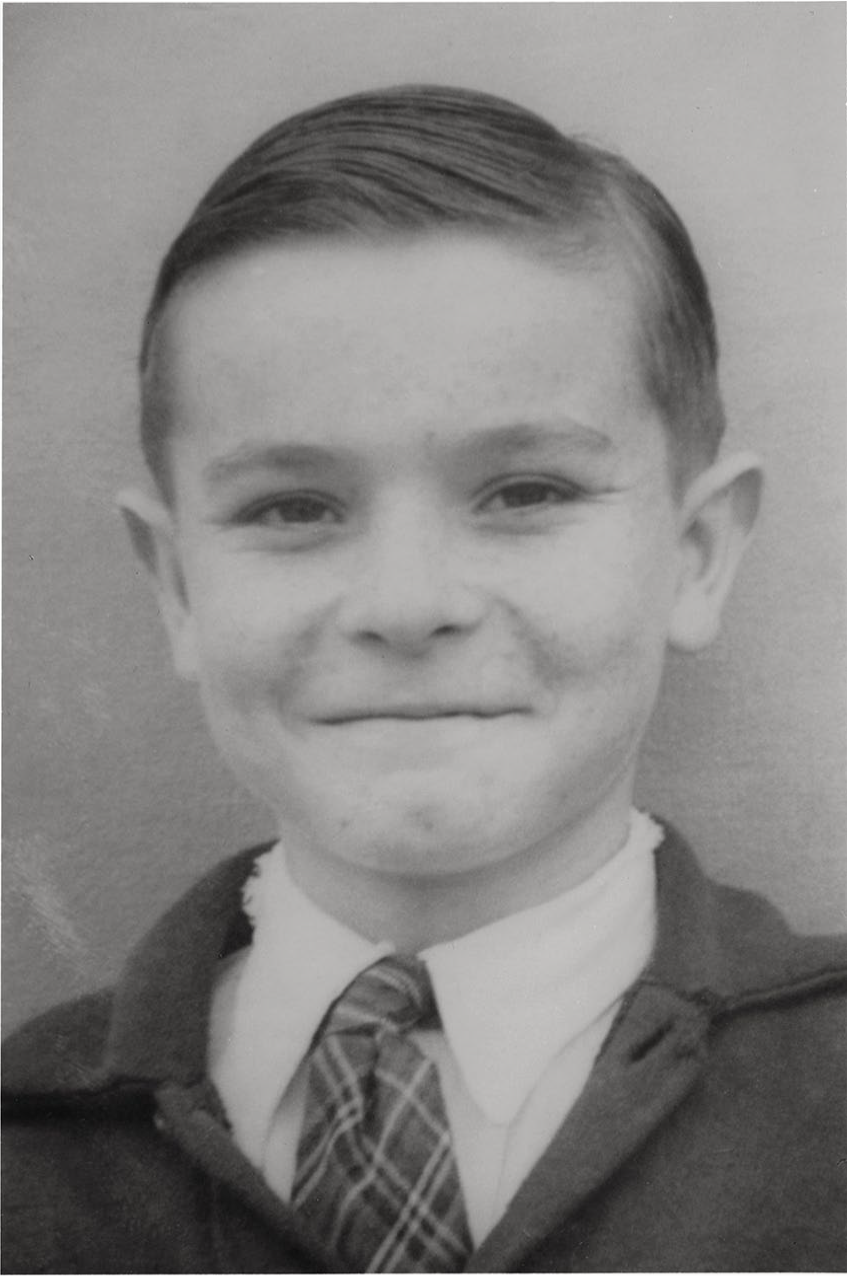
Athol Fugard as a young boy, early 1940s. (Private collection)
We know, thanks to Fugard’s published Notebooks that his mother, Elizabeth Magdalena Potgieter, kept the family afloat by running first the Jubilee Residential Hotel, then the St Georges Park Tea Room. In the same text, Sam Semela — the real-life incarnation of the Sam of “Master Harold” … and the Boys — is described as “the most significant — the only — friend of my boyhood years” (1983: 25). We know that Fugard’s father, Harold David Fugard, was a jazz pianist and erstwhile leader of the Port Elizabeth-based Orchestral Jazzonians. We also know that he died an exceedingly painful death. Fugard has referred to his father an “alcoholic” and a “cripple” (1983: 30–31); the latter the result of a childhood injury to his hip sustained on the ocean voyage from Southampton to Cape Town. 1 It is in Fugard’s descriptions of his father’s pain — “fluttering, throbbing” (1983: 29) — and in particular his notation of its vocalizations that the complex relationship between father and son is most acutely revealed, defined as much by love as by perceptions of weakness and strength; dependence on the one hand, and the ability to provide on the other.
In October 1961, the same month that his father died from gangrene in the stump left over from his latest amputation, Fugard scribbled down a remembered exchange between his parents: “Daddy, why are you chanting like a Jew?” “Don’t be silly. It’s Persian.” “That doesn’t sound like Persian songs, Daddy!” “You want to know what it is? My pain. I’m making my pain sound nice.” He sang that until he died. (1983: 40)
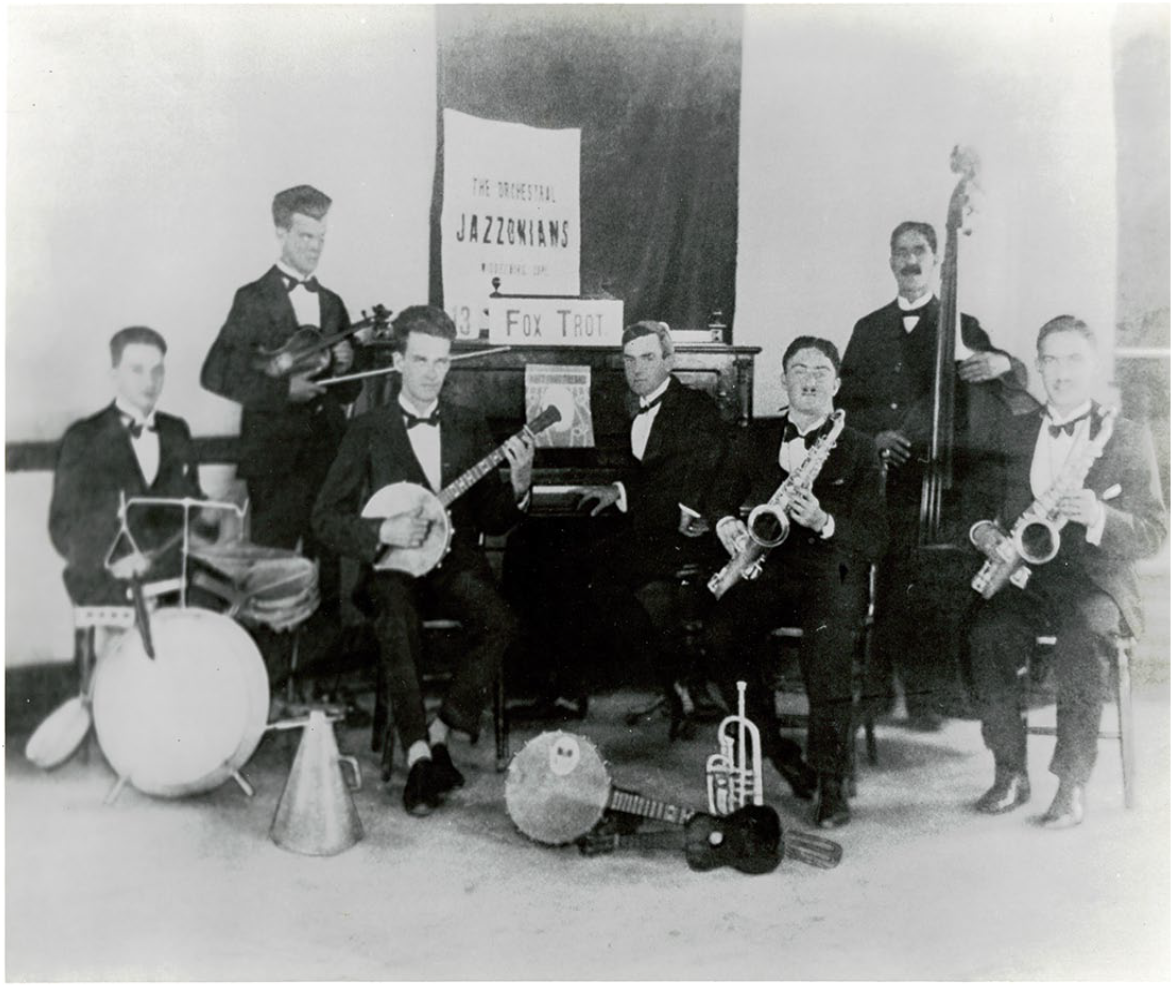
Fugard’s father, Harold David Fugard (at the piano) with the Orchestral Jazzonians, Port Elizabeth, circa 1930s. (Private collection)
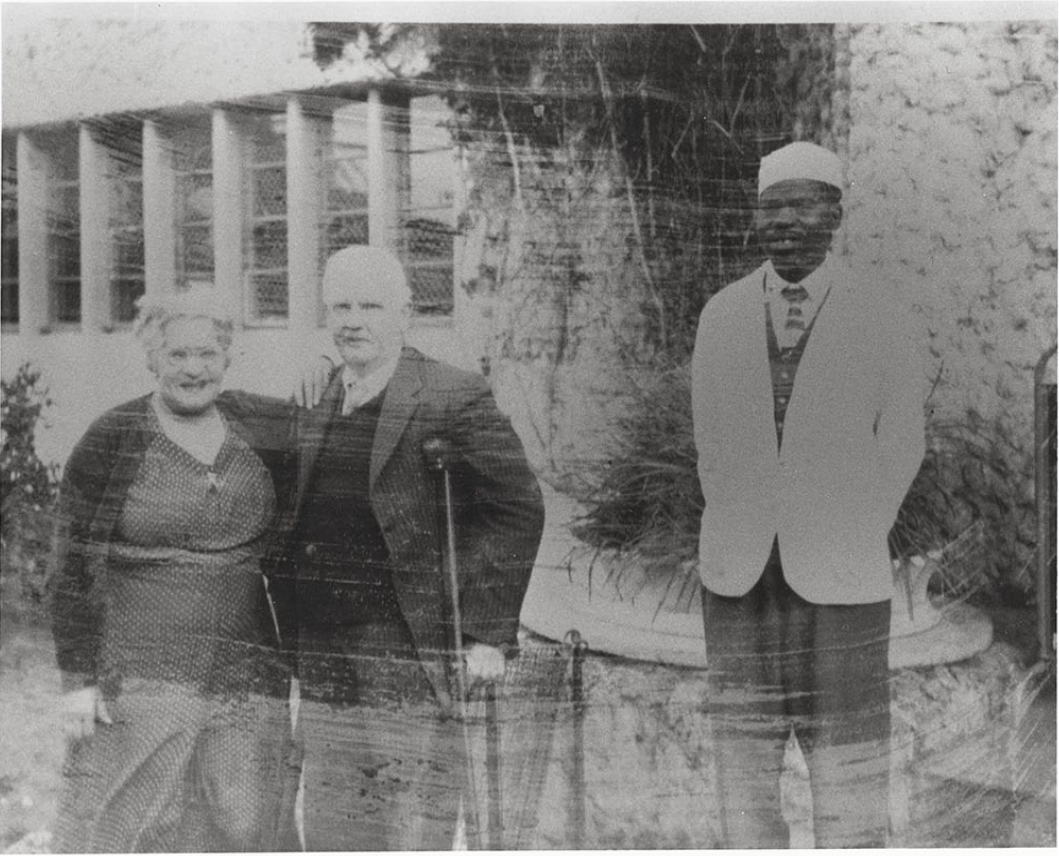
Fugard’s parents, Elizabeth Magdalena Potgieter and Harold David Fugard, together with Willie Molopo outside the St Georges Park Tea Room. (Private collection)
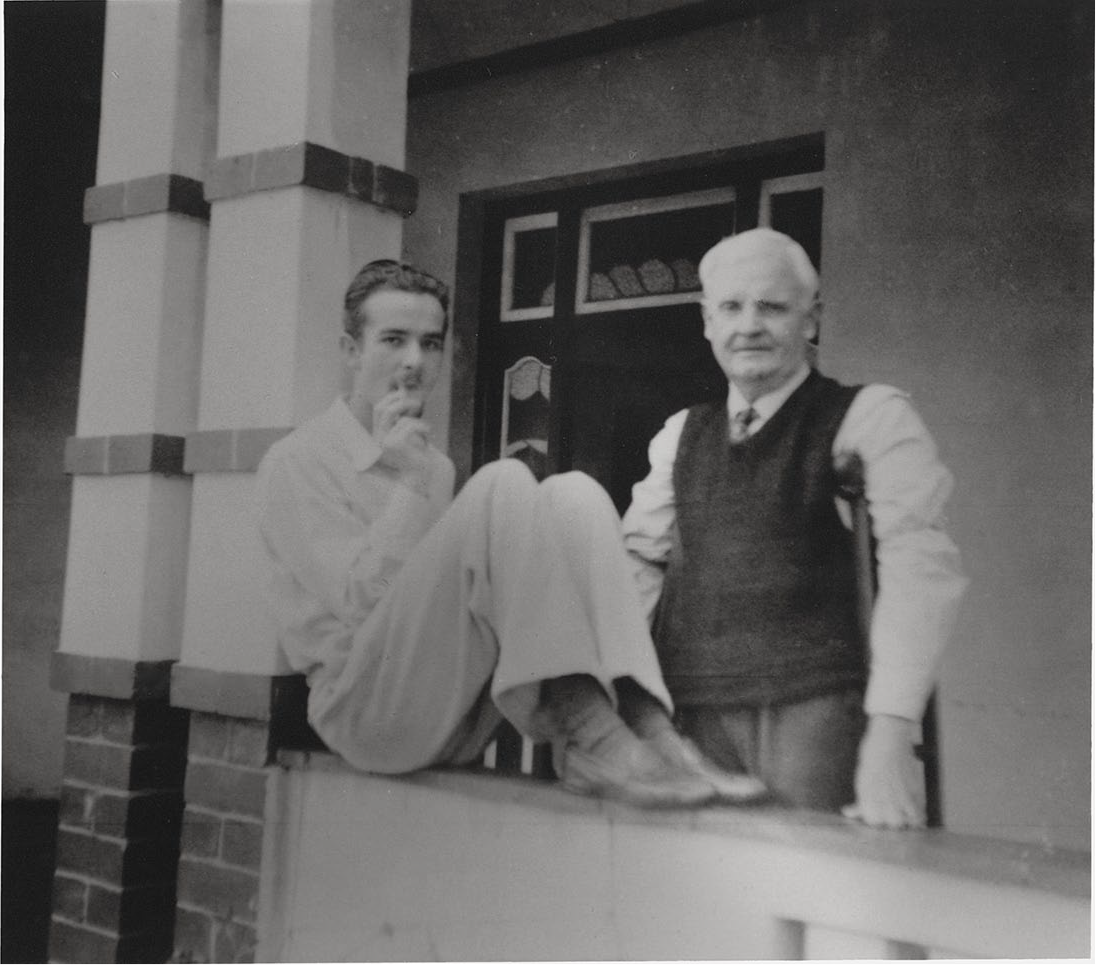
Fugard and his father outside the family home in Newton Park, Port Elizabeth, circa 1950s. (Private collection)
This bittersweet vignette points to one aspect of Fugard’s biography and imaginary that is very rarely mentioned in analyses of his work: the central place occupied in it by music. In another autobiographical text, Cousins: A Memoir, Fugard makes an astonishing claim: “Everything I have written, all the plays that lie behind me, are at one level the milestones of the personal odyssey that started with those two pianos” (1997: 20). The first piano Fugard refers to is the old upright Fritz Kuhla that his father, Harold senior, used to play in the Jubilee boarding house during Fugard’s childhood. These were the years during which he was still affectionately known as Hally, an abbreviation of his first name “Harold”, before — to differentiate himself from his father — he began to insist on being called by his middle name of Athol. Fugard recalls how he used to persuade his father to play the piano for him, and how the two of them would sing popular songs that he fondly recalls to this day, including “Bye, Bye Blackbird”, “Ramona”, and “When the Red, Red Robin”. The second piano is the one that his cousin Johnny used to play. “When the first one fell silent,’ Fugard writes, ‘it was my profound good fortune to find the other” (1997: 20).
While his father had exposed him to the sentimental ballads and jazz standards that were his trade as a jazz pianist, Fugard’s cousin Johnny had provided him with his first taste of Western art music. In an interview, he describes this as “music that told stories, but without words, because my dad’s music always had words” (Fugard, 2014: n.p.). Discovering Chopin, Brahms, Rachmaninoff, Schubert, and Debussy in this way was the start of Fugard’s passionate relationship with Western art music, one that he sustains to this day, to the near-total exclusion of the popular music that had arguably been his first love.
In Cousins, Fugard also details the performances that he and Johnny staged for their parents every Sunday, Fugard spinning out a story to his cousin’s musical accompaniment. In these sessions, he writes, “I developed and shaped a dramatic imagination and forged what was to become a lifelong link between music and my writing process” (Fugard, 1997: 52). This link lies not only in the creative impetus Fugard receives from listening to music, but in his attempt to mimic in his plays the experience of listening to music, “the emotional event underneath that surface of words” (1997: 52). This link also has organizational implications, with Fugard likening important speeches in his plays — like Miss Helen’s near the end of The Road to Mecca — to extended arias, both in structure and emotional content (1997: 52–53).
Reading between the lines, the autobiographical tale that Fugard tells about music is also informed by frustration. In the first instance, frustration that his father was already past his prime as a pianist by the time Fugard was old enough to appreciate his playing. In a recent interview, he recalls: I know it was a great embarrassment for my dad at some point in that relationship when I would put down a piece of sheet music that I had found amongst a pile of music that he had. And I would choose a new song and put it down and he would look at it and he said, “No, my hands. My hands are too stiff, I can’t do this one, Hally.” (Fugard, 2014: n.p.)
In the same interview, Fugard also expresses frustration that his cousin Johnny wasn’t willing to teach him what he knew, a sense that he jealously guarded his own command over the instrument. And this led to the biggest frustration — that he, despite taking piano lessons from various teachers for several years, could never call himself an accomplished pianist. In Cousins, Fugard describes his moment of truth while practising a Chopin prelude on the upright Fritz Kuhla: I savoured the heavy silence in the room for a few seconds, and then said aloud: “Give it up chum, you’re wasting your time.” I carefully replaced the green felt dust cover over the keys, lowered the keyboard cover and never opened it again. (1997: 111)
Yet, today, in his late eighties, his own hands as stiff as his father’s must have been, Fugard has dreams and fantasies of giving piano recitals. In his wildest imaginings, he is even transformed into the Russian pianist Sviatoslav Richter. This scenario invades both his nights and his days, manifesting in the latter as a very specific waking fantasy. Fugard remembers: Ja, I’ve had so many and it usually starts with me accidentally finding, opening a door and seeing this beautiful grand piano and going up and starting to play. And then somebody else looked in and saw and listened and disappeared and came back with three other people, and at the end of my fantasy, a beautiful woman sitting there in front. Sometimes she was sitting, then eventually there were also fantasies where she sat next to me to turn the pages. No! No, it was better than that. I said, “I don’t read music,” or “I don’t know music.” But I want her next to me, so she just pretends there’s music. Pages that she turns. (2014: n.p.)
We must bear in mind that Fugard’s childhood and youth, rich as it was with musical sounds, nonetheless played out in an era when access to music was severely limited. In the first half of the twentieth century, he couldn’t simply hear a piece of music—whether Western art music, pop, or jazz — on demand. The family had no record player, and Fugard remembers only being granted unfettered access to one when he was a university student and could visit the South African College of Music in Cape Town (2018b: n.p.). Until then, he had to contend with what his father or his cousin could provide. As for his own piano lessons, he remembers that they more often than not ended in him convincing his piano teacher to play for him. Specifically, Fugard remembers a jazz pianist and teacher called Sammy Levinthal: And he was just a wonder in my life. I went and, you know, tried to … I suppose I took my musical education in terms of just playing the piano a little bit further. But then he would show me how the tune should be played and, oh Christ, it was a revelation to me, watching him. And what eventually happened, in my lessons with him — because I knew I would never be as good as that, firstly, I realized that, discovered very early that I didn’t have the stretch in my hands for an octave plus two notes — and eventually my music lessons were just little private recitals for my benefit. I’d say, “Just play for me.” (2014: n.p.)
There were also ways of accessing music that did not involve getting others to play for him. One was to be ready to tune into the South African Broadcasting Corporation’s (SABC) Tuesday night symphony concerts, which Fugard remembers were conducted at the time by resident conductor, Edgar Cree. Another, to attend the gatherings of the local music appreciation society which used to meet in the assembly hall of Fugard’s high school, the Port Elizabeth Technical College. Starting in his fifteenth or sixteenth year, he remembers, he used to spend every Sunday night around a turntable with two speakers, listening to what one of the society’s members had brought on LP to share with the group, one of their “favourite masterpieces” (Fugard, 2019: n.p.). Finally, his last option was to drop a shilling into the jukebox at the St Georges Park Tea Room, after which he could listen to the “sloppy sentimentals” that he liked at the time, recordings by the likes of Frank Sinatra, Bing Crosby, Dinah Shore, and Johnnie Ray (Fugard, 2018b: n.p.). But to do that, of course, Fugard needed a shilling that he was willing, and able, to spend.
Reading Fugard’s autobiographical texts and listening to him perform his memories in interviews and conversations, I am struck with a sense that music very early on became for him a scarce commodity, something with considerable value. I have also come to think that Fugard’s early musical experiences created in him an unfulfilled desire towards music-making and a resultant perception of music as a privileged form of creative expression.
Today, this desire is no less present, having become conflated in particular ways with Fugard’s work as a playwright. Discussing his continued imperative to create, Fugard refers to the advice given to Socrates (in Plato’s Phaedo 60e) by his daemon as he neared his cup of hemlock, verbalized as “Make more music, Socrates!” (Fugard 2014: n.p.). Assuming a literal interpretation in applying the imperative to himself, he has, for example, recently purchased a number of harmonicas and tried to learn to play the instrument. But despite these efforts, Fugard concludes that he comes closest to making music when the dialogue in his plays manages to “sing” (2017: n.p.). On the surface, Fugard’s understanding of Plato seems to rest on John Burnet’s (1911) text of Phaedo, which specifically mentions music in relation to Socrates’s dream. Subsequent translators have phrased the imperative differently, as “pursue the arts and work hard at them” (Bluck, 1955: 42) or “make art and practice it” (Plato and Gallop, 1975: 4), in the belief that the Greek text in question does not refer to “music” as we know it. 2 Informed as he is of the wide scope of certain Greek words and what he regards as a permeability between different art forms in the ancient Greek imaginary, Fugard’s embrace of the concept of music in interpreting this moment in Socrates’ life is significant. So, too, his resort to metaphor in concluding finally that words are his only recourse in trying to create music.
It is no surprise then, that Fugard is pleased when scholars or critics bring analogies of musical structure to bear on his writing (see Walder, 2002: 706–707; McDonald, 2006: 210; Fugard, 1997: 53), nor that music carries such symbolic weight in many of his plays. Consider, for example, the crude little songs that Lena makes up during her long and painful journey with Boesman. They are affirmations of her spirit, little bursts of defiance, other ways of shaking her fists and saying: “I am still alive”; hence their power to provoke Boesman. Consider too, the meaning that music holds for Veronica, the protagonist of Valley Song. The songs that she makes up are her only tools, used not only to try and escape the rural village of Nieu Bethesda and the life it can offer her, but more fundamentally, to join her fellow oppressed South Africans in leaving the ashes of apartheid behind and entering what for them was meant to be a new world.
The power with which Fugard invests music is perhaps best illustrated in his as yet unstaged The Abbess, a play based on an episode in the life of the historical figure Hildegard von Bingen. Here, the protagonist and her convent are placed under interdict by the all-male Prelates of Mainz. Henceforth, she and her nuns are barred from celebrating the mass or singing the divine office. For a large portion of the play, they are reduced to whispers. In a published draft of the play, the Abbess laments: “I am choking to death. And so are my daughters. Our songs of praise were the breath of life itself” (Fugard, 2006: 362). Yet music’s role in The Abbess renders it more than a means of divine connection, and more than the affirmation that creative expression and life itself are one and the same. Here, song becomes a feminist concern as the locus of patriarchal control and the very means with which one might resist it.
Fugard’s use of music, imbued with the symbolic power he grants it, goes beyond the diegetic. He chose, for example, to open every performance of The Road to Mecca when it premiered in 1984 with the aria from Johann Sebastian Bach’s Goldberg Variations, a decision that he explains in a recent interview as follows: “I felt that that simple melody, and the way that Bach then went on to create a whole universe of sound out of it, was just right for Helen” (Fugard, 2018a: n.p.).
In the same interview, he claims: “For me, music is the most transformative of all arts”. What does he mean by “transformative”? He answers without hesitation: “It can turn the very mundane reality of your life into something of such glittering splendour as you never imagined”. “More so than words?” I ask. “A substitute for music notes”, he says, referring to “words”. “Never as magical as the music. No. Music is up there. Alone” (Fugard, 2018a: n.p.).
III
What does all of this mean for Hally, Sam, and Willie who are whiling away a rainy afternoon in the St Georges Park Tea Room? Besides apartheid, another spectre hangs over the afternoon: Hally’s hospitalized father, who — as the boy learns over the telephone — is asking to be discharged. The extent to which this disturbs Hally is the first hint that his relationship with his father is a complex one in which love, dependence, and resentment all play a role. Against the distressing possibility of his father’s return home, Hally nevertheless tries to do his homework. He has chosen to write an essay about Sam and Willie’s upcoming ballroom dancing competition, despite not fully understanding that the dance is a “form of disciplined social practice that has specific cultural meaning within the black community”, to quote Jordan (1993: 466) once more. For a few moments, as they help him with his assignment, Sam and Willie’s evocative descriptions make the event come alive between the four walls of the Tea Room. What is harder to imagine, however, is the music at its centre.
“Play the jukebox, please, Boet Sam!” Willie implores (Fugard, 1993: 35). But like Willie, Sam only has money for his bus fare home. It is Hally’s turn to speak, and he does so with authority. “Hold it, everybody”, he says, then asks, “How much is in the till, Sam?” (Fugard 1993: 35). Realizing that his mother has counted the three shillings rattling in the cash register, Hally decides against taking the risk: “Sorry, Willie. You know how she carried on the last time I did it. We’ll just have to pool our combined imaginations and hope for the best” (1993: 36). And, for a while, it seems that the trio has succeeded. Not only in making the illusion complete as Willie dances across the room to the slow beat of an imaginary song, but also in dreaming up the “world without collisions” symbolized by the dance floor (1993: 38).
But the telephone was always doomed to ring a second time, and it does so shrilly, shattering all these dreams. With it comes the certain news that Hally’s father is coming home. Hally protests, but nothing that he says, not even his warnings about his father’s imminent theft from the till to buy alcohol, can change that fact. After he hangs up, he sets his collision course, beginning with a mockery of his disabled father. When Sam objects, Hally finds a new target for his anger and pent-up shame.
And so Hally finally assumes the role of Master Harold, fully inhabiting his white skin and all that it means in 1950’s South Africa. This includes baiting Sam with a racist joke about the fairness of a black man’s arse, to which the older man responds by baring his backside. The dissolution of their relationship reaches an awful climax when Hally spits in Sam’s face, something described by Dennis Walder as “one of the modern theatre’s most disturbing moments” (2002: 699). It is also, incidentally, a moment that occurred in Fugard’s own remembered life (1983: 26).
Silence on stage as Sam wipes the boy’s white superiority from his face, and then, with “awful self-control” (Walder, 2002: 700), begins to tell his truths. That he recalls Hally asking his help one night after his father had been found drunk on the floor of the Central Hotel Bar. That he had carried Hally’s father, inebriated and soiled, through the streets of town that night, the boy following behind. Sam confesses that he made the kite in the wake of this incident; he had recognized the boy’s shame and wanted him to be able to look up. Also, that the day they flew the kite, he couldn’t join Hally on the bench because it was reserved for the use of “whites only”. Hally listens in shocked silence to these revelations, able only to confess, finally, that he loves his father.
As he gets ready to go home, Hally packs his bags and scoops up the few coins rattling in the near-empty cash register. Sam makes another effort to reach the boy, offering, in the spirit of the metaphor, to fly another kite together. Ultimately Hally can only respond with, “I don’t know. I don’t know anything anymore” (Fugard, 1993: 48). He leaves the tea room wordlessly.
Finally, desperately, Willie speaks what in this reading are the most important lines of the play. “To hell with it!” he says, “I walk home” (Fugard, 1993: 48). He drops a coin into the jukebox in the corner of the room, and it lights up. “How did you say it, Boet Sam?” he asks, “Let’s dream” (Fugard, 1993: 48). The final image the audience is left with is the two men dancing together to the soft strains of Sarah Vaughan’s “Little Man, You’ve had a Busy Day”, rain still streaking the windows outside.
IV
Walder has described the final moment of the play as “a resonant image of brotherhood, from which the white ‘master’ has excluded himself” (2002: 701). But what are the reasons, and indeed the meaning, behind this exclusion? In his reading, Rob Amato offers one possibility, namely that the trauma over his father’s disability has rendered Hally guilty of a grave sin, of showing weakness in front of a black man: It seems to me that Hally cannot stay in the world of the tearoom, has lost that magic afternoon world, cannot accept Sam’s several attempts after the spitting to save the situation, because the resurrection of the trauma makes him, again, at seventeen, perceive of himself as guilty of the one crime which South Africans who are white simply can’t commit. The central commandment of the hegemony of apartheid may be “Show not thy weakness to thy neighbour race, to the helots.” (1984: 212)
A focus on the biographical, and in particular on the transformative power that Fugard ascribes to music — the personal value, not related to exchange or commodity value, that it holds for him — offers another possibility.
In the play, as in Fugard’s life, music is both hard to come by and very valuable. In the St Georges Park Tea Room, it can only be gained through sacrifice, in this case Willie’s bus fare: a gesture all the more meaningful because we know that he now faces a long wet walk in the dark. Music is chosen above bodily needs; exchanged, as it were, with the earthly comfort of a dry ride home. Not only does this underscore an understanding of music as a scarce commodity, it is a powerful testimony to the value attached to it in the world of the play.
“Master Harold” … and the Boys is the only one of Fugard’s now more than 35 plays where the playwright has specified music both at the beginning and at the end, the very first and very last thing an audience hears. The first is Willie’s absentminded singing as he washes the floor. Later, he also attempts a rendition of the 1920s popular song “You’re the Cream in my Coffee”. But when that jukebox in the corner lights up and those first descending arpeggios announce the presence of a jazz ensemble, it is a lush sound very different from anything heard before. Willie’s earlier references to the jukebox, each more insistent than the last, are signposts pointing tantalizingly to this moment. When it finally arrives, it takes on hyperbolic proportions, the aural equivalent to the end of a drought.
That Willie delays his sacrifice until this point is also significant, underlining his desperation in this attempt to escape an ugly reality. Sam and Willie are left to dream about a non-racial South Africa, something that, as other scholars have pointed out, is intimately bound up with the metaphor of the dance. I would like to add that, at this late point in the play, the dream can only be dreamed with the help of “real” music, the medium that Fugard invests with the power to transform anything, superior in this respect, to the spoken word. As he himself puts it, “Both Sam and Willie … and Hally as well, but … they’re all dreamers. And the dreamers start when they hear a chord and follow it up, hear something else, you know. It’s access to the magic of music, man” (Fugard, 2018a: n.p.).
The day that Fugard brought down the cover over the keys of the piano was also the day on which he carved out a lasting magical space for music. The trope that posits music as more powerful and magical than words is reserved for those who regard it as unattainable, those who stood up and walked away from the piano. Using music as a metaphor for racial harmony is not as sentimental as it might seem from a present-day perspective. Instead, I believe that one has to consider the paucity of models that were available for white South Africans in the 1980s of the play’s creation with which to dream an alternate future. One could recognize that disenfranchising the country’s black citizens was wrong, one could oppose the racist legislation of the regime, one could refuse to be silenced, but one still needed the tools with which to imagine a different way of living. This is precisely what Fugard tries to provide in that final scene, using what for him had become a near-magical medium.
But far from being a mere staging of the cliché, “when words fail, music speaks”, one has to realize that the sultry sounds heard at the end are also, finally, words. They hint that, despite Fugard’s romanticization of music, he is ultimately a wordsmith, far too concerned with signification to leave it to chance, to personal interpretation, as would have been the case if he had ended the play with instrumental music. Instead, Sarah Vaughan sings Maurice Sigler and Al Hoffman’s lyrics: Little man, you’re crying, I know why you’re blue, Someone took your kiddy car away; Better go to sleep now, Little man you’ve had a busy day. Johnny won your marbles, Tell you what we’ll do, Dad’ll get you new ones right away. Better go to sleep now, Little man you’ve had a busy day. You’ve been playing soldier, The battle has been won, The enemy is out of sight. Come along there, soldier Put away your gun, The war is over for tonight. (Sigler et al., 1934: 3– 5)
The “little man” of the lullaby is, of course, Hally. But there is something perverse in associating the childish and innocent text of the song with his deeply disturbing behaviour. That the lullaby carries a message of protection from the worst of the world is also jarring, underscoring the fact that Hally and other young white South Africans were let down by their parents, who, like their parents before them, by and large reinforced the status quo that would finally morph into apartheid. This song throws into relief the exact opposite of what its text conveys — that there is nothing to negotiate between Hally and the world, that he is a child no more, but an adult who has to make his own choices; in this case, whether or not to remain seated on the “whites only” bench.
How, then, are we to read the fact that Fugard chose to send Hally alone into the gloomy evening, excluded from the possibility of music and its transformative promise? Moreover, Fugard has written a Hally who — in deciding against using money from the till for the jukebox — seems to be saying that music is ultimately not worth the risk. In fact, he makes this decision twice, the second time at the end of the play when he walks past the jukebox with a pocket full of coins, perhaps blind now to the possibility that there could still be music. One way to interpret this decision is as a choice for white materialism, an expression of the middle-class aspirations of poor Afrikaners that in itself became an important rationale for erecting and maintaining the system of apartheid. That Willie finally provides the music becomes an acknowledgement then of black agency and self-determination. The two men do not need Hally to dream their future; they are prepared to make their own sacrifices.
This would connect with Jordan’s labelling of Hally’s taking the last few coins out of the cash register, “a petty gesture of racist distrust” (1993: 468). In his reading, Jordan goes so far as to conclude that, “to exclude oneself from the dance is to refuse participation in this vision of the future” (1993: 466). This reading consciously eschews an autobiographical interpretation of the play, arguing that emphasis on the personal has “led to distorted understandings of its political significance” (Jordan, 1993: 461). While it is as valid as any other, readings such as his and the one explicated above run the risk of reducing the play to a racial allegory, a neat tale about whiteness and black liberation that, in its desire for neat extraction, makes two-dimensional the flesh and blood characters on stage, reducing them to nothing more than markers of “ideas”.
A play, is, after all, more than words on paper. Having observed Fugard at work during the 2016 staging of “Master Harold”… and the Boys at the Signature Theatre in New York, I learnt that Fugard directs Hally very differently during his final moments on stage. And while his direction is but one of many possible interpretations, it is worth noting that to the present day, Fugard still insists on directing the first productions of new plays, a practice that he uses not only to refine his script, but also to ensure that when each play is sent into the world, it as closely as possible resembles his own vision. With Fugard as director, more than 30 years after its first staging in 1982, there are no “petty gestures of racist distrust” left in the boy who leaves the tearoom with his tail between his legs. Instead, it is a character who, as per the stage instructions, finds it “difficult to speak”, has very few words left, who instead makes “helpless” gestures (Fugard, 1993: 47–48). Watching Fugard direct this moment, it is clear that Hally’s silence and his apparent intractability do not lie in his guilt over having transgressed apartheid’s indoctrinated norms. Instead, they are consequences of his shame.
Errol Durbach, likewise privileging the personal over the political in his reading, acknowledges Hally’s shame; occasioned not only by Sam’s nakedness, an indictment which he describes as “Dostoievskian in its power to shame”, but by the boy’s own response, his decision “to exercise his power to degrade” (1987: 508). But similar to Jordan’s reading of the moment, for Durbach, Hally’s “last shamefaced act” is his removal of those few coins from the till (1987: 510). “One entrusts the ‘boy’ with the keys to the tearoom”, he concludes, “but not with the few coins which might tempt him to play the juke-box or take the bus home” (Durbach, 1987: 510).
But being shamefaced is clearly not the same as being ashamed. I also remember Fugard directing this moment very differently, those few coins collected from the till in a spirit of defeat that is also deeply personal. When I ask Fugard how he sees this gesture, he answers simply: “It’s the family’s survival. Pennies, tickeys and sixpences, everything was counted. My mom might need it to buy supper tonight” (2018b: n.p.). Fugard’s seamless movement from the world of the play to his own life, his essential failure to distinguish between himself and Hally, again brings the biographical into urgent conversation with the work.
Like Hally, Fugard is no stranger to shame. He, too, once walked the streets of Port Elizabeth following behind his drunk father being carried on Sam’s back. And like Hally, Fugard also carried the crutches on what he has dubbed his own “via verecundia”, his road of shame (2018b: n.p.). Shame not only for having a drunk and useless father, but as he has “confessed”, for secretly wishing that he were Sam’s son instead. “But how could a white boy growing up in apartheid want a black man as a role model?”, Fugard (2018b: n.p.) articulates his confusion in those years. And, in an oft-cited notebook entry dated March 1961, he concludes his description of the moment he himself spat in Sam’s face with the following: “Don’t suppose I will ever deal with the shame that overwhelmed me the second after I had done that” (Fugard, 1983: 26).
As other critics, have pointed out, “Master Harold” … and the Boys was one attempt to do just that. Walder, for example, calls this play on one level “a call for the radical change then about to take place in the country, although of course on the personal level it was an act of atonement” (2002: 699). Durbach, meanwhile, describes the final dramatic image of the play as follows: It is a typically Fugardian oscillation between hope and despair, qualified only by the realisation that “Master Harold” grows up to be Athol Fugard and that the play itself is an act of atonement and moral reparation to the memory of Sam and “H.D.F.” — the Black and the White fathers to whom it is dedicated. (1987: 511–512)
Just as there is space for both a political and an autobiographical reading of the play, there is clearly then also the possibility for arrhythmia between the two. Paying attention to the workings of music in “Master Harold” … and the Boys provides one strategy for reconciling them. In the first instance, recognition of Fugard’s attitude towards music magnifies the gesture of providing it. The moment in which Hally has to decide whether or not to take money from the till is anything but light-hearted. Instead, it points to a sharp division between recourse to the “magic of music” or duty to family, a duty we might well note that Hally expects his own father — in his anticipated theft from the till to buy his own magic — to fail in. In the second instance, focus on the symbolic weight of music throws Hally’s exclusion from it into relief. Hally leaves, returning to a world he earlier described bitterly as one where “nobody knows the steps, there’s no music, [and] the cripples are also out there tripping up everybody and trying to get into the act” (Fugard, 1993: 41). For Hally, music is ultimately, as it was for Fugard, unattainable.
Discussing the reasons for Hally’s silence and his departure at the end of the play with Fugard, he articulates a possible rationale behind this authorial decision as follows: “I just knew, knowing myself to a certain extent, that I would want to crawl away and hide, and in crawling into myself, make healing impossible” (2018b: n.p.). Again, that persistent identification with Hally. Perhaps, then, Fugard’s exclusion of his fictional avatar from the final moment of music can instead be read as a form of self-flagellation. Yet having come to know the adult Fugard, I also know that contrary to his words above it is those same strategies — crawling away and hiding — that he has learnt to employ towards the opposite goal, to carve out a solitary place within his web of human interactions where personal healing becomes possible.
Hally’s wordless departure is made not because “ingrained attitudes die hard”, as Durbach (1987: 511) would have it. Nor does he do so “rejecting Sam’s offer of reconciliation”, as Jordan writes, in order for the play to “affirm black cultural autonomy” (1993: 468). Instead, it is my contention that Hally leaves because for him, the most appropriate response to white shame is silence. This is not unlike the silence and humility, the “reducing [of] one’s presence” which Samantha Vice calls for as an appropriate response on the part of white South Africans (2010: 335). On the surface, this is easy to mistake with eschewing active participation in trying to create a better world. But far from a passive attitude, the silence that Vice calls for instead forms part of an “inward moral project” that has as one of its goals trying to come to grips with the “moral damage done to the self by being in the position of the oppressor” (2010: 335, 339). One way in which Vice explains this project is as follows: So, recognizing their damaging presence, whites would try, in a significantly different way to the normal workings of whiteliness, to make themselves invisible and unheard, concentrating rather on those damaged selves. (2010: 335)
The difficulty of course lies in this, in Vice’s model as in “Master Harold” … and the Boys: given so little text to speak, it is no easy task for white South Africans, as for any actor who has ever given life to Hally, to adequately express a sense of shame. The workings of active silence are, by necessity, silent.
Finally, what remains to be said is this: despite Fugard’s persistent identification with Hally, the polyphonic nature of theatre makes it possible for the playwright to be also Sam, just as he is also Willie. The transformative power of music may be lost to Hally. Instead, the playwright has chosen to locate Sam and Willie in that magical space that, precisely because of its unattainability, has become instead a space of infinite possibility.
“Master Harold” … and the Boys was written at the start of what Fugard calls “the darkest decade of apartheid” (2018b: n.p.). But it was also written at a time when the possibility for change was very real, the driving force of anti-apartheid activists both in South Africa and in exile who arguably, as Jordan (1993: 468) points out, had more militant methods in mind than the liberally-minded Fugard. Nevertheless, looking back to the 1950s of the play, its final image leaves us with the realization that a great many shillings would have to be spent before things could get better for black Africans like Sam and Willie, that white South Africa would have to lose both its “marbles” and its “kiddy car” before then. And yet, that in the year that the play was set, the “war”, the “battle” had hardly begun. It casts a potent vision of the future, although from the perspective of present-day post-post-apartheid South Africa, where the politics of reconciliation are so dramatically giving way to that of decoloniality, it is one that still hangs in the air, in many respects (most obviously the economic) only partially realized. As it turns out, music — like words — can only get you that far.
Footnotes
Declaration of conflicting of interest
The author declared the following potential conflicts of interest with respect to the research, authorship, and/or publication of this article: The author is married to Athol Fugard.
Funding
The author received no financial support for the research, authorship, and/or publication of this article.
