




Abstract
This article addresses the creation of Athol Fugard’s plays not as performances or as texts, but as material objects, and examines how the meaning and value of his plays were constructed through the interventions of his publisher. The paper draws attention to the sharp distinction in the way that Fugard’s performances and published plays have been received, most acutely with respect to the plays Sizwe Bansi is Dead, The Island and Statements After an Arrest Under the Immorality Act. These plays directly addressed and attacked apartheid legislation and enforcement. In performance in South Africa between 1972–1973 they were regarded as radical and subversive by the South African authorities as well as by audiences and critics. The Oxford University Press edition of this trilogy, Statements: Three Plays (1974), was by contrast packaged as a literary and commercial product that circulated free from censorship. This essay explores the reasons for this dichotomy through a detailed author/publisher case study of the publication history of the plays. It analyses the means by which Fugard was re-branded as an “Oxford author” through the book’s publication in the Oxford Paperback Series, and assesses the impact of this brand on the reception of Fugard’s plays. The published book was also a more individualistic creative product than the performances of the plays: the Press applied a conventional model of authorship which served to defuse the radical, interracial partnership between Fugard and his co-writers Winston Ntshona and John Kani. Likewise, the political content was neutralized as the plays were promoted as allegorical literary works of universal significance. By these means, it is argued, Fugard was successfully incorporated into the literary establishment in the UK, the USA and South Africa under apartheid.
Introduction
Statements: Three Plays by Athol Fugard was published by Oxford University Press (OUP) in 1974. The trilogy of anti-apartheid plays included Statements after an Arrest under the Immorality Act and two plays co-authored with John Kani and Winston Ntshona: Sizwe Bansi is Dead and The Island. This article analyses the series of debates and resolutions surrounding the editing, design, production and distribution of these plays. It charts the ways in which the publisher addressed and resolved the opposition between Fugard as a political playwright and Fugard as a writer disclosing universal truths, negotiations which were part of a broader academic debate in the 1960s about the definition of an aesthetic value system for African literature.
Chidi Amuta (1989: 3) describes the initial response of the European literary establishment to emerging African literature as a quest for ahistorical and apolitical “universal literature” that could be easily fitted into the canonical literary heritage; London-based OUP editors were involved in this process of defining, judging, and categorizing African literature in the 1960s and 1970s through their Three Crowns series. I examine here the interventions of the publisher in the “symbolic production” of Fugard’s work (Bourdieu, 1993a: 37). Specifically, this case study considers the role played by OUP in packaging and promoting Fugard as a “universal” writer who transcended immediate social and political situations. A related concern is whether this was part of a strategy to “universalize” the market for Fugard’s plays. Amuta goes on to suggest that a universal market for literature is an automatic by-product of international publication: “Once written and published, a literary work enters the domain of public discourse and the international market place. The audience of the work becomes universal” (1989: 108). Yet, while an international market for literature might be the aspiration of a publisher, it is not, as Amuta implies in this statement, something that is automatically obtained. Instead, it is the result of specific publishing strategies. Charting OUP’s publishing strategy for the Statements trilogy, this article questions whether the editorial concern for “universalism” in African literature was simply an aesthetic judgement for the publisher, or in fact an attempt to make Fugard’s writing accessible to Anglo-American readers and palatable in apartheid South Africa.
Fugard scholarship has queried whether he should be regarded as a political writer or whether his writing transcends immediate politics. Stephen Gray (1982: 26) wrote of the “universalism” of Fugard, and suggested that: “It is a kind of critical injustice … to deal with Fugard’s plays exclusively in terms of the political issues they dramatise”, while Russell Vandenbroucke’s study (1985) focuses on how works addressed the “universal condition”. Dennis Walder (1984: 461–464) argued that Fugard’s plays were undeniably about the “inhuman facts of apartheid” and that such interpretations of him as “universal” were simply attempts to make Fugard institutionally acceptable: “Fugard’s plays are political. … The South African reviewers and critics who make up the overwhelming majority of contributors to Athol Fugard have to pretend that this is not so”. By contrast, Hilary Seymour (1980: 282) regarded Sizwe Bansi as far from politically radical, writing that its “image of the self-made man pulling himself up by his boot straps is a key concept in the mythology and ideological superstructure of industrial capitalist societies”. Since 1990, several critics have argued for the continued relevance of Fugard’s plays beyond apartheid, and for the plays’ transcendence of a specific political context. For example André Brink’s examination of Sizwe Bansi (1993) reflects on ways in which Fugard “aimed at transcending the ‘merely’ sociopolitical”; Albert Wertheim (2000: xi) insisted that Fugard’s universalist themes extended “well beyond the borders of his homeland”; Harry Garuba (2001: 71) positions The Island within the “‘writing back’ dimension of postcolonial discourse”, in which “issues of colonialism, of race and color, of political disenfranchisement and tyranny come to the fore”; and Walder (2003: 57) maintains that The Island “transcends the immediate circumstances of its making” although he qualifies this: “But that is not the same as saying that it is ‘transcendent’, much less universal”.
While existing Fugard scholarship centres on the plays either as performance or as text, this is the first study of Fugard’s publishing history, which is based on OUP’s archives in Oxford and Fugard’s literary archives at the National English Literary Museum, Grahamstown. I consider that an understanding of the publishing process of Fugard’s plays adds an important dimension to this long-standing critical debate.
Authorship
In the late 1960s and early 1970s, Fugard was writing in the context of increasingly entrenched state repression and violence in South Africa. Following a state of emergency after Sharpeville and a crackdown on political opposition, resistance to apartheid was suppressed. The Terrorism Act of 1967 authorized the imprisonment of suspects without trial, and oppositional organizations were banned in 1968. The Black Homeland Citizenship Act of 1970 changed the status of black people in South Africa so that they became citizens of the Bantustans, rather than citizens of South Africa, resulting in enforced resettlement during the 1970s and the uprooting of almost one-third of a million black South Africans (Foreign Policy Study Foundation, 1981: 131). Fugard’s published diary Notebooks (1984: 213) 1 charts his response to political events as they unfolded in Port Elizabeth in this period, and describes the local scene of devastation in July 1973 following evictions in nearby Salisbury Park under the Group Areas Act. Fugard deliberates at length on the role and responsibility of the writer in “the troubled state of South Africa” (78), formulating the opposition between art and politics as a “tightrope between poetry and propaganda” (226), and declaring that: “my life’s work [was] possibly just to witness as truthfully as I could, the nameless and destitute (desperate) of this one little corner of the world” (172).
Sizwe Bansi and The Island were developed in improvisational workshops, in collaboration with Kani and Ntshona, who were both Xhosa actors in the Serpent Players theatre company. The process of creating these plays was itself illegal under South African law, involving as it did interracial interaction, and the plays had to be rehearsed and performed surreptitiously. In addition, the plays directly address and attack apartheid legislation and enforcement. The Island concerns two prisoners on Robben Island who attempt to alleviate their situation through theatre, by a performance of Antigone. It was based on the first-hand account of life in the maximum security jail by Norman Ntshinga, the Serpent Players actor (150–151), and specifically it was based on Ntshinga’s performance of a two-man version of Antigone with another imprisoned Serpent Player, Sipho “Sharkey” Mguqulwa (Walder, 1993b: xxviii). Sizwe Bansi was written in response to the tightening of pass laws in the 1960s; set in a photographic studio, the plot centres on Sizwe Bansi’s dilemma in arriving in Port Elizabeth without a passbook and therefore being unable to obtain work. Ultimately, he adopts the passbook, and the identity, of a dead man, by pasting over his own photograph. Statements after an Arrest under the Immorality Act was developed in improvisational workshops by Fugard with the actor Yvonne Bryceland. The play concerns interracial sexual relations in South Africa, and the annihilative impact of the state on a white librarian and a coloured school principal, caught in an illicit love affair.
Performances 1972–76
As the most politically explicit of Fugard’s plays, the performances of all three plays in South Africa were subjected to banning restrictions by the South African authorities. In 1972, the police informed Brian Astbury, owner of The Space Theatre in Cape Town, that Sizwe Banzi (as it was first spelt) could not play to open audiences, and the performance was cancelled. The only way to get round this was to run it as a private club event, although the police again tried to stop the show. Statements after an Arrest was also premiered in The Space Theatre in 1972, followed by performances of The Island, which had to be kept quiet because of the legal embargo against publicly discussing the South African prison situation. The Robben Island subject of the play was disguised by the name Hodoshe Span, and it played at The Space to a private audience for three weeks from June 1973 (Vandenbroucke, 1985: 125, 127).
The plays were then invited to London’s Royal Court Theatre as part of its “South African Season”. Sizwe Bansi ran from 20 September 1973 for nine months, The Island ran from 12 December 1973, and Statements after an Arrest ran from 22 January 1974. Following critical acclaim and transfer to the West End in April 1974, there was a national tour and the plays were then performed in America, first at the Long Wharf Theatre in New Haven, Connecticut, in October 1974, and then in repertory at the Edison Theatre on Broadway. The programme for the Royal Court was written by Mary Benson, a friend of Fugard’s exiled from South Africa for her anti-apartheid activism, and it promoted the plays as specifically political, anti-apartheid plays, describing them as “a response to the realities of the South African scene” (Royal Court Theatre, 1973: 1). The programme cover resembled a passbook, with passport photos of each of the actors on the front and it included explanatory material about the political, legal, and penal context in South Africa (see Figure 1). The Edison theatre adapted the same programme, adding a photograph of Kani’s actual passbook. The programme also emphasized the plays’ collaborative authorship. Whereas the cover announced “Directed by Athol Fugard”, inside Sizwe Bansi and The Island are described as “products of … experiments in play-making”, and are credited as “devised by Athol Fugard, John Kani and Winston Ntshona”.
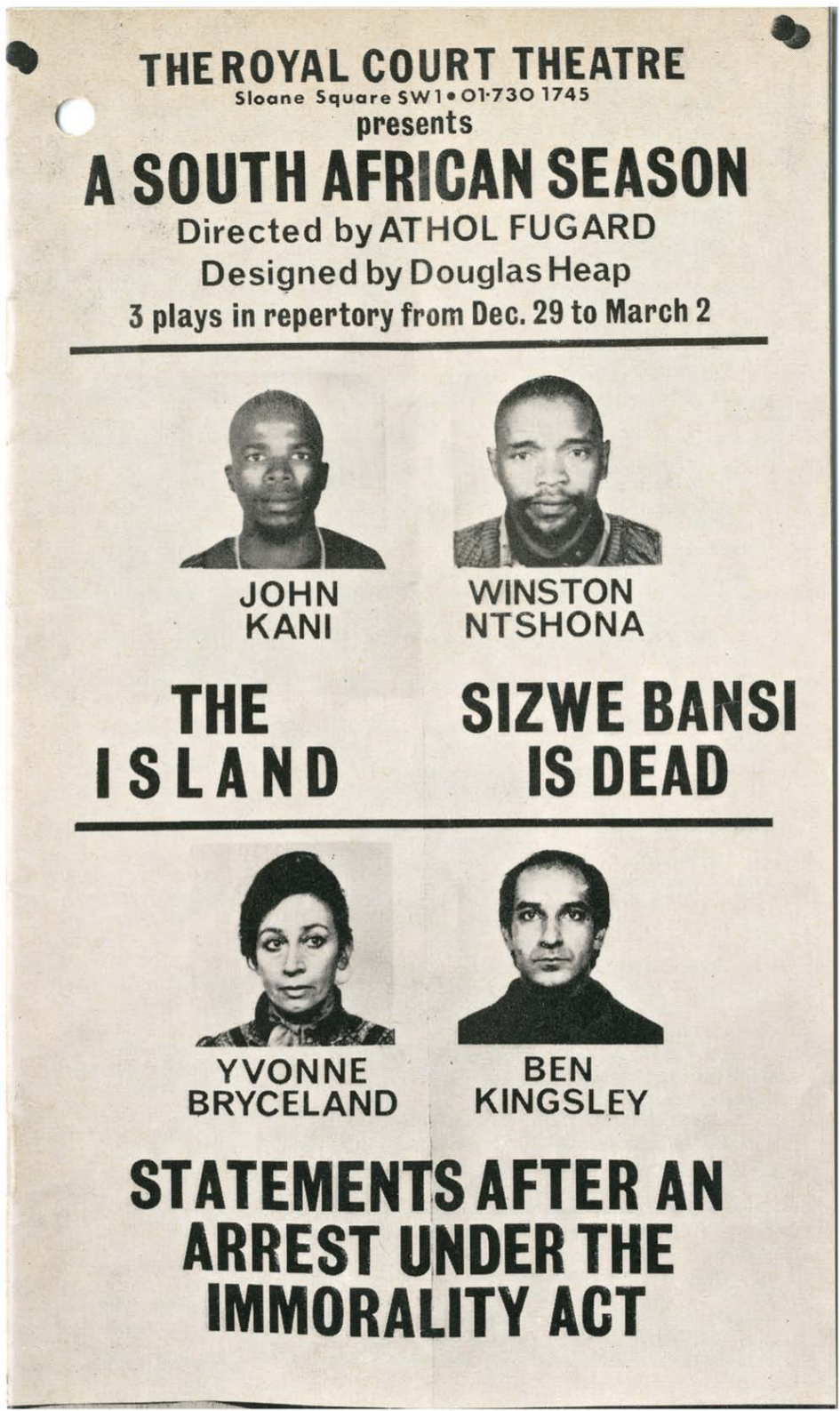
Royal Court Theatre, A South African Season, programme cover (1974).
Two years later, Kani and Ntshona went on tour in the Transkei. A performance of Sizwe Bansi in the small town of Butterworth took place on 8 October 1976, two weeks before the Transkei was due to become independent. According to a report in The Star the actors used the opportunity to convey their opposition to Bantustans: “The reason for the strong reaction to the play is believed to have been references in the Umtata and Butterworth performances — in which the actors have scope to improvise — to the Transkei being a dumping ground for dispossessed urban blacks and wholesale bloodshed following its independence” (c. October 1976). The actors were promptly imprisoned; Chief George Mantanzima, the Transkei Minister of Justice, declared that the performance of the play was “vulgar, abusive and highly flammable” (Daily Telegraph, 13 October 1976: 4). Kani and Ntshona spent 15 days in solitary confinement and were only released after a campaign in the UK led by Mary Benson, the Royal Shakespeare Theatre, and the Royal Court Theatre. The writers stated in a letter to the Royal Court: “we wish to assure you all, that were it not for your involvement and support we would never have been released as our release had no precedent” (Kani and Ntshona, 1976). Following this brief consideration of the plays’ authorship and early reception, this article turns now to the publishing strategy for the three plays.
Acquisition
OUP became Athol Fugard’s preferred UK publisher in the 1970s; he assigned British territorial rights to the OUP for People are Living There (1970), Hello and Goodbye (1973) and Boesman and Lena (1973). The latter two plays were then re-published by OUP together with The Bloodknot in a hardback entitled Three Port Elizabeth Plays (1974). OUP was not the first publisher of these plays: in South Africa, Balkema first published Hello and Goodbye in 1966, and Buren published the first edition of People and Boesman and Lena in 1969. However, the South African publishers were prevented from reaching a world market by the British Traditional Market Agreement, which in 1947 created two cartels that served to carve up world rights in English language publications between UK and US publishers, until its demise in 1976 (Hench, 2010: 212). By the early 1970s, Fugard’s plays were all disseminated from New York and London, and OUP in London became the locus for Fugard sales back to Africa.
OUP editors went to great lengths to try to secure exclusive rights for Fugard’s next plays, before even reading the manuscripts. In April 1972, Fugard approached Sally Carpenter, Editor at the Cape Town branch of the Press, and offered her Statements after an Arrest for publication. Hearing news of this, Richard Brain, Literary Editor in the General Division of OUP London, immediately wrote to Fugard requesting world rights and urging him to inform his agent that OUP should have first option (20 April 1972). Ron Heapy, Editor of the Three Crowns series, likewise worked behind the scenes to obtain rights to Fugard’s other new plays for the series. In March 1973, he wrote: “I read, by chance, in a cutting from some South African magazine that you have “knocked into shape” a play called Sizwe Banzi is Dead. Could there be any chance of us having a look at this? Do you think that Statements is ready for publication yet?”. Brain then heard about the productions of the plays at the Royal Court, and wrote to Fugard, “we can look forward to seeing both your new pieces, Sizwe Banzi is Dead and The Hodoshe Span at the Theatre Upstairs; what I’ve heard of your ‘Experiments in Playmaking’ makes me very eager” (16 August 1973). However, Fugard did not contact OUP until his return to Port Elizabeth in February 1974, at the end of the Royal Court season, whereupon he wrote to Ron Heapy: Sincerest apologies for my appalling neglect of OUP’s interest in the South African Season. My last three weeks in London were unbelievably noisy. The past two weeks back home, unbelievably depressing. It happens every time — a theatrical equivalent of post-coital deflation. I’ve come out of the doldrums now though. (19 Feb 1974)
Fugard explained that the Sizwe Bansi script had already been published in Plays and Players and was available to OUP in that format. He added that the Statements After an Arrest script was clean, and just needed minor tidying up, whereas The Island needed about an additional month’s work.
By this time, Fugard was, in the words of Heapy, “hot property” (29 August 1973). His tour had attracted a great deal of publicity in the UK, and on 13 March 1974 Sizwe Bansi was televised on British television. OUP was keen to capitalize on this, and agreed to generous terms. Anthony Sheil, Fugard’s literary agent, insisted that Fugard should be getting a better deal from OUP than its proposed 7.5% royalty on the paperback, and successfully argued for the royalty to be increased to 10% and the advance to be raised to £500 from the proposed £200 (29 April 1974). Fugard specified that all royalties on The Island and Sizwe Bansi is Dead should be evenly divided between himself, Kani and Ntshona (Brain, 3 March 1974).
There was a notable lack of discussion amongst OUP editors about the potential political repercussions of publishing the three plays in South Africa, considering the risks associated with the publication or importation of anti-apartheid literature at the time. The Publications and Entertainments Act of 1963 and later the Publications Act of 1974 stipulated that all publications in South Africa had to be submitted to one of the Publications Control Boards; the production and distribution of publications declared undesirable was a criminal offence (Van der Vyver, 1983: 21). The Customs Act of 1955 strictly controlled the import of material that was deemed to be objectionable in any way, the particular target of the customs officials being anti-apartheid work in cheap editions (Merrett, 1995: 34). In addition, after 1970, the Cape Town branch was instructed by London to cease liberal, oppositional publishing and focus instead on more profitable educational publishing, under the management of Neville Gracie (Davis, 2010: 94). Despite these constraints, Gracie urged rapid publication of the book in London: We are delighted that you are to publish Fugard’s three new plays. … I am not sure that I would have selected a single three-in-one volume but at any rate I am pleased that it is in paperback. There will be an excellent market in South Africa for this title and I hope that you will be able to publish before the end of this year. (19 February 1974)
The new publications proposal of March 1974 referred to the anticipated market in South Africa: “South African interest — unless there is any political incident between now and then — will certainly be high (1000 copies initially?)”. Evidently, the most important consideration was the book’s marketability: there was no expectation that the book would be banned, and Fugard was regarded as a profitable acquisition for the Press.
Series identity
Fugard’s first plays were published in the Three Crowns series, which was predominantly an African literature series. As a Three Crowns author, Fugard was associated with the West African playwrights Wole Soyinka, John Pepper Clark, and Obi Egbuna, and with black South African writers, Lewis Nkosi and Oswald Mtshali; the books in the series were sold predominantly to the African educational marketplace (Davis, 2005). The initial plan was to publish the new plays in this series, but Richard Brain was keen to move Fugard out of Three Crowns, and into the more prestigious literary series, Oxford Paperbacks, which by contrast was marketed to the UK student market, with a list that concentrated on reprints of classics from English literature, academic non-fiction and the occasional new edition.
In the event, the decision to move Fugard into the new series was made without consulting the author. He was simply informed by Ron Heapy (27 February 1974), “The general plan (I think) is that the three plays and the introduction should come out as an Oxford Paperback. Text of the other three may come out as individual Three Crowns”. The individual Three Crowns editions never did come about, and thereafter Fugard was published only in Oxford Paperbacks: Dimetos and Two Early Plays’ in 1977, a new edition of Boesman and Lena and Other Plays in 1978, A Lesson from Aloes in 1981 and Master Harold and the Boys in 1983.
Pierre Bourdieu (1993a: 37; 1993b: 99–101) describes the publisher as one of the agents involved in the production of the “meaning and value of the work”, and alludes to the ways in which a publisher’s imprint determines the field of production in which a literary text circulates. Yet, the symbolic capital accrued to an author by publication is determined not simply by the publisher’s imprint but also by the series in which the book is published. A publisher’s series can determine a book’s editing, design, production, and promotion strategy and, ultimately, its end market, and therefore its distribution and reception. The decision to move Fugard out of an African literary canon and into a “mainstream” literary series had a determining impact on the publication of these three plays, and positioned Fugard at the centre rather than the margins of OUP’s publishing strategy.
Editing Statements: Three Plays
In his introduction to the trilogy Statements (1974: vii), Fugard muses: “I have always regarded the completed text as being only a half-way stage to my ultimate objective — the living performance and its particular definition of space and silence.” In a later interview, Fugard observed again that his interest was in the play as performance not as a static textual product: “The thing for me is, a play is not so many words on paper; a play is an experience in a theatre. I have absolutely no reverence for words on paper, texts” (Wilhelm, 1982: 111). Fugard thus registered an awareness of his distinct contrast in attitude towards his plays as performances and as texts. It is interesting to consider the editing process of the three Statements plays in the light of these comments.
The text of Sizwe Bansi remained largely unaltered from the previously published edition by Plays and Players. Brain agreed with Fugard that the text should be “printed exactly as in Plays and Players, cockroaches, doom and all”. However, Carol Buckroyd carried out extensive editorial work on the manuscripts of Statements After an Arrest and The Island (Statements. Correspondence and typescript). Her editorial annotations focused on the stage directions in particular, as well as the playscripts’ phrasing, grammar, and punctuation. In a letter to Buckroyd, Fugard gratefully acknowledges her editorial work in helping him to transform The Island, an unstable improvisation, into a fixed typescript: “The Island”. It has really not been easy putting this together. I had to work from two recordings, a mess of notes and scraps of paper. The truth of the matter is that I need the responses of an objective but loving outsider as you so generously provided in the case of Statements. I look forward to hearing your comments on “The Island” text. I really can’t thank you enough for the trouble and care you’ve taken in trying to get the South African Season into print. You make my debt of gratitude to Oxford University Press very formidable. (12 March 1974)
The choice of Introduction was the main concern of the Literary Editor, Richard Brain. Initially, he anticipated that the plays would have an introduction explaining the plays’ political context, in a similar form to the Royal Court programme, and he wrote to Mary Benson: “I’ll certainly suggest to Athol that the longer version of the background material you provided that went into the programme notes for the South African Season might be included in the book, whether as a Foreword or an Appendix or whatever” (6 February 1974). In the event, this idea was not pursued (Buckroyd to Benson, 5 July 1974). Brain visited Fugard in Port Elizabeth to discuss the publication of the plays, and Fugard agreed to write a new Introduction himself (Brain to Buckroyd, 3 March 1974).
Fugard’s Introduction concentrated not on the specific South African political context but on his “experiment with improvised theatre”, his views on “the pure theatre experience” and attempts to put into practice Grotowski’s theories of drama. André Brink (1993: 439) observed: “Significantly, in the seven-page introduction that precedes the three Statements plays, he concerns himself with some of the dramaturgical and philosophical problems he confronted in them, without a single reference to their ideological or sociopolitical context”. It is not clear whether the subject matter of the Introduction was the decision of the publisher or the author, but the end result served to promote Fugard as a serious member of the literary élite, rather than as a political commentator, for it bears the essential marks of a cultural work, as characterized by Bourdieu: Few works do not bear within them the imprint of the system of positions in relation to which their originality is defined; few works do not contain indications of the manner in which the author conceived the novelty of his undertaking or of what, in his own eyes, distinguished it from his contemporaries and precursors. (1993c: 118)
Fugard dwells in his Introduction on the way in which he broke with scriptwriting norms and attempted a new type of playwriting in the creation of the three plays. The improvisational workshop collaboration with Ntshona and Kani has been regarded by critics as a radical attempt – both in terms of form and politics — to blur authorial boundaries and cross racial divisions. Gray (1982: 21), for example, describes Sizwe Bansi and The Island as experimental attempts to create new South African theatre, describing them as “impromptu inventiveness”. According to him, “The collaborative plays … call into question the concept of unique authorship and the copyrighting of communal experience”. Walder (1993a: 417) regards this playwriting process as an important “alternative to the dominant, Western, conventional hierarchy of author-text-production”, but nonetheless reflects on the inevitable difficulties in the relationship: “For Fugard, the task has been to cross the divide, a move which, like all serious transgression, involves difficulty, even danger, producing fear and guilt on one side, but also anger and resentment on the other”. He writes “that the near-total hegemony of the white minority created by apartheid has meant that white liberals and other dissidents such as Fugard are part of the structures of domination they oppose”. Walder’s analysis relates to the process of collaborative writing of these plays, but it might also be applied to the process of publication, which generated significant tension between the authors.
Fugard used the introduction to reflect on the authorship process for the three improvisational plays, and to carefully differentiate between his role as writer and that of the actors: I would just like to make one point clear: we did not jettison the writer. It was never a question of coming together with the actors on a “let’s make a play” basis. The starting-point to our work was always at least an image, sometimes an already structured complex of images about which I, as a writer, was obsessional. In all three of these plays the writer provided us with a mandate in terms of which the actors then went on to work […] These initial mandates from the writer were also not his final contribution. He kept pace with us as fast as we discovered and explored … sometimes as no more than a scribe, but at other times in a much more decisive way. The final dramatic structure of each play, for example, was his responsibility. Looking back on the three experiences now, it was as if instead of first putting words on paper in order to arrive eventually at the stage and a live performance, I was able to write directly into its space and silence via the actor. (1974: xi)
Slipping between use of the first and the third person, Fugard self-consciously positions himself as “the writer”, who exercised a “decisive” role in providing the “initial mandates” to the actors, giving “dramatic structure” to the work, and writing “via the actor”. This version of the plays’ origins and writing process was later contested by John Kani, who claimed in an interview that he and Ntshona were the main creators of the plots and dialogue of the plays and that Fugard had worked with them only one day a week devising the play: “it was not until the London production as we prepared for a wider and more sophisticated audience that we enlisted Mr. Fugard as director. That is when he took over completely” (Vandenbroucke, 1985: 118). With regard to The Island, Kani stressed the actors’ significance in the play’s creation: “Again it was one day with Fugard, six days with us because we can’t exceed a certain number of hours visiting a white man. We had an eighty per cent contribution. In Sizwe Bansi, he was the overseer. The Island is where we worked directly with him in the creation of the play”. (Vandenbroucke, 1985: 126). Kani and Ntshona were not given the opportunity by the publisher to approve Fugard’s introduction or to add their own version of events.
This consideration of the editing of Statements: Three Plays suggests that there was a clear distinction between Fugard’s approach to the plays in writing and performance and in publication. The playwright evidently monitored the performances of his plays with precise detail, frequently directing and acting in his own plays, yet he willingly handed over his playscripts to OUP for extensive copy-editing, adopting a more casual attitude to the printed form of the book. Moreover, in contrast to the writing process, the editing process for these plays was far from collective. Fugard entered into negotiations with the Press without Kani and Ntshona’s involvement, he transcribed the plays and made changes to the manuscripts without consulting them, and the introduction presents his voice and interpretation alone. Fugard acted as spokesman for his silent co-authors; he alone assumed the role as “the writer”.
Designing Statements: Three Plays
A controversy that manifested itself in the evolving paratext of the book related to how Kani and Ntshona should be credited. OUP initially expected to credit Fugard alone on the front cover. It was only after prompting from Anthony Sheil — acting on behalf of Kani and Ntshona as well as Fugard — that OUP made changes to the cover, title-pages and contract to acknowledge the plays’ joint authorship. In May 1974, Sheil wrote to Buckroyd to notify her that he had made arrangements to become Kani and Ntshona’s agent, and to complain that Fugard had licensed his work to OUP without the permission of his co-authors: I received a visit from John Kani and Winston Ntshona from which it emerges that Athol is not much better at communications with his colleagues than with his publisher. … it came as a complete surprise to them that he had agreed terms and that a contract was about to be signed because he told them nothing about details that had been arranged. Their main sources of concern are first, that the authorship of the plays should be clearly attributed and joint copyright attributed in the case of the two plays of which they can legitimately be regarded, as well as wanting to see proofs and read the introduction. (8 May 1974)
Sheil insisted that changes should be made to the title-page to include their names. Buckroyd replied, resisting the idea of making changes to the front cover: I am surprised to hear that Athol did not tell John Kani and Winston Ntshona about the publication plans for these three plays. All along he has been very anxious that the proper credit and return should go to them. They shall also see proofs of the cover, when I have them. We plan to use a marvellous photograph of them on it. On the front, however, we shall not include their names, but simply the wording “Athol Fugard Statements”. You must see the problem here; if we listed all the plays and all the authors, the cover would be far too cluttered to be effective at all. (13 May 1974)
The publisher’s need for an individual, recognizable celebrity author evidently militated against joint authorship. Buckroyd’s concern was that the cover was branded with Fugard’s name alone, lest the cover become “far too cluttered to be effective”. For, as Juliet Gardiner (2000: 263) observes, “The culture that circulates the author’s name in Britain today is one that is suffused with a Romantic reading of authorship as singular, individual, confessional”. Kani and Ntshona were to be seen but not heard: a visual spectacle realized by a “marvellous photograph”, but deprived of authorial attribution.
Buckroyd then contacted Kani and Ntshona to reassure them that “everything is in order” (14 May 1974), and then wrote to Fugard to complain about the interventions of his agent: I’ve just received a rather tiresome letter from your rather tiresome agent, and enclose a photocopy of it, together with a copy of my reply to him and a copy of a letter I sent off to John and Winston. I feel certain that Sheil must be stirring things up, but as equally certain there’s no need and no harm done. (14 May 1974)
Despite Buckroyd’s indignation, changes were made. The copyright notice was altered to incorporate Kani and Ntshona’s names, OUP sought to get them included in the contract, and there were attempts to liaise with them over publication of the text. However, OUP received no reply; the authors’ signatures were not obtained on the contract, and indeed three years after the book’s publication it still remained unsigned, and their royalties had begun to accumulate, unclaimed.
In the 1974 edition of Statements: Three Plays, the co-authors are listed on the front cover, albeit in a smaller sized typeface and positioned below Fugard’s name (see Figure 2). The size of the authors’ names is significant, for as Gérard Genette (1997: 38–9) cogently notes, “On the cover the name may be printed in varying sizes, depending on the author’s reputation”. The title-page has Fugard’s name in capitals across the top; Kani and Ntshona are listed as “devisors” of the workshop productions in a smaller typeface below (Figure 3).
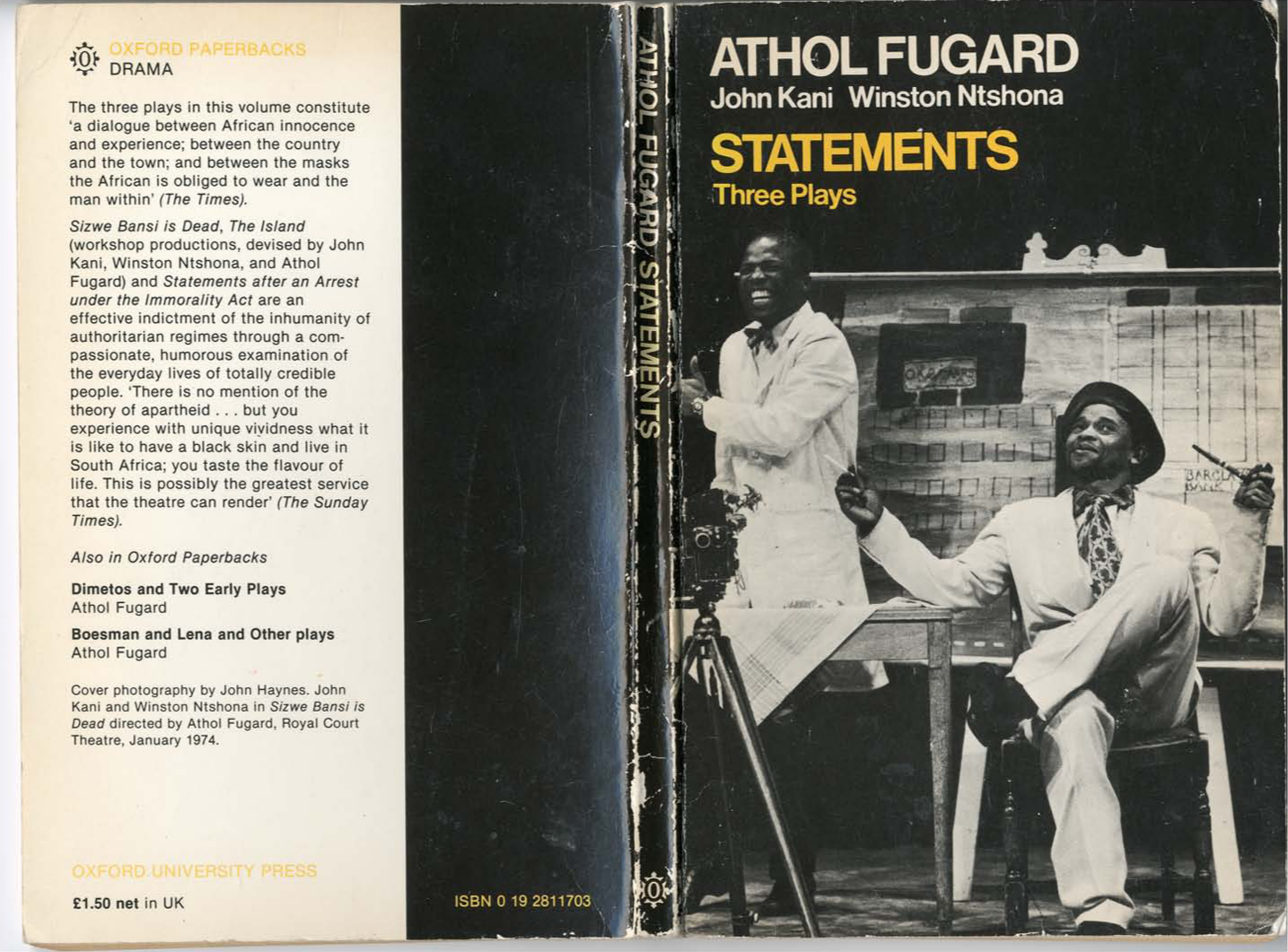
Athol Fugard, Statements: Three Plays. Oxford Paperbacks edition (1974), front and back covers. By permission of Oxford University Press.
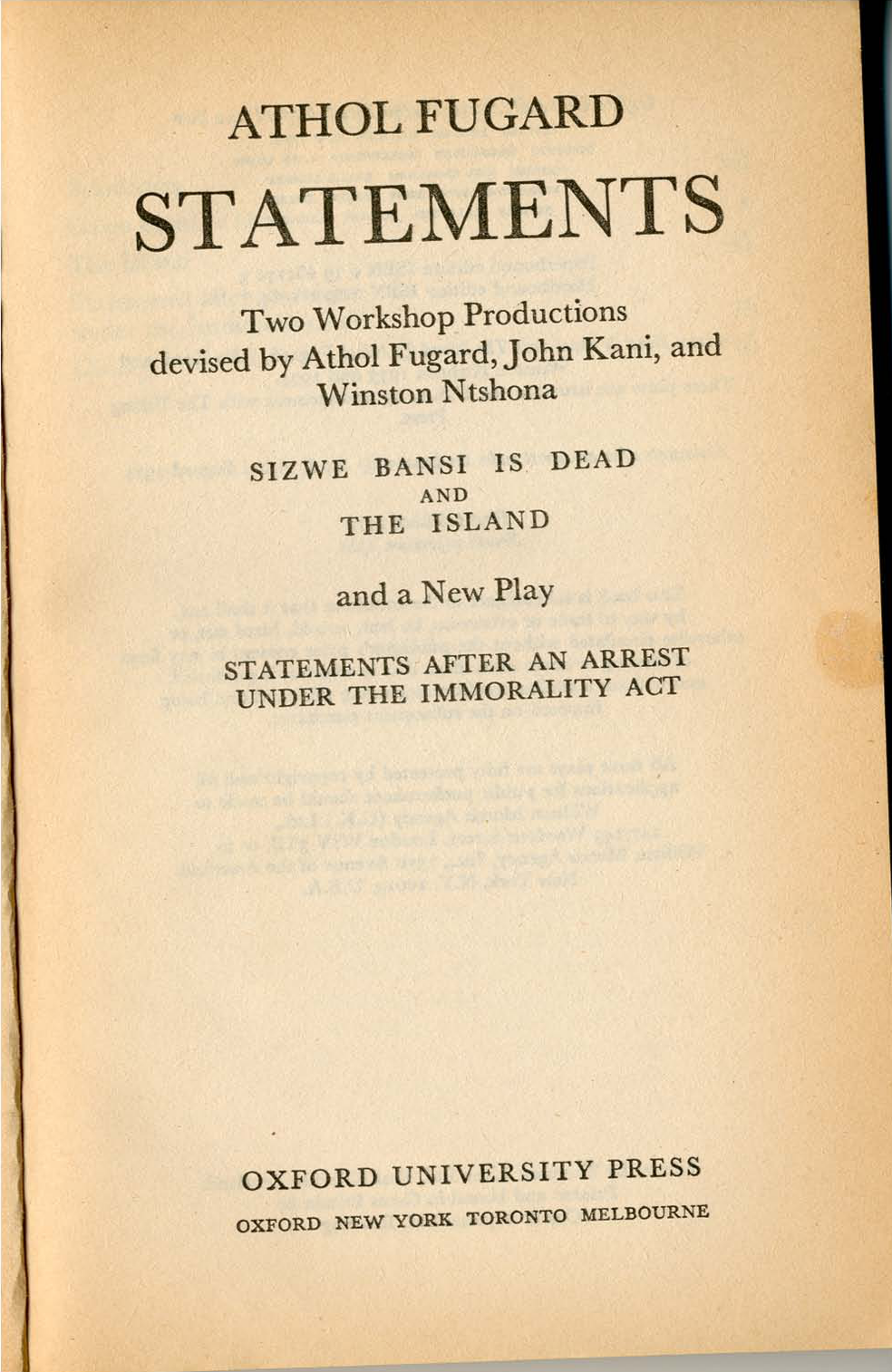
Statements: Three Plays, title page (1974). By permission of Oxford University Press.
The copy on the back cover was also amended to include a reference in parenthesis to the fact that they were “workshop productions, devised by John Kani, Winston Ntshona, and Athol Fugard”. However, the spine of the book, described by Genette (1997: 26) as “a narrow site but one with obvious strategic importance”, contains Fugard’s name alone. The paratext of the published book thus signals a distinct hierarchy of authorship.
The final book design for Statements: Three Plays branded Fugard overtly as an “Oxford” author. The Oxford imprint was becoming increasingly prominent, with its connotations of academia, conservatism and permanence. The back cover had the words “Oxford Paperbacks/Drama”, categorizing the text within the series and genre, while the imprint name was repeated at the base. The quality of production was good, both in terms of paper quality and typography. Published in a traditional serif typeface, the typography contrasted with the avant-garde sans-serif typography of the Three Crowns editions. In comparison with the poor photographic reprints on the front covers of Hello and Goodbye (1973) and Boesman and Lena (1973), Statements: Three Plays carried a well-produced front cover illustration of Kani and Ntshona, which was taken from the Royal Court performance (see Figure 2).
The back cover blurb for the book was written by Buckroyd, and demonstrated her concern to promote the plays as literary works: The three plays in this volume constitute “a dialogue between African innocence and experience; between the country and the town; and between the masks the African is obliged to wear and the man within” (The Times). Sizwe Bansi is Dead, The Island (workshop productions, devised by John Kani, Winston Ntshona, and Athol Fugard) and Statements after an Arrest under the Immorality Act are an effective indictment of the inhumanity of authoritarian regimes through a compassionate, humorous examination of the everyday lives of totally credible people. “There is no mention of the theory of apartheid — but you experience with unique vividness what it is like to have a black skin and live in South Africa; you taste the flavour of life. This is possibly the greatest service that the theatre can render”. (The Sunday Times)
Thus, the reader of these most overtly political of Fugard’s plays was reassured at the threshold of the book that “there is no mention of the theory of apartheid” in the plays. Employing an allusion to Blake, the reader was instead assured that the politics of the plays were tempered by literary abstraction. The specific South African content was not denied, but the plays were promoted as more widely significant, as representations of “Africa” and the “African experience”. Such homogenization is decried by Amuta (1989: 2): “In this totalising fixation with Africa as a vast homeland of the exotic, the linguistic, ethnic and class heterogeneity of Africa is conveniently forgotten”. However, in publishing terms, such generalization serves as an important promotional strategy, and as a means of maximizing a book’s market. This edition — destined particularly for the international literary and academic market in the UK, USA, and South Africa — sought to downplay the specific anti-apartheid message, which had been highlighted in the Royal Court plays.
Sales and distribution
Statements: Three Plays became the most successful of Fugard’s publications for the Press. The book was published on 14 November 1974 and it was decided that 2000 copies of the cloth edition would be published at £3.50, with the paperback retailing at £1.25. However, sales increased substantially after Sizwe Bansi was included in the Open University’s Modern Drama course on the recommendation of Dennis Walder. As a result the book was adopted as a set text, which guaranteed sales of 1500 per annum (Sales Figures, undated). By the end of 1975, it had sold 1965 copies, rising to 2230 in 1976. A reprint of 7000 copies was ordered in June 1976, and by 1980 it had gone into four editions (Swett to Linnet, 18 January 1978). There was some competition for US rights in the plays. In 1974 Viking gained US rights to the two joint authored plays, which were published as a single volume Sizwe Bansi is Dead &The Island in 1976. OUP New York then published Statements: Three Plays in January 1978, estimating initial sales of 11,000 copies (Anon., 16 January 1978).
The South African office was a major outlet for the book and 1000 copies were ordered for it at the outset. OUP had for the first time exclusive rights for the South African market, as Fugard did not have a South African publisher for these plays. Three years after the publication and successful importing of Statements: Three Plays into South Africa, it attracted the attention of the customs officials. In August 1977, Neville Gracie reported that the book had been referred to the Directorate of Publications as possible “imported undesirable literature”; a temporary embargo was placed on the import and sale of the books while a decision over possible prosecution was made (Gracie to Sisman, 3 August 1977). However, there are no further references to this in the file; evidently the ban was lifted and Statements: Three Plays continued to sell freely in South Africa. By 1984, Dennis Walder reflected on Fugard’s success in South Africa and beyond, and attributed this process of assimilation in part to his status as an Oxford author: All twelve plays (excluding ephemera, film scripts, and the minimal text, Orestes) are currently in print, courtesy of Oxford University Press; his latest, “Master Harold” and the Boys, is doing phenomenally well both in America, where it was premiered, and in South Africa. Thus does the poet of the dispossessed and disinherited, the culturally marginal, become assimilated. … Perhaps the process is inevitable: this review participates in it, of course. But it does make the power, the demand, of the original theatrical experience, which is after all the raison d’être of the whole business, seem rather a long way away. (1984: 461)
Conclusion
This article draws attention to the distinction between Fugard’s Statements plays as performances and as published texts. The publication of the trilogy by OUP resulted in a more individualistic work than the plays in performance in the early 1970s, and through publication these improvised pieces were moulded into stable products. The concept of collaborative authorship was at odds with the individualistic one promoted by the publisher: the editors proceeded to publish the plays as if they had been written by Fugard in isolation, and Fugard was considered to be the sole author in terms of all editorial and contractual decisions. This conventional model of authorship applied by OUP undermined the interracial partnership between Fugard, Kani and Ntshona — indeed, the publication process served to expose and exacerbate the divisions between the authors of the plays.
The “elevation” of Fugard from the Three Crowns series into the Oxford Paperbacks literary canon also had marked consequences for the way that his plays were edited and packaged. In sharp contrast to the performances of the works, which were monitored, regulated, and sometimes banned in South Africa, his work was evidently made safe in publication: the books were packaged as literary and commercial products that circulated without constraint. The plays were promoted as allegorical literary works of universal significance for a universal marketplace. By this strategy, the publisher played a decisive role in neutralizing the political impact of the plays and in successfully incorporating Fugard into the literary establishment in the UK, the USA, and South Africa under apartheid.
Footnotes
Acknowledgements
I am most grateful to David Johnson for his valuable advice during the research and writing of this work, and to Robert Fraser and Dennis Walder for all their help. Likewise, I wish to thank Sarah Brouillette and David Finkelstein for their constructive comments. I would like to thank Martin Maw, Archivist of OUP, for his help in locating documents, and the Secretary to the Delegates of Oxford University Press for permission to reprint archival references and images. I would also like to acknowledge the help of the curators at the National English Literary Museum in Grahamstown, whose records I consulted during this research.
Funding
This research received no specific grant from any funding agency in the public, commercial or not-for-profit sectors.