



Abstract
This article examines two poems which deal directly with the events of the Zong massacre of 1781, which saw 132 Africans aboard the British slave ship Zong thrown overboard when the ship ran out of potable water. David Dabydeen’s “Turner” and Marlene NourbeSe Philip’s Zong! attempt to render the African experience of Zong in their work. Despite the similarities in subject matter and approach, there has been little substantial comparative work on these poems. Responding respectively to J. M. W. Turner’s painting The Slave Ship, which was inspired by the events, and art critic John Ruskin’s commentary on the work, as well as the legal case surrounding the massacre, Dabydeen and Philip write with the colonial past at the forefront of their minds. Using Ian Baucom’s theory of the synaptic sea, this article explores Dabydeen’s and Philip’s use of the sea as a space to remember and retell the massacre. Through its fluid and mutable nature, the sea becomes a counterpoint to the colonial record for both poets. It is both a creative and destructive space. Writing about this event is fraught with complexities for Dabydeen and Philip, but the sea emerges for both writers as a space which may accommodate the various pulls in their desire to redress the lack of African voices and depict the Zong massacre poetically.
Introduction: “The Sea is History” — creative and critical perspectives
That the sea is a key feature of much of Anglophone Caribbean literature was perhaps cemented by Nobel Laureate, Derek Walcott’s 1979 poem, “The Sea is History”, in which the poem’s speaker declares that his history is “all subtle and submarine” (Walcott, 1992/1979: 365). The sea’s presence is palpable in the work of several writers from this archipelagic region, including Grace Nichols, Mahadai Das, and Kamau Brathwaite, who, in seeking to locate the Caribbean man [sic], claimed “the unity is submarine” (Brathwaite, 1974: 74). Walcott’s and Brathwaite’s sentiments of a past situated in the depths of the Atlantic echo across Caribbean writing. For Édouard Glissant, the sea is a space of both history and memory; as he writes in Poetics of Relation: “‘Je te salue vieil Océan!’ You still preserve on your crests the silent boat of our births, your chasms are our own unconscious, furrowed with fugitive memories” (1997: 7).
Critical responses to the Caribbean Sea reflect these concerns, demonstrating a shift towards a consideration of the sea and its past as well as the memories that it holds, with Svend Larsen, for example, calling the sea a “universal carrier of memories” (2011: 455). Bernhard Klein and Gesa Mackenthun argue, more generally, that “the ocean itself needs to be analyzed as a deeply historical location whose transformative power is not merely psychological or metaphorical […] but material and very real” (2004: 2). They view the sea as “a paradigm that may accommodate various revisionary accounts — revisionary in the sense of seeing things in new ways, of seeing them differently — of the modern historical experience of transnational contact zones” (Klein and Mackenthun, 2004: 2). This call to view the sea as both a real and material site of history that has transformed people and places, while important to all marine spaces, is key to an understanding of both the Caribbean Sea and the Middle Passage. The writers mentioned above engage with it as a space of history, while also finding in the sea the potential to write afresh the stories of the past. For the poets of Caribbean islands, the sea is a quotidian reminder of the past which, in its currents and flows, offers a space to reconsider and reconcile histories in original ways.
This is certainly the case for two poems which take as their subject matter the 1781 Zong massacre: David Dabydeen’s 1995 long poem, “Turner” (Dabydeen, 2002), and Marlene NourbeSe Philip’s 2008 book-length poem Zong! (Philip and Boateng, 2008). In responding to the incident when approximately 132 African men, women, and children were drowned over a period of three days in reaction to a shortage of potable water, “Turner” and Zong! deal not only with the event itself and the drowned Africans but also the colonial records which carry its legacy. 1 Dabydeen’s and Philip’s poems locate this clash of legacies at sea, and as such can be fruitfully read alongside not only the critical interpretations that opened this article but also the theory of the synaptic sea posited by Ian Baucom (1997).
The sea in Baucom’s work emerges as a space of interconnected histories as people and goods were transported across the Atlantic as from neuron to neuron, across the synaptic gap that is the ocean. Extending this metaphor, Baucom argues, allows us to identify the Atlantic as the nervous system of empire, and to describe the submarine currents tumbling Glissant’s drowned slaves as the synapses coupling the neural densities of metropole and colony. In this description, the submarine emerges as neither European nor Caribbean, neither metropolitan nor colonial, neither within the “West” nor without it. Instead, the submarine locates the system of exchanges which at once acknowledges the distinct character of such “unities” and makes such distinctions meaningless. (1997: n.p.)
As a site of exchange, the sea both is and is not European and Caribbean, holding the histories of both spaces but ultimately belonging to neither. The sea dissolves distinctions into one another while retaining the uniqueness of each. The submarine is a “place […] of the ‘either/or and both’” (Baucom, 1997: n.p.). In this way, it becomes an interstitial, hybrid, connective space without a hierarchy. While both Dabydeen and Philip respond to the Caribbean Sea because of the specific history of Zong, that sea is also a colonial space and one which holds the memories of Africa. As such, it is all of these things, and of course none of them, at the same time. Thus, the synaptic sea offers a productive lens through which to view both poems as it attempts to delineate the sea’s impulses while also recognising the reality of the sea’s flows and currents and their ability to blur.
Baucom acknowledges that much of his theory of the synaptic sea aligns with the theory of the rhizome, outlined by Deleuze and Guattari. Yet, while the “nervous system and its synapses exhibit the topography of the rhizome” (Baucom, 1997: n.p.), he makes a crucial distinction between the rhizome and the synapse: The rhizome has neither a history nor an environment. The synapse has both. […] they bear the traces of both a collective and an individual history. The consequences of this difference are immense. If we conceive of culture as a rhizomatic assemblage, then we must construct a philosophy of culture which has no use for memory. (1997: n.p.)
To think of the sea as synaptic necessitates a consideration of its history and the memories it carries. Baucom’s theory of the synaptic sea thus emerges as a two-pronged idea. Firstly, the sea contains multiple histories which are both distinct and blurred by the workings of oceanic currents. Secondly, the specific location of the sea, its history and environment, is fundamental to the memories held there as well as how they are remembered. Crucially, Baucom’s is an explicitly materialist reading of the sea, as Klein and Mackenthun’s work calls for, because he accounts for the reality of drowned bodies in the sea, the ebbs and flows of oceanic waters and the sea’s spatio-temporal specificities. Alongside an attentiveness to the material nature of the sea, memory and oceanic flows are key to a comparative reading of “Turner” and Zong! as they engage with an oceanic, synaptic system of colonial exchange to examine memory.
This article begins by demonstrating how the colonial records to which Dabydeen and Philip respond remain conspicuous in their works while also being blurred by each poet’s need to carve a space for the drowned Africans in the memory of the Zong massacre. Secondly, I want to focus the main analysis of this work on the sea’s presence throughout each poem as a site of memory, as it is from the sea that the reimagined voices of the drowned slaves emerge for both Dabydeen and Philip. Across both poems, the location of memory within the sea points to a unique method of remembrance. Taking into account the realities of the sea and its history, the stories which emerge from these poems are individual and collective ones, fluid in nature, which speak both to the need to remember and the difficulty in doing so.
Seaing the past: David Dabydeen and Marlene NourbeSe Philip write back
Somewhat surprisingly, “Turner” and Zong! have not been substantially compared in critical literature, despite perceptible similarities in subject matter, approach, and attitude towards the colonial, historical record. Where mentions do occur they are brief and lack any sustained comparative analysis. Overall, this article seeks to redress that lack, beginning the work here by drawing attention to the similarities in each poet’s approach to their poem’s composition, followed by a comparative analysis of the openings of “Turner” and Zong!. Notably, both poets pinpoint the textual and visual records which do exist of the Zong massacre as central to their respective decisions to write their poems.
For Philip, the legal battle that ensued after the events aboard the Zong drive the poem. Key to the decision to drown the African people aboard the Zong was the financial costs of sickness aboard a voyage which ended up taking 100 days, over one and a half times the average journey length to the island (Walvin, 2011: 89). The decision made by first-time captain, Luke Collingwood, meant that the ship owners could claim insurance on the drowned slaves, thrown overboard as part of the ship’s cargo at a time of distress. However, the insurer, Thomas Gilbert, refused to pay out a claim of £30 per drowned slave and was consequently sued by ship owners Gregson & Co. A jury verdict initially prompted the courts to rule in favour of the ship-owners, ordering the insurers to pay out compensation but the insurers appealed this decision. As Veronica Austen succinctly explains: Under insurance law, the only pertinent fact was whether or not the jettison was deemed “necessary”; natural deaths due to illness would not be covered by insurance, but a necessary jettison of cargo, even if that cargo were living beings, would require compensation. (2011: 63)
The judges of the appeal ruled that there was insufficient evidence proving that the drowning of slaves was necessary and ordered a new trial. A two-page summary of this ruling, known as Gregson v Gilbert, is the main surviving legal record of this event, since no official record of the jury trial exists (Walvin, 2011: 140).
For Dabydeen, it is a later visual representation of the massacre which compels “Turner”. Almost 60 years on from the Zong, an account of the massacre inspired British artist, J. M. W. Turner, to paint Slavers Throwing Overboard the Dead and Dying — Typhoon Coming On. In 1840, Turner submitted the painting, commonly known as The Slave Ship, to an anti-slavery exhibition. The Slave Ship, through its depiction of an apocalyptic sea, enclosed by a fiery, blood-like sky, speaks to the horror of the Zong massacre. Yet the victims of the massacre, the drowned Africans, feature in the work as obscured bodies, hardly distinguishable amongst the waves. The painting is undoubtedly a contender to be Turner’s magnum opus and his technical skill and the overall quality and effect of the painting was ordained by English art critic, John Ruskin, who years later claimed that he would rest Turner’s immortality on the work. For him, it featured “the noblest sea that Turner ever painted […] the noblest certainly ever painted by man” (Ruskin, 1844: 377).
Yet, as Abigail Ward notes, “debate surrounding the picture has become, in many ways, as significant as the painting itself” (2007: 48), and Dabydeen’s poem adds to this conversation. Similarly, Ruskin’s writings on the painting have remained a contentious topic of debate. Notably, the only ostensible discussion of the painting’s subject matter appears in a footnote which reads, “She is a slaver, throwing her slaves overboard. The near sea is encumbered with corpses” (Ruskin, 1844: 378). For some, Ruskin’s writings mirror Turner’s painting as they both “[fail] to see the jettisoned slaves” (Ward, 2007: 48), an effect of what Tobias Döring terms Turner’s “imperial eyes” (1997: 4). This gaze may also be extended to Ruskin, as he views the Zong massacre from a position of colonial authority.
While these colonial records of the event (both legal and artistic) seem to demonstrate, to some extent, well-intentioned stances against the slave trade, they also display the contemporaneous disavowal of African subjectivity and autonomy. Considered cargo in the law, lost in the waves in art and confined to a footnote in criticism, the African men, women, and children drowned in this massacre were expunged from the historical record. For both Dabydeen and Philip, these textual and visual records omit the lives and voices of the massacre’s victims.
In extra-textual material accompanying “Turner” and Zong!, Dabydeen and Philip respectively specify the impetus to respond to the colonial record outlined above which doubly victimizes the Africans aboard the Zong through an elision of their murder from the very records that presume to depict them. Dabydeen’s poem gives voice to the obscured, drowning figures of Turner’s painting while also providing a response to Ruskin’s almost complete omission of any reference to the drowned slaves in his critique of the painting. In the Preface to “Turner” Dabydeen declares that his poem draws attention to “the submerged head of the African in the foreground of Turner’s painting […] drowned in Turner’s (and other artists’) sea for centuries”, noting also that the painting’s subject “the shackling and drowning of Africans, was relegated to a brief footnote in Ruskin’s essay […] [which] reads like an afterthought, something tossed overboard” (2002: 7). 2 Profoundly affected by the absence of African voices within the text, Philip pulls apart the summary of the Gregson v Gilbert appeal, using it as the “word store” (Philip and Boateng, 2008: 191) 3 for Zong!. In “Notanda”, which follows the poems of Zong!, Philip outlines her poetic decision to “lock” herself into the legal summary “in the belief that the story of these African men, women and children thrown overboard in an attempt to collect insurance money […] is locked in this text. In the many silences within the Silence of the text” (p. 191).
It is within a world replete with these silences and omissions that “Turner” and Zong! open. The need to make a sound, to speak, to write in and over this space is evident. The sea is established as a key actor from the outset, not as empty space to be traversed but a synaptic gap which in a distinct way both holds the memory of the past and allows for a creative present. In the opening of each, the sea allows these events to be rendered poetically in this synaptic space, while at the same time underscoring the difficulty in remembering and retelling. “Turner” begins: Stillborn from all the signs. First a woman sobs Above the creak of timbers and the cleaving Of the sea, sobs from the depths of true Hurt and grief, as you will never hear But from a woman giving birth, belly Blown and flapping loose and torn like sails […] The part–born, sometimes with its mother, Tossed overboard (9).
The sobs and cries of a woman giving birth are all the more desperate as rather than giving life, they produce a stillborn child. Importantly, the woman’s sobs form part of the oceanic sounds, with the sounds of the ship and the “cleaving | Of the sea” working in discord with her cries. As such the sea is centred as having a prominent role in the voicing of this story, participating in the cacophony of incomprehensible sounds on board and forming part of the lexicon of the poem. It is not merely the location of the events but, as with Turner’s painting, it is a foregrounded feature. Dabydeen’s engagement with the sea here and throughout the poem tempers his combative tone in the preface, suggesting a more nuanced approach to Turner through “a contradictory reliance on and resistance to the cultural authority” of The Slave Ship (Döring, 1997: 11).
Indubitably, Dabydeen is unforgiving in his critique of Turner and Ruskin in the preface to his poem. Accordingly Mark Frost, countering this critique from Dabydeen as well as others, concludes that Dabydeen’s “poem advances a single, closed reading of Turner as sadistic” (2010: 378). Frost devotes much of his article to arguing against Dabydeen’s depiction of Turner as well as of Ruskin, demonstrating through carefully chosen examples their sympathy towards the plight of the slaves of Zong, at times convincingly. Nonetheless, sections of his article in which he suggests that critics who implicate Turner in the slave trade must by the same logic condemn every nineteenth-century figure regardless of their stance on slavery (Frost, 2010: 376–77), or in which he tentatively suggests that, in his writings on slavery, Ruskin “is at least avoiding the perpetuation of an image of black victimisation” before conceding that Ruskin “is indeed guilty of prioritizing a European social agenda” (2010: 382) are some of his more overreaching claims. While much of Frost’s criticism is directed towards critics themselves who have interpreted Dabydeen’s poem, granting the latter “poetic license” (2010: 378), he does not take into account Dabydeen’s complex interplay of assimilation and resistance to the painting. This interplay specifically emerges through an examination of the poem’s interactions with the sea.
For Dabydeen, neither the poem’s speaker nor the stillborn child “can escape Turner’s representation of them […]. Neither can describe themselves anew but are indelibly stained by Turner’s language and imagery” (p. 8). In his focus on the sea, Dabydeen calls to mind Turner’s canvas which is similarly dominated by the it. Accordingly, the painting’s presence is palpable throughout the poem. 4 Just as the truly synaptic sea brings “tribute from many lands”, which turn “mouldy” and “dissolve” (p. 22), Turner’s presence too is invoked and dissolved by turns, rendered undecipherable at points by a speaker who has “become the sea’s craft” (p. 31). Yet, like these tributes which remain within the sea in their dissolved form, Tuner does not disappear completely from the sea or the poem, either physically or aesthetically. The sea becomes “the white enfolding | Wings of Turner” (p. 41) by the poem’s final section, invoking The Slave Ship and, significantly, Dabydeen names the poem’s captain figure Turner. If this poem at war against Turner, his continued presence throughout the poem suggests that Dabydeen is neither victor nor loser here. Nonetheless, a closer inspection of Dabydeen’s oceanic interaction with the painter, presents a more nuanced, layered, yet still antagonistic view of Turner than Frost’s arguments acknowledge.
Philip’s work too blurs demarcated lines and like Dabydeen she begins her poem by focusing on the incomprehensibly of the pain and violence meted out to the slaves. “Zong! #1” opens with a series of repeated w’s with the word “water” broken across the poem’s scattered opening lines being the first recognisable word in the poem. Jenny Sharpe notes that water is a central theme of the poem as it recalls not only the sea as the site of the slaves’ death but also the alleged shortage of fresh water that led to the massacre in the first place (2014: 475). Moreover, water is the poem’s beginning, both linguistically and spatially. What is the site of death is also the poem’s birth, allowing the sea to take on the either/or and both quality central to the idea of the synaptic. In Philip’s performance of the poem’s opening, the gargling, gulping, shivering sounds of the repeated w’s and g’s are striking, reflecting the drowning that is rendered visually elsewhere in the poem’s experimental layout. 5 Birgit Neumann and Jan Rupp point out that “the sea is a substantial creative principle for Philip as she suspends linguistic structure […] and gives herself up to a journey that equals the situation of being at sea, with no language system to hold on to” (2016: 428). With both bodies and language at sea, the shock and pain of the events are heightened as the reader too is placed at sea in his or her encounter with the poem. This link between sound and water is expounded by Philip herself in “Notanda”; she describes her “profound curiosity […] about the sea” (p. 191) and significantly, makes a point of the suggestion that “[Guglielmo] Marconi [an electrical engineer who worked on long-distance radio transmission] believed […] water is a much more ‘sound-efficient medium’ than air”, prompting Philip to wonder “whether the sounds of those murdered Africans continue to resound and echo underwater” (p. 203). In a more visceral way than Dabydeen’s opening, “Zong! #1” places the sounds of drowning and violence in the sea.
Zong! and its opening poems can also be implicitly read as a retort to Ruskin, as Philip invents African names and places them as a footnote to the first 26 poems of the collection. Groups of names such as “Mwita Muhammad Mulogo Becktemba Hadiya” (p. 9) reflect a diversity on board that is not accounted for by slavers’ records in which “Africans are reduced to the stark description of ‘negroe man’ [sic] ‘negroe woman’” (p. 194). Philip’s use of the footnote here is pointed and calls to mind the distanced nature of Ruskin’s narrativization of the painting, forcing the reader to see the names of those consigned to a footnote in history. Yet, despite “develop[ing] a need to know the names of the murdered” (p. 194), her decision to place these invented names in a footnote signals the weight of the colonial past as she mirrors Ruskin’s writings. These sunken names encumber Philip’s poems. Kate Siklosi explains how in recent performances of the poem, “Philip has projected these names onto a water table that cycles the names through a gurgling water fountain so the names appear to float hauntingly amid ocean waves” (2016: 125). This serves as a further riposte to the presumed logic of the footnote itself as the names are present throughout the reading; they cannot be ignored or glanced over as one might with a footnote. Moreover, the constant presence of the drowned slaves in the watery spaces of the sea is reiterated. This interaction with Ruskin displays a shifty interplay between opposition to and absorption of a colonial past, which also points towards a key moment of intertextuality between Zong! and “Turner”.
These openings demonstrate a concern with language, echoing forth from the sea the sounds of the massacre itself. It is precisely this link between language and the sea that prompts questions of memory and remembrance. How does one tell the story which, as Philip says, echoing the closing passage of Toni Morrison’s Beloved, “must be told by not telling” (p. 190)? Reflecting Baucom’s suggestion that the synaptic sea is a space of both individual and collective memory, Philip declares “our entrance to the past is through memory. And water” (p. 203). Similarly, Dabydeen considers the sea central to Caribbean memory: “I come back to Walcott’s statement that if you look for Caribbean history, look for it in the pages of the sea” (Dabydeen, qtd. in Härting and Döring, 1995: 41). Dabydeen demonstrates a personal, artistic engagement here as he interacts with the history of Zong as well as Turner and Ruskin. The sea, for Philip, by contrast, is a shared space of remembrance. Although writing of her own experience of composing Zong!, the memory she locates at sea is open to all.
The specific environment of the sea for these writers is what makes it synaptic, transmitting the forgotten history and memories of those drowned in the Zong massacre. On the one hand, the synaptic sea offers a framework in which non-European concepts of the sea can emerge from a space often dominated by imperial pursuits as hierarchies dissolve. In this case, Caribbean conceptions of the Atlantic as the site of the Middle Passage have provided an alternate view to Western conceptions of the sea which is othered. As Maeve Tynan notes, in contrast to “Western Imperial logic, which privileges terra firma over the lacuna of aqua nullius” (2010: 145), “Caribbean constructions […] read the ocean space as the wound of history” (2010: 175). On the other hand, a reading of the synaptic sea must recognize “the mutating ebb-tides of submarine memory” (Baucom, 1997: n.p.). The sea as a repository can only ever be unstable as flows of colonial and postcolonial impulses are ever changing.
Going further than Baucom, Elizabeth DeLoughrey cautions that “ocean space is conceptually replete with contradictions”, reminding us of the difficulty of dealing with “the vastness of the ocean, a place of ontological limitlessness and fluidity” (2007: 76–77). In more recent work, DeLoughrey distinguishes the sea’s properties from those of the land “Unlike terrestrial space — where one might memorialize a space into place — the perpetual circulation of ocean currents means that the sea dissolves phenomenological experience and diffracts the accumulation of narrative” (2017: 33).
The very histories contained in the sea cannot be remembered in the same way as those that happen on land. The process of blurring and distinguishing that occurs in Baucom’s theory finds resonance in DeLoughrey’s insistence that the sea dissolves and diffracts, although her work pushes towards a less graspable memory at sea. For example, the mouldy, rotting tributes from many lands in “Turner”, mentioned above, can be seen in this light as the diffracted remnants of the many countries touched by the slave trade.
Nonetheless, the fluidics of the ocean transform memory through different processes and these processes are seen in various degrees in the two poems under discussion. It is precisely this fluidity which, for Dabydeen and Philip, allows for a revised, counter-memory to emerge, “not to make the past present but to reconceive our basic notions of temporality, periodicity, and contemporaneity” (Baucom, 2005: 324). Placing the sea as the central feature of the poem, both poets challenge colonial narratives of the past and also implicitly confront understandings of the present. Memory is not confined to a linear, historical conception of time and pastness but rather the memory of Zong is continually palpable for Dabydeen and Philip through the encounters with the sea. It is with these ideas in mind that the following sections explore how some of the contradictions of Dabydeen’s and Philip’s poetic engagement with Zong are signalled through the sea’s presence in both poems.
Memory at sea: “Turner” and the desire to begin anew
From the preface onwards, Dabydeen establishes the sea as a site of rebirth and renewal, a possible escape from the histories and oppressions of racism. Elaborating on the poem’s speaker, the drowned African head of Turner’s painting, Dabydeen says “his real desire is to begin anew in the sea” (7). Yet, as the site of the memory of the Middle Passage, the sea cannot be freed from this history. At the opening of section VII, the speaker declares “I had forgotten the years, now wakened | By the creature that washed towards me” (17). The speaker had become accustomed to the shipboard violence of the slave trade such as “sobbing offenders | Tied naked to the mast” (17), gradually forgetting them. The “salt splash” the child makes when tossed into the sea becomes a crucial moment, “burning [the speaker’s] eyes | Awake” (17). Through this he sees again and anew the horrors he once experienced. The synaptic memory is transmitted through the specific environment of the sea, reawakening the past. Through the burning splash of salt water and the precise nature of punishment at sea, the element itself becomes the source of memory.
Nonetheless, Dabydeen hints at the sea’s transformative potential. The material nature of the sea transforms the drowned women of section V as salt water alters and redraws the women’s faces: the sea bloats them, the salt hardens On their skin, a crust of white that hides Lines of neglect, indelicacies. The sea prepares Their festive masks, salt crystals like a myriad Of sequins hemmed into their flesh through golden Threads of hair. The sea decorates, violates. Limbs break off, crabs roost between their breasts Feeding. The sea strips them clean. (15)
For Dabydeen, the sea holds cleansing powers yet he recognizes that these powers are not wholly positive. On the one hand, the images here point to renewal in the face of violence through the lines of neglect that are hidden and the decadence of poetically embellishing those bodies with gold and crystals. On the other, these bodies seem only to perform renewal, wearing it as mask in a carnivalesque moment of release only to return to the reality of slavery where the body turns grotesque and is beaten and the women stripped of any humanity. The ocean bed prompts these contradictions, as DeLoughrey notes, allowing the bodies to be read in either of the above ways: as a creative hybridity as Baucom might suggest or merely a performance of this. Either way, the need to recognize the contradictory nature of the sea alongside its synaptic qualities signals the productiveness of reading DeLoughrey and Baucom together here. Finally, the lack of a coordinating conjunction in the line “The sea decorates, violates” connotes the multiplicity of meanings at work within the sea’s synaptic fluidity. The ocean is constantly in flux and as such can be a creative space while simultaneously being destructive.
Recalling his own drowning, the speaker of the poem notes that “struggle came only after death” (25) as his body is not claimed by the sea as he had hoped: “Like cork, buoying me when I should have sunk | and come to rest on the sea’s bed” (25). For Dabydeen, the alive-dead speaker cannot be ignored and instead floats on the sea’s surface as a reminder of the inability of colonial powers and of J. M. W. Turner fully to repress the African subjects and also of the way in which the drowning itself is a constant presence in the sea. However, the speaker’s floating body figures as more than just an “unrepressable object of dread” (Baucom, 1997: n.p.) but also a reminder of the need to address and remember that figure. Dabydeen cannot look away from him and his poem draws the speaker to the surface. Yet, the speaker seeks the care of the sea which with an undertaker’s Touch, soothes and erases pain from the faces […] unpastes flesh from bone With all its scars, boils, stubble. (25)
Again, the sea can smooth away the pains and ills of the past, the flow of synaptic impulses not destroying the subject but rendering the pain meaningless as scars are healed. At the same time, however, in a material way the sea is a violation and the broad vowels and harsh “p”, “f” and “b” sounds in “unpastes flesh from bone” speak to the violent history contained therein. The speaker’s flesh is dissolved by the sea in a caring way but is diffracted through the colonial impulses that remain present in the Atlantic flows.
Remembrance in “Turner” is mediated through conflicting forces of colonial inheritance and Caribbean subjectivity which cross and mutate throughout the poem. The strongest example of this duality at work in the poem is evident in section XI. Although the speaker has earlier said “the sea | […] has bleached me too of colour” (19), the only word the stillborn child speaks is a racial slur directed at the speaker: Later it confirmed its breed, Tugging my hair spitefully, startlingly me With obscene memory. “Nigger!” it cried, seeing Through the sea’s disguise as only children can, Recognising me below my skin long since Washed clean of the colour of sin, scab, smudge. (21)
The sea can disguise, as in The Slave Ship, by obscuring the drowned, or concealing the markers of difference. If the former is anathema to Dabydeen, the latter, he realizes, is impossible. Following Ruskin’s discussion of the water in Turner’s painting, Baucom summarizes: Water surfaces […] deceive the eye. In gazing upon them we either see the surface itself, but not what it reflects, or we study the reflection, in which case the actual surface disappears […] The task of the water painter is, then, to keep the eye of the observer constantly in play between these two mutually exclusive ways of seeing. (Baucom, 1997: n.p.)
Section XI above plays with this tension as Dabydeen draws attention to both the surface and the depth of the sea. The bodies of this poem are disguised by the sea, obscured by the surface which washes them clean of colour. Yet, they also retain the sea’s traumatic history and, in particular, the memory of the Zong massacre. The possibility of renewal is signalled by the fact that Dabydeen can write a history of the Middle Passage from the perspective of a drowned African but, as Stef Craps notes “the stains left by a collective history of racial abuse cannot be washed away so easily” (2010: 469).
“Turner” signals Dabydeen’s desire to individualize a collective memory. He comes to the project with a hopeful sense of renewal, that this speaker could bring forth newness for the rest. However, for the poem’s speaker “the desire for transfiguration or newness or creative amnesia is frustrated” (7) by the memory of the past and the inevitable endurance of Turner’s painting into the future. The poem’s final section reiterates this thwarted renewal as the speaker admits I wanted to teach [the child] A redemptive song, fashion new descriptions Of things, new colours fountaining out of form. I wanted to begin anew in the sea But the child would not bear the future Nor its inventions, and my face was rooted In the ground of memory. (41)
The rootedness of the memory of racialized abuse, so evident in the plantations of the Caribbean for which the Africans aboard the Zong were bound, ultimately overrides the more fluid, creative potentiality in memory located at sea. Although frustrated, the creative impulses emerge through the poem’s act of what Döring terms “marine archaeology” (1997: 10). No longer masked by Turner’s sea, African stories and voices are placed at the centre of present interpretations of the Zong massacre. “Turner” excavates both individual and collective histories from the sea, foisting onto Turner’s celebrated painting the deaths it seems to elide.
Memory at sea: Zong! resisting meaning
The work of Philip’s Zong! may also be characterized in some senses as the work of marine archaeology. However, she is explicit about the ontological challenges of raising bodies from the sea, asking in “Notanda”, “What is the word for bringing bodies back from water?” (201). Searching for a liquid equivalent to “exhume” she finds “words like resurrect and subaquatic but not ‘exaqua’. Does this mean that unlike being interred, once you’re under water there is no retrieval — that you can never be ‘exhumed’ from water?” (201).
It is perhaps this questioning of the sea’s obscurity that prompts Austen to claim that Philip’s treatment of the Zong massacre is more involved in questioning “the ethics of representing past traumas” than Dabydeen’s (2011: 65). Dabydeen’s anger at Turner’s representation leaves little space for a metatextual consideration of his poetic project. Philip on the other hand feels “metaphorically speaking, at sea” (190) in her encounter with the legal text. Early on in the section entitled Ratio (reason), this tension between meaning and remembrance is brought to the fore through the poem’s constant questioning: “how do | we | parse | the deed is | it one | or | many how | do | we | praise | the | dead” (102–103). The sonorous similarity in “parse the deed” and “praise the dead” suggests that neither can be answered separately but the rapid disintegration of the sentence across the pages underlines the difficulty of grasping either and, as DeLoughery points out, emphasizes the limitlessness of the ocean. This finds resonance in the earlier section “Zong! #18” (Figure 1), in which the repetition of the word “means” becomes meaningless in linking a legal framework with the reality of the massacre: “overboard” with “sufficient” and “provisions” with “perils”, for example. The neat vertical lines of this poem mirror a ship’s ledger, which Siklosi suggests “narrates the confrontation between tidalectic logic and the teleological language of the law that determines value” (2016: 120). That is to say, the sea’s flows and synaptic exchanges establish a logic that is wholly alien to the linear and highly structured record-keeping aboard a ship and in legal cases. This tension between form and content paves the way for the rapidly disintegrating structure as the poem progresses. The unfathomability of the events of the Zong massacre and its treatment in the English legal system leave Philip questioning the very form, language, and genre in which one might begin to approach the topic.
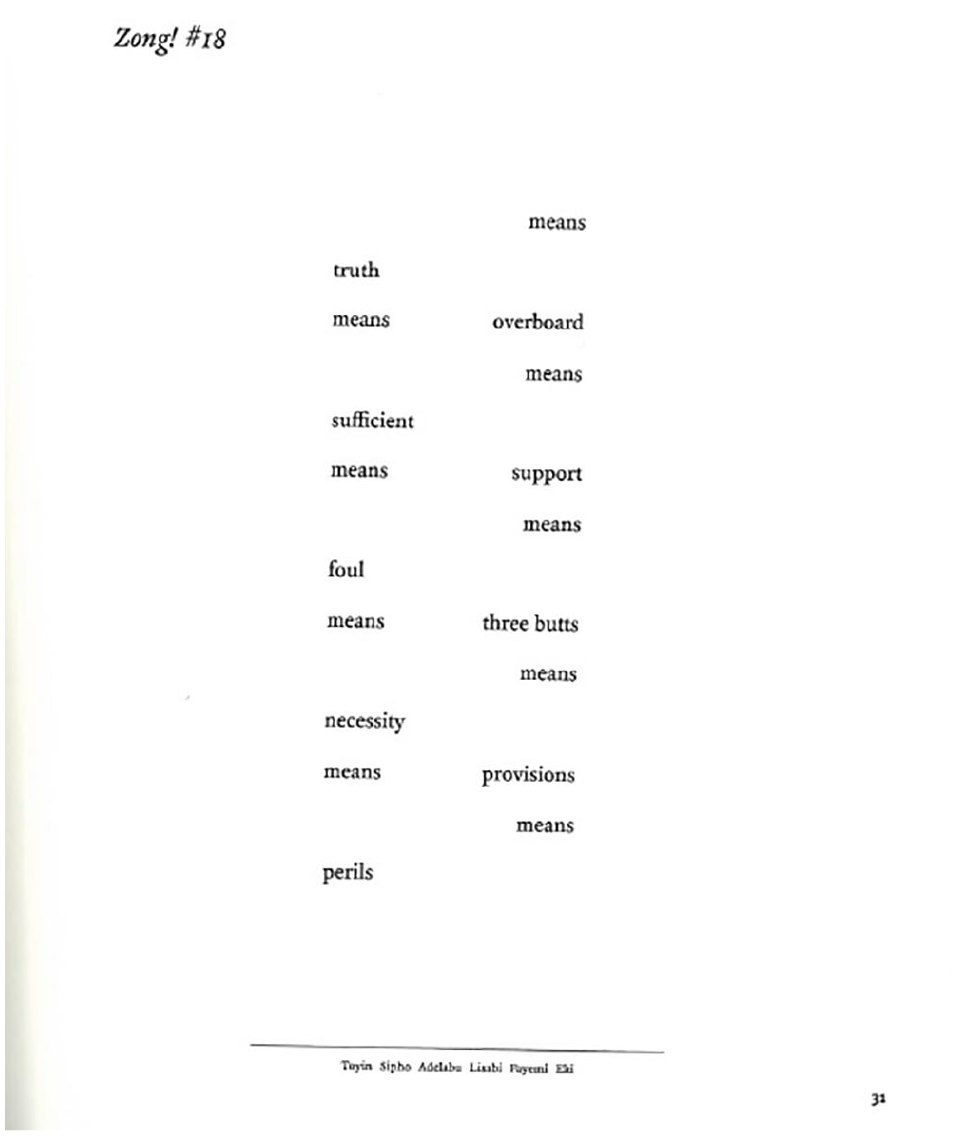
Page 31 from Zong! © 2008 by M. NourbeSe Philip. Published by Wesleyan University Press and reprinted by permission.
In the acknowledgments preceding the poem, Philip says that Zong! is “authored by one person” (xi). However, the poem’s subtitle, as it were, is “[a]s told to the author by Setaey Adamu Boateng”, a fictional African co-author. In a subtler way than Dabydeen, Philip brings African voices to the fore but retains deliberate tensions within this as significant sections of the poem are dominated by a colonial voice. On one level this demonstrates the difficulty of writing the voices of the drowned. On another, much like Dabydeen’s complex relationship with Turner and The Slave Ship, it is reflective of Philip’s reliance on the words of the Gregson v Gilbert legal text. Phrases from two-page summary such as “want of water” and “perils of the sea” (210–211) return throughout the text as increasingly disintegrated ideas, the words themselves spaces across the pages of the poem. Erin Fehskens suggests that the spaces which tear apart Gregson v Gilbert in the poem “stand in for the bodies that disrupt the surface of the sea” (2012: 408). Their presence is inscribed on the sea as much as on the page: “life i | t self they wr | ite on water” (153). Much like the dead–living speaker of “Turner” these visible–invisible bodies within the poem suggest an impossible colonial repression. Yet, when their voices do come through in Zong!, they are indistinct and unknown, the sea acting as a barrier to the possibilities of their song: “tais | tois do | you hear a | bove or | is it un | der the roar | of water their song aide | moi aide | moi help | me help me” (128). Their song for help is simultaneously transmitted by the waves as it is drowned out by that same water which led to their death. For Philip, the sea’s colonial history clashes with the material characteristics which make it a good transmitter of sound. This seems to confirm the need to think of the sea as synapse, as both the environmental and historical factors are at work here in remembering the story of the Zong massacre.
Indeed, Zong is acutely aware of a colonial situation which meant that, for Britons, “the sea […] aroused strong patriotic passions” (Gillis, 2012: 135) as Britain sought to consolidate its maritime hegemony throughout the eighteenth and nineteenth century. Empire infects the poem and that the drowning of these African people is at the hands of a colonial power is made clear. While Dabydeen’s poem does make reference to Empire, Philip’s location of imperial history at sea stresses the frictions in remembering. Speaking of the drowned Africans, the colonial speaker says “give th | em the se | a to pro | ve to kin | g nation & f | lag” (170). The links between Empire, the sea, and nationhood are made explicit as the drowning of African people is presented as a patriotic act. The sea is a key site in colonial expansion and this history seems to have an impact upon its transmission of voices. Yet, to the crew aboard the Zong who so fatally miscalculated the route, the sea is unknown and unknowable. As DeLoughrey points out, “The profound entanglement between perceptions of the oceanic and the hydrarchic — a tidalectic flow between the limitless and the structural, the natural and the social — is constituted and constitutive of western discourse of the Atlantic.” (2007: 77)
That is to say, colonial constructions of the sea force the ship to follow a strict hierarchy (which DeLoughrey acknowledges comes from the colonial, domestic sphere) in attempted recognition of the inevitability of sea-change. This idea of hierarchy and limitless nature is mirrored when the colonial voice aligns himself with the ship on sea and the Africans with the sea: “ship | sail ship | sail how many | men on board | ship sail | ship sail how | many negroes over | board” (114). The colonial voice distinguishes himself (one of the “men” aboard the ship) from the Africans (the “negroes” excluded from humanity) in the sea. Even as the African people drown they are rapidly lost as they are pulled down by the water. The language itself dissolves and diffracts across the page as the word “down”, notably similar to the word “drown”, is pulled down the page (Figure 2), broken up and funnelled into the word “water” as all African subjectivity is lost. The sea’s entanglement in the colonial process and its alignment by Western tradition with the illogical and the other would seem to shore up the colonial divisions from the time of Zong. It is at points such as this that the sea’s synaptic qualities appear to be lost as the wave of colonial history engulfs alternative narratives and the dissolving of binaries. In this way, Philip’s poem may appear as less polemical than Dabydeen’s, which keeps tensions in play throughout.
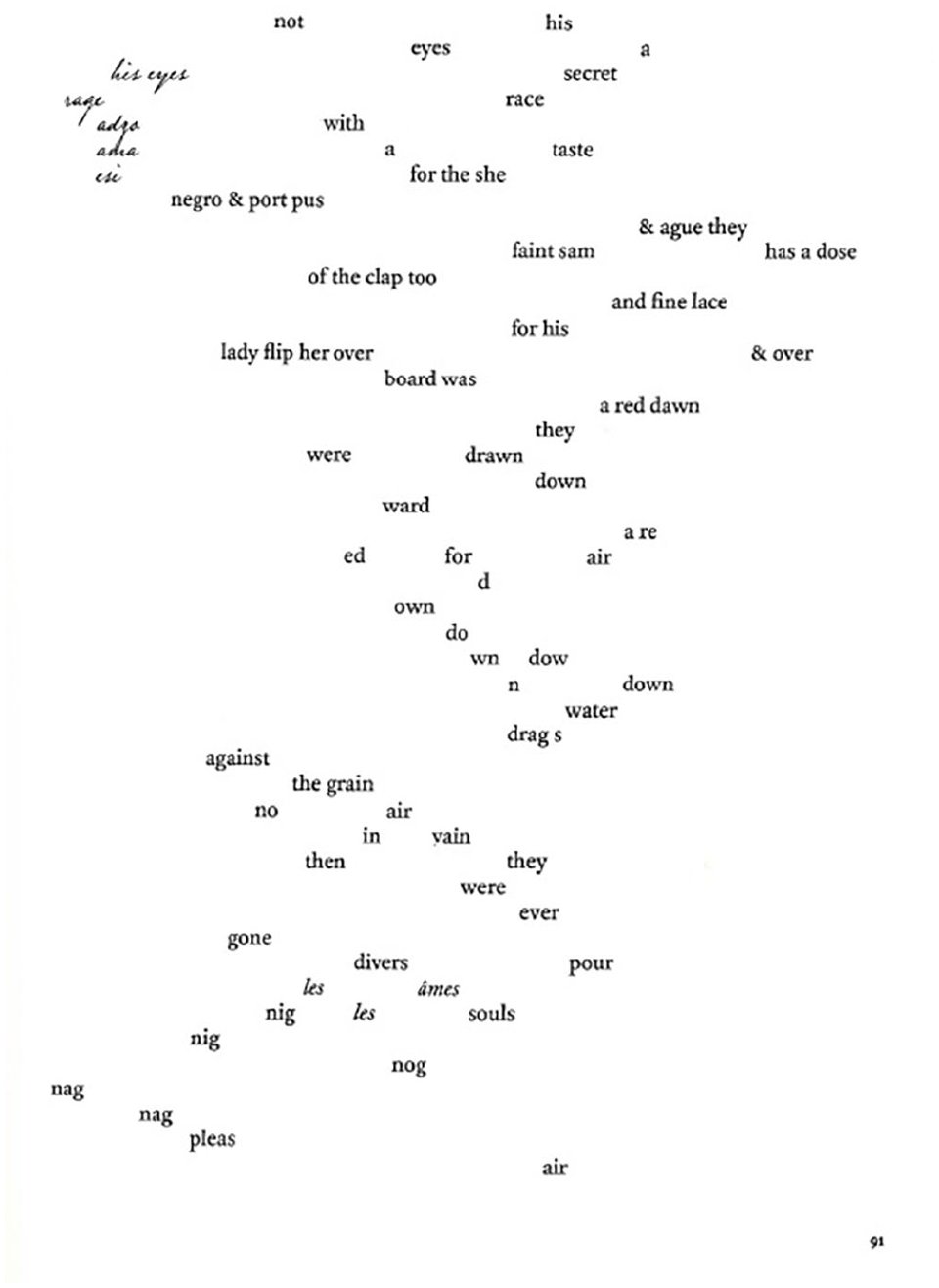
Page 91 from Zong! © 2008 by M. NourbeSe Philip. Published by Wesleyan University Press and reprinted by permission.
Nonetheless, the final section of Zong!, Ẹbọra, the only section whose title comes from the West African language Yoruba rather than from Latin, reflects the cacophony of voices aboard Zong. Ẹbọra means “underwater spirits” and interestingly in the Yoruba section of the glossary which follows the poem, eight different combinations of the word omi, meaning water, appear: from omi mímo, life-giving water, to omi òkun, ocean water. Significantly, the glossary defines omi ẹbọra as “water in which spirits reside” (184), infusing the final section with a relationship to remembrance. This final section of the poem is, at just seven pages long, the shortest section of Zong!. The overlaid typography and grey font used in this section signal the voices’ final attempt to be heard but their ultimate failure to be understood. The final page of the poem proper is the most densely populated. Much of it is unreadable yet many of the poem’s key words can be detected, including “water”. The various languages and voices of the ship attempt to be heard here as snippets of words such as “found africa [sic]”, “my lord”, and “salve the slave” (182) speak to the triangulation of impulses across the Atlantic, from Europe, to Africa, to the Caribbean. In this section, the words are themselves distinct, neural impulses which cross and overlap in the sea-page of the story. Yet narrative has dissolved, as DeLoughrey suggests. Instead, the silences in the original legal text, where murdered African people are treated as mere objects in an insurance claim, become an explosion of language, characterized by Philip herself as “not so much […] non-meaning as anti-meaning” (201). Sharpe usefully characterizes “the spectral quality of the Zong’s elusive memory as tidal”, claiming that “[t]he idea of a memory that is tidal — appearing to be stationary but always shifting — unsettles the presumed stability of an archival memory” (2014: 472). Tidal memory speaks to the synaptic as its undetected movements contain varied historical elements, excluded from the fixed archive. Moreover, as Baucom’s synaptic sea suggests, for Philip, the memory and remembrance of Zong is inextricably linked to the environment in which it took place. The archival memory of the legal text cannot account for the located memory of what took place at sea. The poem’s interaction with the sea demonstrates the slipperiness of memory and the inability to grasp those lost voices while also demonstrating that we must try to hear them at the same time. Listening to the sea may not provide fixed meaning but Philip clearly sees the importance of “exaquaing” these bodies as a way of seeking justice, taking into account the difficulties involved in that process.
Conclusion
For both Dabydeen and Philip, the connection of memory and the sea is a complex but significant idea. Its specific association with colonization, death, and voyaging means that there is much with which to contend. It works as a riposte to Western archival and representational memory because of the fact that it is ever-changing and unstable. Yet, both poets recognize in their poems the difficult task of remembering. It is not a positive act of reclamation but a harsh and unforgiving task which denies any fixed meaning for both. Although Dabydeen’s poem seems more straightforward in dealing with the contradictions in the sea, the poem’s final image of nothingness demonstrates a similar lack of understanding as Philip’s final explosion of language: No savannah, moon, gods, magicians […] No men to plough, corn to fatten their herds, No stars, no land, no words, no community, No mother. (42)
His “no land, no words” contrasts Philip’s explosion of language but ultimately points towards a similar outcome: a story that cannot, yet must be and is told.
Tynan addresses this paradox in her discussion of the place of the sea and memory in Caribbean literature: What chance is there for survival if, as Walcott maintains, “amnesia is the true history of the New World”? This is the crux of imaginative representations of the sea as an archive of submerged histories, erased cultures, and memory sinking into amnesia. On the one hand, the sea appears to offer an alternative narrative to Imperial history; on the other hand, the fluidity and transformative nature of the sea means that its narrative resists narration. (2010: 151)
Philip’s Zong! is acutely aware of a narrative that resists narration as the poem attempts to bring voices forth from their watery graves but is ultimately complicated by the sea’s mutability and colonial history. The rejection of meaning reflects the inability to summarize the events of the Zong and the slave trade more generally. Although Dabydeen’s “Turner” is a more traditionally composed poem, which does not demonstrate the same anxieties about giving a drowned African a voice, the tensions in retelling the story also become evident through his use of the sea. In drawing on the sea’s potential for both creation and destruction, Dabydeen demonstrates the need to bring forward the submerged figures of Turner’s painting but recognizes that this is an endeavour fraught with the traumas of history.
A comparison of these two poems shows that the sea is a significant site of memory within Caribbean poetry about the slave trade and that thinking synaptically about the sea offers productive routes through these texts. This is complemented by DeLoughrey’s work which warns of the sea’s inherent contradictions and inscrutability. Nonetheless, the sea’s environment is an important space in which poets can contemplate the events of the transatlantic slave trade as it is at once the site of the histories themselves and an element which dissolves and erodes those histories. Through the sea’s perpetual flux, the past is a constant presence and regenerated in new ways. This provides Dabydeen and Philip strategies for remembering and writing about the murdered Africans of Zong. Ending their poems with too much and no language respectively, these poets also point towards the inadequacy of language’s ability to address this trauma despite their need to address it in language. A comparative reading of these two works demonstrates, similarly, the paradoxes at work in the sea. Thinking of the sea as synaptic also reflects the multiple impulses and influences that are felt when writing the memory of slavery. The Middle Passage marks beginnings and endings and remains within the collective memory of many Caribbean artists. The sea thus, as Dabydeen suggests, creates as it destroys, destroys as it creates. It denies a closure and finitude as its sounds reverberate not only within Dabydeen’s and Philip’s poetry but also, as noted from the outset, across the work of many Caribbean poets. With this in mind, I leave the final words of destruction, creation, memory, and change to Guyanese poet, Grace Nichols: I have crossed an ocean I have lost my tongue from the root of the old one a new one has sprung. (1990: 94)
Footnotes
Acknowledgements
I would like to thank all those who provided feedback on earlier versions of this article, with particular thanks to Prof Eugene McNulty for his guidance and comments.
Prior Dissemination
Sections of this article have been presented at Aarhus University’s Slavery, Memory and Literature Conference (Paris, 2017) and the DCU School of English Seminar Series (Dublin, 2018).
Declaration of Conflicting Interest
The author declared no potential conflicts of interest with respect to the research, authorship, and/or publication of this article.
Funding
The author disclosed receipt of the following financial support for the research, authorship, and/or publication of this article: Research for this article was undertaken as part of my PhD for which I am in receipt of a DCU, School of English Scholarship.
