



Abstract
This article looks at the transformation of comic book adaptations of the Indian epics from Amar Chitra Katha (ACK) to present-day representations. The overarching thrust of the article is to assess the stature of comic books as cultural “products” and to examine the ways in which culture, religion, politics, and industry entwine. The essay also works to interpret the trends and reasons behind the iconographic transition of comic books, the publication politics which underlie their production and dissemination, and their status as cultural commodities. Subgenres of comics which could be variously categorized as cyberpunk, post-apocalyptic, or superhero styled comics, and evidently have a niche market or readership, are being held as blueprints for oversimplified transference of what has been widely accepted as the “core” story of the Ramayana and the Mahabharata. Therefore, I also argue that contemporary visual culture in the domain of comic books has seen a gradual shift from ACK’s knowledge-based conservative pedagogy to a more globalized entertainment-oriented, market-centred strategy.
This article assesses comic book adaptations of the Ramayana and the Mahabharata as cultural products. The focus here is limited to tracing the development of comic books about the epics from the classic Amar Chitra Katha (ACK) tradition to contemporary renditions. The article intends to understand market trends behind the iconographic transition of comic books regarding the epics, the publication politics which underlie these books’ production and dissemination, and their status as cultural commodities. Epic comics have ventured outside the conventions established by ACK to appear bolder, kitsch, and glamorous, bordering sometimes on profanity, as opposed to the sacred darshanic viewing of ACK. However, these contemporary adaptations paradoxically do not tamper with the moral fabric and core ideas laid out by ACK. With increasing use of technology and innovation, the new avatars could be seen more as “cyberlogical” facelifts of their predecessor ACK than works effecting any real change in ideology. The recent phenomenon of a proliferation of visual retellings of the epics can be explained in part by the enduring quality of the epics which makes them intrinsically “retellable”, and in part by the technological paradigm shift.
The transformation of the classical epics (in the form of “kavya” or poetry) into the popular visual domain has much to do with the transfusing of the oral and the textual. The oral and the textual, at least in the Indian context, are not oppositional categories. The conventional identification of oral with folk and “written” with “the classic” does not hold within the Indian context. The Vedas, which were oral in nature, were always thought of as fixed, though never written down (or at least not until a thousand years after their composition). They were transferred verbatim over generations. By contrast, the Indian epics have allowed for multiple variations since the times they were written, as well as later when their narratives were transmitted orally. It should come as a surprise that the orality of the Vedas has not allowed much tampering, yet the textuality of the epics has given way to so many “tellings”. The various written versions of the epics contain innumerable folk elements. It is this inextricability of the written from the spoken that defines the Indian literary tradition. And it is this literary tradition that clears a path for the metamorphosis of the classics in the popular domain. In this new domain, the verbal entails the visual and the visual is never quite without the verbal.
Just as epics belong to many genres and forms, graphic narratives too may be categorized within art criticism, children’s literature, popular culture, and visual studies. Graphic narratives such as comics, graphic novels, illustrated books, comic strips, and other related subgenres occupy a complex position in the wide ambit of cultural productions. They work through a conjunction of visual images and words, carrying within them an underlying message and ideology. This study makes a departure from existing scholarship on ACK (much of which decodes its nationalist/Hindutva/masculinist ideology) to assess comic books post-ACK as “products” of religion, culture, and market. Campfire’s mythology titles and Graphic India’s Ramayan 3392 AD (2006–07) and 18 Days: The Mahabharata (2010) are some of the texts and publishers examined in this study. Campfire’s titles (which are more like illustrated classics, since the publisher does not release serials) adapt mythology and history for pre-teens and adolescents, and are relatively short in length. A pedagogical motivation similar to ACK’s inception resounds in the “Mission Statement”, which Campfire makes sure to print on the inside of the front cover of each of its issues, to: “entertain and educate young minds by creating unique illustrated books to recount stories of human values, to arouse curiosity in the world around us, and to inspire by tales of great deeds of unforgettable people”. In its official website Campfire declares itself to be the “leading graphic novel publishing industry in India”, yet its “Mission Statement” underplays this claim and confines its works to the modest category of “unique illustrated books” (Campfire, n.d.: n.p.). Besides Campfire, Graphic India also brings out Indian epic titles. 18 Days, Graphic India’s comic book (and Webisodic) adaptation of the Mahabharata, capitalizes on the narrative’s themes such as “war” and “violence”, in order to make it palatable to an international audience already familiar with the Marvel and DC universe. This is achieved by tailoring the characters and storyline to suit the superhero-meets-mythology subgenre.
Since this article looks at post-ACK comic books, selected titles from these two publishing houses provide a suggestive case study. I will first discuss the comic books of the epic tradition established by ACK in India, exploring how ACK’s propagandist pedagogy and potent use of images influenced the nation’s religious and secular culture. The article will move on to analysis of epic comics after ACK in order to examine their primary similarities to and differences from their literary forebear. The final segment of the article will comprise detailed criticism of the publication politics and infrastructure involved in the production and marketing of modern comic book adaptations of the Ramayana and the Mahabharata. In doing so, I seek to answer the central research questions as to why and how the content, format, and ideology of these works has transformed. The particular approach adopted in this study anticipates the conclusion that if ACK used mythology as a medium to inform, educate, and nationalize Indian culture, post-ACK comic books use mythology as a tool to achieve profit-oriented results, since these stories are easily amenable to an array of cross-media adaptations and merchandise. However, common to all these visual avatars are two standard assumptions: one that mythology is a perennially enduring raw material, providing a ready-to-serve formula for retellings, adaptations, reboots, and revamps; and the other, which follows naturally from the previous one, that there is always a target viewership and market available for it.
The Ramayana is popularly understood as the story of Rama’s 14-year exile and his struggles to rescue Sita from the clutches of Ravana, the demon king of Lanka. The Mahabharata and the Ramayana together form the íthihasas or the ancient historical texts of India. This is narrated as a story of fraternal rivalry between two of the strongest clans or lineages of the ancient Indian subcontinent, the Kauravas and the Pandavas. A great war is fought between two groups of brothers over the ascension to Bharata’s throne. Besides this quotidian interpretation of the great kavyas or poems are various other tellings and exegesis of the epics. ACK chose to cater to conventional perceptions and received notions of the epics. The post-ACK comics followed suit, even though they could have experimented with visual and verbal imagery to offer alternative, against-the-grain readings of the epics. Instead, these new renditions appear to be refurbished versions of ACK, with only the better quality of pictures and some very superficial makeovers to boast of. They appear to be polished models of ACK because they do not make any radical departures from ACK — neither in the general storyline, nor in their ideology. For instance, the representation of women in Campfire, just as in ACK, monumentalizes the feminine ideal of wifehood and motherhood. The visual idiom never fails to eroticize female protagonists’ figures, presenting them to the male gaze as objects of pleasurable viewing. Similarly, the visual idiom tries to portray them as headstrong, bold, and wise only to ultimately render them as absolute metaphors of Indian womanhood, resiliently accepting their tragic fates. Elemental as they are, Sita born of the earth and Draupadi of fire, their elementary natures are in the end doused and wiped away. Although Graphic India’s 18 Days styles itself as “graphic novel techno-mythical reimagining” (“back cover of the Story Bible” of 18 Days: n.p.) of the Mahabharata, in effect it only contributes to thickening the stereotypes, associating conventional notions of good with the Pandavas and evil with the Kauravas, and in this sense it is no different from the ACK originals.
From its conception to its execution, ACK was a unique idea that mixed education with entertainment, merging history and myth. It was through a strategic blurring of these two modes that ACK, besides meeting its self-admitted pedagogic visions of making young India aware of its cultural roots, carved out a nationalist, masculinist, and Hindutva ideology. The works of Lawrence Babb and Susan Wadley (1997), John Lent (2001), Aruna Rao (2001), Karline McLain (2005), Nandini Chandra (2008), and Deepa Sreenivas (2010) furnish detailed analyses of how ACK helped foster an integrationist agenda of free India. The creator of ACK canon Anant Pai, often hailed as the father of Indian comics for laying the medium’s foundations in the 1960s, simultaneously invented the “mythological in comic book format. Mythology supplanted history, and popular visual platforms such as films and comics were targeted to be among the more potent media for projecting the newly-formed impulse of “imaging” and “imagining” the nation. Deepa Sreenivas recounts how Anant Pai in attempt(ing) “to refashion history”, was “manufacturing” the bourgeois “consent” (2010: 4) of a nascent post-Independence India regarding the issues of national and religious identity. ACK was recognized not only as means of nation-building but as a power tool for initiating the regressive modernization of India’s youth.
ACK’s bid to install what appeared to be authentic “tradition” coincided with the early inception of the “right-wing” politics of the post-Nehruvian state. India was recuperating from the after-shocks of a two century-long colonial dependence, and the makers of new India were confronted with the dual responsibility of shunning the colonial legacy on the one hand and designing a modern India on the other. While Nehru’s model of politics bore the obvious banners of “socialism” and “secularism”, which came to metonymize the idiom of “modernity”, the growth and resurgence of Hindu revivalism in the 1960s and 1970s symbolized myopic, illiberal, and parochial attitudes. Pai’s promotion of ACK as the “route to the roots” (Babb and Wadley, 1997: 81) was seen by such critics as Karline McLain (2009) and Nandini Chandra (2010) as an attempt to convert the political project of nationalism into a cultural one. Pai relied on the power of images to tell or rediscover India’s glorious past. Uma Chakravarti (1998) speaks of a socio-political crisis which India had been facing in relation to a common conflation of “Indianness” and “Hinduness”, and this reconstruction of the “nation’s glorious past” was “not being expressed through powerful writing, but through the visual media, cinema and television. […] partly because of its reach, but also because of the ideological power of its ‘visual’ message” (1998: 244). Although Chakravarti is reflecting on the medium of television as a powerful tool of forging ideological consensus among audiences, she implicitly acknowledges the power of “visuals” and images, and the role they play in reconstructing the past. Images and visual representations can be used as politically motivated media to speak for a community. The resurgence of epics in the late colonial period was not restricted to literary texts. Its pan-Indian nature accommodated cultural expressions and representation of epics in visual and performing arts ranging from “bazaar” and calendar art to feature films. This sudden spurt of mythic sensibility and the assimilation of epics into mainstream cultural productions, be it in literature or commercial art, became emblematic of the greater, superimposed myth of nationalism. In creating the ACK oeuvre, Pai was treading the treacherously thin line between history and myth, his orientation slightly more inclined towards historicizing myth rather than mythologizing history. Considering Pai’s readership was targeted at young minds, both the religiosity and the seriousness of the epics had to be tempered. ACK’s version of the Ramayana thus presented to the reader/viewer a sacred “image” (both literally and figuratively) of its protagonists. ACK relied on the nation’s cultural sensibilities to tap the epics’ potential to be retold.
Aijaz Ahmad (1992) attributes the epics’ literary endurance and retellability to its “performative” potential. He argues that after generations of “sedimentation”, the Ramayana and the Mahabharata exhibit in the linguistic and ideological aspects of composition “their essential status in the culture”, as fundamentally performative textual traditions (1992: 252–253). This in part explains their inherent potential to be continually retold. Ahmad was writing this in 1992 (four years after Ramanand Sagar’s television series Ramayana became almost a national obsession), the year of the communal ransacking of the Babri Masjid in Ayodhya. His assumptions had verifiable groundings. From the final decade of the twentieth century through to the second decade of the twenty-first, the national canon has become so big that it threatens more than ever to subsume the local within its confines, efface its diverse presence, and denigrate diverse versions as anti-national. The performative potential of the epics blurs itself into the “religious”, because of the inextricability of the national, cultural, and communal sentiments. A. Rajagopal (1994) establishes obvious links between the national televising of the Ramayana from 1987 to 1989 and the preparation of Ram Janmabhoomi (Rama’s birthplace) as a communal battleground until the final outburst of religious rioting in 1992. He observes: The decision to televise religious serials represented a considerable departure from earlier broadcasting policy, and clearly signalled an attempt to formulate a cohesive, Hindu upper-caste dominated cultural identity for the nation. […] a Hindu epic was now identified with Indian culture in general. (1994: 1661)
This quote invites the reader to assess the complex ways in which religion and culture intertwine. The Ramayana here again stands exposed to malleability by religious propagandists who mask themselves as guardians of national culture. The “retellability quotient” of “Hindu” epics can thus also be seen as having an overbearing allegiance to their quintessential religiousness. Contemporary political structures only allow for over-simplistic binarizing. This view is conscientiously captured by Vamsi Juluri (2010), who sees Hindu mythology being ripped apart by two opposing tendencies. First is the “didactic” tendency which contemporizes gods and refashions them into superheroes, proselytizing mythology and using it as evidence for religious chauvinism. The second is what he calls the “experimental” tendency in which mythology is an open text available to infinite interpretations, a view which he says is “espoused” by some “intellectuals” who presume “that any imputation of sanctity to mythology is inherently fundamentalist” (Juluri, 2010). This binarizing undermines the notion that “retellability” of “mythoepics” often transcends into personal/social “relatability”.
Speaking of iconographic transformations influenced by the sporadic retellings of epics in visual media, Richard H. Davis describes the “iconography of Ram’s chariot”, which carries with it a reference to the 1990 “Rathyatra” undertaken by Lal Krishna Advani (the BJP leader) and the Sangh Parivar organizations. He makes the following observation: Posters had appeared on the walls over the previous days, depicting […] the light-blue complexioned God Rama, wearing a saffron dhoti and a red cummerbund […] The posters portrayed Rama striding forward, his left hand holding his strung bow, and his right bearing a sharp-tipped arrow, a look of divine confidence on his face. He seemed to be facing a storm, for his hair and dhoti fluttered behind him, and the clouds were dark blue-gray. (1996: 27)
Details describing Rama’s image in the poster spoken of here are significant, as it is this “image makeover” that marks the radical shift in the iconology of Rama. He goes from being maryada purushottam (epitome of righteous, the ideal man) to being the warrior god of the Hindus, transforming his madhurya (pleasant gentleness) to shaurya (valour). The rathyatra, which was a politically orchestrated movement to claim the “Ram janmabhoomi” (the politically and communally contested birthplace of Rama in Ayodhya, India), evinces the many ways in which the religious and the political overlap. Gyanendra Pandey in his vehement critique of Hinduism (1993) observes this change in iconology of Rama, attributing it to the Ram Janmabhoomi movement: “Ram was not only a Hindu deity, he was a great national hero. […] This was not an argument about religion […] it was an argument about culture” (Pandey, 1993: 266). Ram here becomes the poster-god not of peace and tranquility (as the ACK comics make him out to be), but of war and violence. The mythical archetype of the victory of “good over evil” is retained to be projected onto Hindutva’s perceived threat of the other. Since Rama is a historical–mythical figure, as well as a god humanized through literary and folk traditions, it becomes possible to experiment with his iconography. He is both God and the ideal man simultaneously — the Superhero God. This, of the many ways, was one in which the religious, political, and cultural spheres converged.
The cultural (as also the religious) logic of post-Independence nationalism governed the visual and the textual idioms of ACK’s epic characters. The techniques and stylizations used to depict the portraiture of gods relied heavily on the concept of darshan or the arrested viewing of the god in intense bhakti or worship. This momentary immersion in “seeing” the god and in turn being “seen” by him completes the internal circuitry of divine communication. Close-up shots, with facial features heightened and emboldened and the eyes angled at a plane, create an illusion of the picture transferring its gaze on to the viewer. The element of divinity in the act of seeing transforms or elevates the photo or picture of a god into something akin to spiritual experience. Emma Dawson Varughese discusses how “post-millenial Indian graphic narratives” (of the non-epics) are deconstructing the accepted modes of this darshanic viewing of the sacred, instead creating new modes of “seeing” the disturbing or the “inauspicious” (Varughese, 2018: 10). The new age comics of the epics through their transformation in iconography, it could be said, are achieving a similar effect of “inauspicious” viewing. Darshanic frontal viewing has been replaced by a cinematic/televisual viewing where gods are designed to exude machismo and arouse fandom rather than bhakti.
With considerable transformation in the visual idiom of the comic books of the Indian epics, what have not changed are the core content and the intent of post-ACK renditions. Devdutt Pattanaik explains the jump from ACK to titles and issues from publishing houses such as Liquid Comics (Graphic India) and Campfire Novels, which have stepped into the void created by ACK and taken upon themselves the responsibility of spreading ancient wisdom from Indian, as follows: [There is a] need to make mythology “relevant” for the modern child. […] ACK has tried going on television but the televised version does not have the same magic. The context has changed […]. In attempting to make the story relevant, one gentleman […] created a series of comics imagining a futuristic Ramayana where Ram has a six-pack, Hanuman looks like an ape, Dandaka looks like a dark Amazon jungle, and everyone looks like they have just attended a heavy metal concert. Somehow it does not feel like Ramayana, at all. (2011: n.p.)
Pattanaik’s dig at these contemporary and “cool” replicas of the ACK is clearly indicative of the general disregard for what he believes to be a blind and baseless “mimicking” of the West. Comic book adaptations which model themselves on the American-styled superhero, cyberpunk, and post-apocalyptic comics are being held as blueprints for oversimplified transference of what has been widely accepted as the core story of the epics. Rama breaks away from the iconography of a god to be refashioned into an action-hero; and Arjun is “Photoshopped” as a Greek god-looking “Super-Warrior”.
In attempting to make mythology relevant for children, the erstwhile pedagogic concerns of ACK seem to be of little importance for new publication houses. What assumes prime importance is the potential market value of mythology. Companies such as Liquid Comics and Graphic India deploy intensive research to investigate the latest market trends and the available technology, so as to amalgamate them into projects like 18 Days and Ramayan 3392 AD. The “trick of the trade” is held in the essential awareness that mythology never goes “out-of-fashion”. Unlike Pai’s self-admitted passion for mythology and India’s rich cultural heritage which galavanized into nationalistic/religious fervor through “immortal storytelling pictures” or ACK, the contemporary visions of epics capitalize on their already existing value and mint some “surplus value” off it. Capitalism’s logic of a global market single-handedly dictates production, distribution, circulation, and consumption of the religious and the secular alike. Culture is no longer determined by only the social practices of its people; culture is also collective response to the market.
The shift from ACK to works such as Liquid’s Ramayan 3392 AD can be read as the shift from pedagogy to what I would like to term as “cyberlogic”. In Ramayan 3392 AD the computer-generated images of gods and quasi-gods do not seem to generate “bhakti” or devotion; they instead tend to evoke a kitsch cult of cybernetic “fans” and “followers”. In late twentieth-century India (the 1980s and 1990s), Hindutva ideologues contributed to the popularization of ACK and later the “Doordarshan” Ramayana, which in turn reconstructed the notions of the nation by conflating rashtrabhakti (nationalism) and rambhakti (devotional to Rama). In this rendition, Rama was not simply God; he was the metaphor for the ideal Indian (Hindu) purushatva (masculinity). But the beginning of the early twenty-first century (through to the middle of its second decade) can be seen as the post-liberalization phase of India, ushering in new avatars of the gods. Apocalyptic visions of the world co-habited with technological advancement. With the superhero genre becoming globally popular, Indian publication houses also entered the market to globalize the Indian pantheon. If ACK had aimed at educating the children of India and making them more sensitive to culture, then the new brand of science fiction or superhero Ramayana and Mahabharata comics aimed primarily at returns and turnover. While there are other sources of the chitrakatha such as folklore and the Jataka tales, it is the rewriting or rather the re(viewing) of the epics that takes centre stage. The reasons for this are simple: mythological epics, besides being adaptable to a range of media (TV, webspace, mobile phones, comics and graphic novels, performative arts), are also texts which have many centuries of circulation, acquiring religious and political volatility in the process.
Grant Morrison, Deepak Chopra, and Shekhar Kapur’s venture of recasting the Mahabharata in the form of comics series and webisodes on YouTube is a fantastic example of that intermedial or transmedial storytelling, which I claim is the primary function of this yoking together of the superhero genre-meets-Indian mythology genre. The webisodes, as the term suggests, are online episodes with a running time of approximately 20 minutes, proposing to “retell” the story of the Mahabharata with specific concentration on the 18 days of war. But before the webisodes are released, the Graphic India team has launched the promotional “Story Bible” of 18 Days. It packages the book as containing the “[o]riginal concept notes by Grant Morrison, the superstar creator of Superman, Batman and Robin, The Invisibles” (“Story Bible” of 18 Days: n.p.). Transmediality is of the essence here, considering the “Story Bible” functions as the preview or a screenplay to the Webisodes.
Grant Morrison envisions the Mahabharata as belonging to the realm of “fantastical” time. Since it is difficult to set in real historic time, Morrison finds a convenient explanation for placing it in primordial time on a primordial landmass. His reimagining of the text’s history comes a result of his unfamiliarity with Indian sense of time and narrative. He says of the structure: I’d like to approach the text not in a linear fashion but as a 3-dimensional structure to which we can continually add new modular episodes and which will eventually build up into an incredible mosaic of the war and the events surrounding it. In this way the story will grow in power and interconnectivity as we construct it piece by piece, episode by episode. (“Story Bible” of 18 Days, back cover: n.p.)
The locus of attention for Graphic India therefore is not to really “reimagine” the story but to cast the Mahabharata as a psychedelic Lord of the Rings with Star Wars technology. Neologisms such as “Singularity” for the Gita and “Undiluted Divine” (back cover: n.p.) for Cosmic time/God, in a single sweep not only posit a universal spiritualism springing from India (new concepts which replace the ideas of “Advaita” and “Brahman”) but at the same time assume a distinctly Westernized readership as the audience, since these neologisms do not require a culturally informed awareness of Indian cosmology and theology. The “3-dimensional structure” and “modular structure” of the episodes underscores what I term the “cyberlogic” element of the project. In other words, the creators have full awareness of the trasmedial/intermedial nature of the production: epics transmute into comics, comics into webisodes, webisodes into virtual reality games in the available formats of the digital media.
Thematically speaking, what the work intends or at least appears to be capturing is the darkness of the Kali Age or Yug (the last of the four time cycles which the world goes through, in Indian mythology; symbolized as the age of destruction and ruin). Yellow bilious pimples on the skin of the Kali Yug heroes are symbols of disease, terror and disgust. One of the snapshots shows a raven tearing at the eye of the dead and mutilated Abhimanyu. The “Sinister Fourth Age” of “Kali Yug” (“Story Bible” of 18 Days: n.p.) has made its creeping entrance into the scheme of things. Descriptions of flies on dead bodies, women being gang-raped, people fighting over rotten food, fill the apocalyptic vision of 18 Days. Grant Morrison finds it difficult not to read the Biblical notions of apocalypse and ruinous dead-ends into the Mahabharata, as the Hindu scripture evokes in him parallel visions of sin and Doomsday. Morrison’s 18 Days is a universe where dinosaurs coexist with super warriors (dressed like gladiators and warlords), where research facilities promote high wielding armoury and weaponry. There are the “Base Camps” and “Vimana Interiors” (“Story Bible” of 18 Days: n.p.) for the fighter clans and there are highly trained posthuman machines designed only to kill. On being asked how he wanted to contemporize the epic, Morrison explains: We decided to play up the more fantastic, science fiction elements of the Third Age. We took the descriptions of vimanas and astras as literal descriptions of anti-gravity machines and super-WMDs […]. We chose to translate the Sanskrit term kshatriya as “super warrior”, which suggests something even grander and more disciplined than a superhero but hints […] to the likes of the Avengers or the Justice League. I’ve also given the entire story a new twist, not present in the original, which makes the battle much more relevant to our current times. (qtd. in Kumar, 2013: n.p.)
Unlike another of the Graphic India productions, a sci-fi comic book remake of the Ramayana titled Ramayan 3392 AD, Grant Morrison’s 18 Days is not set in the future. It is in fact, as the blurb on the back cover reads, “a re-imagining of the great eastern myth, the Mahabharata, which tells the story of three generations of super-warriors, meeting for the final battle of their age” (“Story Bible” of 18 Days: n.p.). This “re-imagining” lays emphasis on the war itself. Clearly the production and creative teams have a preconceived readership in mind — readers of sci-fi, adventure comics. On being asked in a web-based interview as to why Morrison chose to highlight the war he says: Mostly for reasons of time. The Mahabharata is massive and its story could fill ten three hour long movies with very little breathing space. I was originally approached to break the whole thing down into animated segments, which could be collected into a 2-hour movie version, so clearly a lot had to go. (qtd. in Brownfield, 2010: n.p.)
Reasons for singling out the war episode from the grand narrative that the Mahabharata is, are surely more manifold and subtle than “reasons of time”. War is the crux of Morrison’s project because it is action-oriented and offers easy condensation of the story into extravagant visuals. But to limit the Mahabharata to a “crux” is an oversimplification. One could read 18 Days as a revised interpretation of the war, with a new breed of fighters, super warriors, comprising both men and women, wherein war equipment is “modern” and technologically upgraded. This obsessive concentration on war imagery gestures yet again to a preconceived target readership, a fanbase which will be attracted to the comic book since it promises a visual makeover of the Mahabharata, in which “the War begins with the clash of super-titans, armed with incredible weaponry. The characters are […] cool […] The tone is modern, gritty and emotionally real against a backdrop of techno-mythic super-war” (back cover of 18 Days: n.p.). This “sci-fi techno-modern re-imagining” or “cyberlogic” (since it is created through CGIs and intends to be produced as webisodes), like most other interpretations of the story, contributes towards thickening the stereotypes, associating conventional notions of good with the Pandavas and evil with the Kauravas. In this it is no different from ACK. In an otherwise action-packed, power-pumped, visually violent retelling of the war, a section of this comic book dedicates itself to the story of Duryodhana’s birth. It serves to identify Duryodhana as the archetypal evil and possibly the man single-handedly responsible for the Great War. This reading becomes even more valid in the light of the preceding section titled “White Flag” in which Yudish (the neo-mythical name of Yudhishthir) is seen to be making a final attempt at peace by offering a truce with the Kaurava army. The veneration of Yudish as the man who wants peace is painted in contrast to the inability of Duryodhana to understand the significance of non-violence. The colour symbolism of the two sections serves to emphasize the polarity of good and the bad. The segment depicting Yudhishthir’s peace pact is painted in soft white, blue, and sunny shades, whereas the segment showing Duryodhana’s birth is painted in darker shades of green, red, violet, and black. Since in Vyasa’s Mahabharata Duryodhana’s birth is described in the Sambhava Parvam subsection of the Adi Parvam, this arbitrary digression into describing his unusual, ominous birth has no other function but to hint at destruction and attribute to Duryodhana its absolute cause.
Besides the colour coding, it is what Scott McCloud terms as “amplification through simplification” (1994: 30) that gives the characters in 18 Days the qualities of caricaturing and cartooning. These features in turn arguably help to reinstate the dualism in human nature. This caricaturing of Duryodhana as inherently demonic and Yudhishthir as innately humane, stands in direct contrast to what Morrison writes in the back cover of the book: We think we know who the bad (and) good guys are […] This is not a Lord of the Rings or a Star Wars where the good guys win because they are right. The “good guys” in 18 Days are forced to cheat and lie and break rules to win. (n.p.)
Neither the visual nor the verbal text seem to validate Morrison’s argument. No one knows what Vyasa’s Duryodhana or Arjuna looked like. Years of pictorial adaptation and assimilations across media, ranging from murals to ACK’s depictions have trained the visual recognition of certain characteristics as “received information” (as opposed to “perceived”; see McCloud, 1994: 49). Duryodhana is not innately evil. The Kauravas in most cultural representations of the epic have been projected as the villains, and this is reflected in popular misconceptions about the meanings of their names. Duryodhana, whose name etymologically means an invincible warrior (dur meaning that which is difficult to conquer and yoddha meaning warrior), has come to mean a “bad” warrior (because of the common usage of related prefixes such as du, dus, and dur which mean bad or wrong in Sanskrit and Hindi). Moreover, McCloud’s principle of “simplification through amplification” contributes to caricaturing Duryodhana as the face of evil. Presented below are some of the images of Duryodhana from the ACK, 18 Days, and other popular re-presentations:
All of these pictures seem to be transmitting a similar vein of visual information. Duryodhana’s facial features, as in images 1 (a), (b), (c), and (d), are projected as wide, his look angry and crooked, and his stance ambitious and vengeful. He possesses none of the serenity and calm that is usually associated with Yudhishthira or Krishna. Given the ideological predisposition of Grant Morrison’s project which reimagines the Mahabharata characters as neither good nor bad, the amplification of these stereotypes in 18 Days’ visual vocabulary is too evident to go unnoticed.
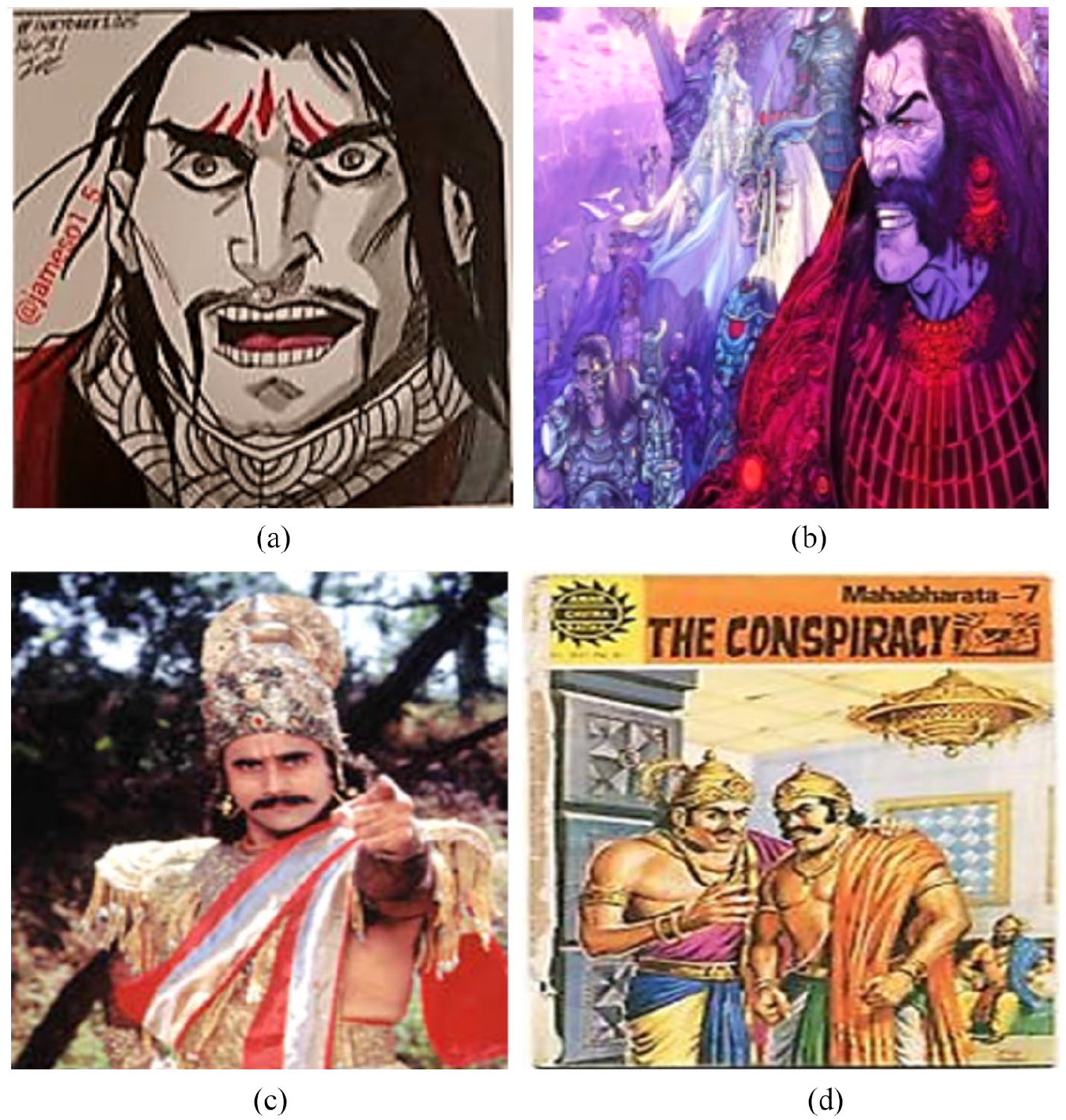
Besides the characterization, the empanelment of this work (as of now still an incomplete series, with a multimedia production line of comics and webisodes) is highly customized to depict the war. Much of the empanelment and “page” design in comics is structured on transitions of “moment-to-moment”, and “action-to-action” sequencing (McCloud, 1994: 67). Since the webisodes were launched before their book counterparts, the panels appear to be faithful renditions of the web videos in sequential snapshots with the number of panels alternating between three to four per page (unlike ACK’s standard six-panelled symmetrical page structure).
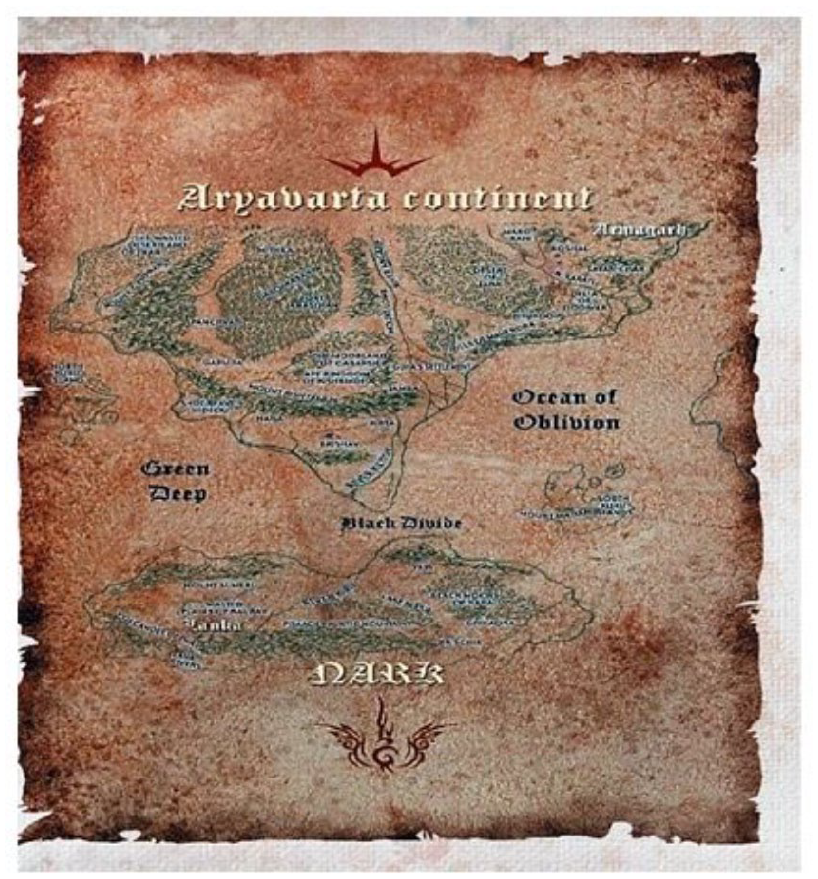
Graphic India’s or Liquid Comics’ other ventures include Ramayan 3392 AD, which is the story of the Ramayana set in the distant future, approximately 1300 years from now. Unlike 18 Days, it is not a conscious reimagination of the epic. Instead, it is a futuristic projection of the Ramayana story with the mythical Ayodhya turning into “Armagarh”. This book locates Armagarh within geological time and space by providing a picture of a map. The story is set a millennium ahead in time yet the map is recreated as an image that looks like Vedic tamrapatra (ancient writing materials such as copper plate; see Image 2). This book seems to be placing the time and setting of the Ramayana outside the traditional Hindu notion of a yug (one complete time cycle in Indian mythology). This is not even the age of Kali, as in the 18 Days. It is instead a post-apocalyptic world, where only two nations have survived: “Aryavarta, where the last vestiges of humankind dwells; and Nark, a dark continent ruled by the savage Asuras” (“back cover” of Ramayan 3392 AD: n.p.). This world apparently cannot accommodate the idea of swarg or heaven. The fictive “Armagarh” is a farcical Ayodhya (the name itself meaning that which cannot be won over or conquered). “Armagarh” is an artificial Hinglish portmanteau term deriving from the English word “arms” (denoting weaponry) and garh (the Hindi word for “fort” which figuratively also means centre). Thus, “Armagarh”, much like Ayodhya, is invincible since it is the garh of arms. The name “Armagarh” also invokes religio-cultural associations with the Christian notion of “Armageddon” or the final day of war before the apocalypse. Further, the deliberate positioning of “Armagarh” in the northeast of “Aryavarta” compels the keen eye to make sociopolitical associations with contemporary Indian insurgency politics vis-à-vis Northeast India. The reconceptualizing of a geologically undivided landmass as “Aryavarta” involves the blurring of the mythic/fictive and the historic/post-historic. The reader is thus invited into a mesmerizing time warp where all time frames overlap, the historical Mithila coexists with the post-historic “Armagarh”, and the mythical Kishkindha coexists with the fictive “Ocean of Oblivion”. Hell or “Nark” is shown to be located on earth and is ruled by Ravana. The water body separating “good” “Aryavarta” from the “evil” “Lanka” is labelled as the “Black Divide”. The map as a visual icon sets up undertones of those racial theories which see the Ramayana as the story of the Aryans’ war against the Dravidians. Lanka figures in the landmass labelled “Nark”. The ethno-cultural associations of adjectives such as “dark” and “black” seem to typecast Ravana as irredeemably evil. Comics as a representation of popular sentiment can use graphic or visual form to challenge rather than reinstate such discriminatory discourses of racism. The image below is the first page from Ramayan 3392 AD, which brings forth more clearly the points mentioned above:
Ramayana 3392 AD like 18 Days is an action-packed comics series that pays homage to adventure, punk, subculture, and apocalyptic comics genres, along with the superhero genre, all of them subgenres popularized by the American comics industry. If Valmiki’s Ramayana is a tale of a king, his clan, and his duties toward his folk, this sci-fi avatar of the Ramayana focuses only on exterminating the asuras who are no less than “cyborg” demons made powerful by technological innovations in Armagarh. Rama loses his serene, calm disposition and acts like an aggressive, macho superhero engaged in saving humankind from the clutches of evil Ravana. The images below show the transformative iconography of Rama from ACK and god posters to his modern incarnations in comics:
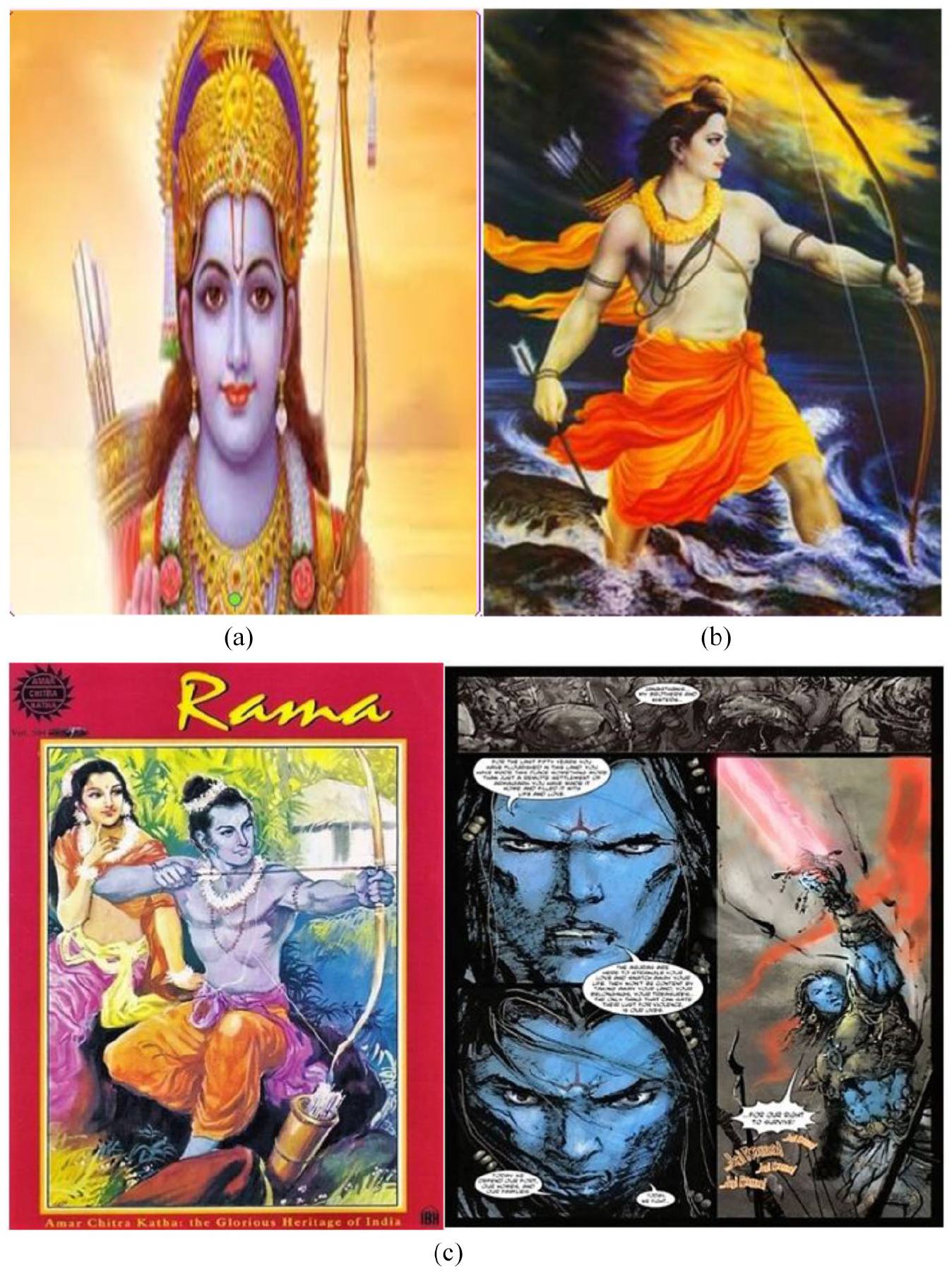
Not just Rama, but even Sita is a warrior princess. She dons a sari but fights like an amazon. This comic book adaptation is a fiery outburst of images and sequences straight out of a sci-fi movie which banks for its commercial success on state-of-the-art special effects instead of a strong plot line.
Comics produced under big banners such as Liquid (Graphic India being its Indian franchisee) focus on the reproduction of the “mythologicals” and in this sense they mark a return to ACK’s modus operandi. But neither the intention nor the content of these “third wave” comics, as J. Barton Scott brands them (2008: 183), is attributable to ACK. Virgin was founded in 2006 and renamed as Liquid Comics in 2008, “born with the simple vision: bring international narratives, especially those of indigenous Asia to America and beyond” (Thill, 2008: n.p.). In the year of its launch Virgin’s creators Richard Branson (of Britain), Shekhar Kapur, and Deepak Chopra (an Indian of US origin) had dreamt of making a company with an estimated 1.3 trillion dollars. That this is a project where finances are as important as the content/message, comes across clearly in Kapur’s words: Some of us in the industry think that about 70–75% of this figure or about $800–900bn will come from Asia. After World War 2 America has culturally colonized the world. It’s time for a reverse colonization. (qtd. in The Economic Times, 2003: n.p.)
He goes on to say that the first thing that needs to be done is to bring out characters of global relevance from Indian mythology; and that from making comics the project then can develop into making films, animation movies, and games. Kapur’s call for characters from Indian mythology bearing a global relevance does not entirely reiterate Pai’s pedagogic concerns with ACK. By garbing his logistic concerns in the ideological vendetta of “reverse colonization”, Kapur designs a trap for himself. His zealous promotion of Indian mythology suggests that the Indian comic books scene is dominated only by myths and legends of a non-locatable historic past. This makes Kapur, who apparently intends to foster a nationalist sentiment by praising Indian culture, a neo-orientalist who “packages” and “sells” Indian exotica to the West. In doing so, as Barton Scott also says, “he is not the first person to invert colonial hierarchies by promoting “spiritual India” over the “material West” (2008: 188).
Liquid’s managing heads in Bangalore, Suresh Seetharaman and Sharad Devarajan, see in Indian mythology (specifically the Ramayana and the Mahabharata) a potential global market. They recognize that “the local comics industry is estimated at $100 million while the animation market is worth $650 million and is growing at 30 per cent annually” (Shashidhar, 2013: n.p.), and that if this potential is to be exploited in the Indian market, it needs to go beyond local characters which cater to local audiences. Like Kapur, Devarajan’s aim is also to globalize Indian culture. Graphic India has been credited by reviewers and journalists with masterminding “Indian Superheroes” such as Pavitr Prabhakar (the “Indi”-genized version of Spiderman) and Chakra. Palande (2015) explains how Indians now feel at home with the idea of a “superhero”, since it is no longer just an imported genre to the Indian market. ACK had provided a constant source for readers to look up to heroic characters from mythology and history alike, relating stories of gods who came as humans and humans who attained godhood by their superhuman struggles.
When Deepak Chopra’s son Gotham Chopra, CEO of Gotham Enterprises, says, “A lot of people, like my father […] they’re tired of India being relegated to being this backroom, this place for outsourcing. They both felt that India has this incredible pool of talent, and [wanted to], if they could, be part of the creative renaissance” (Abramowitz, 2006: n.p.), he has a target audience and a potential market drawn out in his charts. Web articles with titles such as “Liquid Comics Launches Digital Platform to Capture India’s Pop-Culture Crazed Mobile Connected Youth”, self-explanatorily speak of the available platforms to rope in consumers. This article being referred to begins with a ready “recipe” for success in the domain of “pop culture”: Start with cosmos-spanning tales of super-powered beings locked in an eternal struggle of good and evil. Mix in with no-nonsense action heroes, vile bad guys, and sultry seductresses. Prepare it with an over-the-top design aesthetic drenched in motion and color. Then serve it up to a devoted fan base that hangs on every storyline and industry rumor. (Salkowitz, 2011: n.p.)
Salkowitz’s formulae are applicable to what he believes are the two most defining constituents of pop culture: the American Superhero genre and the Bollywood industry. Graphic India’s ventures in nativizing the Peter Parkers into “Pavitr Prabhakars” use these “recipes”, which is giving the company huge profits. Such projects of transcreation structure themselves around sweeping generalizations made on the notions of the nation and “Indian culture”, and a preconceived Anglophone fan base which brings in the money (as all of Graphic India’s titles are in English and are heavily priced at approximately 400 rupees). Devarajan’s (as also Gotham’s) focus on digging “Asian (read Indian) content” and “creating ‘Indian’ comics with local characters and local visuals: busy streets filled with auto rickshaws; cows and traffic; women in saris,” (Rana and Roy, 2007: n.p.). speaks of the urgency with which Graphic India wants to “globalize” the Indian comics industry, since he believes this kind of content is getting more popular in the West.
As the “market creators”, the Chopras and Devarajans gear up for greater sales and even greater profits, what happens to the actual “comics” creators: writers, sketchers, inkers, and pencillers 1 such as the Basus and the Mohapatras? Indians have not got used to reading the Liquid brand of comics, admits Samit Basu, who is a hired writer for Graphic India’s 18 Days, as well as an independent comics creator (writer–artist all in one). Saurav Mohapatra, who was first hired by Virgin and has been writing and drawing for Graphic India since then, says that there is an expectation among readers of the kind of work that can be delivered by writers and artists of Indian origin (Rana and Roy, 2007). Basu and Mohapatra are among the bright young Indian talent who would wish to work for Marvel and DC, the giants of comic book publishing. Samit Basu’s Simoquin Prophecies (2004), for instance, is little known outside India, as compared with big titles such as 18 Days, for which he has authored a few issues. This can be explained, in part owing to the much talked about structure of the assembly-line production houses which come to life in full form and size when speaking of the comic book industry specifically, as compared with other genres of fiction. Comics historian Arlen Schumer (2011) in his work makes a similar case for comic book artists. He sees the comic book artist as the composite “auteur” of the work he or she creates. Schumer gives the examples of Jack Kirby and Steve Ditko, artists in the Marvel universe, who seem to suffer a secondary status as compared with their writer-counterparts namely Stan Lee. Comics discourse finds itself submerged neck-deep in a hierarchical structure which fails to justify the discrepancies and disproportions in the distribution of financial and creative credit to writers and artists alike. This hierarchy is resolved in the case of graphic novels where the artist/writer is, more often than not, the same person.
Besides Graphic India, Campfire also “deals” in Indian mythology. Unlike individually created works, which allow a greater degree of freedom of expression, since the author–artist is the same person, and are not led or bound by seriality, the multi-issue, multi-volume comics are created in restricted setups. Although on the surface, the process would seem seamlessly and equitably collaborative in nature, there is frequently an in-built hierarchy within the whole structure. Although the economies of production are tilted to prioritize the writer (specifically in the case of serialized comics where the writer and the artist is not one), it should be made clear that the power positions are not always fixed. For instance, the complete title (on the cover page) of Graphic India’s 18 Days is Grant Morrison’s 18 Days: The Mahabharata. Since Morrison is a celebrity writer of international fame and has DC’s titles to boast of, it is he who is lauded for the work. Small-scale Indian writers such as Shamik Dasgupta, Samit Basu, or artists like Jeevan Kang and S. Sundarakannan, who also contribute as writers and artists to Graphic India’s comic books, are hardly ever discussed in the share of contributorship. Although participants in the chain of production have their respective expertise and their levels of involvement may differ, the distribution of credit (as also the profit) follows a top-down or a “trickle-down” model.
This raises questions of credible authorship and rights of aesthetic ownership of the work. Will Eisner (1985), whose theory on comics production was the first of its kind, advocated the unity of the author and the artist in one person (132). Although Eisner does not support a hierarchical divide between comics and graphic novels, this unity that he speaks of is more achievable in the graphic novel than in comics. Adi Parva (2012), by Amruta Patil is also a retelling of the Mahabharata like Graphic India’s 18 Days. It clearly achieves a greater level of sophistication both in terms of the art and the writing than the latter. This is because Patil, given her higher degree of authorial or artistic autonomy (as she is both the writer/painter of the work) is allowed to experiment with more or less all the constitutive elements of comics creation: from style to textual content, from colour schemes to pencil sketches, from how much to “tell” (or retell) and how much to “show”. The comic book production with a line of stake-holders involved, might not allow this kind of autonomy.
Malini Roy’s critique of the Campfire graphic novels for instance is wholly committed to assassinating its publication process which she sees as working “on the assembly-line model reflecting the transnational operations of the global economy” (2013: 24). She further comments that scripts are prepared by ready-for-hire freelancers from the “Anglophone” world and the art (or illustrations?) is provided (or supplemented?) from in-house sketchers and painters. One might infer, given the chain of production, that the writer and the artist may never even meet to discuss the synergies of the text and the image. Taking forward the argument on comics as assembled cultural products, one is struck too by Campfire’s inconsistent usage of credits. Campfire’s titles maintain no consistency in structuring its work. It posits synonymy among terms like “Author”, “Writer”, “Scripter”, and “Texter” on the question of writing and between “Illustration” and “Art” on the image front. This slippage and interchangeability of titular credits is suggestive of Campfire’s ideological indeterminacy vis-à-vis its process, which speaks of its indifference to a consistently creative vision. Campfire’s writers and illustrators alike, since they are subservient to an assembly line-up, are bound by the company’s vision and are not free to “show” and “tell” their own visions (of the epics). Roy proffers this argument when she says: Campfire’s assembly-line production ensures that there remains a power differential between English-speaking writers […] and regional-language-educated illustrators. Although complementarity between word and image is considered to be key to the production of the graphic novel, in practice the written words’ primacy remains embedded in the Campfire texts. (31)
Although one could argue that advancements in technology and the digital revolution have considerably democratized the process of production and have adopted newer ways of information dissemination (interactive media, gaming, and so on), the capitalist–consumerist impulse to generate profits has strengthened the existing internal hierarchies of any given system.
One of the other ways in which the target readership is identified and made into a clique is through use of English and Hinglish. A growing linguistic phenomenon in the Indian subcontinent, Hinglish, as this portmanteau word suggests, is a mix of the two languages of Hindi and English. Situating the significance of “Hinglish” in graphic book production in India could be both challenging and rewarding. Considering that the first comic books in India were perfect “vernacular”, low-priced copies of American comics, it would not be difficult to hazard a guess as to why English-language comics are still “out there”. This is not to say that no original Indian languages comics existed before the onslaught of the American prototypes; indeed, the market for the former was big and profitable. Despite this, Indian comics in the English language, even given the fact that their readership was restricted to the urban elite and the Non-Resident Indian (NRI) classes, acquired for themselves a bandwagon effect. Over time, Anglophone Indian comics became signifiers of a high class status.
Tej K. Bhatia (2006) claims that comics in India were received with a general positivity. Unlike in the American cultural scene, where comics tended to be symbols of countercultural radicalism, India’s reception of comics was flavoured with a naive understanding of the genre as conveying literacy (equivalent to English language literacy). Post-Independence India, governed by Nehruvian and Gandhian ideologies, was all too quick to embrace English as India’s official language; it was adopted as a dominant mode of linguistic exchange and soon became a tool of nationalist hegemonizing and homogenizing. If Hindi was the poster language of the Hindutva propagandists, then English soon came to bear the markers of modernity and progressivity in the post-liberal lingo of globalization. Quite irrevocably, then, English became the language within which the idea of a national “India” became available to subnational speakers of multiple “other” languages.
The intent to forge an Indian spirit amid the confused anarchy of genre: sci-fi/cyberpunk/adventure/war-comic/fantasy, all of which are primarily American imports, is achieved by inflecting the verbal idiom with italicized and translated Hindi expressions, such as Lakshman referring to Ram as bhaiya (elder brother); the continent of “Aryavarta”, a distinctly Sanskritized name, in the middle of an English “Ocean of Oblivion” (Ramayana 3392 AD “Map of Aryavarta”), and the Hinglish neologism of “Armagarh”, which as we have seen is a compound of the English word “arms” and the Hindi word garh or fort. There are other such instances of Hindi and Hinglish in an otherwise Anglophone comic book, specifically targeted at an American readership: “Mother Dharti”, “Kameena” (Hindi slang for rascal), “Sura” (alcohol), “Mandir” (temple), and “Armagarhians” (people of Armagarh) (3392 AD, n.p.); the list goes on. The status of comics as cultural commodities is not without an engrained idea of the English language itself as a sellable global commodity.
A specific pattern of translation, both lingual and cultural, can be traced in a retrospective understanding of the growth of comics in India. Postcolonial India appeared to comics creators a fertile ground and lucrative market for, first, introducing translated versions of American comics in major Indian languages: Hindi, Bengali, Telugu, Tamil, Kannada, Gujarati, and a few others. Second, Indian publishing houses such as Diamond and Raj Comics appropriated the Western superhero genre to create characters such as Nagraj and Parmanu. Third, American publishing houses such as DC and Marvel indigenized avatars of their “foreign” heroes and themes, in two of India’s commercially mainstream languages, Hindi and English (example: Spiderman India). Fourth, comics creators deliberately used the English language to generate a multi-modal literacy and general awareness about India’s mythical and historical past, in order to instill a sense of culture and heritage in young and new India (examples include Campfire’s “Mythology” and “Biography” Titles). Fifth, which is the contemporary stage, comics creators have made considerable departures from the existing creation models to experiment with both form and content.
The article has discussed and compared ACK’s pedagogic concerns with modern-day comics based on the epics. My key finding is that the contemporary comics show a pattern similar to the third stage of comics, but in a way that focuses not on indigenising foreign content, but on Americanizing Indian content Comic books such as Ramayan 3392 AD and 18 Days, unlike ACK, specifically target a global and mixed readership. These works, being products of American–Indian partnerships, appropriate Indian mythology to meet a ready-at-hand blueprint: the science fiction fantasy or superhero genre. If ACK was responsible for designing pedagogic comics, then these new-age technophiliac comics are making a heady start towards recreating visions of the Ramayana and the Mahabharata by essentially changing only the style and language. This has the effect of dumbing down the epics for a less mature readership, and sometimes dumbing down, perhaps surreptitiously, its religious authority. That said, it could also be claimed that instead of challenging the modes of viewing and the pedagogy of nationalist sentiments which were established by the ACK, this new form of peddling in sci-fi comic book avatars seems to be recycling the former’s approaches while speaking to a new brand of “ism” — globalist capitalism.
The purpose of rewriting the epics is to acknowledge the cyclical nature of time and the well-worn “history-repeats-itself” trope so as “to improvise the narrative to reflect the time” (Patil, 2012: 259) in which it is being told. One does not need to bring the Ramayana and the Mahabharata back to life, as is the case with other world epics. They are forever there in our socio-cultural repositories and collective memories. Their “polygeneric” vein lies in their vested pliability into various forms of sravya (auditory materials) and drishya (visual culture), such as kathya (verbally narrated), chitrakatha (pictorial narration), gita/bhajan (ballad), and natyam/preksha (drama/performance). Epics therefore reside and proliferate in the parallel spheres of the literary, the non-literary, and the quasi-literary. Over centuries of reuse, the Ramayana and the Mahabharata have acquired the status of grand narratives indispensable to the formation and sustenance of Indian, particularly Hindu culture. Moreover, the coalescence of the religious (communal), historical (national), and mythical (philosophical/mystical) contributes to their complexity and susceptibility to incessant transmission through translations, retellings, and adaptations. One might thus say that mythic narratives need to be retold, first, to remain alive in the collective consciousness of a region, community, race, nation; and second, because stories that are already there” make interesting experiments to tinker with. In doing so, they can be recast into new stock of stories that captures the artist’s and the reader’s imaginations alike.
