



Abstract
This article explores how teachers and pupils construct and negotiate discourses around comic books as part of interaction in the classroom from a New Literacy Studies perspective. The combination of imagery and text, the essence of comics, makes them relevant tools for exploring how literacy is constructed in social interaction in the classroom. The analysis is based on video material from two different Swedish schools, one class in Grade 3 and one class in Grade 8. Nine interactional sequences were initially found, and these have been analysed using a qualitative discursive psychological approach, investigating how assessments are utilized to perform social actions – how participants use assessments of comics as easy or difficult reading, or assessments of themselves or others as being or not being comic book readers – to make something happen in interaction. The results show that participants utilize discourses of personal, visual and textual literacy to construct a comics literacy in which image and text are both construed as important for, as well as a difficulty in, reading comics. This demonstrates constructions of comics literacy and readership, how personal experiences of reading comics are important and the importance of broadening the view of comics as school literature.
Keywords
The current article explores classroom literacy discourses around comics, 1 grounding this exploration in New Literacy Studies (Gee, 1992, 2000). In 1996, the New London Group, a collaboration between leading literacy researchers, stated that the future of literacy pedagogy lay in broadening the scope of what literacy entails, in order to account for ‘the context of our culturally and linguistically diverse and increasingly globalized societies’ (p. 61). This entailed a view of literacy as multimodal, that is, consisting of several modes of communication including ‘visual images and their relationship to the written word’ (The New London Group, 1996: 61; see also Kress, 2003, 2010). As such, instead of a narrow view of literature as ‘text’, and literacy practices as consisting of reading and writing text, school literacy practices need to reflect the literacy practices of society at large, allowing children to explore diverse, multimodal media as well (see, e.g. Sousanis, 2015). Furthermore, literacy, here, is also viewed as not just the cognitive ability to read and write, but as a broader view of our means to construct social meaning (Gee, 2002).
Comprised of image and text, comics – alongside much of online media – are a prime source for pupils to engage with texts and narratives (Versaci, 2001, 2008). Versaci (2008) argues that comics, more so than, for example, film – another sequential medium – allow pupils to engage with meaning production with images and text at their own pace, actively analysing the material. Further indication of the uniqueness of comics is their multimodal layout, use of onomatopoetic language and ability to illustrate time and movement in narratives (McCloud, 1993; Ripley, 2012; Wallner, 2017a, 2019). Combined with their popularity with children and youth (Allen and Ingulsrud, 2003, 2005; Bitz, 2004; Heaney, 2007; Simon, 2012), this makes comics attractive tools for working with literacy in schools. As Simon (2012) puts it, the affirmation of comics as a viable option within the school context ‘suggest[s] their potential for creating alternative inroads into class work that draw upon pupils’ languages, abilities, and interests’ (p. 524).
However, popular as they may be, children’s preferences differ – not all children love comics – and, just as any literary format, comics can be perceived as difficult for an inexperienced reader. In this article, teachers and students studied in naturally occurring classroom interaction (Potter, 2010; Wiggins, 2017) make assessments of comics and comics reading – being a fan, not being a fan, being easy to read, being difficult – thereby constructing discourses of comics literacy (Wallner, 2017b) and negotiating what this literacy could entail.
1. Comics literacy: literacy and comics discourses
Comics have been part of school practices for a long time (Tilley and Weiner, 2017). Throughout the past 20 years, New Literacy Studies has promoted a two-part shift in perspective from viewing literacy as a cognitive ability of reading and writing to viewing it as a sociocultural practice (Gee, 1992, 2000, 2002) as well as widening the literacy term to include the reading of non-text, such as images, sounds, symbols and more (Kress, 2003, 2010; The New London Group, 1996).
Similar to the New Literacy Studies view, discourses around literacy are also considered situated and culturally constructed (Potter, 2012; Triplett, 2007), rather than ideologically based or institutional (Heritage, 2004; Peplow et al., 2016). For the current study, this means that participants are not assumed to be doing institutional, classroom talk; rather, the analysis is done on the participants doing talk (Heritage, 2004), and whether this is a construction of classroom discourse (or other types of discourse) is left to the analysis of the participants’ own perspective. As such, discourses of literacy are analysed as situated social action – what participants do with their constructions of discourse – rather than something that exists objectively.
This article uses terminology from Allen and Ingulsrud (2005) in discussing personal literacy, whereby participants draw on their previous experiences of engaging with narratives in their engagement with new texts. This is akin to Gee (2000) who demonstrates how pupils’ discourses around literacy are intertwined with their identity work and the development of their reading practices, and Wolk (2007) who argues that merely ‘picking up something with words and pictures to read, you become the sort of person who reads comics’ (p. 60). In relation to, for example, visual literacy, which tends to focus on the material aspects of reading, and the individual processing of images (Burmark, 2008), personal literacies are instead viewed as a social competence. For example, through interviews and surveys, Allen and Ingulsrud (2005) demonstrate how readers of manga develop their personal literacies and how they invoke factors such as gender, family and friends, and school reading practices as an influence on this.
In Wallner (2017b), I argue for comics literacy as the collaboration between, on the one hand, communication through combinations of image and text and, on the other hand, constructions of discourses around comics. In the current article, I take an interest in how both teachers and pupils, drawing on their personal literacies, construct discourses around comics as part of natural classroom interaction – interaction around such activities that would take place regardless of the presence of the researcher (Potter, 2010; Wiggins, 2017) – exploring this from a perspective of literacy as socially and culturally situated (cf. Gee, 1992, 2000, 2002)
2. Research on comics as classroom literature
There has been some interesting research done on comics and education since the early 1940s (Hammond, 2009; Pantaleo, 2011; Witty, 1941a, 1941b; for a review, see, for example, Tilley and Weiner, 2017). For example, Hammond (2009) explores 12th-grade pupils’ reading responses to the graphic novel American Born Chinese, in which she demonstrates the affordances of picture-text combinations, and concludes, among other things, that ‘schools need to reflect the wide range of multimodal literacy practices in which students engage’ (p. 144). Furthermore, Pantaleo (2011, 2015) has conducted case studies of younger children’s use of multimodal texts, such as picture books and graphic novels. For example, through observations and interviews with a pupil in Grade 7, Pantaleo (2015) shows that the development of visual literacy skills requires particular knowledge, awareness and focus from the teacher, and offers the potential for the pupil to develop a meta-language and a deepened complexity of textual composition.
There are also a few studies that investigate pupil and teacher attitudes to comics (Allen and Ingulsrud, 2003, 2005; Sabeti, 2011, 2014). For example, through survey and interview studies with over 800 Japanese participants, ranging from elementary school pupils to college students and parents, Allen and Ingulsrud (2005) show how patterns of personal literacy and belonging to a literacy community are important for young readers. In her articles on after-school comics reading groups, Sabeti (2011, 2014) similarly demonstrates the importance of the social group and belonging, in relation to literacy. The teenagers in Sabeti’s studies strongly express connections between personal identity and literacy, how school can be either helpful or disruptive in forming this identity and that knowledge of comics affords the pupil a position of authority in the classroom.
However, there has been little research on the naturally occurring use of comics in classrooms. ‘Naturally occurring’ should here be understood as settings and activities where materials are not introduced by the researcher, and the researcher’s presence has minimal impact on the activities (Potter, 2010; Wiggins, 2017). Most studies of the use of comics are experimental studies, in which the researcher introduces the materials and focuses on the effect this has on already set learning goals (increased vocabulary, motivation, etc.). Often, these are based on interviews and ethnographic observations. Thus, the natural interaction perspective would offer new insight into how these literacy practices are done in situ, rather than as studies on ‘inner’ knowledge or attitudes (for examples of this, see Allington and Swann, 2009; Eriksson, 2002; Peplow et al., 2016).
Further exploring the use of comics as a literary format for classroom activities could offer more insight into ways for teachers to reach pupils, help find alternative forms of literature and further encourage discussions around comics as a part of literacy in education.
3. Aim and purpose
The aim of the current article is to increase knowledge on how participants – teachers and pupils – assert, challenge and negotiate literacy discourses with comics. In order to investigate this, the following research questions were asked:
How do participants construct assessments of comics and comics reading?
How do participants construct discourses around literacy with comics?
4. Participants, data and transcription
The materials analysed in this article were recorded as part of a larger study of comics in education, which involved six teachers and 77 pupils in Grades 3 (9 years old, three classes) and 8 (14 years old, one class) at two Swedish compulsory schools, totalling approximately 36 hours of video over the course of 15 lessons (for details, see Table 1). All names have been changed for reasons of anonymity, and the pupils’ guardians have given written consent for their children’s participation in the study.
Overview of data.
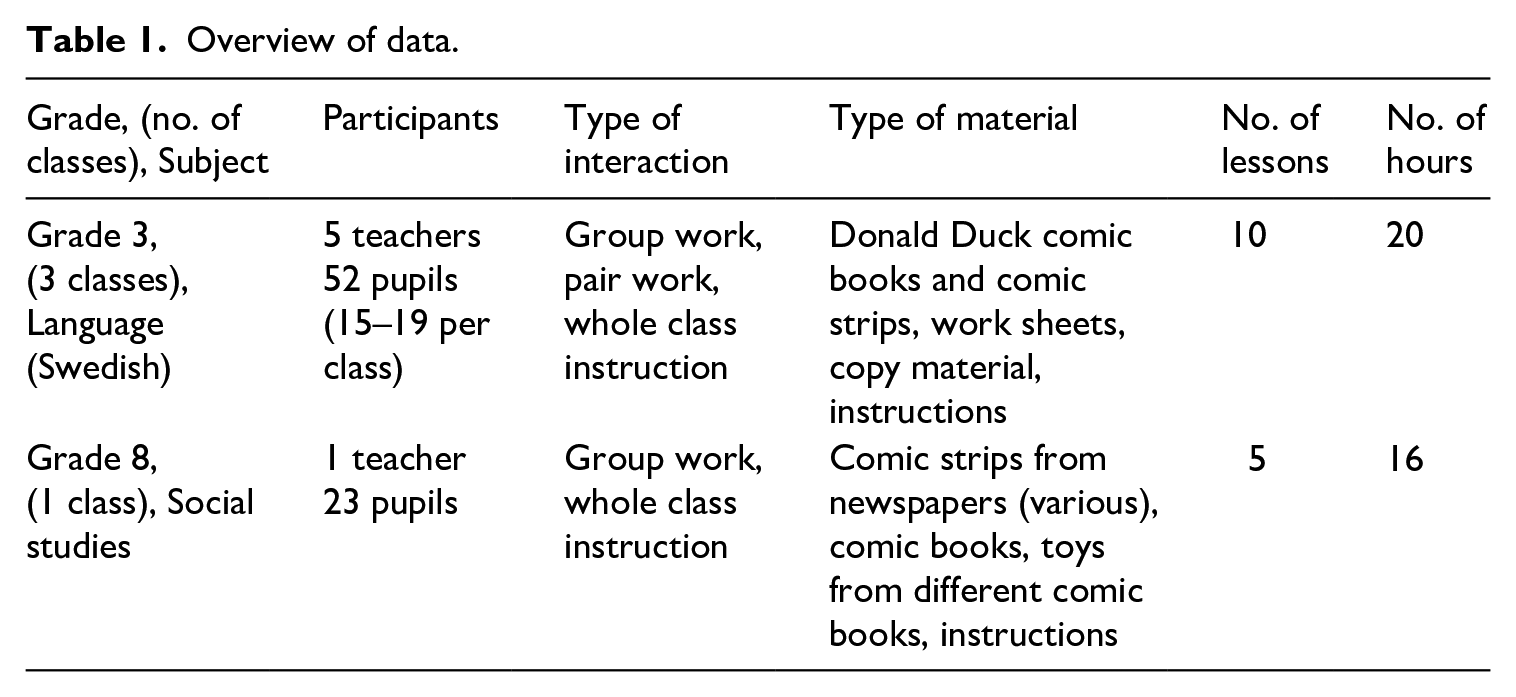
The current article relates to sequences recorded in one of the classes in Grade 3 and the class in Grade 8. The phenomenon depicted here – assessment of comics and comics reading – was prevalent throughout the data, and the excerpts included here were considered, in terms of quality and clarity, to be the primary examples of the phenomenon. These two classes conducted different lessons, based on different curricula (depending on subject and age group). Nevertheless, these phenomena seemed to be consistent throughout the material. A qualitative discursive psychological approach was used (Edwards and Potter, 1992; Wiggins, 2017), focusing on how participants make assessments of comics and comics reading. This way, how participants construct what could otherwise be viewed as internal states of mind, such as preference and assessment, can instead be viewed as socially constructed aspects of discourse (Wiggins, 2017).
Four video cameras and three audio recorders were used in order to capture talk, gestures, gaze and use of materials. The recording devices were set up and turned on before the start of the lesson, and the researcher left the room in order to minimize the risk of disturbing the class. In Grade 3, the class took a break in the middle of the lesson (as lessons could sometimes be up to 1.5 hours long), and this meant that the cameras would also record any activity in the classroom during this break. Generally, these activities would consist of teachers preparing the next part of the lesson (as shown in Excerpt 2). This material was included as part of the data, as it was recorded and considered part of the class activities.
Written transcriptions were made based on the Jeffersonian style (Jefferson, 2004, see also Appendix 1), covering talk and embodied actions, whereby these actions are made relevant, verbally or physically, by the participants. 2 For example, if one participant’s gesture was made relevant by another participant, and it was in turn considered relevant for the analysed phenomenon, it was included in the transcription.
Initially, transcriptions of talk and movement were made, and through repeated study of the video material together with the transcriptions, patterns of interactional phenomena (Wiggins, 2017) were found. These phenomena consisted primarily of sequences in which participants either make assessments of someone, for example, describing oneself or someone else as ‘a comic book reader’ (cf. Eriksson Barajas and Aronsson, 2009), or make assessments of the comics, for example, describing a comic as boring, fun or difficult. As the analysis focuses on social interaction, an assessment made that is not sequentially addressed by other speakers, or an assessment not seemingly responding to what someone else said or did, would not be considered for analysis. However, as of writing, no such assessment has been discovered.
With this focus, nine excerpts were found to be of interest for the aim and purpose of the current article. As the interest is in how participants construct assessment in talk, the focus of the analysis has been on conversation-analytical aspects such as intonation, repetition of phrases and words and participants’ embodied talk (gestures, gaze, etc.). The excerpts were then analysed systematically, using a participant-oriented perspective, asking how a certain action is performed (Potter, 2010; Wiggins, 2017). Videos were viewed repeatedly, exploring the sequentiality of the phenomena, for example, how a participant makes an assessment of a comic (using tone, body language, wording), and how this assessment is responded to by other participants. Three excerpts are presented in the current article to demonstrate different aspects of the discursive literacy work. Nevertheless, the current article makes a qualitative contribution to the study of comics and classroom literacy practices, demonstrating the work of comics literacy in the classroom and how teachers and pupils construct comics discourses through their assessments.
5. Establishing a personal literacy with comics imagery
In a Grade 3 Swedish lesson, the pupils and teachers are working with different types of speech and thought bubbles, using Donald Duck comic books and a teacher’s guide showing different types of bubbles (Galaczy, 2013: 1), and have had discussions on different types of emotional expressions, using bubbles (for more on this practice, see Wallner 2017a). During the first excerpt, Andreas (pupil) and Wilma (teacher) are sitting at a table flipping through a Donald Duck comic (Carlsson, 2012) with the task of finding different types of bubbles for Andreas to copy to his sheet of paper, in order to then design a character of his own expressing something in a bubble. Wilma is doing the flipping, while Andreas cuts in now and then to examine an image. The two other teachers in this class, Petra and Jonna, are standing next to the table, talking between themselves about the difference between various bubbles, pointing out visual differences (cloud-shaped and bubbly, jagged edges, etc.) and connecting this to dialogue and narrative style. Overhearing this, Andreas shows significant interest in this discussion, constantly raising his head to listen to them (Table 2):
Excerpt 1.
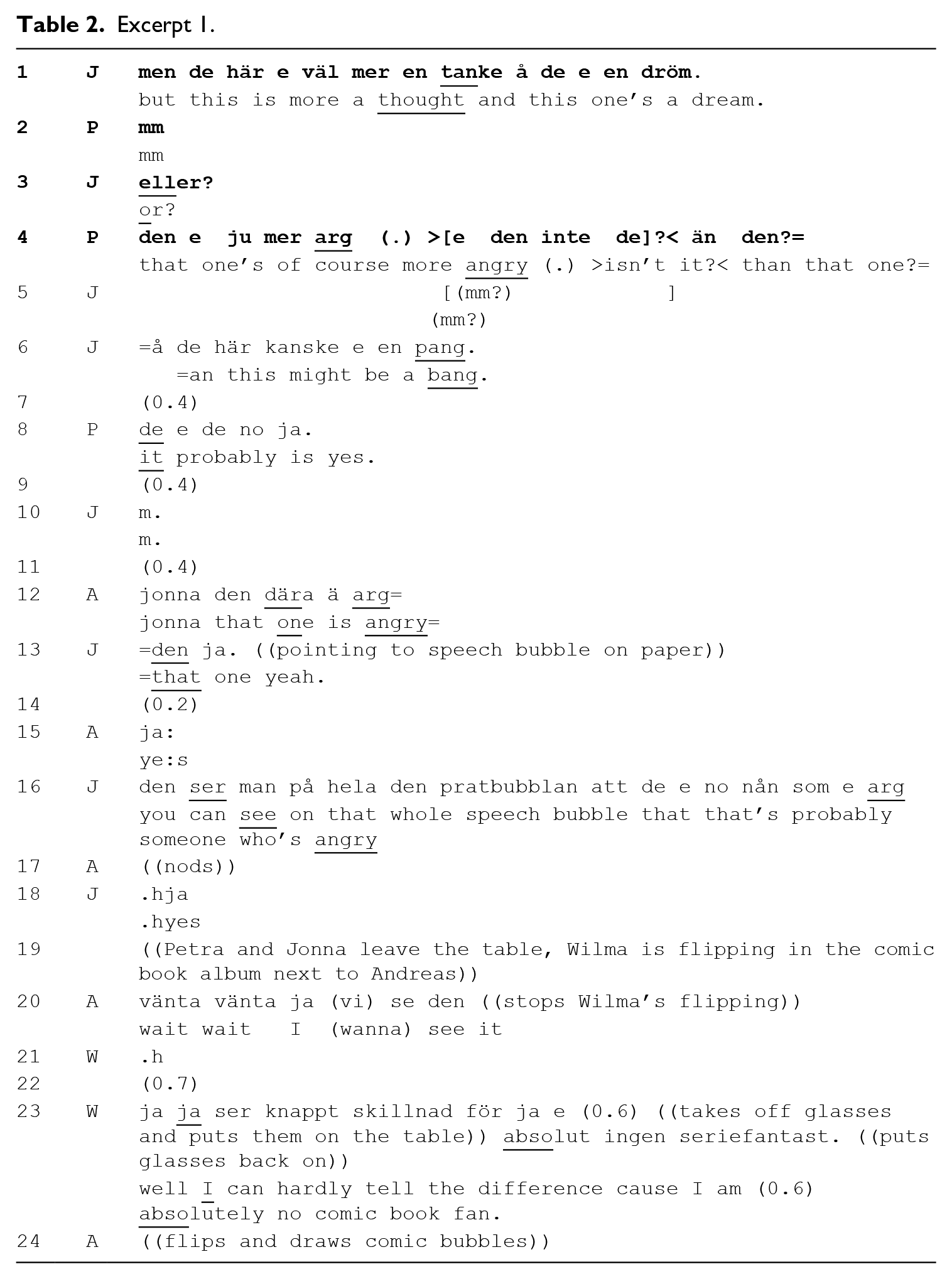
In the first lines of this excerpt, a visual literacy is established between the three participants, Jonna, Petra and Andreas. The two teachers are ambivalent about assigning emotional or sensory qualities to different speech and thought bubbles, this is seen in lines 3–4 (‘
About half a minute passes in silence, with Andreas having taken control of the flipping, and drawing bubbles on his sheet of paper. At this point, Wilma turns to face Petra, who is standing slightly behind her. The following takes place (Table 3):
Excerpt 1 part 2.
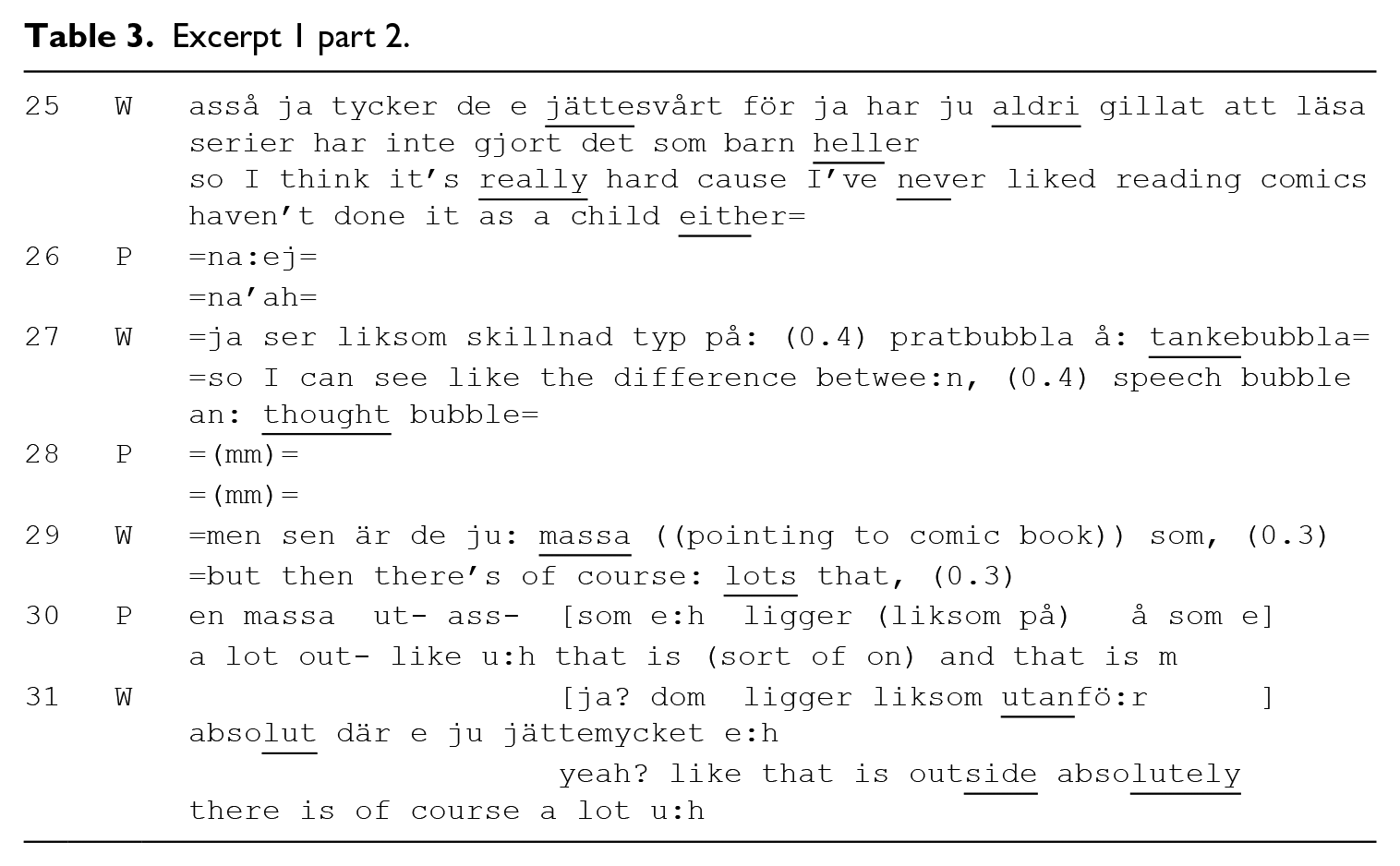
In this latter part of the transcript, as this visual competence with comics literacy has been established between the other teachers and Andreas, the third teacher, Wilma, enters the talk to express her confusion around the matter. She expresses her non-competence as a comics reader: ‘well
As her statement follows on the discussion between Petra and Jonna in which they, and Andreas, demonstrated knowledge on the subject, Wilma’s assertion could be seen as contrasting her own knowledge (as well as interest) with that of the others. Her affirmation of a lack of interest would explain why she cannot tell the difference between the bubbles in the way Andreas can. This way, Wilma’s construction of personal literacy highlights comics as a specific type of literacy, one that she herself is not competent in. She goes on to pinpoint certain key elements in this literacy, such as speech and thought bubbles (which is natural in the context of the lesson), and claims a certain competence of visual literacy, but further affirms that ‘there’s of course:
Wilma further attributes her difficulty reading comics to not having ‘done it as a child
In sum, through their assessments of reading competence and the material itself the participants construct a discourse of comics as something requiring certain literacy skills, whereby one can be a competent or non-competent reader of comics. Furthermore, Wilma specifically demonstrates how this is done as a matter of personal literacy, whereby her lack of interest and childhood experiences of comics affects her literary capabilities as an adult.
6. Comics literacy from a textual perspective
In Excerpt 2, during the break between two lessons in Grade 3, teachers Jonna and Petra are cutting comic panels from a teacher’s guide for the next lesson. Primarily, the discussion shown below concerns the comic book panels they are cutting out, and the comic they are from, Snålheten bedrar visheten (Troelstrup and Santanach, 2013, Eng: Penny wise but pound foolish), a Donald Duck story from 2006 (Table 4). This story has been previously published and was reprinted as part of a teacher’s guide, together with copy material of exercises. These materials were part of a project the publisher (Egmont Publishing) marketed for free to schools in return for feedback on the usability of the comics and materials. This project is ongoing at the time of writing and includes multiple schools throughout Sweden (see Egmont Publishing, 2015). I was not part of this project per se, but contact between the school and myself was established through the publisher.
Excerpt 2.
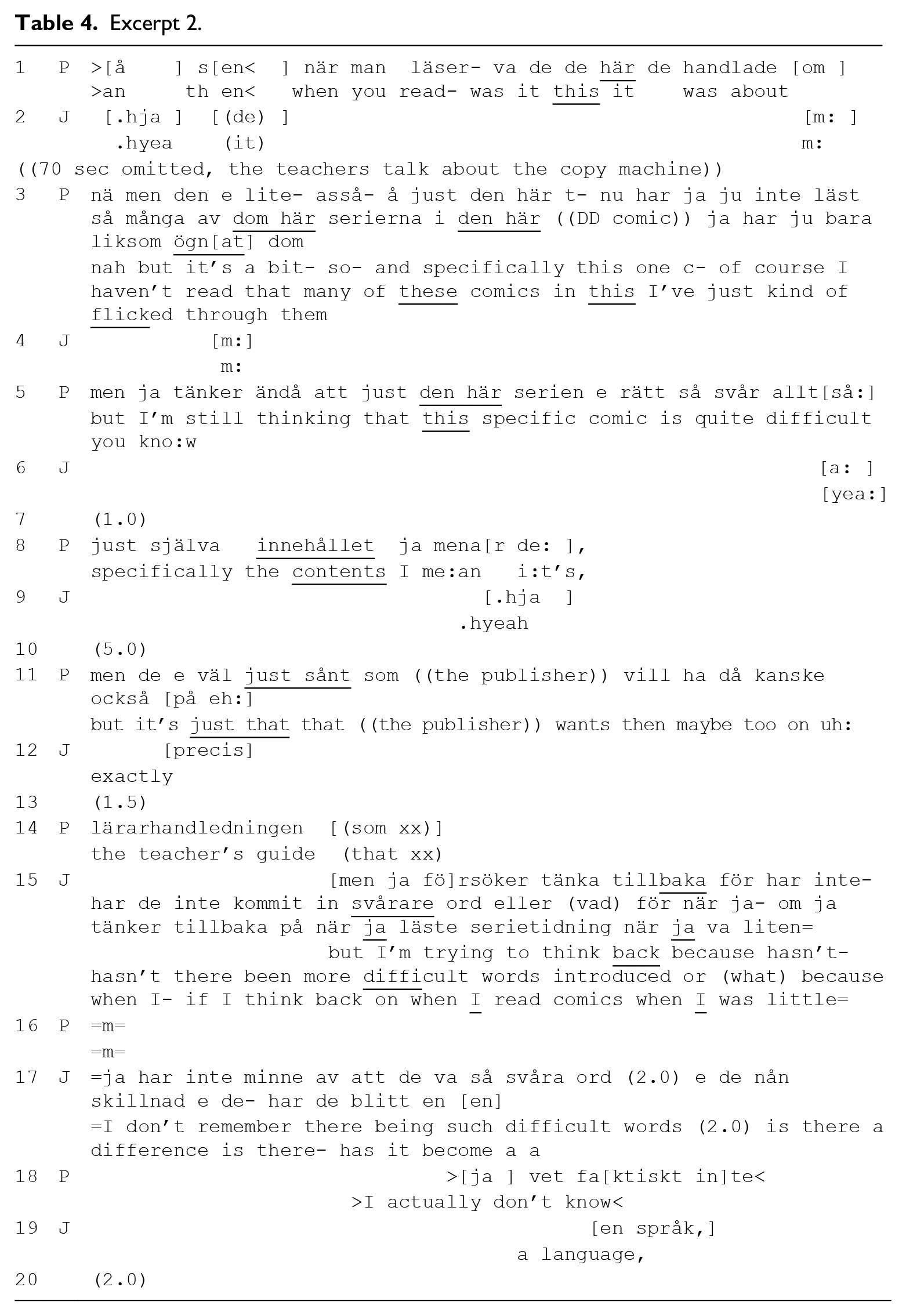
Here, the teachers focus specifically on the content and language of the comic. Petra uses ‘
Similar to Excerpt 1, this assessment becomes connected to Jonna’s personal literacy, her experiences with reading comics when she was a child, as an account for why she finds modern comics difficult, and this is confirmed by Petra in line 16. In fact, it appears that Jonna is both accounting for why Petra perceives the Donald Duck comic as difficult (comics have changed from their previous experiences) and simultaneously voices disagreement with Petra’s idea that the publisher should have to change the material (this is what new comics are like); but as she receives little response it is difficult to know this for sure.
Unlike Wilma, Jonna did read comics when she was younger, but the problem is instead that she cannot reconcile the classroom comics used here with those of her childhood when it comes to language level. Thus, for Jonna, her personal literacy produces an ambiguity, and she accounts for this ambiguity by a failure to recollect: ‘I don’t remember’ (line 17), and through expressing uncertainty: ‘is there a difference is there- has it become a’ (line 17), and this is confirmed by Petra’s doubts: ‘I actually don’t know’ (line 18). As such, the two participants together account for their difficulty in assessing the level of the material. They both assess it as difficult, but whether or not this is something perceived by the general audience (and their pupils), or something only they experience, is unclear to them.
The assessment made here is one in which the textual aspects (content and language) are deemed difficult for the grade level these teachers are working with (which is also the normative age group for these comics). The action performed by Jonna is then to utilize her personal literacy to account for why she would make this assessment of the material – that is, that comics in general have become more difficult. Whether or not Jonna is correct in this suggestion that comics are more difficult than they were when she was a child, this sequence suggests that the personal literacy of the teacher in regard to comics might have to be updated in order to provide the children with the proper difficulty level. Perhaps the material provided to these teachers could still contain difficult stories, but that teachers merely need to be aware that not all Donald Duck stories are easy reading.
7. A discourse of multimodal literacy with comic book classroom practice
In the two excerpts above, the participants draw on both visual and textual aspects in the production of comics literacy. In the following, I will examine pupils’ perspectives concerning these two aspects.
In Grade 8, the class has been given the task of discussing the target group (primarily in terms of age) of the comic strips and comic books they have in the classroom. Prior to the excerpt below, the pupils discuss, among other things, a Gaston album (which they deem readable by everyone), a Baby Blues comic strip (which they consider to be mostly for adults) and a Zits comic strip (which they consider to be mostly for teenagers and parents of teenagers); gender rarely becomes a talking point (Table 5). The group consists of six pupils. Niklas has brought a Donald Duck comic book from a neighbouring table, and Dalia has been tasked with taking notes on their discussion.
Excerpt 3.
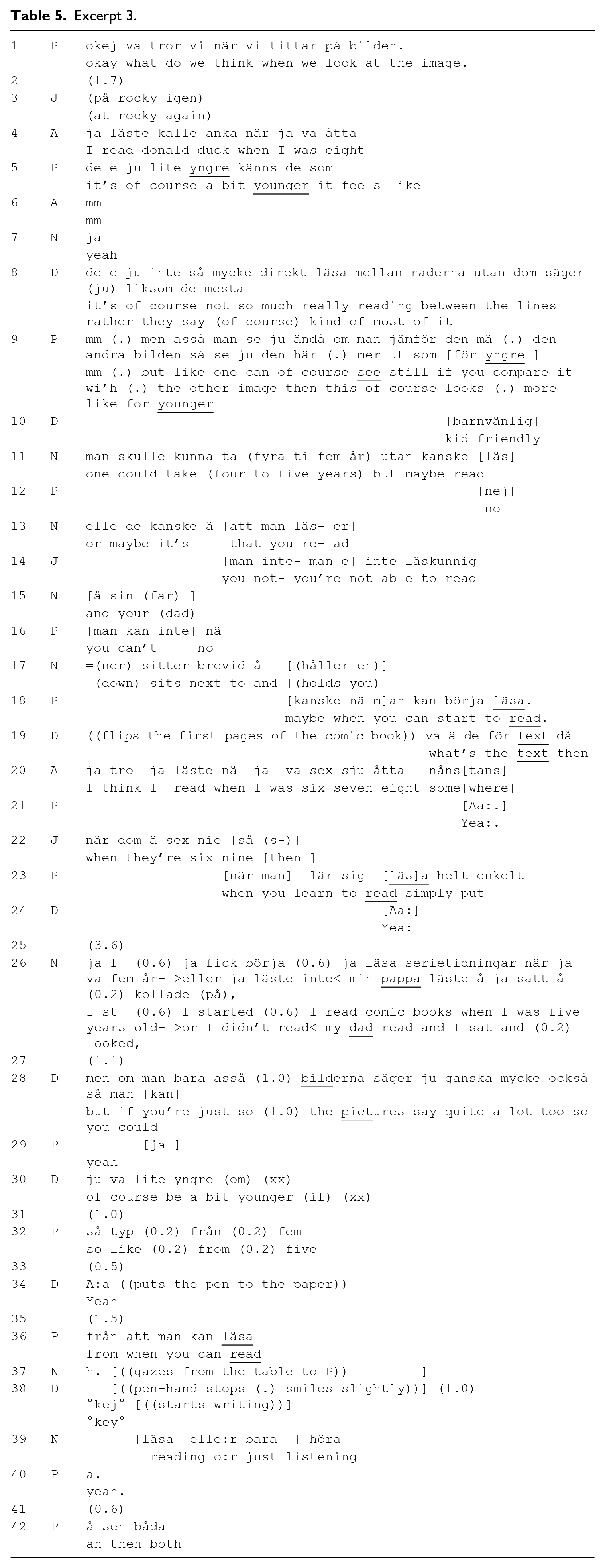
Following the task they have been given, the pupils are discussing possible appropriate age groups for Donald Duck. The pupils continually refer to their own personal literacies, and their experiences reading Donald Duck. Amanda initiates this with ‘I read Donald Duck when I was eight’ (line 4), which establishes an age suggestion for the group to consider, and in the following lines, this is used by the others as a reference point. In the following, the participants assess that Donald Duck is ‘for
As a response to this, Niklas utilizes his personal literacy, accounting for his previous suggestion by referring to his own experiences reading Donald Duck when he was ‘five years old-’ (line 26), something he immediately self-repairs (McHoul, 1990; Schegloff et al., 1977) as ‘my
Indeed, this second option seems to be what Dalia picks up on, suggesting that ‘the
Thus, these pupils form two groups, with one side arguing that textual literacy is more important in order to read comics and the other arguing for the multimodal view and the use of images to convey story. Indeed, Niklas even argues for a literacy of listening to the story (as evinced by his suggestion in line 39). Despite not coming to a united conclusion, both groups present their views of a discourse of reading and literacy, which is prompted by their use of this type of material.
8. Constructions of comics literacy – conclusion
The current article explores how classroom participants utilize assessments of comics and comics reading to assert, challenge and negotiate literacy discourses when using comics.
Pupils and teachers in this study make different assessments of Donald Duck comics as being either kid friendly or difficult. However, what is interesting here is exactly what is perceived as difficult, and how these difficulties are addressed. Both teachers and pupils in the current study utilize personal literacies to make their assessments, whereby they relate to, and use, their own experiences of reading comics to account for the difficulties they experience. The teachers construct the visual aspects as difficult for the reader if they do not have the comics literacy required, while also assessing the content of the comics as more difficult than they remember from their childhood experiences. Meanwhile, the pupil Andreas here is assessed to be comics competent by his teachers as he gets the final say in constructing a speech bubble as a specific type. The pupil group in Grade 8 discusses both the visual and textual as a combined comics literacy, with one part of the group emphasizing the textual literacy required for comics reading and the other instead focusing on the reading of images. They also do this by relating to their personal experiences of reading comics, the age they were, and how they experienced this reading.
In this analysis, I have extended on the discursive psychological approach to classroom literacy work developed by Eriksson Barajas ( Eriksson, 2002; Eriksson Barajas and Aronsson, 2009). In this article, I focus on work with comics through the lens of New Literacy Studies, as the literary didactics of the classroom is studied through a social-interactional lens and wherein visual aspects of literacy are a necessary part of school literature. This work shows how teachers and pupils relate the visual aspects of comics to constructions of reading competency. Furthermore, the analysis also verifies that comics encourage and make necessary a reflection on classroom practice and what literacy and reading entail. Participants engage with, and relate to, comics through their personal literacies, and they pinpoint comics as a specific type of reading – requiring specific skills depending on the reader’s previous experience with comics or their ability to read text and pictures. Thus, these participants construct a discourse of comics literacy, in which they relate to reading in a broader sense than merely that of decoding text, and these reading aspects influence the possibilities for early readers to be comic book literate. This should be of particular interest to scholars working in the fields of comics, education and the New Literacy Studies.
Footnotes
Appendix 1
Declaration of conflicting interests
The author(s) declared no potential conflicts of interest with respect to the research, authorship and/or publication of this article.
Funding
The author(s) received no financial support for the research, authorship and/or publication of this article.
