




Abstract
The Maestro, the Magistrate and the Mathematician, a novel by Zimbabwean diasporic writer Tendai Huchu, adds to a growing body of global immigrant fiction. Huchu’s novel concerning Zimbabwean émigrés in the United Kingdom displays a heightened spatial consciousness that self-reflexively complicates the spatial tropes and trends of much migrant literature. The Maestro, the Magistrate and the Mathematician generates an unrelenting dialectic in which the national home, both for migrants and citizens, is often unhomely, while host spaces yield to various forms of place-making and belonging. City space, in this case the city of Edinburgh, is shown through the unique mobilities of the three protagonists to produce different senses of identity. However, the forms of identity that emerge ultimately succumb to the spatial implosion represented by the death (in contained spaces) of two of the principal characters, whose city perambulations are thus brought to a halt. The reader discovers, furthermore, that the third character is not the cartographer of his re-orienting mental map of the host city, but that his itinerary has been directed all along by a sinister Zimbabwean expatriate, to whom the third character, fooled by this regime spy’s buffoonery, condescends, and patronizes at his peril.
[The Maestro, the Magistrate and the Mathematician is] about three men living in Edinburgh, trying to find a place for themselves in the city. It’s a novel about ideas, music, memory, love, that kind of shit. (Huchu, qtd. in Gyasi, 2015: n.p.) There’s a great Spike Milligan line: “Everybody has to be somewhere.” (Huchu, qtd. in Cousins and Dodgson-Katiyo, 2016: 201)
Tendai Huchu is one of a growing number of African diasporic writers with a significant international literary profile joining the circle of, most notably and in no particular order, Chimamanda Ngozie Adichie, Taiye Selasi, Helon Habila, Maaza Mengiste, Teju Cole, Chris Abani, Yaa Gyasi, Chinelo Okparanta, and Mũkoma wa Ngũgĩ, among others. Born and raised in Zimbabwe, Huchu presently resides in Edinburgh. He may well be the writer who, through his immigrant Zimbabwean characters in The Maestro, the Magistrate and the Mathematician (2014), has written the city of Edinburgh into the twenty-first century global novel, doing for Edinburgh what Charles Dickens did for London, and James Joyce did for Dublin. Dickens as literary cartographer, and many of his often marginal characters who traverse the city of London creating their own cognitive maps of the city, have produced a sense of the space and place of nineteenth-century London for readers of his novels. Similarly, Joyce’s Stephen Dedalus is a latter-day Odysseus whose walking tour of Dublin creates a “literary” map of the Irish city in the early twentieth century. So too the twenty-first century mobilities of Huchu’s migrant characters serve to chart the city of Edinburgh for readers of his novel. The migrant, furthermore, is an important figure in mobility studies whose subjectivity is shaped by mobility and trans-local relationships, which are defined by the spanning of space and time between localities. 1 (Huchu is not the first African diasporic author to reflect on Scotland as host space for transnational characters. The narratives of Sudanese writer Leila Aboulela, and South African writer Zoë Wicomb, also reflect migrant experience in the Scottish cities of Aberdeen and Glasgow, respectively, but with a significantly less heightened consciousness of city space.)
As the epigraphs to this article underscore, The Maestro, the Magistrate and the Mathematician demonstrates that Huchu is a profoundly space-and-place-conscious writer. In its analysis of the novel, this essay will use “space” as an abstract geographical concept suggesting an emptiness that invites being filled. This conception of space emerges in its contrast with place in humanist geographer Yi-Fu Tuan’s seminal study, Space and Place: The Perspective of Experience (1977). The concept of place at the time Tuan was writing was poorly theorized in human geography, in the main being examined through scientific abstractions concerned with location and measurement. Approaching “place” through phenomenology, Tuan foregrounded the lived experience of human subjects that created an attachment to the places in which they found themselves — in other words, a love of place or “topophilia”, “a neologism, useful in that it can be defined broadly to include all of the human being’s affective ties with the material environment” (Tuan, 1974: 93). Tuan identifies the dialectic between space and place as follows: Space is a common symbol of freedom in the Western world. Space lies open; it suggests the future and invites action. On the negative side, space and freedom are a threat. A root meaning of the word “bad” is “open.” To be open and free is to be exposed and vulnerable. Open space has no trodden paths and signposts. It has no fixed pattern of established meaning; it is like a blank sheet on which meaning may be imposed. Enclosed and humanised space is place. Compared to space, place is a calm center of established values. Human beings require both space and place. (Tuan, 1977: 54)
As we shall see in the analysis of The Maestro, the Magistrate and the Mathematician, immigrant space and place in the twenty-first century in some ways transforms the dialectic alluded to by Tuan. The contrast between open, often alienating space, and the sense of belonging created by place, is imploded, for example, by one of the key characters in the novel, whose universal belonging constituted by digital technologies significantly collapses the space–place dichotomy.
Tuan, in addition, uses an analogy to contrast space and place that introduces the related concept of mobility: “if we think of space as that which allows movement, then place is pause; each pause in movement makes it possible for location to be transformed into place” (1977: 6). Following Tuan’s interventions in theorizing place, numerous studies have engaged the question of place from different perspectives; for instance, Doreen Massey’s (1994) identification of the significance of gender in constructions of place. The understanding of place as a domestication of space where one feels at home, or the specific features of place as constitutive of the identity of the person or community has been developed further in many interdisciplinary contexts. One example of this is Space and Place: Theories of Identity and Location, edited by Erica Carter, James Donald, and Judith Squires (1993). The essays in the volume reflect on the impact of political, economic, and cultural transformations in the final quarter of the twentieth century on “notions of identity and location” (Carter et al., 1993: vii). Given the dislocation of people by the disruptions and upheavals of the end of the twentieth century (which have escalated in the twenty-first), the volume suggests that “[i]f places are no longer the clear supports of our identity, they nonetheless play a potentially important part in the symbolic and psychical dimension of our identifications” (Carter et al., 1993: xii). The implied constructivist understanding of place (as opposed to quantifiable space) in Tuan’s conception came to be informed also by a more explicit constructivism so that, on the one hand, the social construction of place became clearly apparent, and, on the other, the influence of place on social and individual identity formation was also explored (Cresswell, 1996; Massey, 1994). Place in these ways thus comes to be conceived as fully social, since sociality is revealed to be fundamentally shaped by the materiality of its contexts.
Huchu’s space-and-place consciousness shapes the novel from many sites between its covers, a factor that, no doubt, influenced the cover design of the Parthian edition of the novel, which features a street map of Edinburgh that extends across the front and back covers: the epigraph to the novel consists of a few lines from the poem “Scotland”, by poet Hugh MacDiarmid, pen name of Christopher Murray Grieve, an artist attributed with constructing a literary sense of the space of Scotland: “So I have gathered unto myself | All the loose ends of Scotland, | And by naming them, | Loving them and identifying myself with them, | Attempt to express the whole” (MacDiarmid, 1993: 197). The “borders” of the homeland in this lyrical identification are not pre-drawn, but potentially come into existence through the speaker’s individual act of “self-placing”. The novel’s foregrounding of MacDiarmid’s project of the creation of a literary Scotland as late as the twentieth century, unsettles the taken-for-grantedness in most immigrant fiction of a timeless sense of the certainties of place and identity in the host land that often acts as a backdrop for the identity-instabilities of the immigrant characters. The novel is also divided into spatially defined sections. The first section of the novel is titled “Edinburgh” with most of the action playing out in this city, and the second, smaller section is titled “London”, a city that forms the setting of the novel at its end. The two cityscapes presented are significant since, by contrast to London as imperial centre, peripheral (colonized) Edinburgh lends itself to immigrant “emplacement” more readily. Furthermore, as far as the spatial consciousness of the novel is concerned, the material reality of text itself, existing in and communicating through the spatial arrangement of letters on the page, is emphasized at various points in the novel when linguistic signs become literal maps of meaning. An example of this technique occurs where a New Year countdown is graphically represented in diagonal descending order down the page:
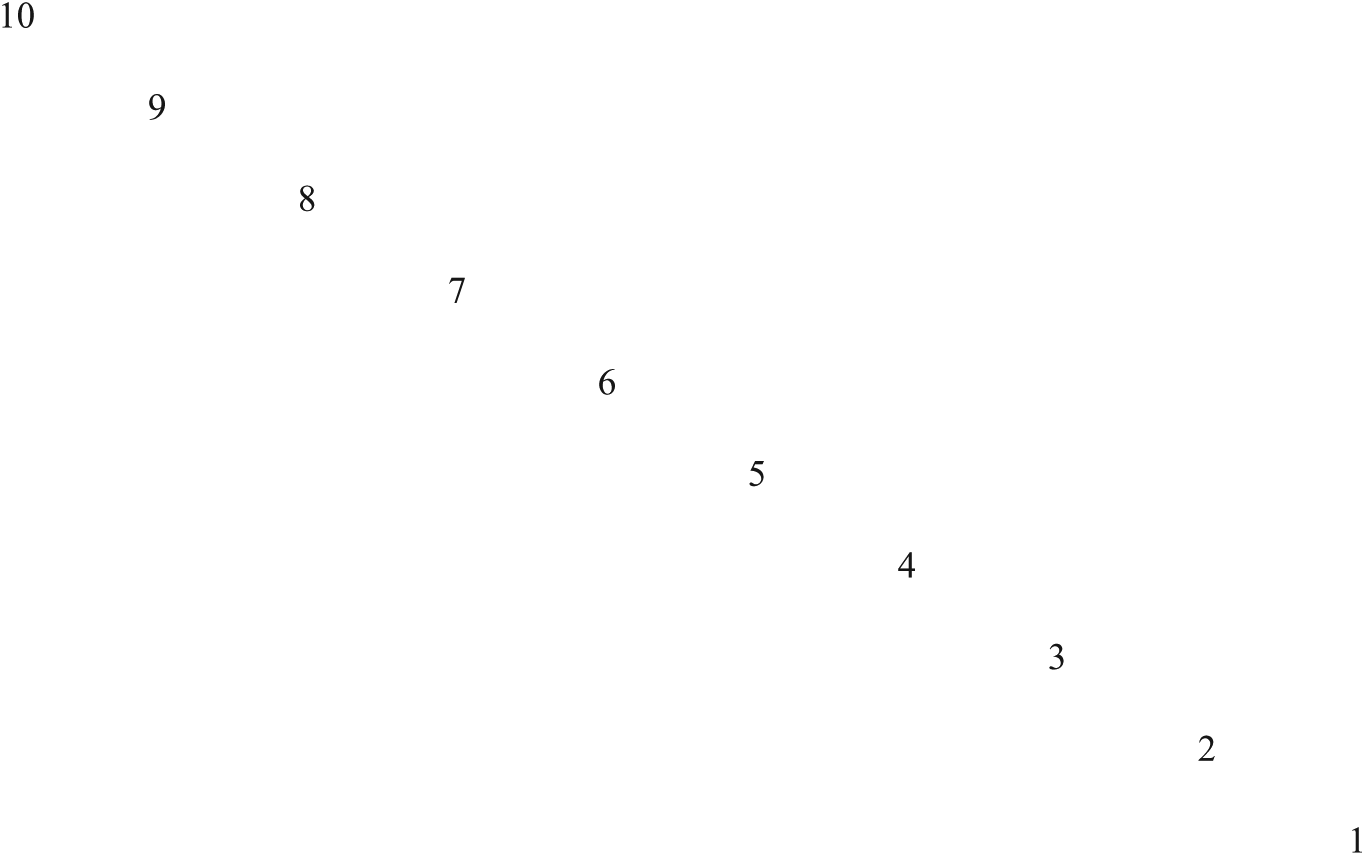
*H*A*P*P*Y*N*E*W*Y*E*A*R* (Huchu, 2015/2014: 288) 2
The Maestro, the Magistrate and the Mathematician is one of four published novels by Huchu, each of which experiments with different narrative modes, forms, and genres. Probably the most well-known of these, and the work which put Huchu on the literary map, is The Hairdresser of Harare (2010), a novel about Zimbabwe, curiously written in Scotland. (The fact is not so curious, however, as the Mathematician storyline in the novel reminds us. The Mathematician takes a daily “quadruple espresso” (29) in a coffee shop where he enters into routine banter with an elderly man. The other patrons in the coffee shop assume that the man is Alexander McCall Smith, the Zimbabwean-born white writer who has relocated to Edinburgh where he writes bestselling novels about black characters in Southern Africa — an enterprise so lucrative that fiction-writing has replaced his career in the law.) Huchu is also a recognized short fiction writer, with many of his stories available in online literary magazines. But, of all Huchu’s fiction, The Maestro, the Magistrate and the Mathematician is the work in which the tropes of immigrant conceptions of space and place are most clearly foregrounded, problematized, and reconceptualized.
The Maestro, the Magistrate and the Mathematician thus represents Huchu’s stab at what has come to be known as “African immigrant fiction”, or “migritude” fiction, a sub-genre that includes Teju Cole’s Open City (2011), Chimamanda Ngozi Adichie’s Americanah (2013), Taiye Selasi’s Ghana Must Go (2013), and Imbolo Mbue’s Behold the Dreamers (2016), to name a few other examples. “Migritude” is a polysemic portmanteau neologism that has entered into the scholarship of diaspora studies through the performance art and transmedial book, Migritude (2010), by Shailja Patel, a performance artist of Kenyan origin. The term “migritude”, combines “migrant with both attitude and Négritude (the antiracist, anti-colonialist movement of black self-affirmation named by Aimé Césaire), in order to describe women and non-Western migrants “who speak unapologetically, fiercely, lyrically, for themselves” (Patel, qtd. in Kulbaga, 2016: 76–77). Although Patel uses the term migritude to encompass, in particular, female Indian diasporic experience, in the context of this essay, it will be used as a synonym for African immigrant fiction, highlighting the allusion to “Négritude” contained in the term. While African immigrant fiction is a well-developed genre in European and American contexts, fictional reflections of African immigrant experience in African contexts are only recently beginning to emerge, pioneered by, among one or two others, Novuyo Rosa Tshuma, detailed further below.
To date, The Maestro, the Magistrate and the Mathematician is one of four Zimbabwean diasporic fictions, including the novels Harare North (1998) by Brian Chikwava, set in London, We Need New Names (2013) by NoViolet Bulawayo, partially set in the United States, and Shadows (2013) by Novuyo Rosa Tshuma, a novella and collection of short stories, with some of the narratives set in Johannesburg, South Africa. Fully conscious of the genre within which he is writing, Huchu intertextually alludes to one of these Zimbabwean diasporic novels: namely, Harare North. Chenai, the Zimbabwean-Scottish “hybrid” daughter of the Magistrate, who is more Zimbabwe-rooted than her father, glances through a copy of Harare North lying on the coffee table while her father and Alfonso, a “friend” who turns out at the end to be a traitor, watch British soccer. Of Chikwava’s novel, she proclaims with a humorous self-reflexive irony of which she is belligerently unaware: “Dad, if this guy cannae be bovvered to learn proper English, why did he write a novel?” (6).
However, while for the purposes of bookshelf classification The Maestro, the Magistrate and the Mathematician invites generic identification as “African immigrant fiction”, its refusal to allow being positioned on any side of the range of questions that have come to define migritude fiction makes it unsettle the genre itself. This article argues that rather than producing an “anti-immigrant” fiction, Huchu seems to have produced an ultra-immigrant fiction, where the concerns of migritude become an untethered mesh for all subjectivities, including those not black or brown, and not refugee — in other words, white citizens whose national belonging is also destabilized in the novel. These effects are achieved mainly through the novel’s foregrounding and subsequent dis-location of the spaces of transnational movement and the places of pausing — to use Tuan’s analogy — which inform identities and belonging.
Routed identities: Mobilities, hybrid being, and networked belonging in Edinburgh city-space
Although The Maestro, the Magistrate and the Mathematician engages (and transcends) the concerns of global African immigrant fiction, this essay will locate it predominantly within a British migritude context as a narrower point of departure. Aarthi Vadde summarizes the themes in successive generations of British immigrant fiction as “centred on the experience of exclusion, conflicts over the meaning of national traditions, and reflection upon the significance of national identity in a multiracial, international society” (2015: 61). Sam Selvon’s The Lonely Londoners (1985/1956), to be referred to again more specifically in the context of city mobility, is identified in many studies as a key archetype of subsequent black British fiction (Ball, 2004: 23; Batra, 2016: 159; Nasta, 2016: 29; Procter, 2016: 129; Vadde, 2015: 61). Huchu’s novel, we shall see, alludes to the general trends in black British fiction, but finally opts out of any ideological position by destabilizing the concepts of inclusion and exclusion, national and racial identity, and the location of home through collapsing spatial frameworks.
The analysis of space and place in The Maestro, the Magistrate and the Mathematician will be approached through characterization since this key narrative element is primarily, and very consciously, spatially conceived. Huchu’s exploration of space and place is articulated through the narratives of three characters, the Maestro, the Magistrate, and the Mathematician, in three novellas. These are presented not in unitary linear time, but in interchangeable chapter fragments, which nevertheless produce three coherent, very compelling individual stories. Each of the protagonists has a rhythm of his own, distinctively represented in the forms and styles of narration that figure the character. Each of the protagonist’s idiosyncratic rhythms, which will be clarified below, is expressed through a dedicated form of mobility that uniquely configures the space through which movement occurs, shaping the character’s appreciation of place, and the sense of belonging thus formed. The spatial dimension of characterization is linked with an inescapable chronological element. Major theorists of spatiality, notably Tuan (1977: 118–35) and Massey (1994: 249–72), have stressed the interconnections between conceptions of time and space. The novel thus attempts to create individuated “chronotopes”, or narrative time–space configurations, unique to the tempo of each of the three protagonists. The concept of the chronotope, in its early twentieth-century elaboration by Mikhail Bakhtin, identified time–space configurations specific to various kinds of novel, among them the three types of ancient Greek novel and the modern European novel. In some cases Bakhtin also linked the concept of the chronotope to specific literary motifs, for example, the chronotope of the road (1981: 243–45). By contrast with the novels studied by Bakhtin, Huchu tries to create fully individuated chronotopes, not for a subgenre of the novel as a whole, nor linked with specific motifs or tropes, but a unique chronotope for each of the three protagonists. In its imagination of individual rhythms for the main characters, The Maestro, the Magistrate and the Mathematician thus also sets itself apart from narratives shaped by the linear, teleological time of European Enlightenment culture or the cyclical time of African culture. In this regard, Huchu explains: I tried to have the novellas that make the novel function like the three hands of a clock. So, the Maestro is your hour hand, very slow, little happens on the surface. The Magistrate is the minute hand and holds the whole thing together with a little more going on. Then the Mathematician, in present tense, is the second hand going tick, tick, tick, tick, at a relentless pace. (qtd. in Tiah, 2015: n.p.)
Although the project of The Maestro, the Magistrate and the Mathematician is one that encompasses a focus on the interrelationship of time and space, which are indissolubly connected, in this article the figuring of the spatial is the primary concern.
Migrant literature is an inherently spatially aware form of writing, since narrative impetus is provided by the story of movement — in the twentieth and twenty-first centuries mainly movement across national borders — leaving a homeland for a host country. The protagonist typically leaves a home that is in some ways unhomely, is tested by crossing borders into a liminal zone, and struggles to find psychic reintegration into the host land where he or she is ill at ease. Migrant fiction explicitly foregrounds movement through space, or alludes to it in the characters’ backstories. The psychic task in these novels lies in turning frequently alienating host space into home place. Very often space becomes place through the ongoing translocal recognition of double identity constructed through growing cultural and social roots in the new locale, together with memories of the home space. In The Maestro, the Magistrate and the Mathematician, space is consciously foregrounded and complicated even more than in other migrant fiction, since the patterns of migrant fiction are unsettled and finally exploded.
Somewhat counter-intuitively, the characters create place not through putting down roots, but through city mobilities that turn host spaces into home places through the establishment of routes, where infrastructure and institutions act as moorings that enable mobility. Place-making through movement has, in fact, been a longstanding feature of the study of place. Kevin Lynch’s classic study of urban space, The Image of the City (1960), proposes that it is mainly through visual markers in the city that inhabitants derive an experiential sense of the city’s legibility, allowing its cognitive mapping and its navigation (Lynch, 1960: 4). Tuan links place-making more generally with movement, progressing from small movements in the home to more extensive movement through suburbs and cities, and also bigger nomadic movement through large swathes of territory (1977: 179–83). He implies, through a reflection on the space of the home, that in all movements from the smallest to the biggest, kinaesthetic experience creates points on navigable maps: These points are places, centers for organizing worlds. As a result of habitual use, the path itself acquires a density of meaning and a stability that are characteristic traits of place. The path and the pauses along it together constitute a larger place — the home. (Tuan, 1977: 182)
Movement both in the home and in the city-space of Edinburgh is crucial to the establishment of different senses of place for each of the triumvirate of characters in The Maestro, the Magistrate and the Mathematician.
City mobilities have generally been articulated through the figure of the “flâneur”, a concept which Huchu’s novel seems to advance beyond its current theorization. Although Michel de Certeau’s intervention into city mobilities in “Walking in the City” (1984: 91–110) does not specifically allude to the flâneur, this chapter from The Practice of Everyday Life (1984) historically updates Baudelaire’s term for the triumphant solitary city sociality of the nineteenth-century leisured aesthete (Baudelaire, 2004/1863: 37–41). For de Certeau, city pedestrianism through street-level itineraries and a street-level view, rather than a view of the city from on high “looking down like a God” (1984: 92), disrupts and rewrites through the everyday practice of individual mobility the spatial maps of city planners: The ordinary practitioners of the city live “down below,” below the threshold at which visibility begins. They walk — an elementary form of this experience of the city; they are walkers, Wandersmänner, whose bodies follow the thicks and thins of an urban “text” they write without being able to read it. (1984: 93)
De Certeau thus transforms the idea of the flâneur memorably taken up by Walter Benjamin in the early twentieth century, where the Parisian flâneur is an ambivalent figure, who is both a symptom of capitalism and able to view the alienation engendered by capitalism operating in the city space (1969: 155–200). The significance of flânerie has been discussed in numerous other studies, but of particular relevance here is the development of the concept of the flâneur in the context of the literature of transnational immigration, generally, and in the context of black British immigration more specifically. London, as colonial centre, is the city whose space is most contested in British migritude literature. Sam Selvon’s narrator, Moses, and ambulatory characters, especially “Sir” Galahad, in The Lonely Londoners are the archetypal flâneurs of the Windrush generation who, in some ways, plot the itinerary for later black British city literature. (“Windrush” of course refers to the name of the ship, the Empire Windrush, that brought the first generation of black immigrants from the Caribbean to Britain in 1948. These early immigrants were given automatic British citizenship through their membership of the Commonwealth.) John Clement Ball in Imagining London (2004), a historical and geographical study of the imperial metropolis in immigrant fiction, finds that “[t]he vitality and detailed originality” (2004: 143) with which Selvon represents the routes of his peripatetic migrants actualizes their London most sharply. Thus, through its “narrative attentiveness and individuation” (2004: 143) The Lonely Londoners, of the Caribbean immigrant fiction of the period, best suggests the city of London as the translocal homeland of its characters. Through a reading of The Lonely Londoners, Mpalive-Hangson Msiska articulates the political urgency of the need for flânerie be extended to the black subject “so that the discourse of metropolitan life and experience becomes racially inclusive” (2009: 9). Msiska proposes the terms “Blaneur” (black flâneur) or “Afraneur” (African flâneur) (2009: 9) to describe the raced city subject who negotiates “Black Diasporic metropolitan subjectivity” (2009: 26). For Msiska, by contrast with Ball, Selvon’s flâneurs are able to negotiate only an “ambivalent acceptance of the metropolis as home” (2009: 26).
The Maestro, the Magistrate and the Mathematician reworks the themes of flânerie so that they reflect the flâneur-figure as it emerges in the studies mentioned above, but also in various ways unsettles their approaches. The quest for place in Huchu’s migrant novel is not a quest for national belonging, but specifically, through the rewriting of the flâneur figure, belonging in the globally connected city. Huchu proposes in an interview that “adopting the identity of a city or postcode is less problematic than shifting national allegiances” (qtd. in Cousins and Dodgson-Katiyo, 2016: 205). And, in a number of ways, belonging in the “peripheral” city of Edinburgh seems less fraught than belonging in the imperial centre of London. In The Maestro, the Magistrate and the Mathematician each of the protagonists adopts a different form of mobility that creates a different sense of place and belonging in the greater space of the city of Edinburgh. While the Magistrate is a walker, the Maestro is a runner, and the Mathematician is a driver. Here Huchu’s narrative appears to make a case through fiction for a “politics” of the particularities of mobility highlighted theoretically by Tim Cresswell who suggests that “mobility itself can be fine-tuned through considering more specific aspects of mobility, each of which has its own politics, and each of which is implicated, in different ways, in the constitution of kinetic hierarchies in particular times and places” (2010: 29). The flâneur that is scripted in the Mathematician figure, as we shall see below, is in some ways like Baudelaire’s aristocrat aesthete, but is also an updated twenty-first century techno-aesthete. Like Benjamin’s alienated flâneur, Huchu’s immigrant flâneur is, in one example, able to overcome alienation (the Magistrate) but, in another case, the immigrant flâneur implodes in solipsistic isolation (the Maestro). There is no sense in the novel of the transgression and challenges to power embodied in the city itineraries of de Certeau’s city walkers. Likewise the specifically black racial inclusion represented by Msiska’s “Blaneur” or “Afraneur” is implicitly critiqued, leveled, and integrated with other forms of exclusion in the itineraries of the Mathematician character. Negotiations of city space and place will now be analysed through the spatial specificities and mobilities of each of the characters.
The Magistrate, as noted above, is identified by the author as the “minute hand” and anchor character, to whom the greater number of chapters is given. He is presented as ambiguously having “freed” himself from the soil and toil of the life of a Zimbabwean peasant through hard work and education. The Magistrate, as we come to know him in the novel’s present, is a character rooted in a middle-class way of life that his profession in the law in Zimbabwe allowed him. He self-identifies as Shona–Zimbabwean and values his culture, to which he nostalgically looks back, through memory, language, cuisine, and, most importantly, music. “Music forms memories” (5) the Magistrate reflects, unsettled by the memories he imagines being constructed for his daughter, Chenai, by the vulgar, misogynistic, and obscene music videos she ceaselessly watches on television.
Although the securities of the Magistrate’s home culture are repeatedly betrayed by Edinburgh, the city of his exile, his experience nonetheless brings into relief the “unhomeliness” of his Zimbabwean home, and the “homeliness” of his Edinburgh exile. The Magistrate repeatedly attempts to create a version of his Zimbabwean home in his home in Edinburgh; but his attempts are largely futile. The traditional roles are reversed in the host country since the Magistrate’s legal training is not recognized and his wife, a nurse by profession, is the main breadwinner. The Magistrate and his wife are like two ships passing in the early hours of the morning when she returns from her night shift and he rises to attend to the daily household duties. Forced to do household chores, the certainties of the Zimbabwean home are also unsettled since he realizes his blindness to the injustices of the working conditions of the maid in his former home. Instead of the benevolent patriarch he had always thought himself to be, he realizes, when he is forced to do housework himself in Edinburgh, that he was in fact an insensitive oppressor. His daughter, in her accent, clothing, and cultural orientation, is virtually a stranger to him, just as he is a stranger to the elderly people whom he takes care of in various nursing homes, when he finds part-time employment as a caregiver. Thus, autochthonous Scots are presented as finding themselves unhomed in their old age, surrounded by strangers in the impersonality and dismal conditions of their nursing homes, as migrants are unhomed in a cold and gloomy Edinburgh. Furthermore, throughout the novel, Scottish locals are made to appear out of place. Native Scotsmen of both the working and middle classes are presented as more foreign than Zimbabwean economic and political refugees since, in their accents and deprivation of a more rigorous Zimbabwean colonial education, they lack the Anglophone and Anglicized sophistication of black Zimbabwean exiles like the Magistrate and the Mathematician, who, for these reasons, better adapt to globalized (predominantly English) culture.
However, the Magistrate also ultimately finds himself at home in his new location in Edinburgh, as he makes a home for the Scottish elderly in their nursing homes away from their own homes. The novel’s dialectical approach thus destabilizes the idea of home, since the spaces of the acknowledged home, for both the native and the immigrant, are rendered unhomely, with the possibility of a new home being found in unhomely space. The homeliness of the Scottish home is discovered by the Magistrate, ironically, through the daughter who seems to him entirely lost to Shona culture. This teenage daughter, Chenai, is doubly alienated from the Magistrate as a consequence of the defiance of the troubled age she is at, and her emulation of the lifestyle of the twenty-first century Scottish teenager, rather than the mannered formalities of the Shona young woman. The greatest filial betrayal, however, is when the Magistrate finds his daughter committing what is to him an unnameable and unspeakable sexual act with her white, Scottish boyfriend, Liam. We later discover that Chenai is pregnant. Chenai, a second generation “immigrant”, who carries very little Zimbabwean cultural baggage, is entirely unruffled by her “condition” and slips it to her parents without turning away from the screen on which a troupe of hip-hop artists gyrate: “[T]here’s somefing I need to tell ya … I’m preggoz” (200). Liam’s bright red penis is the centrepiece of the abovementioned sexual act whereby the Magistrate discovers his daughter in flagrante. The Magistrate is reminded again of the scarlet member by the decorations hanging from Liam’s father’s Christmas tree when the families establish ties as a result of the child to be born. It is, however, through the daughter’s apparent abandonment of traditional Shona conventions that the Magistrate is able to find a home in Scotland through the ways in which the “disappointment” with the daughter’s conduct invigorates his marriage and allows him to extend family relationships in Edinburgh. The daughter’s “mistake” also recreates a sense of cultural attachment that may be contrasted with the failure of the Magistrate’s more purposeful activity to make his daughter connect with her Zimbabwean roots. The Magistrate tries to grow a vegetable garden at the back of his house to instil the same love of the soil in his daughter that he felt as a young Shona peasant: “He liked the feel of soft earth giving in to his hoe. The sound of roots tearing out of the ground was music to his ears. It took him back to his childhood, […]. Then it had been a matter of life and death. Life kumusha revolved around the seasons, around agriculture. They had an intimate relationship with the soil” (113–14). He gets his daughter to help in an attempt to make her understand the cultural significance of land; but it is at best an obligatory duty for her. The attempt to re-establish roots through Edinburgh suburban “peasantry” finally fails. The Magistrate does ironically achieve a closeness to soil, albeit Scottish soil, when his half-Scottish, half-Zimbabwean grandchild’s umbilical cord is ritually buried in the garden, “binding Ruvarashe [the grandchild] and, by extension, themselves to this place” (293).
It is, however, mainly through city mobility that the Magistrate comes experientially, rather than symbolically as above, to feel Edinburgh as a place he can call home. The Magistrate’s city mobility takes the classic, though not only, form for the flâneur, namely, walking. Pedestrianism allows the creation of a sense of the space of Edinburgh that makes it become place through repetitive experience. Unlike the classic nineteenth- and twentieth-century flâneurs, tactile experience is privileged over visuality. The Magistrate’s tactile sense of place is left unfulfilled by motor transport. He thus gets off the bus on which he travels to work in order better to feel the solidity of the buildings on the streets through which he walks. In touching the weathered stone of “solid” ancient buildings, “fixed in this point of space”, the Magistrate feels that through the act of touching he too is “fixed” (93). The stone of Scottish buildings becomes a substitute for the soil of Zimbabwe, an attachment to which is almost visceral for the Magistrate. Mickias Musiyiwa has highlighted how deep cultural attachment to land has been constituted through Shona mythologies, songs, and lifeways. Musiyiwa (2016) also shows how land as lifeblood has been politically manipulated, often with disastrous effect, in contemporary popular songs. The cultural importance of land to the Magistrate is underscored by his tilling the soil in his small backyard to grow a vegetable garden, as we have seen above. But, also as noted earlier, this Scottish suburban attempt to constitute a transformed land ethos fails. The Magistrate’s act of psychic “transference” of land-attachment is thus made possible mainly by city mobility, which gives access to tactile experience, and the intuition that the ancient stone buildings of Edinburgh embody a related land ethic to the Magistrate’s land ethic: — “[t]hey [the Magistrate and the buildings] shared roots for a brief moment in time” (93).
Walking through the city also gives the Magistrate a better sense of who he is, paradoxically through creating distance rather than attachment. Psychic distance from home enables a mental liberation, creating the headspace for deeper and more critical reflections on Zimbabwe and being Zimbabwean: He found he could clear his mind when walking [in Edinburgh]. It was as though the act of perambulation was complemented by a mental wandering, so he could be in two, or more, places at the same time. His physical being tied to geography and the rules of physics, his mental side free to wander far and wide, to traverse through the past, present and future, free from limits, except the scope of his own imagination. (13)
In creating a sense of place through city pedestrianism, mobility and imagination create the potential for identities yet to come in places yet to be known — the Magistrate is able to “traverse” the “future, free from limits”. There is scope in the Magistrate’s city-perambulation for his own evolving dual Zimbabwean and Scottish identities, his daughter’s “Zimbo-Scot” hybridity (Huchu, qtd. in Cousins and Dodgson-Katiyo, 2016: 205), as well as for potential future identities forged by further migrations and future acts of imaginative identification. However, the Magistrate only has the power cognitively to map the host city for himself when he traces the city of Edinburgh to music. Thus his “emplacement” in the city produces a Zimbabwean migritude reinterpretation of Paul Rodaway’s haptic and auditory geographies, described in Sensuous Geographies (1994). The Magistrate is given cassettes of Zimbabwean popular music by his overbearing “friend” and apparent benefactor, Alfonso, which he plays on an old Sony Walkman given to him by Liam, his daughter’s Scottish boyfriend. Particular songs become linked to particular streets through which he travels by bus, and through which he walks. By the end of the novel he is a cartographer of his Edinburgh, set to Zimbabwean music and Zimbabwean memories. Interestingly, he draws a map of his city itineraries when he has a “god-like” view of Edinburgh from the window of the plane in which he flies with Alfonso to London, where the Magistrate’s leadership of the opposition party is formalized: The Magistrate took a piece of paper and drew on it what he remembered of the city so that he would have some perspective of what he had seen and where he had been. This way he hoped that, when his memories abandoned him, they would return if only he played his cassettes. When he was finished, the page was full of lines tracing bus routes that terminated at nursing homes. Along each line he wrote the bus number and the artist he had listened to en route. He compared the map to the one he bought at the gift shop. In it he saw the city in which he lived, a city that he dared not call home. (317–18)
The Magistrate dare not call Edinburgh home in a double sense: first, since he may be excluded in his foreignness by Edinburgh natives; and, second, since he may hanker after a return to the homeland of Zimbabwe, where calling Edinburgh home may be construed as an act of betrayal. Despite the Magistrate’s misgivings, he misses the implication of his drawing the music map. Edinburgh has become a home — a home that needs to be “memorialized” through his music map in case he, at some time in the future, leaves this home for another home. While Edinburgh has become a new home to the Magistrate, the novel, in its habitual teasing contradiction, undercuts the purity of Zimbabwean identity precisely through the Zimbabwean music that allows the Magistrate to superimpose Zimbabwean memories onto Scottish space. We discover in the Magistrate’s meditations on the social significances of the Zimbabwean popular songs he listens to that Alick Macheso, an iconic Zimbabwean music artist — more precisely, the undisputed king of the Zimbabwean Sungura genre — is half Mozambican and half Malawian, pulling the rug out from under “authentically” Zimbabwean popular music. The experience of the Magistrate as the “minute hand” may be contrasted, as we shall see below, with that of the Maestro.
The story of the Maestro, Huchu’s “hour hand”, is the story of a white Zimbabwean in his late 20s who, unlike his black counterparts in the novel, is not well educated. He has O levels, and drifted from job to job in Zimbabwe before migrating to the United Kingdom. There are numerous beguiling terms from music employed in the early chapters where he is introduced, but, in fact, he is not a musician. The name “Maestro” is simply a nickname picked up at the supermarket where he works as a shelf-packer. The Maestro is alienated in all senses of the term. He is an alien in Zimbabwe that sees him through a racial lens as a white, British settler. He is alienated in Britain where he is seen as a foreigner from a colonial outpost — that is, culturally, not very British. He is alienated from his family, with whom he seems to have no contact, and he is existentially alienated from himself and the world around him. He takes refuge in cigarettes, alcohol, and marijuana, rather than his prescribed psychiatric medication, which finally leads to his death.
The Maestro, unlike the Magistrate, has no home outside of the ultimately abandoned home of his existential self. The Maestro refers to his anonymous, indistinguishable apartment on a large low-rent estate as a “dwelling” (136) or a “base, a place to rest outside of work” (157) rather than as a home. The space of the flat is a “hermitage” (204) from the world, and the Maestro’s isolation is completed when he cuts ties even with Tatyana, the friend who gave him his nickname and who takes a strong interest in his wellbeing. The Maestro’s flat is counterpointed with Tatyana’s apartment in Edinburgh which is a “mausoleum” (145) to Polishness. This description of Tatyana’s space is reminiscent of the attempts of Tayeb Salih’s character, Mustafa Sa’eed, in Season of Migration to the North (1991/1969) (one of the earlier examples of migritude fiction) to construct homes for his divided self in different locations. Sa’eed constructs an oriental harem bedroom for himself in London and a secret Anglophile mausoleum, dedicated to an idea of Britishness, in a village in the Sudan. Unlike Tatyana, who is secure in her Polishness, the Maestro is doubly “unrooted”, as a white person denied an authentic Zimbabwean identity in black majority Zimbabwe. He also has a conflicted history as a Rhodesian, subtly alluded to by the fact that he has in his possession a Rhodesian camouflage vest, probably inherited from his father who likely was involved in violently suppressing the second Chimurenga after Ian Smith’s Unilateral Declaration of Independence. The Maestro’s already pared-down, functionally not fashionably minimalist flat, without any memorializing objects from former places called home, is emptied even further when, in paranoid anxiety, the character throws out everything except food and his books. He does this since, even though he tries to block out the place in which he finds himself, he feels it “clawing at him” (168) through the television, the phone, the computer, even the sofa and the bed. In the context of the Maestro’s pathological sense of self, he thus has a very troubled relationship with the idea of belonging through location in place.
Within the empty space of the flat, the Maestro constructs a mansion of books as one might build a house of cards. The Maestro reads voraciously and seeks the truths of life in the ideas in books. Through the narrative maps provided by books, the Maestro tries to construct an abstract world in which he may identify points of reference and find an ideational home. He is drawn to the medieval philosopher Boethius, who, in exile finds consolation and a home in philosophy, but dislikes his “compatriot”, Doris Lessing, whose characters are alienated and oppressed in the wide open spaces of the Rhodesian/Zimbabwean landscape. Pushing Huchu’s negative dialectic to its limits, the “truth” of ideas contained in books is also finally seen by the Maestro as troubled: He picked another book from the pile and found it was just a jumble of words with which he had no connection. His entire body trembled. He went to the wall, leant against it and banged the back of his head again and again. Trying to think, trying to clear his mind, everything was all jumbled up, an incoherent mass of letters and graphemes. Banging his head, putting himself into a trance, took him to a bleak, empty space outside of colour and sound. And when he came back, he knew what he had to do. It was now all so clear. The Maestro walked to the window and calmly opened it. He bent down, picked up a pile of books and threw them out of the window. Then he did it again and again. (211)
He later goes down and makes a bonfire of the pile that collects below. In every way unhomed, the Maestro takes to a wandering existence of homelessness until he dies of exposure to the elements at Christmas time.
While the Magistrate is a walker, the Maestro is a runner. The Maestro’s relationship with the city of Edinburgh is resistant. He refuses to give in to the city’s “seduction and charms”, choosing instead its “dark underbelly, the grotesque sector that never made it to postcards in tourist shops” (136). As the Maestro runs, his attention is drawn not by things in the city themselves, but by their reflection in the murky surfaces of stagnant water, and his own reflection in the glass of office windows. The city’s dark side reflects the darkness of his depression. Running through the city, the Maestro does not attempt, as the Magistrate does when walking, to find correspondences with the Zimbabwean home, where the fecund Zimbabwean soil of the Magistrate’s youth is replaced by the ancient stone of Scottish buildings, and identity is reoriented through Shona music listened to in Scotland. The Maestro’s running through the city does not establish the city with its streets, buildings, and landmarks as a place in which he seeks belonging. The Maestro instead is moved by movement itself. The velocity of his movement turns the city into an unmappable blur that permits an escape into the vortex of his alienated self, and his own deepest psychic sense of unbelonging: The Maestro listened to the sound of his own breathing, everything else was a whoosh […] one foot after the other, just running, […] edging closer to the zone, his eyes no longer making out distinct shapes or objects, light scattering on his retina, the black track, the brown canal, […] not objects but colours […] as the world was pushed back behind him to the past. (139)
The Maestro’s mobility, unlike the Magistrate’s, does not allow him to be “emplaced” in the city; instead, his running allows the atavistic return of the white African to the savannah: He carried on, one foot after the other […] reaching a state of grace where the only thing that mattered was movement, pushing his body to its physiological limits, and then a thud, and another, and another, the beating of an ancient drum going faster and faster, a loud percussion that pierced through the whooshing and the swirling of the atmosphere, louder and louder, this primitive drum that never broke rhythm, only getting louder and stronger, hypnotic in its intonation of sounds from the savannah, the song of the hunter and the hunted, the powerful melody of life and death that plays on and on until he was no longer there, broken free from the shackles of reality into a running induced nirvana, becoming not himself but pure movement, becoming steps within the haze and the blur of the world around him, until it was not he that moved but the earth itself under him like a treadmill. (139)
This is a fragment from a sentence that continues for just under a page, linking the white Zimbabwean with the drum, the most potent symbol of traditional black Africa, and the “shackles” or chains of, most significantly, trans-Atlantic slavery. Huchu thus plays on the routes and roots motif of much African diasporic literature, making attachment to the African motherland an ancestral call for the green-eyed, red-haired Maestro rather than for any of the black characters. To the end of the novel, the Maestro’s cartographic anxiety is never allayed. As a runner through the city, his cognitive map challenges the idea of mapping itself.
Attention in the novel finally shifts to the Mathematician, the “second hand” of the clock. The Mathematician is in fact no mathematician, but an arrogant, cocksure, Afropolitan PhD in economics, who recognized before it was too late that his talent for mathematics was not of the order of genius required to secure an academic career. Farai, the Mathematician, appears to have no ethical commitments beyond a narcissistic dedication to himself and his hedonistic pleasures. Paradoxically, he remains a likeable character throughout as a consequence, oddly, of the fact that his life philosophy, built entirely on individualism as selfishness, allows no hypocrisy. Proceeding from this life philosophy, he regrets, for instance, not having bought lucrative shares in the arms industry before the war in Iraq, whose guided missiles light up his television set as they do in the video games he has played ever since his elitist, upper middle-class Zimbabwean youth. Farai is the cynical, less idealistic contemporary version of the Goethean citizen of the world, whose world has come to be shaped by digital media and is largely constructed in cyberspace.
While the Magistrate’s sense of home is ultimately created through links with the soil, and the Maestro’s home is constructed in a solipsistic self that finally implodes, Farai’s home is constructed by information technology-extended and alternative realities, in themselves a conduit for the mobility of virtual “things”, through vast immobile infrastructures. Using his mobile phone and email correspondence, communication with home is transformed by what David Harvey has identified as the “time–space compression”, produced by late-capitalism. By “time–space compression” Harvey alludes to “processes that so revolutionize the objective qualities of space and time that we are forced to alter […] how we represent the world to ourselves” (1990: 240). Farai’s relationship with his father in Zimbabwe is as “connected” as his relationship with the Edinburgh girlfriends to whom he sends text messages, since advanced communication technology “annihilate[s] space through time” continuing the time–space compression Harvey identifies in earlier revolutions in modes of transport (1990: 241). Farai’s apartment in Edinburgh is simply the location of the various virtual homes he constructs for himself through technology, wherever he happens to find himself. The “uberhyperreality” (75) of Farai’s alternative realities are graphically staged in the novel through its representation of the selection and management of his Xbox 360 FIFA football dream team, with the presentation on the page of the actual mapping of his winning player formation. Farai’s cognitive map thus is technologically universal, allowing him to find a home wherever his creature comforts are met — and he is wifi-connected.
The Mathematician is Huchu’s “second hand” that goes “tick, tick, tick, tick, at a relentless pace”. Farai, given the frenetic pace at which he lives his life, is not a walker or a runner, but a driver. He moves through the city in “[h]is car, a black PT Cruiser, which he bought because it looks like a monster, is fully equipped with a Kenwood KDC-X993 complete with subwoofer that gives the voice on the radio extra kick” (27). But Farai’s “automobility” (Walks, 2015) through the city, oddly enough slows the fast-paced character down “in what passes for congestion in Edinburgh” (27). While Farai’s gaming creates homes in techno-realities, the view from the automobile in the slowed-down speeds of the congested city streets creates the frames through which the real experience of Edinburgh becomes virtual. As if on a screen, Farai from his car in the traffic can watch the 22 cruise by in the bus lane, a woman in a green Corsa chat on a mobile phone and check her lipstick in the rearview mirror, and the rain get squeaked off his windscreen by the wipers (27–28). The car is the buffered mobile place in the city-space of Edinburgh that becomes the location of Farai’s transnational technology-located belonging, rather than his apartment, which is simply the site of access to virtual tech-“homes”.
Conclusion
In the city of Edinburgh, through three privileged forms of local mobility entangled in a multitude of practices that implicitly display the tracks of transnational mobility, Huchu reinterprets the nineteenth- and twentieth-century versions of the modernist flâneur, indexing through his three Zimbabwean characters a twenty-first century super-diversity of identity through an individualized spatial negotiation. These mobilities present a continuum of forms of belonging, ranging from the Magistrate’s synaesthetic superimpositions of Zimbabwe on Edinburgh, the Maestro’s atavistic Edinburgh-located and facilitated retrogression into a psychic primal Zimbabwe, and the Mathematician’s technology- and wealth-buffered, Zimbo-styled, ultra-belonging in a globalized world. The continual flows and movements of the individual characters, furthermore, locally reflect the global flows of capital and the transnational flows of the forced mass migrations that have come to define the twenty-first century in its first decades.
This conception of belonging is contrasted with other more “organic” senses of community that are variously parodied in the novel. Significantly, it is death rather than life that brings the three principal characters together in a communion without togetherness. The Maestro dies in Tatyana’s Polish “mausoleum” home as a result of exposure to the elements at Christmas time when his feelings of alienation lead him to drift around the city like a homeless person. His funeral service, shuttling between sentimentality and farce, is arranged by the Edinburgh black Zimbabwean community, who earlier revealed through a comical fracas at one of their meetings that, in reality, they are not much of a community. Nevertheless, “the community”, including the Magistrate and the Mathematician, muster up some enthusiasm to remember in death the life of one of “their own”, whom they did not know and would probably not have acknowledged while he was alive. The three main Zimbabwean characters are thus brought together only towards the end of the narrative, when one of their number is deceased, in the context of a Zimbabwean “community” that is fractured and potentially treacherous. The treachery specifically of the minor character, Alfonso, further links the three protagonists. Alfonso, who it turns out is a Mugabe regime spy, arranges the Maestro’s funeral, after which he murders the Mathematician, who was onto a government scheme to generate (and cash in on) a hyperinflationary economic environment in Zimbabwe. The Mathematician, who appeared to be “at home” everywhere, thus meets an untimely death when the postcolonial politics of the Zimbabwean home reach out and destroy his hedonistic global home. Similarly, Alfonso encourages the Magistrate, whom he entirely dupes, to take up the leadership of the Zimbabwean “opposition” party in Edinburgh. The Magistrate, with his now settled sense of place in Edinburgh, does not realize that he is only a pin to be moved around on a map drawn by the Zimbabwean regime, where even the opposition is completely manipulated.
The Maestro, the Magistrate and the Mathematician in this way teases the reader with the possibility of migritude place-making through wholly individualized city mobilities, which turn out to be end-stopped; or are revealed to be covertly directed by the politics of the home nation, superimposing the tyrannies of the old unhomely national home onto the new home. Huchu, we see, approaches questions of identity and belonging linked to space and place as he does all other questions and concerns: in a spirit of contrariness. This is a contrariness that he terms an “intra-textual dialectic” where “any position taken is undermined by an equal and opposite truth” (Jackson, 2015: n.p.), or, more to the point, where any place inhabited is undermined by treacherous globalized, transnational networks of space.
