




Abstract
Michael Ondaatje’s Divisadero uses musical references to enhance our understanding of how the story’s characters inhabit time and place. The book’s three parts unfold against a varied musical backdrop that can be experienced as a kind of soundtrack. Although musical allusions appear in Ondaatje’s earlier work, Divisadero is marked by its range of musical references, which run from classical compositions to jazz, opera to rock ’n’ roll, reggae to blues and British new wave. This article examines the way music directs us to see different narrative options in each of the novel’s three parts. One impulse behind the narrative is to connect us to the immediate, to locate the story in mimetic terms that are rooted in the California and Nevada settings that form the backdrop to the first part of the book. The musical references in this part serve to reinforce this sense of presence, as if history could be located and understood in terms of the themes and issues conveyed in particular songs. But another impulse is to work against the immediate, to cast the characters and their experiences as part of an allegorical universe in which actions and choices are symbolic, metaphoric, transhistorical.
Michael Ondaatje’s Divisadero (2007) is a complex, multigenerational novel that uses musical references to enhance our understanding of how the story’s characters inhabit time and place. 1 The book’s three parts unfold against a varied musical backdrop that can be experienced as a kind of soundtrack. Although musical allusions appear in Ondaatje’s earlier work (most obviously in the jazz-inspired exploration of the creative impulses that torment Buddy Bolden in Coming through Slaughter [1976]), Divisadero is marked by its range of musical references, which run from classical compositions to jazz, opera to rock ’n’ roll, reggae to blues and British new wave. The title of the novel refers to a San Francisco street that is historically linked with music: well-known jazz venues such as the Both/And Club, Club Morocco, and The Half Note were all located on Divisadero Street.
Ondaatje has drawn increasing attention to his preoccupation with music, and to the relationship he sees between music and his own writing. In a 2007 interview with Johanna Schneller, Ondaatje notes that he approached Divisadero in much the same spirit as a jazz musician approaches improvisation: “You begin with a territory, and what follows is the adventure” (Schneller, 2007: n.p.). During a conversation in 2008, Liz Calder, his British editor, puts the following question to Ondaatje: “If you hadn’t been a writer would you like to imagine yourself being a painter, a jazz musician, or a filmmaker, or something else?” Ondaatje answers: “I think I would’ve wanted to have been a jazz pianist. That would be my first choice in the vein of Fats Waller” (Ondaatje, 2008: n.p.). Most recently, in 2015, Ondaatje presented a similar statement about his musical interests in a video recorded for the Louisiana Museum of Modern Art in Humlebæk, Denmark. He points out that “The rhythm of music has been the biggest influence on my writing — it’s not Wordsworth, it’s Ray Charles”. He explains how music and writing are so connected in his mind that they must sometimes be consciously separated and notes that the structure of his prose is “closer to music than anything I know”. Then Ondaatje expresses his dream: “The ideal thing would be if I was a jazz pianist” (Ondaatje, 2015: n.p.).
In 2011, Ondaatje collaborated with theatre director Daniel Brooks to adapt Divisadero for the stage. Kate Taylor observes that “the idea of staging this dreamy novel actually began with music, the songs of alt-country performer Justin Rutledge”, who plays Coop onstage (2011: n.p.). Ondaatje says that “When I finished the book, I always imagined it as having a public voice in some way, so it wasn’t a book to be read mentally, but heard as well” (quoted in Taylor, 2011: n.p.). Ondaatje approached Rutledge about the idea of collaborating on a score for the play three years before it was staged (Maga, 2011: n.p.). The importance of music in the novel can be ascertained by parsing its musical landscape. By my count, Divisadero includes 15 references to specific songs, musicians, or composers (see Appendix), almost all of which appear in the first part of the book, which runs from pages 1–168. The second and third parts of the novel span pages 169–273.
How do these references and allusions help us understand the novel? In this essay I would like to focus on the major musical references in an attempt to read them as glosses on some of the central ideas informing the narrative. I also want to consider the role that music plays in defining Ondaatje’s ideas about music and the rendering of time. Ondaatje has said, in the Louisiana Museum interview, that when he writes, music is always somewhere in the background (2015: n.p.). This does not mean that the soundtrack behind Divisadero is consistent or thematically unified. In fact, the range of musical material represented in the novel serves to confuse, and frequently to undermine, what at first reading might seem to be a consistent poetics, part of what might be called the novel’s jazz aesthetic. The mélange makes sense in the context of this aesthetic. As Michael Jarrett notes, “the founding image of jazz is the satura, the figure of mixing. It structures every account of the music’s origination and generation” (1999: 31). This means that jazz is a “mixed dish”, a “farrago”, a “hodgepodge”, or a “medley” (1999: 24). In this sense, “the jazz artist works with collage”, and the music is “a master of appropriation and transformation” (1999: 27). In her study, The Musical Novel, Emily Petermann (2014) elaborates on the jazz-inspired form of Ondaatje’s fiction, particularly in the three sections of Coming through Slaughter, which “contain pieces of narrative told from different perspectives, as well as interviews, lists of songs or bands, etc” that are “strung together in a disjointed order […] in a manner that challenges expectations of causality and continuity” (2014: 85). In this way, Petermann says, Ondaatje modifies history (2014: 86).
Before listening to the music in Divisadero, I would like to consider how this collage might be understood in relation to the novel’s overall design and historical perspective. In a review in the Guardian, Alan Warner speaks of the ways in which the novel explores a “calm but labyrinthine seeking of correspondences” (2007: n.p.). Warner is interested in how the novel’s tripartite structure becomes “a meditation on the indistinct roots of literary creation itself; it is busy, shifting, but coiled within it are themes of recurrence, of our shaky identities. In the latter sections, these echoes and recurrences gradually coalesce” (2007: n.p.). To explain the power of these recurrences, Warner draws on Michel Foucault’s observations concerning the relationship between storytelling and identity in a paraphrase: “we write, in order to have no face at all” (2007: n.p.). For Ondaatje, as for Foucault,
we live with those retrievals from childhood that coalesce and echo throughout our lives, the way shattered pieces of glass in a kaleidoscope reappear in new forms and are songlike in their refrains and rhymes, making up a single monologue. We live permanently in the recurrence of our own stories, whatever story we tell. (2007: 136)
2
I understand this to mean that music need not always be understood as something that is heard. The repetition of patterns in our lives form metaphorical refrains that possess musical qualities, “the way the villanelle’s form refuses to move forward in linear development, circling instead at those familiar moments of emotion” (136). At the same time, these musical qualities are inevitably related to the nature of human identity. As Simon Frith observes, music “describes the social in the individual and the individual in the social, the mind in the body and the body in the mind; identity, like music, is a matter of both ethics and aesthetics” (1996: 109). As with Frith’s intervention, Stephen Benson’s study Literary Music addresses the extent to which musical novels are “caught up in questions of representation, of aesthetics and ethics” (2006: 6).
In her examination of Divisadero, Sophie De Smyter emphasizes the novel’s exploration of identity and time. She focuses on the novel’s “preoccupation with repetition, doubling, and splitting” as a means of representing identity (2009: 99). For De Smyter, what is unique about Divisadero is Ondaatje’s exploration of the idea that “[t]elling already seems to be retelling” because “no phrasing will ever be completely satisfactory” (2009: 101; emphasis in original). One could regard this kind of open-ended understanding of human identity as a continuation of Ondaatje’s postmodern interests in the deconstructed subject — his preoccupation with anti-heroes who are constantly in the throes of transformation, their subjectivities collapsing into pluralities that spread across multiple histories and geographies. As Warner suggests, in this model of human consciousness there can be no sense of closure. Identity is “shaky”, “shattered”, kaleidoscopic (Warner, 2007: n.p.). In this context, Edward Said refers to music as a form of “transgression”. Katherine Fry explains that for Said, the “transgressive aspects of music allow it to engage in any number of social mediations, thus resisting deterministic and totalizing narratives” (2008: 269). But at the same time, both De Smyter and Warner argue that identity can also be understood as a force that is solid and deeply rooted in narrative, for it is through stories that we discover ourselves, and, in that discovery, we come to realize that stories assert the power of “correspondences”, of “recurrence”, of “retrievals”, of “refrains” that allow us to “live permanently” in them (Warner, 2007: n.p.). This perspective is reminiscent of Craig Owens’ concept of allegory: “Allegory occurs whenever one text is doubled by another […] Such doubling (or multiplication) necessarily functions as an act of interpretation — a mode of criticism that is built into the work” (1992: 53; emphasis in original).
These brief descriptions of Divisadero’s aesthetic are necessarily contradictory: stories both shatter and coalesce; they are “shifting” but recurrent structures (Warner, 2007: n.p.); they are simultaneously unstable and predictably allegorical; they are fragmentary and they are whole. Divisadero expresses the conviction that human experience can be understood because it participates in recognizable patterns. Experience is identifiable and knowable because it is fundamentally mythical. Everything that happens to us has happened before. Nothing is new. But how can we live in the realization that we are part of an unchanging pattern? If that is the case, how can we change ourselves, our fate, our story? Narratives might offer the solace of repetition, but that kind of recurrence is ultimately terrifying, because it makes existential self-transformation an illusion.
It is precisely because the novel embraces these grand polarities that its narrative strands are so complex. The challenge is not to resolve the contradictions (about time, space, human relations, or existential efficacy) but to understand how the novel celebrates those contradictions through its inability to resolve them. The novel’s conflicted musical backdrop helps us understand those contradictions. To test this idea, I want to examine the way music directs us to see different narrative options in each of the novel’s three parts. But in fact there is very little testing to be done in Parts 2 and 3 of Divisadero, since they contain only a single direct reference to a specific piece of music, while the first part contains all the rest. One challenge in reading the novel, then, is to understand why a narrative that is so preoccupied with music and song for 168 pages suddenly goes virtually silent in its musical scale. Perhaps this silence makes its musical import even more profound. As Benson explains:
The absence of music only serves to bolster its (music’s) strength, to make it more palpably present. It permeates what we read, suggesting the possibility that musically-inclined fiction is most potent not in those rare exceptions when it manages somehow to catch the coat tails of its object, but rather when it works to deploy its necessary silence. (2006: 142)
The novel’s three parts are quite distinct. I wonder whether they were originally created as separate stories, and then united through the introduction of the correspondences and mirrorings so ably noted by De Smyter (2009). In the interview with Schneller, Ondaatje remembers that he started writing the novel in California, surrounded by that landscape, but then another story began to intrude:
All the southern California material, that took me about two years, then gradually this other stuff [set in France] started coming up alongside it that seemed to be waving. I thought, “Is that another book or is this the same book? Well, let’s bring it into the story and see what happens.” (Schneller, 2007: n.p.)
The first part, set in northern California between the 1970s and 1990s, introduces us to Anna and her natural father; to Claire, her adopted sister; and to their brother Coop, who was also adopted after a hired hand killed his entire family. When their father discovers Coop and Anna having sex, he almost kills Coop and puts in motion the events that force Coop to leave the family farm. He joins the legion of gold diggers swarming over the California landscape and eventually becomes a card shark whose tactics force him to run away again, this time from the gambling cronies he has beaten in a high-stakes poker game. Meanwhile, traumatized by her father’s violence and the loss of Coop, Anna leaves the farm and becomes a historian based in France, where, in the novel’s second part, we find her researching the life of French poet Lucien Segura, whose house she inhabits. The third part of the novel focuses on Segura’s best-selling Claudile stories, which he wrote under a pseudonym in order to disguise the fact that Claudile was based on his illicit love for Marie-Neige, the teenaged wife of his next-door neighbour. On a brief furlough from his post studying disease and trauma near the Belgian border in the First World War, Segura journeys back to seek out Marie-Neige, with tragic results. The book closes with the unnamed narrator (presumably Anna) waiting for her father to emerge from the shadows:
I have recently been reading, in a monograph, a haunting thing about a missing father. “And so I hoped that someone would come, a man, why not my father, at nightfall. He would stand in front of the door, or on the path leading from the forest, with his old white shirt, the everyday one, in shreds, dirtied by mud and his blood. He would not speak in order to preserve what can be, but he would know what I do not.” (273)
In these words we return to the beginning of the book — to the desire for a missing father, and to the primal scene that marks the disintegration of Anna’s family. We enter the story in medias res, following its telling epigraph, which frames the novel in terms of cyclical motifs. Anna emphasizes that “The raw truth of an incident never ends, and the story of Coop and the terrain of my sister’s life are endless to me” (1; emphasis in original). The central elements of family trauma are universal and eternal, eminently recognizable in their repetitive presence. They resemble the elements of archetypal patterning popularized by Joseph Campbell, who argues that in archetypal narratives the hero is
the man or woman who has been able to battle past his personal and local historical limitations to the generally valid, normally human forms. Such a one’s visions, ideas, and inspirations come pristine from the primary springs of human life and thought. Hence they are eloquent, not of the present, disintegrating society and psyche, but of the unquenched source through which society is reborn. The hero has died as a modern man; but as eternal man — perfected, unspecific, universal man — he has been reborn. His second solemn task and deed therefore is to return then to us, transfigured, and teach the lesson he has learned of life renewed. (2008/1949: 14–15)
From this perspective, archetypal consciousness is based on the realization that what we experience now has been experienced before, that we are part of an eternally recurring pattern, and that as humans we come to rely on such patterning in order to make narrative sense of our lives. It is no coincidence that in Divisadero this archetypal view of human consciousness is conjoined with a reference to Nietzsche’s idea, first expressed in The Gay Science (1882), that “We have art […] so that we shall not be destroyed by the truth” (1974/1882: 1; emphasis in original). Nietzsche’s words direct us to the idea that art provides a means of escaping the brutality of reality. In this sense, art offers transcendence through metaphor, timelessness as an antidote to the ravages of time. But Nietzsche complicates this embrace of transcendence. His idea of the eternal return, also expressed in The Gay Science, is at once liberating and enslaving, because it forces us to act in the knowledge that we are fated to repeat our actions and experiences forever. Confronted with this this knowledge, how free can we really be?
The dual references to Nietzsche in the novel’s epigraph make us aware of a double narrative pull. One impulse behind the narrative is to connect us to the immediate, to locate the story in mimetic terms that are rooted in the California and Nevada settings that form the backdrop to the first part of the book. The musical references in this part serve to reinforce this sense of presence, as if history could be located and understood in terms of the themes and issues conveyed in particular songs. But another impulse is to work against the immediate, to cast the characters and their experiences as part of an allegorical universe in which actions and choices are symbolic, metaphoric, transhistorical. This is the world of the second and third parts of the book, which are brought to life through Anna’s historical research and the imagining of Lucien Segura and those around him. The landscape they inhabit seems more symbolic than real, as if they are figures acting out recurring tropes of identity. Why are these parts of the novel so silent? Because, in embracing ideas of recurrence and cyclicality, they engage with a symbolic universe that is beyond the specificity of song. After all, music is ultimately about time. All songs have a time signature. Music always happens in time. In this sense, music tells us that time can be measured and known. But silence invokes a world of timelessness. Silence is about a realm that transcends time. The tension that mobilizes Divisadero is the tension between time and transcendence, figured through the presence or absence of song. Music, as Ondaatje conceives it in Divisadero, is both timebound and timeless, immediate and eternal.
As we enter the novel, we see Claire riding her horse near Glen Ellen, California. The image is concrete; the temporal and spatial frames are specific. But when Anna’s father attacks Coop, and Coop is forced to leave the family farm, the scene becomes primal, archetypal. Coop is cast out of the farm, the garden. He has entered a postlapsarian realm. In Divisadero, we are asked to see Coop’s expulsion from the farm as the immediate factor accounting for his pursuit of gold and, later, his gambling. His fall is a fall into lucre. But we are also asked to see his departure in terms of a more symbolic fall. In this sense, what happens to Coop is what happens to men who clash with fathers over daughters. As Georgiana Banita says, “History repeats itself here neither as tragedy nor as farce but as sustained continuum, a temporal and spatial cadence dimly perceptible in the background of domestic events” (2013: 216–17). While the first part of the novel records the violence of Coop’s expulsion from the farm through an immediacy linked to song, the symbolism of his expulsion becomes a leitmotif in the second and third parts of the book, which treat his fall as but one expression of a never-ending story. There is no musical score for that kind of archetypal experience.
I have lingered over the tension between immediacy and archetype because the centrality of that tension is also reflected in what I am calling the novel’s soundtrack. At first, I was baffled by what appeared to be the variety of Ondaatje’s musical references. They certainly contain mixed messages. But when the novel is understood as a story that is pulled in two narrative directions, the panoply of musical references begins to make more sense. On one level, music in Divisadero is associated with measurable time and discrete historical events. There is music that celebrates the immediate, that is caught up in the conditions of the moment, that focuses on crime, violence, money, and retribution in the here and now. And then there is music about love, deceit, and desire that places characters in relation to their specific historical circumstances. As Cameron Fae Bushnell remarks, “[m]usic positions subjects in history and within cultural frameworks of meaning” (2013: 8), because “music can allude multifariously to concrete elements of social identity, to the abstract ideologies of subjectivity, and to the fleeting figure of the subject itself” (2013: 72).
The first songs mentioned in Divisadero are named in “The Dictation of Lydia Mendez”, which is the tape-recorded account of Anna’s mother’s early years. She remembers her wedding day and how the party danced to “La Vaquilla” and “El Grullo”, boisterous mariachi songs that blare with raucous horns. The sounds are celebratory, intoxicating, and effervescent in their fast-paced rhythms. However, the presence of this music is fleeting in Divisadero. It draws our attention to the California setting and to the Mexican California community that was gradually displaced, largely through the influx of prospectors in the gold rush that began after the precious metal was discovered in Coloma in 1848. Although the presence of mariachi music in the opening pages of the novel is linked to marriage and celebration, it also reminds us of a vanished way of life and of a vanishing people in the American West. In other words, it draws our attention to what is finite and political, to what disappears, and to what has been plundered, rather than to any form of recurrence or temporal transcendence.
The preoccupation with historical change signalled by the mariachi music is soon reinforced by the appearance of another song. Coop has been living in the family cabin where he is often joined by Anna:
One afternoon she brought an old gramophone that she has found in the farmhouse, along with some 78s. They wound it up like a Model T and danced to “Begin the Beguine”, wound it up and danced to it again. The music made them belong to another time, no longer a part of this family or place. (228)
The musical reference here directs us away from the historical perspective associated with the mariachi music to “another time” evoked by this mysterious song (228). “Begin the Beguine” was composed by Cole Porter and first appeared in the Broadway musical, Jubilee, in 1935. When Artie Shaw recorded it to a swing beat in 1938, without the vocals, it became an instant hit, topping the charts and selling millions of copies around the world. The melody of the song is elliptical and complex, but so is the song’s narrative, which equates desire with loss. The narrator imagines hearing the song and knows that when it begins the music will bring back the memory of a night of “tropical splendor” and the memory of an eroticized landscape in which “an orchestra’s playing | and even the palms seem to be swaying” (Porter, 1935: lines 6–7). But this love has ended, and now “To live it again is past all endeavor | Except when that tune clutches my heart” (lines 9–10). It is impossible to bring back the relationship, but the sound of the song haunts the narrator and is a reminder of all that has been lost. It is painful to revisit that loss (“So don’t let them begin the beguine!” [line 17]), but the song is also enticing because it evokes all the sensuousness of the relationship (“Oh yes, let them begin the beguine” [line 21]). The speaker is pulled in two directions: away from the pain of a lost love, and toward the erotic memory of that love, prompted by the music. Ultimately, the song reminds him of his present reality. By the end of the song, which records the dream of hearing the song, the narrator wants it all to begin again. The last line (“When they begin the beguine” [line 26]) is identical to its opening line. The lyrics establish an erotic motif that links sensuality to the perception of loss captured by the song. The erotic pull of the lyrics has everything to do with the death of a relationship. It depends for its power on the recognition of this loss.
Divisadero’s soundtrack oscillates between an emphasis on perpetual return associated with dream, allegory, and eroticism and an equal emphasis on history, locale, and the moment. In Parts 2 and 3, the landscape is dreamy, vague, symbolic, virtually mute. But in Part 1, specific places and moments are captured on television to remind us of the present, as when Coop meets up with Dorn and his gambling team in Tahoe, Nevada and coverage of “the build-up of the war in the Gulf” is running in the background (46). Early in the novel, Coop’s meeting with card player Dorn is distinguished through a musical allusion that focuses on the present: “Dorn’s first principle had always been (as in the song) that you go with ‘the one with hair down to here and plenty of money’” (46). The lyrics are from The Lovin’ Spoonful’s “Did You Ever Have To Make Up Your Mind”, a 1966 composition often identified with the hippie era. The song offers a laid-back expression of that era, with John Sebastian speculating that he will have to choose between two possible lovers. Yet the thrust of the lyrics is existential. The speaker asks, repeatedly: “Did you ever have to make up your mind?” (Sebastian, 1966: line 1) and “you’d better finally decide” (line 21). It is probably risky to give too much weight to these lyrics. After all, the song is not a complex expression of existential choice. However, the song is still there, playing in Divisadero’s background, as if to remind us, pointedly, that sometimes, decisions need to be made in the here and now.
The same could be said about the next musical reference that appears: the reggae-inspired “Johnny Too Bad”, recorded by The Slickers in 1972. Coop sings a line from the song during the final and climactic hand of poker against Autry and The Brethren: “You’re gonna run to the rock for rescue, there will be no rock” (57; emphasis in original). Then he calls Autry’s bet. Most people hearing this song will associate it with The Harder They Come (1972), the Jamaican film starring Jimmy Cliff as Ivanhoe Martin, a notorious drug dealer and frustrated musician whose life is defined by his attempts to evade the police. The song “Johnny Too Bad” forecasts the final shootout that results in Ivan’s death. In the song, as in the film, there is finally no place to hide. Coop may be prompted to sing the song because he knows that he has the winning hand, or he may be thinking about the song because of Dorn’s account of the Gulf War, “with American planes pouring down ten thousand rounds a minute onto a crowded highway of escaping soldiers” (56). For them, as for Coop’s opponents, “there will be no rock” (Cliff et al., 1972: line 117).
The references help us understand Coop and the narrator more fully. Initially, it is hard to determine exactly when the story of Coop, Anna, and Claire begins. We are told about their ages at different points, but it is only after Coop meets Dorn that we have some evidence about when Coop grew up. “Coop was twenty-three years old when he first arrived in Tahoe and fell into the company of Dorn and his compatriots” (42). This coincides with “coverage about the build-up of the war in the Gulf” (46). That year is 1991, so Coop was born around 1968. He is too young to be a hippie and too young to have appreciated The Harder They Come when it was first released in 1972. But he clearly thinks of his situation in terms of the themes of songs from an earlier era, and this allows us to understand that music has had a strong influence on Coop, and that he knows the tunes. “Johnny Too Bad” tells him that at some point — as for the Iraqi soldiers in the Gulf War — there will be no place to hide. The musical references position him historically, but they also position the narrator, who often contextualizes the story in relation to musical themes. It is the narrator who draws our attention to the Lovin’ Spoonful song, perhaps by way of reflecting on the idea that, eventually, choices involving Coop and the other characters cannot be escaped.
We begin to understand that the musical landscape of Divisadero may tell us as much about the novel’s narrators as it does about the characters themselves. Sometimes the narrator is clearly Anna, but at other times the narrator is omniscient, and quite prepared to use music to illustrate particular themes. Ondaatje has also indicated his conscious use of music as a means of rendering character. For example, after her father attacks Coop, Anna leaves the farm, traumatized. It was “the moment of violence that deformed her, all of them” and makes her permanently “fearful of true intimacy” (75). She accepts a ride from a local trucker but never speaks a word to him. Here is what Ondaatje says about that part of the novel in an interview with Robert Birnbaum:
She’s someone who doesn’t want to talk about what has happened to her, so that whole part I find kind of very, very enduring and sad in a way, because she’s blocking everything that came into her, and yet she’s receiving everything. It’s very interesting, because I was trying to find a song that actually refers to it: “Under Your Spell Again”. And I’d heard about this song but I’d never heard the song. (Birnbaum, 2007: n.p.)
Ondaatje emphasizes that he intended to pick a song he had heard of but did not know because he wanted to replicate Anna’s experience:
But I very intentionally did not pick a song I knew, because I knew that if I put in a song we would read into it all of the references of her life, and Anna at that point is bedazzled by strangeness and all the pretty world around her, so I sort of wanted to have a song that she didn’t know and that we couldn’t interpret. (Birnbaum, 2007: n.p.)
This comment allows us to see the musical references in Divisadero in a new light, because those references can be used to explain a character’s situation, even if the character does not know the music he or she is surrounded by. As Lawrence Kramer has observed, “music has the power to give its makers and auditors alike a profound sense of their own identities, to form a kind of precious materialization of their most authentic selves, in the mode of both personal and group identity” (2001: 6). As Frith observes, “Music constructs our sense of identity through the direct experiences it offers of the body, time and sociability, experiences which enable us to place ourselves in imaginative cultural narratives” (1996: 124). In Divisadero, music also conveys the moods of different parts of the novel. Ondaatje encourages us to think of those parts in relation to musical frames. The title of the section that first introduces us to Anna as a researcher in France is “Le Manouche”, which is a kind of jazz also known as gypsy jazz or gypsy swing, popularized by Django Reinhardt and the Quintette du Hot Club du France in the mid-1930s. Reinhart was heavily influenced by American jazz, and particularly by Louis Armstrong. The title reminds us of the jazz influence, but it is also a reference to Rafael’s mother, who is known as a gypsy, a “manouche” (82).
Ondaatje introduces this sequence of the novel (63–95) with the jazz reference, which is followed by other musical references that provide key information about the characters. Anna first meets Rafael in a field near Lucien Segura’s manoir, which had once been the writer’s home. She is drawn to Rafael by the sound of his guitar and a woman who was singing in a voice that was “clear, waterlike” (66). Anna realizes that she had been seduced by the music, by its “subliminal hum and strum, a rhythm and a melody” (67). In this forest clearing, music controls nature: “The musical chords had calmed everything; even the insects had paused their noisy needle and thread” (68). In some ways, in this world, there is nothing but music: “What was adjacent to music was music” (79). Rafael’s own introduction to music was inspired by his mother, the musically named Aria, whose lessons taught him about the way music could alter physical landscapes:
As a boy he had always felt that his musical lessons were a net for holding everything around him — the insects in the field, the weather shifting in the trees — so that he could give it as a collected gift, like a hand cupped with cold water held up to a friend. (69)
Although Rafael’s life is defined by music, he knows that personal trauma once threatened to silence him, as if trauma itself could be defined as silence, or the absence of music: “he would tell her of an earlier relationship that had silenced him completely, and how he had almost not emerged from that. He was in fact coming out of that privacy for the first time with her” (73). What Anna and Rafael share is that they have both been “wounded in some way by falling in love” (73). She watches him strum the guitar, “thinking of the chords of music that had emerged from hands as scarred as these” (74). It is this wounding that inspires Rafael to perform a song which, Ondaatje says in his acknowledgements, “in essence began this book” (276). The song is “Um Favor”, by Lupicínio Rodrigues (1972), a Brazilian vocalist. Rafael casts himself as the song’s male lover, who experiences a life-changing loss:
It was about a woman who had risen from their bed in the middle of the night and left him. He would hear evidence of her in villages in the north, but she would be gone by the time the rumour of her presence reached him. A song of endless searching, sung by this man who until then had seldom revealed himself. His tough fingers would tug the heart out of his guitar. He’d sing this song to those who had grown up with his music over the years, who were familiar with his skill at avoiding the limelight. He knew his reputation for shyness and guile, but now he conceded his scarred self to his friends. “If any of you on your journey see her — shout to me, whistle …” he sang, and it became a habit for audiences to shout and whistle in response to those lines. There was nowhere for him to hide in such a song that had all of its doors and windows open, so that he could walk out of it artlessly, the antiphonal responses blending with him as though he were no longer on the stage. (73; emphasis in original)
“Um Favor” (“A Favour”) was originally sung by Rodrigues in Portuguese. There is no indication of whether Ondaatje encountered the song in its original language or experienced it in translation. However, as the song that “began” Divisadero (276), according to Ondaatje, its mood and theme are telling. The “antiphonal responses” (73) invoked by “Um Favor” and by Rafael as he performs the song implicate us in the music.
Anna’s research into the life of Lucien Segura in Gascony prompts her to contemplate the force of history. She realizes that “everything here in Europe has touched history or a literature” (77). The landscape around Bescançon “became prominent because Julien Sorel attended its seminary in Le Rouge et le Noir”, while the towns in Balzac’s novels became worlds unto themselves, existing as if they were real, so allowing Colette to claim that Balzac was a kind of literary god who “invented everything” (77). Anna questions whether she is another version of David Copperfield, wondering “[w]hether I shall turn out to be the hero of my own life” (147). Her conception of this historical haunting is not limited to writers. She thinks about the bee hovering around an orange lily and speculates that “[t]here must have always been a bee here to hear Catholic music and witness a verger’s arrival. The past is always carried into the present by small things. So a lily is bent with the weight of its permanence” (77).
While songs like “Um Favor” or “Begin the Beguine” may offer the bittersweet solace of a desire that is fated to repeat itself, that solace is undercut by the more pragmatic and quotidian lives of the novel’s three central characters, who are caught up in the realities of their present. When Coop meets Bridget at Jocko’s bar she sits down at his table and starts “mouthing something to herself, a little prayer or a chant perhaps”, and he sits forward, “as if missing something she was trying to impart” (114). It sounds as if a moment of revelation is at hand. That revelation turns out to be contained in the lyrics of Chuck Berry’s well known “Maybellene”: “As I was motivatin’ over the hill | I saw Maybelline [sic] in a Coupe de Ville” (114; emphasis in original). The singer is chasing Maybellene, driven by his need to catch up to her, even in her infidelity: “Oh Maybellene why can’t you be true | you’ve started back doin’ the things you used to do” (Berry, 1955: lines 2–3). He is pushing his hot Ford after that Caddy and finally catches up with his lost lover “at the top of the hill” (line 23). It is a race scene, a fiery pursuit, full of immediacy and implied lust tied to the car chase, a very different kind of desire than that which we meet in the songs devoted to the inevitability of lost love, where the object of the singer’s desire can never, finally, be found.
This kind of musical immediacy colours the scenes set in the Nevada desert, with “music by The Clash pouring like tacks onto the highway” (117) as Cooper and Bridget drive through a darkened landscape that is brought to life through the music on the radio, which “filled yards of the desert night” (118). Although Chuck Berry may seem to inhabit a landscape far removed from the world of The Clash, there are connections between their music. We are never told what Clash songs are playing in Coop’s car, but the absence of specific titles allows us to imagine that music filling the desert silence. If what we imagine is The Clash’s well-known “Rock the Casbah”, the song provides a gloss on the Chuck Berry composition as well as a commentary on the Gulf War, which is happening at the same time that Coop and Bridget are in the desert. The Clash song is about a despotic king who tries to outlaw rock music. But the people in the desert defy him (“you have to let that raga drop | the oil down the desert way” [Strummer et al., 1982: lines 2–3]) while the king’s pilots refuse to drop his bombs. The setting includes a Cadillac that might well be Maybellene’s, but in another time and place: “The Sheik he drove his Cadillac | he went a’ cruisin’ down the ville” (lines 5–6). The song’s mood is busy, with a musician playing an “electric camel drum” and another working his “guitar picking thumb” until all the sound and rhythm creates the “crazy Casbah jive” (lines 17–18, 32). Yet somewhere behind that jive is another sound that reminds us of George H. W. Bush and Operation Desert Storm. “The king called up his jet fighters” and gave specific orders: “Drop your bombs between the minarets | Down the Casbah way” (lines 37–40). There is no concrete evidence to indicate that Ondaatje was referring to this Clash song, of course. Yet the absence of any specific song title invites us to fill in the blanks, and, as we do so, we become co-creators of the landscape we are witnessing in Divisadero. In this way, our actions as readers come to replicate the actions of the novel’s characters, each of whom imagines him or herself transported and altered through different songs.
Perhaps this is why Coop’s initial attraction to Bridget is also based on song. She tells Coop: “Singing is my pleasure” (119). In the eyes of the narrator, her singing is charged, erotic:
When she began to sing, what was surprising was not the power of her voice, or its range from rough to tender, but the confidence she had up there, as if a great actress were sculpting the air with her arms while drawling like Chrissie Hynde. It was a persona Cooper had not met in all the time he had spent with Bridget. Her subliminal dancing, her yelling back to the crowd, her translation of “Season of the Witch” into a rough, dangerous blues, left him unmoored from everything he knew about her. All he recognized was his tie, loose around her neck. She was the only thing he watched. That evening, every approach to a song was a new side of her nature. (122)
Coop identifies Bridget with other singers and songs. After he has known her for a “flashed-by-month” he is already imagining how he will remember her “as someone in a song” (118). That song is “Good Old World” by Tom Waits, which was initially released as part of the soundtrack to the Jim Jarmusch film, Night on Earth, a title that is itself focused on temporality. (The film presents the experiences of five taxi drivers in five different cities on one particular night.) Waits’ lyrics frame Coop’s relationship with Bridget as an affair that has already turned into an intense memory — “Her hair was so yellow, the wine was so red” (118; emphasis in original). This projected memory also recalls a bygone youth: “When I was a boy, the moon was a pearl | the sun a yellow gold. | But when I was a man, the wind blew cold | the hills were upside down” (Waits, 1992: 1–4). The singer laments the fact that now, “nothing can be the same” (line 18). The words position us in relation to his past and define him as someone who is in a perpetual state of loss. Coop imagines himself experiencing that loss, even as he listens to Bridget singing in their erotically charged present.
The mood established in “Good Old World” prefigures a similar approach to time when Coop and Claire meet up with Dorn in Nevada City in 2003 at the start of the Iraq War. Dorn invites them to join in the annual medieval feast. The narrow streets “were full of war protesters amid the music of mandolins and flutes” (160). Claire finds herself walking “alongside medieval monks carrying antiwar placards to the event”, as if historical eras had merged (160). In the context of such merging it is appropriate that Dorn, who is performing his favourite songs all afternoon, sings “verse after verse” of what he calls “a great song” (160) — Loudon Wainwright’s “School Days” — which not only laments the energy and passion of vanished youth but also celebrates the way masculinity can be described as a transformation of identity. The singer remembers himself as someone who “would live the life obscene” and who became Brando and Dean, Keats and Blake, Buddha and Christ, all at once (Wainwright, 1970; line 2). Through that transhistorical imagining he gains supernatural power: “See my lightning, hear my thunder | I am truth. I know the way” (lines 23–24). Yet the very presence of the song is a reminder of lost youth, just as “Begin the Beguine” or “Good Old World” confront their narrators with truths about time, life, and loss.
The festive evening in Nevada City ends “with Dorn breaking the time capsule of the Middle Ages by persuading the high school band to play ‘Fire on the Mountain’” (161). The Grateful Dead song testifies to Dorn’s hippie roots, but it is also a song about performativity. The “long distance runner” who is “playin’ cold music on the barroom floor” is so preoccupied with his own act that he doesn’t feel the heat of the flames that are rapidly engulfing him (Hunter, 1978: lines 1, 3). Although “There’s a dragon with matches that’s loose on the town”, the musician does not even realize that “the flame from your stage has now spread to the floor” and, try as he might, he just cannot fake it any more (lines 5, 17).
The performer’s delusion is not his alone. In insisting that the band play “the endless version of ‘Fire on the Mountain’”, Dorn is also indicating that the condition of the performer in the song is somehow timeless, universal (162). The performer’s delusion is caused by his steadfast denial of the moment. The first part of Divisadero ends with a reprise of “Begin the Beguine”, perhaps to remind us of the power of the moment to evoke loss and desire.
Remarkably, the last two parts of Divisadero (171–273) contain only one reference to a specific musical piece — “Dalla sua pace” from Mozart’s Don Giovanni — and that reference appears in one of the Roman stories, pseudonymously written by Lucien Segura (265). The aria is a reflection on his real-life relationship with Marie-Neige:
On her peace mine depends; What makes her happy brings me life, What makes her sad brings me death. If she sighs, I sigh too; It is mine that anger, those tears are mine; And I have no peace if she does not. (Mozart, 1997/1787: lines 1–6)
Although Warner says that this “spiralling” second half of the book (comprising Parts 2 and 3) is “unashamedly colourful, haunted by the first world war, the music of Reinhardt and Grappelli, by Pagnol” (2007: n.p.), the exact nature of that musical haunting remains unclear. In fact, the novel’s second part begins with a brief opening passage that draws our attention not to music, but to silence. Anna tells us that she walks “in silence” beside the river while bird nests fall after a “silence” that heralds their fall (167; emphasis in original). She stresses the transition from a real to an imagined world that is introduced in this part of the novel, “as if from a life lived to a life imagined”, or, in other words, “a tale told backwards and a tale told first” (167; emphasis in original). The story she conveys about the marriage of Roman and Marie-Neige stresses the connection between their sexual passion and silence, because “[e]very wish for sound between them was impossible and could be translated only into a half-lit glance” (215). Paradoxically, the last two parts of the novel focus on the making of literature and music, but references to specific songs or musical compositions are almost entirely absent. Ondaatje connects the idea of repeating identities with the energy generated by creativity, rather than with the production or performance of specific musical works.
The last two parts of the novel provide us with more background about the lives of Raphael, Lucien Segura, and the women they loved. We learn about the creation of Segura’s wildly popular character, Claudile, whom he based on Marie-Neige, the illiterate child bride who inhabited the neighbouring property in his youth. Segura teaches her to read, and when he is blinded in one eye, she reads to him privately. Their reading is an intimacy they share, a displaced form of sexuality. Segura writes his Claudile stories in order to escape the celebrity that has befallen him as a successful poet, and as a tribute to Marie-Neige, the woman he will never truly possess. Muteness defines their relationship.
The last two parts of Divisadero encourage us to see the characters in relation to archetypal and allegorical forms, rather than in relation to specific songs or musical allusions. As De Smyter (2009) has shown, the novel is preoccupied with doubling and repetition, with characters who mirror each other, or who appear in different periods performing the same kinds of symbolic gestures. Anna comes to realize that “there is a ‘flock’ of Annas” just as there are the many Marie-Neiges that Lucien constructs in the stories he writes pseudonymously under the name “La Garonne” (88). There are endless versions of ourselves, and endless versions of others. This explains why “we fall in love with ghosts” (76). In a symbolic universe, we substitute others for ourselves. This form of substitution is allegorical. As Jim Hansen explains, “under allegory’s auspices any person or object can become an emblem of absolutely anything else” (2004: 667). Ondaatje reflects on the connection between Anna’s historical research and this kind of substitution by way of quoting lines from Lisa Robertson’s Rousseau’s Boat (2004):
It is what I do with my work, I suppose. I look into the distance for those I have lost, so that I see them everywhere. Even here in Dému, where Lucien Segura existed, where I “transcribe a substitution | like the accidental folds of a scarf”. (143)
Anna realizes that her research takes her “where art meets life in secret” and that by adopting a mask, remaining unknown, “she could rewrite herself into any place, in any form” (141–2). She has become addicted to “the drug of stories” (201).
In one respect, this emphasis on doubling, reflection, and substitution underscores the allegorical dimension of the novel, much of which is devoted to illustrating the idea that no event or identity exists in isolation; we experience meaning as a form of recognition, and what we recognize is that we have been here before and that the narrative shape of the world is patterned, repetitive, comforting in its cyclical structures. From this perspective, literature and art offer the solace of a force that transcends history, comfort in the idea that we are not alone but part of a larger structure that joins us to an endless past and an inevitable return. We come back to Anna’s assertion, in the novel’s epigraph, that “the raw truth of an incident never ends, and the story of Coop and the terrain of my sister’s life are endless to me” (1; emphasis in original). But at the same time, Anna asserts that she can choose “in which historical moment do I wish to exist” (1; emphasis in original), as if there is a choice to be made between the historical moment and eternity.
At the end of Divisadero, Anna summarizes this view:
With memory, with the reflection of an echo, a gate opens both ways. We can circle time. A paragraph or an episode from another era will haunt us in the night, as the words of a stranger can. The awareness of a flag fluttering noisily within its colour brings me into a sudden blizzard in Petaluma. Just as a folded map places you beside another geography. So I find the lives of Coop and my sister and my father everywhere (I draw portraits of them everywhere) as they perhaps still concern themselves with my absence, wherever they are. (268; emphasis in original)
Anna’s words help to explain the absence of music in the novel’s last two parts. The first part of the novel, which is by far the longest, uses musical references to ground the characters in time, to demonstrate that they exist in historical moments tied to specific events. The last two parts of the novel work against this temporal model by suggesting that consciousness repeats itself endlessly, that we recognize ourselves in the tropes that allow us to identify with other figures in other times, and to imagine that we ourselves are metaphorical entities who exist in a villanelle-like existence, fated to experience our identities again and again. In this kind of imaginative context we can never truly be alone. Ondaatje writes stories about characters writing stories, or about people who find themselves repeating the life rhythms of others they have come to know through intimacy, reading, or historical research.
Most of the critics who have written about Divisadero attempt to connect the novel’s three parts, as if making that connection will demonstrate a structural coherence that is elusive, to say the least. But is it necessary to make this connection? In the end, Ondaatje decided to place the two narratives next to each other, and to establish some links between them, most obviously through the presence of Anna, who inhabits both stories. But it may be that despite Anna’s presence, the links between the stories are weak, and that the reason they exist under a single cover is that they existed at the same time in Ondaatje’s imagination, one narrative driven by his immersion in the California landscape and the musical references that coloured his experience of it, and another narrative driven by a more mysterious involvement in a foreign landscape that is darker, shadowed, rich in its suggestive details, but largely devoid of specific musical references, even though some of the characters here — most evidently Rafael — are defined by their passion for music and song.
In his commentary on the aesthetics of film music, Roy A. Prendergast helps us understand the soundtrack of Divisadero in filmic terms. If the first part of the novel is preoccupied with music, it is because the musical references give the narrative what Prendergast calls colour:
Musical color may be taken to represent the exotic or sensuous aspects of music, as distinct from musical structure, or line, which might be considered the intellectual side. Although admittedly an oversimplification, this distinction has a good deal of validity in terms of film music. Film music is overwhelmingly coloristic in its intention and effect. This is always true when a composer is attempting to create an atmosphere of time and place. (2015: n.p.)
Prendergast’s emphasis on the immediacy of musical colour helps us understand Divisadero’s tripartite structure. He notes that “the effect of color, moreover, is immediate, unlike musical thematic development, which takes time” (2015: n.p.; emphasis in original). He quotes composer Leonard Rosenman on the effects of musical colour:
film music has the power to change naturalism [in films] into reality. Actually, the musical contribution to the film should be ideally to create a supra-reality, a condition wherein the elements of literary naturalism are perceptually altered. In this way the audience can have the insight into different aspects of behavior and motivation not possible under the aegis of naturalism. (quoted in Prendergast, 2015: n.p.; emphasis in original)
The last two parts of Divisadero capture a world removed from this kind of musical colour and immediacy. They return us to Nietzsche’s idea of the eternal return that is encapsulated in the novel’s epigraph, when Anna reflects upon the fantasy of choosing “in which historical moment do I wish to exist” (1; emphasis in original), as if she had the power to make that choice. This recalls Nietzsche’s assertion that we have art “so that we shall not be destroyed by the truth” (Nietzsche, qtd. in Ondaatje, 2007: 1; emphasis in original). However, by the time we reach the closing pages of the novel, our understanding of Nietzsche’s assertion has changed. Art transcends truth. Art transcends time. And if art transcends both truth and time, it is at once full of sound and mute. In approaching the archetypal consciousness so central to the story of Lucien Segura and Anna, Ondaatje enters a realm that is much more symbolic than real, a landscape that bears witness to the transformations wrought by art. In such a landscape, the historical and political colouring provided by music has little place. We are left with the ability to choose between the two musical realms captured in the novel — one that is filled with history, politics, music, sound — and another that is darker, symbolic, silent. Or we can accept the novel’s invitation to experience its double soundtrack simultaneously, so that we hear its musical presence and its musical absence, powerfully, all at once.
Footnotes
Appendix
Songs and artists in Divisadero.
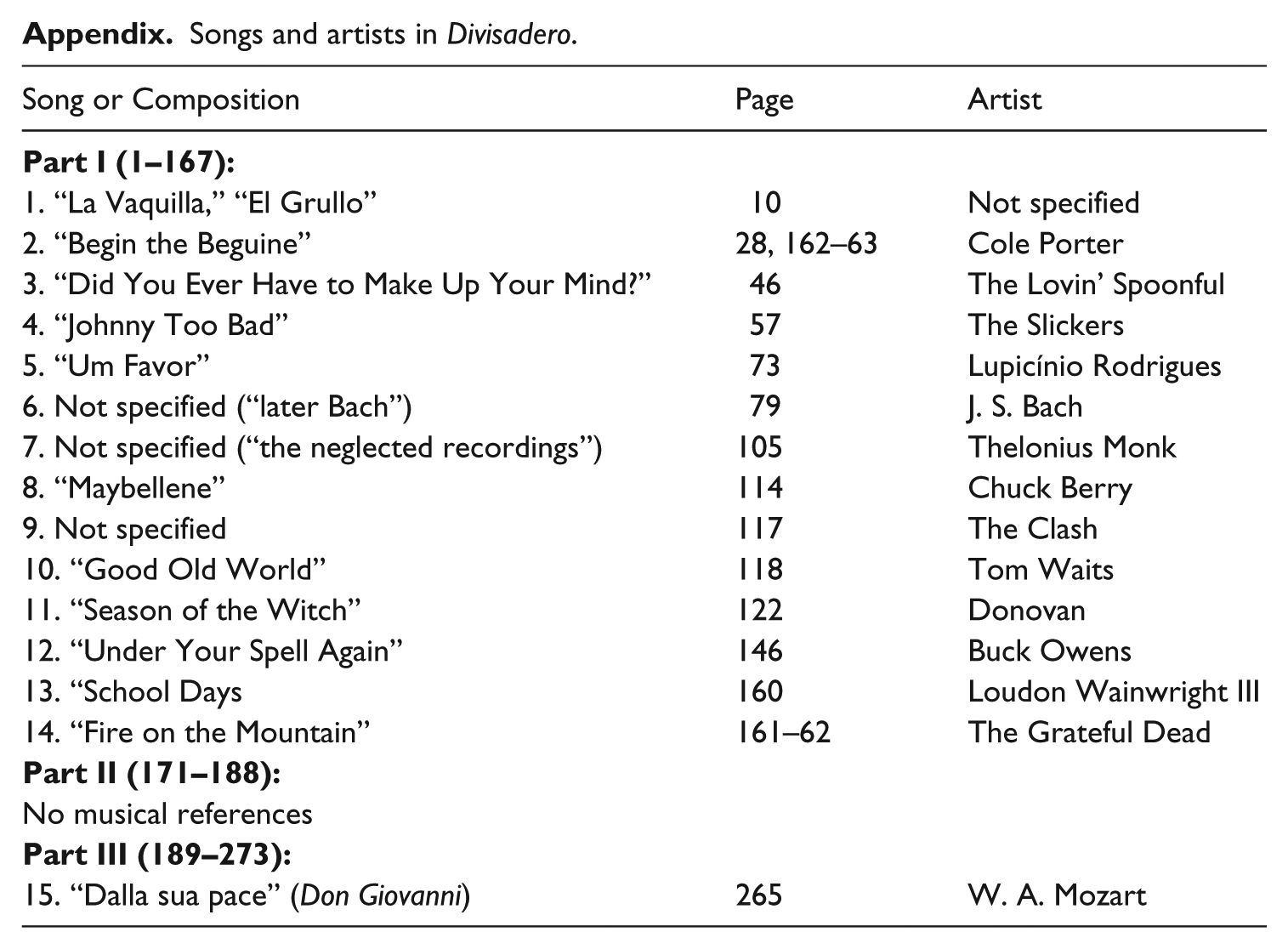
| Song or Composition | Page | Artist |
|---|---|---|
|
|
||
| 1. “La Vaquilla,” “El Grullo” | 10 | Not specified |
| 2. “Begin the Beguine” | 28, 162–63 | Cole Porter |
| 3. “Did You Ever Have to Make Up Your Mind?” | 46 | The Lovin’ Spoonful |
| 4. “Johnny Too Bad” | 57 | The Slickers |
| 5. “Um Favor” | 73 | Lupicínio Rodrigues |
| 6. Not specified (“later Bach”) | 79 | J. S. Bach |
| 7. Not specified (“the neglected recordings”) | 105 | Thelonius Monk |
| 8. “Maybellene” | 114 | Chuck Berry |
| 9. Not specified | 117 | The Clash |
| 10. “Good Old World” | 118 | Tom Waits |
| 11. “Season of the Witch” | 122 | Donovan |
| 12. “Under Your Spell Again” | 146 | Buck Owens |
| 13. “School Days | 160 | Loudon Wainwright III |
| 14. “Fire on the Mountain” | 161–62 | The Grateful Dead |
|
|
||
| No musical references | ||
|
|
||
| 15. “Dalla sua pace” (Don Giovanni) | 265 | W. A. Mozart |
Declaration of Conflicting Interests
The author(s) declared no potential conflicts of interest with respect to the research, authorship, and/or publication of this article.
Funding
The author(s) received no financial support for the research, authorship, and/or publication of this article.