




Abstract
This article examines some of the highlights, limitations, and contradictions of Rushdie’s authorial personas that have been perpetuated and challenged by his critics and the mass media. I argue that Joseph Anton, published in 2012, exhibits evidence of Rushdie’s attempt at authorial self-fashioning, and therefore the memoir represents an important part of his effort to shape the public narrative about him. Joseph Anton highlights Rushdie’s exilic persona through direct comparisons to figures like Voltaire and Galileo, and attempts to privilege this position above his other authorial selves. This authorial self has deep roots in a narrative fashioned by Rushdie that has been abetted by some of his critics and the media since the fatwa. My essay critiques this emphasis, suggesting that Rushdie’s self-fashioning is out of step with his twenty-first-century political ideals and affiliations. Ultimately, the third-person “distancing” of the memoir helps to highlight what it seeks to mitigate: a plurality of Rushdie’s competing for public attention.
The choices authors of memoirs and autobiographies make in their works often help to highlight particular aspects of their personalities or backgrounds. 1 Specific, calculated, if not sometimes unconscious mechanisms of self-representation, memoirs and autobiographies often play a key role in forming an author’s worldly persona, part and parcel of the vague outlines of her or his published and non-published work.
In order to unpack the persona of Salman Rushdie represented in the 2012 memoir Joseph Anton (which is focused mainly on the period of the fatwa and its aftermath), it is useful first to look at an Enlightenment precursor, namely Jean-Jacques Rousseau’s autobiography Confessions (1782). Rousseau writes: “I may have taken for fact what was no more than probability, but I have never put down as true what I know to be false” (1953/1782: 16). This statement is telling in its placement and assurance of the text’s truthfulness. Here we see one incarnation of a varied formula whose emphasis on truth has come to be assumed about autobiographies and memoirs alike, although scandals and recalibrations of textual interpretation have troubled if not upended the presumption of truth underlying these genres. In the Confessions, Rousseau goes on to outline his prolific reading as a boy of five and six, how he used to stay up all night with his father, and the fact that after he read through his entire mother’s library, he began on his father’s (1953/1782: 19−20). While I remain unsure about the veracity of this account, I want to highlight Rousseau’s deliberate decision to use this episode to open the Confessions. This event is meant to assure the reader of the author’s ethos, to establish the sturdy foundation of knowledge from which he draws, and allow the reader a glimpse of the brilliance of his mind. It is an important modern example of authorial self-fashioning, a tradition from which Rushdie draws considerable inspiration.
A number of texts by Rushdie’s contemporaries help to illustrate the various ways that authorial selves are fashioned. Edward Said’s memoir Out of Place (1999) spends a lot of time discussing Said’s childhood in Palestine, and therefore solidifying his rightful claim as a Palestinian intellectual. While the memoir eventually focuses on Said’s education in the United States, it remains rooted in the Middle East, and in particular his memories of Palestine, his lost homeland. Said uses the juxtaposition between East and West to signify his ambivalence about his own identity, and this motif becomes central to the memoir. The narrative ends before he begins his career as an academic, forcing his audience to focus on the lost origins and unstable sense of identity that shaped what Said fashioned as an exilic outlook. Orhan Pamuk’s (2005) Istanbul is a memoir that lovingly details the imagery of his majestic city. In it Pamuk often relegates his own story to the background so that the city — the true subject of the book — can shine forth. In addition to geography and place, authors will utilize stylistic devices from their fiction as signals of authorial identity in nonfiction writing. These markers make it clear that we are reading a text written by, for example, Gabriel García Márquez. Márquez’s dreamy autobiography Living to Tell the Tale opens with a scene in which the author claims not to recognize his mother. The effect of this opening is off-centring, a feeling not unlike the magical realism that crackles through his fiction.
In this essay I identify three distinct yet overlapping authorial narratives fashioned by Rushdie and his readers throughout his career. In the 1980s, Rushdie defined himself as a migrant intellectual located between the “two worlds” of East and West, as well as a critical intellectual and a leftist, antiracist activist. It was also during this time that Rushdie, with the help of quite a few literary critics, became firmly entrenched within the canon of postcolonial literature. After the fatwa and Rushdie’s “internal” exile in Britain he begins to forcefully situate himself among the Enlightenment figures such as Voltaire, Galileo, and Rousseau, among others, and to privilege speech as a central motif in his work. I will place particular emphasis on Rushdie’s attempts to link himself to Voltaire in this essay. Finally, since his relocation to the United States in 2000, Rushdie has tended to downplay the significance of politics in his fiction, while his nonfiction has both argued for the apolitical virtues of literature while also utilizing an increasingly strident form of Enlightenment rhetoric. His celebrity and wealth have led him to be portrayed in the media as a cosmopolitan playboy, moving away from but not necessarily disengaging with the earlier self-defining narratives of migrant figure and hunted exile. Any depiction of Rushdie is likely to use at least one of these narratives to frame his authorial persona. The reigning narrative tends to divide Rushdie into two figures, usually centred on either the fatwa or 9/11 as key historical turning points. For example, in The Atlantic, Isaac Chotiner writes of Rushdie’s memoir Joseph Anton, “By defining the fatwa as the hinge moment of his life, Rushdie offers readers the opportunity to examine his work through the same prism” (2012: 98). Chotiner echoes Rushdie’s authorial self-fashioning to confirm the story of two Rushdies; a pre-fatwa Rushdie and a post-fatwa one. While there is an element of truth in noting Rushdie’s shift from a writer who once employed “biting political satire” and then became “a New York socialite obsessed with name-dropping every celebrity he meets” (Chotiner, 2012: 98), this depiction too easily passes over other complexities, such as how he fashions himself as a Voltairian figure that speaks truth to power while echoing the talking points of US foreign policy.
I argue that Joseph Anton is an attempt by Rushdie to highlight his exilic Enlightenment persona as privileged above his other authorial “selves” and which works to challenge his mediatized image as a playboy. Rushdie’s memoir, like the work of the other authors I have just mentioned, attempts to fashion a narrative that emphasizes particular parts of the writer’s personality and life story while minimizing others. While he can be frank in the memoir about some of his struggles, such as his physical deterioration, feelings of hopelessness, and periods of writer’s block, I am most interested in how Rushdie negotiates authorial selves throughout Joseph Anton and how these representations can be contrasted against Rushdie’s prior authorial incarnations in order to call attention to the various, at times contradictory, ways that Rushdie is framed by his critics and the media.
Contemporary Rushdie criticism — and theories of authorship and audience more generally — has helped to clarify the ongoing struggle between authorial identity both within an author’s work and in dialogue with interpretative communities comprising readers and critics. In The World, the Text, and the Critic, Edward Said discusses three authors, Gerard Manley Hopkins, Oscar Wilde, and Joseph Conrad, and how they “deliberately conceive the text as supported by a discursive situation involving speaker and audience” (1983: 40). Said’s intervention establishes the author as an actor, an historical agent that sets a text’s energies in motion by bringing it into the world, after which control over the text’s various interpretations is usually vanquished. Before the fatwa Rushdie fashioned himself as a hybrid, migratory figure, notions that were repeated by a surprising number of critics and readers. Timothy Brennan notes in his combative book Wars of Position that early in Rushdie’s career, “the surprising unanimity of the public portrait of Rushdie as the displaced Indian of Muslim parentage, the renegade from color and country, is remarkable” (2006: 69). Of course, authorial self-fashioning is not merely the work of an autonomous author or a sympathetic set of readers and critics. Michael Bérubé’s Marginal Forces/Cultural Centers reminds us that the author is merely one component of the complex and ongoing process of canonical formation, and he argues that “canons are at once the location, the index, and the record of the struggle for cultural representation; like any other hegemonic formation, they must be continually reproduced anew and are continually contested” (1992: 4−5). Said’s and Bérubé’s work highlights the ongoing struggle between readers, writers, and critics, the continual need for authors to construct narratives of self, and the forces outside of the author’s control that either affirm the author’s constructions or create alternative authorial narratives against which the author struggles.
Joseph Anton delves into the untold events surrounding the fatwa that was issued on 14 February 1989. It is an intimate and at times frank portrait of life — and the constant threat of death — under round-the-clock security. In The World, the Text, and the Critic, Edward Said points out that every text has a style, a “recognizable, repeatable, preservable sign of an author who reckons with an audience” (1983: 33). As with García Márquez, Rushdie’s style in the memoir is true to his unique novelistic form. Joseph Anton offers a dense set of textual allusions and is told in a nonlinear manner: the beginning of the memoir jumps from the day he found out about the Iranian fatwa (Prologue), digresses to his life as a boy in Bombay (and later England — Chapter 1), and then returns to the events surrounding the conception and publication of the novel (Chapter 2).
The “Rushdie affair” made headlines around the world and caused him, in the words of his good friend Martin Amis, to “vanish into the front page” (1990: n.p.). In the memoir Rushdie gives us a glimpse of what it was like to live under the fatwa. Rushdie writes, for instance, of the process of “dry cleaning”, which he sometimes had to undergo when travelling to a new location:
Countersurveillance driving involved, in part, driving as weirdly as possible. On a motorway he was sometimes driven at wildly varying speeds, because, if anyone did the same thing, it meant they had a tail. Sometimes [the driver] Alex would get into an exit lane and drive very fast. Anyone following would not know if he was going to leave the motorway or not and would have to drive very fast behind them, thus revealing his presence. (Rushdie, 2012: 155)
2
Rushdie also recounts how what might be considered slightly abnormal events quickly become moments of dread. Typically he would call his first wife Clarissa and son Zafar at seven o’clock every evening. One day, having called repeatedly and received no response, he begins to panic. Rushdie’s live-in protectors notice his agitation, and he confirms a “break in routine” with them (159). A police car is summoned to drive by the house, and Rushdie told that “the front door is open and all the lights are on” (159). He writes, “he saw bodies sprawling on the stairs in the front hall. He saw the brightly lit rag-doll corpses of his son and his first wife drenched in blood” (159). Roughly another hour passes with no word on what is happening. It turns out that Zafar and Clarissa ended up staying later than anticipated at a school “drama performance”, and the police drove by the wrong house (160). This episode gives readers a glimpse of the daily terrors that plagued Rushdie, and it invokes their sympathy for his predicaments.
Despite the unique perspective and startling imagery of the memoir, it remains difficult to imagine the extent of the pressure exerted by the fatwa. Rushdie describes this as akin to “the Great Pyramid of Giza turned upside down with its apex resting on his neck” (147). This encourages empathy towards Rushdie when in 1990 he penned an essay entitled “Why I am A Muslim” in a desperate attempt to appease or silence his critics (284). In writing the essay Rushdie sought to create a new authorial persona, one he quickly abandoned. In 1991 Aamir Mufti remarked that the argument had some initial success, writing that “[Rushdie’s claims] were quickly processed by the media into evidence of his ‘conversion’ to the faith with whose proponents he had been engaged in such sustained and dramatic conflict” (1991: 95). The media’s complicity is a notable aspect of authorial self-fashioning, namely the ways in which it assists in echoing and validating the claims of a specific author, as seemingly contradictory as some of these positions may be. While Rushdie’s “conversion” can be understood as a failed attempt at authorial self-fashioning — a narrative that Joseph Anton attempts to mitigate — Rushdie decided to include “Why I am A Muslim” in the hardcover version of Imaginary Homelands (1991), even though he “hated the piece” and “was already rethinking everything he had done” (283). 3 It was removed from subsequent softcover editions.
Rushdie briefly touches on this moment in his memoir to establish it as a low point in his career, which sets the stage for renewed purpose and subsequent redemption. According to the memoir, it was around the time of his capitulation that Fay Weldon sent him a copy of On Liberty by John Stuart Mill. Rushdie states that the “clear, strong words were as inspiring to him as ever” and his “contempt” for his more hardline critics was “reborn” (284). Reflecting on this moment of realization, he states:
he needed, now, to be clear of what he was fighting for. Freedom of speech, freedom of the imagination, freedom from fear, and the beautiful, ancient art of which he was privileged to be a practitioner […] He had asked himself the question: As you are fighting a battle that may cost you your life, is the thing for which you are fighting worth losing your life for? And he had found it possible to answer: yes. He was prepared to die, if dying became necessary, for what Carmen Callil had called “a bloody book”. (285)
He adopts a heroic position here, asserting that after this moment he began “restoring himself to the ranks of the advocates of Liberty” (314).
Rushdie sees the Enlightenment as providing a political impetus that responds to the social injustices he critiques. For example, in Step Across This Line Rushdie evokes figures such as Voltaire and Denis Diderot to suggest that “writers of the European Enlightenment” utilized their skills and imaginations to change the course of history by challenging the power of the Church and the State (2002: 215). The Enlightenment can be roughly defined as a series of affiliations and myths — “abstracts” (Perchard, 2016: 466) such as free speech, secularism, and freedom of imagination — that, according to Alse Kleveland, are “personified” (qtd. in Perchard, 2016: 477) in figures like Voltaire and, in the example I cite above, later figures like John Stuart Mill. Therefore, when Voltaire is evoked alongside Rushdie we are not necessarily talking about literal, historical, or even ideological similarities, given the drastic differences that I will discuss later as existing between these two authors, but rather figures like Voltaire evoke a complex set of otherwise unspoken abstract concepts.
The appearance of particular motifs (freedom of speech, exile, the Enlightenment) and figures (Voltaire, Galileo) is not established by Joseph Anton alone. In fact, the memoir helps to reinforce and add legitimacy to allusions that have been established and maintained over many years of writing within the author’s published work as well as the contested terrain surrounding the authorial persona: the representational figures of Rushdie established by the media, critics, and the public. It will be useful to briefly sketch out these themes to see how they prefigure Joseph Anton.
After developing an authorial identity — aided and abetted by some postcolonial critics — as a left-wing, hybrid, migratory intellectual, Rushdie’s transition into an exilic figure was a relatively smooth one. Günter Grass commented during the third anniversary of the fatwa:
Salman Rushdie has often, and finally despairingly, called upon the tolerance of the Enlightenment. He will know what happened to the essays of our ancestor, Michel de Montaigne. He was placed on the index of the Catholic Church, condemned by Pascal and the Jansenists, celebrated by Voltaire and other men of Enlightenment. He was finally condemned by Rousseau, in the name of the law of nature and the generally accepted idea of virtue, whose tyranny turned into terror soon after the start of the French Revolution — a terror which (if you look closely) still governs. (1992: 4)
Writers like Grass sought to locate Rushdie among persecuted figures of the Enlightenment such as Michel de Montaigne, allying Rushdie with the secular critique of modernity, as well as with the West; note Grass’s use of the terms “our ancestor”, incorporating Rushdie into the European tradition. In turn Rushdie, who successfully oriented his earlier fiction and nonfiction prose as reflective of a “migrant” identity, fashions himself as an Enlightenment-style exile. Having established this leitmotif, Rushdie scatters similar figures into his narratives; figures with whom we might presume, he shares an ideological affiliation or shared mission. These ideas are also repeated by Rushdie’s contemporaries. James Fenton, commenting on Rushdie’s essay embracing Islam, writes that his private gasp in response, his “Oh”, hung around like a cloud and that “I thought I detected in the cloud the broken features of Galileo” (1991: n.p.).
Rushdie has therefore transformed his position from that of a “migrant intellectual” to a Voltairian (exilic) guise as part of his new authorial persona. As Todorov argues, “[in] the Enlightenment […] primacy is given to autonomy” (2009: 36). Rushdie’s authorial persona is not purely a construction; he is a writer who has been wrongly censored — and exiled — for writing fiction. I do not seek to minimize the suffering and injustice he went through. At the same time, the nature of Rushdie’s changing identity — including his alliances with Voltaire and, more broadly, the European Enlightenment — represents a curious change from a writer who was, only a few years earlier, critiquing the arrogance of Western imperialism and attempting to forge new political possibilities out of European and non-European modernities. Rushdie’s exile seems to have caused him to rethink his political and aesthetic orientations and somewhat abandon his position as a migrant writer “between worlds”. Joseph Anton gives us yet another possible explanation for his turn from leftist intellectual to purveyor of Enlightenment values. Rushdie notes in the memoir that at Cambridge not only did he study Indian history and “Muhammad, the Rise of Islam, and the Early Caliphate”, but also “the extraordinary first century or so of the history of the United States, 1776−1877, from the Declaration of Independence to the end of the post-Civil War period known as Reconstruction” (39). This study, while not as overt in its immediate relevance to Rushdie’s published work, is perhaps the most significant of the three in its contribution to his reliance on Enlightenment tropes — liberty, individualism, free speech, rights, secularism — that have deeply informed his political vocabulary and are intensified in his twenty-first-century self-fashioning rhetoric.
In Joseph Anton, Rushdie does not merely align himself with Western motifs and figures from the modern period. He also proudly notes that his last name comes from the “twelfth-century Spanish-Arab philosopher” Ibn Rushd (22). Rushdie states that his father Anis invented the family name (thereby suggesting self-fashioning is a critical part of his familial tradition) because it represented a figure “at the forefront of the rationalist argument against Islamic literalism in his time” (22−23). Further, Rushdie writes that
From beyond the grave his father had given him the flag under which he was ready to fight, the flag of Ibn Rushd, which stood for intellect, argument, analysis and progress, for the freedom of philosophy and learning from the shackles of theology, for human reason and against blind faith, submission, acceptance and stagnation. (23)
Note the affiliation of this figure with the other learned “men of the Enlightenment” we have briefly examined thus far. Here Rushdie is making an appeal to universalism of the idea of “modernity” before it was labelled as such, denoting an Eastern precursor to the theme of Enlightenment, which the West adopted for itself, but at the same time suggesting continuity between very different times, ideas, and parts of the world. It is also worth noting that this is one of the rare moments in the memoir at which Rushdie points to a non-Western figure as an inspiration for his thinking and intellectual orientation.
References to specific names play a critical role in authorial self-fashioning. Robert Eaglestone writes of Joseph Anton, “the book is about naming, about the control of names” (2013: 116). Eaglestone’s analysis connects this theme to the authorial desire for control: “[Joseph Anton] tries to encapsulate the whole history, trying (pace Rushdie’ [sic] speech to the Nobel committee members) to ‘control […] the story’” (2013: 120). 4 Eaglestone sees part of the desire to “set the record straight” as manifesting itself in the “settling [of] scores” (2013: 120). Joseph Anton exhibits an attempt to redefine and reintroduce to the reading public and critics the author-figure known as “Salman Rushdie” whose life and work is mythically connected to the Enlightenment in general and Voltaire in particular.
Rushdie settles on the somewhat tedious use of third person singular throughout his memoir in order to emphasize the split between selves, namely the pre- and post-fatwa, or what he calls the “po-fa”. Naming in the memoir plays a number of other roles, such as to emphasize the split between public and private selves, “the Salman his friends knew but the Rushdie who was the author of Satanic Verses” (5). “Rushdie detached itself from Salman and went spiraling off into the headlines, into newsprint, into the video-heavy ether, becoming a slogan, a rallying cry, a term of abuse, or anything else that other people wanted it to be”, he writes (164). This distinction between public and private, between the actual man and the myths surrounding him, is most aptly captured in the title of the work. Joseph Anton, Rushdie clarifies, is the term he chose for himself when the police needed a pseudonym. Conjoining Joseph Conrad — not by accident a figure renowned for his status as an émigré — and Anton Chekov, Rushdie utilizes the third person to talk about the life of this individual who was not allowed to live. The distance implied in the use of the third person singular throughout the text suggests a distance from this person from the perspective of the present, and yet it also suggests a self-fashioning narrative drive to emphasize this self over all others.
Rushdie writes: “the symbolic icon-Salman his supporters had constructed, an idealized Salman of Liberty who stood flawlessly and unwaveringly for the highest values, counteracted and might just in the end defeat the demon versions of himself constructed by his adversaries” (365). In this juxtaposition Rushdie self-consciously acknowledges the construction of a “self” that is emblematic of higher ideals, but he ascribes this construction not to his own efforts, but to that of his “supporters” — one might say, friends, critics, and sympathetic portrayals in the media — who helped create a romanticized vision of him. Rushdie has focused his energy, through his writing, on adopting this persona and making it a central part of his memoir, while at the same time avoiding admission of the role he himself has played in perpetuating this self-fashioning narrative.
The reproduced photograph (see Figure 1), first published in Rushdie’s remembrance of his recently deceased friend Christopher Hitchens in Vanity Fair magazine, offers proof that Rushdie’s self-fashioning as a modern Voltaire is continuous and ongoing. It is evidence of Rushdie’s (and the media’s) continued effort, aided in part by his critics, to connect the author with the “legacy” of the Enlightenment. In The Secularization of the European Mind in the Nineteenth Century, Owen Chadwick suggests that Voltaire, by virtue of his exile, came to represent a freethinking individual outside the purview of his society, one who called attention to and challenged the norms of his time (1975: 147−48).
5
Rushdie taps into this mythology, fashioning himself and his friend Hitchens as self-standing freethinkers, making critiques that hold power accountable. Borrowing content from a speech he gave to the United States Congress in 1992 in the wake of the fatwa, Rushdie writes in the conclusion of Joseph Anton’s prologue:
Voltaire had once said that it was a good idea for a writer to live near an international frontier so that, if he angered powerful men, he could skip across the border and be safe. Voltaire himself left France for England after he gave offense to an aristocrat, the Chevalier de Rohan, and remained in exile for seven years. But to live in a different country from one’s persecutor’s was no longer to be safe. Now there was extraterritorial action. In other words, they came after you. (16)
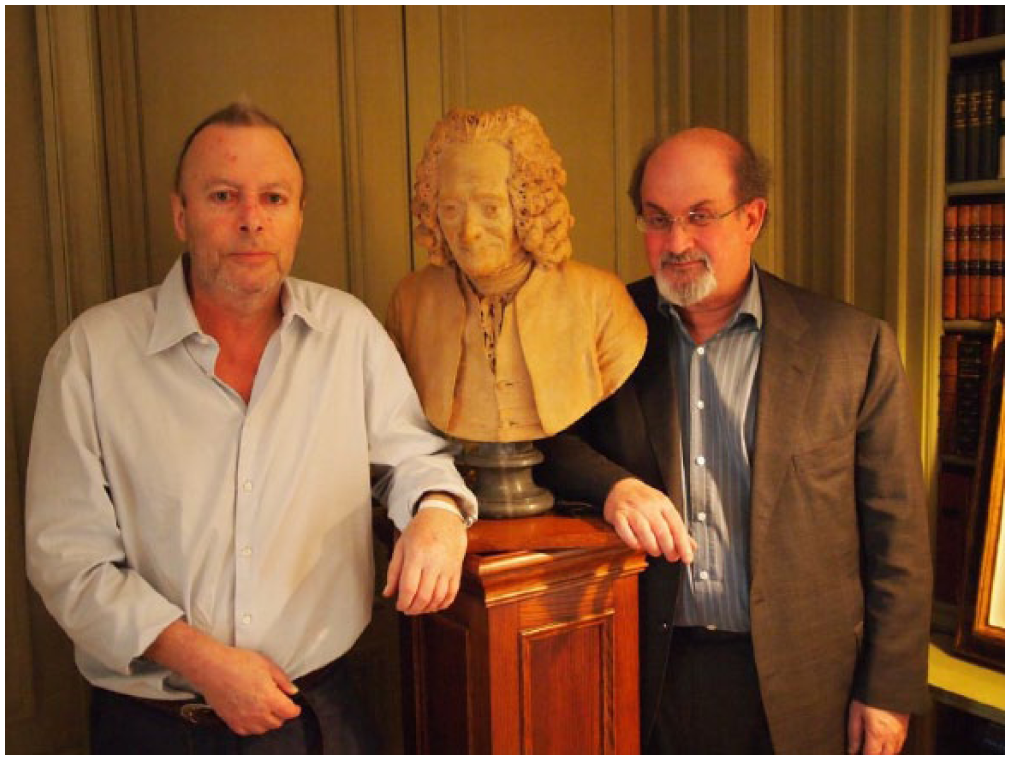
(From left) Christopher Hitchens, bust of Voltaire, Salman Rushdie. Taken 13 April 2011 in Houston, TX as part of Hitchens’ 62nd birthday celebration. Photo by Michael Zilkha.
Note that here Rushdie relies on the mythology of Voltaire to establish his position while at the same time situating himself as exceeding this connection. Rushdie seems to be trying to tell us that there is something more extreme, more dangerous, and perhaps even more heroic in the trials he underwent as a result of the fatwa than anything Voltaire experienced.
As I suggested in the opening pages of this essay, the author does not solely create his or her authorial persona. Edward Said makes this clear in The World, the Text, and the Critic:
The main thing is that a written text of the sort that we care about is originally the result of some immediate contact between author and medium. Thereafter it can be reproduced for the benefit of the world and according to conditions set by the world; however much the author demurs at the publicity he or she receives, once the text goes into more than one copy the author’s work is in the world and beyond authorial control. (1983: 33)
Concepts like “authorial self-fashioning” risk the removal of worldliness, and therefore the various interpretative communities in which the author’s work is made visible, interpreted, and therefore contested or reinforced.
In the following section I will examine three different kinds of criticism and how they serve to either validate and confirm, open new spaces within, or challenge authorial self-fashioning. As my analysis has already shown, the first of these examples usually involves an author continually hinting at or insisting upon a connection between herself or himself and another historical figure or idea. Eventually this notion is picked up by her or his critics, who repeat it among and within various interpretative communities. Paul Brians demonstrates complicity with the “Voltaire” narrative when he writes of Rushdie’s treatment of Islam in The Satanic Verses (1988), “[he] seems to have been trying to become the Muslim Voltaire” (2004: 3). Eventually, this story, hinted at through a series of related but perhaps not fully deliberate insinuations, becomes truth in Rushdie’s authorial narrative. Rushdie writes in Joseph Anton, “the writers of the French Enlightenment had deliberately used blasphemy as a weapon, refusing to accept the power of the church to set limiting points on thought” (177). It comes as no surprise then that on the back cover of Joseph Anton it is written, “‘Swift in Gulliver’s Travels, Voltaire in Candide, Sterne in Tristram Shandy … Salman Rushdie, it seems to me, is very much a latter-day member of their company’ — The New York Times Book Review” (Rushdie, 2012: n.p.).
Adam Perchard’s essay, “The Fatwa and the Philosophe: Rushdie, Voltaire, and Islam” (2016), elaborates comparisons between Rushdie and Voltaire that allow us new ways of thinking about the authors in dialogue with one another. Through a close reading of Voltaire’s Mahomet the Impostor alongside The Satanic Verses, Perchard’s article argues for a new affiliation between Rushdie and Voltaire, namely that both authors rely on Orientalist binaries of secularism/Islam and freedom/tyranny that reinforce West/East paradigms while they simultaneously attempt to explore transculturation between these imaginary dichotomies. The article is illustrative of a second type of criticism, one which works within previous parameters of authorial self-fashioning (in this case, Rushdie’s emphasis on his affiliation with Voltaire) to open up new avenues of thought. Most notable is the hint of a deeper affiliation between Montesquieu and Rushdie, deepening the sense of connection Rushdie has to the tradition of the Enlightenment. In his article, rather than focusing on the “freedom of speech” motif that typically links Voltaire and Rushdie, Perchard raises new questions about the nature of representation and the mobilization of the “Enlightenment” in Rushdie’s work, a term that is fraught with a litany of often unexamined rhetorical tropes and an assumed incompatibility between East and West. Perchard’s conclusion hints at the need for further reevaluation of Rushdie’s affiliations with Voltaire; “the more Rushdie has come to identify with — and as — Voltaire, the less like Voltaire he has become” (2016: 479).
The third and final kind of criticism about self-fashioning that I am interested in works to challenge carefully crafted authorial narratives of self, and therefore undermine authorial control. Within the various forms of criticism surrounding an author’s canon there is an important distinction between critics who reinforce specific authorial narratives and critics who open up new venues of thought about authors who were previously ignored, suppressed, or left unexplored. One such example of interpretation that is not aligned with Rushdie’s own narratives of authorial self-fashioning is Aijaz Ahmad’s In Theory (1992). This controversial book raised a number of questions about Rushdie’s work and self-fashioned authorial personas, placing extra emphasis on Rushdie’s position as a cosmopolitan and bourgeois figure in relation to his fiction and nonfiction. 6 Usurping the author’s desire for control, Ahmad’s criticism points out the tensions in Rushdie’s work between authorial identity, social status, and changing representations of the “migrant”. Ahmad concludes that “Rushdie’s work is not to be located neither in some unified and categorizable ‘Third World’, nor in some innocent myth of ‘migrancy’, as Rushdie himself would have it […] but in a condition which is in some ways older, wider, far more extreme” (1992: 158). Because critiques like Ahmad’s engender a rethinking of orientations and possibilities within Rushdie studies, it becomes clear as a matter of contrast that much of the literary criticism written about Rushdie has been the product of the very textual attitudes and assumptions perpetuated within a growing critical consensus about his authorial persona. While Ahmad’s critique may seem fairly obvious now, in the early 1990s In Theory made the issue of Rushdie’s “position” visible (class, privilege, status) and raised questions about authorial self-representation during that period. One such question that should still haunt Rushdie scholars today is how exactly an upper middle-class, cosmopolitan author like Rushdie was empowered to speak for the plight of poor migrants in England in the 1980s.
Following ongoing (but altogether sparse) critical interventions like Ahmad’s, we must continue to interrogate the limits of Rushdie’s self-fashioning, especially as a twenty-first-century Voltairian figure. Voltaire was an intellectual who, like Rushdie, was critical of the government and the church, and was a brilliant and prolific writer. By contrast, though, Voltaire was exiled largely as a result of a spat with the powerful Chevalier de Rohan-Chabot, and went into hiding as a consequence of a poem for an actress friend whose burial he protested. He had to leave Paris again later for inciting the government in Lettres philosophiques and one more time for a poem insulting the Bishop of Lucan (Ayer, 1986:10–16). Not unlike Rushdie’s work from the 1980s, Voltaire’s plays and writings regularly mocked religious and secular figures (Ayer, 1986: 8–27).
Rushdie mercilessly lambasted the “Emergency” rule of Indira Gandhi in Midnight’s Children (1980) and the oppressive rule of Pakistan’s General Muhammad Zia-ul-Haq and Zulfikar Ali Bhutto, who deposed him, in Shame (1983), and these moments recall vague parallels between Rushdie and Voltaire. But despite these somewhat fuzzy connections between the authors, the comparison quickly becomes strained. A reading of A. J. Ayer’s (1986) biography quickly gives one the sense that Voltaire spent an entire life on the run from various governmental and religious figures, in comparison to Rushdie, who seems to have had his fill of run-ins with high-level figures. And who can blame him? Yet Voltaire remained critical of the government, the bourgeoisie, and democracy as a political formation until the end of his life. As such, making a strong connection between Rushdie and Voltaire involves passing over significant differences in their political beliefs as well as their ongoing willingness to critique powerful figures.
What I am getting at here is the sense of decoupling from some of his political ideals that recurs in Rushdie’s twenty-first-century writing. He speaks less now for migrants and the disenfranchised, instead investigating the trappings of celebrity, money, and power. At times these new orientations spill over into his fiction. Solanka and Neela of 2001’s Fury are, like the protagonists of The Satanic Verses, upper-class. However, the former’s struggles do not truly bring them closer to bare life in the same way as Gibreel and Saladin, who inhabit the spaces of migrants as they roam streets aflame with the anger of the race riots in 1980s Britain. In other novels, such as Shalimar the Clown (2005), Rushdie’s characters, and the situations they find themselves in, are increasingly bourgeois and, at times, mundane. In Shalimar we are treated to the description of “the tall glass of Pellegrino” being thrown against the wall, and are relieved to find that the “glass missed” the “widescreen Lichtenstein portrait of her husband flying the Bugatti Racer” (Rushdie, 2005: 184). Rushdie’s aesthetic vision in his twenty-first-century work ultimately reflects its author: a wealthy, comfortable cosmopolitan.
In “Why Salman Rushdie Should Stick to Holding Obama to Account”, Pankaj Mishra’s (2013) critique helps to clarify the gap between Rushdie’s authorial self-fashioning as a Voltairian figure and, for example, his unwillingness to critique the Obama administration for its use of drones against human targets (including US citizens) around the world. Rushdie is also taken to task by Mishra for failing to offer condemnation of the indefinite detention of Bradley Manning. Rushdie’s excoriations are often lopsidedly pointed at the non-West, Mishra observes, such as his recent critique of Mo Yan as a “patsy” of the Chinese regime. 7 Mishra’s criticisms — and Rushdie’s responses — help to highlight an ongoing antagonism with the political left, which is especially apparent in Rushdie’s twenty-first-century nonfiction.
In November 2006, Rushdie did an interview with Frontpage Magazine, a conservative online magazine published by the David Horowitz Freedom Center, entitled “The Will To Win”. This interview is significant because it shows Rushdie’s affiliations with and comfort within conservative thought that exhibits simplistic views about Islam, a matter analysed in depth by Rachael Trousdale in this special issue. As critics such as Tabish Khair have pointed out, “Rushdie is isolated within a kind of discourse in the West that is radical only when it comes to the non-West” (2010: n.p.). In other words, Rushdie’s most recent political arguments mark him not as a liberal exilic figure, but speaking from the West, embedded in neoliberal Western discourse. In “Reading Rushdie after September 11, 2001”, Sabina and Simona Sawhney point out that Rushdie’s “new articles are surprisingly indistinguishable, in their tone and argument, from many main-stream media responses to the events of September 11” (2001: 433). How radically exilic can one be when one’s rhetoric is so closely aligned with the clichés of American mainstream media?
Rushdie’s new position was most shockingly articulated when he wrote in defence of the American Empire in an article entitled “February 2002: Anti-Americanism”. In this essay he combatively asserted, “America did, in Afghanistan, what had to be done, and did it well” (2002: 342). Rushdie’s claim in Joseph Anton that he has dedicated a “lifetime to anticolonialism”, juxtaposed against this statement, helps to make the contradictions of authorial self-fashioning abundantly clear (121). Elsewhere in the memoir, the limits of Rushdie’s affiliation with the radical Voltaire figure he constructs can be further questioned when, towards the end of his fatwa, he decides to “hold his tongue”, something he finds “difficult” to do (555). The instance in question deals with public critique of the Khordad Foundation, a group that has consistently offered a bounty for his death over many years. Rushdie realizes that as part of a longer strategy his acquiescence to the government’s demands for silence is strategically useful. He writes, “maybe this was a new phase: working with the government instead of against it” (556). This is the same Rushdie, we can recall, who admitted that he feels “on a personal level […] more kindly” toward the British government he once so vehemently critiqued (Rushdie, 2000: 140). No doubt the horrific experience of confinement and years of fearing for one’s life can alter the inner world of any human being. Yet at these moments we must also question the veracity of the Voltairian self-fashioning narrative of Joseph Anton that portrays the author as a mythical figure who stands in opposition to major institutions and formal power structures in defence of free speech and political dissent.
Joseph Anton can be read as an attempt to emphasize the centrality of Rushdie’s exilic authorial identity in contrast to the positions taken above, as well as his twenty-first-century image as a globetrotting playboy. Ever the focus of celebrity gossip, Rushdie’s literary status has taken on additional complexity with his interest in fame, fortune, and beautiful women. Ana Cristina Mendes examines this media image in her book Salman Rushdie in the Cultural Marketplace (2013), as well as in her essay “Salman Rushdie Superstar: The Making of Postcolonial Literary Stardom” (2010). In the essay, Mendes argues that Rushdie’s appearance in Scarlett Johansson’s music video “Falling Down” is but one example of his ambiguous status both as a “celebrity” and a major literary figure “canonized” in academia (2010: 225). He is at once a person with an “authorial status” and a “brand name” (Mendes, 2010: 225). Mendes argues that Rushdie has been able to maintain “skilful management (and self-creation) of these multiple associations” (2010: 225). Channelling Christopher Hitchens in Hitch-22 (2010), Rushdie drops a lot of names in the last third of Joseph Anton, fondly recalling his interactions with Nicolas Sarkozy, Bono, Renée Zellweger, Harold Pinter, Bill Clinton, and Faye Dunaway, among others. In his memoir, Rushdie spends a considerable amount of time suggesting that his former wife Padma Lakshmi is an egotistical airhead. Indeed, hers is one of the more ruthless portrayals of the book. These textual attitudes only confirm Andrew Anthony’s insight that “Rushdie’s relationships have since [the start of the twenty-first century] gained more attention than his books” (2012: n.p.).
At some point in Joseph Anton one starts to wonder which Rushdie is telling the story, given that his memoir is written entirely in the third person. Ultimately, the intention — if perhaps not the effect — of this style of writing is for Rushdie to present his twenty-first-century authorial persona (the one writing the book, as opposed to the “he” within it) as the beneficiary of experience, having gained some insight from a decade of horror. The consequence of this representation is a slightly modified version of Ahmad’s critique of Rushdie in In Theory; Rushdie’s self-fashioning promotes a seemingly excessive number of personae. In this plurality is a loss of authenticity, a sense that Rushdie is a kind of tabula rasa on which his readers — and critics — can inscribe their various beliefs about him. A generous reading of Rushdie’s memoir might view his various authorial selves as a parody of the multiple narratives woven around him, as the book moves from a moving description of the first days of the fatwa and a spirited defence of free speech to rather tedious name-dropping and needless bashing of various ex-wives. The uneven tone of the memoir suggests, more problematically, that Rushdie wants to have it both ways; he claims the mantle of the Voltairian intellectual who “speaks truth to power” but also demonstrates that he is very much enmeshed within and comfortable around circles of political power and celebrity. This ultimately undermines his claims as a critical, Voltairian figure and suggests that Rushdie’s memoir projects an authorial persona that is out of step with an exilic life lived against the hegemonic order.
In an early section of Joseph Anton, Rushdie describes a confrontation he had with Saul Bellow at the International PEN conference in 1986. Bellow was, at the time, extolling the power of American wealth even while lamenting its effect on American spirituality (77). Recalling the event, Rushdie writes that “he went to the microphone and asked Bellow why it was that so many American writers had avoided — or, actually, more provocatively, ‘abdicated’ — the task of taking on the subject of America’s immense power in the world. Bellow bridled. ‘We don’t have tasks’, he said majestically. ‘We have inspirations’” (76). One might imagine the mid-1980s incarnation of Rushdie asking his twenty-first-century self the same question. Would the latter’s response be similar? Rushdie’s politics and ideas about the “task” of the author as well as the purpose of literature have certainly transformed over the last three decades, even as his authorial self-presentation attempts to present these changes in a positive light. Ever the complex personality, Rushdie ultimately fails to live up to the image of himself he fashions — aided and contested by his critics and various media representations — as a Voltairian figure.
Footnotes
Declaration of Conflicting Interests
The author(s) declared no potential conflicts of interest with respect to the research, authorship, and/or publication of this article.
Funding
The author(s) received no financial support for the research, authorship, and/or publication of this article.