




Abstract
A huge volume of literature has been written about Rushdie’s novel The Satanic Verses and the fatwa issued in response to it by the Ayatollah Khomeini. Whilst much literary criticism has recommended that we should avoid reading the text and the furore of “the Rushdie affair” along the harmful binary lines of Eastern tyranny and Western freedom, this article addresses this rhetoric of cultural difference directly. Arguing that an unhistorical idea of the Enlightenment is becoming increasingly central to the way that Rushdie and others explain what they perceive as the gulf between “Islam” and “the West”, and analysing Rushdie’s recent tendency to construct himself as “the new Voltaire”, this study crosses centuries and disciplines to shed new light on the ways in which the discursive figure of the Islamic despot is central to the cultural critiques of both authors.
Keywords
With the advent of the fatwa declared against Salman Rushdie by the Ayatollah Khomeini, The Satanic Verses (1988/1998) ceased, for much of the world, to be a cultural artefact and became a cultural banner — a mustering point for both religious and secular fundamentalists. A few months after the declaration of the fatwa, Srinivas Aravamudan lamented that
[t]he multiple generic, discursive, literary, historical, and cultural protocols imbricated with this novel have been largely abandoned in favour of journalistic yet highly phantasmagorical simplifications, yielding the well-worn dichotomy of religious fanaticism battling secular free speech: (Western) democracy crusading against (Oriental) tyranny. (1989: 3)
With the liberal literary critic’s antipathy for both fundamentalism and careless reading, Aravamudan, along with many other members of the academy, has sought to direct readers away from reading the text in terms of this dichotomy which, if it was “well-worn” when he was writing, is now a gaping tear. Though the motives behind such attempts to deflect the reader from reading the text along East/West, Secular/Religious, Tyranny/Freedom binaries are understandable, however, the scale of the global intercultural phenomenon the novel inspired demands that part of our reading must follow the very lines of the debate the novel has provoked. As carefully as we examine the text, we must examine the cultural function of the text. As much as we deplore the destructive simplicity of the monoliths constructed on either side of the battle lines drawn during “the Rushdie affair”, we must attend to them: look at where they come from, what they are made of.
“In our beginnings we find our essences”, Rushdie tells us: “[t]o understand a religion, look at its earliest moments” (1991: 424). Just as Chamcha “makes himself whole by returning to his roots”, we must both “return […] to the actually existing book”, as Rushdie begs us to, and to the roots of the “struggle between Western freedoms and Eastern unfreedom” that he disavows in order to come to an understanding of the mass of intercultural currents of which The Satanic Verses is both the progeny and the progenitor (1991: 398; 395; 396). For by avoiding reading the novel in terms of such “unhelpful oppositions between fundamentalism and secularism” (Suleri, 1994: 222), commentators have frequently failed to address the essentializing myths about the ontologies of East and West that make up the “well-worn dichotomy” at the heart of the affair, dismissing them as the unworthy products of simplistic reading, rather than historio-cultural tropes demanding nuanced readings in themselves.
One of the central such essentializing myths for Rushdie and his commentators is that of “the Enlightenment”. For them, the term is half historiographical, half a moniker for a contemporary collection of abstracts at the heart of Western selfhood: the birthplace of, and metonym for, freedom of speech, freedom of imagination, and secularism. This problematic discourse makes both Secular West and Islamic East the product of a mythical Enlightenment. As an identity is created for the Secular West on the unsteady fictional foundations of a mingled ideological and historical myth of origin, the Islamic East is constructed in its turn as the historical and ideological Other of that self, forced to converse — or at least protest — across the rift of (imagined) history. And in protesting against the terms of this discursive manoeuvre, the Islamic East has frequently shored up the construction of an Enlightenment-determined West, positioning itself in terms of processes of cultural and historical Othering like Orientalism in such a way that discourses are re-inscribed as they are critiqued. Clement Hawes describes this in terms of a strategy for “constructing oneself, in the name of some tradition or fundamentalism, as the inverted mirror-image of the ‘West’” and goes on to argue that
[t]his familiar nativist gesture often forces anti-imperial opposition to repeat that historical fallacy which annexed science and rationality as the essence of an ahistorical “West”. Thus glib attacks on the Enlightenment, whether postmodernist or neo-traditionalist, often merely invert the values of Eurocentric historiography without challenging its fundamental premise. (1993: 164)
This gesture certainly marks texts like Ziauddin Sardar and Merryl Wyn Davies’ Distorted Imagination: Lessons from the Rushdie Affair (1990). The book identifies the death of God in the Age of Reason as the defining moment for both Western selfhood and the irrevocable divergence of the Islamic World from that self:
For Muslims, the context is provided by secularism, its history, and its rise as the dominant worldview […] Their actions are judged against the backdrop of a bloody conflict between organised religion and forces of reason and liberty that has nothing to do with their own history. […] Understanding secularism and its history is, therefore, the prerequisite for Muslims to make themselves understood; it is also the prerequisite for their survival as Muslims. (1990: 3)
Using the same emotive rhetoric of survival and extinction that we will see at play in Rushdie’s prose and that of many of his other commentators, Sardar and Davies consolidate the Enlightenment as the locus of destructive — even fatal — global cultural difference.
As I explore later in this article, this monolithic vision of Enlightenment becomes central to Rushdie’s increasingly Manichean view of relations between Secular West and Islamic East, and comes more and more to be collapsed into the figure of Voltaire. Rushdie’s powerful identification with the philosophe (thinker of the Continental Enlightenment) in his post-9/11 writing is bound up with the hardening of his notions of “Islam” and “the West”, and with the crystallization of the idea of the Enlightenment as both historical point of departure and ideological locus of difference between geo-political hemispheres. Reading Rushdie and Voltaire together, I suggest, reveals important parallels that go deeper than the banality of their (auto-)mythicization as freedom-of-speech-fighters. An examination of the instrumentalization of Islam and the idea of Islamic despotism in The Satanic Verses and Voltaire’s play Mahomet the Impostor (1736/1744) shows that both authors are participating in a more complex pattern of likening and Othering than may first appear. In re-evaluating both Rushdie’s relationship to the Enlightenment and the post-fatwa historiography of the Enlightenment produced by “the affair”, I argue for a postcolonial reading of eighteenth-century East−West engagements beyond binary discourses of Othering. Such a reading, I suggest, should fold the history of sympathetic representations of Islam which is emerging in the work of scholars of the eighteenth century such as Humberto Garcia, into the well-known postcolonial territory mapped out by Said’s Orientalism (1978/2003). It should also recognize Islam’s status as “something good to think with” (Lévi-Strauss, 1963: 89) in the eighteenth century and beyond: doing so reveals that, rather than an ossified set of binaries, relations between Islamic and European cultures have been a rich and wide-ranging dialogue. In this article I move between an analysis of the clouds of rhetoric surrounding the text, and a fresh look at the text itself; I mingle an account of the role of unhistorical evocations of the Enlightenment in the Rushdie affair with a return to the eighteenth century itself. In an inversion of Rushdie’s essentialist directive above, I will attempt to locate some of the “essences” of contemporary discourses of Western freedom and Eastern unfreedom, and then follow them back through history to find their beginnings. And in this pattern of returns, of cross-period reflexivity, I hope to aid in the destabilization of the binaries that continue, with such fatal consequences, to divide the globe.
A return to the “actually existing book”
The Satanic Verses is a novel about the power of narrative — about the power of fiction. The fictions we tell ourselves about who we are (Saladin’s professed Anglicization), the fictions we tell ourselves about other people (“Gibreel […] was as much the creature of his fancy, as much a fiction, as his invented-resented Allie, that classic drop-dead blonde or femme fatale”; Rushdie, 1988/1998: 429) 1 , and the fictions we tell ourselves about other cultures (the English “rereally like, caw corpses in bubloodbaths, mad barbers etc”; 343). Fairy-tale motifs, myths, and stock characters recur ceaselessly: woman after woman is configured and re-configured as siren, witch, femme fatale, crone, whore, and man after man oscillates between Iago and Othello, despot and prisoner, sage and fool, martyr and murderer. The effect is dizzying and disorienting, but we come to realize that selfhood in The Satanic Verses is always a question of multiplicity. Saladin’s epiphany, towards the end of the novel, is that the “idea of the self as being (ideally) homogeneous, non-hybrid, ‘pure’, — [is] an utterly fantastic notion” (427). The webs of narrative that spread out from the names of the characters, beyond culture, time and narrative, linking them inextricably to one another, are emblematic of the multiple selves “jostling and joggling” within the text’s individuals (519). “No wonder we invent remote-control channel-hopping devices” Saladin thinks, “If we turned these instruments upon ourselves we’d discover more channels than a cable or satellite mogul ever dreamed of” (519).
This is a text, however, in which multiplicity is in crisis: at every stage of the novel people are prevented from embracing the plurality of the worlds around them, and the selves within. As Saladin and the inhabitants of Brickhall rebel against the cruel, racist, totalizing monolith of Mrs Torture’s government, the people of Jahilia (“the state of ignorance before Muhammad’s recitation”), Rushdie’s fictional early-Islamic Mecca, have their stories shorn from them. Jahilia was once a place made of shifting sands, home to 360 gods, a bustling cosmopolis, full of merchants, “Jewish, Monophysite, Nabatean” buying and selling “linen from Egypt and silk from China; from Basra, arms and grain” (97), and pilgrims from across the world. When Mahound, the representative of “terrifying singularity”, of “monophilia” (106), starts preaching the message of his new religion, Submission (a more accurate translation of “Islam” is “Submission to the Will of God”), “one one one”, the Grandee thinks to himself “[a]mid such multiplicity, it sounds like a dangerous word” (103). Sure enough, in time the statues of the gods are smashed, and the city’s three goddesses, Al-Lat, Manat, and Uzza, are destroyed. The faithful of the city, having formally submitted, are subjected to
rules, rules, rules […] It was as if no aspect of human existence was to be left unregulated, free. The revelation — the recitation — told the faithful how much to eat, how deeply they should sleep, and which sexual positions had received divine sanction […] listed the permitted and forbidden subjects of conversation, and earmarked the parts of the body which could not be scratched no matter how unbearably they itched. (363−4; emphasis in original)
Islam — “Submission” — is tyranny, and Mahound is a despot, not content until he controls every last detail of the lives of the faithful.
“In our beginnings we find our essences. To understand a religion, look at its earliest moments” (Rushdie, 1991: 424). In its positioning of the early history of Islam as the text’s ur-despotism, The Satanic Verses has, for all its chaotic diversity, a “monophilic” discursive core. This is not a text that is trying to reclaim Islam from the demonization of the West, and “Mahound” is not a re-appropriation of a “name given in scorn” (93). More terrible by far than the corrupt, racist singularity of Torture’s Britain, the despotic figure of Islam systematically controls, deforms, stifles, and censors all in its path. Ayesha’s pilgrimage becomes a reign of terror — mirroring the coming of Mahound, she heaps rule upon rule onto her followers, leaving a trail of the faithful dead behind her. The novel’s two Islamic leaders other than Mahound, Ayesha-the-pilgrim and the terrifying figure of the Imam who defeats Ayesha-the-empress in a dream vision, are both swallowers of souls. Clouds of butterflies funnel into Ayesha’s mouth, they are seen “fluttering within the dark cavern of their death” and then she chews them up (219). Similarly, on his defeat of Ayesha-the-empress, “the Imam grow[s] monstrous, lying in the palace forecourt with his mouth yawning open at the gates; as the people march through the gates he swallows them whole” (214). Islam in The Satanic Verses is antithetical to the hybrid self — with its monophilia and tyrannical laws, it is the death of expression, of multiplicity. It crushes all beneath its monoglossic super-narrative, ripping Gibreel apart with its revelations until, at the climax of the book, unable to tell his own story any longer, he kills himself.
Mahound and Mahomet
Voltaire’s play Le Fanatism, ou Mahomet le Prophète (written in 1736 and first performed in 1741) has been considered alongside The Satanic Verses in commentaries on the Rushdie affair since a performance in Geneva in 1994 was shut down under the weight of Muslim protests.
2
Voltaire would later decry the way in which Montesquieu deliberately misread and deformed the travellers’ accounts of Islam and Islamic nations that were his primary archive in order to create a convenient vehicle for his deist ideas in Persian Letters (1764/1962: 503−4). However, in Mahomet, Voltaire is guilty of much the same crime. In a letter to the King of Prussia in 1742, he admits that he has transformed the historical figure of the prophet into a vessel for generalized “villainy” and “fanaticism”:
It may perhaps be objected to me, that, out of my too abundant zeal, I have made Mahomet in this tragedy guilty of a crime which in reality he was not capable of committing […] It was not my design merely to represent a real fact […] it was my intention to shew the horrid schemes which villainy can invent, and fanaticism put in practice. (1763: 13)
Voltaire was using the Islamic East as a zone in which to propound his rationalist views — and like both Montesquieu and Rushdie, Voltaire deliberately fictionalized and deformed Islam and its history in order to further his own aims. The similarities between Mahomet and the “Mahound” sequences of The Satanic Verses are remarkable, both in terms of the political furore surrounding their critical receptions, and in the way in which both texts configure Islam as despotism itself, as metonym for the despotism of religion in general, and metaphor for despotism at large.
In 1744, Voltaire’s controversial play was translated by John Miller into English as Mahomet the Impostor, and took the London stage by storm.
3
Banned after three performances in France, its excoriation of the despotism of Mahomet was considered both an attack on Louis XV, and — although dedicated to Cardinal Fleury — a vicious assault on the Catholic Church. Though there are a few token references to rumours of Christian doctrines of gentleness and tolerance in the text, the play raises reason, not God, as the antithesis of the murderous despotism of Mahomet and the corrupting webs of fanaticism in which he enmeshes his hopeless victims. The ban on Le Fanatism in France was lifted in 1745 when Pope Benedict XIV, at Voltaire’s personal request, agreed that the play could be dedicated to him. Voltaire’s letter to the Pope, written with more than half an eye to posterity, is an outrageous piece of satire:
Your holiness will pardon the liberty taken by one of the lowest of the faithful, though a zealous admirer of virtue, of submitting to the head of the true religion this performance, written in opposition to the founder of a false and barbarous sect. To whom cou’d I with any more propriety inscribe a satire on the cruelty and errors of a false prophet, than to the vicar and representative of a God of truth and mercy? (1763: 16)
The fact that the play had been banned in France was a great selling point in London: playbills appeared in many of the London papers announcing, beneath the title “Mr. Miller’s Mahomet the Impostor”,
N.B. Mons. VOLTAIRE’s Tragedy of MAHOMET, on which this is Founded, was Suppress’d at Paris, after the Second Representation, on account of the Free and Noble Sentiments, with regard to Bigotry and Enthusiasm, which shine through it; and which the French Nation found full as Applicable to itself, as to the Bloody Propagators of Mahomet’s Religion. (The Daily Gazetteer, 1744: n.p.)
These “free and noble sentiments” are neatly folded into British national identity by Miller’s prologue, in which Voltaire is figured as “Our Gallick Bard”, on a “Crusade” against “th’Enthusiast’s Rage” (Miller, 1736/1744: n.p.). “France was deaf — for all her Priests were sore”, but “On English Ground she makes a firmer Stand”, we are told, for “No Clergy here usurp the free-born Mind” (Miller, 1736/1744: n.p.). Indeed, it is striking how little attention is paid to the Islamic content of the play in the prologue. Beyond a reference to imposture in the fifth line — a reference which, but for the title of the play, would not have conjured up an especially vivid vision of Muhammad in the mind of the auditor — its anti-fanaticism rhetoric is entirely composed of Catholic European referents:
Hooded and train’d like Hawks th’Enthusiasts fly, And the Priest’s Victims in their Pounces die. Like Whelps born blind, by Mother-Church they’re bred, Nor wake to Sight, to know themselves misled. (Miller, 1736/1744: n.p.)
Like Montesquieu and Voltaire, Rushdie partially uses Islam and oriental despotism as a means of talking about the West. The Satanic Verses is superficially a tale of three cities: London, Bombay, and Jahilia — pre-Islamic Mecca — and yet, as Rushdie has said on many occasions, the three cities are one. The outlines of all three cities blur and shift in tides of myth and magic. Whereas Bombay and London are anchored in the “realities” of contemporary intercultural politics, Jahilia is the text’s ideological battleground — the locale for a fable of despotic singularity versus multiplicity which spirals out to inform and determine the conflicts of the two modern metropolises. The Submission of Jahilia at the hands of Mahound is a metonym for the deformation of hybrid identities at the hands of absolutist master-narratives like Thatcherism and Hindu fundamentalism that are becoming in London and Bombay. Yet it is also the literal account of the rise of the most powerful of these despotic narratives: Islam. Like both Montesquieu’s and Voltaire’s, Rushdie’s critiques of Western and Islamic despotisms are uneven. Both Voltaire and Rushdie locate their representations of Islam at the moment of Muhammad’s triumph over Mecca. Just as Rushdie makes much of pre-Submission Jahilia as a dynamic city of multiplicity in order to emphasize the desolating effect of Mahound’s despotism, Voltaire makes pre-Islamic Mecca a republic in order to intensify his portrayal of Mahomet’s tyranny. By making the birth of Islam the birth of despotism, both authors are deliberately making Islam inseparable from despotism: they are conjoined twins.
Le Fanatism opens with the Priam-like leader of the Meccan senate, Alcanor, raging against the imminent invasion of the city by Mahomet’s armies. From the outset, the despotism of Islam is figured in terms of its elision of the rights of the individual: Alcanor curses his fellow senators – “those Vipers, | Who, singled out by a Community | To guard their Rights, Shall […] sell ‘em to the Foe!” (1736/1744: 2). Rather than the shrill, solipsistic rhetoric of the Mullah in Montesquieu’s Persian Letters, however, this Islam is characterized by its horrifyingly adept command of language. When Mirvan, Mahomet’s general, takes the stage in the opening scene to parley with Alcanor, far from appearing the murderous traitor that Alcanor has led us to expect, he seems almost more reasonable than the distraught old man. His rhetoric, when he speaks of Mahomet, is that of republicanism, of meritocracy:
Mahomet’s Grandeur’s in himself; he shines not
With borrow’d Lustre… Born of himself, Himself’s the only Fountain Of all the flowing Honours that adorn him. (1736/1744: 9)
The auditor is left momentarily disorientated, even partially seduced by the notion of the self-made-man (beneath which is encrypted the fact of his false credentials as the hand of providence), but after this moment of seduction, Mirvan’s mask slips: “[e]mbrace our Faith then”, he exhorts Alcanor, “reign with Mahomet, | And, cloath’d in Terrors, make the Vulgar tremble” (1736/1744: 10). This is the same terror of the reason-suppressing seductiveness of absolutist rhetorics that haunts the pages of The Satanic Verses as the people of Jahilia have their individuality stripped away from them by Mahound’s despotic legislative master-narrative of “rules, rules, rules […] no aspect of human existence was to be left unregulated, free” (363), and the Khomeini-Imam and Ayesha-the-prophetess swallow their followers.
Alongside Rushdie’s account of the Submission of Jahilia, this is the aspect of the depiction of Islam in The Satanic Verses that places Islamic despotism beyond the analogy of any of the other avatars of despotism in the text. While what is represented as the white-supremacist rhetoric of Thatcherism has the power to transform immigrants into animals, it is only the master-narrative of Islam that has the power to unmake people. As the multitudes are lost inside the dark maws of Ayesha and the Imam, Gibreel is torn apart by the despotic monoglossia of Islam. His last, fragmented utterances before he kills himself, his narrative stripped away from him, are searing images of Islamic violence:
always vengeance why I can’t be sure something like this for the crime of being human especially female but not exclusively people must pay. (544)
Similarly, the final act of Mahomet sees the Prophet triumphing over both the destruction of Zaphna, the hero, and of the agency of the people of Mecca:
Go then, and thank your Pontiff and your Prince For each Day’s Sun he grants you to behold. Hence, to your temples and appease my Rage. (1736/1744: 68)
In both texts, we see the death of the individual at the hands of the despotism of the master-narrative, and in both texts this is intended as a parable for the destructive inhumanity of organized religion — although the ultimate face of this inhumanity is, for Voltaire, the Catholic Church. Ironically, both texts have deliberately deformed the history and teachings of Islam in order to promulgate a discourse of reason over the deforming effects of religious faith. And yet, whilst both Voltaire and Rushdie manipulate and vilify Islam in order to further their wider aims, their very use of Islam to talk about Western — or global human — frailties positions them at least partially outside of the binary structures of East−West Othering that crystallized towards the end of the eighteenth century. 4
It seems significant that the Enlightenment that Rushdie appeals to so frequently in the years after the publication of The Satanic Verses and the declaration of the fatwa is so firmly centred around the philosophes. It is possible that this is the product of his study of history at Cambridge in the late 1960s, a time when influential works by Norman Hampson and Peter Gay propounded a historiography of Enlightenment centred on the conflict between thinkers like Diderot, Rousseau — and of course Voltaire — and the Monarchy and Church. 5 Had more recent work, inclined to pluralize Enlightenment and think in terms of cultural dialogues between European and Islamic worlds, taken place in the late 1960s, it is possible that a very different fable of Enlightenment might have been woven into the saga of the fatwa: a fable far more akin to Rushdie’s early celebration of “mongrelisation” than to the essentialist West-and-Rest discourse that has come to mark his recent writings.
Islams and Enlightenments
When Shabbir Akhtar, in his anti-Satanic Verses polemic Be Careful with Muhammad!, wrote, “[a] man who brought a book that directly inspired a major world civilisation is here portrayed as an insincere imposter with purely political ambitions” (1989: 5), he could have been describing any number of works on Islam from the seventeenth, eighteenth, or nineteenth centuries. “Muhammad” in The Satanic Verses, Akhtar claims,
is an unscrupulous politician — “a smart bastard” in Rushdie’s phrase — whose enemies, particularly ideological ones, are victims of a ruthless anger discrepant with his official professions of mercy. (1989: 5)
As he points out, much of this catalogue is consonant with what he terms “the unoriginal biases of traditional Christian polemic” (1989: 27), and yet the representation of Islam as despotic, hypocritical, and misogynist has often functioned, as we have seen, as a means of interrogating flaws in European societies. Building on recent work by scholars such as Aravamudan (1999; 2005; 2012), Ziad Elmarsafy (2009), and Humberto Garcia (2012), my research excavates a largely forgotten history of sympathetic cultural engagement between Islamic and European worlds in the eighteenth century. This history shows that, far from a fatal point of departure between Islam and West, the Enlightenment was in some ways a powerful moment of transculturation.
Turn back to the eighteenth-century beginnings of the “well-worn” dichotomy of Oriental despotism and Western liberty, and it becomes apparent that beside and behind the destructive, simplistic Othering process that many have identified in this discourse, lies an axis of rhetorical likening. The Islamic East was, for Montesquieu, Voltaire, and many other eighteenth-century thinkers, a place in which to explore anxieties about Europe, and tales of the despotism of Islam and Islamic rulers a means of critiquing the arbitrary power of Church and crown at home. Alongside this runs a strong stream of British Protestant thought that celebrates Muhammad as a wise legislator, the phenomenon of “Islamic Republicanism” that I am unable to explore within the scope of this article, but is brilliantly argued for in Humberto Garcia’s recent study Islam and the English Enlightenment: 1670–1840 (2012). The crucial point for Garcia and others is that the representation of Islam — Islams, whether representative of despotism or republicanism — had a dialectical function in the eighteenth century. The Islamic East, whether eroticized, demonized, idolized, or merely narrativized, was first and foremost a locale in and with which to think.
Asserting, with Garcia, “the imaginary opposition between Islam and Enlightenment” (2012: 223), here I move away from English engagements with Islam to begin to reconsider those of Rushdie’s Enlightenment: the Enlightenment of the French philosophes. As Montesquieu charts Europe and its frailties through “Islamic” eyes in Persian Letters (1721/2008), as we saw Voltaire map the rise of Christian fanaticism onto the cityscape of early Islamic Mecca, we see the landscapes (both physical and cultural) of Europe and the Islamic East overlap, producing a turbulent cultural “in-between space” in which these authors explore disturbing cultural Likeness whilst participating in discourses of cultural Otherness. And it is this same uneasy discursive double-vision that is central to Rushdie’s mobilization of Islamic despotism in The Satanic Verses.
The spectre of despotism
Long before Montesquieu codified despotism in The Spirit of Laws (1748/1900) as one of the “three species of government: republican, monarchical, and despotic” (Book 2, 8), ideas of despotism — most frequently Islamic despotism — had been used by political theorists, theologians, and propagandists to propound and illustrate an extraordinarily diverse range of social, religious, cultural, and political standpoints. The historiography of despotism has often concentrated on the notion of an eighteenth-century “insight that Western Europe was not only geographically but also politically and culturally different from the Orient, and that the political liberty and restraints on the exercise of power in the West starkly contrasted with the restrictions on personal and political liberty in the Orient” (Curtis, 2009: 8). This rhetoric of difference is certainly a common feature of European writing on the East, from the pre-modern period to the present — and is consonant with the process of negative self-definition that I outlined above. As Saree Makdisi and Felicity Nussbaum write,
For all the variety […] what mattered to the development of Orientalism was not, for example, whether there was one orient or many, or even whether the otherness of the Oriental was celebrated and valourized […] or scornfully condemned […] What mattered, rather, was the sense of otherness itself, and the creation and maintenance of a sense of radical difference between West and East(s). (2008: 6)
“Saidian” Orientalist readings of European cultural production about the East in the seventeenth and eighteenth centuries as fundamentally hegemonic, and often as proto-imperialist are understandably common in the contemporary academy: there is still much work to be done on teasing out the strands of racist, Islamophobic, and Western-supremacist thought that were woven together across the centuries to become the rhetoric of the nineteenth- and twentieth-century phenomenon of high Western imperialism. Some such scholarship, however, can be slightly blinkered by the presupposition of hegemonic motives amongst Europeans writing of the East. Beside, and bound up with, the axis of Othering that Makdisi and Nussbaum rightly identify as the heart of Orientalism, there is a discursive mechanism that we could term “likening” that operates in European writing on the Islamic East during the long eighteenth century — the very mechanism we have seen at play in The Satanic Verses.
Reciprocal knowledge between the Ottoman Empire and the countries of Western Europe grew over the course of the seventeenth century, through a combination of trade, conflict, captivity, diplomacy, travel and increased linguistic, theological, cultural, and historical research. Concurrently, the figures of the Turk, Islam, Muhammad, and the Qur’an became increasingly common referents, mobilized by both sides of schisms in the Church and the state. Whilst accusations of Islamicism and despotism were used to vilify opponents — “Cromwell or Charles I is like Muhammad”, “Louis XIV is a despot”, “the Catholic or Protestant Church is like Islam” — rather than a straightforward process of Othering, this was a form of opprobrious rhetorical likening. By the early eighteenth century, Islam was an essential part of the vocabulary that Europe used to talk and think about itself, and thinkers such as Montesquieu and Voltaire were quite prepared to make generalizations and mobilize myths about Islam that they knew were untrue in order to propound their ideas.
“The noun despotism”, as Grosrichard points out, “entered the [French] language fairly late. The first dictionary to refer to it is Trévoux’s, in 1721. The dictionary of the Académie Française included it in its 1740 edition, defining it as ‘absolute authority, absolute power’” (1998: 4). Until Robert Clive seized power in Bengal, other than the immediacy of the threat from “Barbary corsairs”, much of Britain’s contact with the East was filtered through France (Ballaster, 2005: 7). Alongside the accounts of travellers like Chardin and Tavernier and the literary productions of Marana and Galland, French theorizations of Eastern “realities” also crossed the Channel to take root in the British imagination — and none more firmly than the idea of oriental despotism. Although it was Montesquieu’s The Spirit of Laws that “gave the term its theoretical accreditation as the name for a form of government, illustrating the concept with the governments of Asia” (Grosrichard, 1998: 4), in 1748, notions of despotic Eastern rule had been circulating through France and Britain for much of the previous century. 6 The conception of despotism as a specifically Eastern, predominantly Islamic, form of tyranny, however, only truly coalesced at the turn of the century, partly via Galland in the form of Shahriyar from the Nights and partly due to the accounts of the travellers Chardin, Tournefort, and Rycaut. 7 By the time Montesquieu writes in Persian Letters that “[t]he king of France […] has frequently been heard to remark that of all the governments in the world, that of the Turks, or that of our august sultan, would suit him best, so high is his opinion of the oriental political system” (1721/2008: 47), there can have been no doubt in the mind of the reader that he was referring to a specifically oriental — indeed, Islamic — despotism.
Through the eyes of the Persian travellers Usbek and Rica, Europe is both strange and familiar. Just as narratives of Britons kept captive by the Ottomans, like that of Joseph Pitts, call mosques “churches” and imams “priests” (1704/2003: 255), the Persians call monks and priests “dervishes”. This exchanging of names recalls a process Homi Bhabha describes when writing on the “misnaming” of Islam in The Satanic Verses, “Mohamed referred to as Mahound; the prostitutes named after the wives of the Prophet”:
It is the formal complaint of the fundamentalists that the transposition of these names into profane spaces — brothels or magical realist novels — is not simply sacrilegious, but destructive of the very cement of community. To violate the system of naming is to make contingent and indeterminate what Alisdair Macintyre, in his essay on “Tradition and translation”, has described as “naming for: the institutions of naming as the expression and embodiment of the shared standpoint of the community, its traditions of belief and enquiry”. (1994: 321–2; emphasis in original)
The contingency and indeterminacy of religious naming in Persian Letters deliberately manoeuvres “shared standpoints” of European and Persian communities into the same space: priest and imam overlap, either jarring the reader with the sense of their difference or surprising her/him with their likeness. Montesquieu takes the pattern of opprobrious rhetorical likening that characterized the deployment of Islam in seventeenth-century discourses, and turns it back on itself so that the critique works in both directions; questions are asked about both faiths.
Montesquieu, like Voltaire, had a rationalist agenda not incompatible with Rushdie’s. In Persian Letters, Christianity and Islam are revealed to be equally conflicted and full of hypocrisy, and the contingency and indeterminacy of religious naming becomes a metonym for the similitude of the failings of both faiths. Cloaked in the frivolity of (oriental) fiction, in Persian Letters Montesquieu is able to attack the foundations of both Christianity and Islam in almost equal measure. This is an important “almost”, however — though both religions are portrayed as fundamentally absurd, their frailties are of very different natures. Christianity’s frailty is that it has become “less a subject of sanctification than a subject of disputation in which anybody may participate” (1721/2008: 102). By contrast, Islam — whether through (one-sided) philosophical exchanges between Usbek and the Mullah, or through the insidious irony of repeated exclamations such as “[b]lessed ignorance of the children of Muhammad!” (1721/2008: 141) — is characterized as backward, fossilized, and — crucially — anti-disputatious. In other words, while Christianity suffers from a surfeit of intellectual inquiry and debate, Islam suffers from the lack of it. To put it bluntly, the seeds of the monoglossic Islam versus heteroglossic multitude that Rushdie writes in The Satanic Verses, with Mahound’s “monophilia”, his leitmotif of “one one one”, have been sown (106). The “delightfully disputatious” (1991: 435) Islam that he (defensively) celebrates in his post-fatwa essays and in the figures of characters like Muhammad Sufyan is civilizational rather than religious. To subvert the title of Zeeny Vakil’s book, the message seems very much to be “The Only Good Muslim is a Secular …” (52).
The disparity between Montesquieu’s critiques of Islam and Christianity in Persian Letters increases in his hugely influential The Spirit of Laws, published 27 years later. In this text, his deist attacks on the social consequences of organized religion are filtered almost exclusively through the lens of Islam. Spirit, though it specifically names non-Muslim states like China and Japan as despotic, repeatedly figures Islam as the crutch of despotism. If the essence of despotism is fear, then Islam is the codification of fear. In despotic states, Montesquieu tells us, “religion has more influence than anywhere else; it is fear added to fear. In Mahommedan countries, it is partly from their religion that the people derive the surprising veneration that they have for their prince” (1748/1900: 59). Islam as the embodiment of what Grosrichard termed “the Absolute One … the instrument of an always deadly uniformity” (1998: 3) had come into its full strength: a potent yet mobile ideological figure which would be used again and again in a range of discourses by subsequent generations.
The battle for the Enlightenment
Less than a month after the proclamation of the fatwa against Salman Rushdie on Valentine’s Day 1989, The New York Times published responses from “28 distinguished writers born in 21 countries” (1989: n.p.). Among them was a message from Octavio Paz: “We are seeing a disappearance of the modern values that came with the Enlightenment. These people who condemn you are living before the Enlightenment. We are facing a historical contradiction in our century” (The New York Times, 1989: n.p.). In “One Thousand Days in a Balloon”, published in 1991, Rushdie himself writes “[o]ne day they [Muslims] may agree that — as the European Enlightenment demonstrated — freedom of thought is precisely freedom from religious control, freedom from accusations of blasphemy” (1991: 432). These invocations of the Enlightenment and its thinkers are some of the first utterances in a dialogue between the Rushdie affair and the eighteenth century that continues to gather strength to this day on both sides of the Secular West/Islamic East battle lines, appearing with renewed force in Joseph Anton (2012c) and the spate of press articles that surrounded its launch.
8
Claes Kastholm, in his essay “The Crime of Silence”, declares:
A straight line runs from the 18th century vision of the free enlightened human being to the finest flower of western culture, the United Nations Declaration of Human Rights, adopted on 10th December 1948. Article 19 of the Declaration states: “Everyone has the right to freedom of opinion and expression; this right includes freedom to hold opinions without interference and to seek, receive and impart information and ideas through any media and regardless of frontiers”. (1995: 121)
“The Crime of Silence” is one of a collection of essays published by the Nordic Council in defence of Rushdie and his Scandinavian publishers, and this “straight line” of thought runs through all of them, “clearly and solidly formulated by Voltaire”, as Kastholm says: “I do not agree with what you say, but I will defend your right to say it to the death” (1995: 121). “Democratic relativism”, Alse Kleveland tells us in the same collection, “means that we allow those with differing views the same rights as we allow ourselves. That we defend the rights of others to say something with which we disagree, to paraphrase Voltaire’s classic maxim” (1995: 69; emphasis in original). Voltaire “is the very personification of the Enlightenment”, and “it is Western Enlightenment itself that is threatened by ethnic nationalism and the fundamentalist exercise of religion” (1995: 63).
Although Kleveland quotes from the opening of the entry on tolerance from Voltaire’s Dictionnaire Philosophique (1764/1962), it is this “classic maxim” of his — the one she paraphrases and Kastholm quotes — that forms the heart of this story of Western Enlightenment, and thus Western democracy, and thus Western selfhood. 9 I do not agree with what you say, but I will defend your right to say it to the death. And yet Voltaire never said it. Surely one of the most widespread of apocryphal quotations, it in fact stems from a misreading of a 1906 biography, The Friends of Voltaire, written by S. G. Tallentyre (Evelyn Beatrice Hall), in which she coins the phrase as a loose, first-person summary of the writer’s attitude towards Helvétius (see Knowles, 2006: 55).
The apocryphal nature of this central tenet renders it all the more appropriate as emblem of the discourse of Enlightenment-as-freedom-of-speech-as-West that continues to shape and be shaped by the Rushdie affair. Rushdie himself is embracing this unhistorical, destructive historiography ever more forcefully. Indeed, he has moved from drawing parallels between his own struggles against censorship and those of eighteenth-century thinkers, to construing the conflict of the Rushdie affair as a continuation of the same battle. In an interview with The Irish Times, he said:
I just felt this is much bigger than me: it’s a fight that’s been going on for hundreds of years. And, oddly, many people, including me, thought it was over — that this battle against religion for free expression was something that the Enlightenment finished 200 years ago. Then here I am in another episode of this fight. And I thought, I’m not going to be the one who caves in, because it matters too much. (Rushdie, 2012b, n.p.)
Not only is he fighting the same battle as the Enlightenment philosophes, but he is increasingly coming to identify — and invent — himself as the present-day avatar of the figure at the heart of this short-hand Enlightenment: Voltaire himself.
“The two Voltaires”
In his 2012 obituary of Christopher Hitchens for Vanity Fair, Rushdie writes with emotion of the way in which the furore of the fatwa drew the two men together. “I have often been asked”, he says, “if Christopher defended me because he was my close friend. The truth is that he became my close friend because he wanted to defend me” (Rushdie, 2012a: 1). As Hitchens “leapt unbidden into the fray” (Rushdie, 2012a: 1), attacking John le Carré for his criticism of Rushdie, he became deeply embroiled in the “affair”, outstripping other supportive voices from the ranks of the intelligentsia to become, so the rhetoric goes, almost a twin voice for the embattled author:
He and I found ourselves describing our ideas, without conferring, in almost identical terms. I began to understand that while I had not chosen the battle it was at least the right battle, because in it everything that I loved and valued (literature, freedom, irreverence, freedom, irreligion, freedom) was ranged against everything I detested (fanaticism, violence, bigotry, humorlessness, philistinism, and the new offense culture of the age). Then I read Christopher using exactly the same everything-he-loved-versus-everything-he-hated trope, and felt … understood. (Rushdie, 2012a: 1)
Though clearly a heartfelt testimony of grief for a much-loved friend, this obituary also functions as a reiteration of Rushdie’s fatwa-story as newly “standardised” by Joseph Anton (2012c), which was by this point approaching the final stages of publication. It is preceded, at least in the archived online version, by a photographic portrait of Hitchens taken by Gasper Tringale and, inset at an intimate, family-photo-album angle, the image of Hitchens and Rushdie posing with a bust of Voltaire reproduced below (Figure 1). Though separated from Rushdie’s account of their oneness in their response to the fatwa by an account of — and excuse for — Hitchens’s flirtation with the George W. Bush administration, the image of the two friends on either side of Voltaire returns to conclude the piece:
On his 62nd birthday […] we had been photographed standing on either side of a bust of Voltaire. That photograph is now one of my most treasured possessions: me and the two Voltaires, one of stone and one still very much alive. Now they are both gone, and one can only try to believe, as the philosopher Pangloss insisted to Candide in the elder Voltaire’s masterpiece, that everything is for the best “in this best of all possible worlds”. It doesn’t feel like that today. (Rushdie, 2012a: 2)
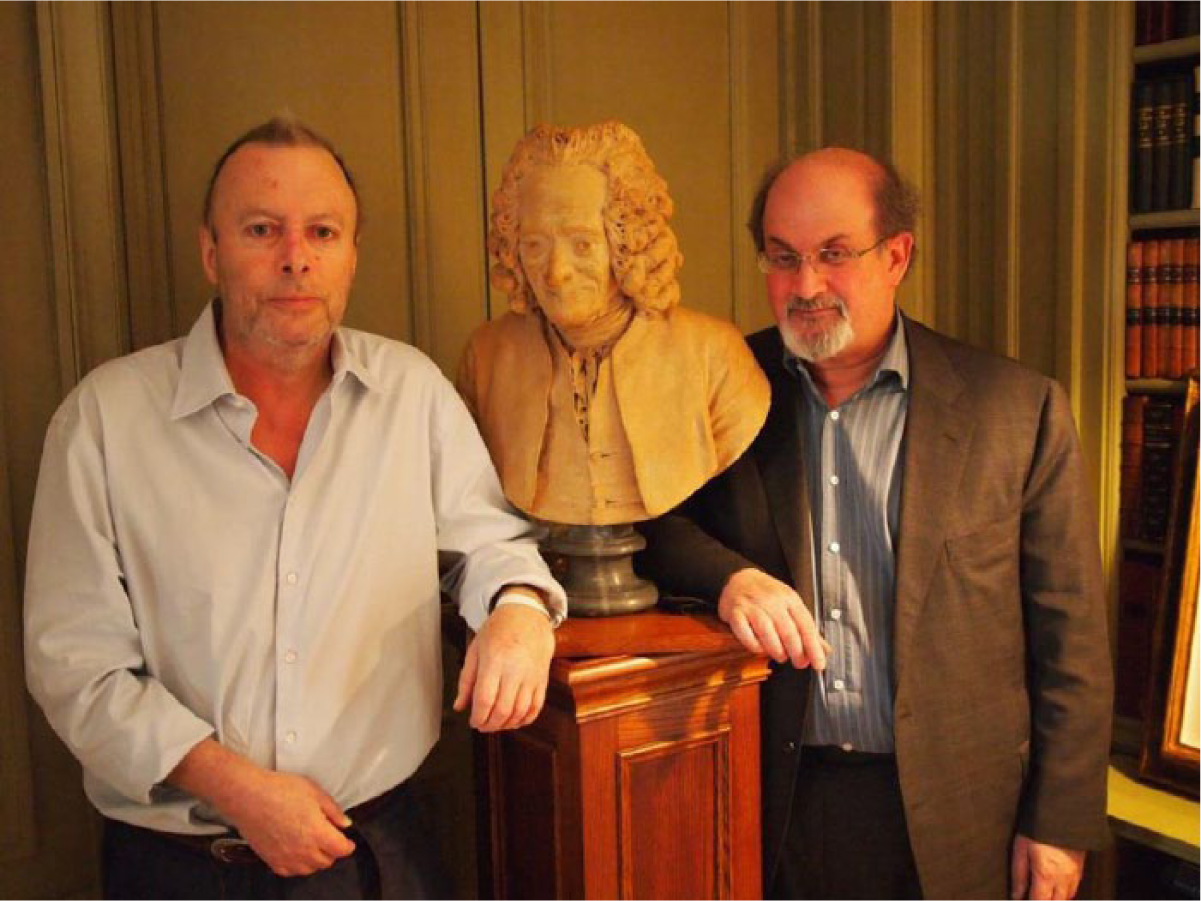
“[M]e and the two Voltaires”: Christopher Hitchens and Salman Rushdie with a bust of Voltaire, 13 April 2011. Image by Michael Zilkha. Available at: http://salmanrushdiearchive.com/tag/enlightenment/; caption quotation, Salman Rushdie (2012a: 2).
Complex patterns of self-positioning are clearly visible here, in both text and image. In a piece that centres so pointedly on the intellectual and ideological similitude — to the point of identicality — of Rushdie’s and Hitchens’ stance in the well-rehearsed clash of “literature, freedom, irreverence, freedom, irreligion, freedom” with “fanaticism, violence, bigotry, humorlessness, philistinism, and the new offense culture of the age” (2012a: 1), the characterization of Hitchens as Voltaire becomes an implicit but powerful self-portrait. Rushdie’s physical stance in the photograph underlines this (tacit) statement of kinship with the philosophe. Where Hitchens faces the camera squarely, his face ambivalent, Rushdie assumes precisely the same three-quarter view angle as the bust — his right shoulder tucked firmly behind Voltaire — his lips quirked in an exact replica of the sculpture’s, his expression knowing. Even the description “one of stone and one still very much alive” (2012a: 2), coming as it does at the end of a eulogy, sets up an uncanny layering of (self-) representation, with the dead–living figures of Rushdie, Hitchens, and Voltaire overlapping and shimmering in and out of one another. The final, rather puzzling, invocation of Pangloss’s relentlessly satirized idealist refrain from Candide ends the piece on a yet more unsettling note. It is a (presumably) satirical reference to a satirical leitmotif, queasily replicating Voltaire’s satirical manoeuvre by parenthetically demanding us to imagine what the sceptical Hitchens would have made of it, to infer what Rushdie himself thinks of it, and to position ourselves as readers in relation to it. Unsettling it may be, but it acts as a final blurring of the boundaries between the three thinkers: a knowing trinity, conjoined in a prism of humorous rationalism.
Conclusion
The irony which haunts this act of self-fashioning is that the more Rushdie has come to identify with — and as — Voltaire, the less like Voltaire he has become. The marked proximity between the two authors that I charted in my reading of Mahomet and The Satanic Verses — the complex patterns of opprobrious likening between Islamic and “Western” despotisms — have given way to a much less subtle axis of approval and opprobrium in Rushdie’s writing. In a 1992 speech to the International Conference on Freedom of Expression in Washington DC, Rushdie asserted that
blasphemy and heresy, far from being the greatest evils, are the methods by which human thought has made its most vital advances. The writers of the European Enlightenment, who all came up against the stormtroopers at one time or another, knew this. (2002: 232−3)
In this rhetoric of philosophes versus stormtroopers lies the seeds of a flirtation with the Hitchensian discourse of Islamofascism that comes increasingly to mark his view of the West’s relationship with the Islamic East. The everything-he-loves versus everything-he-hates binary that he so celebrates and identifies with in Hitchens is a marked change from the multivalent engagement with Islam that characterizes Rushdie’s early writings and the writings of Voltaire and his contemporaries. Indeed, look back at the photograph of “the three Voltaires” above in the light of the eighteenth century’s dialectical engagements with Islam, and the Voltaire in the middle of the trio seems almost embarrassed by his companions.
Footnotes
Acknowledgements
I would like to thank Dr Jim Watt, a constant source of knowledge and support, for the guidance he offered me over the course of the writing of this article. Professor Harriet Guest, Dr Claire Chambers, and Professor Ziad Elmarsafy have also offered valuable commentary on earlier drafts of this piece, for which I am lastingly grateful.
Funding
This article has emerged from some of the research I undertook whilst studying for a PhD that was generously funded by the Arts and Humanities Research Council.